
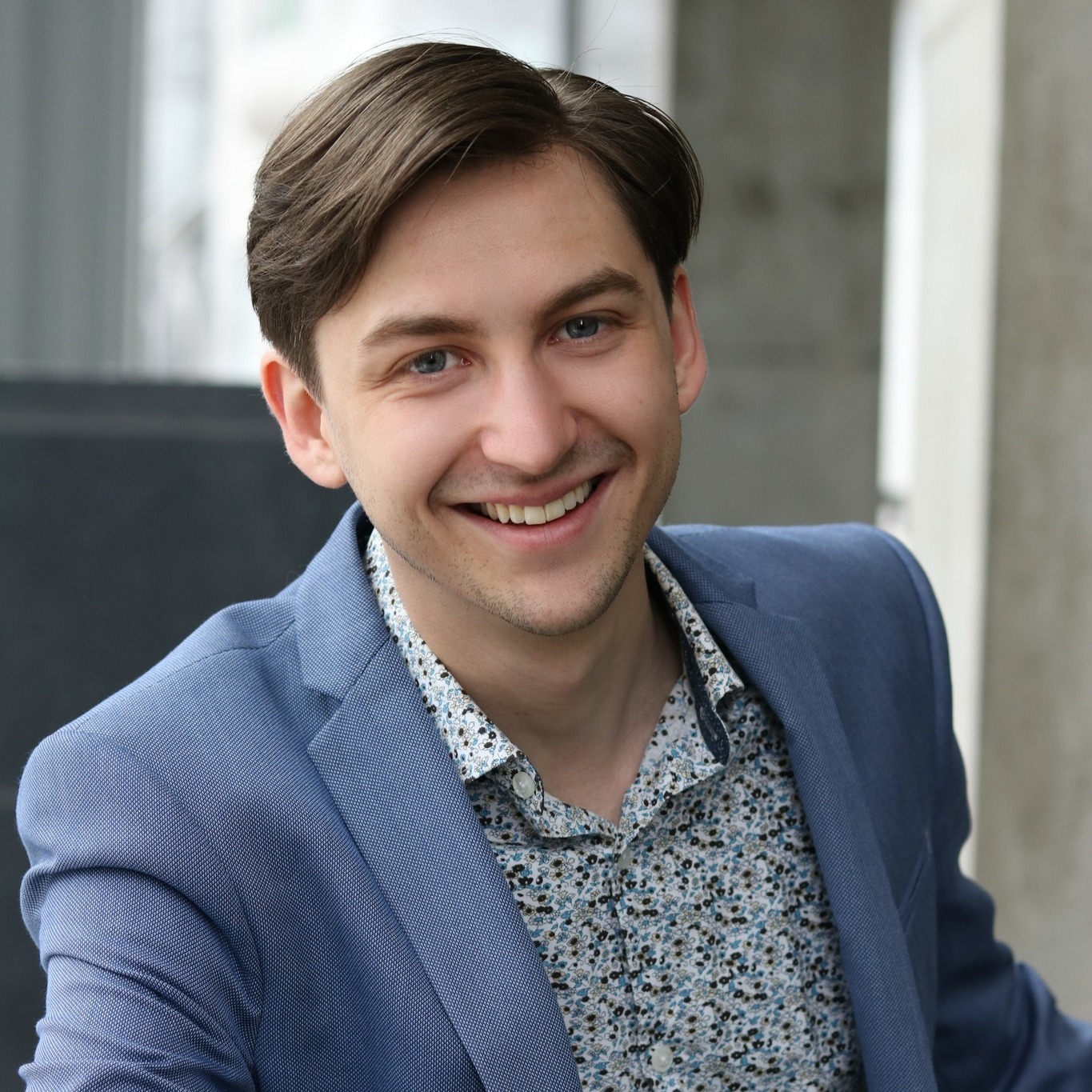
I first encountered Alexander Cappellazzo in the title role of L’Amant anonyme by Joseph Bologne for Voicebox- Opera in Concert back in March of this year, when he sang
“a passage in the first scene that contains an obscene number of high notes, that he executed bravely and accurately, managing to keep things light and comical rather than scary, as they would have been for those of us who can’t sing that high“.
So yes I was obviously impressed. But he’s much more than just a tenor soloist.
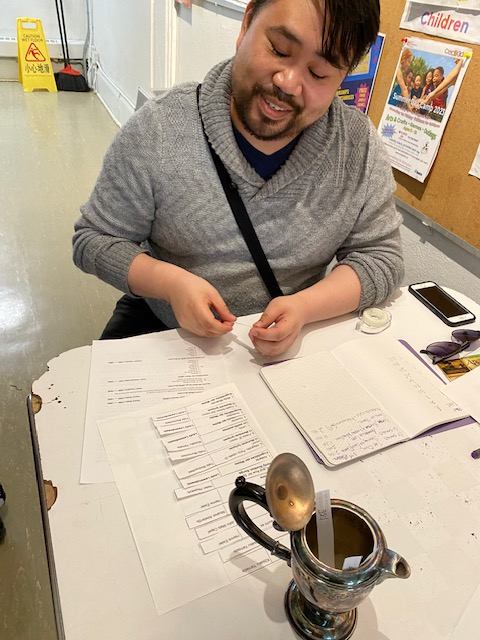
Alex isn’t just a singer but also the founder of Apocryphonia and the Diapente Renaissance Vocal Quintet, two Toronto-based groups dedicated to showcasing underperformed repertoire. In May I saw a very original concert from Apocryphonia, employing a highly original approach, where each audience member participated in a random process to assemble the order of pieces on the program, as you can see in this photo.
Wacky? but also very illuminating. We had a new way of seeing the music and concerts.
Apocryphonia are back Sept 30- Oct 1. with their first concert this fall. I was curious about both of Alex’s ensembles, so I determined to follow up with some questions.
Barczablog: Are you more like your father or your mother?
Alexander Cappellazzo: With how I grew up there ended up being many more influences on my character than just my mother and father.
I lived with my grandmother, and we did a lot of stuff together: I have fond memories for instance of going to Rouge Park to look at the swans with her, or going to the Pacific Mall to pick up almond buns and drinking sugarcane juice. She had a huge influence on my upbringing, and imparted to me a sort of moral awareness and sense of justice I think still guides me. My father has a sense of curiosity and a willingness to discover new things that I admire. My mother is one of the kindest people I know, everywhere she goes she is well loved; I try to be like her in that respect. One of my aunts used to have season tickets to the TSO and I would go with her to see the orchestra growing up, and I would see Mirvish production musicals with my mother; so I was exposed to a decent amount of live music and performance growing up too!
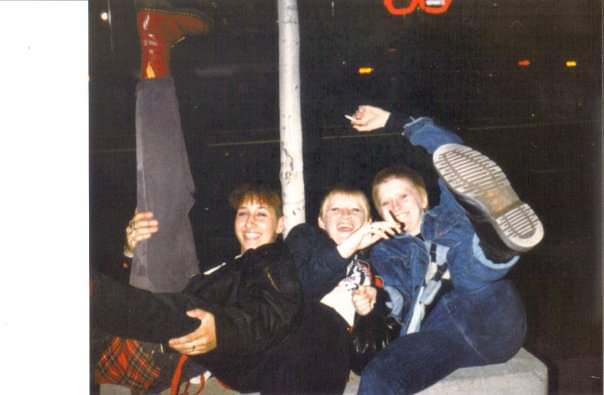
My mother, uncle, and my father were in the Toronto punk scene back in the 80’s, and my step-father was part of the Montreal scene. Besides my uncle, you wouldn’t know it if you saw them now that they were part of the scene, but there are some documentaries and books where there’s video or images of them. Hearing stories about the local and worldwide punk scene growing up certainly shaped my perspective towards production. At the last Apocryphonia concert a friend of mine came up to me and said “I’ve heard of DIY Punk, but this is the first DIY Classical concert I’ve seen.”, and that is one of the greatest compliments towards making art I’ve received.
Barczablog: What is the best or worst thing about what you do?
Alexander Cappellazzo: Simply put, the best thing is that I get to make music! What a joy it is to sing, and even more so when it brings you and others pleasure, inspiration, or whatever motivation it does at that time. I know it’s a simple answer, but this has to be at the core of it all or else why do this sort of work? You gotta love it.
Producing concerts is on equal footing with performing in them in terms of enjoyment; it offers so much freedom and creativity. There’s so much repertoire out there that I love, music I’ve heard that I want to share with others; that I never know if it’ll get any airtime. I don’t have to wait around for someone else to decide to do it. I trust that someone out there is going to like the music I like, and will want to see it.
As for the worst thing, I have to be calculated while writing this; I don’t want to end up writing a rabid polemic on the state of the industry, or come across as whiny or ungrateful! There’s a funny part in Ilf and Petrov’s book The Twelve Chairs – a book that was almost a Shostakovich operetta, but sadly he passed before it was finished; an absolute tragedy… – where a small town event takes an entire day because every speaker ends up making the same rant about the ‘international political situation’; sometimes I fear I can get like that if I don’t rein myself in, or write draft outlines of what I’ll say.
One such struggle for me is the extroversion required for social media and promotion. Social media culture isn’t for me; I don’t think we need to know everything about everyone at all times, and there’s this pressure to be omnipresent on those platforms. On top of that, I run an ad blocker online because I hate the feeling of people trying to sell me something.
The sort of self-commodification that comes with performing and producing isn’t something I totally mesh with. I’ve had to think of that sort of stuff differently in order to not feel gross doing it. It is necessary though, because it’s quite egotistical to think that you can just hole up, do nothing, say nothing, and people will come to you.
Barczablog: Who do you like to listen to or watch?
Alexander Cappellazzo: My wife and I watch a lot of films. We have a subscription to the Criterion Channel, which for 10$ a month we have access to a whole bunch of great movies from around the world, plus commentaries and interviews. Since January we’ve watched around 68+ films, usually around dinner. Some recent stand-out films we saw include ‘High and Low’ by Akira Kurosawa and its commentary, the black-and-white edit of ‘Johnny Mnemonic’ with Keanu Reeves, and Roger Corman’s Edgar Allen Poe movies starring Vincent Price (he’s so cool!).
I’m also a fan of giallo films, especially their soundtracks. Those 1970s Italian genre films have this amazing sense of style that isn’t afraid of being absolutely absurd at times. In the winter, I have a pair of leather gloves I call my ‘giallo gloves’, and pretend my eyes are a camera and grab various walls, fences and doorknobs mysteriously for fun. It amuses me. I want to produce a giallo-themed show one day, that’s one of my dreams.
We also watch video essays on Youtube and Nebula. There’s a lot of really interesting, smart and entertaining people making videos on so many subjects out there! Some of my favourites include Jacob Geller, J. J. McCullough, Philosophy Tube, Religion for Breakfast, and City Beautiful.
As for listening, I highly, HIGHLY recommend the Youtube channel, My Analog Journal. DJ Zag Erlat runs that channel, and he or his guests play vinyl sets of different genres from all over the world. During the lockdown I’d listen to him livestream tri-weekly music sets; I discovered a lot of great music that way. I also watch/listen to classical music score videos on Youtube, which is how I find a lot of new rep.
A few of my all time favourite groups/musicians include: Peter Gabriel-era Genesis, Kraftwerk, 50 Cent, the Igor Nazaruk Quartet, Milton Nascimento, Gesaffelstein, and The Weeknd.
Barczablog: What ability or skill do you wish you had, that you don’t have?
Alexander Cappellazzo: At this point I truly wish I took math class more seriously. I have a great appreciation for Pure Mathematics as well as programming/coding, but I haven’t really committed the more advanced mathematical concepts to memory. I’m really thankful that calculators and ChatGPT are able to help me offset my lack of math/programming expertise, especially regarding Google Sheets! Long, long ago I wanted to become a chemist, mostly because I wanted to learn how to transmute elements into gold, but my mind always drifted when it came to formulae, so I picked something else to want to be.
Barczablog: When you’re just relaxing and not working, what is your favourite thing to do?
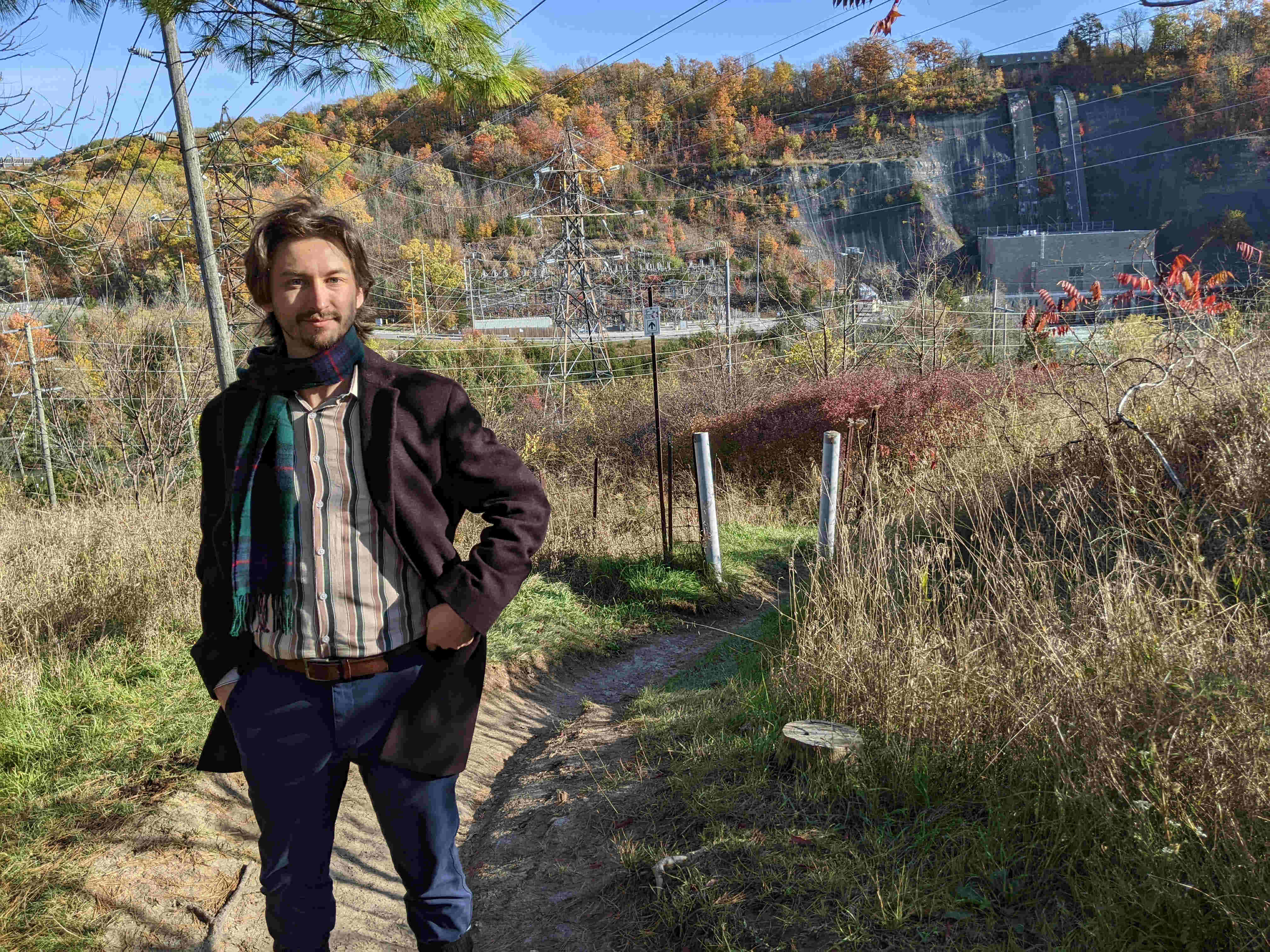
Alexander Cappellazzo: My wife and I try to make good use of our weekends by going on trail hikes and 25km-or-so walks around the city. Where I am in Scarborough I’m close to Highland Creek/Cedarbrae Park, which is one of the best parks in Toronto. The salmon spawn there every fall, we’ve got at least 10 or more very-friendly deer (don’t approach them however!), and it connects to the Waterfront Trail along Lake Ontario. We’ve been doing bits and pieces of the Bruce Trail too; Short Hills Provincial Park in St. Catharines is so far my favourite of it, and on the other side of the Niagara Falls border there’s the Schoellkopf Power Station trail that goes through the ruins of an old hydroelectric plant. I love seeing ruined buildings or signs of previous structures during nature walks, it’s an interesting combination.
At home, my medium of choice is torn between film and video games. I’ve already spoken about the films I love, so I’ll go on to the latter subject. I enjoy classic 6th and 7th generation games like the original Silent Hill Trilogy, Hideo Kojima’s Metal Gear Solid, Suda 51’s Killer7, the Fallout Series and Miyazaki’s Dark Souls games. Less substance narrative-wise, but still a favourite of mine currently is Isonzo, a WW1-themed shooter set in the Italian Front. It’s got a wonderful attention to historical detail in its maps and outfits, and a Puccini-esque inspired soundtrack. The last game I played worth talking about was called Paradise Killer, a sort of cosmic horror, vaporwave, dystopian murder mystery; a very unique premise!
I always tend to wait a while before buying new games. Last year I promised myself I’d buy Elden Ring after I finished writing my grant proposals, but I have yet to purchase it…
Barczablog: What was your first experience of music ?
Alexander Cappellazzo: I will tell three stories relating three first experiences; I’m like a one-person Rashomon over here.
1 – I can’t pinpoint the specific year, but I do know the first piece of classical music that inspired me to become a fan. I used to play trumpet in elementary school band class, and as I was practicing pieces in the book I became enamoured with a specific melody: Tchaikovsky’s ‘Slavonic March’. I half-remember going to HMV with my mother or grandmother and trying to find it on CD. That one piece and that melody is what sparked my love for orchestral music. I eventually branched out towards Prokofiev, Rameau, Purcell, and Beethoven; the last two by way of Wendy Carlos’ amazing soundtrack to ‘A Clockwork Orange’
(Fun Fact: I was apparently named after Alex Delarge!).
2 – When I was very, very young, I used to dance a lot to Oasis’ album, ‘What’s the Story Morning Glory’. I seemed to gravitate to Britpop/neo-mod bands and the Beatles – especially the Beatles. Sadly I couldn’t ride a Vespa at that time.
1960s/70s Progressive Rock bands like Genesis, Emerson Lake and Palmer, and King Crimson really were part of my early musical awakening. The songs told stories, they had different timbres and movements, some songs were over 20 minutes long! It could be beautiful, it could be angular and harsh; it knew how to move you.
3 – My grandmother was a soprano in the church choir, and every Sunday we’d drive over together and I’d sit in my pew and try to figure out how hymns worked. I used to talk with the organist a lot too after services. I loved the sound of the organ, how it filled a space and all the colours it made. I did eventually join the choir with my grandma; she had a quiet speaking voice, but one of the loudest singing voices. We used to listen to a cassette tape of Les Miserables in the car, which was her favourite musical.
If you understand the above three tales, you understand everything about what I like about music.
Barczablog: Who is your favorite composer?
Alexander Cappellazzo: I cannot name just one, that is impossible.
Here is the definitive Cappellazzo tier list of classical composers:
S Tier:
Charles Ives, Alberto Ginastera, Ralph Vaughan Williams,
These three are the cornerstones of my musical personality.
Barczablog: as you can hear in this example
A+ Tier:
Leo Ornstein, Olivier Messiaen, Alfred Schnittke, Samuel Coleridge-Taylor
No matter what, I’ll always come back to these guys.
A Tier:
Henry Purcell, Arno Babajanian, Michel Lambert, Murad Kazhlaev, J. S. Bach
All of them are very great composers, with specific pieces that move me considerably.
Barczablog: Another example
Barczablog: I dream of the day that opera is as Canadian as our theatre or our ballet, where you see companies run by Canadians and mostly performed by Canadians. Can you imagine Canadian opera companies performed with Canadian personnel?
Alexander Cappellazzo: Short Answer: Yes.
Long Answer:
The talent exists, we can see that easily enough by how many amazing Canadian musicians and creative-types we have here and abroad. In my opinion the challenges regarding opera in Canada are much different than opera in Europe or the US. It is a very large country, and many of our cities are not that large in comparison. I wish to see many things happen in the Canadian Opera field, but some of the more urgent ideas is the need to create, support and invest in smaller to mid-sized opera companies, especially ones outside of major urban centres. What is needed is a wider base of the pyramid so to speak.
We have quality, but now we need quantity. This serves two purposes that would aid Canada’s arts sector: paying arts workers; thus retaining talent, and creating more opportunities to grow new audiences; thus growing demand.
I am optimistic about this, the field feels like it is more unified than before. It’s a start and I hope it yields some great results.
Barczablog: How did you get the idea for Apocryphonia? please explain the concept.
Alexander Cappellazzo: Apocryphonia is something that has taken almost a decade to become a reality, and the catalyst can be traced to my fleeting mortality and inherent curiosity.
I’ve always gravitated to non-canon/non-standard repertoire since I started listening to classical music, and I always loved exploring new things rather than sticking with what was already in front of me. I would spend hours at McGill in the library looking for interesting new repertoire to program for recitals; I still do. Both my singing teacher and my vocal coach saw my curiosity, encouraged it, and suggested that I pursue it post-graduation.
I remember during my undergrad reading a professional singer’s bio saying they performed the same role over 300 times or so; that depressed me quite a lot. I didn’t want that future, but it felt unavoidable with how classical music/opera is programmed.
I began to realize that I had two choices: wait around for someone else to program the music I like to perform/hear, or do it myself and trust that others would be interested too. I was really frightened during the lockdown years, and realized how fleeting life is. Any fear of starting something new and unfamiliar was superseded by the fear of passing away before I ever started.
I always wanted to form my own company but I didn’t know how to start. I bit the bullet by writing a grant for a Ralph Vaughan Williams concert for his 150th Anniversary; at that time the only event for RVW150 scheduled in Canada. How could someone like Vaughan Williams, who is not unpopular by any standards, be this underprogrammed? How could there be so much great music out there and yet it hardly sees the light of day?
Surely there must be a conspiracy…
The idea of secretive, hidden music, kept out of reach by concert halls and opera houses, floated in my head until on a neighbourhood walk the word ‘apocrypha’ came to mind.
Apocrypha: secret writings hidden outside of the canon.
I was dealing with Musical Apocrypha…
Apocryphons! (-phone being the Greek for sound, naturally.)
This is the origin of Apocryphonia, the name.
I’ve always enjoyed some healthy esotericism, and this was my way to combine that love with my love of rare and underperformed music. I want to show people how arbitrary the canon is; I want to show people how much great music is actually out there, hidden from view because of decades of Classical Music’s equivalent of binge watching ‘The Office’ on Netflix for the 25th time. It’s not that I don’t like the canon, it’s only that I was blessed with not being attached to the myth of the canon or notions of its ‘genius’ at a young and formative age.
The goal is to keep programming interesting concerts of rare and underperformed classical music. I enjoy playing around with the form of concerts too; randomizing the performance like in my past May concert…
Barczablog: You see the description and photo at the beginning of the interview, when I spoke of this.
…or shifting movements around of pieces to create a new story as will be the case for the upcoming concert.
There’s historical precedent to playing around with concert forms, but that tends to get glossed over by those that write musical history.
On top of that, I want to create an atmosphere for audiences that is not elite and exclusionary; I want to build a true grassroots community of music lovers through Apocryphonia. I tell people when I’m out putting posters up that I’d rather have five audience members pay $10 than one person pay $50. Toronto is an expensive place to live, and I don’t want people to have to choose between groceries/rent or culture! We’ve had audience members that loved the shows who only could come because we eliminated the financial barriers and welcomed them in without judgement.
In Apocryphonia’s current form, I design all the posters, secure the venues, unite the performers, create the contracts, the schedules, write the grants, create the ad campaigns, post the social media, and so on and so on. I’ve learnt a lot because of this and it’s tough, but the more you do it the better you get. I’m lucky to have a network of people I trust to confide in or go to for advice also.
The plan this year is to expand, find a partner(s) and incorporate to non-profit status. In three years the goal is to be established enough to produce concerts involving orchestra and/or choir.
Barczablog: Tell us about the upcoming Apocryphonia programs
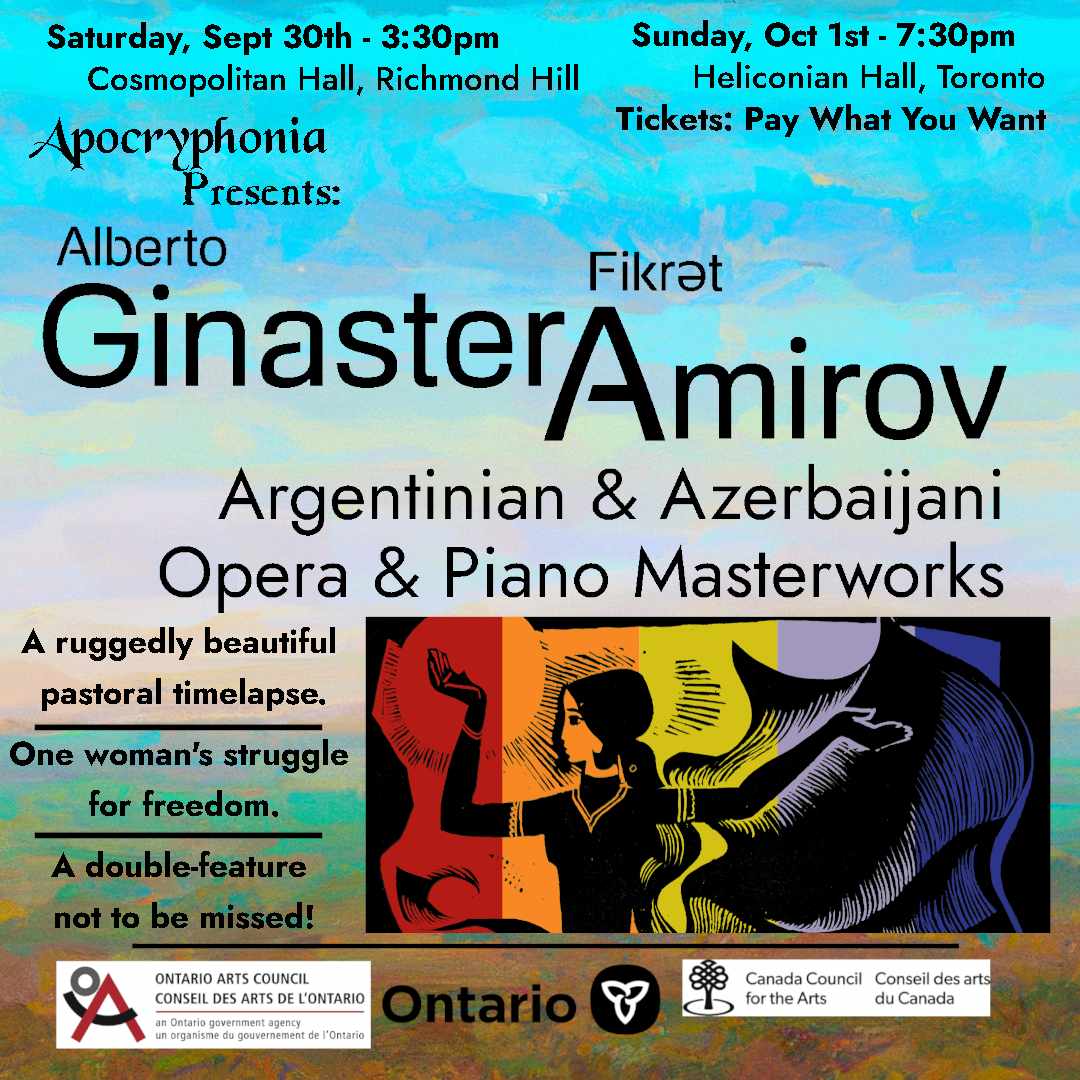
Alexander Cappellazzo: Saturday, September 30th – Cosmopolitan Music Hall (Richmond Hill) & Sunday, October 1st – Heliconian Hall (Toronto) is GinasterAmirov: Argentinian and Azerbaijani Opera & Piano Masterworks. This is going to be a great one; it’s a double-bill of music by Alberto Ginastera and Fikret Amirov. The first half is centered around Los Horas de una Estancia, a song cycle by Ginastera about a day on an estancia ranch, using his Piano Sonata No.1 to further evoke estancia goings-on, and the second half is an abridged performance of Amirov’s opera Sevil interspersed with the Canadian premiere of his Romantic Sonata.
You’ll find that despite both composers never meeting each other, there’s a certain kindredness to how they approach harmonies and rhythms, and how their national culture inspires their compositional styles. On top of that, there’s a big feminist angle to the show; the opera Sevil being very much a story about a woman challenging patriarchal structures and gaining freedom and agency, and Ginastera’s works either using women’s poetry (that of novelist and poet, Silvina Ocampo) or being premiered by women performers (as is the case for both pieces).
Joining me is the wonderful soprano Thera Barclay, and the amazing Narmina Afandiyeva at the piano.
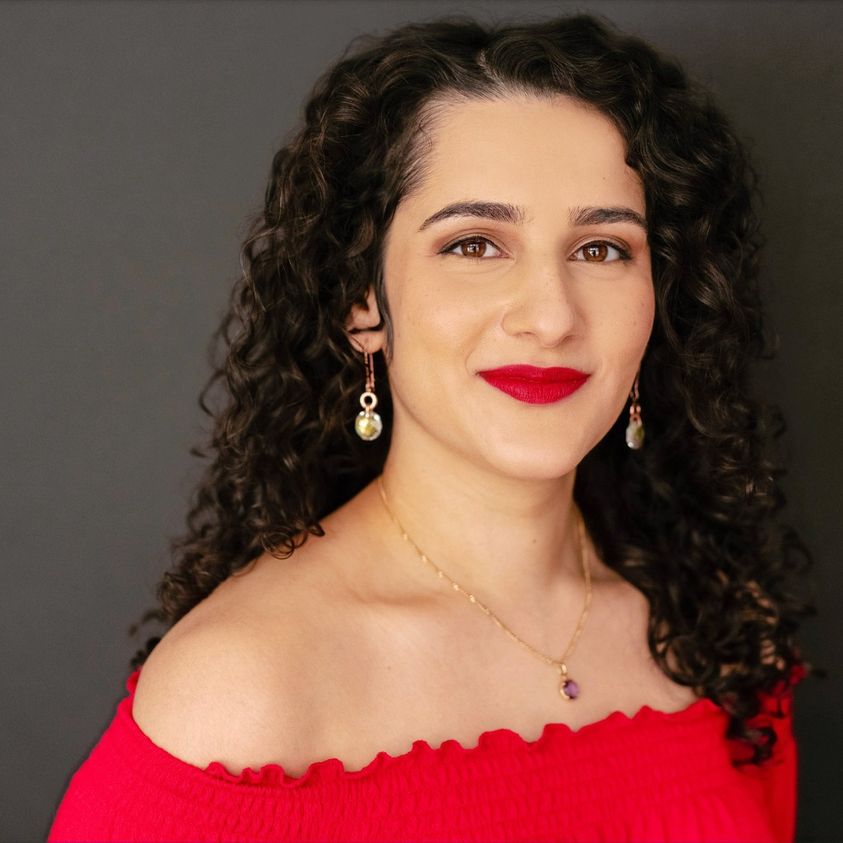
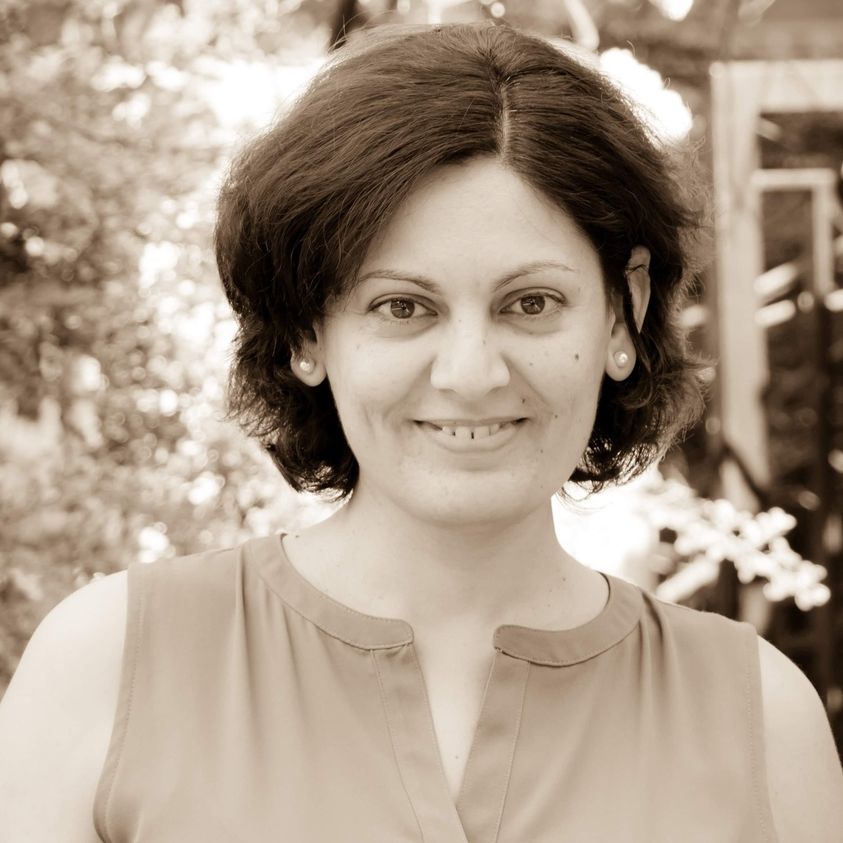
After that, Sunday evening, November 12th at Heliconian Hall is Apocryphonia/Diapente’s Rossi of Mantua, the Songs of Salamone; which delves into the music and life of Jewish-Italian Renaissance composer Salamone Rossi (and friends). Rossi was known for several musical innovations involving trio sonatas and monodies, and also wrote numerous Hebrew-language motets and Italian madrigals. Tickets aren’t on sale yet, but save the date!
Early December, stay tuned… I was originally going to be producing my first Apocryphonia opera, but we hit a snag with funding so that got postponed (I expect to produce it for Fall 2024 now). One must always be flexible, and I tend to have fallbacks in case of stuff like this happening. In its stead I’m working on an absolutely gruesome classical cabaret of horror-themed classical music.
Tuesday, December 19th is The Diapente Book of Carols, which is bound to be full of Renaissance holiday cheer. We’ve got an assortment of well known and lesser known stuff in store for you with that one.
Barczablog: Talk about Diapente Renaissance Vocal Quintet
Alexander Cappellazzo: Peter Koniers and I formed the Diapente Renaissance Vocal Quintet last year right when I moved back here from Montreal. I was part of a madrigal quartet in Montreal, Toni Precari, and it was some of the most fun I had singing. Before moving back home to Scarborough in 2021 I contacted Peter, who is also a fellow McGill alumni, and we started assembling the team:
Jane Fingler – Soprano, Jonathan Stuchbery (also a McGill friend!) – Tenor and Lute, & Martin Gomes – Bass.
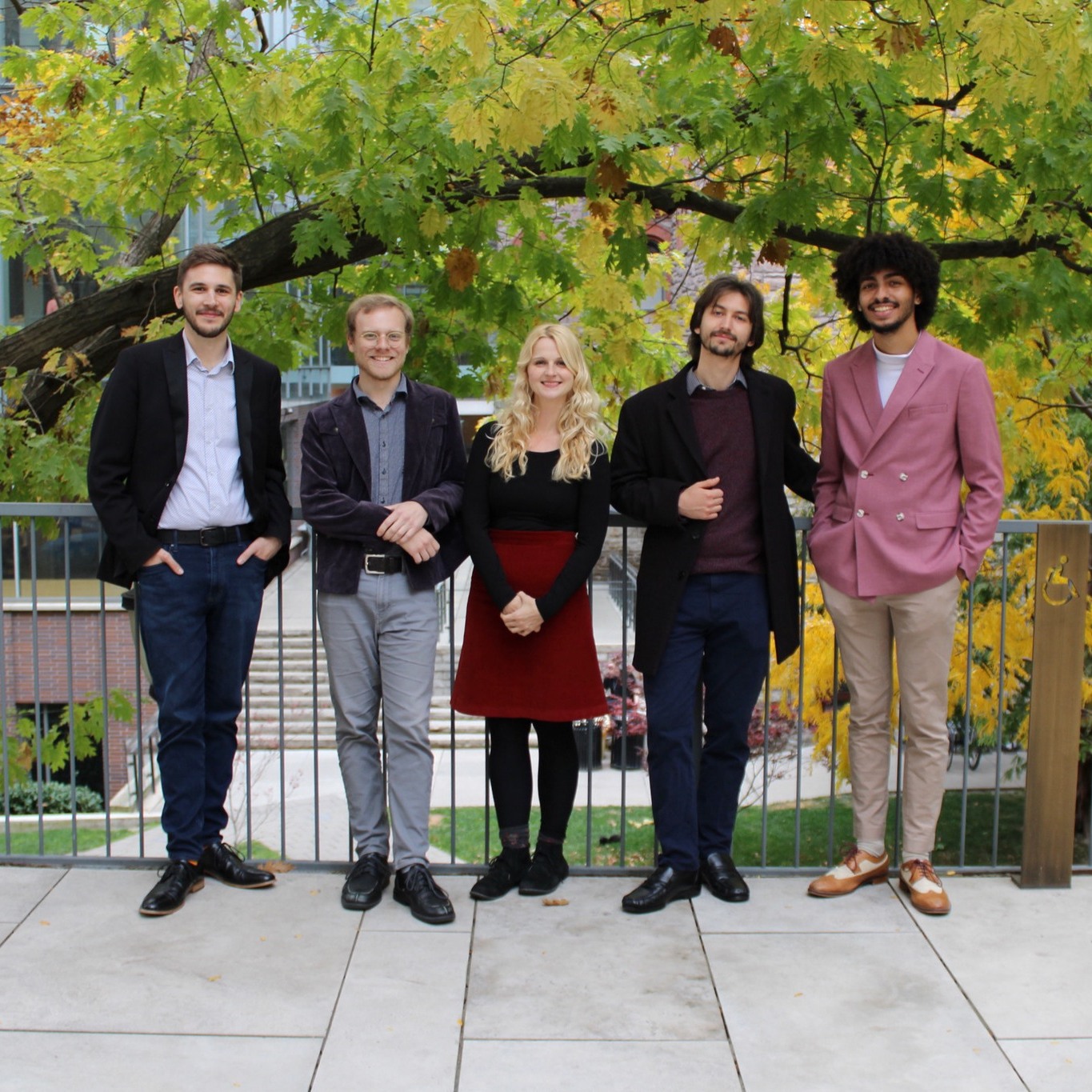
At that time the Omicron variant struck so there wasn’t much else we could do but hunker down and plan for the future; but eventually we all met up, sang some stuff together, and really vibed with each other. We’ve been singing together ever since!
Montreal has such a strong culture for small early music groups forming, but it feels like Toronto isn’t like that yet. I think we’re the only early music vocal quintet currently active in Toronto, which is odd in my opinion for such a big city. We’ve got some superb larger early music groups though like Tafelmusik, Opera Atelier & Toronto Consort though! I hope more smaller groups form in the future, then maybe we could all collab, or start a Toronto early music festival, or something…
Currently, we take turns programming the concerts for the season. The Rossi concert is my idea, and Jane Fingler is working on a Barbara Strozzi/Maddalena Casulana concert for May 2024. Besides that, we’ve got some concerts lined up around the Golden Horseshoe in conjunction with various organizations this year; it’s exciting to see that people are as enthusiastic as we are about this kind of music.
We go out there, tell stories and have a fun time; audiences can tell when you really love what you’re doing and it fuels their enjoyment.
Barczablog: Please tell me what you understand by the term “historically informed performance”, and its relevance to your creative life.
Alexander Cappellazzo: The more you know, the more options you have. Historically Informed Performance in my opinion is the practice of searching through primary sources what those options are for how to perform. With how it stands currently, this phenomenon tends to primarily extend to ‘Baroque and before’ performance practice. One reads a treatise that states how things were done at the time and they do that that way. It creates an amazing effect that you hear things as if they were done at that time.
I’m cheeky however, because technically speaking you can emulate early-1900s styles of early music interpretation and claim that it is ‘historically informed’ by early 20th century aesthetic practices. That is where this concept becomes very liberating because you can start thinking laterally about these treatises. For instance: there are contradictory primary sources out there, or anytime someone writes down what they think performers ‘should’ be doing you can extrapolate that at that time they might not have been doing it that way!
You also start seeing what aspects are being selectively left out of modern ‘historically informed performances’, especially with regards to audiences and spaces.
I didn’t really like early music in University, but I grew to really love it when I learned how much creativity it allowed for performance; a lot of that is due to historical views on improvisation and ornamentation. Take alternative historical tuning into the mix, and all of a sudden you get music that sounds like nothing else!
I highly suggest Le Poème Harmonique’s album Cœur, airs de cour français de la fin du XVIe siècle for some great French early music. If you want something less accurate, but full of passion and love for early music, check out Sting’s (yes, that Sting) John Dowland album, Songs from the Labyrinth.
Barczablog: How do you reconcile your love of cultural artifacts and performance practices from long ago with modern life?
Alexander Cappellazzo: I think in some way the love of the old, of history and antiquity, acts as a buffer to some of the worst things modern life has to offer. There is something fun in how inefficient the past is; it’s almost rebellious in our current ultra-efficient present.
The basement room where I do most of my work is styled like a Victorian lounge; with deep green walls, brocade curtains and spattered curios on shelves wherever they can fit. I like it because it feels a little removed from the now; I enjoy a certain removedness and distance. The more you open yourself up to the past, the more you can see through present obfuscations as well. Do people want to see the same thing, or something different?
I listen to a lot of old recordings of singers, and they tend to have more edge to them when they perform. I want to take the good stuff from the past and leave the bad stuff behind when I engage with the past. Just because something artistic has ‘advanced’ doesn’t mean that the only option is to either forget about it or preserve it in time. You can play with old toys and new toys! You might even come up with something altogether brand new that way.
Barczablog: Are you also singing or performing with anyone else?
Alexander Cappellazzo: This October I’ll be Frederic in Toronto Operetta Theatre’s Pirates of Penzance, which I am extremely excited for. It’s my first Gilbert & Sullivan operetta, and I absolutely love this kind of stuff.

In November I’ll be in Montreal performing for the second time Maria Jiminez’s Oratorio pour Marguerite Bourgeoys, which premiered last May. On top of that I sing with the Jubilate Singers, who have a concert on November 25th. Two days later, November 27th, I’ll be in the Brott Festival’s Messiah doing solo and the chorus singing.
Every Sunday you can catch me at Metropolitan United Church, where I just started as their new Tenor Section Lead. So far it’s been a blast!
Barczablog: Do you have any influences / teachers you’d care to name.
Alexander Cappellazzo: Of course! I owe a lot to a lot of people, but here are a few:
My teachers, a lineage including Lena Wills, Peter Barnes, Stefano Algieri (whom I spent the most time with and owe much to), and most recently Brett Polegato.
My coaches at McGill: Dana Nigrim, Olivier Godin, and Louise Pelletier. Thanks for putting up with me throwing a bunch of random scores that weren’t Mozart and Schubert at you each week!
Patrick Hansen and Stephen Hargreaves who run McGill’s opera program and weren’t afraid to push the boundaries of what opera/classical music can be.
Dr. Ralph Vaughan Williams, a man I never met but feel such a connection to with how we view music, community, and the world.
Apocryphonia begins its season September 30th at Cosmopolitan Music Hall in Richmond Hill and then October 1st at Heliconian Hall in Toronto. Click here for tickets.
Maybe I’ll see you at one of the concerts.
 barczablog