For the fan of chamber music seeking something beautiful but unlike their usual music, for the collector who needs something new and different, this is an ideal gift.
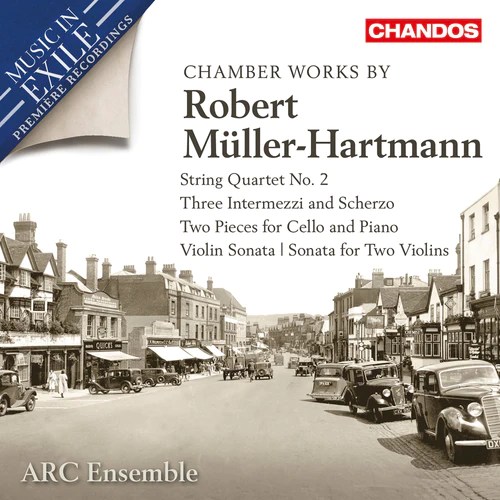
About a year ago I was thrilled to attend a concert by the ARC Ensemble playing the music of Robert Müller-Hartmann, a composer who was unknown to me. There’s a European angst lurking beneath the suave surfaces of his compositions. But except for a friendship with Ralph Vaughan Williams he was unappreciated when he came from Germany to the British Isles. Had his life not been so disrupted he’d likely be much more well-known, possibly famous. That’s where the ARC Ensemble comes in.
“ARC” signifies the Artists of The Royal Conservatory in Toronto established in 2003 as The Conservatory’s ensemble-in-residence and now among Canada’s most distinguished cultural ambassadors. Their “Music in Exile” series is the thoughtful work of their artistic director Simon Wynberg finding composers whose music has been suppressed or lost, and thoughtfully bringing it before the public. It feels like a combination of research and activism.
I remember wishing to have a recording of what we heard on that November afternoon at the RCM, recognizing that the ARC team would likely be the first if not the only ones likely to bother bringing this unknown composer to our attention.
Wish granted!
The music heard on that program of November 2022 is reproduced on the new CD. The only difference is a slight change of the order of pieces. Instead of aiming for the kind of climactic effects just before and after intermission that make a live performance a bit more dramatic, the recording flows in a sequence reflecting something closer to the actual chronology of their creation by the composer.
We open with the sonata for Violin and Piano Op 5 (c 1923). That’s exactly a century, something I only noticed by reading earlier today about Maria Callas’s hundredth birthday, on Saturday December 2nd 2023. The sonata has a mournful soulful quality running through its three movements, sometimes racing along but suddenly pausing as if to ruminate on the meaning of life for a moment.
The Two pieces for cello and piano that follow begin gently, the piano softly in support of the exquisite sounds make by Thomas Wiebe. This is not some quick virtuoso piece but rather a gentler exploration of the instrument, probing & passionate reflections as if to say “look what this instrument can do”.
After the restraint of the two cello pieces, the Sonata for Two Violins Op 32 races away from a starting gate powered by a kind of animal adrenaline, the passionate energy of dialogue. After a pair of works with piano, this time it’s a pair of similar instruments sounding remarkably dense in their sound. While I didn’t need to be persuaded when I saw this live, playing it on the CD it sounds like more than just two violins. Müller-Hartmann gives them real meat to chew on with this remarkable piece. At times I’m reminded of the word “counterpoint” even if the imitation isn’t really like that at all. There are phrases that might be a bit like Bach, but no it’s not taking a theme and using it that way. There’s a back and forth that’s at times more of a call and response, sometimes playing with rhythms and shapes, and just when it seems they’re fighting they work together establishing harmonies, playing off of as much as against one another. This work of four movements is deliciously deep.
The next piece had been my absolute favorite in the live concert, the Three Intermezzi and Scherzo Op 22, a revelation at the piano from soloist Kevin Ahfat. There’s a Brahmsian weight to the pianism for the three intermezzi, sometimes taking its sweet time to unfold its ideas as in the first, sometimes deciding to zoom along in fierce patterns tightly organized around a simple concept as in the second or third. That Scherzo is magnificently clean in organization, reminding me a bit of Saint-Saens or Liszt for its demonic energies yet much more modern in its harmonies and tastes. While it’s contemporary with Rachmaninoff it’s more economical, far more direct in its writing. The virtuosity this requires is more like what you find in the Chopin Scherzi, broad gestures requiring octaves and fast movements with both hands. I must find the score somehow even if I’m fairly sure I will not be able to play it up to speed. But even playing it slowly helps me understand what I’m hearing, to appreciate what Müller-Hartmann has achieved. And also to get a glimpse of the back of that passing express train, aka Kevin Ahfat flashing by as he zips through the piece without missing a note.
Finally we come to the String Quartet No 2, Op 38 this time played by everyone but Kevin, namely violins Erika Raum and Marie Bérard, Steven Dann viola and Thomas Wiebe cello. There are four very different movements, the work of a mature composer who, were it not for the work of the ARC virtuosi, would have slipped through the cracks of history, forgotten. I’m especially enamored of the dance rhythms of the second and the drama of the fourth movements, all four contributing to a beautiful whole.
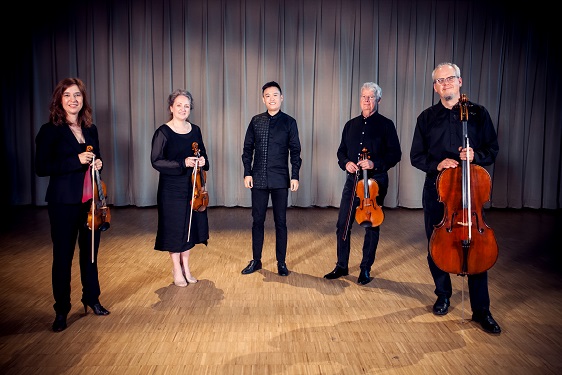
Steven Dann (viola), and Thomas Wiebe (cello). (photo: Suane Hupa)
The recording is over an hour of music, available through the RCM’s website (click here).
 barczablog