
This is a guest blog from William (aka Bill) Shookhoff, the pianist and artistic director of Opera by Request.
Thank you Bill!
~~~~~~~
Recently, the distinguished Metropolitan Opera of New York City announced that this holiday season would be marked by several performances of Julie Taymor’s family version of The Magic Flute, in a schedule that rivals many ballet companies’ presentation of Nutcracker. Some performances would be preceded by an open house, with various hands-on activities for kids, and some would have 11am start times, so the very little ones would still get home for their afternoon naps (with visions of—if not sugar plums—Magic Bells dancing in their heads). GREAT NEWS, RIGHT!!?
Apparently not. When last Saturday’s (December 16th) production was aired (on what I still fondly think of as the Texaco Metropolitan Radio Network), it was almost immediately greeted by a dismayed Facebook post, which set off a stream of comments, mostly dealing with what was cut, often in terminology which bordered on the vitriolic.
Terms like “butchery,” “vandalism,” “shameful” appeared, along with suggestions that the production was trying to “improve” or “dumb down” Mozart.
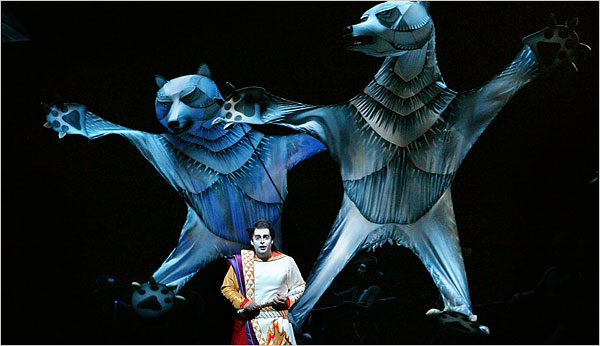
Having attended this production on the previous Sunday, with my great nieces, aged 3 and 6, and having been involved in every conceivable version of Magic Flute, from class-period length to completely uncut, I feel I can fairly respond to this thread.
First, let’s deal with what was included, not excluded:

Every character (including the armed guards)
Every aria (though some with judicious cuts; strophic arias generally omitted one stroph; Ach ich fuhl’s, in a slow tempo near the end of the opera, was presented in its entirety)
Every significant plot development, including the disturbing elements such as kidnapping, attempted murder (times two), rejection and destruction. Only attempted suicide was passed over, which made Pamina’s re-entry one of the less successful moments in the production.
The trials by fire and water.
And let’s mention what this version did not include (as some other family versions have)
Modern dress
Referencing to video games
Contemporary references in the translation
And what might be particularly inspiring to young audiences:
Casting the three Knaben as just that: boys. (Apologies to any mature singers who may be reading this and have been cast in these roles. I’m sure you were wonderful, but the unique presence of unchanged boy sopranos avoids any confusion between the three Knaben and the three Ladies).
And the most practical decision of all:
One hundred minutes (hardly indicative of dumbing down) with no intermission. Imagine trying to get a full house at the Met, over half of them children, in and out of the washrooms at intermission. It’s difficult enough during the Ring Cycle, when intermissions are extended.
But the most important point of all is one that renders all the above irrelevant: Why was this ever a point of controversy? Of course one can always take issue with artistic decisions (I questioned several), but who can argue with an operatic presentation that fills a vast auditorium several times over, largely with people who have never before seen an opera, many of whom are too young to be able to read the supertitles?
Offering 2/3 of a complete opera, with only notes that were gleaned from the original score, should not be problematic. We in Canada have seen the demise of several opera companies in recent years. Germany, still the mecca for many opera singers and audience, boasts far fewer companies and resident artists than was the case when my own career was burgeoning, sometime in the last millenium. The Netherlands, which boasted no fewer than 23 full-time orchestras (in a country smaller than any of the mainland Canadian provinces) in the 1970s, now has fewer than half that number. And the companies that survive are repeatedly trying to come up with ways to attract more audience, some successful, many not.
When I was first becoming acquainted with opera scores, one thing I was constantly being told, to my surprise, was “This scene is always cut.” “No one does the cabaletta.” “We always jump from point A to point B.” Now, many of those dogmas have been eliminated, which is a good thing, but does that mean that these operas were less relevant as they were generally presented in the last century than they are today, when offered in full? I think not. Is a 100-minute Magic Flute, with no intermission, less relevant, than the standard 150-minute version?
I feel fortunate to have been invited periodically to perform with an opera company whose very name, “Abridged Opera” answers these questions. In Toronto we’ve been blessed with numerous innovative companies that offer a taste of opera in varied and unusual venues, presentations of varying lengths.
I would hope that those (and they are a far-too-small minority as it is) who enjoy the art form enough to turn on the radio on a Saturday afternoon could unite and appreciate any and all efforts to bring opera to a wider public.
I thank Leslie Barcza, whose blog is never short on insight and wisdom, to allow me to make a guest appearance on his page. Now let’s all enjoy our next operatic performance, with whatever flaws and shortcomings may be present, and applaud the efforts of those involved.
~~~~~~~
In turn I thank you Bill for your input, and I’m happy to publish your words here. AND i must apologize that the combination of personal business and holiday shenanigans delayed my posting this until today, December 29th.
 barczablog
Thank you to both Bill for writing this, and Leslie for ‘hosting’ it on his blog.
Here are my thoughts on this (and yes, you need to read it all to get the message!):
I generally fall into the “don’t make needless cuts” category. In this case, I am paying to see Mozart’s Magice Flute, not “Joe Blow’s” interpretation of The Magic Flute – this includes the style of the production. As such, for the Saturday Afternoon Broadcast they should have either offered another preformance that day (such as swapping the December 16th matinee performance of The Magic Flute with the December 23rd matinee performance of Tannhauser) and then did a pre-recorded performance from earlier in the year (something they have done in the past.)
However, this production is geared for introducing children to opera. The audience listening to the radio broadcast is likely not a member of that group, hence the negative comments. I have nothing against doing something like this to market opera to kids – December and June (the former with the Christmas holiday approaching and the latter being the end of the school year) are perfect times to do child oriented performances of an opera, or for symphonies to do child oriented performances. Get the chidren hooked.
However, for us adults, I do think that we should be seeing the performances that we are paying for. I recall seeing a Handel opera a number of years ago (Alcina?), and if you took out all of the ‘needless’ repitition of lines that opera would have lasted a fraction of the time. Also, making cuts can push away those of us who want to attend a full length opera, and let’s face it if one is going to a ‘standard’ opera company such as The Met or The COC, the audience is paying good money to attend.
In conclusion, and sorry for the length of this response, is that I think making cuts can have it’s place if the production is being geared to a specific audience (i.e. kids) but not necessarily when trying to get the general audience in.
LikeLike
Funny you’re commenting about length YET apologizing for the length of your comments. Doesn’t that suggest that you too see the value in brevity?
THANKS for the comments!
LikeLike
You are more than welcome!
LikeLike
I agree totally with Bill. We need more innovation not less. Somehow we need to find ways of presenting opera to more people in more ways or it will die. Chamber reductions, opera in pubs, kids’ version, relaxed performances. It’s all good.
LikeLike
Agreed! Thanks for weighing in.
LikeLike