Yesterday I attended the Canadian Opera Company’s Sunday matinee of Luigi Cherubini’s Medea. The main character may tell a lot of lies but that didn’t stop the audience from cheering her on in one of the darkest operas imaginable, a sharp contrast to Donizetti’s Don Pasquale, the other work in the COC spring season.
Speaking of truth, as we drove to the Four Seasons Centre we discussed whether we should expect to see Sondra Radvanovsky not even 48 hours after her Friday night triumph (as reported by friends) in one of the most demanding roles. When Perryn Leech appeared I knew exactly what we would be told.
Chiara Isotton, who was expecting to sing the final two performances of the run sang this difficult role bravely and boldly in an unexpected COC debut.
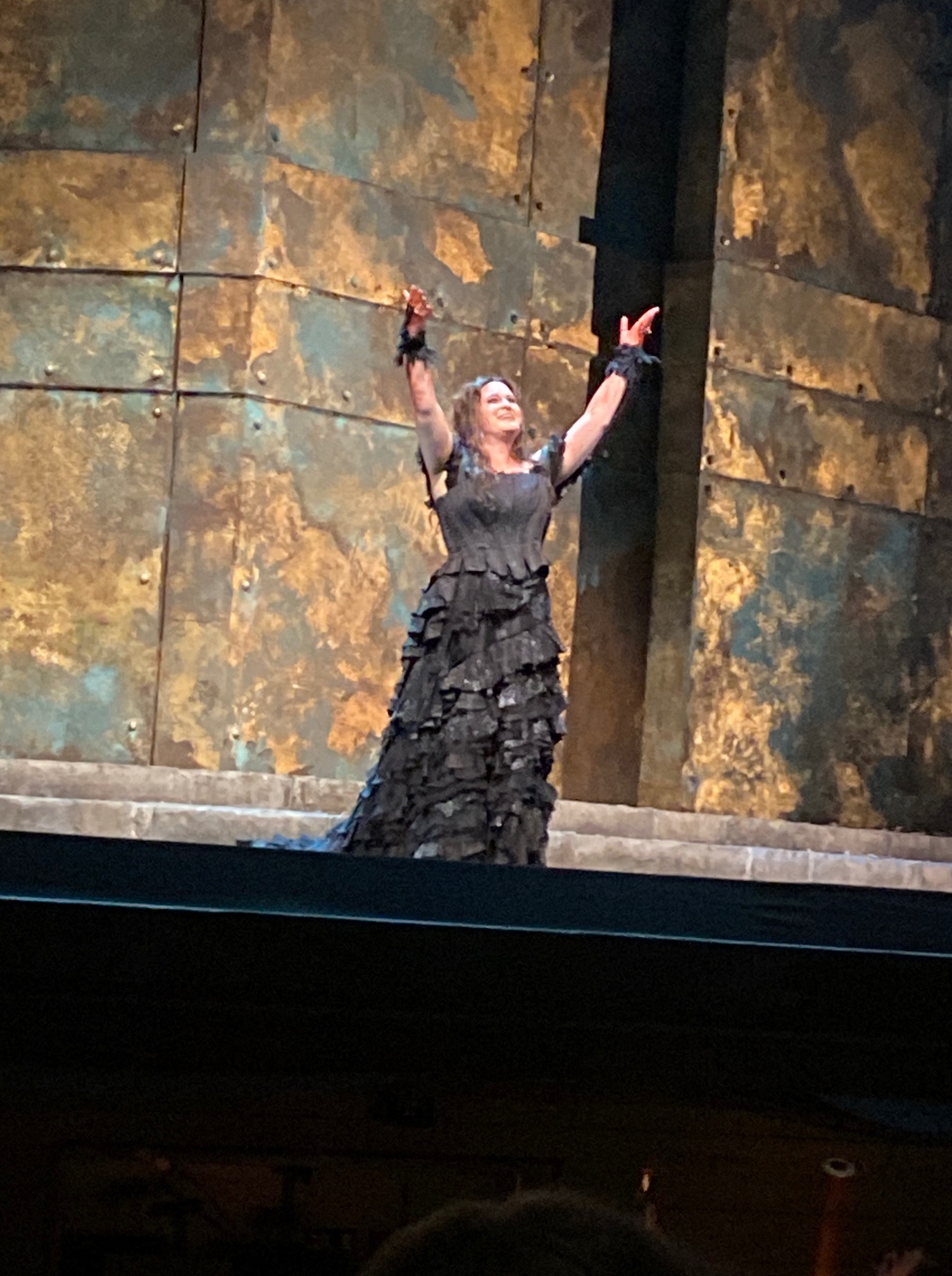
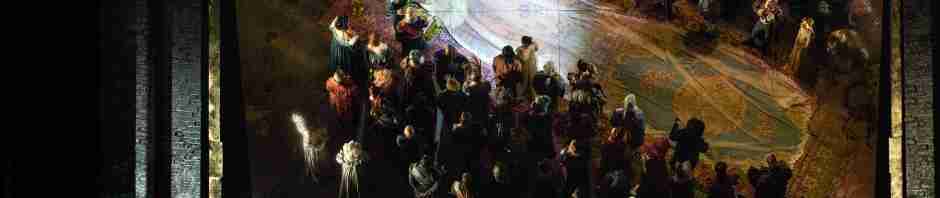
The diva shares the spotlight with an extraordinary set design by director Sir David McVicar in this co-production of The Metropolitan Opera, Greek National Opera, Lyric Opera of Chicago plus the COC, a delightfully anachronistic assembly of colours and textures.
There are two remarkable features to the set, the first in a series of sliding panels that act as doors, opening and closing to change our view. Sometimes they’re completely closed, providing a place at the front of the stage for intimate exchanges, sometimes they offer partial framing or open fully. I was reminded of the way films sometimes employed an iris or a door to set up the transition from one shot to the next. For much of the opera, the action is framed and kept far away from us, which makes a lot of sense if the material might be disturbing.
When the doors were fully open we had a chance to see the the more spectacular second feature. McVicar’s stage places a large mirror surface at an angle upstage, that reflects a view of everyone but seen from above. It’s sometimes disturbing, sometimes stunningly beautiful, but throughout the opera we’re able to see people plus a view of them from above. I am sure this works entirely differently for those sitting further back.

When we open the final act the doors are fully open. Medea is far upstage, seen in the reflection as though floating in the sky. It’s unsettling yet very beautiful. Our final view of her as the temple burns is surprisingly moving.
I found myself feeling grateful for the melodrama of Cherubini’s two dimensional dramaturgy, wanting distance from the ugly story. We don’t expect method acting or depth from Godzilla or Dracula, and Medea is just another monster. The artificiality of music allows us to revel in passion without getting too close to the nasty realities of the story. There is a certain delight in watching pure passion, especially when a composer has captured raw emotion in his music as Cherubini has done. The nerdy part of me that listens to this opera (I have a hair-raising recording with Maria Callas, Jon Vickers, Nicolai Ghiaurov & Giulietta Simionato) revels in Cherubini’s directness, and perhaps that would ideally have me sitting further away, not looking too closely at what they were saying or doing.
Even sitting very close to the action we could see the ways that the director chose to alienate us, to remind us of the artifice. I wish I could have seen how Sondra played the craziest moments, given that I was unable to find sympathy for what Chiara did with the part when she sees the resemblance between child and father, surely a daunting moment for any singer:
MEDEA ——————————MEDEA
Guarda ei pur così! Così Giasone–He too has the same look! Jason
falso ha lo sguardo! —————–has the same false glance!
A morte, orsù! ———————–Come you must die!
(Afferra i bambini ——– (She seizes the children
levando il pugnale.) —— raising her dagger.)
No, cari figli, no!—————–No, dear children, no!
Son vinta già!——————-I am defeated already!
Cessò del cor la guerra;——-The war in my heart has ceased
While Chiara sang very well I wonder how much time she has had to develop the nuances in her interpretation of the role, one that Sondra has done previously elsewhere. If I had been sitting further back perhaps I would have been swallowed up by the music rather than disturbed by what I was seeing. The audience exploded in response to her COC debut, well sung even before we remember that this was an impromptu debut due to Sondra’s indisposition.
To his credit, Leech has been making great use of covers, recalling the Lady Macbeth replacement drama, that began with Sondra Radvanovsky’s withdrawal from the production. Her Friday night performance may represent a triumphant comeback by an intelligent artist, but a big part of being an intelligent artist is knowing when to cancel a performance.
More power to her, and maybe someday I will hear her again.
I would be remiss if I didn’t notice the many other significant contributions to a dramatic afternoon of opera. Matthew Polenzani sounded properly heroic as Giasone, in a thankless role reminding me of Pinkerton, another self-centred sailor with a lover in every port whose vows cannot be trusted. Janai Brugger was a congenial Glauce, displaying a beautiful timbre and a winning presence. Alfred Walker’s Creonte improved from a rough start, perhaps unhappy to be singing on less than two days rest. Zoie Reams as Neris was vocally splendid while carrying out some of the more difficult actions of the story; she’s important to the advancement of the plot, reporting on various parts of Medea’s evil work, bringing the children to Medea, taking poisoned gifts to Glauce, while somehow making that believable and even sympathetic.
The COC Chorus played their usual part in painting the dramatic illusion while singing appropriate responses to situations where they often echoed the sentiments of soloists expressing delight, sadness, or horror. There’s no middle ground. Conductor Lorenzo Passerini gave a taut and apparently flawless reading to a score full of soft lyrical moments between outbursts of fury and horror.
The COC’s production of Medea continues with performances May 9, 11, 15 and 17.
 barczablog
Chiara wasn’t exactly thrown in the deep end. She was much more involved in the rehearsal process than covers usually are since Sondra didn’t show up until quite late on and she sang the Final Dress (extremely well by all accounts).
LikeLike
True enough. My headline was a reflection of my cognitive dissonance, contemplating the politics implied by the pronouncements & promises of Medea, Giasone and Perryn Leech. I have a COC subscription, having renewed once again with Sondra in the brochure: but of course in the real world people cancel. As we drove to the show we were on the verge of placing wagers as to whether Sondra would sing or not, a bit frustrated by scheduling that seemed to make the cancellation inevitable, if not actually part of the company’s plans. Did Chiara wake up Sunday knowing she’d sing? If not I think she deserves more credit for what she had to face. And I understand and respect the challenges of Leech’s job.
At the same time, I was grappling with the opera, a work that doesn’t invite close-up viewing, as the alienating devices of the production seem to testify. It’s not the first time I’m writing a review feeling conflicted, between a response to the work and the performers (as I alluded in response to Zoie Reams’ Neris). I’m glad people enjoyed Sondra’s performance, happy for her even if I wonder how many shows she will sing.
LikeLike
>>As we drove to the show we were on the verge of placing wagers as to whether Sondra would sing or not
There’s been a lot of that!
LikeLike
I don’t agree with that Chiara Issoton was less convincing as Medea. I did not hear Sondra Radvonovsky in person but saw her in the HD broadcast. She sang very well but was too abject, never really the barbarian Colchian princess. She rolled around on the stage floor too much, grimaced, tried too hard for pathos. Chiara Issoton sang with crisper diction—she is, after all, Italian—and more dramatic nuance. She had a strangely regal bearing that Sondra did not have. If her voice stays healthy she will be a big star.
I might add that this was the third time within a year that Ms. Radvonovsky has cancelled a local performance for which I had a ticket. She doesn’t seem to mind letting down her Toronto fans.
LikeLike
Thank you Sofya for illuminating the strength of Chiara Issoton performance. While I was also disappointed in the replacement of Sondra Rodvonovsky, I
was completely drawn into Ms Issoton singing and acting the role.
LikeLike