The title of the opera is Ariadne auf Naxos, done as Ariadne on Naxos because it was being sung in English.
That’s how Richard Strauss’s opera was presented back in March 1969 at the Opera School of the University of Toronto.
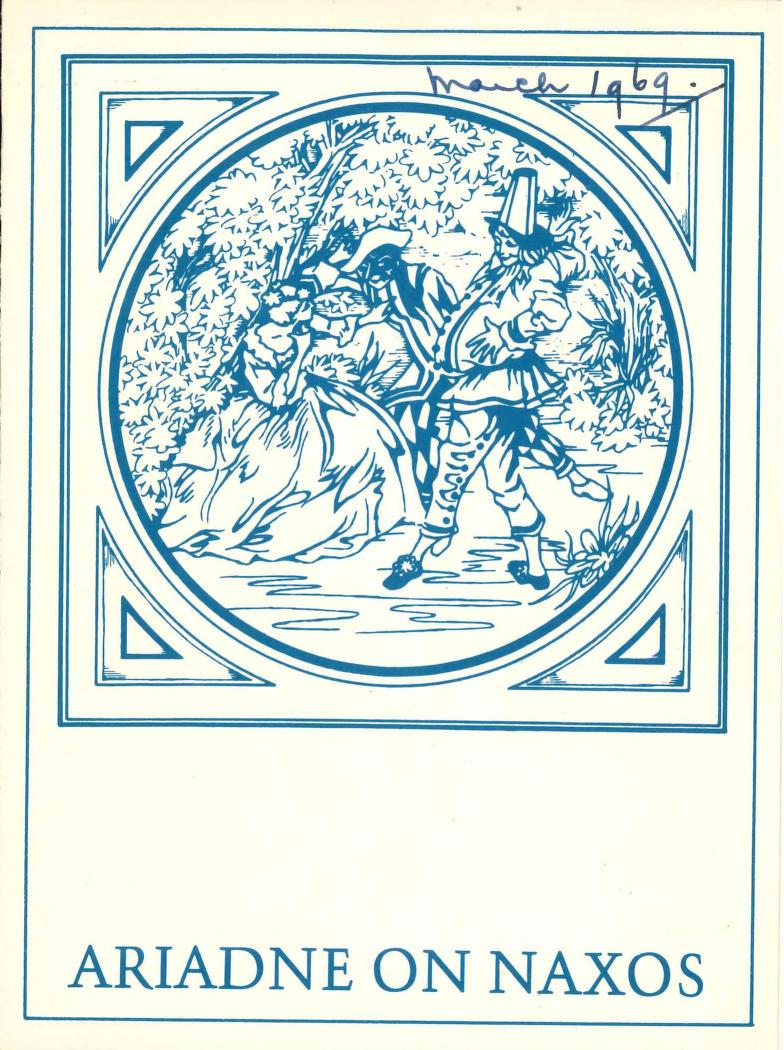
Through the magic of my library card to the University of Toronto Library I have been able to revisit an experience that dazzled me at 14 years of age, thanks to the kind assistance of Music Archivist Becky Shaw at the Edward Johnson Building. And my brother Peter Barcza helped me identify the people in the pictures. He was just 19 years old, and was the reason I came to see this show.
I am also able to time-travel through a few helpful Facebook friends whose names appear in the program.
I asked Riki Turofsky (Naiad), Steve Henrickson (Music Master & Arlecchino) and Mary Lou Fallis (Zerbinetta) what they remembered.
First Riki Turofsky..
Barczablog: what do you remember? any memories / anecdotes to share of Hermann Geiger-Torel, Ernesto Barbini, and your fellow cast members.?
RT: I loved that production. Torel [meaning Hermann Geiger-Torel] of course was yelling all sorts of orders from the theatre while we rehearsed. Nancy Gottchalk’s voice was too light for the role but she performed it brilliantly. I was a pretty high coloratura but was really impressed with Mary Lou’s facility with the score. I think I learned to love Strauss after being in that opera.
BB: I was curious about the way your name appears in the program, spelled as “Ricki” not “Riki” as it now appears.
RT: My name spelling changed after a concert in Victoria when a numerologist in the audience suggested the simplification to Riki from Ricki.
Next Steven Henrikson who was both Music Master and Arlecchino.
BB: Any memories / anecdotes to share of Hermann Geiger-Torel, cast members?
SH: Leslie, Wow, a long time ago, indeed. We were such a young, aspiring, talented bunch!
The larger parts were double cast. However, as a Bass-Baritone I was given two roles: Music Master and Arlecchino. The problem of having both characters in Act I was solved by having Gerard Boyd ‘act’ Arlecchino in Act I on my behalf. This was possible as Arlecchino does not sing in Act I!

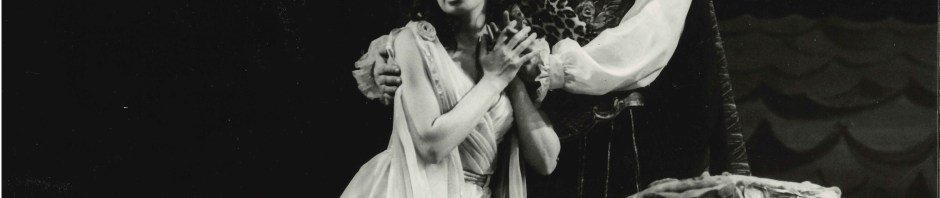
(photo: Copyright Ludvik Dittrich)
SH: Further, having to rehearse as two characters and with other parts double cast, I rehearsed most days for 8 hours, sometimes 10, and once for 12 hours! I was indestructible……
Mary Lou was exceptional as Zerbinetta. Our “duet” was well-received and fun.
During the VERY difficult Act Il quintet, featuring all 4 male Commedia characters, Geiger- Torel had us leap-frogging over each other AS WE SANG! All very disciplined- we could not be anything but 100% accurate in acting and singing.
BB: And you’re still singing today. I reviewed you in The Seagull just this past June and it seems you’re still singing.
SH: Yes, Daland in Wagner’s Flying Dutchman with Bill Shookoff on College St. November 9. I have been singing, full time, for 67 years!
Finally, my interview with Mary Lou Fallis.
Mary Lou Fallis: I was in my third year university, and it was kind of …amazing(!) to me that they were going to do this production because you know it’s a big opera.
Barczablog: It’s ambitious isn’t it. I don’t think they ever did anything like this, right?
MLF: Well they did L’enfant et les Sortileges.
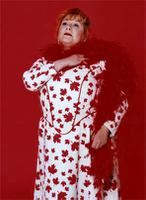
Mary Lou Fallis
BB: but that’s a short little thing in comparison.
MLF: it’s short but it still involves a lot of people, cast and a lot of costumes, sets that were absolutely magnificent.
Yes this was ambitious.
BB: You were singing a part that is one of the hardest in all the repertoire: Zerbinetta.
MLF: Yes I had heard it. I was twenty-one when I sang it. I had heard it two years previously. Reri Grist a wonderful coloratura, I heard her do it when she was a guest with the Toronto Symphony. She did a concert performance of it, and I heard it and thought this is so brilliant, this is my dream role.
BB: So you had the high note, right? The high E? I mean not everybody can sing this thing.
MLF: Well that’s just the way my range was. I was just built that way. I had high Fs since I was about 14. My grandmother was my singing teacher, and she never told me how high I was going.
(laughter)
BB: Good plan!
MLF: Anyway I wanted to do it, so I got the score, and I memorized the role. It took me ages and ages to learn it.
BB: You were singing it in English! Does that mean you had to learn it again?
MLF: Yes!
(and i hear a gasp)
Yes I did: but it wasn’t hard to do that. When you’re there at coachings and rehearsals it doesn’t take long. It might have taken longer to do it in German. I had no trouble with that. It was my dream role and I always felt, the roles you usually did in opera school were all the soubrette parts. I was too smart to sing all those sappy roles, or at least that’s what I felt at the time. I was arrogant much more arrogant than I am now.
BB: Isn’t it useful, don’t you have to be arrogant to be a diva? It comes with the territory doesn’t it?
MLF: On some level. I’ve mellowed. I’m very very happy with where I am now. Very happy that I don’t have to cough out a high “C“.
BB: Do you remember Hermann Geiger-Torel?
MLF: Of course! My relationship with Hermann Geiger-Torel goes back to when I was in the precursor of the Canadian Children’s Opera Chorus. I was in two performances, one was Hansel and Gretel, I was one of the gingerbread people, and then I was one of the orphans in Rosenkavalier.
“Papa! Papa!“
And then I was one of the kids in la Boheme. And I remember my very first time onstage, I guess I must have been about twelve, and I was in the chorus, Parpignol and that whole Act II start with you know Cafe Momus?
BB (singing the intro to the act) “Ta-ta-ta-…(etc)”
MLF: (singing the chorus part) “Ah...!”
Anyway that was me and I had a part in the chorus and what I remember, I knew my part. But I’d never been onstage in a big theatre like that. So when it started I was absolutely boondoggled and amazed. So I remember standing in the middle of the stage and not moving. There were things I was supposed to do: but I just stood in the middle of the stage, with my mouth open, because I was just so overwhelmed by the whole thing.
And so Geiger-Torel stopped the rehearsal, and said “Little girl! Do you know what you’re doing“.
And I was soooooo embarrassed.
But he kind of took an interest in me, when I was a little kid. And when I was 18 he had me understudy the doll in Tales of Hoffmann, early on in the COC. So I was very young. He was always very interested in me. I liked him a lot, I respected him. I thought he knew a lot about theatre. I think he felt a little badly, being in what he would consider kind of a backwater, at that point. It really was. He was starting an opera company in Toronto, when the Metropolitan Opera in New York had twenty-five times the budget.
BB: And a different audience.
MLF: Absolutely. I can remember going to operas with my grandmother when I was fifteen at the Royal Alex. But that’s beside the point.
What I remember about this production is that it was double-cast, which I didn’t enjoy very much.
BB I saw your cast by the way.
MLF: Did you? I think it was one of the most fun things that I ever did. And I think my voice did develop much more after that. It was a high point for me. And I went on to do the role in Stratford. And I went on to do it in Buffalo. And they did performances at the Shaw Festival believe it or not.
BB You’re the only person in that production–I’m willing to bet– who got to do their role again.
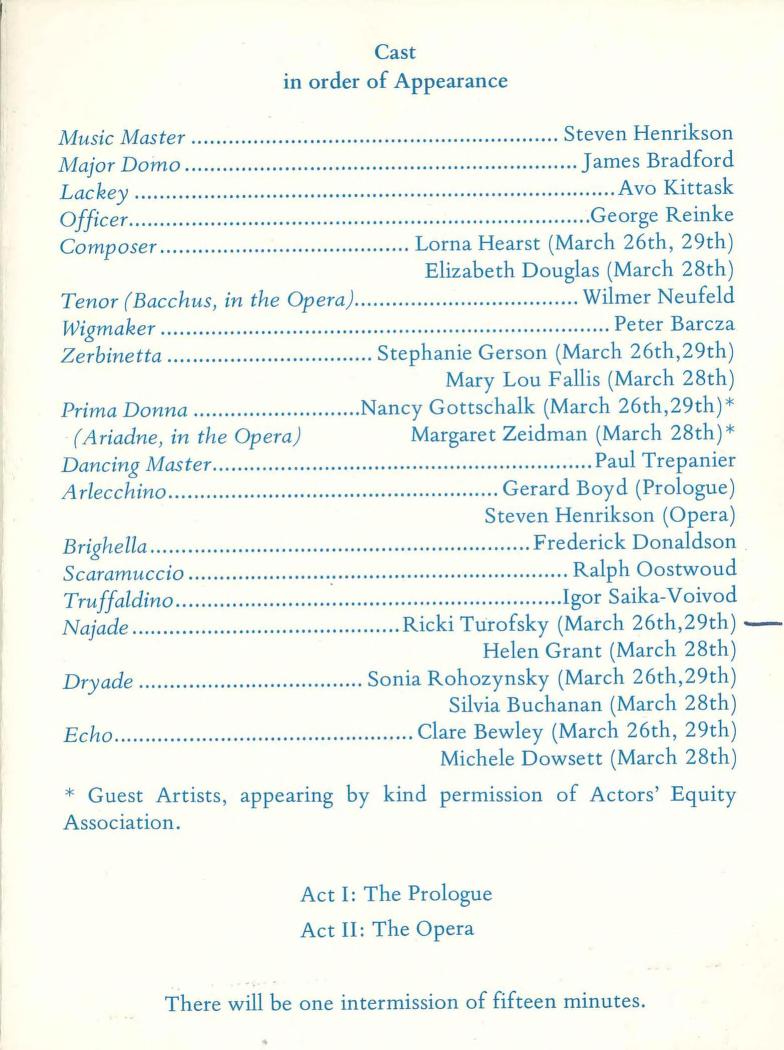
MLF: Do you have the program in front of you?
BB I do, I can share a list of the names.
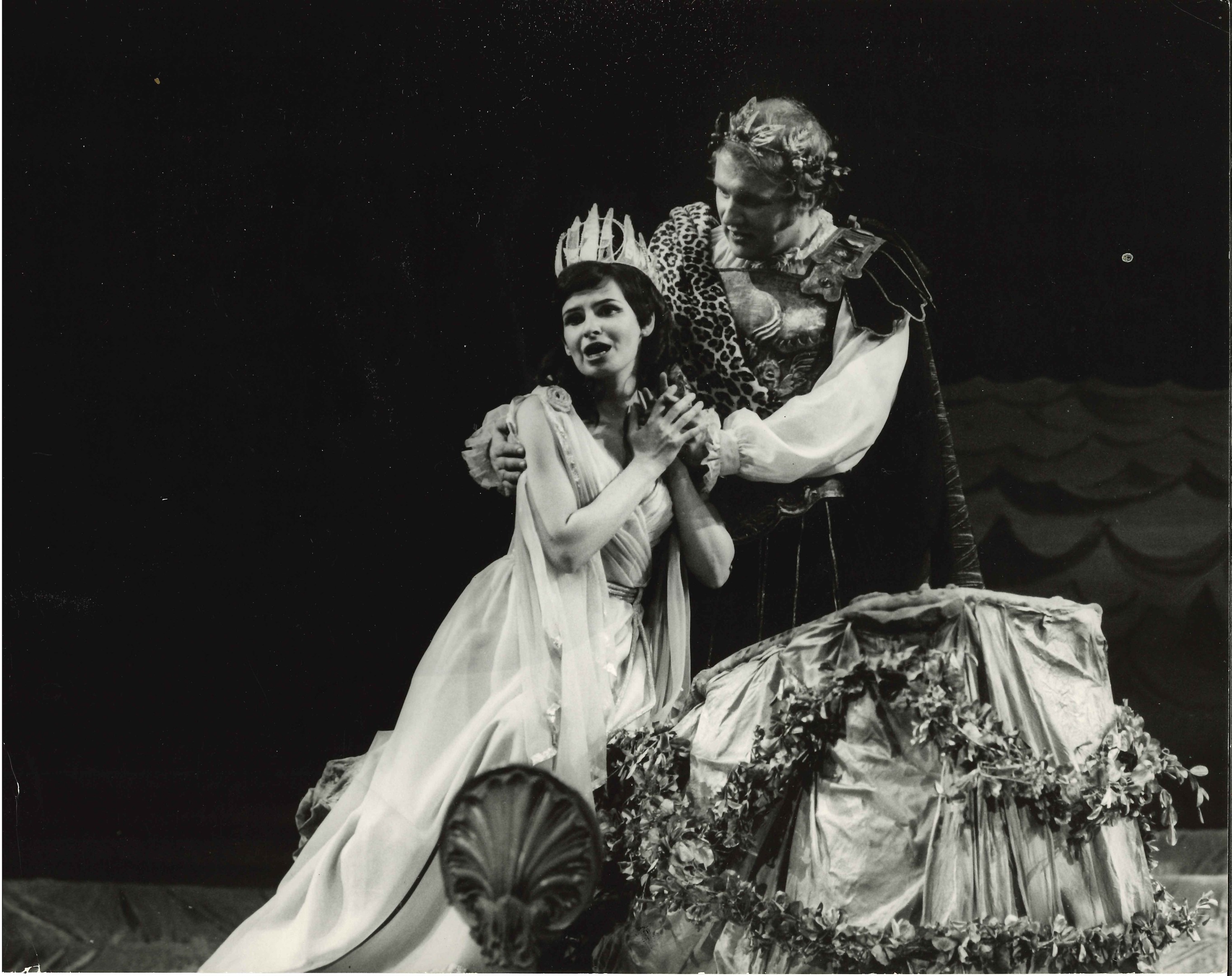
(photo: Copyright Ludvik Dittrich)
BB: Wilmer Neufeld (Bacchus)…
MLF: He went on to have a big career, singing in Glyndebourne, quite a career in Europe.
BB Margaret Zeidman was in your cast, while Nancy Gottschalk was the other Prima Donna / Ariadne.
MLF: Was she really!? I remember Nancy.
I was just thinking of the four guys. My cast was Roelof Oostwoud, who was a professor, he had done a mathematics degree and he had kind of a rough tenor, but he loved singing and went on to have a career in Europe. He was Dutch so I think he went over to The Netherlands, sang for quite a long time in Europe. Was Gerard Boyd in that?
BB Yes, he was the spoken Arlecchino in the prologue, while Steve was the Arlecchino in the opera, because his part had to be split apart.
MLF: Gerrard did a lot of character roles, he went on to have a career with that sort of part.
BB So the four guys (as listed in the program) were Ralph Oostwoud, Igor Saika-Voivod, Frederick Donaldson and Steven Henrikson.
MLF: I was going to say I didn’t know what happened to Fred Donaldson. Did he go to Europe too?
BB I don’t know.
MLF: And Igor did some stuff with the Canadian Opera Company. He had a very deep voice. And then he moved to London Ontario where he taught voice for many many years. When I taught at Western he sent me many students.
BB Did you stay in touch with Margaret Zeidman? She was your Ariadne.
MLF: Yes. I thought Margaret was pretty good. Who was the other Ariadne?
BB Nancy Gottschalk. I never saw her sing it.
MLF: Margaret had that sort of sadness, coolness.
BB The composer was Lorna Hearst or Elizabeth Douglas.
MLF: Elizabeth Douglas was my composer. She was from Kitchener I think. She went on to teach singing in Kitchener locally. I seem to remember that she was older than a lot of us.
BB: I guess there were others who were older. Wasn’t Wilmer Neufeld older? like a mature singer.
MLF: Oh yes quite a lot older. He was like 35 or something.
BB OMG I remember when 35 seemed old. I was 14 at the time, of course.
MLF: So there was Miss Turofsky, one of the three naiads. There was a woman from Australia named Helen (?).
BB: [reading from the program] Helen Grant.
MLF: Yes she had a lovely voice. And Clare Bewley was Echo.
BB: Michele Dowsett was the other Echo. So there was one cast with two performances (March 26th and 29th) and your cast had the single performance on the 28th.
MLF: I only had the one performance because they were worried, as I was so young. And the other woman: have we heard anything of her?
BB: I don’t know.
MLF: She married a dentist and I remember her having a party after her production.
BB Maybe she lived happily ever after.
Do you have any memories of Ernesto Barbini, who conducted..?
MLF: I have wonderful memories of Barbini. I don’t think Strauss was really his thing. He was very Italian. I was there when Teresa Stratas did Mimi, when she was the understudy. What I mean is, I think he did okay but the Germanic style wasn’t his thing. I mean when you’re conducting a student orchestra, it’s difficult. You have to take what you’ve got. But they had some very good people there, including my darling husband. Peter was in the Toronto Symphony for 35 years. He was Principal Bass, for Ariadne.
BB: Small world!
MLF: We were married at the end of fourth year. We had started courting, let’s put it that way.
BB: So Zerbinetta wasn’t really interested in Bacchus or Arlecchino, she had her eyes on somebody in the orchestra pit… (or a dentist)
MLF: Yes I was more interested in the bass player. But I guess Barbini did very well. We all benefited from his professionalism, his professional standards. I think Torel, looking back on it, he was very good. Both of them were what we would now call “old school”. Torel wasn’t into modern acting.
BB: I wanted to ask you about something Steve Henrikson said. He said Torel had the four men leap-frogging over each other, very physical. I wonder if you were tangled up in all those bodies.
MLF: I don’t think I had to do that.
BB Were they all around you while they were doing that
MLF: Yes, i remember one of them had a bit of a crush on me. I had a pink sweater and he said I was just so cute!
BB I guess the show wasn’t supposed to be an invitation to sexual harassment.
MLF: In those days nobody talked about it. You were just supposed to laugh it off, rather than “Don’t touch me!” But I loved doing that part. You have to have the chops and you have to be a musician to be able to do it.
And then I actually sang it on the stage of the Met, because I was in the semifinals of the Met Auditions. I used that as an audition piece. It was so good to be able to sing it at U of T, and Shaw and Buffalo and at Stratford and all those years later at the Met.
*******
1969 Ariadne on Naxos Images: courtesy University of Toronto Music Library. University of Toronto Opera Division fonds, OTUFM 84-B-1, with thanks to Becky Shaw the archivist at the EJB Library.
Mary Lou’s photo: Canadian Encylcopedia article on Mary Lou Fallis
 barczablog
Thanks for doing this, Leslie. Lots of familiar names from that era – especially Mary Lou. In 1969 I somehow found myself in what was called “Extra Chorus” of Turandot at COC. I had just begun singing the previous year, and to be onstage with that sea of music engulfing me was more than I had ever dreamed. If memory serves (and it doesn’t always, and if it does it often spills the drinks), Peter was in that chorus.
LikeLike
Yes I think so! (I can ask) But I dimly recall that weird phrase “extra chorus” and it sounds right.
LikeLike
Lloyd Bradshaw was the chorus master in those days, and he hired a group of singers (many from his choir at St. George’s United Church and U of T) to beef up the sound in the larger scenes. We were paid next to nothing but having made my operatic debut as a lowly supernumerary in Aida the year before I thought I had died and gone to heaven.
LikeLike
It must have felt like magic especially given that we didn’t have so many live (or virtual) opportunities as we do now to experience opera. Thanks for sharing, a wonderful reminder of how far we’ve come in the 55 years since.
I was just remarking (in a Facebook reply) about how amazing it felt to have that big orchestral sound and the voices in Ariadne, in the intimacy of that tiny theatre, a contrast to what we used to get in that barn of O’Keefe Centre. I think Strauss would have approved.
LikeLike