I had another chance to see the Canadian Opera Company’s Nabucco last Saturday, this time using my subscription seat. The first time courtesy of the COC comp ticket I watched and listened as a reviewer, while this time it was simply for enjoyment.

In the process I noticed two places in the opera where the performance did not follow what Giuseppe Verdi wrote in the score. There are likely other instances but these were the two I noticed, both in the last act, and I wanted to call attention to this fascinating pair of changes.
Please note! No musical score is a precise instruction for the performance. It also varies somewhat depending on the period of musical history. While for recent operas composed in the new millennium singers normally sing precisely as it’s written (leaving aside works that build in moments where there are interpretive choices left up to the singer) for the baroque singers were like partners of the composer, expected to elaborate their parts, adding cadenzas and ornaments. This didn’t really end in the bel canto period given that singers were empowered, indeed expected to add additional high notes, although in time publishers would capture these and publish them as options. Singers would learn the standard approach to the score from their coaches and conductors, and might then honour that or change it somewhat.
This is also trickier when it’s an opera such as Nabucco that isn’t well known. I have never seen it before this year, when it’s getting its first COC production in 2024, so “normal practice” could be a bit elusive to identify. When we speak of a production taking liberties it might be understood as a good thing. I’m always intrigued by such choices, and don’t think of a musical score as some sort of document that must be read literally.
This is all a preamble to two relatively small things that happened later in the opera.
While it’s one thing for a soloist who inserts or changes their part to make a departure when a chorus does it, that’s a much bigger deal. While a soloist’s changes are easily done without rehearsal (although a purist conductor may object) the chorus making adjustments are far more complex. It means you plan and rehearse the changes, and they’re surely no accident but the result of deliberation and planning.
I mention all this in appreciation. Normally I don’t read reviews by other Toronto writers, but just now I checked and couldn’t find anyone mentioning this.
The COC Chorus has lots of members but when something like this happens we need to properly credit the creatives behind the choice.

There are two key figures involved in the changes to the score (aside from all the singers in the chorus), namely COC chorus master Sandra Horst and conductor Paolo Carignani.

The first change is relatively brief but still a magical moment.
Here’s a picture of the score for Va pensiero, the celebrated chorus of the Hebrews from the last act. If the COC chorus didn’t do it as written let’s have a peek at what the score says.
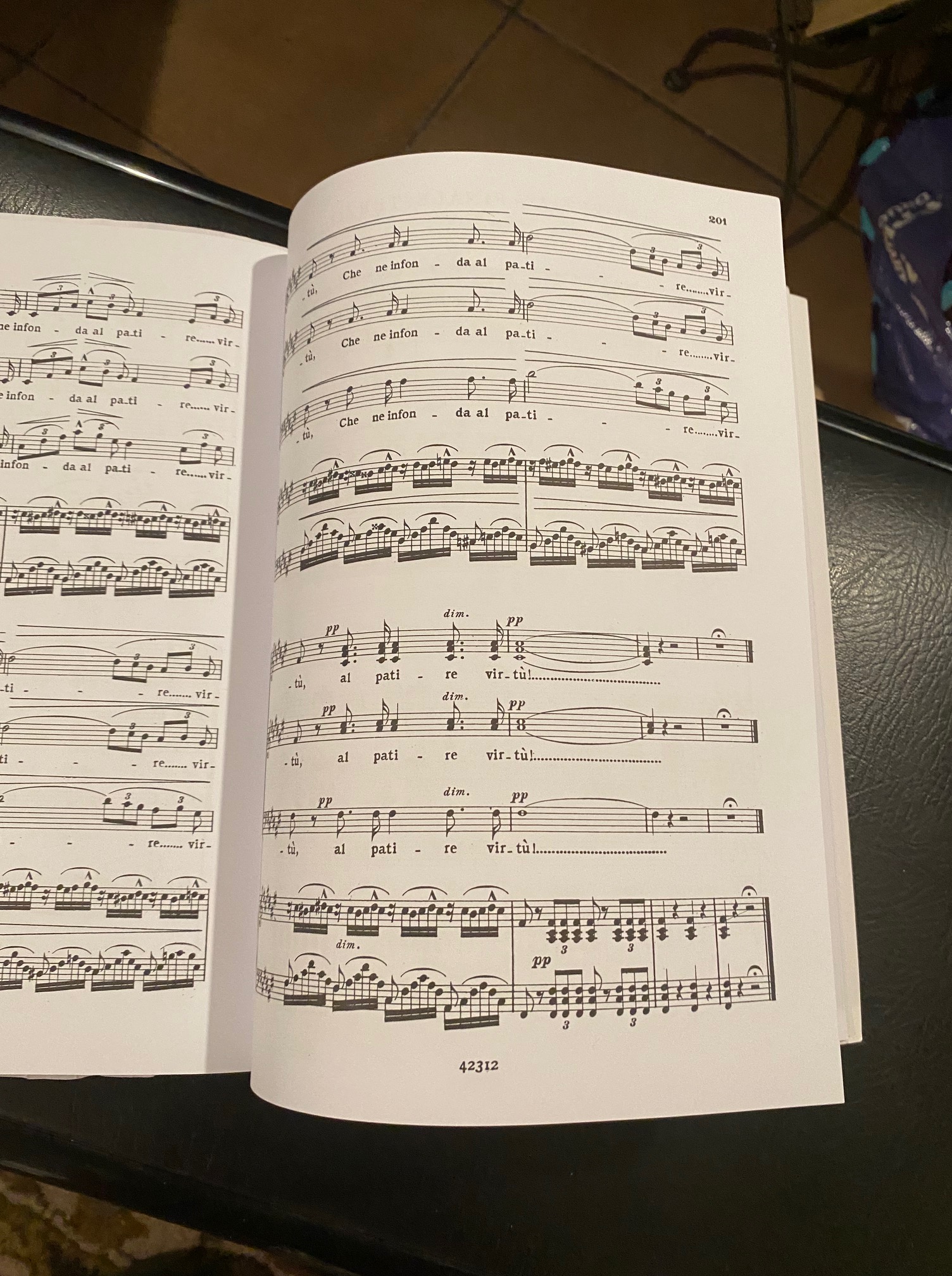
The difference between what we see in the score and what the COC chorus did is a stunningly simple alteration. You can see how the voices sing “virtu” followed by two chords in the piano-vocal score, corresponding to the orchestra..? In other words, the voices cut off while the orchestra plays.
But that’s not what we heard.
Whether this was the creative idea of the conductor or the chorus master, it’s something that they would have created as a team, executed both times I saw the opera. Instead of letting the orchestra finish, the chorus softly persist with their last note long after the orchestra are done, the chorus holding their gentle sound unaccompanied for several seconds of magic. It was hauntingly beautiful adding to the beauty of this moment.
No wonder the audience responded with powerful applause.
When I went fishing for this in my score, i remembered the other, even bigger departure from the original. In the last scene, large passages are done unaccompanied, the chorus and soloists singing a cappella.
I am reminded of something we regularly did at Hillcrest Church with the quartet of soloists or even with our choir on occasion under the direction of David Warrack: namely to do entire verses or entire pieces a cappella.
The audience or congregation listen differently when singers are unaccompanied. There’s an intensification of the drama. Need I add that it’s scary for the singers, knowing that a page or two later in the score, the orchestra will re-enter and we will find out whether they’ve been singing in key or gulp out of key.
If you’ve ever sung a cappella you know how challenging this can be. There you are singing without the usual support system –the accompaniment that keeps you in tune– and so uh oh, what if you wander into the wrong key, going flat or sharp? You aim to stay in tune when you don’t have the orchestra’s support to keep you in tune. When the accompaniment (whether it’s piano, organ or orchestra) comes back in: it’s like a test. Did you stay in tune? At the end of bel canto cadenzas when the orchestra enters for the last chords, it can be embarrassing! But for these big long unaccompanied passages both times I saw the COC’s Nabucco the re-entry was brilliantly precise!
Whoever had the idea to depart from the way it’s written in the score –between COC Chorus master Sandra Horst or Conductor Paolo Carignani — the execution of this makes me want to credit Sandra for practising with the chorus and getting perfection from them. But it’s a team event, the singers deserving credit above all. For all I know (as someone who doesn’t know this opera very well) it may be that this approach is a tradition, or something that’s regularly done. Or maybe it’s a brand new idea.
But I don’t know.
It’s also a bit of a reminder that both of the operas presented in the COC’s fall season are in some sense religious if not precisely Biblical. One leans more towards the Old Testament, the other (Faust) is Christian, but not from a Biblical source.
I will be seeing Faust again on November 2nd.

 barczablog
I saw Nabucco on Wednesday and I loved it. Your insights into the departures from the score add to the pleasure of my recollection. Thanks.
LikeLike
Thanks! That is always my hope, to be helpful.
LikeLike