Today was my first time attending a noon-hour Canadian Opera Company concert in a long time, tempted by a few magic words: a world premiere performance of excerpts from a suite of paraphrases composed by Julien Bilodeau, whose opera La Reine-garçon begins its run with the COC beginning January 31st. Today’s concert was first in a series from Bilodeau.
How could I resist?
Bilodeau composed in collaboration with Piano Lunaire, an organization founded by the pianist we heard today, Adam Sherkin.
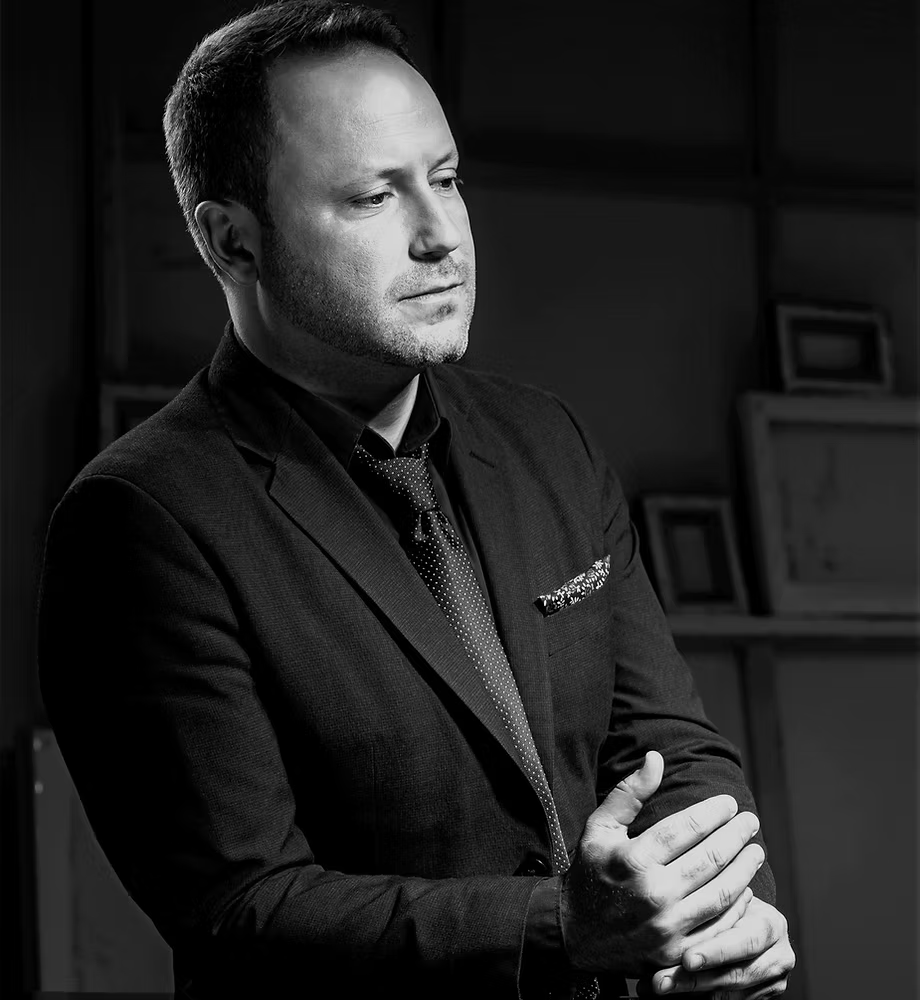
Their website describes the paraphrases this way:
Paraphrases on La Reine-Garçon is a collection of piano pieces based on the Opera La Reine Garçon: as this will be performed at the Canadian Opera Company in February 2025 on its main stage, Sherkin’s recital is designed to accompany its production by presenting Bilodeau’s musical style as well as providing a taste of the opera itself. The Paraphrases will reveal many thematic aspects of the opera: The struggle of Christina, Queen of Sweden, the characters surrounding her (Descartes, her two suitors – Gustav and Johan and her irascible mother) and her quest for free will. Each piece has a duration of approximately five minutes and develops the musical material of the opera for the piano. Through these six pieces, the listener will be transported on a condensed journey that recounts the highlights of the opera while being able to appreciate a pianistic writing that is both virtuosic and poetic
The program for today’s recital was as follows:
Ligeti: Etude No 15
Sherkin: Etude No 1 Op 21
Bilodeau: #3 and 4 of the Quatre Etudes du printemps
Bilodeau: #2, 4, 5, 6 of the Six Paraphrases sur La Reine-garçon
Both Bilodeau and Sherkin were generous in explaining their approach to collaboration. Bilodeau explained that the six paraphrases in the suite each tell us about a character in his opera. We heard four of them today, each distinctive in its sound.
First in the suite came #2 Faraud. I’m not sure I fully understood this one, as we were told that the character being portrayed was someone who saw themself as more competent & adept than they really were in fact. The music was playful with phrases suggesting dance, but I didn’t hear ineptitude. The funny thing is that even here the music was stylish and beautiful.
Next came #4 Fleur de peau, for an interaction between Queen Christine and another woman, when she felt something like attraction. I thought this one worked well, a series of repeated notes to suggest a trembling excitement, first high then lower as a sort of motif for the new idea, among luscious sensuous clusters of notes. It was clever, powerfully suggestive. Or maybe I have an over-active imagination.
Next came #5 Cogito, which was about Rene Descartes, who Christine invited to help understand her psychology. Of course there was no Freud in her century, so Descartes was a good idea, even if he was intent on figuring out the anatomy of faith, looking inside a cadaver for the organ connecting the mind and the spirit. I was reminded of the music Richard Strauss employed in the “Of Science” segment of Also sprach Zarathustra, a complex music to suggest mental complexity and over-thinking. But in time the music settles into something calmer, quite beautiful.
We moved into the last segment without pause 6 Libre arbitre. This was the most fervent and passionate of the pieces, reminding me of Schumann’s closing section of his Scenes from childhood titled “the poet speaks” or the finale of Ravel’s Mother Goose. All four of the paraphrases make me eager to hear the opera, gorgeous music full of drama and emotion.
I am reminded of a famous quote from painter Maurice Denis who said “Remember that a painting—before it is a battle horse, a nude model, or some anecdote—is essentially a flat surface covered with colors assembled in a certain order.” This is important when we recall that pieces of piano music that might tell a story or remind us of a picture or character, are first and foremost a series of notes on the page, a piano composition to challenge the pianist. I bring it up because whatever the relationship between the piano paraphrases and the opera, we heard some gorgeous playing from Sherkin, especially in the paraphrases. We heard a virtuoso playing effortlessly in front of us on the Steinway.
In a friendly chat with the composer afterwards, he remarked that this isn’t quite the usual we know from the paraphrase tradition. We know of a history of virtuoso compositions with a few usual objectives.
- to show off the pianist’s abilities
- to show us the music being paraphrased in a different light
- to promote the composer being paraphrased
Franz Liszt was one of the first composers making concert paraphrases of everything from Schubert songs to operatic quartets from Verdi. I’m a big fan as a listener and as a player even if I can’t always manage the pieces, which are a wonderful challenge and a new lens through which to see the original piece.
Bilodeau admitted, however, that his paraphrases were a bit different from what we’d seen before. The usual paraphrase (if we can speak of such a thing when the traditional type happened long ago) would take a familiar piece such as a Schubert song and then turn it into something quite new. Yes we would recognize the melody but the pianist was offered a showcase for their brilliance.
We can think of them as adaptations. Let’s recall Linda Hutcheon’s observation that the pleasures of an adaptation lie in the layers through which we perceive the original. If we don’t know the new Bilodeau opera, if we have not heard it yet, the paraphrase hits us in a different way than if we’re hearing a paraphrase of a well-known melody, because we could not distinguish the new from the old, as it’s all new to us.

But there’s also another way that such a composition works, as Liszt showed in his time. Before we had recordings, the pianist brought unknown music to the world that otherwise would have been ignored, thereby publicizing and popularizing music that had not yet been heard, such as the music of Berlioz or Wagner.
We had an impressive display of pianism, with more to come. Piano Lunaire will be offering this program (with a few extras in some of the venues) a few more times in Toronto, Montreal & New York.
February 5 — 12:00 pm. Toronto Arts and Letters Club, Toronto
February 8 — 8:00 pm Tenri Cultural Institute – New York City
February 12–7:30pm Montreal
February 20–TBA Canadian Music Center – Toronto
Further information can be found on Piano Lunaire’s website.
And of course we also have Bilodeau’s opera coming to the COC January 31st until February 15.
 barczablog
Pingback: Varieties of virtuosity: an interview with Piano Lunaire founder Adam Sherkin | barczablog