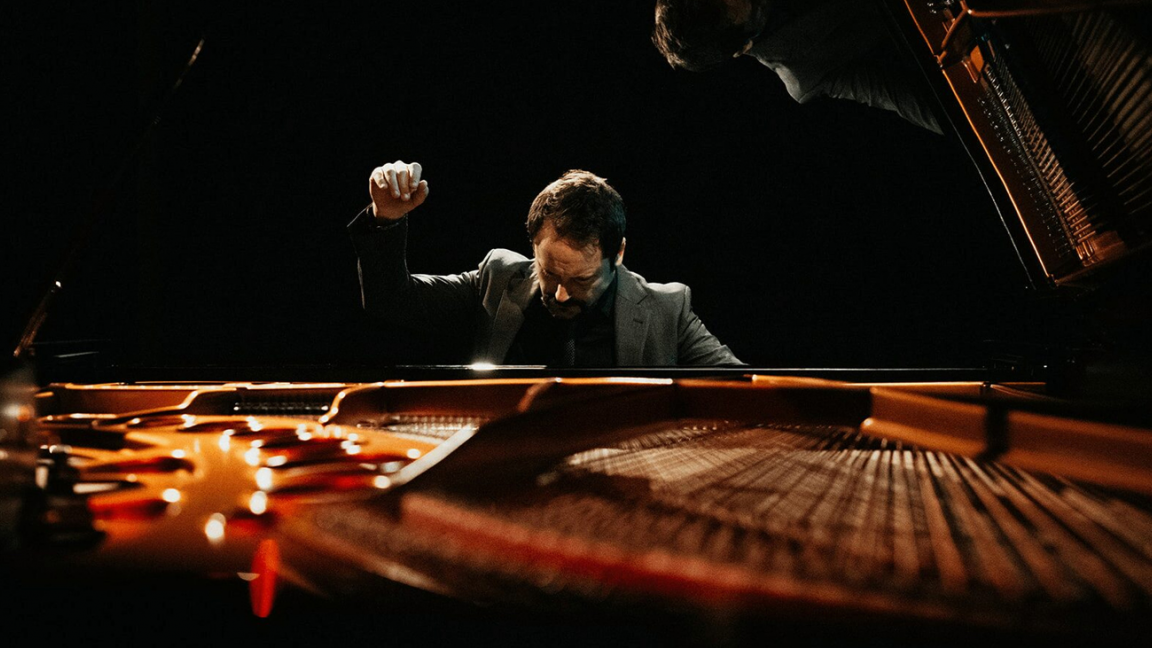
Last month I was delighted to discover Adam Sherkin at a free noon-hour concert in the Richard Bradshaw Amphitheatre, a brilliant pianist & composer I probably should have heard sooner and founder of Piano Lunaire.
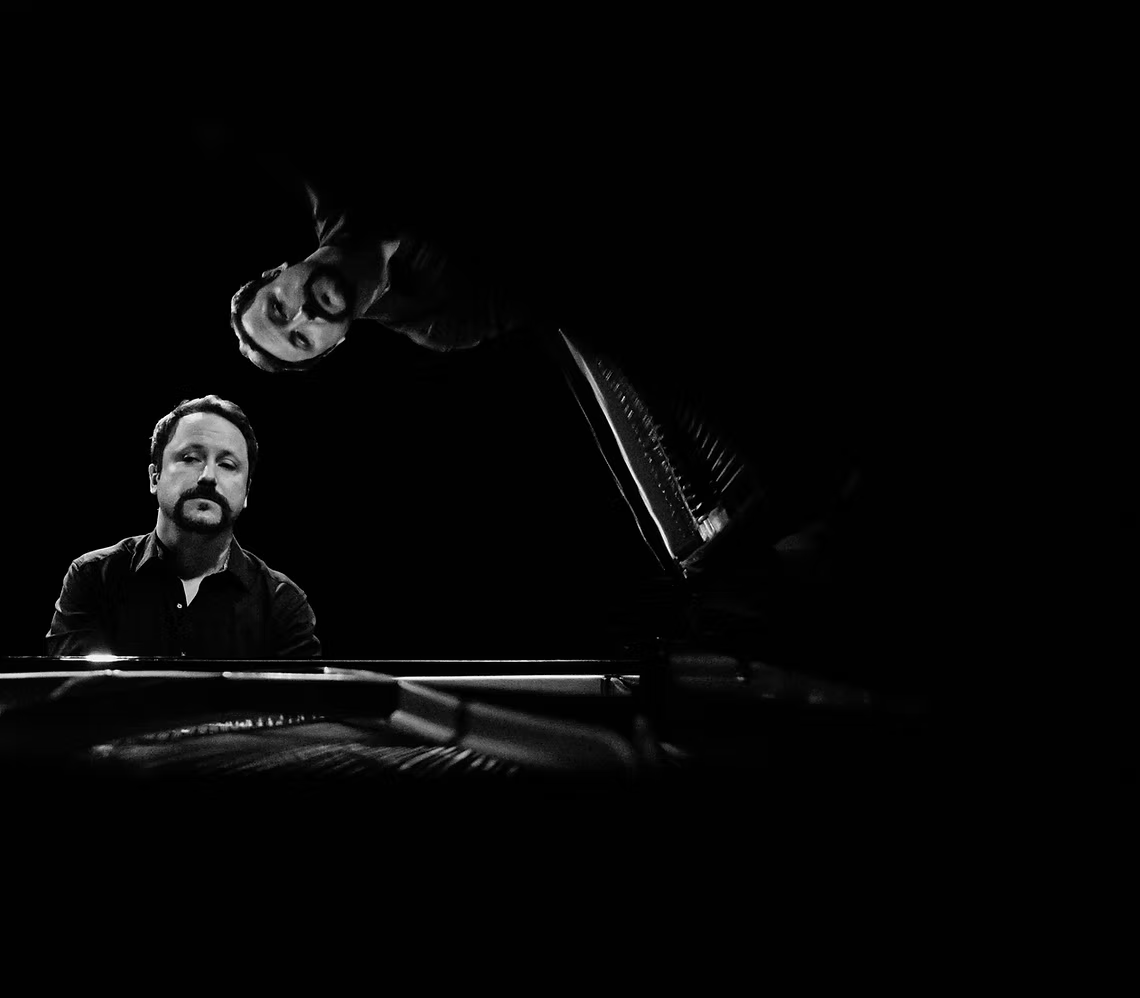
I jumped at the chance to hear his concert as an opportunity to explore Julien Bilodeau’s La Reine-Garçon through a series of piano paraphrases based on his opera. I am a bit obsessive about such music both as a listener and as a pianist even if these virtuoso pieces are sometimes beyond my abilities. I wanted to know more, so I had to interview Adam.
*****
Barczablog: Are you more like your father or mother?
Adam Sherkin: Artistically speaking, I am more like my mother. She is a painter and poet and has worked in the visual arts her entire life. I grew up adjacent to her practice and would frequently visit her studio. She is also an author of children’s books on colour, form and shape, encouraging young minds to appreciate our world in multi-color and contrasting spectra, not just in black and white.
My father – a successful entrepreneur and corporate professional trained as an industrial engineer – has ever been supportive and understanding of the so-called “artistic life,” firstly supporting my mother’s pursuits when they married and then in turn, his son’s (ie, moi). In fact my entire family has been overwhelmingly supportive of my musical practice. We grew up, more or less, in an artistic household. (I have a sister who is a talented photographer and musician, amongst other impressive skills including pottery, darning and wood-working).
Both of my parents knew something about playing music: my father used to bring out his clarinet on occasion and even was a stand partner in high school with Hollywood’s famed composer, Howard Shore. My mother’s father was a pianist with a gifted ear and might have gone further had he not turned his sights to the Canadian Armed Forces in the 1930’s. He would often listen to me play in his senior years and heartily encourage my piano practice when I was an adolescent. He has a knack for Sergei Rachmaninoff and Duke Ellington, often commingling the two at the keyboard in a single (somewhat improvisatory) sitting.
BB: What is the best or worst thing about what you do?
Adam Sherkin: I suppose like many freelance artists and many professionals for that matter, part of my days are spent on tasks I don’t particularly find engaging nor creatively nourishing. Gone are the days when a pianist/composer could simply devote the entire work day to their art and trust others to manage one’s career. While a handful of artists still enjoy this existence in the 21st century, I do not have such luxuries. I constantly hanker for more creative time: both at the piano and with my manuscript paper (I still try to compose by hand!) Nevertheless, the power of our digital media platforms cannot be undervalued and indeed, much of my success and the development of my career betrays a great debt to digital media and the power of networking both on and off the screen. It is still most important to get out and be a living, breathing part of one’s musical community. While the Covid-19 Pandemic has upended that practice and changed our comfort levels of interaction, I still favour real-life connections in a professional ecosystem. Fortunately, I have always been a social creature and this part of the job comes easy to me.
The best thing about what I do? Striving for that ol’ cosmic connection of course. Sure, the business side of Piano Lunaire has been truly rewarding and our commissioning work and outreach is something I’m eminently proud of. But the heart of the matter, the real deal, is to connect with other humans in time. That is ever the goal: to reach an audience in new ways and to urge them, compel them, grip them in the time continuum of dialogue and expression. Our great task – (and one we rarely achieve) – is to move our audience through the medium we wield and move in. At its highest of callings, we are tasked on stage to transform our audience and in some way change them – their humanity – for the better. That’s the name of this relentless game. It’s a calling, a purpose, a dedication or great folly. But as I am about half-way though my life now, there’s no going back. I have been a devoted musician since the age of twelve and a musician I shall be until the end, (this go-around anyway.)
One thing is steadfastly true: there remains no better place I know in this realm of existence than being on stage, at a fine great piano, with a full house and with a masterwork to play for them.
BB: Who do you like to listen to or watch?
Adam Sherkin: When I was younger I had a more eclectic palette but there’s just too much darn good music under the sun. So, these days, I listen/watch traditional and new classical music almost all of the time. On a good day, I will sit down with a (new) score and listen to a work I do not know. This is a special kind of active listening, highly advisable for composers. It instills new ideas and often inspires one to keep writing their own work. One of my teachers at the Royal College of Music in London, David Sawer, adopted this daily practice and it’s a good one. I also enjoy decent films and have a soft spot for old comedy shows of the British variety: Keeping Up Appearances and Two Fat Ladies* are (not so) guilty pleasures.
*The delights and merit of these two unexpectedly hilarious celebrity cooks must n’ere be underestimated! (May they rest in peace.)
Occasionally, I’ll attend a jazz set and have recently become more compelled to hear organ music. Living in New York (and a stone’s throw away from the Metropolitan Opera), I have endeavored to make more space in my life for opera, though I prefer the contemporary ones or at least those written in the last 100 years.
Hands-down, my five favourite composers have long been: Haydn, Fauré, Copland, Claude Vivier and John Adams.
BB: What ability or skill do you wish you had, that you don’t have?
Adam Sherkin: I wish I could have the sort of scientific mind that can think fluently with advanced mathematics and more specifically, a mind that creates and invents in the sphere of cosmology and theoretical physics.
BB: When you’re just relaxing and not working, what is your favourite thing to do?
Adam Sherkin: Spend a day exploring the city; a picnic in the park with a book or hosting an intimate dinner party.
BB: What was your first experience of music ?
Adam Sherkin: While my first musical experience was performing Rudolph the Red-nosed Reindeer at a Christmas recital aged 6, my first important musical experience was at the age of twelve: I heard Emmanuel Ax perform Mozart’s 22nd piano concerto, K. 482 with the Toronto Symphony Orchestra under the baton of Jukka-Pekka Saraste. After hearing such sublime collaboration and the artistry of Ax doing, well, just the kind of thing that Ax does best, I was hooked; It was on that night that I decided to become a musician.
BB: What is your favourite melody / piece of music?
Adam Sherkin: Ach! Nearly impossible to choose. How about this:
First light: any Domenico Scarlatti sonata in D major
Midday: something lyrical and andante-ish by Aaron Copland OR: the first movement of Century Rolls by John Adams
Day’s close: a late nocturne by Gabriel Faure
BB: Are there any well-known transcriptions by classical composers (Rachmaninoff, Liszt, Busoni ) that you enjoy playing…?
Adam Sherkin: When I was a teenager, one of my teachers, Boris Lysenko, revealed himself to be a crazed fan of Liszt operatic paraphrases. Specifically, he loved the Mozart transcriptions and performed the Don Giovanni paraphrase (aka Réminiscences de Don Juan, S. 418) often in his own career. He urged me to find a less familiar Figaro-Giavanni transcription, hard to come by in those days. It was left unfinished (semi-improvised?) by Liszt, S.697 and was – and is – fiendishly difficult. It paraphrases two operas: The Marriage of Figaro and Don Giovanni. I got a hold of a score completed by Leslie Howard, the great Australian Liszt specialist, and to this day I still can’t really play it. Perhaps I’ll dig it out one summer and honour Boris Lysenko’s memory, learning it properly.
Amongst the more reasonable bag of paraphrasiastic tricks is Liszt’s Ballade from The Flying Dutchman (after Wagner) which I enjoy performing. Another memorable piece in my repertoire is the Liszt transcription from Wagner’s Parsifal, “Solemn March to the Holy Grail. (My performance of it, live)”. I had the good fortune to play this work on a Steingraeber piano for Udo Steingraeber, honouring his visit from Bayreuth to Toronto and the 200th anniversary of Richard Wagner’s birth: May 22nd, 2013. It was Steingraeber & Söhne who built the Parsifal bells for Wagner in 1882, as included in the opera at Bayreuth.
A comparable piece to the march is Busoni’s Funeral March for Siegfried’s Death from Wagner’s “Götterdämmerung.” I also have enjoyed performing paraphrases by Rachmaninoff as well. While not technically paraphrasing operas, Rachmaninoff’s works from his later years are superb and I have played them often:Paraphrase of Mendelssohn: Scherzo from the Incidental music to Shakespeare’s A Midsummer Night’s Dream (1933) and; Paraphrase of Tchaikovsky: Lullaby (Cradle Song Op.16, No.1).
Moving forward to our own time, Thomas Adès has revived the genre somewhat with dazzling paraphrases on his own operas. Perhaps the most famous of these is the Concert Paraphrase on Powder Her Face, taken from his first and highly acclaimed opera. To his catalogue, he has added various pieces from The Tempest and The Exterminating Angel. The dark and beautiful Berceuse from The Exterminating Angel is included on my recital programme in Montreal this month, featuring Bildoeau’s complete paraphrases on La Reine-Garcon and selections from my own solo piano cycle, Northern Frames.
Perhaps one fine day, when I finish my own first opera, I’ll have the chance to write and perform (my very own) operatic paraphrases!
BB: do you have any ideas about reforming / modernizing classical music culture to better align with modern audiences.
Adam Sherkin: Too many to recount here. It’s an involved discussion and an ever evolving set of ideas. It’s been the focus of my presentation. since I left college in London in 2008. In brief: don’t underestimate your audience (ie. Challenging them is good). The venue lights shouldn’t be too bright, the program not too long, the bar should remain open throughout and the atmosphere must have a buzz. The slicker the venue, the more modern the feel. Intermission needs to come after one hour of music AT MOST and the ticket prices need to be reasonable. Don’t bore your audience and don’t ever, ever take them for granted. Put yourself in their shoes from first to last experience, including ticket purchase, arrival at venue and final round of applause.
BB: You are both a pianist and a composer . Talk a bit about your background training, and how you got here.
Adam Sherkin: My training began at the keyboard. I was fortunate enough to have excellent piano teachers all along the way, beginning with Claire Hoeffler at her studio in High Park. I entered the Glenn Gould School academy training program when I was 16 and thereafter the university level courses at age 19. My years at GGS were formative and I learned a great deal from the teachers and masterclasses. Leon Fleisher, Marc Durand, Boris Lysenko, Andre Laplante and John Perry: what a roster! The conservatory atmosphere was ideal to focus on musical development and the small student population forged great camaraderie.
In my second year, I performed Messiaen’s piano concerto, Couleurs de la cité celeste, with the orchestra, under the baton of Alain Trudel. This really turned me onto contemporary music. That same year, I also began to compose in earnest. Jack Behrens, who was Dean of Academic Studies at the time, (and who passed away in December of 2024), was especially generous in his encouragement of my compositorial abilities. After the creation of some early pieces I took a year off in between bachelor and master degrees and worked up a compositional portfolio. Jack was very supportive of my studies in this field and so I applied to attend a master’s program in composition with a minor in piano performance, (as opposed to the other way around!) I settled on the Royal College of Music, London and figuratively set sail for the Old World.
In London, the opportunities seemed limitless. I had excellent training there as a composer (much needed by this point) and I was fortunate to study performance with pianist Andrew Ball, a specialist in new music. It was in London that I found my pianist/composer profile and upon graduation, embarked on a career in both disciplines.
After three years and some performances and composition work in London, I returned to Canada. Freelancing in Toronto started immediately and I also worked at the Royal Conservatory and helped out in the New Music Ensemble there, under Brian Current. After nearly a decade in Toronto and multiple seasons of solo recitals, premieres, chamber music and vocal coaching, I decided it was time for something new.
I applied for the professional studies program at Mannes College in New York and mentored there with composer Lowell Liebermann in Fall of 2019. Through the pandemic I remained in Canada but finally completed my studies at Mannes by Spring of 2022. Since then I have made my home in both New York and Toronto and brought the production company and record label, Piano Lunaire, to the USA.
I have been fortunate, as a Canadian, to have worked and studied in these three locations: London, Toronto and New York. It is important, even today, for Canadian artists to gain such wider perspectives, if providence and luck allows. Spending time in both Britain and America respectively have taught me more about my relationship to Canada and this country’s (still very young) musical lineage.
BB: You’re performing the six paraphrases based on Julien Bilodeau’s opera, La Reine-garçon. Please give me a synopsis of how you understand the six pieces: the story / idea that the composer is trying to tell us in each piece.
Adam Sherkin: Originally, Julien and I conceived of one paraphrase containing various sections. That vision quickly augmented into three paraphrases and before we knew it, Julien had produced SIX! He seems to believe it vital to include each of these complementary profiles (pieces) to give a full overview – a condensed form – of the opera. Interestingly, the paraphrases evolved as a kind of character suite, highlighting the major roles and the various dramatic junctures that occur throughout the narrative of La Reine-Garcon. While this is not a literal transcription, musically speaking, Julien has distilled the essential aspects of each character and offers tableaus that can one enjoyed irrespectively of the operatic experience.
The six paraphrases, in chronological order, are entitled: “Butor,” “Faraud,” “Courroux,” “Fleur de peau,” “Cogito” and “Libre arbitre.” Generally speaking, these pieces are fast and virtuosic: highly demanding and technical. But within the virtuoso textures, varying expressions emerge and intersect. The character profile of each is palpable.
Julien describes this process in his composer’s note to the score:
“The Paraphrases reveal many thematic aspects of the opera: Christine’s struggle (the queen of Sweden), the characters surrounding her, (Descartes, her two suitors – Gustav and Johan – her irascible mother) and her quest for free will. Each of the pieces, lasting approximately five minutes, develop the musical materials of the opera at the solo piano. Through these six paraphrases, the listener is transported on a condensed journey, relating the highlights of the opera, while being able to appreciate pianistic writing that is both virtuoso and poetic.”
BB: Thinking again of the six paraphrases, did any of these scare you or give you trouble when you first played them?
Adam Sherkin: There were some initial discussions for revision. Julien produced a first draft in August and we met in Montreal in mid September (2024). Over two intense days of workshopping, we played through the entirety of the score and revised certain passages, clarified notation and adjusted pedaling. Julien has been particularly fond of the sostenuto (middle) pedal in this work so we spent quite a lot of time on performance logistics related to the sostenuto pedal. He also has a predilection for wide intervals: 9ths and 10ths. While I can span particular 10ths, not all are manageable for me. In the hands of another pianist with a larger span, these passages might be doable but at least for our immediate purposes, 10ths were generally rewritten as octaves.
Through the next working phase this past Fall, as these six paraphrases came up to performance level, some of the tempi proved too quick to realize at the piano (the orchestra can sometimes play faster than keyboards!) So Julien has been most gracious in reducing the speed of the metronome markings; this also can depend on the venue and specific acoustics (ie. reverb, dryness, immediacy of sound, etc.)
BB: how difficult are these paraphrases for the pianist to play?
Adam Sherkin: In many respects, these paraphrases are on par with those works of the same genre by Liszt, Rachmaninoff and Busoni. Julien does not hold back in his demands on the pianist, writing multiple textures and constant barrage of notes and episodic changes. The trick here is to make the music sound easy and always within the performer’s control, all the while being technically demanding, requiring extra stamina.
These paraphrases are indeed on the order of virtuoso pianism. That’s why we have themed the tour, “Paraphrases for a New World.” Julien and I will continue to make adjustments and find more efficiencies in realization here as we premiere and eventually record this music, but they nonetheless remain difficult pieces for almost any pianist who opts to tackle them.
BB: It was great to see you and Julien Bilodeau sharing the RBA stage for the concert January 23rd, collaborating and discussion working together. How did you meet and how did you begin to collaborate?
Adam Sherkin: I was familiar with some of Julien’s work through Nouvel Ensemble Moderne and my time attending a workshop in Montreal with the Bozzini Quartet. Colleague and friend, pianist Matthew Fortin had premiered Julien’s piano concerto in 2012 (with much success) so when COC announced their 2024-25 season last Spring in Toronto, I approached Julien straight away and suggested a collaboration for the RBA Free Concert Series, analogous to the opening week of La Reine-Garcon. Both he and the staff at COC proved receptive to the idea and we began to make plans and source funding for a new commission (Six Paraphrases) and the revision of Julien’s existing piano music (Quatre Etudes).
BB: When you’re playing a piano piece based on an orchestral work as you do with paraphrases based on operatic composition, how do you imagine yourself reconciling the two extremes, between aiming to channel the orchestra’s sound vs playing the piece as written.
Adam Sherkin: I do not conceive this as a challenging of two extremes, rather I perceive orchestral tonal palettes informing the work in this instance even more than usual. We often hear talk of colour and orchestration in piano pedagogy, regardless of whether the music in question exists in a symphonic or other comparable form but I think there is a starting point here with a full orchestral score-to-keyboard (ie. clarinet solo or percussion sonorities). The next important step is for the pianist to evoke that orchestral sonic vision and expand it, offering conviction from the keyboard’s special vantage point. This remains a significant aspect in crafting (and performing!) a successful solo recital.
BB: In the era of the old-fashioned competitive virtuosi, when Busoni or Brahms or Rachmaninoff had their own paraphrases, they wouldn’t play those of other pianists: which is a shame. And of course maybe I’m foolish to think you listen to a contemporary pianist. But could you comment as to whether we could ever hear for example Stewart Goodyear play your transcriptions or vice versa (you playing his)? I think it would be wonderful.
Adam Sherkin: This raises an interesting point. In principle, I am an advocate for my community, colleagues and, well, direct competitors. I believe that when one of us excels, we all can, especially in Canada and specifically, Toronto. We must nurture one another and support a healthy ecosystem of music-making, idea-sharing and commissioning of those composers we believe in and respond personally to.
An American colleague and fine pianist in New York, Konstantin Soukhovetski, has a particular knack for skilled transcriptions and has written some very beautiful examples; I have plans to perform some of them soon. On March 15th of this year, at NYC’s Merkin Concert Hall, Anthony de Mare and I will perform a duo piano programme that includes four opera transcriptions by Canadian composer Rodney Sharman.
Now, I admit that I am unfamiliar with Stewart Goodyear’s Nutcracker transcription (as many excellent such essays of the ballet already exist for keyboard) but I am keen to change that and hear them. Stewart Goodyear is an excellent example of a pianist-composer who challenges himself and his audiences to expand their notion of the 21st century virtuoso. Perhaps I can ask him for the score of his Nutcracker transcription and in turn, offer Bilodeau’s paraphrases on La Reine-Garcon.
Since Piano Lunaire and I helped to commission Bilodeau’s new music, we have exclusivity for a few years now but once that time is up, I would be thrilled if other pianists wish to take up these new operatic transcriptions. This is a novel and topical contribution to the Canadian keyboard repertory.
BB I want to ask you about your own compositions. I saw that you composed four piano sonatas, written over a span of fifteen years: 2008 to 2024. Tell me more.
Adam Sherkin: I was lucky enough to present a quasi-retrospective recital in September in New York: all four of my solo piano sonatas. Rarely do I have an opportunity to play an entire performance featuring only my own work. I presented these pieces in chronological order and discussed each one, offering a context for their conception, autobiographical details and their evolving performance and recording practice. The fourth and final sonata to-date (2024) included a part for toy piano.
The first sonata, “Sunderance” was recorded on my debut album in 2012, As At First. Sonatas nos. 2 and 3: “Cŵn Annwn” and Ended in Ice” respectively will be included on my next solo album, to be released in late Fall 2025, Open Myths.
BB: It was an unexpected thrill to hear the way you play the Mozart K 311 on Youtube (my favourite of all the Mozart sonatas), especially your willingness to elaborate / depart from the score as written, creating something fresh & new.
I’m certain Mozart would approve, as surely what you’re doing was normal in his time. Should we expect any other classical works in the future of Piano Lunaire?
Adam Sherkin: I am so very pleased to hear that, thank-you. I used to present a lunchtime series at the St Lawrence Centre a few years back (2013 through 2018) that took place on the first Thursday of every month, themed Write Off the Keyboard. I enjoyed these recitals immensely. They offered an opportunity to work on traditional repertoire by composer-pianists from our not-too-distant past: Scarlatti, Haydn, Beethoven, Chopin and Liszt of course; Brahms, Granados and yes, MOZART! I’ve always adored Mozart’s keyboard music and therefore relished the opportunity to present it alongside contemporary works. Much new music exists from our own time that either pays homage to the famed Viennese composer or takes inspiration from his catalogue and uses existing (original) materials.
But of that particular compositional school, my first love has been the piano works of Franz Joseph Haydn. I have always felt free and spontaneous amongst the (fifty-plus!) sonatas of Haydn and always experiment and embellish, ornament and invent. This proclivity likely shows itself in my Mozart interpretation also as I revel too in finding new and unexpected ways to infuse Mozart’s well-worn keyboard music with a sense of discovery, adventure and a healthy dose of joviality. (The recitals on the Write Off the Keyboard series that features Mozart’s works were entitled “MOZART: Involuntary Genius.”)
BB: Yes! K311 often sounds like laughter, and you bring that out beautifully.
Adam Sherkin:As for Piano Lunaire’s Mozartian programming prospects, they remain slight as we tend to favour Haydn. Just this past summer in both New York and Toronto, we piloted the “High Summer Haydn” festival, offered on midweek evenings at a pay-what-you-wish price point. With a later start time of 9:00 pm and an open bar, these summer concerts were rather successful. The focus was, naturally, on Haydn’s piano music and included highlights from his minor-keyed sonatas, works the maestro wrote in London on his trips there in the 1790’s and keyboard music written expressly for Prince Esterhazy II. We even brought a fun and quirky set of Haydn’s Scottish (!) folk song arrangements to Toronto’s Arts & Letters Club in September, featuring mezzo-soprano Chantelle Grant and TSO violist, Ivan Ivanovich. Currently, we are in the midst of planning for this coming summer at Piano Lunaire and will have more of Haydn’s irresistible inventions to reveal, with concert dates – soon!
Existing live recordings from the festival will be available on our YouTube page. An exciting part of this year’s festival includes small commissions from emerging composers that form companion pieces to Haydn’s keyboard sonata catalogue.
BB: Do you ever feel conflicted, reconciling the business side and the art?
Adam Sherkin: I used to feel more conflicted as a young person but I have developed these skill sets apace as I move through my career. I suppose I am young enough to have been taught about making your own way and not always relying on others to manage you. Moreover, the resources young artists have at their disposal today are impressive, overwhelming even. Despite my familiarity with the demands and the hustle, I often never feel like there is enough time for my art, a sad admission to make. Our world’s technological compulsions don’t help this, as there is ever a reason to be pulled away from the analogue and into the digital: endless emails that replying to, messages, posts, texts, promotional requests, listings, coordinations, banking, contracts, travel bookings, collegial discussions, Zoom meetings, on and on ad infinitum.
However, many successful artists navigate these fatiguing waters each day and enjoy wildly successful careers so, there is hope and there is a way forward!* It was firebrand, soprano Barbara Hannigan (ever an inspiration to me, not to mention a Canadian national treasure) who I first heard openly share her experiences around finding such balance. She continues to struggle with it but has achieved incredible success in her career and always engages – enthralls – her public. Through her integrity, devotion to the craft and ultimately humane approach to her business obligations, she provides us in this kooky industry a shining example of what is possible. We can both thrive at the business side and soar at the artistic, all in a single day.
* This reminds me suddenly of Sergei Rachmannoff, who after first visiting America in 1909 on a concert tour in that “accursed country,” complained of the inordinate emphasis on, “the business, the business…they are forever doing, clutching you from all sides and driving you on… I am very busy and very tired.” (From a letter to his cousin, Zoya Pribitkova.)
BB: Could we talk about virtuosity? When we think of Bob Dylan or KD Lang reconciling sincerity & skill, nobody insists that they hit high notes or play difficult riffs on their instruments, so long as there’s a connection. As artists are we trained animals showing off? Debussy and Wagner both spoke of the virtuoso as a kind of circus animal, and the applause as a kind of trap. I wonder what you’d say, as a performer who likely enjoys applause, especially given that you’re working as a virtuoso pianist, where I’m asking about virtuosity as though that were somehow measurable… Does this influence the way you write and how you perform?
Adam Sherkin: Hopefully, all performers enjoy applause! And equally, all audiences enjoy real pyrotechnics and feats of virtuosity. But this cannot be all a performer offers to their audience, especially not when that performer eventually grows up (ie. post 21 years old)
Virtuosity and technical prowess does influence the way I write, at the piano and off it. I believe that it is necessary to energize and incite our listeners. Sure, we can mutter, whisper, play quietly, slowly and poetically but this is a permission we need to earn on stage. Similar to how actors must earn their silences, musicians must gain the trust of audiences by showing them we can do almost anything: the journey we endeavour to take them on will be stimulating, nourishing, worthy and perhaps even surprising. We engage in a bond of confidence with our listeners, proclaiming we somehow know what we’re doing, that we can do the thing exceedingly well. They will get their money’s worth. If they trust us and we first prove that they can extend this trust, they just might leave our keyboard side elevated, inspired and forever changed.
BB: Since the pandemic a great many ways artists are working virtually, both as teachers and as performers. Do you have a preference between live or recorded performance and when you record how do you make it seem live?

Adam Sherkin: I have always enjoyed both live and recorded performance. During the pandemic, Piano Lunaire originated a digital performance platform, as did many organizations: LUNAIRE LIVE offered as close an experience to live performance as was safe during that period. But something was always missing when playing in an empty room with recording crew and myself alone, it could never replicate a true concert experience. On one occasion during a live stream, a fellow composer came to the outside of my living room, near to the piano, so we could open a window and she could hear her work played – such times! At any rate, the eventual return to live performance was warmly welcomed in my corner.
I tend to believe that truly fine recordings are an art form unto themselves. The medium of the proverbial long-playing record is to be cherished and celebrated, exactly for what it is. There are magics begotten in the recording studio, just as there are in a live concert hall.
BB: If you could tell the institutions how to train future artists, what would you change?
Adam Sherkin: As I don’t do a lot of teaching nor have ever held a full time position at a music institution, I might not be the most qualified to answer this. I will be ever grateful to my own teachers, many of whom have sadly passed on: Jack Behrens, Boris Lysenko, Colin Tilney, Leon Fleischer and Andrew Ball, among others.
If I could perhaps insist on one point though it would be this: instill a love and fearlessness in the young artists of today. Nothing is impossible and a dream-career can be yours for the taking, so long as you are prepared to seek it on your own. Our society (particularly in North America) might try and dissuade you and don’t wait for it to come find you: be brave and singular, drive out the noise and blind your sensitivities to all else that will never serve your artistic practice: this higher purpose.
*****
Paraphrases on La Reine-Garçon is a collection of piano pieces based on the Opera La Reine Garçon: as this will be performed at the Canadian Opera Company in February 2025 on its main stage, Sherkin’s recital is designed to accompany its production by presenting Bilodeau’s musical style as well as providing a taste of the opera itself. The Paraphrases will reveal many thematic aspects of the opera: The struggle of Christina, Queen of Sweden, the characters surrounding her (Descartes, her two suitors – Gustav and Johan and her irascible mother) and her quest for free will. Each piece has a duration of approximately five minutes and develops the musical material of the opera for the piano. Through these six pieces, the listener will be transported on a condensed journey that recounts the highlights of the opera while being able to appreciate a pianistic writing that is both virtuosic and poetic.
January 23: 12:00-1:00pm Canadian Opera Company Free Concert (review)
February 5: 12:00-1:00pm Toronto Arts and Letter Club
February 8: 8:00-10:00pm Tenri Cultural Institute New York City
February 12: 7:30 pm – 8:45 pm Salle Paul-Desmarais du Centre canadien d’Architecture Montreal
February 20: TBA Canadian Music Center Toronto