
This spring season of the Canadian Opera Company feels a bit like the second coming of Alexander Neef, their former General Director. Next week we’ll be seeing the revival of Robert Carsen’s Eugene Onegin, a production that Neef brought to Toronto in 2018. But this week it’s Wozzeck, a show I saw in the Metropolitan Opera’s High Definition series in 2020, announced this way:
“A co-production of the Metropolitan Opera;
Salzburg Festival; the Canadian Opera Company, Toronto; and Opera Australia.”
More than five years later, the co-pro has finally come to Toronto, long after Neef left Toronto and even his successor Perryn Leech left the COC.
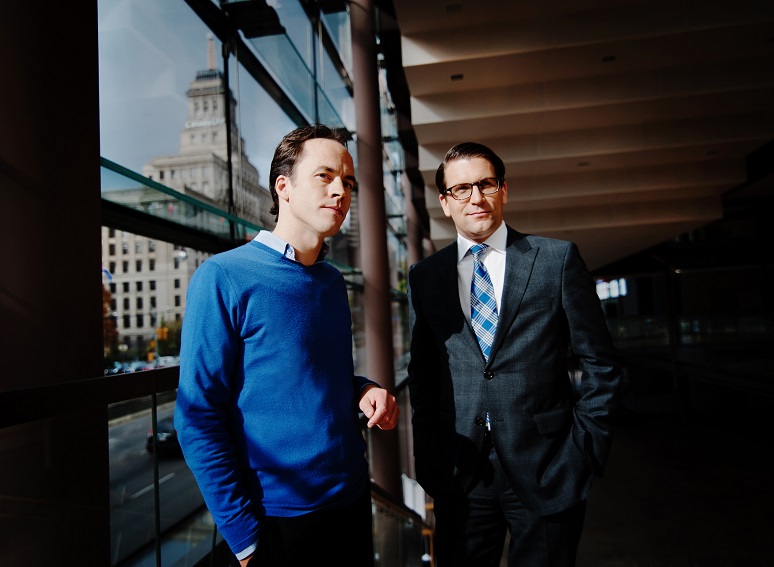
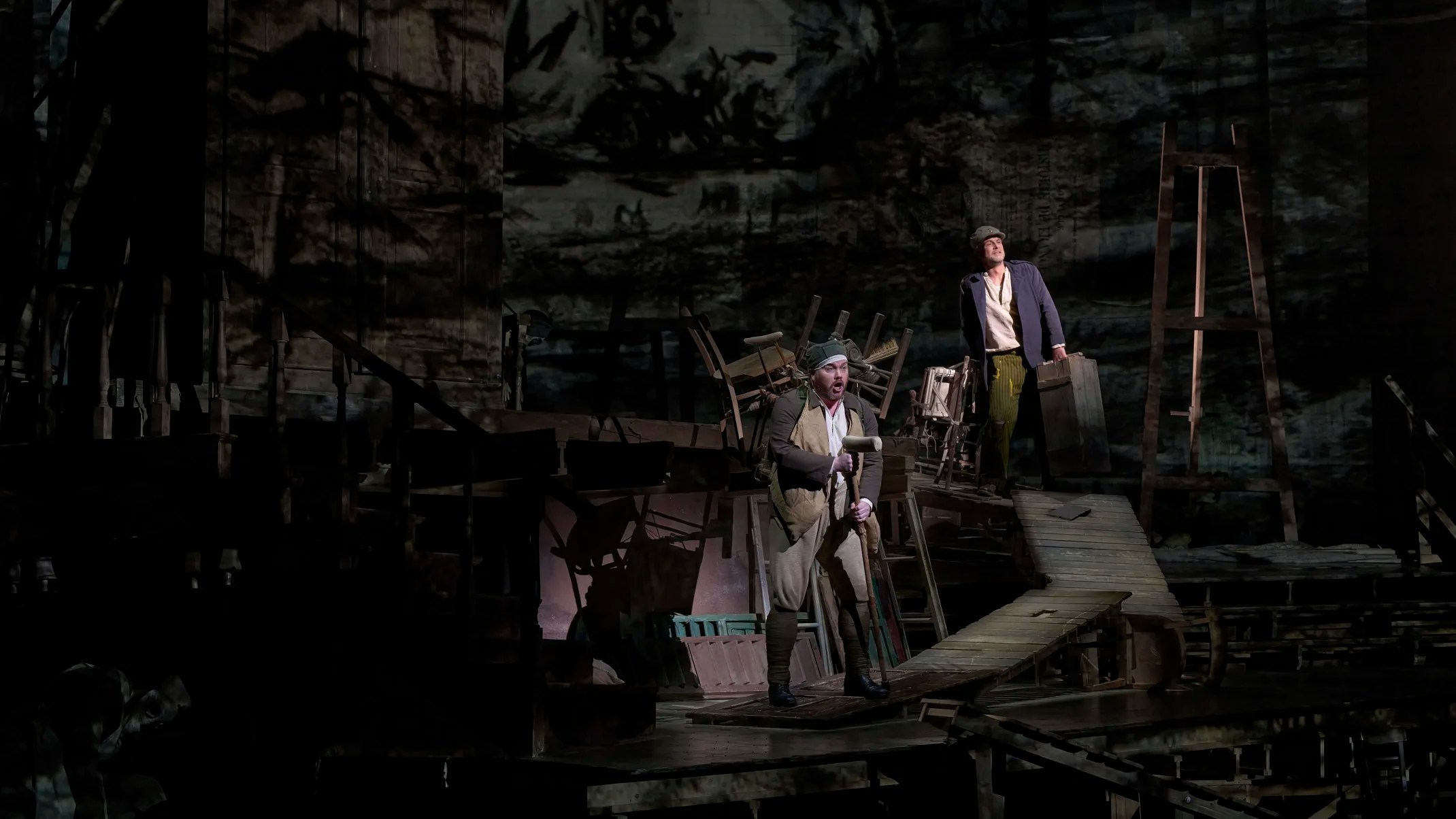
The other fellow in the picture is even more important.
Johannes Debus and the COC Orchestra met all the challenges of Alban Berg’s score, except perhaps one. In the scene when the Drum Major comes into the barracks, to boast about his conquest of Marie, the whistles weren’t easily audible. Except for that tiny silly detail, the orchestra and the chorus were absolutely perfect! I had to mention the whistle to underline my appreciation for what Debus and company accomplished. The lyrical last moments for each of Marie and Wozzeck were truly breath-taking, gorgeous and beautiful even if they were also eerie and grotesque.
Wozzeck is the pinnacle of 20th Century modernism, the top of a mountain first discerned by Liszt, shaped and climbed by Wagner, Strauss and Mahler. While there’s dissonance in the score, it’s not atonal, but the music is difficult.
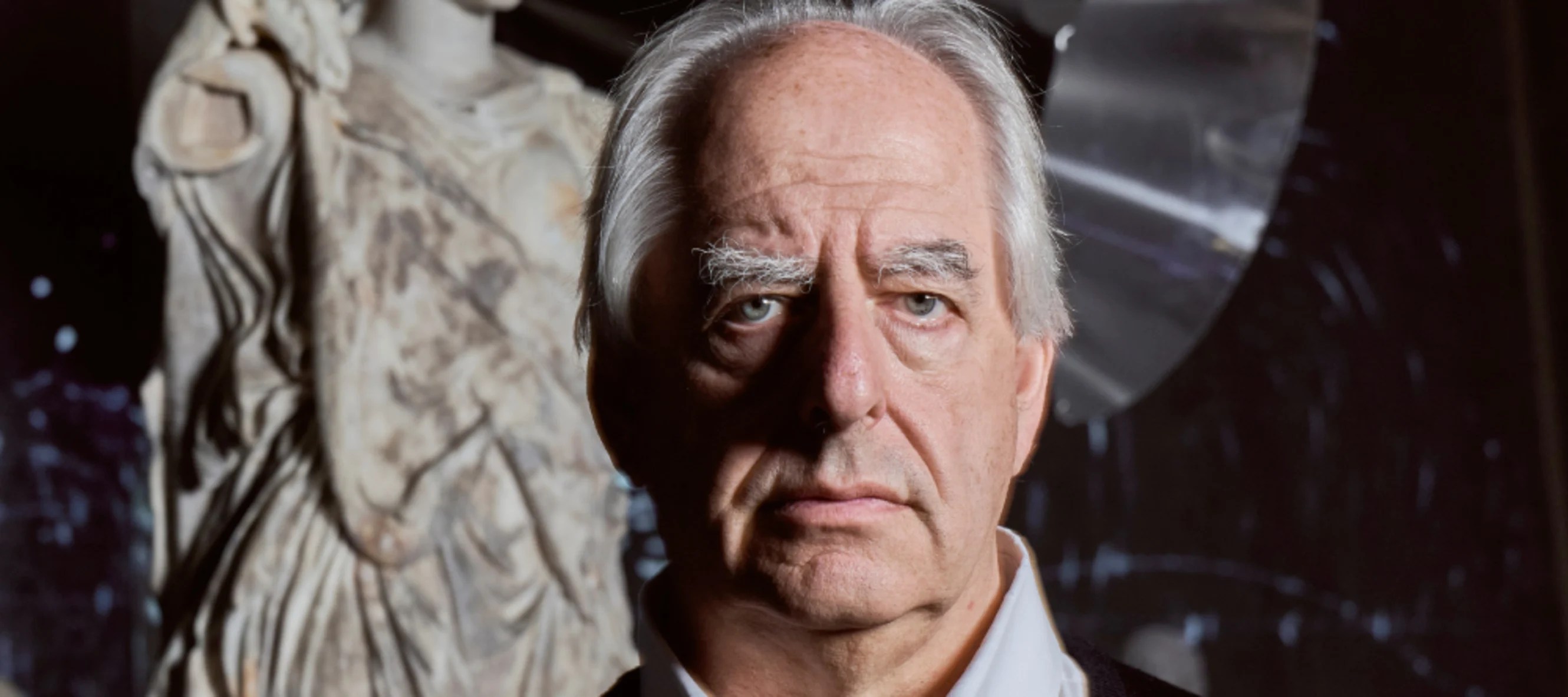
But if you have seen this Wozzeck you’re probably ready to label me a music nerd, given that I am omitting the real key figure in this production, one of the most remarkable stagings I’ve ever seen on a COC stage, namely the director William Kentridge.
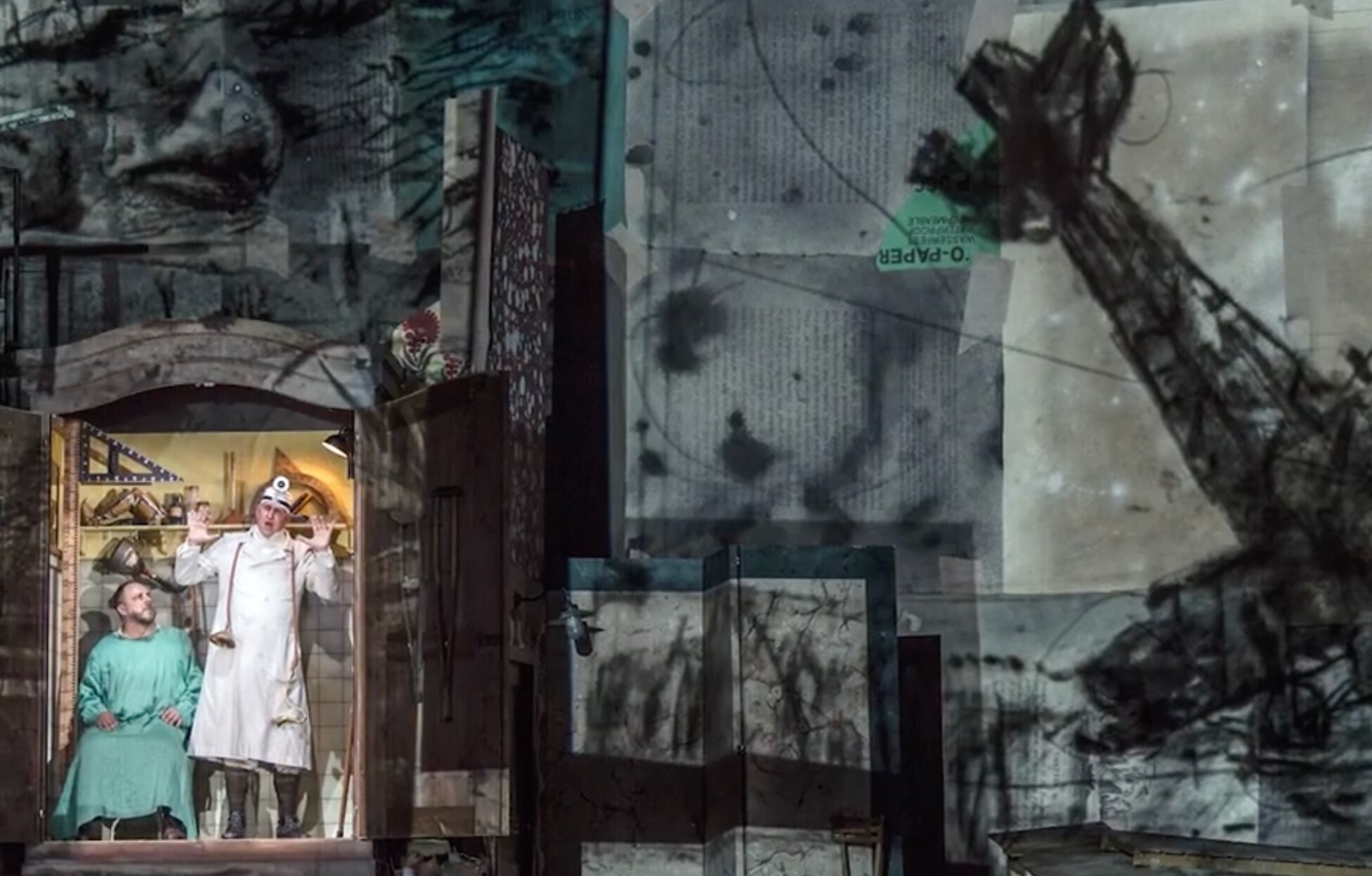
Kentridge has a fascinating vision of the opera. We see a design that seems to relocate the story to the period of the First World War. Okay, that’s what I assumed: until I heard him explain on Youtube that what we’re seeing is “a premonition of the First World War”.
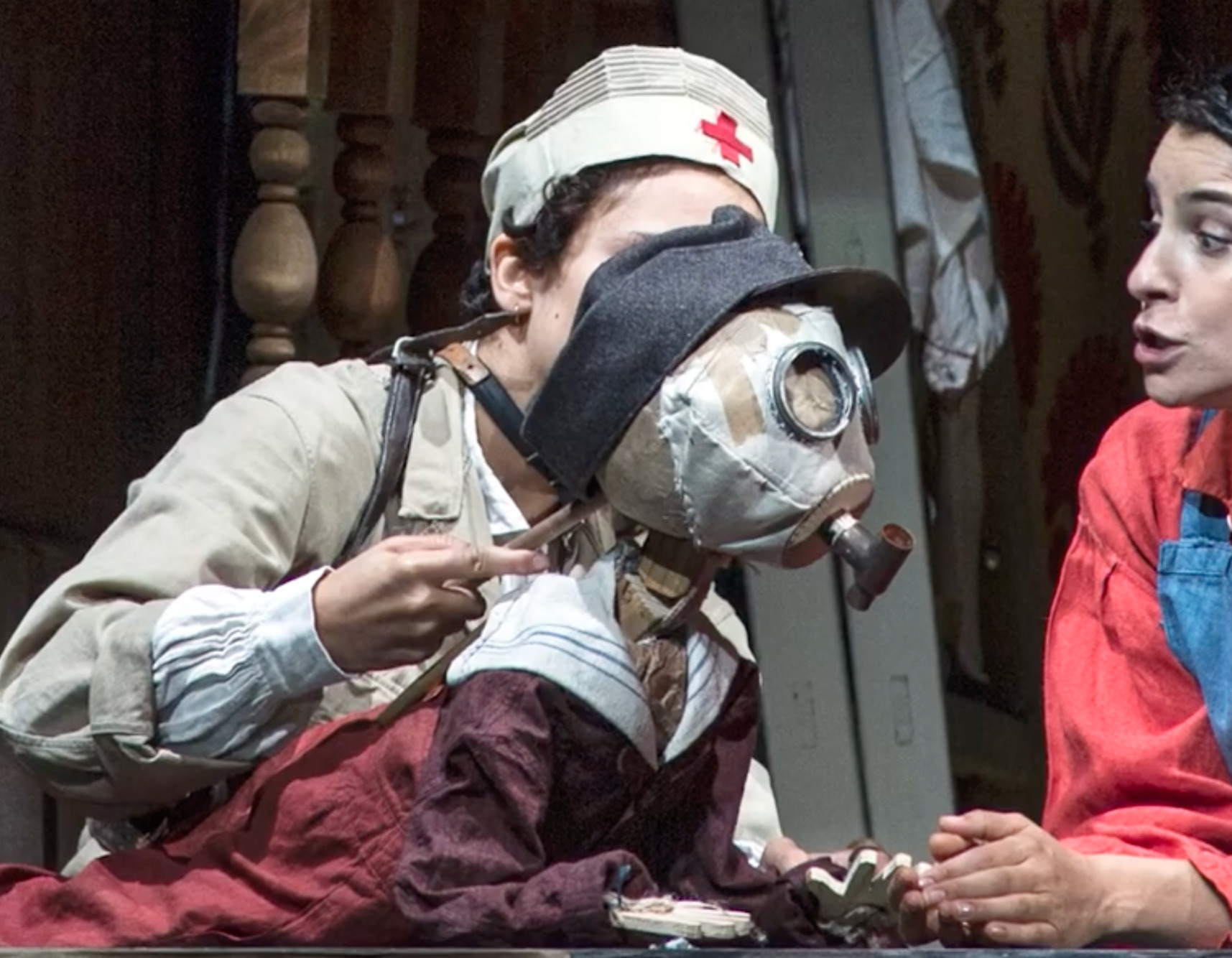
So the puppet child wears a gas mask.
Kentridge leads a brilliant team, presenting something different for the Toronto version of Wozzeck, including Co-Director Luc De Wit, Set Designer Sabine Theunissen, Costume Designer Greta Goiris, Original Lighting Designer Urs Schönebaum, Revival Lighting Designer Mikael Kangas, Projection Designer Catherine Meyburgh and Video Control Kim Gunning. Yes Wozzeck is played by the COC Orchestra and sung by a remarkable cast of singers, but first and foremost you will be immersed in the flamboyant images of Kentridge’s vision for Wozzeck.
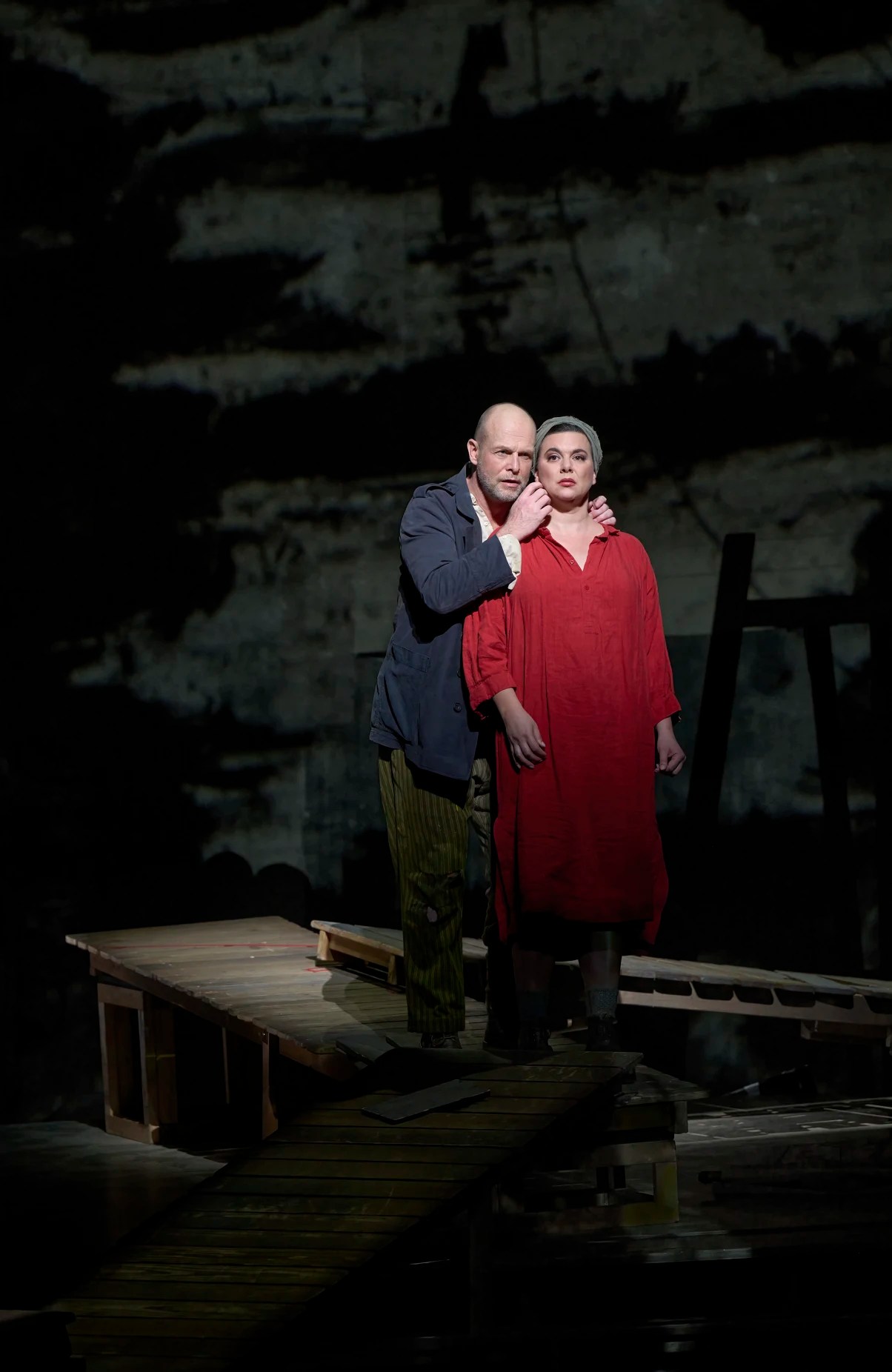
Ambur Braid as Marie continues her winning streak at the COC, inevitably the most sympathetic person onstage regardless of the composer or the style she’s required to play. I never doubted her for a moment as the mother of a puppet-child, indeed she will move you to tears. I think Michael Kupfer-Radecky is a more believable Wozzeck than the Met’s star Peter Mattei, a singer whose ambition to be an artist got in the way of the credibility of his portrayal of this sad everyman in the High Def broadcast (which gives us extreme closeups).
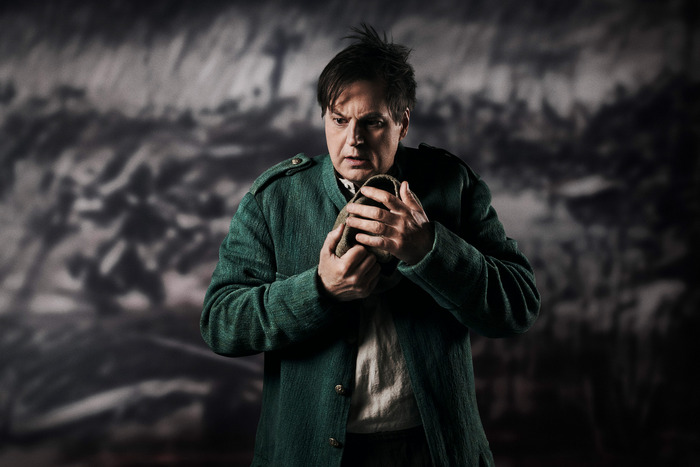
Michael felt so much more direct, and wonderfully musical. I’m not sure whether I was crying in the scene between him & Marie in Act II where he gives her some money because of Ambur’s response or the way he sang his lines, before his exit. OMG, so gorgeous. I guess it helps Ambur to be hearing that exquisite unaffected delivery. I’m envious, they get to hear each other every show.
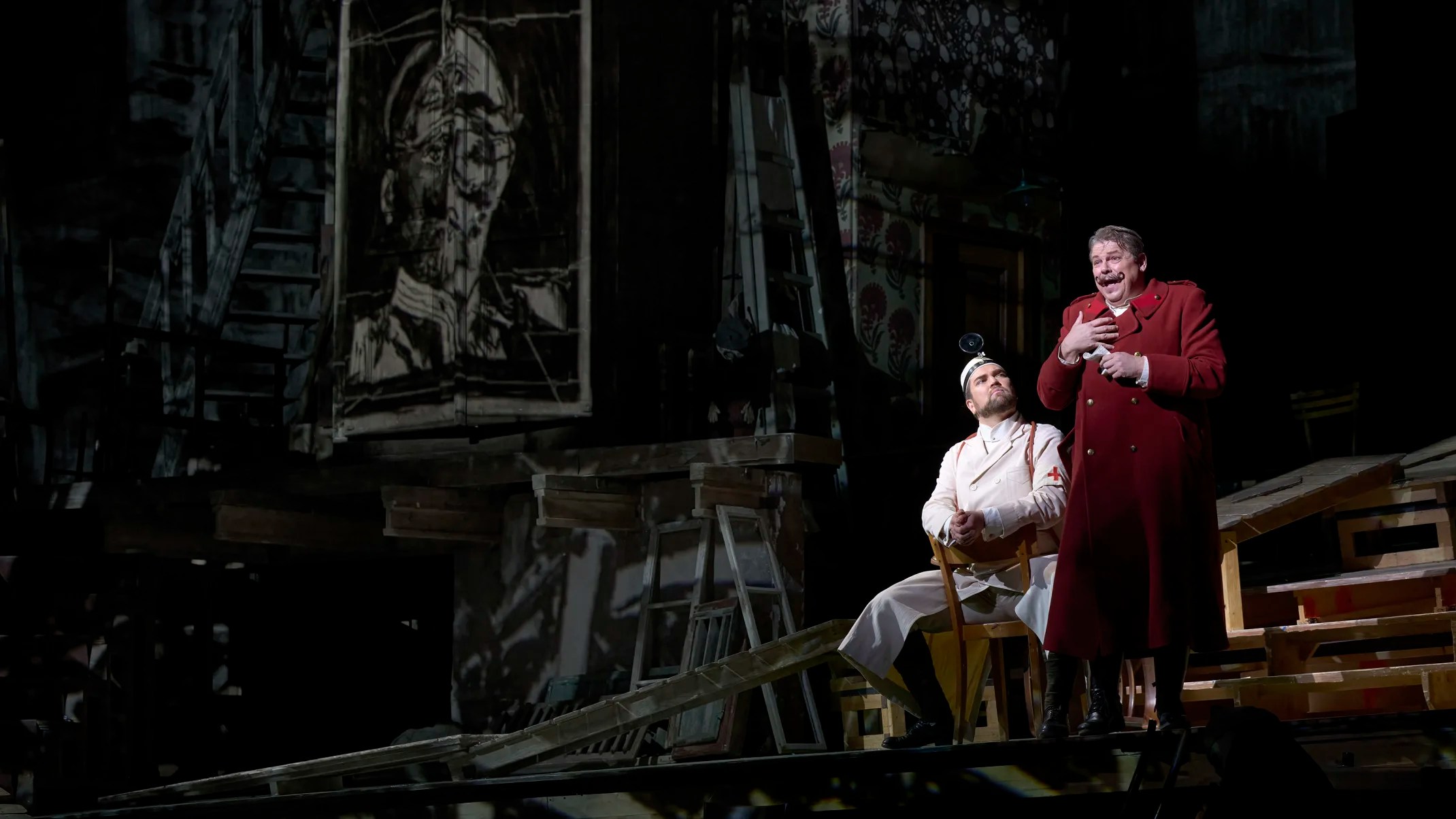
The first voice we hear is Michael Schade as the Captain, berating Wozzeck in the opening scene. We’ve seen so many superb portrayals from Michael, it’s no surprise he gives us such a fascinating Captain. In Kentridge’s theatrical world it’s a caricature such as we might find in Commedia dell’Arte, a self-consistent wooden stock figure that bounces back and forth between quirky and grotesque. There are other comic stock figures who torment Wozzeck. Anthony Robin Schneider is the Doctor, whose experiments will lead to immortality and possibly kill his subject.
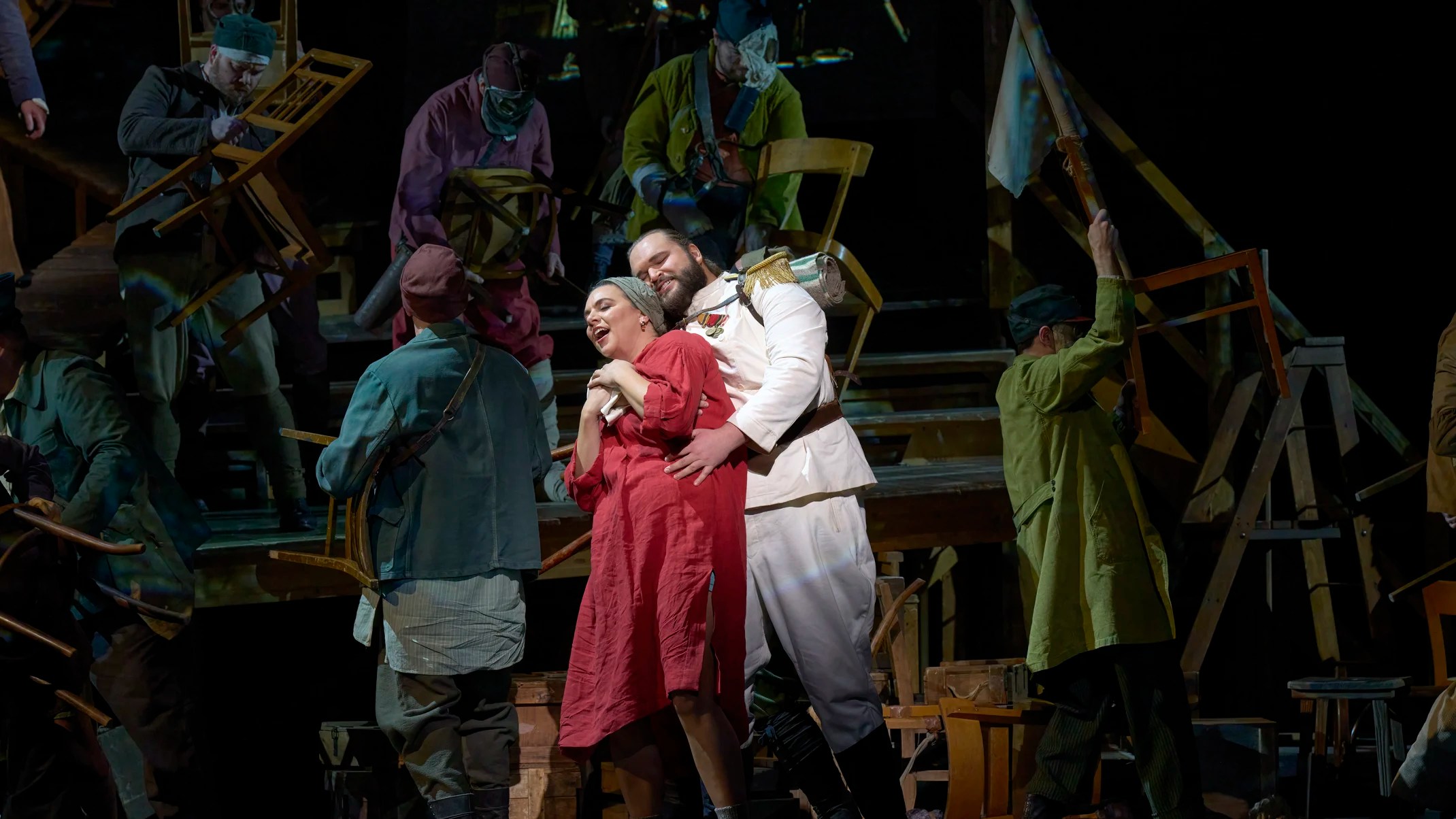
And the other tormentor is a Miles Gloriosus, the bullying Drum Major of Matthew Cairns.
Wozzeck also has a friend named Andres although the scene where we might see Andres as upbeat, in contrast to the torment Wozzeck is getting in the other scenes, is rather dark in Kentridge’s interpretation. Owen McCausland handled all its challenges including the high C in the tavern scene, effortlessly.
In the conversation after seeing this new Wozzeck we were somewhat perplexed. Alas the theatre was not full, even though what we saw is a powerfully cinematic experience, an overwhelming combination of images and performances. My friend Alexander Cappellazzo thought it was the most completely relatable combination of story, action and music that you will find on an operatic stage.

He compared it to Taxi Driver, suggesting that maybe it shouldn’t be promoted as a conventional opera: because of course that’s not what it is. We wonder: how do we get this across to the potential audience? What should the COC do differently to promote this absolute jewel of a production? I feel sad, seeing the best opera performance today that I’ve seen in a long time in a half-empty theatre. I’m reminded of the conversations I’ve been having about popularity, a tricky concept. I believe Wozzeck could be sold out if the audience knew what they were getting. Maybe we need to see Kentridge’s edgy designs, the overpowering stage picture, rather than the usual operatic sales-job with its focus on the singers. It’s more like a movie than an opera, and it sweeps you away.
Okay a bit more nerdy stuff, then I’m done. Wozzeck is an example of a genre called “literaturoper”, a genre that isn’t terribly well-known. If the opera is an adaptation from a play or work of literature one could make the case that it’s a literaturoper. Salome and Elektra by Richard Strauss, Pelléas et Mélisande by Debussy take a play and adapt it without the intervening step of a libretto, such as you’d find with La boheme or Traviata or Carmen. Wozzeck is a fascinating case given that the original is a framentary play reassembled by Karl Emil Franzos, who has a dubious claim to fame. He’s responsible for mistaking the title of Georg Büchner’s fragmentary play Woyzeck as Wozzeck instead. I am not surprised, speaking as someone whose handwriting used to be pretty terrible in the days before I started using laptops & smartphones instead. And while I have never seen Eugene Onegin mentioned for inclusion in the list of literaturopern, maybe it also belongs there given that Tchaikovsky adapted the work from Pushkin’s poem. Or maybe the designation doesn’t mean much of anything.
I’m looking forward to seeing Onegin next week, as we come up on the renewal deadline for COC subscriptions mid-week. Yes I will renew my subscription. I’m looking forward to seeing Wozzeck again later in the run, but this time sitting up close. Kentridge’s production makes this opera fabulous to watch from any distance, exciting from any seat in the house.
Wozzeck continues with performances May 3, 8, 10, 14, 16.
 barczablog
Glad to read your impressive review ! I’m afraid I can’t agree with you . In a word, the overwhelming production filled with bits and pieces of whatever was in those circles and squares of crazy making ‘pictures’ were too overwhelming… It left the wonderful singers as barely visible objects in some scenes… This was especially true for the wonderful singing of Kupfer-Radeky and other members of this fine cast.
These modernistic productions leave me cold as they often overwhelm the beautiful artistry of many fine singers.
Regards, Frances Henry
Dr. Frances Henry O.C. FRSC
Professor Emerita
York University
Thank you for bringing this up. Maybe I’m the wrong person to address. I know every note of this opera, sitting there devouring the presentation in awe. I did not like what the High Def broadcast did to Kentridge’s stage picture, selecting arbitrary bits & pieces, and yes, shining the wrong sort of light on their 2020 Wozzeck, Peter Mattei. For me Wozzeck is a kind of ideal realization of Wagner’s ideals, yet still has so many opportunities for singers to shine. It’s true that there are moments when you may have trouble locating the singer among a crowd as in the tavern scenes. Kentridge makes it really easy to find The Fool when he appears, a stunning moment among many.
I think the funny thing about this production –and maybe about many productions of opera these days– is how the newer approaches may alienate the die-hards like yourself, while hitting an entirely new kind of audience. I am so sorry my daughter Zoe wasn’t here to see this for instance, as this is right up her alley, as a visual artist. I set aside my own objections, for instance,
1-i love the three act structure that we process differently when there are no breaks
2-we lose something with the mise-en-scene choices, as when Wozzeck is fiddling with a projector in the first scene, and not shaving the Captain…
3-i disapprove of the overly busy stage action during the elegiac invention on a tonality (the tragic key of D minor) that forms the transition between the final two scenes: but I surrender to it, as Kentridge & company have the floor, right? I let them speak even if it’s not how I would do it.
When we emerged out of the theatre and saw the big festival on University Ave, that delayed our exit from the garage and helped give us time to reflect on the show, it was with a sense of possibility. Even if it’s not as I would do it, I love the theatricality, the inventiveness, alongside /behind the stunning musicianship on display, Debus and the orchestra especially. It’s theatre and how wonderful that it’s alive rather than stuck in a tradition that resists dissent or change. I write this on election day, feeling hopeful about my country.
Thank you for your comments!
Let me add (speaking of the production as relatable), we were talking in the lobby afterwards about Wozzeck in his scene with Andres. Usually Andres is the confidant, the friend who offers something less bleak in the first act. Kentridge spotted something else, sacrificing Andres on that altar, I suppose. Wozzeck sounds like he’s swallowed all the conspiracies one sees on Twitter/X /social media. When he’s muttering about the Freemasons and what he sees and hears, it seems less like the usual madness we get in Wozzeck productions and more like our contemporary zeitgeist. Ditto when Wozzeck starts to come apart in his scene when the Doctor & Captain taunt him about Marie’s infidelity. And maybe I’m sensitive to this because I feel the whole world is a little oversensitive right now.
Seemed to me (Sunday afternoon performance) from where I was sitting that the vast majority of the more than 250 empty seats around me, on the ground floor alone, were subscribers who decided a priori that Berg (not Kentridge) wasn’t their cup of tonal tea and didn’t even bother to show up to disapprove. You missed an opportunity, folks, to witness “difficult” music made visible: visceral and emotionally searing in a way I could not previously have imagined comprehending it. If you have tickets to one of the remaining performances, and have already decided you are not going, I beg you, find someone with most of their life still ahead of them, and musical tastes not yet frozen in time, to give the tickets to.
Thank you David, that’s a wonderfully poetic message. Yes I think it’s largely generational. In my responses to Frances Henry I alluded to my daughter Zoe and also (in the review) was carried away with the enthusiasm of Alex Cappellazzo, who sat beside me. The word “relatable” in the headline was his coinage, and stunned me to. be honest, given that I grew up always hearing that Berg was box office poison. But that’s the thing, Kentridge’s stage picture is so vivid & stimulating, one has to be obstinate to reject such a beautiful production. Some people show up with stipulations as though they’re buying a house, not really looking at what’s in front of them because golly gee it’s not what they want. How ironic that in an opera with a heart-breaking story to tell, the real heart-break is in the audience, in the theatre.
I’m looking forward to coming back to see it again, up close from my subscription seats. The irony is we got the subscription because Erika would sometimes fall asleep, so we wanted something stimulating. The real payoff isn’t visuals but in the intense sound of the orchestra from 2 rows away, where we can sometimes hear the conductor breathing or singing along.
Thank you for your comments!
Interesting. Opening night I noticed a distinct lack of immediate enthusiasm when the curtain came down. My immediate reaction was it’s the COC audience who don’t know a good thing when they see it. Adrienne Pieczonka suggested it was because people were so deeply moved that jumping up and cheering wasn’t what came to mind. I don’t know which of us was right!
Good question. I don’t know either.
I saw Wozzeck last night (Wednesday May 14) and I’m happy to say that most of the seats were filled. Today I have been posting notes on COC Facebook ads for discounted seats for the opera, urging people to go, hoping that will help.
I liked the opera very much and liked it even better after reading your post. I was delighted with the set design and the lighting and the puppet/puppeteering and the doctor’s “closet office” and the projection art and the boardwalk that ultimately provided Wozzeck’s access to the lake and the way the body of Marie stayed in place until the opera was over. I liked the combination of weirdness and tragedy.
As was the case for someone who commented above, there was a silence last night when the last note ended and the stage went dark, but I think it was stunned silence. Very moving. I felt (as I’m sure others did) that it would be a kind of sacrilege to introduce applause into that near-absence of sound, which underscored the tragedy.
And yes, it seems weird to mention this almost as an afterthought: the singing was magnificent.
What an experience!!
I am so happy to see this, as the production deserves to be seen. I think it’s a bit of a disconnect when people come to Wozzeck as “opera” expecting melodic arias and ensembles, when we’re in the presence of something much more contemporary. The opera’s centennial is almost here, but it’s still so new that it jars, whether undertaken as written or with the interesting dramaturgy of Kentridge’s production. Thanks for your comments.
COC has to cultivate new audiences and marketing is a huge part – totally agree. Closing night saw many empty seats and the seniors near me didn’t clap at all at the end. 100 year old opera can’t be too new, and we as an audience should be excited about getting world class productions. Shameful behavior by the patrons.
I was there too. I came home, my ears still resounding with the glorious playing of the COC orchestra. While I loved it, I was a bit perplexed. When I arrived, there was no traffic at the front entrance at all. I have never come to a COC show at the Four Seasons Centre, to find all of the staff –every single person who checks a ticket– available. I smiled and said thank you, while distressed to see (inside) that there was no traffic. It was a Friday night, and the lobby felt empty at 7:00 pm. When the show started the row in front of me was empty for the first 4 seats, while my own row was empty for 6 seats across beside me. So I didn’t need to wear a mask (as I did for Macbeth a few days ago, admittedly in a tiny theatre).
I am sympathetic to the COC’s marketing team. They have made a particular plan, promoting opera in a particular way: an approach that doesn’t work for Wozzeck, the opera nerd’s dream opera, but without the usual sorts of lyricism, without the usual sorts of tunes. Hindsight is 20-20 so I won’t act like a genius for seeing this. Toronto is a very competitive market. I recall Richard Bradshaw’s stated aim to create the best theatre in Toronto, which arguably they achieved last night & through the run of this opera, and also with Eugene Onegin: except the latter opera matched the marketing plan much better. Perhaps the show should have been sold as edgy avant-garde theatre with provocative visuals? But when I think back to my classmates in grad-school at the Drama Centre at U of T, or students for Ryerson shows (where I played the piano), that group can’t afford the best seats. There is an older crowd who go see Tarragon, Passe Muraille, Crow’s etc, and some of them saw Wozzeck. The muttering I heard in the bathroom was always about mind-boggling excitement: but there weren’t enough of those guys in the boys’ room.
I need to admit you have a point about some in the audience, aka a portion of the subscriber community who were not thrilled. I think that population was larger in Neef’s time, as I recall outrage over some productions, a shrillness I have not heard in several years, as the COC have been far closer to the mainstream in their productions: until we come to this one, announced back in Neef’s time. I wonder about the COC’s artistic direction going forward. Next season is already planned of course, so the impact of this show likely won’t be factored into plans. I wonder if we will see more Puccini no Berg (Lulu) anywhere in our future, at least not under the current regime. Yes I’m a dreamer, wishing to see one of the portrait operas of Philip Glass (Akhnaten or Satyagraha especially, if not Einstein on the Beach), that play to the COC’s key strengths, their chorus & orchestra, while not requiring a star to sell tickets. Or a revival of Nixon in China from more than a decade ago (is it really a revival when everyone associated with a 2012 show is gone?). While I have renewed my subscription, I am wondering about the COC’s direction for the future.
Thank you for your comments.
That’s a great point about the cost for younger people – COC could do better with their Opera Under 30 and convert those people into loyal subscribers. The Met is going completely opposite this year with staging contemporary operas – I hope that strategy trickles down to us, but won’t hold my breath. We get 1 “risky” opera a year and there’s always grumbling in my section, which is dominated by seniors. There was much displeasure at Vixen last year. It gets tiring – I dutifully sit through all the Puccinis and clap for singers doing splendid job even if I’m sick to death of La Boheme. I’m VERY excited about Erwartung next season – saw that production a few decades ago and it was electrifying. But I’m bracing myself for being disappointed by the audience and what that might bode for the COC’s future.
I’m sympathetic to the challenges of the marketing dept. There’s perhaps a disconnect between the offerings and how they’re being promoted, which is hardly surprising when the company’s leadership has been so disrupted of late, both with the abrupt departure of Perryn Leech relatively early in his tenure and the rather tentative messaging we’re getting from his successor(s), who reminds me of someone who is still putting his tippy-toe into the water, rather than offering dynamic leadership. Does a company need to have a leader who articulates a vision? I don’t know. But the COC have often been giving us ambiguous messages about their direction. I am very happy with Puccini & Verdi btw, when they’re done well, but subject to the law of diminishing returns. You can’t keep trucking out the same productions of the same operas. Next year we’re getting four revivals plus two new productions.
I’d be happier with that (four revivals ie) if the COC’s leadership made more of an effort to cast Canadians, and no i am not in some sort of elbows-up frenzy, i’ve been testy about this for literally decades. There are two reasons to import singers:
1) if the import will help sell tickets because they’re well known
2) if the import sings something that no Canadian is capable of singing.
I went to that Onegin prepared to be critical of their casting: but the show was truly superb. I noticed that Colin Ainsworth sang Lensky in Seattle recently (his kuda kuda is on YouTube), and last time out the three leads were Canadians. If they keep importing unknowns I wonder, will that build an audience? Why are the Romeo & Juliette for next season a pair of relative unknowns, when for example I listened to a beautiful rendition of Je veux vivre by Holly Chaplin, a wonderful Canadian soprano who is ignored by the COC. I was frustrated at the Fidelio opening night, listening to an American tenor who sang his entire opening aria a semi-tone sharp. Painful to my ear, but wtf nobody seems to notice. The soprano was almost a semitone flat, so maybe someone thought “aha that evens things.” Finnish soprano singing flat, american heldentenor singing sharp. How about Canadians, singing the roles? Even if they were not competent (and they ARE competent), they would grow into the roles and maybe help return the investment we have already made in them. I am very satisfied by the chorus & orchestra who sound fabulous. Sigh…. we shall see. Thanks for the comments!