
I can’t stop thinking about Mandle Cheung, the successful tech entrepreneur who paid the Toronto Symphony for the privilege of conducting Mahler’s 2nd Symphony last summer. I wrote a review of the concert for the Globe & Mail, and couldn’t stop thinking about him and his music-making.
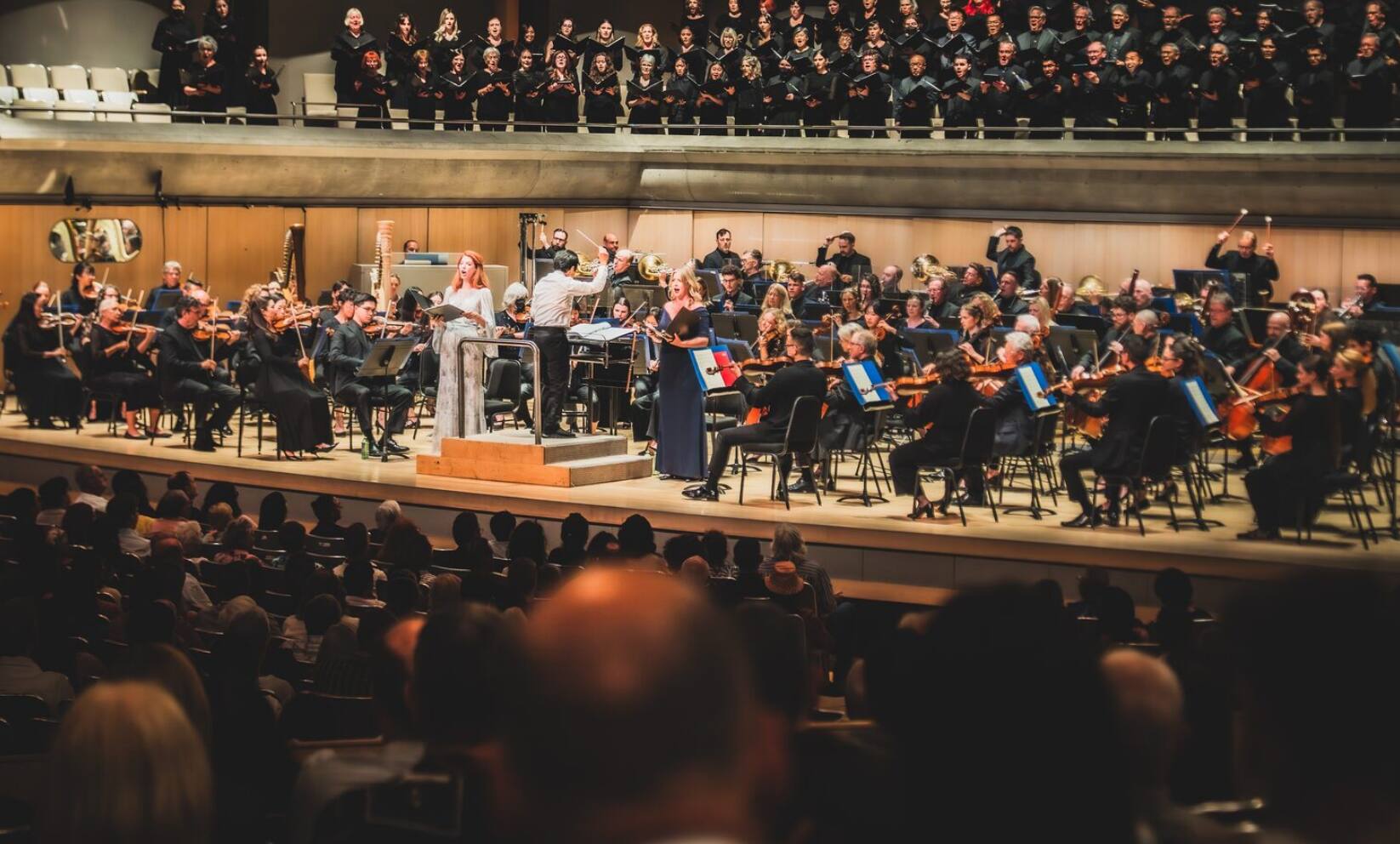
In my review I described my emotional response, although I didn’t tell the full story. In the article I said this while quoting the text from Urlicht, the song that’s the 4th movement of Mahler’s 2nd:
“I was moved by parallels between the composer and the conductor during the concert, especially in the fourth movement when Mahler used one of the songs he had written based on Des Knaben Wunderhorn (The Youth’s Magic Horn):
Da kam ein Engelein und wollt’ mich abweisen. (An angel came and sought to turn me back)
Ach nein, ich ließ mich nicht abweisen! (Ah no! I refused to be turned away)
Both Cheung and Mahler may have asked: Will they listen to me, or reject me? While the third movement is a comical burlesque about being ignored, this solemn song is a brave affirmation, in the face of the officious angel blocking the way.“
I had a previous experience with Urlicht, that song from Mahler’s 2nd that I quoted above. It was in church, where I was playing the piano accompaniment to a mezzo-soprano singing these words. She was partially disabled, and because of her physical challenges could not walk well enough to come out in front of the congregation to sing, but had to find a spot in the choir loft, further from me at the piano. When she sang about the angel barring the way I was shocked that we were in a sense blocking her path inside the church. This song is far more universal than I’d ever realized, speaking to anyone who has faced discrimination & dismissal. I saw a connection between what happened to our mezzo-soloist, Mahler and Mandle, particularly while listening to the same song being sung in that TSO concert, which is why I became so teary-eyed. Mahler is proclaiming redemption & resurrection while fighting against a racist & antisemitic establishment barring his path.
When I talked to Mandle a few days ago, he reminded me:
1) that his orchestra has had more than 16 concerts,
2) that for the June TSO concert he managed to fill Roy Thomson Hall
3) that the ovation after the Mahler was almost four minutes long.
The caption in the Globe & Mail for Allan Cabral’s photo said “The Toronto Symphony Orchestra performs Gustav Mahler’s Symphony No. 2 in C Minor, led by amateur conductor Mandle Cheung”.
Amateur? I wonder what the word even means. How many concerts will be enough? when — if ever– will Mandle get to call himself a “professional conductor”? I wonder is Mandle holding up a mirror to classical music?
At least there’s the original sense of “amateur” as the one who loves what they’re doing, and that’s certain with Mandle.
But there are so many questions one could ask. What does any conductor actually do? We see the performance, not the rehearsal, so there’s already a mystery. And the conductor stands before an orchestra waving their arms, sometimes holding a baton: and music erupts from the orchestra standing before them. When we get a ticket to go to a concert we’ve made a series of assumptions, that may or may not lead to pleasure & music in the performances we attend. If we blindly trust that the conductor must be good, we may have a better experience than if we show up with a series of stipulations & requirements.
In effect a conductor performs magic. They wave their arms and for some reason a bunch of other people make music. That magic may have reached its peak with Disney’s Fantasia in 1940, aided by the great Leopold Stokowski.

And then there’s Long-Haired Hare, released in 1949. Stokowski is the great “Leopold”. It’s not that they mock the conductor but the way he is idolized. I share this excerpt of the later cartoon to suggest some of the blind faith that goes into the music-making and listening. I believe this little sample of Bugs Bunny shows the way people may idolize a maestro.
You see the disconnect, the gap between the way this cartoon conductor is perceived and logic. Whether it is Bugs Bunny or Leopold Stokowski or any conductor waving their baton or their arms (or in Bugs Bunny’s case, waving his paws), they wave: and the music miraculously is heard. Notice that the cartoon goes for the extreme impossibility that is implicit to the newcomer, who may think that the conductor is somehow making the orchestra play this or that, their gestures steering the music to higher or lower notes, their powerful gestures controlling duration and intensity, when of course that’s something that must be established in rehearsals (if at all).
Let’s come back to Mandle Cheung, the tech entrepreneur who conducts an orchestra because it’s fun. In the weeks after that Mahler concert, I listened & then blogged about some of Mandle’s YouTube recordings with his Mandle Philharmonic, the ensemble he has assembled. You can see and hear them play on YouTube if you can’t make it to a live concert.
That word “maestro” that is used to identify a conductor is part of the dynamic. But Mandle told me he does not want to be called a maestro. Yes we can say he’s a conductor, an employer of musicians & soloists & a choir, hiring a concert hall to put on concerts.
Indeed I pulled out a book I received long ago as a birthday present, indeed it was more than a decade ago (thank you Paul Babiak, great gift!), namely “The Maestro Myth” by Norman Lebrecht, a book that studies many conductors over many decades.
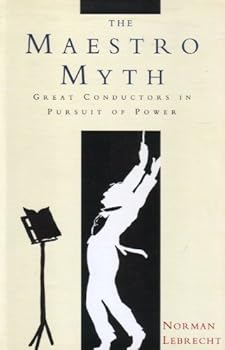
In the introduction he quotes Carl Flesch, who says
“There is no profession which an imposter could enter more easily.” I have to wonder if this might be subtext for some of the negative responses to Mandle, who makes no false claims, who doesn’t pretend to be a Maestro. I think Flesch is touching upon a kind of tension underlying the conductor’s magic trick, the suspicion that we don’t really know how the magic is accomplished.
Lebrecht himself writes
“The conductor exists because mankind demands a visible leader or, at the very least, an identifiable figurehead. His musical raison d’être is altogether secondary to that function.
To the listener in the stalls, the conductor represents a dual form of escapism: the longing to lose oneself in music combined with an urge to subliamte in the actions of that all-powerful figure on the podium. The conductor is an obvious hero whose gestures are unconsciously imitated with a finger on the arm of the concert-hall seat or, back home, waving one’s arms before the bathroom mirror to the accompaniment of recorded sound. “
(Lebrecht 2-3)
Let’s talk about impulses. Children sing & dance, and at a certain point they become more socialized, they stop obeying their impulses. Perhaps that’s one of the ways we know that childhood is ending. When I was a child I used to sometimes conduct the records being played on the hi-fi. I grew up and stopped, but the fantasy didn’t die, given life by various gigs as a music director for musicals, church choirs and even a few operas while I was studying in graduate school. Mostly I sat at a keyboard but sometimes I had to conduct singers & musicians. Whenever I go to a concert and watch the performance I identify with the musicians. Do we all identify? I don’t know. But I can’t be the only one who sometimes wishes they were up in front of the orchestra conducting, enjoying the music while having vicarious feelings watching the performers.
In his book Lebrecht writes about many famous conductors. He goes a long way towards unpacking Bugs Bunny’s magic trick, the trick every conductor accomplishes, when they wave the stick or their hands, and a bunch of music is heard played by other people. I wonder if maybe Lebrecht’s book needs a chapter about people like Gilbert Kaplan and Mandle Cheung. Kaplan was another wealthy conductor who hired an ensemble to play Mahler’s 2nd Symphony. I obtained the CD long ago, fascinated by the unprecedented phenomenon. Setting aside the question of the music, it was a bit of a happening, that this wealthy guy made a recording of the one piece he really knew & loved.
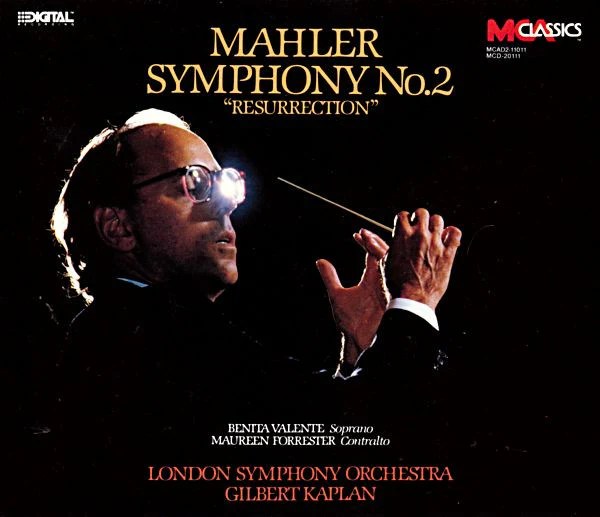
I would argue that the story of conductors is incomplete without the inclusion of the interlopers, the conductors who paid their way into the club, and in so doing cast doubts upon the authority of the ones who had already laid claim to leadership roles. Indeed you may question: how good are Kaplan or Mandle, are the interlopers legitimate creators of music, with the right to conduct? They certainly pay for the privilege.
Meanwhile, it’s the orchestras (as always) who play the piece, whether it’s Mahler or Mozart.
I assume Lebrecht will never bother with Kaplan or Mandle, even if I continue to be fascinated by them. So perhaps think of this interview as a kind of unauthorized appendix to a book I didn’t write, my unofficial questions like an unsanctioned addition.
Maybe the musicological questions concerning credentials are irrelevant as I point you to a quote I saw at mandlephil.com the orchestra’s webpage, that might be the key.
“Your time is limited, so don’t waste it living someone else’s life. Don’t be trapped by dogma – which is living with the results of other people’s thinking.“
Steve Jobs
As of course it was inevitable that I would eventually ask Mandle Cheung to answer some of my questions about his musical adventures. And he did answer…
*******
Barczablog:Are you more like your father or mother?
Mandle: I have to say I don’t know because I am the youngest of 17 children of my father, youngest of six of my mother. The only thing I ever done with my father I can recall is going with him, seeing a movie. And we argued about which movie to see.
BB: So this is in Hong Kong? English or Chinese?
Mandle: Hong Kong. Chinese. But I speak English in high school.
BB: How many languages do you speak?
Mandle: Oh I am terrible with languages. I speak some Chinese and some English. That’s it.
My mother is a very very sweet lady. We never had one conversation. The only recollection of her I have is she loved playing mah jong. Everybody knows what mah jong is. Little square oblong pieces…
BB: What is the best or worst thing about what you do?
Mandle: The best is building my company, from a room in a basement downtown 37 years ago, to know a hundred people, an amazing team of people, operating on their own, so I am very happy about that.

BB: Is there a downside?
Mandle: Actually the one thing about our first major client, 30 years ago, three decades ago, head of the Ontario Government IT Group. The IT Group had something like 7 or 8 Chief Information Officers and one Chief Technology Officer, and he’s the chief of all the chiefs, so he’s the top man. So I knew him when he was still an analyst, in Toronto Dominion Green Line, trading over the phone. That’s when it first became our customer.
So now we hire him on contract to do a few things here and there. And someone asked him about me, and he said “Mandle’s biggest strength is people.” The team I built. He said I know how to hire people, which as I look back, is actually true.
When I hire somebody, the two questions to get answered right away, are “what they are good at doing” and “what they enjoy doing”. And if I find someone that the two answers are the same, then I got a winner! If somebody is doing what they like and they’re good at it, you don’t need to look over their shoulders.
BB: Good point.
Mandle: So the company of 100, we have no managers. And I never liked the word “manager” anyways because it doesn’t make any sense. Somebody who is really good at what they’re doing
“oh we have to promote you to be a manager”.
“Have you been a manager before?”
“No”.
So how do you know what to do as a manager? Of course I know I’m so good at it.”
BB: You’ve just explained the Peter Principle in reverse, that speaks of promoting people to their level of incompetence. Imagine: you have someone who’s good at making dinner who gets promoted, so they are then in charge of the personnel in the restaurant, and it’s a different skill! When they were cooking they were good…
Mandle: Exactly, so I take that one step further. So if you’re good at something I want you to keep doing it. I don’t want to take it away. And I will have people around you to learn from you, by learning how you do things. So I don’t call them “managers”, I call them “function owners”. You own the function because you’re good at it.
BB: What do you like to listen to or watch?
Mandle: I only listen because of Mandle Philharmonic. The only thing I listen to is Mahler 2 and Mahler 8. I just started Mahler 8 actually.
BB: That’s your favourite music?
Mandle: The ultimate in classical music. There’s nothing beyond that.
BB: But what if you did something simpler. Something like Eine Kleine Nachtmusik. You don’t like that?
Mandle: I haven’t listened to music in a long time. Mahler is sort of the end song, after Mahler there’s nothing else.
BB: It gets noisier doesn’t it? I mean if we look at music history. So there’s nothing that appeals to you? For example I play a lot of Richard Strauss. He’s in this same period when the music starts to get very noisy, dissonant.
Mandle: I love Strauss.
BB: He’s a contemporary of Mahler, they were friends.
Mandle: If I have the energy I will conduct some Strauss.
BB: I mean maybe one of those tone poems. I have piano versions of some of them, and it’s so exciting to be able to do a reduced version…!
(I went over to a piano, and played the opening phrases of Till Eulenspiegel…in a piano reduction)
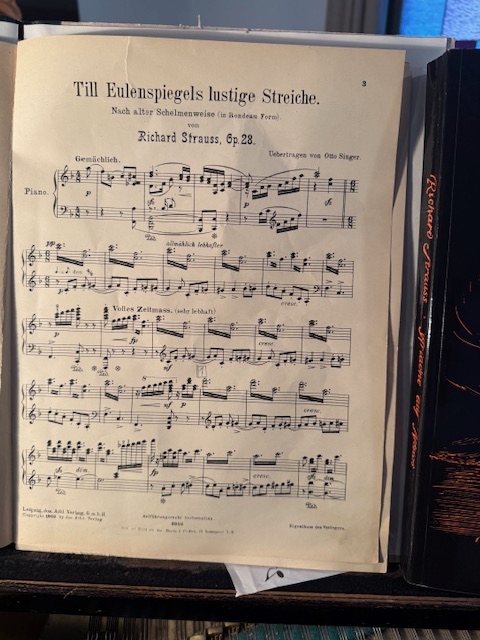
(I stop playing) You know that piece…?
Mandle: Of course.
BB: (I am going back and forth between my interview / conversation with Mandle, and some analytical thoughts like this one that I am adding after the fact. Because they’re in a real sense “parenthetical” I put them into brackets just like this)
I think my desire to play these huge pieces on the piano is similar to your desire to conduct the orchestra. I played it for you because I thought you could relate to it. I have started using a word to describe my ambitions namely “aspirational”. I think playing these pieces as I dream of the orchestral sound is aspirational, trying to make a sound at the piano while I imagine the orchestra. When I am sitting at the piano it’s a fantasy, not always about playing perfectly, and more like imagining the orchestral piece.
(It’s the reason I play pieces like Pictures at an Exhibition, or that I love to play transcriptions of orchestral works, and also love opera at the piano. That was my first big fantasy, because I would accompany singers while trying to impersonate their orchestral accompaniment. It’s fun! Of course I have fewer options, because I am not a wealthy man. But the desire to play a reduction is I think similar to that impulse to conduct or to sing along. It’s normal I think, that people hear music and want to share it, join in, or perhaps to dance. When we sit like zombies silently? that’s un-natural. Applause between movements of symphonies, too, while it’s bad form to do that, it’s a child’s impulse and that can’t be bad. We want to make music. The impulse of the child to sing or dance or wave their arms like a conductor may be something we think of as “childish” or “immature”, but it’s a real natural thing that maturity stifles, whether through inhibitions we acquire or simply because we lose the ability to be like a child. )
When I was a kid, Mandle, I used to conduct along with the Beethoven on the record player. To want to conduct or to dance or sing along: surely that’s a normal impulse, even if our normal experience is often to be told by peers or teachers that we’re not good enough, stifling the natural impulses, teaching us inhibitions, making us forget our childish delight.
At the piano (thinking of a reduction of the big orchestral piecelike TIll Eulenspiegel) it can’t really be played.
Mandle: You need an orchestra.
BB: Playing a big piece at the piano is a bit like pornography, a fantasy.
(laughter in the room)
…because you’re fantasizing about doing something with someone else (at the piano dreaming of the orchestra making the big sound). In my head I hear the orchestra, and of course that’s a fantasy. It’s just a soloist at the piano. It’s like when I was a kid conducting along with the orchestra on a record. It’s a fantasy. Did you ever conduct along with a record as a child?
Mandle: Not really.
BB: I did as a kid.
Mandle: I think I may have bought a baton.
BB: I know at one point you may say “who’s the interview with, is it you or is it me?” …because I like to put myself into the questions, to make it relatable. It’s a conversation, but also because I am trying to analyse and understand. I think when we think of the conductor as a kind of everyman, who acts out our fantasies for us..? No matter how well they conduct, the audience watches the conductor and projects, identifies to some extent.
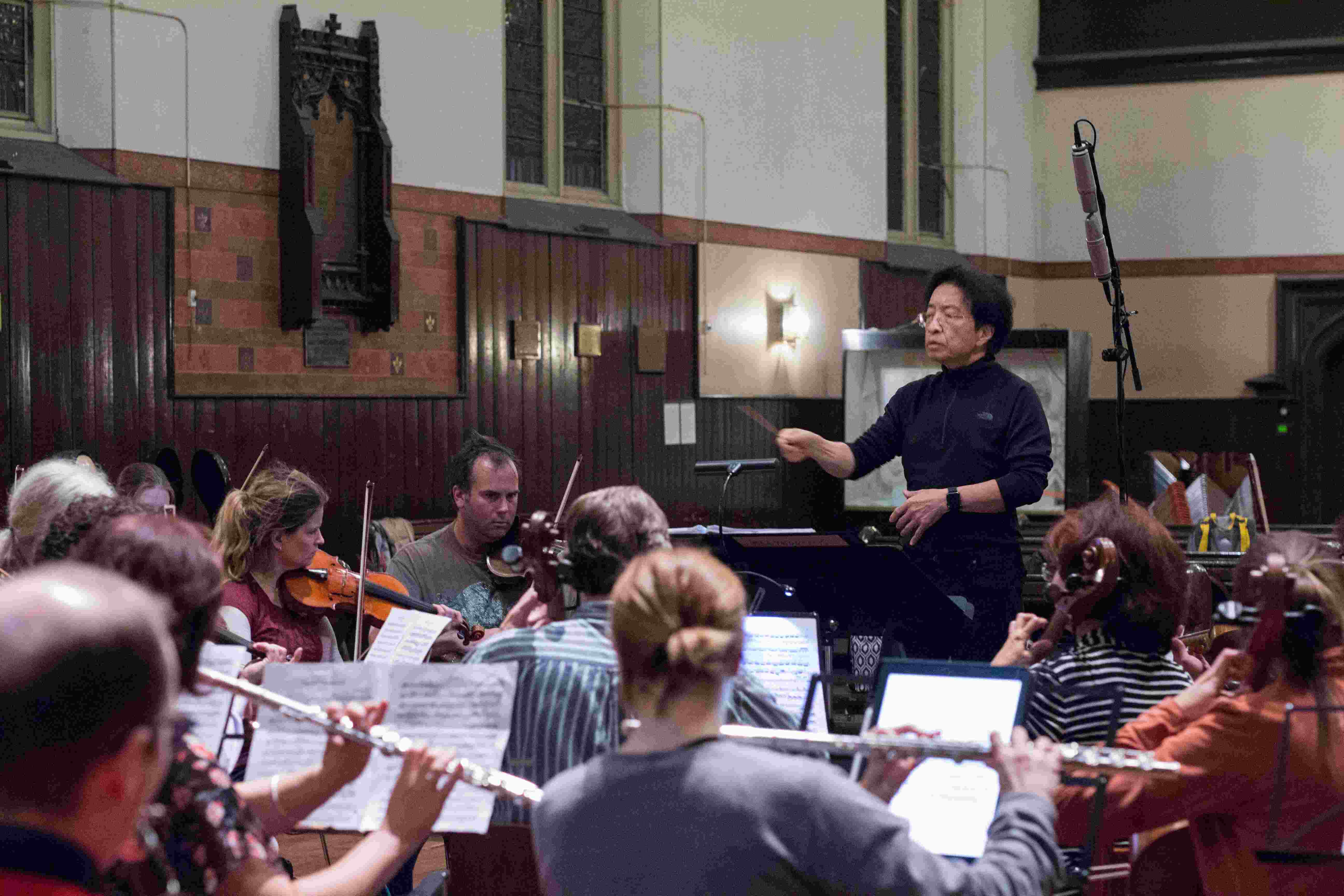
BB: So, we were talking about what you like to listen to.
Mandle: The very first classical music I listened to was on a little FM radio with an antenna and earphones that I listened to in the backyard when I was thirteen years old. I still remember the moment, it was Saint-Saens 3rd Violin Concerto. Bang! that’s it. After that all I listened to is classical.
BB: Would you ever conduct Saint-Saens? For instance that 3rd Symphony with the organ, would be a great project for your orchestra. Or the 2nd piano concerto (one of my favourite pieces).
Mandle: If I have the time & energy, because I have so many things I want to conduct. There are at least 30 pieces I would love to conduct.
BB: Could we make a list? because maybe that tells us the future of Mandle Phil, no?
Mandle: No, the future of Mandle Phil is Mahler 2 and Mahler 8, that’s it. I am conducting the Royal Philharmonic, in London August 21st, Friday.
BB: Wow… so what are you going to conduct?
Mandle: Mahler 2 of course. (giggles)… because there’s is nothing after the Mahler 2 & the Mahler 8.
BB: Did I ask you what is the best or worst thing about what you do?
Mandle: There’s the company and then there’s the orchestra. I came up with the idea in 2015. I started talking to a couple of people in 2016. In 2017 we put a few musicians together. In 2018 we had our first concert at Glenn Gould Studio, a pay what you can. Since then I think we did our 18th or 19th concert this last December, the Beethoven 9th and Carmina excerpts and some Christmas carols.
BB: So do you have a program for the coming year?
Mandle: I was going to do a couple, of Stravinsky, but I cannot afford to divert my attention. Mahler 8 is just too big. I don’t even know if I can do it. It’s huge.
BB: It’s a challenge to be sure.
Mandle: And I really have to be ready for Royal Philharmonic. And we also spoke to the New York Philharmonic. (laughter) You wanna guess the price they quoted us?
BB: That’s a good question. Erika googled the TSO price. Is it higher than the TSO?
Mandle: (laughter)
BB: Is that a yes? (more laughter) Is it a multiple of the TSO? More than twice..? Were they maybe trying to scare you away?
Mandle: No.
BB: They were serious?
Mandle: Very serious. He’s responsible for raising money for the orchestra. You know all about the kefuffle with the TSO? You don’t get surprised at my age but that one just totally caught me off guard.
BB: I’m still asking the first questions, what’s the best & worst thing about what you do…
Mandle: I don’t have any negatives.
BB: There have been other people who say this, you’re not the only one. If you’re enjoying your life and you don’t see any negatives that’s fine, a valid answer.
I asked you what you like to watch. What’s your favourite?
Mandle: TV shows. I haven’t got a good one for awhile. My all time favourites were “Evil” and ” Nip-tuck.”
BB: Nip tuck, I remember that was a great show!
Mandle: Oh there are a couple of shows we watch. The Voice, the singing competition. America’s Got Talent. The judges they have on The Voice are good. They actually know what they’re doing. The judges on the other one…. so bad!
BB: But it’s still entertaining. Bad judges…. like bad critics. Remember that guy who used to be on American Idol? Simon Cowell…
Mandle: Oh i don’t like him at all. The one who kept his accent.
BB: (laughter) He was mean. …So can I ask you what your favourite song or melody is?
Mandle: Mahler 2.
BB: What ability or skill do you wish you had, that you don’t have?
Mandle: ability to recall ! Mine is average at best
BB: When you’re just relaxing and not working, what is your favourite thing to do?
Mandle: when I try to relax, thoughts will keep popping into my head. If it’s before 8:00/9:00 pm, music will always be playing, I’ll go thru my projects, there are so many, and I enjoy all of them. I may play some iPhone games. I may work of music for up coming concert. After 8/9, I may switch on Roger’s or Apple TV. Or organize phone calls and text exchanges, work with ChatGPT.
BB: Do you have a favorite conductor?
Mandle: Karajan who is dead. Today I watch Berlin Phil videos. I didn’t search for other orchestra apps.
BB: What instruments do you play (if any)?
Mandle: when I was in high school, I played in the harmonica band. And Arthur Benjamin harmonica concerto with CBC symphony orchestra 1971-12-09
BB: What was the first piece of music that you conducted and when?
Mandle: 1969/70 University of Manitoba, school of music, Beethoven piano concerto #3, performance by graduate student soloist.
BB: What does a conductor really do? (a rhetorical question?)
Mandle: I’m not aware of any great orchestra concerts or recordings that were performed without a conductor ? None. Zilch.
Great conductors are a rare breed. Besides their amazing knowledge of the music, they bring energy.
The 3 min 55 second standing ovation is for the energy that the audience felt !! As Naomi Buck described (in the Toronto Life article), they sprang to their feet. Note that Naomi is someone who doesn’t know what a conductor does, as you can read in her article. She thinks it’s the musicians that carried the music. You absolutely must have the best musicians to play the best music. You need to add an exceptional conductor to produce extraordinary performances. There is no exceptions to that.
BB: What don’t people understand about being a conductor?
Mandle: I learned the answer to this question first hand during the less than 20 Mandle Philharmonic performances.
You need to be a musician that plays in an orchestra. Musicians follow the conductors baton. All musicians.
I actually don’t have a clue what Mandle Philharmonic musicians think of me. They kept returning. We have a group of core players that’s been with us since 2017/8/9. They play for Canadian Opera and National Ballet. We can’t rehearse or perform when those two are in town playing. I tell them what repertoire I want and they reach out. It’s the same small pool of musicians.
BB: How is building & leading an orchestra as a conductor different from, or similar to building & leading an IT corporation?
Mandle: (setting me straight):
I don’t have an IT corporation. I have a technology company that has an IT department like all small and large corporations do.
By leading I assume you mean conducting? It’s totally different. No similarities I would say.
Conducting an orchestra is real time. If you screwup, there is no place to hide. Everything is instant. I said that in the Toronto Life article. For 20 min 45 min 90 min, you are totally absorbed. It is surreal. Compare to racing cars perhaps? But that’s minutes. I can’t think of anything else. You are not performing by yourself. The orchestra of 50/100 is your instrument.
You try to think about next bar next note next phrase next sound next instrument or combination of instruments. The phrasing the tempo the dynamics the sound … staccato legato … one instrument is forte while another is pianissimo.
BB: Please talk a bit about the politics of being a conductor.
Mandle: I have been told many times, I’m not like conductors that all the musicians are familiar with. I don’t feel vulnerable because I am vulnerable. I talk about my screw-ups openly with my musicians. Often they will point out when I screw-up. That’s not the behaviour of a conductor.
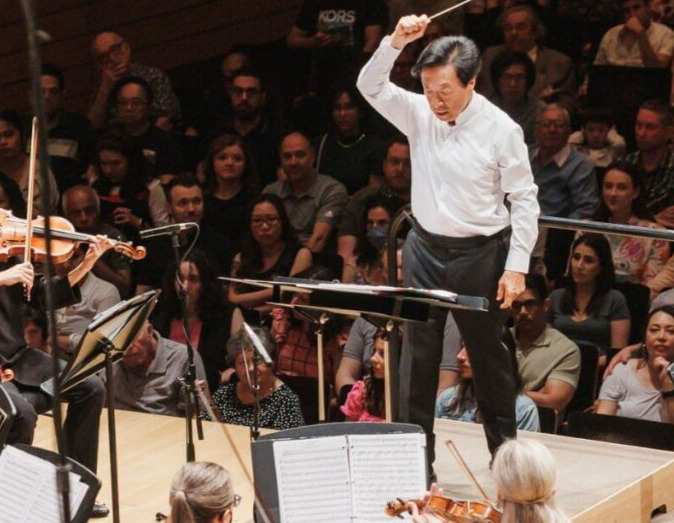
BB: Conductors usually are long – lived because the physical part of the job is exercise using your arms. As a physical feat, how hard is it to conduct an 80 minute symphony such as Mahler 2? How tired were you after finishing that TSO concert?
Mandle: it is a work out :):) no question about it !!! I was happy 🙂 Soooo happy when the cheering started.
BB: Is any of this scary for you? if so what’s the scariest part?
Mandle: most definitely 🙂 when I lost my place in the score and conduct totally from memory :):)
BB: what music will Mandle Philharmonic do in 2026? I think you mentioned Mahler 2 & Mahler 8: but anything else, short pieces?
Mandle: Mahler 8 is monumental. I printed the score few days ago. Will start studying soon.
Talking to Budweiser about a major outdoor concert in June. Just started.
Royal philharmonic in London, Friday August 21. Mahler 2. I’m already nervous 🙂
Thought about a Stravinsky concert but I’m glad I dropped the idea.
June and October we may have two RTH dates to do Mahler 2. Still discussing with my team.
BB: symphony orchestras sometimes program lighter music, as in Boston Pops, music that isn’t as dissonant or edgy as Mahler. Would you ever put something on a program from that category?
Mandle: Georges Bizet, Carmen Suite No. 1 and No. 2
Alexander Borodin, Polovetsian Dances
Antonin Dvorak, Slavonic Dances Op 46 /8
Modest Mussorgsky, Night on Bald Mountain
Camille Saint Saens, Bacchanale from Samson and Delilah
Bedrich Smetana, Ma Vlast: Moldau
John Williams, Star Wars Suite Main Theme
BB: some pieces are done without a conductor, for instance Bach, Vivaldi or Mozart concerti are sometimes led by the soloist (playing violin or piano). Would you consider undertaking any pieces from earlier periods?
Mandle: no
BB: You’re from Hong Kong, do you have any interest in music from China or Asian countries?
Mandle: did one piece !!:):) Li, Spring Festival Overture
BB: There’s a new genre of music emerging over the last decade, as it’s gaining fans & admirers, namely film music, the music in popular films. Do you have any interest in film music?
Mandle: Star Wars is as close as i got :):) I do want to produce West Side Story.
BB: After Mahler 2 & 8 there are other pieces you admire. What are they and would you consider conducting any of them? Mahler 3 or 5 or 9?
Mandle: I considered 5 but again want to focus.
BB: Do you like any operas or oratorios, that you would consider conducting?
Mandle: not really
BB: Do you have any vocal or choral music you would consider conducting with Mandle Phil..?
Mandle: We have done Beethoven 9, Carmina Burana excerpts, and Borodin Polovetsian Dances
BB: Do you have any ideas about reforming / modernizing classical music culture to better align with modern audiences?
Mandle: Adding narratives is something i try to do before each piece.
BB: Yes I noticed in the Beethoven’s 9th concert at Koerner Hall.
BB: What if anything can classical music learn from the way popular musicians play & market their music?
Mandle: the sheer size and length make classical challenging.
BB: Do you have any teachers you would like to acknowledge, who have helped you?
Mandle: Arthur Polsen was concert master of Winnipeg symphony when i studied at University of Manitoba back in late 60 early 70’s. He picked me to conduct Beethoven third piano concerto, with a piano performance student as soloist, in graduation concert. Then the Arthur Benjamin harmonica concerto with the CBC orchestra, same players as Winnipeg Symphony.
*******
Mandle enjoys conducting, and he’s picked music that he loves. It’s not rocket science, he’s doing what he loves.
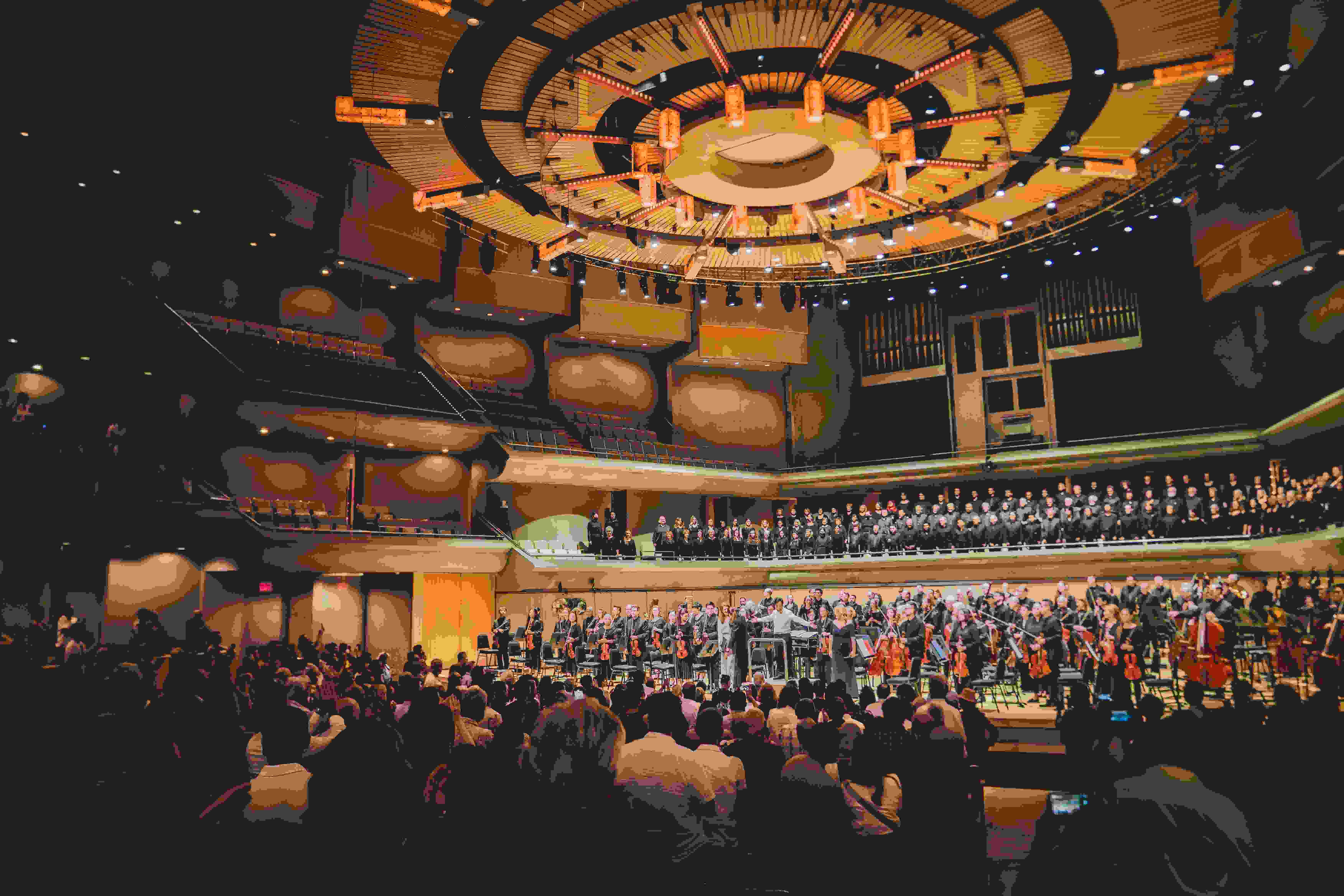
The passion & pleasure Mandle experiences conducting is what we sense watching him, the surrender to a simple impulse of enjoyment & pleasure.
Although the Mandle Phil website does not yet have dates for the Mahler, if you want to attend, follow the link, as this is where you will see the dates and be able to get tickets.
 barczablog
Leslie
Have you interviewed anyone in the orchestra?
>
No I have not. I did listen to the TSO performance live and chatted with a soloist backstage afterwards.
Not to say anything against Mandle – I was at the last concert and found it amazingly good and enjoyable. The members of the orchestra are key. Say no more!
>
The easy flow of your interview is not only an interesting take on a fascinating individual, it captures some of the mystery and fascination we have with conducting. Mandle’s modesty is disarming as well both as an amateur conductor and successful entrepreneur. Thank you for following up on this story. May it continue.
Thank you Wayne for the kind words. No wonder Mandle is successful, he’s very bright and he understands people. I hope we get to hear his Mahler #8 one of these days.
Pingback: Norman Lebrecht vs Yuja Wang using Lebrecht’s own quote against him | barczablog