
Saturday March 21st I was among the viewers in a Scarborough Cineplex watching and listening to the Metropolitan Opera high definition broadcast of Tristan und Isolde directed by Yuval Sharon, conducted by Yannick Nezet-Seguin. At least as far as the listening there can be unanimous praise for the musical side, especially soprano Lise Davidsen as Isolde & Michael Spyres as Tristan, as good as I have ever heard, speaking as a lifetime fan of this opera.
But there are fundamentalist Wagnerians who see the original text as something sacred, who challenge the right of directors & designers to explore the deeper meanings in the opera if their work seems to depart too far from expectation. I loved what I experienced at the Cineplex and plan to see the encore in April, even as I recognize that what we saw via camera work misses some of the magic of an extraordinary design in the theatre space. Spoiler alert: I will describe a few things that may take away some of the pure excitement you’d experience if you didn’t know what’s coming.
Central to my testimony is a bit of comedy at our Cineplex, that our broadcast started late, missing any introductory words, instead beginning partway through the Prelude. While some might be outraged I think it was a windfall, a blessing to be immersed in the first pages of Wagner’s score without preamble or explanation, thrown into the deep end the same way as if we had walked into the theatre at Lincoln Centre NY.
We saw a man and a woman facing one another across a table. In time we saw a second space further upstage where the drama of the first act was played out. It made more & more sense later, especially in the third act, where Tristan is mortally wounded, nearly dead and like a person called back to life before finally dying. The set and the divided personage called to mind the near-death experiences that we often hear about in the media, so that it was as if the struggles of Tristan nearly dead were perfectly captured onstage. And in due course Isolde had her own comparable moment.
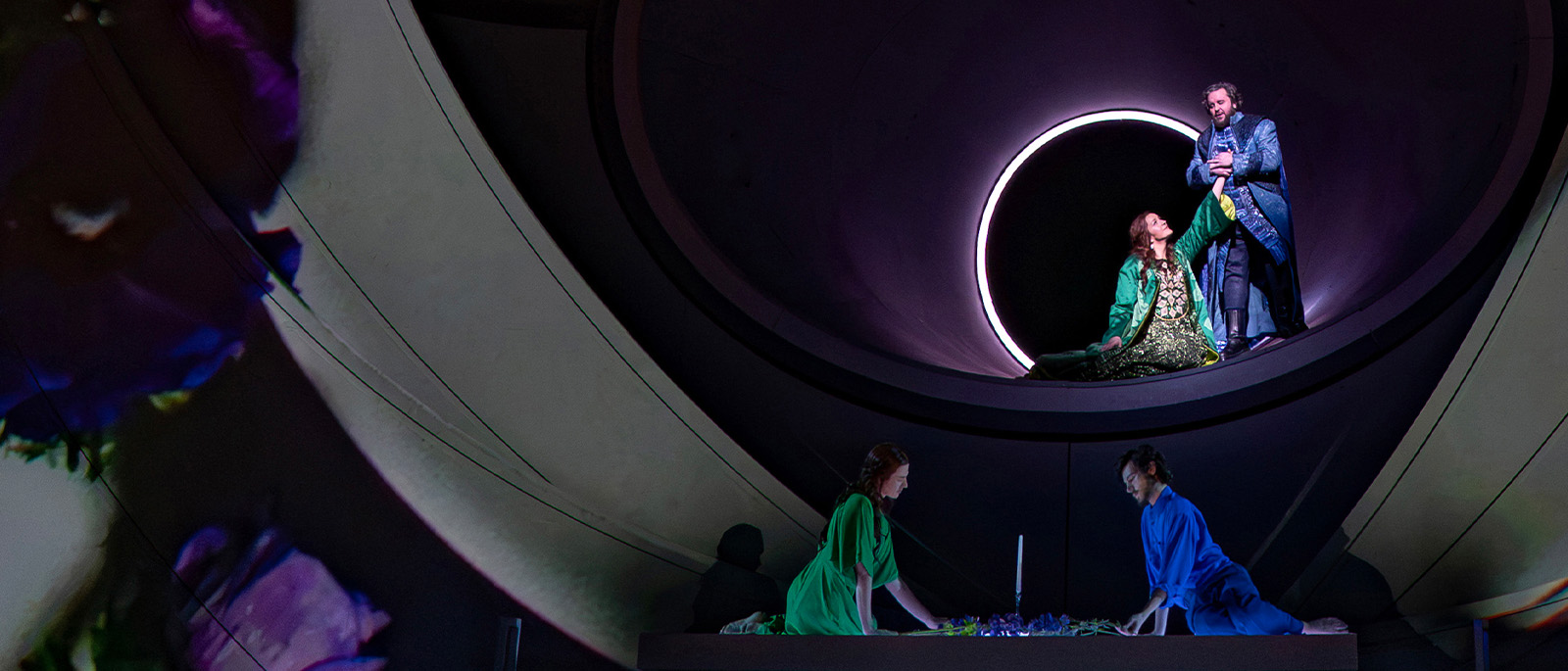
Notice how there are two parallel spaces, one occupied by the singers, one by actors. This works differently at different parts of the opera, as sometimes the singers were in the downstage space. I suspect this was a huge challenge to diagram and plan, let alone to execute and design.
This is especially electrifying in the last act, when first Tristan and then Isolde die, their upstage self being: I’m not sure what exactly. In my spirituality I think of them as the souls. But I think it depends how you understand the world, as to what you will see & understand, and don’t want to impose my beliefs upon anyone. I believe in the immortality of the soul & an afterlife. I suspect Yuval didn’t want to taint his work with anything as spiritual as what I have just described, indeed he missed an opportunity that again might have been too awkwardly sentimental: that Isolde in passing might see Tristan or vice versa. Am I a sentimental fool? perhaps.
There were some things in Yuval’s production that I am not sure I fully understand: and I invoke them without prejudice. I find it comical that some critics go apeshit when they don’t understand something, as though it’s an insult to require the audience to engage their brains. Ego can get in the way. And so I report aspects I did not fully understand or appreciate even though I still found this to be the best Tristan I’ve ever seen, indeed my favourite operatic experience of the last decade, given that the musical side was so good.
While I am not sure I understand why Isolde is shown to be pregnant when she arrives near the end of the opera, and seems to deliver a baby, singing her Liebestod (love-death) presumably having died in child-birth, yet I find this a far more satisfactory resolution than the usual, where Isolde seems to die for no apparent reason. The fact that Tristan tells us in one of his long Act III narratives that his mother died in child-birth may suggest that having Isolde sing her love-death from the upper space as though her body has passed away and she is observing from after life is an interesting choice, whether or not I have understood it correctly or not. I believe the theme of continuity and cycles is clear enough in a set and a story full of circular shapes. I’m also reminded of mysterious Mélisande who dies at the end of her opera, having just given birth to a child.
In many places throughout the opera I was moved powerfully, sometimes to the point of crying convulsively, trying not to be so loud as to disturb other patrons. The end of Act one, after Tristan and Isolde have taken the love potion, and have become so absorbed with each other they have no concept of anyone or anything else, was done as well as I have ever seen it; the double spaces underlined the disrupted subjectivity of the potion. While the music is happy & celebratory with the arrival of the ship into port, the chorus singing their praises of King Marke, our focus is on the two lovers and their unhappy position. That juxtaposition of happy and sad hit me hard.
The love duet of act two is in some ways very conservative, Yuval simply having the lovers stand & sing, before the arrival of the King and his entourage. When Tristan then sings about Isolde following him into the realm of night, and he begins to methodically & ritualistically put out candle after candle, I lost it totally, especially when for a moment tenor Spyres looked into the camera with an expression that seemed to say “this is how I am going to do it”. Remembering that his very forward behaviour triggers Melot to stab him, I wondered if he was aiming to provoke the attack. Or maybe I’m reading too much into it. But I found it very powerful, very moving, this very simple structured set of actions.
And for much of the third act I was crying. As a nerd who grew up with recordings, I was thrilled by the work of Tomasz Konieczny as Kurwenal, playing up the aspects of a role that often get brushed aside in the focus on the protagonists, the observer whose expressions while working loyally for a happy outcome really breaks your heart.
I was moved by Spyres, singing as though he has one foot already in the grave, the split stage making most sense in the last act, seemingly meant especially for the moments in Act III when each protagonist is struggling to stay alive or actually dead. While I love the singing of Lise Davidsen I didn’t find the Liebestod moving in the same way, indeed there was a point partway through Act III when the choreography killed much of my response, watching dancers who didn’t seem to be a match for the opera. If I could advise Yuval –whose work was so stunning– I want to say “less is more”. The gentle intimation of afterlife & spirit powerfully moved me, admittedly aided by the passing of my mother in 2024, that likely sensitized me. But the white-clad figures upstage behind Tristan put me in mind of Roger De Bris (from The Producers) , as I almost said “one two kick turn” aloud in the Cineplex, feeling that we were being hit over the head after so much subtlety in the moments before, and the insertion of a whole new creative vocabulary cluttering the experience and upstaging the tenor.
And I did not understand why Yuval thought it made sense to make a kind of dramaturgical intervention with the plaintive English Horn solo that is heard repeatedly in the 3rd act, presumably played by a shepherd. Normally it’s played from offstage. Tristan explains that the melody has accompanied the news of his father’s death before he was born, and news of his mother’s death at his birth; yes it’s illogical that he can tell us about a tune accompanying the news of something before he was born, we are in a mythological space. Yuval decided to have the English Horn player onstage playing the tune. I can’t understand why, although I am open to hearing someone tell me why. It didn’t kill things the way the white clad dancers did, but then again such things are individual.
Overall I had an amazing experience. That’s why I was happy that our Cineplex started late, throwing us right into the opera. I didn’t need any explanations from Yuval, didn’t need anyone to tell me what I was seeing or what it meant. Later I went looking for explanations, and they didn’t contradict what I observed from first principles in the cineplex.
Director Yuval Sharon described his approach this way in an interview
“To explore polarity, we are introducing a “split world” into our production: Let’s call it the “world of the table” and the “world of the fable.” At the start of the opera, the singers will appear on the stage in a way that will feel very recognizable to us in 2026, closer to a contemporary couple. At the table, arranged ritualistically, are all the objects that have the totemic power to bring us into the world of Tristan and Isolde’s story. As the music unfolds, those objects become portals into another dimension, containing the landscapes of the opera: The water in the jug becomes the ocean centuries earlier, as Tristan’s ship carries Isolde to King Marke. The couple at the table become possessed with the music and the story, occupying both worlds at once: our world, from the standpoint of 2026, and the mythic world of the opera, existing in the blurred historical moment of legend. Like shamans, they will stand in the visionary space containing two realms.“
Whether you have read this or not, the production is completely intelligible. It helps to know the opera, so long as one doesn’t show up with stipulations and demands of the designer or director.
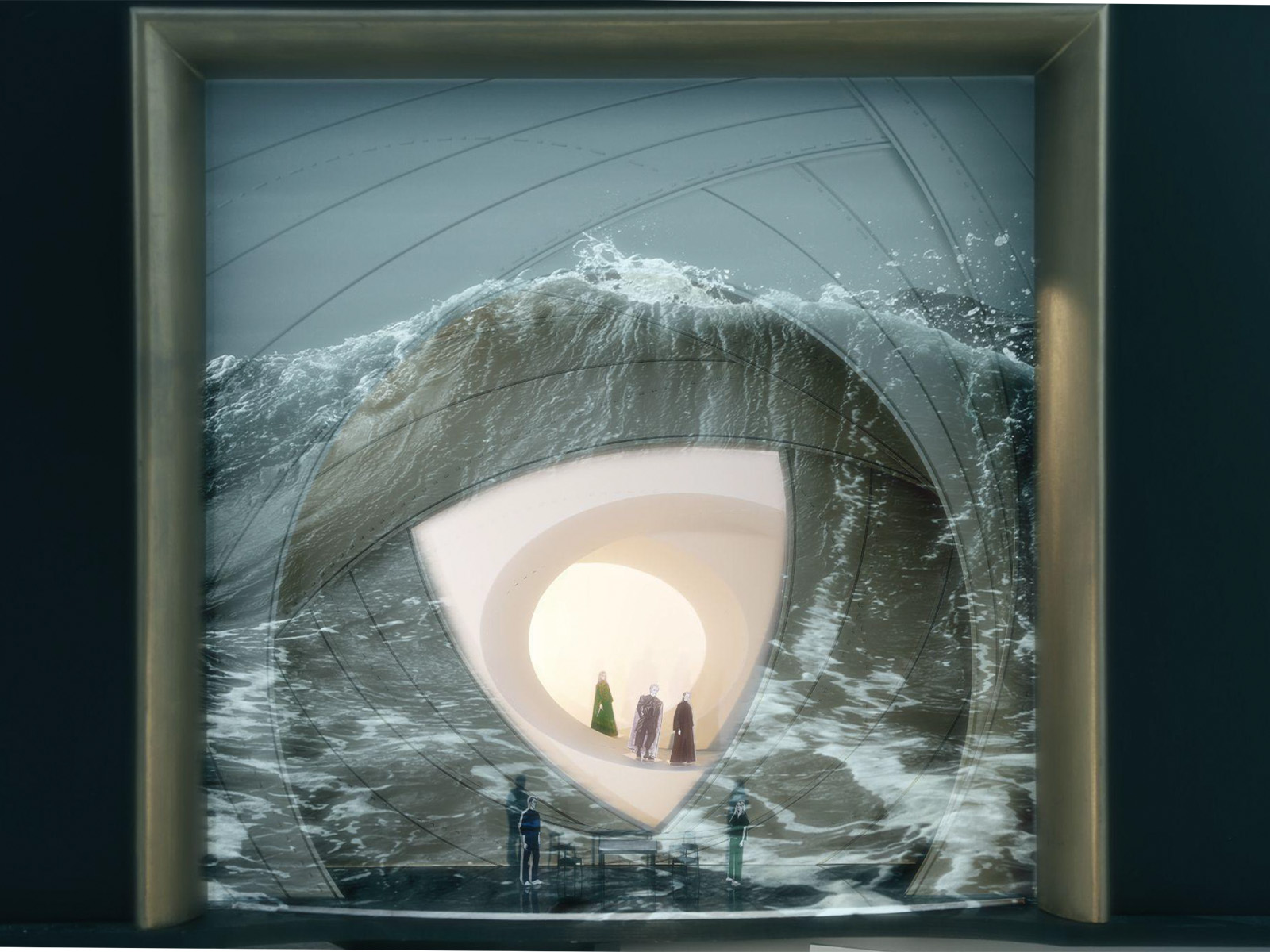
The creative team includes Set designer Es Devlin, Costume designer Clint Ramos, Lighting designer John Torres, Projection designer Jason H Thompson, Video designer Ruth Hogben, and filtered for us by Live in HD director Gary Halvorson. We seemingly had the best of both worlds, at times so intimate as to be watching gigantic images of the protagonists, sometimes watching the complex stage picture from afar. I don’t envy Gary his impossible job, deciding what moments deserved a closeup.
Instead of my rapturous reading you can find some online who object to the production’s concept & its design, which I embrace even if Yuval & his team lost me in the few places that I mention. But for most of the four + hours I was enraptured, not just by Yannick’s superb tempi and the brilliant play of his orchestra but also by tremendous singing. Yannick showed a willingness to adjust, sometimes fast, sometimes slow, in the demands he makes on the singers, a conductor aiming to follow them.
If you are a Wagnerian in Toronto and you missed the broadcast, there’s an encore on April 11th, or if you can get to NY there are four performances left on March 25, 29 April 2 and 4, that last one with a different Tristan & King Marke. Whether you’re a devout Wagnerian or just curious, I strongly recommend the production, which undertakes inclusion of several fascinating aspects of the opera’s subtexts in its presentation. I’ve never had such a satisfying experience, and plan to see the encore in April, hungry for more of what I already experienced.
Sometimes I was a bit perplexed trying to figure out what I was seeing. Is that bad? If you walk into an art gallery, or to a concert of new music one expects challenges from the artists. That’s normal. I would add that when a piece includes a preamble, artist’s statement or program, I take an agnostic position, questioning whether the piece requires that explanation, whether the piece becomes incomplete without its preamble. I’m glad I saw the show without any preconceptions or introduction, and it still held together beautifully.
Critics are not here to tell you what’s good or bad, as though a film or an opera were a car or a blender, to help you decide whether your investment of time & $ is a good choice. Long before the invention of clickbait critics were offering judgment & dismissal in newspapers & print, giving readers a kind of pleasure in the abuse to which they subjected the artists. I have always found this perverse, possibly because I recognize the vulnerability of artists. I remember tenor Jon Vickers avoided Toronto for so many years after he was dismissed as a fat & balding tenor by a critic at the Globe, language that is not far from what we heard more recently directed at Yuja Wang by Norman Lebrecht. Surely the physical appearance of an artist is not just irrelevant but potentially offensive when placed into commentary on the performance as musical artists.
No I won’t judge. And yes that makes my job more difficult. Criticism is only a useful contribution to history when we testify about what we observe & feel, hoping to describe & explain art by making our own subjective experience into a specimen for analysis. Given that creation and reception are processes, we must answer questions such as “how does it work” and “what does it do” and let’s also avoid technical jargon, aiming for inclusiveness, to be helpful. That’s also a good reason to go see the show again, not just for the pleasure but in hope of better understanding what we see and hear. In case I wasn’t clear I recommend that you go see the encore or if possible see the show live in New York.
 barczablog
Thanks for this detailed review! I watched the broadcast at Varsity Cinema, and we got the full transmission, from the start. It was a superb performance musically, but not the most engaging production I have ever seen. I agree with your observation that in general, in a Tristan production, less is more. The dancers were definitely a bridge too far. Still, I was rivetted by the performance from start to finish; the 5 hours and 20 minutes was over in a flash. I was struck anew by how each act of Tristan is a different world unto itself, both dramatically and musically, yet it all unfolds in one coherent act from start to finish. I hope to catch the repeat performance in April.
There are many brilliant moments. That whole sequence where Tristan & Isolde are “inside” the knife shape would be especially powerful seen in the theatre, something we could barely surmise in the cineplex. I am excited to imagine Yuval Sharon directing a Ring cycle.
Thank you for the kind words.