Toronto Symphony recently released their third Harmonia Mundi live recording, captured from performances 21-23 November 2024 at Roy Thomson Hall, featuring two works by Béla Bartók (1881-1945) plus a piece by Canadian Emilie Cecilia LeBel.
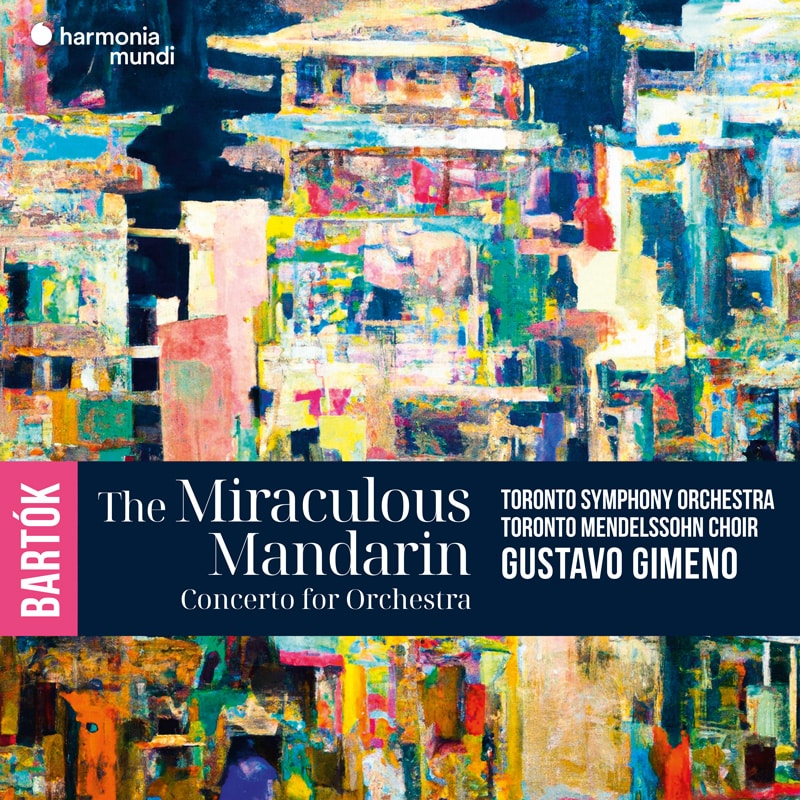
Roy Thomson Hall’s acoustics seem to be perfect for large orchestral works such as these three compositions:
Béla Bartók: The Miraculous Mandarin (complete) 32:51
Emilie Cecilia LeBel: the sediments 9:27
Béla Bartók: Concerto for Orchestra 37:55 in five movements
The Concerto for Orchestra is a big treat, the occasion for our TSO to show their excellence, with Gustavo Gimeno showing us more of his true colours. It may be dangerous because I keep driving the car with the volume turned up, immersed in Bartók.
The TSO have reached a higher level of virtuosity, clearly able to play anything and make it sound fluid and easy, as this piece demonstrates, a unique work that is well known featuring some remarkable sounds and moods. We go from a serious realm in the first movement into something more ironic in the second, sadly meditative for the third, and playful in the fourth even as a solemn melody comes to pieces as though in self-mockery. And then in the closing movement as he brings past themes back, the energy and pace picks up relentlessly, a series of breathless thrills, building to a kind of celebratory finish, feeling public & expansive.
Gimeno’s dynamics are often subtle, the interior voices distinct but gentle. After hearing so much Bach lately I’m recognizing the counter-point and subtler voicing in Bartók I didn’t notice at first. The more I listen to this performance, so clean & effortless, the more depths I find to it.
I think it’s impacting my thinking, as the last two reviews I wrote (one about a new play, the other a Tafelmusik concert) had me repeatedly thinking as though from first principles. I am smiling a lot as I keep listening to this CD over and over.
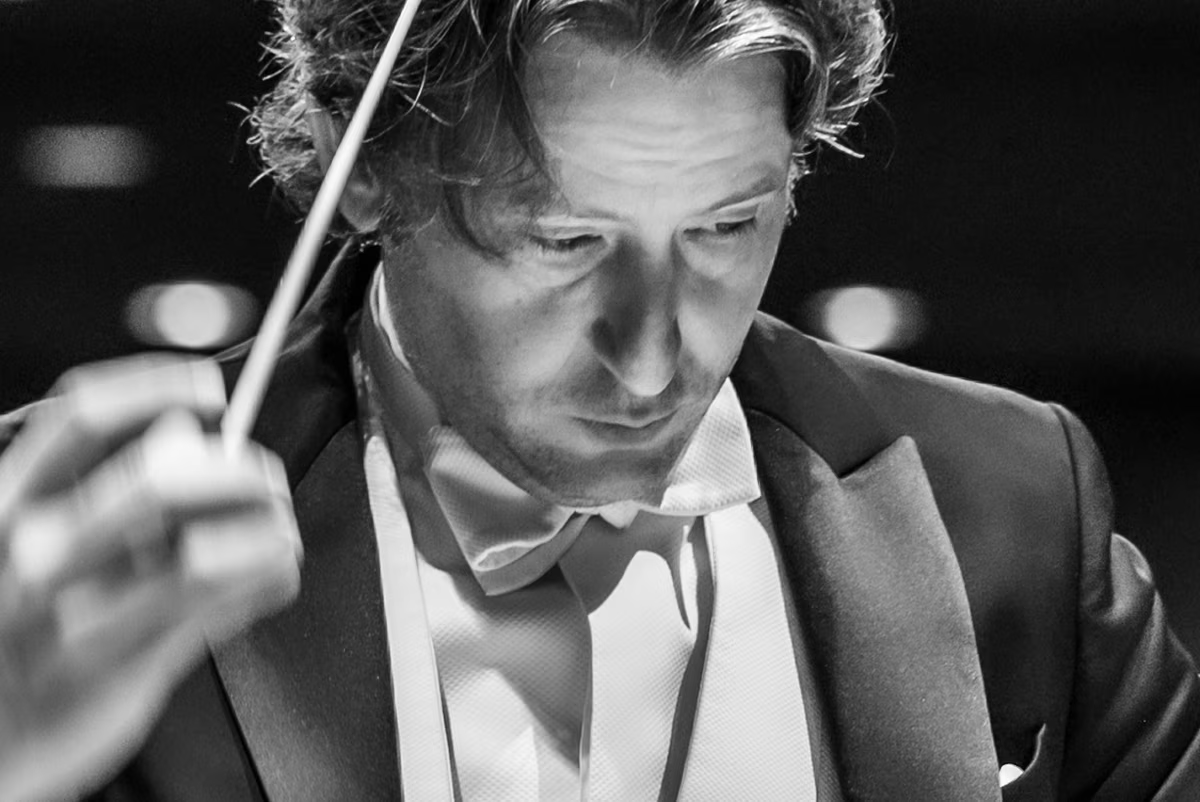
I was puzzled at first that the recording bears the title of the lesser known work (The Miraculous Mandarin) rather than the popular one (Concerto for Orchestra) that I’ve found so thrilling, although with repeated listening I came to discover depths & thrills in the Miraculous Mandarin too.
And when I look more closely at that colourful cover design, yes both works are mentioned. Maybe the obscure title of a lesser known work might get the TSO more attention, given that it’s not usually heard in its complete form.
Gimeno and the TSO remind me of the way a musical score is a kind of puzzle asking to be solved. The way the music is played represents solutions to the enigma, expressions of the composer & their style filtered through the performers and their own style. I recognized listening to this over and over that I didn’t know Bartók as well as I thought.
The Miraculous Mandarin caused such a scandal at its 1926 premiere that it was banned. A century later, I think it’s a revelation. The lurid story is summarized in the record’s liner notes:
Three lowlifes force a young girl to pose at a window and attract men passing on the street, so they can rob them. After an elderly rake and a timid young man, both penniless, have been enticed in then thrown out, she lures a wealthy, strange-looking Chinese man, whom the thieves try to kill, but in vain: neither stabbing him with a knife, nor suffocating him with pillows, nor even hanging him from the lamp bracket can finish him off. He dies only when the girl offers herself to him, finally satisfying his desire.
Bartók’s orchestration is brilliantly original, sounds that had never been heard before to match the extreme stage actions in Menyhért Lengyel’s scenario for the ballet. The descriptive term we sometimes encounter is “expressionist”, that fits most parts of the score really well, music portraying extremes of emotion, employing an exaggerated & angular sonic vocabulary.
I am reminded of Stravinsky’s Sacre du printemps by the way the titles of sections leave so much to the imagination. I used to drive myself a little crazy trying to picture how the particular sections of Le Sacre would be choreographed, wondering what actions or movements went with the particular sections of the ballet. It took me a long time to let go of that compulsion with Stravinsky, something I don’t feel with the Bartók given that it’s newer to me, and its history onstage is so much rarer than Le Sacre. But even so I wonder how this would be staged. While a modern director / choreographer would freely do as they please, I can’t help wondering what Bartók might have meant: although we’ll never know.
While Bartók may have intended his music to depict specific action or movement, the titles of the sections tell us little; this is again from the liner notes.
1. Beginning – Curtain rises 3’05
2 | II. First seduction game 3’37
3 | III. Second seduction game 3’08
4 | IV. Third seduction game – The Mandarin enters 4’11
5 | V. Dance of the girl 4’51
6 | VI. The chase – The tramps leap out 4’27
7 | VII. Suddenly the Mandarin’s head appears 7’17
8 | VIII. The Mandarin falls to the floor 2’15
In the pantomime we meet the three tramps & a girl, then watch three successive attempts at seduction of passersby: first a shabby old man, then a young student, and third a wealthy Mandarin. Where the first two were lured in, and thrown out when their poverty was discovered, the Mandarin is a worthwhile catch for the thugs. The Mandarin is attacked, but does not die and continues to desire the girl. His head mysteriously glows in the dark. Only when the girl recognizes his need and helps satisfy him, does he begin to bleed and he dies. Yes it’s inexplicable as per the title. I see echoes of other death & redemption stories such as The Flying Dutchman or Kafka’s Hunter Gracchus.
The music is often so powerful as to suggest the grim realities of poverty in an urban setting, complete with physical struggles, violence and sexuality. There is also a brief subtle wordless chorus towards the end of the complete ballet (that’s missing from the orchestral suite), performed by Toronto Mendelssohn Choir, led by Jean-Sébastien Vallée. The descriptor “expressionist” breaks down when used for this part, and I say that as an agnostic who dislikes such terms, often thrown about carelessly. Immediately before and after we are still hearing angular & rough sounds, but then the wordless chorus takes us into another realm entirely, one that for me is more of a symbolist effect. We have encountered this before, in Giuseppe Verdi’s Rigoletto in the 1850s, in Debussy’s third orchestral nocturne in the 1890s, Ravel’s Daphnis et Chloé just before the Great War in 1912 or Holst’s Neptune at the close of the war, perhaps finished in 1918. And then there’s the frequent use of wordless chorus in films of the past half-century, because such voices suggest or imply humanity, the presence of life, whether alive or dead, human or supernatural but non-specific given that the choral effect has no words nor any visible personages. I wrote about it a few years ago. Where much of the score is over the top (expressionist), the last part is characterized by restraint & subtlety (symbolist). My joy at the encounter with the music was balanced by huge doubts, humbled when pondering the limits to my analysis and hesitancy about using descriptive epithets. Add to that the awareness that Bartók would not have seen this again in his lifetime. I wonder how it would look in a staging even as I recognize that it’s unlikely I will ever have that privilege.
For this and for the rest of Miraculous Mandarin, I can only say I wish someone would consider this darkly intriguing story, especially considering that what was scandalous in 1926 is much more commonplace a century later. Perhaps someone might consider making a film, video, even animation or puppetry.
Between the two powerful Bartók works we hear Emilie Lebel’s sediments, a TSO Commission in its World Premiere Recording. She speaks briefly on YouTube about her composition, and the support offered by the TSO to Canadian composers.
We hear about the honour Lebel felt sharing the CD with Bartók, a composer she encountered in her studies. I think Lebel’s score makes a calm break from the wild intensity of the two massive works on either side of her piece. While it opens with a passage of great intensity the piece is mostly tranquil, even static in comparison to the Bartók pieces.
As mentioned I’m hesitant about descriptors for musical compositions, especially if they are used to classify works & their creators into pigeon holes. When LeBel speaks of Rachel Carson’s book The Silent Spring (1962) leading to the attempt to represent “sediments” in the composition. Here’s a more detailed look quoted from the recording liner notes.
‘The sediments are a sort of epic poem of the earth. When we are wise enough, perhaps we can read in them all of past history. For all is written here. In the nature of the materials that compose them and in the arrangement of their successive layers the sediments reflect all that has happened in the waters above them and on the surrounding lands.’ — Rachel Carson
‘At the beginning of things, before it ever rained, there were clouds. Clouds so heavy, no light could penetrate to the earth. Any rain that did fall was instantly converted back into steam. At some point when the temperature of the earth dropped enough, the rain fell. Every surface on the planet filled up, and the continuing rain dissolved the land above, washing away and dissolving things. As I listen now to the rain, water surrounds me. I think about the weight of sediment, and our history. Water flows on, whether I am here or not. Everything that ever was is still here.’ — Emilie Cecilia LeBel
I wonder if the piece can be understood in some sense as “impressionistic” given the use of music to suggest rock and water in the Earth. But notwithstanding Leonard Bernstein’s lecture about Debussy’s impressionism, I think this term is so vague as to be useless (sorry Leonard), given that any music seeking to capture a visual reference is therefore in some sense impressionistic: unless he meant to insist on French composers, which makes it even less meaningful. I think Lebel’s words suggest a poetry in her reading of Carson’s book that carries over to her music, an imaginative and suggestive halo to illuminate her work and its imaginative orchestration.
I wish I had been at the hall for the concert, as I’m intrigued by the way different media change our experience of the music. Streaming the music, one can assemble it any way one wishes. In theory that’s also true with a CD, although I’m somewhat old-school, playing a disc from beginning to end, which led to some unexpected consequences for me. On CD you follow the Mandarin’s soft death rattle with the loud opening notes of elements, and so at first I mistook it for the end of the Bartók. Seeing it live, we have a separate experience of each work, including the moments of recognition for Emilie Lebel during the applause that you see on the video.
Placed alongside their two previous recordings, Messiaen’s Turangalila-Symphonie (May 2023), and Stravinsky’s complete Pulcinella with The Fairy’s Kiss (February 2024), the performances boldly promote an image of Gustavo Gimeno and the TSO as modernist experts. Their next project scheduled for June 2027 is Mahler’s titanic 8th Symphony. When I saw that in the schedule I was tempted to join the Mendelssohn Choir, to be part of the excitement, indeed it might help with their recruitment this year. At the very least I want to be there at Roy Thomson Hall.
 barczablog
Here is a staged version with an excellent orchestra!- https://youtu.be/Gc_UsxAmsec?si=Dk6yqx7kvpbbFlyN
LikeLike
Thank you! (must have a look!)
LikeLike