Questions for Emma Char

Born in Kitchener – Waterloo, Ontario and raised in the Philadelphia area, Emma Char (who holds dual U.S. and Canadian Citizenship and currently resides in Toronto) recently crossed the border back to Canada to make debuts with Opéra de Montréal, I Musici de Montréal, Les Violons du Roy and Ensemble Caprice. The current adventure is in a co-production of the Banff Centre, Canadian Opera Company, Against the Grain Theatre and Toronto Summer Music, taking on the title role of Benjamin Britten’s The Rape of Lucretia, which opened July 14th in Banff. July 22nd it’s Toronto’s turn to see this production at the Elgin-Winter Garden Theatre.

I had to find out more about this intriguing young artist and her portrayal of Lucretia.
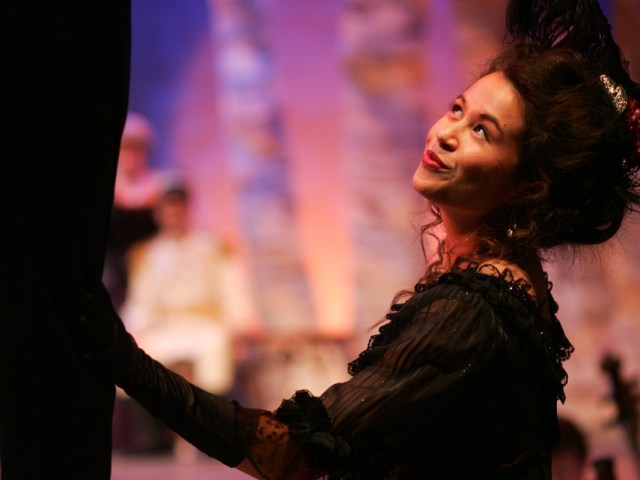
Emma Char in A Little Night Music, Eastman Opera Theatre, (photo: Gelfand-Piper Photography)

Emma Char in A Little Night Music, Eastman Opera Theatre, (photo: Gelfand-Piper Photography)

ONE: Are you more like your father or your mother?

I think I am a blend of both my father and mother in terms of how I look and my inherited character traits. My father is Chinese- American and my Mom is Canadian of British Heritage. I would say I’m calm, analytical and logical like my father, but also possess a non-linear way of thinking and a latent fiery side, which I believe are traits inherited from my mother. My father is a computer-scientist with a passion for musical theatre and my mom is a painter and homemaker; their influence pervades my life in many ways most of which I am probably not completely conscious.

TWO: What is the best thing about what you do?

I’d say the best thing about what I do is the possibility for continuous growth. In this field of work I’m learning about myself all the time through taking risks in rehearsal and making discoveries about what is possible to create with my voice in the practice room. I am usually a quiet person in normal life, so performing through singing is a way I feel I can express myself and connect to people in a much larger way than I would ever be able to do otherwise.

THREE: Who do you like to listen to or watch?


In general, I love watching and listening to people with rock- solid technique that allows them tremendous expressive capabilities through sound but who also use their bodies in an expressive physical way to further convey emotion and drama. Joyce Di donato and Isabel Leonard are two of my favourite mezzos to watch.

I love watching TV shows; Arrested Development, Parks and Recreation, The Office and also getting lost in amazing dramas; House of Cards, The Good Wife, Broadchurch, The Killing etc. Netflix is a major source of joy and comfort, but at times a tremendous addicting temptation.

FOUR: What ability or skill do you wish you had, that you don’t have?

I wish I were an incredible dancer. I love dancing but I’m afraid that will never be a highlight of my skill set.

FIVE: When you’re just relaxing and not working what is your favourite thing to do?

Sharing a meal with family and friends is my favourite thing to do. I also love going outside for any reason; biking around Toronto is amazing, as I find it both stimulating and relaxing.

Emma Char in Amahl and the Night Visitors (Photo: Yves Renaud)

Emma Char in Amahl and the Night Visitors (Photo: Yves Renaud)

*******

More questions for Emma Char as she undertakes the title role in The Rape of Lucretia at Toronto Summer Music Festival July 22nd.

ONE: Lucretia lives through hell in this opera, and has to express that through her voice yet while still sounding heavenly. Please talk about the special challenges of such a role vocally.

Preparing the music very, very well, so what is on the page is more or less automatic and second nature technically in terms of vocal production hopefully allows me to not worry about my voice while performing. Diving into the experience of Lucretia, her intentions, her depth of feeling, has been a huge exercise in getting comfortable being uncomfortable with vulnerability. At times during the rehearsal process, emotion took over and I could barely speak or phonate at all, let alone sing. Getting comfortable feeling such heightened emotions and learning where my edge is; the point where I am completely engaged dramatically with my entire body but where I can still keep my throat calm and breath flexible in order to be able to sing well is a continuous process, the ease of which changes from day to day.

TWO:Rape of Lucretia is a small-scale work both musically and dramatically, to be performed in a relatively small theatre on July 22nd, as the heroine’s heart is laid bare with an almost indecent intimacy for the audience. Please talk about what that feels like, particularly in an intimate venue.

For the rehearsals of our production in Banff, we rehearsed in a relatively small space, where the production team would be watching a few feet away from the front of the stage. These rehearsals definitely felt intimate and at first a bit uncomfortable but I got used to the space and missed it when we moved into the theatre. The best thing about a small space is that I feel I have no choice but to get lost in the character and completely commit to the moment to moment, as there is no shield of distance between stage and audience.

THREE: One of the special challenges in some roles is the desire as a feeling person to react, to feel. A performer who is reacting emotionally –perhaps crying or laughing—has lost some if not all of their control, and is no longer performing, having become another of the spectators. How do you stay clear in a role like this one, where your feelings may overwhelm your thought process?

What is most difficult is learning exactly how far I can let emotions inform me before they take over when I’m onstage. It is usually a lot further than I think. What is also interesting to me is that the audience doesn’t feel what I feel. Sometimes I can be feeling a lot of really negative things about a performance and everyone thinks it was incredibly moving. Other times I feel great about what I have just done and those observing have less intense reactions to the experience. The best advice I have gotten about acting had to do with keeping my intentions on stage active. Sometimes, sinking into too far into “feeling it” does little to move the audience because all that people experience is that you’re standing there flailing your arms around.

FOUR: I can’t help wondering if Rape of Lucretia is a coded work of art, where the composer’s ideas are hidden yet lurking under the surface. But unlike so many of Britten’s operas –thinking of Peter or Grimes or Billy Budd or Death in Venice—there’s no troubled male protagonist at the centre of the story, as though tempting us to seek the correspondence between his life and the story of that opera. Where, if anywhere, would you find him in this story (for instance in the exchanges between the male and female chorus, or in the anguish of Lucretia)? Or am I being too reductive?

Paul Curran, our director at the Banff Centre, brought up the idea that this piece was written at the end of the World War II as a political statement to Churchill and a commentary about war and the harm it does not only to soldiers but to bystanders. At the end of the opera the Female and Male Chorus bring up questions about what the point is of all of this that has happened. What has humanity learned from the horrors of the past, do we ever learn? Why does history continue to repeat itself?

Director Paul Curran

Director Paul Curran (click photo for more info)

FIVE: Opera has always relied upon women to be the voices for suffering from its inception and Britten’s powerful opera isn’t much different, leaning most heavily upon the women, while leaving the men comparatively inarticulate. Please weigh this opera, whether you see it more as a modern piece of theatre, or as a classic opera requiring its diva to suffer and die. Is it modern or timeless in its handling of an ancient crime?

I think this piece is not necessarily just representative of women’s suffering but with the collective suffering of humanity. The characters at the end of the opera dealing with the aftermath of Lucretia’s death are the ones who are perhaps left with the greatest pain.

I believe this piece couldn’t be more modern and its subject matter couldn’t be more relevant. What I hope to do with this role is to make Lucretia a real person with desires and not a one-dimensional character. The subject matter presented in this opera is unpleasant, but so necessary to bring to light. What can we learn from this story, and why do tragedies like these continue to occur across the world in real life?

SIX Is there a teacher or an influence you’d care to name that you especially admire?atg
The Against the Grain Theatre team has been a great source of influence and inspiration to me personally and professionally. The work they have done the past few years has gotten me enthused about the possibilities of opera yet to come and my involvement with this project has been nothing short of life – transforming. My highest admiration and gratitude goes to those brave souls who took risks starting this company.

*******

Produced at the Banff Centre in collaboration with Against the Grain Theatre, Canadian Opera Company, and the Toronto Summer Music Festival, Benjamin Britten’s The Rape of Lucretia comes to the Elgin/Winter Garden Theatre, 189 Yonge Street, Toronto at 7:30 Friday July 22nd. For further information click image below.

2016-Web-Banners-TheRape

Posted in Interviews, Opera | 1 Comment

London Calling: Toronto Summer Music Begins

Tonight’s concert kicked off Douglas McNabney’s final season as artistic director of the Toronto Summer Music Festival. “London Calling: Music in Great Britain” is the theme of the festival. Mother Nature even got into the act, offering us a proper English downpour as we emerged afterwards.

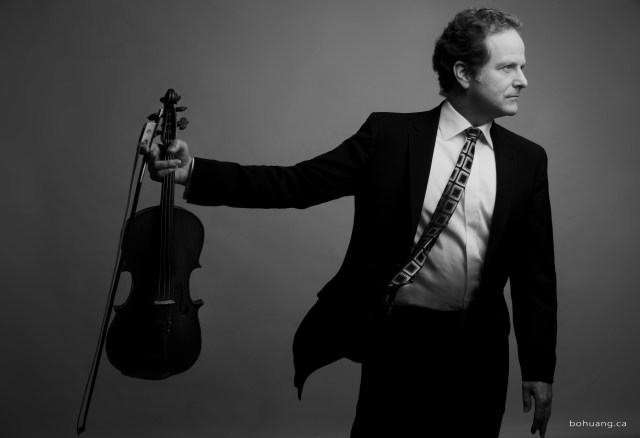
Douglas McNabney photo (Bo Huang)

Douglas McNabney (photo: Bo Huang)

Over the next three weeks we can encounter not just composers of Britain but composers from abroad who came there, such as Handel, Haydn or Mendelssohn, as well as composers known to have had momentous concerts in England, such as a historic 19th century concert of Beethoven string quartets that McNabney described, a concert that’s to be re-enacted. In addition to the concerts, one can hear lectures, workshops and more over the next three weeks.

Tonight was titled “English Music for Strings”, exploring “the Finest and Most Influential Pieces in English Repertoire,” a wonderfully conceived program:

  • Holst’s “St Paul’s Suite”
  • Britten’s “Serenade for Tenor, Horn and Strings”
  • Tippett’s “Concerto for Double String Orchestra”
  • Elgar’s “Introduction and Allegro”

We were presented with some of the glories of English composition over the past century, a series of pieces displaying the kind of resemblances one sees in a family album.

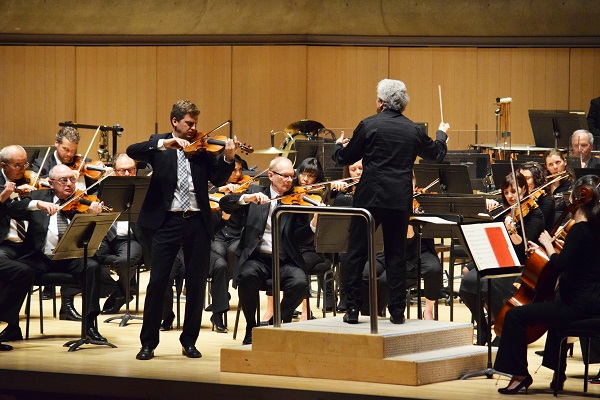
Conductor Joseph Swensen drew a sweet sound from the TSM Festival Strings, displaying an ear for melody & sensitivity to the many solo moments in the evening, while pulling them together into a cohesive ensemble.

neil-deland

Neil Deland

Neil Deland, the Toronto Symphony’s principal horn player and tenor Nicholas Phan gave a splendid account of the Britten Serenade. Accustomed as I am to light voices singing this piece such as Peter Pears or Robert Tear, I didn’t think I could be surprised by a voice going in an even gentler direction: but I was wrong. Phan made sounds that were always supported and strong even though at times he took the piece further in the direction of the upper register and even sounds that resemble falsetto. And yet he also gave us explosive power in other places, making for a sensitive and poignant account of the poetry in this work. I believe Phan showed new possibilities in the piece with his imaginative approach.

Deland played with admirable restraint, impossibly soft in the haunting Elegy, playfully agile in the Hymn that’s as quick as a scherzo, yet always showing off a marvellously well-shaped and controlled sound.  As the first and last sound we hear in this piece (the prologue and the offstage epilogue), Deland’s magical playing was for me the highlight of the evening.

After intermission Swensen and the orchestra seemed determined to show us that they could be just as virtuosic without soloists in the Tippett. The Adagio was especially beautiful, although all three movements showed genuine inspiration.

For more information about the Toronto Summer Music Festival, which continues until August 7th go to their website (click here).

Posted in Music and musicology, Reviews | Leave a comment

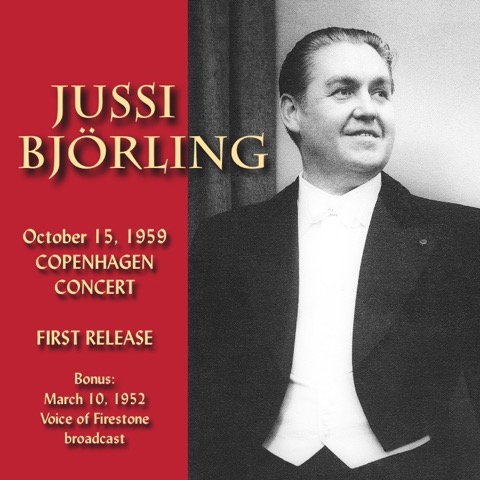
A new Jussi Björling recording, 57 years later

The headline isn’t a mistake nor a figure of speech.

Swedish tenor Jussi Björling is one of my favourite singers.  As a child, it was his recordings of the great arias and duets that I usually encountered first, often spoiling me for any other singer.  In addition to his unparalleled operatic output he created a wonderful body of song performances, often songs from Scandanavia that I’ve never heard sung by anyone else.

The immortal voice came from a mortal.  I came to discover his pluses and minuses –as with any artist—as I grew up.  While the tone was stunningly beautiful, I heard critiques suggesting that he was better on record than in person given his limitations as an actor.  Sometimes his pronunciation showed an accent (for example the Italian word “ciel” often sounded like “shell” rather than “chell”), even though this was a singer who performed in many languages  (the CD includes the usual German, French and Italian, but also Swedish and Norwegian).  Note that he sang in a transitional period, when many regional houses still sang everything in the local language (for example, he had learned Tamino in Swedish and never learned it in German because it wasn’t a role he sang internationally), whereas by the time of his retirement most operas were being done in the original language.  He had a habit of sometimes singing higher notes a fraction of a tone sharp, an effect that I found exciting even if it’s not strictly accurate, and bothers some listeners.

And he died in 1960.

How then can I properly appreciate the magical gift of a newly discovered performance, released for the first time in 2016?  October 15th 1959 was the date of Björling’s recital in Falkoner Centret Concert Hall, Copenhagen, one of the first events in a brand-new facility.  The precious tape of this concert was recently discovered, restored, and now has been released fifty-seven years later for the first time in cooperation with Jussi Björling societies in Sweden, UK and America.  While the recording includes a twenty-four page booklet, the song texts aren’t included but can be found instead on the website of the Swedish Jussi Björling Society with translations (although a couple are missing, possibly because there were late changes in the CD).    The recording concludes with a bonus Voice of Firestone broadcast from 1952, an additional seventeen minutes or so, pushing the total to over sixty-seven minutes in total (the Copenhagen recital comprising almost fifty minutes).

Part of the booklet is the engineer’s explanation as to why these never came to light before: that both the broadcast recording (from 16” lacquer coated discs, exhibiting crackle and disc noise) and the Copenhagen recital recording (on reel-to-reel tape, including dropouts, low-end bumping (bias) noises plus audience coughs) were unserviceable without digital enhancements (NB the re-furbished Voice of Firestone broadcast has previously been made available on an Immortal Performances release of a 1941 Il Trovatore from the Met, and I think I’ve heard it before with its original rough sound).

JB_konvolut

Here’s the list of tracks on the CD:

The Copenhagen Oct 15th recital, Jussi Björling with Bertil Bokstedt piano:

1: Mozart: Die Zauberflöte: Dies bildnis ist bezaubernd schön, (sung in Swedish Ja, detta är en ängels bild)

2: Brahms: Die Mainacht

3: Liszt: Es muss ein Wunderbares sein

  1. Wolf: Verborgenheit

5: Schubert: Die Forelle

6: Schubert: Die schöne Müllerin: Die böse Farbe

7: Bizet: Carmen: La fleur que tu m’avais jetée (Flower Song)

8: Björling announces a Peterson-Berger song instead of the originally programmed Alfvén song.

9: Petersen-Berger: Jungfrun under lind

10: Alfvén: Skogen sover

11: Sibelius: Demanten på marssnön

12: Sibelius: Säv, säv, susa  

13: Grieg: En svane

14: Grieg: Ein Traum (sung in Norwegian as En drøm)

15: Giordano: Andrea Chenier: Come un bel dì di maggio

16: Tosti: Ideale

17: Richard Strauss: Zueignung

The Voice of Firestone from March 10, 1952 with the Voice of Firestone Orchestra & Chorus, Howard Barlow, Conductor

18: Opening announcements & Firestone: If I Could Tell You

19: Announcements

20: Speaks: Sylvia (with Chorus)

21: Announcements

22: Puccini: Turandot: Nessun dorma

23: Announcements

24: Tosti: L’alba separa dalla luce l’ombra

25: Announcements

26: Herbert: The Princess Pat: Neapolitan Love Song (with Chorus)

27: Announcements

28: Firestone: In My Garden and concluding announcements

I think this is an important CD for a number of reasons, that will reveal itself to me in the years to come as I listen incessantly.  Our habits have changed possibly due to shifts in fashion or scholarship, taking us in different directions, so it’s marvelous to hear a singer going back and forth between opera arias and lieder, sometimes bringing the same interpretive approach to bear on both.  His Flower Song is more like lieder than opera, in its remarkable changes of pace and tone, a phenomenally psychological reading unlike anything you’d hear in an opera house.   And although he was only a few weeks removed from the hospital –having had heart problems during the recording of Madama Butterfly earlier the same year—we aren’t easily able to discern any evidence, no signs of compromise.

Several of these are the most perfect realization of a particular piece that I have ever heard (although in the case of the Scandinavian songs, the only other versions are by Björling).

  • “Säv, säv susa” and “Skogen sover” sound more delicate and vulnerable than ever, the soft head-voice fluid yet supported, astonishing to reconcile with some of the powerfully macho sounds in the same fifteen minutes of singing
  • While this “Zueignung” seems to be a bit of a tug of war with pianist Bokstedt (possibly because the singer didn’t have the same wind & stamina we encounter in other recordings, especially that wonderful concert recording from 1960, where the last note goes on so powerfully) I was struck by the lucid intelligence of this trouper, coping boldly with his limitations.
  • This is the first time I’ve ever heard “Die Forelle” sung by someone known to be an avid fisherman, a playful interpretation unlike any I’ve heard.

This recording isn’t just for Jussi fans, but anyone who enjoys good singing and beautiful music.  You can find the CD by going to the Swedish Björling society website ,  then clicking on “Shop” in the menu at the left of the page.  As far as I know you won’t find this in record stores, making this a one-of-a-kind gift for your opera-loving friends / family members. They’ll love you for it.

jussi_logo_940_en

Posted in Music and musicology, Opera, Reviews | Leave a comment

Aida by Request

I am doing something I’m not supposed to do.  I went to a concert more or less having made up my mind what I was going to say before the first note sounded.  It’s not because I’m prejudiced and lacking objectivity.

shookhoff-william

William Shookhoff

Instead of talking about the performance I really wanted to talk about context, about the circumstances underlying tonight’s Aida, presented by Opera by Request.  As you may recall, I’ve reviewed them before, a rather unorthodox opera company run by Artistic Director William Shookhoff.

“By request” means just what you think.  Instead of a company whose programming and casting are driven by market forces, Shookhoff reverses the usual expectation.  Singers come to him wanting to undertake particular roles, although sometimes Shookhoff does pursue a singer.  But this company sometimes performs a valuable function, wonderfully illustrated by tonight’s concert.  Yes it was a concert, so not only were there no elephants, there was no chorus, nor orchestra nor set, nor any costumes either.  It was given for a relatively small audience of devoted listeners, likely drawn by the prospect of hearing the singers in new repertoire.

Here’s the thing.  The template one sees in opera companies –whether we speak of the Merola program in San Francisco, the Ensemble Studio here in Toronto with the Canadian Opera Company, or a host of other frameworks for young talent—is one with strengths and weaknesses.  This is a great way to give young singers a kind of paid apprenticeship, leading to a career.  It seems to be a great way to spot future Zerlinas or Figaros or Taminos, but when it comes to the bigger voices you need for a Verdi opera such as Aida..?

We’re told there’s a worldwide shortage of singers who can handle the roles in operas like Aida.  But maybe it’s the template that’s at fault, the philosophy of companies that select the wrong sort of talent, aiming to fill small parts.  To sing Aida or Radames or Amonasro or Amneris, you need to somehow hang around in the business until the voice comes around, until it’s ready to take on this heavier repertoire.  Some do people manage to hang around.  We’ve seen Christine Goerke, who had sung lighter roles for years, come to Toronto to undertake her first Brunnhildes.  Thank goodness she was able to wait for the changes in her voice.   We heard Sondra Radvanovsky sing a fabulous Aida a few years ago, opposite a weak Rhadames and a barking Amonasro.  Adrianne Pieczonka took on Amelia in Ballo in Maschera,  again a case of patiently waiting for the right time to take on a killer role.

What do you do if you’ve got a bigger voice, but don’t fit the ensemble template?  I don’t know!  It’s a scary question.  Some singers manage to stay in the business, while others continue singing intermittently, as their voices develop.  If you’re not singing regularly the development doesn’t happen the same way.  And so this is where Shookhoff and Opera by Request can play a useful role, at least for the singer, if not for the community at large.

I watched a production of Aida presented by a group of singers who are not singing with a big company such as the COC, perhaps not singing as often as they would wish.

  • Soprano Carrie Gray

    Soprano Carrie Gray

    Carrie Gray sang Aida, and was not at all daunted by this difficult role. Both of the big arias were musical highlights of the evening.  If she were singing more often she’d be better, but wow this was impressive, her legato smooth, her control solid.  I wish I could hear this voice more often.

  • Paul Williamson sang Rhadames, a voice that has grown in heft and colour since I last heard him. While he still has a very Italianate line, a splendid sound up top, he’s making a big big sound that matches Gray’s powerful voice.  This is a voice that would have improved the COC production had he been cast instead.
  • Michael Robert-Broder was for me the highlight of the show, speaking as someone who thinks Amonasro is the most interesting character in the opera. This is one of the prettiest readings of the role I’ve ever heard, a part that is sometimes barked (and again, this mellifluous singing would represent an improvement for the COC), which means that he gave us subtlety and even something verging on bel canto musicianship to which I am unaccustomed in this opera.
  • Ramona Carmelly was every inch the diva princess as Amneris, in a thoughtful performance that held nothing back, especially in her big scene in Act IV. This is a voice that could develop in several directions, as she has the top and low notes, and sang a huge role in a bluesy style a few months ago in the premiere of David Warrack’s Abraham.
  • Andrea Naccarato as the High Priestess made a huge impression in this small role.  I’ve heard Andrea sing “Un bel di”, so this was luxury casting, having such a powerful voice invoking the ancient god.

I have to wonder.  Would Jon Vickers or Maria Callas have managed to make it, to have a career had they come along in the opera world of the 21st century?  One would hope so.   But in the meantime, as the younger versions of Vickers and Callas sing as often as they can, seeking to make an impression, hoping for a career breakthrough, at the very least one can enjoy the voices in performances like this one.

For more information about Opera by Request click here.

Posted in Opera | Leave a comment

Lydia Perović’s All That Sang

Perhaps art is really a proposition. I’m not sure there’s much difference between the approaches we make to one another in our discourse or our intercourse, particularly when so many of the words we use for one, apply to the other.

I recall an amazing conversation I had long ago with a director who had begun to speak retrospectively as if taking a long valedictory victory lap, enjoying the sunshine before the expected onslaught of a major illness. He explained that he got into the theatre because there was someone he wanted to fuck, and yes that’s exactly how he said it, and he was sure that lots of people were in the arts for the same reason. At the time I giggled a little bit, to conceal my surprise but as the years have gone by I’ve started to notice that his statement has more than a little truth to it.

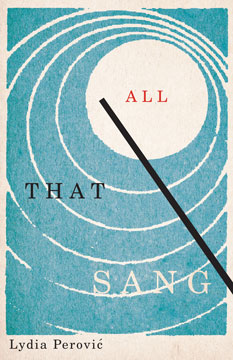
all_that_sangThat conversation came back with a vengeance while reading All That Sang, Lydia Perović’s recent novella. There’s a chicken-and-egg quality in some relationships, as we may wonder: did that couple become intimate first and collaborate later, or were they working together and only later ended up in the sack? The happy oblivion of desire means that people don’t necessarily do what logic or planning would dictate.


That I am speaking this way of All That Sang should tell you that I am fully engaged in its world and its loves, having bought into its narrative, fascinated by the way the book unfolds.

I am reminded of a conversation I had back in university, one that I recall regretting for how it showed my naivete. I’d read a short story about a cellist, and told the writer “I didn’t know you played the cello”.

“But i don’t” he told me matter of factly, while I picked my jaw up off the floor, and realized, oh yes, that’s why it’s called “fiction”, that’s what’s known as “writing”. I think the first mistake I’d made was in under-estimating that writer, someone I’d mistaken for a rock-n-roller without depth. Or maybe the problem was that at this point in my life, I casually underestimated lots of people (rockers and cellists alike), and needed to look deeper, and seek to understand.

I am taken back to this story because in reading All That Sang I recalled the expert descriptions of how to play the cello, and wondered whether I should assume it was all from a kind of expertise.   Of all the different sorts of prose in All That Sang¸ I don’t doubt Perović’s authority and expertise in the explorations of lesbian eroticism, both because she has more or less told me –excuse the euphemism here—that she plays the cello, and also because Incidental Music (another of her books) also demonstrated a comparable virtuosity.

As with Incidental Music, All That Sang takes us into a world that seems to be within Perović’s comfort zone. This time we’re not in the realm of opera but instead the symphony, but every move in the milieu into which we’re taken is made with confidence. This is a work of great self-assurance.

Every note is played with conviction, every word significant. But it’s a lightly Apollonian exercise, less Mahler than Satie, and one that leaves you in your right mind rather than stirred or intoxicated. All That Sang calls for admiration, leaving us with a strong sense of skill and the clarity of Perović’s purpose.

I keep coming back to that notion that there is an intersection in our second Chakra, that creativity and procreativity are related if not actually the same thing. All That Sang takes us to the ambiguous and conflicted heart of passion and amorous vulnerability, not flinching from the unpleasantness we sometimes encounter.  I’m reading it a second time, discovering additional depths and nuances.

banner-2014

For further information & to purchase, click here to go to Véhicule Press’s website.

Posted in Books & Literature | 1 Comment

Gourmet Schnitzel House: look eastward, Toronto

I don’t want to provoke an argument, particularly not one of those regional disputes where someone tries to suggest one place is better than another. Toronto is a city full of neighbourhoods, ethnicities, communities, and nothing stands still because it’s a dynamic city. Not only is the skyline encumbered with construction cranes, testimony to the ongoing growth transforming the place, but every street has the capacity to confuse with new places. It’s impossible to keep up with them.

web_logTonight I’m writing about Gourmet Schnitzel House, the restaurant that’s earned a place in my heart and gulp maybe a place on my waistline as well. Tonight I overate, and while I started out thinking I’d pursue a path of moderation, I let my appetite get the better of me, sigh, again.


Maybe it’s because ancestral voices call to me, singing songs of my ancient home, Magyarország, aka Hungary. I don’t literally mean music, so much as the scents and sights on your plate that go with this breath-takingly simple menu. Everything they offer is executed brilliantly.

I can say that because I’ve tried them all.

Tonight I had their Cordon Bleu Schnitzel, other nights I’m having Goulash Soup, or Cabbage Rolls, or Chicken Paprikas. The schnitzel that’s made here is unlike any I’ve encountered in a Toronto Hungarian restaurant (and I’ve tried a great many). I’ve long been conflicted about Hungarian cuisine (someday we can discuss the mixed joys of Töpörtyű, something I never liked as a child). Most of the schnitzels I encountered around Toronto in Hungarian restaurants were a troubling experience, a celebration of the same fatty excess.

Imagine my joy to discover a new approach in the Gourmet Schnitzel House. These schnitzels are less fatty than any I’ve ever encountered because their process suspends them vertically, while they drip, losing most of their fat. They’re then served dry and crispy.

Ideal!

I was stunned at how beautifully the smoked ham and emmental mixed in my Schnitzel tonight, much subtler than other such Schnitzels I’ve encountered. I recall a dinner long ago at the Austrian House on Beverley (where I think the same one was called the “Franz Josef Schnitzel”), or Tarogato, or so many others, where I struggled to finish those greasy behemoths.

Madness! I didn’t slow down for a moment.  I had dessert too. I passed up the ice cream that could have decorated my warm Apple Strudel, and insanely finished off my wife’s Palacsinta too. The coffee accompanying dessert is the best coffee I’ve had in weeks, muscular without any bitterness.

Such are the blessings of this little corner of Toronto, the Cliffside – Bluffs part of Scarborough. Gourmet Schnitzel House can be found on Kingston Rd a couple of blocks west of Midland, licensed. Here’s their website where you can view the menu, hours and contact information.

Posted in Food, Health and Nutrition | Leave a comment

Divergent objectives from TSO

For awhile now the Toronto Symphony has been offering a series of concerts organized around ten-year periods of history, in other words, their Decades Project. Some have been more illuminating than others, but for me tonight’s pairing was especially powerful, seeming to illustrate a kind of musical fork in the road.

As Peter Oundjian described it, you could see one part of the concert pointing to the past, and the other to the future. One work portrayed the tenderest emotions. The other? human sacrifice. One enacted a secret program rather than anything explicit, while the other was as subtle as being hit by a stick. One gave us a concerto, a celebration of foregrounded virtuosity, while the other subsumed all skill into the total effect. Or in other words, we began with Elgar’s Violin Concerto played by James Ehnes, and concluded with Stravinsky’s Le Sacre du Printemps, both works conducted by Oundjian.

James Ehnes, Peter Oundjian 3 (Emma Badame photo)

James Ehnes violin, Peter Oundjian, leading the Toronto Symphony (photo: Emma Badame)

The contrast between the two works made this the best Decades program yet in my opinion.

When I turned on my laptop after getting home, I googled “effect of heat on acoustics”, seeing a few links confirming my suspicions: that both heat and humidity can make things totally wonky especially in the realm of classical music.

I did so because

  • this was the warmest TSO concert I’ve ever attended, a day with ambient temperatures around 30, and a humidex even higher.
  • There were some very strange effects in the hall

In the first movement of the concerto at times the TSO was drowning out the soloist even though he had lots of sound, plenty of oomph to his playing, particularly on his higher strings. I couldn’t help wondering whether Oundjian –standing a few feet away from Ehnes—could possibly have heard what we heard, sitting in the mezzanine. At times it was more a concerto for violin vs orchestra. I smiled when we got to the third movement passages where the orchestra gets out of the way, quiets down for some exquisite cadenzas, masterfully played. I’ve always heard Oundjian lead with great sensitivity, himself a violinist who surely cares about the result. I have to think he’s undone by Roy Thomson Hall, a space that tonight had the oddest effects. At times the strings –who are assembled downstage, closest to us—seemed to be a big pool of woofy sound enveloping everyone else, making all other details (eg woodwind solos) emerge as though coming through a fog.

Ditto with Le Sacre, and sacre bleu I might have said (an epithet I recall from childhood in comical send-ups, showing a French person cursing: and please excuse me that I have no idea what it actually means when you say this!). The same effect at times concealed finer details that should have been able to emerge. Oundjian seemed to lead a very committed performance, although at times the strings were all that was coming through, as even the massive brass was seeming remote, distant, as their fat sounds were clearly coming from way upstage, rather than emerging properly. The bass & kettle drums seemed to be the only ones who could cut through but that’s likely because they’re playing in an entirely different register, so low that they’re not clogged up by anyone else’s sonic residues.

Even so the audience ate it up, making me wonder if they were hearing something substantially different. Ehnes played superbly, the orchestra especially sympathetic in the last two movements.

Posted in Music and musicology, Reviews | Leave a comment

Rite of Survival: a cheap drunk’s view

Let me first explain myself, why I’d admit (or even boast) that I’m a cheap drunk. Anyone wanting to cut to the part about the beer and avoid the theoretical talk, please skip down to the pictures.

Our culture associates the consumption of alcohol with the rites of passage leading to adult-hood, whereby we prove or fail to prove ourselves. Drink a lot and you’re a man, right? (plug in the appropriate gender- and culture-appropriate descriptors and epithets as needed).

The usual assumption is that sophistication and experience, possibly in the company of maturity, are more or less parallel, while naivete and inexperience, encumbered by youth, stumble along, clutching one another for mutual support. That’s the conventional wisdom.

Yet I am a long-time advocate of innocence, Pollyanna rejecting the trappings of wisdom even as s/he seeks a kind of enlightenment. Those of us hoping to quiet the mind may mistake alcohol for a pathway to nirvana. Before entangling you in too many contradictions, let me simply say—mangling a bit of Shakespeare in the process—that the fault lies not in our contradictory goals (such as the achievement of nirvana and the quiet mind, amidst too much stimulation) but in our logic that can’t handle contradiction & complexity. A child regularly expects to be dazzled and overwhelmed, whereas those of us chasing PhDs and assorted academic /professional laurels, may assume that someday we may achieve clarity, like the pompous teachers we recall. But this is an illusion, the clarity being a performance rather than real wisdom. Life is full of contradictions, not clear like Bauhaus but messy and shadowy as Rembrandt’s chiaroscuro (a word I love as much for its wacky phonetics as its intimations of things I can’t quite see or fathom. I am reminded suddenly of Professor Douglas Chambers at Trinity College, whose lectures were themselves a bit impenetrable in their verbal chiaroscuro, parts of his discourse eluding me like heads ducking into the shadows). In emulating the innocent child, the student looking up at the light rather than the expert talking down to his followers, I model an attitude. A cheap drunk? This is one who is no hardened drinker, eager to be moved-delighted rather than callused and impervious to sensation. It’s the reason I laugh too loudly at some shows, but also cry uncontrollably. Doug Chambers also used the word “sensibility”, to speak of an attitude celebrated by the Romantics that has resonance for me to this day, a readiness to feel and a preference to drop my defenses, given that those defenses may tend to prevent or even preclude joy.

And of course this sounds so pretentious that you’d be right to say “get that man a drink” (and anyone wanting to scream “S.T.F.U.”simply stopped reading. One of the great things about social media is how we’re all preaching to the choir. Anyone who disagrees would simply close the page and go elsewhere).

Still here? Thanks.

Friday was a vacation day, and a morning after. I’d seen Die Fledermaus and stayed up late writing about it, prolonging the sensations (I wasn’t kidding when I said I was star-struck in the review…) even as my caffeinated brain refused to let me go off into sleep even at 2 a.m. Next morning’s breakfast had included eggs, bacon, sausage, ham, cheesecake and scotch. After a walk to the grocery store, it was time for yard work, dealing with a mucky pond (speaking of chiaroscuro). We’d had our moments of hedonism, balanced with the walking and shoveling.

We needed to re-balance with more hedonism.

John Lennon might have said “beer is the answer”, or perhaps he did when he was young.

Hanging around home I turned to something I’d purchased from the Beer Store at the instigation of a very friendly & capable young sales agent (i will thank her next time i see her by buying more of the same product). Knowing that I had a guest from abroad, I was advised to buy a sampler, giving us the makings of a beer tasting, the ideal way to relax on a backyard patio after cleaning the muck out of a pond. Muskoka Brewery has created this fascinating box of fun & games, their SURVIVAL Sampler. Six beers, two bottles of each.

survival_six

Six different beers: SURVIVAL Sampler from Muskoka Brewery

I had opened the pack and then shoved them into the fridge without really paying close attention.  I had noticed that wow there were several different varieties.

Now?  I grabbed the first one to come to hand. Hm… Mad Tom. What a curious name for a beer. It was the closest and the bright red caught my eye.

What we then chose to do, as I looked more closely at the box, was entirely an innocent exercise, as we hid in the shade with beer. We took six bottles, one of each type, and, dividing each in two (a medium sized glass for each of us from each bottle), proceeded to rate them. As we’re going to hear Stravinsky’s Sacre du Printemps tonight with the Toronto Symphony, (aka “Rite of Spring”) you could call it a “Rite of Survival” for our SURVIVAL Sampler. It was only after trying a couple that the idea of a comparison emerged, a tasting exercise. For me, the more innocent activity isn’t tasting but drinking, consuming.

And becoming inebriated. (see headline)

It’s especially funny in light of where we started, our friend Mad Tom.

But more about Tom in a moment. Let me simply identify the survival six, in their “Survival Sampler”.

• Mad Tom
• Kirby’s Kölsch
• Cream ale
• Detour
• Summerweiss
• Craft Lager

side_of_box

What the Survival Sampler box tells you

So let me take you along for our taste-test.

Mad Tom happened to be the strongest beer of the six. I wish I’d known, but maybe that’s just it. It was a gentle echo of the mystique of Brador, the epic beer of my youth that at one time you couldn’t get in Ontario. Speaking of rites of manhood, traveling to a different province was once necessary to get a stronger beer. Later we could get things like Black Ice to name a strong beer that I used to consume regularly. Black Ice is just over 6 % (regular beer = 5% while light beers are usually around 4%) but Tom is stronger still at 6.3%.

But thirsty people sitting down to their first beer after yard work may have trouble calibrating the strength of their beverage, especially if they inhale their half of a Mad Tom in one mad gulp.

Next up was the oddest of the six, something called “Kirby’s Kölsch”.

They tell us it has a hint of peach, which I didn’t mind. But it’s not like the other. Aha, I see how tasting and comparing all these beers may lead one from the realm of innocence into something like sophistication, as I googled the word “kölsch” to try to understand how this brew is different. Ah but that’s something I did the next day (writing), trying to recollect this process from a sober (and hungover) vantage point.

In all honesty, yesterday? I expected that I might write something that led parabolically into a drunken rant, as I became wackier and wackier. Instead of (say) Diary of a Madman which becomes progressively less coherent, it would be an irrational stream of consciousness to match the eventual stream of something else when I went to the bathroom, to return the brew(s) to the source.

Let me simply say that KK was not universally loved like Mad Tom, with the result that it would end up at the end of the rating of 6 bottles. It’s hard to rate things when your brain is a moving target, your taste-buds changing every few minutes. You might enjoy trying this yourself even if it’s less an academic – scientific thing and more of a parlour game. I think KK would have done better had it not followed the unassailable Tom.

The third bottle to be sampled was well-received as the first, the Muskoka Cream Ale. We were off in a reverie of ales, as I recalled how I’d begun my undergraduate pub life drinking Molson Ex, an Ale drinker who also enjoyed many other ales (hmm was Brador an ale?), before morphing into the bizarre dilettante who now sits at his laptop, recalling his drinking yesterday. This was to be #2 in our list, likely the best tasting but only edged out by Tom due to his hefty alcohol content.

Size matters, and never let anyone tell you differently.

Then came beer #4 and how apt to see something called DETOUR… I recognized even before I opened it that yes we needed a bit of a detour because we were getting hammered pretty fast in the afternoon heat.

And so I went to grab something from the kitchen to eat. We hadn’t eaten since breakfast (the afore-mentioned eggs, bacon, sausage, ham, cheesecake and scotch, plus tomatoes, strawberries, toast and coffee), admittedly a feast stretching from 10 to 11 am.

logoAs we sat lunching at 4:30 pm, looking but not touching the Detour, as we took a bit of a non-alcoholic detour, we wandered off the path. I thought back to Muskoka, a place a bit beyond my family’s price-range, where a couple of my classmates had owned properties, a place giving its name to an iconic chair that appears on the label of the beer (see?).

We had company in the yard, between the four different chipmunks (meaning chipmunks of different size who circled around as though they wanted some of our beer), assorted birds & squirrels, the breeze and the obbligato car-horns (“obbligato” as in unavoidable and undeniable in our urban setting). Salami, swiss cheese, and rye bread gave us a bit of a break and put something other than beer inside us.

And then it was time to get back on the road with the Detour, if you will excuse my apparent contradiction. Wow, this has to be the best light beer I’ve ever encountered. Being a bit on the drunk side didn’t hurt. This is one of the best times to drink a light beer, like the smaller personal risk for the gambler seeking to stay in the game without going bust.  Ah but there’s the risk. Like the smoker consuming twice as many light cigarettes than the normal ones, we inhaled the light Detour, losing any advantage it might have conferred upon us.

Number five was Summerweiss, another departure. We were still in the brewer’s realm but this tasted like none of the others, an edgy and quirky taste, wacky with its wheat flavour, somewhat sour and truly unlike any other beer. But it’s refreshing all the same.

Our last bottle was the Craft Lager, possibly a brew beyond the capabilities of our taste-buds at this point. Were we now only susceptible to high alcohol? I found it bland, especially compared to the quirkier flavours of Summerweiss. If we did this the way professional tasters did it –a little taste and spit it out—maybe we’d have a different response but this was primarily fun fun fun, a recreational activity. We weren’t tasting, we were drinking.

I have to recommend this. We had two people drinking and discussing as we rated our Survival Six, but this could work for many more: so long as you have lots more beer to compare. For us this was an innocent activity, not really about identifying who is good or bad, so much as a fun way to enjoy some beer on a summer’s day.
http://shop.muskokabrewery.com/

box

Posted in Food, Health and Nutrition, Personal ruminations & essays | 2 Comments

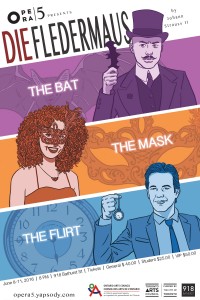
Good-time Fledermaus from Opera 5

Let’s set aside the yard-sticks of excellence that critics use.  I went to see Die Fledermaus tonight in its new immersive Opera 5 Production. Although I was the designated driver I was totally immersed. It was fun even though I only had one beer.

It was one of those nights when I was laughing so loud I got funny looks from the lady standing beside me. Hm, that’s odd isn’t it, that we were standing?

aerial

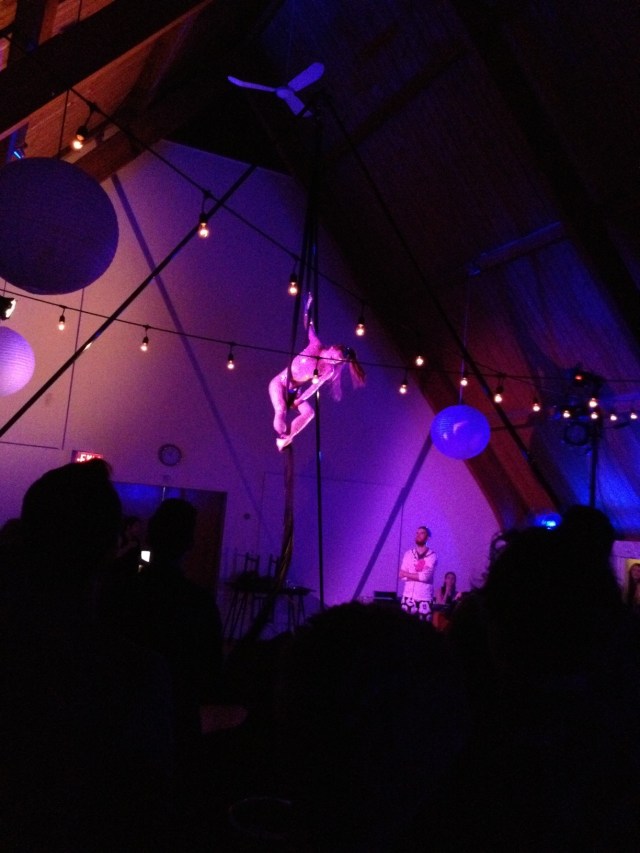
A lucky photo i took with my phone of aerialist Jamie Holmes: not precisely your usual operetta.

Let me phrase it differently, even though I did not get drunk but still am in an altered reality, a bit star-struck, and energized by lots of belly laughter.

You know you’ve had a good time when:

  • You not only wish that you were in the show as a participant but somehow could slip into the world they’re representing onstage
  • You are going back through the photos you took –and when was the last time you were at an opera shooting photos, let alone a hundred or so?—and are surprised by joy, recalling a moment from earlier in the show
  • You wish you weren’t saddled with the role of designated driver, unable to take advantage of the free beer.

Ah yes let me repeat that last one. Yes there is free beer, courtesy of Steam Whistle Brewery. The cast sing their praises a few times (mini-ads?) during the operetta.

beer

Chips & beer at the opera?

As one of the more sober persons present I promise you that our enjoyment was genuine rather than drunken, even if the beverages do help remove inhibitions.

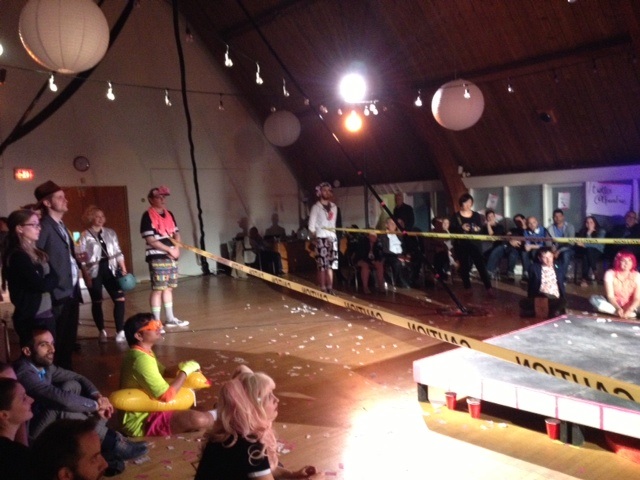
I had heard of the premise: that after the exposition of Act I, we are (mostly) standing for Act II, chairs removed to encourage us to mingle with the show. And then when the cops show up for the last scene we’re put behind caution tape, a simple little device as modern as an episode of CSI.

caution_tape

Standing or sitting behind the caution tape

For the last two acts we’re functioning in the round, with audience on all sides, watching performers fully exposed while singing, dancing and/or acting. There’s so much going on you never know where to look. In addition to a talented set of principals, we have a full chorus as well as a series of additional performers.

Oh my. The story is told well enough, the music is spectacular, joyous and full of life, yet it’s really a big happening. Yes Act II is meant to be a party but wow this was real, including aerials, burlesque and dance to go with a few performances from the players we’ve already met.

For the past five years a series of small companies have been competing for attention on the Toronto scene. For the most part Against the Grain have seemed to be the most accomplished, certainly as far as their ability to maintain a consistently high level musically & dramatically, including A Little Too Cozy, their most recent transladaptation. Now Opera 5 step up to the plate with Fledermaus, a show bursting with ideas, beauty, and charisma, that doesn’t just answer, but would be my choice for the most interesting show from a Toronto opera company this year even if it’s not precisely an opera: and that’s not just the free beer talking.  And who would have expected it..? Operetta is really the same form as the musical, although no one would mistake Fledermaus for Assassins or Light in the Piazza, to mention two of the more adventurous examples of the form.  What we saw and heard was something far more daring.

There’s plenty of credit to be had for the overall effect, a fun deconstruction of the space in the tradition of Brecht, even if old Bert might have some qualms about the show’s politics (as the only thing even a bit Marxist was the beer for all, a celebration of something capitalist). Opera 5 Artistic Director Aria Umezawa clearly knew what she was doing in her stage direction and in the translation she created. The bold choice to broaden the disciplines from just singing in Act II is totally legit (lest any purist claim that an operetta can’t include burlesque or aerialists), and one of the most sure-handed bits of stage-craft I’ve seen in a long time. While I admired what I heard coming from Johannes Debus, once you get past the pit & the musical presentation, there was nothing from the COC this year with the confident swagger of this show.

Alongside Umezawa I want to mention Jennifer Nichols, whose choreography goes beyond anything I’ve ever seen in an opera. The only thing I can compare it to is the few times in amateur musicals or a church choir where we’re working with people who don’t sing. Nichols creates a world populated by dancers and amateurs alike, graceful and empowered whether they’re in dancing shoes or not. I’m reminded of Pina Bausch whose wonderfully moral influence can be seen in Nichols’ willingness to work with bodies of every age, shape, and fitness level, a democratic world that’s genuinely representative of everyone and not just the elite few.  [morning after addendum: recalling Madison Angus as Ida, whose party performance was one of my favourite moments in the show, a fit of choreography against choreography that was like an answer to anyone –like me– who finds virtuosity troubling.  Conventional dance, emulating other  sorts of romantic virtuoso display seems to proclaim “look at me, i’m better than you”. Nichols seems to offer a loving alternative, untroubled by any skills deficiencies, and using attitude above all.  It’s the most curious mix of edgy (when Ida gets heckled for her faux dance) and forgiving (her response: because she can handle it) that i’ve ever encountered, but that’s not a contradiction. It’s adulthood.]

smiley

The small orchestra led by Patrick Hansen matched the theatre at 918 Bathurst beautifully. For Act I, most of which is played up on the stage at one end, the acoustics were at times a little difficult, the text sometimes lost in the space’s reverb. But once the show came into the middle of the space, my gosh what a difference, as everyone sang full out right in front of us, and fearlessly.  Umezawa kept the different constellations of bodies moving to ensure that everyone played out in all directions, so that we were all included.

There were many splendid performances to enjoy. Rachel Krehm as Rosalinda enjoyed the comical oversize costume elements that were part of the Brechtian design scheme by Matthew Vaile. We’re put into a self-conscious self-reflexive sort of world at times resembling cabaret, yet the singing was full-out operatic, Krehm rising every time to the powerful high notes without losing her sense of fun. Julie Ludwig as Adele was every bit as good in her singing, while Michael Barrett as Eisenstein came into his own once he started to play several levels of inebriation at the party scene. It was great to hear Keith Lam’s warm baritone, camping it up as a flamboyant Dr Falke, alongside the brilliant physical comedy of Geoffrey Penar as Frank. Erin Lawson was a highly original Orlofsky, while Justin Ralph was a modern version of the foppish Alfred, complete with pop – song references.

ONE_WEB-200x300I should mention, too, the ways in which Fledermaus flies free of the operetta tradition. There’s the persona of Pearle Harbour played by Justin Miller (must be Canadian with that spelling), aerialist Jamie Holmes and burlesque artist Rubie Magnitude. A pair of dancers—Drew Berry and Lily McEvenue—raised the bar (no pun intended) in several numbers.
There are two more performances of Opera 5’s Die Fledermaus at 918 Bathurst St. Friday & Saturday nights.  Don’t miss it!

Posted in Music and musicology, Opera, Reviews | 1 Comment

Tapestry’s Winner

The DH Lawrence short story The Rocking Horse Winner is a recognizable image of modern life. I’m sad to say that I know people like this mother for whom no amount of money is ever enough, whose son’s mysterious gift (knowing which horse will win makes money for his family) offers her the possibility of wealth, even if happiness continues to elude her.

Tonight Tapestry Opera previewed an adaptation co-produced with Scottish Opera, libretto by Anna Chatteron and music by Gareth Williams, work of deceptive simplicity. I’m tempted to call it minimalistic in its spare writing that at times offers pattern music we’ve heard from composers such as Glass and Adams, firmly in the tonal realm. Sometimes we’re hearing waltzing rhythms apt for the fantasies of such a woman, sometimes sounds that are child-like in their simplicity. Every word comes through clearly in this production offered without surtitles.

The first line of the opera is enacted as a kind of significant form. Ava, the mother sings “Nothing is as it should be”, while she is seated at the piano, having displaced the piano player who was there earlier (and later).

What could be a clearer illustration?

[a thought i am adding the morning after, having tossed and turned with this: that the set by Camellia Koo and the stage picture is wonderfully complex. We have a piano upstage right with a piano player, and a small ensemble upstage left. Is the piano part of the set and the world of the characters, or part of the orchestra? The ambiguity is one of several undercurrents in the show, as though genuine feeling insinuates itself through a surface of lies, or perhaps a life without clear boundaries, leading to the confusion of roles and values]

The chord against which she sings will be heard at the end of the opera, closing the circle as perfectly as in such operas as Pelléas et Mélisande, another opera where both the main female protagonist and her music are static. She and her music resist change between the first and last time we encounter her.

There’s another moment like this roughly in the middle of the opera, when her son Paul asks her why she sings only sad songs. Not only does she resist this, but she bangs on the piano. Needless to say, her son –who had been under the body of the piano—is overwhelmed with the sound, and scared off.  I don’t know if this is something in the opera or something added by director Michael Mori, but it’s unmistakeble in its simplicity.

The house – which is like a perverse Greek chorus, giving vent to her materialist fantasies—is enacted as The House: a group of four singers prodding her like a sick superego. I had wondered how the story would make the transition to opera, given that fiction will speak to us quietly on the page, but collides with the blatancy of theatre. Putting something symbolic onstage may fail horribly. This is where opera can help a text overcome the resistance of an audience. In the story it is the unspoken message that “there must be more money”, made explicit in the words sung by The House. It may be obvious (like the banging of the piano that terrifies the boy, as i mentioned) but that’s how opera works. I’m glad to see a score unafraid to make use of the simplest techniques of opera, working exactly the way opera is supposed to work. I’ve seen recent pieces in Toronto that are influenced by film & spoken theatre, becoming too subtle, too unwilling to approach the blatancy that opera requires.

I was pleasantly surprised by what I saw & heard in this preview. I’d read something in a press release telling me that the boy was to be made older than in the DH Lawrence story, a prospect to make me shake my head sadly at an apparent lack of faith in the original. But when I saw the show tonight I wondered if they found their way back to the original story. We can’t really tell how old this boy is.

rocking_horse_winner

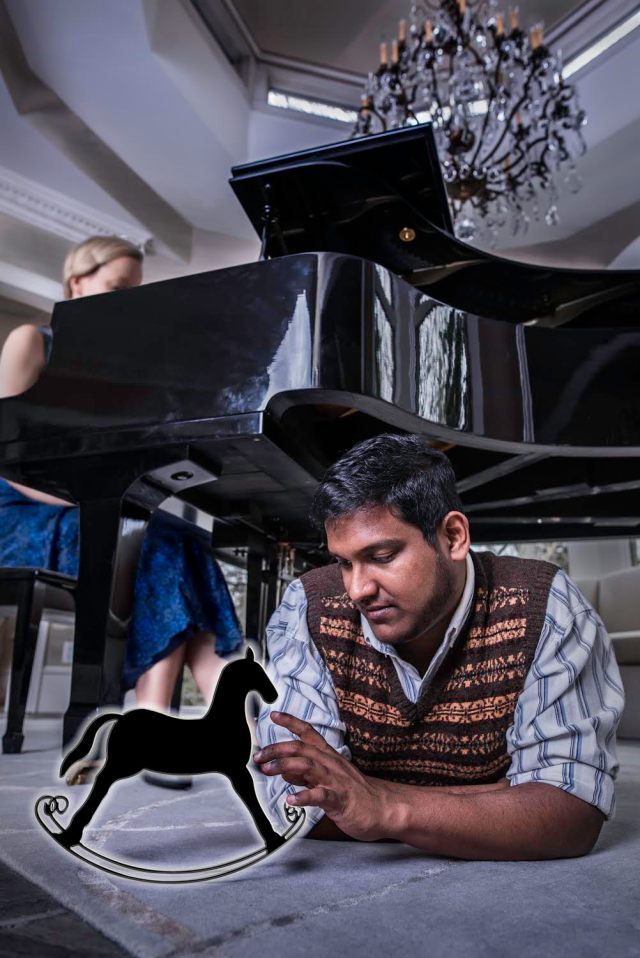
Carla Huhtanen (left at the piano) and Asitha Tennekoon in Rocking Horse Winner. (photo: Dahlia Katz)

Of course he’s played by an adult, namely Asitha Tennekoon, in an intensely obsessive portrayal. I feel sad that this is even an issue. Nobody blinks when we put a 40 or 50 year old soprano onstage to play Butterfly, a fifteen year old. We accept people singing their stories in opera. It’s not a great leap to go from there to accept this man playing a boy, especially when he does such an effective job. The character dynamics between mother and son as Lawrence wrote come through beautifully in this take on the story.

Carla Huhtanen enacted a fascinating mix of frailties as singer, actor and even pianist. Ava isn’t a very likeable person, yet I was moved, able to understand the boy’s love of his champagne-drinking mom.

At an hour the opera is the perfect length, the drama building gradually. Keith Klassen as Paul’s uncle and Peter McGillivray as Bassett (who is something like a butler or teacher), play vital parts in framing the story while helping to show us Paul’s special talent. Jordan de Souza led a small ensemble that were always supportive, never covering the singers, making a great case for Williams’ setting of the libretto.

Rocking Horse Winner runs until June 4th at Berkeley Street Theatre—Downstairs.

Posted in Opera, Reviews | Leave a comment