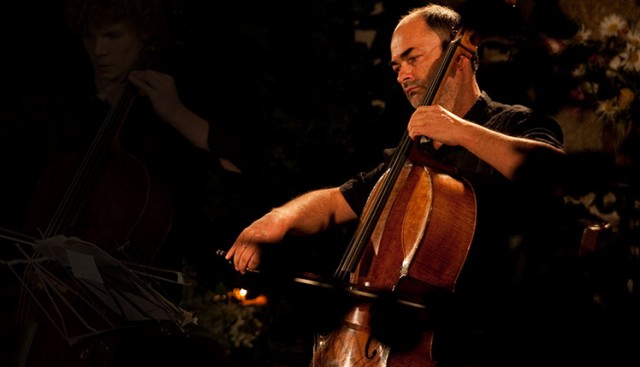
All But Gone

When you’re ushered into the chapel for a wedding, sometimes they ask you “bride or groom?” That’s to identify where you should sit.

I was thinking of that quaint custom as I came into the Berkeley Street theatre tonight for All But Gone, a fascinating hybrid presented by Canadian Stage & Necessary Angel. When they ask which side of the church are you sitting on, meaning are you sitting with the family of the bride or family of the groom, you don’t usually expect that everyone there is from one family and you’re all alone on the other side. But I could have sworn everyone there tonight was from Beckett’s family (meaning the spoken word/ drama side) rather than the opera- sung side, where i hang my hat. I listened afterwards to a fellow all charged up about what was done wrong, how they shouldn’t have been looking at us in the audience, that the instructions in the text are very clear  (oh yes he knew his Beckett) that you can’t do it that way.

So of course when Krisztina Szabo and Shannon Mercer came out behind us, singing first quietly then more loudly & not entirely intelligibly, I wondered how he’d take that. Yet it appears that this will be a happy marriage, so long as the two families let go of their prejudices and really meet in the middle.  Many in attendance were clearly open to the experience, welcoming the blending of styles.
MJ-hi-res

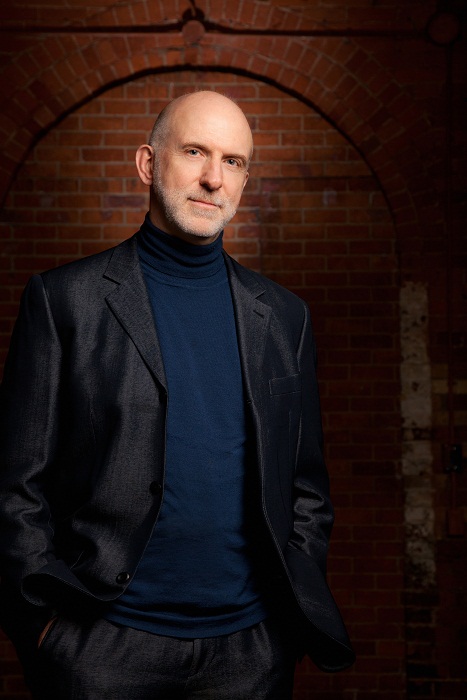
Canadian Stage’s Matthew Jocelyn

As I’ve observed many times over the past few years, Matthew Jocelyn has dedicated himself & his company to inter-disciplinary explorations. The program says “All But Gone by Samuel Beckett, then “a new adaptation by Jennifer Tarver”.
tarver

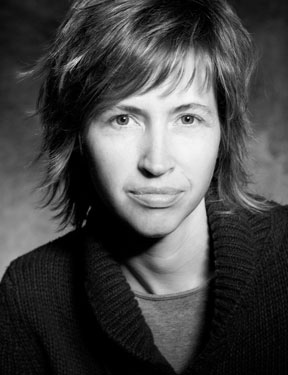
Director & adapter Jennifer Tarver of Necessary Angel Theatre Company

They list four Beckett plays (Act Without Words I & II, Play and Ohio Impromptu). The next two lines say “Featuring Viderunt Omnes by Garrett Sholdice and From the Grammar of Dreams by Kaija Saariaho.” If you come from the musical side you might focus on those featured items, while the Beckett aficionadi would be really intent on the four plays.

I love the fact that I didn’t know what to make of it. For me that’s the element truest to the spirit of Beckett. One of the things I love about him is how open he is (in the sense of Eco’s Opera aperta or “Open Work”), rather than overly determined. These are plays that sit outside the boundary of genres, sometimes invoking laughter, sometimes a darker response. There are many ways that his works can be staged.

I came in a bit fearfully, recalling something Mallarmé had said; when he heard that Debussy had set his “Afternoon of a Faun” to music, the poet more or less said “I thought I already did that”. So too with Beckett, who is already musical in his choice of words. I had thought I was about to see and hear Beckett set to music, which is not at all what this is, thank goodness.

So excuse me if I sound a bit academic for a moment, as I talk about what this hybrid thing is and how it works. When we name it we sometimes help the reception process, but sometimes we strangle it by closing off options or misleading the audience. The dramaturgy question is endlessly fascinating and always useful, I believe.

Tarver’s combination reminds me of several things.

  • I could invoke the model of the musical, where the words go as far as they can until music is necessary. I don’t think that’s really what we had this time, but it’s at least a recognizable template.
  • I woke up today, again, with Ariodante’s da capo lament “Scherza infida” in my head, a Handel melody that haunts me in the best way. I came into the theatre sensitized to the old baroque dynamic that tends to split the heavy lifting between recitative and aria, between words to advance action or music to express emotion. Opera may have moved to newer means of expression in recent centuries, yet there we were, relying upon those age-old methods. The men were making speeches or performing actions. The women sang, taking us deeper into the irrational realms of emotion that music can make available.  The men were distant, cold and opaque while the women were among us and radiant. With this dynamic i couldn’t help feeling that Tarver’s hybrid was attempting to warm up Beckett, make him more human, particularly when i heard the words “jubilate deo”, in the Sholdice composition. Would Beckett have approved? Hm he couldn’t be reached for comment.
  • We could speak too of the way theatres or vaudeville would present several attractions, as suggested by Tarver’s use of the word “featuring”, a word that has a very nice resonance for me, and doesn’t imply that one medium is more important than another.  I think Brecht, too, would have liked this very well, for the way we were in a very sane & respectful place. All But Gone doesn’t have to be understood as a single work with a through-line and progression, so much as four plays with musical interludes. You find the highlights depending on what appeals to you (and depending also on which family you belong to).
  • The eclectic blend of different elements (I am tempted to use the word “pastiche” in the sense of a messy mixture) means that the tonal qualities we get are all over the map, which is only a problem if you show up with stipulations, like that fellow sitting in front of me. The ambiguities of this text are deliciously unresolved, requiring a high tolerance for ambiguity. At times we were in a minimalist place, the unaccompanied music a perfect match for the understated texts in the Beckett.

The main thing is that it works. I’d like to see more such hybrids, to see what can be accomplished in mixing together unlikely ingredients, a worthwhile experiment.
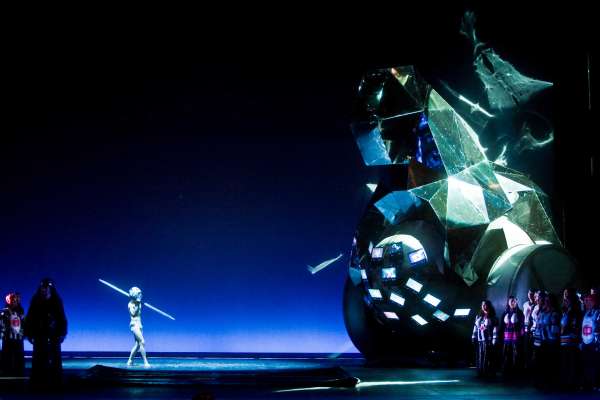
Posted in Dance, theatre & musicals, Music and musicology, Opera, Reviews | Leave a comment

That other Aeneas and Dido story

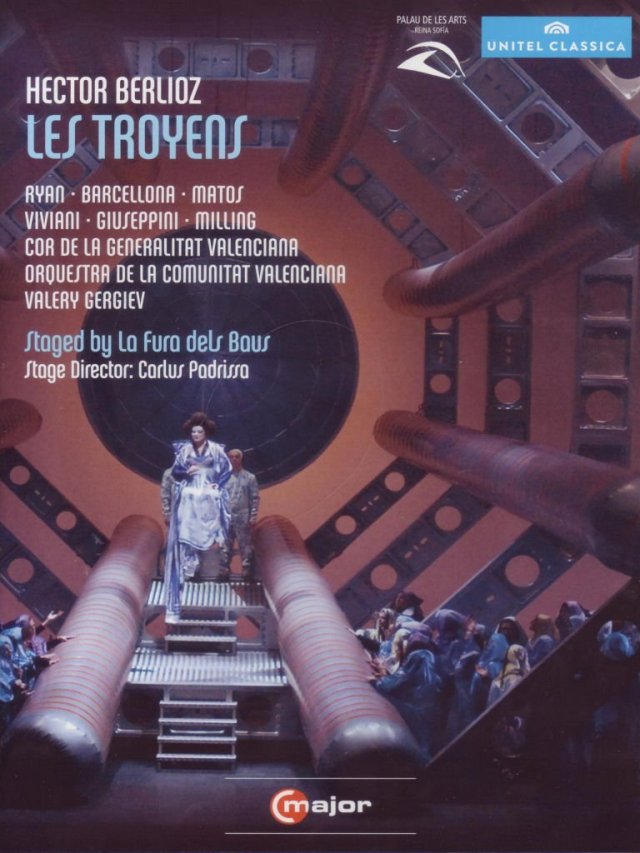
It was a funny coincidence. When I ran into David Fallis the other day –an encounter I mentioned in my recent review of Purcell’s Dido and Aeneas—I showed him a DVD I was returning to the library, the Fura del Baus version of Berlioz’s opera Les Troyens. At one point I thought of putting a headline on it of “La Fura del Baus vs Berlioz”.

I used the DVD to illustrate new approaches to opera in a recent class. After talking about new opera texts from Tapestry, Canadian Stage, Fawn Opera and Soundstreams (to name a few), I went on about adventurous stagings of existing operas. And so we pulled up Tcherniakov (watching some of his Wozzeck), Lepage (his Ring operas), Bieito (that famous gangsters on toilets shot) and still shots from the Against the Grain Mozart-da Ponte transladaptation cycle (ha: autocorrect doesn’t believe “transladaptation” is a word, imagine that!).

61ub9e9ixnl-_sl1024_

One of the most exciting demonstrations was to make head-to-head comparisons in class between different versions of the same scene. We compared two different videos of the Zeffirelli Pagliacci, (Zef being our touchstone for conservative fidelity to a text) first Domingo then Pavarotti, both opposite Teresa Stratas as Nedda. We did a very different sort of head to head, comparing the old 1980s Met Troyens to the Gergiev production from the Fura dels Baus collective, known for their aerials and adventurous design. If you were looking for a textbook illustration of the good and bad of director’s theatre, of the ridiculous and the risible in Regietheater, have a look at this DVD.  There are some startlingly good moments alongside others that are at least puzzling if not aggravating.

1195458

Les Troyens (Photo GVA)

Here’s how La Fura dels Baus describe themselves on their website

La Fura dels Baus is eccentricity, innovation, adaptation, rhythm, evolution and transgression. Such characteristic and unique essence led the company to pioneer the reconceptualization of two of the most significant aspects of the dramatic art: the theatrical space and the public. Thus, respectively, they redefined the space by moving it to non-conventional ones – and changed the public role from passive to active, which meant a breaking of the “fourth wall”. And it is that there is no creation without risk – a compiled premise from the beginning, since their first street shows, where the authentic essence of La Fura was born.
The incessant curiosity and the need to explore new artistic trends have developed, through a process of collective creation, a unique language, style and aesthetic. Nowadays, this is called “Furan language”, which has been implemented in different artistic genres, such as opera, cinema and large-scale performances.
The ability to bind and adapt carnality and mysticism, nature and artifice, rudeness and sophistication, primitivism and technology, in every performance, has given La Fura dels Baus its international success and prestige.

Notice that instead of a Trojan Horse, they have something they’d identify as a virus. It’s a very modern understanding, unsentimental.  The images in this little video (rehearsals) give you a glimpse of how radical they can be.

I will let others judge whether they are truly influential or derivative. That is not a question I can answer and I am not sure such questions are or were ever answerable. We tend to understand Mozart as genius & inspiration, not necessarily admitting influences,  the many things he must have seen and absorbed from his milieu &  his contemporaries: who are no longer heard. I am less interested in “who thought of it” (that over-rated question of originality) than in understanding questions such as “how does it work” (dramaturgy) and “how does it feel” (reception).

We’re in a very different kind of story from what we saw in that Met production that stars Tatiana Troyanos as Dido and Jessye Norman as Cassandre. The scene I chose to explore and highlight differences of approach was the Act I celebratory ballet and subsequent pantomime. The old version is actually danced, a group of dancers looking exceptionally manly. The new version erects a boxing ring, across which we see women strut to announce round 1 or 2, while the pugilists go at it. It’s time for a celebration, which is supposed to be fun, right?  While it’s not precisely solemn, the mood makes a ton of sense. It’s been modernized to a kind of space-station setting, involving costumes resembling a sci-fi hockey league.

The subsequent pantomime is one of the unforgettable scenes of the opera, where Andromache and her son come out, suddenly damping the joy of the (supposedly) victorious Trojans, reminded of the recent death of their great hero Hector, Andromache’s husband. In the older production the boy carries his father’s helmet, while the mother’s grief is larger than life, and I challenge anyone with a heart not to get a bit teary eyed watching it. In the new one the boy steers his toy car, more or less oblivious to the solemnities (see it briefly at roughly the 23rd second of this little excerpt, right after we see that boxing ring).

Yes it might be realistic, but it begs the question. Are we no longer permitted to enjoy the rapture of visuals and music that are in harmony? Is a big opera so suspect as a fascist apparatus, so dangerous that we must deconstruct it and even mock the story we’re telling? That’s how it feels much of the time.

And yet the production has its rewards, and its critique of the opera has merit.  When Dido and Aeneas sing their great Act IV duet “Nuit d’ivresse”, they are each suspended in the air, only meeting for a little kiss at the end, reminiscent of the solipsistic humans in Wall-E.

Considering that this has at times been one of my absolute favourite texts to play and (attempt to) sing, it’s especially hard to face something verging on parody, mocking my beloved duet.   Yet considering the text they are singing –as each talks on and on about the great loves of history, infatuated less with their partner than with the poetry of this moment—they could be in separate carrels in a university research library, for all the real intimacy of their duet. They are in love with the idea of their great love, the greatest love story ever written. And so the staging is a brilliant critique anticipating much of what Berlioz seems to inspire, oxymoronic approaches to staging that seem to recoil away from real life.

The moment when Aeneas describes the death of Laocoon is shown with gory detail, as is the mass suicide that ends Act II. Those two moments emerge out of the cool surface of the production to have a powerful impact. Hylas’s little Act V lullaby is a sad version of Space Oddity, as the sailor tells us of his homesickness, floating above a spinning planet, except Major Hylas doesn’t drift away mysteriously. When Aeneas announces the departure from Carthage, we get a rocket launched, a nice visual. Yes I was impressed with the technology and the beautiful images, but no I wasn’t moved much of the time, or if I was –as in “nuit d’ivresse”—it was with the intellectual justification for their clever vandalism.

As far as the singing is concerned, Canadian Lance Ryan shows great promise as Aeneas. I hope we hear him singing in Canada while he still has a voice, but right now it’s a formidable talent. Elisabete Matos gives Cassandre a passion that resembles something approaching madness, and is the most vividly human thing in the whole opera, making her death doubly tragic. Daniela Barcellona has a luscious sound as Dido, often hanging from wires in the production, in typical Fura dels Baus fashion.

Their final needling question for Berlioz at the end puts Dido onto a virtual pyre, dying above pictures of fire on a myriad of laptops. Is that so odd, though, when this opera is so firmly concerned with what’s written and spoken about the characters, a self-conscious collection of heroes living out their larger than life myths?

In a world where we are less and less living authentic lives and more and more sinking into our devices, this is a fascinating take on the ancient story.   I recommend this video with the huge caveat, that you be certain you’re clear about how you feel about the distance this production offers from the romantic approach seen in productions such as the Met production from the 1980s. Valery Gergiev’s conducting is itself almost worth the price, as he moves things at a fabulous pace. Earlier generations have sometimes let Berlioz be too slow, even lugubrious, but that’s not what you get here. And the images are always stimulating, thought provoking and occasionally heart-breaking.

Posted in Dance, theatre & musicals, Opera, Reviews | 1 Comment

Ariodante questions

My second time through the Canadian Opera Company’s Ariodante yesterday raised more questions in my mind.

There are the vocal questions, ones that aren’t new.  I have long wondered about the way we perceive operatic performance, that a perfect performance is sometimes less sympathetic than one that shows more of a struggle.  I used to contrast Maria Callas and Joan Sutherland in this regard, that one singer’s vocal production was itself a drama, compared to the other, who never seemed to have a struggle creating the sound.  I don’t want to add any layers of judgment to this, as I am not even sure I am reading this correctly, but some timbres and/or interpretive approaches work better for some roles than others.

But some of the singers in the COC Ariodante sang a performance that was mostly free of drama, while others made their vocalization another layer of the interpretation.

Jane Archibald as Ginevra is at the centre of the story, singing Handel with a near-perfect approach to every phrase, an ease that reminded me of Joan Sutherland.  There was never a moment when I wondered whether she could sing the part, never a phrase that seemed difficult. That effortless style is perhaps a good match for her role, as the innocent princess blind-sided by slander: plus a mysterious liquid someone slips into her drink.

16-17-02-MC-D-0907

Alice Coote as Ariodante (photo: Michael Cooper)

I would contrast her delivery sharply with that of her betrothed, Ariodante, as portrayed by Alice Coote.  They’re not only in different vocal categories of course but portraying different genders.   Yet Coote undertakes something very different.  In her coloratura she lets her emotions show, so that when she’s distraught, the notes almost seem to overwhelm her. When she sings her long lament “Scherza infida” –the moment I would call the musical highlight of the performance yesterday –we hear a great variety of sounds.  The passions of the character seem to be having their way with Ariodante.  And later when supposedly celebrating the upcoming happy resolution, Coote offers something very subtle and profound, in the aria “Dopo notte, atra e funesta”.  It’s usually the signal of the reversal of fortunes and signal of a happy ending to come.

But there are some significant differences in this production, as I noted in my earlier review.

And so both Ginevra and Ariodante have some very complex emotions as they come to the final numbers.  With Coote I am reminded of something we don’t see so much anymore: the use of a timbre to signal something complex and ambiguous.   I remember singers such as Maria Callas or Cesare Valetti creating a sense of sadness or melancholy within a single note.  While the music seemed to signal a happy resolution, Coote’s voice said something very different.

Ambur Braid as Dalinda also ventured into this dangerous territory, a wonderfully vulnerable portrayal, while her voice dared to risk all in her stratospheric ventures.

And then there’s the question of the story itself, a tale that might seem anti-feminist if not misogynistic in its enactment.  One woman is abused, while an innocent one is jailed.  Modernizing the story –as the production does in its setting—puts a curious sort of pressure on it.  Instead of placing Ginevra in a medieval prison, remote from the others while awaiting the outcome of the trial combat and therefore alone with her misery, she’s under a kind of house arrest in her bedroom.  As a result there are additional horrors in the community censure she experiences, strongly altering the way she experiences her father’s judgment.  Where we might roll our eyes at the rigidity of the old story, we can’t ignore the way it plays in the newer context, and therefore may sense the inevitability of the outcome we get in this production.

EXPORT_Sylvain_Bergeron_(color2)Sylvain photo by Didier Bertrand

Sylvain Bergeron (photo by Didier Bertrand)

During the curtain calls I recognized a familiar face, namely Sylvain Bergeron playing lute among the cellists, earning them special recognition at the end and deservedly so.  Johannes Debus and the COC Orchestra sound marvelous playing this Handel score.  I’m delighted to see that almost every remaining performance of Norma and Ariodante seem to be sold out. And no wonder.

Posted in Opera, Reviews | Leave a comment

Fourth Annual Elizabeth Krehm Memorial Concert

Monday November 14 at 7:30pm at Metropolitan United Church
Tickets & information

Elizabeth Krehm passed away on November 17, 2012 in the ICU at St Michael’s Hospital. elizabeth_krehmEvery year since her passing, her family has held a memorial concert as a fundraiser for St Michael’s ICU. About $40,000 has been rasied through these concerts. Elizabeth’s family will be ever grateful for the wonderful care received by the doctor’s nurses and social workers at St Mike’s.
Fourth Annual Elizabeth Krehm Memorial will be held on Monday November 14 at 7:30pm at Metropolitan United Church (56 Queen St E)

Admission by donation at the door. Suggested minimum donation of $20. 100% of donations collected will be donated to St Mike’s ICU. For more information please call 647-248-4048.

This year we open the program with Yosuke Kawasaki and Jessica Linnenbach, Concert Master and Associate Concertmaster of the Nation Arts Centre Orchestra, playing Bach’s Concert for two violins. This piece was one that Elizabeth studied as a violinist. Rachel Krehm, Elizabeth’s sister, will sing arias and songs by Mozart, Dvorak and Strauss. The concert will end with Beethoven’s epic third symphony. Evan Mitchell leads Canzona Chamber Players Orchestra.

Program:

Concerto for two Violins in D minor BWV 1043 Johann Sebastian Bach
Come scoglio from Così fan tutte K 588 Wolfgang Amadeus Mozart
Song to the Moon from Rusalka Antonin Dvorak
Morgen op. 27 no 4 Richard Strauss

Intermission

Symphony No 3 Ludwig van Beethoven

Evan Mitchell, conductor
Yosuke Kawasaki, violin
Jessica Linnebach, violin
Rachel Krehm, soprano

Canzona Chamber Players Orchestra

Tickets & information

Posted in Press Releases and Announcements | Leave a comment

JAMES BOND: A Convenient Lie (Opera in Pasticcio)

MALFI PRODUCTIONS in collaboration with MANOSINISTRA LYRIC WORKSHOPS present:
 
Ian Fleming’s
JAMES BOND: A Convenient Lie
(Opera in Pasticcio)
Libretto by Kyle McDonald
 
Saturday November 12, 2016 – 8pm
BETTY OLIPHANT THEATRE
(National Ballet School)
404 Jarvis St., Toronto, CANADA
 
Bond, James Bond, Agent 007 is given his next assignment at MI6. His mission? To save humanity and thwart the evil plot of The Naturalist who vows to save the planet and restore Nature to her pre-eminence. MALFI PRODUCTIONS and MANOSINISTRA have assembled a stellar cast and chorus to bring Kyle McDonald’s new libretto to life in this semi-staged concert “vernissage” inPasticcio featuring well know music from Mozart, Verdi, Donizetti, Puccini, Bizet and more!
STARRING:
JAMES BOND – Kyle McDonald | THE NATURALIST – Stuart Graham | PIERRE LECLÉ – Amelia Daigle | “AUDREY” LECLÉ – Jennifer Ann Sullivan | TINY –Constantine Meglis | SALVATORE – Rocco Rupolo | BLISS – Holly Chaplin | Q –Diego Catalá | MONEYPENNY – Alexandra Harris
 
CHORUS:
Karen Barrett | Alexandra Harris | Mathilde Contat-Federico | Julie Clarke | Martha Spence | Andrew Lorimer | Barry St-Denis | Martin Georgievski | Connor Glossop
 
PIANIST:
SASHA BULT-ITO
For artist bios, please visit  http://www.malfiproductions.com/james-bond
BOX OFFICE | TICKETS
DISCOUNTED ADVANCE ONLINE TICKETS
SINGLE: $36.50
BRING-A-DATE (2 tickets): $65
AT THE DOOR (CASH ONLY)
SINGLE: $40
For full program information or box office assistance, please contact MALFI PRODUCTIONS AT:
If you are unable to view the poster below, you may view in your browser by click on http://www.malfiproductions.com/james-bond
_____________________________________________________________

*******

“Press releases and announcements” are presented verbatim without comment.


Posted in Press Releases and Announcements | Leave a comment

Opera Atelier creates a new Dido and Aeneas

Opera Atelier and Purcell’s Dido and Aeneas go back a long way. This was the opera with which they began, thirty years ago.

But this is not the same opera. Tonight we saw a new creation unveiled, an expanded version of the great English opera.

resized_sailors

From Dido and Aeneas, 2005. (Photo: Bruce Zinger)

I had the good fortune to run into David Fallis, Opera Atelier’s Music Director & conductor,  a couple of days ago at the Edward Johnson Building.  David spoke with quiet excitement about the upcoming dress rehearsal, the expanded work with the children’s chorus that might have some resonances with that first known performance at a girl’s school of 1689.

And so I paid particular attention to David’s notes in the program, where he gives the most useful commentary of anyone on the team or so it felt to me. That’s scarcely surprising considering that in most opera productions the conductor functions as a kind of dramaturg, having final say on which bar of music is or is not included, although it might also be due to his other roles as Artistic Director of Toronto Consort, and therefore as a programmer & educator.

David’s program notes include the following:

…the materials which have come down to us from the 17th and 18th centuries are full of mysteries. The main surviving musical score dates from the mid-18th century, over fifty years after the death of Henry Purcell. There is a libretto (text only) from 1689, entitled “An Opera perform’d at Mr Josias Priest’s Boarding-School at Chelsey, by young gentlewomen”…. Unfortunately there are many details in the libretto which are not reflected in the surviving score. For instance, the libretto of Dido has a prologue for which there is no music in the score. As well, there are numerous indications for dances in the libretto, but again, much music is missing. In our production, we have tried to fill in some of these gaps.

Artistic Director Marshall Pynkoski says a few things that might seem to be a contradiction.

For our current performances we have stripped the production down considerably, focusing more than ever on clear, coherent storytelling and the opera’s inherent tension between the rigid formality of a courtly world at odds with the most visceral of human emotions.

It’s not stripped down as far as I could see, but is a longer Dido than any that one could find in the world, due to the additions to which David alludes. Pynkoski continues

I would be remiss if I did not thank my entire artistic team, most of whom have explored this opera with me for more than thirty years.

While he thanks the new additions – the Toronto Children’s Chorus—and again thanks Tafelmusik Baroque Orchestra, I see no mention of the creator of this work. Is it a team effort, written / assembled by Pynkoski and Fallis plus others? I wish I knew, as this is in some ways a bold experiment. I’d like to know whose name appears on the copyright, if indeed anyone is bothering to create one, for this new version of the opera.  Perhaps at some point they might realize that other opera companies might want to produce this or something like it.  At the very least it deserves more recognition in the program than Pynkoski offered.

Let me repeat, this is not a stripped down Dido. There’s a brand-new prologue that gives us some of the subtext.  Perhaps Pynkoski seeks to defend the longer opera.  I wonder if there was a long conversation/debate before this version was arrived at, because if it had been up to me, it would be longer still. The prologue includes a long dramatic reading from Vergil’s Aeneid, spoken in a big declamatory voice by Irene Poole, who has the role of “Narrator”. Perhaps that’s exactly as it appears in the libretto, yet I would doubt this is how Purcell imagined it, but that it’s more a pragmatic choice, a matter of how it had to be done with the available resources. If this segment could have been somehow set to music, in some sort of arioso arranged from something else Purcell composed it would have been much longer & more expensive. This version is spoken with some music underneath, as you’d get in a melodrama, and doesn’t seem apt for the 17th century, but of course i could be wrong.  And so while part of me rejoices with the bold new creation, another part of me is quibbling, that for a company whose lifeblood has been historicity, that the dramaturgy in this segment is a bit puzzling, at least in the use of the narrator. Yet perhaps this was a choice in service of authenticity, for fear of being too strange, too adventurous, too hard to justify. It’s ironic given that at times the earlier baroque (before 1700) could dispense with restrictions, given the readiness of performers to substitute arias by other composers, and the readiness by some to borrow music from others. Fallis’ use of a passage by another composer (Marais) is totally defensible within this tradition.

David is totally right when he speaks of how the additional material “restores the greater length of an opera that is often considered a small chamber work”. In other words, the weight this adds makes total sense, both in the prologue and in the dances, and makes a full meal out of what has been a mere appetizer.

giunta

Wallis Giunta and Brett Vansickle (photo: Bruce Zinger)

The posters showing beautiful pictures of Wallis Giunta accurately reflect her star power. In a recent class, we talked about the “triple threat”, and how opera singers rarely have that kind of versatility (I could only think of Barbara Hannigan for her unprecedented work in Lulu), yet tonight we watched both Giunta and Christopher Enns moving with the dancers, if not fully incorporated into Jeannette Lajeunesse Zingg’s choreography. Vying with these two for our affections was Opera Atelier & Toronto Consort stalwart Laura Pudwell as a very funny Sorceress with that big voice. Meghan Lindsay was a strong Belinda, a sympathetic presence alongside Dido.

With such a beautiful opera, how could making it longer be anything but an improvement? I suggest you see it for yourself to confirm that additional material improves it. Dido and Aeneas runs until October 29th at the Elgin Theatre.

Posted in Reviews | 1 Comment

What to expect from Ariodante

Part of me is dying to spill the beans about the Canadian Opera Company’s co-production of Ariodante that opened this afternoon in a matinee at Four Seasons Centre, but I have to tread carefully, as I studiously avoid spoilers, especially when the advance knowledge might subtract from your experience. The headline is a half-truth because I only tell you some of what to expect.

I’ll be a bit more open after I’ve seen it a second time. Let me just say that I am eager for a second look at this dense and layered mixture. Expect something complex.  It had people talking to strangers in the bathroom.

I think I’ve missed opera, given that I dished out a load of superlatives last night yet feel that what I just saw might have been better. Could it really be that good? or am I now just over-dosing after suffering opera withdrawal, a happy Pollyanna ready to gush about anything.

But maybe I’ll put it in perspective by speaking briefly about Norma again. The singing last night was amazing, yes, and without any messy directorial overlay to prevent us from getting at Bellini. But I think I was craving complex flavours, and the COC delivered.  This
Ariodante is the product of the team of Richard Jones and ULTZ. This is the same Richard Jones whose 1993 Royal Opera House Ring Cycle influenced other cycles, including that of Robert Lepage; those crumbling gods at the end of Brunnhilde’s Immolation Scene are done much better in what the ROH offered in 1993 (alas no longer available on youtube). ULTZ is the designer working with Jones, but I don’t pretend to know whose ideas we’re really seeing, other than to say that the outcome is very stimulating.

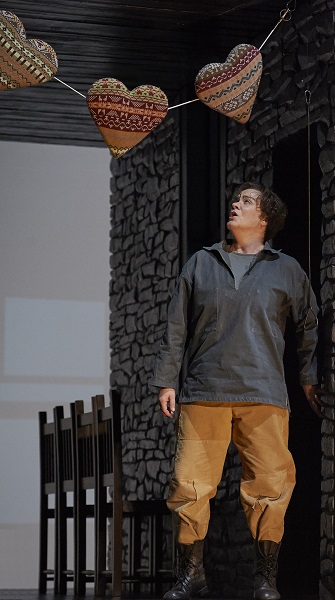
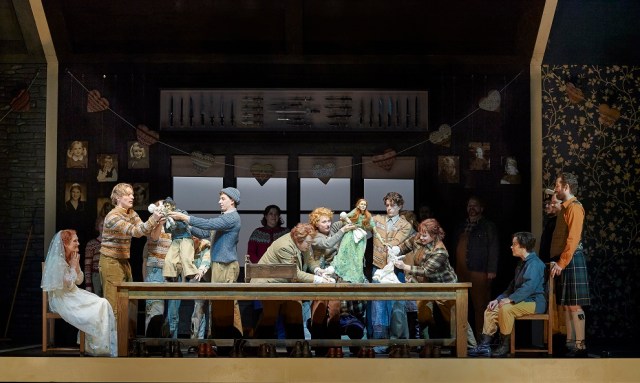
I would identify this as director’s theatre but with the caveat that it’s of that rare sort that illuminates without obscuring the original, and adding something in the process. With Handel I am never going to be a textual fundamentalist, because there’s no real tradition to point to, unless we seek to reproduce the productions as Handel made them in his failed attempts in London (a failure that leads him to oratorio, especially Messiah). Ariodante for example is full of ballet music, but that doesn’t mean a director necessarily uses those passages for dance. Sometimes Jones gives us dance, sometimes drama employing puppets designed and directed by Finn Caldwell. We get to have it both ways, as the story arc is presented to us, even if the characters onstage don’t precisely behave as the score prescribes. So in other words there likely shouldn’t be the sort of controversy we had over Tcherniakov’s Don Giovanni or Claus Guth’s Marriage of Figaro, both of which upset some people for the departures and alterations to beloved works. Ariodante doesn’t have nearly so many alterations, and more importantly, as a non-canonical work, nobody’s going to be terribly upset at departures from a story that most people don’t even know.

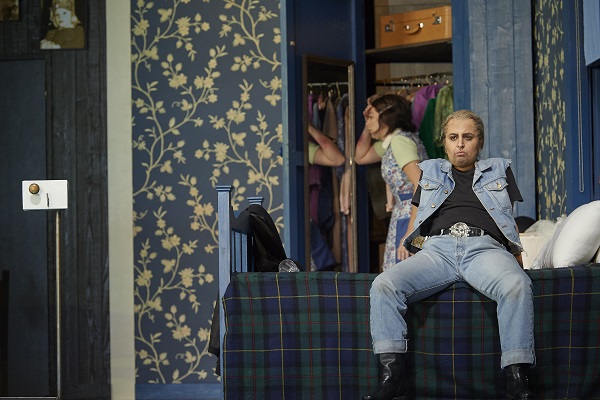
There are nonetheless additional layers that aren’t in the text. The action has been moved to a small Scottish island, the story set in a recent past even if the actions of the story –particularly justice done by fighting duels—are more fitting for previous centuries rather than recently. Such infelicities can be ignored when the director’s overlay illuminates: as this one does. It’s normal for Polinesso to conspire to undermine his political rival Ariodante (sabotaging his marriage to the princess Ginevra, not just by slandering her, but by arranging to have Ariodante see Dalinda, a co-conspirator dressed exactly as Ginevra seeming to have a liaison with Polinesso). In Jones’ reading Polinesso is a preacher whose rants get the tiny community of this production riled up at the sinful actions that Ginevra is alleged to have committed.

16-17-02-MC-D-0093

(l-r) Varduhi Abrahamyan in preacher garb as Polinesso (in background), Jane Archibald as Ginevra and Ambur Braid as Dalinda in the Canadian Opera Company’s production of Ariodante, 2016. (photo: Michael Cooper)

His co-conspirator Dalinda is not merely infatuated with Polinesso, but wears the visible bruises, as we discover a second rougher look corresponding to the person underneath.

16-17-02-MC-D-0926

Varduhi Abrahamyan as Polinesso and Ambur Braid as Dalinda (in background) in the Canadian Opera Company’s production of Ariodante, 2016. (photo: Michael Cooper)

The action of the story invites comparisons between pairs:

  • Ginevra and her double Dalinda: both of whom sing coloratura soprano, although one is a princess, one is of a lower class
  • Ariodante and his political rival Polinesso: both of whom are male characters sung by mezzo-sopranos in male attire
  • Lurcanio and Polinesso, who offer two contrasting ways to pursue Dalinda (Lurcanio rejected initially, Polinesso rejecting Dalinda but pursued by her nonetheless); but Lurcanio recovers from rejection to become the most powerful agent in the story, defying Polinesso and defeating him in combat

Jane Archibald as Ginevra is the focus of the production, a starring role that makes great use of her vocal abilities. Hers is a different sound from that of Ambur Braid, who steals the show as Dalinda.  Varduhl Abrahamyan as Polinesso was genuinely scary, and one of the most believably male trouser performances I’ve ever seen, especially when beating up on Braid.  Yet it was Braid and not Archibald or Abrahamyan who was the most interesting character onstage, a flawed individual right on the boundary between pathos and humour, many of her lines drawing nervous giggles from the audience. Alice Coote in the title role had a swaggering realism as a man, believably opting out of the first act bridal dance like so many men I’ve seen fleeing the dance-floor. Her singing is not overpowering, her coloratura not especially precise, but she offers something more important by inhabiting genuine feelings during her arias, authentic and in the moment. Owen McCausland was a suitably macho Lurcanio. While there were several poignant lament arias–one each for Braid, Coote and Archibald—the most moving number for me dramatically, one that elicited dead silence in the hall was the reconciliation duet between Braid & McCausland, a matter of question marks and possibilities rather than a genuine pathway. Johannes Weisser as King and Ginevra’s father gets to be the figure of dominance at the head of this quirky island of fundamentalists.

The production is full of self-reflexive and meta-theatrical moments, particularly in the use of puppetry in several key moments that are scored as ballet, but of course, can be staged any way the director wants. This is especially powerful at the climax of Acts II (Ginevra’s nightmares resembling hallucinations) and III (the resolution of the story).

16-17-02-MC-D-0711

A scene from the Canadian Opera Company’s production of Ariodante, 2016 featuring Finn Caldwell’s puppet design/direction (photo: Michael Cooper)

The chorus have their moments as do the orchestra, brisk and crisp throughout under the direction of Johannes Debus, although it might have been a bit too brisk, considering that there were a couple of moments when soloists seemed hard-pressed to keep up. But even so the complexities of the stage picture matched the lovely sonorities presented to our ears.

Ariodante continues until November 4th at the Four Seasons Centre. For further information click here.

Posted in Opera, Reviews | 3 Comments

Radvanovsky’s Norma

This isn’t your usual Norma. It’s an opera that requires talent and skill far above and beyond what’s usual or normal.  Believe the hype about Sondra Radvanovsky, who is singing the lead in Bellini’s bel canto masterpiece, in a cast as strong as any I’ve ever seen for a Canadian Opera Company production.  I saw it tonight and am happy to be seeing it again.

norma-cw-1

Sondra Radvanovsky as Norma in the Canadian Opera Company/San Francisco Opera (SFO)/Gran Teatre del Liceu/Lyric Opera of Chicago co-production of Norma, 2014, SFO. (Photo: Cory Weaver)

I’m very lucky that I’ve seen Radvanovsky enough times that I now begin to know some of her mannerisms, to recognize certain quirks of her performance.  In her longest roles she knows how to save her energy, brilliantly marshaling her resources for key phrases, climactic scenes.  And then when the going gets tough she gets a look in her eyes that’s totally ferocious, such that if you were the high notes printed in the score you’d be scared of what she’s about to do to you.  She seems to click into a higher gear, get more alert, more energized, her eyes widening and the scene and the music effortlessly being devoured as though she were a shark and the whole theatre full of people were her dinner.  She effortlessly inhales us, her voice swallowing two thousand of us in one gulp.  Yes she is a humble presence, especially during curtain calls, but in those moments when she clicks into that take no prisoners mode of singing she could be a thousand feet tall, her voice undaunted by any big orchestration or chorus competing with her for our attention.  Oh sure, there are other people onstage with her and they were good.  But at those key moments she totally makes everyone, everything vanish.

I guess you can tell that I like what she did.

There are times I think of opera as escapism, especially lately.  I’ve been watching way too much CNN  although tonight I will turn on Saturday Night Live, which begins in a few minutes.  I couldn’t help noticing that maybe the story of Norma isn’t so old.  A man who has kids with one woman falls in love with another younger woman, and would run off with her.  Act I could be the story of either of the US Presidential nominees, although when we get to the second act it turns out that the Druids and Romans are better behaved than our contemporary liars and cheaters.  And why didn’t I realize before, that if a serial monogamist has kids from a previous wife that he left, the excellence of the kids is probably more a testimonial to the mom than the dad?  Yes I was fitting the moderns to the operatic template like paper dolls, trying on outfits, Norma sometimes reminding me of Ivana confronting Melania, sometimes reminding me more of HRC as she tells a colossal lie with a straight face to a crowd of people.  And perhaps people used to leap into pyres at the ends of stories to spare us the endless hours of dissection on CNN, a merciful option that unfortunately is missing from the 21st century version.  But pardon me, I digress.

Kevin Newsbury’s production is recognizably the usual story, unencumbered by a directorial overlay.  We’re in a world reminiscent of “Game  of Thrones” which is to say that they don’t get in the way of the story.   Stephen Lord brings his high octane conducting to the orchestra pit, holding nothing back.

Yes there were other singers besides Sondra Radvanovsky, and they were quite good.  Russell Thomas was a better fit tonight as Pollione than in Carmen last year (when he was quite good), the voice effortlessly soaring to a ton of high notes, and an especially good casting choice considering the powerful sound emanating from the pit thanks to Lord.   It was great to hear Isabel Leonard again, a beautiful technique up to all the challenges Bellini threw her way, and a tone that blended perfectly with Radvanovsky.  Dimitriy Ivashchenko too was a welcome return, the same big bold sound he made as Hunding a couple of years ago but entirely Italianate this time.

Among such a talented group, the two young Canadians in smaller parts weren’t at all out of place, Charles Sy as Flavio and Aviva Fortunata as Clotilde.  And the COC Chorus sounded great too.

The time flies by on the wings of the bel canto.  I’m looking forward to seeing this again.  Norma will be presented at the Four Seasons Centre by the Canadian Opera Company until November 5th.  Don’t miss it.

Posted in Opera, Reviews | 5 Comments

Christophe Coin’s Eloquent Cello

An intermission conversation at a concert–Christophe Coin playing “The Eloquent Cello”– made a natural lead-in to Thanksgiving weekend, a reminder of the things I love about Tafelmusik baroque orchestra, for which I should be grateful.   We were discussing things of which we weren’t sure, politely exchanging opinions on everything from the church, their repertoire choices to the instruments themselves.

It’s no contradiction that Tafelmusik regularly manage to show us something new even while delving deeper and deeper into the past, always addressing an audience who politely listen to things of which we aren’t sure, exploring the unfamiliar more often than more standard choices. At times as I listen to the conversations in the lobby it’s less like an orchestra and its public than a kind of ongoing colloquium, where the mutual support emboldens the band to experiment. That’s the Tafelmusik she knows and loves in the warmth of their home, a beautiful church. I whined a bit about my preference, that Tafelmusik should finally lay claim to the romantic period (Schubert, Mendelssohn, Schumann, Berlioz); while we have just seen the completion of their Beethoven cycle, there are still so many others still to explore. My friend’s admonitions –that the band stick to baroque rather than those popular composers Mozart & Beethoven—came on the right weekend, when we count our blessings, especially as some orchestras on either side of the border struggle to stay afloat. Tafelmusik don’t just survive, they prosper, and it’s because they clearly know themselves & their limits. And more importantly, they understand their audience, who are not just their community but dare I say it, family.

Last night’s concert was an apt time to ponder the instruments themselves, as we watched and listened to Christophe Coin playing baroque cello.

1617-eloquent-cello-updated-jean-de-la-tour

Christophe Coin (photo: Jean De La Tour), the photo alas cut-off, so you can’t see the way the cello floats in the air, without an endpin to touch the stage.

Yes I am again speaking of things of which we aren’t sure: something that I don’t fully understand. I saw that Coin plays without the characteristic endpin we usually expect, instead holding his instrument between his knees.  The sound coming out of his instrument was remarkable. I wonder – after briefly consulting a page about the baroque cello  found via the oracle according to google—whether this is a true “baroque cello” we’re hearing played? It’s hard to tell from a front-on view, and of course I only realized what I should be looking for long after the fact.

Listening to the way Coin plays, I have to wonder if it’s fair to compare, given the differences:

  • Metal strings vs gut
  • More vibrato vs a more direct attack

The tone is surprising, deep and soulful, to fully justify that “eloquent cello” slogan Tafelmusik used to promote this concert. I can’t help thinking that the way the modern cello is played, with much vibrato, is a way to compensate for what’s missing, to make the instrument seem more accurate than it really is. I wondered too whether the endpin actually deadens the sound, given the remarkable resonance coming from Coin’s cello. If you imagine the instrument resonating, then picture it touching the stage (through the endpin) that this might kill some of the overtones that are otherwise coming out.
Coin has a glorious flood of tone at his disposal when he wanted to seize the moment. Speaking of eloquent cello, what words can capture his celloquence? Perhaps if you imagine the contours of a wave of caramel or single malt scotch gushing from a big barrel? Words fail. At times Coin vanished into the ensemble sound, as though incognito. Each half of the concert asked him to take those dual roles, first as leader from the cello section, then as soloist. The first half gave us von Dittersdorf’s Symphony after Ovid’s Metamorphoses, a colourful piece, even if I felt no real connection to Ovid; we then heard Boccherini’s D Major cello concerto. The second half compositions – a symphony from CPE Bach and Haydn’s C major cello concerto were a bit of a love-fest, both from a rapturous audience, and onstage, between the artists. Half the fun of a concert like this is watching the eye-contact, the nods of heads (particularly in the big exchanges between sections in the Bach, including wonderful unison moments when the band played as though they were all of one mind), and that dreamy look from the players during Coin’s inspiring cadenzas. There were times that the music making swept me away so totally that I did wonder if maybe Tafelmusik might want Coin as their leader.

Ah but election fever from south of the border is influencing the way I watch concerts lately. I can’t deny I am already looking at Peter Oundjian, wondering about the TSO’s future, and recently it was Elisa Citterio as a possible candidate to lead Tafelmusik. I see echoes of the election in the selection, the politics and larger than life personalities. Whether Coin is a candidate or not, the concert was as much a study in leadership as it was an opportunity to enjoy those being led. As agile and nuanced as Coin was as a soloist, maybe it’s just that Tafelmusik manage to inspire every soloist who visits. I suspect Coin sounds better and plays better in the presence of a wonderful ensemble like this one.

I’m sorry I couldn’t write this sooner (car trouble last night meant I went to bed without publishing this), as this likely will be published too late to promote Christophe Coin’s baroque/classical cello masterclass from 1-3 pm today. As I type this, it’s less than an hour from now. The concert repeats tonight @ 8 and tomorrow at 3:30, Jeanne Lamon Hall in Trinity St Paul’s Centre.

Posted in Music and musicology, Reviews | 3 Comments

YUGE!

There’s nothing like an election to make you feel helpless, unless it’s an election in a foreign country where you don’t even get to vote.

Looking back I’m feeling relief, having  survived Harper & Ford, endured Dubya, and the insults hurled at Obama, surely the finest President I’ve ever seen (even if you wouldn’t know it from the way the Houses obstructed him).

At one time I’d engage with an election via literature.  There were the Making of the President books for 1960, ‘64 and ’68 (I think there were more but those were the only ones I looked at).   There was Miami and the Siege of Chicago and  Fear and Loathing on the Campaign Trail ’72.      

At one time I invested a lot of time in trying to figure out what had happened, both in the USA and here in Canada; at this point in my young life  I relied on Peter C Newman for the PMs of our recent past (Diefenbaker, Pearson, Trudeau) and Pierre Berton for history (wars and railroads, plus glimpses of John A Macdonald).

Times have changed.  I don’t read the same sorts of books anymore, possibly because I don’t feel the same way about the process, certainly not since 2000 when the results broke my heart. In this millennium I have accepted the fact that it’s all beyond my ability to understand.

And this election, we’re in the midst of something surreal, and surely something we anticipated here in Toronto with the Mayoralty of Rob Ford.  The similarities between Ford and Trump –and the rationale we hear from their supporters—never cease to amaze me, precisely because they sound so unshakeable.  Never mind facts, when you’re part of a crusade you’re not working from empirical evidence so much as from something verging on the Biblical.

It’s funny because, oh my, I realize that I regressed a bit not so long ago, turning to a book for solace and meaning at a time of madness.  Robyn Doolittle’s Crazy Town: The Rob Ford Story was like a plumb line to help me find equilibrium when the news made me dizzy, confused, upset.

yuge_minicover-6ad9c83845c05633eb209047c2f0de41And I’ve instinctively done something similar in the latest book I bought, namely Gary Trudeau’s YUGE!  While this is a collection of cartoons—that is, 30 years of the Doonesbury cartoons with Trump featured—and not a non-fiction book like all the others I mentioned, there is the same sense of a keen eye bearing witness, and thereby showing us which way is really up.

In prose accounts of elections that’s already a big deal, considering the mass of information that needs to be boiled down into something concentrated & concise.  Yes the books I mention are hundreds of pages long, but they don’t feel long if they’re telling the right story.  It’s insane really, that Trudeau’s book is out at this time (or feels insane, a book of cartoons eerily echoing those prose accounts of elections), except for one silly little fact: that the artist is so uncanny in his ability to capture the essence of Trump.

I used to read Doonesbury all the time, as I used to buy newspapers all the time.  Doonesbury was a strip I knew and loved, not least because I like its politics and its keen eye for satire & American manners.

Fast forward to 2016, and my reunion with an old friend, or friends if I include Duke, BD, Zonker, Boopsie et al.  But what’s uncanny is reading those old strips, with what I know now, aka the benefit of hindsight.

Reading the Donald Trump in Doonesbury having seen him explode into public consciousness through this election cycle and in his ongoing dissection in social media, I feel I know him and his tendencies very well. It’s amazing to see him skewered so accurately on Trudeau’s rapier-like pen.  If he didn’t actually say the things attributed to him (that is, put in his mouth in the comic strip), I would surely expect him to say such things.

But let’s be clear.  Trudeau’s Trump, especially in the early days is actually quite innocent, quite benign compared to what we see him doing in prime time in 2016.   I am guessing that, as a left-leaning liberal, Trudeau would prefer to let him off the hook, or at least that’s how he portrayed him in the early days.  The deeper you get into the book –and the closer to the present day—the more accurate it feels, and the darker the portrayal.

Each cartoon has its date of publication underneath, lending it additional authenticity.  The back cover has an additional layer, being the most ironic endorsement you can imagine, namely a series of quotes from the real Trump, concerning Trudeau:

“Doonesbury, Doonesbury! Everybody’s asking me to respond to Doonesbury! People tell me I should be flattered”.

I hope Trudeau sells a lot of these books.  In this reality TV show of a campaign, who better to chronicle the drama than a cartoonist?

Posted in Books & Literature, Politics, Reviews | Leave a comment