Popular genius: John Williams as seen by Steven Reineke

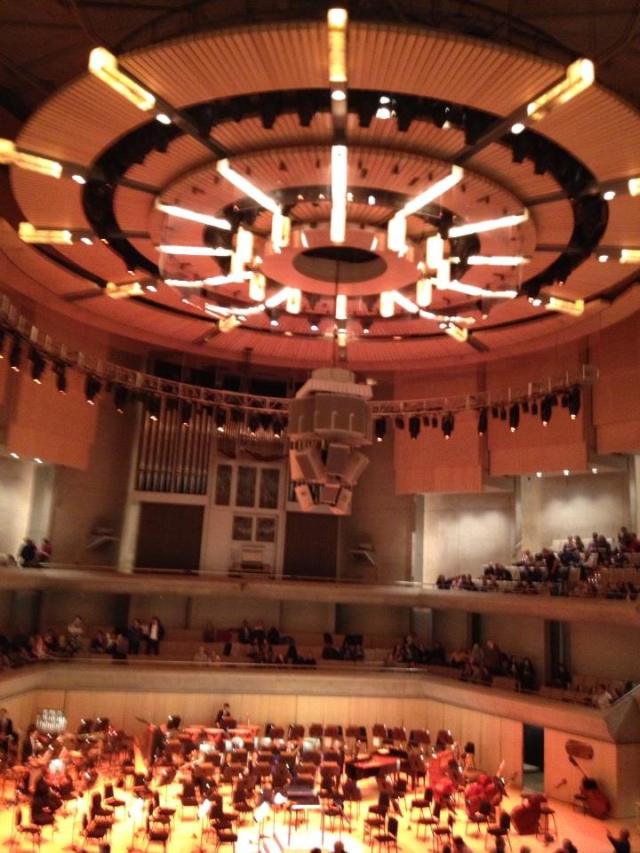
It shouldn’t surprise anyone to hear that tonight’s season-concluding Toronto Symphony Pops Concert, featuring the film music of John Williams conducted by Steven Reineke, played to a full house clamoring for more.

conducting_Michael_Tammaro

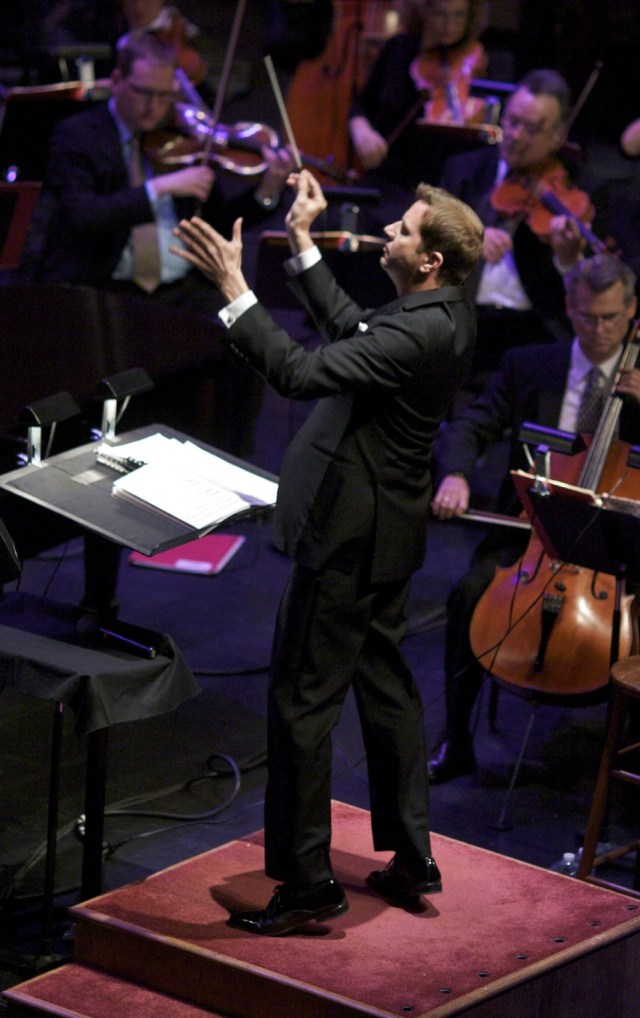
Conductor Steven Reineke (photo: Michael Tammaro)

And yet I was surprised.  Film music is the hot new thing in the symphonic world, as orchestras are programming films with live scores all over, including our TSO who played Psycho, Vertigo (as part of tiff) and Back to the Future with live accompaniments.   The music may not be new, but the orchestra’s enthusiastic embrace of this repertoire surely is new, especially when they have a champion like Reineke.

While Reineke lives in the parallel universe of pops concerts distinct from the more lofty objectives of the orchestra he performs an important function, as a kind of curator / teacher.  Tonight’s concert was an intriguing mix of pure gratification in a few hugely popular selections alongside some more obscure choices reflecting Reineke’s own interests, as he explained recently.

In the first part of the concert we heard excerpts from Jaws, Close Encounters of the Third Kind, Raiders of the Lost Ark, E.T., Hook, and Jurassic Park.  It’s a powerful exercise to lift these scores out of their films, and play them without the visuals.  I wish we could see the films without the music, so that people could see just how much of their emotional response is created in the music.

mother-ship

Hm is that the Mother Ship from Close Encounters?

With the music of Jaws, one of the best-known themes, that thing we sing when we joke about something scary (that back and forth between adjacent notes) misses so much more that we can’t quite replicate, especially the brass.

I was very pleased to be able to listen to some of ET’s score alongside Close Encounters, music that in some resembles two sides of the same coin.  With ET we have a film about children, whereas C.E. is more a film about the child in us, even as its score is full of adventurous & dissonant touches.

I pause here to note that even in a concert sampling eleven films scored by Williams, that some of my favourites are missing (JFK? The Patriot? Home Alone? Always? Superman? Harry Potter? Empire of the Sun? War of the Worlds?).  But some of my favourites are certainly here.  Hook, to be sure, and then we come to that amazing theme from Jurassic Park.  I was musing as I stood at the urinal during intermission, listening to people humming tunes from the first part of the concert while peeing (surrendering to one impulse, they give in to another).  I was struck by how remarkable that first big tune is in Jurassic Park.  Did Spielberg tell him to create something staggering, stunning, breath-takingly beautiful?  When you think about it, yes it’s a movie about dinosaurs with unprecedented CGI. But it’s above all a film that unexpectedly balances a reverence for these creatures, the miracle of bringing them to life, with the horror of what they can do.  Would we be as impressed by those images without Williams’ stirring tune?

In the second half Reineke dared to probe a little deeper before offering us what we’d presumably paid to hear.  Three different examples showed us something unexpected from Williams, in portraits of diverse nationalities:

  • The Jewish sounds of Schindler’s List
  • The English echoes in the score for War Horse, that Reineke unpacked for us, in speaking of echoes of Vaughan Williams and Elgar
  • The Americana in Lincoln, this time via echoes of Copland

And then it was time for Star Wars music, first via episode IV, and then in music from the recent film.  You’d think we were at a Rolling Stones concert listening to “Sympathy for the Devil”, in other words, the crowd went wild.   I could mention that the concert is being repeated twice on Wednesday May 18th (2:00 and again at 8:00 pm). If you’re curious here’s the link

Of course we had to have an encore, which took us back to episode IV, for a wonderfully jazzy arrangement of the music from the bar.

Next season there will be more film music including a few more films with live accompaniment.  I can’t wait. What would be really radical –and totally awesome– would be to give Reineke a chance to program a concert or two as part of the main season rather than in the “Pops” category.  What if he gave us a suite from The Mission or one of the spaghetti westerns, with scores by Ennio Morricone, perhaps alongside some of Herrmann’s music from the Hitchcock thrillers…? And there’s so much more I can imagine, including Rota, Prokofiev, Shostakovich, Glass and many other legit composers who ventured into the cinematic world.

I couldn’t help noticing the delight the orchestra took in this music. And it’s contagious.

Posted in Cinema, video & DVDs, Music and musicology, Reviews | 1 Comment

10 Questions for Danny Ghantous: Lemon

Danny Ghantous is a recent graduate of Ryerson University’s Performance Acting program, and recently starred as Sadiq in Factory Theatre’s acclaimed production of A Line in the Sand directed by Nigel Shawn Williams.

“It will take me a long time to shake the images of recent Ryerson graduate Ghantous’ imploring, too-eager-to-please smile”
– Karen Fricker, Toronto Star
As Sadiq, Danny Ghantous has the poise of a pro.
– Lynn Slotkin, The Slotkin Letter

Next up, Danny’s preparing for the screwball comedy Lemon, to open May 25th with Filament Incubator. I took the opportunity to check in with Danny to ask a few questions.

1-Are you more like your father or your mother?

If I had to choose I would say I’m more like my mother, but I’m discovering everyday as I mature, how I am slowly becoming more and more like my father. I think I like to think of myself as more akin to my mother because of her creative eye and intuition. She’s a former graphic designer, a current hobbyist of jewellery design and has a keen eye for aesthetic. Whereas my father, as an engineer, is very logical, precise and careful. Nonetheless I think I carry the Arab passion that is imbued within them both and it translates in my personality and my work.

In terms of theatre and acting in general, my parents have no idea where I get it from. I think it came from the fact that I was raised in many different countries by quite reclusive and very safe parents who seldom had me playing outside or meeting new friends, so I planted myself in front of a television (theatre in Egypt was limited to the occasional private school production, usually of fairy tales). The shows and films I watched shaped my view of the world, and how society and people worked. I idolized the fantasies and relationships I saw on the screen and I wanted to be a part of them. Wanting to act, create art and perform wasn’t form of escape but rather, a means of inclusion.

Danny Ghantous

Danny Ghantous

2-What is the best thing about being an actor?

The play. In the sense of playing around. With the words, the relationships, the minute details, the history, the story and the means of communicating it all to the audience. I find play both in the physical and emotional work on stage, as well as the long discussions at the table. The act of creative collaborations and discussions, allowing the ensemble as a whole to shape the product, is what excites me the most.

3-Who do you like to listen to or watch?

If you’re referring to music, I listen to artists from so many different genres, from rock, to hip-hop, to funk, to jazz, to classical music and more. I love discovering new music, and I’m always searching for more (unless its country or pop, no offence, I just don’t prefer it). Some artists I really like right now include Anderson .Paak, Hiatus Kaiyote, Kaytranada, Skepta, Hop Along, Kendrick Lamar and Courtney Barnett. If you’re referring to people in general, then I would say just people in general. Walking along the streets of Toronto you come across a lot of different characters. Keeping an ear out for how they speak and what they say informs you of the people in your community. Which, as an actor, can actually help you develop characters, based off of real living people. As well, I love to hear artists talk within and about their craft. Getting the chance to be in a rehearsal space with a director and actors, and seeing the way they shape the actions and story, is mesmerizing.

4- What ability or skill do you wish you had that you don’t have?

I wish I could play an instrument. I always wanted to my entire life, but I just can’t seem to buckle down with an instrument long enough to learn enough. My dream is to be able pick up or sit down to an instrument and play whatever music is in my head without thinking about it.

5-When you’re just relaxing and not working what is your favourite thing to do?

Eat. I love food. Discovering new restaurants and cuisines around the city, and also trying new recipes to cook at home gets me really excited. There’s always a sense of play in my kitchen.

Danny Ghantous

Danny Ghantous

Some more about Lemon with Filament Incubator

1- Please talk about your connection to Filament Incubator.

I became involved with Lemon after one of its co-founders, Aaron Jan, saw me at a reading for another show and asked me to audition for Filament Incubator’s second show in their season. When Aaron sent me the sides to the script, the energetic writing and the pace throughout the scenes genuinely excited me. I came out, feverish and suffering through the flu at the time, and by some miracle they saw something in my approach to Dennis as a character.

2- I found this description of Lemon:
Desperate to retain her potential after courting a barren, post-college job market, Liz opens a lemonade stand on her parents’ front lawn. It wouldn’t be so bad, if her high school fling wasn’t determined to rekindle feelings between them, and her eight-year-old competition wasn’t willing to go to any length to ensure her downfall. A biting satire of a downtrodden economy, Lemon is a tale of dog-eat-dog-eat-dog.
…Please talk about Lemon and what attracts you to the play.

These days a university degree is becoming less and less valuable in the job market. There are thousands of people coming out of these institutions who aren’t able to find work in their field. As a recent university graduate I understand this reality all too well. When I read Lemon I could see the thoughts and fears of my generation come to light through satire. Lemon excellently showcases the struggles of post-graduation, of love, of power and of potential.

3- A famous quote says “Dying’s easy, comedy is hard.” Talk about Lemon, as an opportunity to play comedy and why it’s so hard.

I think considering my darker features and looming, broad body, I got used to being cast as very villainous characters. So any time I am given the opportunity to play a character that doesn’t have a blood lust, I get very nervous. The implicit difficulty in playing any comedy is both the necessity for the appropriate response from the audience and at the same time not playing the comedy. I say this in the sense that if you play any joke, as an actor, acknowledging its humour, the joke falls flat. Getting to play Dennis is both a challenge and a pleasure. He has the power to be optimistic even in the face of complete failure. And though it can seemingly come off as ridiculous, as an actor I have to always come back finding how all of his actions, ideas and decisions are grounded in a real, desperate will to push forward.

4- Talk about this project in context with your recent experience in Factory Theatre’s A Line in the Sand, universally well-received and a totally different kind of project.

After reading Lemon for the first time in its entirety, I immediately saw the similarities between Dennis and Sadiq, my character from A Line in the Sand. Both exemplify this desperate need to break free of the cycle that they feel they are they are trapped in. They both cling to their will as a coping mechanism and a means of survival. I learned so much from A Line in the Sand, from all the people involved, and it has helped my process as an actor, immensely, especially throughout the rehearsal process for Lemon. Getting the opportunity now to work and create new and exciting works with young artists excites me for the world I am entering into.

Danny Ghantous (left) and Morgan David in Factory Theatre's recent A Line in the Sand (photo: Dahlia Katz)

Danny Ghantous (left) and Morgan David Jones in Factory Theatre’s recent A Line in the Sand (photo: Dahlia Katz)

5-Is there a teacher or influence you’d like to acknowledge?

I would like to thank every teacher at The Ryerson Theatre School, or as it is now called The Ryerson School of Performance. To Perry Schneiderman, to Marianne McIsaac to Cynthia Ashperger, to Philippa Domville, to Ian Watson, to Sheldon Rosen, to Irene Pauzer, to Leah Cherniak, to Diana Reis, to David Warrack, to Allen Cole, to John Boylan, to Patrick Robinson, to Vicki St. Denys, to Rafal Sokolowski, to Steve Wilsher and more, I thank you all for your hard work, dedication and patience. As well I would like to thank Diana Yassin, wherever you are, thank you for seeing something in me that I never thought would spring. Lastly I would like to thank, from the bottom of my heart, Mr. Bob Anderson and Ms. Carole Anderson. Without whom, I would have no voice, and who taught me, through music and choir, some of the most important lessons that I still use in my approach to acting.

*****

Danny Ghantous stars in Andrew Markowiak’s Lemon produced by Filament Incubator from May 25th until June 5th with LeeAnn Ball and Julia Hussey. For tickets click .

LEMON

Written and Directed by Andrew Markowiak
Presented by Filament Incubator

Starring Danny Ghantous, Julia Hussey, and LeeAnn Ball
Set Design by Cass Brennan
Sound Design by Wesley McKenzie
Photography by Jordan Laffrenier
Publicity Video by Andrew Pieroni

Onstage: May 25th-June 5th
Preview: May 25th
Opening: May 26th

Showdates:
May 25th – 29th @ 8 PM
June 1st – 5th @ 8 PM

Venue: Majlis Art Garden (163 Walnut Ave)

Posted in Dance, theatre & musicals, Interviews | Leave a comment

Questions for Steven Reineke: the film music of John Williams at the TSO

Steven Reineke is a pops conductor, an arranger, a composer, and very busy all over North America, as Music Director of The New York Pops at Carnegie Hall, Principal Pops Conductor of the National Symphony Orchestra at the John F. Kennedy Center for the Performing Arts, Principal Pops Conductor of the Toronto Symphony Orchestra and Principal Pops Conductor Designate of the Houston Symphony. Reineke has collaborated with a range of leading artists from the worlds Hip Hop, Broadway, television and rock including: Kendrick Lamar, Nas, Sutton Foster, Megan Hilty, Cheyenne Jackson, Wayne Brady, Peter Frampton and Ben Folds, amongst others. As the creator of more than one hundred orchestral arrangements for the Cincinnati Pops Orchestra, Mr. Reineke’s work has been performed worldwide, and can be heard on numerous Cincinnati Pops Orchestra recordings on the Telarc label. His symphonic works Celebration Fanfare, Legend of Sleepy Hollow and Casey at the Bat are performed frequently in North America, including performances by the New York Philharmonic and Los Angeles Philharmonic. His Sun Valley Festival Fanfare was used to commemorate the Sun Valley Summer Symphony’s pavilion, and his Festival Te Deum and Swan’s Island Sojourn were debuted by the Cincinnati Symphony and Cincinnati Pops Orchestras. His numerous wind ensemble compositions are published by the C.L. Barnhouse Company and are performed by concert bands worldwide.
conducting_Michael_Tammaro

Conductor Steven Reineke (photo: Adrian Mendoza)

Reineke will be leading the Toronto Symphony this week in a program of film music by John Williams, arguably the real genius behind the Star Wars films, and a composer of many great scores.  I had to ask him a few questions.

1. How did you become you? What were the early influences on you?

Well as with anybody, especially in a creative, artistic field, I think there’s more than just one person that you take training from and influence from. My earliest influence I would say was my father. From the time I can first remember until I was maybe 12 or 13 years old, my dad, who was a banker – it was his profession his whole career – would sit on the edge of my bed with his guitar and play his guitar and sing me to sleep almost every night. That instilled in me a very early love and passion for music – in particular a lot of popular folk music, because it was the music that he would play, was the music of John Denver; Peter, Paul and Mary; Harry Chapin; and the like. And that was a very early memory of mine that instilled this great love of music. And then, as I got older, of course there were several band directors along the way that were very influential, but it wasn’t until later in life, in college, when I really started to get another mentor that taught me a lot. His name was Ron Matson and I never actually had any official class with him, but he was a piano player, an accompanist, and a faculty member at Miami University in Oxford, Ohio, where I did my undergraduate. I was studying to be a trumpet player, and he would accompany me for recitals and such, and he taught me so much about music and he didn’t know anything about playing the trumpet, but he knew music, so that was a certain thing that was very helpful to me, but also he taught me a very valuable lesson. We would hang out as friends as well and we’d go see a movie together, say, and I would come home and play 85 – 90% of the movie score on the piano, and I thought everybody in music did that. But he was able to convince me, “No, that’s kind of a unique, special talent.” That was a turning point for me, because I almost didn’t want to recognize that that was a unique special talent, because with that came a responsibility of what am I going to do with this? In a way, I didn’t necessarily want to be special, and he taught me that I had a special kind of talent, and something that I really needed to focus on, and hone, and work to figure out how to best use that.

And then my great mentor came in 1995, when I became the assistant conductor for Erich Kunzel.  He was the founder and conductor of the Cincinnati Pops Orchestra, and he hired me to be his assistant and right hand man, eventually becoming his Assistant Conductor. He was the greatest influence I ever had, and took me under his wing, and we truly had one of those great mentor-protegee relationships, where he taught me everything he could about this business, and taught me how to be a conductor. So he was quite influential in my life. When you’re able to look back in the rear view mirror you see how the path unfolded and you see the people that came into your life that were the most meaningful in your career.

2. What is the best thing about what you do?

The best thing about what I do is entertaining an audience and seeing them light up, and have a wonderful time enjoying many styles of popular music. I always say, when I conduct a concert, those two hours of conducting a concert are my favourite two hours of every day. There’s so much work going into it, and yes I do get to arrange for my own programs, I compose for my own programs, put it all together, fundraising, the rehearsing, all of that. But the best part is when we finally get to go out there and I always say, it’s game time. Game on! And there we are. The spotlight hits, and there’s a full audience, and we take them on a journey. Because as a pops conductor, what I do isn’t about some great, deep mystery of education, necessarily. It’s about entertainment. And people love to be entertained, and I think I was a born entertainer. People think it’s maybe an act, but that’s no act, I couldn’t act that, that’s just a natural response. I can be in the worst mood, or have other things going on in my life, and it doesn’t matter. Still, when I take that stage, and the lights are on, nothing else exists for me. It’s the one time where I’m completely immersed in the moment. I just conducted concerts in Vancouver this weekend on Friday and Saturday, and my father passed away Wednesday. I was thinking about it because he of course was a great influence for me and he loved coming to my concerts, and so I was kind of in a bit of a funk all over the weekend, but the concerts were a huge success and I felt so energized and it didn’t even cross my mind while I was conducting. I knew I was there doing my life’s work and I loved it.

3. What do you like to listen to or watch?

As far as listen to, my go to music if I just am relaxing in my house, maybe throwing a dinner party or just cooking dinner for myself and my husband – Ella Fitzgerald is one of my favourites. Ella is one of my girls. But all the girl singers of the Golden Age, the 40’s, 50’s, 60’s, I’m really particularly drawn to the music of that era, and the girl singers, especially Ella, are very near and dear to my heart. As far as watching, there’s lots of TV shows that I love. I binge watch on Game of Thrones, and House of Cards, those are two of my favourites.

4. What ability or skill do you wish you had, that you don’t have?

The ability to fly like Superman. That may not be where you were going with that question, but yes, if I had the ability to fly! I have dreams about it often, and they’re the most amazing dreams when I’m physically soaring. Also I fly on airplanes so much, and that gets so tiresome, if I could do it a different way, just like Superman, I would love that.

5. When you’re just relaxing and not working, what is your favourite thing to do?
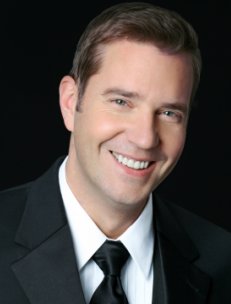
head_shot_Michael_Tammaro

Conductor Steven Reineke (photo: Michael Tammaro)

A couple of things that I really love to do that I find very relaxing: I’m a crossword puzzle fanatic. I do at least one crossword puzzle a day, normally four or five, really. They go rather quickly, it depends, if it’s a travel day, this is how I bide my time on airplanes and whatnot. I definitely do pretty much every day at least one crossword puzzle in the morning, that gets myself awake and alert and gets my brain moving. Another thing I love to do is shoot billiards. I’m quite a pool shark, and that’s great way for me to relax and unwind and spend time with friends. We have a pool table in our building, so when I’m home and not working, and we’ve got our free evenings, that’s what my husband Eric and I do. We go down there and have a glass of wine, shoot a few games of pool, play best out of three or best out of five, and then we’ll go up and make dinner. It’s a great relaxation, fun, game time.

6. Tell us about the “Music of John Williams“, and which films you’ll be spotlighting.

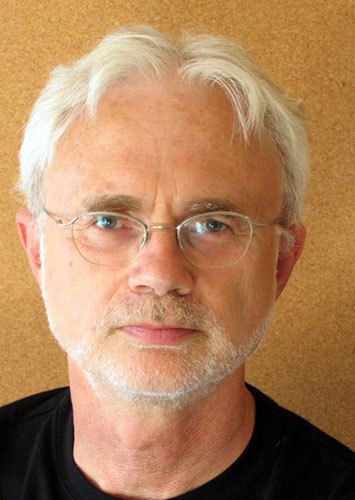
jwilliams2

Composer & conductor John Williams

The concert we’ll be performing is called, “The Music of John Williams: From Spielberg to Star Wars”. This really started out as I wanted to do a tribute to the collaboration between Steven Spielberg and John Williams, getting Spielberg in there because this is the year of Spielberg’s 70th birthday, so it was a bit of a celebration of Spielberg as well. And so, most of the program is devoted to their 40 plus year collaboration. And then the last 25 to 30 minutes of the concert is music from Star Wars, and most of it is the newest music John wrote for The Force Awakens, which J. J. Abrams directed. The music is just recently available for orchestras to be able to perform, and it’s so, so good. And also garnered John Williams his 50th Academy Award nomination for The Force Awakens, which is astounding. That’s the living person with the most Academy Award nominations by far, and he’s only second in history. The only person with more Academy Award nominations is Walt Disney with 59 nominations. John might have a chance to beat him, if he keeps doing this, he might get up to 60, who knows. And oddly enough he’s only won five times out of 50 nominations. Our program begins with a great way to open a concert, with that soft, menacing motif from Jaws. It’s the Shark Theme from Jaws, which was the first big hit that Spielberg and Williams had. They had done one movie prior to that called The Sugarland Express that was rather forgettable for most people. And so in 1975 they had a hit on their hands with Jaws, and that’s where we begin the program. Of course there are some big hits like Raiders of the Lost Ark, and E.T., Jurassic Park, Schindler’s List, but I particularly love some of the other music. I am such a fan of the music from Close Encounters of the Third Kind. It’s such a romantic, lush, almost operatic score that John created for that film. And I’m also very partial to the music from War Horse and from Lincoln, which is a little more subdued than the bombast of Star Wars or Jurassic Park. It’s got really great meat on its bones, some very elegant music. So that’ll be a lot of fun! John has a particular way about him to contribute to films. When you hear a John Williams theme – well first of all, the music can be taken out of a film and put in a concert hall and be just as successful as if you were watching the movie, because the themes become so closely identified with the movie that you immediately think of the film. You may think of the first time you saw the movie, you may think of a particular actor or character, you may think of a scene…it will take you right there. It’s so visual and visceral, and he has a knack for writing these melodies that are just inseparable from the memory of film. Also, I have lately been working on – we do these film with orchestra projects where we screen the movie on a large movie screen above the orchestra, and the orchestra plays the soundtrack live, coming up these year I’m going to be doing a couple of movies that way, so in my practise I have had the opportunity to watch those films with no music in it, and I wish everybody could see it. They’re still good movies but it’s so not the same movie until you put the soundtrack there. So much of it is incredibly boring, dull, nothing going on. You add the music into this and boom, suddenly you have magic! You have cinematic magic. But it takes the music to make these movies work. Spielberg would go over to John Williams’s studios and John would play several themes for him, and they’d work on that together. There’s a wonderful story about the bicycle chase sequence in E.T. where John had a particular idea in mind with the music he wrote, and in the actual scoring session where they were recording the soundtrack, and the movie was playing on a big screen, John could never get it to line up exactly the way he wanted with the music he had created and wanted to create. Spielberg eventually said, “John, let’s turn off the movie, you conduct this awesome music the way you intend it to be.” That’s exactly what they did, and Spielberg went back and re-cut that sequence of the film to match John’s music. Now, think of directors that do that – not many have every done that. Spielberg actually changed his movies after he shot them and edited them, because the music is usually one of the last things to be added. He went back to the drawing board and re-did an entire scene just to fit John’s music.

7. There are several points of contact between you and John Williams, the composer, the arranger and the conductor who succeeded Arthur Fiedler at the helm of the Boston Pops Orchestra. Do you identify with him and his music?

First I have to say that I am a huge John Williams fan and I have been ever since I was a teenager. As a matter of fact, when I was in college studying trumpet and then music composition, I wanted to become a film composer. I would say I wanted to be the next John Williams. I actually won a grant and went to Los Angeles and studied film music for two years as a composer, and even had the opportunity to meet John Williams briefly while I was out there. So I have extraordinary respect for him. If one were to listen to my original music, my compositions, there is clear indication of John Williams’s influence in the music that I wrote. There are a lot of moments of pieces of mine, where you can tell, that’s a bit of an homage to John Williams, which I take as a great compliment, to be able to achieve something as good as that. Now, the other thing is I just totally respect the fact that he is one of the last bit of the old guard of film composers that comes from true European orchestral tradition, where he’ll record with a 90-piece orchestra, and a lot of movies just don’t do this anymore, and the sound of that is a very different type of sound than you get with a lot of modern movies that are using pop or rock music or sourced music. The scope of it is very different, and it goes in the long line of the Europeans that came to Hollywood to do film music, and those include Prokofiev and Bernard Herrmann and Max Steiner. Those guys of the 40’s and the 50’s that were real life composers. John is too. He writes more than movie music, he’s written several concertos and sonatas and lots of orchestral pieces and they’re very different than his film scores. They are true pieces of classical literature and classical repertoire and they are in the classical world. I love the fact that he comes from that tradition, because that’s where I feel I come from too, as a classically trained composer.

8. It’s been said that film music works best when it’s not noticed, a truly challenging medium. How do you handle the paradox of bringing attention to something that lives under the radar?

Well that’s very true, and I’ve heard that quote many times. Some of the most successful film scores, the music just gets out of the way – it isn’t meant to draw attention specifically to itself, but enhance what’s happening visually or dramatically inside of the movie. John’s music is a little different because his music is as much a character in the films as any of the characters. It’s as unmistakable as anything else, he writes real themes and melodies instead of just a bunch of esoteric sounds. There’s real melodic and harmonic structure to it instead of just droning on with a minor chord just to make people feel sad. I’ve got no problem drawing attention to John’s music because it just works so perfectly outside of the film and in its own concert setting. His music works in a concert hall setting better than most. You listen to a lot of other people’s film scores, and if you listen to the entire score you might only find five to 10 minutes out of a 90-minute score that you could actually pull out of it that would be interesting to do in a live concert setting. The rest of it is just often background music – something that is meant to be in the background – atmospheric. His pieces are truly concert pieces. He’s like the Mozart of our day. He is that prolific, and the fact that he has worked in all these different genres – if Mozart were alive today, I believe he would be doing what John Williams is doing. He would want his music out there to as many people as possible, and I think he would have loved the idea of writing for film.

9. What are your favourite film scores?

I’m a big fan of Ennio Morricone.
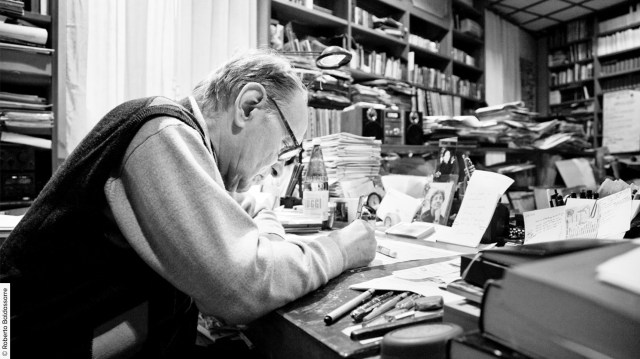
banner1

Composer Ennio Morricone

He’s one of my absolute favourites. And I would say my favourite film score probably of all time is from Cinema Paradiso. Beautiful, beautiful Italian film with just incredible music by Morricone. One of my favourite film scores. It’s a love story about a young boy and a girl, and also his love of film from his hometown as a boy growing up. But the music that Morricone wrote for it, it just touches my heart and soul so deeply because it’s so incredibly beautiful. I’m so jealous, I have often sat down writing, and thought, “God, if only I could write a love theme this good.” The love theme from Cinema Paradiso is one of my favourite pieces of music there is. But also it’s a gorgeous film, and the score and the film work so brilliantly together, and it’s a fairly simple little score, but it’s just so gorgeous and so effective. Of course, the music from The Mission is another great one by Morricone. I am a huge fan of his.

10. Is there a teacher or an influence you’d care to name that you especially admire?

I could list a few. My father, Erich Kunzel from the Cincinnati Pops, who I owe so much of my career to, and then other great influences in my music are Aaron Copland, Leonard Bernstein, and John Williams. No lie. These three Americans – they have a distinctly American sound to them as well, and I just love how accessible their music is while also maintaining real integrity. It’s music with real meat on its bones. They all have written substantive music. It’s music that has weight and power to it, which will give it longevity because it’s not just a flash in the pan and then you get bored with it, because it’s not a novelty, necessarily, it’s music with substance. Every time I’m working, creating, I always judge myself, probably more harshly than anyone else, about, “Is this music good?” And that’s such a subjective thing, but does it have real merit as good art?

*****

Steven Reineke comes to Toronto this week, leading the Toronto Symphony in a program of film music by John Williams on May 17th and 18th .  Here’s the program:

  • Shark Theme from Jaws (1975)
  • Selections from Close Encounters of the Third Kind (1977)
  • March from Indiana Jones and the Raiders of the Lost Ark (1981)
  • “Adventures on Earth” from E.T. the Extra-Terrestrial (1982)
  • “The Flight to Neverland” from Hook (1991)
  • Theme from Jurassic Park (1993)
    Intermission
  • Main Theme from Schindler’s List (1993)
  • “Dartmoor, 1912” from War Horse (2011)
  • “The People’s House” from Lincoln (2012)
  • Main Title Theme from Star Wars: Episode IV – A New Hope (1977)
  • Suite from Star Wars: Episode VII – The Force Awakens (2015)
    March of the Resistance
    Rey’s Theme
    Scherzo for X-Wings
    The Jedi Steps and Finale
Posted in Cinema, video & DVDs, Interviews, Music and musicology | Leave a comment

Cozy Fantastic

I knew how it was going to work. I resisted and was still swept away by the conceptual brilliance of A Little too Cozy, Against the Grain’s latest transladaptation. Don’t let the word scare you, it merely means something that is both a translation and an adaptation. AtG artistic director Joel Ivany has now completed his trilogy of the Mozart- da Ponte operas, previously giving us Figaro’s Wedding (brought to Toronto in 2013 after an earlier workshop process in Banff) and #UncleJohn (2014).

It is the site-specific show to end all site-specific shows.

my_CBC_pic

Ten stories up inside the CBC building, this is the view from my phone (dangled over the railing please note) on the way to see the opera: in a TV studio.

We come to the CBC Building on Front St, with a front door guarded by Glenn Gould’s bronze image, ascending to the 10th floor in a studio that we hear is alongside where they do Hockey Night in Canada (one of my favourite CBC shows) and Dragon’s Den (absolutely my least favourite).

logo-splash

A Little Too Cozy is many things, but above all it is meta-theatrical, a layered creation that is like an opera within an opera, or perhaps an opera within a reality TV show. By seating us in this iconic place the reality is so perfectly authorized that the opera is almost incidental. It’s just about the coolest place I’ve ever been to see an opera (as an opera fan I’d say Lincoln Center is cooler, but only just barely).

The space dominates the experience. Long after the show is over, you are still walking through this place with photos of stars on the walls, a kind of technological cocoon that protects the perfection of broadcast from the outside world. What a coup for AtG to get their opera produced in such a perfect space…!

We watch this opera, even though we hear singing + a tight ensemble led from the piano by Topher Mokrzewski. The space is far from ideal acoustically, given that TV studios are dry rather than reverberant, and not hospitable to big powerful voices. While Cairan Ryan as Donald L Fonzo, the host of the Cozy show (Don L Fonzo = Don Alfonso from Mozart’s opera), was surely the lightest bass voice I’ve ever heard undertake the role, he was the most successful negotiating the acoustic, every word crystal clear. We observe the performers while seeing them also on monitors, captured by a cameraperson. At one especially powerful moment we watch Clarence Frazer as Elmo (the lover formerly known as “Guglielmo” in the original) freak out on camera as Fernando comes on to his betrothed. It’s as disgusting as reality TV or the plot of this opera, but foregrounding the phony performative aspects of romance. Frazer is sometimes funny, sometimes very sympathetic, and does very well in his close-up.

Yes I resisted initially –as I do with anything that’s so clever it captures my imagination—but I was won over. I should perhaps add that I am conflicted about this opera, which means I was especially impressed with how well Ivany’s concept worked. There we were down the hall from CBC’s greatest reality TV achievement –the aforementioned Dragon’s Den—watching impressive echoes of the genre. There are those cliché moments when the lovers are shown in flashback on film with soft-rock accompaniment. There is a lot of dialogue (as opposed to recitative). And above all, there’s the space, always visually intriguing as we are in a self-referential place. Of the three transladaptations, this one seems least encumbered by the devices of opera, emerging into a new hybrid genre, without any creaky shifts of gears between numbers. We are watching something resembling live television, only rarely slowed for an operatic number.

When seeing something like this I often ask myself who’s most likely to enjoy such a thing, between the hardcore opera fans and the neophytes. This occasion seems especially rich in its rewards for first time viewers –and notice I don’t say “listeners”—as we’re in a very hip modern place. The more conservative opera-goer may resist, as I did, but I think they’d have to admit it’s quite a remarkable creation, one that adds extraordinary energy to the original. Instead of the bet between Alfonso and the two young lovers–a creaky plot device of the original that can be so troubling with implications of misogyny and straining our credibility when the same lovers show up in disguise– these problems are avoided.
The reality TV story we watch has them betrothed but never having met (as part of the premise of big money that they would win if they go through with it), eliminating that credibility problem. By framing the story about love and marriage in this exploitive context of modern TV romance we’re in an apt discursive place to be questioning relationships throughout. As a result I like A Little Too Cozy more than the original.

Caitlin Wood as Despina does what all Despinas do, namely steal the show throughout, given that she gets much of the best music and funniest lines. Aaron Sheppard as Fernando has many sympathetic moments. Shantelle Przybylo (Felicity, formerly Fiordiligi) and Rihab Chaieb as Dora (or Dorabella) were for me the most authentic part of the reality TV imitation, disturbing and possibly insulting as that might be to those women. OMFG but they are hysterically funny, hypocritical, and at the same time totally vulnerable. From their hair & fashion to their succession of wineglasses, they are genuine, and make you care about the outcome of the story: no matter who marries whom.

I can’t recommend this highly enough. See A Little Too Cozy.

Posted in Opera, Popular music & culture, Reviews | 4 Comments

Lisiecki’s pianism: Chopin plays Schumann

In the film Impromptu we get interesting close-up looks at the personal lives of Chopin, Georges Sand, Liszt, Delacroix and a host of others.  At one point we see Liszt & Chopin playing a Beethoven transcription together, a fascinating thought really.  What did it sound like when great composers (such as Chopin or Liszt) encountered Beethoven?  From a vantage point almost two centuries distant, when years of exposure to this music nearly thwarts our ability to hear the music with any freshness, it’s hard to imagine how someone living before the age of youtube, wifi, hi-fi, or even Victrola, would have looked at a score and read it for the first time.  The age of recordings has made it possible to hear so many interpretations that a kind of orthodoxy has been established, a normal way of performing the standard repertoire.

Fruits & vegetables can taste quite fresh and wonderful, but sometimes they can be generic and uniform, depending on how they’re grown and procured.  I’m no produce expert, but I imagine that the genetically modified tomatoes that survive any indignity on the way to market, that are somewhat red and taste something like a tomato after weeks, are thought to be preferable in the corporate boardrooms to the tomato that breaks more easily, has genuine flavor but likely ripens more quickly.  No I don’t know this for certain but I suspect it’s the case, that costs are always paramount in the strategic discussions of big companies.  We live in an era of corporate products, where chains such as Starbucks or McDonalds keep close watch on the output in Cambridge, Massachusetts or Cambridge, Ontario, to ensure that no one is disappointed, meaning that no one experiences anything diverging from the usual.  There is much shared knowledge about how to raise chickens or how to raise performers to an amazing standard. As a writer observed a few years ago: virtuosity isn’t as rare as it once was.  The singers coming out of the various schools are all very good for a core group of roles, able to give us Mimi or Cherubino or Marcello or Figaro, but coming up a bit short when some genuine vision, some star-quality is called for, as you’d want to see in an Aida or a Siegmund or a Mephistopheles.

All that is a preamble in recognition of the uniqueness of Jan Lisiecki.

RESIZED_jan_peter

A lighter moment from rehearsal with Jan Lisiecki and Peter Oundjian (photo: Michael Morreale)

I heard three consecutive concerts where Lisiecki and the Toronto Symphony played Beethoven’s 4th piano concerto.  There was a quality to it that I couldn’t put my finger on, but it began with the awareness that this was not the usual approach to Beethoven.  If you can recall the opening –a soft piano solo stating the main theme followed by a gentle echo from the orchestra—it’s usually done with a fair degree of metrical rigor.  Whether fast or slow, the speed one encounters at the beginning is more or less the speed throughout the movement.  That rigor is at least part of the consensus surrounding the way most people play Beethoven, rightly or wrongly.

Lisiecki does something very different, rightly or wrongly.  Beethoven wrote a statement of the theme, ending with a run and what would seem to be the last words closing that opening sentence, usually understood to be in the same tempo throughout, but Lisiecki slows down to something introspective, poetic.  Not only is it unexpected in Beethoven, some might argue that it’s idiomatically wrong, an imposition of another style.  The first of those concerts seemed to throw Peter Oundjian and the TSO for a bit of a loop.  Because Lisiecki had slowed the piece down substantially, when the orchestra answered they were going quite slowly.  It took Oundjian a couple of pages –in this substantial orchestral exposition—to get the big orchestral ship back up to speed.  I wondered whether this was partly because the orchestra was coming off a vacation day on their trip.  Coaches of sporting teams sometimes worry about their team being too relaxed after a vacation, not having as much fire. Whatever the reason, at this moment there was little fire, just poetry.  The next two nights of the same piece, Oundjian watched Lisiecki do his introspective poetry to begin the movement–slowing the piece down to a near stop—and responded by goading the orchestra right back to speed.  It was marvelous to watch, as Lisiecki went in and out of that tempo sometimes slowing down for poetic solos, sometimes taking off in his cadenzas like a wildman.

Listening to Lisiecki’s recent CD of Schumann’s music for piano & orchestra (with Orchestra dell’Accademia Nazionale di Santa Cecilia led by Antonio Pappano), though, I now have a different way of understanding him.  Lisiecki seems to read each score from first principles: which is what you would want any artist to do.  The Dustin Hoffmanns of this world –artists who read the script and explore, seeking deep meanings– can be the bane of a director’s existence, adding time to a production schedule.  It’s a challenge to the productive cycle, when someone goes beyond the surface, diverging from the usual approach.  The generic approach is cheaper, while an adventurous probing reading adds time & expense.  Lisiecki isn’t at all generic and does not seem to be influenced by what others do, if he is even aware.  This can be quite brazen, daringly different,  playing music his own way.  At first hearing I wrinkled my nose because it’s not what I expected, not what I understood Schumann to sound like.

It sounds like Chopin playing Schumann, an effete poet finding something unexpected.

Many of the fast passages are done with great delicacy, softer than usual.  There’s an elasticity to the tempi somewhat like what I described with the Beethoven, but even more so.  In fast passages, especially cadenzas, he is playing with such ease that the music sounds quite different. Instead of the usual sturm und drang a man seemingly on the brink of madness, this is a different sounding Robert Schumann.  The fast passages are like coloratura vocalism, very much the way we hear it in Chopin, softer in many places than usual but with great clarity.  And the overall effect with Pappano and the orchestra is wonderfully intimate, delicate and under-stated.

Lest anyone think this is meant to be a knock on the pianist, it’s not. This is a daringly original reading of these works, including Schumann’s well-known piano concerto, his op 92 Introduction and Allegro appassionato and his op 134 Introduction and Concert-Allegro.  I welcome a new way of understanding this music, a genuinely original voice: a rarity nowadays.  You hear this same originality in his Mozart or his Chopin.

One of these days we’ll stop calling him a “young pianist”, but I think this original voice of his will continue.  I look forward to hearing what he undertakes next.

Posted in Music and musicology, Reviews | 1 Comment

Pisani: putting the “melos” in Melodrama

Everyone uses the word, yet few really know what it means. “Melodrama” is a label often attached to human behaviour, but the usage is a metaphor for something else. And I suspect that those who have studied drama or theatre will be thinking that my accusation was for everyone but them, that they are exempted by having learnt the precise definition of “melodrama” in their theatre history, something like this one from google:
a play interspersed with songs and orchestral music accompanying the action.”

But there’s a problem with that. Melodramas come down to us almost entirely as text, with little idea about the music in melodrama, let alone the more sophisticated idea of “melos” (the mood or affect of the music) in melodrama.  It’s a familiar problem as the so-called silent era of the cinema (not very silent given that music was played with the attractions, short or long) illustrates, when we rely upon indirect knowledge via cue-sheets and the eye-witness descriptions of audience members.

Was melodrama like silent film? And how would I ever discover the answer to that question?PISANI

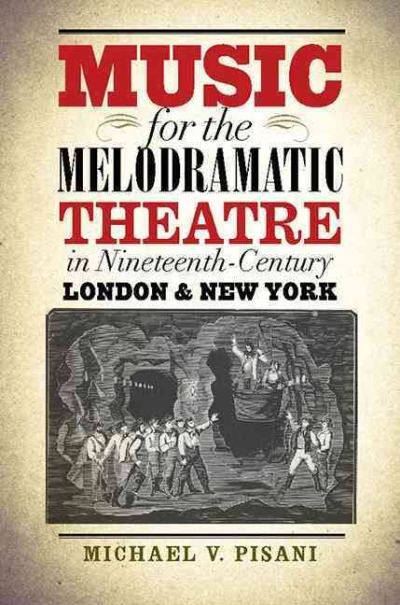
Perhaps the answer can be found via Michael Pisani’s new book (click link  for purchase information): Music for the Melodramatic Theatre in Nineteenth Century London & New York.

Pisani takes great pains to examine specimens of music used in the melodramatic theatre, assembling many samples alongside portions of the plays. I believe it’s potentially very important to scholars of the popular theatre in the 18th and 19th centuries.  But this is almost as important to film music scholars looking for antecedents for the practices of silent film, the immediate successor to melodrama in the first quarter of the 20th century.  Pisani’s book is consigned to the Music Library by its Library of Congress call number, and so likely would fly under the radar to anyone beyond music. Inter-disciplinary research poses a special challenge, requiring the reader to venture outside their immediate subject. If I want to understand Carmen music isn’t enough.  I need to read Merimée’s novella even if that’s not found in a music library. While Pisani’s book is legitimately classified as “music” I would hope that theatre and film scholars will make the effort to hunt it down.

After reading Pisani’s book, which contains many interesting specimens of music from melodrama, explained in context, I strongly believe in the connection between melodrama and film. I couldn’t help noticing the simplest resemblance to habits I observed in two places:

  • Silent film music, where on rare occasions original scores were composed, but more often the medium employed existing music re-purposed and/or arranged by the performer(s)
  • Church music, where one again sees that combination of existing music and the occasional original composition

I think it’s fair to say that this was the normal practice –to combine original and re-purposed music—in the popular melodramatic theatre, which is why the cues in silent film are so similar to what was seen in the previous century, as reported in Pisani’s book.

I was watching Strike Up the Band, the Judy Garland – Mickey Rooney—Paul Whiteman film from 1940. Near the end there’s a fascinating sequence that might resemble melodrama, the presentation of a show called “Nell of New Rochelle”. Did someone recall something from a few decades before (the way we might recall the 1950s)? A girl is tied to the railway tracks. There’s a villain and a hero, and at the end the good guy defeats the bad guy.  We may giggle at the way it is presented in the film, at how simple the form seems, a popular entertainment that is not taken seriously.

But I have to think its influence is underestimated.

  • At one point (p53) Pisani writes about tremolo used to maintain a mood (or what he calls a “melos”) for a few seconds.  This would enable the musicians to suspend the movement forward in the score, to wait until the right moment to move forward, thereby synchronizing with the action.  This effect survives in film, but in fact was one of the fascinating innovations we see in some of Wagner’s music-dramas, a simplification of the orchestral texture. Did Wagner first encounter this practical idea in melodrama? While there is no smoking gun, I’m tempted to think so.
  • We read about the “hurry”, a kind of fast music for chases & action onstage. Rossini is in my head lately, having seen Maometto II twice in the past week. Pisani describes (p55) the use of the hurry in the late 1700s, or in other words well before Rossini. Did Rossini emulate something he encountered in melodrama, perhaps improving it and perfecting it? I wonder if in this and perhaps other cases, that the composer of high art was credited with inventing something that was appropriated from the popular theatre, where the original composer received little or no credit.
  • Underlying the entire discussion is the way taste shifts from one era to the next. Melodrama was despised by those with more refined tastes, as certain forms today are held in contempt. Effects that might move a crowd in one century would become over-used and exhausted. For example we read that the effect known in the 20th century as “mickey-mousing” is considered a low trick by the composer, yet I read of its use in the 19th century, suggesting that at one time it was the height of good taste. Indeed, if we recall moments in opera –for instance Alberich’s two magical transformations in Das Rheingold (first into a dragon, then into a frog) or the sprinkling of water by Rodolfo into Mimi’s face when she passes out in the first act of La boheme—it’s clear that music was sometimes expected to closely imitate the action.

Forgive me if my review is like a bad trailer, that gives away at least one part of the story for of course Pisani makes his own connections at the end of the book, showing the legacy of melodrama in film (both “silent” and long after).  But this is a very fertile subject for investigation.  I heartily recommend Pisani’s study to the student of film music, theatre music, and opera too.  I need to read it again.

Posted in Books & Literature, Dance, theatre & musicals, Music and musicology, Popular music & culture | 2 Comments

Braid or CASP at RBA

Art-song?  The concept didn’t immediately blow me away as a child growing up in the same house with an opera singer, craving the full-out commitment of opera.  The pleasures on record were sometimes esoteric and fleeting.  I think I grew up with a skepticism for art-song that’s analogous to the skepticism some have for abstract art.  Recalling those who snidely say “you only paint that way because you can’t paint the other way”, similarly, I wondered if art-song was for those whose voices weren’t big enough for opera.  Of course I lost that arrogance when I discovered the limitations of my own voice, developing a hearty respect for what one can do expressively without a big voice, let alone the limitations of those who do have big voices.  It’s especially ironic given that the COC performs in a hall where small voices can be heard, that nowadays recordings make it almost impossible to tell who is really in possession of a big voice: in other words, maybe aside from Wagner, size doesn’t matter.  And now at a time when opera’s viability is seriously being questioned (this NY Times piece is just the latest), there’s ample reason to consider this inexpensive alternative, as some companies have been doing.  Whether we’re speaking of opera companies using art-song as the basis for their theatricals – thinking for instance of Against the Grain’s inventive staging of Harawi with Die Schone Mullerin aka Death & Desire —or coming at it from the other direction, as CASP did in some of their programs this year in adding theatrical elements such as dance to a recital, it’s hard to ignore this low-cost approach to musical theatre text creation.  It’s as though CASP, the curators and champions of art song, get the last la-la-la-laugh.

And whither CASP? At this point as a natural end to the season, they had another noon-hour concert in the Richard Bradshaw Amphitheatre, not the first time they’ve enjoyed this venue, but for the first time in closing a season of recitals.

philcox-williford

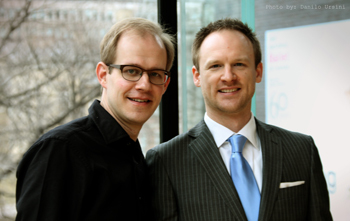
CASP Artistic Directors Steven Philcox and Lawrence Wiliford (photo by Danilo Ursini ursiniphotography.com)

Steven Philcox (piano), who is co-artistic director with Lance Wiliford (tenor), was one of several participants today:

  • Maeve Palmer, soprano & David Eliakis, piano, gave us Alice Ho’s 2007 Three Songs from the Tang Dynasty followed by John Beckwith’s 1947 Five Lyrics of the Tang Dynasty
  • Victoria Marshall, mezzo-soprano, and Mélisande Sinsoulier, piano performed Sylvia Rickard’s 1991 When You Hear Me Singing
  • Philcox and Ambur Braid repeated one of the season’s highlights, namely Erik Ross’s The Living Spectacle, heard in November of last year

Let me ask you a question I love posing to friends and students.  When you listen to opera (or see opera), is it the opera or the singer?  Are you there because of a star you’re hoping to hear and/or see, or is it the opera that drew you?  The question resurfaced in my head, watching today’s CASP concert, because of course the draw for me wasn’t the music but a particular artist, one of the young stars the COC can proudly show off as a graduate of their Ensemble, namely Ambur Braid, ergo the headline above.  No it’s not really Braid OR CASP, so much as Braid AND CASP, although I’m thinking of this in terms of why people are there.  I was there for both I suppose. And while I had my head into the notes to follow the text for the first two singers – looking at the words and marvelling at the ways the composers chose to set the texts—I took off my glasses, put down my notes and simply watched Braid sing.

One of the fascinating subtexts of art-song that I implied already, above, is that some of these songs are mere hors d’oeuvres, little snacks that barely get a voice warmed up, barely get you excited, before they’re over.  Not so with Ross’s settings of the Baudelaire poems translated into English by Roy Campbell, three full courses this time.  While there are some softer lyrical passages, a few times Braid soared above the treble clef.  I am reminded of another fundamental question that comes up from time to time, that I might avoid by simply speaking of two different approaches to Violetta, namely the serene ease of Joan Sutherland, vs the daring vocalism of a Maria Callas.  For some music we want it to seem easy, while for certain rep it’s an additional layer if the singer injects drama into the singing itself.  While Braid sings these songs comfortably, she didn’t take an easy path –for instance to enjoy the friendly acoustic—but went full out, not holding back as she ascended each and every time.  She held nothing back.  I think Philcox would agree with Braid, that the CASP commission to Ross was a great idea, that the curation and cultivation of art song rep needs compositions that push the envelope, challenging singers and pianists alike.

There was lots more to the concert of course.  I was fascinated by the two different composers coming at roughly similar text (if it’s fair to compare the Tang Dynasty poems set by Alice Ho and John Beckwith).  Whereas the English-Canadian employed a pentatonic palette verging on cliché while perhaps dodging outright cultural appropriation in his piano and vocal writing (perhaps on my mind after Adams’ Scheherazade 2 last night) , yet he was very economical, getting through five little poems very quickly, and everyone seemed to like these songs, especially the last one.  Ho chose three wonderful texts of such depth, I hope I can be forgiven if I think they were already music (to misquote Mallarmé), but there were beautiful moments nonetheless.  Maeve Palmer has a lovely sound and a confident manner that likely will serve her well.  I want to revisit the Rickard songs from aboriginal texts sung by Victoria Marshall, whose lovely mezzo voice was almost too rich for these texts.  No I am not saying a person with less voice is better suited, but rather that the lusciousness of the voice is almost a distraction sometimes, and surely not a bad thing.  She sounded beautiful, and I got completely lost in pure sensation a few times.

You can find out more about CASP on their their  website, while the remaining noon-hour RBA concert schedule can be found on the COC website.

Posted in Music and musicology, Opera, Reviews | Leave a comment

Ambitious TSO program

It wasn’t at all what I expected, this Toronto Symphony program of Beethoven, Brahms and Adams, to be taken on a Canadian tour this weekend (Ottawa Saturday and Montreal Sunday). Peter Oundjian did tell us that it’s unusual to program the Brahms 4th Symphony before the interval, with the big modern concerto after. That was a clear signal as to their sense of the true highlight of the concert.

If you get a chance to hear John Adams’ Scheherazade 2, especially live, I would encourage you to hear it. Here’s an excerpt from his program notes:

The impetus for the piece was an exhibition at the Institut du Monde Arabe in Paris detailing the history of the “Arabian Nights” and of Scheherazade and how this story has evolved over the centuries. The casual brutality toward women that lies at the base of many off these tales prodded me to think about the many images of women oppressed or abused or violated that we see today in the news on a daily basis.

The work was composed in 2014 specifically for Leila Josefowicz, who has collaborated with Adams before. As he says in the notes “I find Leila a perfect embodiment of that kind of empowered strength and energy that a modern Scheherazade would possess”. The work is subtitled “dramatic symphony for  violin and orchestra”.  Here’s a brief intro to the piece by the composer.

He mentions Romeo et Juliette by Berlioz, which is also a dramatic symphony, and that in his piece the violin is like the protagonist. Curiously he didn’t mention Harold in Italy, a work with several resemblances to Adams’ work, another composition where a single player –this time a viola rather than violin—is like a protagonist surrounded by the orchestra as though representing the milieu.

Like Harold –and also like Rimsky-Korsakov’s Scheherazade as well—it’s a four movement work:
1. Tale of the Wise Young Woman—Pursuit by the True Believers
2. A Long Desire (love scene)
3. Scheherazade and the Men with Beards
4. Escape, Flight, Sanctuary

And Adams is worthy to be discussed in comparison with those two (Berlioz and Rimsky-Korsakov): arguably the two greatest orchestrators in the history of the orchestral medium.

ja-portrait-1-lw

Composer John Adams

Yes, you need to hear this work, even if it’s sometimes terrifying. Where Rimsky’s composition is a kind of anthology, mediated by the violin soloist who would be Scheherzade the story-teller, both Berlioz’s Harold and Adams’ latter-day Scheherazade seem to be walking through a pulsating world in each movement, sometimes at odds with or even threatened by that world. But Adams gives us a phenomenal range of timbres. When the violin is playing there are often fewer players engaged, often cut back to the celesta, the cimbalom and vibes, a sensual contrast to some of the threatening sounds arrayed against her (although as a Hungarian I was intrigued by the personal associations of some of Adams’ sounds, a very friendly sort of exotica given that one sometimes hears the cimbalom in Magyar restaurants). In addition, though, the full orchestra showed me several new sounds, even while staying mostly in the tonal realm. Josefowicz is sometimes required to play fast passages of short groups of notes, sometimes longer phrases and occasionally venturing into more lyrical music-making. There’s no mistaking the amorous atmosphere in the second movement. Adams is an atmospheric storyteller to stand alongside his heroine, sometimes immersing the violin in devastating walls of sound that make you fear for the life of the protagonist.

Oundjian’s comments (only offered after the interval as we were about to begin the Adams rather than in the first half) explained a lot that had me mystified up to that point. The thematic links he drew –between the oppression underlying Adams’ Scheherazade 2, in the Egmont Overture, as well as the darker side of the Brahms were crystal clear in the music-making. As this is the first performance of this programme, I hope Oundjian and the TSO can find more balance, because right now the two German works opening the concert,  though played with great precision,  are somewhat two dimensional in their lack of emotional depth. Brahms 4th does end with a powerful dark movement –the movement that worked best for me—but there is sensuality throughout all four movements, a warmer side that wasn’t really allowed to bloom, inner voices that could have been given more space to come out. As the TSO relax and enjoy themselves on this tour I am certain they’ll hit their stride.

This wonderful program will be repeated at Roy Thomson Hall Thursday May 5th, then taken to the National Arts Centre in Ottawa Saturday May 7th, and Montreal’s Maison Symphonique May 8th.

Posted in Music and musicology, Reviews | Leave a comment

Maometto II, Conquerer

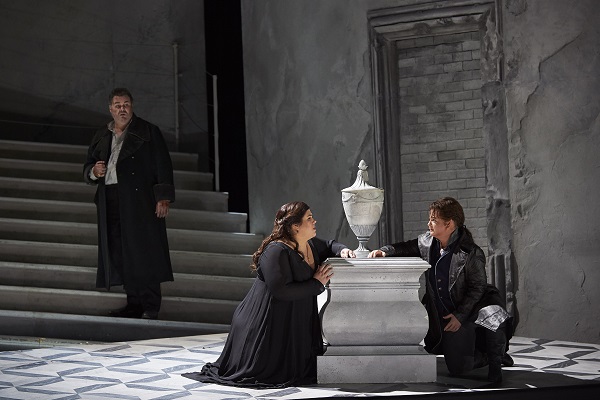
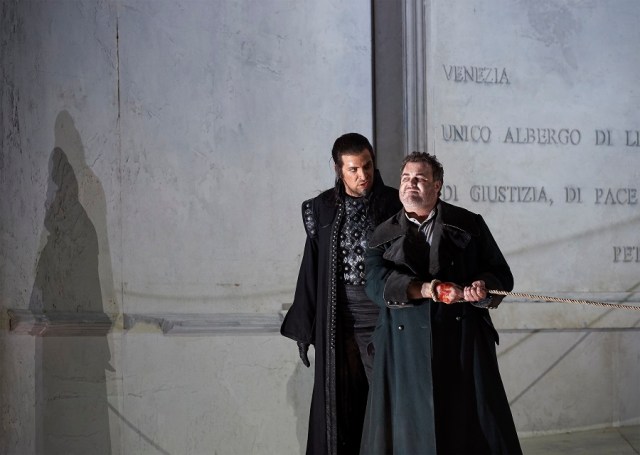
That was a fast three hours and twenty minutes. While I expected Maometto II, the Rossini opera presented by the Canadian Opera Company at the Four Seasons Centre, to be full of spectacular singing, I did not expect to be sucked into the story, at times spellbound.  This opera about invaders and invasion won me over completely.  The COC Production that premiered at the Santa Fe Opera in 2012 was directed by David Alden (who directed COC’s recent Lucia). Alden seems to understand how to stage a virtuoso vehicle, mostly staying out of the singers’ way.

The story –concerning the expanding Ottoman Empire’s battles with Venetian forces—takes place in the 15th century. Nobleman Paolo Erisso (tenor Bruce Sledge) who leads the Venetians would give his daughter Anna (soprano Leah Crocetto) to Calbo (mezzo-soprano Elizabeth Deshong in trousers ), except that she’s already in love with someone else. The suspense builds, with the impending attack by the Ottomans. And of course it turns out that the one she loves is Maometto II (Luca Pisaroni) who she met while in a disguise on a reconnaissance mission.

15-16-06-MC-D-1323

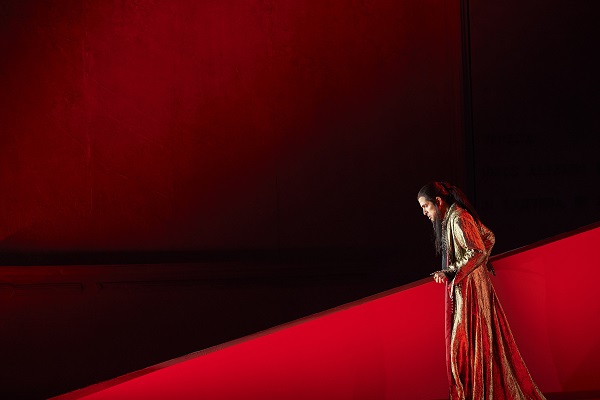
Luca Pisaroni as Maometto II in the COC production (photo: Michael Cooper)

The audience took awhile to warm to the style, at first somewhat hesitant about applauding, and indeed stunned into silence at times by the power of what we were seeing. And the usual casting expectations are a bit scrambled, as the tenor is the father not the hero, the rivals for the love of the soprano are a bass and a mezzo-soprano.  But we gradually cut loose in response to the big arias in the second act, once we’d decided to embrace the opera. All four principals had great moments, although I think DeShong had the loudest applause. Crocetto and DeShong both had several opportunities to shine in the second act, while Sledge’s best opportunities came earlier in the opera.

15-16-06-MC-D-1818

(l-r) Bruce Sledge as Paolo Erisso, Leah Crocetto as Anna and Elizabeth DeShong as Calbo in the COC’s production of Maometto II, 2016 (photo: Michael Cooper)

At Pisaroni’s first appearance –singing from far upstage—I was frankly astonished at how well his voice projected. Maometto’s music is often ornate & quick, requiring great precision to articulate, but Pisaroni’s pitch was bang on, the voice cutting through the orchestra.  This is a believable conqueror, with physical swagger and genuine presence.

15-16-06-MC-D-975

(l-r) Luca Pisaroni as Maometto II and Bruce Sledge as Paolo Erisso in the COC’s production of Maometto II, 2016. (photo: Michael Cooper)

Harry Bicket is a big reason why this was such a spectacular experience, raising the bar for the COC orchestra. I couldn’t help noticing – in contrast to what I’ve seen in the Carmen performances—how well Bicket followed the singers throughout without any slips. Bicket made Rossini sometimes sound like Beethoven, sometimes like Mozart, and always like Rossini. With Bicket you know your performance has integrity & authenticity.

With sets & costumes designed by Jon Morrell (who did costumes for COC’s Aida) there are some arresting visual images, including some genuinely scary moments to amplify the drama that’s in the score. But we’re not experiencing a story being told in realistic fashion. Even so I did not expect to be on the edge of my seat, fearful and troubled by what I was seeing.

I’m seeing the opera again later this week, eager to once again hear four excellent principals and their stunning music. Bel canto can take getting used to, a style so full of coloratura that the decoration takes over, more icing than cake, more froth than coffee. But one rarely hears this music sung so accurately, with such sensitivity & passion.

Maometto II continues at the Four Seasons Centre until May 14th.

Posted in Opera, Reviews | Leave a comment

Lucretia’s Rape: “Is it all”?

If you go see a show and it mystifies you, thank God for the internet to answer questions.

And that’s the last thing I’ll say in this review that sounds even a little bit reverent.

When I was a young boy I saw Benjamin Britten’s The Rape of Lucretia in a student production, one of the first operas I’d ever seen, leaving me baffled with its curious mixture of violation and piety. Fast-forward to 2016, the second time I’ve seen this opera, and again in a student production, this time from Metro Youth Opera at the Aki Studio. To say that the world has changed in the intervening decades is hardly earth-shaking. I feel much better about being mystified as a child as there’s still a whole lot in this opera to perplex a viewer, even if the world is perhaps catching up to Mr Britten. In the 1960s there was no internet to answer a twelve-year old’s questions, whereas I think I have a pretty good idea this time.

Let me be clear, though, this is a wonderful production of Britten’s opera, staged with conviction.

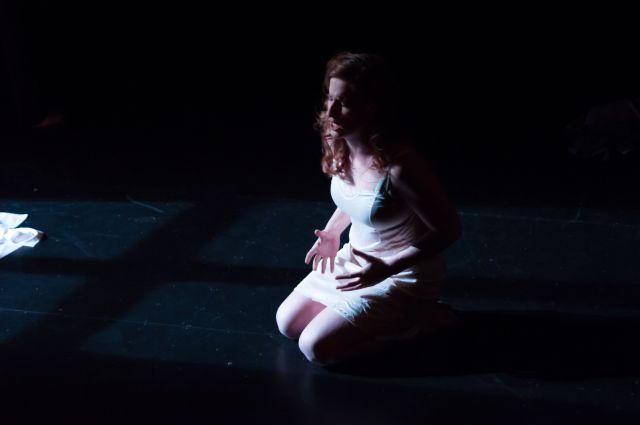
I suspect there would be no staging if not for Christina Campsall, offering one of the most remarkable portrayals I’ve seen in a long time, particularly considering that MY Opera have a mandate to offer performing opportunities to young singers. Campsall would not be out of place in any professional production, looking and sounding wonderful particularly after violation, her lowest notes eloquently evoking her profound suffering.

campsall

Christina Campsall as Lucretia. (Photo: William Ford Photography)

Anne-Marie MacIntosh as Lucia was a bright spot in the otherwise dark tale with flawless coloratura while Jonelle Sills as the Female Chorus asked the key question at the end of the opera, that I felt wasn’t really answered. But I don’t believe I can hold this against MY Opera, considering that this is likely a weakness of the opera as written.

While I think of myself as a believer, I felt like an agnostic watching the scenes of Britten’s opera everytime we ventured into the Christian gloss he’s added to the story. For example, in the Epilogue the Female and Male chorus have a kind of spiritual confrontation. The Female Chorus begins her questioning by asking:

Is it all? Is all this suffering and pain is this in vain? Does this old world grow old in sin alone? Can we attain nothing but wider oceans of our own tears?”

Sills was wonderful, hurling her question up at the lighting booth, where the stage manager might have been the God to which this world responded. One might have expected the lights to go out, so powerful was her questioning.

The Male Chorus responds (again this is an excerpt):

“It is not all. Though our nature’s still as frail and we still fall and that great crowd’s no less Along that road endless and uphill; for now He bears our sin and does not fall and He, carrying all turns round stoned with our doubt and then forgives us all.”

I can’t blame Daevyd Pepper –the Male Chorus in the MY Opera production—that his answer seemed feeble and inadequate, given that the world Britten lived in at the time of the opera’s composition in the 1940s wasn’t precisely tolerant or forgiving. Even now rapists are enabled by a society quick to question any claims by women, making it so painful for women that many attacks go unreported. I felt no consolation in this Christian gloss upon the story, a bland series of platitudes to push me back to the agnosticism of my teens, when I didn’t go to church. Was Britten sincere, or is this a coded passage from a homosexual who was unable to frankly say what he felt to a more unforgiving world back in the 1940s? His depiction of violation is so electrifying, his depiction of shame and degradation so heart-breaking, that the Christian parts seem astonishingly lame in comparison, as if the composer were trying to say “don’t believe any of this, the truth is in the brutality of man”.  And as a society we have yet to answer.

Music-director Natasha Fransblow led a very tight performance, including percussion effects with the piano above and beyond her excellent pianism. Stage Director Anna Theodosakis made a very believable tableau of violation in the secular world of a story transposed to a more recent time via costuming designed by Lisa Magill; but I suspect Theodosakis shares my ambivalence towards the opera’s preaching, her own sermon placing the focus upon consent and rape rather than faith and redemption.

The final performance of The Rape of Lucretia will be on Sunday May 1st at 2:30 pm in the Aki Studio in Daniels Spectrum.

Posted in Opera, Reviews | 3 Comments