Tafelmusik record Beethoven’s Ninth

Tonight’s Koerner Hall concert was recorded, one of a series. But it seemed like a pair of concerts.

Before intermission we watched the Tafelmusik Chamber Choir, led by their founding director Ivars Taurins. This is a choir he built, piece by piece and work by work, so it seemed apt that we were watching them sing a cappella. Their performance was acutely perfect. Can I say that? We listened to three unaccompanied pieces, beginning with Abendlied, a very gentle work by Rheinberger, the world premiere of Jeffrey Ryan’s Valediction, and finally Brahms’s Warum ist das Licht gegeben. Ryan’s work, based on a poem by Norma West Linder, closes with the line “World without, whirled without end”, (which by the way does not have a period, though it does end) the voices conjuring up a genuine sense of whirling motion without the aid of any accompaniment. And then we heard a virtuoso display in the Brahms, especially by the women, unified whether soft or loud, but absolutely perfect.

handel_celebration_v3

Tafelmusik Chamber Choir, directed by Ivars Taurins (left foreground). Photo by Cylla von Tiedemann


After intermission? It seemed to be a different sort of concert altogether (and why not after all), as we heard Beethoven’s Ninth Symphony, played by Tafelmusik Baroque Orchestra led by Bruno Weil, employing that same Chamber Choir for the fourth movement.

Weil is definitely looking older, indeed he moves at times as though he’s in pain, which is hard to watch after so many wonderful years leading the orchestra. But no matter what he looked like the orchestra responded. In general his tempi are quicker than what you’d expect if you listen to a modern orchestra.  The fast movements are irresistible, the climaxes bowl you over.

I can’t help putting that in context with last night. Tonight we heard a work that has long ago entered public consciousness, that turns up in films, TV commercials and even our church service (there’s a hymn called “joyful joyful we adore you”(or thee) based on the same melody as the Ode to Joy), tunes I know so well I could practically sing the whole thing.

I’m not alone.  The guy in front of me was nodding his head in a kind of frenzied ecstasy, depending on what sort of music was playing (for the scherzo his head moved fast, as it did in the last movement while in the third movement he moved his head more slowly). Last night hearing something I’d never heard before (Christos Hatzis’s score for the ballet Going Home Star) I had no real expectation.  One has no way to anticipate what would come next if you’ve never heard the piece before, whereas tonight we can’t help having expectations that verge on stipulations. In the last movement, I hope to hear a clear strong bass voice in the solo to begin, a fast tempo in the big tenor solo, that leads to a clear high note from the tenor, or later when the soprano gets her high note, I hope it’s gentle rather than loud (the way some singers scream it). And there are a whole series of things I hope to hear from the orchestra in each movement. And they delivered on some of my wishlist, while disappointing in other parts of that list.  The chorus were once again near-perfect in their execution.

Maybe I was extra-conscious of this because Tafelmusik are recording their performances this week. Everyone was encouraged to cough between movements but to keep quiet when the orchestra was playing. Maybe I was put into this mental frame of mind after listening to a first-half of the concert sung with absolute perfection.

Before I continue let me offer some context. Back in the 1980s I became serious about getting recordings by ensembles playing what’s often known as “original instruments”, which is to say, strings with catgut rather than metal, wooden rather than metal woodwinds, valveless horns, and so on. These instruments are much harder to play in tune, which might be why you normally encounter Beethoven played on modern instruments, 100% in tune and without any fluffs from any of the wind players. But there’s a trade-off. The sweetness of the sound, the gentle tone of a period band employing historically informed practices, the softer volume and slightly lower tuning all add up to something that has become the core of my listening. I believe we unconsciously suspend judgment in the presence of this sort of playing, as one mustn’t come with the same standards one brings to performances by those playing modern instruments with their perfect execution. I have at least one friend who adamantly refuses to listen to a historically informed band.

Tonight I experienced a disconnect, because the two halves of the concert do not seem to share the same basic principles. The first half with its choral perfection surely isn’t what would have been heard back in the day.  But wait, one of the pieces is from 2015, so why should that work sound like one from 1824? Of course there’s a natural disconnect. Perhaps i am over-thinking, but hearing such clarity in the first half did not work as a set-up for music I really love.  Even so it was a very enjoyable concert, clearly one enjoyed by the rapturous audience.  I’ll be interested to hear the recording they create from the performances made this week.

Tafelmusik orchestra & choir return to Koerner Hall Sunday Feb 7th for another performance of unaccompanied choral works followed by the Ninth Symphony of Beethoven, with the orchestra returning in late February to perform Mozart back at Trinity St Paul’s.
Posted in Music and musicology, Reviews | Tagged , , , | 4 Comments

Alexander Neef’s Pre-performance speech from February 4th

“Good evening ladies and gentlemen, I am Alexander Neef, the General Director of the Canadian Opera Company.

Don’t worry, all our performers are fine.

RESIZED_neef_Debus

COC Music Director Johannes Debus and COC General Director Alexander Neef. (Photo: bohuang.ca)

But I do want to take a moment to speak to you before we start tonight’s performance.

Over the last few months we have witnessed terrorist attacks all over the world, in Paris, but also in Beirut, Bamako, San Bernardino, Istanbul, Jakarta, Burkina Faso and Nigeria.

The common theme of these attacks seems to be a deliberate attempt to undermine the values that form the base of our western societies, most importantly freedom of speech and expression. The terrorists chose to attack places that belong to the entertainment sector, stadiums, concert halls, bars, restaurants and hotels.

At the same time our country Canada, has decided to welcome 25,000 refugees from Syria, one of the countries most affected by terrorism and civil war.

At the Canadian Opera Company, we feel it is important to not only reflect on the impact of the attacks, but also to honour our Canadian values of freedom, respect for cultural differences, and a commitment to social justice.

Tonight marks the beginning of an initiative that will provide access to COC dress rehearsals and performances to refugees and newcomers to Canada.

I would like to recognize our partners Lifeline Syria, the Institute of Canadian Citizenship (represented tonight by the Right Honourable Adrienne Clarkson and John Ralston Saul) and the Canada Council for the Arts (represented by its CEO Simon Brault).

I would also like to acknowledge two other special guests: Han Dong, MPP for Trinity-Spadina on behalf of the Minister of Tourism, Culture and Sport and Councillor Norm Kelly from the City of Toronto.

Mozart’s Marriage of Figaro is uniquely suited to this purpose. It is deeply influenced by the ideas of the Enlightenment. It is a piece about personal rights and the freedom of speech.

But it deals with those matters in the form of a comedy. As you will see, almost the entire second half of the opera is dedicated to a celebration, a double wedding and the party that follows.

Tonight, we want to invite you to celebrate with us the freedom we have to create and enjoy the arts and the privilege to live in a country like Canada.

I will leave you with a quote by the great American composer and conductor Leonard Bernstein: “This is our reply to violence: to make music more intensely, more beautifully, more devotedly than ever before.”

Before we begin the performance I would like to ask you to stand for the national anthem.”


Posted in Opera, Press Releases and Announcements | 1 Comment

RWB Going Home Star: the language of truth and reconciliation

I witnessed something extraordinary and beautiful. The Royal Winnipeg Ballet created a full-length work titled Going Home Star: Truth and Reconciliation, one of the most ambitious pieces of theatre I’ve ever seen, a ballet so remarkable that it could be understood to be part of the broader mandate of the Truth and Reconciliation Commission (or “TRC”) itself.

The TRC  website tells you that

The TRC is a component of the Indian Residential Schools Settlement Agreement.

Its mandate is to inform all Canadians about what happened in Indian Residential Schools (IRS). The Commission will document the truth of survivors, families, communities and anyone personally affected by the IRS experience… The TRC hopes to guide and inspire Aboriginal peoples and Canadians in a process of reconciliation and renewed relationships that are based on mutual understanding and respect.

We might understand TRC the same way as for example Black History Month or Holocaust Memorial Day, namely a “process of reconciliation and renewed relationships that are based on mutual understanding and respect”. Art that furthers that process, both as a guide to the Aboriginal peoples and for other Canadians surely works to promote the mission of the TRC.

RWB Company Dancers in Going Home Star - Truth and Reconciliation - photo by Samanta Katz

Royal Winnipeg Ballet Company Dancers (kneeling foreground, l-r: Liang Xing, Sophia Lee; standing l-r: Yosuke Mino, Dmitri Dovgoselets, Alanna McAdie)  in Going Home Star – Truth and Reconciliation (photo by Samanta Katz)

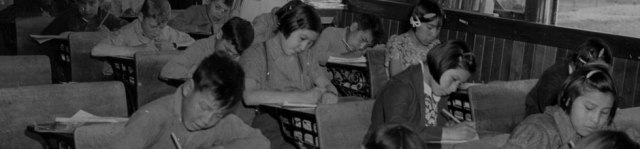
Royal Winnipeg Ballet Artistic Director André Lewis commissioned the work, as he explained, after being approached by Elder Mary Richard (Ah Kha Ko cheesh), to whom the work is dedicated. This is a ballet that is part of a broad consultation, a multi-cultural work that bridges the gaps between cultures. Ballet is an art-form of our dominant European culture, and so we experience this work at the intersection of peoples, languages and art-forms. We began with a drum chant that seemed to consecrate the space, and also heard from an elder who spoke a prayer in one of the native tongues. While the main characters are both European and Aboriginal, the conversation is still mostly on the turf of the Europeans, being a ballet. This work speaks eloquently to people like me, who may have a vague idea of the Residential Schools, but until now did not have a concrete mental image of these events. This is like Schindler’s List or Amistad in telling a story of a race’s oppression.

But it’s not a film, it’s a ballet, and I believe that choice of medium was a wise one. I recall a conversation with Elliot Hayes in the 1980s that still informs my thinking decades later. At the time I was cautioned that my operatic project contained “big ideas”, spoken in a tone to suggest that I’d infested my text with something bad, because of course such things are unwieldy, powerful and almost impossible to control. But I think this is a fork in the road that might be key to deciding the ideal medium.  Why bother with music if your words already give you what you want?  If you want something factual and concrete you make a documentary or a play in a realist / naturalist dramaturgy. If you’re dealing with universals, however, you get specific at your peril. Opera and dance are more amenable to symbolic matters, rather than finely honed topics. Ideas don’t get any bigger than this –the matter for the TRC—and therefore this story (as created by ​Joseph Boyden) was ideal for ballet. You get rid of most of the words –which have the unfortunate tendency to pin down the meaning in specifics and superfluities—and stick to a few key archetypes, namely the characters standing in for humanity. The music furnishes a template for us to react to the story, a plot designed to take us on a journey.

And so the conversations that are prelude to Going Home Star—that is, the collaborative discussions that lead to the creation of the ballet—are a wonderful miscrocosm of the TRC itself. Finding a common language, for example in movement vocabularies, in story-lines, and in music and sound, are themselves journeys very much like the TRC itself, a negotiation between European and Aboriginal, old and new, concrete and abstract.
I was particularly impressed by the work of composer Christos Hatzis in creating the score, a massive composition that energizes the dance. Sometimes we’re listening to pattern music that’s rhythmic, even jazzy, at other times, assembled from samples of noise. Sometimes we hear replicated music.

One passage resembles a wacky version of Opera Atelier’s baroque ballet, as we hear Hatzis parody the music of Jean-Baptiste Lully, the court composer of Louis XIV, as a group of dancers in ornate clothes with miniature naval vessels as hats, mince around, then begin to scratch as we’re told that they needed aboriginal help coping with black flies. And in short order the metaphor is re-used, as we hear that the clergymen have become like ticks infesting the aboriginals.

In another passage Hatzis samples the best-known theme from Swan Lake, the falling third of that phrase repeated, and gradually dropping in pitch a bit like the Doppler effect of an ambulance siren as it passes. The score is full of such moments, as small samples of train-sounds, human breathing or even something resembling a snore gets inserted into a musical phrase. The intersection of styles of music and movement was aggressively inter-cultural, as though people of different backgrounds were meeting face to face, while trying to reconcile their differences: those very same differences that are the basis of the TRC itself.

In one scene – a flashback to life in the Residential Schools—we see two young people with a clergyman. As we’re in the realm of dance, he might not move like a real clergyman, because he’s so fluid in his movements that he might be a ninja, practically flying around the stage. But I am reminded of an operatic equivalent, namely the scariest person in Nixon in China: the elaborate coloratura of Madame Mao. Just as her vocal fireworks are terrifyingly agile, so too with our ninja-clergyman. For awhile, the two kids are enjoying their lives –as youth will—even though the clergyman regularly peers in through a hole in the wall that is comical with scary overtones. When he eventually catches them in the act of smoking, it leads to a virtuoso flogging and abuse.

8

A photo from the Truth and Reconciliation Commission website

There’s so much more to it, as I am barely scraping the surface. Going Home Star is as utopian as the TRC itself, pointing to a redemptive outcome. The work is cathartic, including a moment when one of the residential schools is shown burning. The release of tension is as much in the music as the action, but also more simply an enactment of historical oppression that is then answered, pointing to liberation. This a work that needs to be seen again, that should be undertaken by other ballet companies, with a score that deserves to be played and/or recorded. I recognize that this may not be the way things work, given that the piece is so solidly identified with RWB. But other companies should take on this wonderfully Canadian – aboriginal work.

Somewhere in the program I read what the title means: that the North Star leads the way home, although i don’t think there’s any way to communicate that in a ballet. The synopsis in the program is useful reading before the show to enable one to understand the specifics of the story, even though –as with most ballets– one doesn’t need to know the specifics to follow along, to be swept away.

Going Home Star will be presented again Saturday night at the Sony Centre, as part of a national tour.

Posted in Dance, theatre & musicals, Music and musicology, Politics | Tagged , , | 4 Comments

COC Figaro: memories of Don JianGhomeshi

The media have brutalized us the past few weeks. It’s not enough to be watching Dumb and Dumber, aka the GOP’s epic displays of bigotry. And if they aren’t reporting on the cop who emptied his gun into a deranged addict, or the truck sale gone wrong, we’re hearing about a series of bad dates with a former CBC host.

Does no mean no?

The nature of consent in a first date has been on my mind, listening to these accounts of women who are now coming forward with complaints, after being silent for awhile. Such were my thoughts as I watched the opening tonight of the Canadian Opera Company’s new Marriage of Figaro, a production containing more sexuality & violence than I expected.

While some productions of Figaro are light romps, and others such as Jean-Pierre Ponnelle’s production for the Met emphasized the class war underlying the power struggle between the Count and his servant Figaro, Claus Guth’s production of Mozart’s comedy –brought to the COC in 2016 after a sensational reception in Europe –is more than anything a study in the intersection between sexuality & violence. In the second number we usually hear Figaro eagerly speak of how convenient it is to have a room right beside his master, where the Count can ring for his servant, and Susanna replies, admonishing Figaro, that in fact this gives the Count the ability to send Figaro far away so he can have his way with her. Usually this is a theoretical discussion, not something including a show and tell. In this production we see the Count briefly drag Susanna into a room right in the middle of that number, then releasing her just in time for her to explain why it might not be quite so wonderful to have a room beside the Count & Countess. We are not dealing with hypotheticals but seeing them enacted, and this happens again and again in this show, as Cherubino, Susanna, the Count, the Countess, Barbarina each in turn grab our attention by being libidinous.

Or should i say bawdy?

But it’s darkly powerful, very sexy at times, and with an edge such as no production of Figaro I’ve ever seen, amd as current as the headlines in today’s newspaper.

Last year the COC brought us Dmitri Tcherniakov’s Don Giovanni, a study in an obsolete personality, outgrown by modern humanity who no longer needs the Don Juan type. But nobody told the Count, who is struggling with the same neurosis, amplified by a noble’s sense of entitlement. Ian Henderson coined the cute phrase “Don JianGhomeshi” that seems apt for our love-hate relationship with the eternal libertine seducer.

Perhaps one reason I’m thinking of this as a sequel to the Tcherniakov is that we’re blessed with a few of the same brilliant principals once more. Russell Braun’s Don is back, in a more romantic form, as the Count who eventually does reconcile with his Countess. Jane Archibald is now Susanna (last year’s Donna Anna), while Sasha Djihanian (last year’s Zerlina) is now Barbarina.

smiling

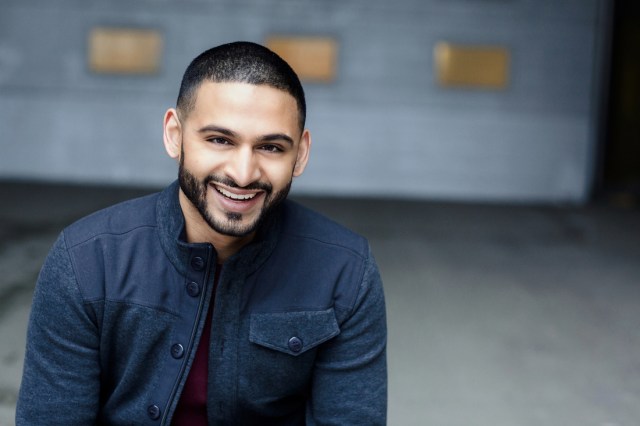
Pianist and Conductor Jordan de Souza (Brent Calis Photography)

One thing I looked for in the program that I sought in vain concerned the pianist for the recitatives. I believe that when Johannes Debus took his bow at the end, the person he raised first in the orchestra was Jordan de Souza (or that’s who it appeared to be at the piano….i could be wrong), the man who happens to be conducting two performances later in February, and coincidentally playing the piano for Tapestry Songbook VI this Friday & Saturday nights. He gave us some of the most stylishly embellished segues & cadences to these recitatives I’ve ever heard, a constant delight throughout.

In fact I understand (from an enquiry after the show) that de Souza was an emergency replacement for Michael Shannon, who was injured and unable to play, perhaps explaining the look of gratitude on Debus’ face as he acknowledged de Souza’s contribution.  Anyone seeing the next few performances will get to hear de Souza until Shannon’s good to go.

The funniest performers in the show had relatively small parts. Djihanian stole every scene in which she appeared with a voice that I heard as Susanna in Ottawa last year, certainly luxury casting for the COC. Robert Pomakov was delightfully deadpan, hysterically funny in scenes where one doesn’t usually expect to be laughing at Bartolo, such as the duet between Marcellina and Susanna, where he became an animated prop for the women to duel over. Doug MacNaughton made Antonio into a wonderful oddball of a gardener.

09-10-S-01-MC-D-002

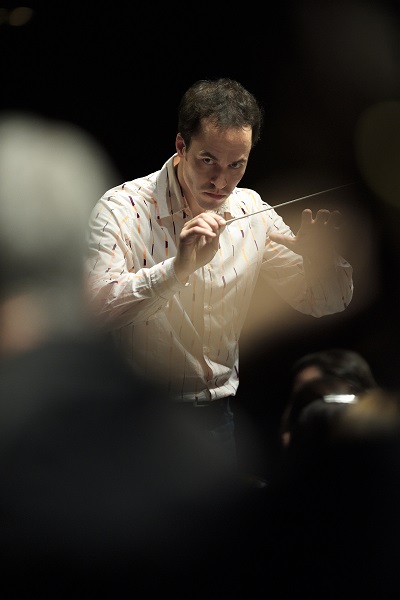
Johannes Debus (Photo – Michael Cooper)

While I don’t believe Guth’s concepts –including a winged cherub character and assorted dead birds—do any violence to the story, there were moments when he had the good sense to stay out of the way. And so Erin Wall’s portrayal of the Countess is untrammeled by bird or cherub, both her arias representing highlights. I liked Emily Fons’ vocal characterization of Cherubino as much as I was captivated by her effortless movement vocabulary suggesting an adolescent male. Josef Wagner was a solid Figaro.

Debus with the COC orchestra plus de Souza at the piano carried us along in another thoroughly prepared performance, irresistible because it’s true to Mozart. Those two –Debus & de Souza– are the real stars.

The COC’s new Marriage of Figaro continues at the Four Seasons Centre until February 27th.

Posted in Music and musicology, Opera, Popular music & culture | Leave a comment

TSO in 2016/17

If each season announcement by a major Toronto company is a demonstration of core values, the Toronto Symphony were in perhaps the most challenging position, having declared their intention to be the most innovative & inclusive orchestra in the world’s most inclusive city. But having set the bar so high they did not disappoint.

Before a note was played or a word uttered we were already in a new place, sitting onstage at Roy Thomson Hall facing out into the auditorium. How cool to be sitting there looking at Peter Oundjian at a podium, even if he wasn’t conducting us but simply announcing the season highlights.

This will be a very exciting year to be in Toronto, as everyone (the COC, and Tafelmusik, and Opera Atelier) commemorates our Sesquicentennial in different ways. In January 2017 CANADA MOSAIC pays tribute to some of the Canadian composers who made our country proud during the mid-to-late 20th century including works by Ridout, Mercure, Coulthard, and Weinzweig.  Even more exciting is the prospect of a series of commissions to be made in collaboration with other Canadian orchestras, but the details are still largely TBA.

The concert presentation of films in partnership with TIFF continues.  

There will be four offerings:

  • Raiders of the Lost Ark
  • Ratatouille (a delightful animated film),
  • The Fellowship of the Ring (first film in the Lord of the Rings Trilogy),
  • an anthology of excerpts highlighting the collaboration between composer Danny Elfman and Director Tim Burton.
wallis

Mezzo-soprano Wallis Giunta

The Decades Project continues, taking us to the roaring 20s in the fall of 2016 (Gershwin, Rachmaninoff, Kodaly, Mihaud, Walton, Ravel) including a pair of works showcasing talent in the orchestra namely Vaughan Williams’s “The Lark Ascending” with Jonathan Crow, violin and Walton’s Viola Concerto with Teng Li, viola. We’ll go on to our exploration off the 1930s to begin 2017, with a series of big projects, namely Belshazzar’s Feast to be led by Sir Andrew Davis, Carmina Burana, and a return by Joel Ivany –who directed the Mozart Requiem so recently—for a semi-staged Seven Deadly Sins with Wallis Giunta (appearing this Friday & Saturday with Tapestry by the way).

Soprano Renée Fleming returns to sing with the TSO on opening night.

The New Creations Festival features seven world premieres, curated by Owen Pallett and including throat-singer Tanya Tagaq and the famous Kronos Quartet.

We heard a great deal about the TSO’s ambitions to be a central part of this city, hoping to someday welcome students from all schools in all parts of Toronto, a beautiful goal that depends on funding.

For all the new & challenging programming, the most exciting thing I heard was that for the next Mozart Festival aka Mozart @261, we would be hearing the Toronto Symphony playing at Koerner Hall led once more by Bernard Labadie. This orchestra is better than people realize from what we hear at Roy Thomson Hall, as I discovered in Florida last month. They will sound heavenly in Koerner. Among the artists appearing with the orchestra in that festival will be young pianist Leonid Nediak in his TSO debut. Nediak came forward to play the Rachmaninoff prelude in G minor for us, a fabulous performance that moved us to applause and clearly left Oundjian so moved he was barely able to talk afterwards, just as he had been fully appreciative of earlier performances of his TSO colleagues. The chemistry is quite beautiful to watch between Melanson, Oundjian and the young players of the TSO, as though their biggest fans were their CEO & their music director.

If it’s contagious I’ve caught the bug… I’m a big fan too.

Here’s an example of Nediak’s amazing playing.  

Posted in Music and musicology, Press Releases and Announcements | Leave a comment

COC Siegfried: Love on the rocks in white PJs

Of the four operas in Richard Wagner’s Ring Cycle the closest thing to a comedy is Siegfried. Yes we do have a couple of deaths and a couple of would-be rulers of the world thwarted but it’s got a happy ending, literally love on the rocks as Siegfried and Brunnhilde are about to get it on, considering that their last words are “lachender Tod”, or “laughing death”, surely a clumsy euphemism for orgasm.

I am torn. I admire the work done in this production, loving almost every performance and certainly appreciating the contribution of every single person up there, so let’s set aside my concerns until after I’ve properly appreciated what’s right about it.

I was fortunate to be sitting off to the side near the front, which meant I could spend a great deal of the show basking in the pleasure of Johannes Debus’ conducting. The COC orchestra was a force of nature, particularly in the big set-pieces where Wagner turns over the story telling to his brass, string, percussion, woodwinds, and conductor. Debus was very sensitive to his singers, some of whom had much more to offer than others. Anyone coming from out of town to hear the big stars might be confused, that they were hearing a performance as good as what you might hear at one of the world’s major opera houses even though they’re in Toronto.  But the amazing opera house changes everything, helping singers who would be inaudible singing the same role in a bigger house.

Three performances stood out for me tonight in a cast with no weak spots.  Stefan Vinke (Siegfried) sings this role as no one I have ever heard, from his first appearance, singing a high C that is usually omitted. Wow! Vinke sang, rather than barking or shouting (as some do because of the difficulty of the role), his lyrical line getting more beautiful the longer he was singing. Amazingly he was in a better groove in Act III than in Act I, in what is surely the most taxing role in all of opera. I begin to understand the people I see coming back to see it again and again. Vinke is the main treat of this production, singing some of the most difficult lines more clearly than I’ve ever heard them. If that weren’t enough –singing the role better than I’ve ever heard it—he is an attractive presence, and a wonderful actor. Whether in the many comic moments –parodying his guardian, sassing the dragon, trying to play a hand-made reed –badly– the few moments of genuine pathos such as the revelations about his past, or the times we want to see something heroic, he is the most believable, musical, heroic Siegfried I’ve ever seen.

Alongside Vinke we get to see the Mime of Wolfgang Ablinger-Sperrhacke. When I recall the first time I saw this production (directed by François Girard, designed by Michael Levine) more than a decade ago in the old theatre, I can’t forget how frustrating it was, that for several minutes I couldn’t distinguish one character from the other, that Mime (supposedly a hunchback dwarf) and Siegfried (supposedly a great hero), both in their white pajamas were hard to distinguish from one another, because they were roughly the same height and sounded alike. This time the contrast is spectacular, both in the physical presentation and the voices. WA-S is one of the best actors I’ve ever seen at the COC, in a vocal interpretation putting me in mind of Gerhard Stolze (on the Solti recording), playing up all the opportunities Wagner puts into the score for vocal comedy. At times I didn’t know where to look, because Vinke and WA-S were both so interesting to watch.

resized Siegfried-1211

1211 – (left to right) Jacqueline Woodley as the Forest Bird (background) with Stefan Vinke as Siegfried and Wolfgang Ablinger-Sperrhacke as Mime Director François Girard, Set and Costume Designer Michael Levine, (Photo: Michael Cooper)

Fortunately I am going to see it again.

The third extraordinary performance is the big name draw of the production, namely Christine Goerke. Her awakening was electric, both in the marvelous hand gestures, the vocal commitment and the magic between the two left onstage. I did not expect the last scene to be the best scene of the whole opera. There were other great moments though.

Jacqueline Woodley’s Forest Bird was wonderfully accurate, and very musical, while Meredith Arwady’s Erda was extremely powerful, especially some amazing low notes.

I first saw (and reviewed) this production back in 2005 when Girard & Levine first unveiled it —and so I am inclined to believe that maybe the problem is that the production doesn’t work as well in the Four Seasons Centre (that magical theatre I was speaking of earlier). I don’t think it’s fair to hold that against the director or designer.  Four Seasons Centre puts everyone under a bit of a microscope, giving us stunning close-ups. It helps highlight performances, seeing the strengths and weaknesses of singers & their acting, and the concepts in the production. Where Girard’s idea that seemed to situate everything in the mind of the young Siegfried seemed fresh and powerful in the big theatre, where everything was far away, hard to see, and impossible to hear, in Four Seasons Centre? Up close it doesn’t quite work so well, the bodies in the mental-tree seen from afar become a bit disturbing in closeup, if not creepy after awhile.

In the program note Girard speaks of how abstract Siegfried is, even though he conveniently skips or ignores the most concrete elements, such as the forging of a sword (magically handed to the hero, rather than created in steps, steps that Girard skips), or whittling a reed to make a flute (this time Siegfried finds his flute hanging in a tree).  Even so, I will mention a couple of directorial choices that bother me. One of my favourite parts of the entire Ring is the opening of Act III, Wotan’s last scene of the cycle as he confronts Erda, seeking a way to avoid the unavoidable. It’s music of despair with backbone. So it’s odd to open the act with the Forest Bird leading Siegfried (yes it’s a beautiful effect, but i missed it at the end of Act II, not inserted to begin Act III) while the music screams a heroic “no way out what do I do now” loudly for 5 minutes, and then to let your Wanderer shamble onstage like an afterthought.  Argh i know i sound like i’m getting old, as I was hungry for the post-modern stuff a decade ago.  Post-modernism means never having to say you’re sorry (and making a joke a decade ago gives me permission to repeat myself).

resized_Siegfried-4492

Stefan Vinke as Siegfried and Christine Goerke as Brünnhilde (Photo: Michael Cooper)

And of course the Wanderer is in this white outfit, just like Erda and everyone else onstage, except for Brunnhilde and Alberich. I get the concept, that there’s all this stuff in the hero’s head.  Alberich has a grey jacket on, because he too is from the outside. Brunnhilde is in a sexy costume, which makes sense. I would think Erda & Wotan should also escape the white PJs, but post-modern also includes the right to change sub-text whenever it suits you.

And let me add another white PJs footnote while I’m on the topic. Brunnhilde wakes up, and looks for the one who has brought her back to life, woken her up with a kiss.
I get that the magic fire is done with all these people in white pajamas. It was better in the O’keefe and stunningly beautiful at that moment when Wanderer steps aside and can’t stop Siegfried any longer. But when Siegfried has crossed through the curtain of fire, why keep these people lingering there like spectators? And so, when Brunnhilde says “Wer ist der Held, der mich erweckt’?” (OR Who woke me up?) she wants to know, not because the stage is this confused mess. Why, François, do you leave 15 white-clad extras onstage, and have Siegfried drift upstage into this mess. And then when she asks her question she might well say (in German) “which one of you people was the one who kissed me awake”?

I mean François, why deconstruct the most romantic moment in the whole opera?  Get them off the stage. Brunnhilde and Siegfried are supposed to be alone.

I should have known that the reason Debus said that the opera points to the last scene was because in this production it’s so good. No wait maybe it’s because there’s too much conceptual clutter everywhere else, too many moments where Girard’s ideas –some good, some not so good—just plain get in the way of the opera. There are moments where the production is clever. I enjoy the dragon. I love the bird.  I love the fire and those extras (including John Allemang, who told us his story recently in the Globe and Mail). But on balance I don’t find the production concept illuminating, not when at least part of the time it’s holding me back rather than adding something. It’s odd to me that this scene that usually seems like an extraneous afterthought—the last one– works best this time. Is it because it’s so good? or simply because it’s the only unobstructed scene,  where two people are allowed to sing without all the conceptual shenanigans?

Posted in Music and musicology, Opera, Reviews | Tagged , , , , , , | Leave a comment

Love, Death and the TSO

Tonight was my first look at the Toronto Symphony playing under Peter Oundjian since their Florida tour.

On the trip I saw an ensemble who were playing with commitment and passion. Oundjian’s leadership for the three performances I saw of Scheherazade reminded me a bit of a talk-show host. When I said this to Oundjian in our brief meeting in Daytona I think I saw him shudder as if he were in the presence of an idiot. But it’s not as dopey as it sounds. The Rimsky-Korsakov piece is full of an astonishing collection of solos, at least one per section. At times Oundjian was behaving like a story-teller which is apt for an episodic composition that is entirely about story-telling, or a curator showing us a beautiful series of pieces. It was perhaps paradoxical to experience a work where he seemed willing to let go of the controls, crossing his arms while the soloist functions a piacere, ad libitum as it were, and then when necessary, having them jump into formation for big precise passages, especially in the last movement.  I saw the pleasure of admiration, mentorship, even friendship, a proud leader watching his collaborators making music, not a boss or an authority figure.

Is this because of the time spent on vacation, playing the same piece over and over? Or maybe it has to do with a slight re-alignment of responsibilities. Since Jeff Melanson came on the scene and has gradually asserted his control in the past 6 months, I can’t help comparing this to what we saw at the Canadian Opera Company. Under Richard Bradshaw you had an artistic director / general director who was both the impresario and the fellow waving the baton, running so hard that maybe it’s no wonder that he tragically died of a heart attack; their current model is for two people –Alexander Neef and Johannes Debus—to do what used to be done by a single person.

And so while Oundjian still gives the occasional talk, I can’t help thinking that he is maybe better able to focus on his orchestra as conductor without extra duties (and excuse me if the analogy is inexact, given that Melanson had a predecessor, but not one who would step up to the microphone). Right now they seem to be in a groove. The TSO sounded good playing Mozart under Bernard Labadie the past two weeks, yet I think they sounded better tonight. We all love Mozart, but this –the large powerful works for big orchestras that we heard tonight—should be the TSO’s specialty, the works that no one else in town can or will undertake. I’ve never heard a sound from the TSO that seemed to match Roy Thomson Hall so perfectly, especially in the final portion of the concert.

Tonight’s program had wonderful overtones of profundity. All three romantic compositions — Sibelius’s Swan of Tuonela, Henri Dutilleux’s Correspondances and Berlioz’s Symphonie Fantastique— explore themes of love & death, the meaning of life, good and evil. I can’t help thinking of something R Murray Schafer said in his book My Life on Earth and Elsewhere as an indication of how far we’ve come. He spoke of the usual place of modern (especially Canadian) works on a typical concert program.

The contract read: ‘It is agreed that the work shall have a minimum duration of approximately seven(7) minutes and no longer than ten (10) minutes.’ That is, the work was to be what Canadian composers call a ‘piece de garage’, intended for performance while the patrons were parking their cars.

But tonight’s fodder for the late-arriving patrons coming from the garage wasn’t a modern piece but a classic by Sibelius! While the opening notes of his Swan of Tuonela were played over a fidgety crowd who seemed somewhat indifferent, I was surprised at how quickly they became attentive, especially once we got to Cary Ebli’s powerful English Horn solo.

The most modern edgy piece was placed second on the program and was eagerly received by a rapturous audience, because of course this was another collaboration between the TSO and soprano Barbara Hannigan. Henri Dutilleux’s understanding of Correspondances – the poem by Baudelaire that gives the work its title-  is a specialized kind of metaphysics, where we’re not in the safe realms of last week’s Mozart Requiem but instead in a place fraught with good and evil: just like life actually.

Nature is a temple where living pillars
Let escape sometimes confused words;
Man traverses it through forests of symbols
That observe him with familiar glances.

Like long echoes that intermingle from afar
In a dark and profound unity,
Vast like the night and like the light,
The perfumes, the colors and the sounds respond.

There are perfumes fresh like the skin of infants
Sweet like oboes, green like prairies,
—And others corrupted, rich and triumphant

That have the expanse of infinite things,
Like ambergris, musk, balsam and incense,
Which sing the ecstasies of the mind and senses.

Baudelaire’s poem is subtext for a series of texts sung by the soprano.

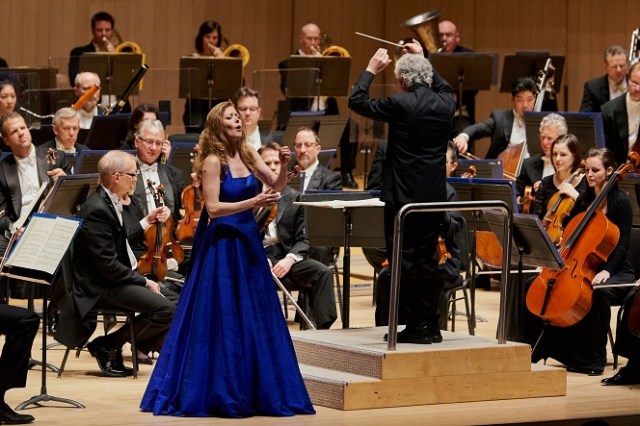
Barbara Hannigan, Peter Oundjian 2  (Malcolm Cook photo)

Soprano Barbara Hannigan, Conductor Peter Oundjian and the Toronto Symphony (photo: Malcolm Cook)

That “forest of symbols” is the forest of the symbolists, meanings that aren’t to be decoded but remain out of reach. We’re in a kind of purgatory, with Vincent van Gogh striving to express the inexpressible, with Solzhenitsyn grateful while lamenting the price his friends (Vishnevskaya especially) paid in showing solidarity. Dutilleux’s scoring sometimes pushes the soprano to sing very high, occasionally loudly, but more often we’re lower in her range, sometimes listening to something intimate & direct with the orchestra mediating. There’s a wonderful duet between an accordion and tuba. Whoever thought to leave the lights on –so that we could see the text in our programs – had a brilliant idea, as I saw lots of people doing as I did, following along with the words printed in the program. RTH was quite full, Hannigan’s reception thunderous, and I have to think it’s both her performance and the simple fact that we understood what was being sung.  Thank you Hannigan but also thanks TSO for leaving the lights on.

And yet I wonder if that’s why they were there, considering what followed, namely Berlioz’s Symphonie Fantastique. I used to own a cassette of the TSO playing this work, conducted by Seiji Ozawa from another century when I knew this as stoner music, given that Berlioz composed the first hallucinatory tunes long before anyone had heard of “Lucy in the Sky with Diamonds”. In those days the brass would fluff every now and then even while boldly doing their best. Fast forward (and not on the tape) to a time when the TSO doesn’t fluff. Saturday I’m wondering who will play what, considering that horn principal Neil Deland –who had the lovely solo in the intro to the first movement and lots of notes (with the whole section) in the second movement—is also undertaking Richard Strauss’s first horn concerto. But the whole section is rock solid, considering that we heard solos from three different horn-players tonight.

This was the most attentive Toronto Symphony audience I’ve experienced, quieter even than the Mozart Requiem a few days ago. There was only one tiny smattering of applause between movements, coming after the shattering climax of the fourth movement. I wonder if I could put in a word for the good old days –Berlioz’s time that is—when not only would there be applause between movements but even encores..? At the premiere in 1830 they encored the fourth movement. We’d been watching the trombones sitting silently, a hint of menace in the air from these people with legs spread to make room for their equipment (literally), and uh oh then they picked up their instruments. Trouble.

There’s no mistaking the chemistry though, an inevitable by-product of the trip. Oundjian is clearly in charge, the orchestra ebbing and flowing, sometimes picking up speed to end a movement as they did for the ball, the March to the Scaffold and again in the Dream of a Witches’ Sabbath. The grotesquerie was maximized, the orchestra filling Roy Thomson Hall with their big sound in the last two movements.

You can hear Oundjian lead the TSO in Symphonie Fantastique coupled with Neil Deland playing the Strauss Concerto #1 on Saturday night at Roy Thomson Hall.

Posted in Music and musicology, Reviews | Tagged , , , | Leave a comment

Questions for Jordan de Souza

Jordan de Souza, “the fast-rising young Canadian maestro with a busy international career” (Ottawa Citizen), is currently a Guest Conductor, Assistant Conductor, and Cover Conductor at the Canadian Opera Company, the National Ballet of Canada, and the Bregenz Festival (Austria), and is the newly appointed Resident Conductor for Tapestry Opera, Canada’s leading contemporary opera company.

There’s a great deal more in the bio you can find on his website.

In February Toronto audiences will encounter him

  • playing the piano in collaboration with Wallis Giunta for Tapestry Opera’s upcoming songbook VI Friday February 5th and 6th
  • as conductor with the Canadian Opera Company (Le nozze di Figaro) in performances February 23rd & 25th.

I had to ask him some questions.

1) Are you more like your father or your mother?

I feel fortunate to have inherited characteristics of both my parents and strive to be like them in many ways: I have my mother’s inward temperament (and hair) and aspire to her sense of purpose and compassion; I inherited my Dad’s cerebral matter (and love of sport) and follow the example of his love of family and work. I have both of them to thank for my love of music: being part of a large family, music was our lifeblood. (I’m the seventh of eight children, a.k.a. #LeadingTone or the best time signature of 7/8) We had four pianos in the house growing up and there were times when they were all going simultaneously!

smiling

Pianist and Conductor Jordan de Souza (Brent Calis Photography)

2)    What is the best thing about what you do?

Music gives us the chance to be. We learn to listen and appreciate diverse vantage points, to engage as a community in a creative act that reflects the sum of its parts but has a life of its own. Poverty of mind and spirit is not a new challenge but, with art as the oxygen of society, we have the chance to understand each other and ourselves better. When the world is dark, it keeps the light inside you bright.

3) Who do you like to listen to or watch?


My favourite people to listen to are my nieces and nephews: I’m always guaranteed to discover something original, quirky, and wonderful! This season I began with the National Ballet of Canada and I’ve fallen in love with the art of dance. I’ve learned so much about music (e.g. phrasing, gesture, etc.) from watching the dancers. 

I also watch my Toronto sports teams as often as I can: I’ve been a Raptors, Jays, and Leafs fan since childhood and enjoy following their progress on my ESPN app and catching the odd game now that I’m back in Toronto. (Though I also secretly root for the San Antonio Spurs…)

3581359

Jordan de Souza (Brent Calis Photography)

4) What ability or skill do you wish you had, that you don’t have?

I’d love to be able to dunk a basketball like Vince Carter, hit a homerun like Bautista, or dance around the pitch like Messi. Sport has always been a major passion: I admire the art of athletes as much as the athleticism of artists.

I heard a high C at the opera last week that easily warranted a bat-flip! 


5) When you’re just relaxing and not working what is your favourite thing to do?

Bass Robert Pomakov

Bass Robert Pomakov will be Dr Bartolo

I enjoy spending time with friends and family. One of the advantages of a life in music is that we meet so many people over the course of our varied projects; and we spend real, valuable moments with them. Seeing somebody every day for six weeks and going through the vulnerability of creating a theatre piece forges a certain connection. And then you don’t see them again: sometimes for three years, sometimes for ten. But when you do, it’s great to catch up and reminisce! I’m working on Figaro at the COC right now and there are two other alumni from St. Michael’s Choir School that I’ve known since I was a child: Robert Pomakov was in my older brother’s class and Michael Colvin has been familiar to me since childhood.

More about Jordan de Souza’s upcoming projects Tapestry Songbook and conducting Marriage of Figaro

1)     How was Songbook VI –the upcoming Tapestry recital with Wallis Giunta and yourself at the piano—assembled?

This is a superb endeavour by Tapestry: all the repertoire being presented was commissioned by Tapestry over the last 36 years. It’s a testament to their innovation, dedication, and longevity. The works are all at least 50% (if not 100%) Canadian: that is, the librettist and/or composer is Canadian (with half the pairing sometimes an import such as a Scot, Irishman, or American). The rep is incredibly varied and showcases a wide range of musical expression. Consider that while all of these works might not have been homeruns as a whole, they each have some really thoughtful and moving musico-dramatic scenes. It will be a pleasure to collaborate with so many talented young artists, as well as my dear friends Wally and Michael, in bringing them to life again. A veritable treasure trove of Canadian dramatic music!

bcb3904652e0063693f35a0d08f00fb1656f7847

2)     At the same time that you’re preparing the songbook – a recital by you on piano in collaboration with Wallis Giunta, you’re also preparing to conduct The Marriage of Figaro at the Canadian Opera Company later in the run.  Could you talk about stretching yourself, reconciling piano & conducting, modern singing with Mozart? 

Conductors have a universal disease that propels us to be eternally immersed in as much music as possible. For me, I seem to have avoided specialization by loving too much diverse repertoire. I love working on Bach and Mozart as much as Verdi and Puccini, Strauss (either) and Wagner, or contemporary repertoire. Each informs the other. Understanding rhetoric, Affektenlehre, and the lack of diacritical markings in baroque music shapes me as a musician and, while I wouldn’t play Verdi like Bach, I can’t look at f-minor as an innocuous tonal region or sing the interval of a rising seventh without feeling the reverb of the rhetorical idea of exclamatio. Anything that brings this music to life in our imagination (i.e. left side of the brain serving the right) is encouraged. Regarding the piano vs. conducting, I think it’s crucial for conductors to stay in touch with an instrument: we must actively make music in a chamber setting in order to stay fresh in enabling others from the podium. 

3)     If you were offered the chance is there any opera or piece of music you’d like to perform either with Tapestry or with anyone else in Toronto?

I’m not a big bucket list guy: I’m too engrossed in what I’m doing presently to think about what I’d rather be doing; perhaps it’s one existential crisis too many. But if you asked me right now to choose any opera to conduct next month… La forza del destino just popped into my head. 

4)     Is there a teacher or influence you’d care to name that you especially admire?

Too many to name! Suffice it to say that musicians are some of the most fortunate because we have a built-in system of mentorship. We would be searching in the dark (which is sometimes good) without the guidance of those who have walked the path before us. I’ve had the pleasure of studying with several wonderful mentors who understand that failure is necessary and acceptable, and that criticism can be a positive and creative agent. But above all, they’ve taught me that as an artist, you get to create the world. So why not use some imagination?

*******

Jordan de Souza will be collaborating with Wallis Giunta in Tapestry’s Songbook VI on Friday February 5th and 6th,  and conducting the Canadian Opera Company’s production of Marriage of Figaro February 23 & 25.


Posted in Interviews, Opera | Tagged , , , , | Leave a comment

Tafelmusik: Season Launch 16/17

Tis the season. At a time of year when it can be so cold that one prefers to dream of next year (even if it’s been unseasonably warm to begin 2016), the major classical music organizations make their big announcements.

Tafelmusik’s event “Season Launch 16/17 enacts everything in miniature that this orchestra stands for.  The event was for a small circle of key donors, including a lovely series of performances, led by Mira Glodeanu as director & violin soloist. At this point I’d like to quote the press release which said the following:

“In June 2014 Jeanne Lamon stepped down as Music Director, and is continuing as Tafelmusik’s Chief Artistic Advisor until her successor is appointed. Tafelmusik’s Music Director search committee, consisting of musicians, board members, administrative staff, and community representatives, has searched Canada and the world to identify possible candidates. Tafelmusik continues to work with candidates as guest directors to assess musical fit and chemistry, and to allow the orchestra to become better acquainted with them. Given the breadth of Tafelmusik’s repertoire, potential candidates must perform music from a wide range of eras with the orchestra. Tafelmusik will also continue to work with a number of guest directors who are not candidates, but who are a delight to welcome to the stage.”

Whether Glodeanu is one of the ongoing series of possible music directors or simply a guest, I cannot say, but it was a friendly stress-free performance of works by Venturini, Tartini, Vivaldi, J.S Bach and finally Rameau.

It was not a big glitzy event full of fanfare.  This was intimate and very thoughtful. While they are all great musicians, they are first and foremost the nerdiest and most unpretentious lovers of what they do. They wear their hearts on their sleeves. And so they thanked their donors –who were the quiet audience—but not in the cheer-leading fashion we see at the TSO or the COC. There was more of a level playing field, the great artists speaking as equals to their family of donors, the people who really get them at a deep level, and who have committed to making important things such as tours, training programs & experimental programming possible.

alisonmackay

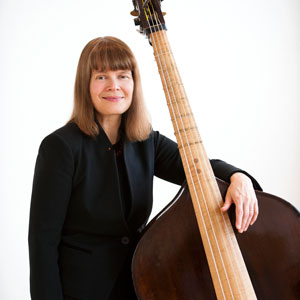
Alison Mackay, bassist & visionary programmer

I was enormously impressed when Alison Mackay took the stage to speak about her special contribution to next season. In past seasons she’s offered creative programs that make older music brand new, showing us original ways of understand the relationship between music and its context in the lives of people from the past, with concerts such as House of Dreams and The Galileo Project.

Her next project may be the most ambitious and profound yet, namely Visions & Voyages: Canada 1663 – 1763 . Just as the COC & TSO are making special programming to commemorate the 150th anniversary of Canadian confederation (COC with Louis Riel, TSO with a promise of special commissions to Canadian composers, details still TBA next week), so too for Tafelmusik, via Mackay, who is almost like their artistic conscience. Instead of zeroing in on 1867 – a year far beyond the usual purview of this orchestra—they’re looking instead to a key century, bringing us context via the music that Europeans would have listened to in those key years of our past. I’m eager to see this project take shape, which is genuinely ambitious and visionary.

The season and this orchestra remain firmly rooted in the baroque, from their season-opener with Handel’s “Water Music”, a program of arias by Karina Gauvin titled “The Baroque Diva”, a program of works by other members of the Bach family than old J.S., and their annual Messiahs in December.

“Close Encounters” take Tafelmusik in a new direction with a series of chamber concerts on Saturdays.

It’s a happy coincidence that the orchestra are simultaneously seeking a new artistic director –since Jeanne Lamon’s departure—and commemorating the 35th year of their chamber choir led by Ivars Taurins, which (if I don’t miss my guess) means he’ll conduct a bit more than usual this season. In addition to Messiah we’ll be getting “Let Us All Sing! Tafelmusik Chamber Choir at 35”, a celebratory program in November 2016; “A Bach Tapestry” including the Mass in G Minor in Feb 2017; and Mozart’s C minor mass in May 2017.

Tafelmusik will also be touring extensively, to Asia in November 2016, USA in Feb-March 2017, as well as their participation with Opera Atelier in another visit to Versailles, this time to offer Charpentier’s Medée.

But in the immediate future? Beethoven’s Ninth in a series of concerts next week that will be recorded, making them the first North American period instrument band to have recorded the complete set of these symphonies.

Posted in Music and musicology, Opera, Press Releases and Announcements | Tagged , , , , | 1 Comment

Opera Atelier’s 2016-2017 Season

Opera Atelier’s 2016-2017 Season, celebrating Canada’s Sesquicentennial, will include Purcell’s Dido and Aeneas in October and Charpentier’s Medea in April.

Dido and Aeneas will star Wallis Giunta and Christopher Enns in the title roles, with Laura Pudwell (Sorceress) and Meghan Lindsay (Belinda).

Medea features soprano Peggy Kriha Dye and Canadian tenor Colin Ainsworth in the lead roles of Medea and Jason. The cast also includes Mireille Asselin (Créuse), Meghan Lindsay (Nérine), Jesse Blumberg (Oronte), Karine White (Cléone), Stephen Hegedus, Christopher Enns and Kevin Skelton.

The tour of Medea to Versailles (May 19, 20 and 21, 2017) is Opera Atelier’s special project in honour of Canada’s sesquicentennial.

Dido and Aeneas and Medea will be directed by Marshall Pynkoski and choreographed by Jeannette Lajeunesse Zingg, with set design by Gerard Gauci and lighting design by Michelle Ramsay. Both productions will feature the full corps of Artists of Atelier Ballet, and Tafelmusik Baroque Orchestra under the baton of David Fallis.

Posted in Press Releases and Announcements | 2 Comments