Mussolini vs The Mermaid: what little girls –and boys—dream

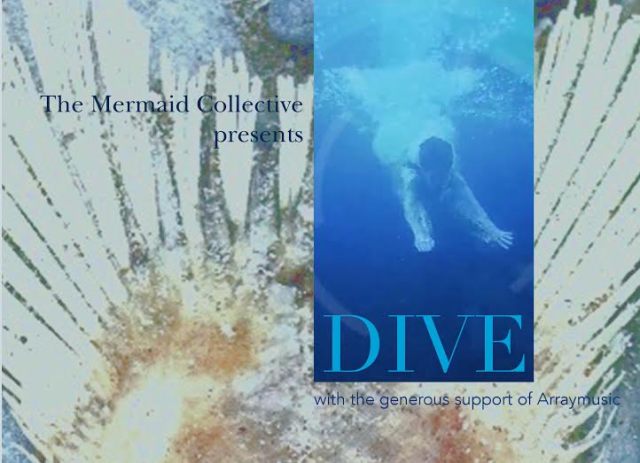
Thursday night is the preview performance of DIVE: Odes for Lighea, Nik Beeson’s new opera at The Array Space. DIVE is based on Giuseppe di Lampedusa’s short story The Professor and the Siren.

That’s “siren” as in mermaid. I am feeling a bit guilty that I get to see this mermaid show, when a young girl I know –daughter of a family member– is obsessed with mermaids. I suppose this is normal, that mermaids likely succeed ponies as objects of fascination for girls of her age.

And she is not alone of course.

I could point to many great composers —for instance Schubert, Wagner, Debussy, Ravel, to name the first few who come to mind—who wrote music for someone that this little girl would instantly recognize. The stories inspiring those composers come from a multitude of places.

I recall her delight when i showed her some of the Lepage Rheingold on video with me last year, as enraptured as if she were another Alberich, seduced by the cavorting Rhine-maidens.  The first 30 seconds of this clip gives you an idea.  

I got her Splash on DVD, a film that helped launch the careers of Daryl Hannah and Tom Hanks, with a generous assist from John Candy & Eugene Levy. The film certainly touched a nerve in its depiction of a romance under the sea.

And I have seen a few times in the media that women can train to be mermaids: which sounds really odd when I read that. But what they’re doing is putting on some sort of fake tail, and learning how to swim as though they were mermaids.  There was something on television news just a few days ago, showing this phenomenon.

Is this so different from the romantic image? For example “Ondine” appears in a poem by Aloysius Bertand and Gaugin’s painting inspired by the poem, images inviting us to dive in and drown in beauty. But the human is rejected furiously when she discovers what, we already have a mortal girlfriend? See of you notice the moment of rage when she turns away from humanity and swims off.
First Ravel 
Or there’s Debussy’s less famous Prelude on the same poem.  
The show I am seeing Thursday is perhaps a bit more serious, both in its sonorities and its philosophical ambitions –putting a mermaid (as an exemplar of the wild) and fascism (or extreme sorts of control) into a kind of dialectical opposition. Indeed when you think about it, they are perfect opposites, the difference between enforced order & natural order, or possibly order and entropy.

I say all this without having seen the show yet, but having listened to the CD a few times in my car. We no longer inhabit the sonic world of Ravel & Debussy & Wagner. Beeson & his muse Fides Krucker are 21st century visionaries.  I’m eager to hear their take on a very old myth. postcard

Posted in Music and musicology, Opera, Personal ruminations & essays, Politics | 1 Comment

10 Questions for Timothy Vernon

One of the biggest opera stories of the year will come to fruition this fall.  Timothy Vernon, already founder & Artistic Director with Pacific Opera Victoria, will take on the additional role as Artistic Director with Opera Lyra Ottawa, sometimes conducting as well.

There’s an old management problem that comes to mind when I think of Vernon. If you were to walk into an office needing something done and see two people, one working hard, the other reading a newspaper, to whom do you give your task?

While it’s counter-intuitive (because the one reading the newspaper is not actually working and should be available) the best choice is actually to turn to the busy person: because they can be trusted to get it done.

I wonder if the search committee at Opera Lyra Ottawa had heard this axiom when they sought a new artistic director, although Vernon’s appearances with the National Arts Centre Orchestra likely were a factor as well. Vernon—the driving force behind Pacific Opera Victoria (both as its founder and Artistic Director) at the other end of the country in British Columbia—becomes the first person to simultaneously be artistic director of two major Canadian opera companies.  He is Conductor Laureate of Orchestra London, and has been engaged as a guest conductor by Calgary Philharmonic, Vancouver Symphony, Edmonton Symphony, L’Orchestre symphonique de Montréal, the Winnipeg and Toronto symphonies, Ottawa’s Thirteen Strings, Symphony Nova Scotia, and the Manitoba Chamber Orchestra.

I dared to hope that such a busy man might answer my questions.  And just as in the story, the busy person got the job done. I asked him ten questions: five about himself, five more about leading two opera companies at opposite ends of the country.

1) Are you more like your father or your mother?

Self-knowledge, enjoined of old in the Delphic maxim, does imply knowledge of one’s parents; can I be sufficiently dispassionate in assessing what traits come from which side? My father was the kindest man I ever knew – I sense how far short of his standard I fall, but know there is no shame in trying to meet it. Devoted to family, but quietly self-dramatizing and with a censorious instinct where human foibles are concerned, my mother tended to inspire in people – as a cousin once told me – a desire to stand up when she entered the room. Louder in my own drama, I’ve tried to be less disapproving of behavior I don’t understand.

Both had a great sense of duty – my father to his students, my mother to the disadvantaged or alienated. It took me half a lifetime to achieve that commitment.
My father loved music deeply, instinctively, tending towards orchestral or instrumental, Mother, with her love of poetry and text, towards voice and chorus.

I’ve spent my life studying, performing it all. My father loved the outdoors and had an explorer’s instinct, always wanting to take the inviting, less obvious road or trail to a beckoning horizon; mother’s outdoors was the garden. I’ve come to love both. When I take time to drive idly down smaller unknown country roads even near my house just to look at the terrain, my Dad comes to mind and I know he’d approve. I wonder how Mother would like our borders or the many flower boxes around the place. Both these ways of relating to nature are strong in me.

Dad was patient, contemplative – me? Not so much. Mom liked to read in depth, to ‘get to the bottom’ – I do recognize this in myself. My father loved to make and build things, something as a child I found boring or even somehow embarrassing. Now it is among my chiefest delights – the four structures on our property are proof. I wish he had lived long enough to see my garden studio, and for me to see the look on his face at the thought that, with help, I designed and built it myself. My father was content with simplicity around him, whereas in me my mother’s modest tendency to embellish has burgeoned into baroqueishness.

Mother loved language and languages – she studied, read, and spoke German (ancestral tongue) and French. For my Dad, despite his ear for music, languages were unknown continents. I remember early travels in Europe; Dad would have wrestled to the ground a phrase in one language just in time to cross a border into yet another Sprachwelt, where he would produce his phrase proudly and be bewildered at the response – I was immature and insecure enough to find this excruciatingly embarrassing. Whatever gift I have for languages – and the love of all literatures – is undoubtedly maternal! If I could work it in, I’d learn Russian just to read Pushkin.

Physically more like my mother’s family, I regret not having my tall father’s ability to eat a lot without gaining weight. Since early youth, I’ve lived mostly in my head, dragging my body through life until it started to complain. My father would be amused, my mother slightly horrified, that I now go to Crossfit training three times a week.

2) What is the best thing about what you do?

Timothy Vernon

Short answer: Spending time every day with genius (I can hear my wife interject: ‘He means when he’s alone…’).

As Conductor: Qualifying to become what Bruno Walter definitively called “a necessary focus of attention among equals” requires devotion to, and almost total absorption in, the works of others. Erich Leinsdorf, unflashy, rigorous, and extremely discerning, called his memoirs, memorably, The Composer’s Advocate (I might have said Executor, but for a mighty interest in the living!) Deciphering text – trying to find the meaning in those symbols on the page, amassing background and historical information about a composer’s intention and expectation, all as a prelude to igniting, sparking a spontaneous bringing-to-life of the piece – the satisfaction is profound before a note is played. My only ambition on the podium is to share whatever insights I’ve gleaned, and my developing convictions about how the work should go. I’m not, or try not to be, a fear-of-God disciplinarian (even though orchestras have during my lifetime begun to drop that requirement from their assessments); rather, in Walter’s spirit, I hope to encourage, to negotiate, to set free the collective powers and talents of the group. Coming out of silence, as we do from the dark, music returns to silence just as the dark claims us once more. One can see performance as a metaphor for mortality.

As Artistic Director: Deciding repertoire is primary. If the company is to be led by the art – and I know of no truly successful artistic entity that isn’t – the choice of what is presented must reflect a spectrum of considerations but be made in the end by a single sensibility (otherwise, why have an AD?). Choices made by committee, or by the marketing department, no matter how successful at the box office, are doomed (stop reading now if ticket sales are your success-defining factor). Personal taste surely contributes something – in fact, can shape the profile of a company – but its exercise should be tempered by a desire to curate four centuries of opera, to provide a range of opportunities for the performers you love and admire, and to bring your audience to understand the deep human values in the art. Relevance? The humanity in a work is its relevance. Seeking, casting light on, the truths of human nature and human relationships – this is at the core of the whole theatrical endeavour, a mission in which opera can be supreme.

The human voice is central to music; I love ‘the singing animal’. Full of admiration for any and all music-making, I feel a special kind of awe for a human’s capacity to stand alone and produce sound from his or her body that speaks – sings – for all of us, and can say everything we know about ourselves, yet reveal something more. Assembling a cast that can meet if not transcend the demands of the score, and still form (more important in some works that others) a coherent ensemble of generous, mutually respectful – and even reliant – artists, is a skill, subject to availability and the unforeseen, that can never be free of risk. The challenge, though, is always bracing, and I cannot imagine relinquishing it.

There are directors who announce that the story they want to tell really has nothing to do with the opera they have been invited to direct– most of us will have seen at least one such production. Eurotrash has now a longish history. Here, we aren’t so tired of the repertoire that we need a dose of incoherence in its presentation, or the replacement of comprehensible motivation with sheer shock and schlock. Surely, telling the story of opera is a variable challenge. A great master is his own best dramaturge: Mozart will survive every effort to update or distort, because his characters, as is, are so from life that we meet them on the street. For me, the director’s test-piece is exposition – who can deliver a really dramatic, compelling Act I? If the setting or period of the opera is to be moved – and there are brilliant examples – my only requirement of the director is that he/she account for everything in the work, local references not excepted. Working with directors has been an almost unalloyed pleasure, no doubt because I get to choose them, and my general expectations are clear.

For a long time, I resisted thinking of myself as in any way a pedagogue – even as a tenured professor in a big university. I still feel I don’t know enough to call myself a teacher; on the other hand I have come to see years of work with young players and singers as the happiest – and often most immediately rewarding – times in my life, and have become gradually less inhibited about sharing (or even trying to articulate) what my experience may have taught me. Perhaps because my general stance is optimistic, I find the company of young and ambitious musicians of every stripe especially congenial; idealism and preparedness for discovery is a given – for whom is that not refreshing and inspiring? My only sadness: the rapid disappearance of any awareness – let alone reverence – for the great tradition of Western musical performance. Used to hearing almost immediately everyone’s latest performances of everything, students tend to be aware of the now, and often surprised to hear that something might be gleaned from, say, a fifty- or sixty-year-old recording. (NB I am not an advocate of learning from recordings!) Demonstrably, the technical achievements of young players worldwide is astonishing and unparalleled; is there a similar growth in understanding, in profound engagement with the substance of the art? I don’t hear it.

3) Who do you like to listen to or watch?

Favourite composers: Monteverdi, Handel, Bach, Mozart, Beethoven, Schubert, Brahms, Bruckner, Mahler, Strauss, Berg, Britten, Shostakovich, Schnittke (This is the A+ list; the A list is endless).

Other genres: Classical Operetta, Broadway, Jazz, acapella groups, Be-bop, Boogie-Woogie, Latin

Of course I admire virtuosity – Art Tatum makes me hold my breath, then laugh with glee – but in the end as a listener I want more than that. My very dear friend Joel Quarrington may be the greatest virtuoso in the history of the bass; the truly moving aspect of his playing is for me that unequalled espressivo tone; his masterful understanding of how a phrase is built and coloured. Every young singer should hear him and learn to phrase – even breathe – from his bow. Smart young things like to make – or parrot – remarks about Dietrich Fischer-Dieskau (whose name they are more and more at a loss to spell) becoming ‘mannered’ and his tone ‘drying out’. One of the very greatest musicians of the last century, he seldom drew attention to his flawless technique, but rather used it to convey a remarkable sensitivity to text, even in languages not his own. Unrivalled the expressive nuances he finds in the Wilfred Owen poems Britten set in the War Requiem. Whose Mozart should I hear? young singers often ask – almost inevitably I find myself writing down my response: Sena Jurinac. I listen to much chamber music, and am proud to realize that Canadian R. Murray Schafer has written the greatest series of String Quartets since Shostakovich. Recently, someone posed the desert island question: What single composer’s works would you choose? For the first time the answer rang clear and uncontested in my mind: Bach. I envy those who have been able to work through the great cycles of Cantatas. Given a chance, I would drop everything to do that.

4) What skill or ability do you wish you had, that you don’t have?

Managerial savvy, and a better understanding of and way with (my own) money. Also, an instinctive aptitude for tools, and the real mastery of an instrument.

5) When you are not working and just relaxing, what is your favourite thing to do?

I’m an inveterate reader, usually with three or four books on the go. I cannot sleep without a good read first, and often wake early to finish something. I love being outside, and regret the demise of my tractor-mower that enabled me to cut our fields myself. I am an enthusiastic but inattentive gardener. Fond of word games, I am beaten in Boggle about every three years by someone in the family. I love to cook and to entertain; sitting about talking with smarter friends over and after dinner is heaven.
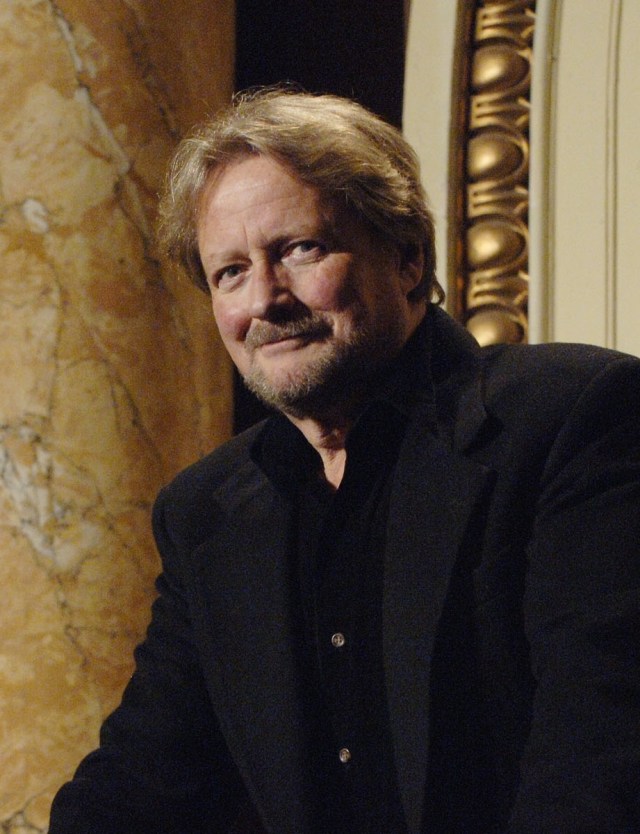
Timothy Vernon (photo: David Cooper)

Timothy Vernon (photo: David Cooper)

Five more about the upcoming year as artistic director with both Pacific Opera Victoria and Opera Lyra Ottawa.

1) Gulp, before getting too deep, for this coming season, what does it mean in terms of logistics alone, that you’re Artistic Director of both Pacific Opera Victoria and Opera Lyra Ottawa?  How many shows does each company offer, how many will you be conducting, and when will you next have a moment to take a breath?

With a history of artistic achievement well beyond what anyone could have foreseen, Pacific Opera Victoria at this point in its slow incremental development, has emerged as a healthy, well-run, professionalized organization that enjoys true allegiance and active support in the community. It would be too easy simply to relax and bask. I know about myself that I prefer building to maintaining (just ask anyone in my household), so the chance to apply what I may have learned to the challenges facing Opera Lyra proved irresistible. I will be able to conduct at least one production in Ottawa annually, and hope that in the beginning of my affiliation, more will be possible so that I can learn on the job how best to help steer the company. I shall be in Ottawa about a half-dozen times a year, and will attend board and staff meetings long-distance in between visits. If Pacific Opera is my baby, Opera Lyra has become what in German is called my Sorgenkind. I do believe that better days are ahead for OL, that there are many people ready to support a serious effort to bring performances of international standard to the stage of the NAC, and that a purposeful and energetic campaign to engage and maintain wide-spread investment and trust cannot fail.

2) What are the differences you see in the two companies, and should we expect to see similarities as time goes by?

I live, like POV, on what I refer to as ‘an island in the Pacific Ocean’. Not too long ago, one could hear on the CBC the following: “Canada coast to coast – from Vancouver to Halifax”. Victoria is still seen as an enclave of the retired, a place of kind climate and unserious elderfun. Events, though, have shown that its cultural roots go deeper and hold better than its bigger mainland neighbor; certainly there is per capita involvement in the arts in Victoria that is more than twice the national average.

The company began, in 1980, playing in an un-unionized hall with found sets and costumes. We built our own productions faute de mieux – none of the rentals would fit into our smaller theatre, but then, even when the company moved to the larger Royal Theatre, we persisted in designing and building. To date, from 105 productions, only three have been rentals. This is a distinguishing feature, certainly in our country, and has earned POV the allegiance of directors and designers who are invited to conceive the work afresh every time. With its great scene shop and splendid artisans, POV has become a leader in co-productions, supplying to sister companies all over North America. There is no doubt that Opera Lyra will become involved and, we hope, benefit from all this.

The Royal Theatre, by far no ideal producing venue, nonetheless more nearly resembles a European opera house than any in Canada, Toronto’s purpose-built space excepted. This allows a certain approach to casting – bigger halls need bigger voices, and everywhere here there are bigger halls than is healthy for singers. The NAC is no exception. Singers must know how to project into that space, and must be chosen with the demands of the hall itself in mind.

The Victoria Symphony, which has played for all 105 POV productions, has become a true opera orchestra, its performance vastly improved especially over the past decade. Opera Lyra has the great strength of its partnership with NACO – a very large part of the appeal of this position to the conductor in me. The shorthand version of my ambition for the company: to raise all the elements to the standards of NACO. That is how Ottawa becomes a player in the opera world.

3) Pacific Opera Victoria have produced a fair share of new and recent operas.  Could you speak for a moment about the importance you place on new works, especially from Canadians?

Canadian paintings hang in the great galleries of the world; our literature in two languages fills the shelves of libraries everywhere, but not a single Canadian opera has been taken up for new production by a company outside the country. Latterly, there has been a big push to develop a Canadian repertoire; POV participated with its commission ‘Mary’s Wedding ‘ a telling and touching setting of Stephen Massicotte’s now famous play by Andrew MacDonald. I believe it is important to foster interest among composers and potential librettists, and hope that Opera Lyra may make some strides in this direction.

It is not uncommon to note that opera companies will program up to and including Turandot and then jump to the newly commissioned world premiere….I would argue that finding the idiom for opera in 2015, never easy, is made harder by ignoring all the great creativity in the form for the past century. Berg, Hindemith, Britten, Prokofiev, Henze, Adams, and many more ‘one-hit-wonders’: a body of work unknown for the most part across the land. I believe all four hundred years of opera creation should be seen on our stages, providing a fuller context (and perhaps inspiration) for indigenous developments.’

In case it be thought my position is mere theory, here is a tally of works presented in full professional staging for the first time in Canada by Pacific Opera Victoria:

Der Freischuetz
The Love of Three Kings
The Taming of the Shrew
The Tempest
Daphne
Regina
Semele
Vanessa
Capriccio
Rodelinda

(A full repertoire list, including many works seen only in one or two other cities here, may be found at: pov.bc.ca)

4) While we are speaking of Canadian opera companies presenting Canadian opera, please address the other big question.  How much of a priority do you place on putting Canadian talent onstage? 

Opera is international; there are no borders in art.

Canada enjoys a huge reputation abroad for the number and caliber of fine singers we have produced over at least four generations. In a recent three-week period, I saw eleven operas in seven different European houses; Canadians were present in four casts, two of them in leading roles.

At POV, knowing how hard it had been to find work in opera in my own country, I determined that we would welcome every worthy Canadian opera artist in every capacity; that we would focus especially on giving main roles and major assignments to younger singers where appropriate, and new and challenging offers to people further along. Richard Margison may serve as a poster-child; I met him in his teens – he sang thirteen roles at POV at the start of that wonderful career., and we feel proud to have contributed to fostering his talent. By contrast, Gerald Finlay, educated in music in St Matthew’s Anglican Church and at U of O, has never appeared on Opera Lyra’s stage.

I do believe in ‘Canada first’. If there is a Canadian I believe to be right for a particular assignment, I will make that offer before any other. That applies across the board to every aspect of the art. And where should Canadians have the chance to shine if not in our capital city?

5) Is there a teacher or an influence you’d care to name that you especially admire?

One’s debt to teachers and mentors is too profound to fathom, but I shall mention three:

Otto-Werner Mueller (click for Curtis Institute tribute upon Mueller’s retirement from teaching)

i) Otto-Werner Mueller: I was a theatre-besotted teenager with much love for music and a freshly cracked solo treble voice, but little rigorous training, when Otto came to Victoria for three years as Music Director of the Symphony. He was, and in some respects remains, the most formidable musician I had ever met. Hugely tall, impatiently omniscient, burning with holy zeal, and a tireless perfectionist, he picked me up as by the scruff, gave me a good shake, and devoted more time than I deserved trying to make a musician of me. For years I would wonder at every turn (choosing socks, giving an upbeat): “What would Otto think?” Of course he went on to Juilliard and Curtis to become the master teacher of N American conductors; many are in his debt, but I am proud to have been his first full-time pupil.

ii) Hans Swarowsky: Clearly, I had to get out of Victoria. And the years with Otto made me want to become that essential thing in music – a composer. At 18, never having been in an airplane, I flew from Victoria to Vienna, where I lived for eleven years. I found within one year that I didn’t need to write music to be happy. This was devastating. I could write, to be sure, but not of necessity, not to survive….So I applied to the conducting School at what is now the University of Music, and was admitted to the famous conducting class of Hans Swarowsky, graduating a scant few years before his death. Swarowsky was a dogmatist and insisted on scrupulous and detailed engagement with the musical text. He didn’t care about our feelings for the music – he was interested only in what we knew. He had little to impart about technique – his own was clear if not compelling – and not much to say about rehearsing, either. But we had to know the score: the notes, their connection, the structures they build, and how the placement of every note in a masterwork can be explained by analysis on classical principles. Intellectually, his class was constantly stimulating. He was versed in all of European literature, art and cultural history and psychology (his first wife had been a Freud pupil). He knew the Second Viennese School, and had been amanuensis to Richard Strauss at Garmisch-Partenkirchen throughout WWII. He was intrepid in rejecting the temporizing, exculpatory and insincere attitude of the Viennese to their own recent history and fought publicly with the direction of the Staatsoper. His humour was often sardonic, his German elegant. He said many memorable things, but one we heard often: ‘Gentlemen, this is the way this piece goes. If you want something else, go somewhere else!’ A collection of his occasional writings, published posthumously by a pupil and entitled “Wahrung der Gestalt” (Preservation of Form) is full of nuggets.

iii) Franco Ferrara: Conducting students spoke of him in whispers, or so it now seems. He had been Toscanini’s concertmaster, was now the greatest living conductor, whose career was made impossible by a condition resembling epilepsy. I attended his summer course at the Accademia Chigiana in Siena thee times, and followed him to Hilversum in the Netherlands, all while still living in Vienna. Everything one heard was true. Nothing could have been further from Swarowsky’s dissections of a score. Just thinking about music, Ferrara somehow generated a white, incandescent heat unlike anything I’ve experienced before or since. He had little to say, but every syllable was a dart to the heart. Occasionally he would demonstrate a beginning or a transition, and it was blinding – forever memorable, but somehow like looking into a furnace, or at the sun. His wrath, at sloppiness or lack of effort (or talent) from students felt apocalyptic, the more so if it climaxed in a fit which left him kicking on the floor. His Sicilian face with its black eyes could seem carved from thousand-year-old stone. The inspiration he gave was personal emanation; he was a magus of music. The greatest thing ever said to me as a musician was a phrase of Ferrara’s: seeking me out after a concert, he put his hand on my shoulder and murmured: “Ho sentito la tua anima”. I still live from that.

*****

Timothy Vernon’s two opera companies go into action this fall.  Click logo below for further details.

  • Opera Lyra Ottawa begin their season September 26 with Rossini’s The Barber of Seville.
  • Pacific Opera Victoria begin their season October 15th with Verdi’s Otello.
Posted in Interviews, Opera | Tagged , , , , , | Leave a comment

Partnerships: the next evolutionary step

Over the past few years we’ve been watching a new model for opera in Ontario, with the appearance of several small companies:

  • Against the Grain
  • Essential Opera
  • Opera 5

I couldn’t help noticing the latest development, namely companies entering into partnerships with their larger brethren.

  • AtG started first, having an ongoing relationship with the Canadian Opera Company and the Banff Centre
  • Essential Opera will be partnering with Opera Lyra in Ottawa.  In October 2015, OLO partner with Essential Opera to present a double-bill of new, one-act operas by young Canadian composters, Etiquette and Regina.
  • Opera 5 have a fundraiser coming up with Volcano Theatre
    on August 15th.
Posted in Opera | Leave a comment

Trudeau against the puritans

I hate attack ads. I previously wrote about this detestable tool before.  In vaudeville, when a performer didn’t get applause they would pull them offstage with a hook. Attack ads are like rhetorical hooks, grabbing at people to trip them, but without even the dignity of context.

I have arthritis.  I had trouble sleeping last night, because I sometimes have some serious sciatica.  The pain in my left leg isn’t so bad now—hours later—because I took my meds.

What did I take to relieve the pain? Medications that, if I am not careful, have serious side-effects. Meanwhile, there are alternatives.  Would my pain be amenable to management if I had access to something like marijuana?  All I know is that I sometimes use alcohol to help me sleep.  It’s nothing I am terribly proud of.  But i am not comfortable trying to “legally” obtain marijuana.  Is it legal, even if you ask for medical marijuana?

You tell me.

Meanwhile in the attack ads, Justin Trudeau is being mocked for words taken out of context.  I wonder if he still supports marijuana legalization, especially now that he is being hounded by these moronic ads?

Pardon me, those are parodies.  Anyone who can be influenced by attack ads is welcome to Stephen Harper, who –seriously– is not up to the job (to quote his own advertising), unless the job is to put Canada deeper in debt.

Our economy is in the toilet.

But let’s talk about a tiny measure that could help that weak economy.  If Trudeau were to promise to legalize marijuana, I would happily vote for him.   But given the ridicule i think he can be forgiven for hesitating.

THANK YOU Conservative puritans!

Legal marijuana would generate new tax revenues (why shouldn’t the government get a slice, the way they do with tobacco?), and likely increase tourism.  And yes, old arthritic codgers like me should be able to get high legally.

I wish!

In fact, we have some ridiculous inconsistencies in our laws.

  • If I am of age I can get alcohol or cigarettes.  Both will kill me if I am not careful.
  • I can supposedly get medicinal marijuana, although I have no idea where I would obtain such a thing.  Why not my drug store?

Yet the Supreme Court had to make a ruling that one has a right to consume medical marijuana in brownies.  Duh! anyone who understands right from wrong should see that this is only fair. You’d think medical marijuana is a crime (i know i think it is a crime because i can’t simply get it from my drug store).

And the Health Minister mocked the decision.  Is medical marijuana legal or not? She was apparently “outraged” (news report).  If you read the report, you have to wonder: is making medical marijuana available via cookies going to corrupt Canada’s youth?  I am more concerned that people in other countries reading this article will be worried that Canada is being governed by a gang of puritanical idiots, who clearly don’t have a very good sense of the different between right and wrong.  From a strictly moral perspective, i find Rona’s commentary astonishing.

Outraged? oh, is that because cancer-causing smoke is a better choice?

I will never seek a prescription from my rheumatologist to buy medical marijuana until I know that the government isn’t about to treat me like a criminal.

But of course the attack ads suggest the same mindless knee-jerk puritanism.

When I was very young I recall encountering JFK & RFK, a pair of brothers who used visionary language.  I remember the commitment to put a man on the moon before the end of that decade, a commitment that was met. This was positive, and it inspired a whole generation.

Vision doesn’t fit into a discourse that is all about catching people making mistakes.  Our political conversation is entirely lacking in vision, nothing more than a fear of saying something that will be mocked.  How small-minded.  What I get out of all that harping on little comments, especially comments taken out of context in those vile attack ads, is that the members of the Government are the same.  They have nothing positive to offer, just negativity. Actually, that’s not fair, because their action plan spending was useful, even if subsidies are usually anathema to conservatives.

Speaking of spending, it is a good thing they have spent all that money on advertising (both the economic action plan ads and the attack ads).  At least those actors will still have work.

Posted in Personal ruminations & essays, Politics | Leave a comment

Ten Questions for Nik Beeson

Composer Nik Beeson

Composer Nik Beeson

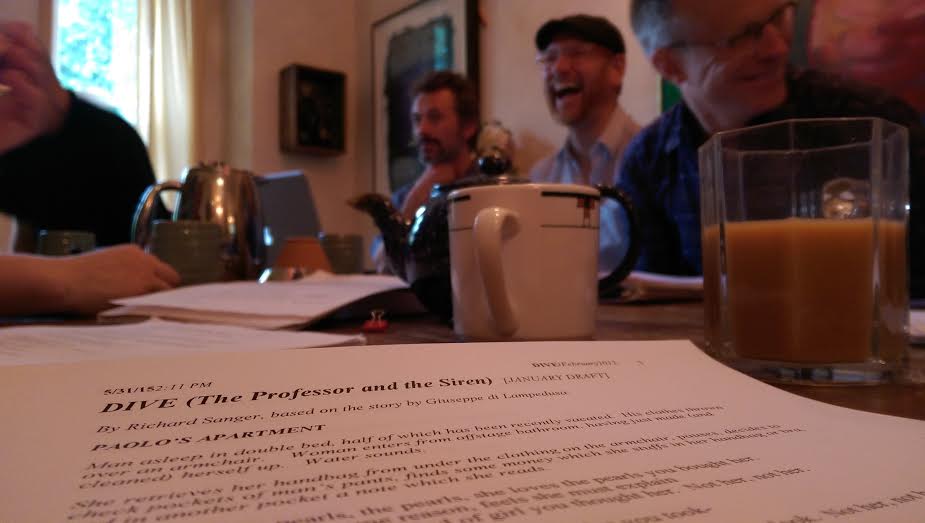
Nik Beeson is a digital communicator & electro-acoustic composer, and completely new to me. I’ve been listening to the CD for DIVE: Odes for Lighea at the encouragement of Alex Fallis, who will be directing the project in its premiere July 31st at The Array Space. I admire Beeson’s ambitions in a work that aims to be political, philosophical and yes, musical. The music on the CD has grown on me (I’ve heard it at least 5 times).

I was glad to get the chance to ask Beeson ten questions: five about him and five more about his work on DIVE.

1-Are you more like your father or your mother?

Some combination of the two.

My folks are wartime British boarding school raised immigrants, and so there is a sense of transience and a loose sense of place deep in my core. We have no other relatives in Canada, and it’s been at least a couple of decades since I last made it to Britain.

My mother is classically cultured (she studied architecture and design), and so I was exposed to a lot of art; at a very young age I could comfortably identify the styles of any major visual or classical music artist. She’s a very bright hardcore rationalist (her mother was the first female surgeon in Scotland and an atheist) and so there was a decidedly no bullshit empirical rigour about things.

My dad is a gentle and kind soul, who left wartime British boarding school into the army. He’s got a lot of ground to him, as well as a strong romantic streak. A man with a deep and powerful well of feeling which, as a British war brat, boarding school, army dude, didn’t have an obvious expressive outlet. Vaughan Williams’ ‘The Lark Ascending’, Strauss’ ‘Four Last Songs’ and Bizet’s ‘The Pearl Fishers’ can all bring him to tears.

There were no instruments in the house until my folks gave me a guitar for my 16th birthday (I sucked for a very long time!). Our record collection was pretty straightforward: Bach, Beethoven, Dvorak, with a Fats Waller if I remember, and a lot of British Military Marching Bands. So, my mother educated me in identifying the masters (and maybe even to aspire to be like them) and my dad could really really feel the music.

First music class in Grade 7 we were told to chose an instrument. I identified that the French Horn was undoubtedly the freaking loudest and also definitely the coolest looking instrument so I chose that. The parts were boring as heck but I would get ‘A’s all the time which was, given the fact that I was a pretty lousy student at everything else, a bit of a mystery to me.

I was given a guitar at 16 and taught myself basic chords. Mostly I ‘noodled’ – fretting – generating melodic patterns and memorising them. That was about it. But I definitely liked it, and it definitely served some kind of deep purpose for me. I wrote poems which I put to music: music was, for a long time just a kind of tool for making philosophical ideas accessible.

I used to busque quite a bit, and I remember a very striking man coming up to me one day and saying very directly, “Get musical…. get musical…”. I was haunted by that: he was dead right – I wasn’t really listening to what was going on, I was just pounding out a set of structures that I hung words off of. I’m super grateful for that old guy: maybe that was where it started.

2-What is the best thing or worst thing about being a composer of “new” music?

I came to ‘new music’ semi-accidentally; I was hired as the web director for the Canadian Music Centre. I had been marginally experimental in my listening before: Eno, Fripp, etc., but working at the CMC blew my ears open. Linda Smith, Eve Egoyan, Claude Vivier, R. Murray Schafer… and then I drifted over to, as my world music friend called it, ‘the dark side’: electroacoustic music. Jean Piche, Gilles Gobeil, Robert Normandeau… it felt a little as if there were almost no constraints at all on how one could try and express an idea or a feeling. This, through some kind chemical reaction, allowed my heart and mind to develop a much more direct and honest path to sound. Sound became a much more potent intellectual and emotionally expressive medium.

So this is what’s great about New Music; the uncluttered forging of direct, fresh and authentic connections from your heart and mind to an expressive medium.

I also love New Music because I feel like I am always in a process of discovery. I truly love this. I do not know what style I’m working in, and I don’t need to know. I have no formal musical education, no authorities, no compositional community, no precedence,. so what I end up creating is pretty raw and direct and naiive and unabashed.

That’s what’s great about ‘New Music’; the feeling of discovery, the feeling of chasing a very unique ‘something’ that is somehow yourself and also somehow very other, and that you are not bound by predetermined styles (and the implicit emotional boundaries of those styles).

What is painful about New Music is that there is almost no audience for it (although anonymity has its benefits!) and no capacity for sustainably making a living from it. So it becomes a project that you do out on the fringe of your daily life, trying to fit in frags of time hither and thither between everything else that keeps house & home & family together. This makes it supremely difficult to work a really deep vein of creativity through. I can only create fragments and flashes of something much larger which would require many many months to delve into and truly uncover.

3-Who do you like to listen to or watch?

I don’t listen to much, though I like a lot of different musics.

The most consistent staple in my music deck over the last year has been Mavis Staples singing Jeff Tweedy’s songs on ‘One True Vine’, and I pick up an acoustic guitar and sing ‘Holy Ghost’ a couple of times a week. Staples just has so much soul and such an incredible and honest access to her emotions…

Here’s what I’ve favourited on YouTube over the last while:

Patrick Watson, Autechre, Best of Gramatik, Karl Richter playing Bach’s Passacaglia & Fugue in C Minor (a touchstone), Unchained Melody – Righteous Brothers, Jesus Make up my Dying Bed – Blind Willie Johnson, Gavin Bryars (with Tom Waits) ‘Jesus Blood Never Failed Me Yet’ (repeatedly), Hundred Waters, Cliff Edwards singing “When You Wish Upon A Star’ (I periodically sing this too), Bill Withers – Ain’t No Sunshine, Beatles – Blackbird, Danny Michel – Cold Road, Martin Sexton – There Go I, Johnny Cash – God’s Gonna Cut You Down, Benjamin Britten – ‘Four Sea Interludes’ from Peter Grimes, Jeff Buckley, Zed’s Dead…

‘Weird Nightmare: Meditations on Mingus’, produced by Hal Wilner, may be my favourite album.

I don’t have tv so can’t comment on any of the tv series other than that they seem one hell of a lot better than the stuff we watched when I was a kid. My spouse (Fides) took considerable interest in ‘Downton Abbey’ for a time, but I was traumatised by it, so we had to stop.

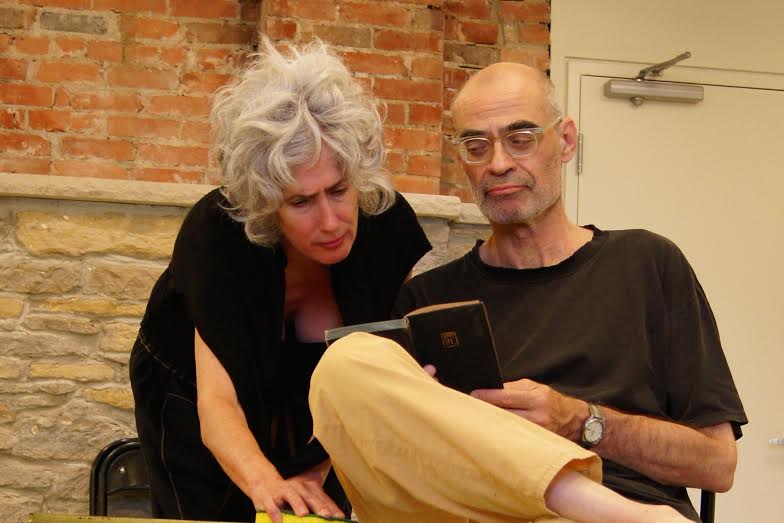
Fides Krucker and Earl Pastko

Fides Krucker and Earl Pastko

I like to watch how my bean vines climb…

4-What ability or skill do you wish you had, that you don’t have?

I’d love to be able to play piano. I can, with enough repetition, play compositional ideas kind of almost adequately so that I can hand them off. But it would be marvellous to be really able to freely improvise.

I don’t read scores anymore. When I was a teenager I could but no more. So, being able to express compositional ideas straight out of my head onto paper, being able to scrawl notes… that would be great.

I’d love to be able to just see a score and play some of the music that blows my mind… being able to play music that really blows me away opens up new pathways in my sonic imagination…

5-When you’re just relaxing and not working what is your favourite thing to do?

Playing music.
Playing structured improvs with friends.
Hanging with my sons.
Dancing: ballroom dance, contact dance, jumpin’ aboot, etc….
Trail running
Getting into the wilderness

*******

Five more about DIVE: Odes for Lighea

1- I read the following on your website: “DIVE’ is based on Giuseppe di Lampedusa’s short story ‘The Professor & the Siren’.” Please expand upon the sources & inspirations for DIVE: Odes for Lighea.

I was completely drawn into ‘The Professor & the Siren’ the first time I read it.

“As I told you Corbera, she was a beast but at the same instant also an Immortal, and it is a pity that no speech can express this synthesis continually, with such utter simplicity, as she expressed it in her own body… Not for nothing is she the daughter of Calliope: ignorant of all culture, unaware of all wisdom, contemptuous of any moral inhibitions, she belonged, even so, to the fountainhead of all culture, of all wisdom, of all ethics…”

Richard Sanger's adaptation of Giuseppe Di Lampedusa’s “The Professor and the Siren” sits among an admiring group of artists.

Richard Sanger’s adaptation of Giuseppe Di Lampedusa’s “The Professor and the Siren” sits among an admiring group of artists.

With that I was hooked.

When I was 23 I spent eight months solo caretaking a whale observatory on an island off the NE coast of Vancouver Island. I understood, very intensely, Rosario’s need for solitude, and also the effect that intense solitude can have on a young man. I was transfixed and completely in love with the wilderness and I undoubtedly associated it at a very deep level as being both divine and feminine.

Following my stint on the island I rowed a 16’ fishing dory down the west coast for 6 weeks. I once had a massive male Orca pass directly under my little boat, clearly scoping me out, turning on his side to look up into my face. On another occasion a Humpback whale dove deep right next to me, its immense tail as long as the boat. In both cases I was completely alone, many miles from other people, and I would describe both experiences as truly magnificent, ecstatic and terrifying.

In my youth I had a kind of dangerous wrestling war with my own creativity and I depicted this creative force as a subterranean or submarine divine feminine force which could arise from the deep without warning. I was entranced and thrilled by the ride, but I also intuited that this force could be exceedingly dangerous. In ‘DIVE’ Lighea at one point recites the names of Ancient Mariners who have been her lovers and I suppose I would have counted the likes of Rimbaud, Van Gogh, Hendrix, and Cobain as amongst them; the divine feminine lit them up and consumed them. This was a poetic explanation I had for creative outbursts whose source I couldn’t really understand; the contents of my own writing seemed alien to me. It was all very archetypal and Joseph Campbellian stuff; I was a self-professed Jungky.

So, yes, writing music about a deadly oceanic wild & divine feminine being made a whole lot of sense to me.

2-The story of this opera would seem to set up fascism and the wild as opposites or perhaps as antagonists. Could you explain?

I cover this topic in some detail in an essay ‘Fascism & the Wild in DIVE: Odes for Lighea’.
Lampedusa’s setting the story when Mussolini was at the height of his power was by no means accidental. The interaction of the dominant fascist dictator with a wild, feminine, divine being is really very very compelling.

I did some research on Mussolini and came across his classic speech declaring war on the Allies (aka his ‘Vincere’ speech), and this speech became a very significant throughline in the music, and also in the theatrical performance. Let’s face it, Mussolini is incredibly charismatic, and his rhetorical bravado, his musicality, eloquence and timing are spellbinding.

I’ve spent a lot of time in the wild and I was certainly very interested in depicting a struggle between fascism and wild, Mussolini and Mermaid. We associate fascism with repression, oppression, militance, authoritarianism and dehumanisation. We associate the wild with many of the opposite traits: it is uncontrollable, wilful, uncivilized, irregular, and openly sexual.

The Prelude – the very opening vignette – really sets the stage for the kind of interaction to follow. We hear a clock, which turns into jackboots, and then Mussolini’s speech rising up, with the great crowd swells. The final roar of the ecstatically excited crowd is suddenly interrupted and completely obliterated by a most ferocious roar from the mermaid, after which the roaring crowd is dispelled into the roar of surf and the calls of seagulls. I liked this very much. I very much wanted the Mermaid to obliterate the Fascists.

But art and political preference are poor companions; when you allow political preference to dictate your art it becomes propaganda. Politics is about agenda, power and control whereas artistic creativity is much less predictable and can’t be herded in that way. There are attributes that fascism and the wild have in common. Neither are democratic and both can be violent. But the violence of the wild isn’t ideological or judgemental, it has no attitude towards morality at all: it’s amoral and exceedingly fecund.

Rosario, when asked by Lighea to join him, refuses. So he refuses the wild divine, running back to his books and his Platonic ideals. But the life of ideal forms only have two paths: Utopian escapism because the world can never be so symmetrical; or the ideological terrorism of trying to force a perfect form onto a very imperfect and irrational world. Rosario chose the former, Mussolini chose the latter: neither survives.

The parallels between de Lampedusa’s tale, and the attitude of Canada’s current government towards ecological sustainability and democracy were not lost on me. During the time I wrote the music for DIVE my day job was at a human rights and ecological justice org. I witnessed very clearly the antipathy of this government towards environmental sustainability, common democratic procedures, not to mention the arts. While I wouldn’t characterise our current government as ‘fascist’, I do see tendencies – repression of dissent, intimidation, a total pre-occupation with maintaining power at the expense of democratic processes, the consistent defunding of arts, ecological and women’s orgs – which fall in line with Mussolini’s antagonism to the feminine and the wild.

3-How are you approaching the creation of the score?

My main techniques for creating the score were sourcing, improvising, writing, recording and mixing mixing mixing mixing. I found inspiration from recordings of whales and wolves, the ocean, the dark dissonant tonality of Harry Partch’s ‘Cloud Bowls’, Mussolini’s speeches, Rebetika and Tarantella folk music, Persian improvisational masters, Benjamin Britten’s ‘Four Sea Interludes’, R. Murray Schafer’s String Quartet #2 ‘Waves’, Weird Nightmare’s ‘Meditations on Mingus’, Sonic Couture’s Glassworks Library, and, always, Fides Krucker’s voice, vocal philosophy and technique.

I composed some pieces by assembling and collaging found sounds. Others by remixing fragments of found music and slowing it down, running it through processors, and layering it. Others by recording myself singing the melodies I would hear in my head, then learning to play them. I did a lot of sequencing and multi-tracking: experimenting with various software instruments and layering them.

I had a number of recording sessions, most of all with Fides, but also with Rick Sacks, Rob Clutton and Neil Gardiner. In these I would ensure that the basic piece was well recorded, but would then diverge into more experimental passes of the same work, or fragments of the work, generating a body of material that I could then build up in the editing suite. Sometimes these experimental fragments would have a huge influence on the final product as they could be more spontaneous, evocative and intense.

I experiment a lot, and I work a lot with, and trust, accidents. Maybe one of the benefits of being so poorly educated is that there are a lot of accidents…!

Fides and I worked very closely. I have huge respect and admiration for Fides’ musicality, musical intelligence, and improvisational instincts. We had many many long discussions about the nature of the mermaid and how that would translate into music. I actually directly scored only a few pieces (The Pearls, Pastry Shop, Lighea’s Ocean) and left the interpretation of emotion and technique very much up to Fides. Frequently the most useful and intelligent thing for me to do was to get out of the way. I would ‘set the stage’ with bed tracks and notions and ask Fides to improvise, recording many takes, feeding back, experimenting with different strategies. This could result in many hours re-assembling/crafting/sculpting what we had recorded (Lighea’s Idyll, The Mermaid Spangles Mussolini). It could also result in Fides absolutely nailing a phrasing and, when I found it when listening back, I was done. The melody in Lament was improvised by Fides off-the-cuff very very early in our first actors workshop. I happened to be running tape and when I played it back later it was perfect.

4-Please talk about working with Fides Krucker and her unusual approaches to vocalism.

Fides Krucker (Photo by Jeremy Minmagh)

Fides was approached by Richard Sanger, who wrote the libretto, to do some kind of musical version of ‘The Professor & the Mermaid’. Fides remembered a CD that I had released called Howlings and she felt that that type of composer could work, so they approached me to do it. Obviously, I was in.

I wanted to create musical structures that would be liberating. The mermaid is an atypical operatic role: let’s face it, most female characters in operas are completely traumatised, if not just killed off. The mermaid, on the other hand, is an enormously powerful character and Fides and I wanted to ensure that that was not lost. We did a lot of collaborating, and a lot of discussing: I remember in our first session I brought recordings of whales and wolves and asked Fides to improvise which she did most astonishingly. I think it was sometime in that session that she made the blood curdling roar that became the ‘fascist killer’ in opening ‘Prelude’. Standing just a few feet from her I think I got a few extra grey hairs in that moment, but that kind of experience influences your compositional intentions. Suddenly I’m thinking to myself, ”a sound like that can wipe out a lot of fascism…”, and the next day I’ve rolled it into a track over Mussolini’s ‘Vincere’. That kind of thing could happen a lot.

As I said before, while there were pieces I directly scored, my role was often to set up a situation and then let Fides do what she does. There’s no way that can be scored, and no way I would conceive of what she might end up doing. It would be stupid, and a waste of time and talent. Fides has a long and storied career of being boxed in by composition, and neither of us had any interest in that: it’s not creatively enjoyable for either of us, and it would blatantly contradict the theme of the tale we were making music for.

Fides has spent decades developing a technical mastery of her voice such that she can express an outrageous range of emotions and types of intensity. She has very deliberately studied how to ‘undomesticate’, and ‘take off the doors’, of her own voice, and this is what she teaches day in and day out. So, the mermaid is a perfect role, and I tried to create conditions in which Fides could really be as expressively powerful and evocative as she is capable of being. I hope I sometimes succeeded.

5- Is there a teacher or an influence you’d care to name that you especially admire?

Mavis Staples, Glenn Gould…

I’m not trained, and so I suppose there is a naivete in how I approach music.
I really like honesty, and also technical mastery, but mastery never for the show, only so that it can be put at the service of genuine emotion and experience in the moment.
I think I can tell when artists are chasing something – maybe it’s ecstasy – and that’s what I want to hear. I heard it in a ten year old playing a piano a couple of weeks ago: I could tell every time he was trying the phrase out he wasn’t just trying to find the right notes, he was exploring, trying to find the specific cadence, intensity, tonality, that taps him right in the soul.

I admire that quality, and hearing this little boy stick at it with that specific intention influences me to keep finding that intention in myself, and to never stop searching…

********

DIVE: Odes for Lighea – July 31st – August 9th – The Array Space
Preview – July 30th

Featuring Fides Krucker, Matthew Gouveia, and Earl Pastko
Directed by Alex Fallis
Sound Score by Nik Beeson
Set Design by Scott Penner
Lighting Design by Simon Rossiter
Costume Design by Nina Okens
Sound Design by Andy Trithardt
Freely Adapted by Richard Sanger
from Giuseppe Di Lampedusa’s “The Professor and the Siren”
Click image (below) for tickets

postcard

Posted in Interviews, Music and musicology, Opera | Tagged , , , , , | 2 Comments

“Whose Opera Is It Anyway?” : Improv Fund-raiser from Loose TEA

IMMEDIATE release Information contact:
Alaina Viau: 647-539-4020, alaina@looseteamusictheatre.com

Loose Tea’s Artistic Director Alaina Viau today announced that Loose Tea will host “Whose Opera Is It Anyway?” on July 22, 2015 from 7pm-9pm at the Office Pub at 117 John Street. Cost is $25 per person includes a free glass of BareFoot wine, nibbles and sore cheeks from laughing too hard . Proceeds will be used to fund the summer opera Dissociative Me an English re-work of the classic “Faust” set in modern times.

A night of opera shenanigans where Loose TEA is doing IMPROV opera! The company singers will be taking the games from “Whose line is it Anyway” and daring to do them while singing opera! Hear a Verdi aria sung in the style of Madonna, or Don Giovanni serenading about flying cats in space.

Hosted by Toronto comedian Andrew Johnston, with DJ’d music this is the party to be at! Bid on the improve element in selected games and have your suggestion played out by out incredibly talented singers!

The event will feature Michael York, Gregory Finney, Whitney Mather, Kijong Wi, Fabian Arciniegas and Charlotte Knight. Loose Tea is a nonprofit organization whose purpose is to make opera accessible to the modern public and bring in a new audience.

For ticket information go to https://www.eventbrite.ca/e/whose-opera-is-it-anyway-tickets-17698313131

Loose Tea is Not Your Grandfather’s Opera – run by a group of arts innovators, Loose TEA offers Torontonians a bold new live music experience. We mash up Classical music and turn opera on its head.

“Press releases and announcements” are presented verbatim without comment

Posted in Press Releases and Announcements | Leave a comment

Minions Is Good

Never read a review before seeing something about which you have no choice.  Adults & children seeing a film aimed squarely at a child? Best to be a child or to be like a child.

In Matthew 18:3 Jesus says  “Truly I tell you, unless you change and become like little children, you will never enter the kingdom of heaven.”

No i wasn’t thinking deep spiritual thoughts, but this is what I channeled today seeing Minions, the prequel to the Despicable Me films, and is the only way to approach such a film.

Minions is good.

The little guys are funny.

I did not expect to laugh.

It is the same joke

Over and over.

That is not a problem

Not if you are six years old.

I miss being six. I miss living in the now.

What’s so good about being able to say “that’s not funny?”  For Wagner I need the big words.  For Hitchcock I need the fancy ideas.

Not for this.

This is a giggle.

Tickle the dog.

Get your face licked.

Wet and messy.

When I engage the part of my brain with the bigger words I start to think, hmm, what exactly are minions and why might this be a troubling series of lessons?  Minions are slaves, workers, and have no individuality or even gender. That is probably fine when you are six, but if you were a minion?  I cherish my individuality, and am more than just my function in the huge impersonal machine of production.

That the minions all speak a kind of gibberish is on the verge of being disturbing.  The cute sounds they make have precedents. The little dudes in Star Wars films are often cute-sounding. In the first film we meet the Jawas, in a later film it’s the Ewoks.  

What exactly are we laughing at, if we are laughing at them, I wonder.  This is no time to be over-thinking the codes for cute and cuddly, the reasons for fun.

At least not yet.

Is Minions a project designed to make lots of money? Yes.  I am wary, as if I were consuming a genetically modified apple, wondering what I am tasting and why I am liking it.  What is this doing to my brain, and even more scary to contemplate: what is this doing to the brains of six-year-olds?

I fear the attraction because I do not like being manipulated. When Wagner or Hitchcock do it—manipulation –I am fine with it. Great artists screw with our heads all the time.  Commercial products with no apparent redeeming value, however, are a different story.

If it were a better piece of art I might surrender fully, the way I do in the presence of a really luscious brownie or sticky toffee pudding. Calories be damned give me sweetness laden with fat!  But there are two things that stopped my surrender as surely as a badly executed harmonization. One was my resistance to Sandra Bullock as the lead villainess.  I experienced this as an actor trying to work against type which is usually fine onscreen if you can make me believe.  Why did I resist? I hate to think I am sticking Bullock into a mental category, stubbornly refusing to see her as a possible villain; but in my defense, I have to say animation is different.  We are not in the realm where we can see the performance, and if the voice is too subtle –and that is the nicest thing I can say for her—then it simply won’t fly (and for me it didn’t).

The other issue is writing.  At times I felt I was watching filler, a cartoon that could have been over in less than half an hour. I won’t deny that a couple of times I almost fell asleep. That might also be an issue for Bullock, who can’t be faulted for failing to transcend the material.

But I did laugh, especially when i remembered to pay attention to the children.  It is funny once you surrender to the spirit of the little child in you, because at that moment you may be surprised that you are screaming with  laughter.  This is decidedly unlike Inside Out, which was full of big laughs that the adults got and the kids did not.

If you see this film, the only thing to remember is what Jesus said via Matthew.  Forget everything else.

Posted in Cinema, video & DVDs, Reviews | Tagged , , , , , | Leave a comment

Attila Keszei: the eco-warrior rides on

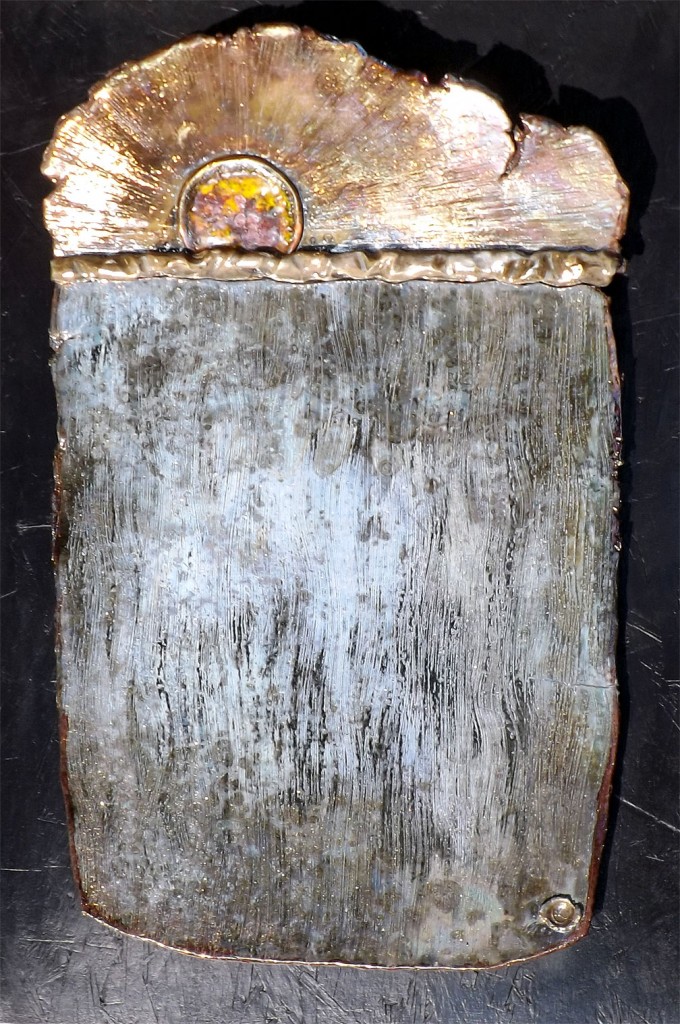
My friend Attila Keszei is back.  Attila, an engineer who offered heroic leadership in the quest for sustainability and reducing the university’s carbon footprint retired from the University of Toronto a few years ago.  But his creativity continues unabated,  retirement allowing him to focus his energies completely on his art.  His new show at the U of T Faculty Club displays recent works.

Is age finally mellowing Attila’s work?  You be the judge.

He has several distinct styles.

1-some of his works are simple representations of nature or humanity often telling stories, possibly even religious in nature.

2-some of his works are political in nature.  Attila speaks of this as “concerned art”, which is a very gentle name for it.  As a Hungarian expat in Canada this manifested itself in several ways. But I didn’t see anything of that sort in this show.

“White Venus” (Raku fired ceramic – 2015 Attila Keszei)

3-some of his works are sensual or even sexual in nature.  Sometimes that means explicit images, sometimes it may be more ambiguous.  I’d say that several of these works at the very least hint at sensuality, while a few are so blatant that they will make some people blush, at least once it’s pointed out to them what is depicted in the art.

“Homage to Georgia O’Keeffe Flower #1”
(Raku fired ceramic – 2015 Attila Keszei)

Georgia O’Keeffe is Attila’s favorite artist, and a natural departure point for his own explorations.

“Homage to Georgia O’Keeffe Flower #3” (Raku fired ceramic – 2015 Attila Keszei )

4- From time to time, the engineer peers out of his art.  “The 41st Day” might be a whimsical response to something in the book of Genesis, but it is essentially an attempt to capture the magic of terrestrial physics.  We see sunlight meeting water but in person one feels the stunning drama of this medium of super-hot ceramic melting and being shaped into something touchable and cool, the sun tamed as though by a sustainability engineer’s cleverness.

“The 41st Day” (Oxidation fired ceramic – 2014 Attila Keszei)

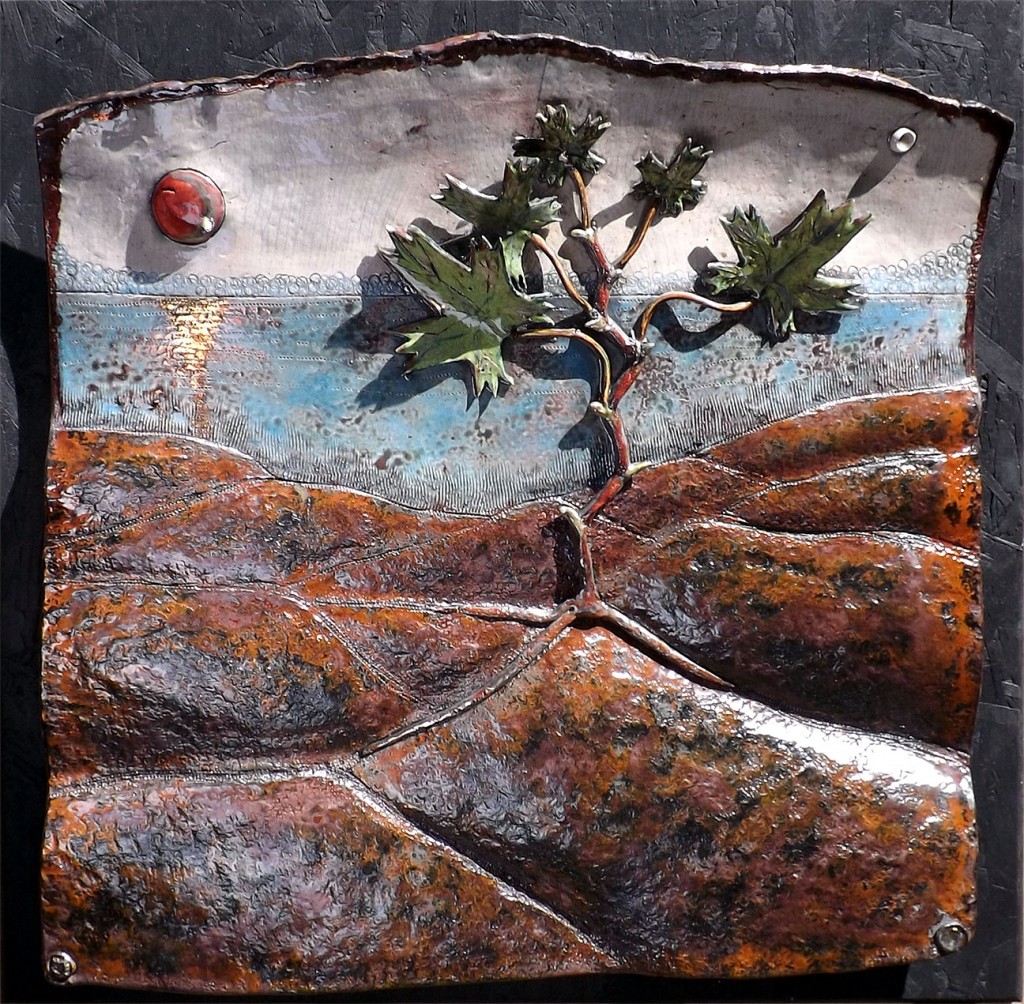
As with so many works of art, the only way to really appreciate the work is in person.  In this show Attila displays works in raku fired ceramic and hammered copper.  The effect transcends the means, a cool sensual finish that seems effortless.  But masterful control is required to get the illusion of such tranquility.

“Canadian Willpower” is a kind of battle between the Canadian Shield and a maple, one that we see all too often up north.

“Canadian Willpower”
(Raku fired ceramic – 2015 Attila Keszei)

While you can also see Attila’s work on his website, that is a mere shadow of what you get in person.  And as far as i can tell this has been a productive year.  His so-called retirement seems to agree with Attila.

Posted in Art, Architecture & Design, University life | Tagged | 3 Comments

Remembering Jon Vickers, Canadian Heldentenor

There have been two singers above all the others who mattered to me as I grew up. Both were tenors.  I’ve talked about Jussi Björling, my touchstone of vocal perfection and the subject of a recent pilgrimage in Sweden. The other was Jon Vickers who has died after what his family announced as a “prolonged struggle with Alzheimer’s disease.” In contrasting my relationship with these two heroes of my childhood I’d like to illuminate these two very different stars, who in large measure can be understood as two polar opposites.

Björling was a singer of great vocal beauty, possessed of ringing high Cs and a lovely cantabile. Vickers was somewhat unorthodox, arguably one of the great singing actors of the 20th Century.  As I grew up i drifted away from love of pure vocal beauty and fell in love with music-drama, good acting and everything Vickers stood for. While I love listening to both Björling and Vickers, it’s on video that you really get a sense of the Canadian’s unique style.

For the longest time it was a pattern of frustration! Vickers stopped singing in Toronto allegedly because of a bad review. In 1970 I was fortunate to be taken to hear him in NY, singing with Louis Quilico & James Levine in the Zeffirelli Otello that had been introduced the season before by James McCracken & Karl Bohm. A few years later I hitched a ride to Montreal to hear his Tristan. Eventually I heard a song recital at the Edward Johnson Building at the University of Toronto (his first words were a fervent “it’s good to be back!”) and the first act of Siegmund in the “Concert of the Decade” with Birgit Nilsson at Massey Hall. While it was only the first act, it was surely a release of all that pent-up frustration for his fans, especially for those who hadn’t traveled to see Vickers in other cities. Not only did it bring us Vickers but Nilsson had never sung in Toronto either, and it was led by Zubin Mehta. For me it lived up to the hype, especially in Vickers’s seemingly effortless high A to end the act. And a short while later he sang it again for another audience (that would have included me if I had been able to afford to see it both times. Oh well, no such luck).

I was fortunate to see him as much as i did in the roles for which he was famed. Everything he sang was unique and unlike what anyone else would do with that role. I can say that because I was a junkie for descriptions and stories about the other roles I never saw. He changed our understanding of Peter Grimes single-handedly, broadening the possibilities of the role far beyond what the composer and what Peter Pears, the first great exponent of the role, understood of the opera. While I don’t believe he is really known for Parsifal there’s a moment on youtube that’s shattering precisely because of the way it goes against what we would expect, a production directed by Rolf Liebermann (whom I mention because the brilliant touch might be from Vickers, might be from Liebermann; either way its execution is stunning). He brings back the sacred spear and then he breaks it in two(!?!), complete with a howl of confused rage from the grail knights in his presence .  

I will add another link that gives a better view of his acting ability, as Florestan in Fidelio.  Even so i believe this portrayal would be more powerful from afar, the movement vocabulary eloquent at any distance but especially convincing when you could only see a tiny figure, posture, dignity, and the huge voice enveloping you no matter whether you were close or sitting at the back of the opera house.  

The ambiguities of this final clip are a perfect epitome of Vickers.  As Otello he kills himself with a concealed weapon. As he heroically strains for a final kiss –the most heroic looking singer I have seen in the part to this day—I could never tell in recordings or this performance, if the “ah” in the last lines was an attempt at a kiss (as this note gives us the recurrance of the moment in the love duet where he and Desdemona kiss)  or impending death. The ambiguity slays me every time, but I found it particularly shattering watching him die in this clip earlier tonight, realizing that he is finally gone.  

Posted in Opera, Personal ruminations & essays | Tagged , , , , | 10 Comments

Independence Day Doodle Dandy

I am a Canadian.  I have a conspicuous “cz” in my surname, but then again, what is a Canadian, if not an immigrant or child of immigrants…?

If you turn on the television any day of the year you’re deluged in the culture of our neighbours to the south.  “Canadian culture” does exist, in fact it’s quite strong in some quarters, but on July 4th, one can’t help being a bit envious, feeling that ours is still so new, so young, given the proud displays of American heritage on so many channels.

I’m going back and forth between Turner Classic Movies & AMC.  TCM are showing Yankee Doodle Dandy, a film I’ve seen a million times while AMC have Independence Day.  I’m an admirer of Cagney.  I’m just at the moment when George (still a boy, so not yet played by Cagney) gets his big spanking.  A moment ago we came to the moment when Will Smith shoots down his alien, then smokes his cigar.  Independence Day is a nationalistic sci-fi flick that works well anytime, but especially today.  Will Smith’s pride –who can forget his “who de man” bluster right up to his punch in the “face” of the alien— is the best of the American spirit, not so different from the ego display that got George his spanking (after having lost his family a big gig by mouthing off to a possible impresario).

I know there are egomaniacs in Canada, but will anyone ever put that into a movie?

This afternoon TCM showed 1776, a filmed version of the musical produced in the decade before their bicentennial.  Wow what a serious piece of work.  I admire its ambitions, its willingness to make serious matters the subject for a musical.

We have Louis Riel, which is an opera rather than a musical.  The other day a friend mentioned Billy Bishop Goes to War.  But I wonder what a Canadian take on any of those American examples might look and sound like.

A Canadian Yankee Doodle Dandy?  Absurd as that may sound, I can imagine a musical celebrating a Canadian musical icon.  Glenn Gould?  Joni Mitchell?  David Foster? Or if you have a better candidate, go ahead: dramatize their life, studded with a few well-known musical moments and you have something with possibilities.

A Canadian Independence Day?  That’s as odd as the previous suggestion, but why not after all.  It wouldn’t be a tale of saucers demolishing iconic buildings, annihilating cities, or humbling our air power.   Our confederation was a matter of conversation—something more like 1776 actually—and without any war of independence.

Recalling how new it all feels here, north of the 49th parallel, and smaller to boot, I happily devour whatever comes along.  It’s Fringe time in Toronto, when for writers, composers, producers, actors and of course also the audience, hope springs not just eternal but immanent.  Perhaps now is the time for the creation that not only captures the national imagination but becomes a representative for our  country.

If nothing else it’s a great time to go see a show.

Posted in Dance, theatre & musicals, Personal ruminations & essays | Leave a comment