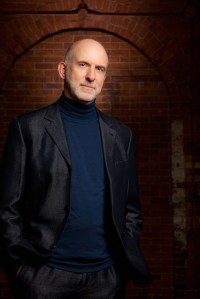
Michael Sanderling led the Toronto Symphony in a program of works from the first decade of the twentieth century featuring soprano Simone Osborne. We heard a diverse assortment of musical styles represented even though the works have a few things in common. Let’s set aside Mahler’s 4th Symphony from the second half of the program.
We began with
“The Dance of the Seven Veils” from Salome by Richard Strauss
The Song to the moon from Rusalka by Antonin Dvorak
“Depuis le jour” from Louise by Gustave Charpentier
The Vilja song from The Merry Widow by Franz Lehar
We heard a seductive dance, a song dreaming of love, “Depuis le jour” (a young girl reflects on her first days in love) and the Vilja song (a sentimental old song concerning love of a spirit of the woods).
Sanderling led a comparatively restrained reading of Salome’s dance, one clearly articulating every sound for the first half of the composition, but gradually building up the pace as though discovering greater levels of passion.
The three vocal pieces (the Lehar piece being an encore) make a nice set. Where the song in Rusalka seems to represent an impossible dream, the Charpentier is a reflection upon the recent achievement of that dream in a young woman’s life, while the Lehar is a sentimental tune meant to look back, as though it were an old folk-song. I found that the orchestral tempo Sanderling gave the Dvorak kept a bit of a lid on its passion, perhaps making Osborne’s reading more polite than it might otherwise have been. Similarly the Charpentier is often done at a moderate tempo. making it more reflective and thoughtful, and as a result perhaps more chaste than what the composer had in mind. In the third item, Osborne fully relaxed into the song, entering fully into the spirit of the song.
After intermission, Sanderling led a fascinating reading of Mahler’s 4th. This is a work that is best illuminated by a conductor willing to make the necessary tempo changes, a piece showing us scenes from childhood, sometimes with wild energy, sometimes with nostalgia and schmaltziness: and Sanderling didn’t disappoint. The TSO responded wonderfully to Sanderling’s choices, opening the first movement gently, building to several break-neck tempi in the first movement, sometimes displaying a playful energy then just as suddenly putting on the brakes. We were treated to several exquisite solos, especially concert-master Jonathan Crow and several of the wind players. The long & dramatic third movement can be done with greater restraint and subtlety than this, which I believe makes the drama ultimately that much more powerful so long as one doesn’t mind making the movement longer; but Sanderling was emphasizing contrasts, bringing forth climaxes from key voices, and making the piece very articulate, very transparent. When we got to the loud climax in the third movement, often spoken of as though the composer is flinging open the gates of heaven, we saw a wonderfully theatrical gesture, as at this moment the stage door opened for Osborne’s solemn entrance, for the final movement.
This is a very different sort of singing from what we experienced in the first half of the program, as the voice must be unforced, gentle, to match the angelic text. Osborne’s charming expression seems ideal for the innocence of the piece, her voice gently floating over the orchestra. Overall Sanderling and the TSO achieved a spectacular rapport.
The program will be repeated Saturday Nov 14th at 8:00 pm.
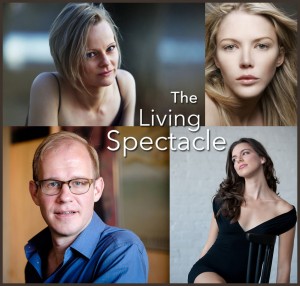
(The) Canadian Art Song Project aim to explore the art song in all its manifestations. Tonight CASP took a bold new step in the first in a new series of recitals. “The Living Spectacle”, the first work on tonight’s program, gave its name to the evening, a series of four different works presented by a pianist, two singers and a dancer.
Pianist Steven Philcox –co-artistic director of CASP along with tenor Lawrence Wiliford—played the entire evening both sitting at and reaching into the piano. Sopranos Ambur Braid and Carla Huhtanen each sang two cycles, an intense night of singing for both. And Jennifer Nichols, who is founder of the Extension Room, the site of tonight’s performances, choreographed and danced in the last cycle.
In conversation afterwards, Wiliford explained some of CASP’s ambitions, which were perfectly demonstrated by an evening going far beyond the usual singer + piano. Wiliford was very humble about defining the art song, suggesting that an evening like this one could potentially enlarge the boundaries of what’s possible, but that the definitions & possibilities are open to revision, and changeable from one year to the next.
I feel a bit promiscuous, on a night when four different works seduced me: at least until the next one came along to turn my head anew…
The Living Spectacle received its world premiere tonight, Erik Ross’ setting three Roy Campbell translations (or should I call them paraphrases?) from Baudelaire. While I don’t know how Ross works, the composition seemed to be built from the wonderful accompaniment (which isn’t necessarily a bad thing, given that for example Wagner supposedly wrote vocal lines after having sketched the orchestral passages), with the vocals almost like icing on the cake. Each of the three was totally different in mood and with a distinct style, corresponding to three very different texts. In at least one I felt the piano was making something that could be described as pattern music, which makes a lot of sense when we remember that Debussy and Satie were arguably the two godfathers of minimalism, although Ross’s pianism was much richer & more beautiful than my description would suggest. Braid opted for a very dramatic approach to the singing, in a series of very clearly conceived portrayals.
And the next set by Carla Huhtanen took us into a classical realm, both in the first CASP performance that I can recall of a touchstone of vocal repertoire –Richard Strauss—and in the dramatization of a figure from Shakespeare, namely Ophelia in the Drei Ophelia Lieder (1918). As she was entering Huhtanen delivered a couple of lines of Shakespeare in English to frame the songs. It seemed particularly apt after seeing Hamlet just a couple of days ago in a production raising the question of the ages of both Hamlet & Ophelia, to be watching these songs that could be sung by an Ophelia of any age. She seems eternally frozen in that bewildered and broken place poised on the edge of the river before jumping in, a place and a perspective that’s truly ageless. Huhtanen is one of the regulars with Tapestry, a singer with a gift for singing with great precision that never seems artificial or overly controlled; and when you hear some of the scores she sings, you’d realize what an amazing gift that is. In the Strauss, with its quirky enharmonics and occasionally funny intervals, she always made it sound natural, even when also sounding mad. She had the guilelessness of a crazy child, heartbreakingly cute even though she’s a trainwreck. Philcox had this insane night at the piano but especially in the Strauss, who can be a total killer, remaining playful and delicate throughout.
I’ve described the first two big pieces as though infatuated, and yet each of the next two were better. Imagine a program with the balls to put the best at the end this way, and you have some idea of what we saw & heard. But maybe i should say “ovaries” rather than “balls” considering that the works could be said to embody feminist principles, particularly the last two items.
The third item on the program, coming before intermission, was Libby Larsen’s Try Me, Good King. The idea is so juicy, I’m embarrassed that I’ve never encountered this piece before: because it’s so good. Subtitled “Last words of the wives of Henry VIII”, each of the five comes from text written by, in succession, Katherine of Aragon, Anne Boleyn (whose song indeed cries out “Try Me” over and over), Jane Seymour, Anne of Cleves and Katherine Howard. Before we heard the songs, though, Braid came back to the stage carrying a drink to address us off the cuff before the songs. Is there a smarter singer in this city? Yes we’ve noticed how attractive she is, how effortless her high coloratura, but let me repeat, I think she’s very intelligent. For a few minutes she stood before us riffing on the wives of Henry the VIIIth almost like a stand-up comic, giving us the background while enacting a kind of distancing Brecht would have loved. I couldn’t help thinking –as I watched five distinct impersonations, one per song—that at least one motivating reason was that Braid was seeking a bit of distance for fear of becoming too emotional. Even as it was, I was in tears in several places, overwhelmed by the intensity of these songs and her portrayals. I wonder if Larsen has ever heard them done this way, so flamboyantly, yet so distinctly? I would think she’d be blown away, as were we come to think of it. Almost incidentally, there was a high C-sharp, among singing and characterization in a different style for each wife.
After intermission CASP revived a work commissioned in 2011, namely Sewing the Earthworm with text by David James Brock, set by Brian Harman. I am reproducing text from the Canadian Music Centre to describe this work, originally premiered by Huhtanen & Philcox back in 2012 in a concert at the Richard Bradshaw Amphitheatre
The character in Sewing the Earthworm is inspired by 1970s punk rock icon Wendy O. Williams. The work dramatizes a private frustration as she looks back on a fragmented life, from the radical punk aesthetic to champion of environmental issues, before her suicide in 1998. This character relates to many other iconic artists: Frida Kahlo, Anaïs Nin and Elizabeth Bishop, for example. Because of these artists’ outspokenness, we find their human weaknesses even more intriguing.The setting for the piece is inspired by an anecdote about Albert Einstein: he loved to garden, but couldn’t bear the accidental killing of creatures living in the ground. Sewing the Earthworm begins with a lonely woman contemplating her garden as a haven for both herself and the many forms of life she tends to within it.The language of Sewing the Earthworm is that of myth, poetry, and spectacle. A physically deteriorating woman remains thankful that her hands can still control larger clumps of dirt in the maintenance of her private garden. She remembers her former abilities, especially with finer manual endeavours, and laments that her mind has remained long enough to know her body’s condition. When she accidentally cuts an earthworm in half while gardening, she decides to attach the pieces with needle and thread to save its life. The seemingly futile attempt is compounded by her desire to prove that physical control has not abandoned her, and the piece makes a rapid shift both musically and textually as a mental struggle takes over.
Clearly Huhtanen has had additional thoughts about the work, as the 2015 presentation is the most involved piece of theatre yet created by CASP (and I say this after chatting with the composer & librettist, who credit her with the key ideas in the presentation). Joined onstage by dancer Jennifer Nichols, Huhtanen & Nichols are dressed so alike that one might think that they are aspects of the same person. Huhtanen sings, Nichols dances, although Huhtanen did a bit of dance as well. Both Philcox and Nichols reach into the piano (I’m not sure if Nichols only mimed or genuinely strummed any strings inside the instrument, as Philcox did). Huhtanen empties a wheel-barrow of peat moss onto a portion of the performance space, in front of the mirrored surfaces (the Extension Room is a dance studio, which makes it perfectly natural to have mirrors behind the performance). The dancer & singer both reach into the peat moss, whose gentle aroma permeates the space. I was reminded of some of Pina Bausch’s works, whereby the organic materials gently perfume the air, creating an effect of great sensuousness. Watching the two blonde women –virtually twins in their black outfits—probing into the soft living material while Huhtanen sings about earthworms was highly suggestive. We’re in the presence of some wonderfully ambiguous dualities, that the earth is rich with life but the place where we put our bodies when they die, that the earth teems with little worms, even as those same worms might infest or devour our remains if we were buried there. At one point Huhtanen has her hands into the dark peat moss while Nichols has her hands into the big dark open piano.
(l-r) David James Brock, Erik Ross, Brian Harman, Steven Philcox, Jennifer Nichols, Ambur Braid and Carla Huhtanen
And I couldn’t help noticing that while the performers are so young in this performance that hints at death and decay, most of us in the audience were much older, much closer to the death to which they gently allude.
CASP will be back in February, in a program titled “The Pilgrim Soul” featuring Phillip Addis and pianist Emily Hamper performing songs by Canadians Chester Duncan, Larysa Kuzmenko (In Search of Eldorado) and Imant Raminsh (The Pilgrim Soul) as well as works by Gustav Mahler (Songs of a Wayfarer) and Dominick Argento (The Andrée Expedition), at the Enoch Turner Schoolhouse.
There is a scene in the first half hour of Mike Leigh’s recent film Mr Turner, juxtaposing the creative ambitions of amateurs and professionals. We see Timothy Spall as Turner, greeting a noble on his estate. Another person –likely another artist—hangs back, waiting for the right moment, as Turner and the noble discuss the relative merits of horse and ox pulling a plow or made into dinner. When he sees his moment to jump into the conversation, he wishes him a good evening before asking “are we not blessed… by the heavens… to witness …so glorious… a crepuscular time of day”? Having seized the moment and mangled it so thoroughly, he steps out of the spotlight, as the noble quietly pronounces “imbecile” to Turner, and they enter a large room, to examine the way several of Turner’s paintings are displayed.
Throughout the conversation, an amateur (likely a member of the noble household) is playing Beethoven on the piano, apparently just having learnt the slow movement of the Pathetique Sonata, stopping & starting with mistakes and changes of pace. Turner approaches this handsome woman and in due course, when they discover a mutual appreciation for Purcell, she plays Dido’s Lament. Turner attempts to sing the tune as only ardent fans nowadays sing Turner Swift or Lady Gaga, getting some of the words wrong while fondly chasing the tune. She follows him as he is carried away with the emotion. At the end, he sadly pronounces it “a song of lost love”, and thanks her.
I can’t get this scene out of my head, a litmus test for the accuracy of Mr Turner, and one of the high-points in a film that’s possibly the most authentic representation of 19th century cultural life I’ve ever seen captured in cinema. Coincidentally the qualities of light captured on the screen are unlike anything I’ve ever seen in a film, but reminiscent of the light passing through the clean air in the few places I’ve been where the atmosphere isn’t befouled, such as St John’s Newfoundland or Reykjavik Iceland. The yellow light there is qualitatively different and we see it in this film, which seems to be at pains to help us see as Turner saw, or indeed, as humans saw almost two hundred years ago.
You might know Leigh for his 1999 film Topsy-Turvy, exploring the lives of Gilbert & Sullivan, a film that also employed Spall, albeit in a smaller role. This time Leigh leans heavily upon Spall, who is onscreen for most of the 144 minutes.
We picked up the DVD in the AGO’s store after seeing Painting Set Free, the exhibit of Turner paintings that recently opened here in Toronto. I would strongly recommend seeing the film if you don’t know the painter or his art. While I thought I knew the painter, I had no idea of the man and his extraordinary life.
The film includes a couple of set-pieces built around some of his most famous paintings, that one should perhaps take with a grain of salt:
as Turner and friends observe a Napoleonic era battleship being towed away by an ugly steam-powered tug against the most perfect sunset, we see “The Fighting Temeraire” in Leigh’s perfect recreation moments before the inspiration hits the painter, so perfect that it’s in the trailer like an irresistible lure (roughly 40 seconds in)
the evils of slavery come up in conversation, as Turner absorbs the conversation and in due course paints that horrific painting of the slave-ship with a tempest approaching, as they throw the sick overboard.
Turner watches a steam locomotive, and shortly we see the images replicated into his fantasy “Rain Steam & Speed”
Surely that’s not how it happened –that these images existed in an objective way, especially as shown in the first and third of the examples, and were merely reproduced by an artist who saw them directly before him—but rather it was Turner’s art that created these compositions, in his mind and in the play of materials on the canvas. But I won’t accuse Leigh of being reductive as this is perhaps a bit of whimsy from the film-maker, and delicious to watch.
As with Topsy-turvy, the film takes its time and has no apparent interest in being commercial or cutting corners, which only enhances the sense of truthfulness. We see a painter, we see him painting, and we see him dealing with a public often unable to understand his work, without a clue as to what he was aiming for. But he’s not an ideological rebel or a deliberate revolutionary. I will continue to watch this film, enjoying the way that it offers a new window on JMW Turner.
“INHERITOR TO CALLAS”: FROM MET TRIUMPH
TO KOERNER HALL!
SOPRANO SONDRA RADVANOVSKY IN RECITAL
A SHOW ONE PRESENTATION, FRIDAY, DECEMBER 4
“Stupendous”… “flawless…technical command”… a true inheritor to the Callas approach” – New York Times
WITH ANTHONY MANOLI, PIANO
The stunning voice and captivating stage presence of Sondra Radvanovsky come to Toronto’s Koerner Hall when Svetlana Dvoretsky/Show One Productions presents the internationally acclaimed Metropolitan Opera soprano in a rare and intimate recital performance for her hometown audience, Friday, December 4, 8 p.m. Information is at http://www.showoneproductions.ca.
At the piano will be her longtime collaborator Anthony Manoli, a sought-after recitalist with prominent singers and highly regarded coach.
In an eclectic program sung in five languages, Radvanovsky lends her rich vibrato and expressive timbre to sumptuous operatic arias by Vivaldi, Giordano and Dvorak and the intimate art songs of Bellini, Liszt, Richard Strauss and Samuel Barber.
It was Svetlana Dvoretsky/Show One Productions who introduced Radvanovsky to Toronto audiences in her Canadian debut, in 2010. She joined baritone Dmitri Hvorostovsky in operatic arias and duets by Verdi and other composers under the baton of Constantine Orbelian. December 4 marks Radvanovsky’s second appearance under the Show One banner. (Show One will present Hvorostovsky in recital on February 21, 2016, 7 p.m., also at Koerner Hall.)
SONDRA RADVANOVSKY (www.sondraradvanovsky.com)
“Stupendous”… “flawless…technical command”… a true inheritor to the Callas approach” – the New York Times’ Anthony Tommasini’s assessments were just some of the superlatives showered on Sondra Radvanovsky in her Metropolitan Opera debut as Anna Bolena in September. It was the first of Donizetti’s three Tudor queens she will portray at the Met this season – a feat accomplished by only a few, legendary sopranos.
Based in the Toronto area, Sondra Radvanovsky is adored by fans and critics around the world for the sincerity and intensity of her performances.
The exquisite depth and color of her voice are matched by her artistry and versatility across a remarkable range of repertoire, and she is one of the world’s leading interpreters of both the Verdi heroines and the bel canto roles of Bellini and Donizetti. Besides her regular Metropolitan Opera appearances, she has performed in most of the world’s leading opera houses – among them the Royal Opera House, Paris Opera and Teatro alla Scala. On the concert stage, she has appeared internationally with such renowned conductors as James Levine, David Zinman, James Conlon and Zubin Mehta.
ANTHONY V. MANOLI
Pianist and Coach Anthony V. Manoli has worked with some of the world’s leading opera companies and conductors. As a sought after collaborator, he has worked with Dame Kiri Te Kanawa, Mirella Freni, Jose Carreras, Rockwell Blake and Edita Gruberova, among other singers, appearing frequently in recitals around the planet. Manoli coaches for the Young Artists Programs at the Washington Opera and the Los Angeles Opera. He is also a faculty member of the Mannes College of Music in New York City, where he lives and maintains an active coaching studio.
SHOW ONE PRODUCTIONS PRESENTS
Soprano Sondra Radvanovsky in Recital
With Anthony Manoli, piano
Friday, December 4, 2015, 8 p.m. at Koerner Hall
PROGRAM:
Antonio Vivaldi: Sposa son disprezzata, from Bajazet
Vincenzo Bellini: Three songs (Per pieta, bell’idol moi; La Ricordanza; Ma rendi pur contento)
Richard Strauss: Four songs (Allerseelen, Befreit, Morgen, Heimliche Aufforderung)
Antonin Dvořák: Song to the Moon, from Rusalka
Franz Liszt: Three songs (S’il est un charmant gazon; Enfant, si j’étais roi; Oh! Quand je dors)
Samuel Barber: Selections from Hermit Songs (At Saint Patrick’s Purgatory, St. Ita’s Vision, The Crucifixion, The Monk and His Cat, The Desire for Hermitage)
Umberto Giordano: La Mamma Morta, from Andrea Chénier
“Press releases and announcements” are presented verbatim without comment
If a scientist could slice up love and loss into small specimens and put them onto slides and put them under a microscope it would resemble what we saw at the Four Seasons Centre tonight and in earlier performances from the Canadian Opera Company, of this piece called Pyramus and Thisbe, including two short works by Monteverdi and one by Barbara Monk Feldman.
Christopher Small in his home near Barcelona in 2002. Credit Michele Curel (click for NYTimes obit)
Opera is often meant to show off the skills of the performers: but not always. Christopher Small, decrying the reification of music, said “performance does not exist in order to present musical works, but rather, musical works exist in order to give performers something to perform”. In the heyday of the virtuoso the singer could dispose of the new aria offered by the composer, and instead pull their favourite piece out of their suitcase instead. Yet the periods before and after that had no use for the virtuoso. BEFORE in Monteverdi’s time –when we begin the COC presentation of Pyramus and Thisbe—the composers still adhered to the dream of the Florentine Camerata, to revive the tragic practices of Ancient Greece, dreaming up a second practice that was more intelligible than the churchy counterpoint that came before. AFTER in Debussy’s time—before Barbara Monk Feldman’s opera but in a century bursting free from the tyranny of the virtuoso—singers again served the text as virtuously as they had in Monteverdi’s time. Yes we’re in a reified place, not unlike that mental space where one would propose to submit 13 ways of looking at something.
The libretto in Monteverdi’s time was the focus, the music being a means to a dramatic end. To that end it must be understood. Are we past that now? Surtitles aren’t really the point, if one is alluding, speaking indirectly in one’s selection of text. The words in Pyramus and Thisbe are from a variety of sources according to the program. There are words in English and German, quotes from Jaspers & Rilke alongside Faulkner and others. Am I a conservative bourgeois in wishing to see the libretto, to read it and to be able to go back to the sources? I know that if I were in a gallery peering at paintings –which seems relevant in a work with such an echo of visual art—I might have all too little to go on, in making a smidgen of meaning. I do recall that back in 1981 I was privileged to be invited to the North American premiere of Satyagraha at Artpark, Lewiston NY, after having written an interview of Philip Glass. I was given a score of the opera to peruse. I can’t help thinking that when we’re exploring something new, we’re more inclined to be sympathetic to what we can understand. Sympathetic understanding is more remote when the learning curve is too steep. I recall the radical move of the COC to invite some of us backstage to see their production of Semele up close (even if one of us went & got all star-struck talking to Jane & Allyson, blush….), whereby it became more comprehensible. That worked for me at least.
The use of these disparate sources, without attribution and without making the text available? At least frustrating. At worst, pretentious name-dropping.
Death lurks throughout this work, but then again that’s what we see with Pyramus and Thisbe, that’s how it is for Tancredi & Clorinda. If we were to reduce our lives to a single plot arc, it might be birth –intimacy—death, where the intimacy is signified by touching. Director Christopher Alden clearly gets this, and clearly signifies this.
I’ve now seen this opera twice, and don’t really think I want to call it an opera. One can make theatre out of musical sources that aren’t opera, for example Against the Grain Theatre company regularly do so using song cycles and oratorios their Messiah is coming up soon. If I call Pyramus and Thisbe an opera, can I call Die Schöne Mullerin or Harawi operas? Do we call Messiah or Mozart’s Requiem operas, when they’re given an operatic treatment? Ballet companies take a symphony and make it into a dance work but that doesn’t actually change the symphony into something else, tempting as it is to now see it as a text for another medium.
I’m thinking a lot about composition. I’ll be seeing Phillipe Boesmans’ Julie very soon in a co-production from Canadian Stage & Soundstreams. Adam Scime’s L’homme et le Ciel will be presented in early December by Fawn Opera.
Geoffrey Sirett & soprano Larissa Koniuk, L’Homme et l’Ange qui a venu du Ciel
I was thrilled to participate in the recent premiere of David Warrack’s Abraham at Metropolitan United Church (an oratorio). There are lots more that I haven’t mentioned. At the same time, I’ve tried it myself. I wrote a piece presented at the University of Toronto back in 2000 called Silence is Golden that was a kind of celebration of some of the stories my mother told me. I did an adaptation of Venus in Furs in 1999 that is still really the trunk of a longer version of the work, if I ever get back to it, to finish it. So much time has gone by…(!) So, while I am in awe –that so much time has passed, that people manage to do so much and be so productive– I am not going to be critical that a work that is not an opera was presented on the COC’s stage.
Louis Riel was premiered almost half a century ago, as was The Luck of Ginger Coffey. We are told we’ll be seeing Riel again on the COC stage, and that leads me to wonder about casting. Who will play Riel? A baritone who can act, I should think. Is it right for Russell Braun, or is he more apt for John A Macdonald, (another baritone role)? While my friends are more likely to bet on who might win the Superbowl or the Stanley Cup, I think it’s fun turning the casting into a matter for a wager. I am betting that they get Riel on stage and that it’s a huge success. Will they get Kristina Szabo to portray Riel’s wife, the part played by Roxolana Roslak including the text in Cree (or is it Ojibwa?)? She is the designated power-lifter for the COC & AtG (i will never get her ““Doundou Tchil” out of my head, the most ferociously sexy thing i have ever seen in an “opera”…notice i put the word in QUOTES!).
Love can be terribly arbitrary. One minute you’re sailing away with Theseus, the next minute you’ve been abandoned on an island, lamenting your fate. Art too is arbitrary. One century, people like Franco Corelli or Jon Vickers sing “Lasciatemi morire”, the next, we get all fundamentalist and insist it only be sung by a woman.
The act of touching magically bridges the gap between discreet objects & beings. We seem to be all alone, isolated, alone. Sometimes we make contact, and in that moment there is another possibility. The poetry of loneliness is in the dream of contact.
Surtitles are so helpful, whether we’re hearing a foreign language or our own. And when no one onstage is moving, there’s always the title to read. I wish David Warrack’s piece Abraham had been presented with surtitles, a work that was wonderfully well-received (and i don’t think i am biased…. i heard the loud applause).
The deeper we got into the piece, the more people and the less actual life. We are examining specimens, discreet snapshots or toe-clippings of romance. We begin with passion, Ariadne alone. We have more passion with Tancredi & Clorinda. But once we’re talking about Pyramus & Thisbe, that’s just it, we are in meta-territory. We observe, we contemplate, and the singing is removed from the realm of real romance. Yes they die. But for the entire piece we are examining death as though we were that detective onstage. It is forensic opera.
Performances happen in this reified realm. Krisztina Szabo, Philip Addis, Owen McCausland each move and sing. The deeper we get into the realm of pure thingified thought, the more I stared at Johannes Debus, his gestures conducting the orchestra, the last vestige of genuine life on the stage. He was worth the cheers.
I’ve been going to Hart House Theatre for a very long time, going back to my own participation as an undergrad in another century, a place for ambitious productions, a less-than-ideal space built in a lovely old building full of tradition.
The new Hamlet directed by Paolo Santalucia opened Wednesday night to a full house, to begin a three week run. The cast are already solidly in command, as I can only recall one missed line, in a long wordy play. Santalucia has given us lots to ponder.
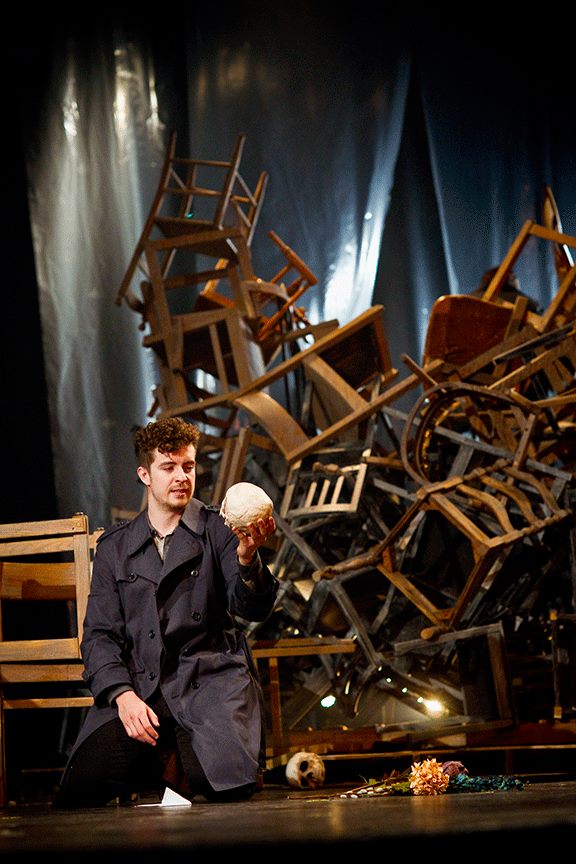
Dan Mousseau as Hamlet, set design by Nancy Perrin
The set design by Nancy Perrin is a curious sculptural construction. If it’s not post-apocalyptic it at least suggests the freight of associations we all bring to any new reading of a Shakespeare play, particularly this one. Can you say “anxiety of influence”? When I interviewed young Dan Mousseau earlier this week this was one of the things I wondered, as one steps onto a stage that echoes Hamlets of yore, both cinematic and live, heroic and hammy (including Mel Brooks glorious take in To Be or Not to Be).
From his arrival onstage, Mousseau is in command: of his text, of his story, of the evening. At times I felt as though I was watching a one-man show of soliloquys, interrupted by the occasional bit of business, because his readings were so extraordinary, so original, so confident, so effortless. I’d asked him about Hamlet’s age, because he’s younger than what we’re accustomed to , even if I have always been bothered by 40 year old Hamlets who are in their mother’s closet, a mother who is presumably still sexual at… 60 or more? Now if Hamlet is 22 (or playing 25, as Mousseau said), this is all that much more plausible. Claudius and Gertrude are younger, more vital, and Hamlet seems oppressed that much harder by their actions. His outcome is more tragic, beginning to resemble that of Romeo, as he and Ophelia are pushed by the offenses of their elders. The play is most vivid and alive during Dan’s soliloquys, as the play hits its stride whenever he’s alone. Perhaps that’s simply because the play itself is working very hard at times.
When the players arrive? Then it’s no longer just on Mousseau’s shoulders. Whenever there is a musical set-piece –and full marks to Jeremy Hutton, Kristen Zaza and anyone onstage during these magical moments—the piece comes fully alive. In the oath-swearing, in the funeral for Ophelia, in the fight sequence, Santalucia does well with his management of people onstage.
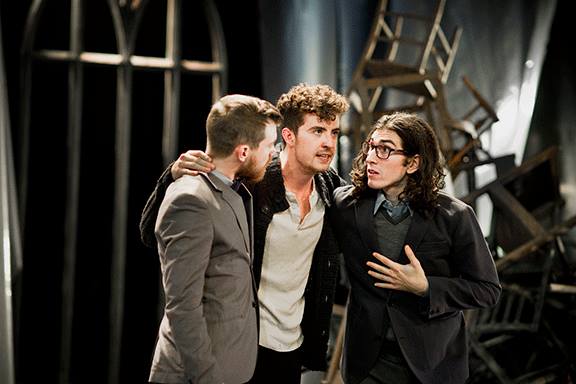
Alan Shonfield, Dan Mousseau and Dylan Evans
I don’t think I’ve ever liked Rosenkrantz & Guildenstern quite so much, the nerdy pair of Alan Shonfield and Dylan Evans, moody, conspiratorial, creepy. Nate Bitton gave us the different facets of Laertes –as the likeable and loving brother, fierce avenger, and eventually the one to validate Hamlet in the final scene’s reconciliation. Cameron Johnston gave us an interesting pairing, as the ghost and his brother Claudius, chanelling something a bit like Stephen Harper in his bland friendliness (did I make you shiver at the thought?). Annemieke Wade’s Gertrude is a sympathetic mother, very powerful in the big closet scene with her son. Thomas Gough hits the right notes as Polonius. Sheelagh Daly’s Ophelia, once given centre stage knew how to take advantage beautifully. Eric Finlayson was as likeable a Horatio as one could ask, while Andrei Preda’s Gravedigger energized the show just when it needed it.
In the end you will be moved. “Let the audience look to their eyes.”
Prime Minister Justin Trudeau, right, goes face-to-face with Finance Minister Bill Morneau at Rideau Hall in Ottawa on Nov. 4, 2015. (Sean Kilpatrick/Canadian Press)
If you are a Torontonian, no one can rain on this parade. The swearing in of the Trudeau Cabinet had the kind of breathless following of a Royal Wedding.
Can you say “honeymoon”?
Don’t get me wrong. I was in Trudeau’s corner way back when he was fighting Brazeau (not literally… a supporter, not a handler or anything), even before the “not ready” attack ads. I am delighted as the next Liberal supporter.
But recent experience watching the Blue Jays persuades me to be skeptical of the discourse. This is another bandwagon, and people will be leaping off before too long, and that’s fine. Democracy requires that. In fact right now it’s not a even a conversation, anymore than the screaming cheers in a bar when the red light comes on can be mistaken for critical thought.
I just had a thought, though. Toronto? we love the Liberals, and but for the aberration of 2011, rarely let a Conservative represent us, although a few ridings have been hard-core NDP supporters. So yes, we are in a honeymoon in Toronto. You can tell, when even a Conservative-owned media outlet like CP24 gets onboard.
But lest we forget. Stephen Harper won a majority with roughly 40% of the vote. As Liberal & NDP supporters were wont to say: “60% voted against him”!
And now, Trudeau is having his honeymoon with Ontarians (and you can see that he gets this, in the number of ministers from Ontario, his true heartland). And this is true for anyone / any place that voted for him.
The other 60%? are they having a honeymoon, or is it perhaps a shotgun wedding? i know that my NDP supporting friends seem kind of irritated that Trudeau has done all these activist things –promising to bring 25000 refugees by the end of 2015, the gender parity in the cabinet, the deficit spending– that used to be the hallmark of the NDP. Will they be won over? I think it’s possible, as some of these people are strategic voters who were simply seeking to avoid another Harper term.
The Conservatives surely are waiting. While they might have felt that their own party was snatched in the night and was replaced by a Reform changeling that they no longer recognize as “conservative”, at least of the old progressive populist style, they’re waiting. They’ll see what becomes of their party. They’ll see what becomes of the liberal promises.
I am reminded of the high hopes when Obama arrived in power, when the energy was also largely the energy of revulsion for the previous regime. Yes Obama was better, but how long can you let that sustain you? And similarly, how long can one smile at the thought of Trudeau replacing Harper?
If the economy does a big downturn, if the credit bubble bursts? We may discover it’s been a short romance. In the meantime, enjoy the warm sunny glow.
If you were to read Matthew Jocelyn’s biography on the Canadian Stage website you might be surprised.
Originally from Toronto and later based in France, Jocelyn is an internationally acclaimed producer and director of theatre, dance and opera as well as arts administrator and educator. He was the Artistic and General Director of the Atelier du Rhin in Alsace, France for 10 years. Under his leadership, he was responsible for establishing the organization as a major centre for theatre, opera and contemporary dance – the only multi-disciplinary artistic centre of its kind in France. In addition to his administrative and financial roles, he directed a number of productions at the Atelier du Rhin. As a result of his accomplishments, he was named Chevalier des Art et des Lettres (Knight of the Order of Arts and Letters), by the French Ministry of Culture in July 2008, one of the country’s most prestigious arts honours.
His professional credits also include: founding Théâtre de l’Autre Rive and Théâtre Des-Hérités in Paris; directing theatre, dance and opera in Europe’s most revered venues; guest director at Canada’s Stratford Shakespeare Festival where he received critical acclaim for the direction of Pierre Corneille’s The Liar (Le menteur) in 2006; developing and directing original plays, operas and translations in Canada, Switzerland, France, Germany and Brussels; and teaching at the University of Toronto, the American University of Paris, the Université de Toulouse-le Mirail and the Conservatoire National Supérieure d’Art Dramatique in Paris. He was appointed Artistic & General Director of Canadian Stage in February 2009.
We’ve seen a wonderful array of multi-disciplinary productions from Matthew Jocelyn, from brilliant talents such as Crystal Pite / Kidd Pivot and Robert Lepage. And yet it’s only now that we’ll have an opportunity to see Jocelyn direct an opera in Canada. Perhaps his biggest priority was in establishing & strengthening the company, building support before undertaking a modern opera. Jocelyn will direct a production of Phillippe Boesmans’ 2005 opera Julie, a collaboration between Canadian Stage and Soundstreams to be presented Nov 17-29 at the Bluma Appel Theatre.
I asked Jocelyn ten questions: five about himself and five about Julie.
1-Are you more like your father or your mother?
I’m more like my mother. We share the same nose.
I’d say both my parents were great influences on my life. My mother, because she was extremely non-judgmental and very free in her attitudes as to what people could do or be. And my father, well, because at heart he was an artist.
Matthew Jocelyn (photo: V Tony Hauser)
2-What is the best or worst thing about being a director?
The best thing about being a director, especially an opera director, are those moments in the rehearsal room with only a pianist and two or three singers performing for you; they crack something which creates a moment of truth for a character, which gives meaning to the music. It makes them sing what they’re singing that much better. It’s an incredibly fulfilling experience, being in a rehearsal room with singers.
The worst thing is when you’re not able to communicate an idea in a way that is helpful to the artist you’re working with, when you sense something that’s essential but aren’t able to find the words or the means through which to convey the message.
3- Who do you like to listen to or watch?
I love to listen to Bach. I love to listen to Melissa Laveaux… Annie DiFranco, to Carmel (Carmel always makes me dance).
And I love to watch really good Italian cinema.
4- What ability or skill do you wish you had, that you don’t have?
I wish that I could play the piano. I wish I spoke ten languages. I wish I could stop wishing that I could do things I can’t.
5- When you’re just relaxing and not working, what is your favourite thing to do?
To hike by the ocean.
*******
Five more about Matthew Jocelyn and Julie
1-Please talk about how you reconcile the different sides of yourself, as you function as a director of the show, where you are also artistic director of the company.
I would like to think that my work as an Artistic Director is a reflection of both the ethical and aesthetic considerations that I bring to my work as a director, and vice versa. So that really, they reinforce each other more than anything else. Luckily, I am surrounded by a team of people that are capable of holding the theatre afloat when I’m in the rehearsal room.
I would add that I think it’s essential for both the team and the company and for the audiences at Canadian Stage, to understand that my perspective is always one of a working artist. I’m always very conscious of the artistry and the nitty-gritty of the craftsmanship that goes into the various projects that we decide to support and collaborate on.
2- You’ve directed Julie before in Europe. Tell us about this opera and why you wanted to bring it here, your first directorial project of an opera in Toronto.
Director Matthew Jocelyn and Composer Phillipe Boesmans (photo: Isabelle Françaix)
Julie is an absolute masterpiece of a chamber opera. Philippe Boesmans is without question, for me, the most important opera composer in the world today. So the opportunity of doing one of his operas in association with Soundstreams, a company I greatly admire, was an exceptional one.
Philippe is also a very close friend that I’ve been collaborating with for more than 10 years, so it was an opportunity to continue to strengthen our artistic ties.
This production was performed in over a dozen theatres in France, Belgium and Switzerland, which shows the appetite the audiences have for this work.
3- Talk about why you place such a high importance on multi-disciplinary work in your offerings at Canadian Stage.
The Tempest Replica, presented at Canadian Stage by Kidd Pivot in May 2014 (Photo by Jorg Baumann)
What I place a huge importance on is the vocabulary that today’s artists are using in order to recount the world. It so happens that some of the most exciting artists – Crystal Pite, Michèle Anne de Mey, Jaco Van Dormael or Robert Lepage, Stan Douglas – are crossing over the disciplines. Because we are a contemporary performing arts company, what I’m really interested in are the most cutting edge artists and what their languages are.
I didn’t set out to say: “it’s got to be pluridisciplinary.” Many artists no longer feel restricted to simply being theatre makers, dance makers, or music makers in order to recount their worlds; they themselves cross over the boundaries. That’s what we want to share with the audiences.
4-Will we see more opera, whether directed by you or someone else, at Canadian Stage?
I hope we continue to see work that is relevant and fresh, and artistically demanding. If that includes opera, then fantastic! It would have to be chamber opera because there is no other conduit in this city doing this kind of work.
5- Is there a teacher or influence you’d care to name that you especially admire?
I’ve had a huge number of influences in my life. In learning my practice, the three people that had the biggest influence on me as a director were Patrice Chéreau, Mathias Langhoff and Jonathan Miller, all of whom I had the great honour of working with at some point.
I’ve been lucky enough to work with exceptionally talented and demanding artists and to see the work of hundreds of exceptional creators, like Philippe. All of that filters through somehow.
*******
Philippe Boesmans’ Julie will be presented November 17-29, a co-production of Soundstreams and Canadian Stage, directed by Matthew Jocelyn at the Bluma Appel Theatre.
Centre Stage 2015, the Canadian Opera Company’s ensemble competition gala, was a celebration of Canada & Canadian talent. Co-hosted by two former winners, we were treated to both official languages, thanks to Karine Boucher’s exquisite French pronunciation as a charming extra in her partnership with Charles Sy, and a visit from the Lieutenant-Governor herself, Elizabeth Dowdeswell. As a further showcase of domestic talent we were treated to wonderful performances from Andrew Haji & Joyce El-Khoury.
We knew it had to be different from last year, when three men (two tenors & a baritone) won the three prizes at the 2014 Centre Stage competition. If the Ensemble Studio was not to become totally unbalanced we couldn’t have the same sort of results.
A big clue as to what was to come? the list of the eight finalists.
Four of the finalists were mezzo-sopranos
Two were sopranos
Two were baritones
….and no tenors!
I picked up one obvious clue –no tenors—while missing the even more obvious clue, that half the finalists were mezzo-sopranos. All that was missing was a banner saying “welcome mezzo-sopranos!” perhaps with an apology as well.
And so it shouldn’t have been a surprise that first & second place went to mezzo-sopranos. First place went to mezzo Emily D’Angelo, while second place went to mezzo Lauren Eberwein. D’Angelo, a University of Toronto alumna, was a popular winner with the crowd, who also picked her as the audience favourite.
In a season when we finally see a Canadian composer’s opera grace the stage, it’s a feather in the general director’s cap. Alexander Neef has much to be proud of, along with conductor Johannes Debus leading the COC orchestra. The evening felt like a genuine celebration.
COC Music Director Johannes Debus and COC General Director Alexander Neef. (Photo: bohuang.ca)
I had the pleasure of meeting Dan Mousseau at Ryerson Theatre School, a remarkable training ground for many of the best actors in this country. You can surmise his range from the fact he’s been cast as both John in Miss Julie and Fluther Good in The Plough and the Stars, two of the most divergent parts one could imagine from the same young actor. It’s rare enough for an actor in his early 20s to be cast as Hamlet (although this is surely how I would prefer the casting, not with some virtuoso who is too old for the part), rarer still for an actor to get to do the part twice at such a young age. But so it is for Dan, who has already undertaken the role of Hamlet for Shakespeare at Play, an online compleat Shakespeare.
Dan Mousseau as Hamlet at Hart House Theatre (photo: Scott Gorman)
And he’ll portray the Prince of Denmark at Hart House Theatre beginning November 4th. I was glad to ask Dan ten questions: five about himself and five more about playing Hamlet.
1-Are you more like your father or your mother?
This is a tough question because I think that everyone is inherently a sort of combination of both. I see how I am a lot like both my Mom and my Dad. It’s funny actually as I get older I feel like I’m more like my Dad where I felt more like my mom in my younger years. My Mom has a wonderful compassion and sensitivity that I think I have inherited. My Dad has an incredible spirit, drive and fortitude. My Mom can also be a bit too sensitive and anxious and my Dad has a temper, both of which I’ve also inherited. At the risk of not answering the question, I think I’m a pretty equal serving of both and I am grateful for it!
2-what is the best thing about what you do?
I struggled with this for a long time when I really decided I wanted to be an actor. I desperately wanted to help people as a kid and always saw acting as an extraneous, elite career.
However, the deeper I get into this career the more I realize how absolutely necessary it is for all of us. I’m going to broaden this to all of the arts for right now, because I think that’s the necessary thing. People need art as a reflection of themselves and the world around them. To criticize the world and who we are as individuals in this world.
Hamlet himself says it in his speech about the players. He says the purpose of playing is “to hold, as twere the mirror up to nature; show virtue her own feautre, scorn her own image and the very age and body of the time his form and pressure.” I think that says it all. There was a very specific reason that art was created and it fills a very important hole for humanity to see who they are, to escape and to relate with each other through honest communication.
Break that down into acting, the ability to tell these incredible stories with my incredible fellow actors, is the best part. And it’s in these stories that I think people see themselves. To have the job of portraying these things as honestly as possible to connect to someone is a really cool thing. It’s like everyone in that room believes in magic for that one moment of connection.
3-who do you like to listen to or watch?
Surprisingly, I’m not a really avid music listener. I love music but for whatever reason I just never got into listening to it in my day to day life. I do become obsessed with certain songs or albums. I keep listening to Kendrick Lamar, Kings of Leon and Pink Floyd right now. I love George Gershwin’s “Rhapsody in Blue” actually, as a random side note. But overall, my love for music is just growing, but music is such a huge part of the show it feels like it fit to start listening to more now.
I love movies and TV, I’ve been watching a lot of Parks and Rec, Rick and Morty, Walking Dead, and the Graham Norton Show. I just finished Mad Men, which was a treat, I’m sad its over.
I really love dramatic movies, I have a taste for the drama and the weird, I guess. I just saw Goodnight, Mommy at Tiff Bell Lightbox, which was creepy as hell. But I love watching Sam Rockwell’s work, Daniel Day Lewis, Paul Thomas Anderson, and I really love Ryan Gosling. Haha, I feel like there’s a type that like Ryan Gosling, but I do dig his work. Number one for movies though is Stanley Kubrick, hands down.
4-what ability or skill do you wish you had that you don’t have.
Practically, for my work, I wish I had a photographic memory and a capacity to relate to any person and circumstance.
But I would either love to learn to play an instrument or learn another language. I would love to fill in the holes of my French knowledge. Those may be cliché answers but that’s it for me.
5-when you’re just relaxing and not working what is your favourite thing to do?
Spend time with my girlfriend. Haha, but all mushiness aside, I love videogames and I love reading. It would most definitely be one of the two. And the joy of having an amazing girlfriend is you can do either or both while you’re together.
Dan Mousseau (photo: Scott Gorman
Five more about preparing Hamlet.
1-Tell us about the challenges of learning the role of Hamlet, one of the longest roles in the language.
Before doing Hamlet for Hart House, I was fortunate enough to do it for a company called Shakespeare at Play. SAP is an App that combines a filmed video of a Shakespearean play with the text itself, which allows the reader to read along with the video simultaneously.
Doing that version, which is technically educational, we couldn’t cut a single word from Hamlet, which meant I had to learn all 2600 lines, or thereabouts. And each line is up to 10 words. Shakespeare also wrote in what is called Verse, a kind of arrangement of poetry, and prose, which is just like everyday writing. This means that the 2600 line number is a bit relative.
Basically Hamlet is onstage for 85-90% of a 5 hour play, and the majority of the text is him speaking to his friends, parents or the audience. And when he speaks to the audience, and often when he’s speaking to everyone else, he uses monologues (14 or more lines in a row). It’s a ton.
I am fortunate enough to be a bit of a sponge with lines. I find they sink in quite easily, especially when it comes to Shakespeare because the words have a rhythm that finds its way into the actor’s body. Although there were plenty of parts where I had to just repeat, repeat, repeat the lines to get them firmly in my head. I try to repeat one line, then learn the next line and repeat them both and I keep doing that until I’ve made a bit of a tower of lines, if that makes sense.
So having done Hamlet before, uncut, it was nice during this process, in which our amazing director Paolo and dramaturg Susan Bond, have made cuts, that I could just allow some of the lines to come back to me. Sometimes I have to watch that I don’t say too much!
2- Talk about the age of the character of Hamlet Prince of Denmark, and how you feel about portraying him in Paolo Santalucia’s production at Hart House.
This is a great question, as Hamlet is technically 30, it says in the script. There’s an interesting thing that happens as a result of Hamlet being a younger person, I think. So much of what Hamlet does is impulsive, while at the same time being withdrawn or thought out to the point of cowardice.
I’m 22 and we’re playing my Hamlet a little bit older since I think I read a little bit older onstage, 24-5 or so, which means I’m still younger than Hamlet himself and definitely younger than the usual casting of Hamlet. It’s strange to me that usually an older man or woman plays Hamlet. although I understand the need to have an experienced player at the centre of a show, what comes out of a younger or age appropriate actor playing Hamlet is something quite tragic in my opinion.
It’s the difference between seeing a young person with potential, a heart full of love, and a confused mind tossed about between these massive forces versus a middle aged person going through a bit of a crisis. The intensity of the parental relationships makes more sense to me since Hamlet is in the transition of letting go of his parents when this happens, he is going to Wittenburg, but he isn’t fully independent yet, which is a stage that is very vulnerable. To have this all (the play) happen at that stage, a stage we’ve all been at, is heartbreaking. The play happens right when Hamlet is discovering who he is as a person.
And right when he has it, he dies. It’s the loss of a great potential, a young, beautiful person who had their whole life ahead of them but is torn away too soon. I think Shakespeare wrote it that way for a reason.
3- in Shakespeare at Play – a Canadian website where one can see entire plays on video—you play Hamlet. Talk about the differences between the intimacy of a video reading and what you’ll be doing on the Hart House Theatre stage.
There definitely is a huge difference. As I mentioned before I had to know every single word for the video, which was one hell of a challenge but we could take multiple takes and it was broken up into shots.
There is nothing like “doing it live” as they say. Once we started doing the show from start to finish, I actually got to feel in my body what it felt like for Hamlet to go through this play. Who the people around him are and what happens to him. And it’s one hell of a journey, he goes through a lot.
When we filmed Shakespeare at Play, we started with the final scene. On the first day of shooting, I died. If was a challenge, and was an excellent acting challenge, to make that real and give the audience the feeling of what he’s been through before that moment. There are certain realities in shooting a film, who is available and when, that have to be taken into account. It’s different when you do a show top to bottom.
That also means its hard on the body, it has been hard on my voice and it is tiring. I’m swimming in buckets of sweat by the end of the first act. The set we have is amazing and tactile but that also means I’m climbing throughout the show too. And, in terms of vocal performance, I have to make sure every word I say is heard, even to the back row of the theatre. That’s a lot different than when I had a mic attached to me in the filming and I could whisper some lines.
That being said, having the energy of the audience is something that can’t be replaced. And going on the full journey that Hamlet goes through is extremely humbling and touching, plus this is several years later which means I’ve grown as a person and I hope my performance reflects that.
4- Playing Hamlet can be a humbling experience, a role where you are inevitably compared to some great actors from previous generations. Please talk about how it feels stepping into the role at this time in your career.
It is pretty humbling thinking about the amount of actors that have done this before me and the calibre of actors they all were or are. Benedict Cumberbatch’s Hamlet is being screened in theatres at the same time, no pressure! He’s amazing! Hopefully people will still want to see ours. Because the thing is, no two Hamlet’s can ever be the same.
I try to limit my intake of interpretations while I’m working on something, because I often worry that I will see something I like and then try to use it for my Hamlet. Doing this will feel fake to the audience and actor alike because it is a thing that didn’t come out of the actor, it isn’t organic, its like doing an impression of someone else playing Hamlet. I just saw Jonathan Goad’s Hamlet at Stratford too, which was hard to get out of my brain!
I try to look at Hamlet in terms of my life and what he means to me. I also look at the different ways I can connect to him, relate to him. We talk about what he wants and I find out what and who is important to him, how he reacts to events and situations and what his hopes and dreams are.
Despite the vast history of this character, the more he is me and mine, I think the more true and resonant it will be with the audience. That’s the goal.
5- Is there a teacher or influence you’d care to name that you especially admire?
There are too many to count! I am always influenced by my parents, siblings, grandparents, aunts and uncles, friends and teachers.
I want to say a huge thank you to everyone in the cast, in the crew, Paolo, Susan, Emma our assistant director, Jeremy our stage manager and everyone involved. It’s the people that im surrounded by every day doing this show that inspire me.
*******
Hamlet begins at Hart House Theatre November 4th, running Wednesday – Saturdays until November 21st.