A Musical, The Importance of Being

I’ve just seen & heard the Toronto Operetta Theatre’s production of Earnest, The Importance of Being, a recent adaptation of Wilde’s play of (almost) the same name.  It was premiered in 2008 by TOT, music by Victor Davies and book by Eugene Benson, a work that I believe deserves to be heard.

The title isn’t just a playful departure from the original.  One of the wonderful things about E,IB as I’ll call it, is how it literally leads with the names.  You may recall that in Wilde’s play –as in this musical work—the drama revolves around the names.  Young Algernon and Young Jack are pursuing Cecily  and Gwendolyn.  They both want someone named “Ernest”.  The discomfort each woman expresses with the other names become exquisite scat, tortured exploration of the sounds of “Algernon” or “Algie”, or “Jack”.  If it’s a truism that a musical begins where words leave off, expressing what can’t merely be said but must be sung, then this central conceit of the play requires music.  I think that raises the stakes, making the transformation from spoken into sung something organic.

There’s a magical moment near the end when Miss Prism tells her story, something that sounds like a bit of Gilbert & Sullivan. That’s what Anna Russell would have told us, and it’s as though Benson and Davies heard her funny bit describing how to write a Gilbert and Sullivan opera.   She tells us about “Dandelion, the large fat contralto with a voice like a foghorn”.  No, Rosalind McArthur is not fat nor does she have a voice like a foghorn (much nicer than that actually!) , but otherwise Benson & Davies follow Anna Russell’s Gilbert & Sullivan template.  Listen to this roughly 1:20 into the excerpt which comes right after the “madrigal”: which come to think of it, ALSO turns up after a fashion in Benson and Davies’s E,IB.  After the madrigal, Miss Prism–just like Anna Russell’s fictitious Dandelion– enters and makes a confession “assisted by the chorus.”

Forgive me if this seems to make light of their achievement.  But part of the brilliance of their version is precisely in the references to what has come before, in alluding to forms & practices to suggest a period and its culture.  Benson & Davies mostly hit the mark.

But excuse me if I mislead you.  E,IB is an eclectic work drawing on several influences. At times I think I hear Romberg alongside the G & S, and sometimes we venture elsewhere, such as a curious ensemble that is like a debate between a can-can (as Cecily confesses her fascination with Paris) and a tango (as everyone else speaks not of Madrid but Birmingham… okay I don’t see why it’s a tango but it sounded great nonetheless.  I am sure Director Guillermo Silva-Marin loved it. And if it sounds good let’s forget about any silly purist notions of how the work should be done. You won’t hear any stipulations from me).

In writing such a review I have to balance my response to the original work –the composition, the adaptation, and the questions of genre—vs the performances and interpretation.  One wonders if one is seeing something that departs from the text and reflects the input of the performers and/or director, or are we seeing something true to the work as written?  And I second-guess, wondering a pair of what-ifs: what if it were written/composed differently, and what if it were performed/interpreted differently.

I believe this work deserves to be heard at a venue such as the Shaw Festival.  But I think the work I heard would be better served by musical-theatre specialists, by performers less intent on singing beautifully (as these were opera singers for the most part), than on being understood.  At times we were hearing fewer than 50% of the lines, which is sad when the chunks of text I did hear were so brilliant.  If it were up to me –and haha in a moment you’ll see why it shouldn’t be up to me—I’d use a smaller band, to make it easier for the singers to be heard, or –as in most musicals nowadays—bite the bullet and use amplification.  I am not a purist, I’m a pragmatist, and I would argue by the way that if Wagner were alive today he’d be the first to advocate amplification, considering that he did the best he could in 1876, by covering the pit at Bayreuth.  While the singing is often stunningly beautiful, the impulse to make a big beautiful sound leads us into a place where lines are unclear.  This is why sub / surtitles are used even for operas in English and might be a welcome addition here.

Clearest pronunciation of the night?  I think it was Jean Stillwell as Lady Bracknell.  I was struck by the thought that she probably looks far more believable than many playing the part, given that the dowager portrayal we sometimes get  (especially thinking of the impersonation by someone like William Hutt) is a handy thing when you’ve got mature actors as Algie & Jack (say in their 40s?) requiring a Lady Bracknell who is completely past it, but must look believably older.  But if the men are as youthful as Cam McPhail and Thomas Macleay? Then Lady Bracknell can be a handsome mature woman, which is what we had with Stillwell.  Forgive me for sounding sexist, but I think there’s additional electricity if for a change Lady Bracknell is beautiful, rather than grotesque.  Stillwell still has star power and her every entrance was aided and abetted by a powerful signature tune from Davies & the orchestra.
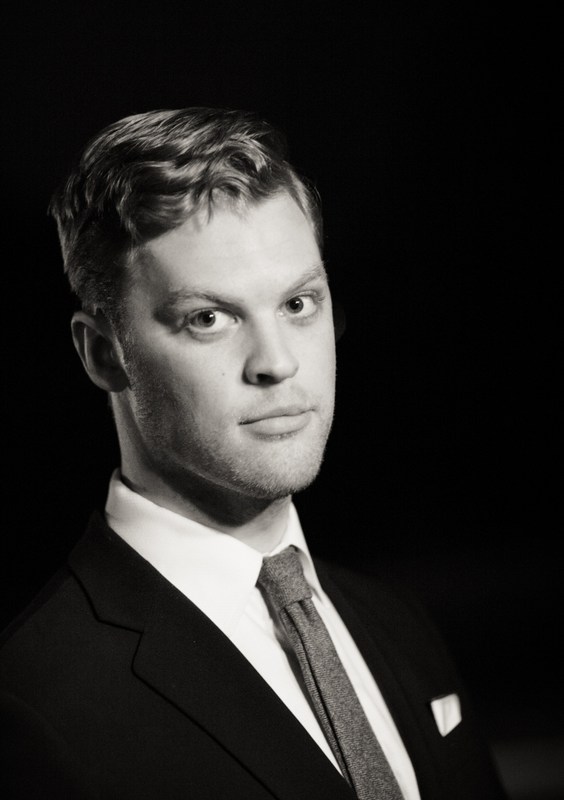
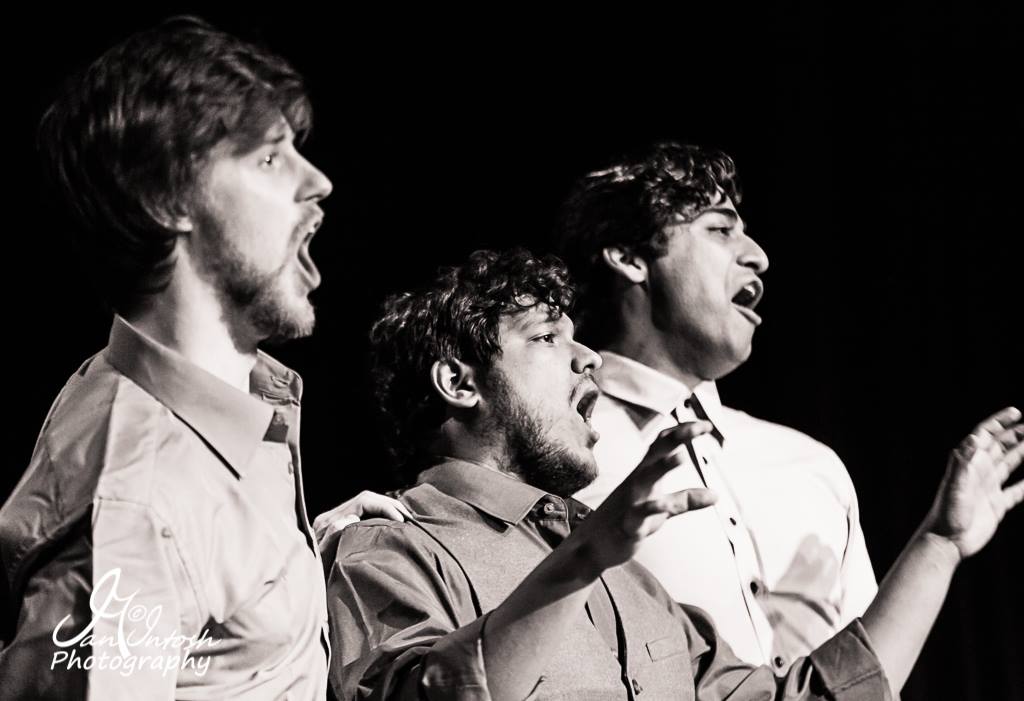
Baritone Cameron McPhail

Baritone Cameron McPhail

Macleay and McPhail are an attractive pair with contrasting voices.  Michelle Garlough as Gwendolen and Charlotte Knight as Cecily were stylish in their approach to the comedy, Knight adding lots of delightful coloratura.   Gregory Finney as Canon Chasuble was very pointed in his delivery of his many punch-lines, his warm baritone a welcome addition to the ensembles.

And so, enjoyable as the evening was, the work deserves a chance to be treated not as operetta –that is a funny crossover hybrid where opera singers speak and sing with big opera voices–but an actual musical.  Is that what they wrote and how it should be performed? You tell me, as i think “musical” is as vague and undefined a word as “opera” or “operetta”. We learn ultimately be experimentation, workshops, different approaches.  Among musicologists operetta = musical.  But is there a difference?  I think it’s in emphasis, which is to say, the approach by the performers. Give the piece to a group who can make it as truly brilliant as what was written. Thank you Guillermo & TOT for birthing the baby, nurturing and bringing the work to life; now let it fly out of its nest to find its true home.

Shaw Festival, are you listening?

And one last thought, namely for Conductor Larry Beckwith, who kept the whole eclectic mix going, leading the small TOT orchestra and cast with great clarity & integrity, faithfully serving the score above all.  E,IB has two more performances Saturday night and Sunday afternoon at the St Lawrence Centre.

Posted in Dance, theatre & musicals, Opera, Reviews | 4 Comments

Towards a new theatre vocabulary: Lepage, Cavalia and the legitimacy of aerials

It’s aerial week in Toronto:

  • Robert Lepage’s pair of brief operas (Bluebeard’s Castle / Erwartung) for the Canadian Opera Company open May 6th at the Four Seasons Centre, including moments when you can’t tell which way is up

    Erwartung, directed by Robert Lepage, set & costumes by Michael Levine

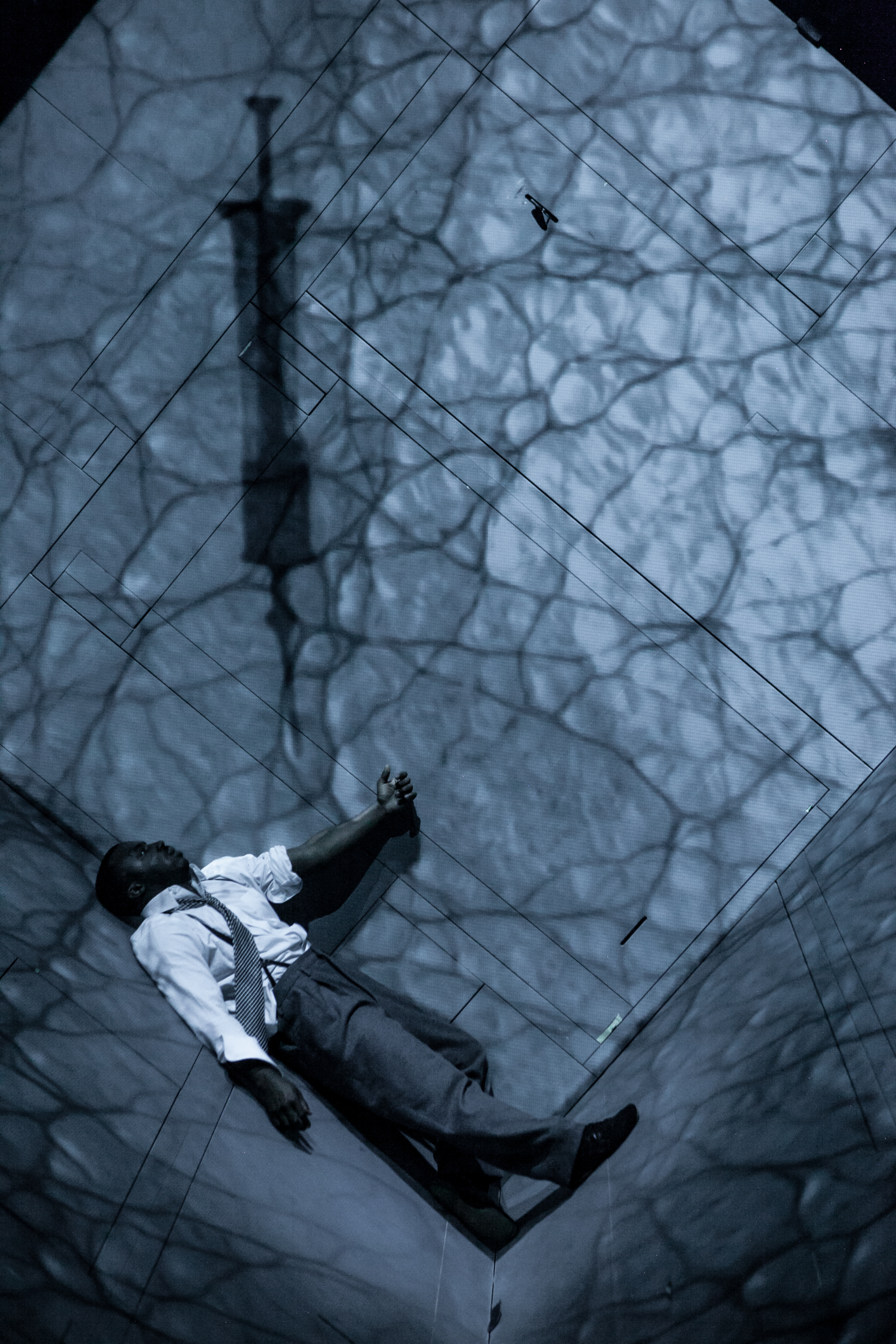
  • Robert Lepage’s Needles and Opium comes back to Canadian Stage May 1st (last seen here just over a year ago), much of it a test of agility as the set rotates while the protagonist attempts to stay right-side-up

     Wellesley Robertson III in Needles and Opium. Photo by Nicola-Frank Vachon.


    Wellesley Robertson III in Needles and Opium. Photo by Nicola-Frank Vachon.

  • And meanwhile, Cavalia continue their mix of horses, acrobats & aerial display in their current show Odysseo on until at least May 24th (review).

Once upon a time someone wrote a song about someone who “flies through the air with the greatest of ease, the daring young man on the flying…”  You know which song I mean because of course you finished the sentence in your head.

But the word “circus” is limiting. None of these shows is really in a ring (the meaning of the word “circus” after all), even if Odysseo does briefly make horse and rider race around inside the confining circle of the enclosed ring space. The “c” word is dated. Gone are the days of entertainments comprised of traveling performers who can barely make a living. No, shows such as Odysseo—currently playing to rapturous crowds under the big white tent on the waterfront in Toronto –or influential precursors such as Cirque du Soleil demonstrate that there’s a lot of money to be made in daring aerial performances.

I’m less interested in the financial questions than I am in the way this plays out in the larger world. What may have started out as a flavour of the month, a case of keeping up with the Jones’s (or Lepages), shows signs of becoming a normal part of opera and theatre. Sometimes such daring displays are necessary, as in a show such as the Broadway Spiderman where the lead character is required to be a daredevil.

But I know I’m seeing these skills deployed elsewhere, and would list more examples if I could think of them. I recall in the COC Love from Afar we saw floating performers to complement the spiritual element of the story.

(left to right) Acrobats Antoine Marc, Sandrine Mérette and Ted Sikström in a scene from the Canadian Opera Company production of Love from Afar, 2012. Conductor Johannes Debus, original production by Daniele Finzi Pasca, set designer Jean Rabasse, costume designer Kevin Pollard, and lighting designers Daniele Finzi Pasca and Alexis Bowles. Photo: Chris Hutcheson

(left to right) Acrobats Antoine Marc, Sandrine Mérette and Ted Sikström in a scene from the Canadian Opera Company production of Love from Afar, 2012. Conductor Johannes Debus, original production by Daniele Finzi Pasca, set designer Jean Rabasse, costume designer Kevin Pollard, and lighting designers Daniele Finzi Pasca and Alexis Bowles. Photo: Chris Hutcheson

In the COC’s production of Semele, recently revived at Brooklyn Academy of Music, at one point Jane Archibald as the heroine has to fly on a wire.

Jane Archibald in the title role,of Handel’s “Semele” at BAM. Photo: Jack Vartoogian (click image for New York Classical Review).

The current Houston Opera production of Die Walküre running until the weekend, puts their Valkyries in the air using machines.

Houston’s Die Walkure (click for more info)

And lest we forget the baroque side of things, Opera Atelier usually have an airborne god or goddess every season: for instance in last month’s Orpheus and Eurydice.  Everything old is new again?

Lepage’s approach seems to be a big part in the shift, making this part of a new normal. He challenges his singers, expecting them to be aerialists.

  • In Das Rheingold he dangles the Rhinemaidens above the stage for 20 minutes, creating a magical effect.
  • Later in the same opera, Loge the trickster god walks backwards up a wall. And at the end of the opera, the gods enter Valhalla, at least with the help of body doubles climbing at a scary angle.  The substitution is similar to the one Lepage makes with Brunnhilde at the end of Die Walküre
  • Lepage’s next operatic venture –in Quebec and also at the Met– was Ades Tempest, again taking us into the air.

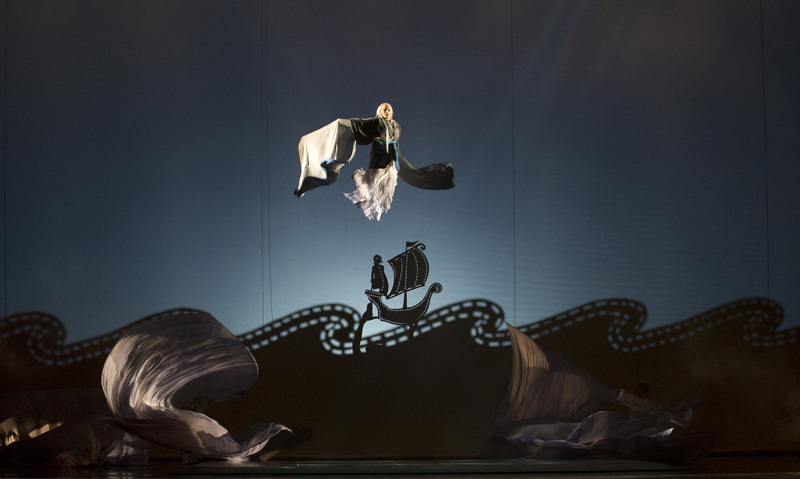
    A scene from Robert Lepage’s production of The Tempest at Festival Opéra de Québec, 2012 © Nicola Vachon 2012 (click for more info)

  • Lepage’s first opera at the Met wasn’t really an opera, but Berlioz’s Damnation de Faust, a work that’s wide open to adventurous mise-en-scène. There’s probably more aerial work in this production than any other. My favourite such moment –among many—is the chorus of soldiers & students, when we’re told of the siege of girls’ hearts. The soldiers climb and then die, dangling from the wires, but fresh waves keep attacking and dying; is this a display of futility or simply normal life as it was lived in the time? As usual Lepage drills down into the literal meaning of the text, almost too literal.

Last night I was reminded of those dangling soldiers, watching Odysseo. I tweeted

They resemble angels until the moment it looks as though they might fall. Mortal angels? I guess not. #Odysseo

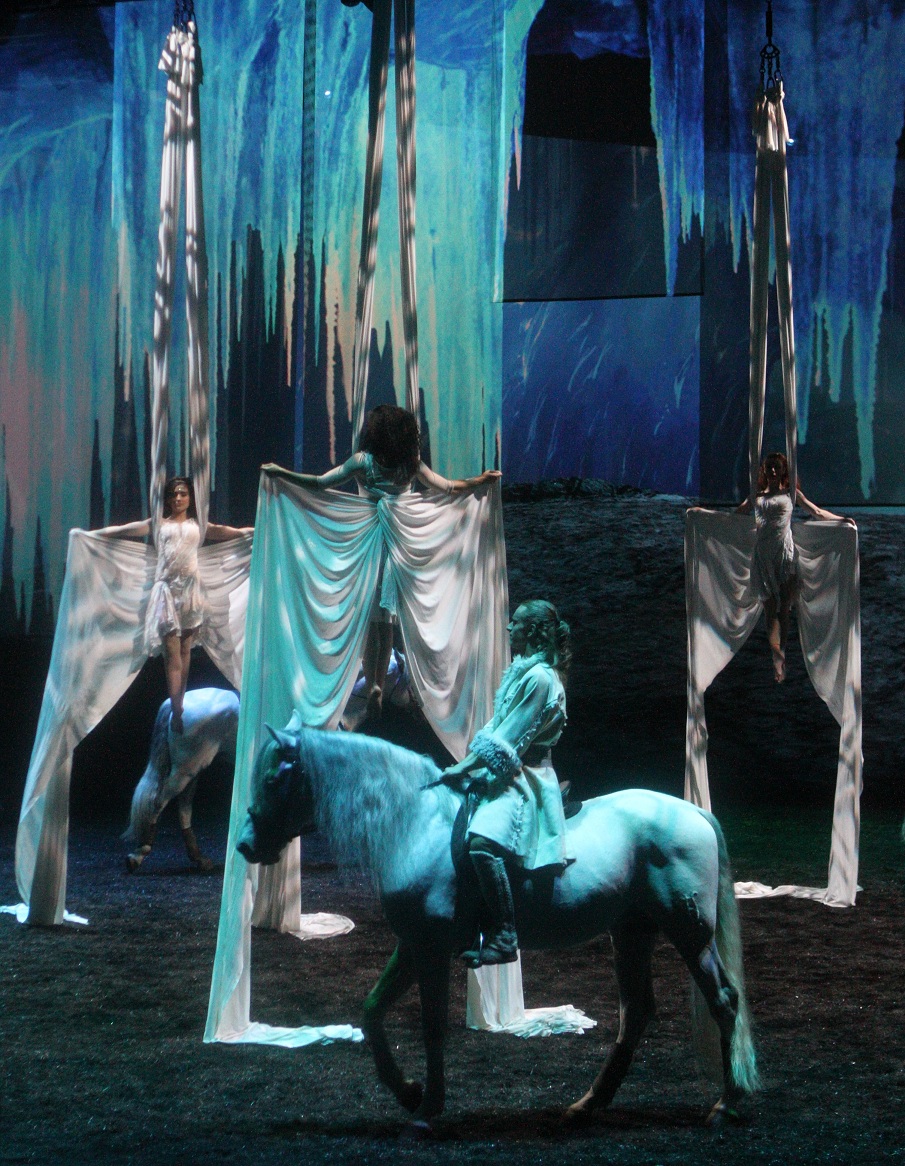
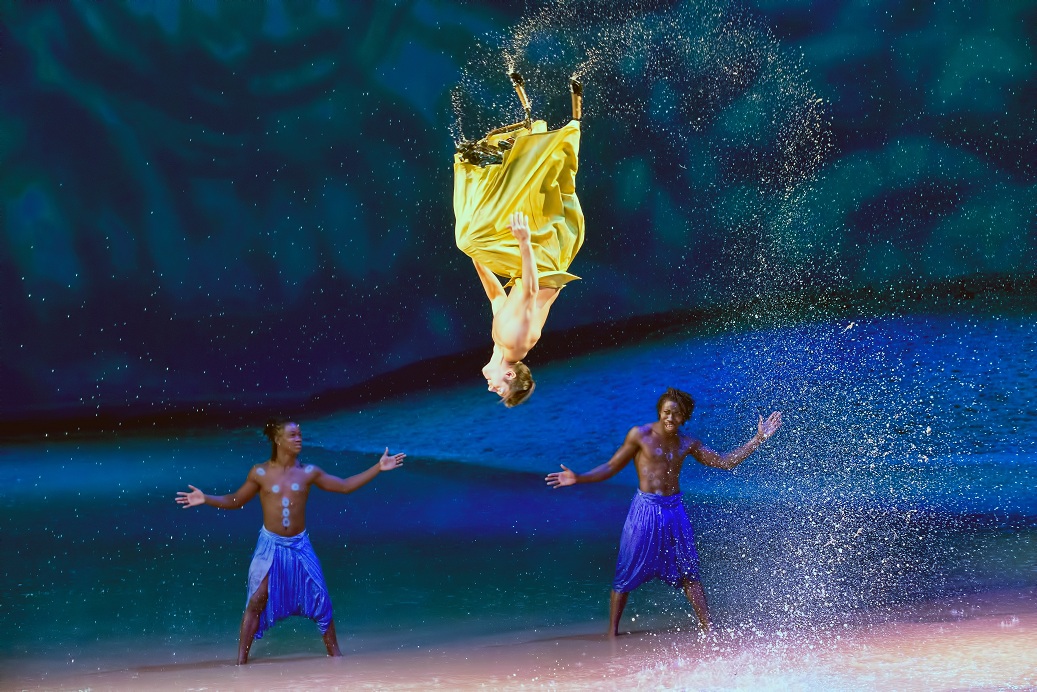
There is a moment near the end of their routine when the aerialists dangle in a way to remind us that they could indeed fall, as if to say they are mortal after all, very much like Lepage’s soldiers.  Curiously, the photo that was downloaded to media is titled “Les Anges”, suggesting that the overtones of something spiritual aren’t just in my mind.

Les Anges (Photo credit:  Pascal Ratthé)

Les Anges (Photo credit: Pascal Ratthé)

The influences don’t seem to work in the usual way, as this isn’t Cirque influencing Cavalia –two competing spectacles of acrobatic skill. No. I have to think that it’s Robert Lepage possibly influenced by his Quebecois compatriots, possibly himself influencing them. This part of Odysseo is a very abstract kind of theatre that’s far more ambitious than just “he flies through the air with the greatest of ease”.

Because the days of the old-time circus –the place where animals are abused, where survival is marginal–are over and thank goodness.  At the very least Cavalia is a kind of “Circus 2.0”, humane, artistic, and seeking to be profound.  The animals are treated with dignity, the performances an enactment of love.

Don’t be surprised if aerial performance is a regular part of the expressive vocabulary of theatre.

Posted in Animals, domestic & wild, Art, Architecture & Design, Dance, theatre & musicals, Music and musicology, Opera, Personal ruminations & essays | 5 Comments

Barber @ RBA: voice trumps schtick

Today’s noon-hour presentation at the Richard Bradshaw Amphitheatre was a teaser, sampling Act I of the upcoming Ensemble Studio performance of Rossini’s Barber of Seville.  These concerts are usually less than an hour including announcements, but today’s was a very full hour with almost no talk.  I’d say we got our money’s worth, which is fair considering that it’s a free concert.

I’ve already seen the production with the regular cast, a highly visual exploration of the text from Els Comediants that appears to have been influenced by the Commedia dell’Arte.  At times the movement vocabulary from director Joan Font requires his performers to behave as though they were puppets.  I came away from the production feeling a bit unsatisfied, delighted with some brilliant individual performances but unconvinced, at least in comparison to the previous show I’d seen from the same artistic team.

I’m not sure how much today’s concert –using piano (the excellent pianist Jennifer Szeto), and without sets or costumes—is a fair sample of the Ensemble show coming May 15th, but I had many of the same feelings today.  Els Comediants’ understanding of The Barber is something I’d characterize as Regie-light, a director’s theatre that doesn’t mess with the original even as the personas of director and designer are inserted into the field of view & reception.  It’s mostly a good thing, but nowhere near as thorough as the clarity they brought to La Cenerentola.

A concert performance makes it easy to get close to the artistry, without any Comediants interventions to distract us.  All we have is the voices & piano, plus a few stage directions.  While there may be some shenanigans overall voice trumps schtick.  When we were laughing it was because of artistry, not gimmicks.

Tenor Andrew Haji (click image for his website)

Andrew Haji did a star turn today, (echoing the pathway charted by Alek Shrader in the “A” cast) both in his stylish singing and his energetic clowning.  Iain MacNeil gave him a run for his money, making “A un dottor della mia sorte” work the old-fashioned way, namely with a buffo voice & dead-pan delivery.  Karine Boucher showed us that her Berta will likely take a different  interpretative approach than Aviva Fortunata, briefly terrorizing everyone on stage, suggesting that she’s got a genuine gift for comedy; I can’t wait to see what she does with the role, even if it’s brief(was it Stanislavski who said “there are no small parts, just small actors”..?).  Charlotte Burrage, Clarence Frazer, and Jean-Philippe Fortier-Lazure also displayed ample charm & high spirits.

The aforementioned Ensemble Studio performance is coming Friday May 15th.

Posted in Opera, Reviews | 1 Comment

Fearless Metro Youth Opera Béatrice et Bénédict

We live in a funny time.

On the one hand it’s the era of director’s theatre, when operas can be a departure point for elaborate adventures so extreme that the composer’s work becomes mere background music for interpretations of the story that may seem to have little to do with what’s in the text, generating spectacular attention in the press due to booing audiences. Yet at the same time it’s an era of fundamentalism in the musical world, between historically informed approaches, or conductors insisting on an approach of “come scritto”, refusing to interpolate the traditional high notes.

In this minefield of contradictory impulses, companies may surprise us with their productions. Metro Youth Opera is a fairly recent company aiming to create opportunities for young singers & artists in the fields related to opera production.

Perhaps it was an omen that I ran into Linda Hutcheon, literary theorist and author of A Theory of Adaptation at today’s Metro Youth Opera production of Béatrice et Bénédict, Berlioz’s version of Shakespeare’s Much Ado About Nothing. At one time I used to worry about the divergence between the source and the resulting opera, a question I understood as one of fidelity, that I now see as a bogus concern.

Berlioz wrote his own libretto for B & B, freely cutting what I would understand as the main storyline of the opera –the drama surrounding Hero’s slander and eventual redemption in Claudio’s eyes – in favour of secondary plotline concerning  Beatrice and Benedick.  Many of the other characters, both high (Don John) and low (Dogberry) are removed from the story. MYO’s Béatrice & Bénédict is itself an adaptation of Berlioz’s opera by Rob Herriot, using English dialogue and with musical numbers sung in French with super-titles. There’s no chorus and there’s no Somarone (a character we don’t miss). I’m not clear as to whether these omissions are in Herriot’s text or a further change made by MYO, but the point is that MYO presented a very slimmed down B & B, accompanied by music director Natasha Fransblow at the piano, roughly two hours with an intermission. I say this huge preamble in defense of an opera that is outside the standard repertoire (aka the works that are regularly produced) possibly because it’s unfaithful to Shakespeare, even though many popular operas also fail to measure up. Berlioz created a highly original, tuneful piece with much to recommend it, and one that MYO are to be commended for having undertaken.

Alison Wong accomplished a bit of a miracle, shared with her cast members, of making the comedy believable, as though we weren’t watching an opera, but instead experiencing a play.The Aki Studio space is somewhat dry in its acoustic yet so intimate that we’re right on top of the performers, able to see every facial expression. We discover that we care about Béatrice (Simone McIntosh) and Bénédict (Asitha Tennekoon), intrigued by their denials of affection for one another, and the birth of a romance between them. Our empathy begins in the skilful dialogue, as each figure is firmly established. Tennekoon shows us more voice early on, soaring with effortless agility to several high notes.

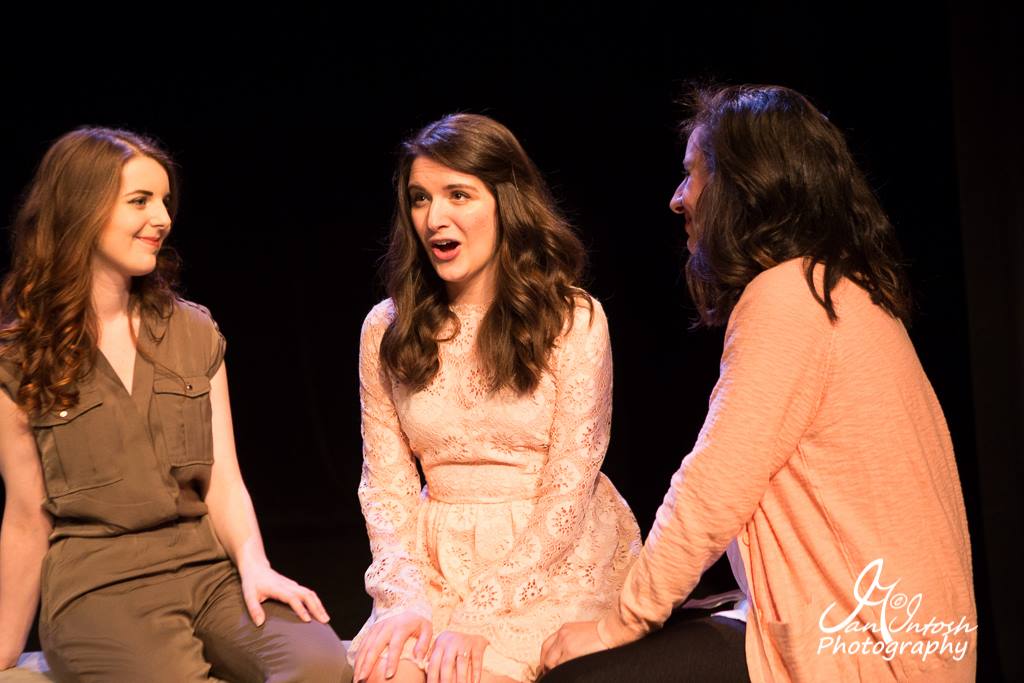
Simone McIntosh, Lindsay McIntyre and Alessia Naccarato (photo: Ian G McIntosh)

Simone McIntosh, Lindsay McIntyre
and Alessia Naccarato (photo: Ian G McIntosh)

McIntosh blossoms in the second act showing off a unique colour; while the role usually goes to mezzo-sopranos she hit spectacular high notes that make me eager to see the path of her future development.

Left to right: Peter Warren Asitha Tennekoon and Janaka Welihinda (photo: Ian G McIntosh)

Left to right: Peter Warren Asitha Tennekoon and Janaka Welihinda (photo: Ian G McIntosh)

Lindsay McIntyre was a delightful Héro¸ especially in her first act aria. Alessia Naccarato’s Ursule was a good addition to the comic mix, her voice blending beautifully in her duets with McIntyre. Janaka Welihinda & Peter Warren were also a pleasure to watch. The performance sparkled on the musical side, the ensembles tightly following Fransblow, often at a brave tempo.

I congratulate MYO Artistic Director Kate Applin for the slightly off-beat choice of opera, an excellent learning opportunity and a brilliant showcase for the fascinating cast she assembled.

Posted in Opera, Reviews | 1 Comment

Youtube’s revolutions, big and small

It’s youtube’s tenth anniversary today.  Much will be written / spoken about the impact of this empowering channel and its imitators, the influence on political movements.  It’s played a role in uprisings & elections, actions both democratic and violent.

And there have been changes in how media are disseminated.  These too are revolutions, even if the changes are subtler.

I’m not troubled by the way youtube helped Justin Bieber, who is really just another teen idol after all.  When all’s said and done he’s a star on merit.

I was more intrigued by the appearance of Gangnam Style (2012) and other overnight video phenomena.   Who could explain the excitement?  People do attempt to explain, but that’s nothing new.  A long long long ago I can still remember how …Don McLean’s American Pie inspired many to try to explain. 

Culture is both the new created object and the conversation that surrounds such objects.

Youtube has impacted everything. Puppets, wrestlers, sports, and yes, even classical music.

A short time ago everyone was talking about Valentina Lisitsa, whose success is inconceivable without youtube, one of the canniest bits of self-invention I’ve ever seen.  What’s so wonderful to me about youtube is how the process has been simplified & democratized.  At one time great artists had to somehow get the attention of a Sol Hurok or a Rudolph Bing, usually with the help of their agents & a step-by-step progression from obscurity to eventual success.  Surely it’s a good thing when artists can reach their audiences without mediation or interference.

But there’s so much more to it than that.  I am inclined to seek the positives, to recognize the ways in which we’re in a golden age.  The internet is a colossal research library, where you can learn about anything at all, and how wonderful that you can also compare versions of your favourite aria or symphony or piano sonata.  Who plays the fastest finale & coda to the Apassionata sonata?  Youtube will help you find this out (and don’t listen to me, do the work yourself).

I did a play in February that included several songs that I couldn’t find in the music library.  The titles and lyrics were in the text, so I thought to look on youtube, finding almost all of them.  And so I notated the songs, which we learned for the show even if they sometimes represented deeply coded texts that could keep a person busy for a lifetime of exploration: which is hardly a problem when we’re speaking of drinking songs.

The fact it’s free is a key part of the equation.  What happens if google (that is, youtube’s owner)  begins charging for the service? Those of us who can’t live without it would adjust somehow, i guess.  I suspect if they do charge, free competition will appear.

In the meantime, I’m sure that things will change, as nothing stands still for very long.  It’s only ten years ago, yet it feels like such a long time.

Posted in Personal ruminations & essays, Popular music & culture | Leave a comment

Ararat: Music of Armenia

That’s better!

Peter Oundjian is back in the saddle leading the Toronto Symphony with his easy authority, and once again there is an intersection between political and musical spheres, but without the friction we saw last time.

Those parts of the world who are not in denial of the Armenian catastrophe of 1915 are commemorating the centennial. Roy Thomson Hall was packed including a large Armenian contingent, the excitement palpable. We were told that this special concert –titled “Ararat: Music of Armenia” –was a result of a collaboration between film-maker Atom Egoyan, and Oundjian,  to commemorate the 100th anniversary of the Armenian Genocide.

There were four very distinct sections to the concert.  First came three songs by Gomidas Vartabed, to show us the “father of Armenian classical music”, as if to give us background for the more recent compositions that were to follow.  They were sung by Isabel Bayrakdarian in arrangements by her husband Serouj Kradjian, who participated from the piano in the midst of the orchestra.  Bayrakdarian employed some extraordinary sounds, a bit different from the voice I’ve known for so many years, singing at times with an unaffected directness that I would compare to the sound one makes in youth before one acquires the technique of a great artist but at all times the voice had clarity and commitment, a portrayal of pain in arrangements of great clarity & directness.  They added a fourth song, namely “Groonk” (or “the crane”), as the bird is asked for news from the homeland far away, this latter song as background for what was to come.

The other item before intermission was Khatchaturian’s Violin Concerto played by a young Armenian violinist Sergey Khachatryan. To my ear it’s Khatchaturian’s usual mix of wonderful rhythms, soaring melodies and an accessibility that made Khatchaturian a favourite in Stalin’s time. Young Khachatryan’s approach was very transparent, very clear, especially in the lyrical second movement, breath-takingly beautiful.

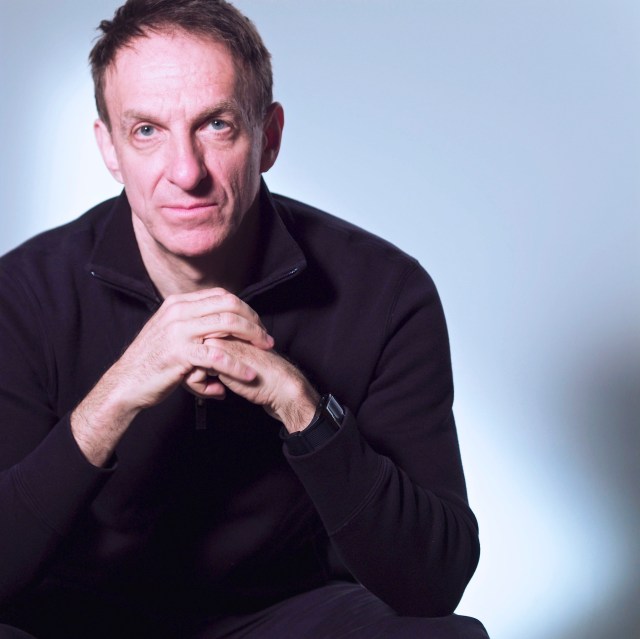
The second part of the concert opened with an electrifying world premiere / TSO commission, namely Ararat, a score by Academy Award-winning Canadian composer Mychael Danna that’s an elaboration of music for Atom Egoyan’s 2002 film of the same name. Danna might be the most successful composer in this country, with a large body of work in the cinematic realm.  Whether he chooses to re-purpose existing compositions or compose new music for the concert hall there’s certainly room for more if it’s anything like this.

Composer Mychael Danna (click on image for website)

Composer Mychael Danna (click on image for website)

Having been to many premieres of original music that only saw a single performance, I devoutly hope this work sees the light of day again, perhaps getting recorded. Danna’s score is ambitious in all the right ways, exploring a story that is officially denied in some parts of the world. I couldn’t help feeling that the first parts of the work –featuring three Armenian instruments, namely, the tar, the duduk and the kemanche—framed Armenia within an objective world witnessing this truth, the sombre orchestra enclosing but not silencing their distinctly ethnic sounds. In a latter part of the work, Bayrakdarian sings beautifully –I am sorry I don’t know the text she was singing, possibly from the aforementioned crane song?—framed by the most curious use of brass, that seems to stand in a kind of commentary, not unlike the countries denying the history, and with a genuine air of menace. In places Danna’s music has the blunt simplicity of film music, getting right down to business without wasting time or empty rhetorical gestures. This is music unafraid of making an emotional appeal, unashamed of conventional tonalities and without the anxiety of influence plaguing conservatory composers. This is among the most beautiful original music I’ve heard in a very long time. To repeat, I hope that this music is recorded! It deserves to be heard.

The closing items were every bit as direct & enjoyable, a Suite by Khatchaturian including several familiar melodies, a rousing conclusion to a very special concert.

Posted in Music and musicology | Leave a comment

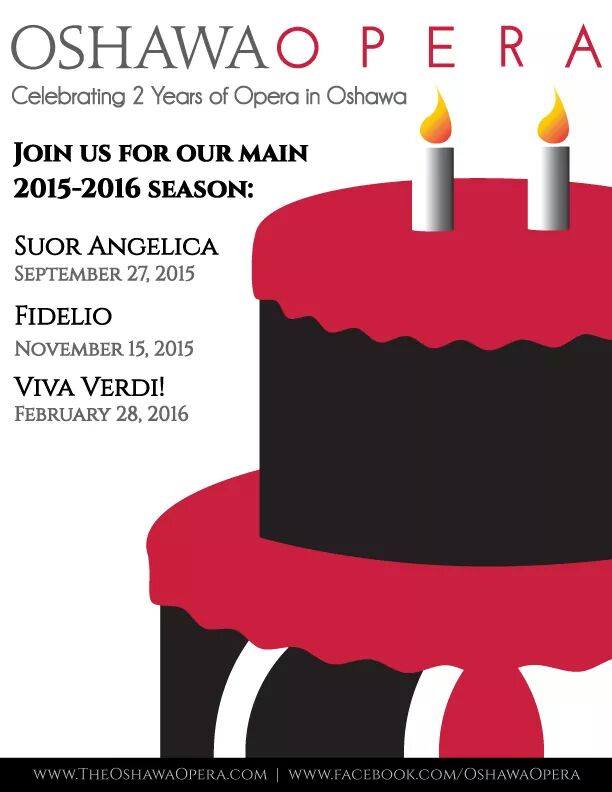
Oshawa Opera 2015-16


OSHAWA_OPERA_201516_REVISED2OSHAWA OPERA–2015-2016 Season
Celebrating 2 Years of Opera in Oshawa

Suor Angelica Septembre 27, 2015

Suor Angelica: Natalya Matyusheva
Zia Principessa: Catherine Carew
Kristine Dandavino: music director (piano and chorus)

Fidelio November 15, 2015

Leonore (Fidelio): Brigitte Bogar
Florestan: Jason Lamont
Kristine Dandavino: music director

Viva Verdi!  February 28, 2016

Stacie Carmona (soprano)
Kristine Dandavino (mezzo-soprano)
Jason Lamont (tenor)
Michael York (baritone)
Oksana Vigan (piano)

“Press releases and announcements” are presented verbatim without comment

Posted in Press Releases and Announcements | Leave a comment

Ten Questions for Wendy Nielsen

Wendy Nielsen is one of the most influential people in Canada’s opera community.

After an international career as a soprano that has included starring appearances at the Metropolitan Opera, Nielsen went on to create a private voice studio.

Wendy Nielsen as Ariadne in Calgary Opera's  2009  production of Strauss's Ariadne auf Naxos with Richard Margison as Bacchus (Photo: Trudie Lee)

Wendy Nielsen as Ariadne in Calgary Opera’s 2009 production of Strauss’s Ariadne auf Naxos with Richard Margison as Bacchus (Photo: Trudie Lee)

Nielsen is Acting Head of Voice at the University of Toronto’s Faculty of Music, the Head Vocal Consultant for the Canadian Opera Company’s Ensemble Studio, and Artistic Director of three vocal programs at St. Andrews by the Sea in New Brunswick.

If you sing well chances are she had something to do with it, and if you aren’t singing right she’s one of the people you could turn to, to make things right. In March I reviewed Postcard from Morocco from the U of T Opera Department, including some of her students. And now the Ensemble Studio of the COC are preparing their annual show, the May 15th performance of Barber of Seville.

I had to ask Nielsen 10 questions: five about herself and five more about the Ensemble show.

1-Are you more like your father or your mother?

Of course, I have a bit of both my parents in my personality. I try to emulate my father’s even temperament and my mother’s love of a good laugh. They are both very good amateur musicians, music is certainly a big part of our family life. I asked my husband who he thought I was most like and he replied without pausing that I am most like my paternal grandmother. She certainly was a huge influence on me in the most profound of ways.

2-What is the best thing or worst thing about being a voice teacher?

The best thing about being a voice teacher is witnessing a singer find their best expressive self when the technique works. It is thrilling and completely addictive!

Worst thing, hmmm I guess commiserating with them when the business of singing let’s them down.

3-Who do you like to listen to or watch?

I don’t listen to much classical music in my free time. I enjoy all types of music and especially a lot of east coast musicians. You can take the girl out of New Brunswick etc….

Watch? House of Cards, Call the Midwife

4-What ability or skill do you wish you had, that you don’t have?

I wish that I was a better swimmer and I would love to have some talent in some sort of visual art. Every summer I think i am going to create some sort of multiple media thing, one day!

5-When you’re just relaxing and not working what is your favourite thing to do?

I love to read and have a morning ritual of getting up at 7 , making a cup of tea, going back to bed and reading for a half hour or so before turning on the computer and getting on with the day. It makes me feel as though I am in control, ha! Seriously, I usually read a little something inspirational, something to think on for the day. Then some fiction, devouring the books of Kate Atkinson at the moment.  And sometimes a little geeky moment with a vocal pedagogy text.

When I am home in NB, I love to jam with my husband and son on my new passion: the accordion!

Wendy Nielsen

Wendy Nielsen

*****

Five more about teaching singing & preparing the Ensemble Studio for their annual production, The Barber of Seville on Friday May 15th.

1- You began your career as a singer before becoming a singing teacher. What teachers were most influential for you as a singer, and also in your understanding of how to teach singing?

Most influential teachers. There are several beginning in childhood with my first school music teacher Kate Jackson in Harvey Station, NB. It was in her class that I first heard opera in about grade three. “Vesti la giubba”, I was thrilled by it! I also remember her playing “Der Erlkonig” and being terrified that she would play it again and desperately wishing that she would play it again.

I had an amazing English teacher in high school, he also directed the Drama club: Alfred Paul-Elias. He let me have free range of expression and encouraged me to act, write and direct my own shows.

My first voice teacher was seminal, Mabel Doak. She taught me the importance of good tone, always! George Evelyn at Mount Allison and University of Lethbridge taught me to be a diligent musician and to sing with physical connection. At UBC,French Tickner ruled the opera department and he taught me so much about stage craft.

When I moved to Toronto I studied with Mary Morrison. We now have studios next door to one another at U of T! Lessons with Mary were always an exploration and not a dictation, this helped me so much through the years I was in the COC Ensemble and receiving such a wide variety of feedback. Dixie Ross Neill was the head of the Ensemble then and she really recognized the potential in my voice for specific repertoire. I think I learned as much from Donald Palumbo, the COC chorus master ,during those years as from anyone. Michael McMahon, pianist and a frequent collaborator of mine,was a tremendous influence on me as a singer and as a teacher. Shortly after beginning the summer program that I oversee in St Andrews he came onboard and helped to create the atmosphere of learning that continues to this day.

I would say that the single biggest influence on my singing and teaching were the twelve seasons that I was at the Met. To sing on that stage and to be able to watch rehearsals and performances with the best in the world was a school like no other. In my early 40s I was fortunate enough to be introduced to Marie Daveluy who is the single biggest vocal influence upon me. Her aesthetic and dogged pursuit of freely produced sound affected me deeply and informs my daily teaching.

Liz Upchurch

I continually learn so much from my colleagues,in particular Liz Upchurch at the COC, Malcolm Balk an Alexander Teacher from Montreal, Tom Diamond stage director and Jennifer Swan, body/breath specialist.

2- Most people think they can sing, but opera is something else again. Please talk about singing opera, and how the use of the voice differs from other kinds of singing.

Opera singing is the heaviest weight class in the Olympics of singing. We maximize our own internal acoustic in order to be able to project without a microphone into big opera houses. We all have vocal cords and opera singers have ones that look much the same as others.  What we do work toward is maximizing our breath control so that we can get ample volume and the ability to sustain long lines.Think of an athlete who has the same body parts as everyone else but has focused on the function of a particular muscle group and its coordination to become an elite athlete. I work with a couple of singers who are not opera singers. One of them is David Myles, a wonderful singer song writer from NB. During a session last week we were discussing his falsetto and his upper full voice. The lesson could have easily been for an opera singer because those sorts of issues are the same. He needs to be able to reproduce the notes with ease and expression even though he uses a microphone.

3-What are the challenges of working with the Ensemble Studio in preparing their annual production?

There are particular challenges in helping the Ensemble prepare for their one show in the run of Barber, this year. It is thrilling for them to have this opportunity to sing a leading role in a mainstage production. This is a superb training opportunity. The Ensemble show is chosen carefully to provide the best fit possible for the voices in the program, certainly Walkure wouldn’t be a good show for the Ensemble 😉

One of the biggest challenges in watching and absorbing rehearsals (many of the Ensemble members are official covers for the lead roles as well) is being ‘unduly influenced’ by the main cast. As singers we are aurally susceptible and whether we intend it or not, we absorb the voices that we are exposed to. It is difficult not to do an imitation of the person one is covering , in particular if their voice qualities are similar. You must be able to do the staging as it is planned with your body and character ideas but this is challenging. Fortunately, the Ensemble will be well rehearsed by Allison Grant and they have told me already that she is working hard to be true to the production while respecting their individual performances. That said, the converse is true. One can gain a lot of knowledge from watching the pros rehearse and perform. I remember the thrill as a COC chorus member to be onstage with Aprile Millo in Andrea Chenier, watching her
breathe and produce that glorious sound.

4-If you could give one instruction to young students who might read this, what would you tell anyone studying singing?

Richard Bradshaw, conductor & general director of the Canadian Opera Company (Michael Cooper/COC)

One piece of advice for singers ‘Cultivate your uniqueness’. The late Richard Bradshaw, who was another exceptional mentor to me, once told me that all of the great voices in opera and other genres had one thing in common. They were recognizable within a couple of notes.Who wants to sound like everyone else?!?!

5- What voices would you point to –either singing today or from the past—as examples of the best technique, and do you ever imitate/ emulate anyone either in your own life as a singer, or more recently as a teacher (in recommending that a student try to sound a particular way)?

There are so many great singers for students to listen to and so many of them are singing at the COC these days, thanks in no small part to the efforts of Alexander Neef. His influence is huge and I respect what he is doing so much, he is so invested in the Ensemble and their success as individuals. It is a joy to be a part of it.

To have Furlanetto here was extraordinary, I am constantly suggesting that baritones and basses listen to him. I had the pleasure of singing Donna Elvira to his Leporello at the Met. His singing is perfection.  I am quite enamoured of the Italian sound, Bastianini is the pinnacle. I am also a huge fan of Mariella Devia, the Italian soprano.My all time fav mezzo is Cossoto and tenor would have to be Corelli.

Stephen Clarke, who oversees the Stratton Collection and Foundation, has encyclopedic knowledge of singers and repertoire. I count myself fortunate to be able to be treated to visits when he plays his favourite recordings.  Ben Heppner’s Tristan here was like witnessing history. Russell Braun’s numerous roles over the past several seasons have been a huge inspiration to the young men at. U of T. And the sopranos and mezzos have had Jane Archibald, Adrianne Pieczonka, Elizabeth DeShong, Marie-Nicole Lemieux, Christine Goerke and Sondra Radvanosky to revel in.

We are living in a golden age of singing in Toronto!

*******

May 15th, the Canadian Opera Company present The Barber of Seville with a cast drawn from the Ensemble Studio.

Posted in Opera, Personal ruminations & essays, University life | Leave a comment

#OdysseoTO: the Golden Age of The Circus

I saw Cavalia’s show Odysseo today at their big tent on the waterfront, in the company of my Mom & a rapturous grand-child.  The world has certainly changed.

I’m reminded of the Commedia dell’Arte that was featured in the Barber of Seville that I saw Friday.  Theatre and circus have a history as a marginal life-choice, starving actors & acrobats who were treated as vagabonds & criminals.  At one time people ran away to join the circus even though you’d never get rich.

Now?  One goes to circus school, and one doesn’t have to run away to do so.

The Cirque du Soleil was in the news this week as there was talk of a billion dollar buyout of the mega-corporation, one of Quebec’s great cultural assets.  While there have been movies portraying the circus business as fraught with risk, that’s only for those who don’t understand how to do it right.

Flash forward to the 21st Century.  Cavalia are circus 2.0, keeping the good parts while jettisoning the negatives:

  • While you still have animals in this modern circus, they’re not treated cruelly or demeaned, the way European circuses were wont to do. These animals are put on a pedestal.
  • While there is fun, the old-fashioned clown is nowhere in evidence. Instead we’re in a spectacle that’s mostly serious, even operatic.
  • The music is modernized
  • Promotion is over-the top. Go anywhere in Toronto and you’re likely to see a Cavalia poster, hear an ad on TV, or see a flyer.
  • The opportunities for revenue generation are everywhere. I brought home a stuffed toy –in the hands of the aforementioned moppet—as well as a couple of DVDs.  Where the magic of the circus used to be evanescent as a momentary thrill and then forgotten, those moments are now captured in media permitting extra $ to be generated.

This isn’t the circus tent of yore.  

Nope, times have changed.  The circus tent is different….

Before one even gets inside the big-top on the waterfront to see Odysseo one is already in a magical place.  The shapes are larger than life.  We’re south of the Gardiner Expressway, in a liminal space between city & lake, sky and water, as if we were on the edge of the world.

And what’s inside is different too.  Modern music, CGI projections, and a sophisticated understanding of the audience.  No wonder we’re seduced so effortlessly.

Moments of great virtuosity & skill are alternated with moments of repose, opportunities to simply breathe, to reflect upon the stunning spectacle.

Cavalia's Odysseo (photo: Lynne Glazer)

Cavalia’s Odysseo with acrobats Ismaël Bangoura and Balla Moussa Bangoura, plus stilter Lucas Mendoça. (photo: Lynne Glazer)

Let me answer the key questions.  I sat in the absolute back row with my aged mother.

  • The view was good even there at the very back (row U as in UP!). There are no bad seats
  • My mom and I clambered to that top row. She gave me a look at first, but the stairs are amazingly solid for a theatre that was built on vacant land.
  • The seats were comfortable for the entire show: an opening act of one hour, a thirty minute intermission and then another hour to the end
  • The washrooms are more than adequate
  • There are lots of souvenirs of course… if you’re coming with children that’s a must

I’d suggest arriving early if at all possible.  You get inside, and then you can hang out, have a beer, get comfortable before the show.

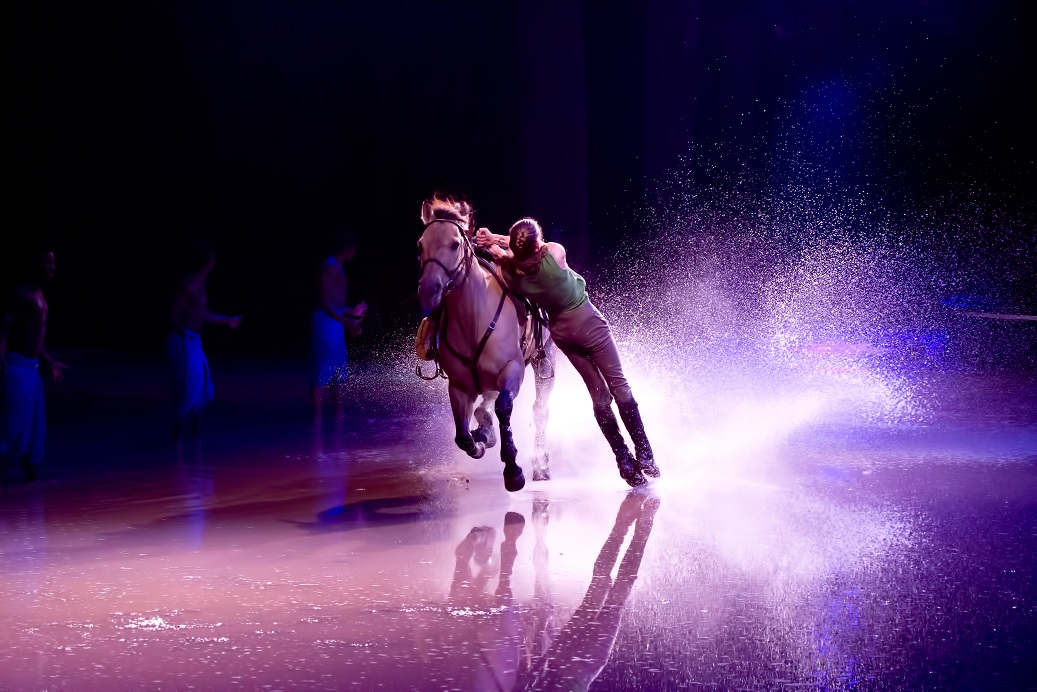
The television ads emphasize the equine element. I’m not a horse freak although I have to confess I was blown away by what I saw. There’s an aura of love around the show, the animals and their riders seeming to be in such harmony that it’s almost an insult to speak of this as “circus”, when I think of what that word usually implies.  This is more like art, a spectacle of dance, music, movement, and yes, horses.

Finale of Odysseo with rider Ramon Gonzalez (photo: Lynne Glazer)

Finale of Odysseo (photo: Lynne Glazer)

It’s like the Circus Maximus minus the cruelty.  Remember the scenes in Gladiator, where we see a pitched battle between two armies in front of roaring crowds?  At the heart of that spectacle is the magic of seeing humans and horses racing full tilt around an enclosed space in front of a crowd.  The power of the muscles being flexed –human or equine—make for a visceral experience that can’t adequately be captured on a camera.  Live is best.

I didn’t realize it wasn’t all horses.  My favourite performances are the aerials, sometimes including horses, to truly mess with you.  I find it hard enough to imagine hanging upside down above a sandy floor, without adding a cantering animal to the mix.

There are several intangibles.  Alongside the flexing muscles, the stunning physiques, the CGI conjuring exotic locales, or the pond through which creatures run on two or four legs, add a musical score that’s a funny mix that I’d call New Age Quebecois, at times jazzy, at times like an ethnic version of Philip Glass.  I’m not sure if I would demean them to say no expense has been spared, when this might simply be the result of excellent taste and artistry.  The multi-cultural look of the cast –riders, aerialists, acrobats and others—is nicely reflected in a score of many colours & styles, including interludes that hold their own on purely musical terms.

The first hour vanished like that first glass of champagne you drank as a teen, which is to say gone before you realized, leaving you high and giggly.  I did not expect to enjoy myself so much.

The Circus is no longer the scruffy marginal life we recall from long ago.  It’s a classy entertainment approaching art, aspiring to something magnificent.  You’ll never know if you don’t go.  

Posted in Dance, theatre & musicals, Reviews | 5 Comments

“Location location location”

The saying goes like this:

“‘There are three things that matter in property:
location, location, location.’”

It’s also true in theatre.

I have a subscription to the Canadian Opera Company, a pair of seats in the second row. When I offer them to friends (when one or the other of us can’t make it) I’ve been told there are disadvantages to this location:

  • Surtitles are hard to read from up close
  • The orchestra is very loud
  • And some people think you need to be far away to see the full stage picture, rather than have it right in your face

Yeah right.  And sometimes I only prefer to smell chocolate or a glass of wine rather than tasting it and drinking it.NOT!

Let me interrupt this tirade to toss out a few theoretical tidbits.

Opera always seemed to be the medium for people who have a lively imagination.  Wagner expects us to imagine gods, giants, talking birds, dragons, nymphs, and rainbow bridges.  Opera composers –not just Wagner—expect us to watch lovers sing about their passion.  And for centuries we lapped it up, largely because we had no choice.

Slavoj Zizek’s Twitter profile photo (click for his Twitter profile)

No choice?  Because there was no MTV, no film, no porn industry.  Opera was the place to go to encounter love and lust, a place for vicarious delights.  In Zizek’s Opera’s Second Death the idea is put forward that opera was replaced by Freud, Jung and the psychiatrist’s couch.

I say that all as a preamble to some of what’s ailing opera right now.  Just as it’s a truism to say that the groundlings of Shakespeare’s time were easily able to handle the bard’s wordplay, or at least more easily than a modern audience, so too with the imaginary challenges posed by opera.  We may be daunted at the thought of flying horses or the twilight of the gods, but at least it’s been possible to imagine middle-aged singers portraying Romeo or Juliet (both in their teens), or Madama Butterfly, herself a mere fifteen years old.  Why? Because we don’t sit close, we listen and are enchanted.

Need I add, that until recently, fat women regularly portrayed the object of desire without anyone suggesting this wasn’t believable.  I find it disappointing that plus-sized divas are not as common as they once were, as though the opera world is catching up to the literal-mindedness found everywhere else in modern culture.  I thought opera-lovers were better than that.  But I digress.

Times have changed.  We don’t just have Freud, Jung and the rest of them.  We also have cinema, another possible cause for opera’s demise: that is if you believe the rumours of its death.  I think opera is alive, but that the audience is continually changing.  We have been watching film for over a century, and television for over half a century.  Our understanding of drama has been transformed, both as viewers / auditors, but also as performers.

So let me get back to the live theatre question.

I was fascinated that some reviewers were completely delighted by the new Canadian Opera Company Barber of Seville, while some (myself included) had misgivings.

Could it be a function of location (that is: where we were seated)??

When I see an opera for the first time from my subscription seats I am sometimes entranced by elements that simply don’t work from a distance. Last night I saw Barber from Ring 3, while I know that some of the reviewers were in the orchestra, closer to the action & the performers.  Alek Shrader and Renato Girolami played their movements & expressions larger than life, whereas I found that, however charming the singing & expressions of Hopkins as Figaro, the subtleties didn’t read for me in my balcony seat.

I am reminded of an old concept, namely the Serlian stage(read more about Sebastiano Serlio here): an approach to the stage whose perspective only worked for the Prince: whose seat was the focus of the perspective.  Imagine a theatre where only one seat saw the set properly, and where every other view was distorted.  In some respects that’s what you get if you have a performance where singers can’t be heard or their performances appreciated outside of the good seats.

I thought I’d encountered a modern version of that experience when I saw Robert Lepage’s Ring, where the broadcast audience had a better experience than those in the theatre: because the singers via amplification sounded adequate, but not so good in the hall (where some were actually booed).  And I realized I’d seen something similar –also from Lepage—when I saw his Stravinsky operas with the Canadian Opera Company.  I’d been enchanted when I saw it from my second row seats, but when I saw it a second time from somewhere up high (Ring 4 or 5?) suddenly the powerful puppets that captivated us when they were ten feet away, had little or no impact to those of us up top, a group who were puzzled at what all the fuss had been about, given how weak the impact of the visuals up in the nosebleed section. While i don’t think Lepage meant to impose a class distinction, the implication was clear to me: that the best experience was had by those who paid for the best seats, while the cheap seats offered a mere shadow of that experience.

The Metropolitan Opera is genuinely democratic, taking its mandate as a national treasure seriously, by insisting that performers play big, so that those who can’t afford a princely sum, can still see and hear a good show. I don’t believe the COC is aware of this issue, perhaps seduced by the rapturous press usually given in support of their excellent opera house.  Yes it’s excellent, but it can’t work miracles.  While I could hear really well up there, if a singer stands still and emotes as though he were in a TV show rather than in a big theatre, his expressions won’t be seen.

Some performers manage to be brilliant at any distance.  Sondra Radvanovsky, Susan Graham, Michael Schade, Russell Braun, Gerald Finley, have all been magnificent whether seen up close or from afar.

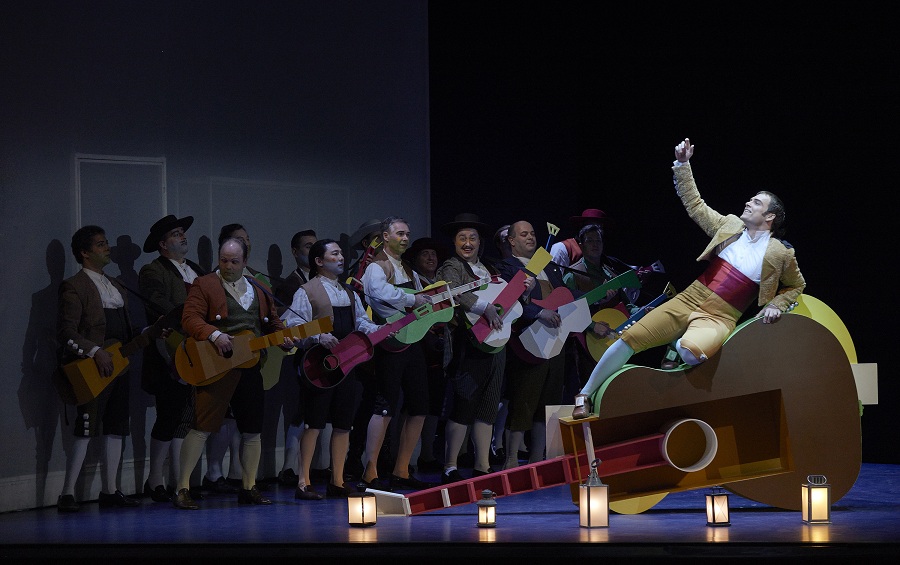
Alek Shrader as Count Almaviva (far right) in the Canadian Opera Company production of The Barber of Seville, 2015. Photo: Michael Cooper

Alek Shrader as Count Almaviva (far right) in the Canadian Opera Company production of The Barber of Seville, 2015. Photo: Michael Cooper

Most recently, the expressions & singing of Girolami & Shrader worked from afar.  But this is a great reminder as I come up to the deadline to renew my subscription tickets in the second row. I’m not about to give up these seats, not when so many performers seem to act as though they were in a film rather than a live theatre.

Posted in Cinema, video & DVDs, Opera, Personal ruminations & essays, Psychology and perception | 2 Comments