Loose Tea’s Artistic Director Alaina Viau today announced that Loose Tea will host “Whose Opera Is It Anyway?” on July 22, 2015 from 7pm-9pm at the Office Pub at 117 John Street. Cost is $25 per person includes a free glass of BareFoot wine, nibbles and sore cheeks from laughing too hard . Proceeds will be used to fund the summer opera Dissociative Me an English re-work of the classic “Faust” set in modern times.
A night of opera shenanigans where Loose TEA is doing IMPROV opera! The company singers will be taking the games from “Whose line is it Anyway” and daring to do them while singing opera! Hear a Verdi aria sung in the style of Madonna, or Don Giovanni serenading about flying cats in space.
Hosted by Toronto comedian Andrew Johnston, with DJ’d music this is the party to be at! Bid on the improve element in selected games and have your suggestion played out by out incredibly talented singers!
The event will feature Michael York, Gregory Finney, Whitney Mather, Kijong Wi, Fabian Arciniegas and Charlotte Knight. Loose Tea is a nonprofit organization whose purpose is to make opera accessible to the modern public and bring in a new audience.
Loose Tea is Not Your Grandfather’s Opera – run by a group of arts innovators, Loose TEA offers Torontonians a bold new live music experience. We mash up Classical music and turn opera on its head.
“Press releases and announcements” are presented verbatim without comment
Never read a review before seeing something about which you have no choice. Adults & children seeing a film aimed squarely at a child? Best to be a child or to be like a child.
In Matthew 18:3 Jesus says “Truly I tell you, unless you change and becomelike little children, you will never enter the kingdom of heaven.”
No i wasn’t thinking deep spiritual thoughts, but this is what I channeled today seeing Minions, the prequel to the Despicable Me films, and is the only way to approach such a film.
Minions is good.
The little guys are funny.
I did not expect to laugh.
It is the same joke
Over and over.
That is not a problem
Not if you are six years old.
I missbeing six. I miss living in the now.
What’s so good about being able to say “that’s not funny?” For Wagner I need the big words. For Hitchcock I need the fancy ideas.
Not for this.
This is a giggle.
Tickle the dog.
Get your face licked.
Wet and messy.
When I engage the part of my brain with the bigger words I start to think, hmm, what exactly are minions and why might this be a troubling series of lessons? Minions are slaves, workers, and have no individuality or even gender. That is probably fine when you are six, but if you were a minion? I cherish my individuality, and am more than just my function in the huge impersonal machine of production.
That the minions all speak a kind of gibberish is on the verge of being disturbing. The cute sounds they make have precedents. The little dudes in Star Wars films are often cute-sounding. In the first film we meet the Jawas, in a later film it’s the Ewoks.
What exactly are we laughing at, if we are laughing at them, I wonder. This is no time to be over-thinking the codes for cute and cuddly, the reasons for fun.
At least not yet.
Is Minions a project designed to make lots of money? Yes. I am wary, as if I were consuming a genetically modified apple, wondering what I am tasting and why I am liking it. What is this doing to my brain, and even more scary to contemplate: what is this doing to the brains of six-year-olds?
I fear the attraction because I do not like being manipulated. When Wagner or Hitchcock do it—manipulation –I am fine with it. Great artists screw with our heads all the time. Commercial products with no apparent redeeming value, however, are a different story.
If it were a better piece of art I might surrender fully, the way I do in the presence of a really luscious brownie or sticky toffee pudding. Calories be damned give me sweetness laden with fat! But there are two things that stopped my surrender as surely as a badly executed harmonization. One was my resistance to Sandra Bullock as the lead villainess. I experienced this as an actor trying to work against type which is usually fine onscreen if you can make me believe. Why did I resist? I hate to think I am sticking Bullock into a mental category, stubbornly refusing to see her as a possible villain; but in my defense, I have to say animation is different. We are not in the realm where we can see the performance, and if the voice is too subtle –and that is the nicest thing I can say for her—then it simply won’t fly (and for me it didn’t).
The other issue is writing. At times I felt I was watching filler, a cartoon that could have been over in less than half an hour. I won’t deny that a couple of times I almost fell asleep. That might also be an issue for Bullock, who can’t be faulted for failing to transcend the material.
But I did laugh, especially when i remembered to pay attention to the children. It is funny once you surrender to the spirit of the little child in you, because at that moment you may be surprised that you are screaming with laughter. This is decidedly unlike Inside Out, which was full of big laughs that the adults got and the kids did not.
If you see this film, the only thing to remember is what Jesus said via Matthew. Forget everything else.
My friend Attila Keszei is back. Attila, an engineer who offered heroic leadership in the quest for sustainability and reducing the university’s carbon footprint retired from the University of Toronto a few years ago. But his creativity continues unabated, retirement allowing him to focus his energies completely on his art. His new show at the U of T Faculty Club displays recent works.
Is age finally mellowing Attila’s work? You be the judge.
He has several distinct styles.
1-some of his works are simple representations of nature or humanity often telling stories, possibly even religious in nature.
2-some of his works are political in nature. Attila speaks of this as “concerned art”, which is a very gentle name for it. As a Hungarian expat in Canada this manifested itself in several ways. But I didn’t see anything of that sort in this show.
“White Venus” (Raku fired ceramic – 2015 Attila Keszei)
3-some of his works are sensual or even sexual in nature. Sometimes that means explicit images, sometimes it may be more ambiguous. I’d say that several of these works at the very least hint at sensuality, while a few are so blatant that they will make some people blush, at least once it’s pointed out to them what is depicted in the art.
“Homage to Georgia O’Keeffe Flower #1” (Raku fired ceramic – 2015 Attila Keszei)
Georgia O’Keeffe is Attila’s favorite artist, and a natural departure point for his own explorations.
“Homage to Georgia O’Keeffe Flower #3” (Raku fired ceramic – 2015 Attila Keszei )
4- From time to time, the engineer peers out of his art. “The 41st Day” might be a whimsical response to something in the book of Genesis, but it is essentially an attempt to capture the magic of terrestrial physics. We see sunlight meeting water but in person one feels the stunning drama of this medium of super-hot ceramic melting and being shaped into something touchable and cool, the sun tamed as though by a sustainability engineer’s cleverness.
“The 41st Day” (Oxidation fired ceramic – 2014 Attila Keszei)
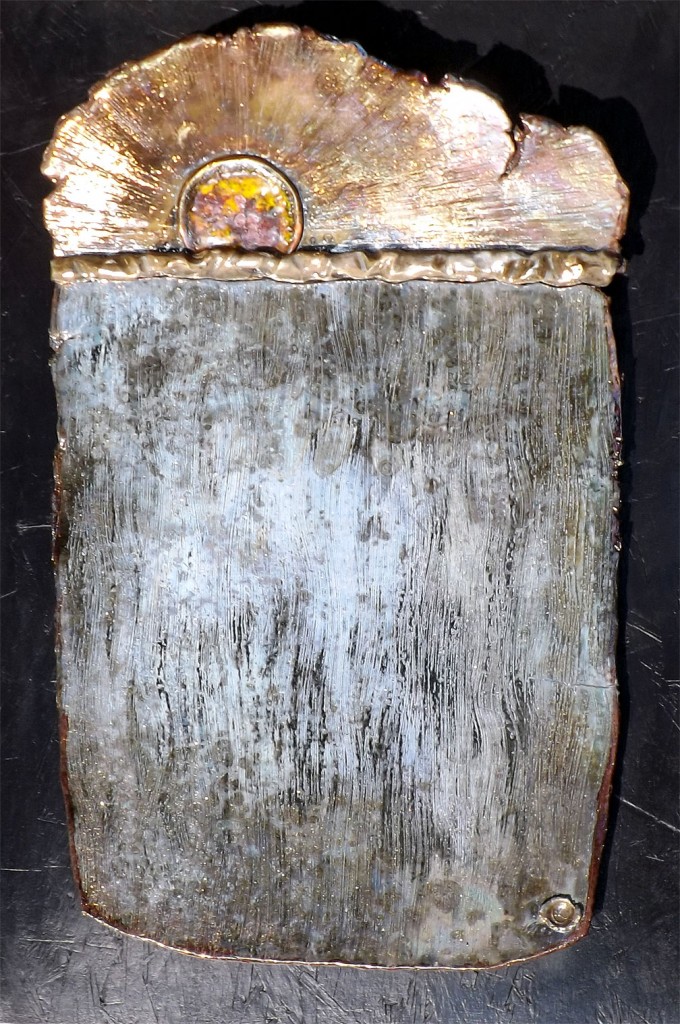
As with so many works of art, the only way to really appreciate the work is in person. In this show Attila displays works in raku fired ceramic and hammered copper. The effect transcends the means, a cool sensual finish that seems effortless. But masterful control is required to get the illusion of such tranquility.
“Canadian Willpower” is a kind of battle between the Canadian Shield and a maple, one that we see all too often up north.
“Canadian Willpower” (Raku fired ceramic – 2015 Attila Keszei)
While you can also see Attila’s work on his website, that is a mere shadow of what you get in person. And as far as i can tell this has been a productive year. His so-called retirement seems to agree with Attila.
There have been two singers above all the others who mattered to me as I grew up. Both were tenors. I’ve talked about Jussi Björling, my touchstone of vocal perfection and the subject of a recent pilgrimage in Sweden. The other was Jon Vickers who has died after what his family announced as a “prolonged struggle with Alzheimer’s disease.” In contrasting my relationship with these two heroes of my childhood I’d like to illuminate these two very different stars, who in large measure can be understood as two polar opposites.
Björling was a singer of great vocal beauty, possessed of ringing high Cs and a lovely cantabile. Vickers was somewhat unorthodox, arguably one of the great singing actors of the 20th Century. As I grew up i drifted away from love of pure vocal beauty and fell in love with music-drama, good acting and everything Vickers stood for. While I love listening to both Björling and Vickers, it’s on video that you really get a sense of the Canadian’s unique style.
For the longest time it was a pattern of frustration! Vickers stopped singing in Toronto allegedly because of a bad review. In 1970 I was fortunate to be taken to hear him in NY, singing with Louis Quilico & James Levine in the Zeffirelli Otello that had been introduced the season before by James McCracken & Karl Bohm. A few years later I hitched a ride to Montreal to hear his Tristan. Eventually I heard a song recital at the Edward Johnson Building at the University of Toronto (his first words were a fervent “it’s good to be back!”) and the first act of Siegmund in the “Concert of the Decade” with Birgit Nilsson at Massey Hall. While it was only the first act, it was surely a release of all that pent-up frustration for his fans, especially for those who hadn’t traveled to see Vickers in other cities. Not only did it bring us Vickers but Nilsson had never sung in Toronto either, and it was led by Zubin Mehta. For me it lived up to the hype, especially in Vickers’s seemingly effortless high A to end the act. And a short while later he sang it again for another audience (that would have included me if I had been able to afford to see it both times. Oh well, no such luck).
I was fortunate to see him as much as i did in the roles for which he was famed. Everything he sang was unique and unlike what anyone else would do with that role. I can say that because I was a junkie for descriptions and stories about the other roles I never saw. He changed our understanding of Peter Grimes single-handedly, broadening the possibilities of the role far beyond what the composer and what Peter Pears, the first great exponent of the role, understood of the opera. While I don’t believe he is really known for Parsifal there’s a moment on youtube that’s shattering precisely because of the way it goes against what we would expect, a production directed by Rolf Liebermann (whom I mention because the brilliant touch might be from Vickers, might be from Liebermann; either way its execution is stunning). He brings back the sacred spear and then he breaks it in two(!?!), complete with a howl of confused rage from the grail knights in his presence .
I will add another link that gives a better view of his acting ability, as Florestan in Fidelio. Even so i believe this portrayal would be more powerful from afar, the movement vocabulary eloquent at any distance but especially convincing when you could only see a tiny figure, posture, dignity, and the huge voice enveloping you no matter whether you were close or sitting at the back of the opera house.
The ambiguities of this final clip are a perfect epitome of Vickers. As Otello he kills himself with a concealed weapon. As he heroically strains for a final kiss –the most heroic looking singer I have seen in the part to this day—I could never tell in recordings or this performance, if the “ah” in the last lines was an attempt at a kiss (as this note gives us the recurrance of the moment in the love duet where he and Desdemona kiss) or impending death. The ambiguity slays me every time, but I found it particularly shattering watching him die in this clip earlier tonight, realizing that he is finally gone.
I am a Canadian. I have a conspicuous “cz” in my surname, but then again, what is a Canadian, if not an immigrant or child of immigrants…?
If you turn on the television any day of the year you’re deluged in the culture of our neighbours to the south. “Canadian culture” does exist, in fact it’s quite strong in some quarters, but on July 4th, one can’t help being a bit envious, feeling that ours is still so new, so young, given the proud displays of American heritage on so many channels.
I’m going back and forth between Turner Classic Movies & AMC. TCM are showing Yankee Doodle Dandy, a film I’ve seen a million times while AMC have Independence Day. I’m an admirer of Cagney. I’m just at the moment when George (still a boy, so not yet played by Cagney) gets his big spanking. A moment ago we came to the moment when Will Smith shoots down his alien, then smokes his cigar. Independence Day is a nationalistic sci-fi flick that works well anytime, but especially today. Will Smith’s pride –who can forget his “who de man” bluster right up to his punch in the “face” of the alien— is the best of the American spirit, not so different from the ego display that got George his spanking (after having lost his family a big gig by mouthing off to a possible impresario).
I know there are egomaniacs in Canada, but will anyone ever put that into a movie?
This afternoon TCM showed 1776, a filmed version of the musical produced in the decade before their bicentennial. Wow what a serious piece of work. I admire its ambitions, its willingness to make serious matters the subject for a musical.
We have Louis Riel, which is an opera rather than a musical. The other day a friend mentioned Billy Bishop Goes to War. But I wonder what a Canadian take on any of those American examples might look and sound like.
A Canadian Yankee Doodle Dandy? Absurd as that may sound, I can imagine a musical celebrating a Canadian musical icon. Glenn Gould? Joni Mitchell? David Foster? Or if you have a better candidate, go ahead: dramatize their life, studded with a few well-known musical moments and you have something with possibilities.
A Canadian Independence Day? That’s as odd as the previous suggestion, but why not after all. It wouldn’t be a tale of saucers demolishing iconic buildings, annihilating cities, or humbling our air power. Our confederation was a matter of conversation—something more like 1776 actually—and without any war of independence.
Recalling how new it all feels here, north of the 49th parallel, and smaller to boot, I happily devour whatever comes along. It’s Fringe time in Toronto, when for writers, composers, producers, actors and of course also the audience, hope springs not just eternal but immanent. Perhaps now is the time for the creation that not only captures the national imagination but becomes a representative for our country.
If nothing else it’s a great time to go see a show.
Opera by Request will be presenting a semi-staged version of a comic opera called “A chair in love” by Welsh-Canadian composer John Metcalf with libretto by Governor General award nominee Larry Tremblay. The plot revolves around an “urban angst” filmmaker who falls in love with a chair, and his faithful, if slightly jealous, dog who tries to save him from heartbreak.
The show will take place on Friday July 17th @ 7:30pm at the Array Space, and features William Shookhoff (music director and pianist), Abigail Freeman (Chair), Michael Robert-Broder (Truman), Gregory Finney (Dog), and Kim Sartor (Dogtor/Doctor).
Tickets for OBR’s production are available online at Eventbrite tickets.
“Press releases and announcements” are presented verbatim without comment
I was already thinking about the art of the film score composer, having recently given James Horner’s work a look in the wake of his untimely death. A question I sometimes ponder: what is the hardest sort of music to create? Or to turn this around, what is the hardest sort of film to score?
Some people seem drawn to certain genres, perhaps because their music seems well-suited to a particular genre. Now on the other hand, what about making something that is cliché or sentimental or hackneyed sound fresh? I would call that the greatest challenge for a composer: to inject life into something that has become stale.
I had that unexpected pleasure today with the remake of Disney’s 101 Dalmations. Perhaps you too missed this film when it appeared in 1996. I didn’t realize it was written by John Hughes nor that its score was by Michael Kamen (speaking of untimely death!), one of my favourite composers. Had I know the talent working on this film (Glenn Close, Hugh Laurie, Jeff Daniels, Joely Richardson and Joan Plowright) I would have seen it long ago. There are live animals alongside animatronic special effects, yet the biggest special effect in this film is the one you hear rather than see: from the orchestra. Kamen takes this live action film and rescues it from being a mere cartoon.
I’ve watched this film four times in the past 48 hours, and only on the last viewing did I figure out the secret of the simple mastery Kamen displayed. The old saying was attributed to Edmund Kean on his deathbed. He supposedly said “dying’s easy. Comedy’s hard.” While he was talking about acting it goes double for film music. What Kamen does in this film is the complete opposite of what you’d expect, and is the reason composers should listen to this score as a touchstone of how to compose. That’s what I am getting at with the headline, that one can learn a lot from watching 101 Dalmations.
In terms of genre we’re in a strange place, that isn’t at all what one might expect from Disney & the dogs. I kept staring at the film, not quite able to figure it out until I realized Kamen was largely doing what he usually did, as the latest incarnation of Erich Korngold, writing swashbuckler music for such films as Adventures of Baron Munchausen, Robin Hood Prince of Thieves, and The Three Musketeers. His mastery of the large orchestra gave him a kind of versatility you see in composers such as Richard Strauss, who once boasted that he could depict anything through music. I believe the same is true for Kamen.
One shouldn’t denigrate the film or its score merely because it’d a remake of a feature-length cartoon. Indeed, what Kamen does in this score is nothing short of miraculous, in elevating sentimental moments & animal scenes to the realm of epic. The key is that the genre isn’t allowed to be a stumbling block to the composer.
Don’t be fooled. This may be a movie about dogs and fashion, but the score could fit into a film with sword-play and heroics. He writes about dogs and romance as though it were vitally important: perhaps because it is. If we make that kind of leap of faith, we are into a different realm, and indeed, a different kind of genre. The conviction he brings to chase scenes involving cute little doggies elevates the action, bringing a degree of seriousness to the proceedings that changes the way we see and hear the film. The first and most important lesson is to always treat the film as serious.
For example, when Cruella DeVil appears we’re in a parody of a horror film with some very genuine sounding nastiness. There’s an echo of the dies irae or ”day of wrath” when she walks into her office. The high strings scurry like terrified birds scattered by her nasty arrival. At this point we don’t yet realize what nastiness she might perpetrate. Two minutes into this clip you get the most delicious exchange between Cruella and one of her many terrified minions:
Cruella: Do you like spots Frederick?
Frederick: I don’t believe so madam, I thought we liked stripes this year.
Cruella: What kind of sycophant are you?
Frederick: (pause) What kind of sycophant would you like me to be?
If Kamen were a parent I would be giving him credit for never talking down to his children, but in this case I am thinking of the audience of the film. He never infantilizes or condescends to us. At all times we are in the presence of great seriousness. The glory of the humour is precisely that it is done with a straight face, as gloomy as Bob Newhart.
Kamen gives us several large set-pieces. One of the chases takes the song “Daisy”, that you may recall had slowed gradually in 2001: a Space Odyssey and instead, increases it to a breakneck pace. Cruella has a leit-motiv based on the song in the old film, this time insinuated at odd moments like the pong of cheap perfume in the air. This is a score that does not comment upon the morality of anything we see, but simply sets us up. At times Kamen creates something grotesque, even invoking something that reminds me of Mahler. We encounter many different emotional snapshots via Kamen’s orchestra, all the while implying that this story is important and worthy of his art.
We are in a realm of parody, at times making a reductio ad absurdum that is always deadly serious even as we are in the presence of great silliness. But this muscular orchestra gallops full out for minutes at a time.
This is like a textbook study in comedy, never obvious but always subtly deadpan, dark and at times very scary for a movie children might see, always very British with more than a hint of European colour. Kamen takes the gig seriously, even when offering us a wee bit of a recognizable tune such as Beethoven’s fifth symphony or “How much is that doggy in the window”. We experience horror, suspense, and also, ecstatic joy. Kamen treats his puppies and horses and raccoons and skunks and birds and dogs and people with no signs of chauvinism.
And this is how it should be done, because we get the laughs while simultaneously experiencing art.
Some say that if done right you shouldn’t notice the music in a movie. Of course that’s one ideal and it’s a much more self-effacing idea of how a composer should approach the task of composing a score for the cinema. You definitely notice when the movie doesn’t work.
Music can be the difference, the crucial element that makes a film intelligible. Sometimes the music is a Greek chorus to tell us what the characters can’t say. Or it might be a matter of subtle atmosphere, even something ironic and distancing.
James Horner died in a plane crash yesterday, a relatively young man as composers go. Ennio Morricone is 86. John Williams is 83. Even Danny Elfman—who I still think of as a relative newcomer—is a few months older, just having passed his 62nd birthday. But Horner is –or I should really say “was”—prolific. Go to the IMDB entry and see just how many films he worked on, including the many for which he didn’t get the full credit.
125 entries under “music department”
156 more as “composer”
At times, classical composers of the last century have seemed paralyzed like deer caught in the headlights. Beauty for its own sake? Rare. But thank goodness that in the cinema melodic composition wasn’t frowned upon. The requirement to be popular vetoes conservatory prejudices against tunefulness. Horner is a classically trained composer who found a natural voice in cinema, where he could freely use his melodic gift, his knack for capturing a mood, and his fluency with the many possibilities available in a large orchestra.
I am simply aiming to offer a few reminders of what Horner has meant in my life and likely in many other lives too.
“Somewhere out there” is a song you may have heard on the radio, sung by Linda Ronstadt & James Ingram.
Nominated for both a Golden Globe (it lost) and an Academy Award (it lost), it did win two Grammies, which is probably a bigger honour when you consider who is voting in each case.
If you were raising children in the 1980s chances are you recognize this song. Here’s what it sounded like in its original incarnation in the middle of An American Tail
Horner is a composer who impresses me with his pragmatic approach to film-making. You might not connect these films from the sound of their music. He scored a number of films of war. Glory, Enemy at the GatesBraveheart, and more recently Troy
I wonder if he felt any pressure to produce when he scored expensive pictures with enormous budgets and millions invested, such as Jumanji, Avatar and Titanic (the latter two for James Cameron). They were hugely successful of course.
Yet he could score films on an intimate scale. A long time ago I encountered The Dresser. More recently Horner helped make A Beautiful Mind a big hit. And I suppose intimate is a good word to describe Honey I Shrunk the Kids, but not for the usual reasons. Some of Horner’s films have cult followings, such as Willow and I Love You to Death. Others are totally mainstream, thinking of science fiction films such as Star Trek II: The Wrath of Khan or Apollo 13.
I’ll finish by citing my two favourites. In both cases the music is a necessary part of the film-makers’ magic toolkit.
I was mightily impressed by Horner’s work on a film that never quite caught on, perhaps a bit ahead of its time. If you watch the trailer it’s immediately clear why it didn’t do well: because the trailer for *batteries not included makes no sense. I passed it up on the big screen but then by good fortune watched it on home video: where i was hooked. There are a pair of wonderful performances from Jessica Tandy & Hume Cronyn. This was before I knew about Alzheimers or dementia. Horner’s score creates powerful juxtapositions between present time and recollections from long ago. The poignancy of that confusion is stunningly beautiful, even if you’ve never encountered a person living through those ambiguities. Music can create an instantaneous sense of a reality, the present even when it is from another time. This clip gives you an idea of what complexity is at work. As in Honey I Shrunk the Kids, Horner playfully quotes from popular cultural elements, including contemporary music and cartoons. And come to think of it, here’s that magical opening sequence:
In Field of Dreams we are watching a story unfold that can’t rely simply on visuals and good acting. The clincher for many of the key moments are music cues. At times it’s very new-agey, meditative, via a melodic Americana, folksy with a few jarring moments to suggest different spheres of the world brought into collision. The music is a necessary part of the dramaturgy that makes us embrace the reality of this movie.
I have no idea how many times I have seen this film, but it continues to cast its spell on me. I will give Horner the last word.
There I was in a theatre full of children for Father’s Day. As we got deeper into Inside Out the small ones were often silent.
The small unrepresentative audience survey I conducted suggests that the kids enjoyed themselves but couldn’t follow the nuances. As so often happens, the children enjoy the film one way while the parents have another sort of experience, laughing at double entendres and subtle asides that go over the kids’ heads.
Inside Out is the latest summertime animated treat from Pixar studios, the people who brought you Up, Wall E, Monsters Inc and Toy Story. Sometimes adult voices roared with laughter, myself among them. While there were tears as well, these too seemed to be confined to the adult population.
Inside Out is a very sophisticated piece of work, reminding me of a modern morality play where a series of abstractions are personified. But instead of this being an allegory (a battle between “good” and “evil”, perhaps with “greed” and “sloth” personified) we look inside the heads of a series of characters, discovering that our emotional lives could be understood as a kind of conversation, sometimes a very intense conversation, between different emotions. I think this film will have extraordinary resonance for most people, in the way it suggests our lives are a series of choices even when we are not aware of the moment when we chose to surrender to one impulse or other:
Amy Poehler is “Joy”.
Phyllis Smith is “Sadness”
Lewis Black is “Anger”
Bill Hader is “Fear”
Mindy Kaling is “Disgust”
Seligman’s book was arguably the beginning of the groundswell of interest in Positive Psychology
The emotions are situated in a kind of control room that’s inside the head. There is a set of emotions monitoring and influencing Riley (the 11 year old who is at the centre of this film), just as there’s another inside her Mom and inside her Dad, as well as her teacher and others in the film. I don’t believe in spoilers so I have to stop soon, but this is a very scientific stimulus-response approach, that probably won’t go over quite so well in the Bible belt. If there is anything allegorical at work in the story, it would be in its concerns with Positive Psychology and resilience, illustrating a pathway to emotional balance.
The film employs such a simple yet powerful way of understanding our behaviour –including incorporating memories and clusters of behaviour that become key parts of our personality (for Riley this includes her love of playing hockey and her sense of family) —that we may see people growing up using this film and its mythology as a reference point.
I am reminded of Maurice Sendak, Roald Dahl and L Frank Baum, authors whose stories are so deceptively simple that we tell them to children, even though they function at such a deep level that we spend the rest of our lives figuring out what they really mean.
This doesn’t mean that children will have any problem with Inside Out. They will have fun and like it, even if they may wonder why the adults are laughing so hard, and sometimes shedding a tear.
The sentence in the obituary that rings truest for me says “everyone believed there was so much more to come from Sten’s life.”
Sten Eirik
I discovered the bad news when I went to the Guild Festival Theatre website to see what they would be producing this year. I’d seen their 2011 debut, shows in 2012 and 2013, gave them a pass last year (my trip to Europe last summer meant I couldn’t make it) and now wondered what they would be producing this summer.
I have been thinking a lot about aging, having just read the Hutcheon’s book about creativity in later life, namely Four Last Songs. We’re all getting older of course and I am sure I’m not the only one looking at the future wondering “what next”…? And so when I stumbled upon the news of Sten Eirik’s untimely death (much too late for the memorial service) it seemed especially upsetting, because I wanted to see the next chapter in the story of GFT as led by Eirik.
I shook his hand at premieres while enjoying the fellowship of opening night excitement. I shared the URL of reviews with him via email that he accepted graciously. I remember a kind and generous man, i remember an excited group of people drawing upon his energy & vision, a sense of great things to come. But even so I had a sadly superficial understanding of his life, wishing i’d had an opportunity to get closer. I’d been delighted to see a couple of actors with whom I’d worked appearing in GFT shows.
I want to remember the three GFT shows that I did see, to go back in my mind to what I saw and what that all portended.
The 2011 Debut was for me the most magical, just the fact that the promise of the Guild Festival Theatre –a stunningly beautiful outdoor performance venue that has only been used intermittently but never with a resident company—was finally being fulfilled. I don’t know what struggles preceded that premiere, only that the money was there to put a professional theatre company onstage.
And the product was surprisingly good. I’ve seen lots of productions of The Cherry Orchard, a work that is often weighed down by the pretentiousness associated with the author, Anton Chekhov. Eirik steered his cast towards a lighter more comical tone, that in no way compromised the serious implications of the play. The gorgeous setting –outside close to the edge of the lake—made for some magical moments, particularly in the lyricism of Act II. It was better than i had dared to hope for.
Season two meant additional ambition, in an original musical adaptation of Aristophanes Clouds, and a fun romp with great energy. Season three was a more deadpan approach, in Moliere’s Misanthrope, and again a thoughtful and original meditation upon honesty.
I was unable to make it to last season’s Importance of Being Earnest.
GFT will produce Romeo and Juliet, their first Shakespeare play from July 16 to August 9, 2015. While the founder has passed, the dream lives on.

 Loose Tea’s Artistic Director Alaina Viau today announced that Loose Tea will host “Whose Opera Is It Anyway?” on July 22, 2015 from 7pm-9pm at the Office Pub at 117 John Street. Cost is $25 per person includes a free glass of BareFoot wine, nibbles and sore cheeks from laughing too hard . Proceeds will be used to fund the summer opera Dissociative Me an English re-work of the classic “Faust” set in modern times.