Kayla Wong – Allure

I’ve been listening to Kayla Wong’s CD Allure incessantly in my car for the past couple of weeks.

Pianist Kayla Wong

Wong emailed me to tell me about herself and the recording. I listened to a couple of samples, deciding that yes this sounded really good. The CD not only confirmed that first impression, but has been a companion in my struggles with Toronto traffic. Who minds being stuck in rush hour when the piano can spirit you away?

Yes the title “Allure” is certainly appropriate, considering the smile on the cover, but Wong is more than a pretty face. The CD is recorded on her label Luminous Vine Records. And like Stewart Goodyear’s Beethoven set, Wong writes her own liner notes that are a personal response to the composers & their music.

But let’s talk about the music on the CD. There are four very different composers:

  • Ernesto Lecuona
  • Maurice Ravel
  • Sergei Rachmaninoff
  • Samuel Barber

We’re firmly situated in the 20th century, in a place requiring great technique and a romantic intelligence to match these composers. Because of the way the tracks are organized, it’s a CD I leave playing at its conclusion. Lecuono leads off with a decidedly Iberian flavour, followed by two contrasting touchstones of piano virtuosity. Barber to finish? It’s perhaps counter-intuitive, but the angularity of this sonata leads nicely right back to the soulful Cuban.

The Lecuono triptych make an impressive beginning, understated passions that catch fire in “Ante El Escorial”, “Aragonesa” and “Granada”.

The Ravel pair are an impressionistic pair, namely “Jeux d’eau” and “Miroirs: Une barque sur l’ocean”. These two are relatively understated, shimmering playing of great precision.

The six Rachmaninoff Moments Musicaux Op 16 are the largest part of the album, a wonderful series of compositions. Yesterday’s morning-after reflections that included the strange images of Lang Lang with his shiny jacket & hair are a contrast to performances like these, sincerely felt & thoroughly thought out. Where the big star virtuoso seems to come from the outside, with no connection to the music (and I wonder if he realizes how ridiculous he looks & sounds), Wong’s readings are as genuine as method acting, seeming to originate right in the music, rather than merely skimming the surface.

And to close, we’re in an entirely different place with the Barber. The opening movement’s herky-jerky rhythms are like a parody of ragtime syncopations, in combination with other angular shapes. The second movement Allegro vivace is a bit of oddball impressionism, more dissonant than what Ravel might offer yet every bit as shimmery in its gossamer surfaces, a bit like a Chopin etude with a hallucinatory waltz in the middle. The Adagio meanders slowly along vistas of emotional depth, a bit bemused with itself but never losing its way. And the closing Fuga is wonderful frenetic energy, jazzy and playful to bring it home.

If you’re listening allow the Fuga to proceed back to the first Lecuona track, a transition that feels remarkably logical, particularly because both pieces (the closing Fuga & “Ante El Escorial”) are in the same key.  For further information go to Kayla Wong’s website.

Posted in Music and musicology, Reviews | Tagged , , , , | 2 Comments

Girl with Flaxen Hair goes to the opera

What’s the reality underlying the music?

People write music & perform music, and the notes & phrases are parts of our day, parts of our lives.

Last night I wanted to leave early to go to the opera. It was raining, and I wanted to park underground to avoid getting soaked. So there I was all dressed and ready long in advance, and someone else, aka my wife, was, um, unable to decide what to wear.

So I sat down at the piano.

Now of course, when you’re going through your wardrobe trying to calmly find something fetching, decide what to wear, the last thing you want to hear on the piano is Schreker: one of the scores sitting there waiting to be explored, in the wake of reading Michael Haas’s Forbidden Music. I am chuckling because in a real sense this stuff really is forbidden music around here. NOT because it’s from Jewish composers, but because too much dissonance & passion can upset people at certain times of day.

I have safer scores though. I am wondering suddenly, is that why I chose Debussy as my area of scholarship: because I could safely play his music at home with minimal freakout? Debussy is tranquil & a lover of pleasure & beauty above all, famous for tunes like “clair de lune” or “reverie” or “Prelude á l’apres-midi d’un faune” (and thank goodness for the piano reduction),which are for the most-part quiet meditations.
Books I & II of the Preludes sit by the piano for times like this. I pull out “The girl with the flaxen hair”. Nevermind that Debussy’s women seem to have been dark-haired, at least from the photos. Does the title of the piece suggest a fascination with blondes?

Speaking of women, I couldn’t help noticing something in the music, that I’d never spotted before. As Erika tried –and discarded—one outfit after another at the other end of the house (and I could hear her mutter unhappily about how X or Y worked with a particular set of footwear), I was playing through passages on the piano that turn this way then that, going this way then that way, trying this pathway or that pathway.

Or trying on this dress or that dress?

Has indecision ever been so beautiful?

Listen to the piece.

There are lots of versions online. I chose this one –with Lang Lang—partly because a friend brought up the question of sincerity, one lurking underneath considerations of virtuosity. I was dressed for the opera, but without the shiny outfit, and nowhere near so much product in my hair. But even in this performance –especially this one—you can see how clearly Debussy is assembling something of wonderful simplicity into a rhetorical construct, a series of phrases and moments, that are a meditation for us.  There’s lots of wonderful melody, but notice the way the rhetorical construction suggests changes of mind, turning of the head or perhaps changes of direction, as if the piano is painting a picture, telling a story. No I don’t think Debussy was describing his wife getting ready to go to the opera, but I do think he was exploring the eternal feminine, as he saw it. He was an admirer of women.

If we believe what Mary Garden wrote in her memoirs, Debussy was obsessed with her, even if the feelings were not fully requited. If it was a self-serving observation on her part, at the very least we’re treated to a portrait of a man who loved women.

I think the piece is an attempt to create the serenity felt in the presence of genuine beauty, not to be confused with something erotic. And in the end –while we’re on the subject—I think Erika’s final choice was a winner. And we made it to the opera early, avoiding the messy weather outside, that might have mussed everyone’s hair (of whatever colour).

Posted in Music and musicology, Personal ruminations & essays | 2 Comments

Gerald Finley is Falstaff

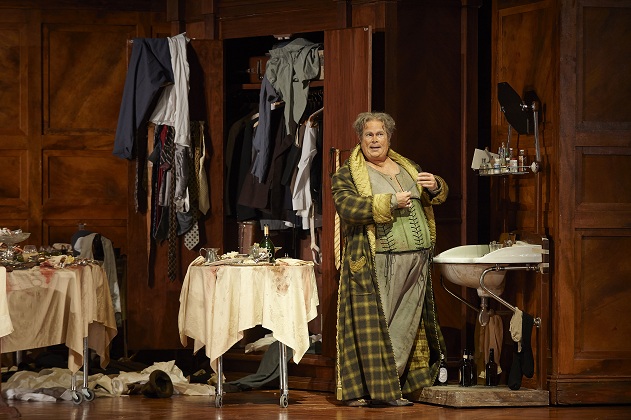
Every time Gerald Finley takes on the role of Falstaff it means’ a two hour makeup ordeal .  Finley is like a classier version of Mike Myers’ “Fat Bastard”, and yet so much more.

Gerald Finley as Sir John Falstaff in the Canadian Opera Company production of Falstaff, 2014. Photo: Michael Cooper

Gerald Finley as Sir John Falstaff in the Canadian Opera Company production of Falstaff, 2014. Photo: Michael Cooper

Falstaff? Yes he is Shakespeare’s fat man, a bad influence on Prince Hal in Henry IVth, part I, pushed aside when Hal ascends to the throne in Henry IVth part 2, and his death is reported in Henry V.  But he was too good of a character for Shakespeare to ignore, so he had to be brought back in another later play, namely The Merry Wives of Windsor.

Falstaff is also Giuseppe Verdi’s last opera, with a libretto by Arrigo Boito that combines parts from several plays –mostly Merry Wives of Windsor—in a surprising score.  While Verdi may be best known for operas inducing tears –thinking of La traviata  or Rigoletto—Verdi’s last opera is completely different.  It has the necessary pace of a comedy, which is to say, very fast and energetic.

Tonight was the opening of the new Canadian Opera co-production directed by Robert Carsen.  In the lobby conversation beforehand it may have been a pure accident that we were talking about fat people and weight loss.  Why, we mused, must women be thin, and some even undergo weight-loss surgery, when men can still splendidly ignore the pressure to lose weight?  In this respect Falstaff touches a deep nerve, even if the story is relatively trite among the Shakespearean or Verdian canon, a fun romp rather than something profound.  But in a world wrestling with the body-image question, one can’t help noticing that the jokes about fat and eating get huge laughs.   Who doesn’t wrestle with anxiety about attractiveness & our ability to control ourselves?

For those of us who have been eagerly waiting for Finley to appear in an opera here in Toronto –a big star in the opera world, with several amazing international successes & a series of wonderful recordings to his credit—this isn’t what we might have expected.  And yet it’s one of the most impressive performances I’ve ever seen.  Finley is Falstaff, and he’s larger than life physically, vocally, and in every sense that matters.

Like a true Don Juan, Finley’s Falstaff believes his own hype, behaving like God’s gift to women.   Falstaff is a walking embodiment of the pleasure principle, loving his food, his drink and especially the opposite sex.  At times his flirtation is subtle, but when it counts he is the most blatantly physical Falstaff I’ve ever seen, throwing his body into action.  In one magical section in Act II we watch a transformation of sorts, as the presence of Mistress Quickly (and her report of the attractions of Meg & Alice to the supposedly irresistible Sir John) seems to arouse him, getting him to move faster & more vividly.  I suppose the massage to his romantic ego might be the motivation, but it’s immediately manifested in his posture & pace, as he seems rejuvenated.  He begins to caper around the stage a bit like an operatic Jackie Gleason, his moves as smooth as a chubby vaudevillian.

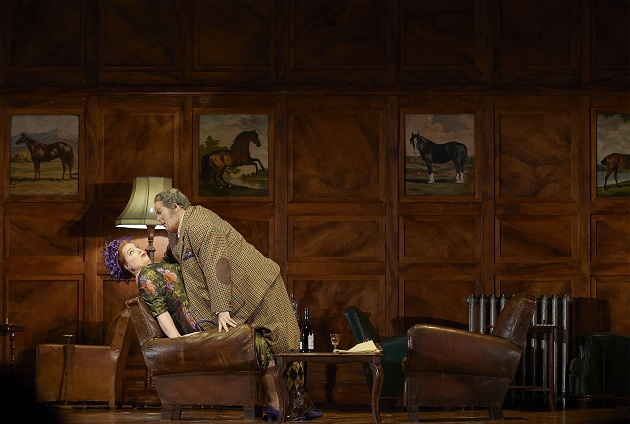
Marie-Nicole Lemieux as Mistress Quickly and Gerald Finley as Sir John Falstaff in the Canadian Opera Company production ofFalstaff, 2014. Photo: Michael Cooper

Marie-Nicole Lemieux as Mistress Quickly and Gerald Finley as Sir John Falstaff in the Canadian Opera Company production of Falstaff, 2014. Photo: Michael Cooper

The chemistry between Finley and Marie-Nicole Lemieux as Mistress Quickly is one of the highlights throughout, as she is one of the few in the cast whose performance can match Finley; although in fairness it’s hard when you can’t take your eyes off the star.  But in the scenes between Lemieux & Finley there’s such a sense of warmth & fun at work, I am sure they were enjoying themselves as much as the enraptured audience watching.

Russell Braun seems to be on a slightly different career path with the COC than before.  At one time he was a romantic lead, for example as Prince Andrei in War & Peace, or Pelléas or Oreste.  With maturity, he’s sometimes in less rewarding parts, even some that might be called thankless, such as the Count di Luna (a very difficult role to sing), or as  the Duke of Nottingham in Roberto Devereux.   As the jealous husband Ford, Braun is again taking on a role that can be daunting, and making much more of it than usual, especially on the dramatic side.  This is the most memorable Ford I’ve ever seen, as I found myself again fascinated by Braun’s choices.

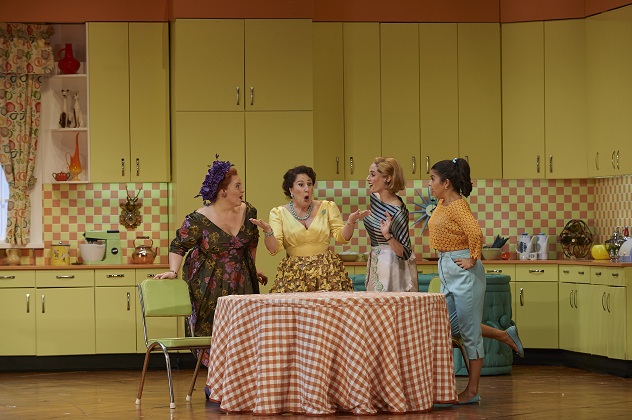
I should acknowledge Robert Carsen’s production, that moves the action from the first Elizabeth to the second, aka the 1950s.  In so doing I sense that Carsen seeks to make more of the opera & its story, a valiant effort.  The tensions we experience—both the one between the original and the modernized version, and of course, between the 1950s and our own time—energize many moments that otherwise are nothing more than fluff in Verdi’s opera.   The scene set in a classic 1950s kitchen is unexpectedly electrifying due to the design features.  We watch Simone Osborne as Nannetta in this scene, upset that her father wants her to marry someone she doesn’t love, begin to stuff herself at the kitchen table, a moment of remarkable innocence considering where we’ve come in the decades since, and a brief glimpse of the dark side of Falstaff’s epic indulgences.

(l-r) Marie-Nicole Lemieux as Mistress Quickly, Lyne Fortin as Alice Ford, Lauren Segal as Meg Page and Simone Osborne as Nannetta in the Canadian Opera Company production of Falstaff, 2014. Photo: Michael Cooper

(l-r) Marie-Nicole Lemieux as Mistress Quickly, Lyne Fortin as Alice Ford, Lauren Segal as Meg Page and Simone Osborne as Nannetta in the Canadian Opera Company production of Falstaff, 2014. Photo: Michael Cooper

Food is everywhere in this production, and because of the decade it’s guilt-free as far as I can tell.  Those were the days.

There’s much more to the production than what I’ve captured here, but the main thing is to recognize that it’s elegant fun, and a delightful departure from the usual.  Gerald Finley puts his fat suit back on to give us more and more Falstaff until November 1st at the Four Seasons Centre.

Posted in Opera, Reviews | Tagged , | 7 Comments

Paride ed Elena: birthday celebrations for Gluck & Essential Opera

Ambition is a good thing, especially from an opera company.  There will always be Bohemes and Carmens galore, but I especially love having the opportunity to see something new, as I did tonight in my encounter with Gluck’s Paride ed Elena, via Essential Opera.  While EO are celebrating their fifth year, Gluck is having his 300th birthday commemorated all over the world.  For example Opera Atelier will present the familiar Orpheus and Euridice (although off the beaten track via Berlioz’s orchestration): but tonight’s show is much rarer.  According to operabase.com –a website recording the activities of the major companies of the world—Paride ed Elena wasn’t presented even once in either of the years they count performances.

And so to EO I say a huge thank you.

I couldn’t help wondering why this work isn’t done more often, why it hasn’t caught on.  Is it because the roles are all female, and even Paris is played by a woman?  Or because there’s not really much to the story (given that there aren’t subplots to flesh out the opera, just the main storyline)?

I can’t help wondering, too, whether one of the big stumbling blocks for most companies –that it includes several dance numbers, identified in the score as “ballo” or “balleto”—is a reason why Opera Atelier might give it a closer look.  Tonight’s EO production did not include any of the dances, and almost all choruses were cut with the single exception of the coro d’atleti (chorus of athletes I suppose?) sung by a trio of singers.  It’s an opera that surely leans upon its divertissements, moments when the tension is lessened in the interest of spectacle.   While grand opera is not out of fashion, that’s when we’re speaking of spectaculars such as Les Troyens or Aida.  An unknown opera full of spectacle might be an entirely other matter for those deciding what to program.

I wish someone would stage it fully, as it’s a charming work full of subtleties and a great deal of character.  It plays like a comedy, especially in the person of Amore, the all-powerful and all-confident God of love.    In tonight’s semi-staged performance by EO, Maureen Batt was especially convincing as the playful god.  I was surprised her performance didn’t elicit more laughter from a polite audience at Trinity St Paul’s Centre, but then again it’s ironic rather than blatant comedy.

Krisztina Szabó’s reading of Paride was startling, considering that she was a late replacement for an indisposed artist (not the first time this week that I encountered singers cancelling due to illness).  Szabó is known for undertaking new music, with such companies as Tapestry or Queen of Puddings, and seems to be the go-to person for the Canadian Opera Company when they have newer music, such as her work in Saariaho’s Love from Afar in 2012 or her appearance in Lepage’s Erwartung coming next May.  I didn’t expect that she’d offer the most idiomatic singing –some adventurous da capo elaborations, fabulous clarity—all while judiciously holding her big voice back for most of the night, wonderfully well balanced with the rest of the singers onstage with her.  A friend told me that in fact Szabó had sung it before–almost a decade ago– but that doesn’t make her performance any less remarkable, a genuine display of virtuosity. She had a few glorious ensemble moments as well, singing with Batt and Erin Bardua as Elena, stunning music that shouldn’t be such a rarity.  Julie Ludwig & Emily Klassen were also splendid, accompanied by Wesley Shen on piano.

Essential Opera repeat Paride ed Elena at the Registry Theatre in Kitchener on October 1st at 7:30 pm.

Posted in Opera, Reviews | Tagged | Leave a comment

Factory Theatre vs the critics

For the second consecutive year, Factory Theatre is in the news.  Last year it was the controversy around its leadership.   That’s ancient history now.

This time it’s an announcement, that critics aren’t invited until the show has already been on for a few days.  While the antagonism may be unintentional, what’s done is done. Here’s the text i saw quoted online:

Factory Theatre, with the unanimous support from this season’s partners, is attempting to redefine what “opening night” means by considering what the artists want from it, and what the audience deserves from it, not just what tradition dictates it should be.

Beginning with The Art of Building a Bunker, we have decided to offer working members of the media complimentary tickets to a media night on October 21 (three performances after opening night) and for the length of the run as long as tickets are available.

We wish to support and celebrate the work of our theatre creators by giving general audiences the first chance to respond to our shows and to be at the forefront of the conversation.  Members of the media are also a part of this conversation, but it is that larger conversation we are striving to facilitate.

This is an experiment.  It might fail, but it might serve the production, the artists, the community, and the conversation it inspires exactly the way we imagined.

We are seeking a new narrative.  It’s time for change.
Welcome to Factory’s 45th Anniversary Season!
Sincerely yours,
Factory’s 2014-2015 Season Partners

Perhaps the critics resent this.  Is this part of the broader transformation of media that’s seeing newspapers and critics drifting towards the slowly circling vortex in the sink?  Music criticism in this city has already been reduced almost to zero.

I suppose free publicity can be helpful.  With this announcement Factory Theatre is once more at the centre of a controversy.  I am more than a bit fascinated by the response, to be honest.   If you google “factory theatre no critics” you’ll quickly find at least two articles suggesting that this pathway is a bad idea, including one from Glenn Sumi in NOW, who made these observations

  There’s also the feeling that with Twitter and Facebook, everyone’s a critic.

But if the 1300 people I follow on Twitter are a good sample, very few Tweeters say anything very critical or substantive about something they’ve just seen (unless we’re talking about TV or blockbusters). There’s lots of cheerleading and selfies and, at worst, silence. Canadians, ya know: so polite.

I too noticed this.  I went to Stratford, and wrote a couple of substantial reviews – of Crazy for You, and of Mother Courage—and saw the brilliant way Stratford uses social media, riding tweets from happy customers, which now serve as a new kind of critical conversation.  Of course it’s not really much of a conversation, is it..? I can’t deny that I felt a bit jealous.  I’m not saying I’m irrelevant, but I do see that the terrain is changing.

Factory Theatre may have miscalculated in not expecting a push back from the critics.  Sumi thinks that the experiment sounds “arrogant”, with the reminder “Whatever happened to the expression:’Even bad press is better than no press‘ “?

No, the paperless office hasn’t happened, but “the press”?  The theatre-going public –that literate, aging crowd– still reads newspapers.  But are the press as important as they think they are?

We shall see.

Posted in Dance, theatre & musicals, Popular music & culture | 2 Comments

Oundjian, TSO: Beethoven and Rachmaninoff

It’s been roughly a decade now that Peter Oundjian has been the Music Director of the Toronto Symphony Orchestra, a time of renewal if not rebirth for the ensemble & its audience.  If tonight’s concert is any indication they’re headed in the right direction.

What one needs is commitment, a sense of occasion, rather than indifference or inconsistency.   On a night including Rachmaninoff’s Rhapsody on a Theme by Paganini and Beethoven’s Ninth Symphony, I found myself asking: what was the occasion?   My kind host (who offered me a ticket) said that it was simply his  first Thursday night concert of the season.  That’s surely what one wants to experience: that any concert in the series seems special.

There was indeed magic tonight.

Young Daniil Trifonov got us off to a good beginning with a subtle reading of the Rhapsody, a familar work that benefits from an understated approach such as that favoured by young Trifonov, introduced a a multiple-prize winner in his early 20s.  When he arrived on the stage he was so enthusiastic that after shaking hands with concertmaster Jonathan Crow, he looked ready to shake hands with the whole orchestra.  But appearances are deceiving.  While Trifonov has a guileless look to him, don’t be fooled.  His playing shows sophistication and depth beyond his years.  The first several variations were all underplayed, the deep emotions lurking in this piece presented with a straight face.  When the piece begins to wear its heart on its sleeve, there was as a result lots of room for growth, a natural organic expansion.

Trifonov added a very apt encore, another Rachmaninoff piece based on violin, this time his transcription of the Gavotte from Bach’s partita in E.  While Trifonov began with the Rachmaninoff, like a genuine virtuoso, he elaborated this already challenging piece into something even more difficult. It was one of the most impressive performances I’ve seen in awhile.

And what do you know, when i looked on youtube i found him playing the piece as an encore at another concert.  While this is awesome i swear he played it better –more meaningful, greater dynamic contrast– here in Toronto tonight.  

I was overdue to hear Beethoven’s 9th.  With Franz Bruggen’s passing in August I’ve been listening to his historically informed performance (“HIP”) of the 9th in the car, and now Christopher Hogwood has also died this week.  It’s ironic that the old fashioned Beethoven I heard as a child and in previous performances by the TSO at Massey Hall –Beethoven on modern instruments–is not one I hear so often, supplanted in my mind & record collection by the new generation of H.I.Performers + appropriate instruments.

Yet I have to think that the H.I.P. movement has informed the approaches of conductors such as Oundjian as well, considering his brave tempi in this performance.  This was most noticeable in the finale, one of the fastest versions I’ve ever encountered.  It held together wonderfully well, aiding the singers, and more or less lifting the roof off the place with the help of the ever reliable Mendelssohn Choir.

The TSO will be repeating the program Friday at 7:30 & Saturday at 8:00 at Roy Thomson Hall.

Posted in Music and musicology, Reviews | 4 Comments

They’re back: Ensemble Studio and COC concerts

The free noon-hour concerts at the Richard Bradshaw Amphitheatre are back, and unfortunately, so’s the flu, as three of the young singers scheduled to sing today had to cancel.

It ended up being six rather than nine arias, accompanied by Jennifer Szeto at the piano, but even so it was a lovely re-launch of a series that’s a cultural leader in the city:

Soprano Karine Boucher

  • Iain MacNeil singing “Rivolgete a lui lo sguardo” (Cosi fan tutte)
  • Charlotte Burrage singing “All’affitto è dolce il pianto” (Roberto Devereux)
  • Jean-Philippe Fortier-Lazure singing “Vainement, ma bien-aimée” (Le Roi D’Ys)
  • Karine Boucher singing “O mio babbino caro” (Gianni Schicchi)
  • Clarence Frazer singing Pierrot’s Tanzlied (Die tote Stadt)
  • Andrew Haji singing “Questa o quella” (Rigoletto)

Every year I go to look at the schedule of concerts on the COC website with eager anticipation.  This year’s line-up looks like the best yet.

It’s a wonderful way to promote the opera company, getting a flood of visitors invited into their building.  But opera is the least of it.   The next concert? Thursday is Payadora Tango Ensemble, followed by jazz next Tuesday.   Tuesday October 14th, we’ll get a preview of dances in Opera Atelier’s upcoming production of Alcina.  Jazz, dance, chamber music (beginning October 21st).  I’ve already marked Thurs. Feb 5, 2015 on my calendar for a concert hosted by Emanuel Ax, with two brilliant young pianists –Pavel Kolesnikov and Orion Weiss—playing Opera Transcriptions for Piano.

But most centrally, this series is about voice.  Yes we’ll hear members of the Ensemble Studio  but we’ll also have the opportunity to hear great artists such as Jane Archibald and Barbara Hannigan. That their recitals are offered for free boggles the mind.  

We’re lucky.

Posted in Opera, Reviews | 1 Comment

10 Questions for Kelly Kaduce

I had the good luck to see Rusalka in Montreal in November 2011, starring Kelly Kaduce. In my review I said

First and foremost, the production leans happily on soprano Kelly Kaduce, whose voice is always pleasant & in tune, and sometimes astonishingly expressive. The demands of the role are somewhat daunting if you consider that Rusalka is a mermaid who is transformed into human form, for a time bereft of her voice, and betrayed by the prince who prefers the heat of a high-maintenance princess to the unconditional love of Rusalka: a mute beauty who is as cold as the princess is hot. Kaduce’s physical beauty not only mirrored the innocent loveliness of the natural world from which she comes, but made this challenging story far more believable and absorbing.

Kaduce has a voice, a sensitivity to language & words, and acting ability. Her physical attractiveness adds an important dimension to her portrayals. And her range of roles is remarkable, as I discovered when I googled a bit further.

Anna Karenina (Kelly Kaduce) with her lover, Vronsky (Robert Gierlach). (photo: Deborah Gray Mitchell ). Click image for NY Times review

For her creation of the title role in Anna Karenina, Opera News proclaimed her “an exceptional actress whose performance was as finely modulated dramatically as it was musically… and her dark, focused sound was lusty and lyrical one moment, tender and floating the next.” For her Boston Lyric Opera debut in the title role of Thaïs, Opera News observed, “Kaduce sings with bell-like purity and silvery sweetness, and she suspends her legato with an effortless, sensual spin. A born actress, Kaduce is also a masterful illuminator of text.“

Kaduce seems to have done an amazing amount considering her youth. She created new roles in original operas such as Anna Karenina, Michael Berkeley’s Jane Eyre (another title role) , Kevin Puts’s Silent Night, Bright Sheng’s Madame Mao and Ricky Ian Gordon’s The Grapes of Wrath. She’s done Donna Elvira, Pamina & the Countess in Marriage of Figaro, Desdemona & Violetta, Rusalka, Mimi & Cio-cio san, Susannah, Juliette, Marguerite, Salome, …and she turns 40 this year.

Does cutting it off like that make you want to hear more? Me too.

Kaduce is married to baritone Lee Gregory with a three-year old son. As she prepares for the title role in the Canadian Opera Company revival of Brian Macdonald’s production of Madama Butterfly in October, I ask Kaduce 10 questions: five about herself, and five about singing the part.

1) Are you more like your father or your mother?

I would say I have taken traits from both of them. My mother was a big influence in music for me. She plays the piano and is the local church organist in my hometown of Winnebago, Minnesota. I loved singing in the children’s church choir and had my first solo at 4 years of age in front of the congregation. “This little light of mine” A favorite of mine since it had fun hand actions that went along with the song! As you can guess I was certainly the loudest child in the group. My mother was the first to get me interested in playing the piano as well. On top of all that, she also was the pianist for the local theater group. I had my first role debut as Annie in 4th grade in the Winnebago Community Theater. A lot of my interest in music was initiated by her. I get my silly, playful side from my father along with my interest in home improvement projects. My father owns his own plumbing business and has a side hobby of renovating houses. That’s been with me from childhood. I enjoy doing hands on projects. He’s happy to be my phone consultant.

Another interesting side bar, I am adopted and have recently connected with my birth mother. Music has been a part of her life too. It seems I have had music in my genetics and in my environment!

Soprano Kelly Kaduce (photo by Devon Cass)

Soprano Kelly Kaduce (photo by Devon Cass)

2) What is the best thing or worst thing about being an opera singer?

In the “Best” category it is hard to list them all! The act of singing itself is one of the biggest rewards. There is a very zen-like zone you get into. Some may call it spiritual or meditative. Not many people have a job that allows them to feel this state on a regular basis. Another perk is the many interesting and creative people involved in the field of opera. The last I will mention is simply the music! I love ALL kinds of music. Being a singer allows you to be SMACK in the middle of it. When you are required to learn a role and perform it over and over, you have the opportunity to learn pieces inside and out.

The worst things…well, one is the same as the best: The act of singing itself. There are days when you cannot find the zone, or you are under the weather, or just plain tired. On those days the act of singing can feel painful and frustrating, but you are required because it is your job. Another thing I have come to dislike is the act of travel. Not seeing new places mind you, but the packing, airports, trying to figure out how to travel with a toddler! I have a 3 year old.

3) Who do you like to listen to or watch?

I do enjoy unwinding with all of the fascinating TV series that are out now. Game of Thrones, the Bridge, Nurse Jackie, Broadchurch, Wilfred, I could go on and on. Probably the standards that a lot of people watch. As for music, I have ALL kinds: Pop, Rap, Blue Grass, Jazz, etc. I enjoy running and listen to mixes while I run. Sometimes I will download talk radio from the National Public Radio station in the US and catch up on the news while I run. In truth, I rarely listen to opera or classical music outside of work. My husband and I will go to the opera or symphony on a date if we have the opportunity.

4) What ability or skill do you wish you had, that you don’t have?

So many to choose from! I wish I had the skill and knowledge to build a house from scratch with my own two hands. I think I would find that very rewarding.

5) When you’re just relaxing and not working what is your favorite thing to do?

My ideal day of relaxation looks like this: Lay around the house, read and drink plenty of coffee. Plan and cook some delicious meals with fresh ingredients. Go for an easy jog or a yoga class. Wrestle with Colin, my 3 year old, on the bed. His favorite is “tickle toes airplane ride”. He has the BEST laugh. Then end the day with some tv watching with my husband.

Kelly Kaduce (photo by Devon Cass)

Kelly Kaduce (photo by Devon Cass)

~~~~~~~

Five more about preparing to sing Madama Butterfly.

1) Please talk about the challenges in Butterfly.

I do think Butterfly is more difficult than Salome or Rusalka. Salome technically requires more volume to cut the thick orchestra, but it is compact and the bulk of the pumping out of sound comes toward the end. Rusalka has more periods of rest built in. For the first half of Act 2, she is on stage but mute. One of the main difficulties of Butterfly is the amount of music she is required to sing with minimal time to simply be quiet. Also in most current productions, the intermission between Act 2 and 3 is removed which means even less time to rest. Another factor is her youth. Young people have A LOT of energy. Part of portraying her youth is the underlying energy. One of the vocal difficulties of Butterfly are the moments that require a lot of volume in the middle voice. It is a natural part of the lyric soprano voice to be able to create a lot of sound in the upper register, but not necessarily in the lower middle register. It can be quite tiring and requires a lot of concentration.

You asked about “big arias”. In fact there are 4 big arias and they are all quite different. Each aria gets progressively heavier and lower. The entrance aria sits the highest and has an optional high d flat at the end. The second aria is the most recognized, “un be di”. The third aria, “che tua madre” shortly follows un bel di and requires quite a lot of middle voice and dramatic use of the voice. The final aria, “tu, tu, tu” is considered the most dramatic and only goes to a high a. They are each challenging in their own right but this is an example of the very wide range of vocal colors a Butterfly needs to access each evening.

2) What’s your favourite moment in the opera?

I think my favorite moment in the opera is in Act 2. There is a light-hearted moment when Sharpless comes for an unexpected visit along with Goro and Yamadori. I love the contrast Butterfly gets to show here with her humor, sassiness and wit. My favorite characters to play are those that display a wide arch of emotions on stage that you get to share with the audience. This is one of those moments that is unexpected and a welcome shift from the seriousness of the drama.

3) How do you relate to the character and her plight as a modern woman and mother?

I get asked this question a lot regarding the characters I play and I’m afraid I always answer the same! It isn’t difficult to relate to any of the characters I play. It simply takes your imagination. It requires cultural and historical research so that you can create a clear idea of the situation in your own mind. Then the time to think and imagine their specific situation. You use this information to inform how you imagine the character may respond to a situation created by the text. But my secret is you do it “as yourself”, not as the character. How would YOU respond given the situation and circumstances. One of the privileges of acting is that it opens your mind to others. It fosters an understanding that although we may all look different and be living in many different situations, the basic emotions we all feel are the same and that commonality connects us all.

4) After taking on Rusalka, Butterfly and Salome, what’s your next big challenge?

My next big challenge is Tosca! I have seen many performances and sung a number of Puccini roles so I am looking forward to taking on this one! I have collected many ideas from other sopranos that I plan to incorporate and some unique ideas that have been brewing in my head as well.

5) Is there a teacher or influence you’d care to name that you especially admire?

Baritone & voice teacher Lee Gregory

I’ve only had three voice teachers in my life. My first teacher, Anna Mooy laid the ground work for my interest in operatic singing. My second teacher, Penelope Bitzas, taught me how to sing and manage my voice. I currently get lessons with my husband, Lee Gregory. He is a baritone and voice teacher. Learning to sing is a life long endeavor and takes many years of study. I find it is difficult to go without an outside source to help listen and refine. As anyone has probably experienced, when you hear your own voice on a recording, it is not what you hear as you are producing the sound. That’s why I feel it is important to have outside input from someone knowledgable that knows your voice well. The voice is not a “set” instrument like a trumpet or piano. It resides in your body that is constantly changing and feeling different sensations. Therefore you need to constantly adjust and respond to it.

~~~~~~

Kelly Kaduce sings Madama Butterfly beginning October 11th at the Four Seasons Centre. For further information click.

Posted in Interviews, Opera | Tagged , , , , | 5 Comments

Waverley’s Aura and the Romance of Scotland

It’s the morning after.  The world is waking up from something. Was it a nightmare or a fantasy?  Scotland will not separate from the United Kingdom after all.

This morning –knocked a bit senseless by a cold, sniff sniff cough cough, and so confined to quarters for a bit—I went to youtube, to see if there was anything that seemed to properly capture the moment.

There are so many pieces of music –some classical, some, not—that in various ways conjure up Scotland.  Please note, too, that I am speaking not as a Scot but as a Canadian, a Hungarian-Canadian come to think of it.  I’d noticed parallels long ago between Hungary & Scotland, and also between Canada & Scotland.  Hungary was the wilder gamier yin to Austria’s yang, the place with spicier cuisine & dance-rhythms, a bit darker in the face.  Scotland seemed to also represent a comparable part of the British imagination (although I suppose Ireland & Wales would fight with Scotland out for that title, such as it is).  French-Canada offers another version of this dichotomy, in its relationship to English-Canada.

I glanced at Bruch’s Scottish Fantasy, a piece I’ve played on piano with a violinist I know (her part is much harder of course), and said a quiet “no” to myself, a piece that if anything is a kind of exploration of Scottish music rather than the country or its soul.

I spent a bit longer on Mendelssohn.  I was struck suddenly that the Jewish sensibility too seems like an echo of the Scots, as I think of his music, his characteristic attitude of sadness.  There’s the opening theme to the Hebrides Overture (contrasted with a lovely melody in the major: but ending with the re-affirmation of that tragic minor),…. and the first movement of his Scottish Symphony (#3).     I suppose I am projecting, especially given what I’ve understood of Mendelssohn & his sensibility, who self-identified not as “Jewish” but “Christian”.

And then I remembered Berlioz, who led me to the key influence on the foreign perceptions of Scotland, namely Walter Scott and his novel Waverley.  Nowadays we immerse ourselves in films & books and even video games taking us away from our mundane world.  It’s hard to properly imagine what it felt like, reading Waverley when it appeared.  It may not have been  the first historical novel, but Scott’s romance suddenly made Scotland the coolest, most romantic place in the world (excuse the pun) .  Of course that doesn’t mean that anyone really understood the place or its people.  The idea of Scotland though is what we’re talking about, not the reality.

Waverley seems the perfect image for September 2014, and the results of the referendum.

Young Edward Waverley is a perfect every-man, or every-Scot if you will.  He fights on both sides.  While he pursues a beautiful highland woman named Flora (and is rejected by her) he marries Rose, who represents someone comparatively safe.  That outcome –a flirtation with a high-spirited beauty, but a marriage into the conservative land-owning family reminds me of the referendum itself.  Safety prevailed over romance.

It seems fitting that Berlioz’s Waverley overture is so unexciting.  But perhaps that has more to do with the composer’s development than with the subject.  The introduction is a long preamble reminding me of someone afraid to commit, a good six minutes (in this version) before anything really “happens”.  Was it Waverley or Berlioz having qualms?

It’s so different from the way Berlioz begins his Rob Roy overture.   Of course this piece is about romance without doubts or fears.  We’re galloping into harm’s way in the first minute.

I am glad Scotland did as Canada (or Québec) did, deciding in the end that after sowing some wild oats, we must settle down.  Will there be any regrets, fond looks over the shoulder?  From afar –that is, via the music, novels & art– i have no idea.  It’s all very romantic, and that’s more to do with what i dreamed last night than the morning after.

Posted in Music and musicology, Personal ruminations & essays | Tagged , , | Leave a comment

Ten questions for Eric Woolfe

While I sometimes aim to write the bio that goes into an interview, sometimes I can’t top the brilliance of what I’m given to work with.

For instance, the origins of Eldritch Theatre are explained this way on their website:

Eldritch Theatre was formed in 1886 after an impertinent Ouija board informed Randolph Pomeranski that his soul would be devoured by the Great Old Ones That Were And Shall Be Again unless he produced a series of puppets plays exploring the dark and foreboding mysteries of the Dread Necronomicon of Abdul-Alhazred. Unfortunately, none of these plays were ever performed, because when it came time to write grant applications, the Ouija Board would only spell gibberish.

And here’s the bio of Eric Woolfe, who bears the title “Director of the Uncanny”:

Eric Woolfe was born the bastard child of an itinerant sideshow contortionist, and a door-to-door alienist. He began his career at the age of eight and three quarters, when a national famine forced him to follow his mother’s twisted feet into show business. Following failed careers as a learned pig tamer, flea circus promoter, and gaffed armless calligrapher, he formed Eldritch Theatre after losing a bar bet. He is now an actor, writer and puppeteer, as well as being a noted spiritualist huckster. He is often visited by the ghost of his beloved miniature schnauzer, Schubert, who offers Mister Woolfe valuable career advice, such as “You should chase more squirrels”, and “You better hide in the basement when there is thunder outside.”

Eldritch Theatre are back, presenting Frankenstein’s Boy, written by Eric Woolfe, with puppets by Eric Woolfe and starring Kimwun Perehinec & Eric Woolfe, at the Red Sandcastle Theatre 922 Queen Street East October 23th – November 8th. Having heard about this momentous event I had to ask Woolfe ten questions: five about himself and five more about his work with Eldritch Theatre.

1-Are you more like your father or your mother?

Eric Woolfe’s Facebook photo.

I used to think I was more like my mother, who is energetic, creative and engaged with the world. However, as I age, I realize that I am very much a product of my father. I am astoundingly irritated by lego bricks left on the floor. Nothing seems more heavenly than falling asleep while watching a movie. And I often forgo regular modes of communication in favour of short, surly grunts. Like my father, I look forward to my boys becoming teenagers so I can scare their friends with my wild eyebrows, curmudgeonly scowls, and wry, ironic mockery of their choice of clothes and poor taste in music. When I was younger, these habits of my father used to drive me crazy. And now I cultivate and nurture them in myself.

Also, it was my dad who introduced me to horror movies, and nurtured my love for them. He was the one who encouraged me to watch the Saturday afternoon horror shows like Super Host, and Sir Graves Ghastly when I was little, which fostered my love for both the classic Universal and Hammer films, but also taught me the virtues of good schlock.

And in my teen years, when I’d come home, often at one or two in the morning, on weekends, he’d be half asleep on the couch, waiting to watch some slasher video nasty he’d rented to watch together. That’s what we did instead of playing catch.

2) What is the best thing or worst thing about your work, building, writing and producing for Eldritch Theatre ?

The lack of financial stability is certainly the worst thing… Well, at least one of the worst things. On one hand, it’s wonderful to be able to make a living- however meagre- by playing with puppets, and magic tricks and telling spooky stories. These are all things I love and am interested in. On the other hand, there is a constant pressure to keep up with deadlines and create to a schedule in order to keep the Eldritch Theatre balloon afloat. It takes a lot of hot air to keep this basket aloft.

That said, it isn’t many people who get to run their own flea circus, or haunted medicine show, or whatever. We fill a unique niche in the Toronto Theatre scene and I am happy about that. I mean, there are a lot of wonderful companies re-discovering Shakespeare or the American classics, or producing hard hitting political work, or challenging cultural boundaries, but, to my knowledge, we are the only company producing dark horror comedies with live actors, puppets and parlour magic, relying heavily on motifs from genre movies, sideshow traditions, and gothic literature.

3) Who do you like to listen to or watch?

I really love the film Re-Animator. Anything by George Romero, even the darkhorse films like Bruiser or Knightriders. Books: I’m a big fan of Lovecraft and Raymond Chandler, chiefly—and I guess this is what I love about Romero too—because of their ability to use trash to tell stories of depth and deep sophistication, without losing their sense of fun, or, well, trashiness.

4) What ability or skill do you wish you had, that you don’t have?

I tried to learn the banjo. But I was terrible at it.

I’d also really love to be able to write a kitchen sink play. Something really Canadian about, say, someone on a farm, or with a terminal illness struggling with something middle-life-crisisy that summer theatres would program. A play without monsters in it. It would be nice to be able to do that. But I lose interest too quickly.

And I wish I made better pancakes.

5) When you’re just relaxing and not working what is your favourite thing to do?

I like to make bread. And eat potato chips. Rye whisky is fun too.

click for tickets / info

*******

Five more about Frankenstein’s Boy, coming October 23rd.

1-Please talk about the challenges of Frankenstein’s Boy in the context of the growing body of work created by Eldritch Theatre.

Kimwun Perehinec, appearing alongside Eric Woolfe in Frankenstein’s Boy (click for bios of Eldritch Theatre’s team)

Frankenstein’s Boy is a play I have been trying to write since Sideshow of the Damned in 2001. I wanted a vehicle for Kimwun Perehinec that would show off her many talents, as well as her fearlessness.

But for many different reasons the various versions of the script were never quite up to snuff. In the last few years we’ve started incorporating parlour and stage magic into a plays, in much the same way songs are used in musicals. And that seemed to do the trick. It provided a spectacular element of Mad Science that the previous incarnations were always lacking.

There are only two actors in the play, who not only perform human parts, but manipulate and interact with about 30 other puppet characters. This is the first time we are having single characters performed by either actor, which requires a daunting level of both virtuosity, and trust in your fellow performer.

The play itself is based on an extensive mishmash of sources: The Hammer and Universal Frankenstein films, the original novel, a large portion of the Hunchback of Notre Dame, a spattering of the Ilsa, She Wolf of the SS, and some unexpected sources of inspiration, like early Frank Capra and Preston Sturges movies, and the works of John Steinbeck .

2-What do you love about Eldritch Theatre?

I think we have a really nifty website.

Also, I get to work with some wonderful, creative people, who get to work on subject matter that doesn’t usually get covered in Toronto Theatre.

We tend to use the same team over and over, so we build up a relationship, an understanding of each other’s strengths and weaknesses, as well as a short hand. It’s our second or third outing with Marjorie Chan and Kaitlin Hickey. Kimwun has acted in, a think, a bazillion Eldritch Shows. I forget the exact number. And our designer Melanie McNeill has worked on everything we’ve done since 1892, or something.

I also love that our audience has grown steadily in the last six or so years, with the same people coming back over and over, sometimes even to repeated viewings of the same show. I am very grateful for that, especially when many other theatres are complaining of dwindling numbers.

3-In a world that includes Muppets & Disney, but where some artists employ puppets for profound works of art, how do you feel about the way puppets and marionettes are understood in our culture?
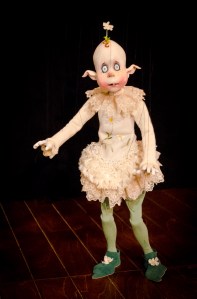
Ronnie Burkett's Schnitzel (photo by Alejandro Santiago)

Ronnie Burkett’s Schnitzel (photo by Alejandro Santiago)

I am almost embarrassed to say this, but I never really pay too much attention to puppetry’s place in history. There are some wonderful companies in town, like Ronnie Burkett and the Puppetmongers who are deeply knowledgeable about all the different forms and styles, and the great masters of the art form through out the ages. But to me, the importance of the puppets is what they provide for a horror story, and the way they invade an audience member’s imagination and leave them open to otherwise difficult emotions to reach, like terror, dread, wonder and awe. The reality of the puppet exists only in the imagination of the observer, and so they act on people’s psychology in a way that humans can’t.

For example, our play Dear Boss opened with Jack the Ripper’s final victim having a nightmare in which she faced off with the Caterpillar from Alice in Wonderland. The Caterpillar was a fifteen foot tall rod puppet with multiple operators. It could be scary one moment, funny the next, graceful, threatening, sexy, and coarse. It could be all those things and more in close concert, some times more than one thing at a time. However, if that character were played by an actor in a caterpillar suit, it could only be on thing: stupid looking.

4-As an artist whose work regularly visits the realms of mystery and terror of a writer such as Edgar Allan Poe –one of the writers who influenced everyone from the French Symbolists right up to more recent artists such as Alfred Hitchcock and Tim Burton—please reflect for a moment on the value of fear and suspense in works of art, as evidenced by the work of Eldritch Theatre.

I think fear, and it’s cousin wonder, are grossly neglected in modern theatre. I suppose, in part, it is because they are difficult feelings to arouse in an audience. Like humour, fear is largely subjective. Also like humour, fear requires great understanding of timing and technical skill from the performer in order to be evoked successfully. Both Comedy and Horror tend to be dismissed as lesser art forms, as well. I can’t really understand why this is so.

I believe that the purpose of entertainment is to provide for society what dreams provide for individuals. They are a collective outpouring of our subconscious yearnings and trials. To neglect to provide nightmare entertainment along side the other more accepted forms of art, I believe, results in profound societal neurosis.

Also, and more importantly, way more importantly, scary stories are really, really fun.

5-Is there a teacher you’d care to name that you especially admire?

My Theatre Arts teacher, Art Fidler, when I was in highschool in London Ontario, over 25ish years ago, was hugely influential. He let us run the drama club as if it were a small theatre company. And I learned as much about show business doing that as I have in a lifetime of working professionally.

*******

Eldritch Theatre present Frankenstein’s Boy, written by Eric Woolfe, with puppets by Eric Woolfe and starring Kimwun Perehinec & Eric Woolfe, at the Red Sandcastle Theatre 922 Queen Street East October 23th – November 8th.  For tickets click here.

Perehinec & Woolfe + creations in Madhouse Variations (2010)

Posted in Dance, theatre & musicals, Interviews | Tagged , , , | 1 Comment