Les Adieux

The Canadian Opera Company Ensemble Studio had their annual noon-hour concert to commemorate the departure of some of their members, titled “Les Adieux”. The three performers?

  • Michael Shannon, piano
  • Cameron McPhail, baritone
  • Sasha Djihanian, soprano
Baritone Cameron McPhail

Baritone Cameron McPhail

For most of the concert we went back and forth between artistic solo songs, in other words, far from the operatic idiom of the COC: until the last items on the program.  It makes sense, considering that for most of their time with the Ensemble, these flamboyant singers are often required to soldier in comparative obscurity, rarely getting the opportunity to show us what they can really do, what their voices can do, what charisma they could display if given half a chance.

That is, until the last two items. Djihanian sang & danced a broadly seductive “Meine Lippen, sie küssen so heiss” from Giuditta by Lehar, including a couple of notes that might have been high C’s, tossed off to huge applause. It was a fitting reminder.  The two youngsters singing for us were not just capable of snazzy high notes, but could take the stage with flamboyance. And to close? The pair offered us a poised and well-acted “là ci darem la mano” as an encore, the one time McPhail & Djihanian sang together. It was a fitting display of their musical dramatic skills, at this bitter-sweet moment of graduation, embarking on their careers.

Photo: Sasha Djihanian, 2013. Photo by Chris Hutcheson.

For the rest of the hour we were hearing other sorts of singing, different tests of skill.  McPhail opened with Chansons gaillardes, eight dryly ironic songs from Poulenc. They’re as much a test of your ability to keep a straight face as of vocal stylings, McPhail ever the deadpan comedian, never telegraphing the joke or tipping his hand, as suave a display as you could imagine.

Djihanian followed with a contrasting pair of Armenian Songs by Sayat Nova. Where “Kani vor jan im” showed off a rich middle voice in a moody composition that almost suggested that the soprano could sing mezzo-soprano rep if she so chose, “Kamancha” took us to a more extroverted place. She followed with Debussy’s Ariettes Oubliées, the furthest we’d drifted away from an operatic idiom, exploring varieties of internalized experience, with excellent support from Shannon. Another subdued pair of songs from Dvorak followed.

Michael Shannon, pianist & répétiteur

McPhail followed with I Was There, five powerful songs with English texts from Walt Whitman composed by American composer Lee Hoiby, requiring the singer to step forward into the spotlight.

All this variety serves to remind us that Ensemble Studio members can do much more than just opera. I wish them well in their future life.

Posted in Music and musicology, Opera, Reviews | Tagged , , , , , , , , | 2 Comments

Louis Riel

When I was young there was a phrase used so often that it became a cliché, something to be joked about. What exactly was the “Canadian identity”, and –other than hockey or maple syrup –what was Canadian culture?

click image for information about the DVD including how to obtain

As far as those asking were concerned, it hadn’t yet been articulated. Had they looked in film or literature they wouldn’t have found much back in the 1960s. Over the next few decades, though, artists did what artists do. Leonard Cohen, Joni Mitchell, Margaret Atwood, David Cronenberg, and so many more told their stories, and in so doing, gave us stories with which to tell our own story.

It’s so simple, and so recent, that perhaps nobody realizes just how precious & new it is. The Canada to which my family came –before my birth, when my parents crossed the ocean—was a bland but safe place. Trudeau had not yet appeared to articulate the ideas of bilingualism & multi-culturalism, two central tenets of modern life in Canada.

I just watched a DVD, one of a series to commemorate the death in 1999 of composer Harry Somers. They took the recording from a CBC broadcast made in 1969 of Somers’ opera Louis Riel, one of two operas premiered in 1967 by the Canadian Opera Company. It’s a remarkable historical document for a number of reasons.

  • The opera captures some of Canada’s history: not just the story of the Métis hero Riel, but the circumstances of his life & death, including a portrayal of the bigotry with which he was executed (although I have no idea if that’s something accurate or merely a creation of librettist Mavor Moore)
  • The opera was commissioned by the Floyd S Chalmers Foundation in three languages (English, French & Cree).
  • The DVD shows some of the singing talent from almost fifty years ago, including Bernard Turgeon’s definitive portrayal of the Métis leader and visionary, sung in two languages, Donald Rutherford as Sir John A Macdonald, Roxolana Roslak as Riel’s wife Marguerite, and other singers of note such as Alan Crofoot, Joseph Rouleau, Patricia Ridout, Mary Morrison, Peter Milne and Howell Glynne.
  • The CBC broadcast re-framed the historical events within a contemporary context, given that there were contemporary echoes in Québec, even citing Pierre Trudeau’s words at the beginning & end.

Some aspects of the broadcast don’t wear well with the years. The wigs / hair on some of the singers, for example look rather artificial, although I think it was one of the first times that an opera production meant for a big stage had been captured in the intimacy of a camera. In other words the DVD is likely the COC production seen from up close, and so naturally there are a few blemishes showing. For some moments the camera-work is sensitive, even though the acting is often oversized, more proper for a big stage rather than film or television.

Yet the main portrayals are superb. Bernard Turgeon is convincing in both languages (and as I didn’t follow the libretto closely he may also have some lines in Cree: I’m not sure), on the edge between a kind of vulnerable passion and religious fanaticism. The compositional style is the modernist idiom that was brand new in the first half of the century, as in Wozzeck, but perhaps conventional in some TV dramas by the 50s and 60s.  Somers’ idiom includes some dissonant brass and string chords, as well as some whimsical woodwind writing, often associated with the political discourse for the scenes in Ottawa.. Turgeon sounds very comfortable with his music, always illuminating his singing with the passions of Louis Riel, poised somewhat like Joan of Arc between inspiration and madness.

For the rest, I’m less certain as to whether the quality of what we’re seeing reflects the composition or the performer. Moore’s libretto offers several witty moments for some characters. Thomas Park plays a key role in the first part of the opera, as Thomas Scott, a quarrelsome loudmouth asking for trouble. He gets himself executed, and becomes the martyr who later brings about Riel’s downfall.  You can’t take your eyes off Park whenever he’s onscreen.

Donald Rutherford is given marvelous lines by Moore to work with, as Sir John A Macdonald. One scene ends with Macdonald singing to the Bishop Taché “touché, Taché”. In another scene, Taché arrives saying “Sir John your health is in my prayers”, to which our first PM replies “So that’s where it’s gone”. Most of the role is played with the camera in very tight, so Rutherford has no choice but to be a smooth performer: as Macdonald likely must have been.

Conducted by Victor Feldbrill I can’t find any credit for an orchestra on the DVD. While it might have been the Toronto Symphony when presented at the O’Keefe Centre, perhaps there were some substitute players, which might explain the lack of a clear credit.

I’m thinking of this now, having just posted something about the CBC and their shrinking budgets. Who will champion Canadian culture? The CBC no longer have their orchestra, likely can’t commission so many (if any) original works by Canadian composers.

Does Canada still need champions of Canadian Culture? The COC once were big champions of Canadian culture. Indeed a friend of mine recently told me that there’s a charter somewhere stating that the COC have a responsibility to uphold Canadian culture & talent. Sometimes I feel that’s what the Ensemble Studio represent, a pathway for Canadian talent, although other times I feel the studio is simply a repository of talent for the company, a ready answer to critics (like moi), even though I am often frustrated at how often the talented graduates vanish, never to be seen on a COC stage.

But in the meantime, as we wait for a newly composed main-stage opera from the COC –The Golden Ass was their last I believe—the fiftieth anniversary revival of Riel is coming soon. Rufus Wainwright’s Hadrian may not satisfy those within the classical composer fraternity who must feel bypassed by Alexander Neef’s decision to approach a popular composer. Yet Wainwright’s composition –whatever its strengths or weaknesses—is Canadian culture too.

For those who can’t wait, Louis Riel is available on DVD from the Canadian Music Centre.

Posted in Cinema, video & DVDs, Music and musicology, Opera, Politics, Popular music & culture, Reviews | Tagged , , , | 3 Comments

Media Circus 2: CBC

I am trying to be hopeful about the changes to the CBC. It’s been reported that over 600 jobs are being cut, that the network will reduce its sports department in the wake of the highly publicized loss of Hockey Night in Canada. This is not surprising, but a consequence of budget cuts in 2012, one of a series. For years, the Conservative aim has been to reduce the size of the CBC. I believe their concerns are far different from mine.

Their concern? Public affairs programs, news, all allegedly with a left-wing slant.

Ha… Ironic! The network has been drifting closer over the years to being commercial, in its sensitivity to public taste. Where its 1960s and 70s programming seemed immune to such concerns, nowadays? Not so. But the irony is that the hard-core news function is not driven by ratings. The radio programming, ditto. CBC will cut back on its comedy and drama, and especially its sports programming long before they stop being a pain the conservatives’ collective butt.

But –speaking of butts—that’s not at all what bothers me.  I see the CBC in an entirely different context.

For me the CBC is the network of Saturday Afternoon at the Opera. I remember CBC orchestras and think of the Glenn Gould studio as a magical place for classical music programming. I always understood the CBC to be the broadcaster who would do what the public could not or would not do. They were the ones to help identify and create Canadian culture by commissioning and recording. I am not as confident about the future of classical music on CBC as I am of news & public affairs. I do feel strongly that this could be an election issue: if the other parties would identify it as one. The conservatives will never do so, as the party who have been systematically killing the public broadcaster through a series of cuts. The other two parties don’t need to promote the CBC as a cultural issue –even if it is so—because it’s also an economical one as well. Arts funding gives a great return on investment. The proof is relatively recent, and needing to be shouted from the roof-tops. Some –notably Tom Hudak—still think that austerity works, even though economists have discredited trickle down and supply side economics as fallacious. Pumping money into the CBC creates jobs, and not just the immediate ones working for the corporation. Artists are not to be compared with other disciplines such as law or medicine, where immediate payback is expected & required. A classical composer can be a guy driving a cab (like Philip Glass did at one time) working in insurance (as Charles Ives did long ago) or teaching music. A commissioned composition trickles down to the performers and to the audience who might otherwise not hear a new Canadian piece (admittedly an intangible). Trudeau & Mulcair should take positions on this right away. I am under no illusions. Harper won’t rescue the CBC, although he might temporarily soften his position if there were an actual conversation on the subject. But let’s make sure there is such a conversation.

Posted in Opera, Politics, Popular music & culture | 3 Comments

Toonseum

What was it that he said again? Joe Wos could have been talking about the way we make them, or the way we perceive them. I think he said that cartoons both exaggerate and simplify. The funny thing is that my recollection of him is exactly like that. I’m remembering him as a virtual cartoon, not because of who he is so much as the way he reminds me of a particular cartoon character.

At first glance, as he sat by the cash register in this place full of comics and memorabilia, I thought I was in the presence of someone just like that comic book guy on The Simpsons (speaking of toons). You know who I mean? The one in the store who is a nerd of deep & esoteric knowledge. If it were rocket science or medicine he’d be rich, but because it’s something comparatively obscure –like comics – he has not yet become wealthy, although there are other things in life besides money, right? I realize that by resorting to a stereotype I’m being simplistic, and in the process creating something in my mind that’s just like a cartoon.

Cartoonist and Toonseum curator Joe Wos alongside one of his quick creations

Cartoonist and Toonseum Executive Director (curator?) Joe Wos alongside one of his quick creations (photo by Leslie Barcza)

It had started out as a tour of a small gallery. Toonseum is a museum of the cartoon, or “toon” for short. If you don’t realize how broad a purview is covered by a place such as Toonseum, ask Joe Wos.   (hm or should one use “the” before saying the name? Is it “The Toonseum“? or just “Toonseum”? I forgot to ask) Today’s show, of artists illustrating for Golden Books had included images of famous artists such as Richard Scarry. Some had been refugees from eastern Europe (Feodor Rojankovsky, and Tibor Gergely), as well as artists formerly employed by Disney, who had chosen to go off on their own, perhaps giving up something financially for greater expressive freedom.

And come to think of it, do we really appreciate people like that, with their encyclopaedic knowledge of esoterica?

At least the nerds of the world are no longer ignored. Yes it started out as a tour. And then suddenly by good fortune I discovered I’d come exactly at the time when I’d be able to take a brief drawing lesson. Oh my gosh what a windfall. There were three others there at the same time , all of us sitting there watching JW’s lecture/demonstration. He explained some of the basics of cartoons. Hm…. Exaggeration and simplicity? As I thought about it, I was reminded of the cloisonists, painters such as van Gogh and Gaugin (at least for part of his career), whose paintings resemble cartoons, because they are a series of blocks of colour.  “Cloisonism” is a term coined by a U of T professor awhile ago to describe the phenomenon, whereby the artists emulated the style of cloisonné (a kind of ceramic where each cartoon section is surrounded by a thin strip of metal, and looks indeed like a cartoon). I think it was just as relevant to observe the similarity to stained glass. Just as a window showing a saint or Jesus would be forced to work in blocks of colour surrounded by a metal outline –because of the limits of glass—so too these painters. Gaugin at this time –before Tahiti—was a symbolist, and associating with others who were part of the movement. Maurice Denis, who wrote the manifesto for the Nabis (the movement to which Gaugin was attached at this time) lived with Aurelien Lugné-Poe, the man who directed the first production of Maeterlinck’s play Pelléas et Mélisande in 1893. You want to see a very exalted cartoon? Look at the first edition (either the cover or frontispiece: both by Denis) for Debussy’s La Demoiselle élue. You can’t see any features clearly because these are highly stylized images, aiming for something symbolic & ideal rather than realistic & individualized.  Anything by Denis or Gaugin from this period aims for an ideal largely by emulating stained glass and avoid realism or specificity at all costs. So in other words, I hope I can be forgiven by Mr Wos for the way my mind works. I am not one to denigrate cartoons, cartoonists or cartoon collectors, associating such works with some very ambitious artists.

My puppy, created with the help of Joe Was in cartoon class today

My puppy, created with the help of Joe Wos in cartoon class today.

After speaking of these two principles he then went on to demonstrate. We were taken along for the demonstration, invited to draw the same sorts of figures on our own piece of paper. You can see JW’s puppy (his last drawing) behind him on the easel. JW took things a step further by employing the letters of words in the drawings. We all did an owl, using the letters O, W and L. It was an apt demonstration of how even with the simplification of a cartoon, he could still portray something quite recognizably. Here you can see one of my drawings that I made as I took in the handiwork of the master. I think his puppy is far more sympathetic than mine.

Not what I expected!

Posted in Art, Architecture & Design | Tagged , | Leave a comment

10 questions for Cameron McPhail

All good things must come to an end.  Brandon, Manitoba native Cameron McPhail has been a member of the Canadian Opera Company Ensemble Studio, Canada’s premier training program for young opera professionals.

Recent COC appearances include Schaunard in La Bohème, Guglielmo in Così fan tutte (Ensemble Studio performance) and the Officer in Dialogues des Carmélites. Other credits include Nick Shadow in The Rake’s Progress (Music Academy of the West); Ford in Falstaff and the title roles in Don Giovanni and Gianni Schicchi (University of British Columbia Opera); Tarquinius in The Rape of Lucretia, Masetto in Don Giovanni, Marcello in La Bohème, Riccardo in I Puritani and George in Of Mice and Men (Yale Opera Studio); Mercutio in Gounod’s Roméo et Juliette and Ford (Opera NUOVA); Conte Almaviva in Le nozze di Figaro (Opera on the Avalon); and, Schaunard (Highlands Opera Studio). In February 2014, he won a George London Award (for a Canadian singer) in the George London Foundation Awards Competition. This summer, he appears as Marcello in La Bohème.

On the occasion of his farewell to the Ensemble Studio at the Richard Bradshaw Amphitheatre on May 20th  I ask McPhail ten questions: five about himself and five more about a special concert titled “Les Adieux”.


Baritone Cameron McPhail

Baritone Cameron McPhail

1)    Are you more like your father or your mother?

I am a legitimate cross-breed. As children, we subconsciously recognize traits and characteristics of each parent, then we do our best to embody the ones we admire. My dad was… I mean IS (sorry, Dad….) an athlete, a competitor, a philosopher and business man. My mother is warm, compassionate, artistic, creative and loves to shop.

I guess I fluctuate. I have my father’s competitive spirit, his wanderlust, hopefully as much of his manners and appreciation for people’s good qualities and their flaws as possible. He taught me to be gracious with people when they piss you off, because he always insisted that all people are inherently good and mean well. Thanks to my dad: I see my art as a product, I hate losing, I swear too much, I put too much butter on my toast and I like almost everybody. Thanks to my mom: I admire strong, independent, driven women; I could play as many sports as I wanted to, but had to be studying some sort of musical instrument. She was the performer and musician, my Dad was loud. A perfect recipe for an opera singer.

2)    What is the best thing or worst thing about being an opera singer?

The worst thing about being an opera singer is the uncertainty and not working. There are an infinite number of people who will tell you what they think, an infinite number of decisions to make which can affect your ability to put food on the table, pay a mortgage or get your kid braces. You can get an infection in your chest or sinuses and have to cancel an engagement that you might have been counting on to get you through the spring, or you can get a phone call from your manager letting you know that someone ELSE got an infection in their chest or sinuses and that you don’t need to worry about getting through spring anymore. As much as you work on your craft, as much as you practice, prepare, rehearse, you still need to be offered a job by someone. It’s not like being a lawyer where you can simply work harder and bill more hours. You can only work as frequently as someone else is willing to hire you. The big balancing act (in my opinion) lies between resisting the urge to become complacent and overly secure with your product, while also loving it enough to enjoy the journey through the ups and downs. Vocal technique is an infuriating, ever-changing labyrinth of variables. You go to bed thinking you have it. Then you wake up, head to the practice room, try to warm up and wonder during which REM cycle you got terrible again….

The worst things are also at the same time, some of the best things about being a singer. You get it together eventually. You become more consistent, you can correct mistakes yourself faster and that’s when the fun starts. All of those doubts and worries temporarily go away once you’re actually working. It’s hard to explain the feeling you get that contract, the feeling of walking past security through the stage-door. The way your heart starts to beat a bit faster when the orchestra begins tuning, and the feeling of standing in that principle bow-line when you’ve all had a great show and the audience is on their feet. Those are the moments when you forget that you’re actually being PAID to do this. It is those times when you feel extremely lucky, and you feel that urge to keep coming back, keep auditioning and keep getting better.

3)    Who do you like to listen to or watch?

If it’s opera that I’m working on, I think we all have our heroes we prefer to hear. I love Nicolai Herlea, Piero Cappuccili, Cornell MacNeil and Ettore Bastianini. If I need a DVD to watch, I’ll choose Simon Keenleyside, Bryn Terfel or Ferruccio Furlanetto. They are such incredible artists AND singers… Easy to emulate and be inspired.

If I’m not listening to opera (which is usually the case…), I’m a die-hard rock and roll fan. I grew up with Neil Young, Hendrix… Seeing The Rolling Stones live was a religious experience for me. Their virility, longevity and love of their craft is exactly what we need as opera singers. We want that 50-year career…

TV-wise, I think the greatest shows on TV are Pawn Stars and Deadliest Catch. Honorable Mentions go out to Game of Thrones, The Sopranos and Judge Judy. This summer, Cat (my wife) and I are going to do Breaking Bad and House of Cards. We’ll be on the road a ton… I tip my flask to the creators of Netflix.

4)    What ability or skill do you wish you had, that you don’t have?

I wish I could play piano better than I do. I was an athlete growing up, and while I took some lessons when I was a kid, I never really learned to read music as well as I wish I had. These days, that would be an extremely useful skill, especially when I was learning The Rake’s Progress, Billy Budd and The Rape of Lucretia.

Slightly less practical, I would love to be a haberdasher, bespoke tailor or cobbler. I have slightly expensive tastes when it comes to clothes and shoes. If I could make my own, I’d probably reduce my costs. Maybe not… I love the parts of men’s fashion that celebrate purity, tradition and timelessness. Raw denim, Goodyear Welting and British Tweed, and hand-made suits made from the manes of Milanese Unicorns.

5) When you’re just relaxing and not working what is your favorite thing to do?

On my days off, I love to pay golf. I think it’s the greatest thing in the world. It’s so pure, so imperfect and when it’s just you in the woods, you’re at address and the ball moves, you’re the only one who knows you just incurred a two stroke penalty. It’s a game that shows your true character and grit. It also has so many parallels with singing. The focus, the mental endurance, the demand for great strength, yet at the same time dexterity, agility and flexibility. You need control over your big muscles, yet the ability to isolate and manage the small, intricate ones. It is extremely difficult to be good at either golf or singing. As you age, some things get simpler and new things get harder. Perfection is unattainable.

If I’m on the road, I love to get a little dressed up and go for a walk. I’ll shop, see people, places, eat, drink, do whatever it is that people do where we are!

As a Prairie-boy, I was bred to love road trips. My bachelor’s degree in economics and geography was at the University of British Columbia. My wife is also from Vancouver, so needless to say, I have done the drive from Winnipeg to Vancouver more times than I can count. My Dad’s Cadillac CTS-V, a few great playlists and one of those Lumberjack Sandwiches from Safeway… I’m in. I don’t care how far it is.

********

(l-r) Phillip Addis as Marcello, Eric Margiore as Rodolfo, Cameron McPhail as Schaunard and Tom Corbeil as Colline in the Canadian Opera Company production of La Bohème, 2013. Photo: Chris Hutcheson

(l-r) Phillip Addis as Marcello, Eric Margiore as Rodolfo, Cameron McPhail as Schaunard and Tom Corbeil as Colline in the Canadian Opera Company production of La Bohème, 2013. Photo: Chris Hutcheson

Five more about your farewell concert with the Ensemble Studio.

1)    Please talk a bit about the next step.  How does one approach life after the Ensemble?

This is a tricky part, because there are so many different paths to choose from. My wife and I are both singers, we have the same manager but other than that, we are both making individual career moves while supporting each other every step of the way. We are engaged in North America next season, but we are also spending as much time as possible in Europe to sing as many auditions as possible. These days, it is very difficult to simply have a career in JUST North America or JUST Europe. You have to work hard to try and maintain a presence in as many places as possible. It’s not easy, but we simply keep working hard, keep taking voice lessons and set high goals. We both hope to sing in Canada as much as possible, but Europe has to be a priority too.

I am lucky enough to have the support here at the COC, in that they fully understand the importance of auditions and competitions… especially in your final year. If you’re not careful, you can enjoy the safe atmosphere of the Ensemble Studio, and once you’ve graduated, you’re on your own. The COC gives you every opportunity to cultivate future plans and a young singer can do everything right in his final year, but a challenging year after the Ensemble Studio is almost inevitable. I am very lucky to be relatively busy, but it’s still going to be an uphill battle. Wish me luck…

2)    What do you love about the Ensemble Studio?

The Ensemble Studio is as good as it gets. There are comparable programs in the world, but ours here is on par with every single one. They gave me as good opportunities as any artist that has come through the program. I was given lessons, coaching, guidance, financial stability, networking, freedom to be in New York for auditions or competitions when I needed them, and roles on the COC mainstage alongside the best singers in the world as my cast mates. What more is there to say?

My colleagues are some of my best friends, they’re talented, creative and a hell of a lot of fun. We get to do a show together each year, and it’s always a huge success simply because of the relationships. It’s pretty hard not to be close with people that you’ve changed with in a broom closet somewhere in Northern Ontario at 8:30 a.m. for an elementary school performance of The Brothers Grimm. I always tried to wear my nicest underwear.

3) What will you be singing in Les Adieux, and does it have personal significance for you at this moment of saying goodbye?

For the Les Adieux concert, I’m going to sing two song cycles that I love very much. The first will be Poulenc’s Chansons Gaillardes. It is extremely difficult for both the singer and the pianist (Michael Shannon), but the rewards are countless. The poetry is so incredibly French… so beautiful, yet with so many ingenious metaphors, double-meanings and innuendos. To perform them properly takes great restraint, subtlety and vocal control. I hope you like them.

Composer Lee Hoiby and his partner/collaborator Mark Shulgasser at The Falls, Long Eddy, New York.

The second cycle is by American composer, the late, great Lee Hoiby called I Was There: Five Poems of Walt Whitman. The poems are timeless classics and Mr. Hoiby was a close friend of my voice teacher while I was at Yale. Mr. Hoiby was such a kind, passionate man who wrote remarkably well for the voice. He was a wonderful pianist, and Michael Shannon definitely has his hands full with this set too. Both sets, the Poulenc and the Hoiby are about as challenging a sing as it gets for me, so to do them both in one hour will be a hell of a challenge.

As a vehicle for saying goodbye to a place that will always be extremely dear to me, the Poulenc represents maturity, gained wisdom and the notion that your own, unaffected, natural voice is going to be best received. The Hoiby, beginning with the song “Beginning my studies” contains personal awakening, accomplishment, loss and inspiration garnered from quality leadership, and lastly, departure on a new adventure with the future unknown. I can’t think of better music with which to take my leave. Sasha Djihanian and I will also sing a duet from Don Giovanni, because it’s cute, charming and will be on the Four Seasons Centre stage next season!

4)    Please put the COC Ensemble Studio into context, in a culture that doesn’t always value opera, at a time when it’s challenging to make a career.

Opera most certainly has a future. Anyone that says differently is being silly and close-minded. As time passes, there will be changes of course, but change is inevitable in all things. In the last month, the COC has just produced three of the greatest productions I have ever seen, anywhere in the world. World-class directors presenting well-thought-out productions sung by LITERALLY a half-dozen of the most in-demand singers on the planet. Eric Owens, David Daniels, Alice Coote, Sondra Radvanovsky, Russell Braun, Ferruccio Furlanetto?!?! Are you kidding me? You cannot go ANYWHERE else in the world right now and hear that many world-famous singers in the same week. ANYWHERE.

Sorry, I know that didn’t really answer your question… but in a way, it did. Context for a young artist program? Look who we get to watch in rehearsal. Our General Director, Alexander Neef, is a superstar. Only in the recent seasons are we seeing the vision and foresight that he has in distinguishing voices that are going to be valuable. These stars are going to keep coming to the COC and that attracts connoisseurs, agents, critics, coaches and the Ensemble Studio gets to be part of those performances, work with those conductors and directors. All of those superstars have high-powered management and they will hear us all. It’s cyclical. Talent attracts talent, and while people may question the future of opera, the shows I watched this weekend were packed, with people of all ages. It takes resilience and flexibility, but the young singers of the Ensemble Studio are getting to witness the re-birth of a company that has quickly established itself as one of the greatest houses in the world.

Canadian singers are wanted all over the world. The young batch of us in our 20s and 30s are benefitting from great work by singers like Adrienne Pieczonka, Russell Braun, Judith Forst, Tracy Dahl, Richard Margison, Ben Heppner and Gerald Finley. They’ve paved the road for us and set the bar extremely high, but luckily, we’re being exposed to that high level here at the COC, so we’re ready for the undertaking.

5)    Is there anyone out there who you particularly admire, and who has influenced you?

There are a lot of people that I admire. I admire my parents, my brother, my wife, my in-laws, my friends.

There are people that heard me when I was still studying business at UBC, without whom I would never have done this. Bruce Pullan, Nancy Hermiston and Peter Barcza at the UBC School of Music got me excited to actually pursue opera for a semester or two and see how I did. After one semester, David Agler of the Wexford Festival, Richard Margison of Highlands Opera Studio, Kim Matice-Wanat of Opera NUOVA, and John Churchwell and Marilyn Horne of Music Academy of the West gave me the next series of shots. Each time someone says “YES”, we take a step forward in our confidence, determination and desire.

Bass Robert Pomakov

Bass Robert Pomakov: paying it forward

The biggest influence and positive impact has been recent. I’m approaching 30 years old and am on my way but it’s hard to know what to expect in the next five years. It has been my older colleagues, cast mates and other singers who are 5-10 years ahead of me who have really made the big difference. Guys like Stephen Costello, Josh Hopkins, Quinn Kelsey, Robert Pomakov, David Pomeroy and Dimitri Pittas are who give me my biggest motivation. They’re only about 4-7 years older than me, but they know exactly what I’m going through. They share ideas, advice, talk ‘man-to-man’ about money and investments over a few beers while making me feel like I belong. They’re the next generation of superstars and want me with them. They pay for dinner, despite my objections and say “just pay it forward man… I’m making lots… someone else did it for us not too long ago”. They remind me that money will come, success will happen if you play it smart and that I can support a family, pay a mortgage and be a happy man. That’s the way I want to be, the way I want to sing and the way I want to help another young guy someday.

*******

“Les Adieux” is the special concert to end the season at the Richard Bradshaw Amphitheatre, a goodbye from the departing members of the Ensemble Studio, May 20th at noon.

Posted in Interviews, Opera | Tagged , | 1 Comment

Penalty balks

We often hear about the beauty of sports, that soccer –aka “football” to most of the world– is “the beautiful game”.  The aesthetic pleasures found in sports vary of course.  Winning really helps, don’t you find? When you lose, things never look quite as rosy.

I’d like to think I can discuss this dispassionately, but then again that may be something I am particularly well equipped to be, as a fan whose teams are mostly out of the race.  I was remarking to a friend that the World Cup and the Stanley Cup are similar for Toronto Maple Leaf fans.  Just as Canada never seems to play the final tournament, so too with the Leafs.  Who I’m rooting for becomes a kind of academic exercise.  Ir’s not yet the All-Star Break but the Blue-Jays are already eating the dust of the division leaders: and that’s okay.  The Raptors gave us an unexpected thrill this spring, even if they were on the sidelines after a very closely matched playoff with the Nets.  Now it’s back to normal for Torontonians: watching the rest of the world play.

It’s been said we make great commentators.  We’re a country of observers, it seems.  Marshall McLuhan, Northrop Frye, John Kenneth Galbraith, Glenn Gould..  Maybe this goes hand in hand with our relationship to our team sports: who –in Toronto at least– haven‘t won a championship in a long time.

I want to speak to one fundamental aspect of sport, namely justice.  Team sports have rules, and sanctions of some kind for breaking those rules.  I would argue that the aesthetics of a game are inseparable from the sanctions for transgression and the way rules are enforced.  Need I remind you that I live in a city where it appears to be okay to smoke crack or drive drunk, at least if you’re a rich political figure.  At one time I thought our society was fair because the rules were the same for the poor & the rich; silly me, how could I believe such nonsense?  I believe the enforcement of the rules is a system that makes beauty possible.

  • In NFL football if you break a rule you pay a territorial penalty: the position where the ball is scrimmaged is moved a certain number of yards, depending on the severity of the penalty
  • In NHL hockey if you break a rule you pay a temporal penalty
  • In NBA basketball penalties vary in severity, but eventually result in opportunities to score: free-throws
  • In FIFA soccer penalties vary in severity, but penalties in the penalty area are near-certain opportunities to score: penalty kicks

I’m falling out of love with hockey, tired of

  • a macho culture that substitutes thuggery for skill (if you need someone to explain this to you ask Don Cherry, the apologist for hockey players who substitute toughness for real skill: something like Cherry himself come to think of it)
  • rule changes that are touted in the autumn (when the season begins) but never enforced come springtime (aka playoff time)
  • a tendency to call the game differently at the end of the season.

Imagine any other sport working this way.  Can you imagine a baseball game where the strike zone is different in October than in April?  A football game where pass interference or holding infractions are defined differently in the playoffs than at the beginning of the year?

But that’s exactly how hockey works, which is why I find it hard to watch in the spring.  Not because the Leafs are out.

And so, in the interest of making hockey a bit more like the sports that I can count on –NFL, NBA, baseball, even FIFA soccer– here are some modest proposals.

  • Overtime in the regular season?  Why not make it 3 on 3 (goalie included)?  Surely the goal should be to reward skill. Teams that skate would prosper in that scenario.  And while you imagine that, imagine that the referees will actually call penalties: every penalty all season long.  Now picture that 3 on 3, when a team gets a penalty, and the power-play team pull their goalie (three skaters against one + goalie).   Unfair?  Or is it simply the way it works in those other sports –such as soccer or basketball– where penalties are understood to lead to scoring, are understood to bring about –wait for it– justice.
  • Here’s a way to make every NHL team a bit more prosperous with an easy rule change, something with a precedent.  At one time hockey was played with seven skaters a side (goalie plus six), and then they changed it from seven to six.  Players are bigger and stronger, right?  Some are having issues with concussions from the bone-jarring collisions.  What if the NHL were to again reduce, from six to five?  Suddenly every rink would feel bigger.  Suddenly skating ability would matter more, and body-checks would be harder to do.
  • Sometimes a team gets a couple of penalties, and — gasp — the team is then two men short.  And at this point, do the players suddenly stop committing infractions?  Of course not. Often you’ll see a play where two or even three infractions occur all over the ice within a few seconds time.  The referees seem to be prisoners of a kind of political correctness, not wanting to interfere in the outcome of the game.   It’s madness, when they enable a culture of thuggery and rule-infraction.  The penalty box will have two people in it, and subsequent infractions seem to be invisible. Referees don’t call the rules.  But what if they did? What if you escalated penalties, in fact making it anathema to commit a third penalty instead of something one can do with virtual impunity.  You have two penalties, and when the third happens, why not really clobber the perpetrator?  How about a penalty shot on the spot?  How about a two-man penalty shot, given that single man penalty shots are far from certain of scoring..?  Just as FIFA penalty kicks are almost certain goals, NHL penalty shots should be something to be feared, a genuine deterrent to the infraction.  Or what if the third infraction were required to sit in the box, awaiting the end of the previous penalty before the clock even starts…?
  • Fighting should be eradicated. It’s unhealthy for the poor guys who get pounded on.  Stick infractions should be treated as a priority foul. There should be no such thing as two minutes for high sticking.  Do we put people away for six months when they commit murder?

Okay I’m dreaming.  This isn’t’ meant to make Toronto a winner. This is meant to make hockey fun to watch again given that I always watch the playoffs, with the Leafs on the sidelines.  The NBA and the NFL are truly fair, which means that they are genuinely beautiful to watch.  While there are stunning moments in the NHL it could be so much better.  Clutch and grab hockey is really a way to allow mediocre talent in, because there aren’t enough good players.  It’s a bit like deciding to hire singers with bad voices, people who sing flat in a musical or opera, because you can‘t afford good voices.

The World Cup is coming soon.  It’s a beautiful game because it’s just, fair.  Same with baseball & basketball & football.

Would that it were so for hockey.

Posted in Sports | 4 Comments

10 Questions for Ann Cooper Gay

Every now and then I get the opportunity to interview one of the key figures in the Canadian opera scene, people such as Stuart Hamilton or Marshall Pynkoski.  Ann Cooper Gay is another such figure.  I’ve known Ann a very long time.

How long? I remember a time before Mr (Errol) Gay came into the picture.  I saw her Anne Truelove redeem Henry Ingram’s Tom Rakewell from the Nick Shadow of Peter Barcza at the U of T‘s Opera Department production.  Ann played the organ at my first wedding, accompanying Peter singing my setting of William Carlos Williams’ poem “The Rewaking”.  Even then I knew her for musicianship, energy, a unique personality, and it must be said, a deep well of patience and loving kindness because I know I must have been a pain in the butt.  I may be conflating roles, but I am sure I recall a Despina and a Mimi, although hehehe it‘s awhile ago.  But in other words, the Ann Cooper Gay who has been running the Canadian Children’s Opera Chorus knows the medium from the inside out, as a gifted musician, singer, actor, and working artist before she undertook the complexities of running a company.

Mentorship was something extra Bradshaw was known for. He's gone,  Ann Cooper Gay is still at it...

Mentorship was something extra Bradshaw was known for. He’s gone, Ann Cooper Gay is still at it.

Excuse me if I digress, but the opportunity to remember Richard Bradshaw –and through his eyes to recall earlier days for Ann & the CCOC– is something I can’t pass up, as I cite both a letter from Richard Bradshaw to Ann Cooper Gay, plus a photo, showing Bradshaw-the-mentor with his heart very much on his sleeve.

Dear Ann,

You really are a most magnificent triumph in every way. Quite how you got that thing together with all its sometimes puzzling complexity, I don’t know, but it must have taken a will and enthusiasm that nobody has in quite such measure as you.  I thought it was a remarkable achievement and many, many congratulations to you all (and to your excellent pianist)!

Love,
Richard.[Richard Bradshaw, General Director Canadian Opera Company]

Librettist Kaitlin Bryski

Librettist Kaitlin Bryski

As Bradshaw implies, it’s a huge undertaking.  Recently I interviewed a CCOC alumna Kate Applin, and realized that Ann is an important figure who is often under the radar.  Sometimes her charges appear in COC shows –the children in Tosca or La boheme or  Carmen.  The three genii in Magic Flute were CCOC singers. But at the same time, Ann keeps commissioning new operas from Canadian composers, recruiting young singers to replace those who have grown up with her as a role model, producing, fund-raising….  The latest such project will premiere on May 29th at the Enwave Theatre, Norbert Palej’s East o’ the Sun and West  o’ the Moon, libretto by Kaitlin Bryski.    I feel privileged to know Ann and Errol (who has composed some of the CCOC operas), for all this time.  It seems especially apt that I’m assembling Ann’s responses on Mother’s Day, a time when we celebrate and honour mothers & nurturing spirits in our families and among us in our culture.  Ann is a genuine mother figure even if she still has the energy and cute smile of the ingenue.

On the occasion of the May 29th premiere I ask Ann ten questions: five about herself and five more about CCOC and her work

1) Are you more like your father or your mother?

Ann Cooper Gay (photo: Tom Sandler)

I am probably a good mix of both my parents.  I love to dream and create and I am curious about most things in this world and beyond.  I am passionate about learning and have enjoyed learning other languages and several musical instruments.  My father’s sisters sang and played and my mother sang and played the piano.  I wouldn’t describe my family as a musical one, but my parents made sure that I had a piano and a flute as well as good private teachers and my brother had his trumpet.

I was born in North Texas and grew up in South Texas where my father ran a store and my mother taught school.  It was a small town along the Gulf Coast, but the opportunities were there in the form of very excellent musicians.  The church organist (trained at the Chicago Conservatory of Music) taught me theory & organ and I started playing the organ at age 10; I was already playing flute by this time and the band director had attended the University of Michigan and had also studied under William Kincaid (principal flutist of the Philadelphia Orchestra).  His wife was my beloved piano teacher and choral director.  What are the odds of finding this caliber of teachers in a small coastal town anywhere?  There is a system in the States called the All-State Bands/Orchestras/Choirs run by the individual State Music Educators Assn.  It’s all done by audition, is quite competitive, allowing advanced music students the opportunity to rehearse and perform with like-minded peers under the direction of top-notch guest clinicians.  I lived for All-District, All-Region, and All-State Band.  I also enjoyed being a majorette and a cheerleader – I must have enjoyed performing because it wasn’t a huge stretch to become an opera singer.  I also liked to plan events and work with people and that led right into teaching and conducting.  I like to think of myself as a salesperson for music.  I believe in the power of music to change lives. I am a huge fan of the music program emanating from Venezuela  –  El Sistema.

2) What is the best thing or worst thing about being Artistic Director of a company such as Canadian Children’s Opera Company?

The best thing is watching the kids grow up, improve as singers and actors, develop leadership skills, and to see their pride when they have done a really good job.  The hardest part is having to choose kids to sing lead roles over other kids who would love to do the roles, but aren’t yet ready to assume that responsibility – both vocally and dramatically.  This is my 14th year (I can’t believe it) and the job I accepted in 2000 has evolved into something much more.  I suppose the difficult part of the job, as it has developed over the fourteen years, is that one doesn’t really have a proper down time.  That is partly my fault (I have trouble saying “no”) and the lack of funds to hire more staff.  We have a great staff – both administratively and artistically and a wonderfully supportive board of directors.  Locating proper funding is the real challenge, and that’s true for every arts organization.

3) Who do you like to listen to or watch?

I like to watch Jeopardy and The Agenda (TV).  I listen to, and attend when time permits, operatic, symphonic, and celtic music concerts.

4) What ability or skill do you wish you had, that you don’t have?

The ability to reserve quiet time for myself…I’m working on it and I can see the benefits to one’s mind and body.

5) When you’re just relaxing and not working what is your favorite thing to do?

I enjoy hearing daughter Erin sing and learning more about early music from her, sewing, reading, genealogy, discovering interesting postings on YouTube, & gardening now that the weather is better.

********

Charwomen from A Dickens of a Christmas (Errol Gay, composer, & Michael Albano, librettist/stage director)

Charwomen from A Dickens of a Christmas (Errol Gay, composer, & Michael Albano, librettist/stage director). Photo: Michael Cooper.

Five more about Canadian Children’s Opera Chorus and their upcoming production of East o’ the Sun and West  o’ the Moon.

1) How does being Executive Artistic Director of Canadian Children’s Opera Company challenge you?

This is a very good question.  How does CCOC keep me engaged?  Well, I am never without something to do:  that is, to think about, to decide upon, to figure out, to talk to staff about, to read hundreds of emails, to listen to new auditions, to listen to existing choristers and hear their progress, to answer parents’ questions, to attend board meetings, to interview potential staff (both artistic and administrative), to assist with fundraising, but most important is the necessity to plan rehearsals so that all material is covered and the children and youth will be able to present the music with confidence.

2) what do you love about programming & commissioning & producing with CCOC?

This is probably a walk down memory lane, but productions where the children and youth have contributed the most effort – musical and dramatic – toward making the opera a huge success.  I love to hire professional singers to appear with the CCOC and they are terrific role models for the children.  We’ve had many over the past and before my time, Ben Heppner, was a much-loved performer.  In Harry Somers’ A Midwinter Night’s Dream, we had James Westman, Michael Colvin and Allyson McHardy; Dean Burry’s The Hobbit allowed us to work with John Fanning; in Errol Gay/Michael Albano’s A Dickens of a Christmas we had Mark Pedrotti, Ryan Harper, and James McLean; in Errol Gay/Michael Albano’s Laura’s Cow we had Andrew Love and CCOC alumni:  Marta Herman, Tessa Laengert, and Adanya Dunn.

Director Joel Ivany

Director Joel Ivany

We’ve had wonderful stage directors starting with Tom Diamond, Duncan McIntosh, Valerie Kuinka, Joel Ivany [directing the current production], and Michael Albano.  Our collaborative partners have provided opportunities that we might never have been able to experience:  Canadian Opera Company, Toronto Symphony, Soundstreams Canada, Hannaford Street Silver Band, and the TENORS.  From the inception of the RUBIES, the gala run by Opera Canada, the CCOC has opened the festivities.  Ruby Mercer, our founder, also founded Opera Canada, so it’s a very lovely evening celebrating one of Canada’s visionaries in the field of opera.  When I started in July 2000, there were only about 90 children in four divisions; we now have 150 kids in six divisions plus an outreach program called OPERAtion KIDS (in its sixth season).  The total membership fluctuates between 150-190, depending upon the season.  One thing I’m really pleased about:  when I started in 2000, there weren’t a lot of graduates going into opera studies.  Of course, there was always the brilliant Karina Gauvin and we’re enormously proud of her.  Over these past 14 years, we’ve seen the numbers increase in the number of grads entering university and pursuing a degree in music.  Some are already attached to German opera houses and that pleases me greatly.  Our grads tend to go to U of T, McGill, Western, Laurier, UBC, and the Glenn Gould.  Over the years I have been proud to hire alums to teach various choruses or work in an administrative position – Bronwen Low, Sophia Perlman, Tessa Laengert, Katy Harmer, Liam Falkenheim, and Adanya Dunn.  The new (not so new, now!) directors at the COC (General Director, Alexander Neef, and Music Director, Johannes Debus) have welcomed the CCOC and we enjoy a wonderful working relationship with both of them.

3) Out of the complex planning and development cycle, what’s your favourite moment when you mount an opera?

I have two favourite moments:  1) when I come up with the idea and watch the librettist and composer react; 2) the buzz of the opening performance and the closing performance because the children and youth are so engaged and excited.

Ann's caption:  "Our favourite cafe in Yorkville --  Coffee Mill, where I can practise my three sentences in Hungarian!!! Errol, Michael, myself, Johannes, Erin -- just having lunch together."

Ann’s caption: “Our favourite cafe in Yorkville — Coffee Mill, where I can practise my three sentences in Hungarian!!!  Errol, Michael, myself, Johannes, Erin — just having lunch together.”

4) Please put CCOC into context, in a culture that doesn’t always value music education or classical culture.

Leslie, I asked Errol to put these thoughts into a paragraph or two and I think he has written something very, very fine.  So, here is his contribution to this question:

CCOC is the only organization in Canada (and possibly the world) that commissions and performs operas written for and performed by children.  There is an important cultural and philosophical corollary to this factual statement.

When children are exposed–positively–to an artistic format other than that with which they are bombarded mercilessly by the purveyors of crass commercialism, they tend to respond in an unusual fashion:  they attain a sense of discernment.  This is not to say they abandon the culture of their peers, but they do develop the ability to make informed distinctions among their cultural options.  This is, of course, what education is all about:  leading one to be able to make enlightened choices.  The understanding of “high” art is, by definition if not by popular consensus in our times, a goal towards which any educated person should strive.  Opera is perhaps its most complete manifestation in that it combines almost all of the separate elements of that all-encompassing term.  Although “grand opera” may not have as much “traction” in the 21st century as it has had over the previous 400 years (it’s always about money, isn’t it?), chamber opera–and yes, children’s opera–have, I think, a future that  will only grow in status and appeal.  The longevity and accomplishments of the Canadian Children’s Opera Company attest to it.

5) Is there anyone out there who you particularly admire, and who has influenced you? 

Obviously my husband, Dr. Errol Gay, who has shown patience in teaching me the craft of conducting, especially orchestral; my first opera mentors (musical and dramatic) were Dr. Herman Geiger-Torel (General Director, COC), Ernesto Barbini (COC conductor), Madame Irene Jessner (voice), James Craig (conductor/coach), Constance Fisher (stage director), Leon Major (stage director), Jan Rubes (singer & stage director), Bruce Lunkley (voice), Edward Matthiessen (voice), my friend — your brother Peter Barcza (baritone), Dr. Grady Wilson (organ),  and huge thanks to the larger-than-life, former General Director, COC, Richard Bradshaw, who believed passionately in the CCOC.

********

Canadian Children’s Opera Company’s production of Norbert Palej’s East o’ the Sun and West o’ the Moon runs May 29th to June 1st at the Enwave Theatre at Toronto’s Harbourfront.   poster

Posted in Interviews, Opera | Tagged , , | 2 Comments

Questions of identity

Do you know who you are?

Today’s performance of the Canadian Opera company production of Roberto Devereux  at the Four Seasons Centre seemed like an investigation of identity.

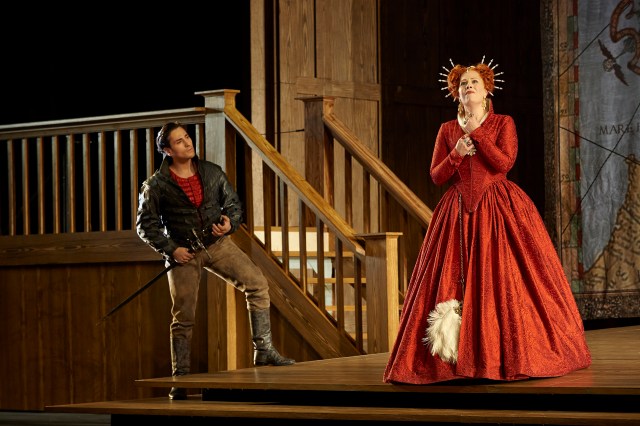
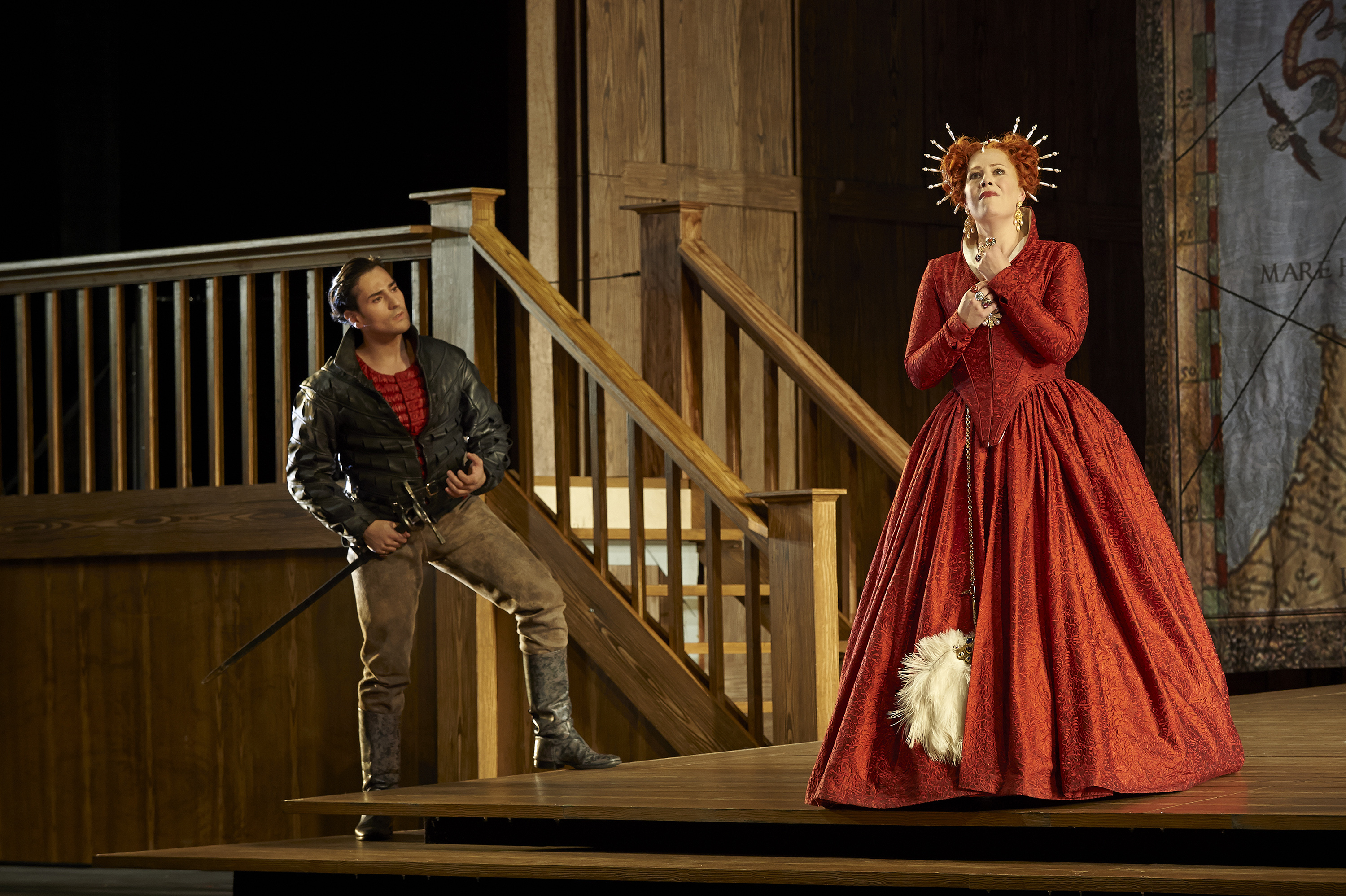
For one thing, there’s the opera’s plot, which concerns Elizabeth I and intrigues surrounding her.  In Donizetti’s opera we’re not coming at the story from the usual pro-British perspective but instead from the Catholic side.  It makes Mary Stuart a tragic hero (different opera but part of the “trilogy”), and quite possibly portrays Elizabeth more truthfully than what we get from Hollywood.  This is a vain & troubled Elizabeth, which is something unexpectedly edgy when you’re watching a bel canto opera.    So be advised, this is not what you’d expect.

Stephen Lawless’s productions of the trilogy are self-referential, particularly in the last scene of the last opera.  We’ve been in a kind of Globe Theatre replica, in recognition that in her world surely Elizabeth was in some sense a performer with an audience.  I avoided speaking of this aspect the first time I saw the production because I dislike spoilers; yet today, where I deliberately sought a front row seat for a full-frontal experience of the last scene, and knowing what was coming I was still so bowled over I was without a voice for a long time.  The last scene is very much about Elizabeth coming to terms with who she is, both her private sense of herself and the larger spheres such as the political and the historical.  In a good production at a special moment, it doesn’t change anything knowing it’s coming.

Leonardo Capalbo as Roberto Devereux and Sondra Radvanovsky as Elisabetta in the Canadian Opera Company production of Roberto Devereux, 2014. Conductor Corrado Rovaris, director Stephen Lawless, set designer Benoît Dugardyn, costume designer Ingeborg Bernerth and lighting designer Mark McCullough. Photo: Michael Cooper

Leonardo Capalbo (from earlier in the run) as Roberto Devereux and Sondra Radvanovsky as Elisabetta in the Canadian Opera Company production of Roberto Devereux, 2014. Conductor Corrado Rovaris, director Stephen Lawless, set designer Benoît Dugardyn, costume designer Ingeborg Bernerth and lighting designer Mark McCullough. Photo: Michael Cooper

And the identity of our Elizabeth was of course the main reason I had intended to be there in the front row.  This was a chance to see Sondra Radvanovsky again from very close up.  Sometimes good performances don’t look quite as good from up close.  I’d been very moved, for example by Lucy Crowe’s singing in Hercules when seen from afar, as I’d been moved by Alice Coote; up close I found Crowe histrionic and unconvincing (but still nice to hear) whereas Coote, who’d already moved me blew me away even more up close.   Similarly, Radvanovsky was ready for her close-up.  She made me cry three times (at least) in Aida a few years ago, so I wasn’t really surprised.  I didn’t expect to be reduced to a blubbering mess at the end, by the solemn horror with which she–literally– steps into her place in history to end the opera.

Maybe the biggest identity question for me today was the title role.  Ernesto Ramirez, who was the cover for Roberto Devereux, got the nod today.  Knowing that people were coming to see Radvanovsky from all over the world, I can imagine the pressure Ramirez must have felt when he was told he’d be getting a performance.  And so –speaking of theatrical drama– this was the classic drama within a drama.

Tenor Ernesto Ramirez

And Ramirez knows who he is.  While I was grooving on Radvanovsky’s voice, I was wondering how the young tenor would approach the role.  I say this because I recall seeing something rather interesting in the run of Aida, a matter of identity and self-knowledge.  Radvanovsky shared the run with a young soprano named Michelle Capalbo (coincidentally the same name as the tenor who sang earlier in the run). Here’s what I wrote in my blog back in 2010, just after I started.

Radvanovsky enticed the Rhadames of Rosario La Spina to sing louder than he probably intended.  By Act IV, he was a spent-force, after heroically singing himself out earlier, cracking and fading.  On the night I saw him with Capalbo, on the other hand, he stayed within his usual limits, and as a result never cracked.  At times the voice sounded lovely.

In other words, singing opposite one of the most powerful voices in the world, do you know who you are and continue singing as you should, or try to perhaps be something you’re not, press, and sing yourself out (as La Spina clearly did)..?  So I wondered if the same thing might happen to Ramirez, singing opposite such a powerfully-voiced soprano.  But no.  Ramirez knows who he is.  The singing was thoughtful, well-planned.  I have not heard a performance that was so accurately pitched in a very long time. Every single note was exactly on pitch, including two high B’s in his final scene.  I believe there may have been other posssible interpolated notes –that Capalbo gave us on opening night– that Ramirez had the good sense to skip.

Ramirez is not Pavarotti –again speaking of identity– but to my ear, the resemblance is striking.  The line, the lovely precision attack on high notes… but one big difference.  The Great Pavarotti was known to be an instinctive singer who did not read music.  Ramirez? I saw him accompany his wife Michelle on clarinet at a concert I reviewed, as she sang ““non piu di fiori” from La Clemenza di Tito.  Later? He sang “Grenada”, among other things.  I hope this is the big break that shows the world what Ramirez can do.  Who have we heard around here who sounds as good?  Stephen Costello, Ramon Vargas? lovely sounding to be sure, but Ramirez is genuinely in their league, and i swear, a prettier voice.  Yes he does sound like Pavarotti.

Could this be a scene from some operatic equivalent to A Star is Born?  Perhaps it should be.  Ramirez seemed fearless even though the costume didn’t quite fit, even though he’s required to be all over the stage in business that’s above & beyond the singing, for instance as Bottom in a brief snippet from A Midsummernight’s Dream complete with ass’s head.  But I don’t trust the opera world.  I’ve seen too much mis-casting and bizarreness of late –here and abroad– to believe that could happen.  It should happen, the same way the voters of Toronto should wake up and elect someone competent as Mayor.  Sure, I don’t mind if my friends take drugs or drink.  But I wouldn’t want the plane I’m on to be piloted by a drunk.  I’d want someone competent in the driver’s seat.  I want to win my case, not get drunk after losing my lawsuit with the fun chubby guy who’s my lawyer. And yes, I am accustomed to seeing singers who can’t find the right pitch sharing the stage with people who sing perfectly, and nobody in the audience or running the company seeming to give a damn or know the difference.

Sorry, I don’t mean to be negative on a night that was surely a triumph for all involved.  Speaking of identity, what am I doing exactly and who am I?  I’d like to be the one who builds up rather than tears down.   Last night left me feeling sad both for what I saw and for what I felt unable to say.

Tonight? My faith is restored.

Posted in Opera, Reviews | Tagged , , , , , | Leave a comment

Quixotic Ride

On Thursday May 22nd Stephen R. Clarke will be lecturing on “Chaliapin: A Portrait in Recordings” as part of the Canadian Opera Company‘s free noon-hour lecture series.  I wonder if Clarke will play any examples from Massenet’s Don Quichotte?  Unfortunately Clarke’s lecture comes near the end of the run of Don Quichotte at the COC, but I‘m very interested to hear what Clarke will play and what he‘ll have to say.

The opera –and of course the role –of Don Quichotte was created for Chaliapin by the composer Jules Massenet, and premiered in 1910.     Don’t confuse his portrayal of Massenet’s creation with his later portrayal in a film made much later.

Although designed explicitly for a great star, Massenet at this time had come a long way from the virtuosic writing in Manon.  The orchestral textures brilliantly stay out of the way, allowing a singing actor a relatively easy ride  (with or without a horse) through the role.  While it’s a clever vehicle for a star, it’s never caught on among the standard rep operas, being a relatively flimsy vehicle lacking any big numbers or memorable arias.

We’ve come a long way since then.

I had the misfortune to blunder into an article in the Toronto Star writing about the Stratford production of Man of la Mancha and the COC Quichotte (“Don Quichotte inspires two very different shows“) , and as a result conflated them in my mind on opening night Friday May 9th.  I don’t think it was a good idea for the COC to encourage this thinking.

Yes, I loved Ferruccio Furlanetto, who gives a very good performance as the Don.

But it’s not good that I was sitting there watching a Massenet opera, thinking it could just as easily be a road-show production of a musical.  The chorus, usually a pillar of COC productions, seemed very uninspired, possibly because at times they’re asked to take on very unsympathetic roles.  There’s a miraculous scene where a camp of bandits –played by the chorus plus Michel Corbeil in a non-singing  role as head bandit–surround the Don, who’s on the verge of being killed, until the Don moves them to a spiritual transformation.   Perhaps Director Linda Brovsky wanted young buff bandits in the front, but it was a bad choice.  Old and grotesque, particularly if they had the tiniest inkling of commitment & dramatic interest in the scene, might have made a difference.  From where I sat, I saw Michel Corbeil persuading me,  surrounded by a bunch of singers who probably miss the magic of the Donizetti & Handel operas they’ve been in over the past few weeks. They posed very nicely, but otherwise seemed altogether static, as they did in other scenes as well.

The set is a ponderous and obvious assembly of books.  While I found the concept moving and beautiful at first (even if it’s been done at the COC let alone everywhere else), that was before being made to sit through a series of long scene-changes that chose to ignore the music Massenet gave us for that purpose (at least two entr‘actes were staged, rather than employing that music to cover the movement of these humongous books).

I won’t say much more about Don Quichotte -as you can tell what I felt– but I do want to address something I’ve been wondering about for months now, namely casting.  I don’t envy the singers because they seem to regularly take roles that seem ill-advised.  Forgive me if this sounds arrogant, and yes I know there are complex political issues underlying casting decisions.

I saw Allyson McHardy do an unbelievably wonderful job singing Dejanira in Handel’s Hercules with Tafelmusik a couple of years ago.  But of course the Sellars Hercules arrived with its cast etched in stone from the previous incarnation, so forget Canadian McHardy it had to be Alice Coote –who I really loved by the way.  Last week McHardy seemed miscast in Donizetti, singing opposite Russell Braun, who also seemed miscast.  Braun is a subtle actor whose skills were wasted in Trovatore the year before as the villainous Count di Luna, just as I felt they were mis-applied in Roberto Devereux.  But Quinn Kelsey would have been amazing in the Donizetti, admittedly a younger man than Braun, but with a fabulous bel canto sound that was totally mis-used in Don Quichotte.  Kelsey was an awesome Rigoletto recently at the Four Seasons Centre with wonderful top notes; but the role of Sancho Panza is a bass baritone. Every time Kelsey ventured above middle C I kept waiting for the voice to ring out: except that’s not how it’s written.  It’s written in a halting style that seems to short-circuit anything melodic, and not so different from what Richard Strauss gave to Sancho Panza, whose music is what you’d expect from a humble servant.

Sorry let me get back to that road show production of the musical I was talking about… remember?  We used to disparage those things as a mediocre product.  But at least when Lion King or Wicked  blow into town they’re not also supported by tax dollars.

There I was, staring at Johannes Debus conducting the mediocre product I watched tonight, starring Ferruccio Furlanetto (who was wonderful), Quinn Kelsey (who was wonderful pretending to be a bass-baritone, stunningly beautiful in that one lyrical prayer in the last act), Anita Rachvelishvili (fairly good in a generic sort of way…sorry to say), the indifferent COC chorus… and I thought it could be a road-show musical.  It was melodramatic and sentimental, and the crowd ate it up, the way they eat up Lion King, and likely will eat up Man of La Mancha at Stratford, and it should have been much better.  The production continues at the Four Seasons Centre until May 24th.

Excuse me as I take refuge in what I consider a brilliant adaptation of Cervantes, namely Richard Strauss’s tone poem.  I feel fairly certain Massenet knew this music, given that he calls upon the cello for one of the most moving of the entr’actes; Strauss‘s tone-poem is a double concerto, where Sancho Panza is the viola and Don Quixote is the cello.  So let’s be clear –before I give you Strauss– that Massenet’s opera is meant as a vehicle, one that the right singer can indeed ride for all it‘s worth.  Furlanetto does a wonderful job.  It could have been better, but maybe that’s asking too much.

Posted in Music and musicology, Opera, Reviews | 4 Comments

Art Installation: The Ingenious Gentleman Don Quixote of La Mancha

“Press releases and announcements” are presented verbatim without comment

ART INSTALLATION, THE INGENIOUS GENTLEMAN, ON DISPLAY AT CANADIAN OPERA COMPANY’S FOUR SEASONS CENTRE

Toronto – The Canadian Opera Company showcases a quixotic suite of sculptures by Toronto-based new media artist Mitchell F. Chan this May at the Four Seasons Centre for the Performing Arts in honour of the company’s spring production of Massenet’s opera Don Quichotte, opening May 9 and running for seven performances until May 24, 2014.

Chan’s creation is entitled The Ingenious Gentleman Don Quixote of La Mancha and is now on display in the Isadore and Rosalie Sharp City Room, the glass-enclosed lobby of the Four Seasons Centre. The Ingenious Gentleman Don Quixote of La Mancha is available only to those patrons attending one of the remaining performances in the COC’s 2013/2014 season, including Roberto Devereux, which the COC is presenting in repertory with Don Quichotte.

The Ingenious Gentleman Don Quixote of La Mancha pays homage to the famous literary tale of the eccentric knight-errant of Cervantes’ Don Quixote, which inspired Massenet’s opera. Created by Chan in 2010, the installation is composed of three separate pieces: The Ingenious Gentleman, Portrait of the Artist as Cervantes and Don Quixote, which together produce a translation of Cervantes’ novel through the medium of water vapour.

The Ingenious Gentleman writes out, letter by letter, the entirety of Cervantes’ Don Quixote by using water vapour to emit columns of clouds to form the shape of a given letter. The letters appear as an arrangement of “cloud pixels,” scrolling upwards over time.

Portrait of the Artist as Cervantes is assembled from dehumidifier parts and pulls ambient water vapour from the air and deposits it onto blank paper sheets as water droplets. It’s assumed that this water vapour literally contains the content of the novel having originated from the letters created through The Ingenious Gentleman.

The final piece in the trio, Don Quixote, concludes the metamorphosis with a display of transubstantiated water on paper. The once blank pages from Portrait of the Artist as Cervantes have been bound into hardcover editions with the paper sheets now slightly deformed by absorbing the water droplets that make up the “content” of Cervantes’ book.

Mitchell F. Chan has exhibited in galleries across Canada and the United States. He made his American gallery debut in 2009, exhibiting alongside Robert Rauschenberg at the Alan Avery Art Company in Atlanta. In the same year, he was named a Trustee Scholar in the Art & Technology department of the School of the Art Institute of Chicago. He is one of the co-founders of public art and design firm Studio F Minus.

Tickets to the COC’s productions of Don Quichotte and Roberto Devereux are $12 – $332 (includes applicable taxes), and are available online at coc.ca, by calling 416-363-8231, or in person at the

Four Seasons Centre Box Office (145 Queen St. W.).

Posted in Press Releases and Announcements | Leave a comment