Ten questions for Benjamin Bowman

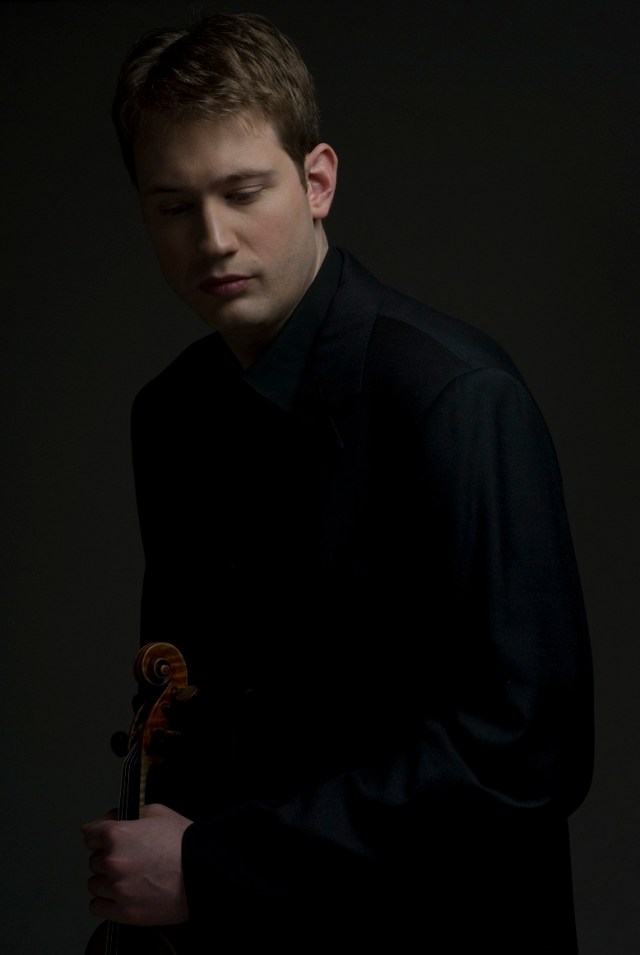
Violinist Benjamin Bowman

American-Canadian violinist Benjamin Bowman performs to critical acclaim throughout North America, Europe and Asia. A very active and engaged chamber musician and soloist, he is a member or frequent guest artist for leading chamber music ensembles internationally, including the twice Grammy-nominated ARC (Artists of the Royal Conservatory), Art Of Time, and Leondari Ensemble. Bowman was featured on the 2013 Juno-winning album ‘Levant’ and the 2011 Juno-nominated disc ‘Armenian Chamber Music’ with the Amici Chamber Ensemble. Other collaborative work includes extensive immersion in contemporary/new music, improvisation and performance with singer/songwriters.

Bowman was Associate Concertmaster of the Canadian Opera Company Orchestra: a ten year appointment that began when he was only 23 years old.   Bowman was recently appointed concertmaster with the American Ballet Theatre orchestra in New York. This week Bowman will be participating in the Saronic Festival, a celebration of chamber music on the island of Spetses Greece beginning August 4th.

Bowman’s performances have been recorded for radio broadcast in the USA, in Canada with the CBC, the UK, Poland, Hungary, Switzerland, the Netherlands, Denmark and Korea. His discography includes recent solo and chamber-music releases on the Sony Masterworks/RCA Red Seal, ATMA Classique, and Innova labels. Bowman received his Bachelor of Music degree from the Curtis Institute of Music in Philadelphia.

And Bowman—as the name might imply—is obsessed with bows, the owner of two very old bows (a Husson and an Henry), and a visitor to bow shops all over the world.

On the occasion of the 2014 Saronic Festival I ask Bowman ten questions: five about himself and five more about his participation in the festival.

1-Are you more like your father or your mother?

I notice, possibly as a function of age, that I’ve adopted many of my father’s mannerisms. But as soon as I stop to think about how I’ve just said something in exactly the same way as my father would, I realize that I’ve just been tapping my foot as my mom would… I guess I really feel like I’m really a mix of my parents. But if you twist my arm, I guess maaaybe I’m a bit more like my dad.…

With respect to our careers, we seem pretty different. My folks are both born teachers. They are university profs (mom in nursing, dad in philosophy of music and music ed), and focus a lot on writing and research in their respective fields. But my dad actually started off as a trombonist. He even played for awhile with the “Fabulous Flippers”, a pretty well-known band touring around the midwest in the 60s. I grew up listening to him practice with “Music Minus One” records, and watching him direct the university jazz band. My mom is also very musical (she’s got a great voice!), even if most of her performance experience was confined to the house, singing along with the likes of Kiri Te Kanawa…

All of this to say that the life I live now has come from both of my parents’ fundamental love for music, and their desire to share this with their children (and others), even if on the surface it appears I was raised more along academic channels.
That my father writes a lot on the subject of music education is not insignificant to how I identify with him. One of his specific focuses is on “being musical and educating musically”. I love this phrasing. This obviously resonates strongly with me, as I believe I have been raised with this in mind. Perhaps I’m nothing more than a philosopher’s guinea pig! Regardless, whatever is behind the words he writes and the notes I play, I believe we share a common philosophy about music, and about life.
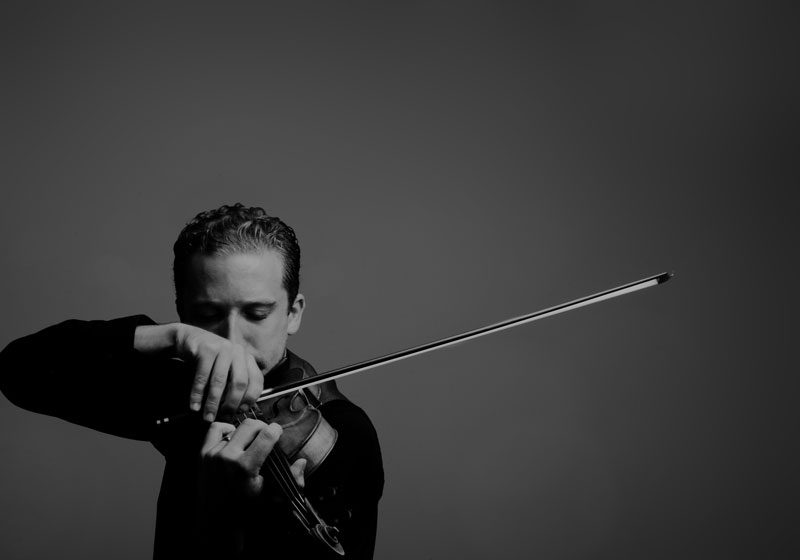
Violinist Benjamin Bowman

Violinist Benjamin Bowman

2-What is the best thing or worst thing about being a violinist?

Most people probably don’t equate the notion of being a violinist with countless hours spent alone. It must seem like a very social activity, playing an instrument. Naturally, people usually are only exposed to us – or us to people – when the lights come on and the music is performed… But to be a violinist is not just to love the music, and to perform. It is to live the music, and to imagine the life that has gone into it, to empathize with the composer as much as possible. This requires immense commitment on the part of the individual. The mastery of the craft is the obviously massive time commitment, but no 5 year-old that picks up a violin can possibly understand the soul-searching they will endure in order to become a professional. And to become a truly successful professional is yet another level of commitment, along with a dose of luck.

To play the violin – to be a musician – is to communicate, on as profound a level as possible. This is the best – and the worst – thing about being a violinist. Once you are committed, there’s no going back! Great music is like a drug. It’s not just the high you get from performing that is great – it’s the complete absorption into another realm of existence, often with friends, often in front of hundreds or thousands of people. At the best of times, you’ll completely forget where you are for a few hours. You just never want to come down.

Is it worth it? Yep.

3-Who do you like to listen to or watch?

I admire anyone who does what they do with utter commitment, skill and passion. It can be anything. If any of these three components are missing, I’m really not interested.

4-What ability or skill do you wish you had, that you don’t have?

Haha, there are so many!

For this conversation, let’s go with the making and restoring of violin bows and violins! I’m actually trying to clear some dates in my calendar to learn how to do this. It’s a beautiful art; one that hasn’t really changed in hundreds of years. I love the idea of a workshop full of old non-electric tools, listening to music that I love, possibly looking out a window into the countryside…. Basically, I wish I could create something tangible and long-lasting.

Music is wonderful, but it vanishes as soon as it happens.

At very least, it’d be great to be able to be confident enough to do all of the required maintenance on my equipment. When you travel around with instruments made of wood, they need adjusting pretty often since all the parts expand and contract with the various climates. And the bows need to have the hair replaced every so often as well. Most of us classical string players wouldn’t dare touch our instruments or bows for fear of causing the slightest bit of damage, and potentially ruining an irreplaceable work of art. This doesn’t seem right.

5-When you’re just relaxing and not working what is your favourite thing to do?

I just had a little two-minute vacation, fantasizing about the next time that might happen…thank you!  I love to camp, and to hike. I really enjoy the outdoors and reconnecting with nature. I actually feel it is a vital experience, one that recharges the body and soul.

When I can’t get all of my camping gear together, I love to eat well and drink well!

*******
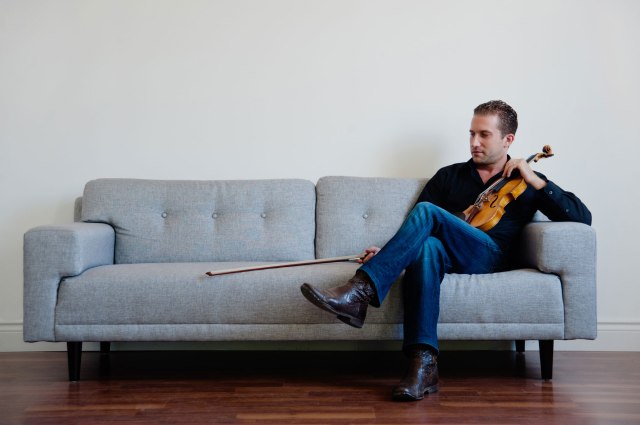
ND3_9922-lowres

Five more concerning the Saronic Chamber Music Festival in August 2014.

1-Please tell us more about the Saronic Chamber Music Festival and how it figures in your life right now.

The SCMF is a haven for chamber music. It’s a stunningly beautiful and evocative environment; a perfect place to meet and work with extraordinary musicians from around the world.

This will be my third time going back (the festival is in its 4th year).  When I first visited Galatas, Greece was in the heat of economic crisis. It was quiet, at least by tourism standards. Spirits were high though, and the festival, clearly nurtured by love and determination, was embraced by the local community. It is touching to see the relationships that will create the foundation of the SCMF’s future materialize and grow, along with the audience presence. The Saronic Gulf deserves a world class music festival, and the musicians who go there love to be there. We are all committed to engaging with the community, whether it means busking on the streets or meeting local shop owners, or just talking with audience members. I must say this is a rarity in the modern corporate world. The feeling of family and community keep us coming back, because there’s really no other place like it.

2-Do you have a favourite moment in one of those works?

The Schoenberg sends chills down my spine, every time. It is unbelievable music. The Brahms sextet warms my blood and fills me with love. The Mendelssohn quintet flashes and dazzles. I can’t pick a moment!

3- Talk about the requirements of chamber music, and what it means to you as a violinist to be playing this repertoire.

I think I’ve inadvertently answered this question in my previous answers. But I can reiterate that a great deal of time and commitment is required to become a musician. Sweat and maybe even some blood, over the years. Certainly many tears….To play chamber music is to open the door to some of the most intimate work of the greatest composers to walk the earth. It ’s not for the faint of heart. What does it mean to be a violinist playing this repertoire? Woohoo, is what it means.

4- Please put your feelings about classical music into context for us, especially with respect to what you’re playing and doing this year.

Without trying to go too deeply into this subject (I could probably write a book about it), I’ll say a couple of things.

First and foremost, I LOVE the music that I play. I am grateful for its existence in the world. And for all the hardships involved in trying to play dead people’s music in a world preoccupied with living people stuff, it’s truly an honor. This music is alive, and will always contain the essence of life, no matter how old it is, or how dead the composers are. (I also play the music of living composers, and I compose as well, for the record…)

Classical music, or “music”, as I like to call it, is truly an auditory experience. This is not a popular notion in the world at present. People want to SEE stuff. So do I, I’ll admit. To try to keep up with the times, my industry tries to sparkle up the music and make it impressive to young people – “to attract new audiences” –  but it’s not really what it’s about, and they should admit it. There a niche for that. I really believe there’s a time and a place where just sitting in silence and letting great music stream directly through your ears and into your soul can be more satisfying than just about anything. I honestly do not care what the person playing the music looks like, so long as they do their job well.

I struggled for a long time with the value of playing old music in this world. I felt it was irrelevant somehow, or unappreciated. It was stuffy with all the tuxedos and rules… But I’ve come a long way with this. I now know that there is value in performing this music (especially live), not just selfishly, but as a service to those who have also discovered it, or who are open to giving it a try. It is therapy.

5- Is there a teacher or an influence you’d care to name that you especially admire?

David Zafer (click image for an appreciation)

One of my best teachers, Mr. David Zafer. A true musician, this man taught me for awhile when I was a teenager, and he helped me to find myself in the violin. What a gift! One could feel the joy he experienced from his work. He was certainly brutally honest at times – even mean, but also gentle and supportive, and hilarious, and incredibly generous with his time. My lessons with him were sometimes 5-7 hours long – however long it took to get the point across. I suppose I was a bit dense, then?

A few weeks ago I was in New York playing in an orchestra I recently started work with, and a substitute in the 2nd violin section approached me and told me that she had also studied with David Zafer. The difference between us is that she just retired from the Met Opera orchestra… He has taught across (at least) three generations of successful violinists. And he’s still teaching!

*******

The Saronic Chamber Music festival runs August 4 – 10, 2014 with concerts in Spetses, Hydra, Poros and Galatas.  For more information visit http://www.saronicfestival.com
Posted in Interviews, Music and musicology | 1 Comment

BOP Program B

My trip to Stratford is over, but the cycling singers of the Bicycle Opera Project are still there. By the time I post this they’ll have finished Saturday afternoon’s show. A pair of performances remain Sunday at Revel Caffè presented under the auspices of Stratford Summer Music, followed by other performances elsewhere over the next couple of weeks.

The conversation around bold opera ventures such as this one usually mentions the precarious health of opera.  For example, Peter Gelb has just threatened to lock out the various unions of the Metropolitan Opera, and opera fans are holding their collective breath. The passing of tenor great Carlo Bergonzi could be mistaken for news from another century.  We remember a career that ended in the 20th century, in an art-form that goes back even further.  As we read of civilians dying in various theaters of war, the wars staged or sung inside actual theaters seem especially poignant right now.  Yet we need them more than ever, however irrelevant they may sometimes seem. Opera will not stop global warming or cure cancer. But in the meantime we go on living, never more vividly than in our performing arts culture.

azimuth_1

Mezzo-soprano Stephanie Tritchew and the BOP orchestra, namely Tristan Durie, flute; Wesley Shen, music director/piano and Chelsea Shanoff, saxophone(s).

For all the laughs I experienced at BOP’s Program A Friday morning, Program B did not leave me laughing quite so much. I wonder if that’s because of where I sat? whereas my experience yesterday was to be immersed in the show seated at the front with singers right in my face, today I was at the back of the stage, staring at the serious and verklempt expressions on Stratford faces surprised by grand passions while they sipped their morning coffee. How could I laugh (even if there were several funny moments)?

Mezzo Tritchew, joined by baritone Geoffrey Sirett

Mezzo Tritchew, joined by baritone Geoffrey Sirett

We began with the romance of (What rhymes with) Azimuth, music composed by Ivan Barbotin with libretto by Liza Balkan (who is BOP’s stage director). A man and woman (played by Stephanie Tritchew, mezzo-soprano, and Geoffrey Sirett, baritone) who explore two very different discursive pathways, find meaning and a connection.

The second work is an excerpt from Airline Icarus, music composed by Brian Current and libretto by Anton Piatigorsky.

icarus1

Baritone Sirett & flight-attendant & mezzo Stephanie Tritchew, with music director Shen wearing the Captain’s hat at the piano

This opera premiered by Soundstreams in June. The café becomes part of a jet, complete with a flight attendant bringing around refreshments, in a realm poised on the edge between laughter and tears.

Tritchew offering refreshments to the caffe patrons.

Tritchew offering refreshments to the caffe patrons.

Third was Rosa, with music composed by James Rolfe and libretto by Camyar Chai, a powerful scene between two people that was also the most intensely sung. I wish I could say I know what it was about, although I don’t care (?). The specifics of who Rosa is, and why the two people are arguing and later reconciling in sobs are details that are less important than that Larissa Koniuk and Chris Enns were very good in the indecently intimate space in which they were forced to perform, and that they made me care about them and believe in their commitment to the performance.

Soprano Koniuk and tenor Enns, in Rosa

Soprano Koniuk and tenor Enns, in Rosa

We concluded with Bianchi the short bicycle opera with words and music by Tobin Stokes that also finished yesterday’s program A. Here at last was a place where laughter filled the space.

Enns & Tritchew, in one of the photos that wasn't blurred by all the fast motion

Enns & Tritchew, in one of the photos that wasn’t blurred by all the fast motion

The Bicycle Opera Project may be riding into your town, as they continue their performances into August.

Posted in Opera, Reviews | 1 Comment

Bicycle Opera: Program A

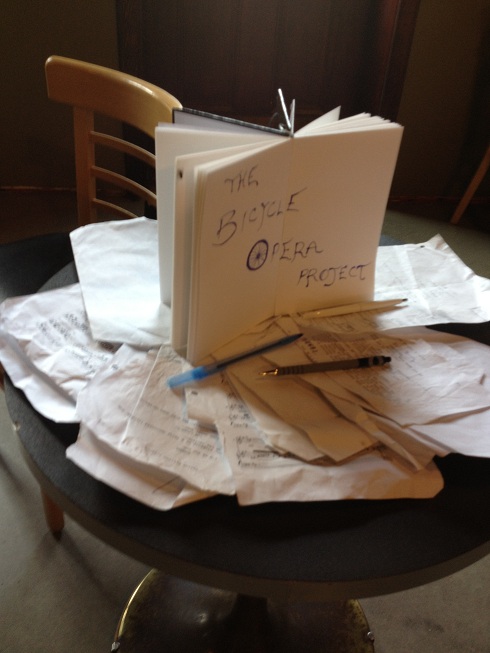
click for more info about The Bicycle Opera Project

Sometimes the writer recognizes that words are limited, that in the end “you had to be there” especially for something that’s more of an event or happening, than merely a conventional performance. It was never truer than this morning as I took in Program A of this year’s Bicycle Opera Project, at Revel Caffè in Stratford.

sign_outsideIt’s been an amazing 24 hours, what with Crazy For You Thursday @ 2 pm, Mother Courage and Her Children @ 8 pm, and now BOP at 9 am Friday. It’s only just past 10:30 as I write this up. (although adding the photos etc has pushed me to 11:30). But as I said: for something like this it’s not enough to write. So I took a zillion pictures –with the performers’ permission I must add—to try to give you some idea of the experience.

There’s no FLASH permitted, which means that many pictures aren’t terribly usable. I’ll look them over later (I have paintshop pro at home, but not here with me as I do my usual ASAP publishing). With the exception of the images that I am linking to on the BOP website, any picture you see here is one I took, which I offer with apologies. The cast & musicians are much more beautiful than what you see here.

Let me repeat that, they are seriously a beautiful group. I’m a little sad that the photos don’t do them justice. BOP is not just a company but a kind of political statement, transporting themselves from gig to gig on bicycle. The piano is supplied by the host, but otherwise, they pull hundred pound trailers behind the cycles. So in other words, if they look fit, it’s not just from their excellent breath control. But please God let no one speak of fat opera singers. Opera is a physical discipline, even if in other eras the social consensus permitted big performers alongside thin ones (and there have always been thin singers, no matter what Bugs Bunny told you).

Never forget: that live theatre is magic. Live music, live singing, live dancing, or live bodies simply standing delivering lines, represent something very different from what you see in film or TV.  Don’t believe me? Go see a live performance in your own town, or (even better) come see BOP.

Program A consists of four works to be presented again on BOP’s tour of the province. They’ll do Program B later today (5:30 pm) in Stratford’s Revel Caffé, then reverse themselves tomorrow (Program B in the morning, Program A at 5 pm) with another pair of performances Sunday in the same sequence as today’s.table_pic

After a brief introduction from the ensemble—pianist & music director Wesley Shen; Chelsea Shanoff, saxophone(s) and Tristan Durie, flute—we begin with an excerpt from Dean Burry’s The Brothers Grimm.

dog

I saw his head through a doorway, fore-shortened. Up close i realize he’s not a purebred shepherd. Still, he’s a very well-behaved doggie.

Note: we’re deep in Revel Caffé. My friend and I sit at the communal table, right beside two very young children brought by well-meaning relatives. How young? They’re younger than the age at which I took my daughter to see Magic Flute in English, as her first opera, and hello, these aren’t meant for children (as they found out in short order: vacating their seats…or maybe their auntie finished her latté?). At one point a wacky cat carrier went by, and the whole time –just outside the door that was used for several entrances by the singers—a well-behaved German Shepherd [NOTE: i am fixing this later, having realized i made a mistake in my haste…he’s not a shepherd. SORRY] cocked his head appreciatively throughout (and he shows up in some of the photos….plus THIS PORTRAIT that his owner graciously permitted).

Patrons came and went, lugging lattés and cappucini, mostly very quiet. I was the most disruptive person there, between my loud guffaws (yes I laugh a lot) and my incessant iphone. I told myself this might be fun for the performers, even as I recalled how irritating I usually find it when someone shoots a picture of me with my mouth wide open.  But while the space is phenomenally live –exposed brick and wood floors—I was never uncomfortable about the levels. The voices soar wonderfully, and like good baristas filling but never overflowing their containing space.

Geoffrey Sirett & Chris Enns, aka The Brothers Grimm

Geoffrey Sirett & Chris Enns, aka The Brothers Grimm

In this coffee house, we begin with the Brothers at a table as if with writers’ block. But in short order a table is piled on another, and there’s Rapunzel letting down her hair, as if in a tower. The story is sufficiently self-referential –with the brothers who create the story front and centre in their portrayal of the story—to give it a witty edge. Chris Enns and Geoffrey Sirett are two familiar young singers, enjoyable delivering lines in this super-intimate setting. I was right on top of them (or vice versa?) the whole time.

Sirett & soprano Larissa Koniuk, L'Homme et l'Ange qui a venu du Ciel

Sirett & soprano Larissa Koniuk, L’Homme et l’Ange qui a venu du Ciel

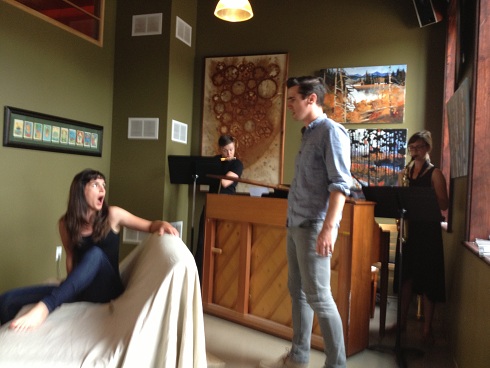
The second work is an excerpt from Adam Scime’s L’Homme et le Ciel. I’m thrilled to have a second listen even if the work is arranged for the different group of instruments. Sirett’s big physical presence changes the effect substantially from what I saw in the spring. At that time the big powerful female voices went with a different physical dynamic. I can’t help remembering (perhaps in context with seeing Mother Courage last night & thinking of feminist readings) that opera has been traditionally a medium where women are violated and killed in front of a voyeuristic audience. That’s not what we get here –in any of the operas—as one can sense composers & librettists seeking to move the medium into a new direction (please God I hope so!) away from the misogyny & violence of the past. And so while we’re still in heavily gendered territory, the male is a physical body onstage, while the female is an aetherial spirit creature, an angel who could be any size I suppose. Sirett is a towering figure, yet he’s crumpled up with the spiritual doubts of L’Homme, in this story. The Angel figure played by Larissa Koniuk? Here is one place I was really sad about how poorly the photos captured what I’d felt. I can still feel Scime’s score pulsing through my head, as if pulling me towards Koniuk’s magical presence. Her gestures are very simple and eloquent, a more minimal response to the score than what we saw in the more elaborate staging by FAWN opera in the spring.angel_homme2

killers

Sirett with mezzo-soprano Stephanie Tritchew–putting the dead into deadpan– in A Little Rain Must Fall

This piece is in French. While we did not have the projected titles (which BOP usually provide in other venues, but couldn’t in this space), I’m lucky that I could understand the text, had heard the excerpt before, AND seen a synopsis. But if there were ever an opera that could work without comprehension purely on the basis of the beauty of the images and the people onstage, this is it. The brilliant light coming from outside –confounding my photography—is in some respects a perfect model for the spiritual experience of the work, which seems to invite us to surrender to pure sensation, to allow the piece to move us whether we really understand what’s happening or not. My God (excuse the pun) I know that sounds pretentious, but that’s one of the things that sometimes happens in opera, particularly when it’s in another language. I—again—was taken back to my experience of opera before surtitles, when we had to listen and try to understand what we heard: not unlike childhood itself.

Sirett and Tritchew again

Sirett and Tritchew again

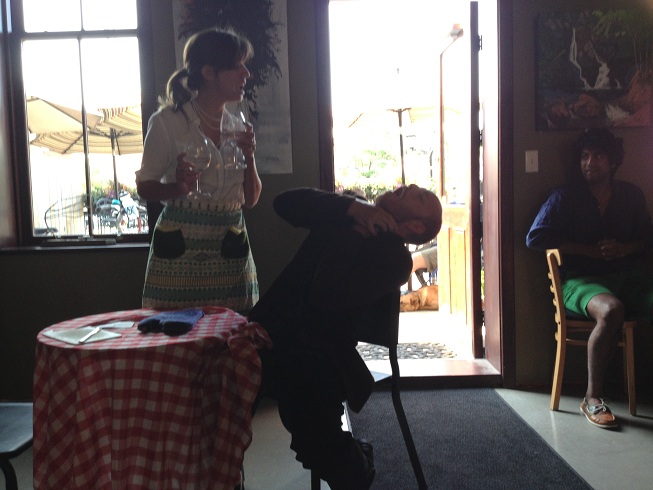
The third item presented was A Little Rain Must Fall, libretto by David Yee, music by Chris Thornborrow –I think I saw previously?—created not long ago in Tapestry’s LibLab, again re-arranged for the BOP ensemble. A different staging with a new cast can make something seem so different from what you saw previously. Sirett and mezzo soprano Stephanie Tritchew sang the piece full-out and dead-pan which only make the laughs even more explosive in the tight little space.

spoiler alert... oh well TOO LATE

spoiler alert… oh well TOO LATE

To close we were figuratively put onto bicycles. If I understand correctly, the BOP invites proposals from composers, but this time someone wrote about being on bikes. While the presentation was done by two men and a woman running –and falling—in the space, one could imagine the piece on cycles, or perhaps filmed while riding. It’s a five minute piece called Bianchi: A Five Minute Bicycle Opera, with libretto & music by Tobin Stokes that could be subtitled “every bike pun you could imagine”. As a man who likes puns I was in heaven.

Our cyclists --Chriss Enns and Geoffrey Sirett-- go from one end of the Caffe to the other.

Our cyclists –Chris Enns and Geoffrey Sirett– go from one end of the Caffe to the other.

The Bicycle Opera Project (whom I’ve been calling BOP) continue their cycling ways, touring through Ontario into August, eventually coming to Toronto Summer Music Festival August 7 & 8. Their schedule is here. But in the meantime if I can make it to program B (here in Stratford) I’ll write about that too.

Some of the BOP cycles awaiting their riders.  The road goes ever on..(?)

Some of the BOP cycles awaiting their riders. The road goes ever on..(?)

Posted in Music and musicology, Opera, Reviews | Tagged , , , , , , | 5 Comments

Mother Courage

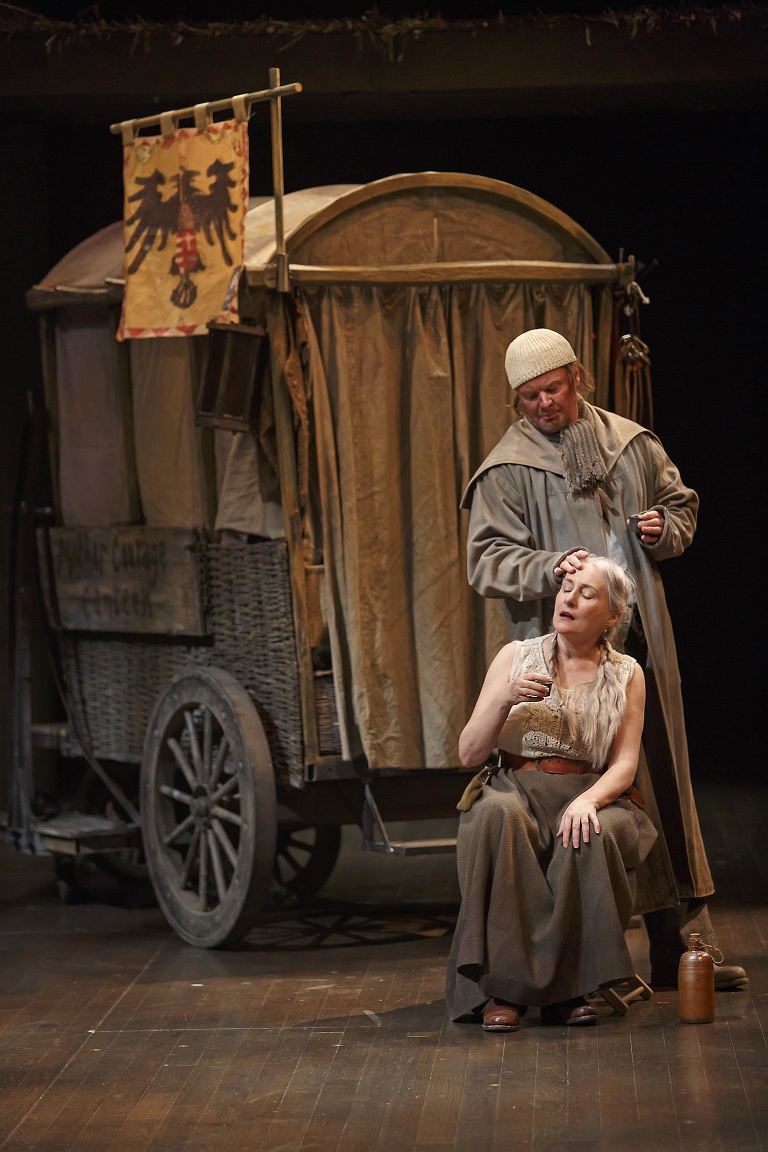
I just saw Seana McKenna tonight as Mother Courage aka Anna Fierling in Brecht’s play Mother Courage and Her Children, at the Tom Patterson Theatre until September 21st.

It’s a horrible week in the news, between civilian planes being shot down, civilians being killed in a Middle East war, and a little girl being hit by a car in a neighbourhood I drive through. As a citizen, as a political being, as a parent, everything confronting me screams that life is painful and futile, that it’s a terrible time to bring children into the world, a time to hide under the covers and say no to anything daring or risky that might break your heart yet again. Of all Shakespeare’s plays the most apt might be King Lear, that Everest that challenges actors if not audiences, even if we can take comfort in its poetry, in the solace of knowing it’s a classic.

I can’t help speaking of Mother Courage and Lear in the same breath, a pair of mythic parental figures, two colossal roles to daunt any actor. Seasons are built years in advance based on complex commitments to the company, so it might be a fluke that these two shows come along in the same year. I suppose while I’m at it I should admit that Man of la Mancha represents another relevant study in an aging personality, although one that doesn’t interest me (because –not meaning any offense –I can’t think of Wasserman and Leigh as peers of Brecht & Shakespeare).

Why would Lear pop into my head at the same time as Mother Courage? First and foremost it’s no magic, just me staring at the calendar, trying to decide what to see.

There they were side by side.

And then I was jarred by the memory, of seeing Seana McKenna as Cordelia in the 1980s. Oh my I don’t think I’ve ever cried so hard at a Shakespeare play, sitting there hopelessly heartbroken when she’s torn away. I saw Lewis Gordon’s gruffly human Lear.

It struck me, though, that Lear and Anna Fierling are an interesting pair, a study in contrasts:

  • Lear begins with all the power, although that’s stripped away
  • Anna is at the bottom of the power hierarchy
  • Betrayals & misfortune push Lear to madness. The portrayal of that madness is maybe the greatest challenge for the mature actor, across many generations of famous actors
  • Anna’s adventures push her to a point where she might go mad: if she had such a luxury. She conceals her feelings much of the time. Anna is a more recent creation, one that has far fewer famous exponents, so perhaps too we can be surprised by a great portrayal such as McKenna’s.
  • Lear is the archetypal father, while Anna is the archetypal mother. Is the difference perhaps that fatherhood has been swathed in tradition & respectability –making Lear’s fall so precipitous—whereas motherhood is still a matter of contention? And is a mother more than a biological function?

The Brecht is also directed by one of the great women of Stratford, namely Martha Henry. Does that mean McKenna + Henry = a feminist reading? I certainly would embrace that: if I knew what it meant.  But I’m not saying you’ll like this version of motherhood. Brecht’s mother is not romantic, not subject to the political correct expressions of loyalty to her children: although we see her stoic suffering, unable to let her loyalties show. But she’s a survivor, unlike Lear. His pride is a luxury she can’t afford. Perhaps the chief difference –excuse me for being obvious—and it’s apt for a feminist reading, is that whereas Lear is a man who loses his power, Mother Courage is a woman, which means she never has much to begin with.

I am intrigued because I am mostly wondering about Brecht, in the anti-Marxist decades following the collapse of the Soviet empire. With the end of the USSR, Marx’s reputation was diminished by implication. I couldn’t help feeling that the ideologically tainted phrases in this play –and others from Brecht—can’t get a fair reading, because we’re in a strange place culturally, unable to even see Brecht’s didactic / activist side.  We have poor people starving on our streets now, and we’ve inured ourselves to such atrocities, so the suffering in Brecht doesn’t sting as it once did.  Maybe I’m imagining things, but I couldn’t help but feel echoes of the cynical laughter I heard when I saw Assassins recently, a willingness to treat anything pointed as social satire. The gravitas Brecht used to connote –especially in this play—seems to be harder to find, when the prevailing tonality of our culture is to embrace ironic laughs. I’m seeing a resemblance between Mother Courage and Heller’s Catch-22 that I never saw before, possibly because the play isn’t usually permitted to be so funny.  War is just a backdrop for both tales, while a more materialist exercise (especially for Milo Minderbinder) is played out in the various theatres of war. Yes there are dark places in the plot –as there are in Heller’s novel—but also places to laugh too.

Excuse me the ridiculously long preamble, but I have long been fascinated by Brecht, both from the political side and from the dramaturgical side. Henry’s Brecht is very unpretentious, and not weighted down by the awe one sometimes encounters in the presence of one of the great names of theatre. Working with composer Keith Thomas, music director Laura Burton & the various performers jumping into the songs, this is a very intelligible telling of the story. I think it works very well.

Seana McKenna as Mother Courage and Geraint Wyn Davies as Cook in Mother Courage and Her Children. Photo by David Hou.

Seana McKenna as Mother Courage and Geraint Wyn Davies as Cook in Mother Courage and Her Children. Photo by David Hou.

It’s ironic that some of these ideas –“parenthood”, “war” and “politics”—are sometimes so reified as to lose any direct contact with reality. I’d also add the word “Brechtian” to the list of big abstractions that sometimes mess up a production of a play by Brecht. Henry’s Brecht, however, and McKenna’s Anna sidestep that trap. They’re so simple & direct that they could be a textbook on how to do Brecht without fear.

There are several other meaty performances, and lots of delightful moments in Mother Courage although it’s all dwarfed by McKenna’s work. Patricia Collins & Stephen Russell turn up in relatively tiny parts, but make the most of them. Geraint Wyn Davies is a dense mixture of strengths & frailties every bit as substantial as McKenna’s own blend.

Mother Courage and Her Children continues at the Tom Patterson theatre until September 21st .

click image for further information

Posted in Dance, theatre & musicals, Reviews | Tagged , , , , , , , , | 2 Comments

Crazy For You

It’s summertime, when the livin’ is easy: and Gershwin might be on my mind right now. Summer  musicals are taking over the stages at summer festivals in Stratford & Niagara-on-the-Lake. Crazy For You –the show I saw today at Stratford—is a second-generation Gershwin musical, Ken Ludwig’s inspired re-purposing of songs that had previous lives in shows created on Broadway back before WWII.  George’s tunes and Ira’s lyrics are so well-known that they seem to segue effortlessly out of the plot unfolding before us.

This show is counter-intuitive, because it seems to go against the usual practice. We’re accustomed to encountered musicals (or operas) where the words came first, and then were set to music. Ludwig had a brilliant idea, one that’s been done in other musicals.  Never mind starting with the book.  Assemble some amazing tunes instead, and then work from there.

With Crazy For You..? Imagine a popularity contest assembling the best songs written by anyone in the 20th Century. The results could look a lot like the list of songs in Crazy For You.  How can you miss with

  • “I Got Rhythm”
  • “Embraceable You”
  • “Someone To Watch Over Me”
  • “They Can’t Take That Away from Me”
  • “Nice Work If You Can Get It”
  • “But Not For Me”

I’m reminded of other shows built backwards from the songs, such as The ABBA musical Mamma Mia! or the Beatles film Across the Universe. The well-known set-pieces threaten to over-shadow the story, which is a mere pretext for the beloved & familiar music.

What Ludwig does that’s truly remarkable is to weld together these golden moments into something surprisingly coherent. The music doesn’t really stop the story –the way the ABBA musical stops dead on those famous songs—so much as bring it to life. It’s a truism that in a musical, the song takes over when words are no longer enough. Several times we were in a magical place where an all-too-familiar song such as “They Can’t Take That Away From Me” sounded brand new, emerging organically from the dialogue.

While there were some remarkable star turns that I shall allude to in a moment Crazy For You is first & foremost a showcase for the ensemble values of the company. The creative team of Director & Choreographer Donna Feore and Musical Director Shelley Hanson get brilliant air-tight work from everybody in this huge show, presented with 20+ orchestral players. I can’t decide whether it’s Feore’s choreography or Hanson’s tight hold on the musical values of the performance that makes the most decisive contribution: but they depend on one another for one of the most cohesive and physical displays I’ve ever seen. The excellence from every side in the Festival Theatre almost makes the stars an after-thought. If you’re a fan of dance you’ll love this show. They never stop working, seeming to get more physical as it goes on.

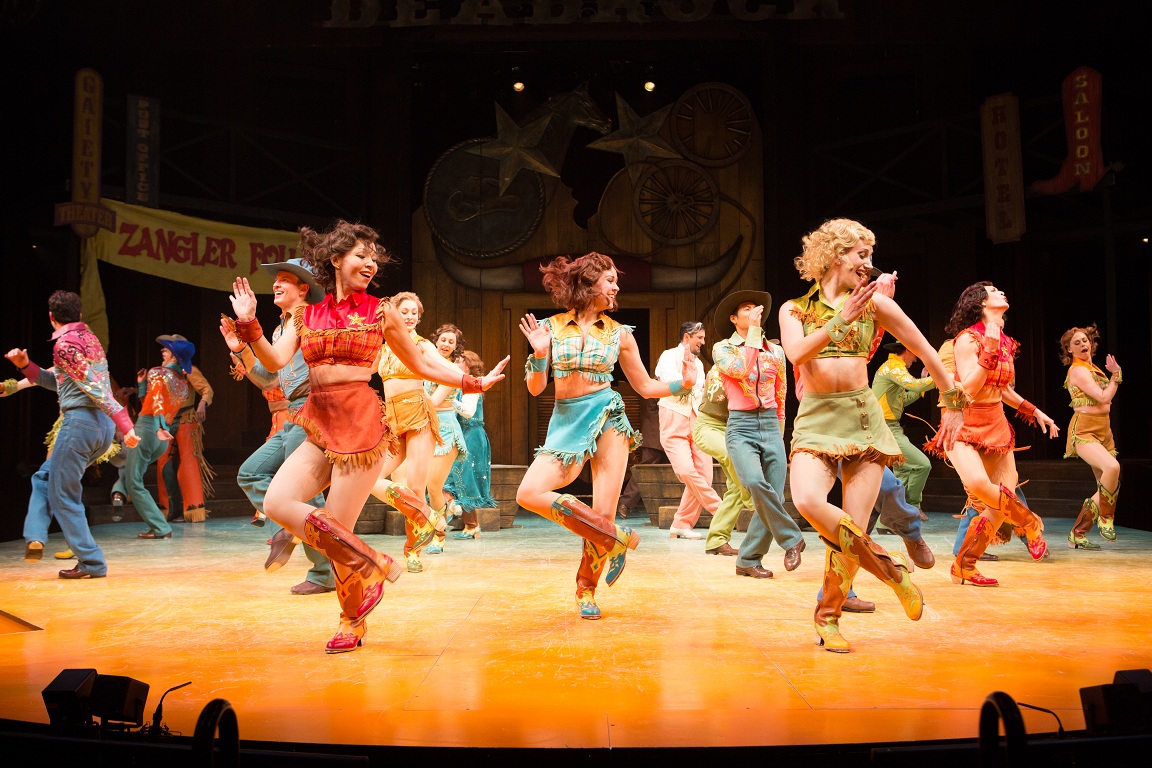
A glimpse of the raw physicality shown by members of the company in Crazy for You, choreographed by Donna Feore. Photo by Cylla von Tiedemann.

A glimpse of the athleticism shown by members of the company in Crazy for You, choreographed by Donna Feore. Photo by Cylla von Tiedemann.

Even so I should mention Josh Franklin and Tom Rooney. While Rooney’s heroics are perhaps expected by now –wonderful physical comedy to go with a larger than life persona—Franklin as Bobby Child is new to me, a charismatic presence who can dance, can really sing and yes, he can act too. The prime reason Crazy For You flies so high is because we care what Bobby feels, the one who is truly crazy for someone.

Crazy For You continues at the Stratford Festival until October 12.

Posted in Dance, theatre & musicals | Tagged , , , , , , , , , | 3 Comments

Emerson String Quartet’s Modern Age

The Emerson String Quartet kicked off Toronto Summer Music with a concert tonight.
I’m sure some people were there to hear Beethoven’s Op 95 quartet, many more to hear Schubert’s “Death & the Maiden” quartet, while comparatively few were there mainly for Britten’s 2nd Quartet, a work premiered in 1945 and the one piece on the program that’s genuinely modern.

I can’t help thinking about the programming questions faced by TSM artistic director Douglas McNabney. It’s the same question bedeviling anyone seeking to build an audience. Does a concert comprised of a masterwork by each of Beethoven & Schubert, with a 20th Century work tucked in between challenge the audience? While I wouldn’t normally think so –especially when the Festival theme is “The Modern Age”—I saw two people in close proximity to me sleeping through the Britten: so maybe this is more than enough modernity for some people. I shouldn’t over-estimate what audiences can handle.

Perhaps the advantage of such a combination of works is how it can satisfy a broad spectrum of listeners. While the Beethoven & Schubert are clearly crowd-pleasers that may have been the chief draw –and it should be noted that every seat was sold—I prefer to hear the Beethoven & Schubert as antecedents, key touchstones in the string quartet repertoire that are part of the context influencing Britten. Composed as a homage to Henry Purcell on the occasion of the 250th anniversary of the great English composer’s death, Britten’s 2nd Quartet is tonal, tuneful & clearly pointing as much to the past as to the future.

This is especially true of the third movement of Britten’s quartet, in its use of a baroque form, namely the chaconne, a witty set of variations.  Sandwiched between two works from more than a century before, the Emerson Quartet’s performance of the Britten piece pleased me more than either of the older works. Each of the players shone at times in the Britten, especially in the concluding chaconne.  It’s easy to see that Britten would find his truest voice in opera, considering the flamboyant animation of each part, as if portraying personages.   

Toronto Summer Music –a festival and an advanced institute for players and singers—continues until August 12th.

Posted in Music and musicology, Opera, Reviews | Tagged , , , , | Leave a comment

Ten Questions for Jonathan Crow

Jonathan Crow is a young violinist making in impact on several fronts. This fall will be Crow’s fourth season as Concertmaster of the Toronto Symphony. He is also an avid chamber musician, including his role as a founding member of the New Orford String Quartet. Crow also teaches, previously at McGill and currently at the University of Toronto.

Crow will be participating in Toronto Summer Music on all three fronts: coaching as part of the Chamber Music Institute; playing the “Russia After Revolution“ chamber program August 1st, and he’ll be playing with the Toronto Symphony as Concertmaster as they make their Koerner Hall debut later this summer.  On the occasion ofToronto Summer Music I ask Crow ten questions: five about himself and five about the multiple roles he plays.

Violinist Jonathan Crow

Violinist Jonathan Crow

1-Are you more like your father or your mother?

Not sure I can answer that one- what if they read this? I suspect they would have a better answer for you than I would anyway!

2-What is the best thing or worst thing about being a violinist?

The worst thing about being a violinist is definitely airline travel! Having to worry about finding a free overhead bin on every flight can get tedious very quickly. Most cabin crew are extremely accommodating- especially the pilot on a flight to Portland who put my violin behind his seat as the plane didn’t have any overhead bins. You never know though…

3-Who do you like to listen to or watch?

This summer I’m doing quite a bit of traveling with my family between festivals- which means I’m getting to know the music of Katy Perry extremely well! (I have two daughters…) “Let it Go” from Frozen is also a huge hit with them. For me, I do quite a bit of score listening on youtube- it’s amazing the out of print recordings that you can find.

4-What ability or skill do you wish you had, that you don’t have?

Is this a favourite superpower question? If so- definitely being able to fly. Or perhaps teleport. Anything to avoid taking my fiddle on planes! Seriously though, I’ve wished I was quicker to pick up new languages- both for musical reasons and also just to make traveling more simple.

5-When you’re just relaxing and not working what is your favourite thing to do.

I don’t think this summer is a good time to answer that question- I’m on a plane now to Calgary after being on the road for four weeks. Yesterday night was one of about ten nights in my own bed this summer… A bbq in my backyard with my family sounds great right about now!

*******

Five more concerning the Aug 1st concert “Russia After Revolution”, mentoring at Toronto Summer Music, and the upcoming TSO debut at Koerner Hall.

1-Please tell us more about the works on the  “Russia After Revolution” program, namely

  • Prokofiev: Sonata for Two Violins C Major Op. 56
  • Vaughan Williams: Phantasy Quintet
  • Shostakovich: Piano Quintet g minor Op. 57

This is a great program- the Shostakovich is one of the great works of the chamber music repertoire, and an unbelievable compelling piece. It has everything- great virtuosic moments, humor, and incredible beauty. The last movement is so typically Shostakovich- a seemingly upbeat beautiful movement which is actually bittersweet and almost tragic. The Prokofiev is one of my favourite pieces- I’m lucky to play it at three different festivals this summer. It’s perfectly written for the violin, and the parts interchange seamlessly. And the Phantasy Quintet is a lesser-known piece which deserves to be played more- I love the lush string writing that you get from Vaughan-Williams!

2-Do you have a favourite moment in one of those works?

The middle movements of the Shostakovich 5tet are about the most meaningful movements in the chamber music literature- listen for the contrast between the power and sarcastic wit in the Scherzo and the deep sorrow of the slow movement.

3- Talk about mentoring, and what it means to you as a violinist.

I’ve always loved teaching, and have been lucky to have had opportunities to teach for almost my entire career- previously at McGill University and now at UofT, the Orford Arts Centre and many other summer festivals. As a student I attended the Ravinia Festival and Domaine Forget where I had the chance to play with established professionals in a fashion similar to what we do at TSMAF. For a student on the verge of a professional career this is an amazing way to learn how life really works in the field- everything from how to streamline the rehearsal process when you don’t have an entire semester to learn a piece to how other artists interact when playing a piece with different colleagues. As a mentor it’s also amazing to realize how many new ideas I get when playing a piece with younger artists who might have fewer preconceived ideas about repertoire.

4- Please put your feelings about classical music, The Toronto Symphony & mentorship of the next generation of artists into context for us, especially with respect to Toronto Summer Music.

I hope that the relationship this year between the TSO and TSMAF is the start of something permanent! These are both great organizations that are giving back to the community in different ways and have so much to offer. There are so many articles being written these days about the “Death of Classical Music” but I would suggest that the interest in classical music around the world has never been stronger. Both the TSO and TSMAF are finding creative ways to bring young people to concerts- the TSO Soundcheck program and TSMAF Shuffle concerts are great examples. People love classical music and love the concert experience, but rather than complaining about how hard it is to “sell” classical music these days, it is up to us to offer what we do in new and exciting ways, to find venues and ways of presenting ourselves that are exciting to people in the 21stcentury. Over the past ten years of teaching I haven’t yet had a student who didn’t find a niche for him or herself somewhere. Perhaps the days of expecting to win a job in an orchestra a few weeks after graduation are over, but students these days are incredibly creative with what they find to do in the classical music field. Hopefully TSO and TSMAF are leading the way in setting an example to young people and showing them the different ways that we can all present what we do. Honestly though, I think we learn as much from them as they do from us!

5- Is there a teacher or an influence you’d care to name that you especially admire?

Too many to mention! I’ve had the chance to work with so many great artists over the years, and one of the reasons I auditioned for the OSM while still in school was to have the chance to work with world-class soloists and conductors every week. This has just continued since I moved to Toronto to join the TSO!

Not sure I have much to add to the above! Just in case people don’t know though, TSMAF has wonderful professional concerts, but the gem of what we do is working with advanced students and pre-professionals over the course of the week on a specific piece after which we present it in concert. This for me is always the highlight of the week, and the energy that you see on stage during these concerts is like nothing else!

*******

Toronto Summer Music begins Tuesday July 22nd. Jonathan Crow’s chamber concert is August 1st, which he’ll be concertmaster for the Toronto Symphony’s debut concert at Koerner Hall is on August 12th at 7:00 pm.

click image for more information

Posted in Interviews, Music and musicology | Tagged , , , | 1 Comment

StageWorks Assassins

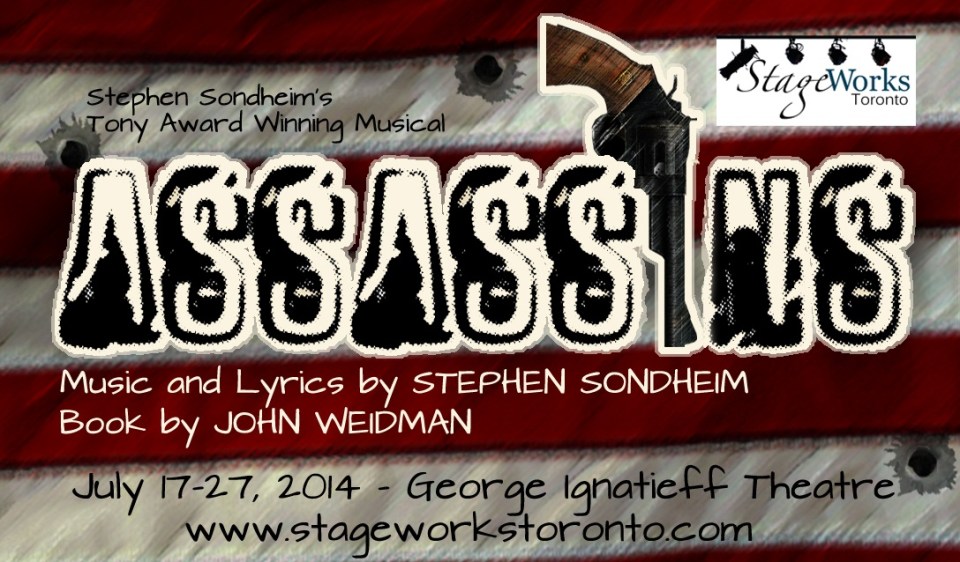
Tonight I saw opening night of StageWorks new production of Assassins, an occasion that any serious fan of the musical theatre form must celebrate.  The score by Stephen Sondheim is challenging. The material in John Weidman’s book is electrifying, and at one time was too powerful to be presented.  I don’t think I’ve ever seen a show that is so dense with meanings, because there’s so much going on.  If you’re a fan of good musical theatre, if you enjoy political humour you mustn’t miss the chance to see this wonderful play.

In the 1970s H ‘Rap’ Brown said  “violence is as American as cherry pie,” a saying that Weidman and Sondheim seemed to embrace.  Histories usually tell us of great men, wars & inventions and the people in power.  Assassins is an anti-history, at first glance glorifying people usually condemned & hated.  We’re in a realm thick with irony, because of course the play is brutally truthful.  While we hear the story of Lincoln’s assassination from the point of view of John Wilkes Booth, he is razzed unmercifully.  This actor turned killer is skewered by the Balladeer:

Some say it was your voice had gone
Some say it was booze.
They say you killed a country, John
Because of bad reviews

And so we meet both successful killers such as Leon Czolgosz (of William McKinley), Charles Guiteau (of James Garfield) and Lee Harvey Oswald (of JFK), and would-be killers such as Squeaky Fromme and John Hinckley. In every case we’re presented with unhappy people who would use guns as a pathway to a sort of happiness.  For almost the entire play we’re submerged in that inverted world, only rarely coming back to the surface for a reality check. Any production of Assassins faces some interesting tonal choices.  The material includes some of the darkest images in any musical and strong challenges to the intelligence of the audience.  But Sondheim and Weidman never expected mainstream acceptance or success.  It was perhaps ahead of its time when written.  But now?  The work can still be treated with great seriousness, yet much of what they’ve written can be presented as black comedy.   Assassins is like a psychological barometer of an audience, testing their mental health.  I remember seeing the play years ago, in a room full of silent reverent listeners, looking at me as though I was strange when I laughed. Tonight?  I couldn’t help thinking that we –North American culture—have come a long way.  I’ve never seen a production with so many laughs, so many moments that were light and fun.  Yes, there’s still lots of serious political content. But maybe after years of Jon Stewart and Michael Moore, our political sophistication gives us the ability to laugh rather than just cry.  I have to think this is progress, a healthier way to be.  I know that I felt really great at the end of the show, and surely that’s what Sondheim & Weidman would have wanted, even if it seemed far off back at the beginning of the millennium.

The Stage Works production is being presented in the intimate George Ignatieff theatre, powerfully supported by a seven-member band led from the piano by music director Tom Kerr.  Large sections are through composed, although from time to time we’re in a realm of dialogue, often riotously funny.  The most stirringly emotional moments are sung.  But the play doesn’t preach, doesn’t tell us what to think or feel.  It simply holds up a mirror, and then defies us not to be overwhelmed by what we see and hear. As with any play you love, there are several favourite moments to look forward to, and the cast did not disappoint.  Luke Witt as the Proprietor was the dark instigator, and foil to the warm optimism of Hugh Ritchie’s tuneful Balladeer.  Rich Burdett was a terrific combination of strength & vanity as John Wilkes Booth.  I’ve always loved the scene between Leon Czolgosz and Emma Goldman, a curious mix of politics and romance that can be one of the warmest moments in the play;  Dylan Brenton made a strong but vulnerable Leon, opposite the gentle strength of Suzanne Miller as Emma.  Russ Underdown did a fabulous job in one of the toughest songs in the show, namely Guiteau’s cakewalk.  Although Kerr took a brisk tempo in most of the songs, which was especially daring in Guiteau’s number (which is challenging both to sing & to dance), it worked beautifully.  The three characters whose parts function more as comic relief were especially strong in this production, namely the three failed assassins: Samuel Byck, Squeaky Fromme and Sara Jane Moore.  Will van der Zyl commanded the stage effortlessly in Byck’s monologues, while Laurie Hurst (Moore) and Christie Stewart (Fromme) had several explosive laughs from the audience.  Michael Buchanan has one of the most beautiful moments in the gentle & tentative acoustic guitar intro to “Unworthy of your love”, Hinckley’s duet with Fromme; it serves as an anti-romantic change of pace: madness but of a calmer sort.

StageWorks Assassins continues until July 27th at the George Ignatieff Theatre.

click for more information

Posted in Dance, theatre & musicals, Reviews | Tagged , , , | Leave a comment

Late night reading

Whether it was a virus, a cold or summertime allergies isn’t the point. I’ve been awake at night, coughing, sneezing, blowing my nose, and otherwise trying not to be a nuisance to anyone unlucky enough to be under the same roof.

The bright side is that it’s a great time for reading without distraction.

to buy, click to go to Amazon

A few months ago I quoted composer John Adams’ first impressions –in his book Hallulujah Junction—of the director Peter Sellars. It was a great illustration that one shouldn’t underestimate anyone, as I’d clearly underestimated Sellars.

The TV is off. The house is silent. And so I can get back to this book that I set aside.

This time it’s being read in chronological order of course, the way I usually read. I’d been a bad boy previously, partly because I knew only a few things about Adams and wanted to explore his comments on those compositions. But when read in sequence, these events unfold with a fascinating combination of passion, lucidity & unpretentiousness.  Last night I suddenly thought of Philip Glass’ Music:¸a book that contains some marvelously aphoristic passages, quotable quotes. But I don’t recall being absorbed in the book, not like this. Adams’ book is different. Adams life might be inspiring, but it’s especially his writing that is something any composer can relate to.

I am feeling very moved today, recalling the chapter (or perhaps it’s really chapters) describing the crises of his growth as a composer. I am embarrassed to admit that I can relate intimately to what he’s describing: because I didn’t go nearly as far, didn’t commit myself to the struggle the way Adams did.  I too felt the conflicts, the dislike for writing serial music, or more precisely, felt revolted at the orthodoxy in the composition departments.

Forgive me for oversimplifying, but in a nutshell, Adams confronts the central challenges faced by composers in the second half of the 20th century. The way Glass explained what an apprentice composer does –an explanation that was both intriguing and creepy as I recall—was that they must try out other compositional approaches. They must find their own authentic voice in imitating others, until they find one that’s no longer an imitation but one that’s genuine and truly their own.

Please note, this isn’t from a book. It’s from an interview I did with Philip Glass for Music Magazine back in the early 1980s, on the occasion of the North American premiere of Satyagraha at Artpark in Lewiston. When he said this I was simultaneously alienated, yet recognized that it had a ring of truth to it. I was and maybe am so naïve, really. Glass described a very healthy pathway for the initiate even if it also felt a bit like putting on a monk’s robes, praying, and then pausing to see whether your prayers ascend to heaven or you burst out laughing at your own insincerity. There are so many alternative paradigms for disciplines such as acting or teaching or dancing, that posit at least two diametrically opposite approaches. Do you go from the outside in (eg the British actor) or inside out (as in the Method)?

But pardon me if I digress, talking about Glass and about myself. This is very personal to me, and I felt a shock of recognition in the way Adams wrote. Whether or not I have ever managed to be fully sincere and committed to a musical style that I would present as my own authentic voice, I was swept up in Adams’ description of his struggle with himself, with his ego and with the materials (and yes, here I am facing questions I wrestled with not so long ago). It’s not just a matter of the music, because there’s the unavoidable anxiety of influence. While Adams names many composers whose names I expected to read (the inevitable names such as Stravinsky, Webern, Ives, Cage, Stockhausen, Glass and Reich), there are many more I didn’t expect to encounter (Schumann, Wagner and Gershwin for starters). Whatever I may think of his compositional voice, it feels very sincere, every syllable fully uttered, every word proclaimed by the blood pounding through his veins. Adams went through several stages, and to me it felt as though his discovery was from the inside out, a sincere and committed series of choices. Along the way he writes a few pieces that he dismisses or at least critiques harshly. And when he really hits his stride—which is to say, composes something whose music is something from which he doesn’t pull back or repent, but instead stands behind loyally—the prose is superb, the description more dramatic than anything you’d find in one of his operas.

I still haven’t finished the book. I’m now in a chapter called “SINGING TERRORISTS” which surely will tell us about the composition of The Death of Klinghoffer, an opera coming up at the Metropolitan Opera next season.

Adams just experienced his biggest news headlines ever in the past few weeks , because the Met have cancelled their High Definition broadcast of Klinghoffer due to politics (The Met announcement and an eloquent NYTimes response). Don’t feel bad if you didn’t hear about this “big story”, as the firestorm was only in the operatic subset of social media, not the real world. As I come to the part of the book where Adams talks about Klinghoffer, I’m eager to see what the composer has to say.

The funniest thing as I glance over at the book and see that it’s not yet 9:00 o’clock, not even dark, is that I have to admit there’s a certain wistful longing for the house to again fall silent, so that I can once more be absorbed in Adams’ Hallelujah Junction.

Soon.

Posted in Books & Literature, Music and musicology, Opera, Reviews | Tagged , , , , , , , , , , , , , | 1 Comment

July 31 Sondra Radvanovsky concert program

“Press releases and announcements” are presented verbatim without comment

Sondra Radvanovsky, soprano
Thursday, July 31 7:30pm
Koerner Hall

Sondra Radvanovsky, soprano
Anthony Manoli, piano

Beethoven- “Ah! Perfido”, Op. 65
Verdi- “In solitaria stanza”, from 6 Romanze, No. 3
Verdi- “Perduta ho la pace”, from 6 Romanze, No. 5
Verdi- “Stornello” (Tu dici che non m’ami)
Rachmaninov- “A Dream”, from 6 Romances, Op. 8, No. 5
Rachmaninov- “Oh, never sing to me again”, from 6 Romances, Op. 4, No. 4
Rachmaninov- “How Fair this Spot”, from 12 Romances, Op. 21, No. 7
Rachmaninov- “Spring Waters”, from 12 Romances, Op. 14, No. 11
Cilèa- Adriana Lecouvreur– “Io son l’umile ancella”

Intermission

Duparc- “Chanson Triste”, Op. 2, No. 4
Duparc- “Extase”
Duparc- “Au pays où se fait la guerre”
Massenet- Le Cid– “Pleurez! Pleurez mes yeux!”
Copland- “Simple gifts”, from Old American Songs, First Set, No. 4
Copland- “Long time ago”, from Old American Songs, First Set, No. 3
Copland- “At the river”, from Old American Songs, Second Set, No. 4
Verdi, La Forza del Destino– “Pace, pace mio Dio!”

Posted in Press Releases and Announcements | Leave a comment