I’ve just seen the Canadian Opera Company’s new Nabucco, a production of Giuseppe Verdi’s 1842 work from Lyric Opera of Chicago greeted by a rapturous audience at Four Seasons Centre this afternoon.
I never thought that Nabucco could feel so timely. We were watching a Biblical story that resonates strongly for me with what I see on the news reports about the war in the Middle East every day:
War at the intersection of faith groups. People being held hostage Questions of loyalty within familial relationships. Accusations of betrayal Threats of violence and death Fear of genocide, People living in exile searching for freedom.
Did I miss anything?
Directed by Katherine M. Carter with sets designed by Michael Yeargan and costumes designed by Jane Greenwood, we’re happily looking at a presentation that’s recognizable rather than displaced into another era, such as we sometimes get in director’s theatre. The Israelites look exactly like what you’d expect them to look like.
Maybe the Babylonian costumes seemed a bit like sci-fi but nobody’s weaponry or body language wrecked the illusion.
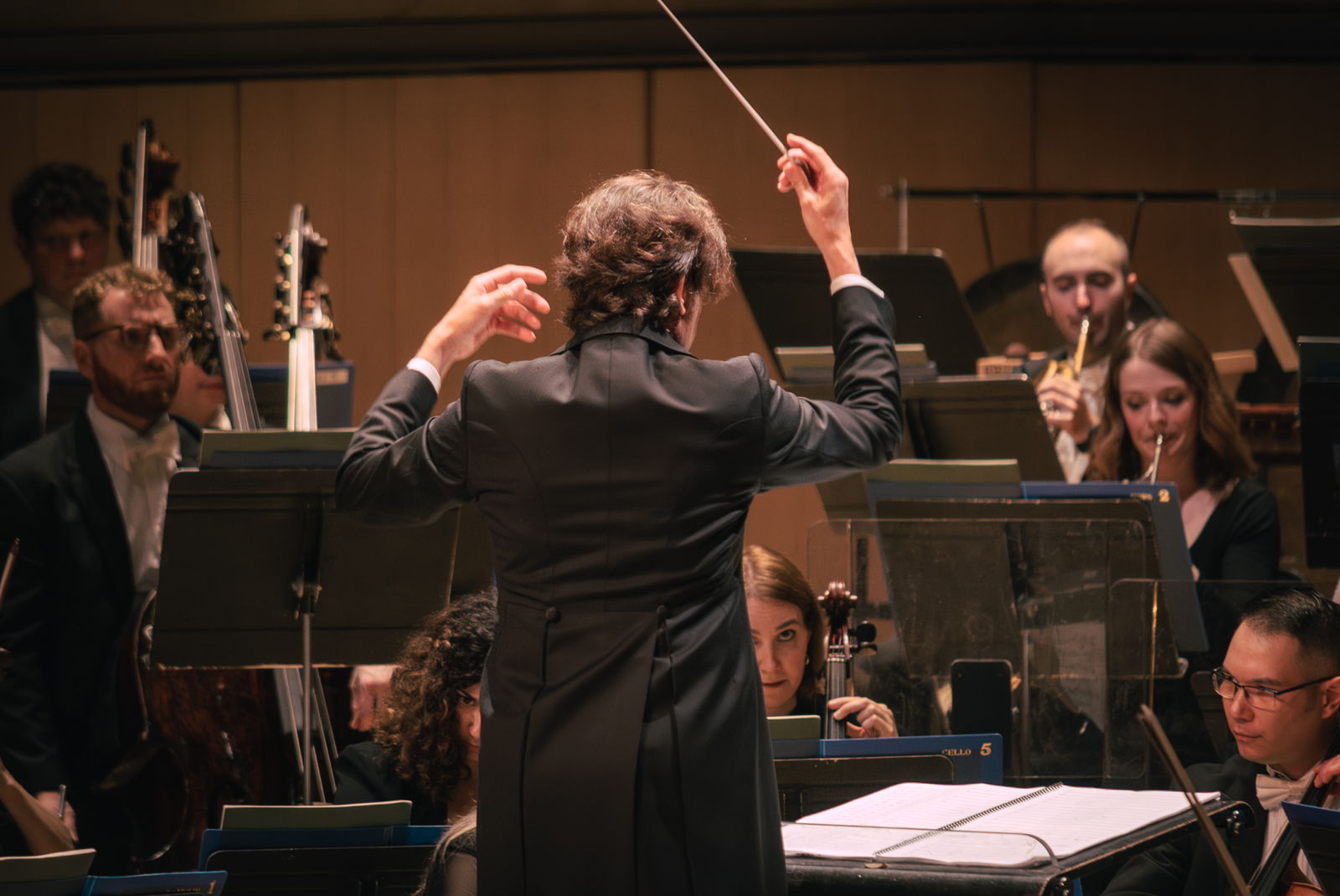
The COC chorus carry a huge load in this opera, both musically and dramatically. Given that the other fall opera is Gounod’s Faust, another work full of great choruses, I think that the COC planners remembered their chief assets: a superb chorus and orchestra. Conductor Paolo Carignani led a vibrant and energetic reading, often encouraging his chorus and soloists to sing more softly so that they build to powerful climaxes at the end of their numbers. As expected, the Third Act chorus “Va! pensiero” was one of the highlights.
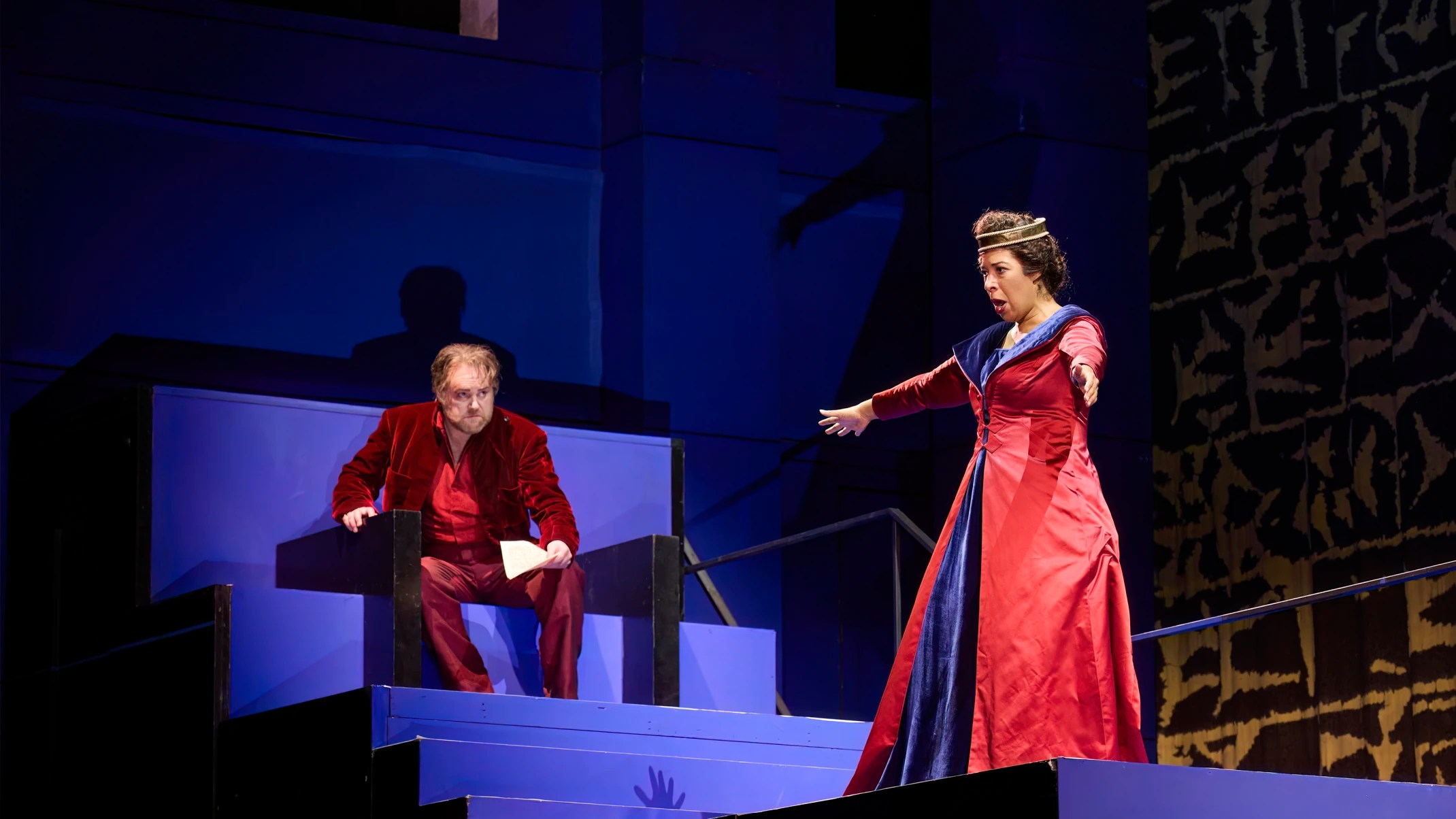
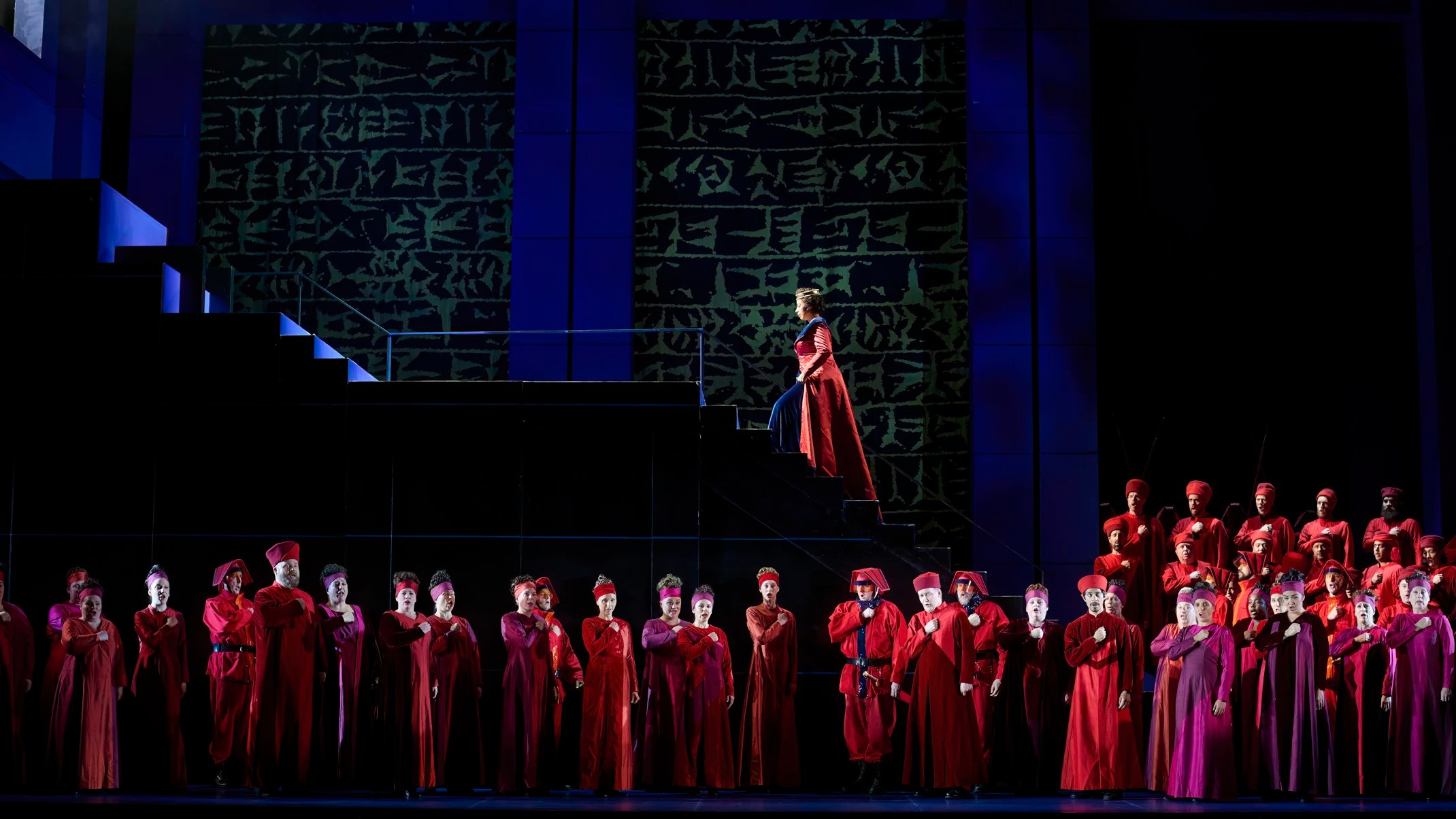
Earlier in that Third Act the set design by Michael Yeargan helps us see the power struggle play out between Abigaille (Mary Elizabeth Williams) and Nabucco (Roland Wood), as they each climb upwards towards the throne.
Roland Wood (Nabucco) and Mary Elizabeth Williams (Abigaille) (photo: Michael Cooper)
The throne is at the top of the stairs Mary Elizabeth Williams ascends behind the COC Chorus (photo: Michael Cooper)
Those two singers were my two favourites, even if their rivalry is only in the story, and not a battle for our attention or applause. Roland Wood in the title role is a COC regular, employing a lovely bel canto timbre and superb dramatically. Mary Elizabeth Williams is a brilliant newcomer as Abigaille, whose voice was more than up to the challenges of this daunting role, sometimes dark at the bottom of her range, sometimes agile in her coloratura and possessed of some powerful high notes when she chose to use them. Her last scene was very effective, poignant and yes, brought me to tears.
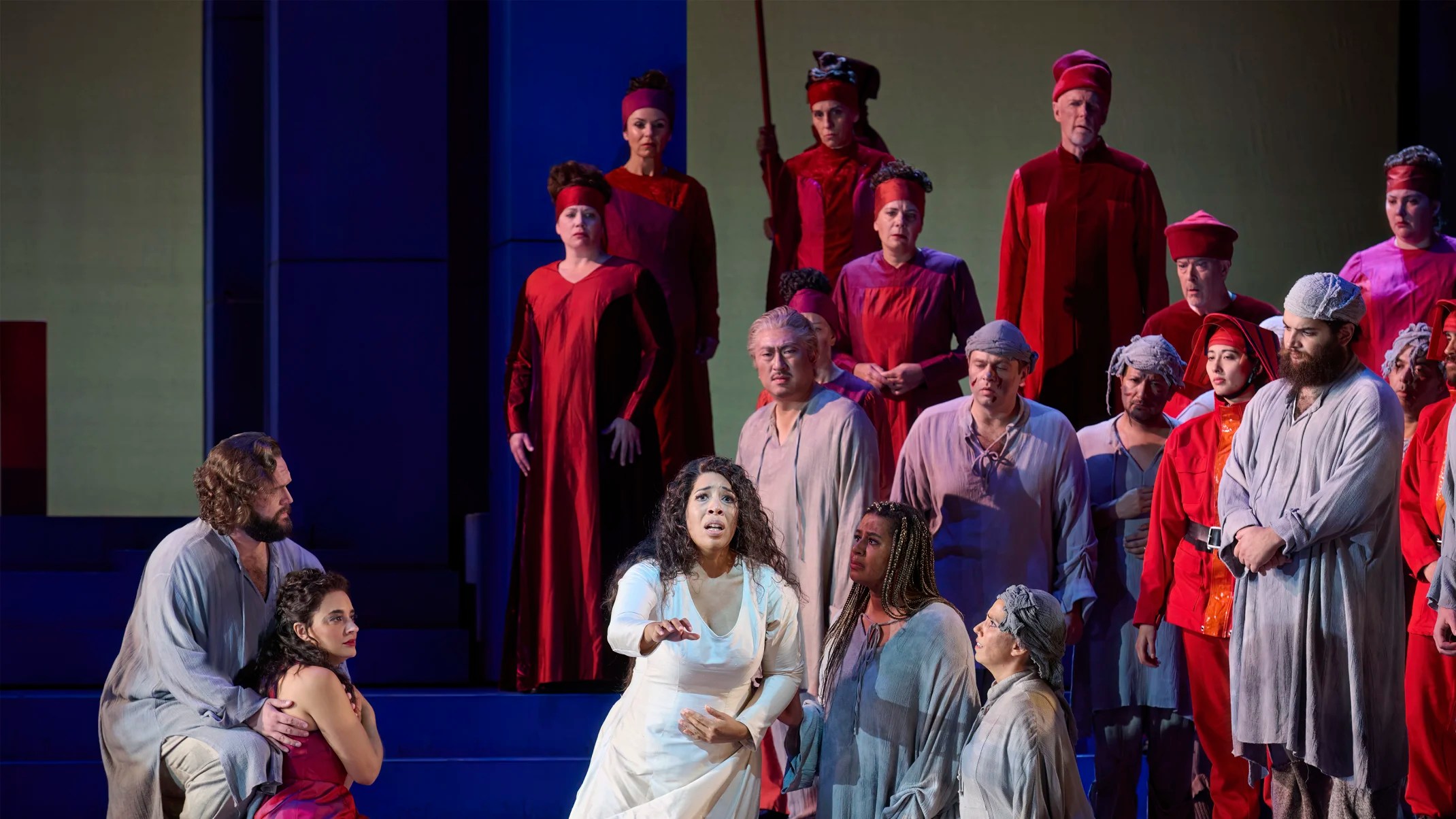
Mary Elizabeth Williams (Abigaille, centre) surrounded by COC chorus, Matthew Cairns(Ismaele) & Rihab Chaieb (Fenena) (photo: Michael Cooper)
I thought at times she was being prudent, holding back likely because she sang less than two days ago and needs to conserve her voice for a run that will have her back for five more performances. I’m looking forward to hearing and seeing her again, the most exciting voice I’ve heard in a long time.
Two former COC Ensemble Studio singers gave us standout performances. Rihab Chaieb as Fenena and Matthew Cairns as Ismaele sounded and looked terrific. Simon Lim as Zaccaria was superb vocally, with a big powerful voice.
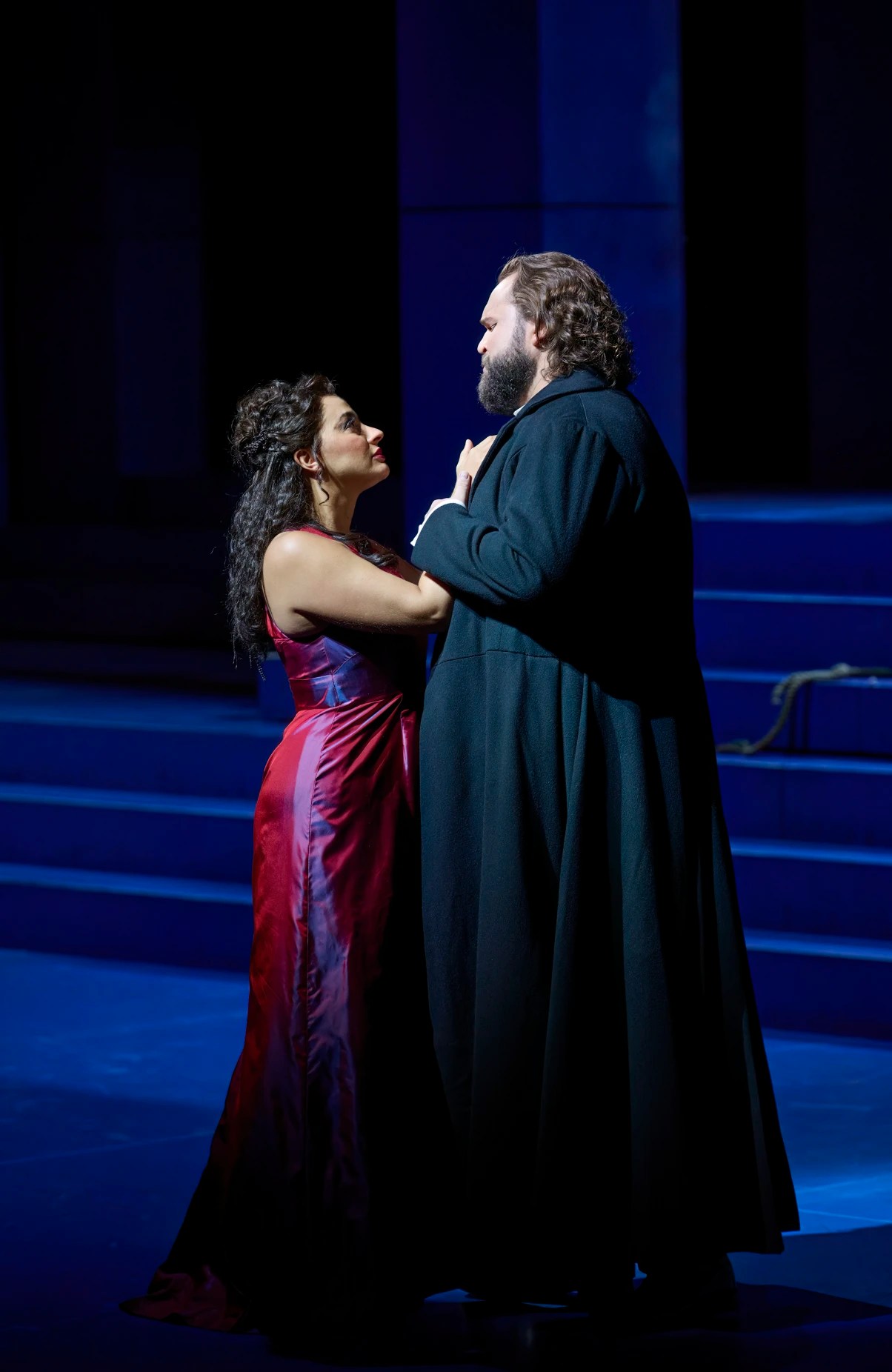
Rihab Chaieb (Fenena) and Matthew Cairns (Ismaele) (photo: Michael Cooper)
Nabucco continues at the Four Seasons Centre with five more shows October 12, 17, 19, 23 & 25.
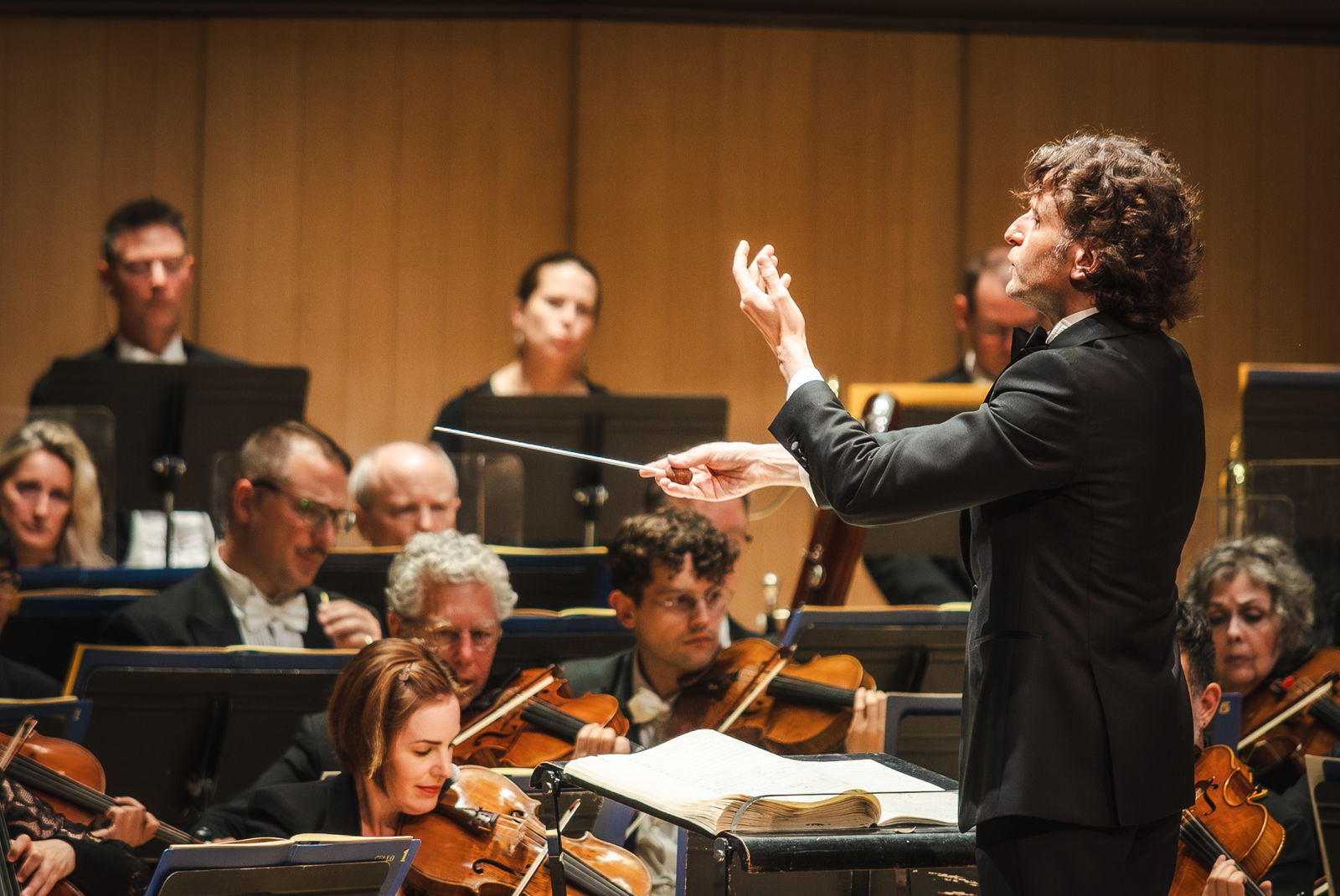
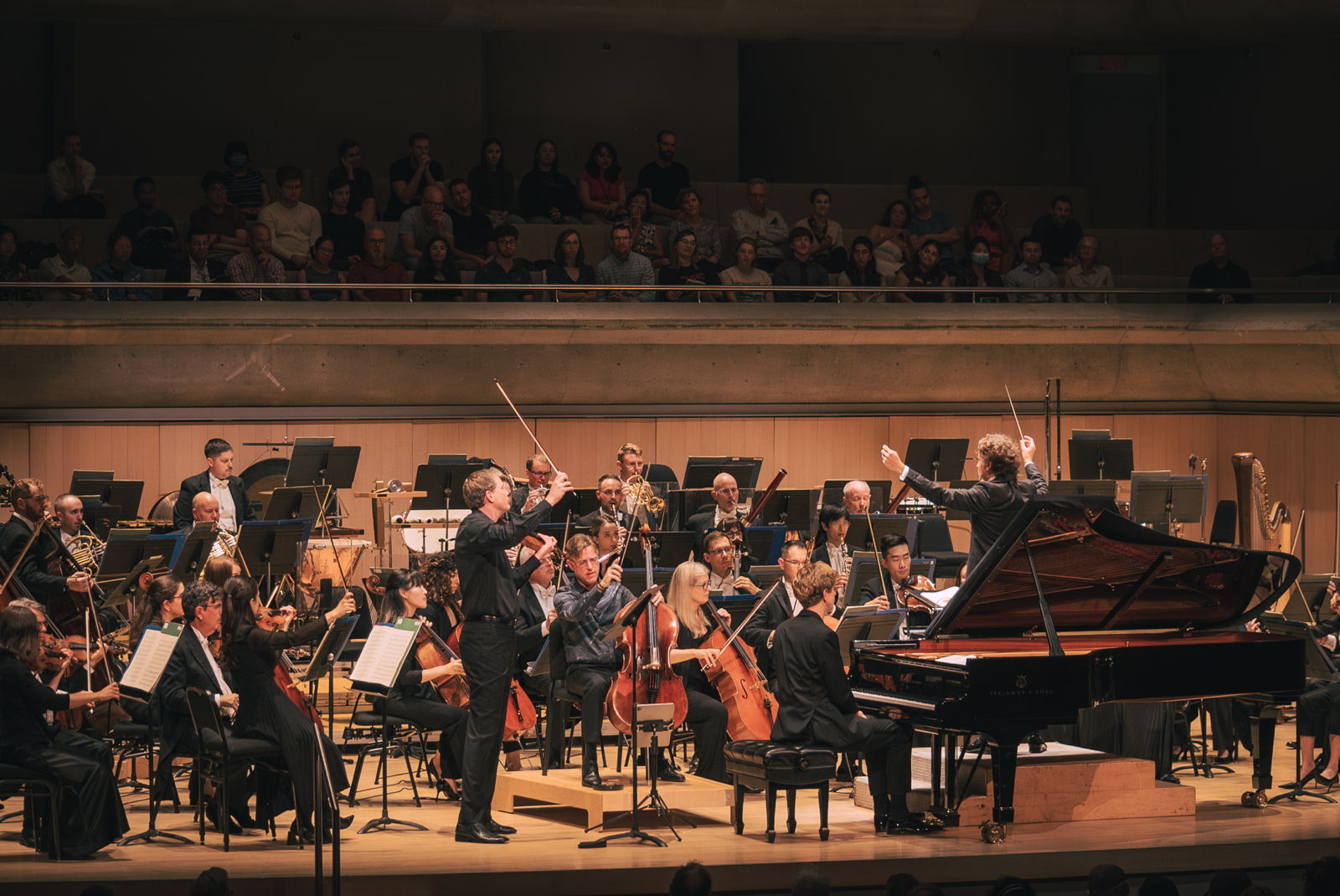
The Toronto Symphony, Conductor Gustavo Gimeno (photo: Allan Cabral)
Play is the operative word for a Toronto Symphony program titled “Spirited Overtures:”
Gioachino Rossini–Overture to The Barber of Seville Igor Stravinsky–Jeu de cartes (Card Game) –intermission– Wolfgang Amadeus Mozart–Violin Concerto No. 3 in G major Johann Strauss II–Overture to Die Fledermaus
It was a theatrical event, overtures to opera or operetta to begin and end with a ballet score and a concerto in between.
TSO Music Director Gustavo Gimeno explained the rationale for the program. The core idea of this concert is Stravinsky’s 1936 ballet score Jeu de cartes, that quotes from Rossini and Ravel among others. It was remarkable to hear the Barber of Seville Overture and a few minutes later to be hearing a passage in the last section of the ballet that quotes at least one, maybe two themes from Rossini.
The orchestra offer a nerd’s exploration of comedy, drilling down on music-making that reminds us of humans as cartoons.
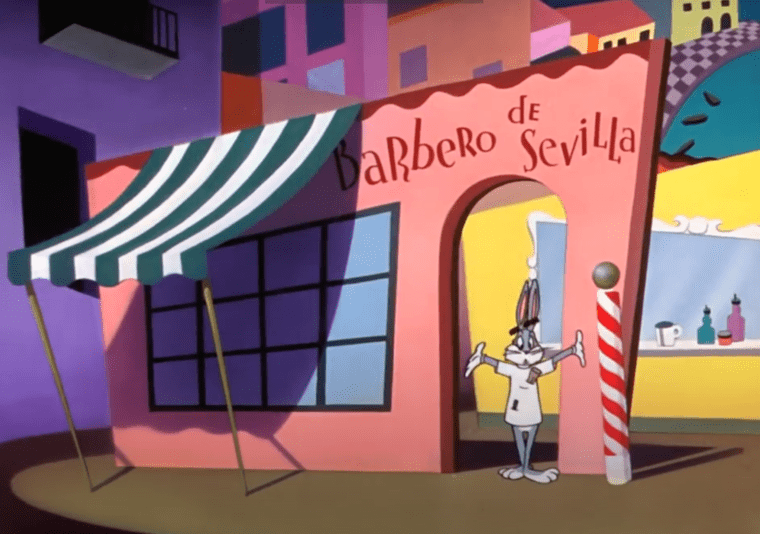
Yes of course that famous overture leads us to the famous Bugs Bunny cartoon.
“How do! Welcome to my shop, Let me cut your mop Let me shave your crop. ….Daintily, ….daintily…”
What Rossini (especially in his Barber of Seville overture) and Stravinsky (in Jeu de cartes) have in common is an approach to composition that brings out the comical.
Rossini famously makes humans like automatons or puppets or robots. The music resembles a cartoon because it’s often so quick it flashes by like an express train.
Stravinsky in Jeu de cartes, as in Petrouchka, gives us a ballet score that plays up angular little phrases, jagged chunks of music that don’t offer a lot of pathos but instead suggest, again, cartoons or puppets, somewhat similar to the images on playing cards. Remember too that cards in a deck challenge us with a kind of arbitrary randomness, and Stravinsky does that for us in the music, so we don’t get an orderly progression from say small to big or dark to light, but sudden abrupt shifts when the cards take us suddenly to a new face or idea. The phrases too are short little ideas, something like what we see on each card.
Stravinsky’s Jeu reminds me of Debussy’s Jeux (1913), another ballet score that Stravinsky surely encountered given that he was not just a young friend of Debussy, but busily premiering his own Sacre du printemps at the same time as Debussy’s score was premiered, and decisively emerging out of the older composer’s shadow. Both scores are often very laid back, taking us into a genuinely recreational sort of music, playful and relaxed. The question of the influence of the composers upon one another is a deep and complex one that I’m only hinting at, but Stravinsky offers us lots to think about in the way he plays with many sorts of musical influences, chopped up into tiny chunks in this score as if they’ve been run through a food processor. The chief structural element is a thematic figure that I understand to represent each of the three deals, like three hands of a game, to signify the one organizational principle around which everything else is built. We hear that music –suddenly making calm order out of the chaos– at the beginning, after five (to introduce the second deal) and fifteen minutes (to introduce the third deal) and again near the end of the 21 minutes piece.
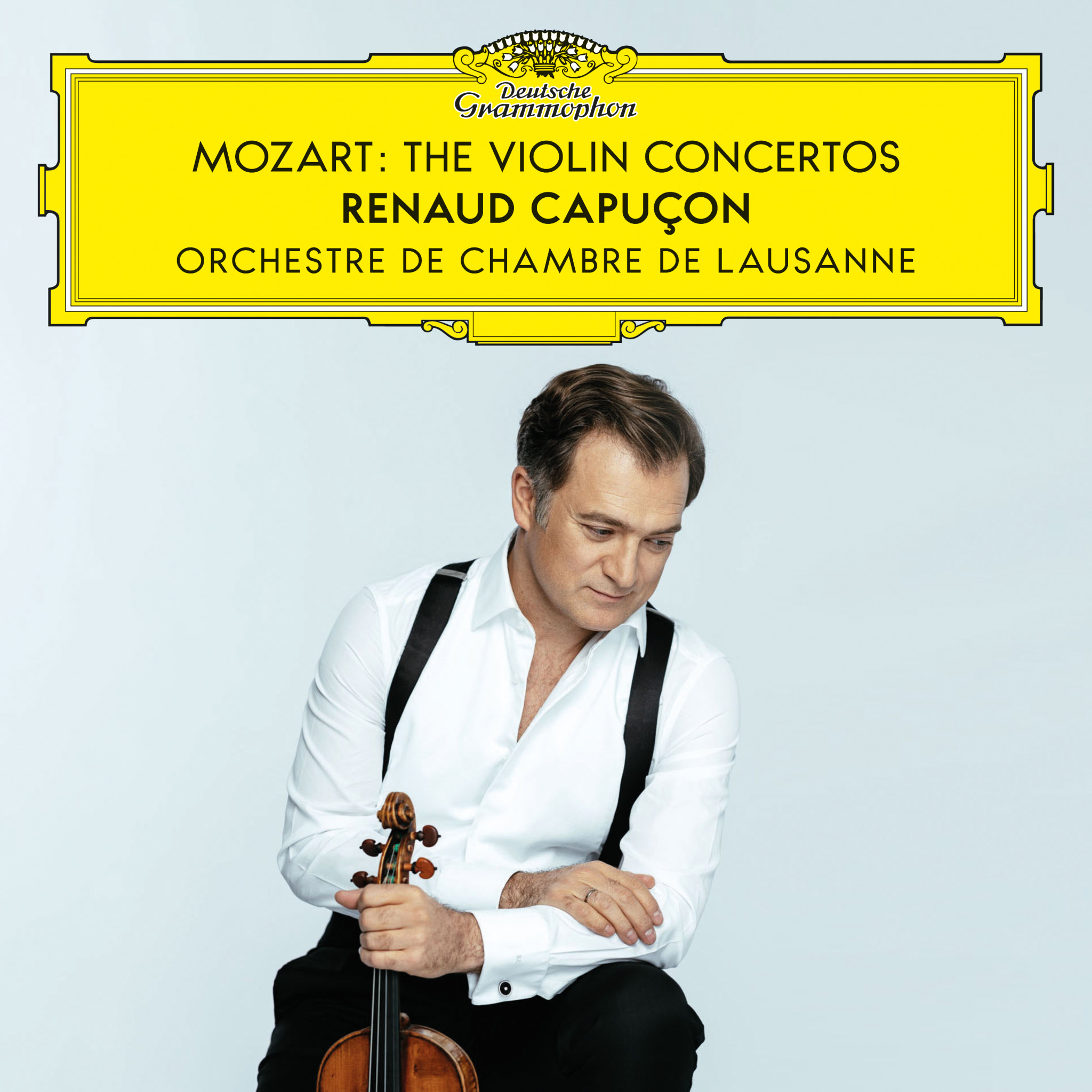
After intermission we were presented with a stunning rendition of Mozart’s third violin concerto played by soloist Renaud Capuçon, the violinist on a Deutsche Grammophon recording with the Orchestre de Chambre de Lausanne.
His performance with the TSO who play on modern instruments makes a brilliant complement to the Tafelmusik Mozart 2nd violin concerto I heard last week (when they played on original rather than modern instruments, with Rachel Podger as soloist). It’s an endless conversation at this point as to how far one goes in pursuit of authenticity, whether through original instruments or historically informed performance practices. I don’t think it makes sense to argue or insist on one over the other but rather to register gratitude and wonderment that we have the chance to hear both sorts of performance.
Capuçon offers a stunning sound, a wonderfully subtle delicacy to his tone in the middle movement and perfect intonation. The tasteful cadenzas especially in that theatrical last movement offer us another side to the playfulness in this program.
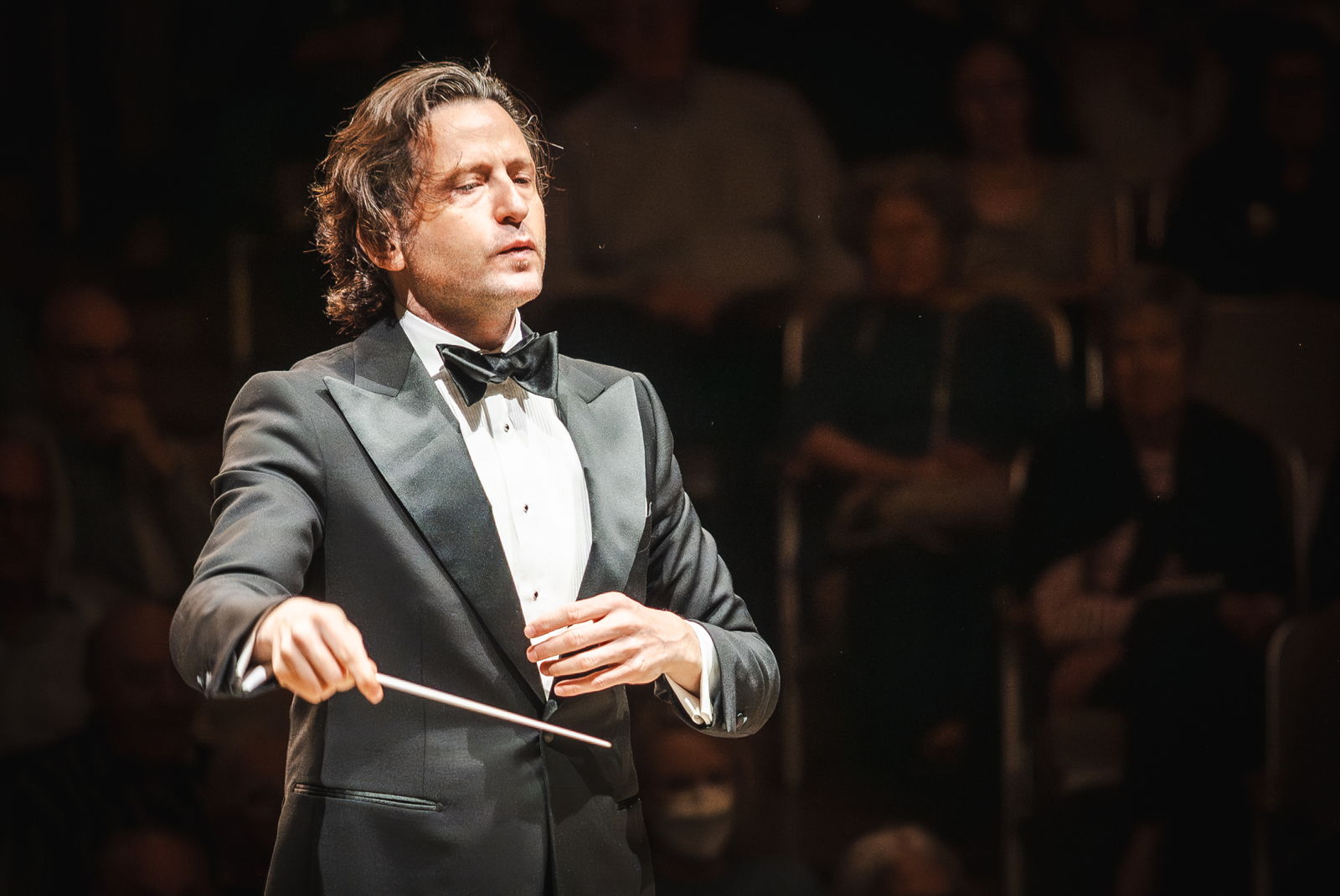
TSO Conductor Gustavo Gimeno (photo: Allan Cabral)
We concluded with more fun in a breath-taking reading of Johann Strauss Jr’s Die Fledermaus overture. I’m glad we had a chance to see a playful aspect of Gustavo tonight, the TSO responding eagerly to his lead.
And the TSO will be playing again Saturday night at Roy Thomson Hall (8:00 pm)and Sunday afternoon at George Weston Recital Hall (3:00 pm).
The concert was titled “Pictures at an Exhibition.” Roy Thomson Hall was full Saturday night for a fun evening at the Toronto Symphony.
Music Director Gustavo Gimeno leading the TSO (photo: Allan Cabral)
It was a showcase for the TSO. Music Director Gustavo Gimeno’s program notes suggest that he was engaging in an exercise to build his ensemble by challenging them somewhat.
The first half featured Beethoven’s triple concerto employed TSO concertmaster Jonathan Crow violin, principal cellist Joseph Johnson and Jan Lisiecki, 2024/25 TSO Spotlight Artist on piano.
Jonathan Crow violin Joseph Johnson cello Jan Lisiecki piano Gustavo Gimeno conducting the TSO (photo: Allan Cabral)
After a splendid and sensitive account of this uplifting Beethoven piece, we were treated to a substantial encore, announced as “a bit of Mendelssohn”. I think it was the slow movement in A from the D minor trio #2, a delicious bonus to reward the delighted crowd, exquisitely played. It has been exciting to watch these three young artists develop and grow with every new challenge, and a bit of a coup to see them working together as such a cohesive trio.
The concert opened with Carlos Simon’s Wake Up! Concerto for Orchestra, receiving its Canadian Premiere this week. The title puts me in mind of the subtext a composer might have, wanting to entertain and delight the listener but maybe not wanting their serenade to put us to sleep. Although the piece opens with a series of jagged and raucous utterances of a two-note motif that sounds a lot like an orchestra saying “wake up” (given the title of the piece) there were also several lyrical passages, lovely solos for flute, violin and cello, exciting passages for the percussionists and complex rhythmic pages to give conductor Gimeno a bit of a workout as well.
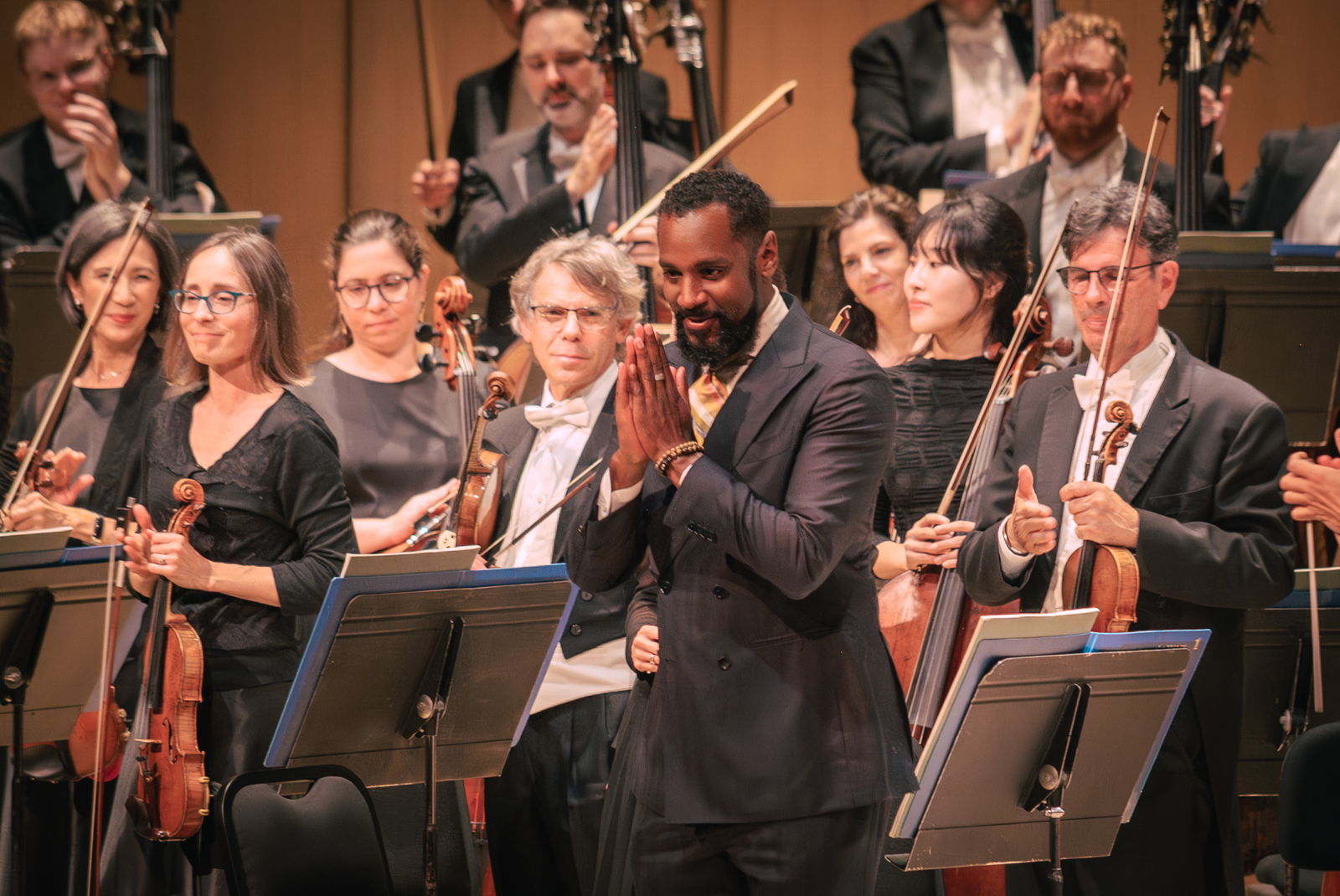
Composer Carlos Simon accepting applause earlier this week after the TSO played Wake Up! (photo: Allan Cabral)
And after intermission, Mussorgsky’s Pictures at an Exhibition but not get the usual Ravel transcription as conductor Gustavo Gimeno explained in his program notes.
Modeste Mussorgsky
“For the second half of the program I wanted to approach a familiar piece from an unfamiliar angle, and this brought me to Pictures at an Exhibition orchestrated by Sergei Gorchakov…I greatly admire Gorchakov’s rarely performed version. To me it feels more direct and raw, and less sweet and refined, with a soundscape that captures the original mood of the music. This is not to say that the differences are conspicuous. Unless you are intimately familiar with Ravel’s instrumentation, you may not even notice them. But for the musicians, it’s the equivalent of playing the part of Hamlet for years and then all of a sudden being asked to instead play Claudius. It is a way to challenge ourselves, to refresh the whole formula and it’s going to be wonderfully invigorating.”
The effect was to make a familiar piece seem new. In a few places Gorchakov uses similar instruments, for example in the opening Promenade featuring trumpet for the melody as in Ravel. But in many places we heard something bigger, louder. The brass had a bit of a workout, especially given that they were already employed prominently in Simon’s opening piece.
Gorchakov (1905 – 1976) seems to be a bit of a one-hit wonder, although perhaps in time we will learn more and hear more about him. I saw references to him in Google as a conductor but could not find anything reliable, given that I can’t read Russian.
Roy Thomson Hall was full, the crowd enthused and vocal in response to a terrific Saturday night concert to conclude the opening program of Toronto Symphony’s 2024-2025 season.
Somebody must be doing something right, considering how much younger this group is than the audiences I am seeing at other Toronto cultural events. The TSO have been gradually changing over the past decade. Music Director Gustavo Gimeno begins his fifth season on an impressively high note.
Mark Williams is their new CEO since April 2022.
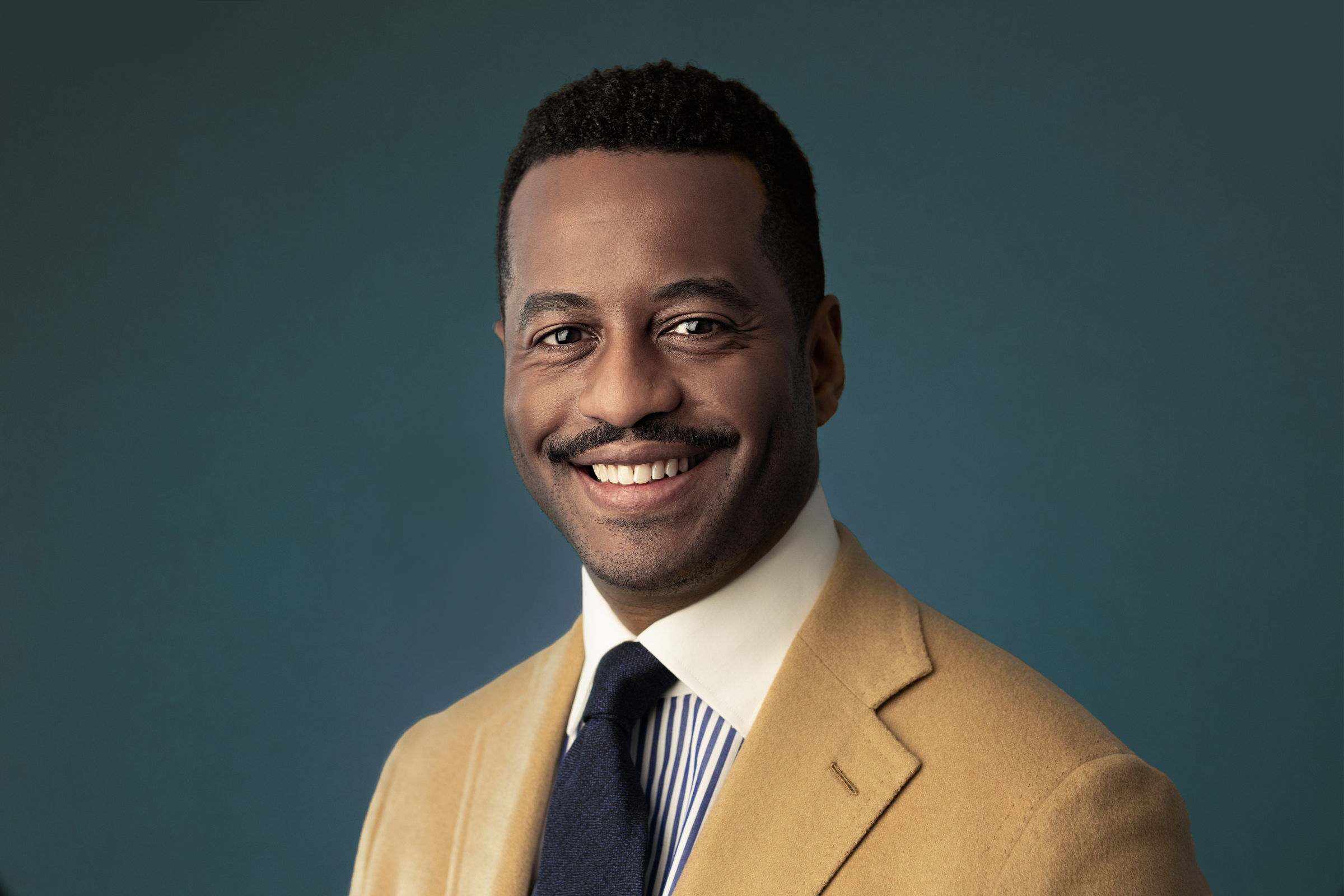
TSO’s new CEO Mark Williams (Photo by Philip Maglieri)
Mark came out to make an announcement before the concert.
“The Toronto Symphony Orchestra (TSO) is thrilled to announce a landmark $15 million gift from the Barrett Family Foundation, marking the largest pledge in the orchestra’s history and the most significant commitment ever made to support programming at a Canadian performing arts organization. This extraordinary gift will support the TSO’s community engagement and education programs, ensuring that the power of music continues to reach and inspire audiences of all ages across the city.”
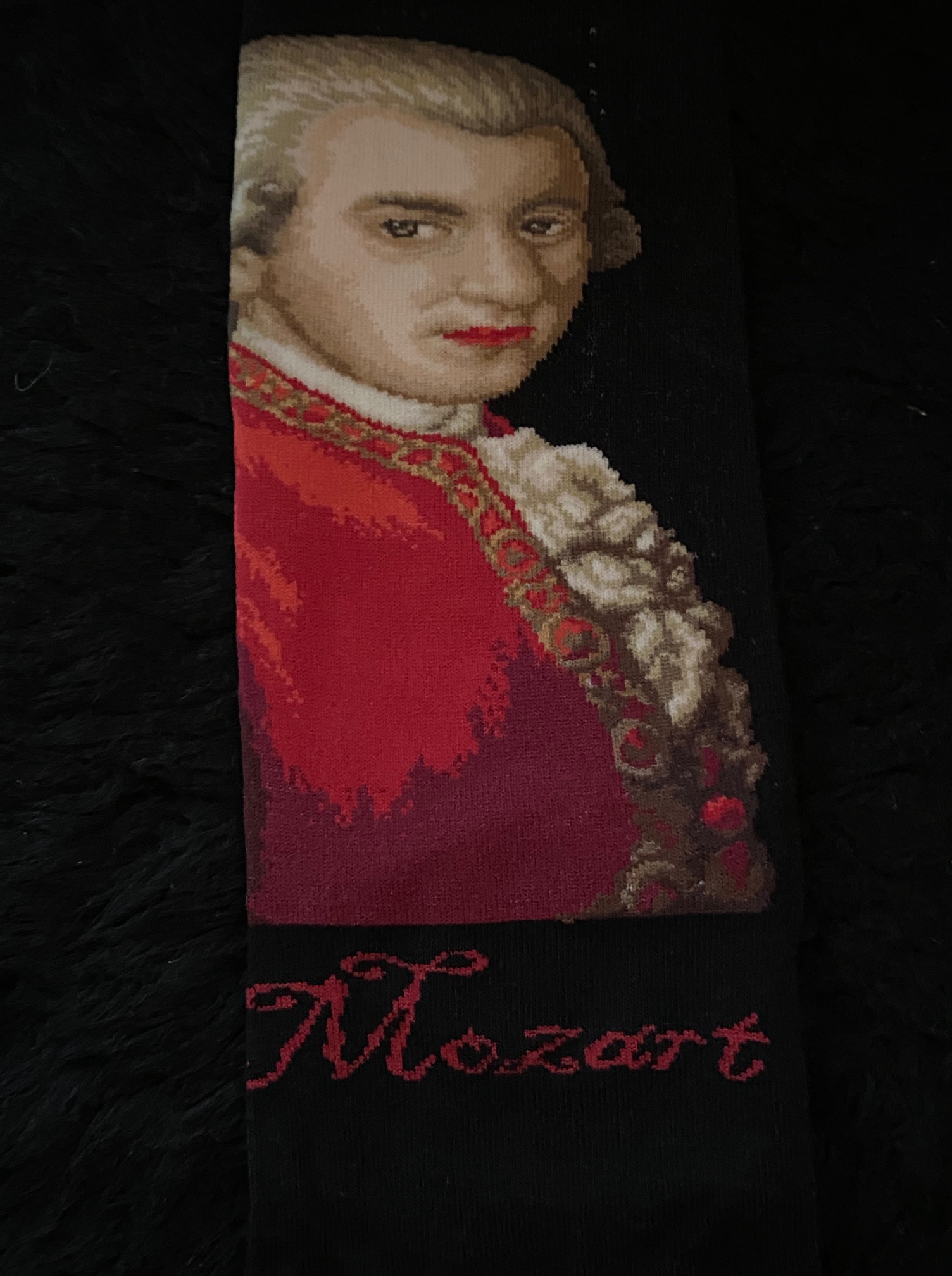
As I look at this stylish picture of Wolfgang Amadeus Mozart I wonder.
Through the decades I have been listening to his music there are a variety of approaches, sometimes so respectful as to put Mozart on an impossible pedestal. The historically informed performance movement has gradually changed the way we understand his music and how to play it. He is one of the most frequently played composers, tremendously popular: yet maybe misunderstood, in how he is played.
I say that after the breath-taking performances heard Friday night in an all-Mozart program from Tafelmusik Orchestra under the leadership of Rachel Podger at Koerner Hall to begin the season.
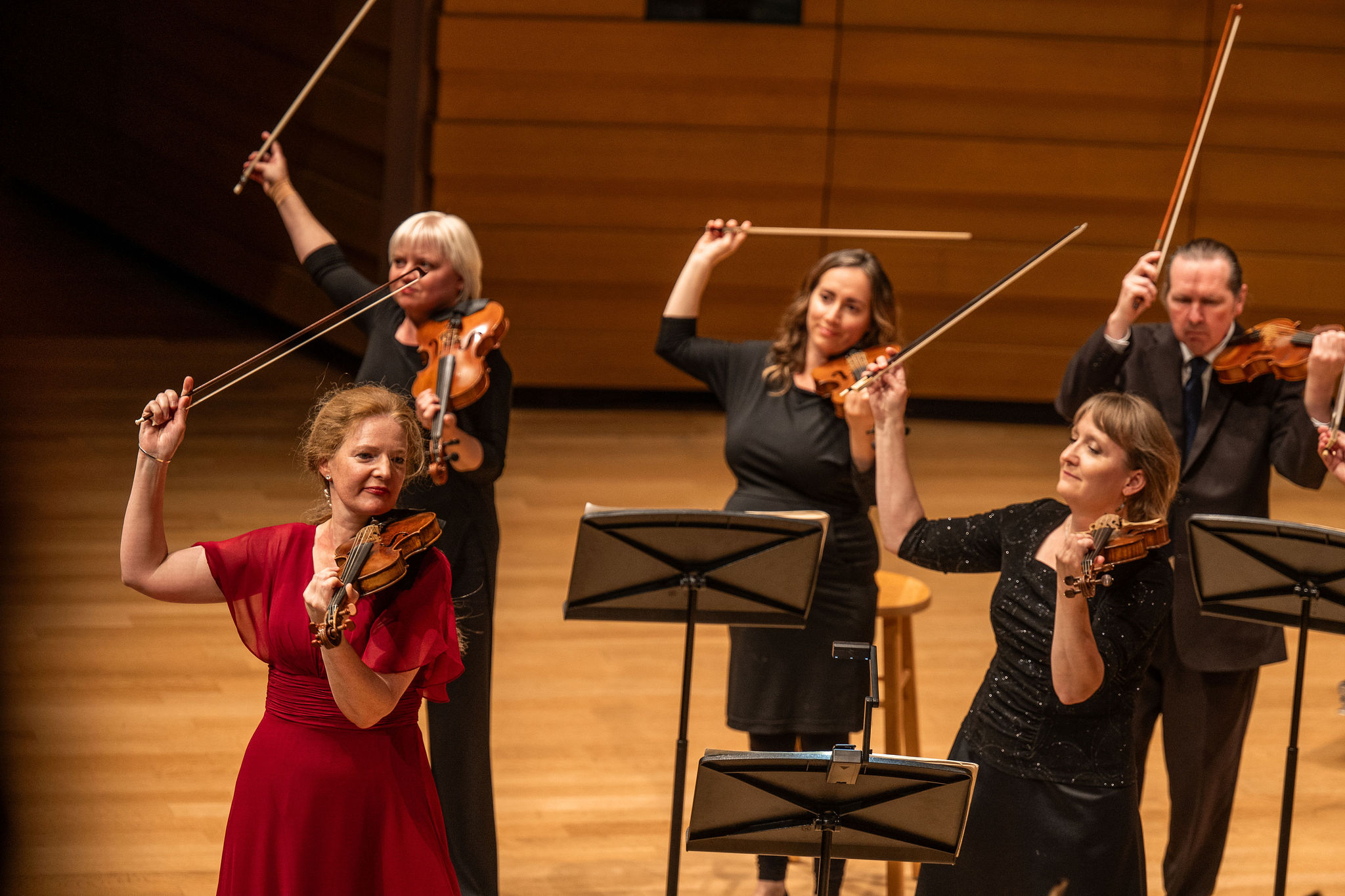
Tafelmusik led by violinist & Principal Guest Director Rachel Podger (photo: Dahlia Katz)
If you love Mozart please please find a way to go hear this concert. What I heard was so strong and confident as to be paradigm shifting. I’ve been listening to Mozart’s C major Symphony (known as the “Jupiter”) and the violin concerti all my life. Last night’s was astonishingly different. It felt brand new, refreshingly direct, simple. Please note Tafelmusik have inspired such feelings in me before. Their Mozart, Haydn or their Beethoven contrast with the usual ways we heard well-known pieces, given that their historically informed performance style meant going faster, without the same sorts of vibrato, and with the delightfully rich timbres of original instruments.
Yet this was a quantum leap, more impressive than ever before.
For starters there’s the benefit we enjoy of the usual Tafelmusik thorough scholarship, playing in a historically informed style, and the sweet-sounding winds and the deeper throb of the strings that an orchestra employing original instruments offers. and they usually play pieces in a far quicker tempo than we heard in the generations before. I recall a time when Mozart was played with a big orchestral sound, much slower. The meaning of the discourse changes in much the same way the delivery of lines is altered by someone doing the William Shatner approach (sorry Captain Kirk…).
Do you say “to be or not to be, that is the question”? or do you ham it up, to squeeze meaning through pauses, saying “to be….. or…. not to be… that…. is the question”. In the quest for more meaning the listener is no longer pondering meaning because it’s ponderous. Weighed down by its own quest for ultimate heaviosity, when we treat something with too much respect.
Similarly, the opening to the first movement of the Jupiter Symphony. You don’t have to know the piece for me to explain (as I aim to be inclusive).
The first phrase is a series of notes on the beat, with a quick flourish of notes sliding up to that note, with an answering softer phrase from a different complement of instruments.
Earlier generations of conductor (whom we admired of course) would conduct the piece to give you every note played (C, g-a-b-C, g-a-b-C) as though it were important to be played as part of the meaning. Last night I think I saw and heard what Mozart really wanted, as Podger and Tafelmusik gave us something more like C – C – C, the notes in between so light & quick as to resemble ornamentation rather than a meaningful utterance. That older generation of interpretation resembled the William Shatner delivery, giving the notes emphasis that wasn’t likely given back in the 18th century, but rather to be thrown away.
I feel certain that Mozart never meant us to really notice these notes, because of what follows. The soft phrase that answers when done this way takes us almost into the realm of call and response. No Mozart wasn’t writing blues, but suddenly there’s a playful conversational element that’s missing when we think of this as (perhaps while genuflecting to the great Mozart) the Jupiter symphony. The name wasn’t from the composer of course but added years later. If we lose the pompous fear and instead acquire a modicum of playfulness? that’s likely closer to the right spirit.
And Tafelmusik were playing together with Rachel Podger violinist, herself making eye contact around the ensemble as though (to quote Paul, the friendly gentleman seated beside me) Tafelmusik were a chamber ensemble not a big band requiring a conductor with a baton. That’s especially exciting when we come to the last movement, an extraordinary display of musicianship accomplished by players listening to one another.
There is a rhetorical elegance to what we were hearing and yes, seeing. I must compliment Rachel and Tafelmusik for their dramaturgy. It may be that in fact the ensuing tutti, when everyone comes in forte, was a moment later than it might have been from a modern orchestra with conductor, slaves to the metre and the baton. But this felt like genuine dialogue, discourse of the highest sort. We saw the orchestra speaking and answering. To speak of call and response is perhaps a modern idea, but there are many places where Mozart has sections going back and forth, as though in conversation. The third movement is especially dramatic that way, a drama that’s clearer when instead of a conductor enforcing an interpretation, we actually have Mozart speak to us, through the back and forth of sections who listen and respond to one another with the fluidity of a string quartet.
I feel that Rachel Podger gets Mozart, understanding his music as no one I’ve ever encountered. Her leadership of Tafelmusik is truly inspiring.
And it doesn’t hurt that we were in Koerner Hall, where the sound is particularly transparent.
Rachel plays the phrases, her body language a tiny bit larger than necessary because her head and arm and shoulder movements serve to indicate where the downbeat is, where the others should also place their downbeat. I saw eye contact across the stage between players.
I also saw some amazing smiles and expressions from Rachel, and it’s a mutual thing. When the players in the orchestra are smiling in every section you know something good is happening.
She was sometimes looking out at us, particularly during the violin concerto.
Violinist Rachel Podger and members of Tafelmusik (photo: Dahlia Katz)
Rachel seemed to be playing with us at times, teasing us, testing us. Audience members on all sides were giggling with me, as I wasn’t the only one to observe something that felt like a kind of gamesmanship, pushing the rules of the concerto procedure to its limit. We see that there’s a moment when the soloist has the option to pause or continue. She looks out at us with a whimsical expression as if to say “what do you think audience? will I continue? what will I do?” And of course she went on, pushing the pause to its limit without in any way broaching the rules of period performance. I think at that moment a few hundred people were in love, the violin a subtle instrument of witty comedy. We were reminded that a virtuoso such as Mozart (who played his own concerti) had all sorts of freedom to elaborate or pause especially during cadenzas.
I’ve previously made a mental division, associating the Toronto Symphony with newness and modernity while aligning Tafelmusik with the baroque, early music and their older period instruments. While that’s more or less true, yet we heard something edgy and new in Koerner Hall tonight, as though an old portrait had been cleaned and we saw it as though for the first time.
Rachel and Tafelmusik seem to have a special chemistry. Rachel said in an earlier interview that she’s “always been struck by the spirit of Tafelmusik, the lovely sense of collaboration”. That is what we saw and heard. And I look forward to hearing Rachel Podger’s ongoing contribution to Tafelmusik in the concerts to come.
But first “Mozart Jupiter” as the concert is titled is repeated this weekend, September 29 and 30 at Koerner Hall. See and hear it if you can.
As M John Kennedy explained it to me before the show, they had to fill in a space on the application form they completed for their production of David Ives’ Venus in Fur, identifying the name of their company.
“Pickle Theatre” was the result, and maybe that helps explains the image on the poster.
It made sense to me. As in the production of 1939 that I saw on Friday night, live theatre is made of different influences, styles and training, a mix of tools like lights and music and dance and voice, modern and classical mixed: pickled together. Yes it’s fair to say that the result really is a pickle.
We were even offered pickles before and after the show.
Lucas Romanelli sampling a pickle.
But never mind pickles. Let me talk about the reading. I saw the 2:00 matinee in a jam-packed Annex Theatre. It’s not a huge space but we were somewhere between 50 and 100 attendees hooting hollering and laughing.
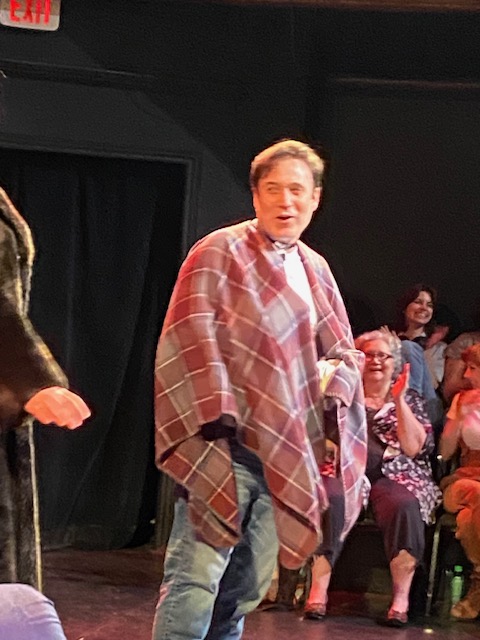
I may be risking my life posting this picture of M John, considering that Dahlia is the best professional photographer in Toronto. No she didn’t take this picture (obviously). But notice that the place is full and the audience is applauding enthusiastically .
Venus in Fur is a 2010 play by David Ives, adapting the 1870 novella by Leopold Sacher-Masoch (a writer immortalized in the word “masochism”), and filmed in 2013 by Roman Polanski mostly using Ives text although filmed in French. Although Ives’ play was presented in Toronto by Canadian Stage, I didn’t see it, passing it up due to what I’ll call an anxiety of influence given that I did an operatic adaptation of the novella in 1999, that I was revising for a planned revival that still hasn’t happened.
Like 1939 the play I saw Friday, Ives’ work is meta-theatrical, a fancy way of saying that sometimes we’re watching a play-within-a-play. Unlike Hamlet or Midsummernight’s Dream, the distinctions between the play and the show they put on during the play can get blurry, not quite so clear in either of the modern works.
We bounce back and forth between the diegetic world of the two characters in the play –the playwright and an actress auditioning for the lead role in his show– and the story he wants her to portray. We are sometimes hearing them address the text as a project, sometimes delivering the lines of that project, as they go deeper & deeper into the dynamics of his eventual submission to her, very much as in the original novella. The interplay between the two worlds is irresistible.
Erynn Brook played Vanda, M. John was Thomas, and the reading was directed by Dahlia Katz, who read out the stage directions. As I type this the second reading at 7:00 is just starting tonight. They began by using accents self-consciously to suggest the Sacher-masoch story of Wanda and Severin although things get blurred even further when Vanda starts using the name “Tom” instead of Severin.
In case I wasn’t crystal clear, the reading was extraordinary, a breath-taking exercise that the audience devoured rapturously. We were often laughing at the implications of the story, although at times things got very serious, but this is a story that’s tremendously ambiguous, full of multiple meanings, double entendres at every turn. We loved it.
And I’m sorry there’s no upcoming run of the play to recommend, although perhaps we shall see more from Pickle Theatre, M John and Dahlia.
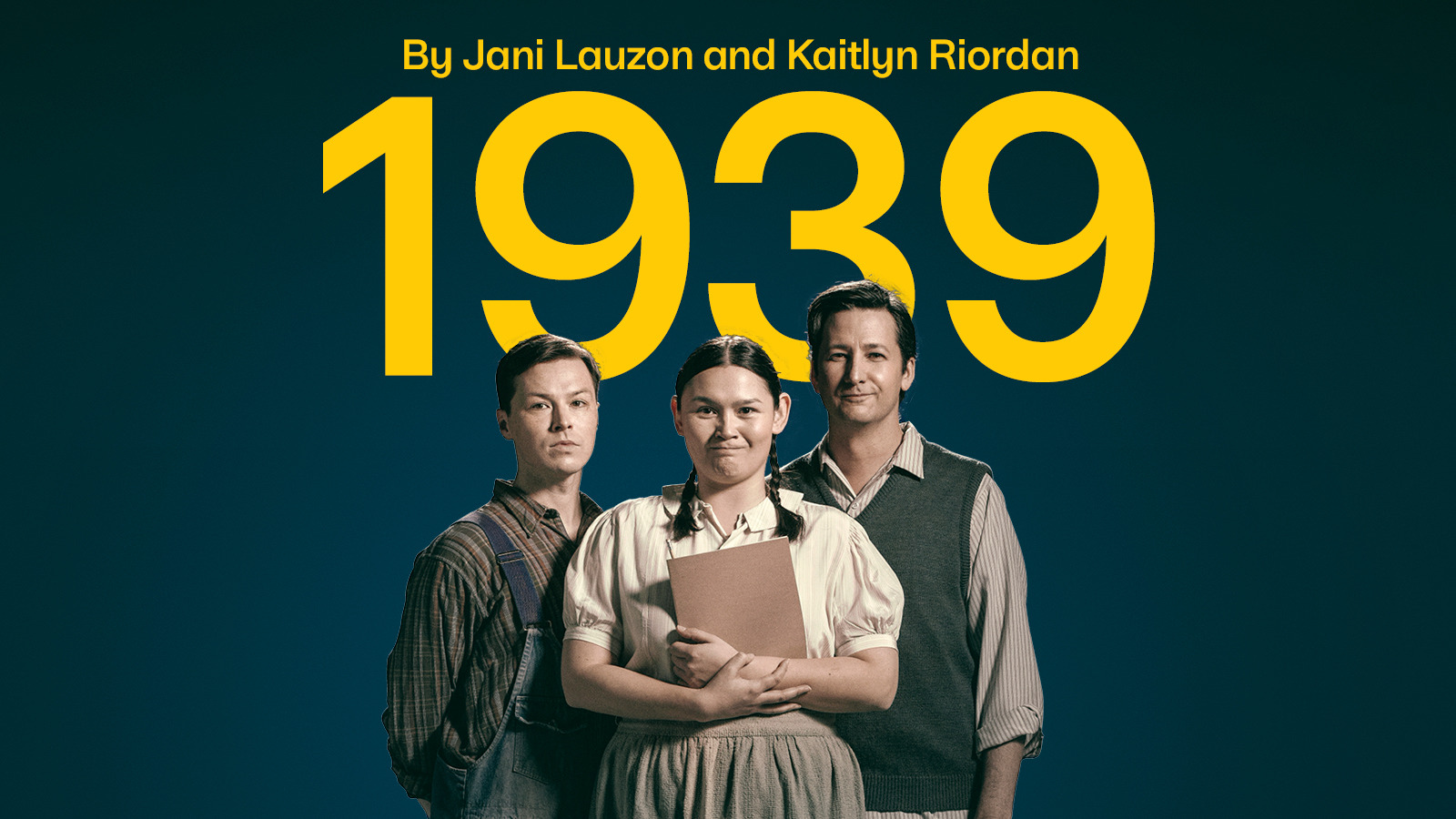
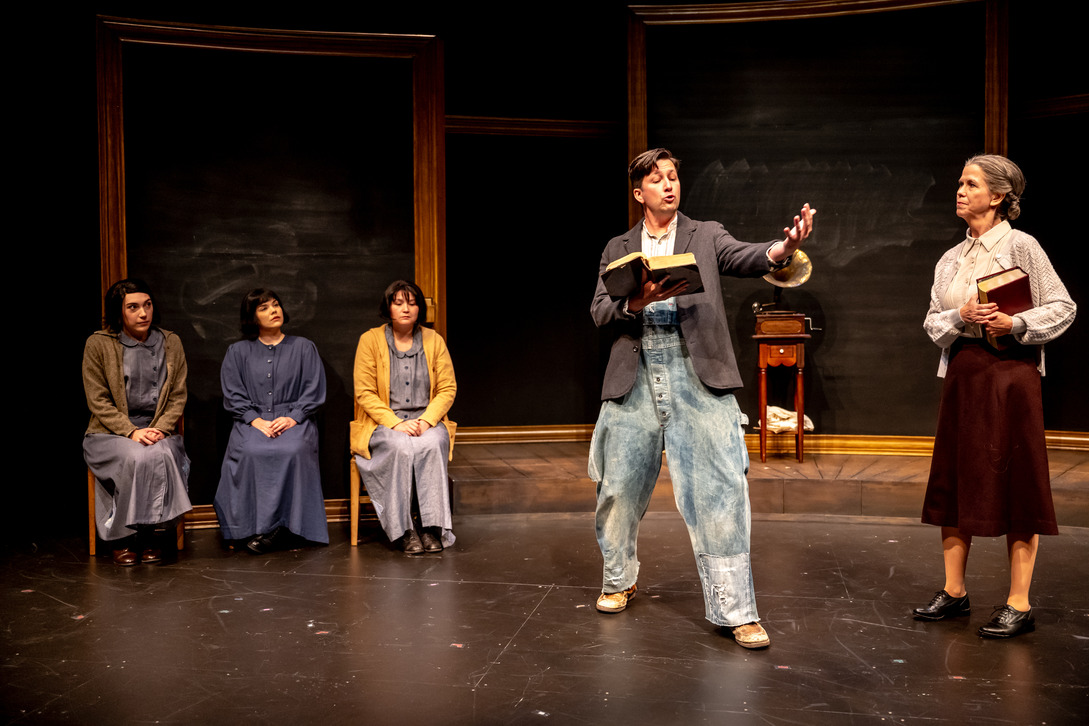
Last night I watched 1939, a recent play by Jani Lauzon and Kaitlyn Riordan at Berkeley St Theatre, a brilliant snapshot of the madness of residential schools and resilience in response. It’s a Canadian Stage and Belfry theatre joint production in association with the Stratford Festival, where 1939 had its 2022 premiere.
Imagine the presentation of a Shakespeare play by residential school students for a royal visit by the King & Queen of England in 1939. Their normal lives in school were already a performance, the lies they are forced to tell while suppressing the truths inside them. The bizarre Shakespeare project underlines the absurdity of students separated from families & culture while being imprinted with new unfamiliar Christian ideas by their teachers.
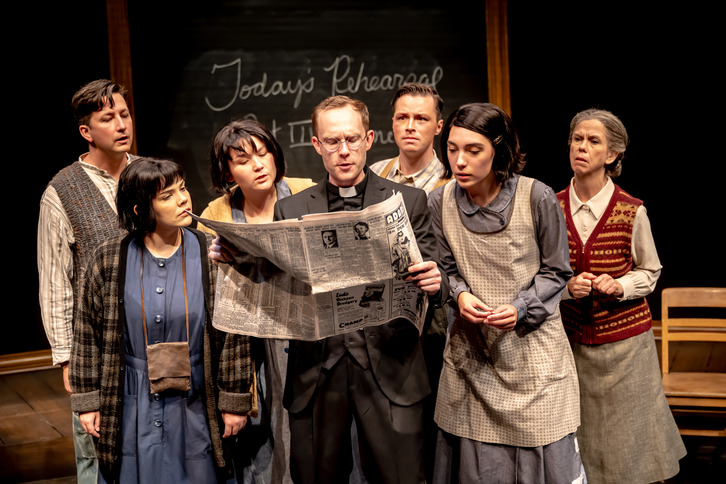
As in any first encounter with a text I’m balancing the creation of words and the performers’ creation, this time directed by Jani Lauzon, who is one of the authors. I missed seeing the piece in 2022 at Stratford, but wonder if in this incarnation it has become something new or different, deeper or perhaps lighter. I don’t know. At times we’re watching a frenetic stage full of fast moving bodies. At other times we observe a person alone in quiet reflection. At times they may struggle with language, although at times words are used playfully even if we don’t understand the words that are in an Indigenous dialect. There is so much going on, layers of meaning and action. Frequently we see words written on a blackboard, that will then be erased by Father Callum, a reminder that truthful expression is not always permitted. There is a persuasive self-assurance to this production and its cast that is irresistible, perhaps also because so many in the show are themselves Indigenous.
It was much funnier than I expected. For some such a topic may trigger overpowering emotions, and in response Canadian Stage included a gentle talk-back session for sensitive reflection afterwards, facilitated by Angel Brant, Shak Gobert and Manuel Chaves. I found that the deeper we penetrated into the story, the less I was able to laugh, although Lauzon/ Riordan did offer cheap laughs via silly costumes and fart jokes, perhaps hoping to dissipate powerful emotions. It’s barely conceivable that this be comedy, when we recall Kent Monkman’s paintings or the Truth & Reconciliation Commission, the cultural genocide to eliminate Indigenous languages & cultural practices through schools forcing children to become something they weren’t. The idea of finding comedy in residential schools is not only unexpected but a beautiful objective, perhaps a step on the pathway of reconciliation. I’m grateful for the encounter, amazed at the generosity of the performers.
It’s fascinating to watch the poignant variety of responses to Shakespeare, who at first is as completely alien as he must be to anyone reading gibberish, words they can’t understand.
Beth (Grace Lamarche), Evelyne (Merewyn Comeau), Susan (Brefny Caribou), Joseph (Richard Comeau), Sian (Catherine Fitch) (photo: Dahlia Katz)
While Shakespeare’s language, especially as understood through their teacher, is at first foreign and rigid, the attempts to perform Alls Well that Ends Well become a redemptive escape into something more authentic than the Christian platitudes they’ve been force-fed.
Father Callum (Nathan Howe) hopes that donors seeing the student play performance will help pay for needed repairs to the roof of their building. When a newspaper reporter (Amanda Lisman) comes to see their preparations for the royal visit, leading to a feature article publicizing their production, the project is pushed in a new direction.
Joseph (Richard Comeau), Evelyne (Merewyn Comeau), Susan (Brefny Caribou), Father Callum (Nathan Howe), Jean (John Wamsley), Beth (Grace Lamarche), Sian (Catherine Fitch) (photo: Dahlia Katz)
Suddenly instead of the usual effort to deny their culture and to assimilate the students as Christians, Sian the teacher and director of the student production (Catherine Fitch) seeks to emphasize Indian culture, getting costumes and sets for the production. Of course these are inauthentic and cliche. At one point in rehearsal, perplexed when she discovers that no they are not all the same culture, as one is partly Cree, another Ojibwe, another Mohawk, Sian asks if there is a generic Indian that they can play. The ineffectual teachers are more sympathetic than expected.
Evelyn (Merewyn Comeau) surprises her teachers by the strength of her acting, because she channels the wisdom of her elders. Susan (Brefny Caribou) follows suit, letting the memory of a quirky uncle inspire her as the clown. In contrast, Beth (Grace Lamarche) has loyally subscribed to the instructions of her teachers, believing in the residential school promise of a better life if she learns her lessons and rejects her native heritage. When Sian encourages them to play as Indian rather than as an assimilated English Canadian, Beth is perplexed, caught in the contradictions of the school and its lies, but also aware that in her acceptance of the school’s implicit bargain, she has cut herself off from a native past to which she no longer connects.
Joseph (Richard Comeau) is Beth’s brother, a fact the teachers didn’t realize until it’s disclosed during rehearsal. Jean (John Wamsley) and Joseph, who also have parts in the play will also tell us about a hockey game with a local private school that figures prominently in the unfolding of the plot. In due course we will see the presentation of their play within a play unfold, and their decisions as to how to enact their Indian portrayals, reconciling themselves.
1939 continues at the Berkeley St Theatre until at least October 12th. I recommend that you attend, and if possible stay for the experience of the reflection space after the play.
No opera today, although the headline may seem to promise as much.
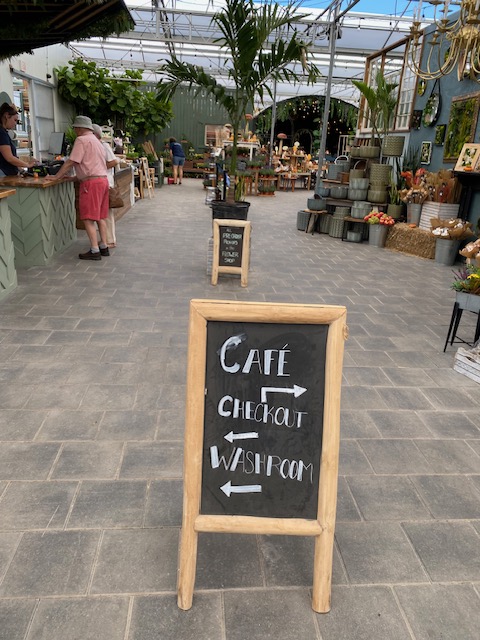
Before we got to Eryna’s house in Thorold we stopped in Vineland. This was our third or fourth visit to The Watering Can Flower Market, a place to find plants and also to have lunch.
Speaking as a resident of Scarborough who loves outside yard-work and indoor cultivation, it’s thrilling to see such an enormous inventory of plants and gardening products, often at prices far below what we pay at the garden centres in Toronto.
It was worth the drive.
We picked it, or maybe I should say “him” up on the way home Thursday after spending Wednesday night in Thorold with Eryna (picture below).
On the way to her place Wednesday we caught a glimpse of the handsome fellow (Erika is thinking of the plant as a male, although she hadn’t yet given him a name) …while enjoying lunch.
I had a savory scone with a bowl of squash soup, Erika had tomato-red pepper soup, then we split a breakfast sandwich (egg over easy, bacon & cheese on toasted sourdough bread), and I finished with the best pumpkin pie I’ve ever tasted with ice cream on top.
It was a hot day yet the fans above us in the spacious cafe area cooled us.
Walking around in this big gorgeous space leaves me feeling I’m in an altered reality as if I’m wandering in a museum or art gallery, overwhelmed by so many varieties of beauty. And it smells amazing.
On our last visit to Eryna, you may recall pictures of Meeshko, the beautiful older cat I wrote about last year. I will spare you the reminder of his beautiful face, as he had been ill, wasting away and finally dying a few months ago.
Heartbreak.
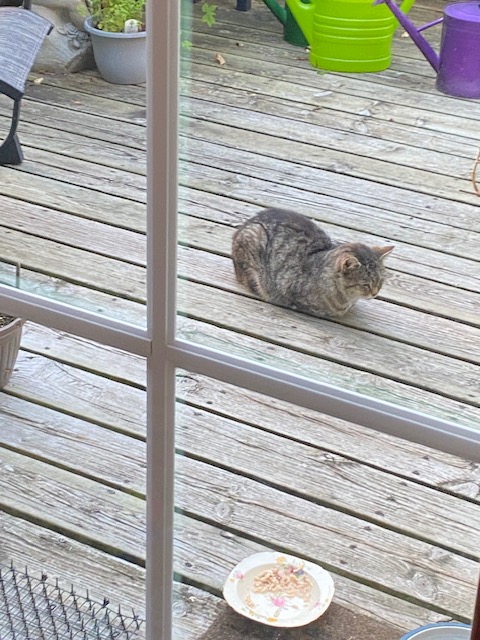
Sambuca aka Sam the feral is still alive, although he’s much smaller. Eryna does her best to get him to eat.
Sam and his breakfast
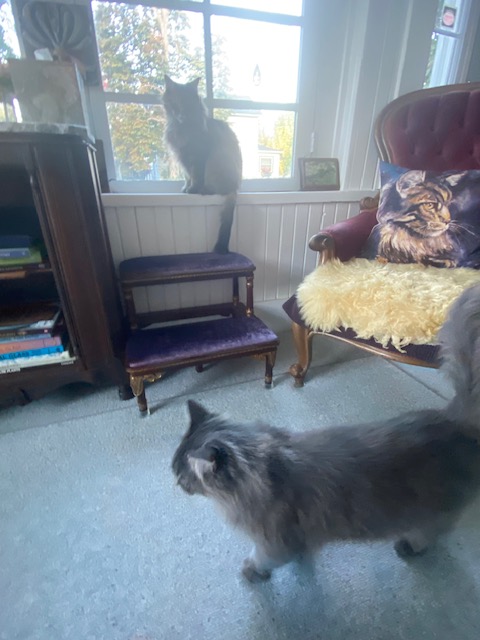
After a few weeks a friend encouraged Eryna to check out a couple of cats who were in need of a new home. Eryna couldn’t resist. The newcomers are both female, Zeerka (which means “star”) and Zenia (which means “flower”).
Live cats plus cat images on the cushions
Zeerka is much friendlier.
Zeerka is much the friendlier of the two
Zenia is kind of shy, apparently because of a troubled history, bullied by an earlier feline housemate.
Furtive Zenia, not yet sure she could trust us
You see more pictures of Zeerka because she’s such a social butterfly, a bit of a whore for someone willing to stroke her: aka me.
I’ve only included a few of the many kitty pictures I took, several while juggling iPhone and feline in my lap.
We went to dinner just a few blocks aways from Eryna’s house down Clairmont Street in Thorold. It’s amazing to be able to walk anywhere you want in this charming little town. We’re grateful to Eryna for showing us the sights.
The menu of Pho18 reflects the creativity of Andy and Jenny Tang. Erika had pad thai, Eryna and I both enjoyed Tom Yum noodle soup, a delicious combination of coconut, broth & noodles. I finished with a mango cheesecake and a brilliant Vietnamese iced coffee, with the added magic of condensed milk. We were welcomed by our server, a charming & helpful fellow named Will. You can see their website including their menu here, or call them at 905-680-8889.
I understand their cuisine to be Vietnamese fusion, assembling the synthesis of different cultures with a confident panache.
Next morning it was time to visit some Thorold businesses.
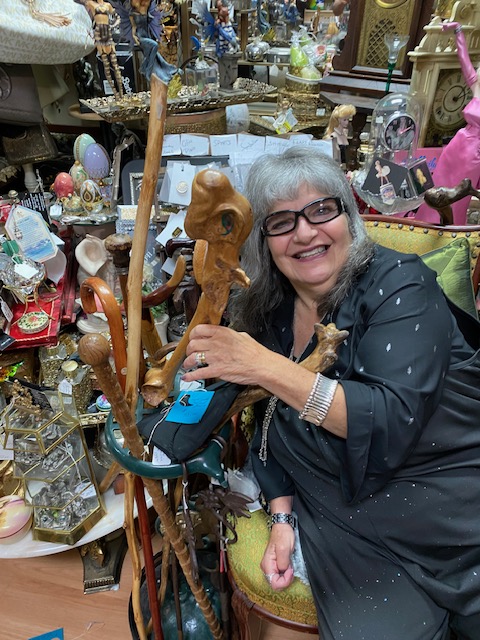
First came Angie O’H Antiques, where I tried out several walking sticks, including the shillelagh Angie herself is brandishing in the photo.
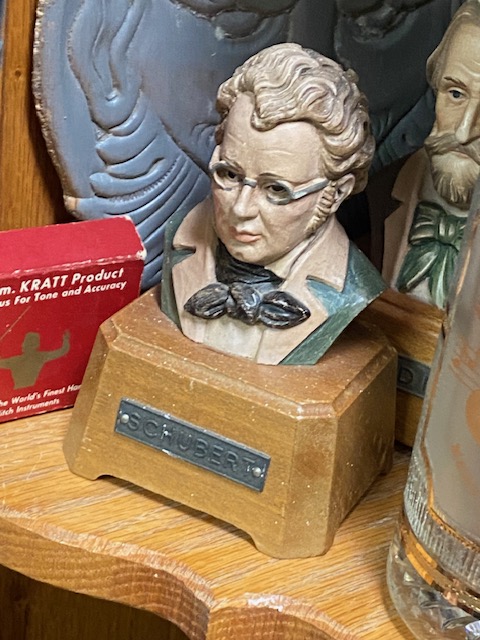
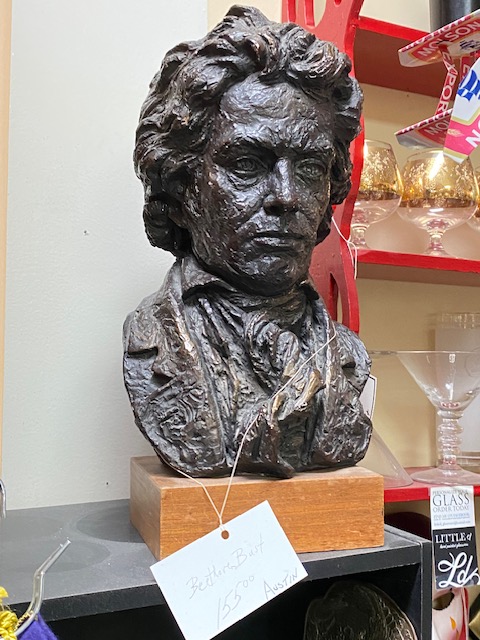
I fell down a black hole for awhile, bemused by model boats, figures of dragons and composers.
There’s so much to see. And Angie is endlessly fascinating.
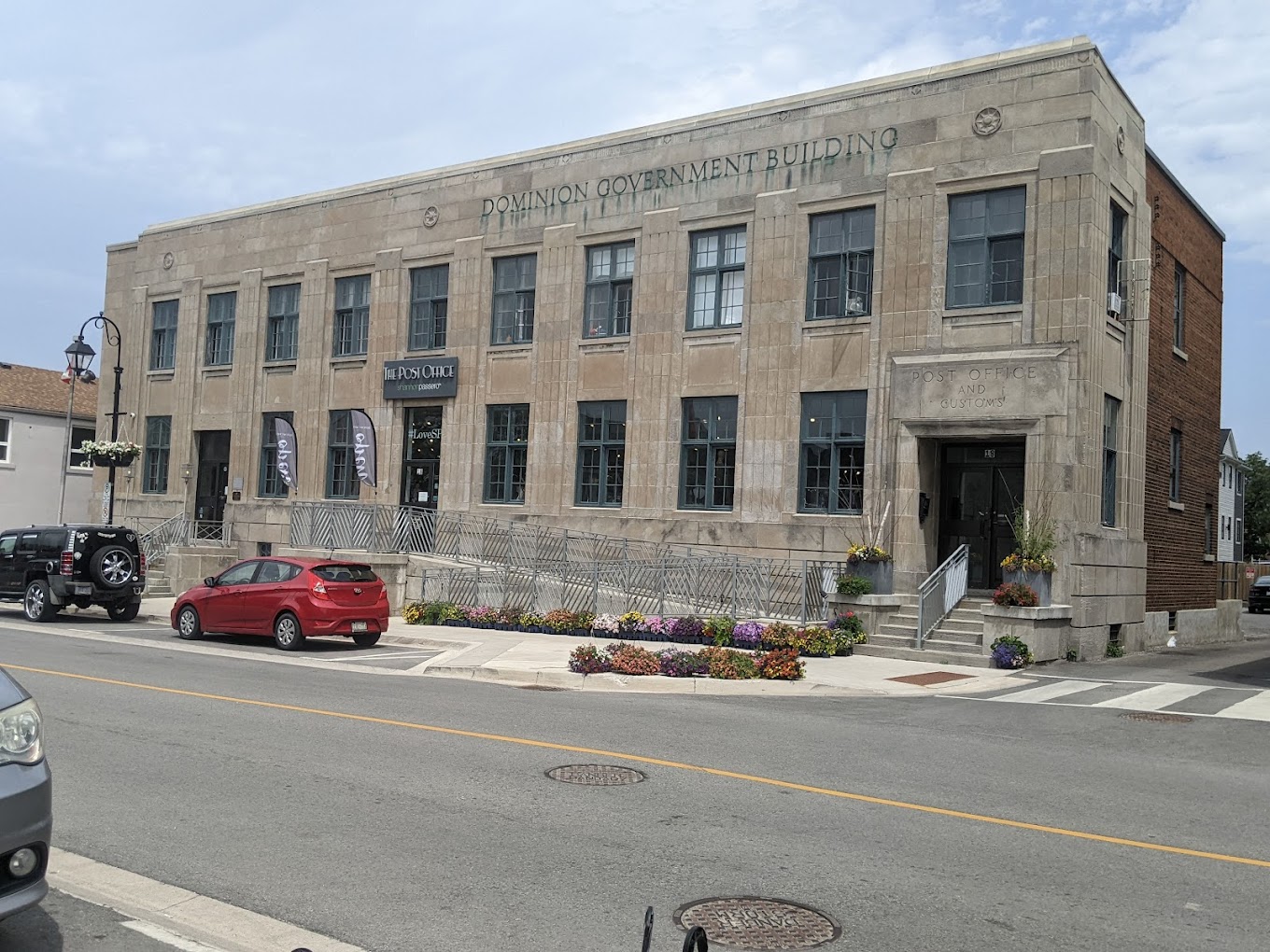
Next came The Post Office, featuring the original creations of Shannon Passero.
The name is logical given that the building seems to be a repurposed post office / government building. But Canada Post never accomplished anything as brilliant as what Shannon is offering. Inside the unpretentious exterior you find a big showroom to dazzle the eye. Eryna bought four items, Erika five, and OMG prices were reasonable, although yes, Erika has always had an eye for a bargain. She found me right? (only one previous owner).
Later as we drove back towards Hamilton (where Erika had an appointment) we were again in Vineland returning to The Watering Can.
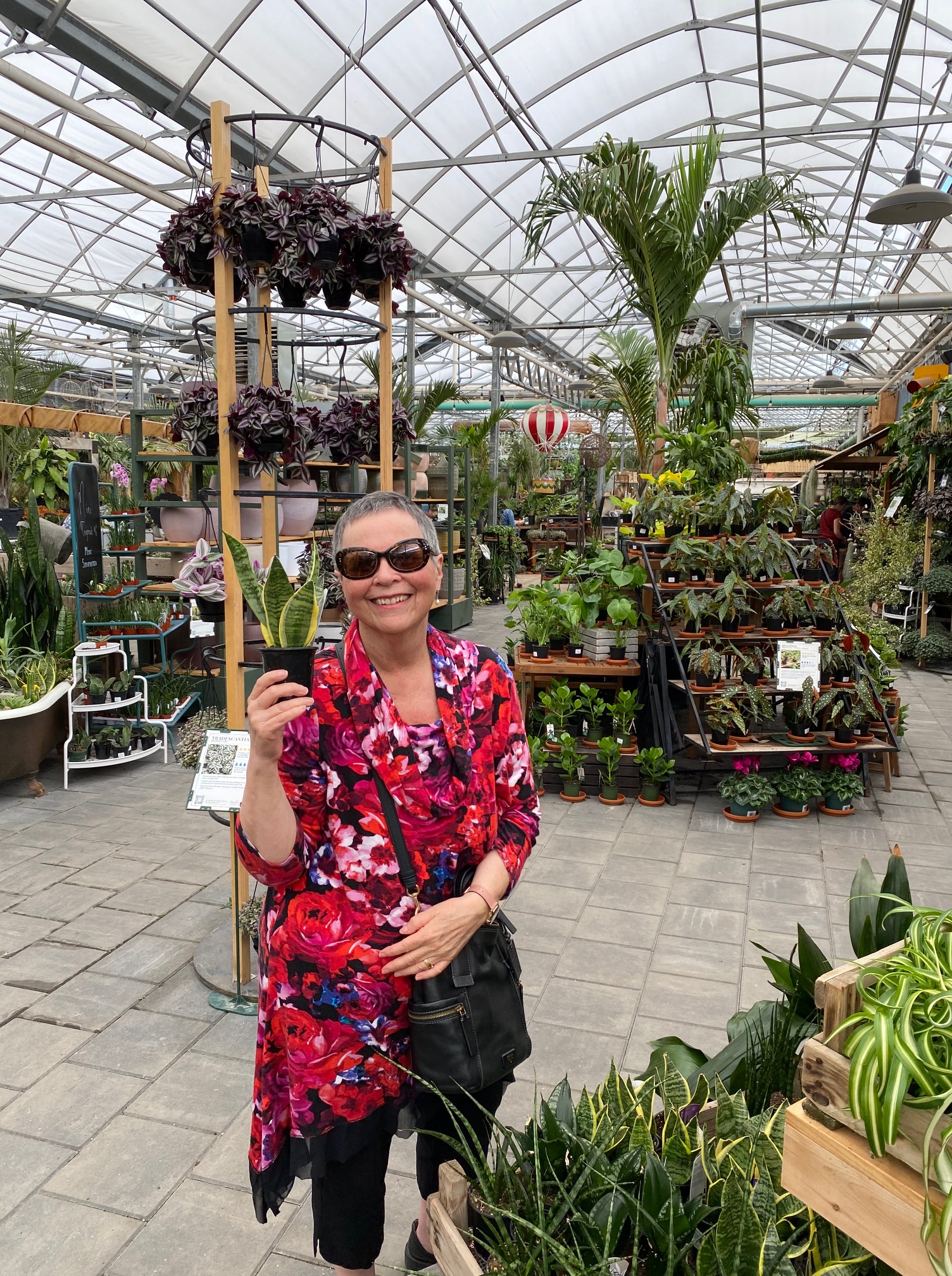
My few pictures can’t really capture the richness, a space that feels so healthy with oxygen, plants surrounding you not as a jungle but a friendly and well-curated museum.
Our errand was more purposeful this time, going directly to the plant Erika had decided upon the previous day, without stopping to eat this time.
Erika holding a much smaller plant than the one we bought.
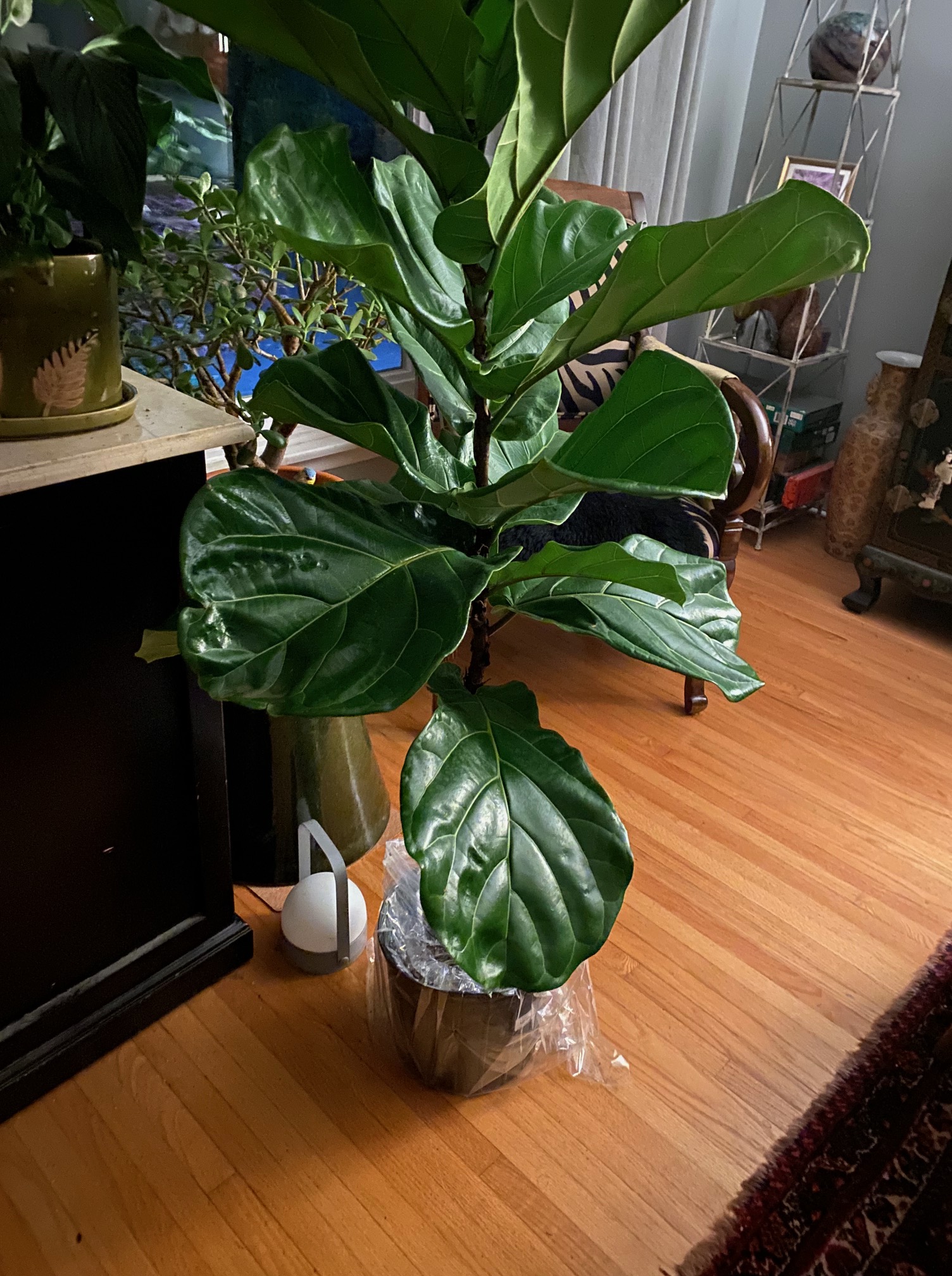
Our new plant only cost us $49.00, even though a GTA store (not naming names) would have charged us four times as much or more. It’s about the same height as Erika which is to say 64 inches.
Figaro can grow. Up to 60 feet tall in their native climate? OMG
The Watering Can isn’t just a plant warehouse but much more. Erika showed me the write-up they share on this plant, known as a Fiddle Leaf Fig (ficus lyrata). Helpful staff showed us information on a page in a big book, that’s also available online.
Erika’s expecting her fig to grow. No wonder she called him Figaro.
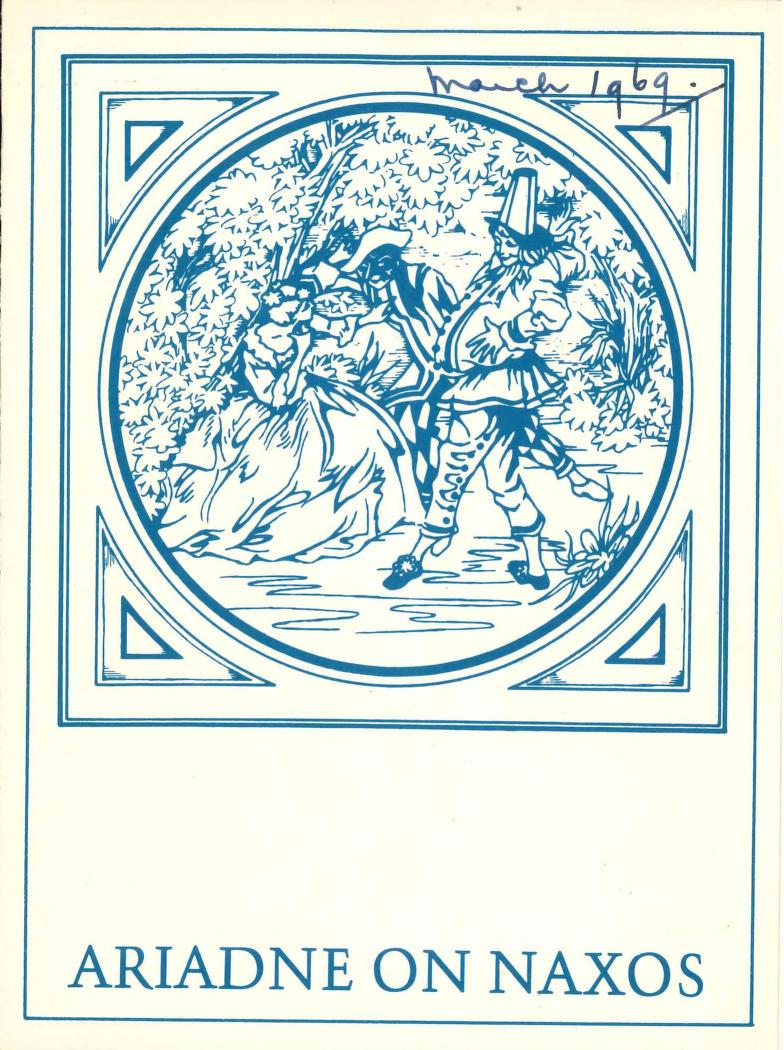
The title of the opera is Ariadne auf Naxos, done as Ariadne on Naxos because it was being sung in English.
That’s how Richard Strauss’s opera was presented back in March 1969 at the Opera School of the University of Toronto.
Through the magic of my library card to the University of Toronto Library I have been able to revisit an experience that dazzled me at 14 years of age, thanks to the kind assistance of Music Archivist Becky Shaw at the Edward Johnson Building. And my brother Peter Barcza helped me identify the people in the pictures. He was just 19 years old, and was the reason I came to see this show.
I am also able to time-travel through a few helpful Facebook friends whose names appear in the program.
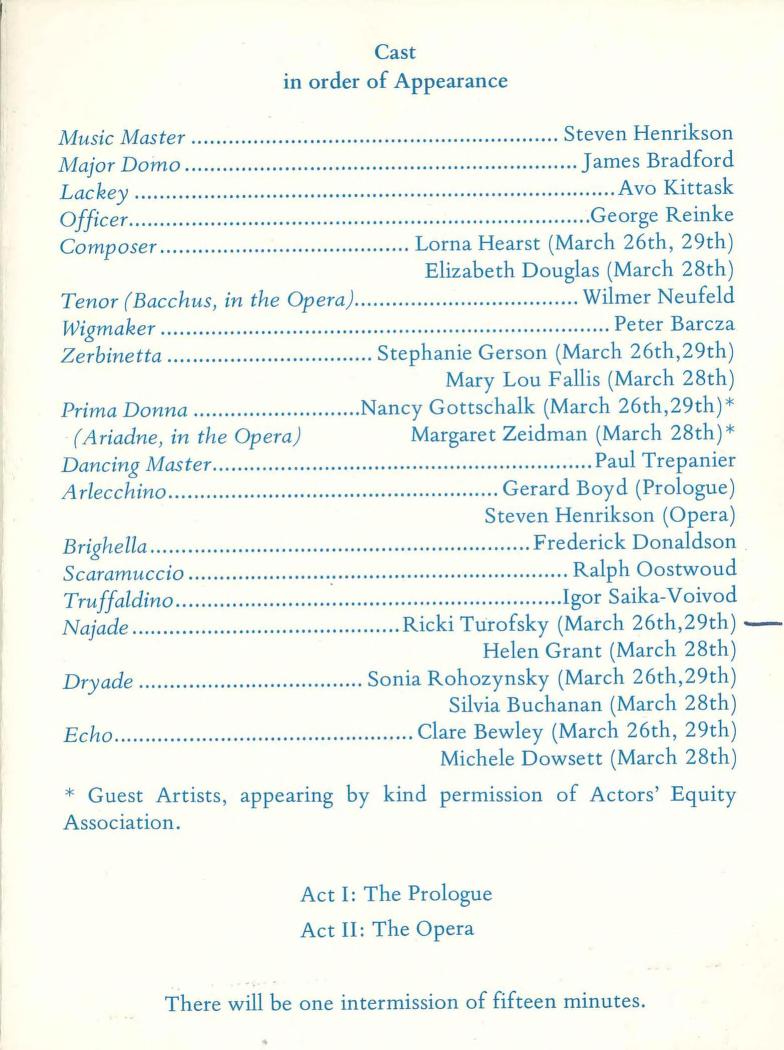
I asked Riki Turofsky (Naiad), Steve Henrickson (Music Master & Arlecchino) and Mary Lou Fallis (Zerbinetta) what they remembered.
First Riki Turofsky..
Barczablog: what do you remember? any memories / anecdotes to share of Hermann Geiger-Torel, Ernesto Barbini, and your fellow cast members.?
RT:I loved that production. Torel [meaning Hermann Geiger-Torel] of course was yelling all sorts of orders from the theatre while we rehearsed. Nancy Gottchalk’s voice was too light for the role but she performed it brilliantly. I was a pretty high coloratura but was really impressed with Mary Lou’s facility with the score. I think I learned to love Strauss after being in that opera.
BB: I was curious about the way your name appears in the program, spelled as “Ricki” not “Riki” as it now appears.
RT: My name spelling changed after a concert in Victoria when a numerologist in the audience suggested the simplification to Riki from Ricki.
Next Steven Henrikson who was both Music Master and Arlecchino.
BB: Any memories / anecdotes to share of Hermann Geiger-Torel, cast members?
SH:Leslie, Wow, a long time ago, indeed. We were such a young, aspiring, talented bunch!
The larger parts were double cast. However, as a Bass-Baritone I was given two roles: Music Master and Arlecchino. The problem of having both characters in Act I was solved by having Gerard Boyd ‘act’ Arlecchino in Act I on my behalf. This was possible as Arlecchino does not sing in Act I!
SH: Further, having to rehearse as two characters and with other parts double cast, I rehearsed most days for 8 hours, sometimes 10, and once for 12 hours! I was indestructible……
Mary Lou was exceptional as Zerbinetta. Our “duet” was well-received and fun.
During the VERY difficult Act Il quintet, featuring all 4 male Commedia characters, Geiger- Torel had us leap-frogging over each other AS WE SANG! All very disciplined- we could not be anything but 100% accurate in acting and singing.
SH: Yes, Daland in Wagner’s Flying Dutchman with Bill Shookoff on College St. November 9. I have been singing, full time, for 67 years!
Finally, my interview with Mary Lou Fallis.
Mary Lou Fallis: I was in my third year university, and it was kind of …amazing(!) to me that they were going to do this production because you know it’s a big opera.
Barczablog: It’s ambitious isn’t it. I don’t think they ever did anything like this, right?
MLF: Well they did L’enfant et les Sortileges.
Soprano Mary Lou Fallis
BB: but that’s a short little thing in comparison.
MLF: it’s short but it still involves a lot of people, cast and a lot of costumes, sets that were absolutely magnificent.
Yes this was ambitious.
BB: You were singing a part that is one of the hardest in all the repertoire: Zerbinetta.
MLF: Yes I had heard it. I was twenty-one when I sang it. I had heard it two years previously. Reri Grist a wonderful coloratura, I heard her do it when she was a guest with the Toronto Symphony. She did a concert performance of it, and I heard it and thought this is so brilliant, this is my dream role.
BB: So you had the high note, right? The high E? I mean not everybody can sing this thing.
MLF: Well that’s just the way my range was. I was just built that way. I had high Fs since I was about 14. My grandmother was my singing teacher, and she never told me how high I was going.
(laughter)
BB: Good plan!
MLF: Anyway I wanted to do it, so I got the score, and I memorized the role. It took me ages and ages to learn it.
BB: You were singing it in English! Does that mean you had to learn it again?
MLF: Yes!
(and i hear a gasp)
Yes I did: but it wasn’t hard to do that. When you’re there at coachings and rehearsals it doesn’t take long. It might have taken longer to do it in German. I had no trouble with that. It was my dream role and I always felt, the roles you usually did in opera school were all the soubrette parts. I was too smart to sing all those sappy roles, or at least that’s what I felt at the time. I was arrogant much more arrogant than I am now.
BB: Isn’t it useful, don’t you have to be arrogant to be a diva? It comes with the territory doesn’t it?
MLF: On some level. I’ve mellowed. I’m very very happy with where I am now. Very happy that I don’t have to cough out a high “C“.
BB: Do you remember Hermann Geiger-Torel?
MLF: Of course! My relationship with Hermann Geiger-Torel goes back to when I was in the precursor of the Canadian Children’s Opera Chorus. I was in two performances, one was Hansel and Gretel, I was one of the gingerbread people, and then I was one of the orphans in Rosenkavalier.
“Papa! Papa!“
And then I was one of the kids in la Boheme. And I remember my very first time onstage, I guess I must have been about twelve, and I was in the chorus, Parpignol and that whole Act II start with you know Cafe Momus?
BB (singing the intro to the act) “Ta-ta-ta-…(etc)”
MLF: (singing the chorus part) “Ah...!”
Anyway that was me and I had a part in the chorus and what I remember, I knew my part. But I’d never been onstage in a big theatre like that. So when it started I was absolutely boondoggled and amazed. So I remember standing in the middle of the stage and not moving. There were things I was supposed to do: but I just stood in the middle of the stage, with my mouth open, because I was just so overwhelmed by the whole thing.
And so Geiger-Torel stopped the rehearsal, and said “Little girl! Do you know what you’re doing“.
And I was soooooo embarrassed.
But he kind of took an interest in me, when I was a little kid. And when I was 18 he had me understudy the doll in Tales of Hoffmann, early on in the COC. So I was very young. He was always very interested in me. I liked him a lot, I respected him. I thought he knew a lot about theatre. I think he felt a little badly, being in what he would consider kind of a backwater, at that point. It really was. He was starting an opera company in Toronto, when the Metropolitan Opera in New York had twenty-five times the budget.
BB: And a different audience.
MLF: Absolutely. I can remember going to operas with my grandmother when I was fifteen at the Royal Alex. But that’s beside the point.
What I remember about this production is that it was double-cast, which I didn’t enjoy very much.
BB I saw your cast by the way.
MLF: Did you? I think it was one of the most fun things that I ever did. And I think my voice did develop much more after that. It was a high point for me. And I went on to do the role in Stratford. And I went on to do it in Buffalo. And they did performances at the Shaw Festival believe it or not.
BB You’re the only person in that production–I’m willing to bet– who got to do their role again.
MLF: Do you have the program in front of you?
BB I do, I can share a list of the names.
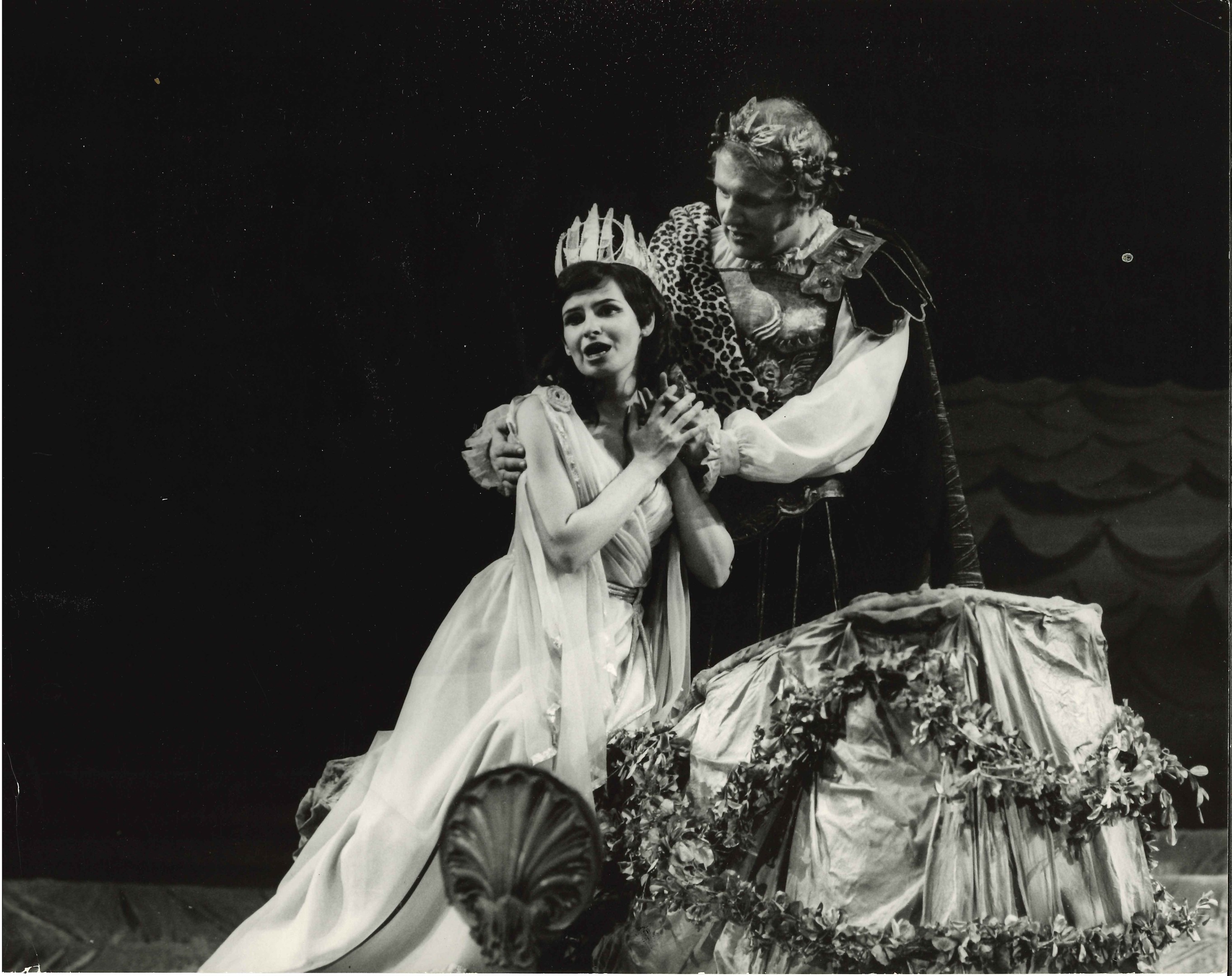
Margaret Zeidman (Ariadne) and Wilmer Neufeld (Bacchus) (photo: Copyright Ludvik Dittrich)
BB: Wilmer Neufeld (Bacchus)…
MLF: He went on to have a big career, singing in Glyndebourne, quite a career in Europe.
BB Margaret Zeidman was in your cast, while Nancy Gottschalk was the other Prima Donna / Ariadne.
MLF: Was she really!? I remember Nancy.
I was just thinking of the four guys. My cast was Roelof Oostwoud, who was a professor, he had done a mathematics degree and he had kind of a rough tenor, but he loved singing and went on to have a career in Europe. He was Dutch so I think he went over to The Netherlands, sang for quite a long time in Europe. Was Gerard Boyd in that?
BB Yes, he was the spoken Arlecchino in the prologue, while Steve was the Arlecchino in the opera, because his part had to be split apart.
MLF: Gerrard did a lot of character roles, he went on to have a career with that sort of part.
BB So the four guys (as listed in the program) were Ralph Oostwoud, Igor Saika-Voivod, Frederick Donaldson and Steven Henrikson.
MLF: I was going to say I didn’t know what happened to Fred Donaldson. Did he go to Europe too?
BB I don’t know.
MLF: And Igor did some stuff with the Canadian Opera Company. He had a very deep voice. And then he moved to London Ontario where he taught voice for many many years. When I taught at Western he sent me many students.
BB Did you stay in touch with Margaret Zeidman? She was your Ariadne.
MLF: Yes. I thought Margaret was pretty good. Who was the other Ariadne?
BB Nancy Gottschalk. I never saw her sing it.
MLF: Margaret had that sort of sadness, coolness.
BB The composer was Lorna Hearst or Elizabeth Douglas.
MLF: Elizabeth Douglas was my composer. She was from Kitchener I think. She went on to teach singing in Kitchener locally. I seem to remember that she was older than a lot of us.
BB: I guess there were others who were older. Wasn’t Wilmer Neufeld older? like a mature singer.
MLF: Oh yes quite a lot older. He was like 35 or something.
BB OMG I remember when 35 seemed old. I was 14 at the time, of course.
MLF: So there was Miss Turofsky, one of the three naiads. There was a woman from Australia named Helen (?).
BB: [reading from the program] Helen Grant.
MLF: Yes she had a lovely voice. And Clare Bewley was Echo.
BB: Michele Dowsett was the other Echo. So there was one cast with two performances (March 26th and 29th) and your cast had the single performance on the 28th.
MLF: I only had the one performance because they were worried, as I was so young. And the other woman: have we heard anything of her?
BB: I don’t know.
MLF:She married a dentist and I remember her having a party after her production.
BB Maybe she lived happily ever after.
Do you have any memories of Ernesto Barbini, who conducted..?
MLF: I have wonderful memories of Barbini. I don’t think Strauss was really his thing. He was very Italian. I was there when Teresa Stratas did Mimi, when she was the understudy. What I mean is, I think he did okay but the Germanic style wasn’t his thing. I mean when you’re conducting a student orchestra, it’s difficult. You have to take what you’ve got. But they had some very good people there, including my darling husband. Peter was in the Toronto Symphony for 35 years. He was Principal Bass, for Ariadne.
BB: Small world!
MLF: We were married at the end of fourth year. We had started courting, let’s put it that way.
BB: So Zerbinetta wasn’t really interested in Bacchus or Arlecchino, she had her eyes on somebody in the orchestra pit… (or a dentist)
MLF: Yes I was more interested in the bass player. But I guess Barbini did very well. We all benefited from his professionalism, his professional standards. I think Torel, looking back on it, he was very good. Both of them were what we would now call “old school”. Torel wasn’t into modern acting.
BB: I wanted to ask you about something Steve Henrikson said. He said Torel had the four men leap-frogging over each other, very physical. I wonder if you were tangled up in all those bodies.
MLF: I don’t think I had to do that.
BB Were they all around you while they were doing that
MLF: Yes, i remember one of them had a bit of a crush on me. I had a pink sweater and he said I was just so cute!
BB I guess the show wasn’t supposed to be an invitation to sexual harassment.
MLF: In those days nobody talked about it. You were just supposed to laugh it off, rather than “Don’t touch me!” But I loved doing that part. You have to have the chops and you have to be a musician to be able to do it.
And then I actually sang it on the stage of the Met, because I was in the semifinals of the Met Auditions. I used that as an audition piece. It was so good to be able to sing it at U of T, and Shaw and Buffalo and at Stratford and all those years later at the Met.
*******
1969 Ariadne on Naxos Images: courtesy University of Toronto Music Library. University of Toronto Opera Division fonds, OTUFM 84-B-1, with thanks to Becky Shaw the archivist at the EJB Library.
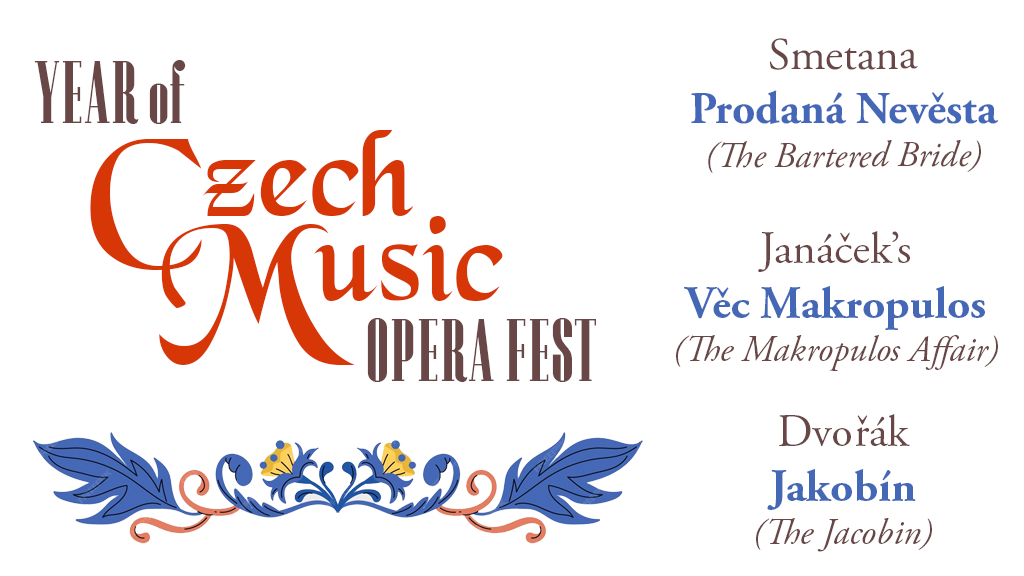
The Canadian Institute for Czech Music (CICM) and Opera by Request (OBR) collaborated to present Antonín Dvořák’s opera Jacobin in a concert performance with orchestra at Jeanne Lamon Hall Friday September 13th.
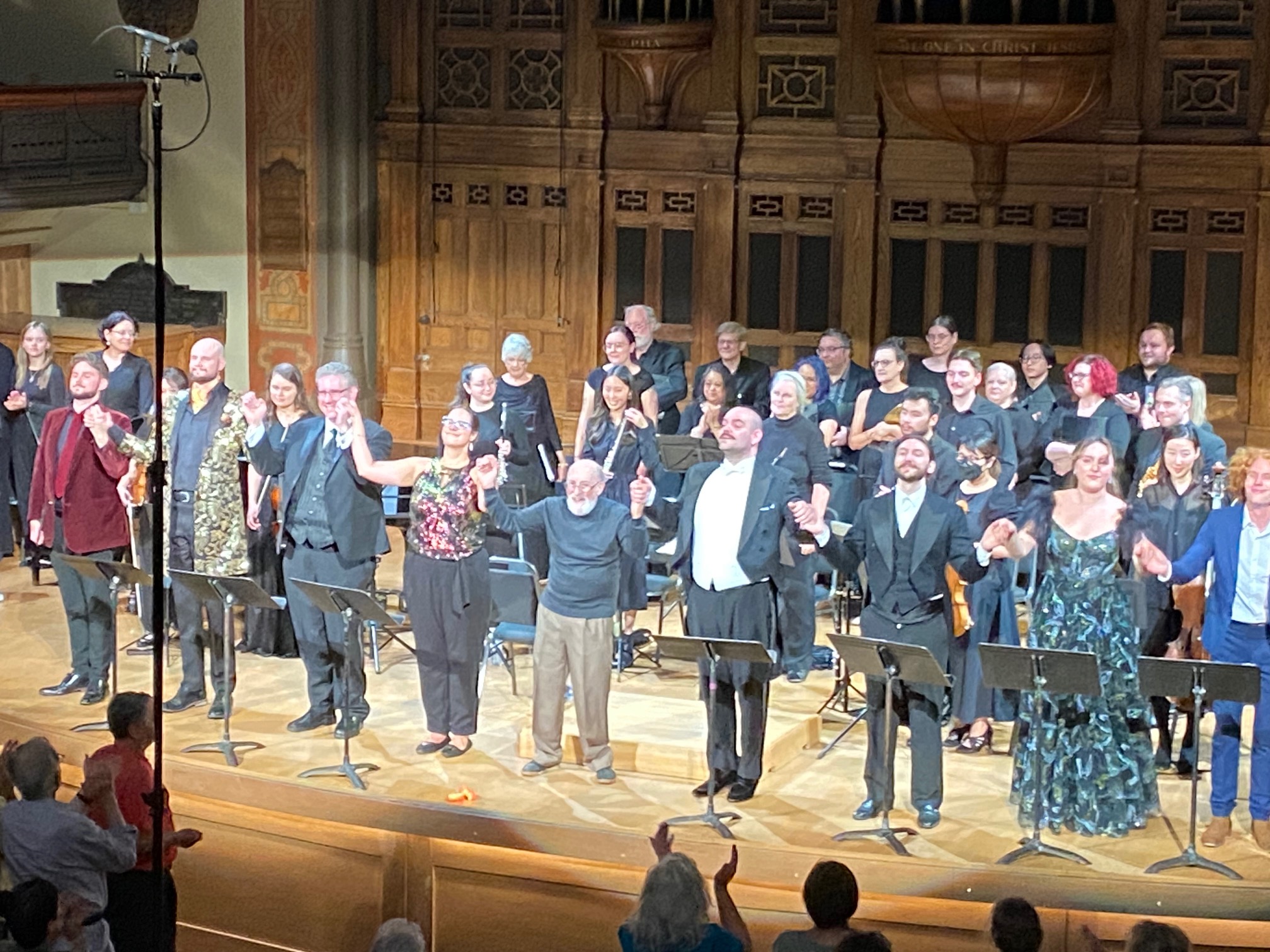
Produced by Professor John Holland of CICM, conducted by Bill Shookhoff of OBR, it was a labour of love as part of the Year of Czech Music (an international event celebrated in every year that ends in a “4”). CICM and OBR have offered a festival of three operas culminating with Jacobin.
I know Bill must have been working hard to get the orchestra to play so well in a score that’s new to everyone. Bill walked with a painful limp, worrying me because he’s irreplaceable. I hope he’s okay although he seemed to conduct with energy and verve. I suspect that Bill seemed tired having worked around the clock to ensure that Jacobin was properly prepared for the singers chorus and orchestra.
Opera By Request artistic director William Shookhoff
Let me repeat, the orchestra sounded wonderful. I want to mention them by name.
Natalie Wong ———-Violin I Amma Protasova——Vioin II Fanny Tang————-Viola Hyemee Yang———-Cello Jamie Zhang————Flute 1 Katie Kirkpatrick——Flute II Le Lu——————–Clarinet Hazel Boyle————Oboe Paolo Rosselli———-French Horn Todd Holland———-Trumpet Aaron James———–Organ Narmina Afandiyeva–Piano
There are several solos for the winds, who played boldly and with an idiomatic sound. Shookhoff also kept the chorus tightly together, as well as a children’s chorus directed by Erin Armstrong.
I don’t know Czech but observed that the singers sounded right to my ear, their accents well coached by whoever was responsible for coaching their delivery of the libretto, perhaps John Holland.
Count Vilem of Harasov — Dylan Wright Bohul, his son ————– Michael Robert-Broder Julie, Bohul’s wife ——— Cristina Pisani Benda schoolmaster ——- Alexander Cappellazzo Terinka, his daughter——- Grace Quinsey Jiri, a young gamekeeper– David Walsh Filip, Burgrave ————- John Holland Adolf the Count’s nephew- Alasdair Campbell Lotinka, keeper of keys—- Erin Armstrong
I was reminded of Fidelio, another opera containing a rescue and political themes plus a romantic story. Unlike Beethoven’s opera, this work seems much more firmly in the comic realm, while the political content is minimal even though the title might lead you to expect more. I wonder if that genre question might be one reason why this tuneful piece hasn’t yet caught on around the world. We watched the opera presented in concert, singers in formal attire portraying their part from a music stand. Perhaps next time CICM will give us something staged with costumes and sets.
Dvořák’s score is full of melody but more difficult than one might expect due to his tendency to modulate. I came out of Jeanne Lamon Hall humming the tunes that were humming in my head. The audience gave the cast and participants a strong ovation in appreciation for their hard work and their committed performances.
L to R: Alasdair Campbell, Dylan Wright, John Holland, Cristina Pisani, Bill Shookhoff, Michael Robert-Broder, Alexander Cappellazzo, Grace Quinsey, David Walsh
My headline is not just a nod to “Sticks Nix Hick Pix”.
There truly was no ham to see in the gala World Premiere of William Tell, unless we include the man who wrote and directed, namely Nick Hamm speaking to us in the talkback afterwards.
Writer and Director Nick Hamm
I didn’t know what to expect, even if I had Rossini’s over-played overture to his rarely performed opera in the back of my mind. I came in thinking William Tell was a known freedom fighter, a famous archer, and oh yes, he was Swiss.
Hamm crafted something remarkable, steering his script and his cast clear of the excesses one might expect in a dark violent story. While we might demand passionate responses to such a story the acting was amazingly restrained.
No ham in other words.
My headline is not just for fun. Hamm prevents his actors from overdoing it two ways. He wrote a script requiring restraint, and then he actually followed through, enforcing that upon his actors. One regularly sees actors improvise which might make for better performances, improving a script, until they veer into a language that’s from a 21st century idiom rather than the 14th. The director has to be firm given that nowadays actors normally improvise.
Of course the film is in English, not one of the languages from the actual story, so it’s a matter of simulation, a way of foregrounding historicity. You create a kind of illusion that you’re in the 14th century through art direction, costuming, set, and a choice of words to suggest the story in its time. One desperately wants to avoid being reminded that we’re watching a young person from our own time improvise in front of a camera.
William Tell (Claes Bang) famous marksman and reluctant freedom fighter
Ben Kingsley and Jonathan Pryce restrain themselves. Claes Bang as William Tell is especially restrained. I am especially mindful of this restraint having seen Rosmersholm at Crow’s Theatre, where Chris Abraham seemed to create the world of the play through the repressed behaviour of most of the cast. Or maybe I was sensitive to it having seen William Tell the night before, thinking that the careful control of Hamm over his cast is a kind of magic trick to keep modernisms at bay.
The original sources including Friedrich Schiller’s 1804 play and earlier legends from the 15th century that I’ve looked up since seeing the film allow Hamm space to insert his own spin on a story that is for all intents and purposes unknown.
We see stunning scenery that as Hamm joked in the talk-back, might remind you of The Sound of Music.
We see more women taking up arms than I have seen in any film, something I enjoyed whether or not it’s in any way accurate. I suspect it’s a genuine possibility when a small community is under attack.
We see that Tell brought back a wife from his crusade in the Holy Land, fathering a son who appears a bit different from the others in his Swiss town. I can’t help seeing a bit of resonance to modern events in that famous moment we all know. It’s set up by details we won’t know of course, as the Austrian bailiff who posted his hat in the town square, demanding a bow of loyal obeisance from everyone. When Tell and his son refuse to bow, soldiers grab Tell’s son. Having heard of the father’s marksmanship the bailiff has the idea of demanding that the father shoot an apple off his son’s head at 20 paces, perhaps 100 feet away. There’s a visible racial marker in Hamm’s film complete with an insulting slur against the boy. I think I heard someone call him a mongrel. The actors portraying the Swiss characters show astonishing restraint in this scene, their emotions building very slowly, inexorably. So while Hamm said in the talkback he was trying to dodge anachronism, that indeed he hates anachronism in film, it was troubling to see something that felt so modern, namely the fascistic overtones to the scene, including soldiers seeming to mock someone as though for their race. But then again maybe that was accurate? Who knows. It made the scene that much more powerful.
As I watched I was mindful of what I knew about the Middle Ages. Agency in a society like this is relatively new, individualism would not be articulated for a long time, as people obeyed their church and their kings. We think of films set in the future especially science fiction as having to perform futurism, assembling mores and fashions and manners to help actors flesh out the future world they inhabit. But the same thing should be just as true for a film with historicity, foregrounding another time remote from our own. I think it’s rarely done this well, as we may think of actors slipping modern phrases and accents into their dialogue, for instance “yonder is de castle of my fodder,” from an American actor. Hamm has done a great job of keeping his actors firmly on track with the script and the world they inhabit.
The orchestral score is from Oscar winner Steven Price, composer of the music to Gravity (2013) for which he won the Oscar, Suicide Squad (2016) and Fury (2014). I don’t know his work. For this project Price seems to have been asked to subtly underline the action, so that when something momentous happens such as a storm or an attack, the music gets louder to underline that excitement. I suppose we’d call that a traditional approach to scoring even though I heard nothing especially artistic: but maybe that’s because Price was working from the same template as the actors, aiming for understatement rather than overdoing it.
I want to see this film again. I found it sometimes very violent in its depiction of combat, but then again that’s only reasonable. If you’re easily triggered you’ll avoid a film featuring battles and hand-to-hand struggles with swords and crossbows. Yet the film is handsome and a worthwhile treatment of its materials.













 barczablog