Sympathy for the Bedevilled

It’s an odd week.  Since seeing the COC production of Dialogues des Carmelites I have the “Salve Regina” in my head, particularly the last two pages of the score, where Blanche appears.  I also hear the complementary sonorities of Ravel’s Le gibet, whose content is decidedly at odds with the sublimity of the staging I just alluded to.   Was Poulenc at all mindful of Ravel’s huge extended chords, connoting a lyrical image of death, in his own meditation upon mortality & our entry into the afterlife?  If so it’s as though he redeemed something dark and scary.   There are other compositions i could add to the list, but i chose two that are wildly divergent that still have some overlap, in order to problematize the whole question of aesthetic judgment.  Until i heard what Ravel’s piece was “about” (meaning the program associated with that lovely music: read the poems for Gaspard de la nuit here), i loved the piece without reservation.  And after a period of disturbance –not quite revulsion, but a break in the my rapturous admiration for this piece–i am back to loving the Ravel.

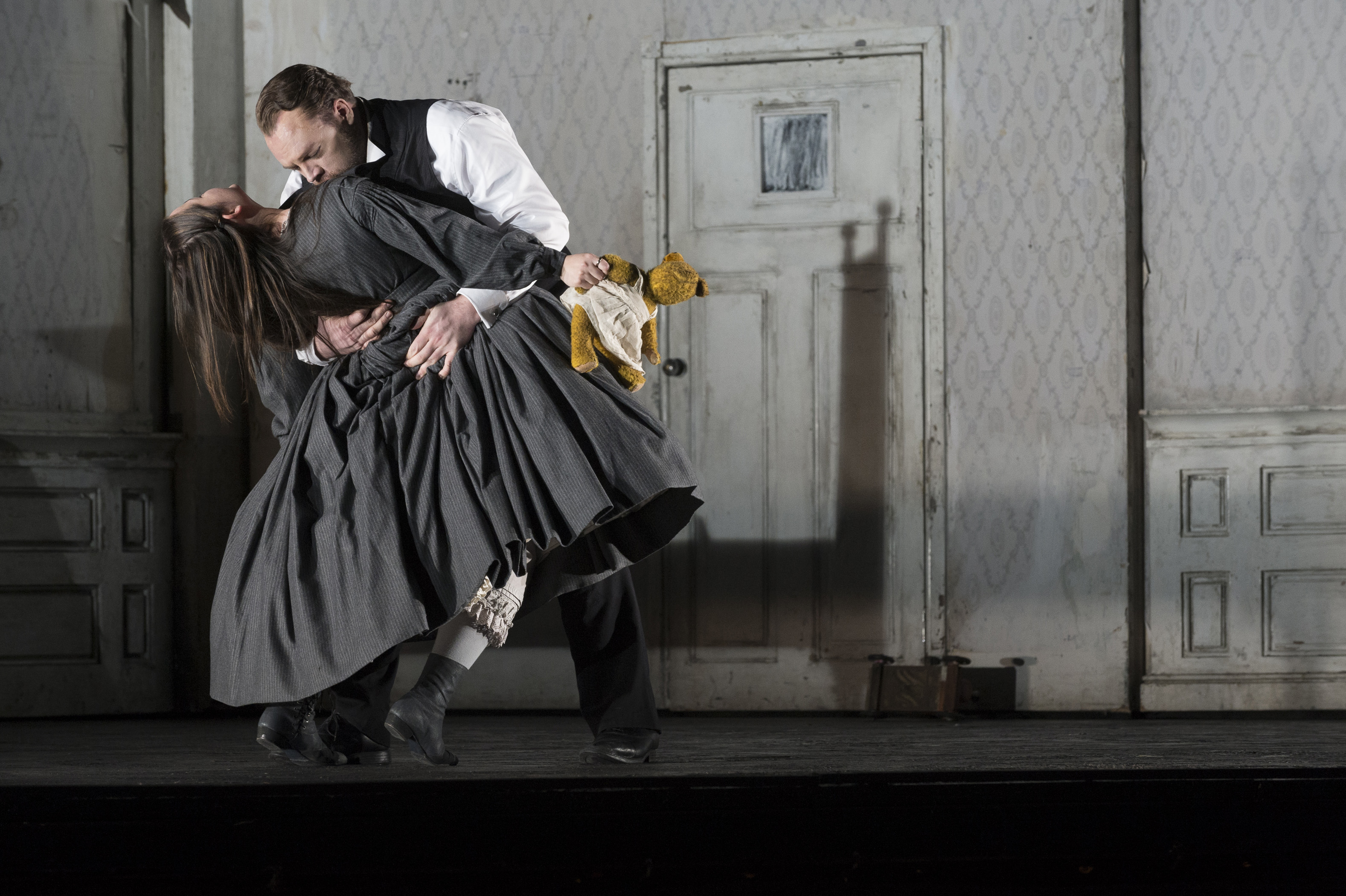
Isabel Bayrakdarian as Blanche de la Force in the Canadian Opera Company’s production of Dialogues des Carmélites, 2013. (Photo: Chris Hutcheson)

Which makes me wonder about the relationship of these two compositions to systems of morality (I almost typed the word with an extra T: “mortality”).  Hm, perhaps that’s a slippery concept from the same realm of relative values as artistic interpretations, in other words, so ambiguous as to be impossible to pin down definitively.  But what I am getting at is that we attribute meaning, that there’s no such thing as a meaning that exists anywhere without the assistance of the eye of the beholder attributing meaning to what they see; this is true whether we’re speaking of aesthetics (beauty or something else) or morality (good or something else).  If that’s so –and I feel very strongly that it is—then the similarity between the two compositions is rather intriguing.  Is there perhaps a macabre and nasty subtext to the Poulenc? Or is there something quasi divine lurking in the Ravel? Yes and yes I believe.

I put that out there, as I look at several tormented figures in the public eye.  I am wondering if the discernment of that eye is any different from the way we read and re-read metaphors in opera.  Some of us want to believe accusations made against political figures we dislike, and indeed are so eager that we believe before we have any proof.  Some are cynical, unready to accept anything without hard evidence.  I sometimes find myself contemplating one or the other: that is, the artistic taste of various political parties, or (to flip it around), the political tendencies of the followers of certain performing arts genres.  I know I know, it’s silly, nothing is monolithic, nothing can be reduced to that degree.  Indeed, life is polyvalent and multi-faceted, a tendency that’s only troubling to those who want neat and tidy categories.

I find myself empathizing with those currently accused of substance abuse for the simple reason that I happen to know a couple of people who have over-indulged over the years, sad drinkers & pain-killer abusers.  My drug of choice these days?  WordPress, as I seem to be addicted to the sound of my own voice on this blog.  Prose composition got me through the darkness of February –with a lot of help from the Ryerson theatre school & Feydeau—so I’m not about to judge.  I point to the similarities between so many different indulgences, some that we call addictive (alcohol, drugs, sex), some that we have not yet identified that way (the internet, work) in the same spirit as the similarity between the two compositions.  Perhaps our categories are false, our distinctions just theological posture or nerdy nattering.

When in doubt, take the compassionate path.

Posted in Music and musicology, Opera, Personal ruminations & essays | Leave a comment

Carsen Dialogues

Director Robert Carsen

I like to read a director’s notes before seeing a show, because they often contain clues about what you’re going to see. Robert Carsen’s take on Dialogues des Carmelites is a case in point. The production has been mounted all over the world, first in the Netherlands in 1997, including such major companies as Chicago Lyric Opera and La Scala in Milan (who produced a DVD that I reviewed a few weeks ago). But I didn’t really understand it quite so clearly until I saw Carsen’s notes before tonight’s performance (the second last of the production’s run) at the Canadian Opera Company in Toronto.

I’m seeing it late mostly because that’s the hand I was dealt by my subscription, but also because I felt this production & this opera don’t need any help from me. I assumed it would do well at the box office and likely would have great word of mouth.

In the program Carsen explained that “dialogue is at the centre of the dramaturgical material”.  And so each scene is really about the relationship of the principals singing onstage, literally a dialogue. We may watch a pair of characters seek or avoid eye contact. At times the chorus present the gradually impinging reality of the French revolution upon the various milieux we encounter, whether aristocratic or not. At one point Blanche (Isabel Bayrakdarian) and her brother (Frédéric Antoun) engage in a heart-rending dialogue through a curtain of nuns, the screening effect of those bodies representing the cloister to which Blanche has moved.

I understood the religious aspect of this opera in an entirely new way tonight, possibly getting something with Carsen’s help that had eluded me before. Poulenc’s opera is studded with little religious set pieces, such as an Ave Verum Corpus, an Ave Maria, and the Salve regina that ends the work. When people talk about religion we hear about extremes, either abuses or ideals: but in reality? It’s a challenging enterprise that we do while our kids are getting sick, our marriages are breaking up, our countries going to war, or into depression, family members are dying or we are sick. It’s the backdrop against which the rest of our lives (some of us anyway) unfold from beginning to end, a possible source of comfort, but ultimately, something we notice in passing, while all those big things (marriage, parenting, sickness, war, death) happen anyway. We are told that religion is heroic, and that’s very much what we see, not just in the trip to the scaffold at the end of the opera; every step is a challenge.  This was especially powerful in Michael Colvin’s wonderful scene giving mass as Chaplain, singing gently but fully supported & wonderfully articulate in his scene.

There were many other wonderful moments. I’m a fan of Adrianne Pieczonka, and was fascinated by her approach to Madame Lidoine. At times I thought she was holding back because she has so much voice to give, and of course in the last act she cut loose with that wonderful warm timbre she generates, a combination of fullness with agility that other singers can only envy. Judith Forst’s charismatic Madame de Croissy was so vivid I forgot I was watching a performance, spellbound. Can I mention everyone? I’d like to cite Hélène Guilmette’s Sister Constance, who surpassed the usual cuteness of the part in a portrayal of genuine warmth & illuminated by something i’ll call inspiration, and Cameron McPhail, the most impressive voice of any of the men in his brief appearance.

As usual the COC Chorus were like another virtuoso singing actor on the stage, and indispensable to Carsen’s conception.

The last performance is Saturday May 25th at the Four Seasons Centre.

Posted in Music and musicology, Opera, Reviews, Spirituality & Religion | Leave a comment

Wagner and the animals

Don’t mistake me for an apologist for  Richard Wagner.  I am merely seeking balance.

It’s the birthday of Wagner: the composer, the dramaturg, the musician, the pamphleteer, the communist, the racist… Yes, all of those and more.

Was he also perhaps suffering from Asperger’s?  I say that purely from a kind of intuition.  I know two things about Wagner with certainty, leading me to this additional speculation:

  1. Wagner spent a big part of his life in exile, running from the law,  creditors….  That doesn’t mean he was naturally estranged from humanity, but it also suggests he was happy living on the edge, outside of the mainstream.
  2. Wagner had a special love for animals.  I’d go so far as to say that whenever he writes a scene involving an animal, the music is usually among the high-points of that opera.  If i didn’t know better i’d say Wagner likes animals more than people.

Maybe it’s all wrong.  But I’m putting it out there in context with the hate-fest that is the normal day-t0-day discourse about Richard Wagner, a man reviled for his anti-semitism.  Liking his music is almost something to apologize for.  Would it change our outlook if we were to discover that RW were pathologically estranged from people, that he has an excuse, owing to a disability?  Perhaps.

So on his Bicentennial, I am posting a series of examples of Wagner’s extraordinary love for the creatures in the natural world.  Here’s a quick list of moments that I turn to, in order of their composition:

  • Lohengrin: a swan pulls a boat carrying the knight of the grail, both upon his first and last appearances 
  • Das Rheingold: as Alberich shows off for his guests he turns himself into first a dragon, and then a toad
  • Die Walküre: the immortals come with immortal live-stock (Wotan and the Valkyries on flying horses, Fricka in a cart pulled by a ram).
  • Siegfried: a bear appears in the first few minutes, birds (one of whom talks) in later acts, and we hear tell of other creatures from the hero.
  • Die Götterdämmerung: Brünnhilde’s immortal horse became mortal when his mistress became mortal (in the previous opera).  At the end of this one she sings first to her father’s ravens (announcing the end of things), then directly to the horse moments before she mounts him and rides into Siegfried’s pyre.
  • Parsifal: a swan is again at the centre of things, shot by the hero upon his first appearance, and the first in a series of lessons in compassion.    

The most noteworthy example i know of is not operatic.  Wagner wrote a story during his first visit to Paris.  While it’s fiction, i can’t help feeling his identification at a time when he was himself impoverished.  The person in this story that seems to be Wagner’s alter-ego seems to have a sense of connection to animals, and leaves me feeling a little uncomfortable.  Do animals prefer some people over others?  It’s an odd question, and a nice counterpart to the one i put to you: does Wagner like animals better than people?

I can’t help thinking that Wagner seems happier with animals than humans.  His tales and his music rarely venture into places or situations that resemble normal life.  It’s all reified philosophy & passion, and doesn’t feel very real to me.

If only his pets could talk.

Posted in Animals, domestic & wild, Personal ruminations & essays | Tagged , , | Leave a comment

Wagnerian Bicentennial

We’ve come to the first of the three important opera composer birthdays in 2013.

  • May 22:  Richard Wagner’s bicentennial
  • October 10:  Giuseppe Verdi’s bicentennial
  • November 22: Benjamin Britten’s centennial

You may prefer Britten’s operas. You may point to the box office advantage Verdi holds with operas such as La traviata, Rigoletto and Il trovatore.  However much some may portray him as a hateful anti-semite –and it’s hard to avoid coming to that conclusion when you look at his behaviour & his writings—RW is the most influential of the three.

You only need look at the adjectives from their names. I’m not even sure what they are for either Britten or Verdi, and for that matter what they signify: love of the composer’s works or something pertaining to their operas?

And then there’s “Wagnerian”.

It’s not just an epithet to suggest grandeur or sheer size. But consider. The adjective is so strong it dwarfs its subject.  If i speak of my Wagnerian appetite, or a Wagnerian carbunkle on my nose, i am already surrounded by a swirling crescendo of associations as surely as if i had an orchestral entourage.

Yet this is the most superficial use of the adjective.

The fact I am bothering with this subject suggests a nerdy interest that brands me as a “Wagnerian”. Is there an equivalent word for an admirer of Verdi or Britten? No.  Verdian is only barely recognizable to identify a vocal Fach; and there’s nothing comparable for Britten as far as I know.

But there are other aspects to Wagner’s influence that aren’t properly acknowledged.

  • When your play or concert begins, the lights dim. That began with Wagner
  • The idea that actors and designers and directors and text should all work together may seem obvious, but it began with Wagner, who even coined a word for it, namely Gesamtkunstwerk, or “total art”.
  • It’s such a simple but all-pervasive idea that you may not notice that it’s how most films work, how everything from video games, aircraft instrumentation, to software installation and museum exhibits also work.
  • In passing we might mention that RW was one of the first (if not the first) modern conductors. How we hear symphonies and operas –and how we experience those works performed–bears his influence
  • Dialogues des Carmélites Dale Travis as Marquis de la Force and Isabel Bayrakdarian as Blanche de la Force in the Lyric Opera of Chicago production. Photo Credit: Robert Kusel © 2007

    Dialogues des Carmélites
    Dale Travis as Marquis de la Force and Isabel Bayrakdarian as Blanche de la Force in the Lyric Opera of Chicago production.
    Photo Credit: Robert Kusel © 2007

    In passing we can also mention that RW claimed that opera had it backwards: it was meant to use music to serve a dramatic medium, but usually instead employed drama to create a musical medium. (I almost typed “musical tedium” which may be a Freudian slip). The later generations of Wagnerian operas—who resemble Wagner 2.0—are much subtler in their use of leit-motiv , the voice, and extended orchestral interludes. Debussy’s Pelléas et Mélisande and Poulenc’s Dialogues des Carmelites, to name but two, are classic examples from composers who may not be understood as Wagnerians, but who are inconceivable without Wagner’s example.

  • In passing we can also notice how many films continue to show Wagner’s influence on the musical score even if it doesn’t include a leit-motiv.

And so it’s RW’s birthday, 200 years along the way. While the importance of opera may be waning, Wagner’s influence is, come to think of it, so pervasive as to be genuinely Wagnerian.

Posted in Opera, Personal ruminations & essays | Tagged , , , , , , , | Leave a comment

Brian Wyers: artist at work

It’s Victoria Day long weekend. Fireworks are exploding in my neighbourhood as I type this. It’s not fair to call it the Canadian equivalent to the 4th of July, as there’s no particular patriotism, no national myth underlying the date, unless you mean the relationship Canadians have with Britain and royalty.  To most of us the holiday means cottagers making their first visit of the season, examining the winter’s damage. We’re on the cusp of summer, even though there may still be a residual chill in the air, and even a mass of ice still floating on the lake (but that depends on how far north you get).

I went to visit my friend Brian Wyers, a painter I’ve written about a few times. I’ve been fortunate to visit him at home where I can see works in progress. I think we’re kindred spirits in a number of ways:

  • Arthritis: which means we both deal with pain
  • We both have a stiff-necked way of standing & walking
  • We both work very quickly.  Currently that’s the blog, although I could speak of plays & music compositions that I’ve pumped out very quickly; in his case it’s paintings normally done in a few days, or in the case of one he showed me today, a single day(!).

And I wonder if our pace is related to pain & arthritis..? Do we work quickly to avoid pain? Or are we in pain because of what we do?

skylitBrian’s dad, who was also present, made us tea. He makes excellent tea.

Brian talked to me about his artistic journey and the directions he’s been going. The paintings & the environment –particularly the skylit room where Brian works—led to various questions about art and the meaning of life. Brian is gradually learning to live again since losing his wife to cancer. His creative pathways seem to be a kind of mourning, and evidence of his gradual recovery & return to life.

Last fall I’d already commented on his enormous florals celebrating his love, and the first tentative paintings of bodies.

Brian explained that the florals have been a very congenial pathway, allowing the paintings to be done very quickly. By a happy coincidence, they’re in demand. In his self-deprecatory way, he called them “decorative”, recognizing that market forces don’t necessarily reflect the preferences of the art critic.

But he has ventured out of that lucrative comfort zone. Sometimes it’s in the most indirect and subtle manner, taking the floral subject into new, more abstract territory.

unfinished_whiteThis unfinished painting works from a photograph that Brian is using as his departure point. The work already diverges from the “source”, but employs a kind of ambiguity, in using an image that isn’t immediately recognizable as floral. The flood of white invading a dark field plus the tiniest bit of colour adds up to the usual Brian Wyers subject (likely as marketable as ever), but at the boundary of the representational.

outoffocus

There’s also “Peek-a-boo”, a tromp l’oeil game playing with the viewer, placing something suitably floral into a vase that’s deliberately out of focus (don’t blame the photographer).

foil

And then there’s a new work that’s much less representational even if the source is concrete. “Foil” re-creates the sensuous magic of –you guessed it—a piece of foil. In this case, the details required Brian to slow down a bit, requiring a third day of painting.

As I was leaving the painter admitted that while he’s still in mourning, it’s not the agony he felt before. He keeps painting.

Life goes on.

Posted in Art, Architecture & Design, Personal ruminations & essays | Tagged | 3 Comments

Book of Dialogues

Dialogues des Carmélites Dale Travis as Marquis de la Force and Isabel Bayrakdarian as Blanche de la Force in the Lyric Opera of Chicago production. Photo Credit: Robert Kusel © 2007

Dialogues des Carmélites
Dale Travis as Marquis de la Force and Isabel Bayrakdarian as Blanche de la Force in the Lyric Opera of Chicago production.
Photo Credit: Robert Kusel © 2007

Momento #1 of that production I haven’t yet seen was the DVD.  I reviewed it a few weeks ago, fascinated to see Robert Carsen’s take on Poulenc’s opera Dialogues des Carmelites in its La Scala incarnation from 2004.

I stumbled upon Momento #2 at the Edward Johnson Building’s Library at the University of Toronto, a treasure trove of scores, recordings and yes, books too.

The volume in question appeals to me mostly as a picture book, another by-product of the La Scala collaboration between Carsen & Muti that led to the DVD.  It bears the title Francis Poulenc Dialogues des Carmelites, and includes the names “Riccardo Muti” and “Teatro alla Scala” even though as far as I can tell, Muti did not write any of the essays in the book.  It’s atmospheric, conjuring up the time when the opera premiered in 1957: at La Scala.  Poulenc may have been thinking like a Broadway artist, trying his opera out in the boonies (ha… Milan would never see it that way) before bringing it to Paris.  Forgive me if this sounds impertinent.  There are many great photos of Poulenc, of the first production and the recent one on the video as well.

Ah but I suspect there’s a great deal of politics behind this book, especially after reading a fascinating blog post from Albert Innaurato this week. Clearly Muti had supporters and detractors, and maybe the book was itself a battle site, a skirmish between factions.  I’ll know better when i finish reading it.

Speaking of pictures, if one were to attempt to gauge the relative importance of the director or the conductor(or their power in the company) it’s 7-1, Carsen only managing to get into the same group bow with Muti on stage after the opera.  I would have liked to have seen something of the creative process; but then again, perhaps Muti did not like the production?

I regret that I won’t likely find out much more about Muti.  I recall surveying recordings of Le Sacre du Printemps decades ago, eating up the ear-candy of Muti’s reading with the Philadelphia Orchestra, its solo playing of stunning virtuosic clarity, the tuttis powerful yet supple; I found it a bit too self-infatuated, not unlike his photos (or maybe i’m jealous that he’s handsome as a matinee idol).  But to my youthful ear it was great fun all the same.

The grown up Muti is a man of more balance and reserve.  His Dialogues –as I observed—makes the case for the orchestra he’s built in Milan.    This is the man whose moving reading of “Va pensiero” –including his comments about cuts to arts funding as an attack on the country, and invitation to the audience to join in the encore—showed more integrity, and yes, cojones (sorry I don’t know the Italian equivalent) than any conductor I know of anywhere. 

Whatever the subtexts, it’s a beautiful book.  If you look for it online it’s still available new & used.

Posted in Books & Literature, Opera, Reviews | Tagged | 2 Comments

Figaro’s Wedding

“Press releases and announcements” are presented verbatim without comment.

FOR IMMEDIATE RELEASE: MAY 14, 2013
Against the Grain Theatre puts new spin on Mozart classic with Figaro’s Wedding

TORONTO (May 14, 2013) — Against the Grain Theatre (AtG), the daring indie opera company that has received critical acclaim for its unconventionally staged works, presents a brand new production of Mozart’s The Marriage of Figaro this spring, re-titled Figaro’s Wedding. Taking place at The Burroughes on Toronto’s Queen Street West, four performances will be presented on May 29, 30, 31 and June 2, 2013 at 7:30 p.m.

Staged as a real wedding with audience members as guests, the production is directed by Joel Ivany with musical direction by Christopher Mokrzewski. Marking an AtG first, Figaro’s Wedding is accompanied by Music in the Barns Chamber Ensemble in a special arrangement with Mokrzewski at the piano. The cast brings together several of Toronto’s hottest young opera talents in the lead roles: soprano Miriam Khalil as Susanna, the blushing bride; bass-baritone Stephen Hegedus as Figaro, the stressed-out groom; soprano Teiya Kasahara as a gender-bending Cherubino; soprano Lisa DiMaria as Rosina, the modern Countess; and baritone Alexander Dobson as Alberto, a re-imagined version of Mozart’s Count. Gregory Finney sings the traditional characters of Bartolo and Antonio, who have been transformed into the wedding officiant and florist, respectively. Michael Ciufo is Basilo, the wedding planner, and Loralie Kirkpatrick is Marcellina, the wedding venue coordinator.

The creative team reunites lighting designer Jason Hand and costume designer Erika Connors, who were praised for their work on AtG’s 2012 production of Britten’s The Turn of the Screw. Patrick DuWors makes his AtG debut as set designer, transforming the 6th floor event spaces of the Burroughes—where real weddings frequently take place—into the setting for Susanna and Figaro’s comedic and contemporary wedding-planning angst.

The bride’s gown—the most important item of any wedding—is custom-designed for the production by Toronto couturier Rosemarie Umetsu. The dress will have its debut on opening night, wrapping Susanna in a truly original creation.

“We’ve set our Figaro in the way everyone always wanted it,” said Ivany. “I’m often asked why we would mess with a good thing; I really think you have to take risks if you want to present truly new, engaging musical experiences. We’ll be true to the most important elements of the opera: Mozart’s sublime score and the funny, charming dramatic core.”

The Burroughes is located at 639 Queen St. W. Tickets start at $35 and are available at www.againstthegraintheatre.com.

A special preview of Figaro’s Wedding will be offered on May 16, 2013 as part of the Free Concert Series in the Richard Bradshaw Amphitheatre at the Four Seasons Centre for the Performing Arts. The hour-long free performance begins at 12 p.m. Tickets are available on a first-come, first-served basis with the doors opening to the public at 11:30 a.m. Details about the series may be found at http://www.coc.ca.

A video trailer for Figaro’s Wedding may be viewed at http://www.youtube.com/watch?v=il5lWdVqTlo.

For more information, please visit http://www.againstthegraintheatre.com.

Figaro’s Wedding is generously supported by BMO Financial Group; the Canada Council for the Arts; McAuslan Brewery; Cointreau; Chairman Mills; and friends of Against the Grain Theatre.

Susanna is dressed by Atelier Rosemarie Umetsu.

About AtG
Against the Grain Theatre is a five-person collective comprising Joel Ivany, Christopher Mokrzewski, Nancy Hitzig, Caitlin Coull and Cecily Carver. The wider but closely-knit AtG community includes musicians, actors, dancers, visual artists, photographers, and arts professionals who come together to turn the classics sideways. AtG’s inaugural season in 2010/2011 included three critically acclaimed concert presentations and a fully staged production of La Bohème. Last year’s highlights include sold-out concert performances of The Seven Deadly Sins (and Holier Fare) and a four-run production of Britten’s The Turn of the Screw.

Posted in Press Releases and Announcements | 1 Comment

10 Questions for Nancy Hitzig

Opera, theatre and the live arts are Nancy Hitzig’s passion, and she leads an active cultural life in pursuit of new opportunities to experience and explore the best Toronto has to offer. A dedicated and tireless arts community “connector”, Nancy was formerly the manager of education and marketing at Opera Atelier, where she developed the keen project management skills that she applies as General Manager of Against the Grain Theatre. She currently works in development for the Institute for Canadian Citizenship, and is actively involved in the Toronto arts community as an often-sought volunteer and performer.

Near the end of this month Against the Grain will open their updated version of Mozart’s Nozze di Figaro, namely Figaro’s Wedding. In anticipation, I ask Hitzig ten questions: five about herself, and five more about being an operatic Wedding planner.

1) Are you more like your father or your mother?

Nancy Hitzig

Nancy Hitzig, General Manager of Against the Grain Theatre

Outwardly, I have my mother’s communications skills and mannerisms. On the inside, I like to think I have my father’s determination and integrity. The older I get the more I realize I’m turning into my mother and that I’m okay with it. She’s a pretty remarkable woman.

The Hitzigs are very much a team. My parents have been self-employed for 30+ years. I remember being a little girl and helping pack shipments for my dad in his warehouse with my mom. We often joke that we’re a sales family but each of us have a different style. My mother is the soft seller, my father the hard seller and I’m somewhere in between.

2) What is the best thing or worst thing about being the manager of a company presenting opera “against the grain”?

Best thing: The feeling of community. The speed of our growth is thanks to the strength of our partnerships. I love that artists, patrons and volunteers leave our shows feeling inspired and end up talking about the experience of “AtG” long after the show is done. What a great feeling!

Worst thing — or, rather, most challenging — ensuring we keep our ethos and remaining “against the grain”. That we don’t “sell out.” Everyone conforms, for a variety of smart reasons. Risk and innovation are exciting but also extremely stressful. It takes a huge amount of energy to be truly different. The reward is often greater than the work, but it continues to be a challenge.

Left to right, Joel, Nancy, Cecily, Topher & Cait (click photo for more info)

On a personal level, as an arts administrator — or producer, or general manager or whatever you want to call me — sometimes you do a lot of work for very little glory. People don’t understand that AtG is a collective, that it is a company that belongs to six people, six artists/administrators. Often the buck stops with Joel and Topher, who deserve their success and kudos, but never quite gets to Caitlin, our communications impresaria, and Cecily, our outreach advisor. I find people don’t get that we’re a team that accomplishes unbelievable results versus one person’s company. It’s a common tendency in the arts to believe that the artistic director IS the company. At AtG, WE are the company, along with the numerous incredible artists who work with us. It’s why we love what we’ve created; because each one of us breathes life into every project and aren’t labelled “administration” versus “artistic”.

Oh, and money. We have no operational funding. Every show is a huge risk. Figaro’s Wedding is the most ambitious thing we’ve ever done. Receiving donations are a pleasure, but soliciting them can be a challenge. I am a fundraiser by day and I love my work, but you have to be very persistent. There are a lot of start-up companies in Toronto, which is great for the artistic landscape of our city. But it also presents stiff competition, and we’re constantly struggling to stay afloat and to do our best work. One of the strongest parts of the AtG mandate is to pay artists fairly, and we hope that being an equitable employer of emerging artists and a truly DIFFERENT producer of great theatre will motivate donors.

3) Who do you like to listen to or watch?

I love classical music but I listen to early jazz the most. Every day I listen to WWOZ.org — the New Orleans Jazz and Heritage station —for their traditional jazz show. Somehow it seems to know exactly what I need to hear at that moment.

click to go to their site (which allows you to click and listen)

4) What ability or skill do you wish you had, that you don’t have?

Gillian Smith (click for further information)

The ability to fly. Or to be in two places at once. I often find things all happen on the same nights in Toronto and I wish I could make it to multiple events in a night. Although, friends sometimes comment that they think time moves differently for me. My boss and mentor at the Institute for Canadian Citizenship, Gillian Smith, is often referred to as “a 48 hour woman in a 24 hour day”. I like to think of myself in the same way.

5) When you’re just relaxing and not working what is your favourite thing to do?

My friends tease me because I can’t sit idle very long. I love to cook. I find it extremely relaxing. I often will start a meal, text some friends and invite them for an impromptu dinner. I am the forever hostess.

~~~~~~~

Five more questions about going ‘Against the Grain‘ at Figaro’s Wedding.

1) How does being the General Manager of Against the Grain Theatre challenge you?

I love live theatre. I believe it’s transformative.

AtG challenges me because I’m constantly learning — how to run a company, what is required for dressing rooms, how to get a piano in a salvage shop, etc. It never stops and it’s always something new.

Also, I love ensuring the Front of House (FOH) experience is as good as it can be. People don’t remember good FOH, but they certainly remember bad or disorganized experiences. I strive for us to be finessed, and I think about the audience member’s experience from the moment they walk in the venue.

It’s also a challenge to juggle this on top of my day job. We don’t pay ourselves at AtG, so it’s truly a labour of love. Keeping on top of a million details for an upcoming show is a task that keeps us on our toes in our non-working hours; for example, Cait and I often conduct meetings and touch points on our cell phones while working out at the gym, grocery shopping, and tending to the other things that help us remain functional members of society!

2) What do you love about presenting operas in Toronto?

The Toronto arts community is incredible. Whether it is helping us source a bed for The Turn of the Screw or cross-promoting shows, we are extremely supported. I also love the reception we receive, and the utter magic that’s created in the room for each show. I always tell people about our 7 Deadly Sins show at Gallery 345 where Toph and Daniel Pesca were hammering out John Adams’ Hallelujah Junction. There was this moment of silence and then everyone leaped to their feet. That is the power of live theatre. The entire team is important in that moment, because we put those people in that room. It’s an honour and a privilege to be a part of that.

Toronto is also great because we never lack for interesting venues, inspiring collaborators or a great neighbourhood pub to take over after the show!

3) Out of the complex planning and development cycle, what’s your favourite moment when you mount an opera?

That silence I mentioned, right before applause. You can almost see the audience registering what they have just seen and reacting to it. It’s a pretty powerful moment.

There’s also a vino verde drinking tradition shared with the AtG girls before every show that marks the “letting go” moment – we’ve done everything we can do by the time that bottle is uncorked!

4) How do you relate to the opera community as a 21st century woman?

Well, I am certainly a strong motivated woman. I am my mother’s daughter after all! I like to think I have a fearless attitude that makes me a perfect fit in opera. My energy and passion are boundless and I love talking about the artform to people of all ages. At times, I think people feel intimidated coming to the opera, but even when I was running workshops for school kids at Opera Atelier I used to always tell them, opera is about compelling storytelling. If you understand human emotion, there is nothing to be afraid of.

The Right Honourable Adrienne Clarkson (click for more information)

AtG gives us the opportunity to present exciting works in innovative ways that include and inspire our audience, rather than isolate or alienate them. It makes them feel like a part of team. And I think that’s a new thing for opera in the 21st century – inclusivity.

5) Is there a teacher, singer, or an influence that you especially admire?

I am fortunate enough to work full time as the Development Officer at the Institute for Canadian Citizenship, which was co-founded by Adrienne Clarkson. I spend a lot of time talking to her about the arts and culture scene in Canada.

I find her passion and commitment to the arts tremendously inspiring. I really perceive her as one of the most vocal champions for the arts in Canada. Her love of opera specifically resonates with me. She told me one story about how the Metropolitan Opera’s Saturday Afternoon at the Opera was the first thing she felt she discovered on the radio without the aid of her parents as a young child and it had a huge influence on her

~~~~~~~

Don’t miss Figaro’s Wedding May 29-June 2 from Against the Grain Theatre.
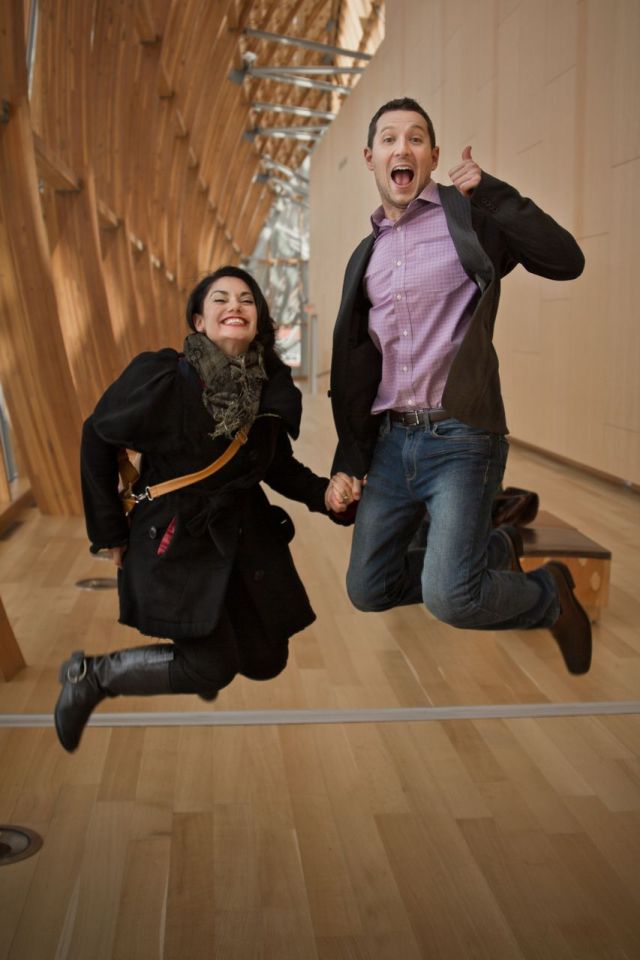
Susanna and Figaro

Posted in Interviews | Tagged , | 1 Comment

Visions: not saying “no”

I’ve been listening to a CD of piano music, contemplating the word “no”.   It may seem like an odd combination, a strange segue.

Why would I wonder about the word “no”?

I’ve been thinking a lot about how people make choices.  Whether you’re big or small, opportunities present themselves in various forms.  Some people seem to live in a rarefied world of a few high-quality projects.   I have no idea what demands are made upon them, but I have to believe that someone doing only a few discreet projects, is someone who says “yes” carefully, and indeed must be saying “no” much of the time.

I’ve seen people who seem to be perpetually in demand, who seem to never say no.  I believe they’re in demand partly because of that positive outlook, that they’re inspiring in their energy and their upbeat approach.

I think about this (saying YES or NO) all the time, as I wonder what I am going to do with my life; and  I think about this (saying YES or NO) when I see an artist who seems very busy, clearly someone who is asked to be part of projects, who is positive & a dynamic inspiring person.

I had these thoughts listening to Christina Petrowska Quilico’s new double CD Visions.  The project is so daring the first thing I had to wonder about was how it could even happen.  And that’s why I see CPQ as the catalyst, the one refusing to say no.  Visions is a series of original piano compositions from Constantine Caravassilis.  It‘s an unlikely project, an enormous double CD of great scope.  The title is apt, as the music is visionary.

But for a visionary to get anywhere? Someone has to say YES.  CPQ clearly said yes, as she does so often.   I connect that YES to the whole artistic-appreciative process.  When someone says something that might be poetic, do you say “no” or “yes”?  Do you consider the possibility?  Some people are more open to this than others.  Listening to the CDs –and I continue to listen to them—I have to say CPQ is genuinely open, positive.  Her playing is inspired on the CD, possibly because she was inspired: by the music.

There’s much more one can say, about the music, the paintings she’s gone on to do in response… But I’d suggest you investigate Visions for yourself.  It’s unexpectedly wonderful.  I gave it a listen, and I am glad I said yes.

CPQ is a very active artist in the GTA (perhaps again because she doesn’t say no).  Monday night? the Quilico Awards at the Richard Bradshaw Auditorium.  (click image for more info)

Posted in Personal ruminations & essays | Tagged , , , | 1 Comment

A reception experiment: Lucia last night

I remember from Psych 100 that one of the ways scientists learned about the brain was from what they called natural experiments.  In the war, sometimes a man would suffer a catastrophic wound to part of his head, allowing scientists to test hypotheticals that were otherwise unbearable to contemplate in an actual experiment.  What happens if you sever the corpus callosum —the nerve pathway connecting the left & right cerebral hemispheres– to see how the person’s brain functions? It’s a disgusting thing to contemplate as an experimental psychologist; but if someone walks into your life who has already suffered this trauma due to a bullet wound (a pre-existing circumstance, making it a natural experiment), why not study the effects?

I had a natural experiment last night at the Four Seasons Centre, watching Lucia di Lammermoor.  It was the second time i’d seen the production.  I sat beside someone who didn’t know the story but who had seen my review.

I am not necessarily an advocate pro- or con- for textual fidelity, but in the process of my experience last night, I inadvertently was part of an experiment last night.  As I was simply a passive observer, i’d like to call it a “natural experiment”, and thankfully nobody was injured in the process.

As I said, the person with whom I sat said they were unfamiliar with the opera.  Partly because of time constraints, partly because of a little instinct, I suggested to her that she not bother reading the synopsis.  I said enjoy it just as it is in front of you, and don’t worry.

And she loved it.

Then, at the interval I ran into a friend.  As we exited, i discovered that my friend shares my misgivings about the production, or at least some of it. Portraits are used as a design element several times to suggest a reverence for ancestors, so much so that Enrico clings to a portrait of his mom through “Cruda funesta smania”.

Here’s a more typical reading of the aria.  It’s one of several macho displays from Enrico, a character whose rage is one of the unavoidable elements of this opera: unless you deconstruct his rage into something pathological & ridiculous.  In later scenes we watch him play with his sister’s toys, tie her up, and yes, violate her in various ways.

Anna Christy  and Brian Mulligan  (Photo: Chris Hutcheson)

Anna Christy and Brian Mulligan (Photo: Chris Hutcheson)

As my friend & I laughed and joked about what we’d seen –a mix of positives and negatives– i sensed the consternation from the other party (who had sat happily beside me up to the interval without any misgivings whatsoever). Afterwards she suggested i was wrong in my review, as she felt the director was spot on.

Let’s put aside the question of my review or indeed of the production itself.

I can’t help concluding that one has a decidedly different experience watching an opera with previous experience or knowledge of the text, than coming to the performance, the surtitles, the music and the mise-en-scene without prejudice.  Nevermind which might be better or worse.  It seems rather interesting, though, that this little experiment underlines the politics of Regietheater (director’s theatre), the awareness of the opposition between directorial intervention and the text itself.

In passing, I felt much the same as before: that Enrico was caught in a kind of crossfire.  The concept was designed for Edgardo & Lucia, not Enrico, who seems to be shoe-horned into the production as an after-thought.  There are subtler ways to do what this production did, but to do so requires a slightly different approach to Lucia & Edgardo, and instead of hitting us over the head with Enrico’s obsessions.

The musical treatment was as wonderful as before, but this time i was less than ten feet away from the glass harmonica accompanying Anna Christy in the mad scene, giving me shivers throughout.  Christy’s underplayed performance made more sense to me, that she only fully cut loose in the last minute or two.  Stephen Costello seemed quite fresh in the last scene, although this time i was ready for the violation of the last moments when Enrico “kills him”.  Yes it’s in quotes because it’s a strange moment among many.  I wasn’t sure whether Enrico is really there or not, given the various surreal & symbolic moments in the production.  I had a funny –perverse– thought afterwards, perhaps an echo of my blithe suggestion to Atom Egoyan on how he should have directed his Salome.  What if, after all the gross and nasty imagery, if –in a scene that i understood could be Edgardo’s subjective experience– we were to see something nice?  In this version Lucia shows up all bloody in Enrico’s arms (and sorry if that’s a spoiler for any of you).  What if instead, we had a mute echo of Lucia’s first scene, when she speaks of the ghost.  What if Lucia wanders by Edgardo, as he speaks of seeing her in heaven. OR what if –my mushy romantic heart on my sleeve– you do something like you get at the end of Les Miserables?  Why can’t he imagine his angel leading him to heaven? we’ve been in Edmund Gorey goth-hell for 3 hours, why not a minute or two of something nice, even blissful?

Is that too much to ask? Of course it is.  I guess i’ll just have to get my own opera company if i want to do something different.  That’s another way of saying that i respect what they’re doing & how difficult it all is, no matter whether i agree with it or not.

Posted in Essays, Psychology and perception, Reviews | 2 Comments