Linda Catlin Smith is a composer I’m pleased to interview, as a couple of her works are about to be premiered, including one by the Toronto Symphony next week. Her music is heard and acclaimed around the world, whether it’s for solo piano, chamber music or larger scale compositions. I admire the clarity of her compositional voice, and the way she talks about music making. I’m going to quote from one of her online biographies, at least as a matter of showing respect for a great artist & teacher.
“Linda Catlin Smith was born in New York, and lives in Toronto… Drawn to an ambiguity of harmony and narrative, her work is informed by her deep appreciation of the work of writers and painters, such as Virginia Woolf, Cormac McCarthy, Cy Twombly, Giorgio Morandi, Mark Rothko, Agnes Martin, and Joseph Cornell, among many others. Her works have been commissioned and performed by many soloists and ensembles in Canada, the US and abroad, including: BBC Proms (BBC Scottish Orchestra), Victoria, Vancouver and Kitchener-Waterloo Symphonies, Tapestry New Opera Works, Arraymusic, Vancouver New Music, Pacific Baroque Orchestra, Evergreen Club Gamelan, Societe de Musique Contemporaine du Quebec, Bozzini, Del Sol and Penderecki Quartets, Fibonacci Trio, Duke Trio, Sabat/Clarke Duo, and many soloists including Eve Egoyan, Louis Goldstein, Philip Thomas, Colin Tilney, and others. Her works have been recorded by: Another Timbre, World Edition, Arraymusic, Eve Egoyan, Evergreen Club Gamelan, Barbara Pritchard, Les Coucous Bénévoles, others. Her lecture “Composing Identity: What is a Woman Composer?” is published in Descant Magazine (#107) and Musicworks (#80).”
There’s so much more, but I’m just so happy to share her responses to a few questions, in anticipation of her upcoming premieres.
Barczablog– What is the best or worst thing about what you do?
Linda Catlin Smith: The best thing about composing is that moment of finding one’s way into the piece, finding new material that makes me happy to be exploring. That’s at the beginning of the process. Then at the end, another wonderful thing is being in rehearsal with the musicians, working together on the interpretation of a new work. The very best thing is hearing it for the first time – it’s where you find out if everything will sound ok, and it’s such a joy to finally hear it.
BB – What ability or skill do you wish you had, that you don’t have?
Linda Catlin Smith: I would love to be fluent in French.
BB –When you’re just relaxing and not working, what is your favourite thing to do?
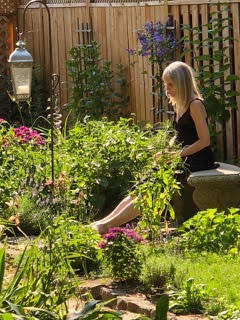
Linda Catlin Smith: In spring, summer and fall, I’m happy to be in the garden, planting, weeding, watering. Doing these things is the best way to really see everything in the garden, and sometimes I find things I didn’t plant, volunteer plants that just appear.
BB: “Volunteer plants!” What a concept.
Linda Catlin Smith: I find when I’m gardening it’s like an extension of composing – I’m still thinking about the piece I’m working on, and being occupied with my hands gives a kind of space, allowing my thoughts to go in new directions. In the winter, I tend to do a bit more playing of piano, more reading, more research (listening). And there is nothing better than having a coffee with a good friend.
BB: What was your first performance that you remember?
Linda Catlin Smith: My mother took me to the NY Philharmonic when I was quite young – maybe 5 or 6 years old. I remember how big the hall was, and how there were so many musicians on stage, and so many people in the audience, and the music was really big, too.
BB: When did you discover your true voice as an artist?
Linda Catlin Smith: I think one’s voice is always developing. At university, I wrote a number of pieces, but it was my graduation piece that was a breakthrough piece for me – by working slowly and really listening, I found a way to work with melody and harmony that felt like new territory for me, that truly intrigued me. I felt closer to material than I had before. This sense of discovery is one of the things that excites me most about composing. I like to feel that I am finding something new for myself. Every piece has that hope, that there will be something new, something I don’t quite understand, something that has the feeling of stepping into the next new world.
BB: Dogs or cats?
Linda Catlin Smith: Both
BB: paper & pencil scoring or digital?
Linda Catlin Smith: I compose in pencil at the piano, and put the finished piece on computer at the end.
BB: what was the last tune you heard?
Linda Catlin Smith: It’s a melody from the piece I’m working on. It keeps looping and changing in my head, a constant variation. I often float through the day with some kind of melody winding around in the background.
BB: “What is a woman composer?” : quoting your own words from an essay you wrote long ago, inviting you to comment on the way our understanding has changed in the nearly 3 decades since you asked this.
Linda Catlin Smith: There are many more women programmed on concerts now, including in orchestras and operas, and that’s a very real change.
It would be great to see more conductors who are women, especially in our larger orchestras. This is already starting to happen, but we’re still in the early stages of these advancements. I sometimes think about myself as a child at orchestra concerts, where the musicians were mostly men, and the composers were all men. Somehow, I ended up thinking I belonged there, I don’t know why. Thinking about today’s children, I believe it’s so important that they see people like themselves on stage, so they know they can belong there too.
BB: As a composer who has several titles that mention plants, I was intrigued to read ( from your programme note to Morning Glory) when you say “As an amateur gardener, I intersperse my composing time with small excursions into the back garden for daily weeding and watering. Often I’ve thought about melody as a winding vine, the twists and wrappings around a beat, the curves and contours of tunes.” Could you expand a bit upon the relationship between your gardening & composition practice?
Linda Catlin Smith: I mentioned earlier that gardening gives me a place to think about my work-in-progress away from the actual composing process – a kind of meditation on the piece at hand. This form of occupation, of doing something (weeding, walking) that still allows thought, is really helpful to me; somehow, I feel the mind becomes less tight, things flow, ideas come.
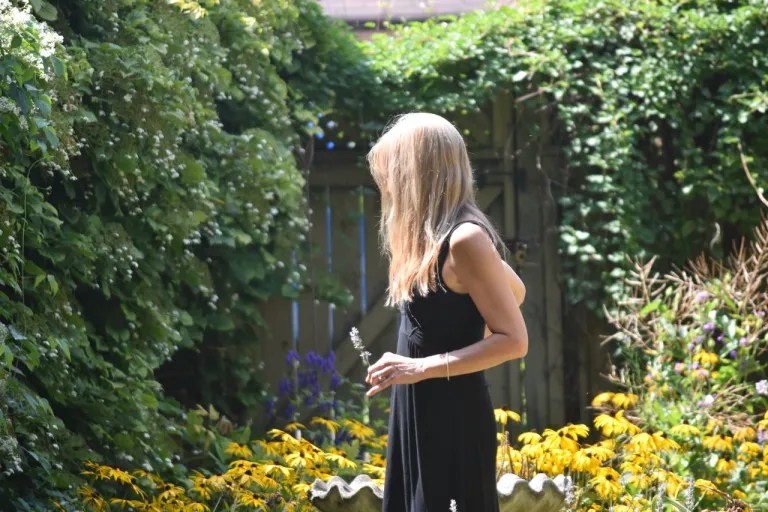
But there is another aspect of nature that I find really helpful to think about. I’m inspired by the way a vine wraps itself around a fence, or the way branches intertwine – these are images that relate to melody, or to counterpoint, to a kind of subtle irregularity that is everywhere in nature. It’s the same with looking at water – its supple rhythm, its gentle undulation – these have really informed my sense of rhythm. This is why so many of my titles are drawn from nature – these images resonate with the kind of sound worlds I try to create.
BB: do you still sometimes like to perform your works?
Linda Catlin Smith: It’s better when really good musicians play it. I don’t consider myself a performer, though there are a few composers whose work I very occasionally perform. But I prefer to be a listener.
BB: Do you mind when someone calls you a “minimalist” composer?
Linda Catlin Smith: I think it’s a bit confusing, as the word minimalist has more often been used for composers like Phillip Glass, Steve Reich and others who use repetition and patterning as the basis of their work. My work doesn’t do that. But I understand the use of the term, as my work is plain and spare by contrast with others, maybe less dramatic too, and so has a kind of minimal aspect to it.
BB: Please tell us more about The Horizon, the piece getting its world premiere at TSO Sept 24-26-27.
Linda Catlin Smith: The Horizon was commissioned by the Toronto Symphony. My writing for orchestra comes out of my love of slow movements in the classical repertoire. It’s always so amazing to have the opportunity to write for orchestra, to have so many colours and textures to think about.
When I finished it, and was beginning to copy it out on computer, I started to think of the opening melody as a faint horizon line in the distance. This sense of melodic line as horizon continues throughout the work, sometimes as melody, sometimes as a long, sustained note. The horizon is always changing, it is always out there, slightly beyond reach.
BB: What is the process like, when you’re commissioned by the TSO?
Linda Catlin Smith: The orchestra approached me in June of 2025, so I had about a year to write it, which was good as I had some other projects I had to do as well. I worked steadily from June to October, then had to take a break for two months, which was really great, as I could then go back to the piece with fresh eyes and ears. I then worked from January to May, and then moved on to the final copying of the score. Once I finished the score I worked with a copyist for the parts and final touches on the score – it’s so helpful to have an extra pair of eyes on everything. I also attended symphony concerts when I could, to hear the orchestra, in that hall, giving me a greater sense of the reality of the sound. Then before the concert, there are the rehearsals, where final aspects of the interpretation by the orchestra are realized. And finally, the concert!
In general, my process is to work most days, at the piano, generating ideas and material, listening to it, playing with it. Then, away from the piano, hearing it in my mind, thinking about it, asking a lot of questions. Then back to the piano, trying things, going over my questions and ideas. I often think about my pieces as I am falling asleep. The work is always with me.
BB: In October mezzo-soprano Ema Nikolovska will be singing “Dark Light” in a programme including vocal works by John Dowland, Laurie Anderson, Thomas Adès and Bob Dylan. Please tell us about the song.
Linda Catlin Smith: Yes, Ema Nikolovska and Sean Shibe asked me to contribute a short work to their Orlando project. The text is made up of a few very small excerpts from Virginia Woolf’s book Orlando. Throughout that novel there are many images of light and darkness, reflected in the fragments I chose. These texts also gave me the feeling of a state of being where one is seeing things as though for the very first time…I so look forward to hearing their concert. (In Toronto the concert is October 29th)
BB: If you could tell the institutions how to train future artists, what would you change?
Linda Catlin Smith: I would suggest they give artists more hands-on experiences – for composers it means giving them more opportunities to write for musicians and to hear their pieces in concert; you learn everything from working with musicians in rehearsal, and then from the feedback from friends and listeners. Artists learn so much by doing – trying things, getting feedback, changing things. It all goes into your back pocket for the next piece.
BB: Is there a teacher or an influence you’d care to name that you especially admire or wish to thank?
Linda Catlin Smith: I am very grateful for all my teachers and my fellow composer/friends – I’ve learned so much from them, truly. All the hours sitting with composers over coffee, talking about music, about working, about process, about art… This sense of community helps so much, as we’re all mostly working on our own; but to share the problems and questions and thoughts with others is a wonderful thing. Art is always a conversation with others – other listeners, other artists. These conversations always shine a new light on what one is doing.
*******
September 24, 26 & 27 the Toronto Symphony concert at Roy Thomson Hall includes Yuja Wang playing Prokofiev Piano Concerto #3, Debussy’s La Mer and the world premiere of Linda Catlin Smith’s The Horizon.
October 29th Mezzo-soprano Ema Nikolovska returns to Koerner Hall with acclaimed guitarist Sean Shibe including Linda Catlin Smith’s newly commissioned work “Dark Light”.
One can find out more about Linda’s music & teaching, including selected writings on her website.

