Whose skin?

I just watched Written on Skin via youtube.  I won’t include the url, as this likely will only lead to its being taken down due to the traffic.  Anyone serious about seeing it, can go to youtube and search for “Benjamin Written on Skin”.  It’s an hour and 42 minutes, with over five minutes of applause at the end.  That doesn’t sound long, but I don’t think I will watch it again.

Look at the title of the work AND my headline, then imagine that i mean my own skin, and ask yourself if that sounds like something pleasant (at first glance i thought the tale might refer to tattoos, but no…).  Perhaps the creators would laugh at me and say that’s precisely what they sought to achieve.  Maybe.

There is much to admire, much that is clever and new, yet I am perturbed by what’s familiar.

Chief among these is something a family member regularly lambasts me with, the fact that opera is a collection of horrible tales.  Must it continue? I have trouble watching Carmen because I feel it’s a story of such misogyny that we’re watching a powerful woman getting put down –the way a mad dog is put down– for the sin of being too strong for the man she was with.  It makes me furious just to think of it, so I avoid this opera like the plague that it records, a plague that’s with us still.  Sure, it’s as universal as stalkers and rape.  Do I need this in my life?  Not if I can help it.  I find myself embarrassed by and for my gender watching this opera, needing to explain that some men aren’t like Jose. Yet some, clearly ARE, G*dd*mm*t.

Written on Skin boasts a libretto from Martin Crimp, a playwright whom I admire a great deal.  The score composed by George Benjamin is subtle, full of original touches, and still echoing in my head.   But the opera makes Carmen look like Hansel und Gretel.  Ha, as I look for an analogy (Magic Flute and Rigoletto popped into my head), everything is nasty, even the kids’ opera by Humperdinck.  No I’m not going soft, quite the contrary.  I am thinking about opera composition, and what I’d undertake to write if I had the cojones.  Yet must one show one’s cojones in violating everyone?

I feel violated, I guess.  The story is opera’s bread and butter, a love triangle, just like Tristan or Pelléas.  Or Otello.  Or Il tabarro.  Hmm, brutal as Puccini’s entry into the infidelity sweepstakes may be, at least the wife is still alive at the end, which is more than you can say for any of the others.

When is someone going to write an opera that’s relevant to our own morality?  Bill Clinton or Tiger Woods or –probably– the guy who lives right next door to you all screwed around, and nobody has to die, because it’s actually very funny. Just ask Pagliaccio (whoops… bad example i suspect).  No I shouldn’t issue the blanket condemnation.  There are lots of operas that I embrace, including some I complain about above.  Neither Tristan nor Pelléas is misogynistic.

In any case, you can find it for yourself if you like.  The singing is really good.  Barbara Hannigan is quite a bold performer, likely undertaking this because of the bravery of her character Agnès, in standing up to her tyrannical husband.  She reminds me of a line from ee cummings “I sing of Olaf”, namely “there is some shit I will not eat.”  Near the end of the opera, she’s being forced to consume the heart of her dead lover (she didn’t know what was on her plate), and boldly….. kills herself?

Sorry that’s not much of a rebellion in my books, even if the music and the slow-motion enactment try to lend some dignity to the proceedings.   No Pollyanna doesn’t normally lambast something this way, but then again, I also don’t want to send people innocently to see something that is –in my books—so horrific.  Musically? Wonderful.  Dramaturgically?wonderful.  But politically? Inexcusable.

So let me concentrate on what I like.

The stage contains modern and medieval spaces, people in modern dress in two quadrants, while people in antique garb occupy other parts of the stage picture.  It’s jarring, and surprisingly effective, something I’ve never seen.  This is from the Aix-en-Provence, Grand Théâtre de Provence performance on youtube from July 2012.  We see figures from our own time cheek-by-jowl with those from the middle ages, and in the process it powerfully authorizes what we’re seeing.  The frameworks are metatheatre, matching the text itself, which is a story about making a book and making stories.  The characters sometimes speak in the third person, as though exploring the new notion of identity; I read somewhere that in the middle ages our modern notion of individuality didn’t exist, or wasn’t intelligible, so I am hoping that’s why we have the third person narration.
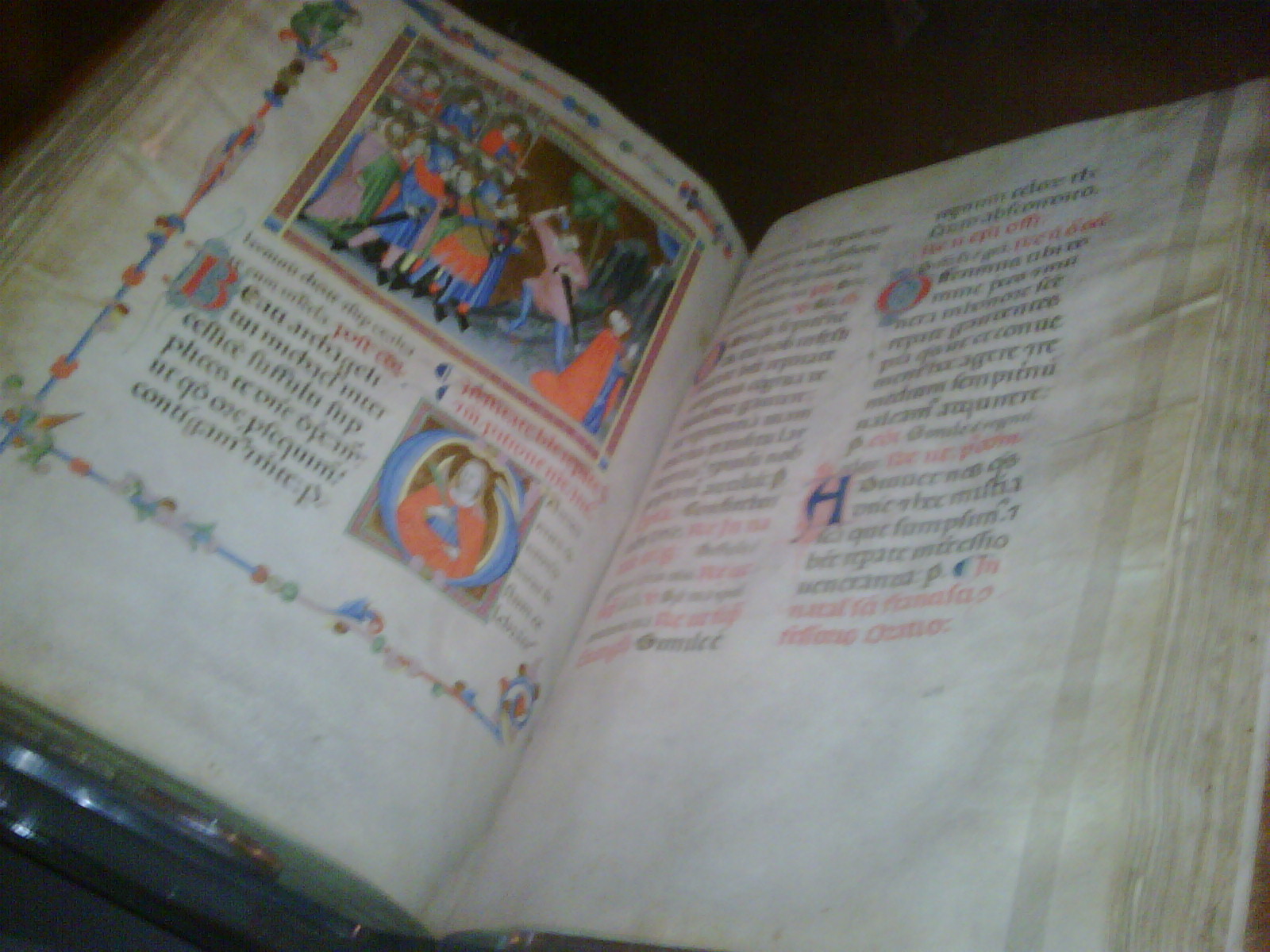
Here's what an illuminated book can look like. This is from the AGO show of early Renaissance art that just opened.  (photo: Leslie Barcza)

Here’s what an illuminated book can look like. This is from the AGO show of early Renaissance art that just opened. (photo: Leslie Barcza)

The boy is creating an illuminated book, yet in opening up Agnès to the life of the flesh that had previously been missing from her existence, he also writes on skin.  When the Protector –as Agnès’s tyrannical husband is called—kills the boy it’s with a knife, another –nasty—sense of the title.  In a time when we seem to be witnessing the end of books and coincidentally, a month when I wrote about the magic of illuminated texts at the AGO, the title has a powerful set of implications.  I was so sad to see where the story went, even as I recognize that the opera works like clockwork, the music powerfully enacting and signifiying the characters.

Christopher Purves is powerful, as you’d expect, in the role of the Protector, enacting and abusing his power.  This is the sort of thing you’d hear sung in a baritone voice –like Prospero in the Tempest come to think of it—rather than a tenor or bass.  Purves manages to be very likeable, perhaps a tribute to the writing, but also surely due to his performance, the depths he manages to convey in the harsh glare of high-def close-up.

Multi-talented Barbara Hannigan, shown here conducting (click for more)

Barbara Hannigan is as always, unstoppable, wonderfully subtle for the first part of the work, understated and self-effacing, as she gradually discovers herself.  As a portrayal showing a change in a character, this is a wonderfully impressive piece of work.  I have to remind myself that this is an opera watching her, and get over my horror at what happens.

Bejun Mehta is the boy, a counter-tenor whose mysterious presence animates and electrifies the world of the Protector & his wife Agnès.  He is the artist –writing and drawing—and as such must perhaps be expected to suffer.  Oh dear, another cliché…?  But again, Mehta is wonderful, every note beautiful and every moment hypnotic.  I hope to see him again.

Benjamin’s score is really good.  The only really massively loud parts come when the action calls for it.  Most of the time we hear the singers easily enough, although one of the singers I didn’t name was all but unintelligible (that is although sung in English, I needed the French subtitles to understand what this person was singing…everytime they appeared).

I wonder if I’d be happier with this viewed from a distance?  In close-up, where I can be seduced by the faces of the cast, it’s very hard to endure such extreme violence enacted.  Perhaps from a distance, bathed in Benjamin’s music, it might move me differently.

You’ve been warned.
Posted in Reviews | Tagged , , , , | 3 Comments

Esprit’s McPhee

I picked up Esprit Orchestra’s CBC recording of Colin McPhee in the lobby at one of their concerts earlier this year.  I’d reviewed their live performance in October of Tabuh-tabuhan (1936) a reading of such playful energy that there was no mistaking their enjoyment, right down to the beatific smiles back and forth between the members of the orchestra.  They love this piece, and it shows in their performance.

Ditto on the CD.

Alex Pauk

Alex Pauk

Alex Pauk leads readings of great clarity, energetic yet as tranquil as leaves flickering in sunlight.

McPhee should be better known, a composer one might be tempted to call a minimalist . There’s the same de-emphasis on harmonic development, in favour of rhythmic activity that one finds in such composers as Philip Glass.  McPhee spent time transcribing Balinese music, going on to write works influenced by their style while using a modern orchestra rather than instruments from the East.  If Glass or Reich or any of their peers had heard McPhee he’d surely be understood as an influence, and thereby recognized as a hugely important composer, certainly the most influential of all Canadian composers.  McPhee did influence Benjamin Britten, but as far as the minimalist movement is concerned, they seemed to find their idiom without any help from the Canadian.  Does influence matter? perhaps in some circles of musicology.  All i know is that McPhee is one of my favourite composers.

The CD (all compositions by Colin McPhee) includes

  • Symphony #2 (1967) 
  • Concerto for Wind Orchestra (1960) 
  • Transitions for Orchestra (1954)
  • Tabuh-tabuhan (1936): the work that gives its name to the CD
  • Nocturne (1958)

It’s one of the most delightfully relaxing CDs I own, meditative and oozing charm.

One of the things I especially admire about Pauk & Esprit are the way they program music.  This week they’ll be offering orchestrated versions of Jimi Hendrix and Marius Constant’s theme from The Twilight Zone, on the occasion of Esprit’s 30th Anniversary.  Pauk is a man with a mission, as captured on the occasion of an interview he gave last year:

Esprit’s relevance to modern man has to do with keeping us abreast of recent trends in music and the relationships of that music to how we think about our present condition. By way of comparison, we don’t expect doctors to use medical equipment from the 1800s in their practices today, so why should we expect musicians to only perform music from the past? I enter into my work with Esprit with a sense of adventure and discovery and I want my artistic colleagues, as well as audiences, to share in that experience. While there is sometimes a degree of entertainment value in what we do, the idea of moving music forward in a pure sense is important. We aim to provide a sensual experience as well as an intellectual one – one that relates to life in a meaningful way today.

~~~~~~~

Esprit Esprit Orchestra end their 30th Anniversary Season with a concert Thursday March 28th Esprit Orchestra, 30 and Counting!, at Koerner Hall, March 28, 8 p.m.

~~~~~~~

Programme:

DENIS GOUGEON Tutti*
ERIK ROSS Burn* concerto for saxophone, percussion and orchestra
ZOSHA DI CASTRI Alba
MARIUS CONSTANT TW. Z. (The Twilight Zone)
JIMI HENDRIX Purple Haze
*Esprit Commission and World Premiere
Posted in Reviews | Tagged , , , , | 1 Comment

Wallis Giunta Sins

When is a recital not a recital?  Perhaps when its materials and its assembly begin to outgrow that narrow definition, to resemble something bigger and more exciting; so it would seem on the basis of Wallis Giunta’s program Sunday March 24th as part of the Canadian Voices Series, in collaboration with pianist Ken Noda.

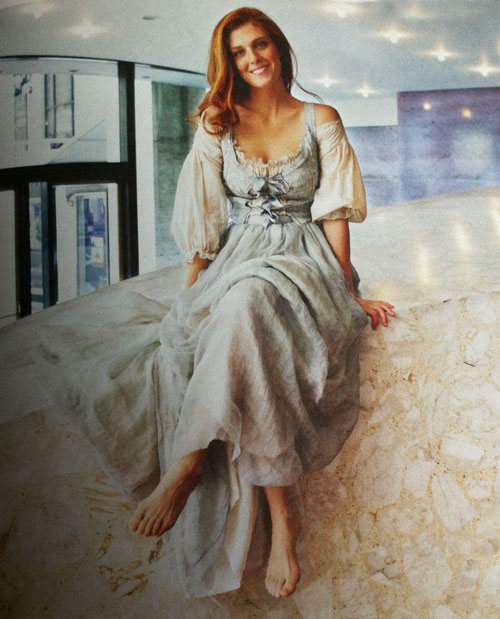
Mezzo-soprano Wallis Giunta as she appears in re:porter, Porter Airlines magazine (photo: Michael Edwards; costume by Camille Assaf)

Mezzo-soprano Wallis Giunta as she appears in re:porter, Porter Airlines magazine (photo: Michael Edwards; costume by Camille Assaf)

Giunta’s choices seem to reflect the same creative breaking-the-mold approach to assembling a concert program seen lately in the area.  It’s not enough to be a brilliant performer in the astonishingly competitive Toronto market, not when small opera companies are laying claim to rep outside their usual purview (something I’ve talked about so much recently that I won’t beat a dead horse by naming names).

It’s handy that we recently saw a version of Kurt Weill’s Seven Deadly Sins presented in the city, to have some idea of the originality of the concept.  Instead of two Annas and family, we had Giunta singing some of Weill’s songs in a cavalcade of the sins, followed by other materials ranging wildly in an all-out investigation of various aspects of sin, at least as commentaries or echoes of one another.  Without even addressing Giunta’s performance, this is one of the most amazing programs I’ve ever seen, for example,

  • Weill’s languid “Youkali”, Poulenc’s luscious “Hôtel” and then Flanders & Swann’s “The Sloth”
  • Weill’s “Stolz(Pride)” with Britten’s “The Plough Boy”
  • Weill’s “Zorn(Wrath)” with Montsalvage’s “Cuba a Dentro de un Piano” and Monteverdi’s “Addio Roma” from L’Incoronazione di Poppea
  • Weill’s “Unzucht (Lust)” with Chapi’s “Al pensar en el Duno de mis Amores” and Porter’s “Love for Sale”

And that’s just the first part of the concert.

I came expecting something intelligent, having been keenly impressed by her work (last month) as Annio in the COC Clemenza di Tito, channeling Michael Cera’s character in Juno.  The gorgeous red-head was unrecognizable (it took me about 10 minutes to realize who she was, even though i had the cast list and knew the opera well), transformed into the sweet & gormless youth, as instructed by her director.

And so Giunta’s approach was as varied as the compositions.  For “Addio Roma” Giunta sang much of the aria facing into the piano, making both a curious acoustical effect and a fascinating visual.  For Foster’s “Old Folks at home” –a song bundled with Schubert’s “”Der Zwerg” and Weill’s “Neid (Envy)”or in other words, a problematic song laden with potential irony—Giunta gave us the utmost directness & simplicity, sitting at the foot of the stage, and singing half the song unaccompanied.  For John Lennon’s “Imagine” (a song that drew spontaneous applause at its conclusion), she came fully downstage, but looking directly out.  Some songs called for something physically outgoing, as in the lust-set, while the sloth set were matched by a far more low-key movement vocabulary.  Each number wasn’t simply sung, as you’d expect in a recital, but fully realized.

I wish the concert had been video-taped, as there’s much there to unpack and explore, that I am sure I missed on this single encounter.  The program was sufficiently complex that Giunta decided to ask for an introduction, smoothly delivered by Eric Domville, giving us some of the contexts for the works we encountered.

At times, particularly in the two songs that are also on Theresa Stratas’s Weill album, I was aware of the way some other singers come at this material, songs that are as daunting in their way as Everest.  For the mountain, there’s a well-annotated history of people who approach it from the north or the south; for these songs it’s more a matter of whether one comes at them with the direct and intense presentation of text as by a cabaret performer (thinking of Lotte Lenya, or more recently Toronto’s Lindsay Sutherland Boal for instance), or the pathway via pure voice (thinking of Stratas, who in my opinion didn’t always really manage the songs), or some other set of choices entirely.  Giunta’s young voice has all the beauty of Stratas but with a better integration of upper and lower registers, so that one doesn’t suffer (take that literally if you wish) the disconnect between the sounds that Stratas made at the top and bottom of her range.

Let me add a brief parenthetical rant while I am on this topic.  Giunta really gets how to sing popular music without insulting the material or the audience.  While this was not a young crowd, I suppose the oldest among us are still baby-boomers, fluent in rock n roll or jazz.  It’s wasn’t fake that “Imagine” won the applause.  Singing Cole Porter, her line had a fluidity you didn’t hear in the Schubert, a way with pitch that was like a gentle tease, which we also heard in “Youkali”.  This is, in miniature, the issue one often encounters when opera singers take on popular music, the pretentiousness of a Carreras singing West Side Story or Placido Domingo and John  Denver singing an embarrassing duet.  So long as one knows what one’s getting –suspending judgment of a great artist, the way we suspend our judgment of our children or our grand-parents—there’s no harm I suppose.  Giunta’s venture outside classical rep is always clever & brilliantly conceived, with no hazard to anyone’s sense of taste.

So in other words it was one of the greatest vocal recitals I have ever seen, wonderfully eclectic but purposefully so.  Ken Noda brought lots of emphasis with no loss of clarity to his contribution from the piano.  If Giunta plans to repeat this program somewhere, I’d ask her to please capture it on video.

Wallis Giunta, wearing McCaffrey Haute Couture (photo Miv Fournier)

Wallis Giunta, wearing McCaffrey Haute Couture (photo Miv Fournier)

Posted in Reviews | Tagged , , , , , , , , , , , , , , | 6 Comments

Serendipitous Poulenc

The mind sometimes makes patterns out of the chaos of the programming around us.  Lately it’s been Francis Poulenc:

  • March 1st Isabel Bayrakdarian programmed the boisterous Le bal masqué, a work I’d studied a very long time ago 
    …look at Poulenc’s face. What a comedian!
  • Wallis Giunta will sing the languid “Hôtel” as part of her concert program this coming Sunday at Glenn Gould studio 
  • The COC are about to present Dialogues des Carmelites (no comedian in sight)

Such variety…!

click for more info about the CD

That’s part of my context coming to Musique de chambre from Pentaèdre, a CD collaboration between the woodwind quintet and pianist David Jalbert, offered in honour of the 50th anniversary of this amazing composer’s death in 1963.  Like Debussy and Stravinsky –likely influences upon him—Poulenc is a composer ranging broadly across the emotional landscape.   While the music of some composers seems to hang together neatly in a single tight statement for posterity, Poulenc’s variety suggests a colourful personality & and an interesting life.  If we think of our exploration of a composer’s music as a journey, Poulenc throws more than a few surprise twists our way.  The disparity may be entirely in my head, given that someone else may easily manage to find harmony in my discord.  Like Debussy & Stravinsky, Poulenc at times pays homage to the past, at other times boldly points to the future, music that may invoke nobility or spirit at one time, while at other moments happily reminding us of popular culture & even jazz.

And voila –courtesy of Pentaèdre, Jalbert and ATMA –we’re presented with Poulenc’s glorious variety.

There’s the “Septuor pour piano, flute, hautbois, clarinette, bassoon et cor”, a kick-off for the CD utilizing all six of the personnel in a bold beginning.  Their reading is pristine yet jarring, fearless and crystalline in its perfection.  In this instance Poulenc shows his allegiance to Les Six, in a clinical score pushing any ensemble to its limit without sentimentality.

Danièle Bourget follows (with Jalbert) in a reading of the well-known flute sonata.  It’s been awhile since I’ve heard the piece, from its haunting opening movement, to the rhythmic vitality of its closing.  Bourget and Jalbert offering is the first of several highlights on this CD.

Then it’s the turn of horn-player Louis-Philippe Marsolais in the “Élégie pour cor et piano”, this time showing a deeper and more soulful side to Poulenc, composed in response to the untimely death of Dennis Brain in the 1940s.  Martin Carpentier & Jalbert follow with Poulenc’s clarinet sonata, one of his final works, written with Benny Goodman in mind.  At times soulful, at other times wildly joyous, the balance is very self-assured and congenial.

And then for something completely different –yet typical of the variegated genius that is Poulenc—we come to the trio for oboe, bassoon and piano.  This elegant neoclassical work –written in the 1920s –points backwards at the 18th century in a manner reminiscent of Ravel’s Tombeau de Couperin.  Norman Forget and Armand Lussier join Jalbert in a sparkling reading, a subtle display of delicacy and grace.

They close with an arrangement of the melodious Novelette oozing charm & class.  Here and throughout the CD, Pentaèdre –a Quebecois treasure—show a natural affinity for one of the recent masters of French culture.

Posted in Reviews | Leave a comment

2013 CanAsian International Dance Festival

“Press releases and announcements” are presented verbatim without comment.

2013 CanAsian International Dance Festival
“Lights Up the Stage”
presented in association with Harbourfront Centre
April 28 – May 12

 Toronto, ON (March 21, 2013) – The CanAsian International Dance Festival lights up the stage! This year promises an emotionally spectacular line-up that includes some of the best and most memorable performers from past festivals mixed with performances by world-class artists making their Toronto debut. New this year is the introduction of special workshops devoted to contemplative writing, dance and calligraphy; a special Japanese film screening, magical labyrinth walks and the ever-popular noodle night. This year’s festival takes place from April 28 to May 12 with performances at Harbourfront Centre (207 Queens Quay West). Festival passes cost $50 or single tickets are available for $30 or $25 for students|seniors by calling 416-973-4000 or online at HarbourfrontCentre.com.

“If you’ve been meaning to attend the CanAsian International Dance Festival but haven’t as yet, 2013 is the year to remedy that as this year’s festival features new works by some of the best that CanAsian has presented throughout the years,” says Artistic Director Denise Fujiwara.

Performances:

  • Susan Lee (Toronto) | Mainstage A
    Commissioned by CanAsian Dance for their 2012 Kick Start Festival, Susan Lee remounts her solo work Trace Elements where she explores the delicate interplay between inner perception and outer representation in the experience and creation of self.
    Date & Time: May 1 & 2 at 8:00 p.m.
    Location: Fleck Dance Theatre, 207 Queens Quay West, 3rd Floor


  • Jocelyne Montpetit Danse (Montreal) | Mainstage A
    Hailed as the Best Performance of 2011 by Montreal’s La Presse newspaper, Jocelyne Montpetit’s riveting solo La danseuse malade (The Ailing Dancer) makes its Toronto debut. Inspired by Tatsumi Hijikata’s book La danseuse malade (The Sick Dancer), Montpetit explores an echo of Hijikata’s universe using her own body, psyche and childhood.
    Date & Time: May 1 & 2 at 8:00 p.m.
    Location: Fleck Dance Theatre, 207 Queens Quay West, 3rd Floor

  • inDANCE (Toronto|Singapore) | Mainstage A
    inDANCE premieres I, Cyclops, a post-Modern, pan-Asian, multimedia vision that will spellbind audiences  in a dream of seductive eyes and Winnipeg snow; erotic poetry and red silk; marigolds and monsoons; girls’ hips and boys’ chests; fierce multi-armed Goddesses and hottie Super Heroes! This new work, a collaboration with Singapore’s Bhaskar’s Arts Academy sees choreographer Hari Krishnan bringing together exquisite dancers and master musicians from India, Singapore, Canada and the U.K.
    Date & Time: May 1 & 2 at 8:00 p.m.
    Location: Fleck Dance Theatre, 207 Queens Quay West, 3rd Floor

  • Taketeru Kudo (Tokyo) | Mainstage B
    Taketeru Kudo performs his haunting solo A Vessel of Ruins. From the broken land, from the zones of destruction, from shattered landscapes and from memories, rises the figure of a man, forcing himself to wake-up to a new life. He searches in himself the power to overcome, to make it, to tell people what he saw.
    Date & Time: May 3 & 4 at 8:30 p.m.
    Location: Fleck Dance Theatre, 207 Queens Quay West, 3rd Floor

  • Ziya Azazi (Vienna) | Late Night – FREE PERFORMANCE
    Winner of the “2011 He Blew Me Out of the Water” by the Globe and Mail’s Paula Citron, whirling dervish Ziya Azazi will literally be on fire at CanAsian’s 2013 edition. Recently performed for the 2012 London Paralympics Opening Ceremony, Ember: Trapped in Fire is a spectacular work based on repetition and experimental whirling. It is particularly concerned with self-destruction, the pain of the awareness of mortality, and the inevitable ending within the continuous cycle of life. The piece depicts the lifelong battle with individual boundaries, leading one to a growing awareness of the diminishing possibility.
    Date & Time: May 2, 3 & 4 at 10:00 p.m.
    Location: WestJet Stage, Harbourfront Centre

Workshops:

All workshop participants receive one free ticket to a mainstage performance; to register, and for more information about any workshops please e-mail outreach@canasiandance.com.

  • Contemplative Writing with Sarah Selecky
    Contemplative writing is practical, radical, and transformative, developing capacities for deep concentration and quieting the mind in the midst of the action and distraction that fills everyday life. Contemplative practices can help develop greater empathy and communication skills, improve focus and attention, reduce stress and enhance creativity, supporting a loving and compassionate approach to life.
    Date & Time: May 4 from 10:00 a.m. to 1:00 p.m.
    Location: Centre for Social Innovation, 215 Spadina Avenue, 4th Floor
    Cost: $125

  • Butoh Workshop with Jocelyne Montpetit
    Based on internalization of mental images developed by Master Tatsumi Hijikata, this workshop will lead the performer to a greater awareness of their external and interior space. This incredibly rich method of working was transmitted to Jocelyne Montpetit by Hijikata himself; a privilege that he accorded to very few foreigners. The workshop will also focus on spatial awareness exercises, which lead to an awareness of movement arising from the interior. This workshop is open to all levels.
    Date & Time: May 3 from 12:00 noon to 4:00 p.m.
    Location: Canadian Children’s Dance Theatre, 509 Parliament Street, Studio C
    Date & Time: May 4 from 2:00 p.m. to 6:00
    Location:  Dovercourt House, 509 Dovercourt Road, 3rd Floor
    Cost: $125

  • Contemplative Dance with Denise Fujiwara
    A workshop in deep, simple, creative dance providing good training for the body and mind. Using Japanese Butoh and creative post-modern dance principles participants will work towards becoming more present and therefore more creative while expanding movement vocabulary and conditioning the body for strength and agility. The work can be done at many levels and challenges both the beginner and professional dancer. If one can walk, one can participate in this dance work.
    Dates & Time: April 28, May 5 & 12 from 10:30 a.m. to 1:00 p.m.
    Location: Canadian Contemporary Dance Theatre, 509 Parliament Street, Studio C
    Cost: $90

  • Contemplative Calligraphy with Noriko Maeda
    This one-day workshop will explore the contemplative art of Japanese and Chinese writing with ink and brush. Through the use of a different media, Sho: Japanese Calligraphy, this workshop will explore different ways to express feelings and scenery, such as wind, heart, and moments based on Japanese characters.
    Date & Time: May 5 from 3:00 p.m. to 5:00 p.m.
    Location: Japanese Canadian Cultural Centre, 6 Garamond Court
    Cost: $45 (includes all materials)

Special Opportunities:

  • Labyrinth
 Walks
    Labyrinth walking in an ancient practice used by many different faiths for spiritual centering, contemplation and prayer. Entering the serpentine path of a labyrinth, the walker walks slowly while quieting their mind and focusing on a spiritual question or prayer. Join CanAsian for a free lunch time labyrinth walk led by composer and Shakuhachi musician Debbie Danbrook.
    Dates & Times:
    – April 29 (International Dance Day) from 12:00 noon to 1:00 p.m.
    – May 1 (first day of Asian Heritage Month) from 12:00 noon to 1:00 p.m.
    – May 4 (World Labyrinth Day) from 1:00 p.m. to 2:00 p.m.
    Location: Toronto Public Labyrinth in Trinity Square Park (by the Eaton Centre)
    Cost: Free.  Pre-registration is required.  To register e-mail
    outreach@canasiandance.com

  • Film Screening: The Space in Back of You and La Femme à la Cafetière
    Filmmaker Richard Rutowski explores the life and artistic journey of Choreographer Suzushi Hanayagi in his 2011 documentary The Space in Back of You. From Noh and Kabuki through to the mesmerizing and sometimes macabre world of butoh, Japanese dance runs the gamut from conservative and courtly to the outer limits of the avant garde. Suzushi Hanayagi bridges these two worlds beautifully and has changed modern theatre and performance in the process. Robert Wilson’s 1989 short film La Femme à la Cafetière also about Suzushi Hanayagi, and based on Paul Cezanne’s 1895 painting of the same name will precede the feature.  
    Date & Time: May 4, 2013 at 7:30 p.m.
    Location: Fleck Dance Theatre, 207 Queens Quay West, 3rd Floor
    Cost: Tickets are $10 and may be purchased through the Harbourfront Centre Box Office at 416-973-4000.

  • Noodle Night
    A casual get together hosted by Artistic Director Denise Fujiwara, CanAsian’s annual Noodle Night offers a rare opportunity to meet some of the Festival artists while enjoying delicious food and intriguing conversation. For details and to R.S.V.P. email outreach@canasiandance.com.
    Date & Time: May 4, 2013 from 5:00 p.m. to 7:00 p.m.
    Location: TBD

About CanAsian Dance

CanAsian Dance presents and cultivates exceptional dance inspired by Asian ideas and expressions through the biennial CanAsian International Dance Festival and annual artistic, educational and professional development activities. For more information please visit CanAsianDance.com.

Posted in Press Releases and Announcements | Leave a comment

Talk Is Free Theatre: 12th Season

“Press releases and announcements” are presented verbatim without comment.

An European transfer, a national co-production and a re-imagined classic are on tap for TIFT’s 12th Season.

March 21, 2013. Barrie, ON… A transfer of this season’s production of Possible Worlds to Munich, Germany, a co-production of the haunting musical Floyd Collins and a new conceptual adaptation of Shakespeare’s Romeo and Juliet set in a retirement home are among the highlights. Today Artistic Producer Arkady Spivak announced details of the upcoming season for Talk Is Free Theatre (TIFT), which sees the company producing a wide range of new and re-imagined material in Barrie, Ontario and beyond.

The 2013-2014 Season will begin with a transfer of the current season’s production of Possible Worlds by John Mighton, directed by Mitchell Cushman, to BeMe Theatre’s John Mighton Festival in Munich, Germany in October, 2013.

On the home front in Barrie, Ontario, the season will be launched with The Sneeze by Anton Chekhov, translated and adapted by Michael Frayn (Noises Off, Copenhagen). The collage evening will include material Chekhov wrote for the stage, pieces he adapted to the stage himself and Chekhov stories adapted by Michael Frayne for the stage.  These hilarious short “vaudevilles” are the brief glimpses into human folly, adversity, eccentricity, ego and exasperation. Directed by Marti Maraden and starring Lucy Peacock, it will run from November 28 to December 7, 2013.

The Last of Romeo and Juliet, a conceptual adaptation of Shakespeare’s tragedy will be set in a Canadian retirement home. Romeo & Juliet has become synonymous with the idea of forbidden love, love that is not condoned by society. In Shakespeare’s day, young teenagers may not have been in control of their own sexual destinies, but now today it is our oldest generation for whom new love is taboo. In our version, Romeo and Juliet will be played by actors in their 70s whereas their parents will be played by actors of the biological age to be their children. Through this relocating of Shakespeare’s text, the production will explore the “fated powerlessness” and subject of “old love”, which can feel more impossible and just as star-crossed as that experienced by Romeo and Juliet. Directed by Mitchell Cushman, this production will run from January 9 to 18, 2014.

The Wakowski Brothers – A Canadian Vaudeville with book, lyrics and music by Wesley J. Colford, will be given the world premiere after the pervious version’s successful run at the Toronto Fringe Festival in 2012. Eight years after splitting their act, Canadian Vaudeville legends Jimmy and Conrad Wakowski reunite for a one night tribute performance. As the night goes on, original skits and songs bring old demons to the surface. Jimmy’s ex-wife Caitlyn joins them as painful memories and past betrayals conspire to destroy the attempt to rebuild their shattered relationship. Directed by Richard Ouzounian, The Wakowski Brothers will be performed from March 20 to March 29, 2014.

The haunting contemporary musical Floyd Collins, with music and lyrics by Adam Guettel, book and additional lyrics by Tina Landau and directed by Peter Jorgensen, in co-production with Vancouver’s Patrick Street Productions, will play from April 10-19, 2014.  In 1925, while chasing a dream of fame and fortune by turning a Kentucky cave into a tourist attraction, Floyd Collins himself became the attraction when he got trapped 200 feet underground. One of the most acclaimed in recent years, this revolutionary musical­ tells the transcendent tale of a true American dreamer.

Miss Caledonia, written and performed by Melody A. Johnson, will round off the home season playing between May 23 and 31, 2014. Desperate to escape the stall-cleaning, hay-baling drudgery of 1950’s life on Rural Route 2, Peggy Ann Douglas dreams of becoming a movie star. Can she sing, twirl and pivot her way into the hearts of the pageant judges to set her on her path?

Other activities of the organization next season will include the inaugural Barrie Comedy Festival running from September 19 to 21, 2013; a brief one day appearance on October 2, 2013 of Hawk from Halifax’s Onelight Theatre and the US tour of Tales of an Urban Indian by Darrell Dennis, staged on a moving bus, in 2014. Additionally, Richard Ouzounian’s adaptation of Great Expectations, based on the TIFT world premiere production, will be seen around Ontario next season.

New work development initiatives will include an original piece written by Kristen Thompson and directed by Chris Abraham in co-commission with Crow’s Theatre; an adaptation of Heinrich von Kleist’s The Prince of Homburg, directed by James Kudelka; and a musical version of Moll Flanders, written by Leslie Arden.

Early-bird rates for subscriptions and 4-ticket passes for the 2013-2014 season are available until May 31, 2013. Single tickets are available from August 1, 2013. For more information, please visit www.tift.ca or call (705) 792-1949. All performances are held at the Mady Centre for the Performing Arts, 1 Dunlop St. West in Barrie, Ontario.

For more information, interviews or photos, please contact:

Arkady Spivak
Artistic Producer
Talk Is Free Theatre
P.O. Box 247
Barrie, ON L4M 4T2
Telephone: (705) 792-1949
Fax: (705) 792-6108
arkady@tift.ca
www.tift.ca

Posted in Press Releases and Announcements | Leave a comment

So far so Cracked

CBC has a new television series called Cracked.  “Cherry Blossoms”, the ninth episode of the new series aired last night, while “The Thump Parade”, episode #8 aired last week.

Over the years, CBC have had regular TV series, some identified as “comedy”, some as “drama”.  When I think of comedy, i cringe a bit.  Sketch programming was practically invented in this country.  Currently we have This Hour Has 22 Minutes, or Rick Mercer Report, building on the down-east heritage of Codco.  The links between SNL and Canadian sketch comedy (Second City being just the most prominent export in the category) are known and acknowledged.  As good as we are at sketch comedy, though, we seem to freeze up doing comedy series.  Yes I know that Little Mosque on the Prairie lasted several years; but that doesn’t mean it was in the same league as the sketch comedy programming i alluded to.

David Sutcliffe as Detective Aidan Black (click the picture for more info about CRACKED characters)

And the series in the “drama” category?  While there are amazing programs further back in time —Street Legal, Quentin Durgens and perhaps best of all, Wojeck, starring John Vernon–it’s been rougher sledding for the CBC since that time.  Being Erika was a very inconsistent series, getting me hooked for a few weeks at a time, then lapsing into periods of writing that seemed gelded, if you’ll excuse me for being blunt.

Compounding the challenge for anyone undertaking a new series on CBC is the low expectations.  While it’s easy to commit to a half-hour comedy sitcom, and ridiculously easy to commit to a portion of a sketch program, drama usually requires more of an investment, not just to get through a single episode, but to learn the characters and the quirks of the series.

I am writing not just because i watched and liked a couple of episodes of Cracked, the new drama series.  I feel i have to write because one of the major dailies took the easy path of taking a shot at the series.  Regular readers of this blog will know that i have little patience for that kind of thing.

No program appeals to everyone.  Some have a bigger slice than others, but there’s always going to be a segmentation of the market.  What part of the market does Cracked seek to capture?  It’s early days, and I am not a typical viewer.

Cracked is a hybrid sort of show.  On the surface it’s a police show, something like CSI. Something happens and the protagonists of Cracked investigate.  But the formula is a bit different, as the two key players are a partnership between a policeman and a psychiatrist. Knowing that i liked Being Erika, a program that was built around the conceit of psycho-therapy as a framework for the dramas of Erika’s life, this shouldn’t be a surprise.  But this is a harsher version of B.E., as though it was given an infusion of testosterone.  There’s a troubled undertone to Cracked, because the police are sometimes as stressed and upset as the people they’re investigating.  Of course there are no clear good guys or bad guys, but the show is refreshingly direct & honest.  See for yourself.

The storyline last week –The Thump Parade– concerned a hockey enforcer getting locked into a life of crime.  I watched parts of it with my mouth open simply because i hadn’t expected the plot-turns, at least until the last few minutes of the episode when the show reverts to a more typical CBC show, and a gentler ending.  But this week’s episode –Cherry Blossoms–blew me away with a strong guest appearance from Lisa Ryder.  One tiny part of the plot was predictable, even as there was a moment that brought me to tears, way beyond what i expected when i tuned in.  But i was totally disoriented, as if i had rented a movie.  In the one hour of Cracked there’s tons going on.  The show has a very sophisticated texture, hopefully one that will appeal to enough viewers so that i don’t end up lamenting the brilliant show that was cancelled before anyone saw it. Yes I have a vested interest: as a fan.

If you’d like to see for yourself the show is available online, or live Tuesday nights.  I was already guaranteed to tune in —22 Minutes is not just my favourite show on TV, but until now the only show i watch–so it’s handy that Cracked is also broadcast on Tuesday nights.

Cracked?  So far so good.

Posted in Reviews | Tagged , , , | Leave a comment

Two Weddings & a Funeral

2013 is not even one quarter gone yet already I’m sure we’ve seen the cleverest title to promote a pair of one-act operas (partly because they don’t exactly grow on trees).  Essential Opera’s  program is called Two Weddings and a Funeral.

I suppose I am aware of the cleverness of the promotion because suddenly Toronto’s opera market is getting competitive.  Ten years ago?  We had two opera companies, plus the regional wannabes in the suburbs.

And now?  There are so many companies I can honestly say I can’t remember them all even with google’s help.  I saw a singer from one of those companies turning pages for the piano player tonight, while another singer I’ve reviewed with yet another company sang capably tonight, for Essential Opera.  I bring this up because of the lovely collegiality on display. These companies aren’t fighting, but happily supporting one another.  If it’s not a love-in they’ve completely got me fooled.  Everyone is Facebook friends with each other, coming out in support of the operas being presented by the other companies.  And in the process the standards keep improving.

Tonight?

Major laughs.  I found a great deal more humour in Essential Opera’s Gianni Schicchi than in the recent –modernized—production from the COC.  There are of course always trade-offs in theatre & opera.  In a big house with an orchestra you get big effects, but details get blown away by all that sound.  The COC’s Schicchi was played by the Wagnerian Alan Held –recently Kurwenal in Tristan und Isolde—easily commanding the stage and the powerful orchestra when necessary.  When he throws the greedy relatives out his voice has the authority to make it happen.

But those twenty seconds are the only time the unsubtle and blustering Held might be preferable over the subtleties of Essential Opera’s lyric baritone James Levesque.   Tonight’s portrayal –which I saw up close in the wonderful intimacy of the Heliconian Hall—had wonderful nuances.  The family was fully fleshed out, from the strident Zita of Catherin Carew to the squeaky doctor of Keith Lam.  Levesque gave us a stylish schemer of a Schicchi, including a fun turn as Buoso Donati.  Ryan Allen and Maureen Batt were a believable pair of young lovers, Batt delivering an understated reading of the famous aria “Oh mio babbino caro”.

The backbone of both operas was pianist & music director Michael Rose, who matched the style of each composer.  I heard a concert Schicchi a year or so ago, played correctly but without such a strong sense of style or so much drama.  Rose gave us a very Wagnerian reading, holding the huge ensembles together, while playing Puccini’s bold textures fearlessly, always adding to the comic tension .

Beginning the program, Rose showed us a different personality in the bubbly score of Donizetti’s Il campanello.  Again, the ensemble work was rock solid, perfectly tight and with a delicacy that was a complete contrast to what we heard in the Puccini.

Fabián Arciniegas (left) and James Levesque

While I had expected to laugh during Schicchi I laughed much more at the Donizetti, a work that’s brand new to me.  Levesque made a solid contribution to this opera as well, this time as the straight man.  The comic star of the evening was Fabián Arciniegas, a most impressive performance on several fronts.  He started out seeming to be a parody of a romantic tenor, mugging shamelessly while singing with great intensity, but Arciniegas was just getting started.  We saw him in disguises, taking on different voices, and never ceasing to be hysterically funny, while offering the clearest articulation of his Italian text.  At times he could have been giving a master class on how to use your voice in opera buffa.

As I said, the bar keeps getting raised higher.  Essential Opera gave us great music and side-splitting comedy.  I wonder what they’ll do next time.   

Posted in Reviews | Tagged , , , , , | 2 Comments

Inside the box: fu-Gen’s Ching Chong Chinaman

click image for ticket info

Lauren Yee’s Ching Chong Chinaman is the latest offering from Toronto’s fu-Gen Theatre, a satirical  expose of the hypocrisy at the heart of the American Dream.  While there are some differences between the US & Canada, it’s a tale that could just as easily unfold in Toronto.  And while CCC displays fu-Gen’s usual focus upon the Asian-American experience, the issues are just as pertinent to other immigrant communities.

I laughed loud & long throughout, recognizing the same dynamic one finds in first and second generation immigrant families of European heritage.  Because the first generation wants to assimilate, the dream is defined in terms of the effacement of ethnicity, while subsequent generations struggle to find out who they really are underneath that surface.  And so one generation faces off against the next, a war between competing visions, at least two possible identities battling it out.  That’s just one sense in which one looks at what’s inside the box; no wonder that the image is central to Camellia Koo’s clever set design, when the metaphor runs through Yee’s play.  We’re interrogating their authenticity in this new place, and laughing the whole time.

As I try to put it into words, I know I make CCC sound far more serious than what I experienced in the theatre tonight.  But I laughed so hard, at times I worried that I was being disrespectful, even though the play is a high-spirited comedy calling attention to the vanity of our dreams in the new world. Yet we do dream and thank goodness this is not one of those plays telling us that it’s all futile.  Success and happiness may be possible, but in this manners comedy–mocking our illusion–everyone is fair game.  While no one is safe from Yee’s satire it’s a very laid-back kind of comedy leavened with dance & wit.

Once I stopped worrying, my only concern was that my laughs might drown out some of the clever lines.  I don’t want to spoil the surprises of the story, other than to hint at the broad outline of Yee’s play, of an Asian-American nuclear family who each come face to face with their own self-delusion with the help of an unexpected visitor from abroad.  The situations are up to date yet universal.

Nina Lee Aquino’s direction is wonderfully fluid & physical, fast-paced but pausing from time to time for a moment’s reflection.

CCC aka Ching Chong Chinaman runs until March 31st at the Aki Studio on Dundas St East.  Go see it, and come prepared to laugh.

Posted in Reviews | Tagged , , , | 2 Comments

Early Renaissance

There’s something magical about getting a glimpse of someone famous in their youth.  Seeing a great leader or film-star as a child, we recognize some of the qualities that will emerge, even as we see a version of that person before they matured.   It may be the clearest look we ever get at their genuine essence.

I feel a little overwhelmed with what I’ve seen.

I have just been to the Art Gallery of Ontario to see the preview of their new show Revealing the Early Renaissance: Stories and Secrets in Florentine Art, that opens this Saturday March 16th, a show created in collaboration with the J Paul Getty Museum in Los Angeles.  I’d already been thinking a great deal about the state of the Christian Church:

  • because of the ongoing controversies underlying the drama of the papal conclave
  • because of the thoughts raised by François Girard’s production of Parsifal at the Metropolitan Opera, that seemed to make Wagner’s merging of the grail legend & Christianity into a very contemporary myth (my review suggested that Wagner’s opera seems timely in its depiction of a church in crisis, and in need of redemption).
  • and because I continue to attend church both as a musician and one who has not given up hope (it helps that I go to an exceptional church: but that’s another story)

What must it have been like in a simpler era, when belief was the norm, when no one doubted the church…?  One can ask.  Or one can seek a direct experience of such a culture.

Imagine my experience, then, today at the AGO.  I feel as though I stepped into a time machine, going back to a time before Jesus became the cliché in so many Biblical epics, before anything religious was circumscribed by Dürer or Rubens or Michaelangelo.  Conventions don’t spring out of nowhere, but require generations of articulation and refinement.

At the beginning of the Renaissance?  Artists of any century take their inheritance –perhaps the images & stories they see around them in stained glass, illuminated in books, and in the paintings they had seen—and then seek to elaborate upon that tradition.  I don’t pretend to understand how this works, only that before things become too coded, there must be freedom, which includes the possibility to make “mistakes”.   In the 1300s, before conventions had hardened into the painterly equivalent of dogma, artists had a great deal of freedom.  The Jesus painted by The Master of the Codex of St George, staring dramatically at Mary Magdelene beside a yawning tomb, is expressive in ways we don’t see in later centuries.  The angels surrounding God the Father in Giotto’s Apparition of God the Father are the most human angels I’ve ever seen, bemused, awestruck, and yes, very vulnerable.  Similarly, in Giotto’s Peruzzi Altarpiece we see simply human individuality.

Giotto: the Peruzzi Altarpiece (click to go to the AGO website for more information & images)

It’s as though we’ve had the good fortune to meet Jesus & his angels before they became famous, back when they were still people with human expressions & emotions.

It’s really something one needs to see to grasp.  I am grateful for the explanations & background from the AGO programmers, creating a multi-disciplinary show.  We’re not just seeing art but the background & the reasons why the art was created. They explained to us that the powers-that-be in Florence had the wisdom to create a standard currency, something called the “florin”, in 1252 AD. This paved the way for great prosperity, as trade boomed, the people going to church began to reflect, considering what they might do with their wealth.  Art was a way to possibly gain intercession.  And so, with prosperity came art.

Among the many things you can see, make sure you see the short documentary film that shows something of the process of making a canvas, paint and its gilding.  I never realized before that the gold-leaf (usually in the background) needs to be done first, and that the figure in the foreground is actually a kind of after-thought in some respects, considering how difficult it is to make a proper halo surrounding the head of the saint or angel being depicted.  If you can manage it, see this first, and only then wander through the exhibit, because you’ll have valuable insight into the processes.

The collection assembled for Revealing the Early Renaissance is remarkable, mostly consisting of rare pieces that are not usually allowed to venture outside of Italy.  In his welcome message, Matthew Teitelbaum told us that the show is “the greatest exhibit of italian art to come to Canada.”

This show is paintings and sculpture and stained glass.  And it includes the Laudario of Sant’Agnese which is something like an illuminated hymnal, although to call it that doesn’t do it justice.  The exhibit not only allows us to see the pages, but we hear the music sung as well.  But our relationship with books has become so Spartan, so focused only on the transmission of content that we have perhaps forgotten what books and indeed what art can be.

For example I took this picture to attempt to capture the view of a Messale (an illuminated book of the mass) as if I were looking out at a congregation.  I remember how children’s books always had to have pictures.  As I grew, that became the exception rather than the norm, although –thankfully—art books are a wonderful exception to that dismal rule.

Imagine that you are a priest, celebrating Mass, and now, instead of simply looking at one of our modern books containing only words, imagine instead that you look upon an illuminated volume like this one.

Illuminated Messale (photo: Leslie Barcza)

Illuminated Messale (photo: Leslie Barcza)

As you look out from your pulpit upon a church of faithful, the pictures seem to peer out of the book, as though the book itself were alive, seeking to inform what you sing or say to the congregation.

In the week following the high-profile opening of Patti Smith’s show that drew worldwide attention, it’s a great pleasure to see the AGO crowded today for the preview of this exhibit.  And no wonder.

Don’t miss it.

show_header.jpg

Posted in Art, Architecture & Design, Reviews | Tagged , , , | Leave a comment