Mornings after and music

Caution: some of this essay may stick in your head.

As I write this on the first morning of the year, it’s a time when many of us are still feeling the after-effects of our celebrations, and may feel literally different than how we felt yesterday morning, let alone late last night.

Water is the cradle of life.  Whenever we drink we’re restored, a process that is inherently transformative, especially if you’re drained & tired.  But the same process –drinking—that heals can also take us on a very different sort of journey.

One can imagine two mutually exclusive goals.  As I expose myself to the world some of it stays with me, and some of it doesn’t.  The cleanest substances & experiences leave no residue, allowing safe consumption.  While we take such things for granted nowadays, eating and drinking was at one time very risky.  Survival was not guaranteed.

And the other extreme?  I suppose it’s a question of just how much transformation one can imagine, whether we’re speaking of Alice in Wonderland or Timothy Leary.  Again, survival is not guaranteed, particularly when one is no longer staying close to our ancestral home (water).

No wonder we read tales of magical drinks.  For example, I’m wondering: was Wagner a drinker?  I didn’t read anything that might suggest he was a drinker, yet he used this plot device at least three times (the love potions in Tristan und Isolde and Gotterdammerung, plus a very different kind of drink with the grail in Parsifal).

Before we had science we had alchemy, the research of old.  Alchemy is not entirely about science, but incorporates spiritual—interpretive aspects, in the same way that the ancient study of the sky didn’t separate astronomy from astrology.  Alchemists sought several ideals:

  • transforming substances into gold (the noblest element)
  • the universal solvent
  • immortality

I am reminded of Ariadne auf Naxos, Strauss’s opera.  In the mythology of this tale, we hear of Circe, who was able to transform sailors into swine –appealing to our true animal nature—with her magic.  The god Bacchus comes ashore expecting to encounter Circe, but is not transformed, resisting her magic.  On New Year’s Eve Bacchus rules anyone who drinks and then struggles the next morning against their transformations, (porcine or otherwise).

I’m thinking of the ways that music can transform us or not transform us.  We may seek to listen to music that is safe and leaves us unchanged.  Would such music be interesting?    If my mind is engaged, chances are it would be memorable, and as memories accrue, I am changed.

Puccini, Strauss, and yes, Barry Manilow: composers who knew how to get into your head

Imagine writing music that stays.  If you’re no longer working from the ecological paradigm –writing non-invasively—but now seek to infect the ear?  A good jingle –an “ear worm” –refuses to leave your head.  I will not offer any examples, as this may tend to leave you humming the example.  While a jingle hardly invokes Bacchus or Circe, we are still addressing transformation at least as an objective.

Are there sorts of music that won’t stay in your head?  When our mind replicates the melody as text we’ll suffer from the recurrent melodies in our heads (see previous paragraph), so I would think that if there is no recognizable tune we would not be forced to retain the tune.  It helps, too, if we’re in an unintelligible foreign language, and if there’s enough going on that our mind simply surrenders to the energies of the music as a flowing process.   Does this stay in your head?

Posted in Personal ruminations & essays | Tagged , , | Leave a comment

Gourmet Schnitzel House

My usual procedure is to write as soon as possible.  I try for a report that’s authentic in its immediacy, even as I sometimes admit ignorance on some matters.  Sometimes I may struggle a bit, but I never put myself to bed before I’ve put my review to bed.

But this one’s different.

I’ve been going to Gourmet Schnitzel House for months now.  No wait, let’s make that a couple of years.

I let Paul & Mari into my life gradually.  It started with dinner.  And then, it would become a regular thing, as every now and then we’d go there for dinner.  Then I started using the take out menu, to grab something on the way home.  If I called to order the House Schnitzel that was easily prepared before I got there.  They’re in Scarborough, not far from my home, so it works beautifully.  The Goulash Soup or a Cabbage Roll order doesn’t require quite as long, as they warm it up.

And now I realize that I’ve tried everything on their menu, and continue relying on them, particularly on those days when I come home late.

I was pondering this matter of expertise as I considered writing this.  I’m no food critic, although I’ve written a couple of pieces appreciating places where I’ve eaten.  Hungarian food, however, is the one tiny corner of the hospitality realm where I might dare to believe I know something.

In fact this is the sort of expertise that Paul & Mari confront regularly: the Magyars, whether exiled Europeans or second & third generation Canadians, walking in hoping to find the taste of “home”.

I’ve been to a lot of Hungarian restaurants.  There are many ways to conjure a sense of authenticity.  It could be the music, the décor, and yes, the tiny matter of what’s on the plate.

The one intangible –or unexpected surprise—in all this is the ease with which Mari & Paul produce their wonderful little menu.  You call Paul or Mari as you come home, bringing home perhaps a Goulash Soup, or a House Schnitzel, or a Chicken Paprikas with dumplings & sour cream… Sometimes  it’s time to relax, which means eating in, having a beer with dinner, and finishing with the Palacsinta (a Hungarian crêpe): and by the way I can’t recall anyone doing this quite so perfectly, reminding me of, you guessed it, my Mom’s Palacsinta.

There’s only one, and it’s in Scarborough.

Posted in Reviews | Leave a comment

Tristan und Isolde –Glyndebourne 2007

As Toronto audiences gear up for a new production of Wagner’s Tristan und Isolde they could do worse than to watch a free video feed of the 2007 Glyndebourne production conducted by Jiří Bĕlohlávek (the man originally slated to conduct the Toronto production until he cancelled last week due to illness) and directed by Nikolaus Lehnhoff.  The video is available until January 6th 2013. 

While the presentation is not precisely as what’s in the score the departures are relatively minor compared to what often happens in Wagner productions.

I suspect that Elizabeth Kubler-Ross –were she alive—would approve of the set, designed by Roland Aeschlimann with its echoes of wombs and birth canals.  The third act begins with a colour scheme as pale as the face of a dying man, which is precisely how Tristan appears to us.  The production is less interested in love –the word most often associated with this opera– than in death, and i believe this is a completely legitimate, and not especially radical, reading of the opera using Schopenhauer as subtext.

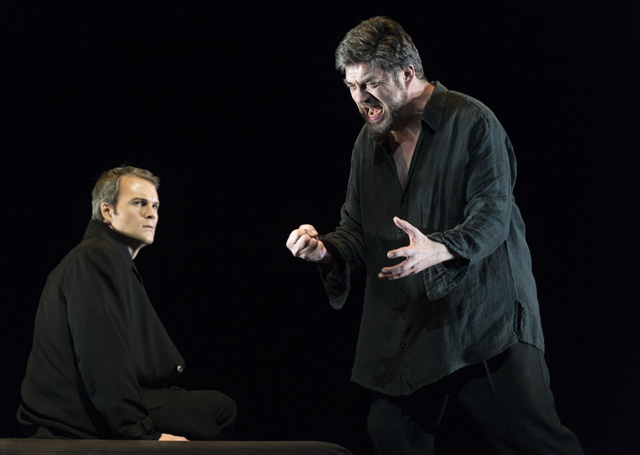
Nina Stemme, still one of the world’s great dramatic sopranos according to what I’ve been told—was in strong voice at this time.  Have a look if you wonder what love really looks like.  In Act I she’s one of the scariest Isoldes you could imagine –standing up to Bo Skovhus’s macho Kurwenal—in her assertion of her rights.  When she drinks the potion she loses no intensity, but drops her defensive façade, letting us see the passion underlying her initial outrage.  It hangs together wonderfully as a portrayal.

Robert Gambill starts slowly as Tristan, sounding a bit wobbly in the first act, but better as he goes on.

Skovhus is subdued considerably in the last act, a performance in tandem with Gambill’s allowing great sensitivity even in the closeups.  Katarina Karnéus as Brängane has a lovely lighter sound –unlike the darker voices one sometimes gets in this role—leading to moments in the first act where she and her mistress are so similar one almost could mistake one for the other.  While this may not sound desirable, I recall an old recording where I heard a similar effect in Act III between Lauritz Melchior’s sick Tristan and Herbert Janssen’s gentle Kurwenal.  Indeed there are many ways these roles can be sung, so I am always grateful to hear something a bit different.

For the brief time he’s onstage Rene Pape as King Marke is the most impressive cast member.  When King Marke shows up in Act II, interrupting the action, it’s hard not to resent his complaints, hard to hear him as anything but sanctimonious. Yet Pape is so sympathetic, so instantly lovely in his singing & acting, you’re not surprised when Gambill hugs him, in a gesture of complete contrition.  I would imagine during rehearsal somebody was muttering “oh my God, give the guy a hug.”  It’s one of the climactic moments of the opera.

Enjoy it while you can, although you can also obtain the Blu-Ray or DVD.

Posted in Reviews | Tagged , , , , , | Leave a comment

Messianic

In one of the early essays “On German Music”, Richard Wagner said, comparing the French to the Germans, that Germans “are generally more prone to fall beneath a foreign influence than is good for the preservation of a certain self-dependence.”  He continues “Somebody once said: ‘The Italian uses music for love, the French for society, but the German as science. Perhaps it would be better put: The Italian is a singer, the Frenchman a virtuoso, the German a–musician.” (found on p 85 here )

He goes on to make the link back to the Chorale & JS Bach, that the particular genius of the German national theatre –the tendencies you see both in its compositions and the singers—began in the churches.  Where there’s an extroversion you see in Italian opera, German opera is about a selfless blend as if you were encountering the same kind of skills you’d see in a Lutheran church service.

Soprano Lesley Bouza

As I sat at a weekend performance in Brantford of Handel’s Messiah I wondered about the comparable genius of Canadians.  There we were in a small town, in a church seating roughly 500 packed to the rafters for the annual reading by the Grand River Chorus & Grand River Baroque orchestra.  Richard Cunningham conducted, with four excellent soloists (Tenor Andrew Haji, Bass-baritone Andrew Tees, Counter-tenor Daniel Cabena and soprano Lesley Bouza)  in a town known more for its associations with First Nations or Wayne Gretzky than baroque music.

With the recent experience of Tafelmusik’s Messiah still resonating in my ears I feel more competent to reflect on period performance.

The numbers for Grand River Chorus (25 sopranos, 18 mezzos, 13 tenors and nine basses) are a more traditional complement, meaning that you hear emphatic soprano lines quite different from what you encounter with Tafelmusik Baroque Choir, who balance the four groups equally.  Perhaps it’s more correct that Tafelmusik rarely gives us a big sound considering that “ff” doesn’t show up in scores until many decades after Handel.

There are a set of trade-offs necessary for authentic period performance:

  • balance via numbers (a small choir in other words)
  • balance via vocal technique: singing softer, more evenly
  • balance via taste: a romantic-modern voice gets louder as you ascend the scale (which i’d argue is the natural tendency of the human voice), whereas in baroque as you ascend you stay even or even get softer

And so I don’t know that this small town reading of the Messiah necessarily shows the rigor I found at Koerner Hall.  But then again this was a semi-pro performance (amateur choir, professional soloists & orchestra).  The climaxes surrender to the old-style passions you find in the Beecham Messiah, where the maximum level is a full out fortissimo. It’s a lovely hybrid, in places authentic (indeed, Cunningham’s brave tempi were faster then what Taurins gave us earlier in the week, and Cunningham himself stepped forward as the second alto in the alto duo), in places more old-fashioned.

But it should surprise no one that in a country now producing so much great talent for the world that our small towns can be relied upon for more than hockey.

Posted in Reviews | 2 Comments

Pollyanna’s picks for 2012

This is a look back at 2012 through the rose-coloured glasses of someone who prefers to avoid negativity.

Most impressive singer: Jane Archibald.  I’d already been persuaded by her Zerbinetta in the recent COC Ariadne, then I heard her Haydn CD which won awards in 2011 (and elicited my favourite pun of the year: see the headline) but was floored by her charisma & wit in Semele. I wonder when we’ll see her here again?  In January the COC announces their next season and alas i don’t believe she’s in anything next season, but perhaps the following year..(!)

Most interesting couple: Frida & Diego at AGO, a study of a relationship and yes, lots of art: until Jan 20th.  I wrote a lot about it and don’t feel i was anywhere near exhausting the subjects they raise:

  • feminism, sexuality & gender
  • aboriginals & colonialism
  • disability & medicine
  • workers & socialism
  • ecology
    …and i suspect there are more

Most eagerly awaited (three different events come to mind)

Most impressive performance, periodStewart Goodyear in the Beethoven Marathon.  In an old-style display of virtuosity, Goodyear made it look easy.  I don’t believe people appreciate his brilliance.  Beethoven sounds brand-new, even while being true to the score.  His scherzi are fast & light, witty & dramatic.  His slow movements are profound and probing.  His contrapuntal movements (Op 101 & 106 especially) are startlingly accurate, faster than i’d believed was possible.

Most visceral theatre:  Dark Matters, an inter-disciplinary creation on the boundaries of choreography & puppet theatre: it was very good theatre.

Closest to my heart: Early in the year I interviewed Michael Slattery, then reviewed his highly original CD “Dowland in Dublin”. It’s in my car, where i listen to it regularly and i posted a small sample a few weeks ago in response to the COC ensemble competition as a cautionary note about our mortality.

Game-changers: 

  • The Toronto opera community has become a remarkably vibrant place, full of small companies producing exciting productions.  I can’t list them all, but 2012 was an occasion for several remarkable presentations, often giving an operatic spin to works that weren’t acually opera.  THAT is what i see as game-changing:

Merry Christmas..!

Composer Louis Dufort (Photo: Diane Charland)

Posted in Essays | Tagged , , , , , | 4 Comments

Body Language

I was having a crabby episode this Friday morning.

I was running late.  It’s ridiculous to admit. I didn’t have any appointments, but I just had hoped to be downtown already, and everything about the morning seemed to add to my sense of gloom:

  • The car was in the shop.
  • And so instead I was at a bus stop.
  • A rain-snow mix was falling intermittently, quite picturesque if I hadn’t been too busy rebelling against the big flakes that kept landing on my face.  I love that sensation (usually).

I was pacing about in the general vicinity of the bus stop.  It’s such a low-traffic street that you can wander into the middle of the road without fear.  That absence of any kind of traffic usually makes it a wonderful place.  Of course when you want a bus to appear,  deadly stillness only punctuated by wind whipping through the trees does not precisely betoken the imminent arrival of a bus, nor any other Deus ex machina rescue from this winter pastorale.

I didn’t just stand at the bus stop.

I am not sure why I was pacing.  Partly it was impatience.  Partly it was because I was not alone, and so I stepped away from the bus stop to show that I didn’t really need to be there.  I’ll show you, bus, I don’t need to stand here, where there’s no bus anyway.  And then I’d saunter back to the stop and…

As I’d started walking to the stop I’d seen people coming towards it, from across the street.  We were all converging on the same spot.  They were so cheerful they were like a party, while I was solitary crabbiness personified.  They didn’t seem to care whether the bus came, because of course they were obviously having a nice time.

I think I’ve already said that their mood was more or less the opposite of mine.

They were older than me.  I should probably pick my words carefully, as they were to outward appearances chronologically of an older age; but at the same time, they were having a good time, and I wasn’t.  In some ways I was the one acting out the part of the crabby old man.

One of them had been at the bus stop already, and had greeted the other three as they crossed the road to get to him.

The other three? Two women and a man, all white or gray-haired.  The women seemed to be watching over the older man, who walked with some difficulty. The women seemed very protective of him.  They spoke in a friendly tone, while admonishing him about various sorts of things he should be careful about.

I had been silently present but not really grasping more than a tiny bit of the subtleties of their dynamics.  I think I may have been scowling.  The wind whipped the melting precipitation into my face, while the foursome had their friendly encounter on the street before me.

I suppose I was jealous, feeling left out. This may be my home neighbourhood, but i felt like an intruder.

The older man was closest to me.  Our eyes met briefly, and he said something non-committal.  He was concerned that the bit of grass upon which he stood–right beside the bus stop—had a slope, or at least that was the conversational gambit whereby he spoke to me, admittedly a scowling curmudgeon who may have been raining on their parade.  So he met my eyes and said something about worrying that he might slip.

I smiled and nodded and said good morning (or something… i can’t recall).

I looked up at the weather falling and blowing about us, probably looking like I hated it.  I think I’d made a face in response to his remarks about slipping, but come to think of it, I guess I wasn’t really sensitive to his difficulties walking, and the real possibility he could fall and seriously hurt himself.  He didn’t look very fearful, smiling and chuckling, because in response to my glance at the sky, with a bit of a grimace that was meant to be empathetic, his next comment surprised me.

“It’s so beautiful”.  True enough, even if I’d been fighting it.

He probably said something else, although I don’t remember it because I wasn’t yet fully paying attention, but still in my head, wondering when the bus would arrive.

He looked at me and made a movement with one of his arms.  He looked up, while he lifted his hand over his head, then as he looked at me, swirled his hand a bit, and said “he’s up there you know…(?)” it was half a question, but sounding very knowing.

“He lets us do what we do.  But when we wants us….(?)”  And he made an ironic face, of the futility of challenging this fundamental rule.

He finished the gesture, and then explained it.  “…we’re there.”  The hand movement was really showing us being called I suppose, but subtly, reminding me –in retrospect—of a good conductor.  His fluid motions were a bit like what I saw from Ivars Taurins Wednesday, conducting Händel’s Messiah.

I smiled back… I suppose I said something banal and weak-assed in response, but I was thinking about what he’d said.  This seemed to be a knowing voice however much of him was already re-called.

I recall him smiling, and turning back to his companions.  Shortly thereafter, the sound of a bus could be heard, and there it was; and so we got on board.  My day was now righted in every sense, as surely as if the conductor had brought me back into alignment with the rhythm of the bigger ensemble.

When I pondered our encounter later I thought of Wordsworth’s Resolution and Independence even though this was a different kind of encounter.  I suppose that in writing it down I’m trying to understand, and trying to pay it forward.

Friday turned out quite nicely.

Posted in Personal ruminations & essays | Tagged , , , , | Leave a comment

Apocalypso

What music accompanies the end of the world?  I suppose it depends whether you’re cowering or celebrating, sitting, dancing or running for cover.

I ask ironically, of course, because the whole Mayan thing is silly.  It’s a finite calendar, limited not because someone was attempting to make a prediction of our doom but simply because the date in question –which may be Dec 21st 2012 –was inconceivably far in the future.

Remember Y2K?

In the late 1990s there was a genuine concern because computers hadn’t been conceived with an eye to the distant future: even a date as remote as Dec 21st 2012 come to think of it.  Nope, the date of Jan. 1st 2000 was already daunting because it had a digit too many.  Was this the end? No, although it was a threat to the smooth operation of our infrastructure, the banks, utilities, and all those systems we take for granted.

I make the comparison because the arbitrariness of the new millennium, and its extra digit, were beyond the imagination of those who had come before.  I’d say it’s the same with our remote Mayan friends.

And so, as we smile, contemplating yet another end of the world scenario –smiling  because for once it’s not genuinely terrifying, unlike, say, climate change, nuclear weapons, the loss of biodiversity through the destruction of rain forests, superbugs created by the rampant use of antibiotics, to name a few—I simply wonder what might be appropriate listening?

The End of the World is nothing new, and so of course there’s always been an artistic response to the idea.  We’ve been dancing something like an Apocalypso for a very long time.  I believe it’s a kind of egomania to tie our own lives to the doom of civilization or the planet, perhaps the flip side of Utopian longings.  When we can’t picture a perfect world, we imagine that the mess we’ve made will be our downfall, rather than a mess that has good decades & bad decades.

So here are five different ways to think of The End, because there’s nothing particularly new about this idea.

1) I’ll start with something inspired by last night, spent in the company of Tafelmusik, Ivars Taurins & four soloists, performing The Messiah.  If there’s a rapture and Jesus comes back, it would affirm the sorts of things you encounter in Revelation 5:12-13

Worthy is the Lamb that was slain to receive power, and riches, and wisdom, and strength, and honour, and glory, and blessing.
Blessing, and honour, glory and power, be unto Him that sitteth upon the throne, and unto the Lamb for ever and ever.
Amen.

This is a rapturous image of the end of the world, although in this telling of the story it’s what I’d consider a happy ending: at least if you’re a Christian.  I don’t claim to be a theologian, but I understand that other religions have similar visions of eternity with a God on the throne.

2) the artist known to me forever as Prince was surely influenced by the Judaeo-Christian tradition, as much as by current events in writing 1999 which uses not just the date but the perennial fears of war.  Speaking of apocalyptic doings, this song makes me feel old, for its discoey sounds, its familiar sentiments that at their worst take us back to the happy innocence of the 1990s.  The end of the world was never so carefree as this time in a tune fully embracing our strange days (and while I may sound a tiny bit like Jim Morrison, we won’t listen to “The End”).

3) let’s get this one in right away because you knew I was going to, right?   There’s actually an opera that shows the end of the world as they knew it, namely Wagner’s Die Götterdämmerung.  I chose this performance because it does have a wonderful sense of both an ending –particularly its clever handling of the gods, since imitated in at least a couple of Ring productions, including that of Robert Lepage.  The Gods had been important in earlier operas, but here they’re reduced to the kind of status reserved for irrelevant deities, superstitions at most: symbols on poles.  Sure, the action is more than a bit difficult to follow the first time, and the longer you watch it, the wackier it gets, given that directors often go off on wild tangents when they direct the Ring cycle. 

4) REM’s end of the world, feeling fine. …did they get enough credit? i’m not sure.  Again, as with Prince, wow does this sound old and yeah, boy does it make me feel, um yes, … old.

5) Here’s a purely musical way to look at the End.  This for me is a utopian vision, via Beethoven in his Diabelli Variations.  This segment (the last quarter of the set) begins an extended exploration of C-minor, before an explosive fugal variation, as cleansing in its way as the Rhine river flooding its banks at the end of Götterdämmerung, but without any singers.  And then we have a serene final dance, as if we’re in heaven or a perfect world where Diabelli’s little dance has been reborn.

Posted in Personal ruminations & essays | Tagged , , , , | Leave a comment

No costume necessary

Tonight I witnessed the first of Tafelmusik’s annual presentations of Händel’s Messiah at Koerner Hall, being presented nightly until the 22nd, followed by the annual singalong Messiah on the afternoon of the 23rd at Massey Hall.

Who is that be-wigged maestro?

The four at Koerner Hall are led by Ivars Taurins, while the singalong is led by the composer himself.  Okay okay, so it’s actually Taurins, channelling Georg Frederick Händel.  Having seen the video of the singalong broadcast on Bravo (last year), I suspect that this exercise has been very good for Taurins.  I recall that Anton Kuerti once said that in playing Beethoven one must to some extent become Beethoven.  Romantic identification?  Surely.

But what I saw tonight from Taurins has me believing that Taurins has gone very deeply into character, gaining a profound understanding of who the composer is, and more importantly, what he’s really written.

He needs no costume. At times that felt like the genuine article up there, conducting his own masterpiece.

Best moment?  Again this is a person view, seen through tears that were dripping off my beard.

One of my favourite numbers is the chorus “Lift Up Your Heads”.  It’s a curious thing, a dialogue between segments of the chorus as if to explain to us in a Socratic fashion, just what we’re experiencing with God and belief.  Taken from Psalm 24, Händel takes these few words:

Lift up your heads, O ye gates; and be ye lift up, ye everlasting doors;
and the King of Glory shall come in.
Who is the King of Glory?
The Lord strong and mighty, the Lord mighty in battle.
Lift up your heads, O ye gates; and be ye lift up, ye everlasting doors; and the King of Glory shall come in.
Who is the King of Glory?
The Lord of Hosts, He is the King of Glory.

Just looking at these meagre few lines,… I’m tearing up.  Here’s the good thing about a blog.  If I were in class or speaking to friends my voice would be breaking and I am sure I would elicit at least some laughter (deservedly).

I watched Taurins get a couple of inches taller conducting this.  He gave us two very distinct voices, with the chirpy women singing the first part, the questioning males, inquiring (“who is the King of Glory”?), the women answering, and so on.  It went by at a ferocious pace, which gives it tension that’s usually missing in older – style recordings.  I was ambushed by Paul McCreesh’s recording, where the dialogue is very clear indeed.  But I daresay it’s even clearer in the live performance I saw, where – I swear—Taurins seemed to be inviting his choristers to distinguish one section from the next, by singing with a different deportment (one side very clipped, the other more relaxed, for example).

Have a listen ….(!)…although i think Taurins & the Choir are even more vivid live & in person.

It needs to be said that Taurins is a choral conductor leading an orchestra.  This is a good thing even if in the (at least formerly) macho world of orchestral music, these kind of gestures or a bar-for-nothing isn’t usually done.

So what..!

Taurins seemed to treat the orchestra like another part of his chorus, with voices that just don’t happen to have any text but are still every bit as articulate & clear as what you find from the singers.  Instead of merely beating bars –which almost every conductor does—Taurins conducts phrases, sometimes several bars in one sweeping gesture, and then with an answering gesture if necessary.  If a series of words are being sung, Taurins marvellously punches out the big word in a sentence that he wants emphasized.  And surprise surprise, Tafelmusik Chamber Choir deliver exactly what he asks.

There were even places where he stood stock still, as if admiring the Christmas tree: looking adoringly at his choir, as they delivered ravishing music, adoring him right back.  The smiles I saw all over the place were genuine, unfeigned admiration.  I suppose this at least is part of the long-term experience of playing Maestro Händel: that the choir see his portrayal, and are in various ways seduced.  But of course that probably starts in rehearsal, and is a long-term and loving relationship.

I have never seen such committed conducting.  For the entire length of this large work, Taurins was dancing about the stage, not letting up for “Worthy Is the Lamb” or the closing “Amen”.

When the soloists were required to come to the fore, it was a different kind of conducting, perhaps because Taurins did not want to take any focus from his quartet:

  • Soprano Joanne Lunn
  • Mezzo-soprano Allyson McHardy
  • Tenor Aaron Sheehan
  • Bass-baritone Douglas Williams

I am unsure about the dramaturgy of the different approaches taken by this quartet, that each imply a different sort of drama: although I know that each had great moments.   I am still trying to wrap my head around the contradictions of baroque performance, which is at times a medium for display and showing off skill, at other times about deep moods & sensitivity to emotion.  Couple that with Messiah, a work that is a drama of the spirit, and one may be perplexed at some of the choices. Should one emphasize the drama, or let the text & music speak for the inner passions of the situations?  I suppose it depends on the section.

Lunn was unquestionably the most dramatic.  Her best moment I felt was in stepping forward for the recitative “Thy rebuke hath broken his heart”. What an interesting idea: that “thy” is addressed at the chorus who have indeed been rebuking Jesus.  And she seemed so deeply engaged, I was jolted in a new way by this passage, finding a whole new way of seeing it.

Of the four, I would say that Lunn’s voice is perhaps the most true to historically informed performance of Händel, often being very clear & direct, with less vibrato than any of her colleagues onstage.  Lunn’s delivery of the Christmas lines concerning the shepherds was for me the highlight of Part One, delivered with unshakeable conviction and a lovely innocence.

My one negative is perhaps me being a stickler.  Lunn was a most enthusiastic and committed soloist, often nodding her head with her lines.  This was powerful in “If God be for us, who can be against us, ” whereas the nods undermine “I know that my redeemer liveth”.   While this may be excellent acting, the problem at this moment is that an affirmation of faith should not be dramatic.  It’s an enthusiastic attempt to signify belief, but it’s not good to remind us that this is an attempt to persuade. This affirmation of faith needs to be as calm and assured as ownership or breathing itself.

McHardy faced down a tough challenge, in arguably the most difficult single number in the entire work, namely “He was despised”.  McHardy underplayed, in comparison to what Lunn was doing, a sincere calm passion in the slow “he was despised” section, a more powerful, angry delivery in the “he gave his back to the smiters” section.

The men sang beautifully, but without the conviction I saw from the women.  I am sure all four care, so forgive me if this sounds critical; but you can’t miss when the two women are singing along with the “Hallelujah chorus” (they looked so sweet, too…absorbed in the music) while the men are staring elsewhere.  It’s a little thing, but perhaps something to consider: that all four be working from the same style-sheet.  That’s one thing I had in mind when I spoke of dramaturgy, but there’s more.

For instance –to invoke a line that was satisfactory but not brilliant—I will never be content with the usual delivery of “unto which of the angels said He at any time, Thou art my Son, this day have I begotten thee?” …now that I have heard what Michael Schade does with this line.  No I did not see the TSO Messiah (that includes Schade), but I do have him on the Harnoncourt recording.  Schade delivers the first part as recitative, then snaps into a voice that is truly God-like in its ostentation and loving delivery.  How can I listen to this line as mere connective tissue after hearing Schade channel God?

And it was fun watching the orchestra play the “Pifa” (a pastoral symphony introducing the scene of the shepherds with their flocks), watching Allyson McHardy, after she admitted in her interview that this was the processional at her wedding.  I don’t think I’ll ever listen to that music quite the same way again.

Yes the soloists –and several instrumentalists – were stars.  But as far as I am concerned Taurins is the real star.  I’m very impressed, and now am eager to see him on the new DVD of the Messiah that’s been released recently.

Considering that the run is sold out, that’s probably your best bet.

Posted in Reviews | Tagged , , , , , , , , , , | 2 Comments

Beatrice Rana – Chopin and Scriabin

When you like a composition, chances are you’ll listen to a recording by a new unfamiliar artist whether or not you’ve heard any fanfare or PR.  And so, when I saw that Beatrice Rana’s debut recording with ATMA Classical was mostly devoted to Frédéric Chopin’s twenty-four Préludes Op 28, I wanted to hear.

Is it one work or twenty-four?  Although some of these preludes get performed independently, the cycle works wonderfully as a unit.  I can’t help thinking that our assumptions need to be flexible to recognize changing attitudes and approaches.

  • On the one hand, other contemporary media such as opera or symphonies can furnish hints about how such a work was received and understood in its time.  While today we perform the cycle in a whirlwind of passion without any intervening applause– comparable to the relatively taut audiences for symphonies and operas–there was a time when arias and symphonic movements earned, not just applause, but multiple encores.  I recall reading that the premiere of Berlioz’s Harolde en Italie saw both inner movements encored, one being performed a third time (although I can’t recall which).  And so it shouldn’t surprise us that a few of these little jewels are sometimes removed from their exquisite setting (the complete cycle of twenty-four) to be played discreetly on their own.
  • On the other hand recordings –particularly CDs, which are so much more flexible than LPs—encourage an entirely different relationship to text, allowing us to get to know them better than was possible in times when our only option was live performance.  Mahler only came into his own, only truly appreciated, after listeners were able to listen and re-listen to his mammoth works in the comfort of their living room.

Yes you can have it both ways. The work (or works if you prefer) seems poised between traditions.  While paying homage to previous masters, particularly JS Bach, the cumulative effect is powerful indeed.

Pianist Beatrice Rana

Who is Beatrice Rana? ATMA’s site tells us

In June 2011, Beatrice Rana, then 18, became the one of the youngest winner of a first prize at the Montreal International Music Competition. As well, she won each of that year’s special prizes. She is, said Le Devoir, “not only a pianist but, above all, an artist.

In 2012-2013, Beatrice made her debut with several orchestras, including the Orchestra Internazionale d’Italia, the Südwestdeutsche Orchester, and the Aarus Symfonieorkester in Denmark. She also performed as a guest artist with the Orchestre Symphonique de Québec, the symphony orchestras of Edmonton, Saskatoon, and Winnipeg, the Kuala Lumpur Philharmonic Orchestra, the Violons du Roy, and the Orchestre Métropolitain with Yannick Nézet-Séguin.

Though only 19 years old, Beatrice has performed in major concert series including the Tonhalle de Zurich, Montreal’s Pro Musica, the Società dei Concerti de Milan, and the Vancouver Recital Society, and at many festivals, including the Festival Berlioz de la Côte Saint-André, the La Roque d’Anthéron International Piano Festival, the Festival Radio-France de Montpellier, the Folle Journée de Nantes, the Flâneries de Reims, the Festival Busoni de Bolzano, and the Festival de Lanaudière in Quebec.

Beatrice has won numerous prizes at competitions such as the Muzio Clementi Competition, the Concours International de San Marino, and the Bang & Olufsen pianoRAMA Competition. She began studying piano when she was 4, and became a student of Benedetto Lupo at the Conservatoire Nino Rota, from wich she graduated at the precocious age of 16. She now studies in Hanover with Arie Vardi.

Rana offers a conservative reading, and I mean this in a good way.  Many of the preludes include passages that can be ambiguous when played quickly, when interpretive liberties with accents & emphases cause us to lose a sense of the work’s meter and so to change the shape of the piece.  I believe that if you start it with a particular shape, while you may bring out voices in places, play with it briefly, that the preludes should be essentially static from beginning to end.  In this sense, I prefer a straight-forward and conservative reading, whatever its pace.  This is what I believe we find in recordings by the great Chopin interpreters, such as Rubenstein, Arrau, Ohlsson and Zimerman.  I think of Chopin as a neo-classicist, not unlike Mozart & Debussy and therefore want transparency & a respect for structure in the execution, especially simple compositions such as these.

Rana is sometimes reticent, playing a prelude quietly, but each one is self-consistent, shaped with eloquence and nobility.  Before too long I relaxed into the performance, put at ease by her easy mastery of the requirements of these short pieces.

The CD also includes two other Chopin Préludes and the op 18 sonata of Scriabin.  The French spelling of this Russian composer’s name appears on the CD—a nod to the PQ Government language laws?—so be aware of this if you google it.  The easy way is simply to look for ATMA and Chopin and Rana.

The Scriabin shows us more of Rana’s fluidity, particularly with evenly shaped phrases of perpetual motion constructions.  As such it’s a good match to the Chopin Op 28, albeit somewhat more angular & chromatic.

Rana was still in her teens when the recording was made, not that you could tell from her excellent playing.  Another star is born.

Posted in Reviews | Tagged , , , , , , | 1 Comment

Cohorts

At one time in Ontario there used to be something called “Grade 13”, the last year of high-school before one went on to University.  My online reading tells me that, while there were a few other places where one had grade 13, most places only go up to Grade 12.  I don’t claim to know the history of such distinctions, only that educators noticed that we were different, and sought to harmonize our educational system with other nearby places such as the rest of Canada & the USA.

And so it came to pass that Grade 13 was abolished, Grade 12 becoming the last year of high-school.

Imagine the year of the change.  Those in Grade 13 would go on to university, and so too, those who were in Grade 12.  As a result, two different sets of graduates would emerge from high-school, some having matriculated from the old 5 year high-school curriculum, others emerging from a new 4 year program.  That year –when twice as many kids descended upon the universities of Canada—a phrase came into common usage in the educational sector, namely “the double cohort”, describing twice as many freshmen, then (the next year) twice as many in second year, and awhile later, a larger than usual contingent of graduate school applicants (not necessarily double, but likely bigger than normal).

It may be that some academics always called the students a cohort, but the first year I caught wind of it was in the lead-up to the year(s) that our population would be doubled.

The word “cohort” has a militaristic echo, but the metaphor is useful.  It sounded as though a huge contingent of soldiers would descend upon the unsuspecting populace, perhaps bringing up unconscious echoes of the shore-leaves seen in such films as On the Town.  After all, university students can be just like soldiers (not just in age, but in their desire for enjoyment of a drink).

It all came back to me recently as I attended a memorial celebration at the Faculty of Music, University of Toronto.

In the room people did what people usually do at parties: gather with their friends & colleagues.  This means that in different parts of the room, people would be organized by their sense of affiliation.  In an educational environment this can often mean something just like cohorts.  On one side of the room were the older grads, who had left decades ago.  In another one bunch were those who had been in the school roughly twenty years ago.  In another group in the room were the current students talking amongst themselves.

Hermann Geiger-Torel (photo from Susan Weiss)

On the wall if one cares to look, there are pictures of former mentors (both educational & professional), particularly Hermann Geiger-Torel, the one-time General Director of the Canadian Opera Company.

It struck me as I noticed the way people were socializing, that cohorts are a kind of subtext for our lives.  I’m getting older.  We all are.  Those who are my age –the ones of course that I know and who know me—represent my own cohort, and we’re aging together.

I can’t get this impression out of my head.  When I attended the COC ensemble studio auditions I was aware that the current group will eventually leave, to be replaced by a new cohort, year by year.  Watching young singers perform in groups such as Opera Five –in their recent program of one act works—I was touched by their youth even as I took in their position on the threshold of mastery and eventual greatness.  And as I tried to remember all the new names of singers  in European productions the same construct stayed with me, as if the new singers were recently students (as they surely were), and were soon to be retired (as eventually they would be).

I am listening to Barack Obama, as he addresses the congregation in the prayer meeting Sunday December 16th, saying “we know our time on this Earth is fleeting”.  I was contemplating my own fragile voice, roughed up by a bit too much fun on an exhausting Saturday night of partying, glad to be alive.  We are all flowers with a brief span, even if we’re not plucked like those whose names Obama listed in the service, not yet “called home” by God.

The talents we see onstage are fragile, mortal.  We shouldn’t need violence to notice our vulnerability, to appreciate the brevity of our time on Earth & the flowering of talent.  I am grateful for the blessing of friends & ability around me, the opportunities to enjoy our frailty in live performance.  If we were like machines –if no one ever fluffed a note or missed an entry—we’d be immortal.  Young or old, whichever cohort you might belong to, our humanity argues for our gratitude.

We are not machines.  Hallelujah.

Posted in Personal ruminations & essays | Tagged , | Leave a comment