We always know our spatio-temporal co-ordinates with the help of satellite surveillance and assorted electronic devices. When was the last time you were lost? Those of us with regular jobs go back and forth along the same streets. From time to time we may discover a new way to get home; the novelty of that first time quickly fades into routine.
Nowadays it’s a luxury to get lost, a magical experience. Tonight I managed it with the help of Against the Grain Theatre.
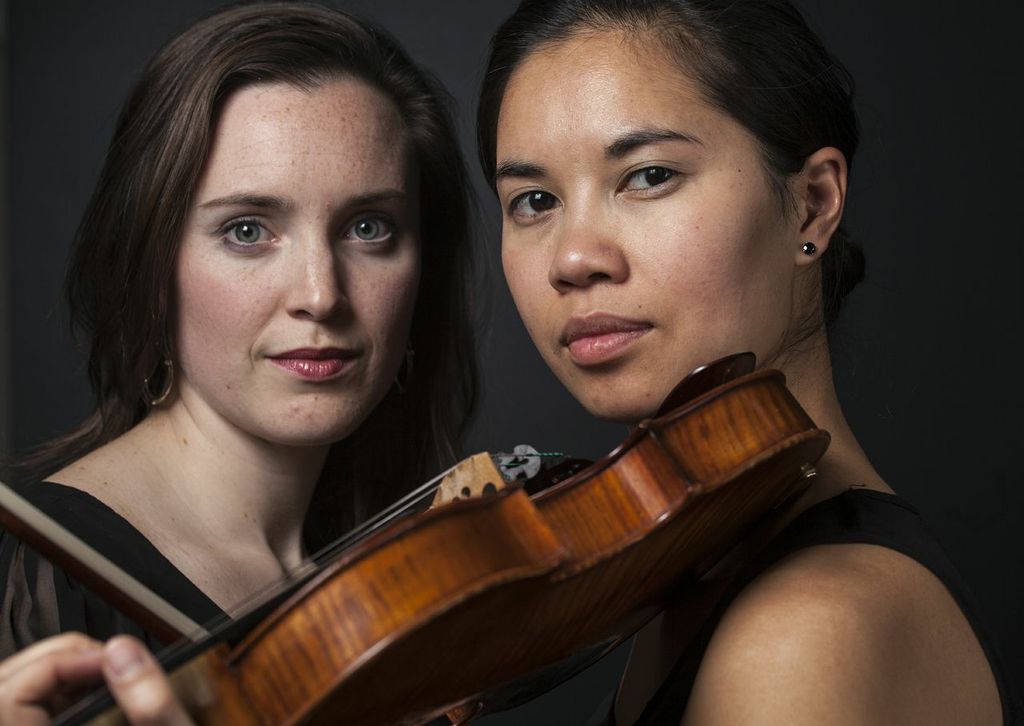
AtG regularly find new places to undertake unorthodox performances. How apt then that they took us to “The Extension Room”, in other words, a place where people stretch? Kafka/Janáček/Kurtág certainly stretched singers Colin Ainsworth & Jacqueline Woodley in new directions; ditto violinist Kerry DuWors & pianist Topher Mokrzewski.
I may be making too much out of this, but while I’m playing with this, I couldn’t help noticing
Kafka/Janáček/Kurtág is a program of Eastern European writers & composers
The Extension Room is located on Eastern Ave
And so, between the location and the rep I was most definitely lost. And I like that sensation. Earlier today I was watching Parsifal on the High Definition broadcast, knowing the words & music really well. I envy those experiencing such works for the first time, because that’s when you can truly get lost in the work. Luckily I was able to get lost in the east: or the east end of town at least.
The two works being presented were quite different.
Kerry DuWors, violin and Jacqueline Woodley, soprano (photo: Darryl Block)
Kafka-Fragments by György Kurtág began the evening. We’re told “words have power” and we can see it in this work, comprised of small writings Kafka wrote, set in the 1980s by the Hungarian composer for voice & violin. Some of the segments are long, some short, some surreal, some hysterically funny. There are forty in all, a genuine virtuoso tour de force from violinist Kerry DuWors and singer Jacqueline Woodley, a dissonant work in a modernist idiom (possibly atonal… I’d have to hear it again to be sure). I wish someone would record their remarkable performances so I could hear it all again.
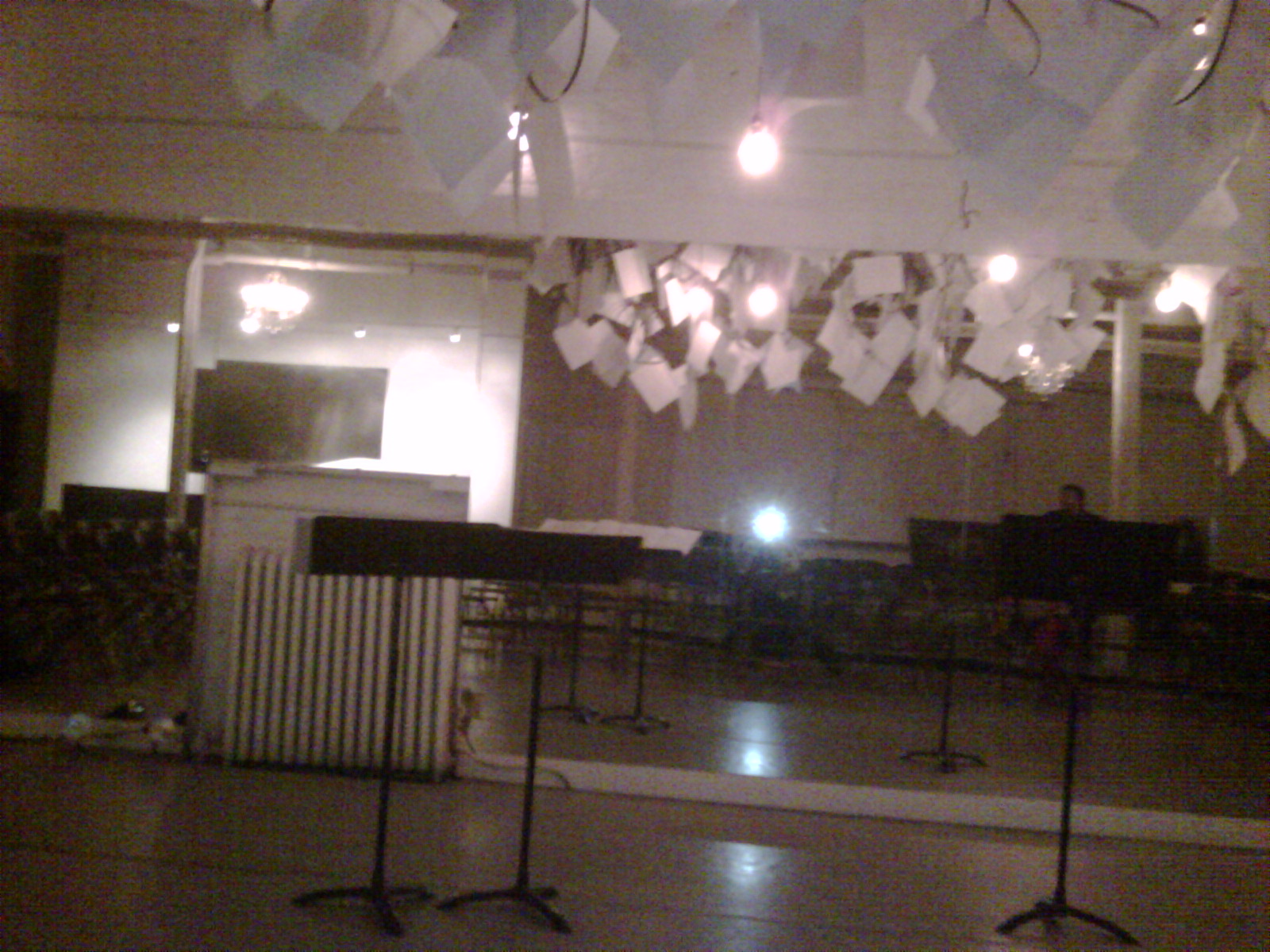
There are at least two reminders of that emphasis on words. The handed out translations resemble something from an old-style typewriter, a cute design element matched by the cascade of papers hanging from the lights in the ceiling (see them in my photo?).
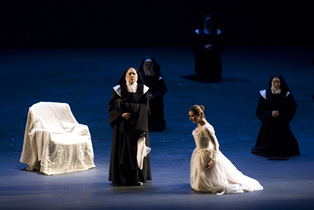
The second half of the program was in a more accessibly tonal idiom, namely The Diary of One Who Disappeared by Leoš Janáček. Sung in Czech, most of the work is handed to the tenor, in this case Colin Ainsworth. I’ve been listening to Ainsworth’s easy tenor for years with Opera Atelier as their go-to singer in roles such as Armide (last season), Mercure (on their Persée DVD) or Tamino (in Magic Flute, coming in April). It’s a chance to hear him singing something completely different from the usual.
One of the oddities in musical theatre is the regular contradiction between someone singing when they should be doing something. A man singing on and on about a gorgeous female right in front of him?
When are you going to kiss her, man?
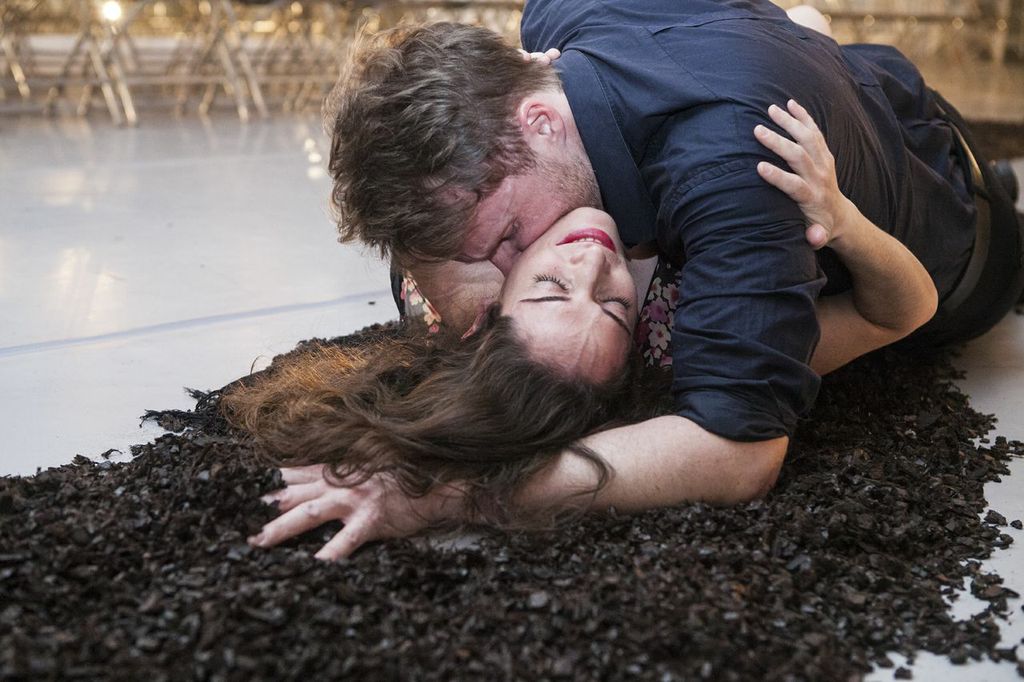
Colin Ainsworth, tenor and Lauren Segal, mezzo-soprano (photo: Darryl Block)
Director Joel Ivany might have read my mind. One minute I am thinking “why doesn’t he kiss her”, the next, a man is on top of a woman a couple of feet away from my feet, and I am wondering just how far they will go. This was such a Toronto moment, sitting in a theatre across from another bunch of people, as we were all watching the couple making out, and not sure what we should look at. After the kissing, Ainsworth reminded us why he was there with a couple of superb high notes.
AtG will be back at the end of May with Figaro’s Wedding, an updated adaptation of Mozart’s opera.
Hm, the headline may strike some of you as an oxymoron. CAN a February be fabulous?
Yet mine was, without a doubt. This was my best February ever. I want to share the wealth as we slip into March, knowing how some people suffer at this time of year. It may be unreasonable to put this out there when i am no professional, but i have had years when i felt totally buried under something like seasonal affect disorder. I felt SAD (literally): before. But I am feeling so much better this year, I think i have found a prescription for the February blahs.
In a month when the temperatures are cold, the days are dark & short, and without the compensations we experience in December (holidays such as Christmas) and January (New Years, and the comparative novelty of the weather… what’s picturesque in January becomes tiresome in February), everything seems a bit more difficult in February.
And it doesn’t help that Christianity gives us the season of Lent. This is a time of reflection, when the extroverted emotions of celebration are proscribed in favour of something quieter and more internalized. “Hallelujah” is something we’re not supposed to say until Easter, although I suspect a few people are saying just that: because February is over.
One of the hardest things to do at this time of year is to be active. You probably think i mean physical activity; sure, the physical is part of it. But I mean in the more fundamental sense: of not being passive.
When it’s cold outside, cycling, running, even walking get so much more difficult that some people give up until the weather improves. The shorter day leaves us with fewer opportunities to exercise. So that sort of activity becomes tougher.
But there are other sorts of activity. When you choose to do something—seeing a film, doing a big chore, reading a book—your mind is active. When we allow ourselves to be circumscribed by work & weather, going through the motions without making personal choices, we cease to be active. We become passive. Passion is not necessarily a bad thing, but if the only thing you’re feeling is irritation, fatigue, the absence of sun and the things you may love the most? Letting that funk own you is actually a choice. The choice not to choose, not to be active, is still a choice.
Being overwhelmed by our feelings is not something we may really be aware of. I know sometimes it happens to me. And it’s not as though you can run a marathon or build a house to make it go away. But one can open one’s Beethoven sonatas book, and start playing through them. One can open one’s Complete Shakespeare and start reading great literature. If you’re so inclined, of course there are brilliant and generous things one can do to pick up one’s spirits such as volunteering. But I am not proposing that you suddenly morph into a saint, especially if you feel anti-social.
I am simply bearing witness, sharing my experience. I am no psycho-therapist, but do think I may have hit upon something. Sitting in front of the television is passive, no matter how good you may think the programming is. You don’t engage enough of your brain to escape being passive. Last night I did watch a hockey game, but for most of the game I was on the treadmill or lifting weights.
If I were to give my prescription it would be “be active”, or “choose”. Sit and use your brain, and you will still be active, if that’s something you might enjoy. Now that it’s March I suppose I can catch up on the sleep i lost, doing so much this past month. I am not saying i did a brilliant job at what i did. That’s the funny part. I suspect that harsh self-judgment defeats the positive effects. We have to allow ourselves to be nourished by being busy. I don’t beat myself up when i make mistakes at the keyboard. I sing out of tune, and try to do it right next time. Eventually i will say Hallelujah, but for now, i am simply keeping busy. It’s been the best February I’ve ever had.
For some people maybe taking a vacation is a better idea. And of course some people don’t want to live in a place like Canada, which may also be a solution. Me? i am not about to leave my home, particularly because i like it here. I don’t claim that this works for everybody. i don’t even know if it will work for me again.
But I will see if it works next year. (tune in 11 months from now…)
Soprano Carla Huhtanen is in demand internationally for her soaring, translucent voice, her winning stage presence, and her diverse repertoire, gracing stages throughout Europe and across North America, a strong interpreter of traditional repertoire, unafraid of new composition.
A regular with Opera Atelier, Huhtanen is often the most sympathetic performer on stage. In Der Freischutz a few months ago, I said
Bellwether of this sanity is the Ännchen of Carla Huhtanen. Where Max & Agathe face the perils of the romantic imagination, the terrors in dreams & in the wolf’s glen, Marshall Pynkoski encourages Huhtanen to play up the comedy of Agathe’s comic foil, in a portrayal of exquisite energy & musicianship.
On the occasion of the Don Giovanni dress rehearsal i said.
The most successful singing of the night came from his partner Carla Huhtanen as Zerlina. Perhaps it’s not fair to address singing in a dress rehearsal, not just because when singers conserve their vocal resources, mindful of their opening less than two days away; but also because some of these roles are more demanding than others. Even so Huhtanen displayed her usual flawless intonation, clear diction, and likeable stage presence.
A leading interpreter of modern and contemporary music, she is a member of Tapestry New Opera’s Studio Ensemble, where she has developed and premiered many roles. Huhtanen was part of Queen of Puddings’ production of Ana Sokolovic’s Svadba – Wedding, which was premiered in Toronto in 2011 and recently toured nationally and internationally.
Next week Huhtanen joins baritone Peter McGillivray and theatre artist Stewart Arnott for Time and Tide, a program reflecting on the meaning of lives lived, presented on March 5 and 6 at Trinity St. Paul’s Centre.
I ask Huhtanen 10 questions: five about herself, and five about her participation in Time and Tide.
1) Which one of your parents do you most look like (what is your nationality / ethnic background)?
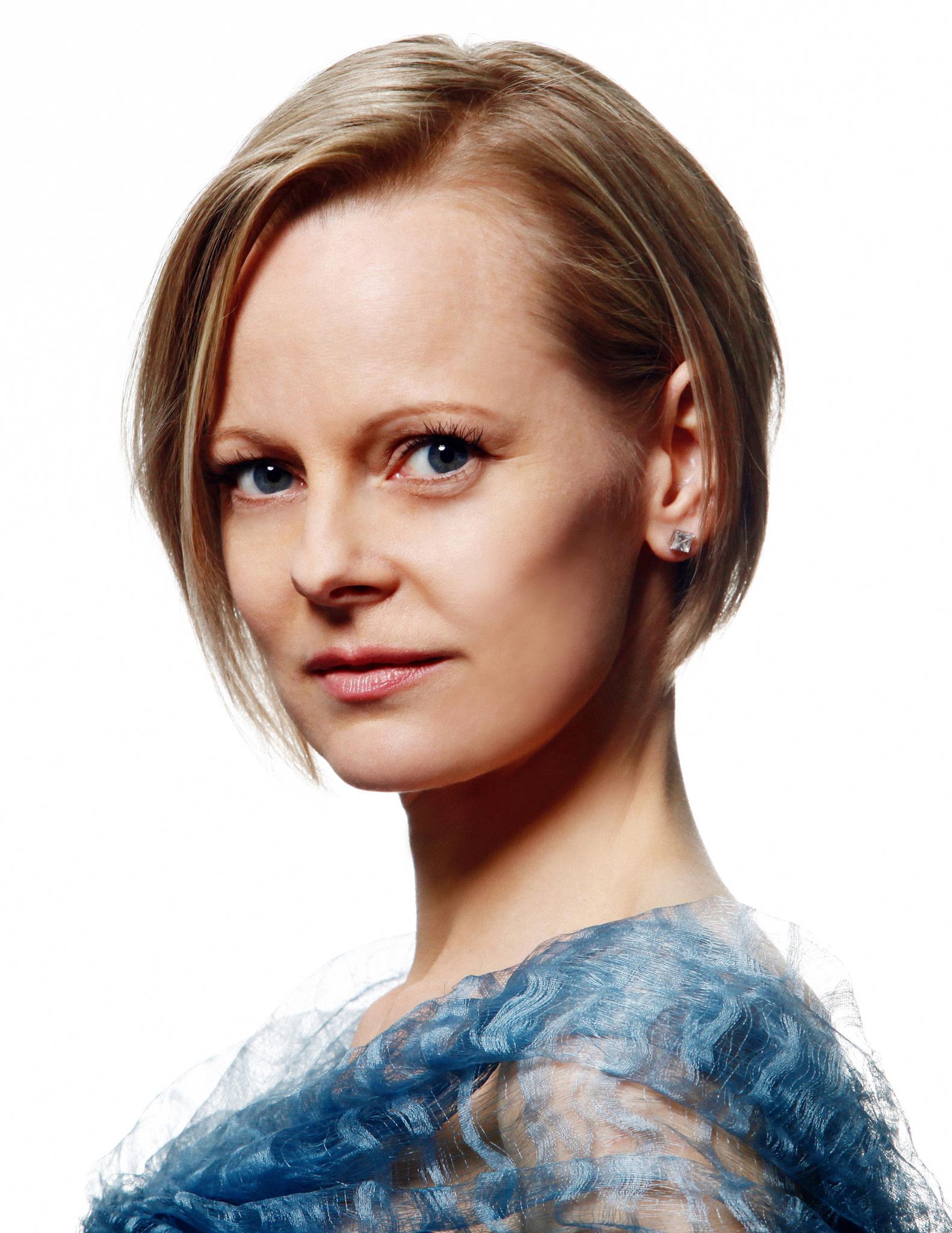
Soprano Carla Huhtanen (photo: Tobin Grimshaw)
People tell me I look my mother on first sight, and also like my dad if they know me. – Finnish stock on both sides.
2) What is the best thing or worst thing about being a singer?
The best thing is that I get to do what I love to do. Learning, exercising and in a sense creating repertoire fuels my brain, body and spirit. Interpreting a character onstage is fulfilling and challenging because it makes one face aspects of themselves that they may not know, or they are afraid to know.
The worst part is having your instrument with you all the time. Vocal wear and tear from speaking, laughing, etc. can tire you out more than singing, since we are rarely continually aware of how we use our voices as we adapt them to loud environments, pollution, allergens, social situations, temperature changes…..aaaaah! No wonder singers are neurotic!
3) Who do you like to listen to or watch?
At this moment I’m listening to a french pop singer – “M”. I’ll often listen to French and Italian radio to keep up languages; and music is a great way to soak them up. I was just in NYC to see Thomas Adès’ chamber opera “Powder her Face” and saw some jazz at the Vanguard – variety is key! I may or may not be watching “August Sings Habanera” on YouTube every day.
4) What ability or skill do you wish you had, that you don’t have?
Driving stick shift. It’s one of the few things on my To Do List. That and learning Russian.
рычаг переключения передач = “stick shift”
in Russian (according to google)
“rychag pereklyucheniya peredach”
5) When you’re just relaxing and not working what is your favourite thing to do?
Sleep? Playing/watching tennis, hanging out with close friends, reading, film.
Soprano Carla Huhtanen (photo: Tobin Grimshaw)
~~~~~~~
Five More Questions concerning participation in Talisker Players’ multi-disciplinary evening Time and Tide, a reflection on the meaning of lives lived
1) How does singing songs (as an artist who is known here in Toronto both for undertaking older operatic repertoire as well as edgy new works) challenge you?
The relationship of music to text, and my relationship to both is intense, exposed and requires a full spectrum of interpretation and technical mastery that a singer cannot express through action. I think our aural sense is more focussed since sound is at the forefront of the concert experience. This said, discovering the text as I sing it (as if I were speaking it) will naturally bring about an interpretation not unlike a theatrical one – just not a 1500-seat theatrical one.
2) What do you love about the works (namely Deuil engoisseux, by Scott Good; Walter Buczynski’s Three Songs alongside Grieg’s well-known Solveig’s Song)?
I love singing with a string quartet! It’s a rare treat to sit among your fellow musicians and feel like a chamber player. The Talisker Players offer their musicians and audiences alike the experience of finding colours in the music, the words and the strings that speak to all who enjoy or wish to discover the power of art song and poetry.
The Buczynski has a lot of chromaticisms and large leaps yet moments of lyrical melody and jaunty rhythms as we explore the relationship of a mother to her three children who have left (or will leave) home. Dorothy Glick’s thought-rich, colour-contrasting poetry puts us square in the life of a mother as she observes, muses, remembers, and prepares for the inevitable “loss” of her children.
Scott Good sets medieval author Christine de Pizan’s heart-wrenching anguished grief as she experiences the recent loss of her husband – a direct, emotional outpouring of a noble woman’s suffering that intrigued the royal court of Charles V in its humanity and its honesty. The music reflects her dark moods, her incredulousness, her futility to escape pain with late medieval/renaissance forms and styles alongside modern quirks and references. The subject is so relevant to our lives that I’d think it were recently written if it weren’t in Middle French….
Interpreting poetry vocally is like combing through a horse’s mane with a fine-toothed plastic comb. Or sometimes it’s like combing through air. It can be dense with palpable emotion and direct, tangible text, or it can be abstract and intellectual, catching in your teeth through random sounds and ideas.
3) Do you have a favourite moment in these works?
There is a small florid cadenza in the Good that bursts out of long, held passages in the work that release the widow’s anguish. It’s a great contrast to the low-lying ranges that book-end the piece.
In the Buczynski there is a vocal glissando moment about wind that I find fun as it spans chest to head voice registers. It is a discombobulating and driving wind! The harmonic “landing points” when the strings and voice lock in to each other feel important in relief to the parts wander away from each other at times. Like parents and their children..
4) How do you relate to the works assembled in the Time and Tide program as a modern singer?
Well, since one of the works is in English, I have the most immediate and sincere emotional reaction to the text. As for the Middle French, part of being a modern singer is having quick, easy access to resources online – and having fun researching historical context, pronunciation and language use of the period.
I am grateful to have had the training to present works of our time to our society. Collaborating with living composers and writers is a passion that leads me to many discussions, debates and successes as we ask ourselves what contemporary vocal art music can offer us in an age of branding and marketing, pitch-correction and celebrity performers.
5) Is there a teacher, singer, actor or an influence that you especially admire?
Sandrine Piau – I have always admired her technical precision, musicality and beautiful tones. She just gets better and better!
Natalie Dessay’s clear process of “living through” words and her character’s emotions is compelling. The Zerbinetta she did in Paris 2004 is hard to forget when watching other interpretations or interpreting it oneself.
I try to go regularly to live theatre to learn about dramatic pacing, range of expression, and what makes someone a good actor. Yeah, I’m that creepy thing staring in the third row. Therefore I admire all the actors I see live – from Mark Rylance at the Globe to Angie Cheng’s hilarious and weird performance at the Rhubarb! Festival last week.
~~~~~~~
Talisker Players present Time and Tide, a reflection on the meaning of lives lived Tuesday& Wednesday, March 5 & 6, 2013 at 8PM Trinity St. Paul’s Centre Carla Huhtanen, soprano, Peter McGillivray, baritone, Stewart Arnott, actor/reader
Tuesday, March 5, 2013 &
Wednesday, March 6, 2013 at 8 PM
Trinity St. Paul’s Centre: 427 Bloor Street West
TICKET INFORMATION
Individual tickets: $30 / $20 (seniors) / $10 (students)
Box office: 416-978-8849
Email: words.music@taliskerplayers.ca
Information: 416-466-1800 www.taliskerplayers.ca
Talisker Players Chamber Music offers one of the most imaginative and exciting concert series in Toronto. In collaboration with some of Canada’s finest young singers, Talisker Players present the rarely-heard repertoire for voice and chamber ensemble. Their unique programming includes readings that illuminate the music and delight audiences with a stimulating, theatrical concert experience. The music, engaging and varied, includes both celebrated works and unknown gems from all styles and periods, with a strong presence of Canadian compositions.
Talisker Players Upcoming Event
On the Wing:Tuesday, May 7, 2013 & Wednesday, May 8, 2013 at 8 pm
An exploration of the magic of birds Erin Bardua, soprano, Vicki St. Pierre, mezzo soprano, Graham Abbey, actor/reader
Trinity St. Paul’s Centre, 427 Bloor Street West
Depending on your taste, there are good and bad things in Peter Gelb’s announcement of the 2013-2014 season at the Metropolitan Opera.
I am most excited by an item that seems to currently be under the radar. Dmitri Tcherniakov will design and direct Borodin’s Prince Igor. Here’s what the New York Times’ article said:
The production, Mr. Gelb said, would strip away the usual medieval pageantry and send Igor on a “psychological journey.”
Tcherniakov is already famous for Regietheater in Europe. By a happy coincidence, his recent Bolshoi production of Ruslan and Ludmilla appeared on TFO last weekend (a much more enjoyable way to spend my Sunday night than with Oscar). Tcherniakov begins with the most conservative look imaginable: except that he’s playing with us, when we discover that the wedding that opens the opera is in period costumes. We’re in the present day, as it turns out, and later we get to a brothel scene.
Tchernikov has faced controversies before, and there’s no reason for him to be faithful to the text, in the first Met production of Borodin’s opera in roughly a century. I expect the “psychological journey” will be very exciting.
Among the rep, there are a few other items that I am eager to see and hear:
A new Falstaff from Robert Carsen
Wozzeck with Deborah Voigt and Thomas Hampson, conducted by James Levine, in his return to the podium
Werther with Jonas Kaufmann
Nico Muhly’s opera Two Boys which unfortunately won’t be among the high-def broadcasts; I’ll have to go see it
Three Richard Strauss operas –perhaps to balance the absence of Wagner from their repertoire, namely reliable Der Rosenkavalier, alongside Die Frau Ohne Schatten and Arabella
There is also some controversy in Peter Gelb’s announcement. He’s made some price adjustments, concerned about the company’s revenues, which surely were hurt both by the continuing aftermath of the financial downturn, and Hurricane Sandy’s impact on the region.
In the NYTimes piece, Gelb is also quoted to say that he
“blamed falling attendance on a “cannibalization” of the audience by the Met’s high-definition movie theater broadcasts.”
It’s a fascinating conclusion to draw, but I wonder if it’s a sound one or not. There have been other analogical anxieties about impacts of related media upon one another. At one time recordings were feared because they’d supposedly put live musicians out of work. The paperless office may still be coming, but print & hard-copy have surely been hit by the migration to various online sources. Are books being replaced by their electronic rivals? That still remains to be seen, given that it’s not a simple one-for-one substitution. Overall, perhaps many more people are reading. But in any case, Gelb has opted to present ten rather than twelve films this year, without explaining his data sources.
When I pictured writing a biographical essay about Isabel Bayrakdarian, the phrase that popped into my head –no lie—is exactly the one you find on her official bio on her website. She really did “burst onto the international opera scene”. I was hearing about her successes abroad long before I had a chance to hear her voice in person. Hers is a unique path, having abandoned her plans to be an engineer, in favour of a vocal career. It’s not surprising then that she’s an artist of rare intelligence. Her voice may be familiar to you from the Lord of the Rings soundtrack (composed by fellow Canadian Howard Shore), from recordings broadcast on radio or live performances.
While Bayrakdarian continues to roam the world, Toronto is her home. The presence of young children and family at home makes our stages & concert halls more attractive to her, and so we’re lucky to have regular opportunities to hear her. One of my warmest memories of the COC is her Susanna in Marriage of Figaro visibly pregnant (and I went to the last performance of the run). Since then she’s been at the heart of many wonderful productions that I’m able to remember vividly for her part in them: Mélisande, Euridice, Ilia, and Pamina. I think there may be more but these are the ones I remember. In each case she’s central to my recollection of that opera (the first haunting scene of the Debussy; her moving handling of a corpse in the grim tableau in the first scene of the production of Idomeneo; goading her husband to turn around in the last act of the Gluck; and as a stronger than usual Pamina in Diane Paulus’ feminist reading of Magic Flute). In May Bayrakdarian will join a star-studded cast for Robert Carsen’s Dialogues des Carmelites by Francis Poulenc.
And speaking of Poulenc, on March 1st Bayrakdarian joins Amici Chamber ensemble’s celebration of their 25th Anniversary. Friday night’s program is titled “Le bal masque”.
I ask Bayrakdarian 10 questions: five about herself, and five about “Le bal masque”.
1) Which one of your parents do you most look like (what is your nationality / ethnic background)?
I’m the youngest of 6 children. I don’t think any one of us really looks like a carbon copy of either parent. I like to say that we’re 6 different fruits from the same tree! I personally have my mom’s lines with my dad’s coloring. My voice comes 100% from mom, while my practical personality is from my dad. To this day, I’m very handy with fixing all things mechanical, electrical, and structural, and I get great pleasure from building or creating with my hands.
2) What is the best thing or worst thing about being an opera singer?
I love the gypsy lifestyle of an opera singer. I have a free spirit. I love my independence. You can’t imagine how much I love travelling and living in different places. Even after 15 years in this business, I feel giddy with excitement when I travel, and feel at home in airports. I love that this profession allows me the independence that comes from choosing my work, be it a new recital repertoire, concert repertoire, or an operatic role. I love that through my work, I can open up the world to my children, so that they also travel and experience different cultures, languages, and cuisines. I also love working with new people all the time, because through new ideas and perspectives, my life is enriched, and by hearing new expressive voices and interpretations, I’m inspired anew.
The same reason for my joy also happens to be the reason for my pain. It’s not always possible or practical for my family to travel with me, and on these occasions being away from my 2 children is such an indescribable pain. Skype-ing actually hurts even more, because when I see them on the screen, all I want to do is hold them, hug them, and kiss them!
3) Who do you like to listen to or watch?
Youtube is great when you want to see and listen to many different interpretations of the same piece, especially by the glorious singers of the past, such as de los Angeles, Schwarzkopf, Tebaldi, Baltsa, and Scotto. However, when I’m not researching or learning new repertoire, I love listening to world music, from Latin America to the Middle East. I can relate to this music and feel comfortable and peaceful in it, because of the mosaic of my background. Being an Armenian born in Lebanon, I was trilingual by the age of 5 (Armenian, Arabic, English) and was exposed to many different types of exotic music from a very young age. When I briefly lived in Spain, I took up Flamenco dancing and from then on the latin fire started burning in me too. My whole musical world opened up to a new level when I met my husband 11 years ago, whose encyclopedic knowledge of music and composers meant that my musical horizon became vast, ever-changing, and exciting.
4) What ability or skill do you wish you had, that you don’t have?
When it comes to wishes or skills, my philosophy is as follows: if I believe that whatever I want is attainable, then I actively work on obtaining it through study, action, thought, and/or prayer. I don’t give up until I do. If there is something I can’t change, then I accept it and let go. So, I don’t believe in lamenting or wishing for something. You either work on getting it, or you forget about it and don’t dwell on it.
Having said that, wouldn’t it be lovely if I could magically put names to faces accurately, every single time? Too many fiascos and faux-pas have happened in the past, worthy of Coen Brothers movie scripts, but somehow I always live to laugh about it afterwards.
5) When you’re just relaxing and not working what is your favourite thing to do?
Without any doubt: cooking! I love to cook; I love making elaborate and delicious meals, but most of all, I love seeing the food I’ve prepared being devoured and enjoyed by the people I love. I have the talent of creating multi-course meals in a very short time, and can come up with many creative dishes with whatever I have at hand. Get-togethers at our house have become must-attend events, which is a great thing, because I love to entertain.
~~~~~~
Five More Questions concerning participation in Amici Chamber Ensemble’s special 25th anniversary concert “Le bal masqué”:
1) How does singing this sort of repertoire (Ernest Chausson’s Chanson perpétuelle, Francis Poulenc’s Le bal masqué, and Xavier Montsalvatge’s Cinco canciones negras) challenge you?
In this program, all the vocal repertoire is performed back-to-back in the second half. These 3 pieces are very different from each other, stylistically and vocally. The Chausson is a classic example of the French Chanson, the Poulenc is a witty presentation that involves play on words with surreal and unexpected surprises, and the Montsalvatge is an exotic and politically loaded commentary on the American occupation of Antilles. Since I perform recitals quite often, where you have to assume different characters in short successions, I don’t mind the shift in gear when performing these pieces. As a matter of fact, the development and evolution from the romantic to the exotic is a natural and comfortable progression, both dramatically and vocally.
2) What do you love about these works?
First and foremost, all three pieces are a great fit for my voice. I can be both expressive and a risk-taker in this repertoire. Second, the music of each work is so satisfying to sing. The Chanson Perpetuelle is a romantic piece that just takes your breath away. I don’t think there’s any other piece written for voice/string quartet/piano that’s as effective and powerful and genius as this piece. Then you have a piece like Poulenc’s La bal Masque, which is written for a mini orchestra without a conductor. It intersperses whimsical, silly music and surreal poems with unexpected arcs of gorgeous melodies. The last group, Montsalvatge’s Canciones negras, is usually performed either in the piano/voice version or the full orchestra version. For this concert, my husband Serouj Kradjian arranged this cycle specifically for the group of musicians playing in the concert. So I feel extremely privileged to have top-rate soloists all assembled and accompanying me in these pieces.
3) Do you have a favourite moment in these works?
In Chanson Perpetuelle, when the initial love affair is being described, I could swear that the text reads like a page from a steamy Harlequin novel. Definitely not for children! And the music underneath is so sexy, that you can hear the carnal and violent desire of both lovers, the climax/consummation, and the satisfied calm afterward. Even if I was vocalizing there instead of singing words, I’m sure the audience could follow the story: FYI, this is the text:Le premier soir qu’il vint ici Mon âme fut à sa merci. De fierté je n’eus plus souci. Mes regards étaient pleins d’aveux. Il me prit dans ses bras nerveux Et me baisa près des cheveux. J’en eus un grand frémissement; Et puis, je ne sais plus comment Il est devenu mon amant
In Poulenc, I think the first piece will be a treat to whoever is fluent in French because there’s so much play on words. But my favourite place is in “Malvina”, where after describing the banality and absurdity of Madame Malvina’s life throughout the song, Poulenc surprises us by glorifying her death, and therefore gives us the most romantic – almost operatic- phrase in the entire piece, which is gorgeous to sing. In this song, he also gives many hints of phrases and lines from his opera the Dialogue of Carmelites.
There is one piece in Montsalvatge’s cycle “5 Canciones Negras” which is very dear to my heart, and that is the lullaby. The slave mother is singing to her child, who has “eyes which look out to the sea” meaning the child has blue eyes, as he’s been fathered by the American “master of the house”. The mother tells him that he’s not a slave anymore, and that if he goes to sleep, the master of the house (i.e his father) will gift him a jacket with buttons, like an American “groom”. Even though it’s a bittersweet lullaby, you can feel the absolute love of the mother towards her child and her protectiveness towards him.
4) How do you relate to the works assembled in the Bal Masque program as a modern singer?
Bal Masque is described as a profane cantata. We usually associate cantatas with religious music (think Bach) so it’s already a sign that what we’re about to hear is not ordinary or expected. In addition, this piece is rarely sung by a female voice, and has been traditionally sung by a baritone. I’m assuming that in Poulenc’s time, it was deemed more appropriate if scathing portraits of unpleasant women were delivered by a man instead of a woman. However, if you refer to the root of the original poem, Max Jacob’s “Laboratoire Central” from which Bal Masque was excerpted, you see that it’s got so many surreal elements, and surrealism in art is the presentation of recognizable objects/elements in bizarre context. So, when the singer is swearing on their beard, “par ma barbre”, who’s to say that she doesn’t have a beard, on her face or anywhere else for that matter???
5) Is there a teacher, singer, actor or an influence that you especially admire?
From my earliest days, I’ve admired both Placido Domingo and Marilyn Horne for their seemingly endless energy, honest and direct artistry, zest for life, unquenchable thirst for learning new roles and exploring new horizons, and most of all, for being very down to earth, practical, and positive human beings. I’ve discovered that the truly great singers are actually great human beings too, and through these role models I have gotten the ultimate proof that music refines the soul.
~~~~~~
Soprano Isabel Bayrakdarian
Friday March 1st, Isabel Bayrakdarian joins the Amici Ensemble in their program “Le bal masque”:
Beethoven’s Septet for Strings and Woodwinds in E-flat Major, Op. 20;
Chausson’s Chanson perpétuelle, Op. 37;
Francis Poulenc’s Le bal masqué, FP 60;
Montsalvatge’s Cinco canciones negras (arr. Serouj Kradjian).
Whenever a new pair of presenters come out onto the stage at the Academy Awards, the pit band begins to play something suitable.
Nobody does that when I walk into a room.
I was thinking about this after reading some negative commentary –again—about the COC’s recent production of La Clemenza di Tito. It closed Friday night, a production I loved without reservation, even if that view is not one shared by some people. There was a recent piece in a newspaper about this production (and the COC Tristan) claiming that opera is “moribund”.
I need to be careful I don’t lose my way, distracted by my own passion for this subject. There are several ways in which one can read my headline, about pageants of power, and I hope I can make them all work.
I begin this in hopes of exploring some of my favourite music while putting it into a meaningful context. And while I am at it, I will do just as the newspaper has done, namely to say something controversial and upsetting to blatantly attract attention to myself.
When a reviewer makes a strong statement I believe there are usually two conversations going on, that are inter-connected.
The reviewer is telling us about something
The reviewer is telling us about themselves
No, a reviewer doesn’t say “look at me, I am a musicologist and an expert.” But in various ways, their comments about the opera or movie or The Oscars will tell you possibly something about the subject (opera, movie or The Oscars), while implicitly telling you a lot about the reviewer as well. You’ll quickly get a sense of their competencies (or lack thereof), in their use or avoidance of technical language, in their use of buzzwords, in their familiarity with what’s hot or not hot. And of course, as you judge them, perhaps you’re measuring yourself, figuring out whether you, dear reader, are their peer or perhaps not (and zillions of permutations besides).
Let’s think a bit about what’s going on in an opera like Clemenza di Tito, which may resemble some of what I described in the Oscars show. As I said, when I walk into the room nobody plays a loud fanfare or a burst of a tune that in any way can be associated with me. Hopefully this is not surprising.
I bring this up in context with opera seria and Shakespeare. Haha, I bet you didn’t see that one coming. Shakespeare? No he never saw an opera seria, given that the form wasn’t invented until quite a long time after his death.
In Shakespeare a funny word pops up from time to time. Here it is in The Merchant of Venice
PORTIA
Go in, Nerissa;
Give order to my servants that they take
No note at all of our being absent hence;
Nor you, Lorenzo; Jessica, nor you.
A tucket sounds
LORENZO
Your husband is at hand; I hear his trumpet:
We are no tell-tales, madam; fear you not.
Aha, but what’s a tucket? The fact that Lorenzo says “I hear his trumpet” is a clue. In fact a director (who was telling me what to compose for that show) explained to me that a tucket is a kind of fanfare, usually associated with a person of nobility. I remember fondly the way he demonstrated, with a kind of tah-ta-rata-TAH.
Indeed, when they say “his trumpet” it’s in more than one sense. The trumpet is played by a servant (which is all that musicians amounted to, until quite recently), so that’s one way that it’s “his trumpet”, indeed it’s his trumpet and his trumpeter in every sense. But the tune would be the same tune each time, as though Wagner had written him a leit-motiv. It was indeed a signature tune. Nota bene that at this point in time everyone used false advertising. Unlike, say, the music Wagner gave Hagen, you’d have a tune that would portray you as a straight-shooter, a wonderful person.
And the more money you had, the more power you could signify with your entourage. Indeed, this is the whole point of an entourage.
So I think we’ve made the connection between Shakespeare and Oscar: at least as far as those introductory tunes go. It’s the same deal, of course, when someone wins, which is then accompanied by some music associated with the film. The winner comes to the front of the auditorium accompanied by this tune, gets to talk for oh twenty seconds or so, before the band starts playing again. And where its previous playing signified honour, this time the music signifies ignominy: that you have to shut up and shuffle off the stage.
That is only one aspect of the Oscars that i dislike. There are others, but again, i don’t want to veer off topic. (For example, it’s the 10th anniversary of Michael Moore’s courageous acceptance speech, calling Bush’s bluff on WMD, which was greeted with more boos than you’d expect if you were a Jew crashing the Nuremberg rallies. It was not Hollywood’s finest hour.) But i digress.
So you may wonder, what does this have to do with Opera seria? The pattern of the tucket can be seen in opera. The power pageant that is underscored by a tatataratataTAH –or something like that—is fundamental to opera.
Let’s compare two examples.
Consider recitativo secco also known as “dry recitative”. Dry? Because there’s almost nothing there except the bare bones of accompaniment plus the singing of text.
This style was designed for persons of no particular class. Note that Mozart has here taken it to use in a dialogue between a servant and a noble. But Don Giovanni? Haha, the man and the opera break all the rules.
And what of recitativo accompagnato? In this example you can see that it’s a mixed blessing, being both less flexible for dramatic purposes, and also easily capable of drowning out singers (especially when the conductor isn’t even looking).
In any case, the understanding at the outset—before Mozart started breaking the rules—was that the operas containing persons of high rank (aka the pompous people of opera seria) would use accompanied recitative, music signifying that you were a somebody. And if you were a nobody (the usual classes found in comic opera), your music would underline this.
It should be obvious that loud music is something we use to tell the listener all sorts of things about power relationships. Who has the loudest entourage? I quoted a bit of the Mozart Requiem in a review a few days ago, that demonstrated the moment in the Judgment Day narrative when God announces his arrival. Mozart’s God? very civil & stylish. Notice that when Verdi or Berlioz come to this moment (because the Requiem Mass employs more or less the same text) they seek to scare the crap out of us. Oh and if you play this, turn the volume up. Don’t worry, it’s just music, not the actual trumpets of Judgment telling you that the world has ended.
Viva Verdi..!
And so pageants of power can take many forms. When you get a film –and it can be Biblical Epic or sci-fi—the same dynamic applies. Why not cite the most blatant example, the most oft-imitated of all?
This opening was, first and foremost, a hymn to itself. In this set of opening credits Kubrick proclaims –with the help of Richard Strauss– the power and importance of this film, and who are we to argue? Oh and yes I do love this film.
Let’s backtrack a bit. I decided to write this while listening awestruck to a couple of passages in La Clemenza di Tito, blatant celebrations of power. When Mozart wrote the opera he was simply hoping to encourage the viewer to trust their sovereign, to blissfully let the power music wash over them, while they trusted in their king. If you listen to this, pretending that the French Revolution never happened, that absolute rulers can be as excellent as the one Mozart shows in this opera, you do not fight the manifest power of this music, but are at one with the chorus singing Tito’s praises.
Mozart himself seemed ready for revolution, having already embraced Figaro a few years earlier, in a play that wasn’t so much a catalyst for change as a symptom of changes already underway. If we can remember that this is the same man who wrote Clemenza di Tito, a man with a superbly developed sense of irony: why can’t conservative critics?
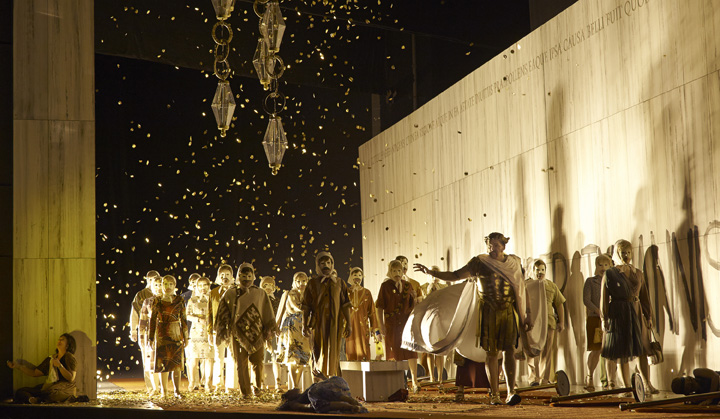
Christopher Alden managed to give us most of Tito with a lovely veneer of irony. In the final scene (which by the way, begins with the very choral procession I played above: see the picture below), Tito and the populace enter. The Emperor is in the process of becoming an icon, a statue, and who can blame him, when almost everyone onstage has at one point or other betrayed him?
Sesto (sought to kill him)?
Vitellia (asked Sesto to do it)?
Servilia (turned down his marriage proposal)?
Annio (pleaded for Sesto, and is the reason Servilia turned Tito down)?
If opera companies actually presented operas exactly as they were written centuries ago, as though the stage were some sort of museum? Then indeed opera would be less than moribund. It would be dead.
Recalling my assertion –that reviews are always about two things, namely the topic being reviewed and the reviewer—there’s a lot of irony in a newspaper pointing its finger at an institution and saying “you’re moribund”. Newspapers are themselves being tested for signs of life. Was the provocative headline meant to proclaim that an art-form was in trouble, or perhaps an attempt to signal that the newspapers weren’t irrelevant…? Or not dead yet…?
Michael Schade as Tito (standing), and the chorus in the Canadian Opera Company’s production of La clemenza di Tito, 2013. director Christopher Alden (Photo: Michael Cooper)
It’s late at night. It’s intermission, as I watch Philip Glass’s opera Akhnaten from Jacobs School of Music, at Indiana University, Bloomington, conducted by Arthur Fagen, directed by Candace Evans, and live-streamed on my laptop. This student production is very impressive, raising some interesting thoughts, in no particular order. How cool is it that I am watching this thing live, while I comment? What a world we live in. This opera invites this kind of fourth-dimensional thinking, an opera that straddles millennia like a colossus.
Oh how I wish we’d stage it (or Satyagraha) here in Toronto.
Click the picture to read more about the production
The design/directorial team have chosen to depart slightly from what Glass wrote, in one of the more intriguing departures from a text. The opera is set mostly in the distant past (the time of Akhnaten), plus a tiny bit in the present day, when the dead souls of Akhnaten & his family suddenly recognize –sometime in our century—that they’re dead. It’s one of several magic moments.
The big change? That we begin not in ancient times, but in the modern Egyptian uprising, among burned out cars. While I was dubious when I read of this, I was moved powerfully when I recognized that this is exactly what this opera is about: an opera concerning the fights between faith groups in ancient Egypt. Akhnaten banishes the old beliefs in favour of the first mono-theistic religion in history; and of course he and his family are removed in a violent upheaval when the old faith & power structures are restored. When it appeared the talk was that this is an opera about faith and religion; and that Satyagraha is an opera about politics.
In Satyagraha Gandhi and his followers protest in South Africa. But its core? Faith & spirituality. Gandhi tells us (possibly my favourite lines in all opera)…
Whenever the law of righteousness withers away and lawlessness arises, then do I generate myself on earth. I come into being age after age and take a visible shape and move a man with men for the protection of good, thrusting the evil back and setting virtue on her seat again.
Gandhi takes action out of conscience, but as a kind of incarnation of the spirit of good. Martin Luther King –whom we see murdered near the end of the opera—likewise steps forward, passionately doing what he believes is right. By the spiritual calculus of the quote, both Gandhi and King, and also –by implication—such figures as Jesus, also step forward to incarnate the spirit of truth and good in human form on Earth. My mind boggles thinking about this paradox: that the supposedly religious opera is about politics, and the supposedly political opera is about spirit & religion. I think, too, that it’s intriguing that when we see people talk about faith –as we see Akhnaten praying—that it’s less spiritual in its way than when we see Gandhi trying to lift the spirits of his followers in their struggle. Seeing someone pray is not as dramatic as seeing someone live through a crisis of faith, as we see several times in Satyagraha. How odd that is, but how true to how the human eye perceives things. I wonder, am I partly influenced, too by the directorial choice, that frames Akhnaten’s spirituality within a political frame, suggesting that his choice is within a temporal frame, that his faiths will be overcome and overturned, just as the Egyptian uprising is part of a political struggle between faith groups. That frame makes the prayer seem to be a physical and human reality rather than a timeless and spiritual one. But then again what we’re really talking about is that discrepancy between the ideals of a religion and its spiritual essence. And the metaphor of the current uprising superimposed upon this opera aligns Akhnaten with the out-of-touch tyrant Hosni Mubarak who is overthrown by the will of the people (did they want that? I wonder. It’s a brave choice). The one really spiritual moment in Akhnaten (when the offstage chorus intones psalm 104) works precisely because we don’t have the physical reality of an actor getting in the way of our own prayerful moment. Did Glass realize what he’d created? From his current vantage point –75 years old—chances are he gets it now.
And yes, it moves me that this quote is older than any of those humans I named, that this is an ancient idea.
I love that this university chooses to stage an American opera rather than standard repertoire. Yes it’s true that the students would gain from learning a role in a Mozart opera. But isn’t it wonderful that these students are challenged to do something difficult & worthwhile: like this. I was commenting (more than once) how proud I was to be in a production of a Feydeau farce at Ryerson, a play you won’t usually find on a commercial stage. Ditto Indiana U.
It’s the day before the Academy Awards, which means Canadians can indulge in our favourite sport. No I don’t mean hockey, which is more of an obsession than something you could dismiss as mere fun. It’s too much of a passion. No, the favourite sport I am referring to is Canadians puffing out our chests when one of our countrymen is noticed in the USA.
Last year it was Christopher Plummer’s turn to finally get recognition (he should have won several times before), while the foreign language nominee from Québec (notice how I put in the accent aigu, meaning you pronounce it to rhyme with Kay-beck, not the anglicized Quee-beck) unfortunately lost out.
This year Mychael Danna (Anglophone from Ontario this time) is up for an Oscar. Again he’s a talent who could have won several times already. Maybe this time?
And in newspapers and blogs emanating from New York, another Québecois is winning acclaim. No it’s not a movie although the man is an acclaimed director. I speak of François Girard, who may be known to you as the man behind Thirty-Two Short films about Glenn Gould and The Red Violin.
Film-maker and opera director Francois Girard (click picture for an interesting interview)
He has also been a frequent presence in Toronto as a director for the Canadian Opera Company. As I puff out my chest – proud of his current acclaim—I want to be honest. I was conflicted about both of his previous triumphs in Toronto.
Triumph #1 was the Stravinsky double bill of Symphony of Psalms and Oedipus Rex, dedicated to victims of AIDS. I was sensitized to why it’s problematic to associate a guilt-tainted plague in Oedipus Rex with AIDS, and so perhaps prevented from opening myself fully to the experience. Even so it remains one of the most powerful things I’ve ever seen, a warm memory of Richard Bradshaw & Michael Schade that won’t fade soon.
A scene from the Canadian Opera Company’s production of “Oedipus Rex with Symphony of Psalms” at the Edinburgh International Festival, Playhouse Theatre (Scotland), 2002. Photo by Douglas Robertson CLICK for a contemporary review from Toronto Stage
Triumph #2 was Girard’s piece of the COC Ring, namely Siegfried (recalling that the COC took the unorthodox path of dividing the cycle among four directors), again in collaboration with Michael Levine. I’d complained in a review I posted about aspects of the production, one that pleased critics & fans alike; my quibble was mostly about the staging of the forging song. Even so, Girard’s interpretation stands as the tightest of the interpretations in the COC’s cycle, as conceptually rigorous as any of his other work, if you look back at the Stravinsky double bill (a kind of waste landscape, with a pile of bodies), and the Gould film (borrowing its structure from the Bach composition most closely associated with the pianist namely the Goldberg Variations). Similarly, Girard structures everything around the conceit that the world is all in Siegfried’s head, and so, for example, the dragon who fights Siegfried is a compound of several humans strung together in a bizarre puppet, and the magic fire is actually a human chain trying to scare Siegfried away.
Parsifal, which premiered last year in Lyon, and recently opened at the Metropolitan Opera in New York, is perhaps the same sort of opera, but with a much bigger budget. Co-produced by Opera de Lyon, the Met and –voila—the COC, it appears we are again in the presence of something conceptual, exploring the fundamental subtext of the story. With Oedipus it was plague & death. With Siegfried it was the possible solipsism of poor Siegfried, isolated in the forest. Parsifal? I will see it next week, so I can only go by what I have been reading, but it appears to take the Christian grail story and re-frame it around deep questions of gender & sexuality, once again calling upon Michael Levine to work his magic.
Girard’s Parsifal has been getting the kinds of reviews that help Canadians indulge that sport I was telling you about. The Metropolitan Opera emails include the following quotes from reviews:
“Radiant new Parsifal makes Met glow, audiences cheer… I don’t think better singers exist anywhere in the world” (Bloomberg).
“In imagination, cohesiveness and brilliant execution, this Parsifal honors the composer’s concept of total artwork” (Star Ledger).
“A magnificent new production… It is an exquisite pleasure for the eye and ear, it’s also food for the soul” (New York Post).
“Arresting, consistently absorbing… a powerhouse cast of singers… a moving, modern vision” (Wall Street Journal).
“A modern new Parsifal for the 21st century” (Huffington Post).
“Both the production and the performance caught fire, and the Parsifal of Wagner’s imagination came vividly to life” (Musical America).
Here are two very detailed reviews that tell you a great deal about the production (if you’d rather not know what you’re going to see, perhaps you shouldn’t read them yet…but i did and they whetted my appetite):
Even if the great voices (who may or may not be available when the production comes to Toronto) may have influenced the critiques, the key to this production is the relationship of the design concept to the directorial conception of the work. I am eager to see what Girard & Levine have accomplished, in the high definition broadcast next weekend. If you’re curious look for it at a movie theatre near you March 2nd.
As usual, concerts by Tafelmusik Baroque Orchestra & Baroque Chorus are exercises in creative programming. Their latest (premiered last night, running until the weekend, and announced as completely sold out) isn’t simply a presentation of the Mozart Requiem, but a study of the composer’s psychology.
They seemed to be asking us how to frame this work, how to understand Mozart’s musical journey. Conductor Ivars Taurins & the Tafelmusik Chamber choir presented it in context with Mozart’s influences. He reputedly played a lot of JS Bach’s Well-tempered Clavier (a work supposedly to be found open on any given day, on his keyboard). And so we’re led to make connections to the contrapuntal writing in the Reqiuem.
We were also told that while the young Mozart had written some religious works, such works were infrequent once he came to Vienna.
The first half was an intriguing experiment, one that Taurins was honest enough to explain to us, whereby they’d originally thought to alternate Bach family motets with orchestrated fugues; but opted instead to cluster the fugues together, followed by the pious choral works.
The first half closed with a shimmering reading of the familiar Ave Verum Corpus.
In the second half we heard the Requiem. I found myself feeling the edginess of the Requiem, which may not have been what was intended. I did not see the work arising within the context of the opening works, whose genuine piety is in contrast to the theatricality of Mozart’s writing. I couldn’t help thinking that maybe Mozart was unable to finish the work because he had writer’s block, a lack of connection to the text. Much as I love parts of the Requiem (the first half much more so than the latter portion: whose authorship is not so clear to me), I feel a closer connection to the operas written in Mozart’s last year than anything religious or contrapuntal.
I feel pleased that Tafelmusik and I seem to be on a similar wavelength, exploring musical journeys (as I have been doing the past few weeks, taking us from Troyens to Tristan, and soon on to Parsifal). I realize now just how fortunate we are in Toronto, currently exploring Mozart’s last year.
La Clemenza di Tito closes tonight at the COC. Mozart’s Requiem is currently being presented by Tafelmusik. And in a few short weeks Tafelmusik will collaborate with Opera Atelier to bring us the other opera of Mozart’s last year, namely The Magic Flute. It’s a remarkable fluke, one that I am determined to explore & enjoy.
I couldn’t help hearing connections, by the way. Listen to Sesto’s “parto, parto” with its big intervals in the vocal line (so typical of opera seria), and the clarinet.
Now listen to the bass soloist’s “tuba mirum” from the Requiem.
I was struck by this and other parallels, thinking of how daringly theatrical Mozart was in his composition.
Tafelmusik Baroque Choir, led by Ivars Taurins, get completely inside this music, particularly the Mozart. Taurins kept everything moving at a brisk pace, conducting with more modest gestures than what we used in his recent Messiah, but every bit as genuine.
Nathalie Paulin was especially spirited in her delivery of the soprano part, although the quartet (including Laura Pudwell, Lawrence Wiliford and Nathaniel Watson) were solid throughout.
We’re very lucky in Toronto. I felt a small-town innocence to the presentation that belies the world-wide reputation this ensemble enjoys. From the energy of the conductor & orchestra, to the joyful reception from the audience it’s clear that there’s a huge appetite for this music in our city, and an appreciation for our artists.
McLuhan’s dictum “the medium is the message” has some curious ramifications in the fourth dimension (the dimension of time). An archive gathered across any significant period will function not just as a record for the subject(s) portrayed in the images, but also testify to the history of the medium.
Sometimes that testimony is so strong that our understanding of the past is completely tied to the medium: as when we listen to recordings of singers from the past. While Jussi Björling’s voice is heard very clearly in recordings made at the end of his career (he died in 1960), the orchestra isn’t so clear in his early recording (1930s); the star of the previous generation, Beniamino Gigli isn’t captured quite so perfectly in the recordings from his time, while with Enrico Caruso, the recordings are sufficiently imperfect that we begin to wonder just how good he truly was, and how he would have sounded. And further back? The rest is silence, because we have no record.
This is a preamble to considering the photographs of Franz Liszt. So many of the great media icons of recent history are, alas, dead. While it’s true that Marilyn Monroe and Jimi Hendrix and James Dean died young, we have wonderful records of other stars who lasted at least as long as Liszt’s three quarters of a century. But none of them made their mark in the 19th century. The long-lived Hungarian pianist, composer, and (eventual) abbé was one of the first great artist-celebrities in history. While you may not think much of Ken Russell’s film Lisztomania (1975), I love this suggestive title, ahead of its time in deconstructing a classical icon. While it’s imprecise to see a 19th century pianist through the lens of a rock band (that is, to imagine Liszt as an early prototype of the Beatles or Elvis), there are still many parallels to consider. For example, as a result of the feverish attention the pianist generated, photographers were eager to take portraits, knowing they’d be hugely in demand. Again, we need to see past our prejudices; while portraits were already largely irrelevant as historic evidence in the days of Karsh, in a time of primitive photographic technology (ie the middle of the 19th century), the formal staged portrait was one of the key documentary sources.
Franz Liszt nelle fotografie d’epoca della collezione Ernst Burger is a handsome over-sized book recently acquired at the Edward Johnson Building’s music library, containing a wonderful collection of portraits of Liszt. Googling the title shows that it’s available from Amazon in several countries as well as the NY Public Library.
Burger’s book was partly occasioned by the Liszt bicentennial (in 2011), but driven principally by another (and for me, unexpected) motivation. In the prefaces we discover that the book records an exhibition held in Italy, where the great virtuoso frequently made his home: Villa d’Este.
Yes of course, I remember the Villa d’Este from L’Années de Pelerinage (“Years of Pilgrimage”).
More about the music in a moment.
The exhibit was an opportunity for the proud inhabitants to celebrate Liszt’s connection to a small part of Italy that the composer-pianist used to frequent throughout his life, in an exhibition of photographic portraits, recorded in this wonderful collection.
These compositions are like travelogues, although the word really doesn’t do them justice. They’re arguably derivative, from Byron’s Childe Harold’s Pilgrimage and Berlioz’s program symphony Harolde en Italie. What Berlioz & Liszt accomplished has about as much to do with Byron, as Columbus’s exploits have to do with China (his original objective). Year One includes some remarkable mood pieces that resemble paintings, as though recording travels through the landscapes of Switzerland.
Year Two takes us to Italy, including the famous Petrarchan Sonnets.
You may say that I digress, but I am talking about Liszt. I can’t show you the pictures, can i..? I can only speak of their subject, this fascinating fellow who went through several interesting incarnations. The earlier photos show the handsome pianist, clearly accustomed to public acclaim & attention. And then in this enormous collection of portraits, we see him morph into the figure he’d become, the abbé withdrawn from public life, aging but still strikingly handsome. Because of his fame, people often asked to be photographed with him: leading to many charming group photos.
No, these are not photos of a man playing a piano: which by the way could have been useful. How did Liszt sit? While we do see him pose politely at a piano, that’s not the same as a picture of how he looked while playing. Yet we do have sketches showing us his attitudes at the piano, so it’s not as though we’re in the dark about this.
I can’t be objective, as I am the Lisztomaniac I spoke of in the title. I am so totally fascinated by the man that I find each of these photos intriguing.