Philadelphia pairs from Jonathan Demme

We watched Philadelphia (1993) last night for the first time in awhile. I’m just writing this to call attention to a pattern I think I’ve observed in the work of director Jonathan Demme.

I haven’t seen all of his films, but did devour several upon their appearance, notably Something Wild (1986), Married to the Mob (1988), Silence of the Lambs (1991), Philadelphia (1993) and more recently Rachel Getting Married (2008).

The concept I keep grabbing onto with Demme is pairs.

In Philadelphia I’d point to the juxtaposition of two lawyers you see on the film’s poster and the cover of the video, who are at the heart of the story, namely Andrew Beckett (Tom Hanks) and Joe Miller (Denzel Washington).

Near the beginning of the film there’s a great scene shot with the two in an elevator with a third person between them, a shot with such symmetrical composition as to be worthy of that compulsive symmetrist (is there such a word?) Wes Anderson.

Beckett has AIDS, has been fired from his firm and will die before the end of the film. Miller is a black man who also faces discrimination even as he utters some of the same homophobic bigotry as the partners in Beckett’s firm. After initially rejecting the case Miller agrees to represent Beckett.

We are seeing displays of loving kindness from two different families, both Beckett’s extended family, (all of whom are supportive of Andrew’s ordeals) and Miller’s family, that has just recently enjoyed the arrival of a new baby. One of the most magical oppositions is set up when we first see Hanks’ response to the Maria Callas aria as he speaks of love, then the same music underscoring Miller’s return home to his sleeping baby, whom he seems to embrace with a new appreciation of mortality, a new level to his love. While much was made of Hanks’ performance (winning an Oscar) I am as impressed with Denzel’s nuanced portrayal of a man whose character arc begins with bigotry and a rejection of homosexuality, growing towards something like acceptance.

The other pair I’d like to point to in this film is musical. Demme frames the movie with a pair of songs.
We open the film with Bruce Springsteen’s Oscar winning song “Streets of Philadelphia”, a song I’ve struggled to hear in the multiple times I’ve seen the film.

Okay! This little blog is as much about me deciding, hey let’s look at those lyrics! This song opens the film with a series of shots of people in various settings.

I was bruised and battered
I couldn’t tell what I felt
I was unrecognizable to myself
Saw my reflection in a window
And didn’t know my own face
Oh brother are you gonna leave me wastin’ away
On the streets of Philadelphia?
I walked the avenue, ’til my legs felt like stone
I heard the voices of friends vanished and gone
At night I could hear the blood in my veins
Just as black and whispering as the rain
On the streets of Philadelphia
Ain’t no angel gonna greet me
It’s just you and I my friend
And my clothes don’t fit me no more
A thousand miles just to slip this skin
The night has fallen, I’m lyin’ awake
I can feel myself fading away
So receive me brother with your faithless kiss
Or will we leave each other alone like this
On the streets of Philadelphia?

I find this first song perhaps a better composition than the other one, a perfect creation that stands alone. Yet it’s the other song, Neil Young’s Philadelphia, that always stays in my head, that usually reduces me to a wet lump of tears and sobs, and for days afterwards has me running the song and scenes of the film through my head.

Sometimes I think that I know
What love’s all about
And when I see the light
I know I’ll be all right.

I’ve got my friends in the world,
I had my friends
When we were boys and girls
And the secrets came unfurled
.

City of brotherly love
Place I call home
Don’t turn your back on me
I don’t want to be alone
Love lasts forever.

Someone is talking to me,
Calling my name
Tell me I’m not to blame
I won’t be ashamed of love
.

Philadelphia,
City of brotherly love.
Brotherly love
.

Sometimes I think that I know
What love’s all about
And when I see the light
I know I’ll be all right.
Philadelphia.


I have to ask, is that academy award for “best song” to be understood as best song in some absolute musical sense? or the best song in the dramaturgical sense of how it functions in the film? Because for me the first song, good as it is, has little connection for me to the film, the second one however completes the movie for me, one of the most perfect endings I’ve ever seen to a film. Howard Shore, who composed the film’s score might deserve some credit for this as well, as he segues smoothly from the song to the music in the credits. Indeed I think Shore’s score was written with this song in his head, a very accomplished and under-rated piece of work.

Young’s song hits me in combination with the home movies of children playing at the film’s conclusion, the words sounding as though we were hearing from the protagonist. Oh it’s absurd really, Neil Young doesn’t sound like Tom Hanks, but he does sound like a child full of questions. What does Andrew feel after death, as all these loved ones celebrate his life? I feel the song speaks as though Andrew is between lives, contemplating the meaning of the life that’s to come (meaning in that future from the old films, of growing up to become the adult Andrew) and perhaps looking back after this life asking what it all meant.

Neil Young’s child-like delivery plays into this, seemingly struggling to understand the meaning of love and life.

It gets me every time I see it, which might be why I don’t see this film too often. I don’t want this song to lose its power to move me.

That pattern of pairs that I think I see may strike you as overly reductive. But I see it in other Demme films. In Something Wild there’s a kind of walk on the wild side by both of the protagonists, although the significance is different for each, as each one confronts their identity. In Married to the Mob too, we can’t help noticing the crooks who wear guises and the police too who pretend to be something they are not. In Silence of the Lambs we watch a criminal held in jail assist the police to catch another criminal, even as the incarcerated criminal gets away and causes more mayhem himself.

Maybe Demme was interested in pairs because he was born February 22, 1944, or in other words 22-2-44.

Posted in Cinema, video & DVDs, Music and musicology | Tagged , , , , , , , , , , | Leave a comment

Resurrection Again

Handel’s oratorio The Resurrection received its belated Canadian premiere in Opera Atelier’s production brought to Koerner Hall, an early work long neglected.

Although the production had been prepared in 2021 it had to be filmed because in-person performance wasn’t possible due to the pandemic. This is, excuse the expression, the second coming of this production, and starring the same principals as in the film.

The timing adds a layer as I chose to see Resurrection on Easter Sunday, thinking that would be the best timing, as opposed to earlier in Holy Week. After seeing it I’m not sure about my choice. While I quite love the work and this production, it’s a piece of theatre, and not to be confused with something religious like a mass.

While there is much to admire in this presentation I’ll begin with the set, as it conditions our experience before the show even starts, calling attention to resident set designer Gerard Gauci’s creation. You will notice that there are matching pulpits downstage left and right.

The one to our left serves for the Angel, soprano Carla Huhtanen while the one to our right is home base for Lucifer, bass Douglas Williams. For some of us this is a profound echo of our lives in church even if there’s nothing churchy about the set.

The set is a perfect conceptualization of the antagonism in Handel’s score between the Angel and Lucifer, whether the insight originates with Gauci or Stage Director Marshall Pynkoski.

The Angel (Soprano Carla Huhtanen) at the pulpit (photo: Bruce Zinger)
Lucifer (Bass Douglas Williams) at the other pulpit (photo: Bruce Zinger)

The other key locus for action is concealed by that mysterious golden curtain under the stairs. It’s the sepulchre of course, where Jesus’s body lay: and then at the key moment, stood up and departed. While we don’t see it, that’s the drama, the absence that has been witnessed by the two women in this oratorio (Mary Magdelene–soprano Meghan Lindsay and Cleophas–mezzo-soprano Allyson McHardy). Gauci has captured an extraordinary amount in his set design.

Opera Atelier resident Set Designer Gerard Gauci

While I was smitten with the production in its film version, the impact of the voices and Tafelmusik Orchestra is that much greater. All five vocal soloists are superb with brilliant moments.

Carla Huhtanen was a properly stern presence as the Angel, yet capable of ironic mockery for her debate opponent, Lucifer. Douglas Williams sounded splendid, boastful but beaten. Meghan Lindsay continues to develop her big dramatic soprano sound, with Allyson McHardy’s smoky mezzo-soprano as a delicious contrast. Colin Ainsworth’s tenor sounded effortless, fluid and clear.

As I said back in 2021 when viewing the film, there can be no objections to an unorthodox production philosophy when applied to an unknown work such as this. Pynkoski and Choreographer Jeannette Lajeunesse Zingg employ a great deal of dance throughout to release tension in crucial moments. Jeannette herself dances one of the key moments, a very bold vulnerable choice on her part.

Soprano Meghan Lindsay as Mary Magdalene, and Mezzo-Soprano Allyson McHardy as Cleophas, with Artists of Atelier Ballet and Alexis Basque, Trumpet (photo: Bruce Zinger)

The dramaturgy is a hybrid that works especially well in the intimacy of Koerner Hall. Tafelmusik led by David Fallis sounded especially good in the warmly welcoming acoustic.

Posted in Dance, theatre & musicals, Opera, Reviews, Spirituality & Religion | Tagged , , , , , , , , , , , , | Leave a comment

Worship in a Time of Plague: Capella Intima and the Gallery Players of Niagara

Worship in a Time of Plague is a recording project by Capella Intima and the Gallery Players of Niagara.

The title seems especially fitting for Holy Week in 2023, three years into our own pandemic.

The scholarly side of the undertaking can be understood as an exploration of the possible influence of Venetian composers upon Heinrich Schütz, due to his nine month residency in the Republic. As they put it “We have assembled a selection of music to which Schütz would have been introduced in 1629.”

Schütz’s travels clearly made an impression on him. How much?

In this recording juxtaposing the influential Venetians with Schütz, they’ve created a remarkably cohesive whole, as if to suggest that the Venetians’ style was imprinted upon Schütz.

1–Laudate pueri: Giovanni Rovetta
2–Paratum cor meum: Heinrich Schütz
3- In te Domini speravi: Alessandro Grandi
4- Bone Jesu verbum Patris: Alessandro Grandi
5- Dixit Dominus: Stefano Bernardi
6- O quam tu pulchra es: Heinrich Schütz
7- Veni de Libano, amnica mea: Heinrich Schütz
8- Credidi, propter quod locutus sum: Giovanni Rigatti
9- Benedicam Dominum in omne tempore: Heinrich Schütz
10-Exquisivi Dominum: Heinrich Schütz
11- O beate Benedicte: Alessandro Grandi
12- Exultavit cor meum: Heinrich Schütz
13- Angelus ad pastores ait: Antonio Cifra

The liner notes remind us of the challenges church musicians faced in such times, as larger scale performance became difficult or impossible. Smaller scale motets represent a clever solution.

The line notes say
“Schütz returned to Dresden just before the outbreak of plague to which one third of the Republic’s population succumbed.”

The team includes Sheila Dietrich & Lindsay McIntyre, sopranos, Jennifer Enns Modolo, alto, Bud Roach, tenor and Artistic Director (Capella Intima), David Roth and Paul Winkelmans baritones, Julie Baumgartel & Andrew Dicker, violins, Margaret Gay cello and Artistic Director (Gallery Players of Niagara), Jonathan Stuchbery, theorbo, Borys Medicky, organ.

It’s stunning music done with wonderful attention to every detail, every note, every syllable. The music may be new to me but it’s now played every chance I get, in the car or at home.

To obtain click here.

Posted in Music and musicology | Tagged , , , , , , , , , , , , , , , , , , | 1 Comment

Visions of Spain, Glimpses of Gimeno

This past week’s Toronto Symphony concert offering “Visions of Spain” also gave a few interesting perspectives on their new Spanish-born music director Gustavo Gimeno.

After two rather obscure pieces before intermission, we proceeded to three of the most well-known pieces associated with Spain, in a concert drawn entirely from compositions of the 20th or 21st century.

First came selections from Manuel de Falla’s El amor brujo that furnished the opportunity for the TSO to play alongside members of the Toronto Symphony Youth Orchestra, including some superb solos from the young players. When Gimeno took the microphone to speak of the lessons learned on both sides (teachers and mentors as much as the students) his sincerity was evident. I sat beside a mother watching her child playing, encountering other family members in the lobby and being greeted by an especially enthusiastic little one in the washroom.

Toronto Symphony Orchestra and Toronto Symphony Youth Orchestra sharing the applause

Next came Rodrigo’s Concierto de Aranjuez for guitar and orchestra featuring soloist Juan Manuel Cañizares. I’ve been in love with this piece since it grabbed me back in my days working in a record store in 1980. The second movement with its stunning English horn melody is the most famous part, leading the guitar eventually to a stunning cadenza exploring the implications of the melody, before leading us back to an explosive orchestral tutti giving us the melody in its boldest version. Cañizares took us to the biggest dynamic extremes, so soft but growing until eventually so powerful.

The first movement used to be my favorite at one time with its rhythmic energy, its clever use of a melody that is barely more than a couple of notes. But nowadays the one that stays in my head most (all three movements containing passages that can be like delightful ear-worms, to be honest) is the last one with a playful approach to keep you guessing until the last phrase sneaks away into the darkness. One of the great joys of this piece was to watch the interplay between Cañizares and Gimeno, in a respectful dialogue between orchestra and virtuoso guitar. And then Cañizares blew us away with a superb encore (no idea what the piece is called), the orchestra sitting respectfully in place while Gimeno bobbed around in his seat like a kid watching his hero in action.

Gustavo Gimeno: one of the many admirers of soloist Juan Manuel Cañizares (photo: Allan Cabral)

Finally we heard Ravel’s Boléro, watching Gimeno watch the orchestra. Did he conduct? Not at first. Boléro is remarkable for its uniform template of verse after verse of a melody, over a rhythm laid down by the snare drum playing as steadily as a metronome. Of course that’s easier said than done, and likely appreciated by Gimeno, the former percussionist.

TSO playing Bolero (photo: Allan Cabral)

We went through verse after verse while Gimeno watched, sometimes moving his focus of attention given that in a real sense he’s the audience for whom the TSO are playing. Only when we came to the verses using the full orchestra more than halfway through the composition, with strings playing the melody, did Gimeno take up his baton to lead.

And while we’re told in the program that they’re to play as loudly as possible I swear this was an organic build-up that didn’t strike my ear as loud or offensive. I recall performances where the final phrases (with those wacky sounds that tell you it’s ending shortly) jar and jolt you, noisy and edgy. Not so Gimeno’s TSO. We started very softly, and as always this orchestra tends to be softer than any I can recall. And I like it.

We began with the Canadian premiere of Aqua Cinerea from Francisco Coll, a young Spanish composer Gimeno has championed. What struck me about this piece was that it does not sound like the output of a conservatory musician trained in the usual procedures but rather something strikingly original, almost like crossover: where we see someone new to the discipline unafraid to break rules. Frequently the piece includes small details and barely audible decoration that colours the whole without overpowering it.

No the program was not all Spanish music. Surely Gimeno wouldn’t want to overdo it. The second piece on the program was Henri Dutilleux’s First Symphony, a work sounding far less radical than its composition date of 1951 might suggest. This Dutilleux work gives the TSO opportunities to shine, colourful moments in each movement without being noisy or dissonant. There’s a clever scherzo, eventually a peaceful ending.

I suspect Gimeno won’t be pressured to program works he doesn’t like, and will find beauty in any piece they undertake. In about a month, the TSO will play and then record Messiaen’s Turangalîla-symphonie. Is this to be their identity, I wonder: fearlessly undertaking works of the last century, as they did this past week? We shall see.

Posted in Music and musicology, Reviews | Tagged , , , , , , , , , , , | Leave a comment

Being Legendary at the ROM: Kent Monkman confronts Colonialism and rethinks History

Kent Monkman’s current show Being Legendary at the Royal Ontario Museum continues for a couple of weeks more until April 16th. Art Canada Institute have created a book that helps preserve the show and its impact.

I’ve been pondering the combination of displays, words in three languages (Cree, English and French), artifacts and art in the installation. One can understand it as much from what it is not as from what it is.

The ROM installation performs some of the same sort of reframing seen in the two big paintings at the Metropolitan Museum, that reference art in their collection. Similarly this is a chance to address images of the world as seen in the ROM. It’s not just art and the representation of Indigeneity, as at the Met.

Our focus shifts this time from the preoccupations we’ve witnessed before in his work. The art Monkman presented in his Shames and Resilience show that came to the UC Art Centre in 2017 as part of a national tour was galvanizing in showing us the experience of Residential Schools, especially The Scream (2017), while raising the question of Indigenous representation. The show includes a 2016 painting Death of The Virgin (After Caravaggio) , that reframes the original composition, as though to begin to address his concern, as he stated in the Foreword to the show’s brochure:
I could not think of any history paintings that conveyed or authorized Indigenous experience into the canon of art history. Where were the paintings from the nineteenth century that recounted, with passion and empathy, the dispossession, starvation, incarceration and genocide of Indigenous people here on Turtle Island?

That ironic reframing of old images, that was so prominent in the two massive works at the Metropolitan Museum in NY from 2019 to 2021, takes a new form this time at the ROM. We’re not to worry so much about art history and the representation of the Indigenous experience in art as we’re to focus on colonialism and history. The ROM’s collection takes a role similar to the one taken by the Met Museum. Where the art in NY that could arguably be called “the canon” by being the collection in the biggest museum in the greatest city in the western world, furnishing the context for Monkman’s reframing, the ROM’s collection stands in for the broader world of nature, the dinosaurs and the natural world in which we live, a snapshot of western cultural assumptions that go with histories as part of the colonizer project that Monkman interrogates.

While I’ve had powerful responses to the artist before (especially recalling the way I was impacted by his 2017 show) I did not expect the experience I had at the ROM. I’m not an art critic, nor am I Indigenous, so I think that qualifies me as a typical Canadian. Full disclosure: this is a description of my emotional experience at the ROM instillation, struggling with what I saw & experienced.

I felt that he softened us up with the first part of the show before delivering a gut-punch in the second half of the show, eliciting more tears than I’ve ever shed for art in a gallery. I experienced Monkman’s work in a kind of dramatic tableau, a sequence of scenes curated for us, and recall Monkman at this moment as an artist who was worked in film and theatre, not just the art gallery. Indeed I’d like to see him make something for the theatre. Here we begin with something light & positive, a joyous series of images featuring spirituality alongside science, without the kind of disciplinary divisions we normally crash into in museums or universities. A world with stars and rocks, little people and dinosaurs, Miss Chief’s high heels and handmade moccasins coexist happily: because at least for the moment his art and the installation present a vision of the world before the fall (if you can forgive me for inserting a peculiarly Christian metaphor, apt for the time of year), aka before the settler invasion. And this merging of spirit and science and culture are refreshingly free of the sort of second-guessing by the positivistic scientists insisting on the primacy of that which can be proven and known with photographic proof. Myth and science co-exist for the moment in this first part of the installation.

Then things turn abruptly: as they did in history as we arrive at what felt like the climax of the show, the drama of the room with three powerful paintings of children. This segment of the show (and the book) has the title “When they tried to break our spirit”.

The first is in a darker recess of the room, immediately suggesting its importance. I believe the picture is titled “The Sparrow”, although the book reproduces “A study for The Sparrow”, possibly because the painting was not yet finished. A child reaches towards a sparrow just out of reach in a residential school room, that I almost think of as a prison cell, what with its windows covered in bars, the rows of beds and the crucifix on the wall. I’m conflicted speaking of that cross –especially at this time of year—when of course that image reads different to someone embracing a religion without any awareness of the oppressiveness with which these children were treated.

Jesus himself must blush at the thought.

We see a child hiding from pursuit by a distant Mountie, shushing the little people who watch from among the flowers. The painting is titled “The Escape”.

And the one that really got to me is the picture where we see children, as viewed from the point of view of the ones being executed in the 1885 conflict.

The signage identifies the painting as “Compositional study for The Going Away Song”, although in French it says “Le chant etc” so perhaps the painting is “Going Away Song”. I don’t know for sure.

I didn’t understand this at first, only that I was crying and upset. Later I figured it out. The viewpoint of this painting looks out between armed Mounties from underneath a scaffold as where one might end up when executed by hanging. I was also very moved by the text in the signage, in three languages.

I found it impossible to continue happily going through the installation when I’d seen this painting, looking at the group of boys in the centre of the painting, and retreating out of the room to gather myself together. Once again (recalling The Scoop or The Scream) Monkman shows us the impact upon the children.

I’ve included a photo I made of a detail of this painting, from the book, to try to show you some of the power of Monkman’s painting. I put it sideways because I wanted to make something a little bit as monumental as what he’s made.


At the ROM show, I came back briefly to look around, but I was still too upset to really digest anything. I only really took in the rest of the installation through the retrospective views offered by the book. I did look at the moccasins in the next part of the installation, silent testimonials to heroes and I realized later, a disturbing echo of the museum specimens, of lives lived.

Being legendary indeed.

There’s more to the show but for me this was the part that reverberated with me over the next days, as I couldn’t get the images out of my head.

I’ve looked through the book several times since going to the ROM during March Break. Being Legendary at the Royal Ontario Museum continues for a couple of weeks more until April 16th.

To obtain books on Monkman as well as recommended reading from the ROM Boutique click here.

Posted in Art, Architecture & Design, Books & Literature, Spirituality & Religion | Tagged , , , , , , , , | Leave a comment

Mass in B minor from Toronto Mendelssohn Choir

Last night’s performance of the Bach B minor Mass by the Toronto Mendelssohn Choir at Koerner Hall with a baroque orchestra led by their new artistic director Jean-Sébastien Vallée has put us on notice, that maybe Toronto Mendelssohn Choir are changing.

Yes they were already the big choir in town, employed by the Toronto Symphony for their annual Messiahs or an occasional Mahler’s 2nd Symphony, a high-calibre amateur ensemble, with a professional core.

But Vallée’s creative input seems to alter the equation.

Toronto Mendelssohn Choir Artistic Director Jean-Sébastien Vallée

For starters, that aforementioned “baroque orchestra”, populated with recognizable local stars such as John Abberger or Alison Mackay, raised the stakes for our experience of JS Bach, under Vallée’s capable leadership.

Toronto Mendelssohn Choir (photo: Taylor Long)

And then there’s the way the chorus sounded. I did a few double-takes, as I was frankly a bit surprised at how gentle the big choir sounded, especially in the intimacy of Koerner Hall. I think the problem for years was that this was an ensemble who were regularly played like a powerful car that’s driven with the gas pedal to the floor. The power was the priority, not the subtlety.

But Vallée has them singing softly, and even in the climactic numbers, will allow a forte only for a moment here and there, while surrounding a louder note with softer ones. Rests are properly observed, offering silence around the music. Diction is crisp and clean. They sounded precise, musical. The voices are thereby saved rather than spent. No wonder that we saw smiles.

The soloists came from among the professional ensemble. Yes there were tremendous performances, especially countertenor Simon Honeyman, tenor Nicholas Nicolaidis, mezzo-soprano Rebecca Claborn and soprano Lesley Emma Bouza. But I especially love the politics implicit in using their own talented voices, both in the dramatic moments when they come walking forward from among the choir and when we watch the soloists participate in the big numbers with the rest of the choir. It changes the way I see the work. And it likely changes the relationships within the choir: in a good way.

Today TMC announced their 23-24 season, including
September: In Time, a fusion of music and dance
October: Carmina Burana
December: Festival of Carols
March: a new choral adaptation of Schubert’s song cycle Winterreise performed by the Toronto Mendelssohn Singers, with baritone Brett Polegato, and pianist Philip Chiu,
April Verdi Requiem

For further information click here

Posted in Music and musicology, Reviews | Tagged , , , , | Leave a comment

Metamorphoses 2023

Last night I watched a brand new opera featuring a sensual feast of colours hitting the eye and ear. Today I was at Crow’s Theatre, enjoying Metamorphoses 2023 from Theatre Smith-Gilmour, in Ovid’s stories of transformations of gods & humans, animals & plants as adapted by Michele Smith & Dean Gilmour in collaboration with their performers.

Although superficially the two are different both rely upon imagination, both thoroughly theatrical creations in their requirements of their artists even if the materials & methods are very different.

Dean Gilmour (photo: Lyon Smith)

We watch a company of five represent over twenty named characters plus several other background figures such as sailors or hunters, as well as making some of the background sounds in Johnny Hockin’s sound design. At one point, when a ship sinks, we even see something like Of the Sea as the occupants drown, and we meet a drowned sailor. The mise-en-scène, however, is not through vivid costuming and colours, but via the energetic work of the five onstage, signifying changes for us through their bodies and voices. It’s the most magical kind of theatre, putting the onus on the audience’s imagination. I sat in the front row to experience this as powerfully as possible, the performers sometimes right at my feet as they added sound effects using materials stored under the stage.

It’s mind-boggling even as it’s intimate. They do not insult our intelligence by filling it all in for us.

The ongoing theme of the Metamorphoses is change, whether through the intervention of a god, the violent actions of a human, or the natural world unfolding. There are some funny moments but more often than not we’re seeing humanity pushed to extremes with violent consequences.

Pardon me as the nerd in me digresses for a moment. Google can’t give me a clear answer to my question, as to whether Ovid’s contemporary audience encountered his poetry in public readings or not. I do see that perhaps 10% of the population were literate. Does that mean that only these would encounter Ovid? Or did some hear The Metamorphoses read in a public setting? I ponder this because Smith and Gilmour have chosen to adapt Ovid with Gilmour as a story-teller via his role as Tiresias. I wish I knew whether this were actually in a sense true to Ovid: as I sense it must be. Although it doesn’t matter except for my nerdy digression. I was swept up by the story-telling right away.

The nerd in me also wishes he were better able to identify and understand the influences working upon the creative team, Rob Feetham, Daniel R. Henkel, Neena Jayarajan and Sukruti Tirupattur who join Gilmour onstage, directed by Smith. Neena and Sukruti sometimes employ movement vocabularies that strongly suggest Indian influences, which is hardly surprising when I see in their bios that Neena has been a Company dancer for Menaka Thakkar Dance Company for 20 Years, while Sukruti has Bharatanatyam dance choreography projects upcoming. The resulting style is a fabulously eclectic mix that makes Ovid seem more universal than ever. I see on their website that they describe it this way:
At the centre of their adaptation, is a dialogue between European Mime and Bharatanatyam Dance Style (which uses codified South Asian Mime).

Neena Jayarajan and Sukruti Tirupattur (photo: Johnny Hockin)

Metamorphoses 2023 is the best kind of magic, leaving you sometimes wondering what’s coming next, wondering how they did what they did. I was quiet at the end, struck with wonderment. It’s a beautiful series of portrayals, stretching each performer and the viewer’s imagination to the limit.

Metamorphoses 2023 continues at Crow’s Theatre until April 9th. For further information and/or tickets click here.

Posted in Books & Literature, Dance, theatre & musicals, Reviews | Tagged , , , , , , , , , | 2 Comments

Glorious Of the Sea

Of the Sea opened tonight to tumultuous applause from the Bluma Appel Theatre crowd, a co-production of Obsidian Theatre & Tapestry Opera.

Kanika Ambrose (photo:Dahlia Katz)

Kanika Ambrose (libretto) and Ian Cusson (music) have collaborated to bring a beautiful myth to life. I heard how they worked together at the Tapestry Liblab in 2018, gradually inventing a story that hit me as a perfect parable for our time. We’re watching people who have fallen or been thrown from slave ships, sinking to the bottom of the ocean and being brought back into a kind of life. It’s easiest to imagine such a scenario in an opera, and I am grateful to hear this sung by a cast of black performers. I had no trouble believing the illusion especially with the magical visuals from Rachel Forbes (set & costume designer) and Laura Warren (projection designer).

Dzifa (Suzanne Taffot) and Serwa (Chantale Nurse) seek to lead Maduka (Jorell Williams)

It’s almost Easter, and here we are with another opportunity to ponder the immortality of the soul and the meaning of life, admittedly via a different set of cultural assumptions,. Dzifa (Suzanne Taffot) is the Queen who revives those who have fallen or been thrown into the ocean. We meet Maduka (Jorell Williams) who is unwilling to accept his fate, seeking to rescue his baby girl. Izunna (Justin Welsh) shows Maduka a group of others led by Serwa (Chantale Nurse) who seek to avenge themselves, even if their efforts prove to be futile.

The final scene hundreds of years later reminds me of a cross between the end of Wozzeck (in the foregrounding of the next generation) and Akhnaten (recalling the brutal reality confronting souls finding themselves displaced in time): except it’s gentler than either of those two.

Composer Ian Cusson

Cusson’s score sweeps you up, at times making patterns that might remind you of the oceanic music of Debussy, but including vocalism that is always easy to hear and understand. Cusson’s music is truly beautiful, the singers given occasion to seduce us into their world.

On occasion Cusson asked his singers –especially the two Queens, namely Nurse and Taffot—to venture to the top of their range. Williams gives us a great deal of dramatic singing, passionately committed throughout, and wonderfully transformed in his last moments. Welsh (whom I haven’t heard in awhile, but who will be back with the COC next year) sounded especially strong, his tone ringing out beautifully. It was good to hear sweet-voiced tenor Paul Williamson as Yaakar. Ruthie Nkut makes a stunning grown-up Binyelum.

Two key members of Tapestry’s team for Gould’s Wall were back, namely stage director Philip Akin and music director/ conductor Jennifer Tung, leading members of the COC orchestra; 19 players are listed in the program.

Tapestry offered us other impressive world premieres in the past year, recalling RUR and Gould’s Wall last summer. I found that Of the Sea moves me more than either of the other two, a surprisingly uplifting experience considering the dark history of the middle passage. In its way this tale is just another way of looking at fundamental questions of morality such as those faced by MLK or Malcolm X, pondering how one chooses to respond to oppression.

No one in North America is making so much good new opera as Tapestry. There are four more performances for Of the Sea at the Bluma Appel Theatre until April 1st. For further information and tickets click here.

Posted in Dance, theatre & musicals, Opera, Reviews, Spirituality & Religion | Tagged , , , , , , , , , , , , | Leave a comment

Gimeno conducts Beethoven 5

Wednesday night was the latest example of the remarkable chemistry we see, hear and feel between the Toronto Symphony and their new music director Gustavo Gimeno, continuing the magic of their 100th anniversary season.

Toronto Symphony music director Gustavo Gimeno

Last night’s program included Madrigal: Celebration Prelude by Harman and the A minor Cello Concerto by Schumann before intermission, followed by the Ligeti Cello Concerto, Jeder Baum spricht by Habibi and the Symphony #5 by Beethoven. .

As we’ve already seen from the TSO and Gimeno, a series of contrasting works in a program function like appetizers preparing our taste-buds.

You may think you know a piece. Yes I’ve heard this symphony #5 all my life, quoted in movies and even pop songs: yet Gimeno makes Beethoven feel original and brand new. The motto opening to the piece usually gets a big dramatic pause, but this version has almost no hesitation whatsoever, neither after the first four notes nor after the next four. It’s a breathless approach that was as much about watching the players responding as it was to the bold tempi and sharply etched dynamics. Everyone was on a bit of a roller-coaster ride.

Gimeno’s control isn’t just about speed, though. There’s a wonderful passage in the third movement. You’ll recall the movement is in c-minor (like the first movement), but includes a fabulous contrasting section in C-major that’s begun by the basses playing a fast melody that is the beginning of some contrapuntal hijinks with the rest of the orchestra. At one point things seem to stall, as the basses play a short phrase, and repeat it, before plunging back into their tune once more. Gimeno adds a teaser to this, having driven his orchestra so quickly, he leaves that phrase hanging for a breath or two. It’s a simple gesture but truly magical: and the orchestra are all in, fully committed to his vision.

And shortly thereafter we’re hearing the suspenseful transition to the last movement, as exciting a reading as any I have ever encountered, primed for this moment by a concert getting our ears attuned to sounds across the full range from barely audible to fortissimo.

Madrigals in its world premiere was a whimsical post-modern composition sounding like a hallucination you have after seeing too much Shakespeare, that irresitible lilt of Elizabethan dance-rhythms but sampled in chunks across different orchestral groups, sometimes delicately sweet in woodwinds, sometimes overpowering us in the lower brass like dancing hippopotami, but dressed in period costume of course. I was reminded of Hindemith, a modernist with an irresistible sense of humour. It was a remarkable three minutes.

Then we’re in a different realm altogether, via Robert Schumann. Cellist Jean-Guihen Queyras gave us a reading of the a minor concerto that seemed to be a method acting interpretation. We began as though the soloist were far away, almost lost to us, in his soft attacks and understated playing. There’s depression and madness underlying some of Schumann, and it seemed to show up here. I was wondering how this was going to work, to be honest, a bit perplexed, until I realized how genuinely he was exploring the piece in his reading. The word “organic” might fit, as Queyras held himself back as though stifling his impulse to be too big & loud at the start, introspective as I’ve never heard. And gradually our soloist found his solo voice, meaning bigger and more articulate, demanding our attention.

But Gimeno’s approach with the TSO was gentle and soft, so we could always apprehend these gradual tentative steps toward something more decisive. And then finally when the soloist showed us a bigger sound. Gimeno finally asked the orchestra to speak more powerfully in response, yet a soft dialogue for the most part. Indeed the thing about Gimeno that often impresses me the most is how often he gets this orchestra to play softly, to hold back. It makes the conclusions more dramatic, it makes the inner voices more readily available to discern. And my gosh but they respond to him.

This is the second time this season that we’re hearing Ligeti. I wonder if that’s ever happened before.

The Ligeti concerto is in many ways the opposite of the Schumann, demanding a different sort of virtuosity. We begin with the softest possible solo from the cello. Can one hear a soft solo cello, when people are talking and moving about? there was a person in front of me late coming back from intermission who plunked down and talked to his seat-mate, as the rest of us tried to hear Queyras. No matter, it’s still a fascinating exercise, and perfect preparation for the Beethoven, as we try to hear music on the edge of audibility, suddenly hearing more coughs than usual. Why is it that people think it’s okay to cough at such a time? The cough obscures the soft music, the same as if they were to stand in front of a painting in the AGO. I heard two loud moments when seats declared that the occupants had departed in mid-performance, making a sort of statement I suppose, even if I’d paraphrase the statement as an admission of their rudeness. But I suppose they wanted to hear their Beethoven. After Queyras made some very fast playing of great ferocity and heat, he would bring us eventually back to a quiet conclusion, the ending hard to discern. Our ears were being prepared, calibrating the space and the music.

Jeder Baum spricht is a short work that I understood as a preparation for the Beethoven, that the program note identified as a dialogue with the 5th & 6th symphonies of Beethoven, reflecting upon the climate catastrophe. While I applaud the ambitions of the work, I didn’t get it, except as a nice warm-up for the Beethoven that came immediately after. Perhaps I should hear it again.

Speaking of which, the concert repeats Thursday & Saturday at Roy Thomson Hall, and Sunday afternoon at George Weston Recital Hall. If you can make it I recommend it.

Posted in Music and musicology, Reviews | Tagged , , , , , , , , | 2 Comments

L’Amant anonyme

Voicebox Opera in Concert presented the last performance of their season series dedicated to Mozart and the operas of his time, L’Amant anonyme by Joseph Bologne, Chevalier de Saint-Georges aka Joseph Boulogne, sometimes called “The Black Mozart”. His life story would make a great opera: but that’s a tale for another time.

Chevalier de Saint-Georges

The story of this opera reminds me of old films such as Shop Around the Corner or You’ve Got Mail, both romances involving concealed identities. This time we’re watching Valcour anonymously send gifts and notes to Léontine, a wealthy widow whom Valcour loves in secret. Valcour is aided by Léontine’s tutor Ophemon as well as Colin and Jeannette, two friends of hers.

The music is stronger than I expected for an opera that premiered in 1780, and perhaps deserves to be produced more often.

I want to call attention to the amount of work going into the production. For starters, it wasn’t precisely opera in concert, not when everyone memorized their parts and moved about the stage in character. We might usually expect singers at music stands, but this went far beyond that.

Consider too that usually singers prepare for roles they will sing again elsewhere, which this cast won’t likely do ever again, not when the opera is so infrequently performed. When you watch a production of boheme or Nozze di Figaro, you’re usually seeing singers performing music they learned long before, perhaps as students while they were first studying voice. Not so with a newly discovered work, however.

I suspect the weaknesses in the execution arise from a story that is somewhat dated, and ambiguous without an available performing history to observe. But when something has never been done before and includes a perplexing plot point, one has to boldly take the plunge even if it doesn’t seem to make sense in 2023. And that too is why it’s vitally important to see such works presented for us, to at least get some sense of why these works are rarely done. But maybe if we saw the piece more often we’d understand the story better, and solve any problem posed by the score.

One of the other big challenges with unfamiliar repertoire is making sense of the music. Every score is a kind of a puzzle to be solved rightly or wrongly. When a piece hasn’t been produced it is especially mysterious, posing questions to the producer as to what sort of voices should be cast. If the parts are too tough, no singer will want to undertake them, and that opera may languish in obscurity no matter how beautiful its music.

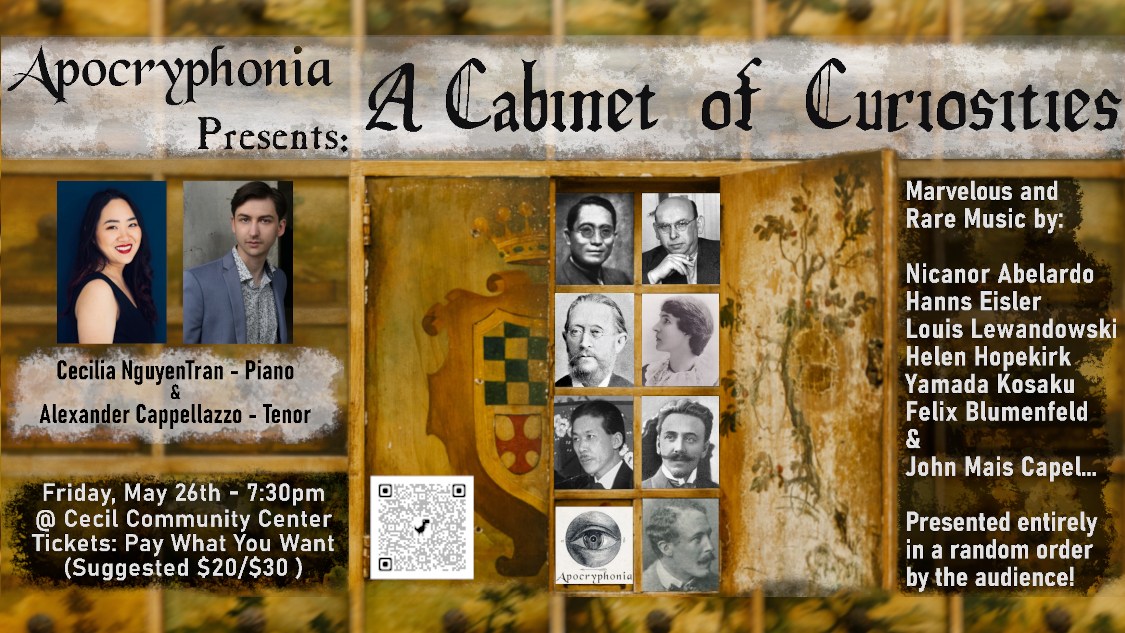
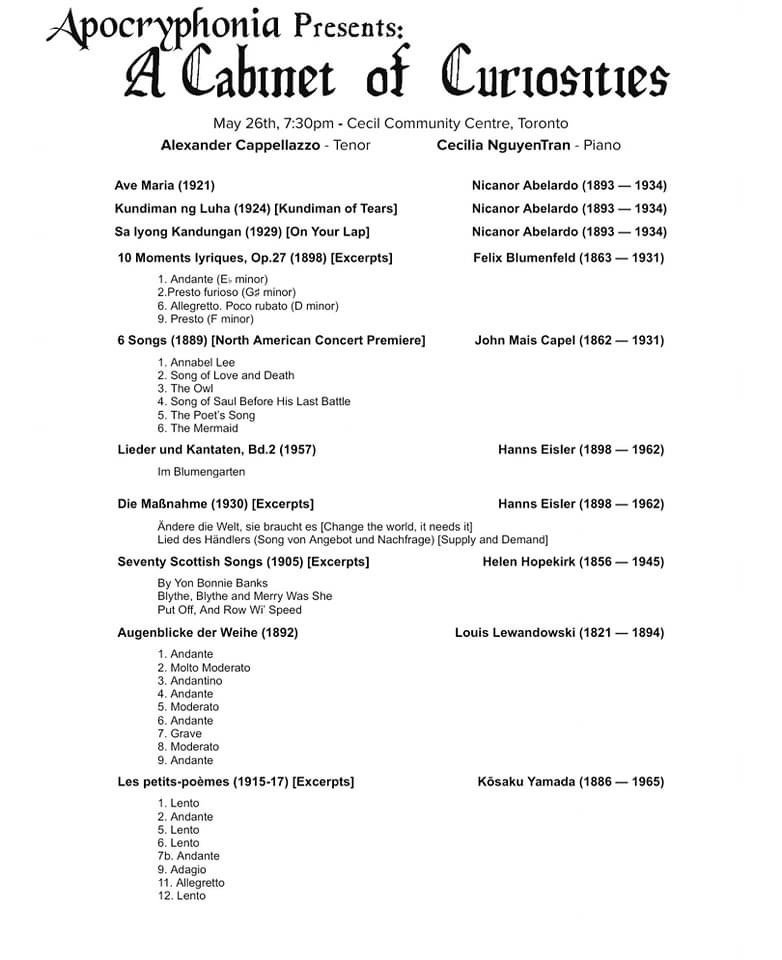
Alexander Cappellazzo as Valcour the anonymous lover (aka the title role) sang brilliantly in a role that lies very high at times. There’s a passage in the first scene that contains an obscene number of high notes, that he executed bravely and accurately, managing to keep things light and comical rather than scary, as they would have been for those of us who can’t sing that high. He kept smiling!

I was impressed with the way Holly Chaplin sang Léontine, the object of Valcour’s affections & mystery gifts. It’s quite different from The Queen of the Night, which I heard her sing in Richmond Hill recently. Léontine also has coloratura and a few high notes, but also dramatic legato passages. It’s a daunting role that sometimes lies low, but Holly was up to it.

Dion Mazerolle was a spectacular Ophémon, particularly in the music with Léontine that opens the second act. Where Valcour is asked to be insincere and to counterfeit words, Ophémon sings with great conviction on his behalf.

…And then I was frankly astonished when, shortly later, we came to the resolution of the plot, hearing Valcour and Léontine sing such a weak scene together. While it works, it wasn’t persuasive as a big change of heart. I was disappointed at how this was composed, considering how excellent the music had been earlier. Thank goodness there was a happy chorus to follow. We all smiled in the end.

I must also acknowledge the work of Robert Cooper preparing the chorus and especially David Fallis leading a small orchestra that seemed to play in a style apt for the period (not excessive in their vibrato and very quick tempi), keeping all these singers together. It’s like magic considering that the soloists were mostly working behind David’s back without scores, although David seemed to have eyes in the back of his head. The singers sounded pretty close to flawless in their execution.

We won’t likely hear this opera again, but I do hope Voicebox – Opera in Concert find proper funding, in order to keep the historical investigations coming. They’re not just valuable, but enormously enjoyable.

Posted in Opera, Reviews | Tagged , , , , , , , | 2 Comments