No there was no cake or champagne but I’m watching my weight and can’t drive home to Scarborough if I’ve been drinking.
Yet it was truly like a party, a celebration of our host Colin Eatock on the occasion of his 65th birthday, an occasion full of joy. And our ears were blessed by the generosity of what we were offered.
Colin Eatock
Colin was not only premiering “Two pieces for Tenor Recorder and Harpsichord (2021), but handing over the programming for the remainder of the concert to his soloists, Alison Melville recorder and Christopher Bagan harpsichord, which I can elaborate upon after addressing the main event, namely Colin’s new works, a pair of contrasting pieces.
In the first one, the recorder began with something rhapsodic, a lovely meditative melody that instigated everything to follow. The harpsichord functioned as a kind of accompaniment sketching in the harmonic landscape surrounding the plaintive wind-melody, as though explaining what was implicit in what Melville had played, a bit like a shrink or a priest explaining the mysteries of the recorder’s sounds. The recorder started with something that may have been notated as a mordent (the note going up and down, back to where it started) or written out (I am only guessing). Ornaments, meaning mordents, trills and more were a big part of the baroque, and may have been something Colin wanted to emulate in the piece, perhaps to invoke something of the period, even if the harmonies from the harpsichord (the timbre of the harpsichord offering another automatic pathway of association to the baroque) put me more in mind of someone like Debussy, Ravel or Poulenc.
The second piece is a contrasting composition, beginning with the harpsichord as provocateur, regular minor thirds in a pattern establishing a rhythm and urgency, while the recorder this time was responding or even debating rather than provoking. Where the first was subtly thoughtful, the second was more from the realm of a movie score, something dramatic and troubled. Where the first was to my mind sunny the second was stormy and with anguish underneath. They’re a nicely matched set, like yin and yang.
Of course music is a bit like a Rorschach test, so what I’ve written here may sound more like my pathology than a proper assessment of what Colin created. Yet it was absorbing to hear these two works from unexpected instruments, and employed cogently and economically without a surplus note.
Between Alison Melville, recorder and Christopher Bagan, harpsichord, we heard music from three different centuries. It all felt very new whether it was the 1700s, 1900s or from our own time, complete with some fascinating introductions explaining something about the way the instruments were being employed by the music, a wonderfully diverse assortment of sound from two instruments that you wouldn’t think of as the vehicles for anything modernist or edgy.
Framing Colin’s pieces, Bagan and Melville had their solo moments.
To start Bagan gave us Louis Andriessen’s Overture to Orpheus, speaking first of the idea of “following”, one hand quickly echoing the other on different manuals to create some remarkable acoustic effects. Euridice may have walked behind Orpheus in like manner, or so it seemed in this meditative work from the 1960s. I never knew a harpsichord could sound so modern.
Following Colin’s pieces, Melville offered Telemann’s Fantasia No. 9 seguing directly into Staeps’ “Allegro deciso”, suggesting that perhaps Telemann’s ideas weren’t so old considering how fresh he sounded, particularly alongside Staeps.
The remainder of the program featured two impressive works. Hans Poser’s Seven Bagatelles showed signs of Hindemith’s influence, works I wish I could hear again to enjoy their wacky humour and stunning brevity. JS Bach’s trio sonata #1 BWV 525, transcribed for recorder & harpsichord contained perhaps as many notes as everything else in the concert combined, a stunning display from Melville and Bagan to close the concert.
I was also thrilled to be able to get my hands on a copy of Colin’s Glenn Gould book, which I’d looked for in vain online. Thank you Colin and Happy Birthday!
I wanted to shine a spotlight on OperOttawa, a relatively new company, by talking to their founder and Artistic Director, Canadian baritone Norman E. Brown.
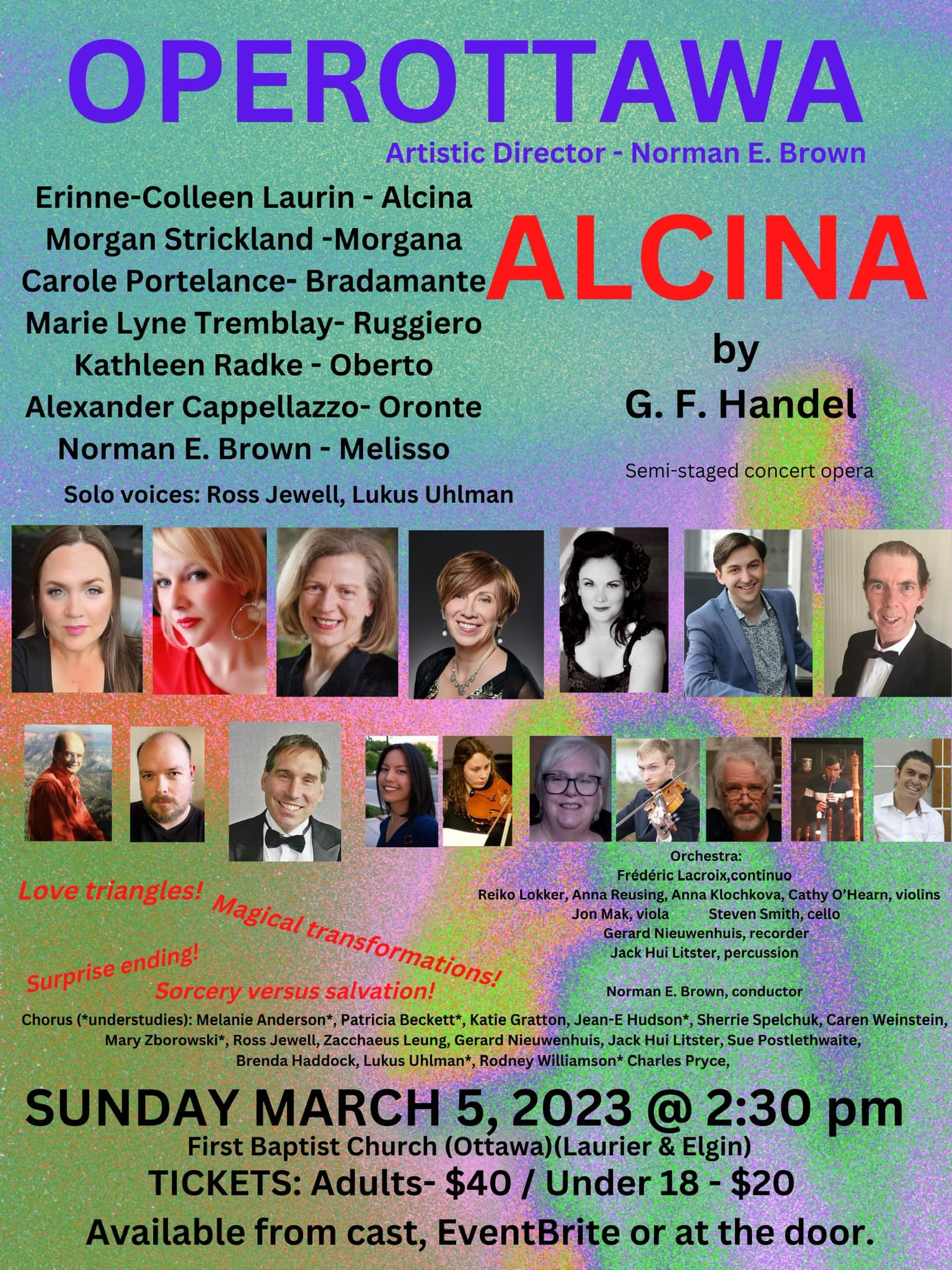
OperOttawa present Handel’s Alcina on March 5th in Ottawa, so I wanted to ask Norman some questions.
Who and what is OperOttawa?
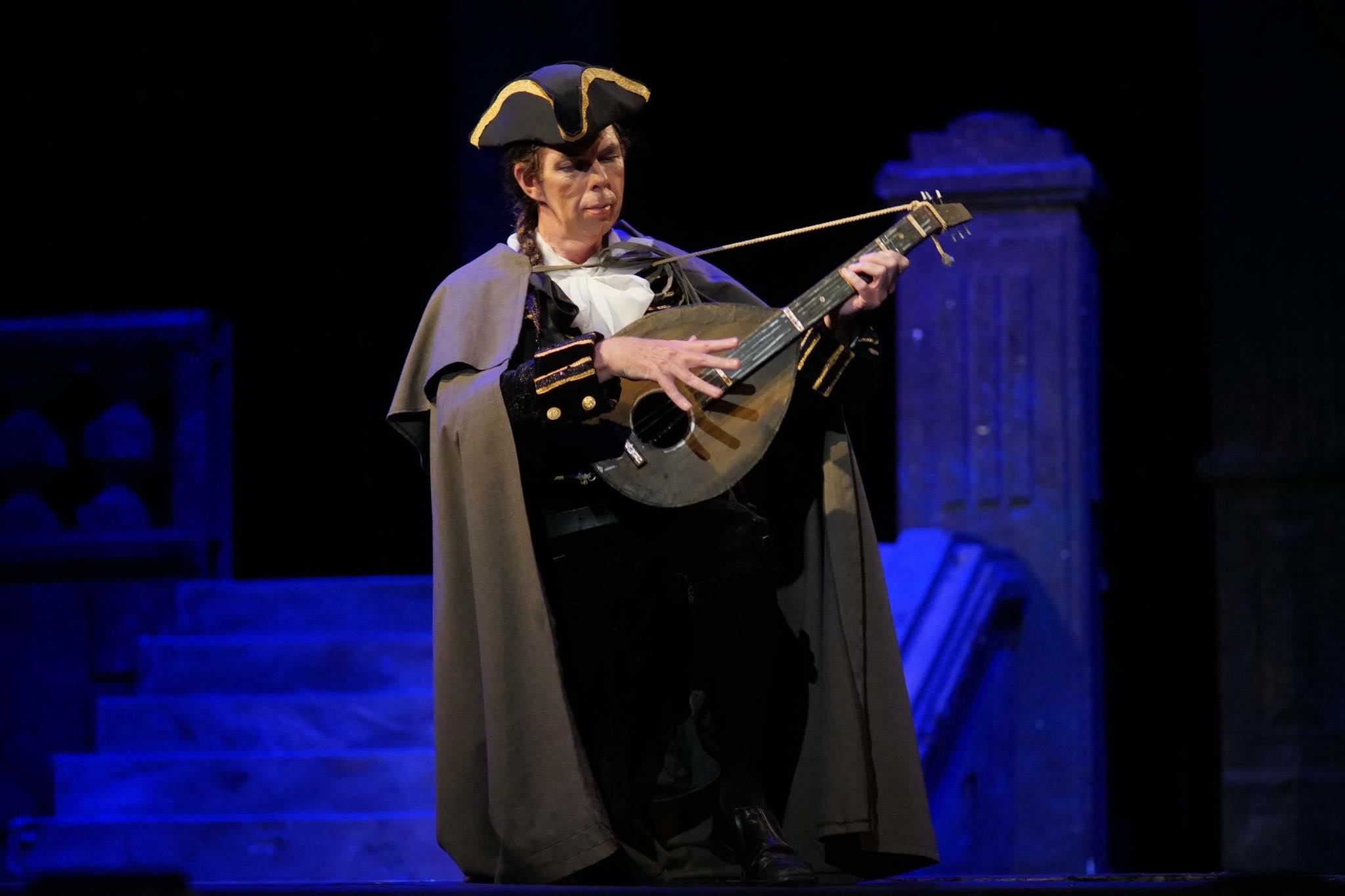
Norman E Brown, Artistic Director of OperOttawa
OperOttawa is a relatively young opera company (10th season) producing opera and concerts amidst the larger well-established companies across Canada. In Ottawa OperOttawa has specialized in filling a gap by producing operas and oratorios of the Baroque early periods, producing staged versions of lesser performed works, and supporting and encouraging young Canadian, Ottawa based composers. OperOttawa also endeavours to produce operas in their entirety with no cuts, giving singers an opportunity to fully learn major roles. We also offer younger and less experienced singers an opportunity to understudy main roles, with a chance to perform at rehearsals.
During the Covid pandemic OperOttawa successfully produced on-line the world premiere of Jack Hui Litster’s opera “The Day You Were Born” and led the return to live performances last November with a successful “Acis & Galatea” (costumed and semi-staged), our “alternative Messiah”, and a successful performance of Jack Hui Litster’s world premiere “What is Love“.
In November of 2022. The 10th season kicked off in October with a successful Opera Gala. OperOttawa was incorporated as a not-for-profit entity in November 2022, and formed its first Board of Directors.
Are you more like your father or your mother?
I get my musical talent from mother’s side of family. And probably my strong determination from father’s side.
What is the best or worst thing about what you do?
After studying the sciences and business administration and after a career in government it is great to be able to spend my time devoted to music both performing and producing. And yet I truly believe I couldn’t achieve what I do if it hadn’t been for those aspects of my life. So for me the best thing I hope I am doing is making it possible through mentorship or through providing opportunities for others to equally enjoy music.
The worst thing about what I do is seeing empty seats in our shows. OperOttawa engages some incredible singers and musicians, many of whom have performed on major stages internationally, and it is my goal and hope that their talent can be heard and appreciated by more.
Who do you like to listen to or watch?
While I do watch a lot of opera videos (at least half are the operas of Handel) I also have a penchant for horror films.
I think I would love to stage an opera one day with zombies of the apocalypse!
I also enjoy watching sports such as squash (before Covid I played in many tournaments) as well as bobsledding World Cup competitions. Something about the adrenaline rush the teams must experience as they fly down the track is akin to the rush I feel just before going on stage to sing a major role.
What ability or skill do you wish you had, that you don’t have?
I wish I had continued my piano studies beyond the conservatory and the university. While I play quite well I would have liked to have the talent to play major works.
When you’re just relaxing and not working, what is your favourite thing to do?
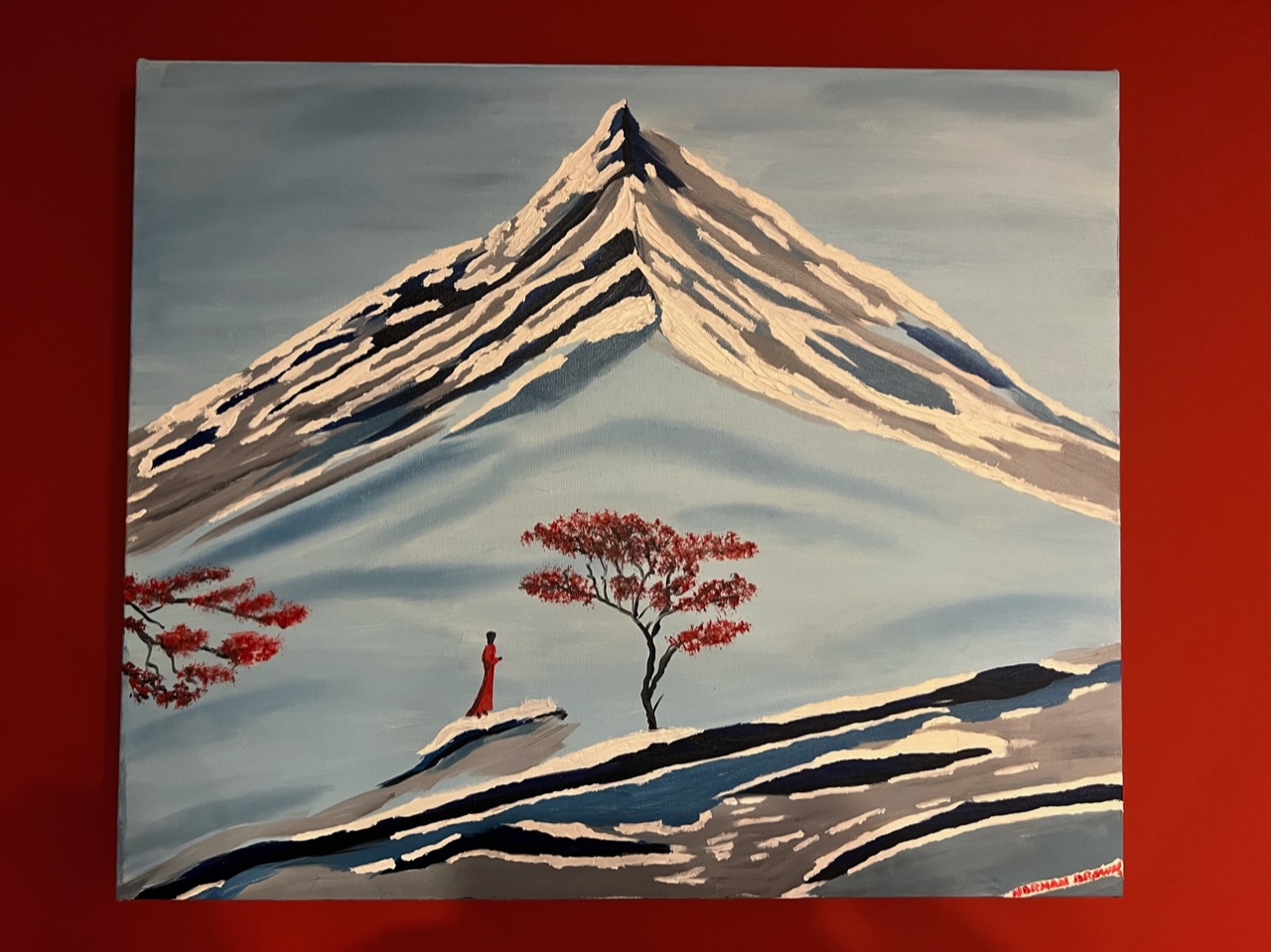
One of my favourite pastimes is painting in oils. I have always had artistic talent and for the past 15 years I have done over 300 oil paintings, in various styles and themes. I sell my paintings in the hope to find them a loving home, and I donate the funds to charity. I also will admit to enjoy baking. My forte seems to be muffins of every kind possible. It’s where my creativity comes into action. I watch many films especially horror, science-fiction and historical documentaries. These tend to transport me to another place where I don’t have to worry about scores, schedules, rehearsals, or performances.
What was your first experience of classical music?
When I was 5 I joined the boys’ choir at my home church (St Anne’s Anglican in Toronto) where we received excellent training and were exposed to the most amazing music including Handel’s Messiah. We were accompanied by members of the Toronto Symphony which is where I fell in love with viola – an instrument I still play when time permits.
I was most fortunate as a child in primary school. I was always in the school choir and starting at age 8 I was chosen to sing in the May Concerts at Massey Hall. We would rehearse one afternoon a week for three months leading up to the concert. I sang in these concerts for 5 years.
What’s your favorite opera?
While I should be “politically correct“ and say my favourite opera is which ever one I am currently singing…but… Quick answer – Mozart’s “Magic Flute” (which I will be conducting next November). Also one of my first opera roles was as Papageno.
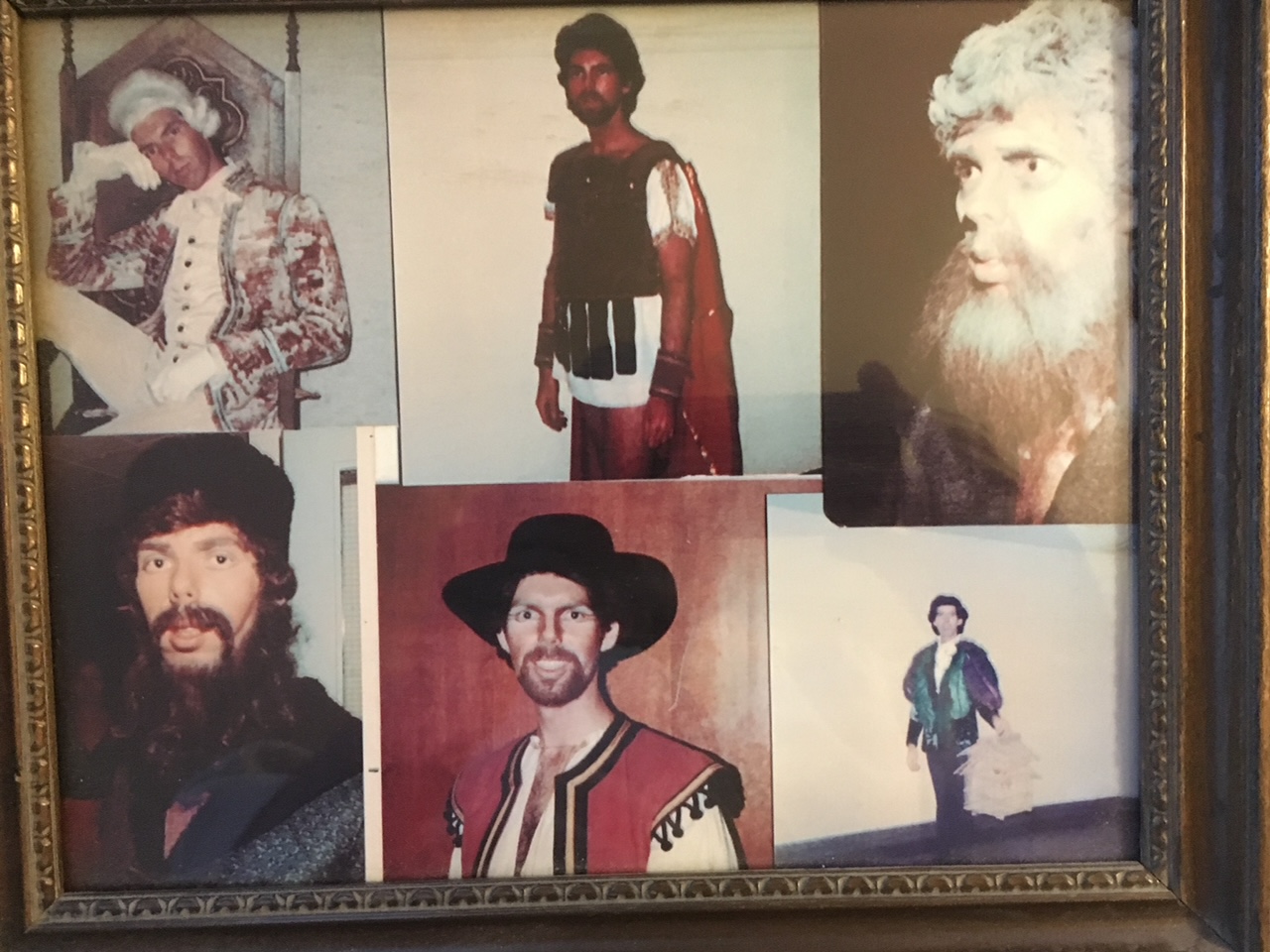
Photos of Norman’s early opera roles
Long answer – perhaps “Don Giovanni” because it is one of my favourite roles to sing – I made my official debut as Don G with the Stara Zagora State Opera in Bulgaria and subsequently sang the role on tour with Opera by Request and later sang the role in a creative production of “Don Giovanni Triumphant “.
Don Giovanni in Bulgaria
I also love the opera “Aida” by Verdi. It was the first opera I sang at age 18 with the Canadian Opera Company in chorus. I think that was where I realized my future was in music.
I saw on Facebook that you said “Now is the time to get your tickets and support Ottawa’s longest running currently producing Opera Company—OperOttawa.” What is your history?
This is an amazing statement I am so proud to make. For the past ten years we continued (even during Covid on-line) to produce opera.
In addition to the history bio posted above for OperOttawa, my own history that got me to where I am started after I graduated from the Royal Conservatory of Music – Toronto, the Trinity College of Music – London UK, and the University of Toronto faculty of music, and I had concerns about what would happen if I could no longer perform. So, with the assistance of a Canada Council Arts B grant I completed my MBA in art’s administration. Eventually this led to my engagement as General Manager of Opera Lyra Ottawa in the early 1990s. Later with the demise of Opera Lyra I started producing opera performances under the banner of OperOttawa.
Our first show was Handel’s “Acis & Galatea” in 2012 featuring Erinne-Colleen Laurin as Alcina, myself as Polyphemus and Frederic Lacroix as our collaborative pianist. The three of us along with others just performed the opera as part of our 9th season and the return to live performances after Covid.
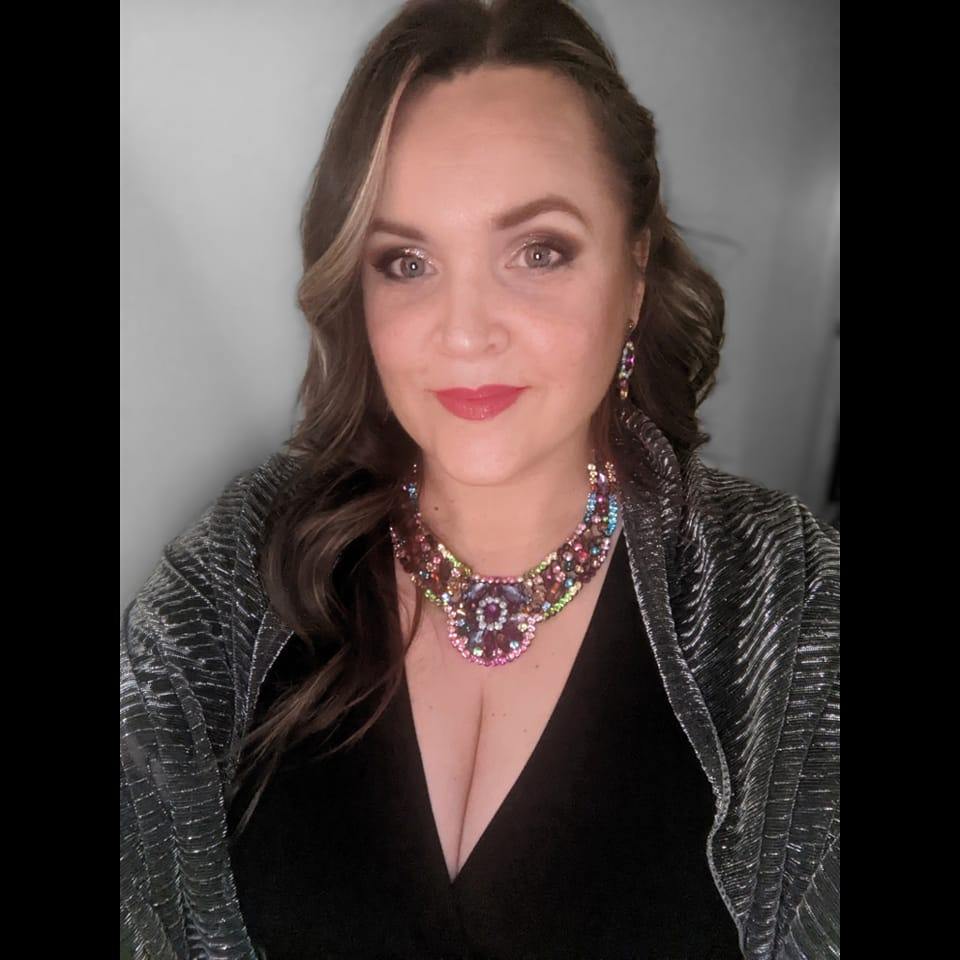
Erinne-Colleen Laurin (Alcina)
Since that first year we have performed over 25 performances including a fully staged “The Medium” by Menotti, a multi-city tour of Bizet’s “The Pearlfishers”, a semi-staged “Giulio Cesare” by Handel, and two World Premiere Operas by our composer-in-residence Jack Hui Litster – both for which we received City of Ottawa Arts Project Grants. OperOttawa has also produced concerts featuring local singers devoted to the music of Mozart, Schubert, or Bach & Handel.
OperOttawa has produced two performances of Handel’s “Messiah” the last one in 2022 featured many alternative versions of arias and a chorus that is rarely if not ever performed.
Currently OperOttawa produces three full opera productions per year.
What’s the hardest part you face wearing multiple hats, as Artistic Director.
Fortunately I am a very organized person who enjoys what I do. And so I wear many hats – Artistic Director (selecting the operas, casting, hiring orchestra and singers), General Manager (booking the venue, scheduling, contracting, budgeting, paying the bills), Conductor (conducting rehearsals and performances), Fund Raiser (filling out grants and creating fund raising strategies), Marketing Director (publicity, posters, programs, etc), Stage Director (stage direction for some shows), and Stage Crew (setting up and tear down for shows).
It sounds like a lot but I enjoy it and I think for the most part I am good at it.
In November 2022 OperOttawa became officially incorporated as a not-for-profit organization and we formed our first aboard of Directors who serve in an advisory capacity.
Tell us about your cast for Alcina
We have an incredible cast for “ALCINA” made up of long time audience favourites and regulars such as: Erinne-Colleen Laurin as Alcina, Morgan Strickland as Morgana, Carole Portelance as Bradamante and Kathleen Radke as Oberto. We also have, as always, Frederic Lacroix on keyboard continuo with the OperOttawa Orchestra and our wonderful chorus.
Morgan Strickland (Morgana)
And you’re singing too? Tell us more.
In addition to conducting “Alcina” I will be singing the role of Melisso.
As a singer I keep very busy (see bio) with concert recitals, and operas in Canada, in Italy, in Bulgaria and in Japan.
I also perform as soloist in oratorio – recently sang in two different productions in 2022 as bass soloist in “Messiah”, and will be soloist in June 2023 in Bach’s “B minor Mass” in Toronto.
For many years I sang as professional lead with the Ottawa Choral Society as soloist and on tour, and with the Men & Boys’ Choir of Christ Church Cathedral that included Europe tours singing at St Paul’s London, Notre Dame Paris, Ely Cathedral, Salisbury Cathedral, and Chartres Cathedral to name a few.
What’s next for OperOttawa?
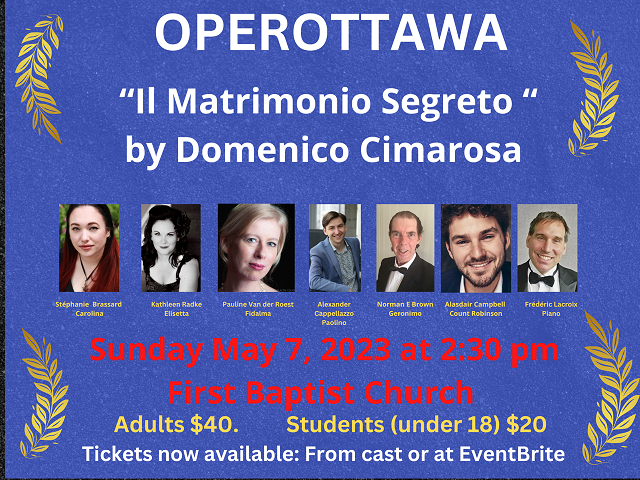
Next in the 2022-23 season we are producing “Il Matrimonio Segreto” (the secret marriage) by Cimarosa on Sunday May 7 2023 at 2:30 pm at First Baptist Church Ottawa.
OperOttawa’s 2023-24 season will include “Suor Angelica” by Puccini, “Magic Flute” by Mozart and a world premiere Requiem by Hui Litster. I will be conducting all three. And we will perform using only female upper voices!
Do you have any teachers or influences you’d care to mention?
I would be remiss not to mention my grade 1 teacher who handed me a recorder and a learning guide. I went through that first book in a week (I still have it!) and was given the second book.
In High School I played viola and received huge support and encouragement for my musicality from my music teacher Stanley Clarke.
My early singing studies were with John McKnight, Bernard Diamant and Patricia Kern. Later I worked with Saverio Bambi in Italy, Darina Tokova in Bulgaria and Tom Studebaker out of New York. I’m a big fan of Lucas Meacham and I follow his masterclasses on-line which are very useful.
My two favourite singers are Joan Sutherland and Janet Baker. When I listen to their recordings I always take away some new sense of what singing should be about.
OperOttawa present Alcina March 5th at First Baptist Church 140 Laurier Avenue West, Ottawa Ontario. (Click for tickets).
Every year at this time, the Toronto Symphony and National Arts Centre Orchestras visit one another as part of a tour. NACO and Joshua Hopkins brought the cycle Songs for Murdered Sisters by Jake Heggie and Margaret Atwood to Roy Thomson Hall in Toronto last night, a special program that has been in the works for years, but delayed by the pandemic.
It was a concert of considerable emotional impact. If the NACO sought to impress their Toronto neighbours, they succeeded.
Baritone Joshua Hopkins (photo: Dario Acosta)
In the Dedication in the program, Hopkins explained a bit about the creation of the work.
One week after my sister Nathalie’s murder in September 2015, my wife and I met with Daphne Burt and Stefani Truant at the NACT Orchestra to discuss the development of a new musical work that would both commemorate Nathalie and address the worldwide epidemic of gender-based violence.
Margaret Atwood wrote the words, a series of poems that Jake Heggie set to music as a cycle sung with piano and then orchestrated. The orchestrated version of the work received its world premiere earlier this week at Southam Hall in Ottawa.
Hopkins told us that he created the cycle to “both commemorate Nathalie and address the worldwide epidemic of gender-based violence,” again raising a question that has dogged me all my life. If art moves people, can it change their hearts and their behaviour? I grew up listening to the protest songs and rock music of the 1960s and 70s. I’d like to think that the culture of that period changed how we understand racism, war, inequality. Music, film and theatre have been powerful to awaken awareness of injustices even though the problems don’t vanish. This cycle similarly opens up questions for us. We’ve seen how Kent Monkman’s paintings have been powerful tools to help us understand the experience of residential schools. Atwood’s poems and Heggie’s music aim to be part of the bigger conversation that follows.
I wonder how this process changed Hopkins, the idea for the cycle growing with the NACO, Shelley, Atwood and Heggie. We listen to the songs, able to read and re-read the texts in the program, and see Hopkins enact a response. I have to think this was a healing act for the singer, reconciling him in some ways to the loss of his sister, a cathartic exercise at the very least, that becomes almost like a sacrament, a ritual bringing her back every time he sings the songs. I think we bring our loved ones back when we celebrate them.
Poet, novelist and lyricist Margaret Atwood
Awood’s song texts offer a variety of opportunities to Heggie the composer. His sound world reminds me at times of Mahler, possibly because of the darkness of the texts but also because he’s tonal, going back and forth between major and minor, sometimes dissonant in his response to pain, sometimes sweetly lyrical. In the songs where the text takes us away from the brutality of murder, Heggie seemed best able to get Hopkins to sing, as in “Bird Soul” (exploiting bird sounds from the orchestra) or as in the second song, “Enchantment” seguing directly out of the first song into a magical exploration of how his sister might be brought back. The text of “Dream” was one of Atwood’s deepest explorations, suggesting an image where the singer sees his sister when they’re younger, and then when they’re older she’s further away; Heggie made this a very simple but powerful song. I wished for something stronger from Heggie in the song “Lost”, the song that seems to step outside the cycle to comment upon the many sisters lost, although Heggie makes it a very simple and direct statement from Hopkins: which might have been what they wanted to do (excuse me for second-guessing). The closing Coda: Song addressed the catharsis idea as a healing act for Hopkins, and that this performed ritual serves to revive Nathalie. It’s a wonderfully positive way to finish the cycle.
Composer Jake Heggie
It’s hard to comment upon Hopkins’ performance when the entire event was so personal, so far beyond the usual parameters of performance. To say the baritone showed commitment would be absurd. At times I thought Hopkins was looking out into the auditorium and perhaps seeing his sister. It was very moving, a stunning experience. I don’t really want to call it a performance, as it seemed so genuine and authentic, rather than the outcome of vocal skill and acting, which we’ve seen from Hopkins in happier roles such as Papageno. At the end when Shelley and Hopkins embraced before the rapturous audience, it seemed like the culmination of their journey rather than something performed.
Songs for Murdered Sisters deserves to be studied and performed. A couple of the songs are strong enough to stand alone outside the cycle.
There were two other works on the program. We began with Emilie Mayer’s Faust-Overture, a work that was a decent warm-up although not really a peer to the other sizzling works on the program. In addition to the song cycle, which was very well-received we heard Brahms’s Fourth Symphony after the intermission. As we watch the TSO gradually become accustomed to Gustavo Gimeno, their new music director, it’s a fascinating experience to watch a conductor like Alexander Shelley leading the NACO in a work he conducted from memory: and seeing how well an ensemble can follow.
NACO music director Alexander Shelley
For the first movement I was surprised at an opening phrase that was so slow and gentle as to almost sound like a loving caress. It was so different from any version I’ve ever heard, that I wondered if this was even intentional and how it could work for the rest of the movement. But gradually, inexorably they got faster and faster, one long gradual accelerando, a phenomenal display of interpretative control, as the players took Shelley’s direction, perfectly coordinated at any tempo. When we came to the recap, wow there it was again, that slow approach, as gentle as a remembered dream, before we start to get serious, more intense, again accelerating, building.
For the second movement Shelley and the NACO did the opposite to how they began the opening movement as the horns powerfully put out the motto we would hear throughout, quickly and boldly stating it: and then the orchestra joins in oh so gently. Throughout the movement we experienced several tempo changes and a broad range of dynamics. The third movement was a delicious roller-coaster ride, quick yet controlled. The final movement again showed us extremes, Shelley taking some passages as fast as I’ve ever heard them, the orchestra precise and accurate. It was the most exciting live experience of the work that I’ve ever had.
“I’m organizing a concert in Toronto on February 20 (my 65th birthday). The programme will include a new piece by me. Admission is by donation — I hope you can make it!”
We’ve seen the name Colin Eatock in a few contexts. I’ve heard some of his music. We saw his byline at the Globe & Mail and elsewhere as a writer.
His website says he did his PhD in Musicology, writing about Felix Mendelssohn, and he has also written a book about Glenn Gould.
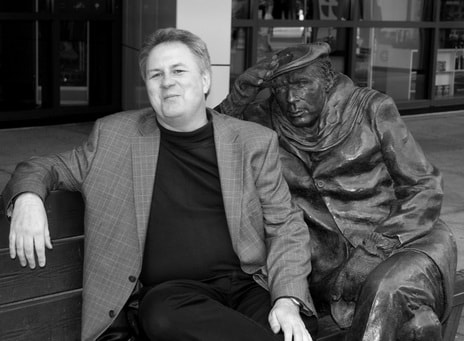
Colin Eatock beside Ruth Abernethy’s Glenn Gould sculpture
This interview is a chance to find out more about him and the upcoming concert.
*******
Are you more like your father or your mother?
I’d say I’m more like my dad, who was a high-school history teacher in Hamilton for most of his professional life. He was very much drawn to scholarship. And I should also mention that I had an uncle who was a violin teacher. But he was the only professional musician in my immediate family.
What is the best or worst thing about what you do?
Composing music is a real “workout” for the brain – and I’m hoping it will forestall senility! And although I find composing a challenge, it’s not nearly as hard as finding opportunities to have my music performed.
Who do you like to listen to or watch?
If I find a show I like on Netflix, I will shamelessly binge-watch!
What ability or skill do you wish you had, that you don’t have?
It would probably be really useful to be a conductor. But it’s nothing I’d ever want to do! And I’ve avoided it like the plague.
When you’re just relaxing and not working, what is your favourite thing to do?
During the Covid lockdown, I took up cooking, with mixed results. At least, I haven’t poisoned anyone (yet)! I retired from music criticism a few years ago, and I find that I’m very well suited to a leisurely lifestyle.
What was your first experience of classical music?
Listening to classical music was a part of my home life from birth, so I have no memory of being formally introduced to it. I do recall attending Handel’s Messiah as a child, performed by the Hamilton Philharmonic. And my first opera was Don Giovanni, in Chautauqua NY – but I slept through most of it.
The concert is offered by “St. Wulfric’s Concert Society. Works by Bach, Louis Andriessen, Hans Poser and Colin Eatock.” I notice with the aid of Google that your February 20th concert falls not just on your birthday but also the day that Wulfric of Haselbury passed away in 1154. Please elaborate on the connection, whatever it might be.
Casting around for a “presenter” for this concert, I did a search to find out if any saints’ feast-day fell on February 20, which is my birthday. That’s how I discovered St. Wulfric. It seems that he was a bit of a recluse, so maybe we have that in common.
Please describe the works on the program by Bach, Louis Andriessen, Hans Poser and your own new piece.
When I asked recorderist Alison Melville and harpsichordist Christopher Bagan to perform on my birthday concert, I asked them to play a new piece I composed just a few months ago.
RecorderistAlison Melville (Photo by Colin Savage)
They kindly agreed. My Two Pieces for Harpsichord and Tenor Recorder contains a lot of obvious “baroque-isms,” but the harmonic language is all my own.
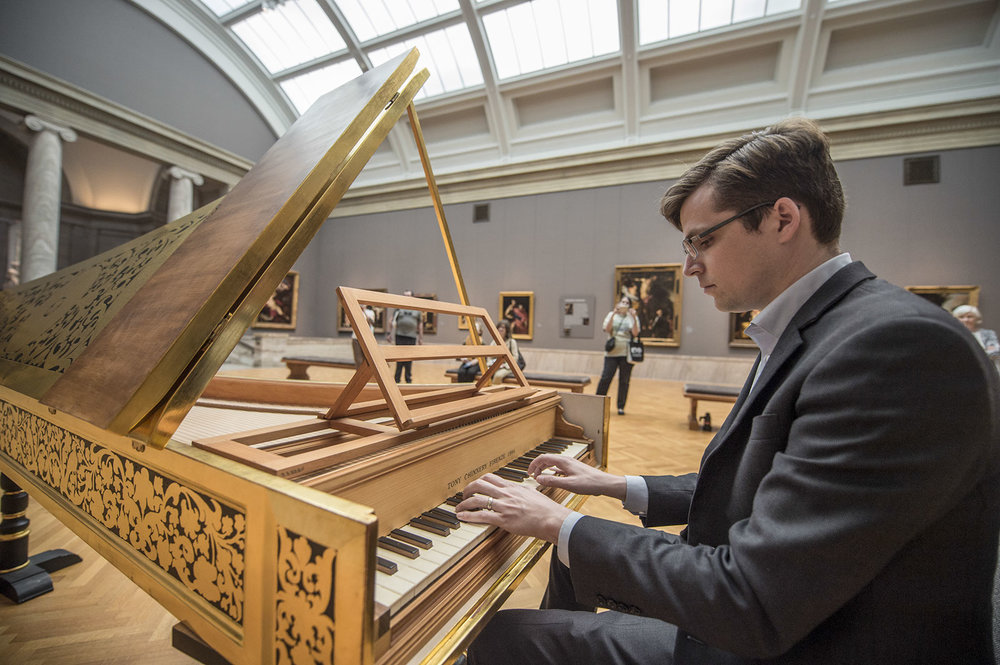
Harpsichordist Christopher Bagan (Photo courtesy of the Cleveland Museum of Art)
For the rest of the program, I suggested Alison and Chis play whatever they wanted.
The Bach is his Sonata BWV 525. It was originally composed for the organ, but it works really well with recorder and harpsichord.
Hans Poser
The Andriessen is his Overture to Orpheus – which is not really an operatic overture at all, but a concert piece for harpsichord. It makes clever use of the difference in timbre between the two keyboards on the instrument. And you can really hear the descent of Orpheus into Hell!
Alison chose Poser’s Seven Bagatelles – and I must confess that I don’t yet know the piece. All I’ve been able to find out about Hans Poser is that he was a German composer who was born in 1917 and who died in 1970. During the Second World War, he was pilot in the Luftwaffe, and he was shot down over London in 1940. He spent the rest of the war in a POW camp near Gravenhurst, Ontario.
On your website you ask yourself “What kind of music do you write”, telling us that you began composing at the age of 16 long before the advent of digital notation software.
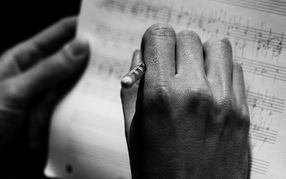
You include a picture showing two hands manually composing using a pencil and staff paper.
Photo from Colin’s website
Do you still compose with a pencil, or have you at least partially gone digital?
I still do most of my composing with a pencil, staff paper and a large eraser. That’s how I was taught, and it has served me well. I don’t want composing to be too easy, and directly typing the notes into a computer – or playing them into a computer with a keyboard interface – feels a little too facile, and could lead to hasty decision-making. Once I’ve worked out the music on paper, I then “engrave” the music with my computer for a professional-looking score. I find that musicians respect a score that looks just like “real” music.
Do you remember your first teacher and the first things you composed in your teens. And did you keep any of the pieces?
At first, I was self-taught as a composer, reading books about orchestration at the library. Then, I wrote an ambitious orchestral piece that was performed by the Hamilton Philharmonic Youth Orchestra. From that point, I decided that being a composer was the most splendid thing a person could be, and I was hooked on writing music. So I went to Western, to study formally.
A couple of years ago, when I was moving apartments, I found an old cardboard box containing my student compositions. I looked through them and was horrified by how bad they were. I chucked them in the garbage – and the world is a better place for it!
You say “my music is tonal”. In the 1970s when you started, classical music was often modernist and dissonant. When you began were you encouraged to find your own voice even if that voice was tonal, or were you in any way pressured to emulate famous composers of the time?
In my student days, I tried my best to be a good little modernist. Certainly, this is what most of my composition teachers strongly encouraged. And I struggled for a long time, before I found my own voice, in a more tonal idiom. Yet I’m glad I had the experience of being immersed in modernism. It freed up my thinking about music. Although my music is now based on a tonal harmonic language – you’d have a hard time finding a chord in my music that Brahms never wrote – I try not to be one of those composers whose music is essentially an exercise in nostalgia for some glorious past. I like to think that the present is present in my scores.
You say “Mostly, I write choral music and songs“ which leads me to wonder about your relationship to the church: one of the places in my experience where tonality is welcome.
I’m very much drawn to the traditions of church music, and some of my choral music is based on sacred texts, in either English or Latin. But my choral music is intended for concert performance, not for liturgical use. And most of my choral music is simply too difficult for the average church choir, so you’re not likely to hear it anywhere on a Sunday morning. Also, I’m not affiliated with any religious denomination, and I haven’t been for many years.
Speaking of churches and church music, your dissertation concerned Felix Mendelssohn, a composer whose spiritual compositions I admire. What drew you to him as a subject?
It was a kind of pragmatism, I guess. I wanted to study a composer who was connected to Great Britain – so I could get a research grant to go and live in London for a year. I recall having dinner with a friend, and talking about various continental composers who lived or worked in Britain. He said, “What about Mendelssohn – didn’t he spend some time there?” I replied, “Yes, he did. But I’m sure that subject has already been researched to death. For a PhD dissertation, you’re expected to do something original.” Then I looked into it – and discovered, much to my surprise, that there wasn’t much scholarly research done on Mendelssohn’s time in the UK.
Eight months later, I landed at Heathrow. Of course, it helped that I liked his music.
Did the Mendelssohn you studied during your dissertation influence either the way you compose, write criticism or the sound you aim for in your compositions? Do you in any sense think of yourself as a romantic?
I was struck with how Mendelssohn was a “Janus-faced” composer, looking back to historical models, while also very much engaged with his own era. Maybe there’s something of that in my music, as well.
Describing your music you said “My music is rarely virtuosic, although it demands a high level o precision from performers. (So they tell me.)” Could you unpack that?
I suppose that’s a bit of a boast. But I guess I was thinking about how delicate and thin-textured my music often is. It doesn’t give performers anything to “hide behind”: a wrong note really stands out!
Who is your favorite composer? Is there a music you enjoy merely for pleasure / fun, distinct from your appreciation of the art of that composition?
Music for pleasure? What a strange question! Pretty much everything I listen to is intended for (my) pleasure. The only time I put the “pleasure principle” on hold is when I attend a contemporary music program even though I suspect I probably won’t like it. I think it’s a good idea for composers to keep up-to-date on what other composers are doing — even if what they’re doing sounds like a train-wreck.
And to answer your first question last, my tastes are pretty broad, and I don’t really have a favourite composer.
Some composers were just hitting their peak in their 60s, doing their best work. Do you have any big projects ahead?
At present, I’m producing a new CD of my music: of compositions for choir, and also music for chamber orchestra. In the fall of 2021, Sinfonia Toronto recorded some of my orchestral music. And in the fall of 2022, Choir 21 recorded some choral pieces. So I now have over an hour of repertoire in the can. It’s all currently being edited to perfection. The disc should be released this spring on the Centrediscs label.
Front cover design for the upcoming CD
After the CD has been released, I’ll be able to look to future projects. It will be interesting to see what direction my inspiration takes me in.
You’ve combined different professions, at a time when it’s very challenging to afford living in Toronto. Do you have any advice on day jobs or side hustles for young composers wondering how best to survive?
Hmmm … I may not be the best person to answer that question. Music journalism worked for me, for a while. But these days, there’s very little money to be made, writing about music.
Of course, teaching has always been an option for composers. Everyone knows that.
If I may address your question more broadly, I’d like to see the list of “proper” occupations for composers expanded to include everything. To say that a composer who works as a music teacher is a “professional” composer, and another who works as a tax accountant is “just an amateur” is really just snobbery.
Is there a teacher or influence you would name who was important to your development?
The best composition teacher I ever had was John Beckwith, at U of T. Sadly, he passed away recently.
I can also call myself a student of R. Murray Schafer. He taught for one semester at Western while I was there, and I attended his classes. But his approach to teaching composition was nothing like the traditional nuts-and-bolts method; it was more abstract and philosophical. To this day, I ask myself how his instruction influenced me. I’m sure he did, somehow, but it’s hard to put my finger on it.
*******
Colin Eatock February 20th 7:30 St Wulfric’s Concert Society In Recital Works by Bach, Louis Andriessen, Hans Poser and Colin Eatock. Alison Melville recorder, Christopher Bagan, Harpsichord. Heliconian Hall, 35 Hazelton Ave. By donation ($20 suggested)
There’s lots more wonderful content to read at Colin’s website (click here). Colin has also shared the following track from his upcoming recording.
The Canadian Opera Company’s co-production of Richard Strauss’s Salome returned last night in the first of seven performances to huge applause. It’s a star vehicle for Ambur Braid in the title role, a wonderful first outing for Michael Schade as Herod, surrounded by a brilliant cast and another brilliant reading from Music Director Johannes Debus at the helm of the COC orchestra.
Sometimes opera forces one to compromise, settling for someone who looks the part but can’t sing it, or sings it but doesn’t look right. Braid seems to be on the verge of a Maria Callas career, in a voracious portrayal of nuance and vulnerability. As with Callas I’m wondering if there’s anything she can’t sing, if she has Isoldes in her future, having so far not shown us any limits to her vocal development, a genuine stage animal who seems to love performing. I want to see her in the roles requiring dramatics such as Lulu or Kundry.
Michael Schade was her perfect foil, finding all the grotesque comedy as Herod. I couldn’t take my eyes off him, the lovechild of Dr Evil and Elton John. Someday I’d like to see his Mime (in Siegfried) or the Captain (in Wozzeck). His piercing tenor and frenetic energy seemed unstoppable.
Herod (Michael Schade), Herodias (Karita Mattila) and Salome (Ambur Braid). Photo: Michael Cooper
At the end I identified with the disgust displayed by Herod, who could well be the walking presence of the composer himself, the Gesamtkunstwerk that must murder its heroine that it made. Herod is like Frankenstein and the “monster” Salome (as he calls her) is largely his creation (even if he blames Herodias). All that beautiful music leads to the brutal explosion of noise that ends the work, a most satisfying resolution: all passion spent.
In the latest version of director Atom Egoyan’s ongoing relationship with Salome, the mise-en-scène is the other big draw, Salome’s dance a highlight of the evening whether or not you buy into the director’s explanations (I don’t): but it didn’t stop me from enjoying the opera.
A scene from the Canadian Opera Company’s production of Salome, 2023, photo: Michael Cooper
Michael Kupfer-Radecky as Jokanaan and Karita Mattila as Herodias were excellent imports alongside a mostly Canadian cast. Robert Pomakov, Michael Colvin and Jacques Arsenault manage to reconcile their comic roles in Marriage of Figaro to an entirely different style in Salome. Frédéric Antoun as Narraboth, alongside Carolyn Sproule as Herodias’s page, were heroic in the extraneous drama they’re called upon to enact upstage of the main action (perhaps the most egregious yet ultimately harmless transgression against the text inflicted by the director). Vartan Gabrielian was an impressive soldier, his deep voice resounding beautifully. I wish at a time when so many Canadian artists are struggling to make ends meet that the COC would always try to employ them, singers who were all terrific: rather than casting foreigners in the small parts.
The other main attraction for me is the COC orchestra, Debus leading a tight quick reading that accords with what I understand about the composer’s own preferences. The opera sounds amazing and looks beautiful. I’m looking forward to seeing and hearing it again.
It can be enjoyable to trace the changes in the way a story is adapted and/or interpreted.
Salome begins in the Gospels of Matthew and Mark.
Matthew 14:1-11 (NIV) 1 At that time Herod the tetrarch heard the reports about Jesus, 2 and he said to his attendants, “This is John the Baptist; he has risen from the dead! That is why miraculous powers are at work in him.” 3 Now Herod had arrested John and bound him and put him in prison because of Herodias, his brother Philip’s wife, 4for John had been saying to him: “It is not lawful for you to have her.” 5 Herod wanted to kill John, but he was afraid of the people, because they considered John a prophet. 6 On Herod’s birthday the daughter of Herodias danced for the guests and pleased Herod so much 7that he promised with an oath to give her whatever she asked. 8 Prompted by her mother, she said, “Give me here on a platter the head of John the Baptist.” 9 The king was distressed, but because of his oaths and his dinner guests, he ordered that her request be granted 10and had John beheaded in the prison. 11His head was brought in on a platter and given to the girl, who carried it to her mother. 12John’s disciples came and took his body and buried it. Then they went and told Jesus.
Mark 6: 13-29 13 They drove out many demons and anointed many sick people with oil and healed them. John the Baptist Beheaded 14 King Herod heard about this, for Jesus’ name had become well known. Some were saying, “John the Baptist has been raised from the dead, and that is why miraculous powers are at work in him.” 15 Others said, “He is Elijah.” And still others claimed, “He is a prophet, like one of the prophets of long ago.” 16 But when Herod heard this, he said, “John, whom I beheaded, has been raised from the dead!” 17 For Herod himself had given orders to have John arrested, and he had him bound and put in prison. He did this because of Herodias, his brother Philip’s wife, whom he had married. 18 For John had been saying to Herod, “It is not lawful for you to have your brother’s wife.” 19 So Herodias nursed a grudge against John and wanted to kill him. But she was not able to, 20 because Herod feared John and protected him, knowing him to be a righteous and holy man. When Herod heard John, he was greatly puzzled; yet he liked to listen to him. 21 Finally the opportune time came. On his birthday Herod gave a banquet for his high officials and military commanders and the leading men of Galilee. 22 When the daughter of Herodias came in and danced, she pleased Herod and his dinner guests. The king said to the girl, “Ask me for anything you want, and I’ll give it to you.” 23 And he promised her with an oath, “Whatever you ask I will give you, up to half my kingdom.” 24 She went out and said to her mother, “What shall I ask for?” “The head of John the Baptist,” she answered. 25 At once the girl hurried in to the king with the request: “I want you to give me right now the head of John the Baptist on a platter.” 26 The king was greatly distressed, but because of his oaths and his dinner guests, he did not want to refuse her. 27 So he immediately sent an executioner with orders to bring John’s head. The man went, beheaded John in the prison, 28 and brought back his head on a platter. He presented it to the girl, and she gave it to her mother. 29 On hearing of this, John’s disciples came and took his body and laid it in a tomb.
In each of these accounts what’s consistent is Herod’s fear of John, his promise to Salome, and the motivation for the murder, namely Herodias’s request of her daughter.
Oscar Wilde (1854-1900) wrote the play Salome (1891) in French, but banned in England until long after Wilde’s death. He never saw it produced in his lifetime, as it was given a single performance in Paris in 1896 during the time of Wilde’s imprisonment.
Wilde originated the “”Dance of the Seven Veils” and changed Salome’s motivation. Where the Biblical accounts have Herodias’s request as the reason for the dance and the demand for Jokanaan’s head, in Wilde it becomes an expression of Salome’s own desires. Salome kisses the mouth of Jokanaan. Wilde also adds the conclusion, where Herod in disgust orders Salome killed.
Richard Strauss’s opera Salome (1905) using a libretto taken from Wilde’s play also met with resistance in some cities, although it has become a standard work in opera houses all over the world.
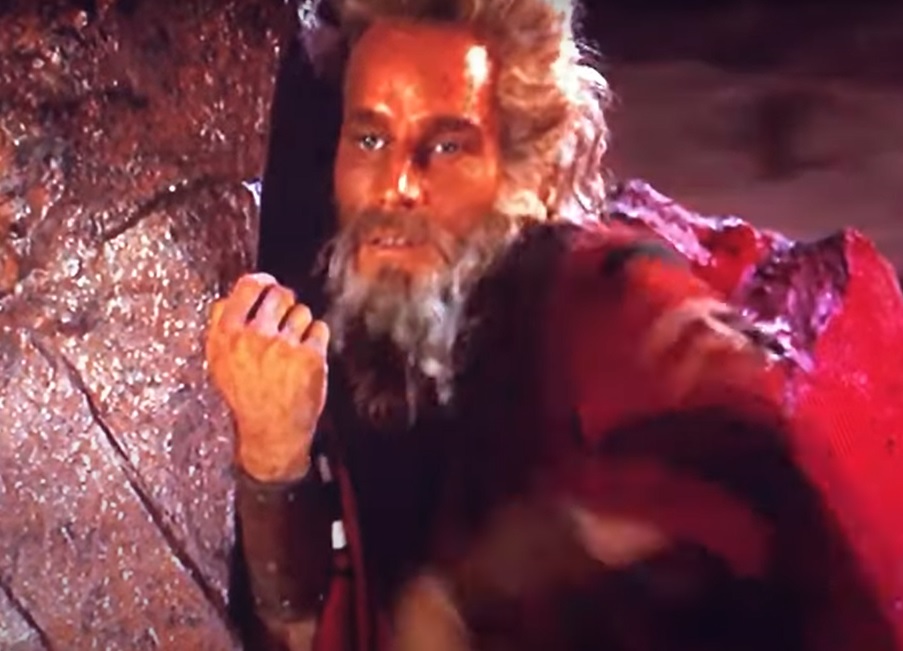
Directors theatre or Regietheater is sometimes understood as a conversation between existing works and the performance text, an opportunity to revisit works that have been produced so often as to have become kitsch, images and sensations that deserve to be interrogated. The orchestral style of Richard Strauss and composers of his generation that was adopted in Hollywood became a kind of cliché. There is an overlap between the aesthetic we see in conservative productions of Salome that rigorously follow the instructions in the score, and Biblical epics on film such The Ten Commandments (shown here).
A production such as the Atom Egoyan Salome, previously seen in Toronto with the Canadian Opera Company and being revived this month, might avoid some of the baggage of the past. Salome opens Friday February 3 at the Four Seasons Centre.
Salome’s Dance from the 2013 COC production directed by Atom Egoyan (photo: Michael Cooper)
The Canadian Opera Company have revived Claus Guth‘s production of Mozart’s The Marriage of Figaro that they presented to us in 2016, this time with a slightly different cast and conductor.
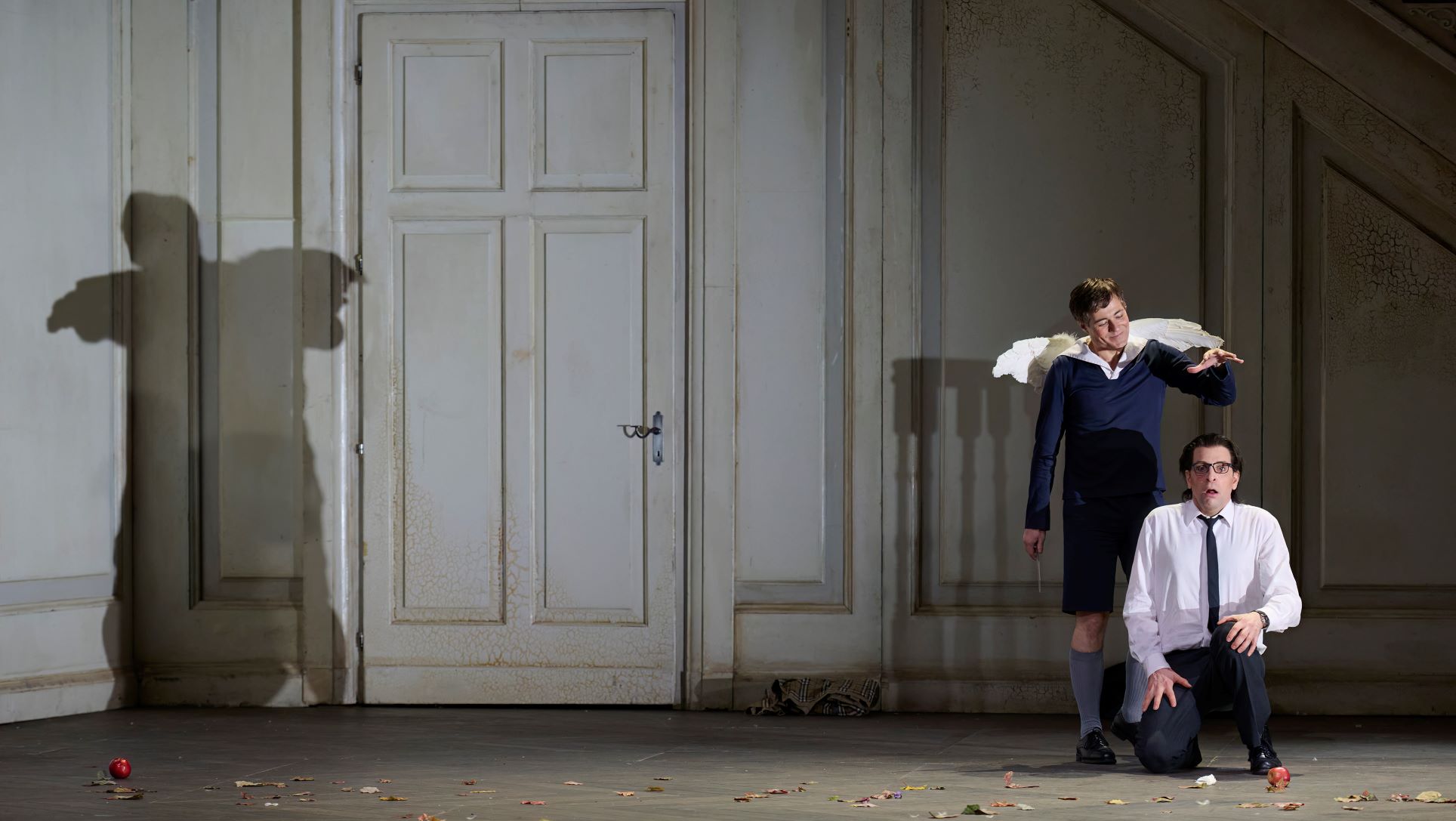
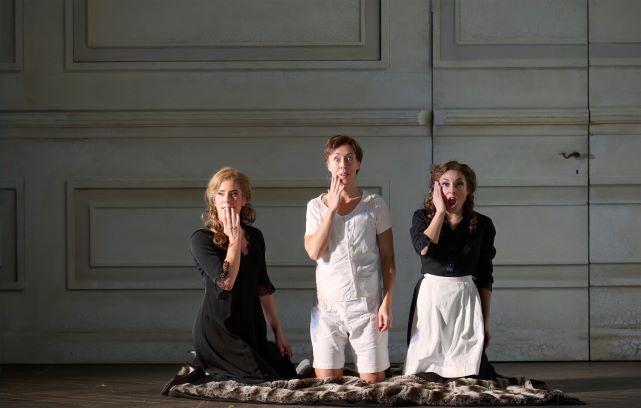
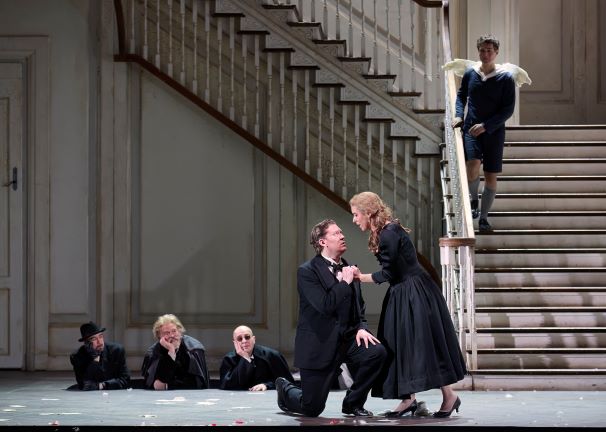
The three and a half hours fly by on the wings of birds, cherubs and assorted eye candy, quirky moments in the production to keep you amused and wide awake. Full disclosure. Much as I love the music in the last act I’m yawning & may desperately want it to be over.
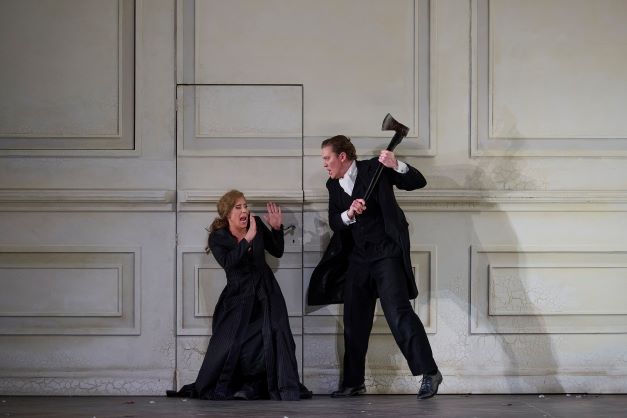
Not this time. The headline may offend those who think of the opera as flawless, but it’s also very long. Guth’s combination of sex, violence and beautiful images kept me alert. And the audience ate it up, giving the production a huge ovation at the end.
As expected Conductor Harry Bicket is a key contributor, leading the orchestra in a wonderful authentic reading at a terrific pace and very tight with the singers throughout. While Mozart is well-served, the music is always at the service of the comedy.
Whether it’s me or the production that feels different this time, I love it. Last time the small parts stole the show while the leads were adequate but a tad too serious rather than spectacular. This time the leads are especially good, taking us back to the realm of genuine comedy. And thank God for that.
Last time I remarked on Emily Fons (Cherubino), Robert Pomakov (Dr Bartolo) Doug MacNaughton (Antonio) and Sasha Djihanian (Barbarina). Except for the Barbarina (now brilliantly played by Mireille Asselin) they’re all back and as excellent as before.
What’s new is the star-power of the leads, both vocally but especially dramatically. Gordon Bintner brings that remarkable voice of his –lovely tone and precise intonation—and matches it with a stage persona to contrast his last appearance. Where he was a sweetly lovable & vulnerable Papageno, his Count is scary in the amount of violence he channels, a terrific bullying presence that amplifies everything implicit in the text, never holding anything back. Usually when the Count asks to be forgiven at the end it’s a touching moment, not an instant of laughter from an audience who don’t believe he can be trusted. Is that a symptom of modern audiences who no longer want or believe in the happy ending? I’m looking forward to seeing what Bintner sings next, a star in the making.
(l-r) Uli Kirsch as Cherubim (sic) and Luca Pisaroni as Figaro (photo: Michael Cooper)
The other big upgrade was with Luca Pisaroni’s Figaro and especially Andrea Carroll’s Susanna. The chemistry between these two, particularly in the last act, is a highlight of the show. Carroll is another note-perfect singer like Bintner, her “Deh vieni non tardar” a heart-breakingly beautiful moment in the last act, a stunning answer to Pisaroni’s “Aprite un po’ quegli occhi,” when he tells us (the men in the audience) not to trust women, and don’t discuss the rest (complete with horn-calls for the cuckold). What a joy that two of my favorite pieces were done so perfectly, and vividly dramatized.
They sing it well, but they especially connect to one another. Last time I feel that the Figaro (Josef Wagner) and Susanna (Jane Archibald) were obedient to the darkest colours of the director’s vision, taking us away from anything really comic. This time that underlying and undeniable romance is back. I find that whenever we have a Director’s Theatre production, its original stridency fades under the mitigating influence of a revival director (Marcelo Buscaino this time) or simply the natural inertia from centuries of doing the text as written. But I’m not complaining. I like seeing a Figaro and a Susanna who seem to really love one another. There’s a mischief to their chemistry.
Lauren Fagan is a good Countess, although last time we had Erin Wall who was wonderful as well. But the chemistry between Fagan and Bintner is riveting, extraordinary.
(l-r) Countess (Lauren Fagan), Cherubino (Emily Fons) and Susanna (Andrea Carroll) photo: Michael Cooper
And the scene between Fagan and Caroll in the second act with Fons is enormously fun, turned on its head when Bintner comes storming back and terrifies everyone.
Countess (Lauren Fagan) and Count (Gordon Bintner) photo: Michael Cooper
While I think this was all there in the production last time, it never quite gelled as well as what we saw this time.
Reconciliation between Count (Gordon Bintner) and Countess (Lauren Fagan) Photo: Michael Cooper
I suppose I should mention Uli Kirsch in the silent role listed in the program as “cherubim”, which is problematic when we remember that this is the plural of the word “cherub”. But I recall that when I’m a stickler I lose my sense of humour, so I’ll ignore this in the spirit of the show. He’s well-liked by the audience regardless of his name, indeed much more so than last time. I think it’s the best indicator that the production is working, that he now feels like an organic part of the show, a bit of eye-candy, helping to keep us alert & awake. Or is it simply that I’ve lightened up? Either way, it’s a good show.
I’m looking forward to seeing and hearing it again. You should too.
I loved the book (André Alexis’s 2015 novel Fifteen Dogs).
I love the play (adapted for the stage and directed by Marie Farsi at Crow’s Theatre).
The book hit me in totally different places than the play. When you read something to yourself it may not evoke laughter the way watching a human actor portray a dog will do. In Guloien Theatre today I was fascinated by the many times people giggled and laughed at things that I saw in more ambivalent terms.
When Benjy the beagle tells Majnoun about his ability to get a response from people by rolling over in the book, it’s a dark admission, that the dog can manipulate a human. But when Benjy (played by Peter Fernandes) demonstrates this to Majnoun (played by Tom Rooney) and all of us in the theatre, it’s hysterically funny. There’s a tonal shift as the prevailing tone of the show is lightened by the enormous amount of laughter. When you’re watching people impersonate dogs the laughs are guaranteed, and perhaps the first casualty is some of the seriousness that I might have craved.
It’s not that Farsi has done anything wrong, so much as the misanthropic sensation I have about my fellow humans, who seem to laugh at things that aren’t funny, that are profound or disturbing. I like to think I’m an extrovert but a moment like this makes me wonder, do I really prefer books to plays? Even though Rooney, Fernandes et al play with a resolute deadpan refusal to tip off any gags, the audience howls with laughter throughout. Even at moments that are dark & troubling there are laughs, although maybe some of those are of the nervous variety.
Let me repeat, I love this adaptation, amazed that the whole story seems to be there without omissions, that the subtleties are captured.
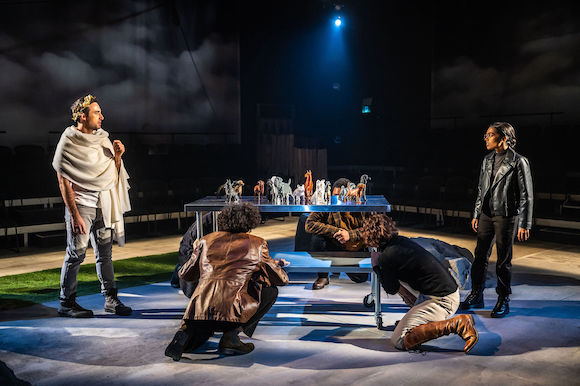
Apollo (Tyrone Savage) faces off against Hermes (Mirabella Sundar Singh), while the other four cast members are also visible (photo: Dahlia Katz)
I can’t recall the last time I saw a show where every single player seemed essential, an indispensable part of the whole but that’s what Farsi and her team have created. I’d go so far as to suggest that the book and/or the play is a bit like a Rorschach inkblot test, where your favorite character or your favorite story-line might be a reflection of your issues. So in other words, the players I emphasize likely reflect my own sensibility.
My favorite parts of the show were the poems from Prince, the dog whose poetic gift earns him exile from the pack. While I found these fascinating to read in the book, they take over the play in the most eloquent creations from the team of actor Stephen Jackman-Turkoff (portraying Prince) and the music and sound design from David Mesiha. When I read the book I wondered if music might come into play for these moments and was thrilled with the flamboyant result. Jackman-Turkoff is sometimes giving us something resembling rap, sometimes dancing and never dull. We see a totally different approach when he’s playing Zeus or Miguel.
I found it hard to take my eyes off Fernandes in his various roles. While I was a bit uncomfortable with the book-version of Benjy, the one whose cleverness leads several dogs to their deaths and whose cynical canine dramatics I mentioned above. Is my own beagle also faking me out, I wonder? Say it isn’t so. But there I was laughing at Fernandes showing up the gullability of humanity, and impossible to ignore in every one of his canine creations.
Rooney’s Majnoun represents one of the most important dogs in the story, the character with whom I identified for most of the book when I read it. I found Rooney’s underplaying set up some of the best laughs, as when he goes to join Nira on the couch and promptly walks in circles on the couch precisely the way a dog would. Yet he’s always dignified, straight-forward and compelling precisely because he seems so human: as a dog.
Nira is one of several characters from Laura Condlln, who showed a great range in playing eight different parts, human, canine & immortal. By turns cute, scary, seductive, or lovable, she is one of the anchors of the production.
Tyrone Savage is a more likeable Atticus than I would have expected from the book, injecting a kind of sympathetic charisma into his portrayal of one of the scariest dogs in the story. And he’s a funny Apollo.
Mirabella Sundar Singh did as much heavy lifting as Condlln in seven diverse roles including an irresistibly mischievous Hermes, who also takes on additional canine incarnations in dreams.
Farsi’s adaptation seems to have it both ways. On the one hand, yes this is a popular subject. Yet there are classical overtones what with the appearance of gods we might see in classical tragedy (even if Apollo and Hermes are not consuming ambrosia but simply having a beer at the Wheat Sheaf Tavern in Toronto). So it felt perfectly natural today at Crow’s Theatre when Marie Farsi began her adaptation for the stage with a kind of choral prologue for all six of the players that wouldn’t be out of place in Sophocles or Aeschylus.
From there it’s not a huge leap to watch the fifteen dogs in a west-end veterinary clinic having their lives altered by divine intervention, portrayed by those same actors. Pet owners regularly wonder what their pets are thinking, whether they’re happy, and voila, the story where the gods grant 15 dogs human consciousness as an experiment in happiness.
I did a double take when I noticed the book is from 2015, when it seems to anticipate MAGA and the political developments in the USA.
Fifteen Dogs has been held over at Crow’s Theatre due to popular demand. I can’t recommend it highly enough, but hurry. The tickets will soon be gone.
For example I heard that in 2020 COVID caused a surge in canine adoptions.
Later I heard there was a flood in reverse, dogs being given up when people changed their minds.
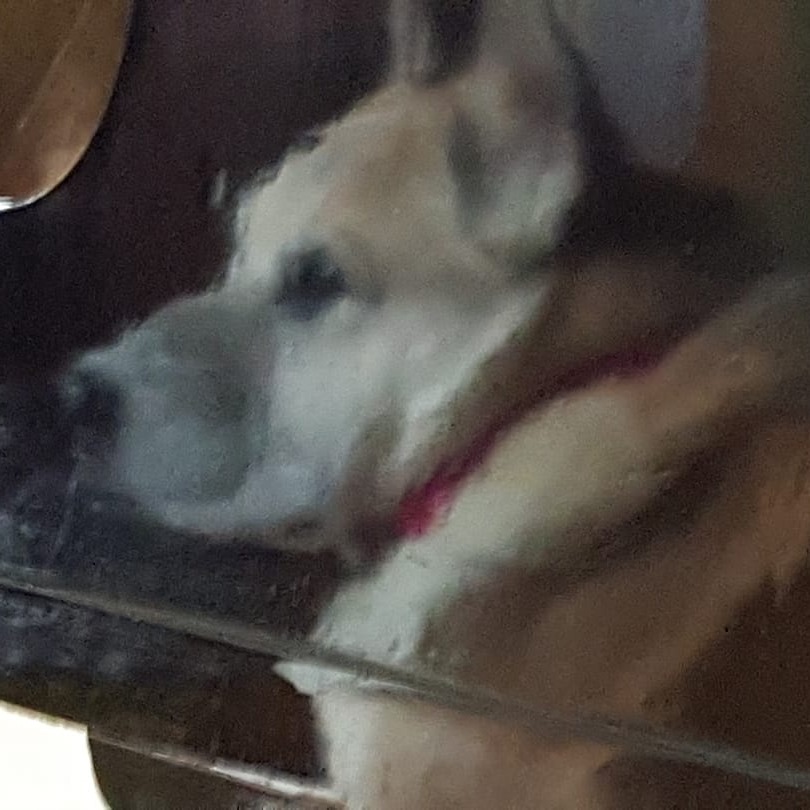
No I don’t know how true the anecdotes might be, only that Erika and I again have chosen to bring a rescue into our home. Sam was an older dog we welcomed back in 2019, who passed away back in April 2022.
If Sam seems a bit blurry it’s because she’s actually reflected in the surface of the piano.
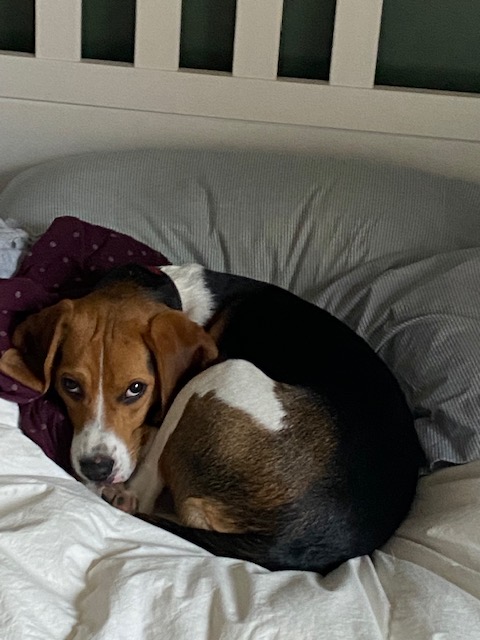
Barkley is an eight month old beagle who has lived in at least four homes so far. Hopefully we’re his last.
Barkley: please note he already had the name Barkley before he became a Barcza
As I ease into the role of doggie daddy with Barkley I’m extra sensitive to current canine discourse in our society. In post-pandemic social media dogs and cats hold a special place, helping us cope with stress, bringing light into lives that otherwise would be darker.
By “canine discourse“ we would expect to mean humans conversing about dogs, rather than conversations of dogs talking to other dogs. But come to think of it, there is some of that. In a few days Erika and I look forward to seeing the Crow’s Theatre production of Fifteen Dogs, adapted by Marie Farsi, from André Alexis’s 2015 novel of the same name.
A play adaptation is another sort of story.
I decided to read the original, the Giller Prize winning novel, to sample the story from André Alexis in order to have some idea of the adaptation.
The Crow’s website summarizes / promotes the play with these words, that are apt for the novel as well.
Is it possible to die happy? That is the question the gods Hermes and Apollo ponder over a beer at the Wheatsheaf Tavern in Toronto. They make a bet, grant 15 dogs human consciousness, and watch from above as the pups discover the poetry and the pitfalls of complex thought and emotion.
If you’ve read the book you likely don’t need persuading. You surely like the book if you read it, but like me you may wonder: how can the novel be turned into a play?
As a fan of opera and film I find the process of taking something from one medium (like a play) and turning it into something for another (such as live theatre) endlessly fascinating. My mom and I have watched and discussed several different film or tv versions of Jane Austen novels. Some people –like my mom—prefer an approach that errs on the side of inclusivity, leaving out nothing. So of course my mom far prefers the 16 hour Pride and Prejudice that she watched via PBS’ Masterpiece Theatre to any of the 2 hour film versions.
Because I was reading online using the Toronto Public Library interface I was told that I read the novel in about seven hours (mostly yesterday and finishing today). Imagine if it took that long in the theatre(!). Even Die Meistersinger (Wagner’s longest) doesn’t take that long. I’m sure the Crow’s Theatre adaptation won’t approach that massive size.
But thinking about that, the process of going from one medium to another, you have to recognize that this always entails some sort of trade-off. If you include everything –as they did in that PBS experience—your audience has to sit through 16 hours of television. Sometimes that might seem like a good idea but in Hollywood they usually shorten the story down to something more commercially viable, for fear of scaring off the customers. Marie Farsi at Crow’s Theatre likely will make a similar sort of adjustment.
There are also trade-offs in the media themselves. In a book I can go back to re-read what I missed, especially in the first part where you’re still getting to know the names of the characters. In a theatre they don’t do that, although they may build in some repetition to help you.
In a book my imagination has freedom to run wild. Once you put the character in front of me that may limit what I can imagine. Chances are they know that and will approach the story with that in mind.
Music sometimes is helpful if there is something verging away from the real towards the symbolic, the unreal or the spiritual.
If I’m reading about dogs my mind may readily jump to the images in a way that I might resist in live theatre. I recall that when we saw the caged tiger near the beginning of the play Bengal Tiger, also at Crow’s Theatre, it was a female actor standing inside the cage. I’m guessing that the 15 dogs will in some sense be portrayed by humans, not dogs. There are many ways one can imagine doing this.
In the meantime I’m listening to Barkley, with the novel resonating in my head. I believe we are attracted to certain genres of storytelling because of how they fit into our lives. We watch romances while contemplating the meaning of love, and when we’re loving our dogs, a story like this one resonates.
As with George Orwell’s Animal Farm or Wes Anderson’s film Isle of Dogs, Alexis’s novel is an apologue, a kind of allegory that uses animals to illustrate a moral point for us. One of the things I love about this new book is its subtlety. I cried like a baby at the end, surprised by how strongly I was moved. In a work such as the Orwell or the Anderson, politics seems to be the author’s allegorical focus. For me Alexis is chasing something much subtler that I wouldn’t presume to summarize so glibly. Perhaps it’s the nature of art and happiness.
I’m hopeful that the play can capture some of the magic of a book that I enjoyed so much.
The headline is only partly in jest. Yes it was the best concert so far in 2023, as of January 11th. Many are still saying “Happy New Year” and writing the wrong date on cheques (if they even write cheques anymore).
But it was truly brilliant.
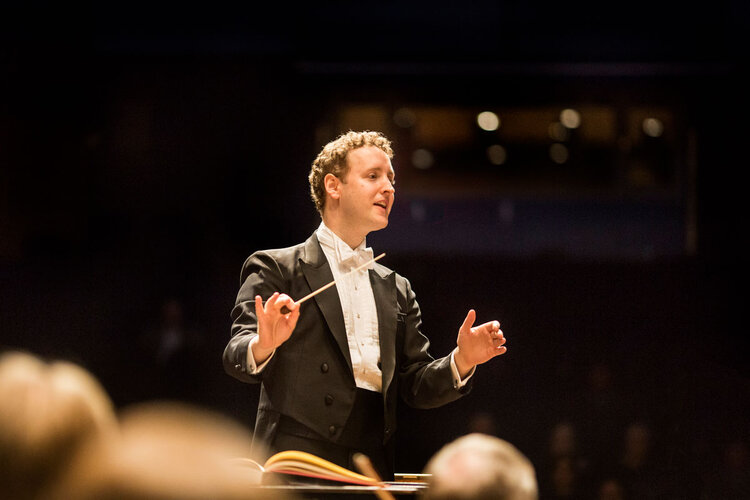
The Toronto Symphony and the Toronto Mendelssohn Choir were led tonight by Michael Francis in a program that left me speechless with wonder. The question of whether this marvel was curated by our own TSO wizards (who did such magic in October) or the visiting conductor was settled when I peeked at Francis’ 2023 schedule, which shows he will conduct the same program on July 2nd in Speyer, Germany (if you scroll down far enough). So clearly it’s Francis who deserves the praise.
I should have known from his witty patter at the microphone. And of course that’s to be expected when he’s also Music Director of the Mainly Mozart Festival in California, The Florida Orchestra, and Deutsche Staatsphilharmonie Rheinland-Pfalz, all at the relatively youthful age of 47.
Michael Francis, image from the Mainly Mozart Festival website
Why am I so stunned?
Before intermission we heard: -Von Bingen’s O virtus Sapientiae -Mozart’s Masonic Funeral Music -Beethoven’s Grosse Fuge -Allegri’s Miserere
Full disclosure: for years I’ve been conflicted about Roy Thomson Hall, sometimes enjoying its sound, even as I join the gaggles of seniors struggling to get to the washrooms (myself included), not always able to reconcile the modern architecture and classical music.
Tonight it was as though someone (Francis? Or the ghosts of Mozart, Allegri, Beethoven & Van Bingen) sought to consecrate the hall, to bless this space. For the moment I’m in an altered state as I recall the experience, seeing and hearing it in a whole new way. The first half of the concert was like that, not just the music but also the way it was executed.
For the brief von Bingen opener, lights were dimmed. Ten female voices processed in one by one, carrying their music with only enough light for their upper body and their pages. The text is almost secular in its focus on wisdom.
The Masonic Funeral Music is something I have to revisit, trying to discern whether it usually sounds as macabre & morose, or if that was Francis’ doing in his interpretation, pushing the darkest colours. We’re listening to some remarkably dark orchestral timbres supplied by contrabassoon and some brass in this tiny majestic piece.
Then we were plunged into something different again, a modern-sounding reading of Beethoven’s Grosse Fuge in its free¬standing string version (as opposed to its place in the string quartet where it originated). Again I was particularly impressed by the low voices, this time work of the double basses with their edgy lines. Francis takes this piece without apology to the limit, meaning quickly and in the bolder passages without restraint. We experience big contrasts, but then again the program is all contrasts, every piece a change of pace.
And just when I thought I knew what to expect came what was for me the highlight of the evening. The presentation of the Allegri has me thinking of the modern hall in a new way. Nineteen singers were illuminated at the back of the stage in the choir loft, the first voices we heard. Tenor Isaiah Bell was the answering solo voice, coming to us from backstage. The third group, the high voices in the parts of this composition that everyone remembers best, were situated out among us in the audience (I couldn’t see where, but perhaps on the higher balcony). I see in the program (even if I couldn’t see them for myself) that this group consisted of Rebecca Genge, Rebecca Claborn, Simon Honeyman and Neil Aronoff. There we were in Roy Thomson Hall as though encountering proper antiphony, voices exchanged across the big space, but without the excessive reverb you might have in an old church. It was the best of both worlds truly.
If you can’t see this concert in Toronto (Thursday and Saturday at 8 pm) or North York (Sunday at 3 pm) go to Germany if you can (but then you won’t have the TSO, TMC or the soloists… and that’s a pricey option). It’s outrageously good.
That first part was a little over half an hour, to set up the presentation of Mozart’s Requiem after the intermission.
The version we heard is the Robert Levin edition from the 1990s. Again I’m not sure how much of this is really the edition and how much is Francis. The pace was often breath-taking, passages I’ve known previously as leisurely, suddenly taking on intensity I hadn’t expected. Soloists Jane Archibald (sorely missed around here of late), Isaiah again, mezzo-soprano Susan Platts and bass Kevin Deas were all stylish, in tune, and well-balanced against the forces of the TSO and the Toronto Mendelssohn Choir.
I don’t know what share of the excellence comes back to the input of the new Artistic Director of the TMC, Jean-Sébastien Vallée, but they’re sounding better than I’ve ever heard them. They’re precise and accurate, powerful when called upon by Francis, but delicate when necessary.
If your experience is anything like mine after that stunning opening, you’ll come to the Requiem ready to be moved, tenderized and vulnerable. Francis, the soloists, the choir and the orchestra will not disappoint you.
It’s a great start to 2023, that I suspect will be mentioned in my list of the “best of 2023”.