Tonight’s concert by the Toronto Symphony was a fitting beginning to their centennial season, a genuinely celebratory evening.
The program message from Music Director Gustavo Gimeno is very promising:
“The creation of contrast is at the heart of what I believe about concert programming—the coming together of past and future, masterworks side by side with new commissions, old friends and new faces on the concert stage: all manner of refreshing or startling juxtapositions.”
Tonight for example they put Chopin’s lyrical 2nd piano concerto and Rimsky-Korsakov’s epic Scheherazade, alongside two new pieces, namely Kevin Lau’s The Story of the Dragon Gate, a brief prelude to open the concert and Lera Auerbach’s Icarus.
And while the music was exciting there’s the remarkable discovery I made, that I was completely surrounded by persons younger than myself at Roy Thomson Hall. Need I mention: this is the goal, to bring a younger crowd to classical concerts. You have no future when your subscribers are all seniors.
Clearly somebody is doing something right.
Kevin Lau grabbed the stage fearlessly for three minutes of enthusiastic melody that sounded a bit like a John Williams film-score, his heart on his sleeve employing the full range of orchestral colour. It’s a bit hard to follow, although Auerbach’s Icarus took its turn, syncopated and even more energetic than what Lau gave us, seguing to something more subdued, sweetly lyrical.
Pianist Bruce Liu gave us an understated reading of the Chopin, often playing notes softer than usual with perfect clarity. Liu has an original approach, sometimes teasing us with his rubato, while articulating every note. As his encore we were treated to the Etude Op 10 #5 in G-flat, the so-called “black – key” Etude, a perfect exercise for showing off his flawless technique.
After intermission we encountered Rimsky-Korsakov’s vibrantly ethnic Scheherazade, a brilliant study in story-telling. The work has been a TSO signature piece, especially with Jonathan Crow playing the violin solo passages, as he did on the 2014 Chandos recording conducted by Peter Oundjian. If anything Gimeno seems to be pushing this orchestra to greater heights, taking some sections faster, bolder than before. I think the climaxes seem bigger because Gimeno carefully restrains them to begin the crescendos, super soft building inexorably. They sound like a virtuoso ensemble, offering a series of eloquent solos from every section, ready for anything Gimeno asks of them. The chemistry is palpable. The Chopin-Rimsky program repeats Thursday and Saturday nights.
The anniversary season exploiting contrast continues Thursday, Saturday and Sunday of next week, mixing Mendelssohn’s Hebrides overture, Chausson’s Poème for violin & orchestra, Saint-Saëns’s Symphony #3 and Samy Moussa’s violin concerto.
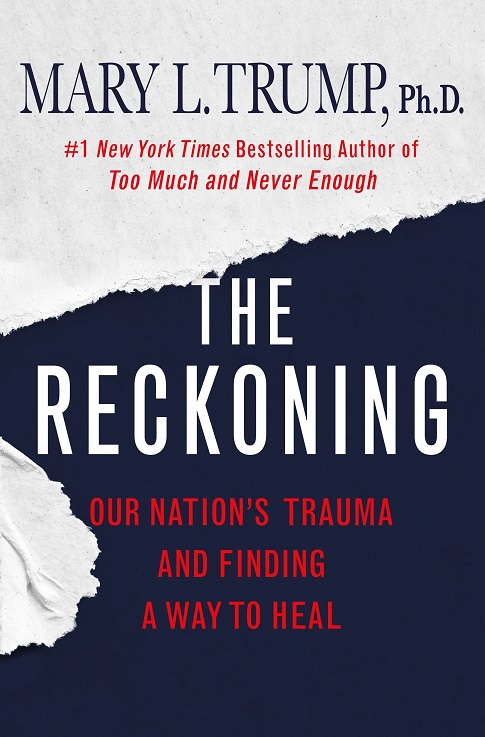
The title of the book is The Reckoning: Our Nation’s Trauma and Finding a Way to Heal.
It’s to be understood as a reckoning for America, but perhaps also a personal one for the author.
After watching the Royal Funeral today, September 19th 2022, I want to connect the personal & the political, the macrocosm seeming to reflect the microcosm. Just as Elizabeth’s dutiful vow expands outward from her family to the myriad contacts she made, shown in the worldwide outpouring of love for her, so too in the two ways of understanding Mary Trump’s ongoing project (within her family and writ large for her country).
But of course there is a huge contrast between the two. The past ten days since Elizabeth’s passing have been a constant affirmation of the rule of law, and dare I say it, a transfer of power so orderly that the protocol can be planned long in advance. As a Canadian I rejoice in these serene & peaceful rituals, even as I recall recent transgressions such as the convoy in Ottawa or January 6 in Washington DC, reminding us of the fragility of the American experiment in democracy.
I raced through The Reckoning, this latest book from Mary Trump, within a day: unable to put it down.
Her previous book Too Much and Never Enough was a careful dissection of her uncle’s personality, laid bare as only she could do, a psychologist writing about the pathology of a family member.
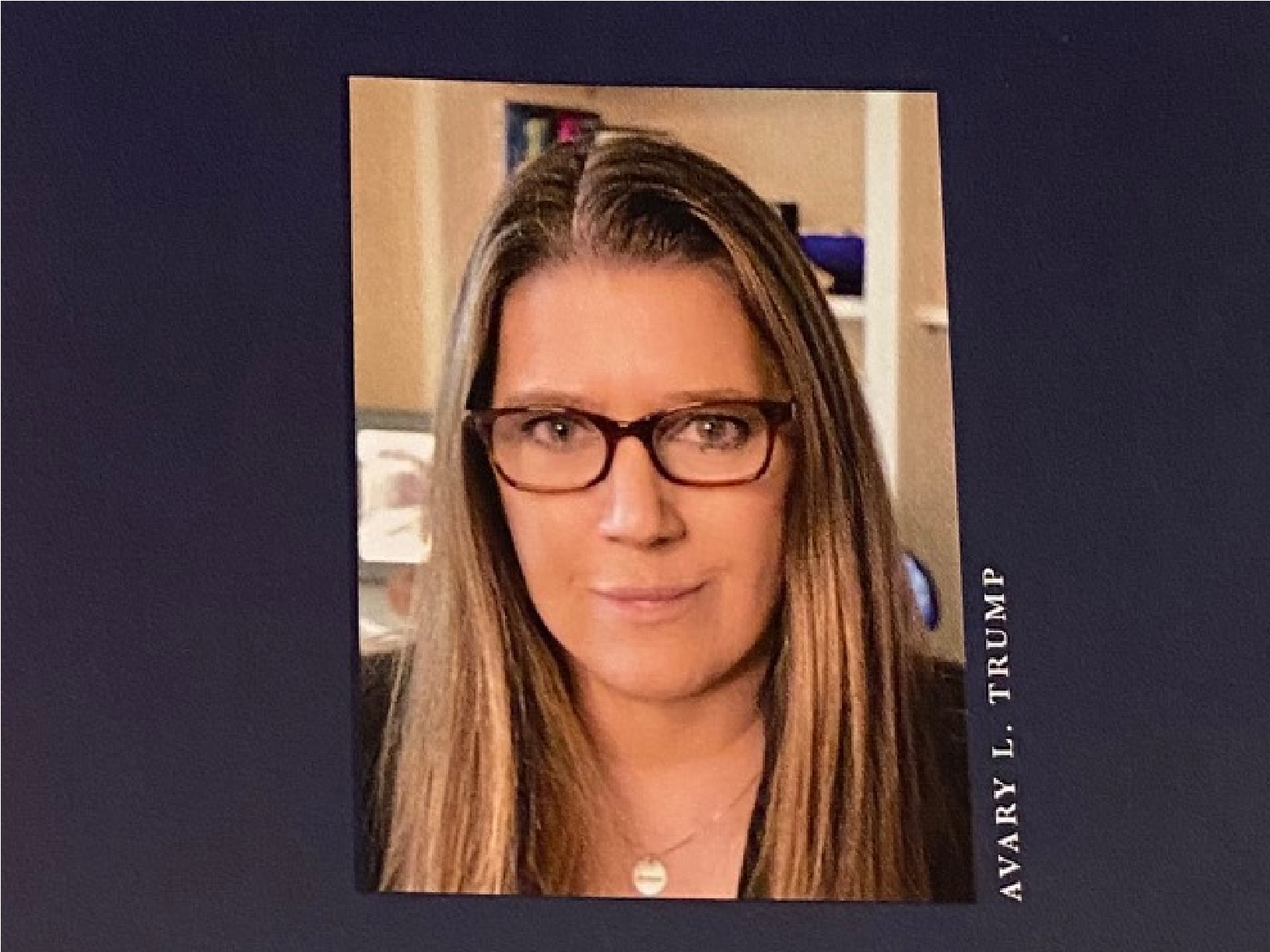
Back flap photo of Mary Trump
This time? I was surprised to discover that she was writing much less about her uncle and more about his context. It reminds me of the second Godfather movie, when much of the film resembles a prequel to show the history that led Vito Corleone to become the Godfather. Similarly Mary Trump gives us a brutally honest history of America: to explain the background context for Donald Trump.
I should caution you that reading the first 50 pages hits you like a blunt object. This is a history of America pulling no punches, while explaining how her uncle fits into the ongoing project of white supremacy. I will give you one tiny safe sample.
By the time I was a sophomore in college, I knew more about the Holocaust than I did about the genocide of Native Americans and the complete oppression of enslaved Africans and their subsequent generations in my own country. The message I’d received through most of my years at school, and my life in general, was that Black American history was not my history, and it was not “our” history, but something separate, other. Toni Morrison wrote “In this country American means white. Everybody else has to hyphenate.” (Trump 140)
But it isn’t really telling us how that reckoning will happen. I say this having breathlessly raced through Mary Trump’s book, hoping for some glimpse of redemption or salvation. Nope. Perhaps I need to recall how therapy works, that the therapist listens, while the patient figures it out & hopefully grows, heals, reckons with who they are. While we’re given a fair bit of history there isn’t anything to explain how we can get from here, our current mess, to some kind of solution or reconciliation. There is more diagnosis of the problem(s) than any idea of a prescription, a pathway to healing.
Indeed, I’m not sure whether she understands her title to mean the resolution of historical injustice by righting wrongs or in the destruction of democracy itself and the ripping away of the illusion of American exceptionalism. I did not finish with any sense that Mary Trump’s book could lead us to “finding a Way to Heal,” as the title seems to promise. In fairness the first step must be recognizing the problem, so in that sense I suppose that it’s a step in the right direction.
A Window To A Dream breathes new life into opera favourites
Unprecedented program brings fresh Farsi translations of opera essentials to the stage at Richmond Hill Centre for the Performing Arts September 23rd, 2022
FOR IMMEDIATE RELEASE
Richmond Hill, Ontario — Although Cultural Interchange-360’s upcoming production A Window To A Dream features a program consisting of some of the most famous and beloved music of the past 400 years, this event is the very first of its kind.
The event, supported by Canada Council for the Arts and Ontario Arts Council is coming to the Richmond Hill Centre For The Performing Arts on September 23rd, 2022 and includes a stunning collection of arias from the Baroque era to the 20th Century. The crucial catch: everything has been translated into Farsi.
Top-tier vocalists Abdolreza Rostamian (tenor), and Farshid Tabloie (baritone), alongside CI-360 co-founder Golrokh Aminian (soprano), will be performing a selection of classic opera arias accompanied by a 25-piece orchestra and 16-member choir conducted by JUNO-nominated composer Saman Shahi. Shahi has also re-orchestrated the music to accommodate these instrumental forces. Meanwhile, director Kamran Aminian, storyteller Arianna Aminian, and the stage & costume designers Amir Rahbar and Morvarid Alinejad will bring the unique worlds of each opera to life, while tracing a cohesive journey between each of them.
Golrokh Aminian, in addition to serving as co-director and vocalist, has put her multilingual background to work for this production, crafting poetic, musical translations of each song. The songs are woven together by a dream recounted by our young narrator, who is confused about the notion of love.
Listeners will be treated to stirring, evocative Farsi renditions of important works such as Dido’s Lament by Purcell, Puccini’s O Mio Babino Caro, as well as excerpts from Verdi’s La Traviata, Bizet’s Carmen, Mozart’s the Magic Flute, and other cornerstones of the operatic repertoire. They will also include a rare performance of Saghi be Noore Bade, an aria by Azerbaijani composer Uzeyir Hajibeyov (1885-1948), from his 1937 opera Koroghlu.
Under Iran’s Islamic Regime, opera became a heavily politicized artform—banned, in fact. The 1979 revolution brought an end to the nascent opera community which had only been active for 18 years. Opera’s secular content (depictions of earthly love, for instance), and the participation of female vocalists, were deemed objectionable by the regime, opposing its strict religious-derived laws. Even prior to the 1979 upheaval, the European languages of opera libretti and art-song texts had posed an obstacle for these genres in terms of reaching a more mainstream status among the Iranian populace.
A Window To A Dream will indeed broach the history of opera in Iran, but its primary purpose is to offer an opera primer to Iranian audiences and other Farsi-speaking communities. It’s at once a celebration and reclamation of this cherished body of work.
A Window to a Dream
Presented by Cultural Interchange-360
Friday, 23 September 2022, 8:00 PM – 9:30 PM
at the Richmond Hill Centre for the Performing Arts: 10268 Yonge Street, Richmond Hill, ON L4C 3B7
Featuring:
Soprano: Golrokh Aminian
Tenor: Abdolreza Rostamian
Baritone: Farshid Tabloie
Conductor & Arrangement: Saman Shahi Director: Kamran Aminian
Narrator: Arianna Aminian
Stage & Costume Design: Amir Rahbar & Morvarid Alinejad.
Over the past five years, Cultural Interchange-360 has been mounting elaborate musical presentations throughout the Greater Toronto Area, all of which have situated music within broader thematic frameworks that merge various artforms, languages, and cultural elements. Featuring the work of local musicians and composers their past productions have fused the classical traditions of Europe, with those of the Persian/modal lineage. Co-founders and co-directors, Golrokh Aminian and Amir Rahbar are both of Iranian descent and each one’s artistic practice is informed by thorough training in European idioms. Aminian, a vocalist, was a soprano in the Roudaki Hall of Tehran, before coming to Canada and studying at the Royal Conservatory and under several renowned sopranos. Rahbar, a pianist, started his music training on accordion and tonbak, and subsequently studied piano and the language of European classical music with a host of notable Iranian scholars.
*******
“Press releases and announcements” are presented verbatim without comment
Tina Brown’s book The Palace Papers is brilliantly timed.
Don Lemon mentioned her book during CNN’s coverage of Elizabeth’s passing and Charles ascension to the throne. While it wouldn’t appear opportunistic on the surface, come to think of it a book that appeared in 2022 when the Queen was in her mid-90s had a good chance of being a valuable resource when she died.
This is the Tina Brown of Vanity Fair, who led the magazine through some of its greatest years, covering famous people. I devoured every issue.
We might want to contrast the high-quality prose & glossy photography in its pages with the ugly culture of paparazzi and the tacky publications pushing them to get invasive pictures, pursuing Lady Diana on motorbikes. They’re widely blamed for killing the mother of the Princes Harry & William. I believe it’s really the same impulse. Brown writes better, her photographers at Vanity Fair took classier shots.
But the hunger is ultimately the same, meaning our hunger: for news, details, dirt. Whether I eat a Big Mac or caviar, it’s still food.
No I’m not making some sort of smart-ass intellectualization. When I started reading Brown’s book, I was momentarily troubled, having enjoyed the rituals of mourning on TV this week.
Part of me noticed her excellent writing, her impeccable way with attributions of sources. Brown is the best in the business.
But in the first few pages I was wondering if I could handle the book, because part of me shivers with revulsion at the tone. When we write about the British Royal Family, we’re entering a domain that is the most fundamental exploration of class one can imagine.
Today we watched people lining up, to walk past the coffin of Elizabeth II. I don’t think this is something crude to be mocked. It’s a beautiful thing even if it’s not what I would do as a Canadian living far away. Perhaps I’d feel differently had I grown up in the UK instead of Canada. What I feel only matters as far as you may suspect my motives. I liked Queen Elizabeth, troubled by what I saw portrayed in the film The Queen (2006) even if it’s likely accurate (and confirmed by Brown btw). I pitied her for what she endured even if I can also be upset with the royals for what they did to poor Diana.
The thing is, I always felt troubled by people who might mock you for using the wrong fork, for looking down their nose if your tie wasn’t tied correctly or if your shoes weren’t sufficiently shiny.
I find there’s something of this in Brown’s prose, as she seems ready to mock those with upward aspirations, indeed to mock everyone at some point or other if they take a wrong step. Perhaps she’s right, but right now I’m just not in the mood. I find the camera eye too invasive, and this prose pushes my buttons, still feeling guilty for Diana even now.
If you’re looking for the true dirt on the Royals you might love this book. If you’re a royalist perhaps you will be upset by what she’s saying even if it’s the truth. I repeat, I’m conflicted. Maybe it’s just my timing, that I’m fascinated by the stiff proper deportment of funerals and regal procedure. Watching the processions & listening to the music I was thinking of Berlioz, who had such an ear for the big public spectacle: which we never see anymore. If nothing else the broadcasts remind me of the past use of big massed bands for their emotional impact. I guess I’m a sucker for that.
I will probably finish the book, but for now have found it rubs me the wrong way and have stopped reading.
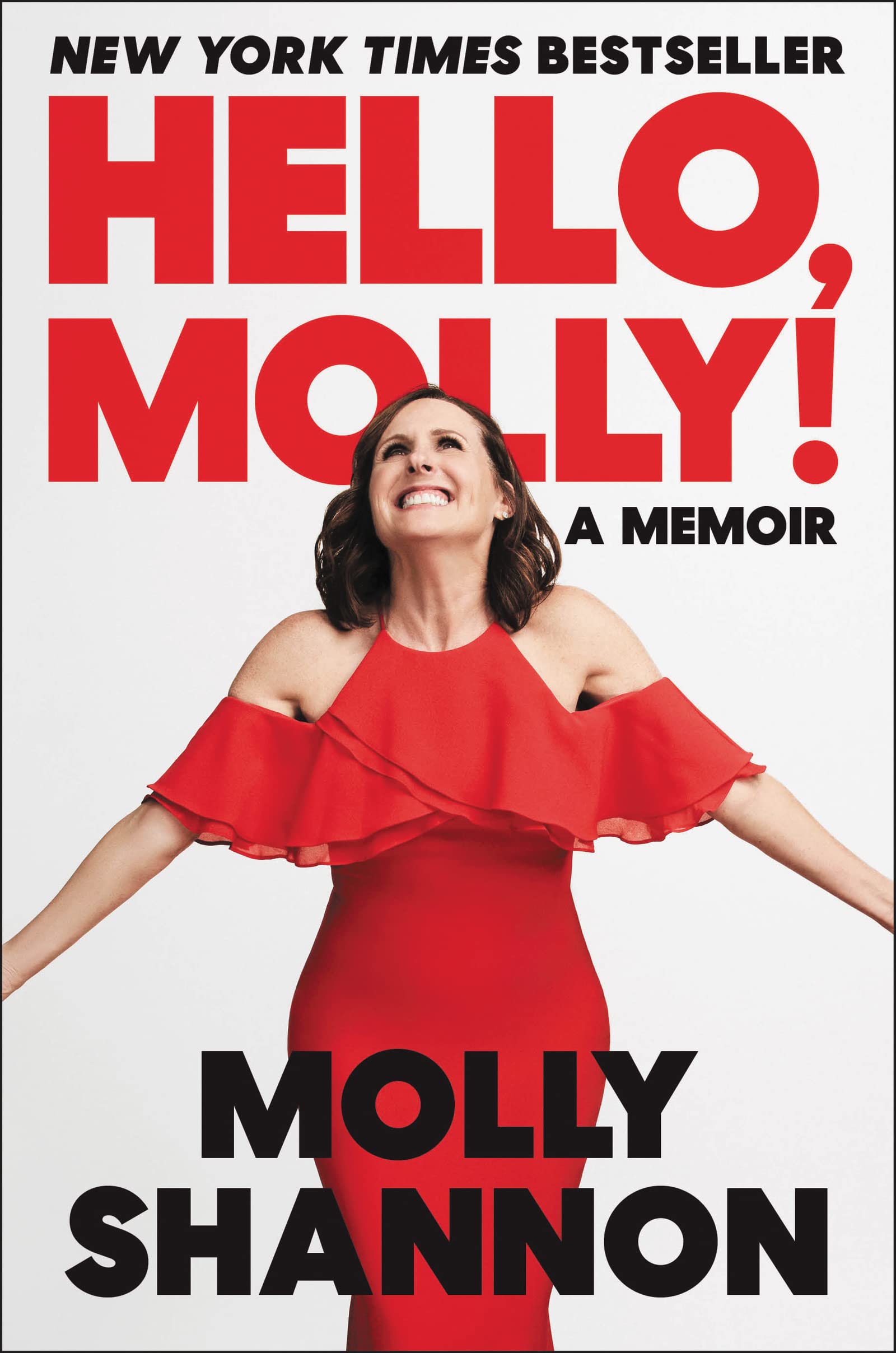
I’m re-reading Hello Molly, the memoir of Molly Shannon.
It’s likely a bestseller mainly because of the fame of its author, a star on Saturday Night Live from 1995-2001.
But I didn’t expect to be so moved, reading the book cover to cover, unable to put it down. It’s not just well-written but a gripping story with overtones of redemption.
I didn’t expect to be picking it up to re-read, hooked again by its opening pages.
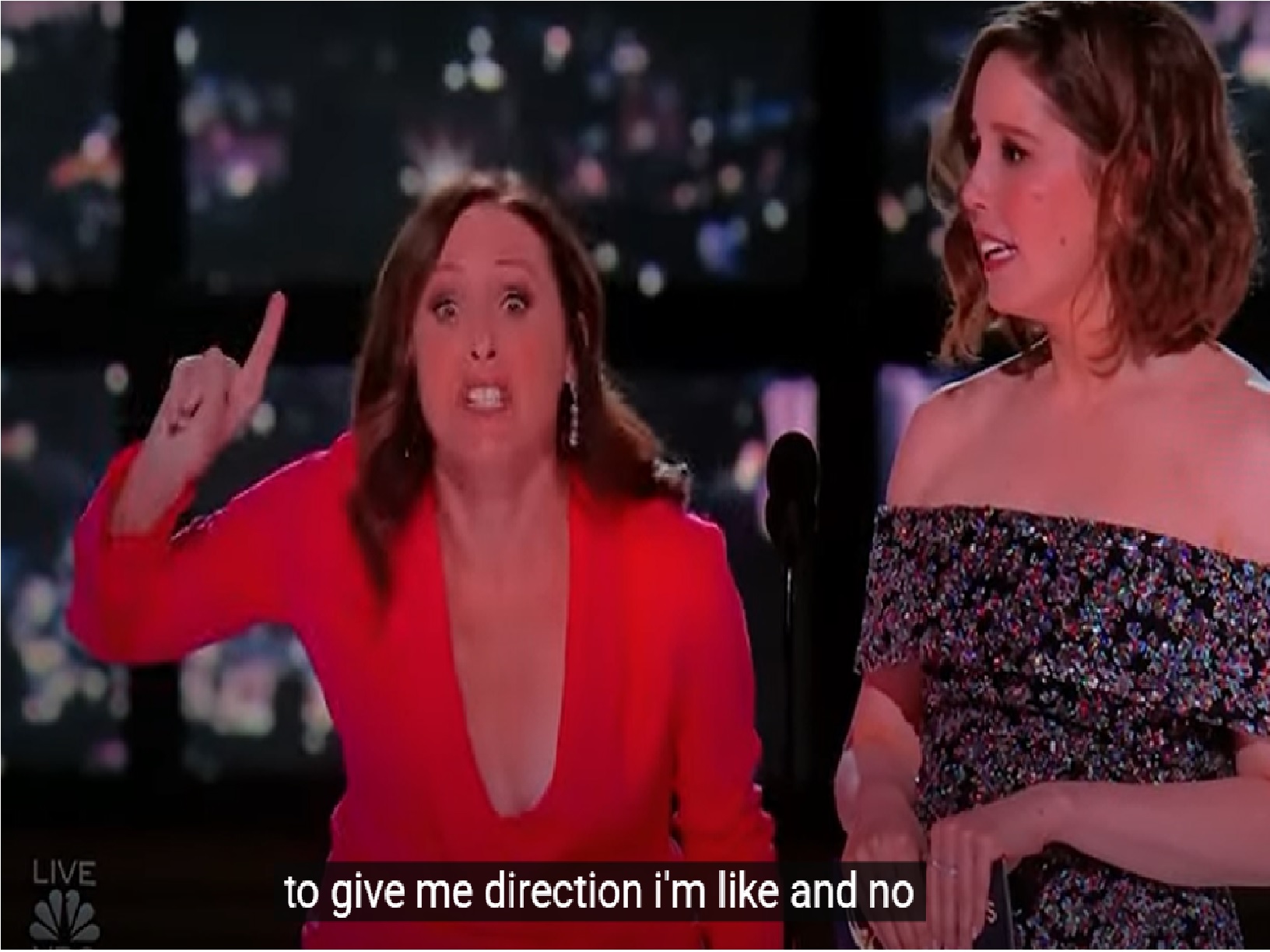
I saw Molly on TV last night during the Emmys.
Molly Shannon and Vanessa Bayer
The caption machine left out the B word (you can lip-read it if you’re good) that she used to describe herself. It’s admittedly a mild word compared to the many f-bombs flying last night, telling us what she’s like to work with. She said it with pride although I’m sure it was meant for laughs. She’s one of those actors whose presence is so intense as to sometimes scare you. I can’t always tell when she’s joking. The boundaries get blurry with someone who has so much conviction.
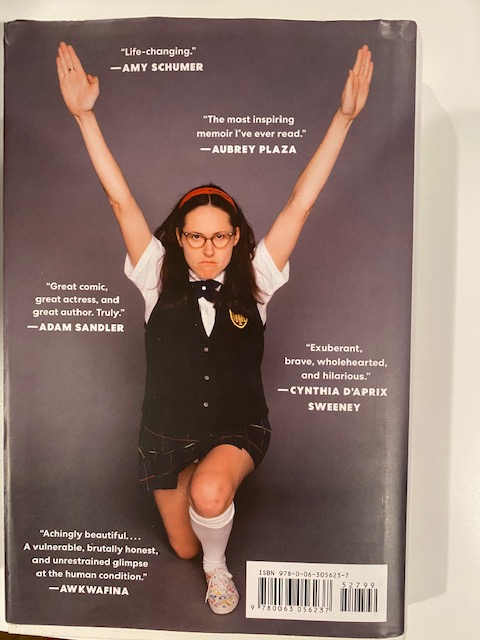
The back cover of the book features Molly’s best known recurring character on Saturday Night Live, Mary Katherine Gallagher, speaking of intensity.
I come back to something I observed with Brian Cox’s memoir (who was also on the Emmys last night). The most entertaining books aren’t necessarily written by the most entertaining performers, something I said because I didn’t love Cox’s work but did enjoy his book.
Similarly while I didn’t love Molly’s work (back then at least) I truly love this book. Wow it’s like I’m making a confession but yes the book surprised me totally.
And the person I discovered inside the pages? Admirable to say the least.
Her story is so honest at times I wonder whether the police will go knock on her door. Of course the crimes she confesses to are from her youth when she was on the brink of ending up in juvenile detention. The chapter titled “Swimming to Juvie“ is not even the darkest part of the book by any means: but it’s troubling until we recall (as with any biographical film): oh yes, we know all about her happy ending, she couldn’t (shudder) end up in detention or jail (shudder) or (gasp) dead because we see her become a regular on SNL.
But I truly shuddered & shivered when I came to the end of that chapter. Whew. Did she clean it up for us? It’s such a relief.
“Swimming” was her euphemism for shoplifting, the chapter showing her close brush with the law, the genuine consequences for a wild period in her youth.
But it makes sense when you read the powerful opening chapter. I feel a powerful connection because I’m hearing from someone who lost her mother and sister on page two of her life story. Molly the ever resilient daughter is not at all judgmental about her father who was likely a bit impaired when he crashed. Their closeness seems co-dependent, an observation I don’t offer as criticism but rather in hoping to understand. I’m perhaps a mirror image, as someone who lost his own dad early, as I marvel at the brave fearless creature Molly’s dad raised.
Out of the wreck Shannon emerges as a special talent. Our categories and genres break down, sometimes failing in the presence of someone truly original, a sensation I felt a few days ago watching Tom Rooney in Uncle Vanya. So too with Molly Shannon, as for instance when she throws herself around onstage.
We’re told that SNL had to hire someone to help protect Molly from herself, because she threw herself so completely and so literally into her work, far beyond mere method acting. Via YouTube (aka giving these routines another look), I find she was perhaps ahead of her time.
There are life lessons in this book.
For a parent I think you’ll see how & when to be strict and how to be more permissive. I’m reminded of my recent brush with bad parenting in Sarah Polley’s book, when –if I may be permitted to offer my own take—parents must decide whether it’s more important to protect your child or to suck up to someone you admire. While Molly tippy-toed on the edge of disaster, encouraged and even goaded by her dad, she became one of the most fearless performers through his influence.
Molly tells us how she approached meeting Lorne Michaels, great advice for any audition or interview.
I noticed that Molly & fellow SNL alum Vanessa Bayer (seen in the B-word picture above) have done a show together, I Love That for You. I’ll have to check it out.
It seems that SNL was reinventing itself at the time Molly arrived on the show, as several cast members left and new ones arrived. Ditto this year it seems. Seven cast members are leaving (Kate McKinnon, Pete Davidson, Aidy Bryant, Kyle Mooney, Alex Moffat, Melissa Villaseñor & Aristotle Athari). I’m a huge fan of the show, wondering if they will finally cancel it.
Lorne looked very old last night, winning his Emmy. It’s been gasp 47 seasons. I wonder how much longer he can last, whether he’ll make it to 50 seasons.
In the meantime I’ll keep re-reading Molly’s book. You might enjoy it too.
The new version of Uncle Vanya, by Liisa Repo-Martell, directed by Crow’s Artistic Director, Chris Abraham works very well. I loved it.
Chekhov can be a challenge, possibly because he’s often put on such a high pedestal, his name spoken in hushed tones. He defies definition, straddling genre boundaries in ways to confound & confuse, comedy embedded in situations fraught with tragic possibilities. I think it’s a mistake to hold him in so much awe as to lose your way or lose your nerve.
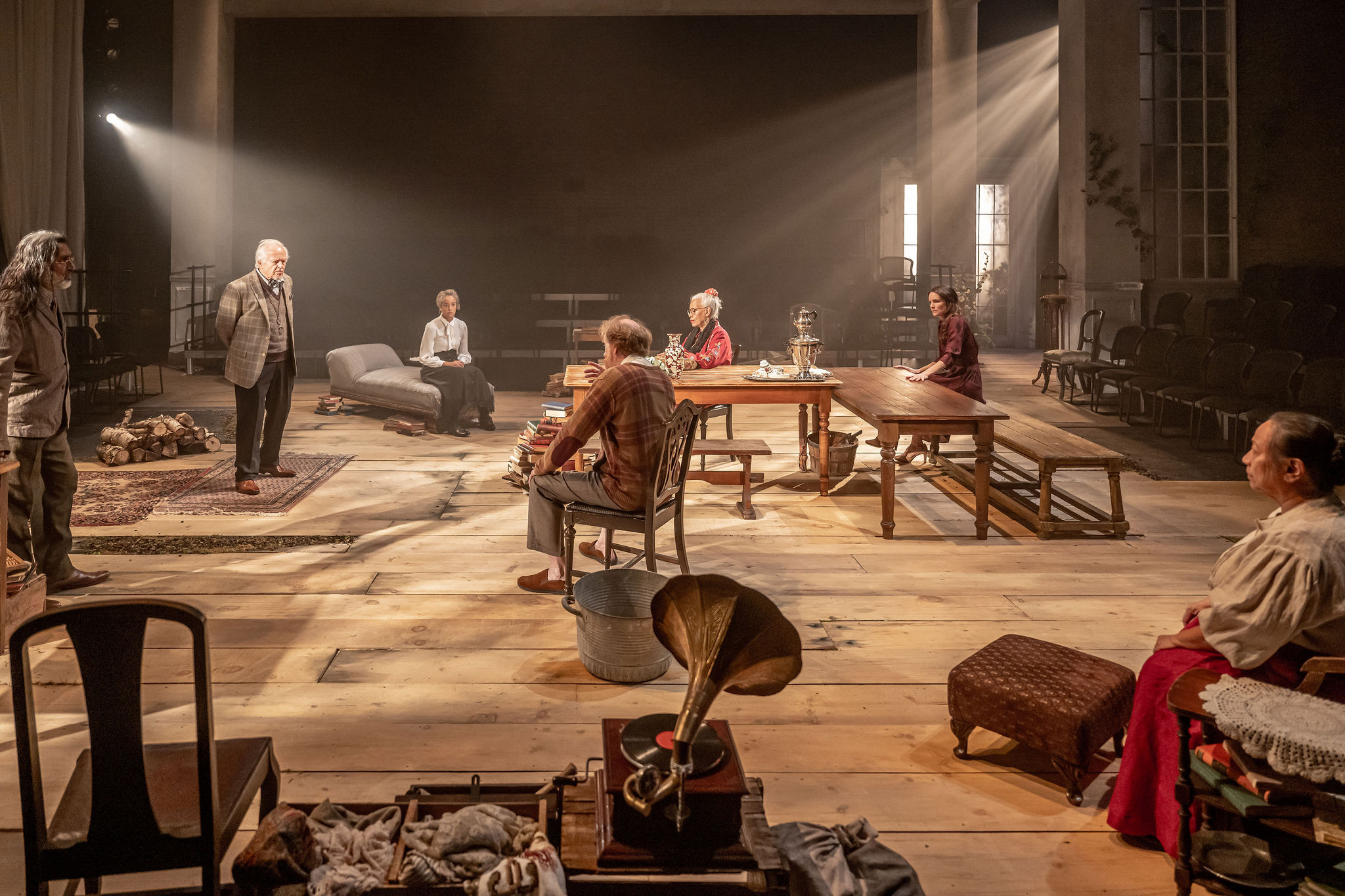
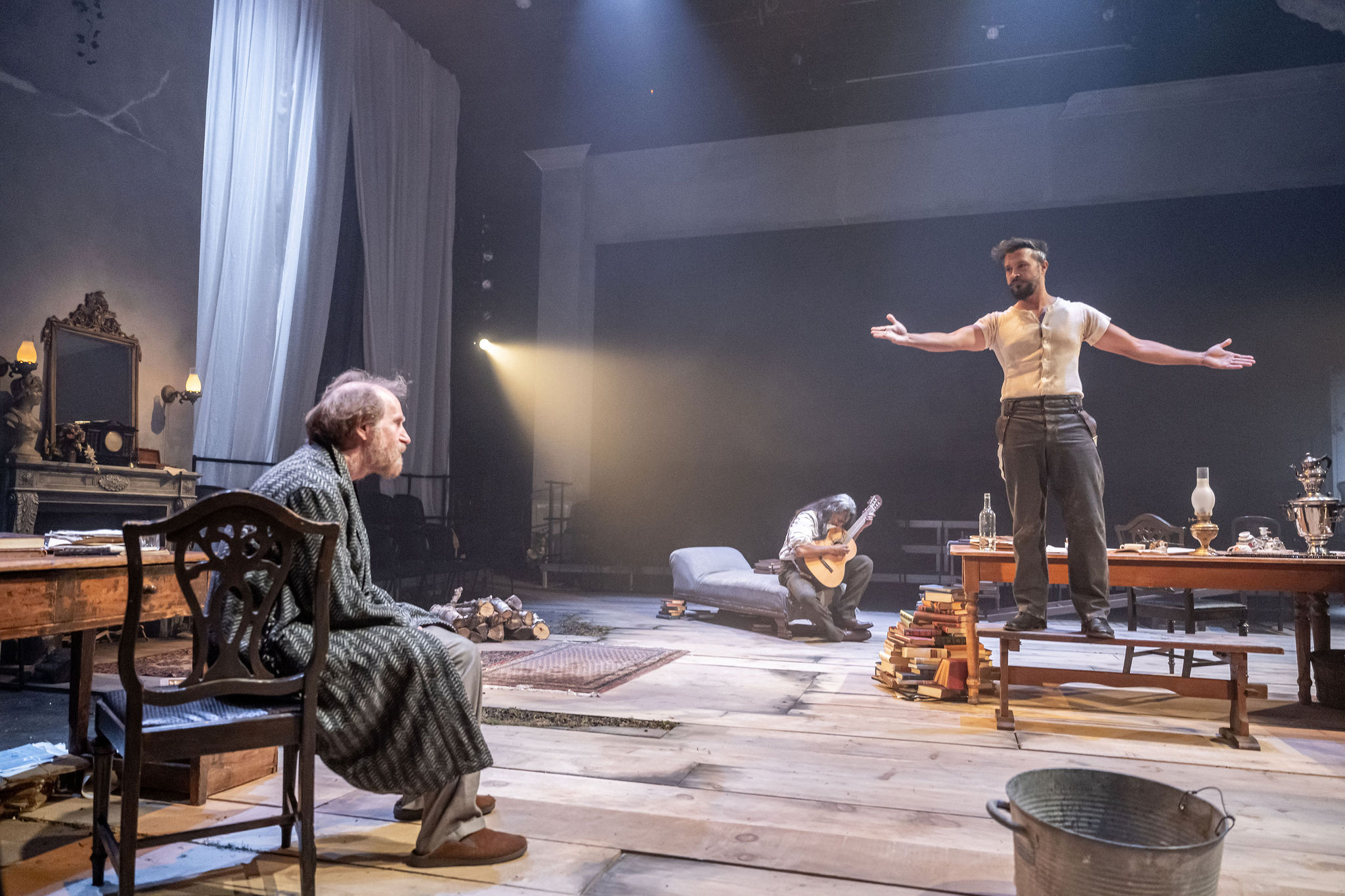
But Repo-Martell and Abraham are fearless, casting the show in a way that feels totally natural for the Toronto of 2022, less like the 1899 classic from Russian literature and more like a modern romantic comedy with an atmospheric set design to suggest the period. Yes there’s a samovar (reminding me of the agonies decades ago, trying to find one for a student production). Yes we hear the horses that pull a carriage. It’s wonderfully suggestive, presented with the intimate Guloien Theatre audience (perhaps 120? not sure) completely surrounding the action.
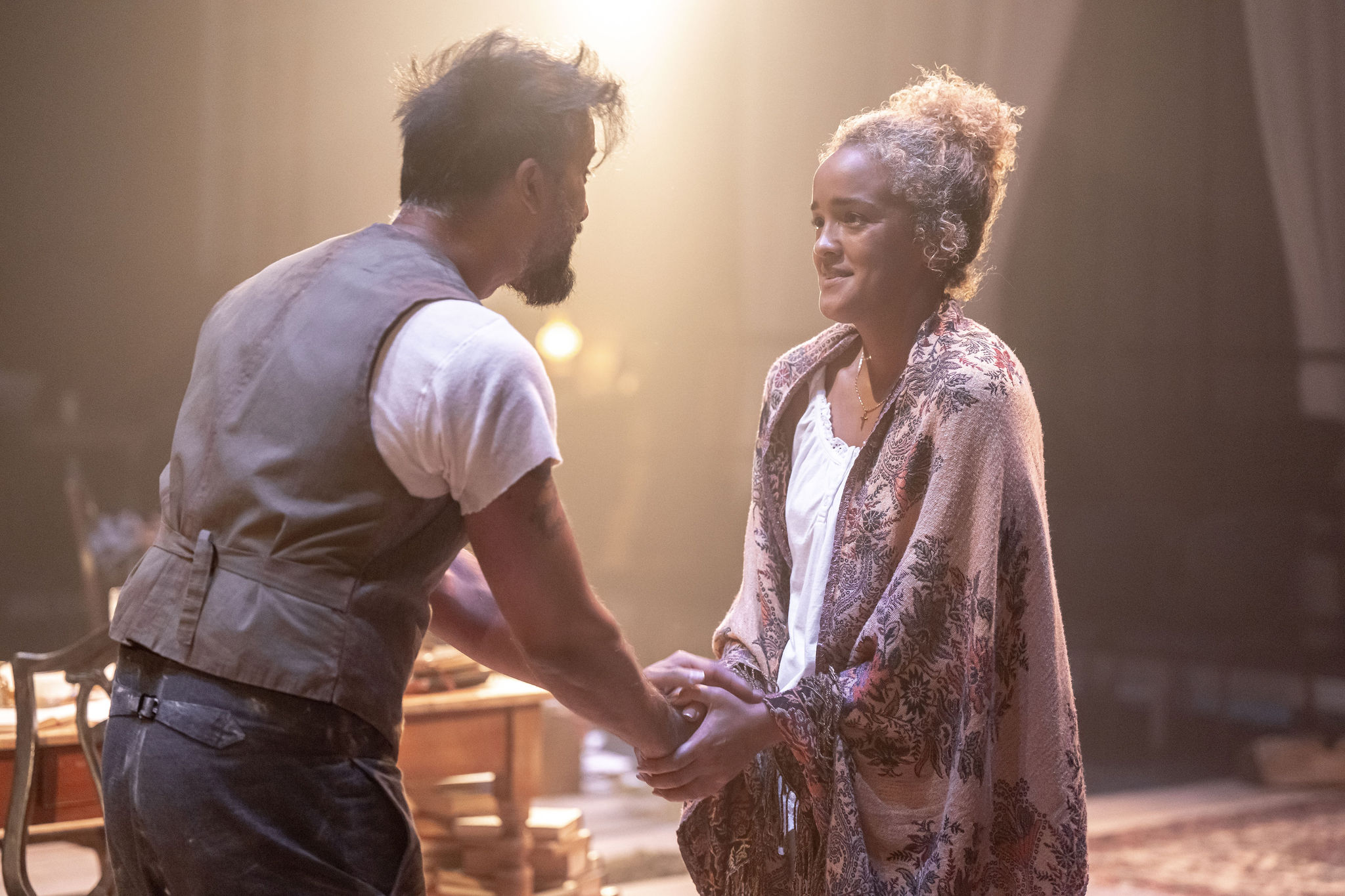
(l t r) Anand Rajaram as Telegin, Eric Peterson as Alexandre, Bahia Watson as Sonya, Tom Rooney as Vanya, dtaborah johnson as Maria, Shannon Taylor as Yelena, Caroline Fe as Marina (photo: Dahlia Katz)
One natural entry point with this play is in its echoes of the pandemic, as we watch the irritation grow in a crowded house. Deja vu! We see the comedy, we’re ready to laugh, as we watch everyone coping in different ways using various coping strategies. Some of them are cheerful, some are grouchy & grumpy. I think there’s probably somebody you’ll look at onstage, seeing yourself.
Repo-Martell & Abraham encourage a feminist reading of Chekhov’s text: or at least they refused to allow the sexist / misogynistic language of several characters to disbalance the show’s interpretation. Maybe my age is showing but I recall productions where the contrasting pair of Yelena (beautiful & living a life of bored luxury) and Sonya (plain & hard-working) underline some sort of imagined political or moral symbolism by the playwright. Yes we do hear judgments hurled at Yelena by other characters. But perhaps the text has been waiting for interpreters who would see past the surface, showing the challenges faced by each of these young women. The magical scene between Yelena (Shannon Taylor) and Sonya (Bahia Watson) is one of the highlights of the show.
And of course there’s the testosterone in the script, so many men both young & old responding often in the most predictable ways to the women around them. Tom Rooney as Vanya is turned loose, muttering softly for much of the show but gradually building momentum as his anger grows making for some fiercely dark moments This powerfully intimate space often left me unsure where to look on a stage populated with terrific performances: but Rooney was truly remarkable, as I couldn’t take my eyes off him.
Ali Kazmi gives us a fully fleshed out incarnation of Astrov, who is at the heart of the play as both the tempter (of both young women) and the tempted (between his romantic aspirations and his inability to resist vodka), the idealistic young doctor who dreams of the future.
(l to r) Ali Kazmi as Astrov and Bahia Watson as Sonya (photo: Dahlia Katz)
Kazmi and Rooney are great fun together, especially when they begin to sing & dance, aided and abetted by the work of Anand Rajaram (as Telegin) on guitar.
(l to r) Tom Rooney as Vanya, Anand Rajaram as Telegin, and Ali Kazmi as Astrov (photo: Dahlia Katz)
The best comedies must sometimes be serious and Uncle Vanya is no exception. Chekhov poses the difficult genre questions (tragedy or comedy?) alongside the difficult life questions (what is happiness and how do I find it?). After getting tangled up in the smallest trivia of life, we stumble upon depths & horrors. Money questions, romantic questions, and the very purpose of a life all jostle for their place before us.
And Abraham gives them breathing room, inserting some wonderful pauses to allow us to hear the lines, both funny and profound. He and his cast have the sensitive ear of a musical ensemble, listening to one another. It’s lyrical and beautiful.
I heartily recommend that you get to Crow’s production of Uncle Vanya, running until October 2 at the Guloien Theatre. Click for more info.
I ask because it’s common, a given in a modern life. Whether we’re speaking of the things we do for work-life balance, as part of an artistic discipline or simply to get through a busy day, it’s not a radical idea.
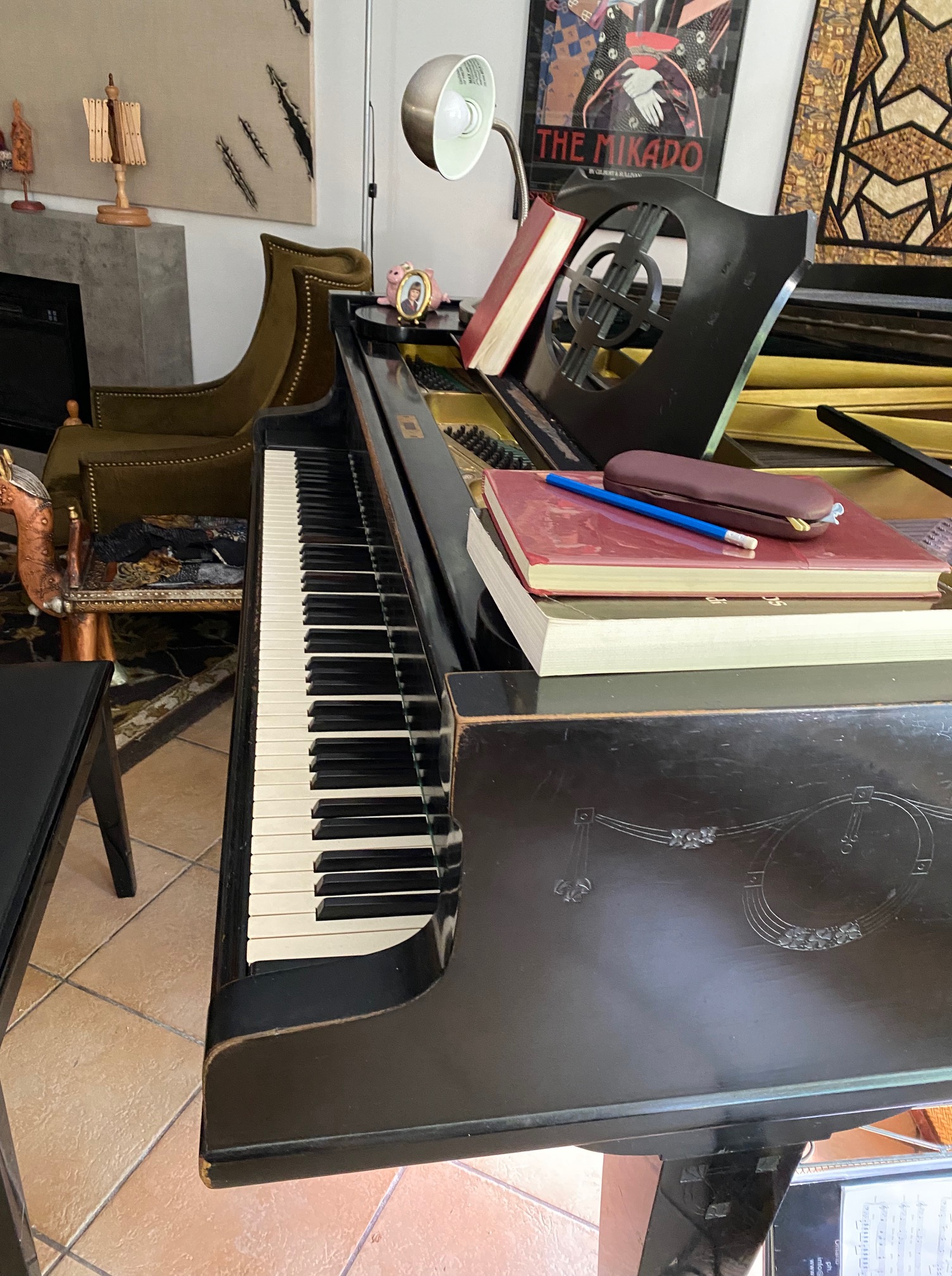
I bring it up because a photo I shared in the last thing I wrote inadvertently demonstrates my inevitable tendency to pigeonhole, subdividing parts of myself. And it’s especially relevant to the book in question.
I thought it felt funny when I took the picture with my phone. Glass’s book immediately went onto the piano. This “book” is of course a musical score, read in different ways than the other two.
I’ll gallop through Mary Trump’s book cover to cover once I start. I need to read the rest of the Sarah Polley book, her essay really a secondary source for researching & writing about film & directors.
So yes there are three books in the picture, but it might be more accurate if I showed two books plus the piano. Conceptually it’s almost as though Glass’s Etudes (2014) represent exercise equipment like barbells or an elliptical trainer, the place to work out and better myself.
Or face my limitations. I bought the Glass book, nervous about what I might find. Oh sure, I had trepidations when I opened the book, but it might more properly be understood as a mirror.
Mirror mirror on the floor….
Mirror? When you go to a gym after a long interval (and this is huge for me, having quit my Hart House membership in February 2020, nervous about what I had read concerning the “new” coronavirus): you are looking at yourself, measuring yourself. How you feel, how much you can lift, how quickly you move, how high your heart rate gets (and how quickly you recover), how flexible you are stretching, all signifying aspects of fitness in various ways, snapshots of life in motion.
Exercise serves as a mirror in that elaborate sense, and it’s also true for the music we play on our instrument. Whenever we sing, especially anything taking us to the limits of our voice, we are confronted by the body’s feedback. As a church soloist I used to notice some fatigue near the beginning of the busy seasons for singing, near Christmas and again near Easter, but the busy schedule would get us all into better shape, just like workouts in a gym help us to improve our athletic performance. Indeed one can forget that making music is an athletic activity, sometimes tiring us, sometimes bringing on repetitive strain injuries, and to be understood across the great arc of our maturation and (sigh) aging.
I might be reading a bit more into this than usual, recalling Philip Glass’s statements about being a Buddhist. I don’t know what he believes in 2022 but I recall long ago that he said so. His Etudes may be studies in the usual sense, to help build one’s skills, but for a Buddhist the idea of self-improvement and discipline has an additional meditative dimension.
Let me interrupt this serious discourse to offer up the classic Philip Glass joke, relevant because so many people love him even though a lot of people seem to hate him.
Knock knock, who’s there? Philip Glass. Knock knock, who’s there? Philip Glass. Knock knock, who’s there? Philip Glass
(repeat?)
If you’re laughing I forgive you. I’m not one of those people who laughs at this joke, indeed, I’d say it’s funniest for those who don’t “get” Glass, people who disparage his style.
You might think it’s odd that I speak of music the same way as I speak of a joke. But it’s similar I believe.
I recall having an enormous long argument concerning Satyagraha with a critic who was concerned (I was going to say ”upset” but no, I think he was pleased to have an obvious target for his critique): concerned that the music of that opera didn’t do what he thought the music should do. In other words, he was employing standards to judge Glass that were irrelevant and inapplicable.
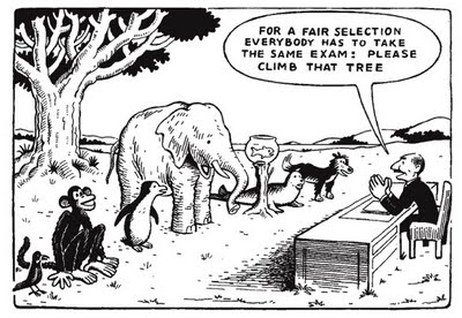
I’m reminded of this famous image concerning intelligence testing.
If we must judge fit the test to the subject being tested. Don’t be surprised that birds fly, fish swim or Glass is repetitive.
But I must admit that I am now grateful decades later for this early (1981) demonstration of something I’ve seen many times since, especially with respect to opera productions.
Whew, let me come back to Glass. I think those who experience Glass as repetitive might not be troubled by the Etudes, given that Hanon or Czerny can seem boring too. I submit that if you’re bored maybe you’re doing them wrong. Maybe I’m sounding like a pedant nerd, to think they’re enjoyable.
But I used to love jogging (which I don’t do anymore, to protect my knees), and still enjoy long walks. I don’t use the word “boring” except when speaking of the way other people perceive the world.
Most of the music lies under the hand, but then again that’s to be expected with music designed to help exercise your hand. I played through the book, glad that they weren’t difficult to sight-read.
But it’s a deceptive simplicity. To play Glass properly one must be mindful of tempo, a steady beat inside you whether you’re counting or not. To play the notes smoothly and evenly is the goal, even if there’s lots of repetition.
So far I’ve played through the book a couple of times. It’s not really the way they’re likely meant to be consumed: closer to the way I’ll read Mary Trump’s book or an opera score, than a book of studies, to improve discipline. Ha, my lack of discipline is showing. It’s one of the drawbacks of being a good sight-reader. I don’t really practice well. To be honest, I don’t practice at all. I simply play. It goes with my compartmentalization I suppose. But I do have fun.
And I’ve also started listening to a recording of the Etudes by Leslie Dala, although I’ve only listened to a couple so far(there are 20). I found one of his interpretations on YouTube to share.
Violence is everywhere these days. Excuse me for stating the obvious. I’ve recently seen an adaptation of Shakespeare’s Titus Andronicus that plays with our imaginations, encouraging us to feel for the people getting hurt in the play. Sometimes it’s much more scary to do it offstage, to encourage our fear and our creepy thoughts rather than being gory and graphic…
So I have a question.
Did you ever buy a book, and immediately turn to the one passage you wanted to read?
One went to the piano, one went to Erika (Mary Trump) but first Sarah Polley.
That’s what I did when I got Sarah Polley’s essay collection Run Towards the Danger.
I wanted to read the section I first heard about in social media, concerning her work on The Adventures of Baron Munchausen, Terry Gilliam’s 1988 film.
What I am about to say may sound a bit like Friedrich Nietzsche talking about Richard Wagner, which is a really corny nerdy pretentious way of saying that something that seemed to have me under a magic spell no longer has that power, because the magic has worn off, and now I am turning on the one I love, perhaps upset that the magic is no longer working. I mention Nietzsche because when he turned on Wagner he denied the love that used to be there; and supposedly on his death-bed he repented his angry denunciation, and admitted his love, renewing his old vows.
So let me be clear, let me be honest. I don’t think any film has ever touched me so deeply as Gilliam’s Baron. The year I re-married I felt reborn. I saw the film multiple times on the big screen in 1989. And I saw it on video many more times in the 1990s, sometimes in the company of a daughter roughly as young as Sally, the character Polley played in the film. It’s a visionary film about fantasy and the power of story-telling. While my love for the film has now faded somewhat, its lustre tarnished by my recent discoveries, I won’t lie. I’m still mesmerized by a combination of the glamour of the Monty Python aura surrounding Gilliam and his friends, and the mad admiration I still have for his work. I think too that Michael Kamen needs to get some of the credit for how I experience Gilliam’s Baron Munchausen given that Kamen’s perfect orchestral score is one of the most impressive I’ve ever encountered, the music plus the poetry of the story twisting me around its finger.
But: as a parent it was hair-raising to read Polley’s account of her experiences making the film. I feel sick, disgusted. While there were moments when we saw young Sally seemingly in danger, I never suspected that the film gave her PTSD, that she repeatedly experienced danger at least subjectively. That is the least of it, that the young impressionable girl was terrified. But sometimes the danger was real. For years something as innocent as the slamming of a car door could trigger Polley’s flashbacks. If you read her book you will probably change your views of Gilliam.
His blithe rock-star swagger, arrogantly laughing off the wreck & ruin he caused over and over: makes me crazy. It’s so normal that we worship our idols.
My reaction, (or perhaps what I should more accurately call my over-reaction) is absurd on the surface. But I find myself scrutinizing the work of Terry Gilliam, disturbed by what I think I see.
In The Adventures of Baron Munchausen Sally is not the only one having a rough time. There is actually an opera within the film called “The Torturer’s Apprentice”, ostensibly composed by the Sultan. It struck me today that this title could aptly go on Gilliam’s resume or bio, as he has seemingly been studying modes of torture, both in the content of his cinema and in the manner he treats his colleagues while putting his ideas onto film. Yes it’s consistent with the history of film & theatre, in a long tradition going back to Titus & King Lear. It’s profoundly troubling.
The opera within the film is being played by a fictitious keyboard invented in the film, whereby instead of the hammers striking strings, they hit slaves whose moans and cries make music. This link includes some of the screenplay.
See why I mention Nietzsche? I must seem like I’ve gone nuclear on poor Gilliam, but I can’t help thinking that –like so many artists—he’s repeatedly giving us a self-portrait. The sign outside his studio might well read “Torturers R Us”.
But this is not the only time Gilliam shows us torture.
Brazil (1985) is another film from Gilliam featuring torture. Depending on which version you see, (spoiler alert) the protagonist may or may not end up tortured to death; or perhaps he’s rescued from his torture at the end. But it’s very dark stuff.
Katherine Helmond’s portrayal of Sam Lowry’s mother Ida also features torture, although it’s the self-inflicted horror of plastic surgery. It seems very witty to put these two together in a film.
What’s recently freaked me out was her report that I saw purely by coincidence, suggesting that the suffering we see on screen that we normally presume to be fake, was actually a whole lot more painful than we ever knew.
The way I saw it reported, Helmond endured “ten hours a day with a mask glued to her face. Her scenes had to be postponed due to the blisters this caused.” (from IMDB).
Sorry but that reminds me of what Sarah Polley endured.
Polley reports the most curious thing in her book, that several people she met got into film because of Baron Munchausen, and their admiration of Gilliam’s work. I’m certain that the film is ideal to me because of the way it melted together as the most ideal Gesamtkuntwerk, Wagner’s total art. I don’t bring Wagner up to praise him even if this is the consummation of his greatest dream, that text and music and all component parts cohere together into a perfect whole. I think I’m a sucker for this sort of film, particularly the ones where the director exerts perfect control over all the parts.
Is it any wonder that actors report suffering at the hands of tyrannical directors? I’m thinking of John Candy (over-worked on a set), or Heath Ledger (a sensitive soul playing too many nasty parts), Judy Garland (drugged as a child, her whole life stolen from her). Yes they’re paid well but: what’s the cost? I find myself revolted by my admiration for their films, when I see the toll on the performers.
My favorite films all seem to exemplify this ideal, even as I blush at the recognition, that I expect directors to treat their actors like puppets or objects. I hope the world is improving, but I’m not sure. Unions protect workers, so hopefully children too are safer now.
This book will help.
My favorite director used to be Kubrick, who was famously perfectionist in requiring many takes of his actors. His great achievement in consecutive films, was to dethrone composers. In 2001: a Space Odyssey instead of using his composer he uses his temp tracks (Richard Strauss, Johann Strauss Ligeti and Khachaturian). In a clockwork Orange he again uses old composers but via Wendy Carlos’s synthesizer, playing Beethoven, Purcell or Rossini. But none of this was hurting anyone.
In 2022 I’m still totally enamored of films similar to and likely influenced by Gilliam’s hyper controlled art-direction, such as Scorsese’s Hugo or Wes Anderson’s Moonrise Kingdom. I admire the control I see from directors such as Julie Taymor or Robert Lepage, even as –in context with Polley’s book—I’m recalling their history. Taymor ran into controversy with her ambitions for Spider-Man on Broadway, demanding too many risks of life & limb of her cast. Lepage similarly crashed into resistant cast in his Ring cycle, singers unwilling to ride his huge machine, leading to its re-invention as a backdrop rather than its original purpose as a symbol & installation representing & enacting the ever changing world. Bravo to the ones like Debbie Voigt who pushed back.
After seeing Sky’s show, I’m also wondering about catharsis, how we are hooked by violent shows in a different way. When I’m scared shitless I care differently.
And yet I’m feeling gratitude for being stimulated, by Polley, by Sky Gilbert, and yes: by Terry Gilliam.
I’ve just seen a preview of Who’s Afraid of Titus, Sky Gilbert’s adaptation of Shakespeare’s early play Titus Andronicus. They used the Red Sandcastle Theatre, a space associated with horror through proprietor Eric Woolfe and his Eldritch Theatre cohort.
No offense Eric, but this is scarier than anything seen from Eldritch Theatre certainly since Madhouse Variations: but crazier.
I didn’t realize it was to be immersive. The theatre is tiny, which left us no place to hide, nowhere to flee.
I was intrigued by Sky’s expertise in Shakespeare; he’s a professor after all. Our recent interview probed that nerdy locus, and yes it may be Elizabethan in its tropes or its poetry: but it was as modern as CNN headlines of thugs hurting smaller people. It was like watching the January 6 insurrection up close, and I was not entirely sure I was safe. Oh sure, they wouldn’t want to hurt me, or so says the logical part of my brain.
My viscera felt differently.
While Julie Taymor’s Titus polishes the nastiness of the story, Sky lets it be dirty.
How many ways can you think something can be dirty? I think we covered them all tonight.
I was reminded of Sweeney Todd, not just because TIFT’s production was nominated this week for so many Doras, We were again contemplating the gap between “yum” and “yuck” and in something I think we can genuinely call “immersive”.
Forgive me, is that word being used too much nowadays? I wonder, is the immersive King Tut going to put us into a sarcophagus and bury us alive like Rhadames & Aida? Nobody is advertising this as “immersive” but that’s what I felt.
I like it btw.
I was reminded of King Lear, a play revised sometimes to mitigate its horrors, as indeed Sky might have chosen to do. Did he? Sorry I won’t be a spoiler. But for me the other connection to Lear is how this story has lots of the same sort of disgusting brutality, except Titus doesn’t just get abused. He fights back.
Director & adapter Sky Gilbert
I cried a few times genuinely astonished that my face was wet. But mostly I was really scared. The energy of the performances in the modest arena felt like a balloon inflated to bursting. It’s powerful. The cast bring Stratford level passion to this miniscule theatre.
I chose to sit in the first row because I love intensity. Don’t sit there if you’re easily scared.
But it’s a thrill ride.
*******
Titus features a stellar cast including Brian Smegal (Stratford Festival) as Titus, Ellen-Ray Hennessy (Canada’s Queen of Voice and Animation) as Tamora, Sandy Crawley (movies galore; Green Party candidate) as Marcus, Veronika Hurnik (paula and karl, DNA Theatre/Six Stages) as the Narrator, and Michelle Mohammed (Handmaid’s Tale) as Lavinia… (correction from Sky: Michelle Mohammed is not playing Lavinia it is Augusta Monet — an understandable mistake. Michelle had to leave the cast because of COVID and there was no program for the preview so understandable you might make that mistake). The production also features Ray Jacildo, George Alevizos, Max Ackerman and John Humeniuk.
WHO’S AFRAID OF TITUS? Shakespeare’s Titus Andronicus Adapted & Directed by Sky Gilbert
August 31 to September 3rd, 2022 at the uncanny Red Sandcastle Theatre 922 Queen St East, Toronto $15 Arts Worker/$25 Advance/$35 Door 6:30PM Doors/7:00 Evening Showtime 2:30PM Doors/3:00 Saturday Matinee approximately 1 hour, no intermission