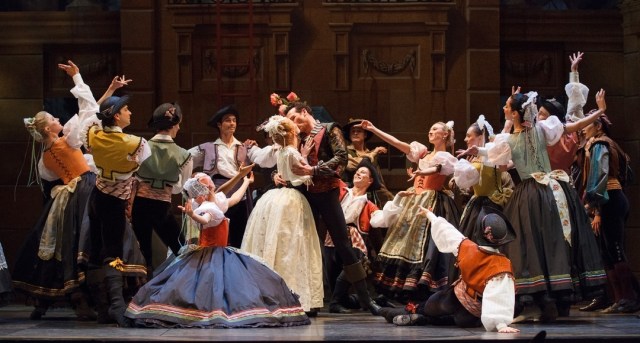
In 2013 Against the Grain offered the first of their “transladaptations” of one of the trilogy of da Ponte-Mozart operas, Figaro’s Wedding.
Tonight AtG premiered something we might call a revival of the work, with a number of intriguing differences, the first of twelve performances at the Enoch Turner Schoolhouse.
Sequels and revivals can be especially challenging, because the stakes are higher. We were excited by a new concept in 2013. This time, knowing the premise, could it work as well?
It could and it did.
In 2013 it was lighter & cuter. Tonight we encountered something darker. Where the first take was delightful & energetic, this time there was a bit more weight.
Rosina is pregnant. Last time we wondered if they would reconcile at the end but it had the colours of a romantic comedy. This time felt more like Shakespeare, pondering deeper meanings & consequences.
We were in a different sort of space this time, which may have impacted acoustics. Last time Topher Mokrzewski achieved miracles of precision, where this time we danced on the edge of chaos. But the result had weight, the voices placed at the service of storytelling.
There’s a special magic we get from the scenes in the round, watching an audience seduced & spellbound on the other side of the action staring in wonderment. Director Joel Ivany gets spectacular performances from every member of his cast in this wonderfully intimate performance, where we’re at times inches away from the singers.
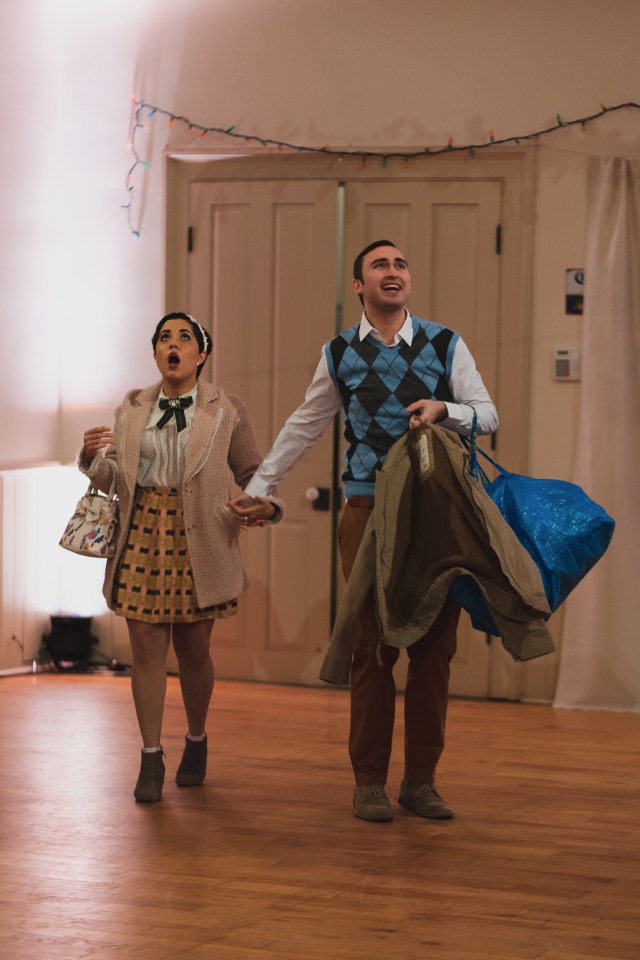
We do indeed see a wonderful wedding between Figaro & Susanna. Bruno Roy is a vulnerable & likable Figaro, Alexandra Smither a passionate volatile Susanna, every second meaningful & never letting the illusion fade.
Alexandra Smither and Bruno Roy (Photo: Taylor Long)
Miriam Khalil, our Susanna in 2013, is now Rosina opposite Phillip Addis as Alberto Almaviva. I believe Ivany’s darker reading begins with the fact of his wife’s pregnancy, lending true gravitas to the story. Where we wondered about the playful ending last time, this time? they’re playing for keeps. Khalil continues to be Ivany’s muse and the centre of gravity for the production. Addis is a fascinating contrast, a very dark presence for much of the show, but turning the last act into something wildly comical with his pelvic dance moves.
The modernized reading works quite well, or perhaps it’s just easier to accept the second time around. The final act shenanigans on the dancefloor –and everyone gets into the act—serve to set up the action quite nicely. I didn’t expect it to be so believable.
And speaking of shenanigans, the rest of the cast might be testimony confirming Stanislavski’s truism that there are no small parts, just small actors. Lauren Eberwein continues to be just about the most watchable singing actor in Toronto, hysterically funny in her scenes in Rusalka and again demonstrating a gift for comedy in her over the top approach to Cherubino. Greg Finney is delightful as Bartolo, underplaying while getting the best laugh of the night with a line that more or less brings the house down to end Act III. Amazing. But I won’t be a beast and steal the joke.
Maria Soulis as Marcellina and Jacques Arsenault as Basilio both have great moments, especially in that wild & woolly last act.
Everybody and I mean everybody had a great time. If you want a fun night at the theatre go see Figaro’s Wedding. Don’t be surprised if you’re not just laughing but profoundly moved.
Figaro’s Wedding continues at Enoch Turner Schoolhouse until December 20th.
I came to hear Tchaikovsky at the Toronto Symphony and was rewarded with one of the most brilliant performances of his violin concerto that I’ve ever heard. The program at Roy Thomson Hall featured three works by the popular Russian composer, but perhaps should have been promoted for the prodigy we heard as soloist.
Daniel Lozakovich was born 2001. And yet we heard an interpretation of great maturity & wisdom.
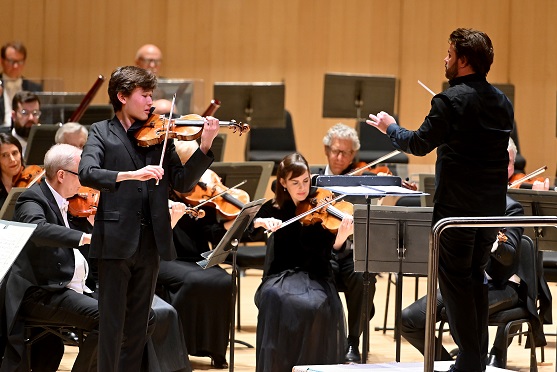
Simon Rivard leading the TSO and soloist Daniel Lozakovich (photo: Jag Gundu)
It’s not so much a matter of perfection, as indeed there were wrong notes, but come to think of it Horowitz sometimes did that too.
What we heard was a genuine virtuoso, not just in his skill but perhaps more importantly in his sense of drama. Phrases were begun with the kind of rhetorical flourish making everything seem especially new. I had the impression in the first movement of a kind of method actor coming at the solo from the inside, making it seem spontaneous and fresh, a series of responses to the orchestra pursuing a musical logic, and making the composition tight & organic.
Lozakovich, Rivard & the TSO (photo: Jag Gundu)
In the second movement, when he’s in a kind of duet with the woodwinds, he actually turned to face them, a stunning moment of genuine theatricality, to suggest that they were listening to one another. Yes I think they really were doing so.
Lozakovich has several different sounds he gets from his violin. Sometimes he got a big sound, sometimes something extremely soft & subdued, as in the opening to the second movement. In his cadenzas he made them seem like complete thoughts, soliloquys leading to profound statements. For minutes at a time, he seemed to be shaping phrases as though to suggest a series of sentences or thoughts, building one upon the next.
Lozakovich was aided by conductor Simon Rivard, who stayed with the soloist in spite of some quirky shifts in tempo, all working well to illuminate Tchaikovsky.
I was surprised that there wasn’t a bigger reception, meaning enough to get an encore. The violin playing was superb, but there weren’t enough of us screaming our approval.
Bracketing the concerto were a pair of Tchaikovky works, his 1st Symphony and his well-known 1812 Overture in a reading from Rivard that was passionate in its restraint, refusing to rush anything, building inexorably to its big finish. The TSO respond wonderfully to Rivard’s leadership.
While I liked Rivard’s reading of the Symphony there are other works one could wish for, such as the Manfred Symphony that I don’t think we’ve heard in Toronto in a long time.
Rivard did well with this early work that features some lovely melodies without the subtleties of orchestration or structure we might be accustomed to in the mature composer. At times we hear the gears shifting and the wheels turning, building gradually.
The program repeats Saturday night & Sunday afternoon. I recommend you go hear the young violinist if at all possible. You won’t hear anything better.
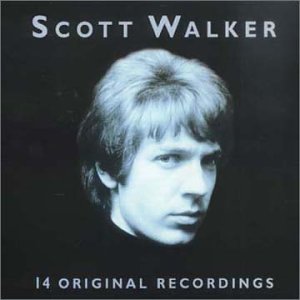
Long ago I stumbled upon Scott Walker, via a cassette with the hand-written inscription The Godlike Genius of Scott Walker.
I remember wondering: is this for real? What may have been at least part ironic self-mockery was upon closer inspection perhaps a statement with some truth. In fact the person who wrote the title on the cassette had truncated the name of the recording: which was twice as long…
Who is Scott Walker and how does he fare in Melancholiac? Interview questions are partly for the subjects, partly for me. I seek to unpack the work of the artists, lobbing easy questions into their strike-zone in hopes that someone hits a self-promotional home-run. But I’m also asking questions out of genuine curiosity. Greg & Adam are remounting a work incubated at Summerworks four years ago that’s described on the Music Gallery website as “part concert, part spectacle, part existential talk-show”.
I’m looking forward to seeing it.
Walker is unusual, a unique sound, a voice, a persona. Melancholiac: the Music of Scott Walker is the brainchild of two admirers: Adam Paolozza & Gregory Oh and a large company of collaborators we’ll see and hear in three performances at the Music Gallery Dec 6th at 7:30, and Dec 7th at 4:00 and at 7:30.
And as we go through the interview I’ve interspersed a Scott Walker playlist curated by Adam.
Song #1 It’s Raining Today
barczablog: Whose idea / passion was this originally: did Gregory go find you, or did you find Gregory, OR did someone else originally conceive of this? What was the process that brought you two together?
ADAM: I tend to get obsessed with artists and after I watched the documentary about Scott in 2009 I became obsessed with him. I loved the music and I loved how he talks about his process. It reminded me of Samuel Beckett, one of my earliest art crushes. So, I had it in the back of my mind since then that I wanted to sing Scott’s songs in some performative setting eventually.
Then a few years later I met Greg at Soulpepper, I think, and we worked on a few cabaret shows there. Greg and I really got along and I pitched the idea of doing something about Walker to him. He listened to the music, really dug it, and that’s how it all began. The current show, is very much a collaboration between Gregory and I. Greg really helped choose the songs, structure the evening, hired the arrangers and the band and he makes it all come together sonically. I brought in the singer/dancers and choreographer and staged it.
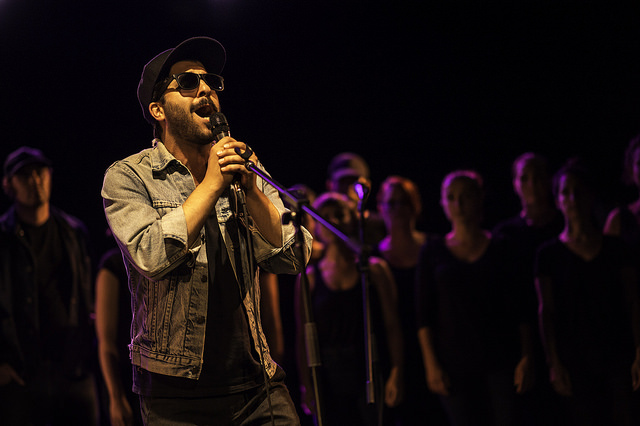
Adam singing Melancholiac
barczablog : But it’s much more than the two of you. Please mention the names of the singers & players and anyone else involved… (besides the two of you)
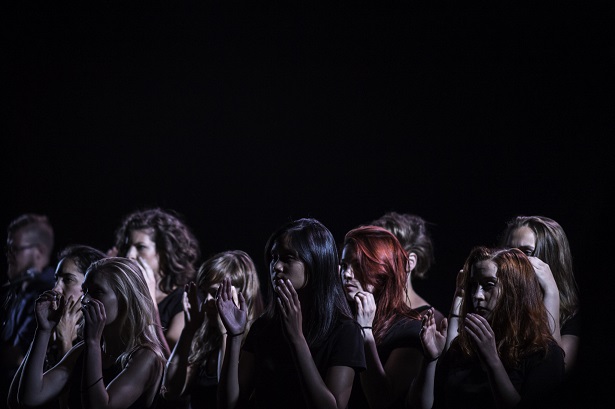
Some of the chorus members (photo: Dahlia Katz)
Chorus Members (they sing and move): Kari Pederson Eduardo DiMartino Richard Mojica Julianne Dransfield Mandy Maclean Joshua McFaul Michael Keene Neil Silcox Nick DiGaetano Saba Akhtar Susanna Mackay Marina Gwynne
Lighting Design: Andre Du Toit Stage Manager: Dylan Tate-Howarth
Musicians: Electric Bass: Matt Fong Upright Bass: Adam Scime Drums: Spencer Cole Percussion: Dan Morphy Guitar: Paul Kolinski Leslie Ting: violin Arlan Vriens: violin Samuel Edwards: viola Amahl Arulandandam: Cello Lina Allemano: trumpet David Quackenbush: horns Shaun Mallinen: saxophones
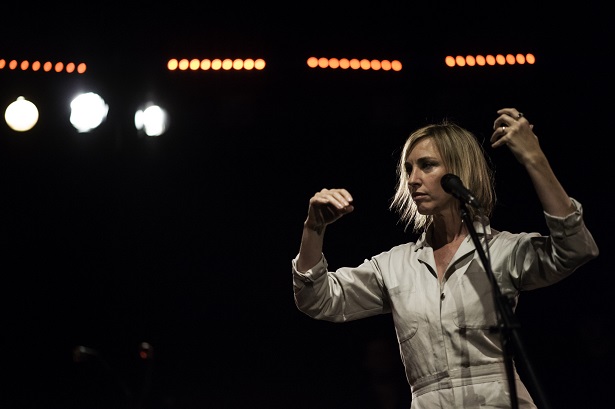
Patricia O’Callaghan (photo: Dahlia Katz)
Solo Singers: Patricia O’Callaghan John Millard Alex Samaras Matt Smith (aka Prince Nifty)
Song #2 Duchess from Scott 4
barczablog: Scott Walker sits on the fertile interface between popular music & serious music previously visited by people like Kurt Weill, David Bowie, David Byrne, Philip Glass, Tom Waits, and lots more. Who if anyone does he remind you of?
ADAM: His music doesn’t remind me too much of any of these musicians. His early stuff reminds me of a certain lush, orchestral 60’s sound that I loved as a child. But again, with an eerie atonal ambience. So, maybe he reminds me of some dissonant 20th century composers, like Ligeti. But his newer compositions are really sui generis. I guess if I had to compare him to anyone, I would use Samuel Beckett again. In the sense that they both pare things down to the essential and do their best to avoid cliché.
GREG: I would think of someone like John Oswald or Franz Liszt. Oswald because of his ability to knit together pop and post-classical forms, always with an awareness of person/place/context, and maintaining a genuine sense of self amidst creative kleptomania. Walker and Liszt were both “rock stars” and significant performers, and both had compositional careers that started with the hyper-popular and ended in under-appreciated innovation and eclecticism.
Song #3:Clara from The Drift
barczablog: How would you describe the style you’re using in the presentation? Concert? Or Cabaret?
ADAM: It’s an expressionistic style, inspired by cabaret for sure, that Greg Oh and I have developed over the years through projects like this and another recent collaboration, The Cave (which premiered at Luminato last year). It’s a hybrid musical-theatre form, without a plot per se, more like a concert punctuated with expressive dramatic sequences. The look and feel is also influenced by watching music videos from the 90’s and musical tv specials from the 60’s, like the BBC one Scott Walker had very briefly. Shows that had variety, dancing, singing, etc. We shamelessly reference that.
barczablog: Is the persona of Scott Walker the artist presented in your show, either as a character or a presence? I had the impression that the earlier version of the show divided the Walker persona among multiple performers a bit like the film about Bob Dylan I’m Not There.
ADAM The idea is to send a tribute to Scott beyond the grave, as he recently passed away. To evoke his presence. Sometimes we do this by physically playing him (a little like I’m Not There for sure, but it’s mostly me that plays him) and speaking words he spoke, but more often by evoking the sonic, emotional experience of Scott’s music, making it present in the space.
barczablog: Can you talk for a minute about the word “Melancholiac” and what it tells us about SW, what it tells us about the show, and maybe what it tells us about you (two), and your relationship to SW
ADAM: I’ve always been drawn to darker, more contemplative, uncompromising artists who explore the extremities of human experience. Again, that’s why I often think of Beckett when I think of Scott Walker.
In my own work I’ve been exploring the idea of melancholy through various shows over the last few years, like Italian Mime Suicide, Empire of Night and Paolozzapedia. It’s less about the sadness associated with melancholia. It’s more about approaching the art experience as a means to reflect on existential thoughts and feelings. More about finding and contemplating beauty in darker, denser things. And I think Scott’s music is definitely dark and dense. That’s why we named the show the way we did.
GREG Chronicle of a public executions? Check. Inevitable ephemerality and insignificance of love? Check. Life and times of a CIA torturer? Bing. Sadomasochism? Yup and yup. Dark funereal humour? It’s in there. Blood money of arms dealing? Selbstverständlich.
Song #4: The Electrician from Nite Flights
barczablog : Can we talk about influences, as in who you see influencing SW, perhaps what influences you’re allowing in how you approach Melancholiac. I am especially intrigued by some of the musical adaptations, which are a kind of modernist pop music, far more dissonant and daring in places than the original (and please let me know if you’re okay with me saying that… perhaps you don’t agree). But I think this treatment is ideal for the Music Gallery. I understand some of Walker’s late music was much more adventurous, edgy sounding: but I don’t know those songs. If you can point me to any examples (youtube or elsewhere) that might be useful too.
GREG: Not to pass the buck, but this Pitchfork article is quite good at achieving an understanding on just how wide the borders of Scott Walker’s music are.
ADAM Also, I would recommend the 2006 documentary 30 Century Man, that’s what introduced me to Scott Walker and it’s a fabulous documentary.
In most cases we’ve just tried to recreate the sound of Scott’s original arrangements, which are quite daring and dissonant, especially in the later stuff. That’s our biggest influence. What we’re doing isn’t so far removed from the recordings. The 60’s stuff we tried to just reproduce as best we can with what we’ve got.
But in some cases, I supposed we’ve transposed an idea, taking some license. Instead of having 10 guitars we have 10 shakers, for example, or we chant something chorally Scott originally sang. Or, when Walker has done something really unusual, like having a percussionist pound a side of raw beef, we’ve attempted a more vegetarian approach to the same effect. Still food based, of course!
barczablog: Walker died back in March of this year. How does that change how you understand him and this project?
ADAM It’s made me think more of the show being a message that we’re sending him. A send off, a love letter, an evocation.
GREG: In this culture, I see parallels between Scott Walker and Claude Vivier. Many of their compositions were so obviously obsessed with death, darkness and the afterlife. They told stories about murder, stabbings, executions, wars and the fatalities of social injustice. If I had to contrast their post-mortem narratives, Vivier was obsessed with predicting his own death, and perhaps Walker gave more thought to the cyclical nature of life, and wondering “what happens next”?
Claude Vivier
Perhaps because of this, my reading of the show didn’t really change, but I understand the show in a more nuanced way. Walker did have a very dark but subtle sense of humour, and I think his tune “30th Century Man” was both a witticism and a credo. Most classical composers strive to be of this century, but Walker, whether or not he succeeded, had his eyes on the next millennium. In my imagination, Walker endured the melancholy of life, having sampled and rejected the fruits of popular success, and in doing so freed himself to creatively explore anything and everything.
Song #5: Mathilde
barczablog What’s your favorite song of SW (if you can pick one)? One for each of you?
GREG: My favourite of Scott Walker’s is probably The Electrician. My favourite in the show is the cover of Mathilde, sung by Patricia O’Callaghan and arranged incredibly well by Bram Gielen.
ADAM: Ah! Impossible to pick but maybe I’d say The Electrician. That always gives me chills when I hear it.
barczablog: Do you have anyone you’d like to thank?
ADAM: Thank the Canada Council for the Arts, The Music Gallery, SummerWorks and In The Soil Festival for supporting early stages of the project. As well as the artists from earlier versions who can’t be with us this time around.
GREG: Thanks to Adam, without whom I never would have discovered the music of Scott Walker. Also, thanks to David Dacks and the Music Gallery.
*******
Melancholiac: the Music of Scott Walker is coming up Dec 6th at 7:30, Dec 7th at 4:00 and Dec 7th at 7:30: at the Music Gallery 918 Bathurst St., telephone 416.204.1080 (click for tickets).
Yesterday I watched Philip Glass’s opera Akhnaten as presented in the Metropolitan Opera’s High Definition broadcast on a big screen in Scarborough, at the same time people were watching it in many places around the world.
I wish the Canadian Opera Company would undertake one of Glass’s operas, thinking especially of Akhnaten or Satyagraha. The works are written in many ways as a big blank slate inviting a director to interpret, to make something to fill broad swaths of music where the action is described in the most abstract terms.
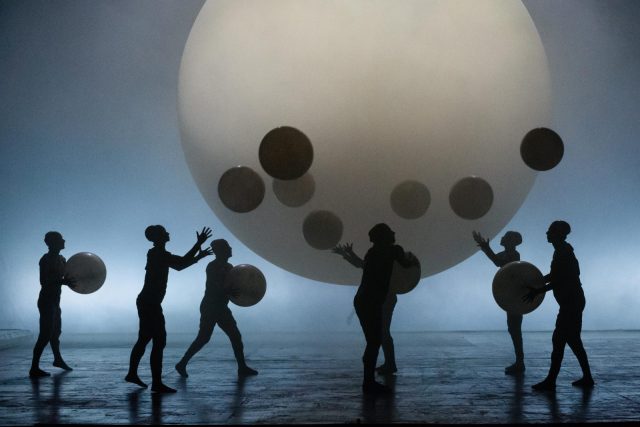
So for example in Phelim McDermott’s conception of Akhnaten the ball shape of the sun that is worshipped by Akhnaten (who is for a time leading a monotheistic culture that goes against the previous religion & culture) gets replicated onstage by jugglers tossing balls or later carrying larger balls. His design concept working with set designer Tom Pye is blessedly simple, often a powerful stage picture.
Set by Tom Pye, costume design by Kevin Pollard (Photo: Jane Hobson)
The action could just as easily be shown through dance or puppetry or projections, and one is free to employ as few or as many persons, moving as quickly as the sometimes frenetic music or more slowly.
The curious thing about Akhnaten and Satyagraha is that one can easily mistake the themes of one for those of the other.
Akhnaten shows us religion as a subject of political struggle and war
Satyagraha shows us political struggle against the backdrop of belief
Akhnaten seems to concern religion
Satyagraha seems to concern politics
But Akhnaten is very much about de facto existence, a series of historically existing texts including a prayer & a series of rituals of burial, coronation & marriage
But Satyagraha is very much about spirituality, a series of passages from the Bhagavad Gita, as though to illustrate the activities of Gandhi’s life through his religious subtext
I have found Satyagraha very powerful in every version I’ve seen as a spiritual document. I’ve found the two versions of Akhnaten that I’ve seen to be less about spirituality and much more about the predicament of a soul incarnated in a sometimes challenging world.
These two operas would make wonderful opportunities for the COC for the following reasons:
They showcase the orchestra & chorus (two strengths of the COC)
They don’t require star power to be sold, indeed the composer alone would help sell them. It might be possible to cast either show entirely from the members of the Ensemble Studio, although Akhnaten is played by that rare bird, the counter-tenor. But there are Canadian counter-tenors.
They are visual treats, depending on what director were hired, but it’s a natural for someone like Robert Lepage, François Girard, la Fura dels Baus or indeed any director the COC has employed in the past.
There is interpretive room on the musical side too. Conductor Karen Kamensek made a number of fascinating departures from what we hear on the original CBS recording conducted by Dennis Russell Davies from 1990. Where the original often snarls, maximizing the brass & percussion, Kamensek’s reading goes for something far softer. Her choices likely make things easier for the singers & especially the players expected to still have lips at the end of the 2 + hours of playing. The chorus too have a totally different sound that I’d credit to both Kamensek & Donald Palumbo, the Met chorus master. It’s most divergent in a section that I’d happily identify as my favorite passage not only in Akhnaten but in all of Philip Glass, the funeral music of Amenhotep III.
Where the 1990 version is sung and maximized in volume, Kamensek & Palumbo make the chorus sound almost like rappers, as they pump out their consonants with little sustained sound on the vowels: making for a remarkably percussive effect matching the aggressive percussion in the orchestra. It’s wonderful to see the artists take advantage of the opportunity to interpret something original & new.
It was especially enjoyable after the recent Robert Wilson Turandot to see the Met chorus sometimes juggling or carrying balls alongside the troupe of jugglers.
It’s interesting after the Euridice story that I saw Friday with its preoccupation with the afterlife and with frustrations, that this too is a story concerned with the afterlife & with frustrations, both in the abrupt ending to Akhnaten’s monotheistic experiment in revolution & warfare (Act III scene ii) and in the final scene when the protagonists’ souls discover to their dismay (in the 20th century!) that OMG they’re dead. I wish I could chat someday with Glass (who identifies himself as a Buddhist) about how he reconciles a work such as this one or Satyagraha with his own beliefs.
There are encore presentations scheduled for Saturday February 15, Monday Feb 17 & Sunday Feb 23rd . The live performances continue until Dec 7th at Lincoln Center in N.Y.
I don’t use that word lightly, and it’s not an insult.
Some operas are oxymoronic, rife with contradiction, asymptotic in their fascination with impossibilities. Maeterlinck’s play Pelléas et Mélisande is the creation of a playwright who cringed in the presence of live performance, who said “something of Hamlet dies” in the theatre. Maeterlinck’s ideal was plays that you read rather than see enacted live; he also wrote marionette plays. And so it’s no wonder that Debussy’s setting is reticent to the point of self-effacement, without arias or any ostentation, the players standing like puppets in a series of short scenes. And in that contradiction –an anti-theatricality –we discover its beauty & Debussy’s achievement.
Or perhaps we can consider the various operas about Orpheus as he seeks to get back to his deceased love Euridice. Does anyone ever tell the tale from her perspective? Aha, that’s what this one does.
Because tonight I saw the penultimate performance of Tapestry Opera’s latest version of their Tap EX series, flirting with the notion of virtual reality, an evening brimming with great ideas. As is so often the case with new work, I couldn’t help thinking that the idea on paper was better than what we experienced, perhaps because it’s not ready for prime-time, a series of parts needing a bit more work before it will be finished. There’s lots to admire, but it’s not quite there, yet.
What better way to experience something new than in a new place?
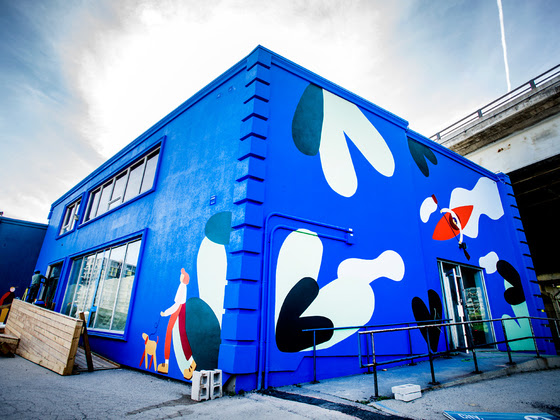
Sidewalk Labs in Toronto
We came into Sidewalk Labs, located at the corner of Parliament & Lakeshore Blvd. The piece we were to see has a science fiction aspect to it, and so what could be better than to come to the edge of the world.
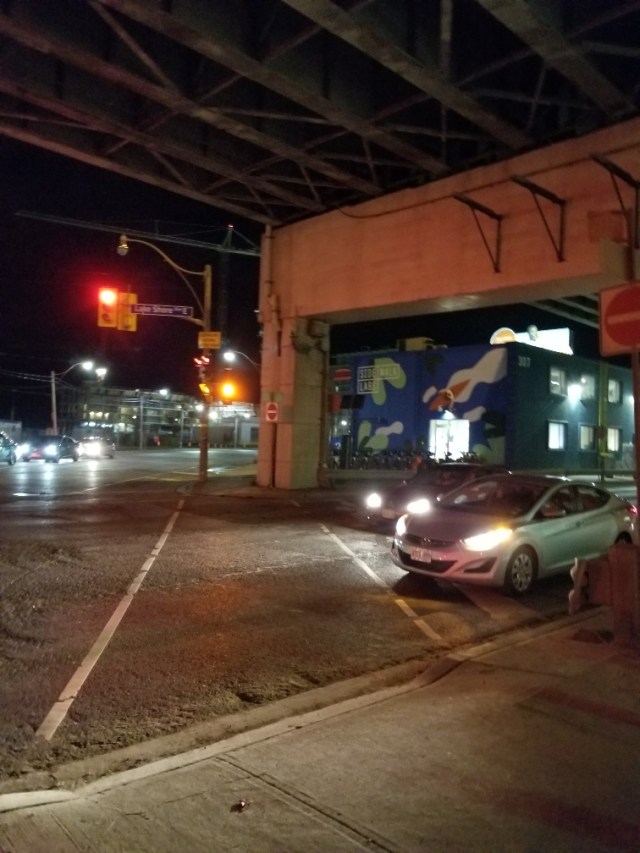
Did you know that’s a genre, stories about ”the edge of the world”? The corner of Parliament & Lakeshore definitely FEELS like the edge of the world, and is a brilliantly conceived location for the projects happening at Sidewalk Labs: a space investigating the socially conscious change & transformation of our city. Dare I say it, they knew that they were building this brilliant showcase of reinvention on the brink of all that’s wrong with Toronto. We’re under the Gardiner Expressway, a crumbling monstrosity that consumes many of the dollars we could use to redevelop our city.
Speaking of oxymorons, isn’t it remarkably funny that Sidewalk Labs sits in a place where one is almost afraid to walk on the sidewalk: with the cars whizzing by on Lakeshore Blvd? The Gardiner Expressway provides the lovely canopy overhead, in some ways the epitome of how we’ve messed up this city.
To get to that beautiful blue building one must first dare to cross this expressway (Lakeshore Blvd) masquerading as a mere street. And there’s a real expressway overhead.
And isn’t it bizarre to note in passing that Toronto is becoming too expensive for artists at the beginning of their career. If you drive or take a cab, Sidewalk Labs is a great place to go to. I parked by the Distillery District, to see just how hard it is to walk there. It wasn’t bad other than my near-death experience with a cyclist. His idea of a horn was to twice say “whoops whoops” in that soft nerdy voice that signals a millennial; someone of my generation would scream a four letter word. But we didn’t die so perhaps I shouldn’t complain.
Someone had a brilliant idea. The opera begins and ends a bit like a dog and pony show, like a TED talk or one of those 30 minute ads you see on TV. Before the opera we had a presentation from Sidewalk Labs to tell us about the venue. But more subtly, it served to frame the show as a dog n pony show within a dog n pony show.
Clever.
The music by Benton Roark was quite lovely in that noodly minimalist way we’ve heard since the time of Philip Glass (who’s on my mind because I’m seeing the broadcast of Akhnaten tomorrow).
Early on in the show we were advised that we might want to put on a mask to simulate the virtual reality of the opera: which was a clever idea. Would you call it a coup de theatre, or just a gimmick? I found it sensational in the way it made me listen to Roark’s creation and the words in the libretto (whereas a friend of mine thought it’s more of a radio play than an opera, because it was too static in his opinion). Forgive me I’m not sure whose words they sang, although perhaps it’s Tapestry Opera’s artistic director Michael Hidetoshi Mori and co-director Debi Wong, who are credited with the idea.
Partway through we were encouraged to remove our masks. I liked it much better before I took off the mask. Yes the piece is static, not just because of the minimalist noodling (and please note Roark was setting the text pretty well as written, reflecting the lyricism in the words). It’s very poetic, more of a long lyrical song than an opera without much in the way of conflict or action. I wonder if that’s intentional? If you leave your mask on for the entire show chances are you won’t be as troubled by that. The text talks a lot about what is happening, rather than directly making something happen; so in other words, there’s little or no action, just words about things. Given that we’re in the realm of subjective experience that might be justifiable, but this didn’t work for me, as a depiction of what we were promised, which was a big luscious idea.
Imagine that we’re talking about the afterlife as a business proposition, where you create a virtual reality for eternity. Atheists could suddenly have a heaven. I’m reminded of Walt Disney’s version of immortality, where he was cryogenically preserved, hoping to be revived later (and there’s even an opera about it: whoops there’s that Glass fellow again). Such a reality is a plum of an idea for a composer & a librettist.
Except I didn’t think the libretto (at this point in its creation) lives up to this fabulous idea, as Roark did his best with what he was given. Perhaps it will be better in its next revision, as it’s a work in progress. Just as I’m inclined to credit Roark with the loveliness of his creation, so too the performances by Lauren Segal, mezzo-soprano, Vanessa Oude-Reimerink, soprano, and Lyndsay Promane, mezzo-soprano. The voices blended beautifully at times hauntingly lyrical. Whether or not you want to call it opera it’s a splendid hour of music.
But the story is in some ways about impossibilities & frustration, as Euridice (the main character) longs for something that she can’t have. I couldn’t decide if her frustration was with what she was shown in the virtual reality, or simply the normal dissatisfaction that seems to be fundamental to her character. She is after all the one who refuses to trust Orpheus and gets him to turn around and look, which kills her in those other versions of the story. So she’s never a happy camper in those operas either.
While eight singers may have been drinking eight drinks at 8:00 pm on November 8th no one ate much of anything.
(see what I did there?)
At first I just thought it was a fun exercise, an excuse for a bunch of young people to have some fun flouting the rules & conventions that have applied to the older generation.
Tongue in Cheek Productions have already laid waste to a few rules along the way, while entertaining many of us here in Toronto. Little did I expect that I’d be confronted with so many profound questions along the way.
Think about it.
Performance is often an exercise in control, a demonstration of skill if not outright mastery. You learn lines, music, perhaps some dance-steps, and need to do all that precisely in time to the music.
Now what happens if you have a drink? Or several drinks..!? Does the performance improve or maybe get clumsier? Does alcohol perhaps help put you in touch with something, stripping away a phony veneer to expose the beating heart underneath?
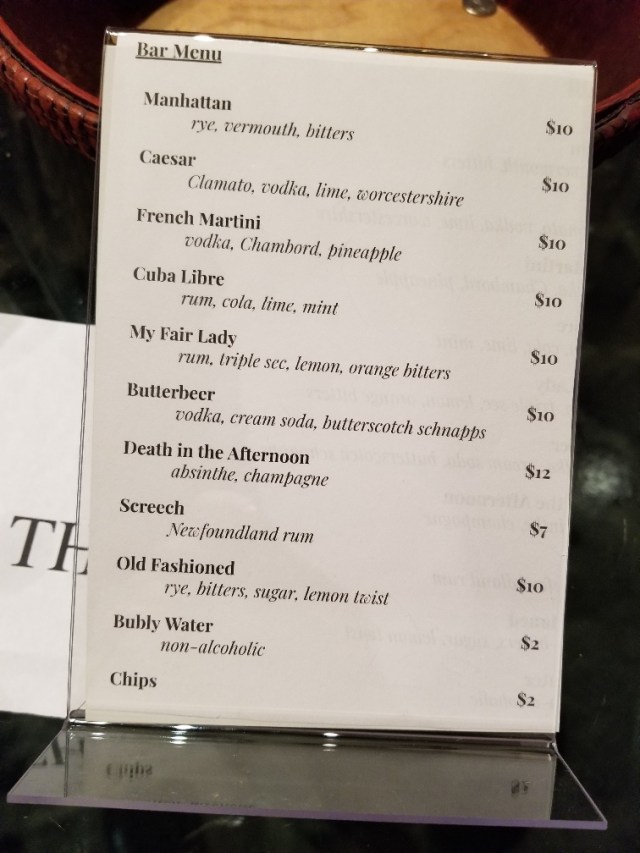
Before the concert I perused the menu of 8 drinks, and grabbed my single drink knowing I’d be sober by the end. Hm, the menu was pretty interesting even before we saw it interfaced with each of the singers.
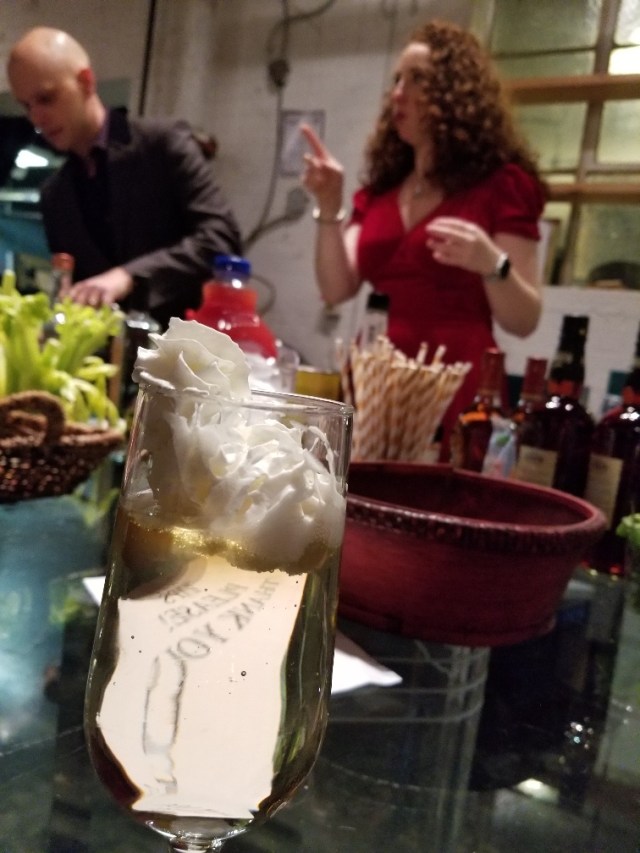
I had the Butterbeer
Eight times we watched some version of that question (what happens if you have a drink?!) enacted for us, but different each time, not just because of the different drinks & performers involved. Each time pianist Trevor Chartrand came along for the ride, sometimes even getting a sip for himself.
Some music sounds better with a drink, some artists improve after a swig or two.
First:
Michael Nyby baritone under the influence of a Manhattan gave us three songs by Cole Porter.
Michael isn’t just a singer. He’s also one of the two artistic directors of Tongue in Cheek as you’ll recall from their interview.
He was pouring drinks a few seconds before he started to sing.
That’s my drink in the foreground, while Michael of Tongue in Cheek & Rachel of Opera 5 serve drinks to us… before later singing.
Aha no wonder that he sounded more relaxed in his third song “It’s De-Lovely”: when he had consumed most of his Manhattan. And the fun in the song shone through.
Second:
Beste Kalender, mezzo-soprano took us in a baroque direction with the help of a Caesar, apt for arias from Handel. As we watched her boldly consume more than expected en route to her da capo in each aria, I couldn’t help noticing. Sure, a baroque da capo is exciting, when you repeat the original tune, but dressed up with extra notes & effects. But I never realized how passionate that can seem, how it’s as though the original emotion has exploded to another level, as though (duh…) you had just chugged a bunch of alcohol. Scary as this must have been to explore and perhaps to execute, we were taken deeper into the essence of the aria each time.
I didn’t expect that.
Third:
Sonya Harper Nyby brought us unexpectedly into contact with another side of the music. Her French singing was delicate and sensitive, beginning with Viardot’s impressive vocalization of Chopin, then a delicate taste of Chaminade, concluding with a stunning bit of Fauré.
They were setting us up.
Fourth:
Again we went in a new direction, or perhaps more properly, an old direction. Ryan Downey & Screech took us in the direction of authenticity, arrangements of folk music without pretense. I was impressed as much by Downey’s readiness to consume Screech as by his delivery of a series of stunning songs taking us to the root of the musical impulse. For someone like me, who’s often agnostic about classical music and its failure to connect with people, this was a tonic, although no I didn’t drink any screech (not a good idea if you’re driving home alas alack).
We were at intermission, as many rushed up to get another drink.
Fifth:
Tenor River Guard sang songs from the realm of Broadway. These were for me the most impressive performances of the night, not least because I don’t know the artist nor do I know the latter two songs he sang. You know you’re enjoying a performance when you’re not second guessing the performance, but rather eating it up while thinking “wow that’s a great song”. Guard used every nuance and wrinkle in his voice.
He has a lovely sound but is especially a wonderful actor. I’m going to keep my eyes open because I expect great thing from him.
Sixth:
Aaron Durand, the other AD of Tongue in Cheek brought us songs with a connection to magic, while drinking the drink I had grabbed, namely the “Butterbeer”, apparently from Harry Potter’s world. What a fascinating trio he sang. He began with the impossible discipline of “My Name Is John Wellington Wells” sung at a bat-out-of-hell pace.
I was worried he’d be undone by the alcohol. Don’t drink Aaron!
Whew. But he did, and then segued into a romantic Warlock song. He gave us something intensely personal to conclude, including the first tentative thoughts about a new creative venture, and a song too…If performers are understood as advocates for the music they sing, somewhere Ralph Vaughan Williams is smiling.
Seventh:
Rachel Krehm didn’t make it to the fourth song of the Four Last Songs, which is “in the evening”. That – I believe—is why they called her set of the first 3 songs “Death in the Afternoon”. The whole time she was confronted by Absinthe, a drink with fatal associations.
No wonder she hesitated to take the fatal drink.
And by the way, Rachel will sing all four of the songs next time with orchestra as part of the program on Monday November 25, 2019at Christ Church Deer Park in Toronto to benefit St. Michael’s Hospital (click for more info).
Eighth: Mezzo-soprano Catherine Daniel gave us another way to think of drink & song, in a bravura reading of Cincos Canciones Negras by Xavier Montsalvatge. The songs are a broad array of emotions & sounds, sometimes tender, sometimes deadly, ultimately a celebration. I understand she’s performing next week on Wednesday November 13th in Kensington at 268 Augusta Avenue (a CD launch). From what I heard you’d be well advised to check out this rising young talent.
There we were in Gallery 345, Edward Epstein’s unique venue on Sorauren. I knew I must be in the right place when I sat down and felt a curious sense of familiarity.
Amazing.
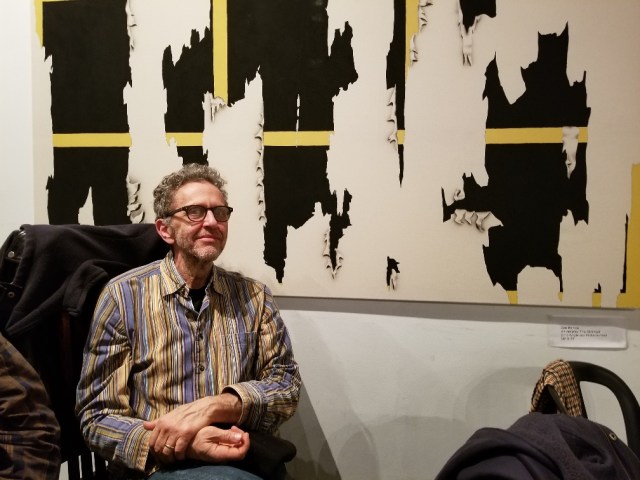
In Gallery 345 finding myself in front of a painting by Zoe Barcza (photo: Paul McKernan)
AND SO… once again Tongue in Cheek gave us something fun, something that breaks the usual template. It was new & fun & yes, a wonderful exploration of singing. All of the singers had a fabulous opportunity to showcase their talent while the audience had a great time.
I saw Opera Atelier’s revival of Don Giovanni that’s running at the Ed Mirvish Theatre. I loved it last time & it continues to thrill me as though it weren’t an opera I’ve known since childhood.
But it feels new. The headline might sound like an oxymoron if you remember that OA aim for historicity & authenticity. As usual we hear the gentle Tafelmusik Baroque Orchestra, easier on the ear & the kinder to voices of the singers aiming to be heard. We’re watching the dancers of Opera Atelier’s ballet corps, and the entire cast moving with at least a nod towards the period.
But while the look is authentic, if you look closer you see a few interesting improvements. Marshall Pynkoski frames this work around Mozart’s own understanding of the opera as something comical, rather than the accumulated weight of centuries of romantic interpretations.
Pynkoski isn’t afraid to prioritize the needs of his audience, so (as in the previous Opera Atelier production) he only gives us one of the two tenor arias, which is simply logical when we recall that Mozart only added the second one as a substitute for a difficult aria, not in addition, as modern producers inevitably will do.
More intriguing was the decision to segue directly from the graveyard scene to the finale, cutting the competing prima donna arias (“mi trade quell’ alma ingrata” from Donna Elvira and the scene between Donna Anna & Don Ottavio) that always have made me find that last act leaden and wayyy too long. No that’s not something Mozart would have seen or likely approved of in his own century but even so: thank you Marshall!
The last time I saw this production with a different cast, it was years before #MeToo, before Jian Ghomeshi, when an opera about a seducer didn’t ruffle so many feathers. I think this time the emphasis on comedy is subtler, the style closer to what we usually see in a Don Giovanni, in deference to current sensitivities. Meghan Lindsay’s Donna Anna has the biggest cojones of anyone onstage, as heroic vocally as she is fierce in defense of her virtue. Carla Huhtanen sounds as though she’s moved up to a bigger more powerful vocal classification, the sound spectacularly strong yet as accurate & expressive as usual.
Colin Ainsworth sounded bigger than ever, even while making it sound easy, and with a comical dimension in our last view of him (when Donna Anna would prolong their engagement with a year of mourning). Stephen Hegedus as Leporello was a favorite in a huge role that’s even harder with Opera Atelier’s emphasis on movement.
Zerlina & Masetto, played by Mireille Asselin (who gets to sing the best tunes all night) & Olivier Laquerre (who is mad as hell all night, until they kiss & make up) were wonderfully sympathetic. Gustav Andreassen offers a bookend to the show, as the Commendatore to begin things and as the Stone Guest to finish off the Don, with a voice to match the weight of his role.
Douglas Williams is an especially strong Don Giovanni vocally, making the entire show credible with his youthful presence. The opera is immediately problematic if he doesn’t seem attractive, if we don’t see why women would throw themselves at him. The show clicks from the word go because of the amazing chemistry between Williams & Hegedus, and catches fire whenever we’re watching & listening to the two powerful female leads (Lindsay & Huhtanen).
L-R Meghan Lindsay, Colin Ainsworth, Stephen Hegedus, Olivier Laquerre, Douglas Williams, Carla Huhtanen & Mireille Asselin (Photo: Bruce Zinger)
The key to this show is David Fallis, leading a gossamer soft reading from Tafelmusik, never covering the singers, always light & quick. The music sounds fresh in this reading, as though Fallis had reinvented the score for us.
We’re watching a production with set by Gerard Gauci & costumes from the late Martha Mann, who passed away in the spring: to whom the production is dedicated.
Opera Atelier’s Don Giovanni continues until November 9th at the Ed Mirvish Theatre.
The Ethics Project presents
October 31- Nov. 12, 2019 in Toronto, Ottawa, Montreal
Remembering Terezín
November 4, 10, and 12, 2019, in Toronto, Ottawa, and Montreal.
The Schulich Singers, McGill University’s premier choral ensemble,
Jean-Sébastien Vallée, conductor, and guest artists
featuring
ITTAI SHAPIRA The Ethics (2015), for violin, piano, percussion, and chorus. With guest artists Israeli-American violinist/composer Ittai Shapira, and German pianist Constanze Beckmann.
MICHAEL SPIROFF Panikhida: Vechnaya Pamyat (Requiem: Memory Eternal) (Premiere)
And other selected works, with readings from the magazine VEDEM, by the boys of the Republic of Škid, and the memoires of the late George Brady, a survivor of Terezín.
With the generous support of the German and Israeli Embassies, the German Consulate in Toronto, the German Consulate in Ottawa, and the German Consulate in Montreal. TORONTO: November 4, at 7:30 p.m.
As part of Holocaust Education Week (November 3-9, 2019)
Trinity-St. Paul’s Centre for Faith, Justice & the Arts, 427 Bloor St. W, Toronto, ON M5S 1X7 OTTAWA: November 10, at 7:30 p.m.
Dominion Chalmers United Church, 355 Cooper St., Ottawa, ON K2P 0G8 MONTREAL: November 12, 7:30 p.m.
Pollack Hall, McGill University, 555 Sherbrooke St. W, Montreal, QC H3A 1E3
Offered in conjunction with the choral concerts above:
TORONTO: October 31, at 12:00 p.m.
Four Seasons Centre for the Performing Arts, 145 Queen St. W, Toronto, ON M5H 4G1
A new chamber version of THE ETHICS, by Ittai Shapira, performed by vocal quartet, in a one-hour program for the Canadian Opera Company COC Free Concerts Series (Vocal/Chamber Music).
About the Artistic Directors
Israeli-American composer/violinist Ittai Shapira and German-born pianist/co-producer Constanze Beckmann are based in New York.
Ittai Shapira
Hailed by the NYTimes as “an Israeli dynamo with a flourishing solo career”, violinist/composer Ittai Shapira composes music responding to critical issues facing society today, with recent premieres at Carnegie Hall and BBC National Orchestra Wales. He made his Carnegie Hall debut in 2003, and has since returned to that world renowned stage numerous times, including a concert with the American Symphony and most recently premiering his own work, The Ethics. Ittai Shapira has performed in Europe, Asia, Latin America, and the US. He has premiered 19 concertos and recorded 20 CDs, and is the first violinist to tour regularly with his own Concertos with Orchestras in over seven decades. His most recent album features three of his double concertos, co-produced by the BBC. The Victor Herbert Foundation recently gave him a special award in recognition and support of his unique projects, which frequently involve social causes. He has collaborated with the Daniel Pearl Foundation for an HBO Film, and has performed with Glenn Close, Brooke Shields and Salman Rushdie. Shapira studied in Israel with Ilona Feher and at the Juilliard School with Dorothy DeLay and Naoko Tanaka. He serves as advisor for the Music and Medicine program at Weill/Cornell, co-founder of the Ilona Feher Foundation, dedicated to the nurturing and promotion of young Israeli violinists, and “Sound Potential”, an organization exploring Music and Healing on medical, educational, and societal levels.
German born pianist and curator, Constanze Beckmann, is a passionate advocate for cultural exchange and tolerance through the arts. The legendary conductor, Kurt Sanderling, praised her as “A musician with extraordinary musical taste and great potential as a performer”. As a soloist, Constanze has performed throughout Europe, Canada, and Israel; including the Berliner Philharmonie, the Konzerthaus Berlin, the Freie Akademie der Künste in Hamburg, the Richard Bradshaw Amphitheatre at the Canadian Opera Company, and Koerner Hall, in Toronto. Working with musicians from the Mahler Chamber Orchestra, Constanze was acknowledged by Claudio Abbado as “A sensitive and gifted chamber musician”. A sought after collaborator for singers and string players, Constanze regularly plays with musicians from the Toronto Symphony Orchestra, the Gewandhaus Orchestra Leipzig, among others.
The winner of several first prizes and special awards in major youth competitions, including the International Steinway Competition and “Jugend Musiziert“, Constanze has performed with renowned orchestras including the Berlin Symphonic Orchestra, the Kammerakademie Potsdam, and the Erzgebirgisches Symphony Orchestra. Ms. Beckmann is a graduate of The Royal Conservatory of Music under the tutelage of John Perry, majoring in piano performance. She also holds a BA in economics from the Thompson Rivers University in BC. She has participated in master classes for some of the world’s finest musicians, including Leon Fleisher, Arie Vardi, and Dmitri Bashkirov. Further mentors include Robert Levin, Elena Richter and Ilana Vered. Constanze is currently working and living in New York, completing her Master’s degree at the Manhattan School of Music.
“The Ethics”, for Violin, Piano, Percussion, and Chorus, was written as a modern day response to the Holocaust, and inspired by Ela Weisberger in memory of Eva Sachs and the children of Theresienstadt. Ela Weisberger played the role of the cat in the children’s opera even in Brundibar, the children’s opera by Hans Krasa, which was performed in the concentration camp.
“The Ethics” was commissioned by the family foundations Krueger and Blavatnik, for “Humanity in Action”. The premiere took place on May 14, 2015 in Carnegie Hall on the occasion of the 70th anniversary of the liberation of the Theresienstadt concentration camp. It has also been performed at the Holocaust Museum in Florida, and in Washington DC.
From the composer, Ittai Shapira
“In interviewing some of the survivors, my main goal with the piece was an exploration of the history, what would have happened with the children that did not survive, and what my own life could have been had I been in the camp. Thus, the piece starts and ends with a Spinoza Quote: “If you want the present to be different from the past, study the past”.” How has it come to be presented in Toronto and why this particular group of musicians?
Constanze Beckmann lived in Toronto from 2009 to 2017. She studied at the Royal Conservatory of Music and graduated 2014 under the tutelage of John Perry. While here, she originated and performed in numerous projects as a pianist and curator, including recitals as part of Holocaust Education Week since 2010, featuring works composed by Holocaust survivors. These were followed by exhibits and lectures in collaboration with well knows artists such as Samuel Bak.
In 2018, at the request of the German Embassy in Ottawa, Ms. Beckmann created and performed a musical program for the 80th anniversary of the Reichskristallnacht, with concerts in Toronto (at the COC Free Concert Series) and Ottawa.
In 2019, the German Embassy in Ottawa initiated and sponsored a project in memory of the late George Brady, and the victims of Terezín. With the ongoing support of The Embassy, Constanze curated a musical program which includes The Ethics (2015), for violin, piano, percussion, and chorus composed by the Israeli-American violinist, Ittai Shapira.
Three concert performances will feature the Schulich Singers under the baton of Maestro Jean-Sébastien Vallée, in Toronto, Ottawa and Montreal.
The Schulich Singers choir is McGill University’s premier choral ensemble, and consists of approximately 24 singers performing repertoire of all periods and styles. The ensemble presents two concerts every semester as well as several off-campus concerts and tours.
For more information, please contact
Constanze Beckmann
416-893-9251
constanze.beckman@t-online.de
I’ve just seen the Théâtre Français de Toronto production of La Cantatrice Chauve aka The Bald Soprano by Eugène Ionesco, at the upstairs space at the Berkeley Street Theatre.
I must apologize that the run is almost over, as I tell you about one of the most exciting things I’ve seen all year, that I would recommend without reservation.
Sorry about that.
There are two versions. One can see it as I saw it tonight in French with English surtitles (Thursday, Friday or Saturday, Oct 31, Nov 1 or 2), or in French without surtitles (Sunday Nov 3).
Christina Tannous, Sophie Goulet, Pierre Simpson, Manuel Verreydt, Geneviève Langlois, Sébastien Bertrand (Photo: Théo Belnou)
Do you know this play? One might read it in a theatre or drama course, yet not have the pleasure of seeing it. Sometimes we wonder why a piece is considered so important, and don’t have the pleasure of seeing a production that takes the text and truly brings it to vivid life. While I’ve seen it in English this is my first time seeing it in French, and boy oh boy does this production pulse with life.
Ionesco was never so seminal as in this crazy glimpse of the bourgeoisie. All the absurdists are footnotes to this play although I suppose one could look back to Jarry’s Ubu. Yet I thought I was watching a Monty Python sketch. I thought I saw Robert Wilson’s progenitor, the groundwork for minimalism in so many actions, words, silences: that lead nowhere. We get pejorative when we start calling something ‘absurd’ when of course that’s simply the human condition, isn’t it… This was a funnier version of what we saw in Turandot at the COC.
But hang onto your hat. This is one tough play to perform, a bit of a toccata, a tour de force of verbiage that’s so much harder than what actors usually are asked to do, because unlike almost every other role, Ionesco doesn’t offer the usual semantic connectors to help with memorization or shaping phrases. One remembers lines in reply to what is said, but that’s not available when the logic is missing or twisted. I’m reminded of Krisztina Szabo’s describing the special challenge in learning Schönberg’s Erwartung, a piece that’s almost atonal. It’s a stunning assortment of words, ‘cascades of cacas’ (and other sounds too): if you’ll excuse me for quoting one of my favorite lines.
There are six spectacular performances on view.
Sébastien Bertrand might get the most laughs as the Captain of the Fire Brigade, making the most of this jewel of a role. Sophie Goulet is Ms Martin, inspired or challenged by Director Chanda Gibson, to show us every subtext you’ve ever fantasized while reading this play. Geneviève Langlois’s Ms Smith reminds me of so many people I don’t dare name, a brilliant satire on suburbia.
Sébastien Bertrand is the Captain of the Fire Brigade (Photo: Théo Belnou)
At times we’re watching performers becoming robotic. We’re in the territory inhabited by Rossini, a kind of comedy where humans become like machines, underlined by Director Chanda Gibson in the movements she choreographed for her characters.
I was especially impressed with the way Gibson shaped the play from its calm banal opening to the frenzied minutes with which we conclude.
If there’s any way you can get to see The Bald Soprano –surtitled or not –I’d suggest you go see it.
Two down, one to go as far as the big operas are concerned.
Robert Wilson’s Turandot and David McVicar’s Rusalka, a pair of fairy-tale operas in visually brilliant productions have finished at the Canadian Opera Company, while Opera Atelier are about to open their revival of Marshall Pynkoski’s Don Giovanni. At the same time a series of smaller companies are offering premieres, including Loose Tea Music Theatre’s Singing only Softly/The Diary of Anne Frank to open this weekend and The Ethics, to be presented at the COC’s noon-hour concert series October 31st. No this isn’t nearly a comprehensive list, just an observation meant to illustrate a point.
There is a specific context that I have in mind, one that keeps coming up in conversations about opera-going in Toronto.
The last mainstage production of Don Giovanni in Toronto was the COC’s in 2015 directed by Dmitri Tcherniakov. I put an ironic headline on my review, when I said “Some resist seduction by Tcherniakov’s Don Giovanni.” I was frankly astonished, watching an interpretation that I loved but that left a lot of people cold, and upset more than a few.
That’s part of the context right now. While I love director’s theatre, especially the controversies that erupt around creative readings such as the Wilson Turandot, they’re not for everyone. I’ve had a lot of conversations with people who disliked the show.
Opera Atelier’s recognizable brand of historically informed performance represents an another alternative.
I was going to say they’re “against the grain” in their adamant resistance against modernity while insisting on a period look & feel. Even the company who are called “Against the Grain” spent the past few weeks presenting a La boheme that is recognizably Puccini, very different from what the COC offered with their Turandot.
It’s ironic that the COC are the company who seemed to be the ones working “against the grain”. The new operas I mention above may have new scores that are not familiar but they will likely have an approach to the staging that doesn’t fight the score, the way Wilson’s seemed to. I was sympathetic to Joseph So’s recent review that sums up Wilson when he says the following:
“I argue that his vision is more suited to modernist and new music, and certain enigmatic works such as Pelleas et Melisande. I was very taken by his staging of Einstein On The Beach, seen at the Luminato Festival some years ago. I can also see his style working beautifully in certain Baroque and Classical operas, which would benefit from his formalism. But to give the Wilson treatment to Puccini (and Italian verismo in general) where primary emotions are at the core? Not to my eyes and ears.”
I saw the Wilson Turandot twice:
once in the company of someone expecting the usual relationships to be explored & a mise-en-scene that matches the style & dramaturgy of the story-telling: leaving that person upset & disappointed
once with someone having no stipulations: who loved it to pieces
I daresay that it’s a useful lesson about how to approach director’s theatre. When you show up with stipulations you’re bound to be disappointed. Those same sort of expectations turned up in the comments about Tcherniakov’s Don Giovanni, a show that I loved. Ah but I had seen it on TVO and so had a good idea how it was going to go. But even so, it simply doesn’t work going to a show determined that it must be x or y, rather than letting it be what it is. That’s a bit like arguing with the weather or trying to change the interest rate by shaking your fist at the sky.
But unlike the Tcherniakov interpretation, there’s no danger of encountering a modernized Don Giovanni this time with Pynkoski. With Opera Atelier you won’t be shaking your fist at anyone.
It’s a wonderfully light approach, driven by…
Tone:
the romantic period had a great time making the Don a tragic figure, and turning many around him into serious figures: when in fact Donna Elvira & Donna Anna can be as funny as Zerlina.
Pace:
if it’s done quickly you alter the tone, making it more likely to be funny.
Youth:
if Don Giovanni is young & attractive (see photo), he has credibility as the irresistible seducer
Douglas Williams, a believable Don Giovanni in Opera Atelier’s production
I wrote a fair bit about it last time they did it in 2011, totally blown away (here’s one of the reviews I wrote), when I went so far as to call director Pynkoski a genius.
I found the show amazing & original precisely because director Pynkoski resisted the usual modern tendencies, while doing the unexpected in taking us back to something lighter & funnier. I think it’s the best thing Opera Atelier have ever done, and can’t wait to see it again.
Opera Atelier’s Don Giovanni runs October 31 – November 9, 2019 at the Ed Mirvish Theatre, 244 Victoria St.. Don’t miss it.






 barczablog