Lisztomania? It was a Ken Russell film. And the name described an actual phenomenon, crazed admirers of the great pianist Franz Liszt aka Liszt Ferenc back in the 19th Century.
And there’s a CD from Mikolaj Warszynski, capturing a live concert from 2017.
I’m a bit of a Lisztomaniac myself I suppose. So many of my musical experiences are filtered through the lens of Liszt. He was not just a great pianist interpreting his music, but an original, one of a kind, opening doors that others have gone through since. In an interview concerning Melancholiac The music of Scott Walker, Gregory Oh spoke of other composers similar to Walker. Oh spoke of Liszt. I’ve always seen him as one of the most under-rated pathfinders; but I couldn’t reconcile my intuition with a logical rationale. At least until that interview that is. I’m seeing connections between such disparate persons as George Gershwin and Dvorak, Franz Liszt and Nicole Lizée with the help of Oh’s commentaries on Scott Walker. Listening to Johann Strauss last night—especially his Zigeuner tunes & dances—my mind naturally connected to the Hungarian Rhapsodies and composers who connect to popular and/or folk music.
There’s so much to him, as philanthropist? as a supporter & promoter of other composers? as a theorist & thinker? I don’t think Liszt is appreciated. But excuse the lengthy preamble / digression.
I’ve been listening to the Lisztomania CD for weeks. Or is it months? I have been thinking about this music, having been so many times through the CD that I have a clear image in my head. You may recall that I wrote earlier this year about a CD by Warszynski playing mostly romantic piano music, including Liszt & Chopin. That earlier CD had more Chopin (Polonaise op 26 #2, Scherzo #1, Nocturne op 48 #1 and Polonaise op 53), with just the one big Liszt warhorse (the Mephisto Waltz #1).
I still can’t tell whether he has a preference between the two (Liszt? or Chopin?), which might be another way of saying that he does justice to both composers, a highly original & authentic approach to each composer.
This time except for a single tiny Chopin encore (the A minor Mazurka Op 68 #2) tucked in second-last near the end, it’s all Liszt including several big pieces.
Il Penseroso, that begins the 2nd of the Années de Pèlerinage
Un Sospiro, concert Etude
Liebestraum #3
Hungarian Rhapsody #10
Ballade #2
Hungarian Rhapsody #12
Petrarchan Sonnet #123 from later in that second of the Années de Pèlerinage
Let me talk for a minute about the different flavours of Liszt that we explore on this CD. We’re not encountering the opera transcriptions or song transcriptions or symphonic transcriptions nor are we hearing the big Sonata.
Warszynski assembles a program for a live concert that we hear on the CD (or so one would assume). This is a particular corner of the Liszt phenomenon we might call “Liszt the romantic poet”. Warszynski assembles, or should I say curates(?) the sequence to flow naturally, from the darkness of the opening Il Penseroso, to the optimism of “Un Sospiro”, to the well-known melody of the love-dream, Liebestraum #3. Those three seem a bit like an opening chapter. The stern and rhythmic decisiveness of Il Penseroso contrast the inspiring flow of the Etude, and more flow of a gentler sort in the Liebestraum.
Then we come to the stormy middle of the concert, three huge works that push any pianist at least as far as showing technical ability. I have to wonder, does Warszynski think he has to avoid sounding like a show-off? It’s a problematic aspect of virtuosity, damned if you do, perhaps also damned if you don’t.
But Warszynski doesn’t. That is, he doesn’t seem to play any of these pieces to show off. If anything he’s showing us a subtler Liszt than you might have expected, a genuinely poetic Liszt without the artificiality one would associate with the circus act that is virtuosity for its own sake. That’s not the real Liszt but it’s so hard to get to a level of skill, an ease with the technical requirements to be able to toss the music off, sounding musical rather than showy. I think it also means that given the choice one aims for the most purely musical effect, dodging the big coups de theatre and the fireworks.
In the last part of the CD we’re into a gentler place, with the quirky Mazurka and the questioning voices of the Petrarchan Sonnet.
In the previous review I wondered about the process, how pianists get known & how they become stars. I continue to wonder. Warszynski deserves to be known.
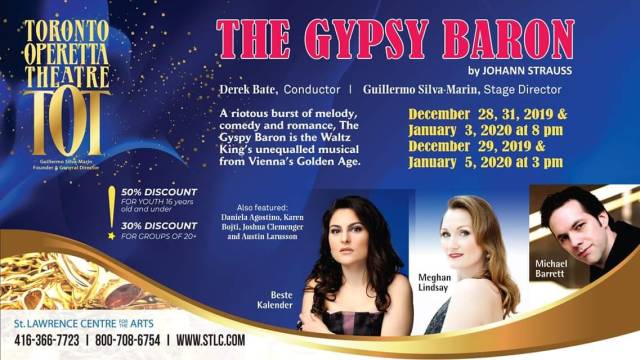
The Toronto Operetta Theatre opened their new production of Johann Strauss Jr’s The Gypsy Baron tonight at the Jane Mallett Theatre with a full house in attendance for the first of five performances.
It’s a very uneven production of a work that is very elusive to present in 2019. The subtleties may simply be beyond us given how coded this was for its 19th century audience.
At one point we listen to a chorus singing while banging to create their own percussion, somewhat like the famous Anvil Chorus in Il Trovatore, Verdi’s opera written in the 1850s that featured gypsy characters. For awhile Verdi’s work was the most popular opera of all, imitated by the Marx Brothers in A Night at the Opera, an image of exotic & erotic otherness in Europe. No wonder Strauss would want to emulate that, especially given ethnic sensitivities in Austria.
But that time has largely passed us by. It’s a delicate thing to get the exotic or erotic from such a scenario. The word itself is now problematic. To say “gypsy” at all is to flirt with censure, given that the name of the people is “Roma” not “gypsy”, the same way that “eskimo” is a word in another language (“eaters of raw fish”) we’re not supposed to use because it might be seen as derogatory by the Inuit.
I bring all this up merely to suggest what an ambitious effort, what a tall order it is for TOT to offer this piece, requiring singing & dancing of its soloists & chorus in multiple ethnicities. I believe they’ll get better. Opening night the musical side was excellent, while the diction was uneven, at times very hard to understand. Cast members need to work at their enunciation if this isn’t to be a struggle for the audience (i heard “I couldn’t understand them” from someone in the lobby as I was leaving). Or perhaps subtitles need to be used.
The women are better than the men. I won’t name names except to suggest that when your text requires you to hurl the same expletive repeatedly, don’t make us cringe every time you repeat it. Find a way to make it sound different or interesting, or beg the director to change it.
We’ve seen a lot of serious roles from Meghan Lindsay on the Opera Atelier stage, showing off her wonderful voice but rarely hinting at her ability to play comedy: which we glimpsed tonight. Beste Kalender was her co-conspirator (playing her mom), with a genuine knack for comedy. And the two of them sound lovely and stylish in this score.
Daniela Agostino comes into her own, indeed the whole show gets better in the second half when we get past all the details of exposition and we can get down to singing, dancing and having some fun. Karen Bojti is wonderful, with her lovely voice and natural comic flair.
Michael Barrett too improved as the evening went on, a solid job vocally and likable in the title role, with all eyes on him. When it was just him & Lindsay, or with Kalender everything worked beautifully.
The crowd scenes can be exciting musically but are still not quite where they need to be, without any of the subtleties the piece demands.
Derek Bate led the TOT orchestra in a solidly idiomatic reading of the score, including many recognizable waltz tunes.
The Gypsy Baron continues until January 5th at the Jane Mallett Theatre.
I’m trying to find the right word, so please bear with me.
For someone who goes to see concerts & theatre more often than most people, you might never guess that I’m sometimes frustrated. My mantra is “I’m a lucky guy”, because I believe gratitude can be a sacrament, a way to celebrate life.
And yet there are conventions that drive me nuts, barriers to being real. At classical concerts we’re not supposed to clap between movements, and people look down their noses at those who do: even if those spontaneous outbursts may be moments of great beauty. A baby may begin to cry during a concert when everyone else is stifling their every sound, the child for a moment dissenting from the profoundly unnatural artificiality of the crowd.
But of course at a rock concert people are more real. They’ll laugh they’ll cheer or chant, sometimes in the space of a few seconds and all in the same song.
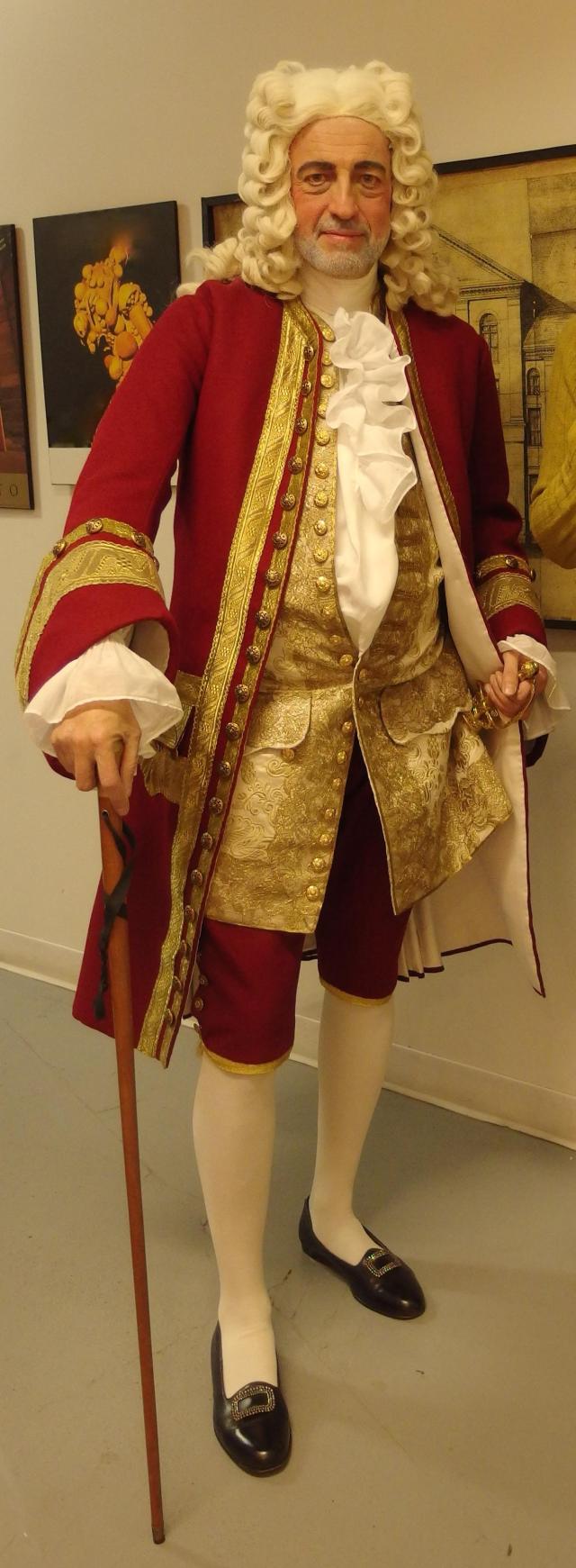
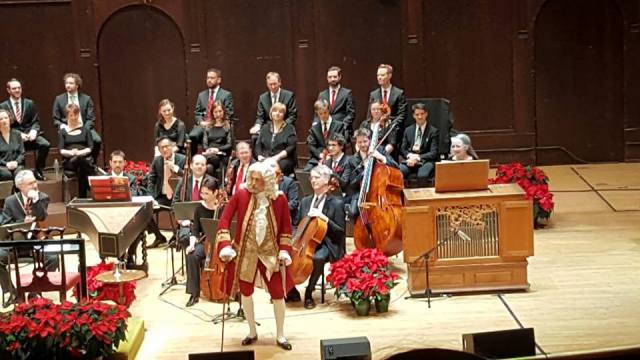
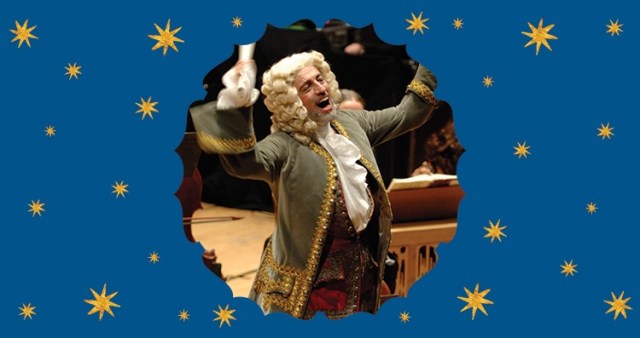
I’m just calibrating what it’s like to go to the annual Singalong Messiah from Tafelmusik. Yesterday afternoon was the 2019 Singalong which in so many ways goes against the usual consensus for proper deportment at a classical concert while emulating something much closer to what we get at a rock concert or a comedy club. The fact that the fellow portraying Handel in costume sometimes seems like more of a stand-up comic than a serious musician helps break down some of the conventions.
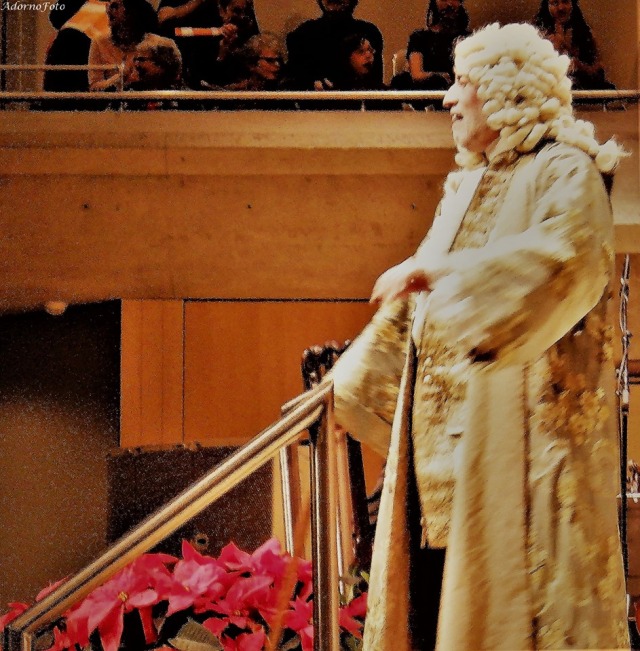
Herr Handel waxing eloquent in the middle of one of his lectures (photo: Constance Adorno Barcza)
So I have to let you in on a little secret. For those of us who go to the singalong, it’s simply magic, one of the highlights of the year. The fellow sitting beside me said that it’s how he begins Christmas every year
At one point Herr Handel asks us to stand up if it’s our first singalong. And usually there’s a fair crowd in this group. Then he asks for those going to number 2-5 singalongs (I’m in this group). And then the ones who have done up to 10. Then 11-20 singalongs (the fellow beside me was in this group). Eventually we get to those who have done all 34 (next year it will be 35) Singalongs.
As with Holy Communion, there are some for whom it’s still a new ritual, while for others it begins to resemble something you do your whole life long. The headline might make some sense as I grapple with the implications of a gathering that simultaneously brings everyone together, at times in a frenzy of excitement –as when we’re singing “Hallelujah”—or simply in the joy of watching, listening, and participating together. For a couple of hours we are all of one tribe, the Toronto Handel’s Messiah tribe if you will. While I may be in the audience while the performers are up on the stage at Roy Thomson Hall, we are one, we are united. Oh sure, they (both the Tafelmusik Chamber Choir plus soloists) are singing it more correctly than I am, but I don’t feel the usual gulf I have at a classical concert. There’s none of that implicit shushing of whispers and surreptitious chat. We can talk and laugh throughout.
And why not when the master of ceremonies is so full of wit & charm?
It’s so profoundly different from the Toronto Symphony’s Messiah. I watched from almost the identical seat in section C2 Friday (only 5 rows difference). Something’s much clearer with hindsight. While the four soloists for the TSO have breath-taking credentials for drama and theatricality in the world of opera (where each of them has made their mark): oratorio is a totally different medium. Opera acting is not oratorio acting, especially when the conductor is so busy with the Mozart version –that often has lovely additional textures & voices—that he forgets his job. Pardon me Alexander, but you had one job.The singers are delivering texts from the Bible. Stay out of the way. Yes the music is pretty. But when a soloist is singing you can ask the orchestra to play more quietly.
Ivars Taurins / George Frideric Handel gets this, and I daresay David Fallis (of the Toronto Mendelssohn Choir but also, Opera Atelier) gets this too (even if he had to hand things over to the TSO conductor). The sound of Tafelmusik Baroque orchestra’s instruments doesn’t get quite as loud: particularly if their leader insists that they don’t cover the singers.
The four soloists are giving us oratorio drama rather than operatic drama, and so they stand still, they don’t necessarily sing loudly, but they command our attention with their impeccable diction. While I adore all four of the TSO soloists, they weren’t nearly as intelligible as what we heard in the singalong Saturday afternoon from soprano Margot Rood, mezzo-soprano Lucile Richardot, tenor Thomas Hobbs and baritone Peter Harvey. But then again I wonder how much of that comes back to Herr Handel, holding back the orchestral tide as though he were Moses parting the Red Sea to permit his soloists to cross unscathed..?
It’s too much fun to be mistaken for Holy Communion, yet it’s very respectful of the text all the same. We are not frozen in silent fearful respectful awe. This is a celebration and as uplifting as anything you find in the text of Messiah. We’re juggling our scores (and several times one hears one dropped) and turning pages, actively involved rather than passive. Sometimes we have to jump to our feet (and the leader screams at us to get up… and it’s funny),
Does Ivars Taurins have the coolest job in town? Maybe.
I think the underlying impulse of the singalong is a desire to join in, to break down the artificial division that’s considered normal in the concert hall or the theatre, even if it’s anything but natural. The vicarious wish we all have is held back by the usual concert dynamic that frames music as a performance of those who can for those who can’t. The magic of the singalong is to erase that great divide.
We can and we do.
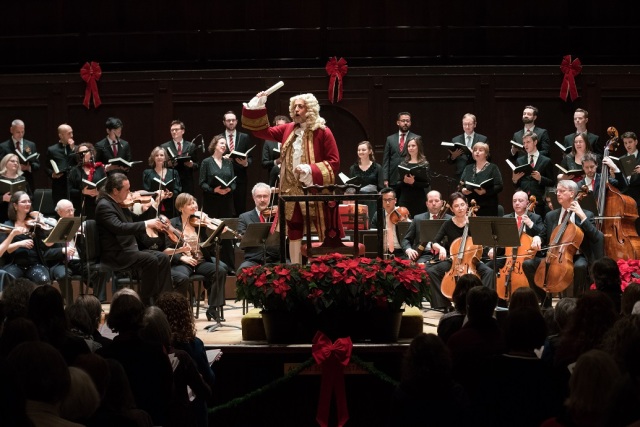
Tafelmusik Baroque Orchestra, Tafelmusik Chamber Choir, and Ivars Taurins aka Herr Handel (photo: Jeff Higgins)
Tonight I heard something different from the Toronto Symphony.
The TSO’s annual Messiah in Roy Thomson Hall with the Toronto Mendelssohn Choir may seem like a ritual, but it actually varies from year to year.
Every time we get different soloists; more on that in a moment.
And some years they vary the actual musical score that’s being played. Handel’s Messiah has been presented in many versions, using many performance philosophies even if you don’t go for something radical like Soundstreams’ “Electric Messiah” or Andrew Davis’s muscular re-orchestration that’s been done a few times at the TSO.
This year we’re hearing Mozart’s take on Messiah. Eyebrows may go up in places where it’s not done the usual way, whether it’s the additional winds, the different phrasing & voicing or for instance when the soloist says “The Trumpet Shall Sound” and we get some trumpet and lots of horns as well. But there are always trade-offs. While we get the score as Mozart revised it we also get a modern orchestra and performing space, which had me wondering what this might sound like with a period band like Tafelmusik playing in a smaller space with a smaller chorus, rather than the big space & the large-scale sounds of the Toronto Mendelssohn Choir. We’re in a comparable situation to watching Marriage of Figaro or Cosi fan tutte done at the Metropolitan Opera House, where we may love the quality of the performance but without intimacy due to the big venue.
There are some fascinating choices in Mozart’s score that will look like heresy, for instance making the soprano sing an accompanied recitative for “If God be for us” rather than the usual number. But perhaps Mozart wanted to make the concluding choruses truly climactic. That’s how “Worthy is the Lamb” & the subsequent “Amen” struck me tonight. He was working from a different set of assumptions than ours.
I got there early, wanting to read the program notes. As I sat I watched fascinated as the trombones practiced intently for the last 10-15 minutes before we began. I heard the intricacies of “Lift up your heads” and a few other passages as well.
Let me digress for a moment. While reading about Dvorak’s Slavonic Dances, I saw someone comment that everyone likely has a different favorite dance. I found that an intriguing thought, almost like a psychological test, where the choice of favorite tells you something about the person.
Perhaps one could do the same with Messiah? I say this having asked several singers to identify their favorite number in Messiah. Mine is “Lift up your heads”, a piece that never fails to excite me, a miniature drama that I believe enacts the process of discipleship & evangelism, of telling others about Jesus. It’s a wonderful piece of theatre, a back and forth dialogue between the men & women.
Mozart added this astounding trombone playing… It’s hair-raising. I had to resist the impulse to applaud afterwards, thinking that perhaps Mozart made it better, although in the silence after the piece ended I am sure the whole place noticed what a wonder we had just heard. That’s not the only place the trombones are kept busy.
The concert was conducted by Alexander Shelley, artistic director of the National Arts Centre Orchestra, although I believe David Fallis of TMC helped prepare the choir: who were mostly impeccable. The Mozartian sound –where the wood-winds sometimes add a layer, sometimes echo an extra voice, where the brass, particularly trombones, double lower choral parts—is at times a wonderful elaboration upon Messiah, a work that I thought I knew. But in many places I’m hearing all sorts of great new things. I’ll have to see if there’s a recording of this version available.
The four soloists added an intriguing dimension as well. I’d be hard put to identify four singers with greater credentials on the dramatic side, at the COC and elsewhere, namely soprano Jane Archibald, mezzo-soprano Emily D’Angelo, baritone Russell Braun, and tenor Isaiah Bell. The Mozart score juggles some of the assignments, although the best known ones for each singer are as usual, namely the soprano’s Christmas eve lead-up to the Glory to God chorus and “I know that my redeemer liveth”; the tenor’s “Comfort ye” and “Ev’ry Valley”; the mezzo’s “He was despised”; and the baritone’s “the trumpet shall sound”.
It’s a mixed blessing in Roy Thomson Hall, a place that works beautifully for the big climaxes but that is not ideal for the softer subtler moments. Shelley has a masterful hand on the tiller, leading us inexorably to the brilliant conclusion. The TSO & TMC are in wonderful form.
There are two more performances, namely Saturday night Dec 21st & Sunday afternoon Dec 22nd .
Left to right: Emily D’Angelo, Jane Archibald, conductor Alexander Shelley, Isaiah Bell, Russell Braun before the Toronto Symphony & and the Toronto Mendelssohn Choir (photo: Jag Gundu)
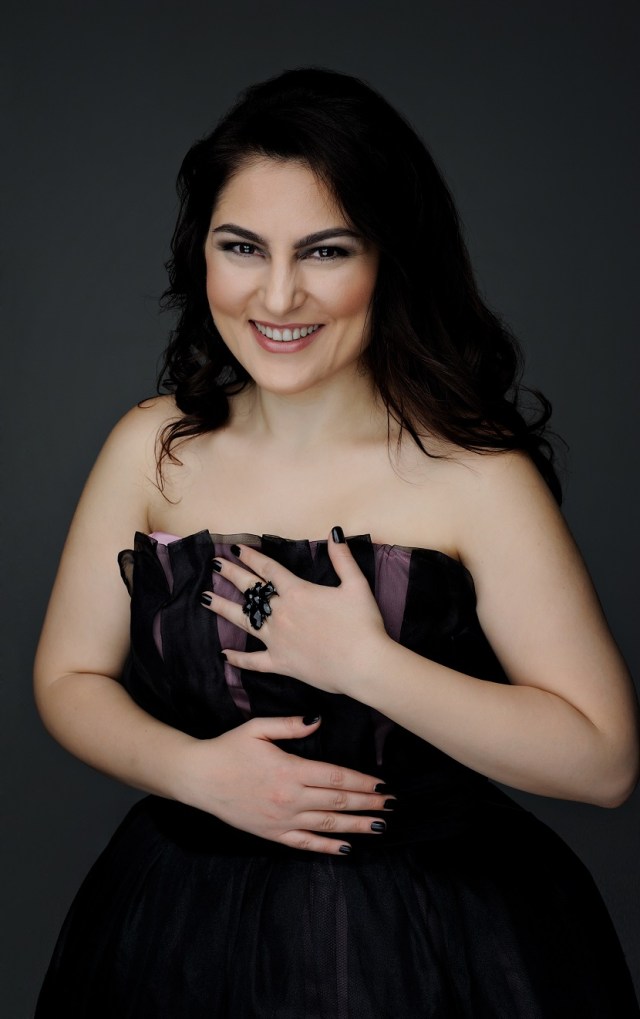
Beste Kalender could tell you about the different pathways to success.
One can be discovered in competitions, especially if one wins. You can be mentored by great singers. There’s even the Hollywood legend, the understudy going on as last minute replacement for the star in a production of Carmen. Beste has done them all.
Every time I’ve seen her I’ve been impressed by her intelligence. At Verbotenlieder roughly a year ago I wrote this about her performance:
I laughed loudest at Beste Kalender’s brilliant re-imagining of “Erlkönig” (a drinking game! Divide the audience in three, based on the three characters in the song, and take a sip whenever you hear yours –Vater, Kind oder Erlkönig—mentioned).
She made a familiar song brand-new with her reinvention, and we had a great deal of fun along the way.
In a few days Beste will be back with Toronto Operetta Theatre in Johann Strauss Jr’s Gypsy Baron. I had to ask her a few questions.
Barczablog: Are you more like your father or your mother?
Beste Kalender: I am very close to both my parents, but I would say that in many ways I am more like my father. He is a self-taught musician and a guitar player. Growing up, I remember him working at the bank during the day and playing gigs with his band in the evening. In celebration of my birth, my father composed a song about me, and somehow foreshadowed my future by naming me Beste – which translates to ‘musical tune’ in Turkish. In fact, both my parents have an artistic side to them – my mother has a literary talent for writing stories and poems – but neither of them had the right circumstances to pursue art or literature professionally.
I can trace my love for opera back to when I was five years old. It was a cold winter in a small apartment in Ankara, and my parents were watching a concert on TV. When I looked up at the TV, I saw a beautiful lady in a fabulous red dress making the most magical sounds one can imagine. As my mom recalls that day, I pointed at the lady and said “I want to be like her!” As I look back to that day, I never doubted what I wanted to do in life.
Beste Kalender
My parents did not have the financial means to support my training as a musician abroad. However, they never let that stand in the way of my imagination and dreams. It is because they were such good parents who appreciated my passion and encouraged me, that I believed in myself, searched for scholarships, received grants, and completed a graduate training in Voice, as well as in Psychology.
Even though I am more like my father, I also think my parents make a great team and they both have inspired me in so many different ways. If I ever become a parent, I hope I can be as perceptive, kind, and loving as they have been to me.
Barczablog: What is the best thing about what you do?
Beste Kalender: The performing arts go well beyond entertainment to help us communicate with the whole world. That’s one of the main reasons why I’d like to keep singing, to share beautiful works of music from all over the world and to give voice to people’s joy and sorrow, to change lives or at least try to make a difference through my voice and music.
Today’s world is filled with so much conflict, hostility, discrimination and fear. One of the greatest and most creative performers of our times, Joyce DiDonato, often repeats: The opposite of war is not peace, it is creation! (J.Larson). I aspire to ‘create’ through my artistry and want that to be my antidote to all the negativity out there. I also love the fact that my profession gives me the opportunity to travel, meet with new cultures, people and colleagues from different parts of the world, which I find gives me perspective about my own understanding of art and people.
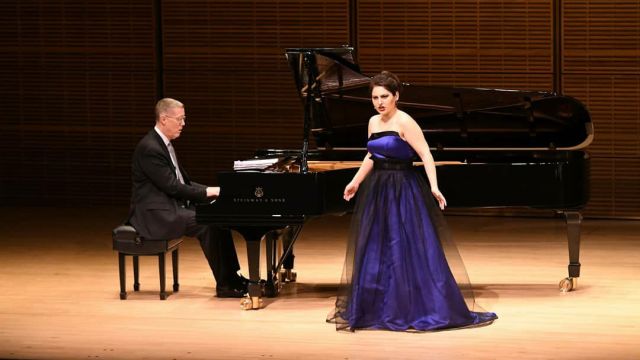
Beste Kalender at Carnegie Hall, in Marilyn Horne’s Song Celebration with Warren Jones.
So far I have performed with companies and festivals in a number of countries. Jeonju Sori Festival (Korea), Helikon Opera (Russia), Bolshoi Theatre (Belarus), Bologna Opera (Italy), Choregies D’Orange (France) to name a few. Each engagement taught me something novel about people and their perception of the art. The only down side of all the travelling is that most of the time I am not able to share those experiences with my family. Feelings of homesickness and loneliness can creep in from time to time, but I try to make the best of the situation!
Barczablog Who do you like to listen to or watch?
Beste Kalender: I generally really enjoy classical jazz. Nowadays, I find myself listening more and more to my favorite Turkish composers from when I was growing up, as well as 60’s and 70’s world music. As for classical music, when in need of inspiration, my go to performers are Marilyn Horne, Joan Sutherland and Jessye Norman.
I also love listening to Anne Sofie von Otter and Leyla Gencer. For those who don’t know the latter, Leyla Gencer was actually the first Turkish singer who built an international career, and Italians called her “La Diva Turca”. She has become an idol and inspiration for many Turkish singers who would dream about an international career in opera, like myself. Unfortunately, she was not very interested in making recordings. Almost all the recordings you can find of Gencer are pirate recordings of live performances. Therefore she is also known as “The Pirate Queen”.
Barczablog: What ability or skill do you wish you had, that you don’t have?
Beste Kalender: Definitely sports! I love learning languages, dancing, singing, acting, painting etc.… However, when it comes to playing any kind of sports, I am generally hopeless. It would have been fun to play some volleyball or basketball growing up, but I didn’t have the aptitude for it. The only reason I got passing grades in the gym class was that I was representing my high school in music competitions. Bless their soul, my teachers must have felt sorry for me!
Barczablog: When you’re just relaxing and not working, what is your favourite thing to do?
Beste Kalender: When I am exhausted or want to relax, I usually end up in the kitchen baking and cooking, with some delicious jazz music, most probably by Ella Fitzgerald or Oscar Peterson, in the background.
More questions about projects & professional life.
Barczablog Can you talk about what you’ll be doing in the coming year ?
Beste Kalender: 2020 will be busy with some exciting projects. After The Gypsy Baron I will be on my way to San Miguel for the 6th annual Mexico-Canada CO-OPERA-TIVE Concert, which will be my performance debut in Mexico. Then, I will be back in Toronto as a guest soloist at Sinfonia Toronto’s concert: Musical Bridges & KOMITAS 150. This project has a very special place in my heart, as this will be the first concert in Canada where Armenian and Turkish artists will join each other on the same stage to celebrate this great musician and the founder of Armenian School of Music: Komitas. The concert will also feature the world premiere of some beautiful music by internationally celebrated Turkish composer Tahsin Incirci. After that, I will be with Edmonton Opera, giving life to another “older lady” character, The Old Lady in Candide. I have previously performed this role two years ago at Banff Centre and I am really looking forward to reviving it! After Edmonton, I will be back in Toronto in April with a busy schedule of some other opera and oratorio projects. Fall 2020 performances will mostly be in Europe. More details about my upcoming engagements for the year are available online at www.bestekalender.com
Barczablog A few days ago I heard that you’ve won the 26th Théâtre Lyrichorégra 20 Jeunes Ambassadeurs Lyriques in Montréal. There’s a cash prize plus performance opportunities, too. Please tell us all about it.
Beste Kalender: Jeunes Ambassadeurs Lyriques is a competition in concert format. Singers are selected via preliminary auditions in various cities in Canada or international competitions in Europe. There are four concerts in total. Participants perform arias and ensembles, in different styles and languages, in front of opera directors from Eastern and Western Europe, Asia and Canada. After the fourth concert selected singers are offered money prizes and/or role/concert engagements as well as other audition opportunities in Europe.
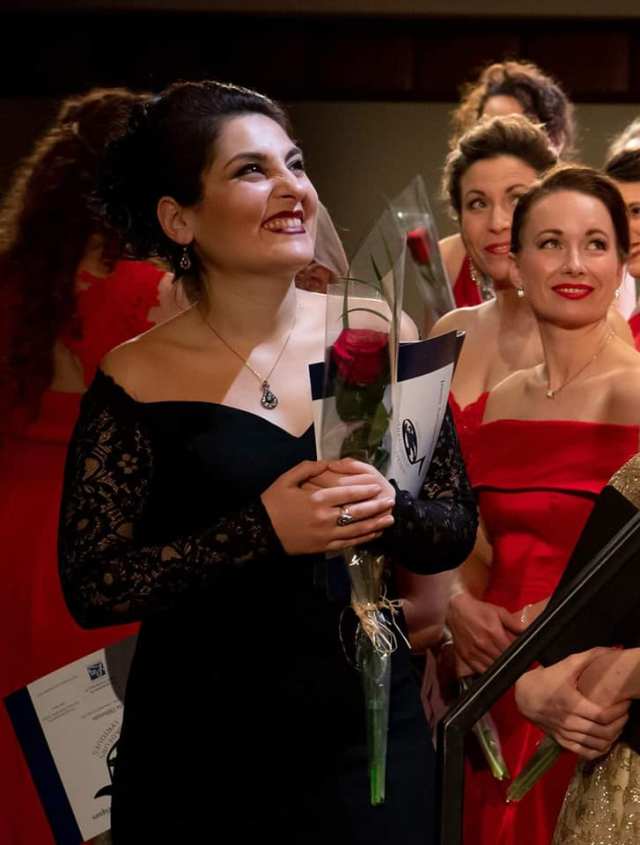
At the Jeunes Ambassadeurs Lyriques finals
As for this year’s competition, I have been awarded the grand prize by the jury, was chosen as “Jeune Espoir Lyrique Canadien 2019”, and granted $5000 by Azrieli Foundation to support my future engagements and auditions in Europe. I have been also offered the title role in Carmen by Bizet in Sofia National Opera and Ballet(Bulgaria) for Fall 2020, a concert engagement in January 2020 with Opera de San Miguel, concert engagements with Opéra Angers Nantes (France) for next season as well as concert engagements with Shenzhen Poly Theatre (China)
Barczablog Later this month you’ll be singing in Toronto Operetta Theatre’s The Gypsy Baron by Johann Strauss Jr. Tell us about your role in the production.
Beste Kalender: The Gypsy Baron is a very fun piece with a number of colorful characters. Czipra is definitely one of those. She is an old gypsy woman full of life, also the leader of the gypsy troops in her area. She is very deeply involved in anything related to the spiritual world, fortune telling and such. She is also a very strong woman who fears nothing and no one. She raised Saffi (performed by Soprano Meghan Lindsay) who is later revealed as the daughter of a Turkish Pasha (I know…the irony), as her own daughter, and protected her against the Pasha’s enemies.
The story is about the marriage of Saffi and the landowner Barinkay (played by Tenor Michael Barrett), who just returned from exile. Czipra has a very central role in all the events bringing these young lovers together and it is very exciting to experience her “larger-than-life” spirit, laughter (she does laugh big…and A LOT)) and determination in taking care of her beloved Saffi throughout the story.
It all takes place in Hungary and Vienna in late 18th century but get ready for some modern touch with the English text as our fearless leader Guillermo Silva-Marin has a great skill to always bring these works up-to-date with some ingenious word play.
Barczablog You have a new hat you’re wearing with Tongue in Cheek Productions. Please explain.
Beste Kalender: As the position of “PR Sorceress” goes, I take care of the Public Relations, Press and Media Services for the company but, in reality, we really try to share the work as much as possible including casting and other organization related subjects. Mike Nyby and Aaron Durand are two of my favorite colleagues with whom I have performed in a number of different productions. They founded Tongue in Cheek Productions and asked me to sing for them in their second show “Verbotenlieder: Forbidden songs”, where female performers sang pieces they always longed to sing but were never allowed to, because their teachers or the actual “fach” forbade them. I got to perform Erlkonig by Schubert, which was SO MUCH FUN!!! I officially joined the team shortly after “Verbotenlieder”.
I really liked Mike and Aaron’s way of thinking about classical music, and how they wanted to stretch the boundaries of the average person’s understanding of the opera world and I am a big believer in the power of strong social presence and promotion for a successful career in the arts. I also really enjoy talking to and connecting with people, hearing what they have to say, which – I suppose – has something to do with my Psychology training. At the time, I was also curious about the administrative and promotion side of the shows in which I was involved. Since then our journey together has been nothing but real hard work and lots of fun. We all share the same vision, and I look forward to see what the future holds for our innovative, “classical music and people friendly” company!
Barczablog You’re playing in an operetta with TOT, you’re singing the Old Lady in Candide in Edmonton, you’ll be singing Carmen again (having sung the role before). You’re a singer who is very comfortable with spoken dialogue. Have you done a lot of this before?
Beste Kalender I was never trained particularly for spoken theatre but I have had the opportunity to work with so many wonderful stage directors who have significantly contributed to my talent as a performing artist. Leon Major, Paul Curran, Guillermo Silva-Marin, Tom Diamond, just to name a few. As for my acting and spoken scenes in general, I guess I am just comfortable with the stage.
I love the process, the dynamics, and the action in live theatre. It doesn’t really matter what role I perform…I am the happiest performer when I feel the presence of my audience.
Barczablog How many languages do you speak?
Beste Kalender My native language is Turkish and I am fluent in English. My life-long passion for opera meant that I always had a great interest in Italian songs and the language itself. When I was in high school more and more Italian tourists started visiting our city of Antalya (on the Mediterranean coast of Turkey). A family friend was fluent in Italian and had his own carpet and silver shop at the bazaar. He loved to hear about my passion for opera and I loved the fact that he was a real gentleman and fluent in 6 languages including Italian. So we made a deal: I started working for him at the carpet shop, and he taught me Italian for one hour every day… and then let me practice with the tourists. It was the best summer of my life and the lessons came in handy when I had my first contract with Teatro Comunale di Bologna in Italy, years later.
I have studied some French in Turkey, and later continued my studies here in Canada. If you are patient enough I can even discuss some politics in French. I just adore the language! I am also a beginner in German but hope to have a better grasp of the language in the near future.
Barczablog At one time you were doing research in psychology. Could you talk for a moment about your interest in music and how it leads to your present life as a performer?
Beste Kalender: In Turkey, I finished a bachelor’s degree in Psychology (at Bogazici University in Istanbul) as well as a Voice Diploma Program (at Istanbul University State Conservatory with Ayse Sezerman Unel). I was really looking for an opportunity to study music abroad and, being exuberantly inspired by “La Diva Turca” Leyla Gencer’s biographical novel, to pursue an international career in performance.
At the same time, I was curious about how music can enhance our lives. During my studies at Bogazici University, I was working in three different labs with internationally respected scholars and professors. Oliver Sack’s Musicophilia being my favorite book, I was fascinated by neuroscience and studies supporting the idea of how music can promote so many cognitive functions, including memory and language skills via the overlapping faculties in the brain. I was the valedictorian of my class, also the recipient of the presidency award upon graduation from Bogazici University and I started applying for PhD programs in North America where I could conduct music-related Developmental Psychology research. In my applications, I was always honest about my interest in opera performance. I knew I wanted to be an opera singer but I did not want to feel disappointed with myself if I simply didn’t have the talent I thought I had. My goal was to be happy, to nurture my interests and dreams to the fullest. I was immediately accepted at University of Toronto by renowned developmental researcher Sandra Trehub. Upon my arrival I also convinced mezzo soprano Jean MacPhail to meet and hear me-I may have begged a little. Within six months, I was conducting my own studies as well as working on my first role, Tancredi in Rossini’s Tancredi for Guillermo Silva-Marin’s Summer Opera Lyric Theatre. Guillermo was the first director who ever gave me a chance to perform in Canada and develop as an artist!
Guillermo Silva-Marin, General Director of SOLT.
During my time at the PhD program, I continued performing regularly and also completed an Artist Diploma in Voice at The Glenn Gould School of The Royal Conservatory of Music.
When I took a leave from research and joined Calgary Opera’s Emerging Artists Program, I was “all but dissertation”. Then, originally cast as Mercedes, I had the unexpected opportunity to fill in for the title role in Carmen at Calgary Opera, singing all four performances. My performance was well received and I knew I was ready to embrace what the future brings as a performer. The next day, I phoned my supervisor in Toronto and informed her that I am leaving academia. That Carmen role was just the first of many others… I can easily say that I owe my professional career to Carmen and to my mentors in Calgary Opera who believed in my talent to bring “her” to life!
Barczablog I saw in your bio the “Marilyn Horne Song Celebration Concert”. What is your connection to Marilyn Horne?
Beste Kalender: I feel very lucky to call Marilyn Horne my muse and mentor. I will never forget my first time meeting her…
Beste with Marilyn Horne
When I talked to my former teacher about how I admire Marilyn Horne and aspire to meet her someday, she advised me to apply to Music Academy of The West’s Summer Music Festival.
In 2014, Music Academy announced their season production of Carmen – obviously my favorite opera ever – so I decided to give it a try and actually received a call-back. I entered the room and there was Marilyn Horne looking at me with the most radiant smile I have ever seen. I don’t remember how I sang. I just remember that all of a sudden it was hard to breathe. I turned back to exit the room then I heard Warren Jones, who is also one of the greatest coaches of the program, say “Please stop!” The rest of my audition turned into a short working session. After my audition, I was full of all sorts of feelings (singers joke!).
Then I heard the door open. It was Ms. Horne. She said “…so Beste Kalender from Turkey. You have worked with some wonderful voice teachers and you have the right voice for Carmen. Now tell me why you were so nervous…”
I told her: “Ms. Horne I grew up with this dream of meeting you some day. I was so overwhelmed by your presence.”
She answered back with that same wonderful smile of hers and said “Whatever happens…Don’t forget to breathe.”
Shortly before the results were announced, I was offered a lead role at a main opera house in Moscow. But I forgot all about Moscow when I heard that Ms. Horne invited me to her festival, this time just as a cover… for Mercedes. The following year she offered me the title role in Rossini’s Cinderella and we developed a great “”teacher-student” bond during the preparation process. Thanks to her, my story turned into a real life Cinderella story. She was very pleased with my performances and invited me to sing for The Song Continues Masterclasses at Carnegie Hall, which was followed by my recital debut at Carnegie Hall with another favorite mentor of mine: world renowned Maestro Warren Jones. After that I was featured by Musical America as “The Artist of the Month”. The following year I had the opportunity to perform at Carnegie Hall once again, this time at the Marilyn Horne Song Celebration Concert with many other internationally celebrated artists such as Isabel Leonard, Russell Thomas, Nicole Cabell, Susanna Philips et al.
Barczablog Do you have any teachers or influences you’d like to acknowledge?
Beste Kalender A career in this business is only possible when you are surrounded by the right team of people. I would like to thank TOT’S Guillermo Silva-Marin and Jean MacPhail for taking a chance in me 10 years ago when they first met me as a researcher and my former academic supervisor at U of T, Professor Emerita Sandra Trehub for her support throughout this adventure.
I would like to also thank my current teachers and mentors: Marilyn Horne, Warren Jones, Laura Brooks Rice, Rachel Andrist and Hans Nieuwenhuis for always being there for me.
With Beste Wishes…
*******
Beste Kalender is featured in Toronto Operetta Theatre’s holiday production of Johann Strauss Jr’s The Gypsy Baron, presented with full orchestra conducted by Derek Bate and directed by Guillermo Silva-Marin, December 28th until January 5th at the St Lawrence Centre. Click here for tickets.
Looking for an alternative to the Messiah & Handel?
Look no further than Toronto Consort’s current program, Schütz’s Christmas Story, curated by David Fallis.
You will hear stunningly beautiful music that you’ve probably never encountered before. Schütz is new to me. Speaking of Handel, Schütz’s baroque aesthetic is in some ways more primitive & simple than what we encounter in Messiah in the next century, at least as far as his creative procedures that we see growing from Monteverdi, a composer you might hear echoed by Schütz: except the words are sung in German rather than Italian.
My Toronto Consort attendance is irregular, so I can’t be sure when I say that this is the most impressive thing they’ve ever done. But wow, there are a great many wonderful things happening among the players, colours & timbres that would be our focus if we didn’t have so much text & drama before us. Schütz deserves to be better known, and perhaps programs like this one will remedy that injustice.
The approaches to story-telling is something I wish I could have studied more closely, but then again I’d have to know the music & the words much better, to have a sense of the dramaturgy, the strategies in the piece as written vs what I think I see in the interpretations.
And you will hear remarkable performances.
Charles Daniels is again showing us his versatility. Where with another artist I might question the authenticity, asking “is this the right way to do this”, with Daniels I assume it’s right. He works hard to sing the words clearly, has impeccable pitch & phrasing, and usually underplays even at the most dramatic moments in a text.
Tenor Charles Daniels (photo: Annelies van der Vegt)
Katherine Hill sounded wonderful & clear. Dare I say it “angelic”? But how does one sing music meant for an angel, and how much drama does one include? Like Daniels, Hill underplayed.
And Joel Allison showed us a lovely rich tone, while at times giving us a bit more theatricality in his Herod. That feels right to me as a former PLS actor (“PLS” are a University of Toronto troupe exploring pre-Shakespearean theatre), familiar with mystery plays & the tradition of histrionics in a role such as Herod: possibly the most over-acted role of them all.
I admire the ambitions of this program, the way Fallis dared to assemble pieces in the first half around a lamentation after the massacre of the innocents. It lends a weight & depth to the Christmas story, making the eventual joy & celebration feel three-dimensional and grounded.
In the second half we get Schütz’s Historia von der Geburt Jesu Christi, a complete Christmas story. Daniels is the Evangelist telling the story through a very simple recitative. Schütz’s style & delicate attention to the text reminds me of his near-contemporary Lully, a direct, unencumbered approach to setting words to music. The priority is telling the story.
The music goes back and forth between evangelist recitative & “intermedium” perhaps to be thought of as “intermezzo”, a concerted composition that is a little bit more like an aria or song, although sometimes the intermedium sounds somewhat like recitative. There are eight of these episodes, corresponding to parts of the story such as the visit of the Magi or the Angel singing to the shepherds in the field. This is a baroque that is transparent rather than showy, not yet seeking to give us a display of skill or virtuosity, as we’ll get later with Handel or Bach.
David Fallis curating a program usually takes us deeper, in programs of integrity & ambition. He’s likely a big reason we’re so fortunate to have another visit from an extraordinary artist such as Charles Daniels.
The program repeats Saturday night & Sunday afternoon at Jeanne Lamon Hall, Trinity-St. Paul’s Centre.
“September 25 is going to be a big night for the Canadian Opera Company.”
That’s how Alexander Neef’s email to subscribers began. It was in my inbox early this afternoon.
Alexander Neef (Photo: Gaetz Photography)
It will be an expensive project, so of course he –meaning Neef on behalf of the COC—are asking for donations. And I’m thinking about whether I’ll make a contribution. The email offers some incentives, as I shall explain below.
The COC have come a long way from their Ring Cycle that opened the Four Seasons Centre, remounting 3 of the 4 operas in the past 5 years but with a huge upgrade in the level of talent, thanks for Neef’s connections in the international opera world.
Let me jump to the linked page he appended to his email, perhaps a test of one’s true nerdy devotion. If you’re a Wagner fanatic you click on such things, because of the gold that lurking underneath as though this were the Rhine.
They give us a cast, at least as of today, with a cautionary note at the end that “ All casting and production information is subject to change”
Parsifal: Christopher Ventris/Viktor Antipenko
Amfortas: Johan Reuter
Kundry: Tanja Baumgartner/Daniela Sindram
Klingsor: Robert Pomakov
Gurnemanz: Mika Kares/David Leigh
Titurel: David Leigh/Mika Kares
Conductor: Johannes Debus
Director: François Girard
Set Designer: Michael Levine
Costume Designer: Thibault Vancraenenbroeck
Lighting Designer: David Finn
Video Designer: Peter Flaherty
Price Family Chorus Master: Sandra Horst
Ventris and Antipenko are both talented singers. We saw Reuter not so long ago. Canadian Robert Pomakov can comfortably stand alongside the imported talent, as he did in Götterdämmerung not so long ago.
The dates?
Friday, September 25, 6 p.m.
Sunday, September 27, 2 p.m.
Saturday, October 3, 6 p.m.
Sunday, October 4, 2 p.m.
Friday, October 9, 6 p.m.
Saturday, October 17, 4:30 p.m.
Sunday, October 18, 4:30 p.m.
Subscriptions will go on sale February 10.
Single tickets for the general public will go on sale July 20.
Monumental Campaign donors who give $1,000 and above will receive early access to single tickets (date forthcoming)
I don’t presume to know how one does the Singalong Messiah thing. I am no expert.
[morning after emendation… There are different sorts of experts. Singers? organists, conductors, musicians? or the textual scholars, people who really know Handel? I avoid the mantle of expertise because I don’t like class distinctions. In Roy Thomson Hall we’re all admirers of Handel, amateurs in the best sense of the word, loving the music & the art: except of course for those who are professionals.]
But I’m taking a family member along on the afternoon of December 21st, to Roy Thomson Hall. And I realized as we chatted back and forth about this, that this is a really good topic for the blog.
One might wonder how one approaches Handel’s Messiah. Does one prepare? Does one study the score, listen to the music, prepare one’s voice, warm-up the day of the event? Yes yes yes…
And it’s not every day that one gets the opportunity to perform with accomplished professionals in the same piece. One of the great thrills –and there are several to be had—is to look up and to notice that you’re singing with all these people, including the Tafelmusik Baroque Orchestra & the Tafelmusik Choir. It’s heady stuff, especially in the more complex pieces.
Two years ago I had the singular honour of interviewing Herr Handel himself, although admittedly with some help from Ivars Taurins, the conductor of Tafelmusik Baroque Choir. Does Taurins have a special gift that he is able to channel the spirit of the departed composer? Or maybe it’s just the music that gets into him, bringing Handel to life.
I invoke that interview to suggest that above all this is fun. When you look at the pictures you can see it. When you come into the hall you feel the unique vibe: as though we were at a rock concert from the 18th century.
I don’t think anyone is stoned or drugged except perhaps with antihistamines stifling their coughs or cold symptoms.
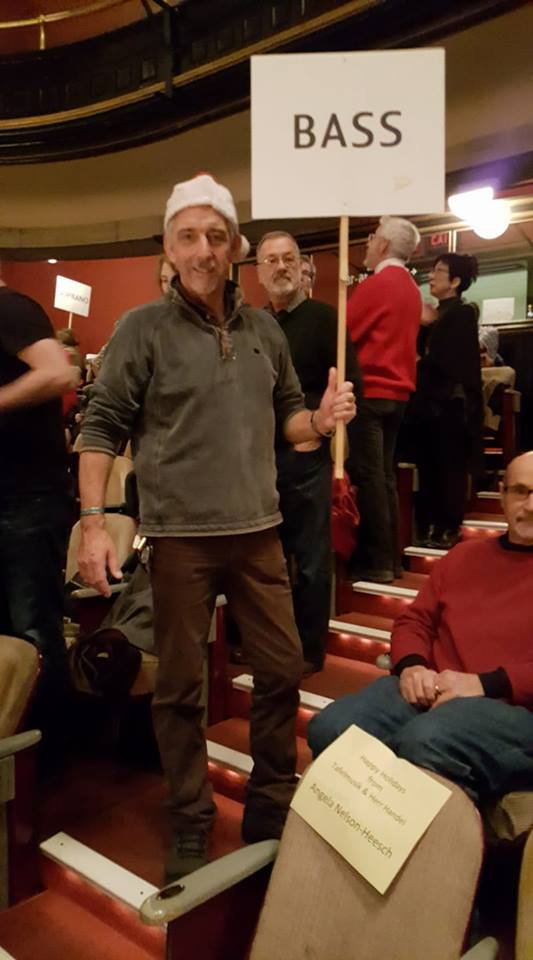
I am reminded that seating is assigned by voice part. If you’re a soprano, sit among the sopranos. Altos sit with altos, tenor with tenors, basses with other basses.
For those who wanted to be among the same vocal type, they help us find our sections.
And there is also a general mixed section for groups that want to sing together.
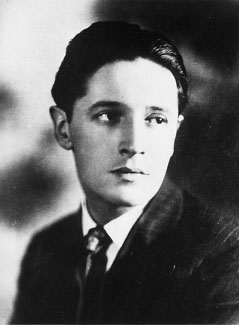
Ivor Novello
While we do not sing the whole Messiah, we sing enough that one would do well to be accustomed to singing, the way one is as a regular church chorister.
Don’t underestimate the effort required. If you’re not in shape –that is, using the analogy of an athlete because in fact singing is an athletic discipline requiring wind & a kind of fitness—then you would do well to pace yourself. Don’t give it your all in the first part or you’ll be all sung out by the end.
We use the Novello score.
Not Ivor Novello, the composer & film-star, who shows up as a character in the film Gosford Park.
That would be the wrong Novello!
No, the score comes from a publishing house founded long ago by Vincent Novello. If you look around you’ll see that it’s the score everyone seems to use, as it appears that there’s a consensus around these versions of Handel’s music. If you don’t own one of these, they will be on sale at Roy Thomson Hall.
Here is a list of the choruses sung in the Tafelmusik singalong last year, including page numbers from the Novello score (and please note, there are solos in between, which I’m leaving out of this summary).
In the first part of the concert before the intermission there are five big choral pieces:
Chorus: And the glory of the Lord 11
Here’s a version where you can see the score as you listen.
This version is from the Monteverdi Choir, English Baroque Soloists, led by John Eliot Gardiner in a reading that might resemble what Tafelmusik under Ivars Taurins would do: except that there are an additional 2000 or more in Roy Thomson Hall, singing along. But it’s somewhat useful practice to follow along with the score.
That text (like all of them) is fascinating, from the book of Isaiah.
And the glory of the Lordshall be revealed, and all flesh shall see it together: for the mouth of the Lord hath spoken it. (Isaiah 40: 5)
It’s a prophecy. I find it comes true when I come to Handel & his treatment of the text, and remarkably it seems to happen to me every time.
Alto Air and Chorus: O thou that tellest good tidings to Zion 41
Here’s a wonderful performance (I love the alto’s pronunciation). Notice that the chorus gets little warning before their entrance. If you get too carried away with the alto’s performance you’ll miss your entrance!
The process of communication in this chorus never sees to amaze & overwhelm me. Is this number not a bit like a snapshot of the entirety of Christianity in miniature? Someone has heard good news, and they report it, and they’re spreading it and it does spread, from a soloist to a multitude.
Wow.
Chorus: For unto us a child is born 55
OKAY the last two chorus examples were ideal performances by small ensembles. That’s not what it sounds like when you add 2000 people in a singalong, no matter how perfectly you sing your part.
Will we sound as good as the Mormon Tabernacle Choir? Let’s see.
The next chorus comes in response to recitative lines from the Soprano. When she gets to the lines “And suddenly there was with the angel a multitude of the heavnly host praising God and saying” it’s time for the chorus to sing Glory to God 68
One of the most exciting parts of Messiah is the dramatization of Christmas Eve. We in the chorus get to play a chorus of angels. The strings almost sound like wings, don’t they?
And to close the first part of Messiah,…
a Chorus: His yoke is easy, and his burthen is light 86
No we won’t go this fast. Our burthen (or Herr Handel’s burthen) will not be so light, not with so many singers.
But isn’t it cool, to be able to follow the score, to see your part, to sing a part of this amazing piece? What a rush!
And that brings us to the Intermission. Don’t mistake this for a halfway point, though. The usual full Messiah has three parts, with an intermission normally after the 1st part, with two big parts still to come.
Rest.
Go to the washroom,
Perhaps have a coffee.
Because after intermission there’s lots more.
The first Chorus is Behold the Lamb of God 91
And yes that’s Tafelmusik you hear.
There are several more choruses.
• Chorus: Surely he hath borne our griefs 98
• Chorus: And with his stripes we are healed 102
• Chorus: All we like sheep have gone astray 106
…a bit of comic relief: at least to begin.
The photos of the sheep are cute, and Handel’s vocal lines meander, truly tempting us to go astray.
“Every one to his own way?!”
Hopefully not in the performance of the music.
Then the Chorus: He trusted in God 115
And we come to Chorus: Hallelujah 171
Do we sing this loudly? Perhaps not if we want it to be musical, to be meaningful. Best to start softly, and to save something for later, rather than exhaust yourself on your first Hallelujah, right? And that means that it builds to something over the course of the piece. To become louder, it’s safest to start softly.
•Then there’s the Chorus: Since by man came death 186
And finally we come to a pair of choruses to conclude, one after the other.
Worthy is the Lamb that was slain 217
…again allowing you to see the score as you listen. It’s even harder if you allow the music to move you, which it inevitably does. But can one sing like a machine without emotion? I wonder.
And then it’s immediately followed by the Amen
One of the wonders of the season is getting to hear these pieces anew, even if we know every note. I never tire of them. And when you’re in Roy Thomson Hall surrounded by so many others, the chemistry adds something. I know I’ll make mistakes, and I won’t be the only one. That’s okay. It’s a happening.
I’m looking forward to it. Perhaps I’ll see you there, 2:00 pm on Saturday December 21st at Roy Thomson Hall.
The best works of theatre or music function as advocacy for the creator. A good production of a play, a great performance of a song, should persuade you of the importance of the work & its author.
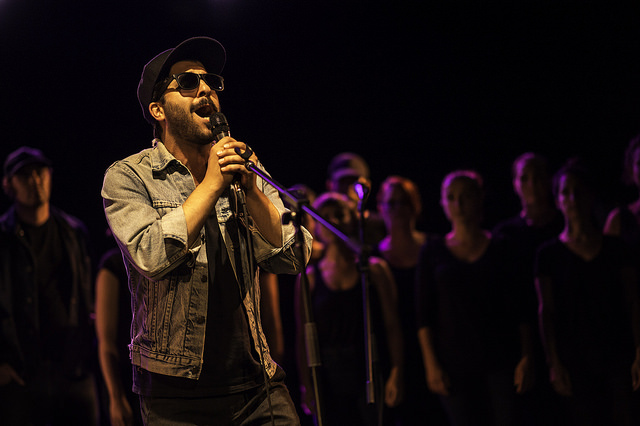
Adam singing Melancholiac
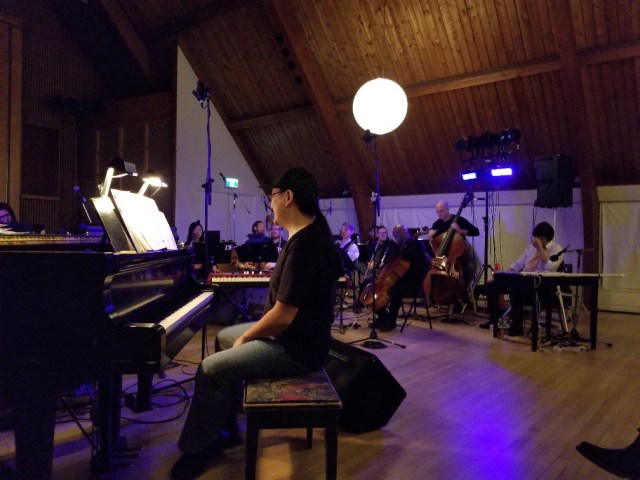
Melancholiac: The Music of Scott Walker is a strong argument that Scott Walker is a genius who deserves our attention. For about two hours, we watched the collaborative efforts of Adam Paolozza & Greg Oh, plus a great many other singers, actors & musicians, offering us a multi-disciplinary exploration of Walker’s art.
Notwithstanding the title that might suggest sadness or ennui, the two hours flew by, one of those wild tumultuous shows I wish I had been somehow part of.
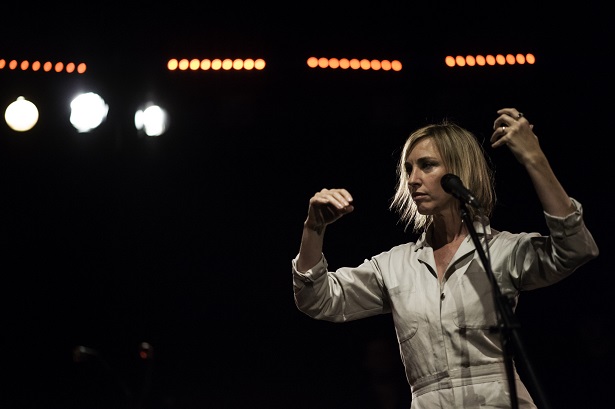
I glimpsed giggling performers who were clearly having the time of their lives with something brand new. Imagine the excitement if you were invited to premiere an undiscovered Shakespeare play or someone found a new Beethoven Sonata. This was a special project whether you were conducting (Greg Oh), part of the chorus, the small orchestra, or working in support, let alone getting to sing one of the exquisite solos, thinking not just of Adam, but also Patricia O’Callaghan, Alex Samaras, Matt Smith, John Millard, and probably a couple of other people too. There were so many different voices, all so fascinating, so much to hear & see. You can read more about this wonderful group on their website.
Can you discern the big smile on Gregory Oh’s face? a not-so-melancholy Melancholiac
Yes it was fun.
There was the tiniest bit of Puccini, some Jacques Brel but mostly Walker.
The Music Gallery & Bad New Days teamed up for a project that will have concluded its third & final performance tonight (I saw the matinee aka the 2nd performance), by the time you read this.
Patricia O’Callaghan (photo: Dahlia Katz)
Music Gallery could have been the intersection of Bloor & Yonge for the crossover. And yet I wonder if that joke is dated, as I don’t think anyone even talks about “crossover” anymore. We may recall “fusion” from another century, but ‘interdisciplinary’ is no longer unorthodox. The boundary between media and/or forms is a wonderfully fertile place to find treasures. At times it was a concert vibe, the musicians & singers mostly static on a stage. Adam sang too but he also spoke as though he were Scott Walker. We had musical moments that were ostentatious theatre (cracking a belt as a whip in time to the music? A procession of percussionists?), messing with our expectations.
And yes, there were moments that were straddling discursive boundaries, lines that were painfully funny. I wish more people had dared to laugh. It’s liberating.
Perhaps the unsung hero or heroine was the one controlling the levels & mixing it all, making sure that we could hear the vocalist given a dynamic range that went from silence to maxed out.
I can’t be the only one thinking that we will see / hear more of Scott Walker, given the fertility of what we saw & heard. Perhaps Adam & Greg will attempt another version of Melancholiac; this is already its second incarnation.
The word I am thinking of is “beauty”, something we don’t always encounter in the realm of “new music.” The later modernists (thinking of Berg, Boulez, Ligeti, Kurtág and beyond) seem especially eloquent when signifying pain or conflict (and yes I know that’s arguably a projection). And they’ve been less interested in beauty, which can sometimes be dismissed in the same waste bin with kitsch. Yes I know this is entirely a subjective category. But I’m thrilled when someone can show me a new way to express beauty, particularly if it’s as fraught as modern life. Walker’s world is sophisticated & problematic, sometimes troubled & never simplistic.
Of course Greg Oh & company took us far deeper into the realm of modern, and it was a fascinating journey; I have a new lens thanks to Greg, who likens Walker to Franz Liszt. That’s very resonant for me right now, as I begin to think of Liszt (and even Dvorak) in the same way as Walker.
I want more Scott Walker. He was under the radar for awhile. I’m sure we’ll hear and/or see more someday.
In 2013 Against the Grain offered the first of their “transladaptations” of one of the trilogy of da Ponte-Mozart operas, Figaro’s Wedding.
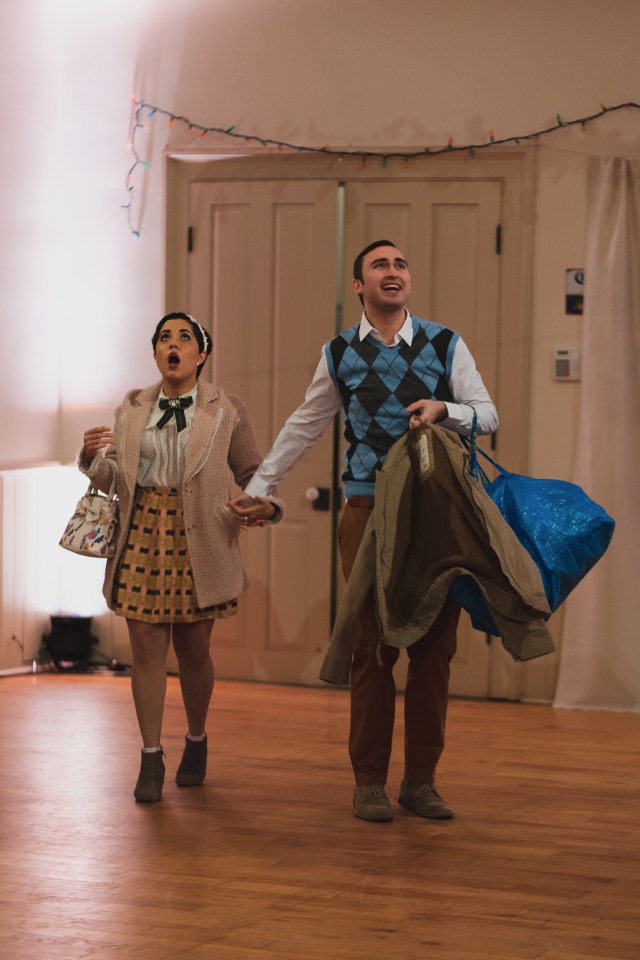
Tonight AtG premiered something we might call a revival of the work, with a number of intriguing differences, the first of twelve performances at the Enoch Turner Schoolhouse.
Sequels and revivals can be especially challenging, because the stakes are higher. We were excited by a new concept in 2013. This time, knowing the premise, could it work as well?
It could and it did.
In 2013 it was lighter & cuter. Tonight we encountered something darker. Where the first take was delightful & energetic, this time there was a bit more weight.
Rosina is pregnant. Last time we wondered if they would reconcile at the end but it had the colours of a romantic comedy. This time felt more like Shakespeare, pondering deeper meanings & consequences.
We were in a different sort of space this time, which may have impacted acoustics. Last time Topher Mokrzewski achieved miracles of precision, where this time we danced on the edge of chaos. But the result had weight, the voices placed at the service of storytelling.
There’s a special magic we get from the scenes in the round, watching an audience seduced & spellbound on the other side of the action staring in wonderment. Director Joel Ivany gets spectacular performances from every member of his cast in this wonderfully intimate performance, where we’re at times inches away from the singers.
We do indeed see a wonderful wedding between Figaro & Susanna. Bruno Roy is a vulnerable & likable Figaro, Alexandra Smither a passionate volatile Susanna, every second meaningful & never letting the illusion fade.
Alexandra Smither and Bruno Roy (Photo: Taylor Long)
Miriam Khalil, our Susanna in 2013, is now Rosina opposite Phillip Addis as Alberto Almaviva. I believe Ivany’s darker reading begins with the fact of his wife’s pregnancy, lending true gravitas to the story. Where we wondered about the playful ending last time, this time? they’re playing for keeps. Khalil continues to be Ivany’s muse and the centre of gravity for the production. Addis is a fascinating contrast, a very dark presence for much of the show, but turning the last act into something wildly comical with his pelvic dance moves.
The modernized reading works quite well, or perhaps it’s just easier to accept the second time around. The final act shenanigans on the dancefloor –and everyone gets into the act—serve to set up the action quite nicely. I didn’t expect it to be so believable.
And speaking of shenanigans, the rest of the cast might be testimony confirming Stanislavski’s truism that there are no small parts, just small actors. Lauren Eberwein continues to be just about the most watchable singing actor in Toronto, hysterically funny in her scenes in Rusalka and again demonstrating a gift for comedy in her over the top approach to Cherubino. Greg Finney is delightful as Bartolo, underplaying while getting the best laugh of the night with a line that more or less brings the house down to end Act III. Amazing. But I won’t be a beast and steal the joke.
Maria Soulis as Marcellina and Jacques Arsenault as Basilio both have great moments, especially in that wild & woolly last act.
Everybody and I mean everybody had a great time. If you want a fun night at the theatre go see Figaro’s Wedding. Don’t be surprised if you’re not just laughing but profoundly moved.
Figaro’s Wedding continues at Enoch Turner Schoolhouse until December 20th.




 barczablog