When you see that the Metropolitan Opera are producing The Gershwins’ Porgy & Bess for the first time in almost thirty years, seemingly selling every ticket to every performance, you might well ask them: “hey what took you so long”?
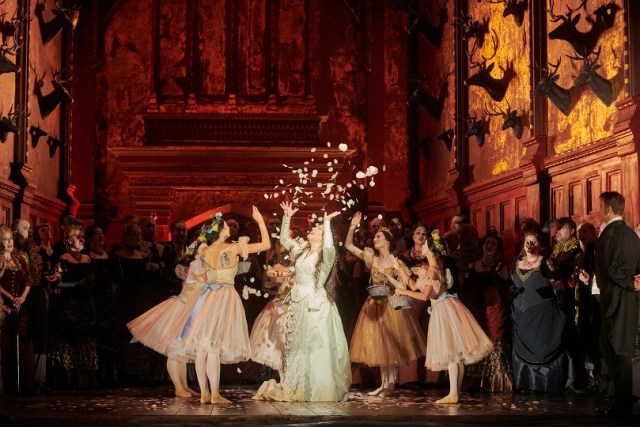
It’s a hit. The principals are brilliant singing actors. The staging, sets & costumes are conservatively faithful to the score as written.
The high definition camera gave us an intimate look at a pair of remarkable performances. I remember watching Angel Blue as Mimi here in Toronto, so totally enraptured that I dared believe she might survive at the end, and here I was again daring to dream about a happy ending as we see Bess go off to NY with Sporting Life & a nose full of happy dust. The voice is superb but she’s especially sympathetic in such a complex role. We’ve seen Eric Owens’ towering presence as Alberich changing the landscape of the Ring Cycle. The Canadian Opera Company brought him in to play Hercules a few years ago. The voice is still there, even more expressive now that he’s singing in a language where I can understand his subtlest nuances.
Frederick Ballantyne was a remarkable Sportin’ Life, explaining in the intermission interview that he’d been given some latitude to improvise some of his performance, especially the call & response of “It Ain’t Necessarily So”. The tightness of the ensemble is crystal clear in his quirky phrases, always perfectly echoed by the chorus. And yes, that chorus plus the dancers are like another character, singing some very difficult music, always part of the action and sometimes taking over. Director James Robinson and Choreographer Camille A Brown emphatically brought the town of Catfish Row to life although at times the show becomes more artificial & stagey, whereas the three principals I named are always persuasive even in close-up.
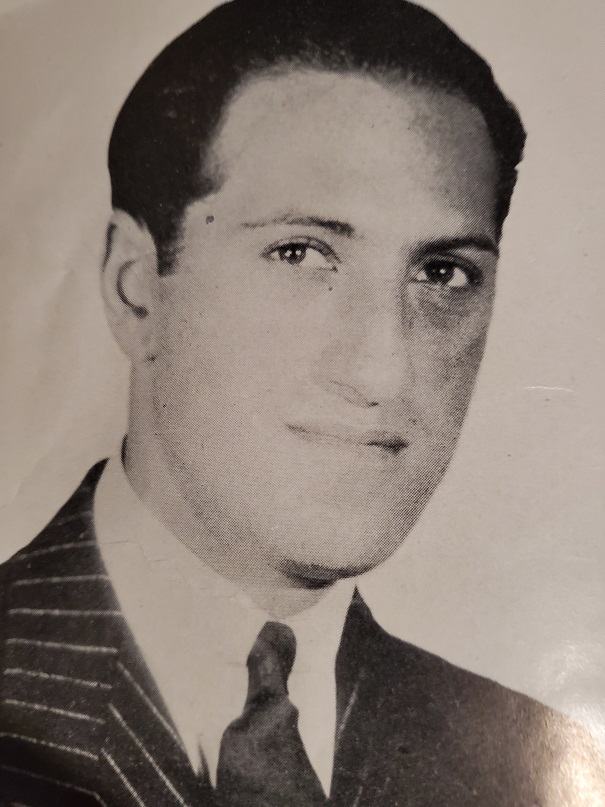
George Gershwin
The Gershwin stipulations represent a kind of trap. They (composer George & librettist Ira) insisted that the cast must be 100% Afro-American. While it gives the show authenticity it means that if your company can’t come up with the required black principals & chorus, they can’t mount the show. And that’s why we haven’t seen more productions of Porgy & Bess.
There are two intriguing exceptions to that rule to mention.
1) During the intermission we heard from Golda Schultz, the South African singer who played Clara, aka the one who sings “Summertime” as a lullaby to her baby. So while Porgy & Bess may be a rarity in North America (for instance the Canadian Opera Company wouldn’t be able to produce it without violating the Gershwins’ stipulations) Schultz told us that Porgy & Bess has been staged a fair bit in South Africa, which of course makes sense.
2) The other one isn’t nearly so nice. You may recall the furor over a production in Hungary done with an all-white cast, and as a Hungarian-Canadian I’m very conflicted about the conversation. Director Szilveszter Ókovács had the nerve to suggest that the Gershwins were being racist. The author György Lázár explains the rationale as follows:
“Ókovács… called Gershwin a “Jewish genius” while blasting his casting requirement. Connecting Gershwin’s Jewishness to the all-black cast requirement has a hidden message in Hungary: Jews are oppressing Whites; racism is their fault. This is eerily similar to the mantra of American fascist David Duke. It is important to note that Ókovács was hand-picked for his post by right-wing Prime Minister, Viktor Orbán who thinks that “ethnic homogeneity” is key to Hungary’s success. He opposes race mixing in Hungary.”
But here we are in 2020 and perhaps the world has caught up to the Gershwins. There are now plenty of good black singers in the USA. Perhaps this production will play every season, becoming a cash-cow for the Met. I’d like to see it again and I’m sure I can’t be the only one.
And there are other problematics at work.
One is right in the work’s history. I can see it for myself in the score that I took out of the library, published in 1935 and therefore still using the language of the premiere. Ira Gershwin & DuBose Heyward wrote the libretto. In the versions extent since 1951 the N word has been removed, replaced by other safer epithets: or so I’ve read. That early score though is full of language that’s no longer permitted.
And as I alluded in a recent piece I wrote about the Cambridge Companion to Gershwin, the composer and his music faced challenges from the more conservative musical establishment.
For a first opera, it’s an amazing and original piece. I can’t help imagining what his later work might have sounded like, knowing that he died at the age of 38.
The story of the opera is a troubling one.
The score has several melodies that stick in my head. Between “Summmertime”, “It ain’t necessarily so”, “Bess you is my woman now”, “There’s a boat that’s leavin’ soon” (my personal favorite) or “I got plenty of nuttin’” one or more is always rattling around inside me afterwards: but not the final number. If Gershwin wanted us to believe that Porgy was going to find Bess, he needed to write a better number than what he creates for his finale.
I heard that the box office for the run of Porgy & Bess is over 100%, a remarkable achievement. They extended the run. I’m sure we’ll see the production again, perhaps next year, perhaps every year. Why not after all. We’ve been watching Zeffirelli’s bohème for years, why shouldn’t we get a chance to watch this genuinely American opera?
There will be encores of Porgy & Bess available. See it, see them, if you can.
I’m impressed. Nicole Lizée has more reason to be pompous & full of herself than any composer or performer I know. But she seems to be totally unpretentious.
Exhibit “A”: the piece we saw & heard tonight is called “Karappo Okesutura Volume 3”. The word “karaoke” is buried in there, but perhaps more important?
Just try to say that first word out loud without laughing. I dare you.
Tonight we watched a powerful hour of music performed by the composer plus the Australian Art Orchestra presented by Soundstreams, including a remarkable video from the composer accompanying the composition. OR is the music accompanying the video? They were created at the same time, inextricably connected.
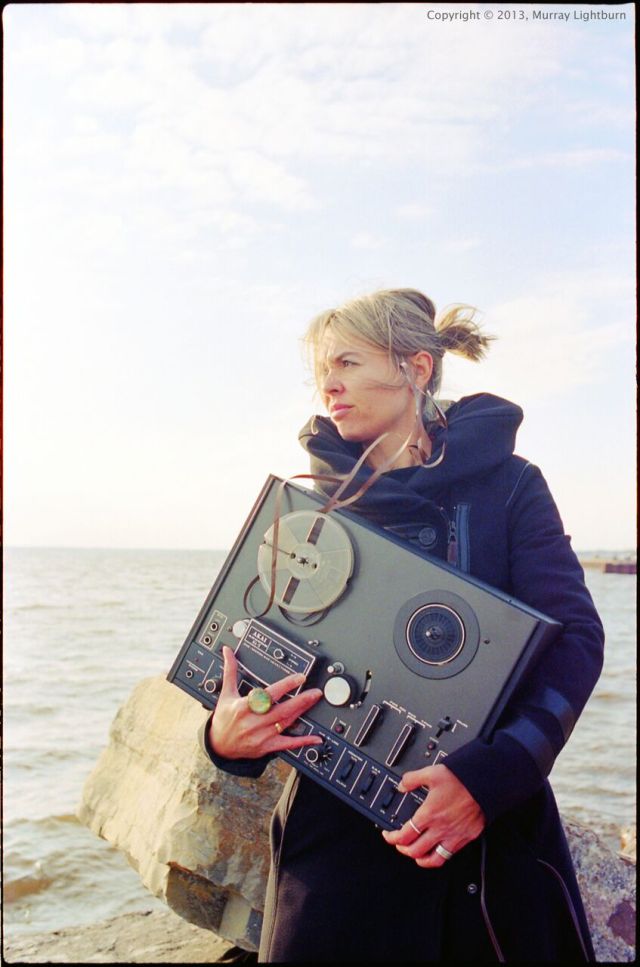
Composer Nicole Lizée (photo: Murray Lightburn)
We the audience experienced something deep & powerful. One might not expect profundity from karaoke.
In the talkback Lizée admits she has a fascination with karaoke even though she dodged the obvious question when asked if she likes karaoke.
Did I mention that she’s unpretentious?
Exhibit “B” could be the excerpts of the songs that we encounter suggesting an autobiographical subtext: except that might be taking it too seriously.
“You’re the one that I want” from Grease, arguably the most popular film musical of all time and certainly popular when Lizée was young.
“I wear my sunglasses at night” by Corey Hart
A little bit of Mr Dressup with Casey & Finnegan
“Turn me loose” by Loverboy, especially a bit of the bass & the synth from the beginning
The theme from St Elmo’s Fire for piano, the distinctive sound of the ‘80s courtesy of David Foster (as I wondered in this tune without a vocal: was this something Lizée played at the piano herself? I recall having had an arrangement of the tune. Or maybe she was just fishing for something evocative and yes, with a Canadian connection).
“Ironic” by Alanis Morissette: but only a bit of the loudmouth in the loud green sweater part (in the backseat)
I may have missed a couple..?
In the talk-back afterwards we were told that this, the third installment in the series of pieces exploring Karaoke (something I need to explain more fully), was meant to have a Canadian connection.
But from what I’ve said you’d never guess at the depths, the remarkable music made from the source material. I’m scrambling for reference points, to attempt to properly do justice to what we saw & heard.
In the talkback Lizée used a word I was thrilled to hear namely “foreground”, suggesting at the very least that she’s thinking in terms of visual art or film as she composes & conceptualizes the music. I’m reminded of minimalists such as Philip Glass or Bernard Herrmann, whose texture might remind you of an accompaniment looking for a melody, with nothing really in the foreground: just endless background.
But we didn’t just get pattern music. There’s so much more. So let’s go back to what one gets in karaoke. Remember first of all that pop songs are designed to be simple, transparent rather than full in texture. Now imagine that you’ve taken that frail little construct and you removed the chief point of interest, namely the vocal line.
What’s left? When they remove the melody leaving only the backup bass & percussion plus possibly some accompaniment, there’s really not much there.
I love the nerdiness of this ongoing project, that she could make those bare hulks (meaning karoake accompaniments) the basis for her compositions. You have to love the elegance of it, making music from something that’s in a sense anti-musical, a crude commercial product as the basis for something beautiful. It’s like making a cordon bleu quality meal using Kraft cheese. I haven’t heard the earlier episodes, so I can only imagine. But what we heard and saw was gripping & powerfully absorbing. There’s a word I must use that is regularly misused that applies here. Lizée deconstructs these pieces into their constituent parts: or at least some of them. At times we’re still hearing something sufficiently recognizable to be able to laugh about it. At least that’s how the first song (the one from Grease) came across, with plenty of Olivia Newton-John & John Travolta smirking & posing, even as the song wasn’t really allowed to play. We were being teased at this point, and it would go much further.
The songs at times resemble covers or adaptations: but we’re in different territory now, as the results aren’t intelligible in the usual ways. There are places where the ensemble, including vocalist Georgie Darvidis, would seem to be impersonating the effect of someone messing with playback as one does when one scratches a turntable or messes with the speed of a tape: but as Lizée admitted in the talkback it’s all scored. Those places where the orchestra and vocalist all seem to shudder in synchronization, adjusting pitch & pace: are all clever effects on the page.
Speaking of visual art, I’m reminded powerfully of Maurice Denis’ admonition, that might irritate Lizée (and I’m not sure she’ll like me bringing this up). Denis said
“Remember that a picture, before being a battle horse, a female nude or some sort of anecdote, is essentially a flat surface covered with colors.”
When we hear all those fragmentary phrases, while watching all these fractured movements and smeared colours on the video, one might want to go in the direction of Robert Wilson, as in Einstein on the Beach, where the movements suggest pure movement & energy without motivation or subtext random numbers & phrases. We might: until we see one of Lizée preoccupations. She’ll have a video of someone (Alanis or Corey Hart for instance), and we’ll see the face and then a little shovel comes and digs into the surface on the image. Denis could scream with indignation, that Lizée would posit something deep. She said “We go down a rabbit hole and out the other side.” However shallow the images may seem she wants us to know that they have depths and are not just surfaces, and too bad Denis if you think otherwise.
The performance matches that quest for depth, the commitment of the players. As Lizée said in acknowledging her collaborators from down under, the music “needs a special group of players to breathe life into it.” And so it was.
I’ve heard her music before, but this time was different. In all the others, I never actually saw her play, notwithstanding that wonderfully hands-on image of the composer holding a tape-deck.
Here she becomes more of a Liszt or a Gershwin, the composer as virtuoso albeit not in the pianistic way of those two men. We are again in that wonderful threshold between popular and serious that we visited with Scott Walker. But while we are given a whiff of popular culture we are exploring something very deep. If I may invoke Liszt again, I’m reminded, with the music built of semi-recognizable fragments, of his Valses oubliées, that are about memory & forgetting, about cliché and style that at times invoke the whole question of perception & even dementia as we confront the limits of our brains.
Holy cow this is amazing music. Sorry there was only one concert. But she’ll be back, perhaps with this music, certainly with other works.
You probably didn’t expect that did you? Did you anticipate where that sentence was going?
It starts like a truism that we hear so often about money being the root of all evil, which I can relate to heartily.
How might money be the root of all opera?
It’s expensive.
Without money you will have a tough time doing a real opera. Orchestras are expensive, and even if you’re using a piano, hey, last time I checked, pianos are expensive. And that’s before we consider the musicians playing in those orchestras or on those pianos. If you’re doing Aida with elephants & spectacle, perhaps you can do it all through projections & CGI. That may be cheaper than real live pachyderms but still doesn’t come cheap.
Money comes up in the story.
The operas I’m seeing in 2020?
I just saw Wozzeck. The main character sings an aria in the first scene, “Wie arme leut”, which can be translated as “we the poor”, a sad manifesto.
In The Barber of Seville a rich count pursues a beautiful young girl whose guardian wants to marry her for her money. In the current wacky COC production we see that rich count throw wads of money at everyone and everything, including us in the audience at the final curtain.
If Rossini wasn’t one of the Fathers of Confederation, maybe he should have been.
Porgy and Bess, coming up on February 1st in the next Metropolitan Opera high definition broadcast concerns the poor and their lives in a small town.
Hansel and Gretel is a story driven by poverty, the poor kids in the forest (or in the modernized versionJoel Ivany and the COC will offer, in the city) are starving. A witch tempts them with sweets.
It’s amazing considering how few operas concern actual poverty, that I’m having this interesting run (admittedly by choice). As the entertainment for middle class viewers aspiring to something better in the 19th century, as the medium for princes to assert their power in allegories of divine right or pageants of military might, one would see the bourgeois or kings & princes, princesses & goddesses.
Real people were left out of the mix. But more recently? At the end of the 19th century it’s front & centre in La bohème or in Madama Butterfly. In a scene of Debussy’s Pelléas et Mélisande we actually see homeless people sheltering silently in a cave. In Amahl & the Night Visitors, Menotti’s TV opera from the 1950s, we see a poor boy & his mother meet the 3 Kings en route to their rendezvous with Jesus. But those are the exception to the rule.
More typically we’ll see the pomp & majesty of triumphal marches such as what we get in Aida (upcoming from the COC in their spring season).
Even so, I suppose for drama to be human at all it must touch on the realities of the human condition, whether it’s in the surfeit or the shortage of the silver.
Am I foolish to suggest that someone needs to write more operas reflecting current realities? Or do audiences prefer to hide away from the truth, watching pure escapism instead?
In a few days Joel Ivany, Artistic Director of Against the Grain Theatre, will be premiering his new Hansel and Gretel at the Four Seasons Centre, in a Canadian Opera Company production. Singled out for last year’s Against the Grain creations (Figaro’s Wedding and Kopernikus), impressive in his COC debut (and managing to make a well-worn opera such as Carmenseem fresh & new), this is his eagerly anticipated return.
It’s a pleasure & a privilege to get a chance to ask him about the new show that opens February 6th.
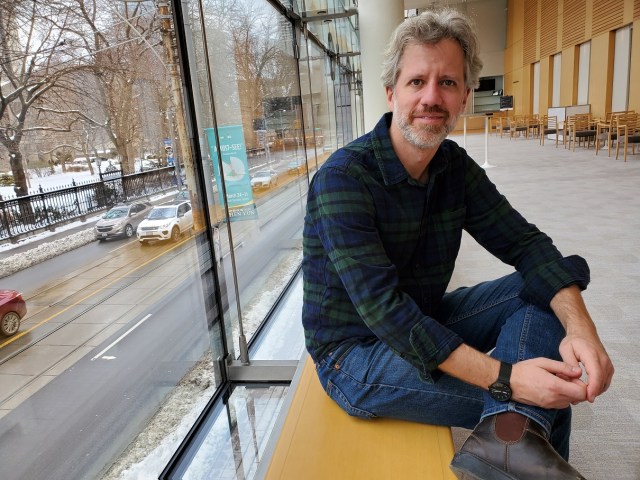
Joel Ivany, artist in the city
BB: Whose idea was it to do the opera? Did you come to Alexander Neef (the COC’s General Director) and say “I’m dying to do this” or was he doing it anyway and plugged you in?
JOEL: He approached with the title. We had always talked about the Carmen [that Joel directed at the COC in April 2016], and he knew of my desire to do something new.
Alexander Neef, Canadian Opera Company General Director (Photo: Gaetz Photography)
He approached with this piece, and considering where I was at in life, it just made a lot of sense.
BB: Your relationship with the company is a really interesting thing. I’m not saying Alexander is like your dad, as he’s closer to being your brother, but it seems that the COC have mentored Against the Grain and on a separate pathway, yourself as a director.
JOEL: Yeah… my first relationship with the company was as a light-walker and then as a supernumerary, at the O’Keefe Centre. I was also fortunate to see all the dress rehearsals of the Ring Cycle back in 2006. When Alexander started, I had my first assistant job working on their Bohème. He saw AtG’s original Bohème…so all those things, it all started together.
BB: So… you’re a dad. The second child is on the way. But is that the main lens? You’re not “just” a dad. Do you have a special relationship with the father in this show?
JOEL: Sort of. This opera and its characters are so familiar.
Even my son (5 years old) knows this opera through a kids’ TV program. There’s one episode of Curious George where he goes to the opera and it’s Hansel and Gretel in English.
He knows the tunes and some choreography. The whole episode is 15 minutes, but they’re able to get quite a bit across. So I can’t help bringing my life into the production based on who the characters are in the opera, bringing this family dynamic.
BB: Are you doing it in English or German?
JOEL: Our production has both. They have an English performance for schools but also one in German for the subscribers.
BB: So the cast has to learn it in both?
JOEL: The Ensemble is doing the English one. But they’re also covering the German one. They’ve got two versions bouncing around in their heads.
BB: That’s hard.
JOEL: And they don’t get much time on stage, so they’re getting put through their paces.
BB: Great idea though. So glad to hear that the Ensemble Studio get to do a show. That’s something that was missing the last couple of years.
BB: Do you find yourself troubled in your gut with where the story goes?
JOEL: Sort of… In the Grimm fairy tale it’s a step-mother who sort of … life would be easier without her kids so she leads them off into the woods (!). I believe that humans in their heart do have good natures. But the Grimms’ tale was difficult to reconcile. The librettist of the opera removed that aspect of it and made the story with a husband & a wife. Her intentions are not meant to be so evil.
BB: It’s very Christian too. Can we talk about that? You have pagan stuff, faeries, you have a witch(!), and angels. And it’s modernized. So could you speak to where pagan & Christian shake down in this morality play, in a modern version?
JOEL: Yes, it’s a thing where in Toronto, we’re not living in a Christian-valued city. (while a lot of it kind of conservatively is). That’s a tricky thing to reconcile in the arts, because one way to move forward is that we have to be as inclusive as we can be. And that can be hard as the text is so explicitly mentioning these angels & God…
BB: You could cut stuff out. They did that with Magic Flute. The surtitles omitted the racist parts. Has there been any talk about adjusting the text?…either in the titles or what’s actually sung?
JOEL: Yes, in the English performances we’re looking into keeping what they meant while seeing about leaving out intentional Christian words. The German is trickier because of how authentic the company is in producing these works.
BB: So let me back up again. The modernization. You’ve got this big picture on the front of the theatre… Is this an opera for children? Or is it an opera that mature children can handle? It’s right on the boundary.
JOEL: It’s a good question, one I’ve tried to have in the forefront. Companies all across North America program this opera for children. Often they are turned into smaller school tours. There have also been interpretations that have been strictly for adults.
So our team – we’ve tried to make it so that a 9-year old could be as entertained by it as the 9 year old that is inside the thirty-year or seventy-year olds as well. We did a room run-through just before we moved into the theatre. The childrens choir were watching the scenes they weren’t in, and again to have them laughing at certain parts where the adults weren’t laughing is a good thing, because they’re getting something we’re not and vice versa…
BB : I want to ask you about the character of the witch. Are we talking about someone who is kind of a theatrical over-the-top grotesque? OR someone who is a manifestation of –dare I say it—evil? I guess it’s a matter of how you frame it.
JOEL: So…what you may see is a bit over the top.
BB: making it fun, wacky rather than too scary? To make it safer.
JOEL: Yes, a lot of people have asked how the witch’s end is met, in this opera. What’s important with her character is how important it is to conquer evil, to be faced with it, yet knowing that the kids can win over that evil. It’s a powerful thing for kids to see.
BB: Are you having individual meetings with your cast, to work through their motivation?
JOEL: Right away we met with the cast, and looked through the whole text. For example, we take a different approach in Act II. A lot of what we’re after, was inspired by reading Where the Wild Things Are. It’s a book that I’ve read to my son.
For the cast, we had someone read it to all of us. The hope was to trigger something, to remember. This is the power of imagination and make-believe. When a child imagines something it’s real to them, even if we don’t think it is.
BB: a child’s understanding of reality is different than an adult’s.
JOEL: Yes . So for this production, we’re living through their eyes.
BB: So Hansel & Gretel is an opera that’s concerned with poverty. And it’s right there on the first page.
Poverty is prominent in the story from the first pages of the score. They joke about it. (“The geese are running barefoot because they’ve no shoes.”)
How do you modernize that? Poverty in a forest home is distant & safer, but if you put it right in Toronto? that’s scary. Do you frame it as a neighbourhood in Toronto? is it like Regent Park?
JOEL: Well it certainly triggered memories. In my 20’s I was much more heavily involved in the Salvation Army. My parents still work for the Salvation Army and we were all more heavily involved with ministry in Regent Park.
BB: It’s such an interesting place.
JOEL: We did a lot of kids programming there. There’s obviously hundreds and hundreds of kids in these neighbourhoods. And you’re seeing generational impact. How did these communities form? At some point the government said “these sort of buildings will fix this issue”. And fifty years later they destroy it all, to make it brand new.
So we looked at brutalist government housing. Even right around the COC rehearsal spaces there are many low-income houses. Those communities played a part in what we were doing, and they’re all over North America.
BB: Is it kind of a universal look, how the set is designed? Does it seem “Torontonian” or is it more North American?
JOEL: North American. There will be some specific references that will show that it’s Toronto. But those could easily be adapted.
BB: Do you think this show could have a life somewhere else, as a co-production, exported to other cities, the way the COC has the Barber from abroad?… take Toronto to Madrid or NY?
JOEL: Perhaps.
BB So can I ask you about the opera itself? What’s your favorite scene? [no answer] Do you have a favorite scene?
JOEL: Ha… that’s a good question. Maybe this is a cop-out answer, but it’s very blocky, like little chapters. But they all flow really well, one into the other. And we have lots going on while one scene is equally going on at the same time. We’re lucky to have so much tech-time, to sort out how sharp we make those other stories, if that makes sense…?
BB: like projected stuff?
JOEL: That, and new stories. This opera is typically set in one house set in the woods. For us it’s set in an apartment building where you know most of your neighbours.
BB: Did you grow up in a building like that?
JOEL: We moved around a lot, because my parents worked for the Salvation Army. I don’t think we ever lived in a building like that. But we visited many…
BB: it’s nice to have that sense of trust. Would you say that underlies your work… like a social contract we would see onstage. The world is a safe place: did you used to play on the street as a kid?
JOEL: Yeah!
BB Me too.
It’s a hard thing to reconcile in my head, having had to drive the kids everywhere, because it was deemed unsafe for them to walk to school. This sense of safety underlies our sense of trust though, doesn’t it.
JOEL: Yes…and that’s an overarching theme in this production.
BB: another way to put it, you have scary movies that teach children to be viscerally afraid. I don’t think that’s what you want to do. You want it to be a safe world.
JOEL: Yes.
BB: BUT watch out for people offering you nibble nibble mousekin treats.
JOEL: And that’s a great question for adults too. Is the world safe? How safe is it?
BB: I think that underlies a lot of the political splits you see, between liberals and conservatives in Canada & the US. Are we going to be xenophobic? Are we going to slam the door and not let anyone in who comes from another country? In modernizing, you’re dealing with a story-book mythic aspect to the story. It’s not “once upon a time” anymore. Do you have an element of storybook magic around this, or does it… become like a “panto”?
JOEL: That’s been brought up. Even this over the top stuff…We’re viewing it through their eyes. How they draw. And what does that drawing look like?
BB: is there actual drawing happening? Are the kids doing what kids do..? they’re on the floor sketching?
JOEL: yeah. And that’s becoming part of the projected world that we’re showing as well.
BB: wow so it’s self-reflexive.
JOEL: And it was –my five-year old—who helped inspire. It’s also special that he is in the show as well. As a super.
BB: Awright!
JOEL: At one point he was looking at the set. He kind of sketched the set on a piece of paper. And he called it his “battle plan”. We had also just watched Home Alone. There’s one scene where Kevin sets up all the rooms and what he would do. Well that’s kind of like what it is. The kids leave Act 1 on a mission. Mom told us to get food. How are we going to do that? Where can we get food nearby? So we’re looking to involve elements of their adventure.
BB: so: your cast. Are the angels dancing? Or children singing?
JOEL: so there’s a 30 person children’s chorus. For the two English performances the company is working with assembling a community choir of an additional up to 70 kids who will come in. So for those two performances there may be 100 kids, and for those 70 they’re coming in the day before to get familiar with the stage, and be on the stage of the Four Seasons Centre. It will be very powerful.
Others in the cast, well I’ve never worked with Russell Braun or Michael Colvin. They’re very different from what I thought, but not in a bad way. It’s just they’re very kind and they’re very playful too. I thought they’d be very serious.
BB: And you’ve worked with Krisztina Szabo before.
JOEL: yes it’s always nice working with her, this time in a different capacity.
And Simone Osborne, she was the Micaela when I did Carmen here, so now to see her embodying such a different character is very much a testament to her performance.
Simone Osborne as Micaëla and Russell Thomas as Don José (Photo: Michael Cooper)
So she’s great. So when she and Emily Fons (a joy to work with) are being brother or sister, eight & nine year olds they can really … when they commit to going after it it’s really amazing.
BB: Is that how you’ve identified it, for them? That they’re playing an eight or nine year old?
JOEL: And young enough to still believe in witches.
BB: Are they like twins or do you see one being older than the other?
JOEL: I had an older sister so I view it that the sister is just a little bit older.
BB: Even if they were twins, girls are a bit faster to develop, usually more mature at the same age. They know all the rules. I have an older sister too, so I can relate.
And so the musical side is just rolling merrily along I guess?
The COC Orchestra and Conductor Johannes Debus. (Photo – Michael Cooper)
JOEL: That’s been good, yeah.
Another artist I’ve been wanting to work with: Johannes Debus.
And so to be able to do that, and he’s been so open to meshing this contemporary world to what he’s doing. The story-telling that the parents do, it’s been a lot of fun.
“Collaborative” has been the key word.
BB: Someday Against the Grain will do their version?
JOEL: someday maybe. It would be fun.
BB: so….Every Christmas they hand over the opera house to the Nutcracker. A lot of opera companies put on Magic Flute or Hansel & Gretel: because it earns money for the company while also recruiting young audience members. I’m sure they’re being paid well for the ballet rental. But… it would be interesting if they could slide some opera performances in there.
JOEL: well I do think they’re hoping that this will be something that can come back easily.
BB: say on March break…?
JOEL: Maybe. We are hoping that it can connect with the kids and parents alike. As I mention to others, one theme that I keep coming back to is how we were all kids at one point. From how we are raised is kind of where it branches off. Diversity is a strength, but in many ways, we all started the same way.
*******
The Canadian Opera Company’s new production of Hansel and Gretel opens Thursday February 6th at the Four Seasons Centre. For further information click here.
The Canadian Opera Company have revived their production of Rossini’s Barber of Seville. We saw it in 2015, a creation of the Spanish theatre troupe Els Comediants led by the team of director Joan Font & set/costume designer Joan Guillén.
I found that it’s better this time in two ways, ultimately coming down to one person.
First of all, everything was funnier. I was laughing my head off throughout, listening to an audience giggling with me. Why? It may sound simplistic bringing it all back to one person.
Last time while I did have some laughs, I found it political. Perhaps the whole thing seems so innocent for 2020, what with impeachments, forest fires & threats of war. But maybe it’s simply that the skill-sets of this group are different. Last time I was impressed by the direction & design in a show that seemed to overshadow its singers.
This time? a stunning array of talent in the lead roles, all sensitive to the stylistic requirements of the piece.
Santiago Ballerini is not just a wonderful singer, interpolating more high-notes (at least 3 high Cs, the last especially impressive) into the role of Almaviva than any tenor I’ve ever heard. He’s funny, with a gift for comedy even while singing beautifully.
Emily D’Angelo is every bit his equal for her comic chops but bringing a genuine weight to the role, serious when she had to be. Yes she sings it wonderfully well, a star in the making. She makes us care about Rosina.
Santiago Ballerini as Almaviva accompanying Emily D’Angelo as Rosina in the COC Barber of Seville (photo: Michael Cooper)
Vito Priante is the most impressive Barber I’ve ever heard, speaking as someone reared on Robert Merrill and playing this score over for my own brother in the role. While his acting was not up to the brilliance of the other two his voice is the most remarkable baritone you’re ever likely to hear in this role, soaring up to his high “As” effortlessly, a light lyrical sound: but still a baritone, still a voice with weight.
For Bartolo we have Renato Girolami giving a clinic to teach you the genuine buffo style.
Put them all together and it’s breath-taking, quick as lightning. And that’s where the other person comes in.
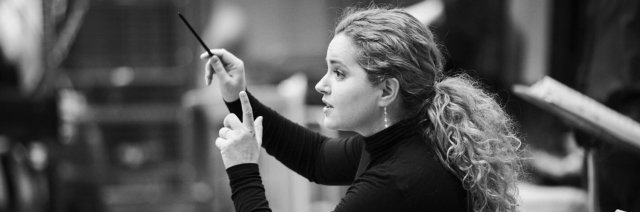
Conductor Speranza Scappucci
Speranza Scappucci conducted some of the fastest tempi I’ve ever heard in this opera, especially in the finales & big ensembles. The wheels almost came off in the Act I finale, so hair-raising as to border on the unintelligible, but totally wild & crazy. Mind-boggling. Powerful. And yes very funny. Her reading of the overture drew the biggest ovation I think I’ve ever heard for a COC overture: because it was so original. In the final passages she kept the pedal to the floor, a pace that never let up. In the ensembles where the singers stop seeming like individual people and begin to resemble a big automated machine –there are a few of these—Scappucci was especially relentless. Did the singers swear at her behind her back? Shake their fists like the ballet dancers in Bye Bye Birdie (recalling that they are forced to dance at hyper-speed)? We may never know.
And yet in the arias & duets there was a stylistic give & take, fluidity, flexibility, a stylish reading even while making the performance fly by. Scappucci achieved a miracle of cohesion & pace, raising the comic stakes in that most old-fashioned of methods: through the music. The COC Orchestra sounded wonderful throughout.
This Barber is better than last time. While it’s a team effort it’s especially the work of the brilliant conductor. There are seven more performances, the last on February 7th . I hope (pun intended) to see it again. See and hear it if you can.
Early in the musical documentary film The Last Waltz we see Ronnie Hawkins coming out onto the stage of the Winterland Ballroom. The music begins to play. Hawkins may be a musical legend but he is nervous, about to sing a song. You don’t want to blow it when you know you’ve got the largest audience of your entire career.
As he starts he calls out “big time, boys, big time!”
While Kent Monkman may have had similar apprehensions as he prepared to step out on the biggest stage of his career in front of his biggest audience there’s no evidence of fear or nerves. We’re witnessing a very self-assured and masterful debut on the world stage.
As Zoe and I came into the Metropolitan Museum yesterday I knew we’d see the paintings in the corridor even before getting tickets & entering the museum, the two big pieces so prominent right now as to be almost parts of the skyline.
Maybe I sound like I’m exaggerating?
The Met installation consists of two paintings of identical size. A pair of paintings, each 22 feet by 11 feet. Or 6.7 meters by 3.35 meters function on an epic scale that dwarfs most rooms and the viewers. For matters of history & cultural mythology?
As I have previously observed when speaking of Miss Chief Eagle Testickle, his/her canvases, or the body parts portrayed therein: size matters.
His ongoing artistic project is meant to redress a colossal imbalance as he has previously observed, in the program to his 2017 show “Shame and Prejudice: A Story of Resilience”:
“I could not think of any history paintings that conveyed or authorized Indigenous experience into the canon of art history. Where were the paintings from the nineteenth century that recounted, with passion and empathy, the dispossession, starvation, incarceration and genocide of Indigenous people here on Turtle Island?”
And if I may digress for a moment to remind you of the obvious, “Miss Chief Eagle Testickle” plays on two key words, namely “mischief” and “egotistical” with a little tickle for good measure. And if you see anything else in there? good for you.
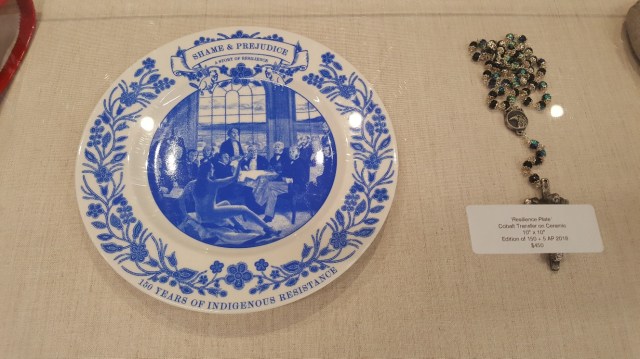
Monkman is a post-modern artist, making inter-textual references to cultural images & icons to populate his paintings. We already saw this in his Shame & Prejudice show, both in a painting and later plates sending up the famous Canadian painting of Robert Harris’s painting “The Fathers of Confederation”.
Canadians will recognize Robert Harris’s painting “The Fathers of Confederation”, parodied here.
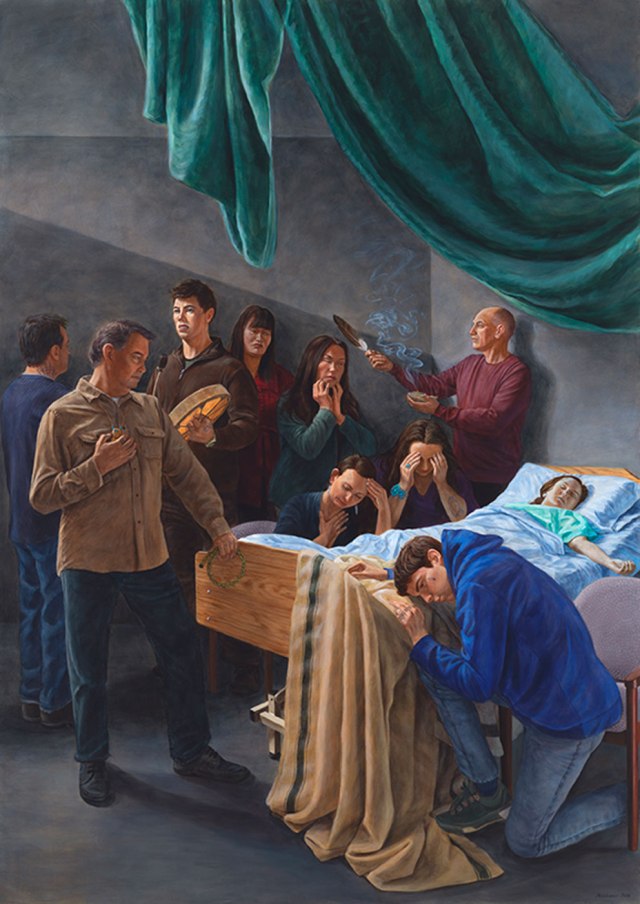
Or in Death of the Virgin, with a respectful nod & a wink to Caravaggio.
Kent Monkman Death of The Virgin (After Caravagio) 2016. Acrylic on canvas. 183 X 130cm.
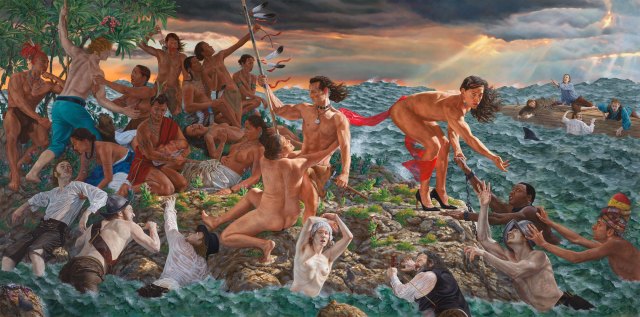
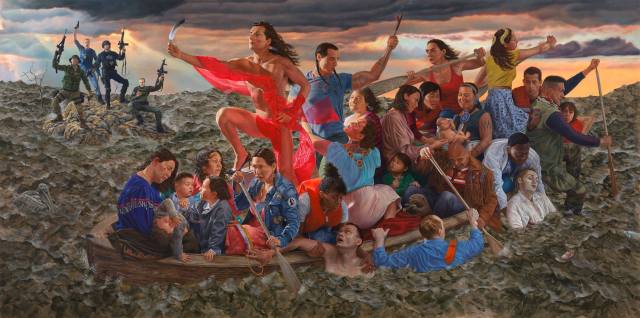
For the big project in NY Monkman / Miss Chief have given us a pair of paintings, mistikôkosiwak (Wooden Boat People), namely Welcoming the Newcomers and Resurgence of the People.
I may be wrong to put them into a kind of historical order but that was the fortunate sequence I encountered them in, coming into the museum. I think of the “welcoming” painting coming first, and creating the circumstances –the cultural and physical genocide of the Indigenous Peoples as well as the madness of the ongoing colonial enterprise—that would necessitate the redemption implicit in the “resurgence”.
The “welcoming” painting is a kind of rescue drama, not far from the Thanksgiving myth that is so well—known, travelers coming ashore hungry and needing shelter from the stormy sea that has overturned or destroyed their vessels. There is turmoil, some in the background crying for help as we see people cling to the hull while a shark circles. We see a black man still in his chains struggling to come ashore, perhaps to show that slavery too was one of the things the colonial adventurers brought with them to their so-called “new world”.
Kent Monkman (Cree, b. 1965). Welcoming the Newcomers, 2019. Acrylic on canvas, 132 x 264 in. (335.28 x 670.6 cm). Courtesy of the artist
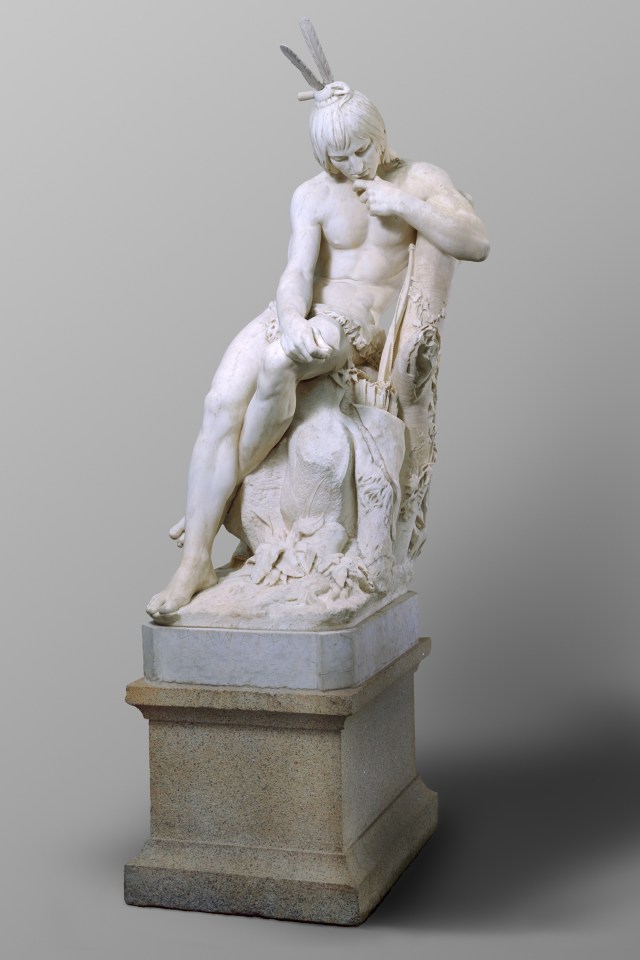
The gentle parody at one side has Hiawatha who appears to be sitting in contemplation in the “welcoming” painting.
Augustus Saint-Gaudens (American, 1848–1907). Hiawatha, 1871–72, carved 1874. Marble, 60 x 34 1/2 x 37 1/4 in. (152.4 x 87.6 x 94.6 cm). The Metropolitan Museum of Art, New York, Gift of Diane, Daniel, and Mathew Wolf, in memory of Catherine Hoover Voorsanger, 2001 (2001.641)
The second painting would seem to be the Indigenous response, the Resurgence of the People being a bold declaration of defiance, resilience in the face of genocide.
Kent Monkman (Cree, b. 1965). Resurgence of the People, 2019. Acrylic on canvas, 132 x 264 in. (335.28 x 670.6 cm). Courtesy of the artist
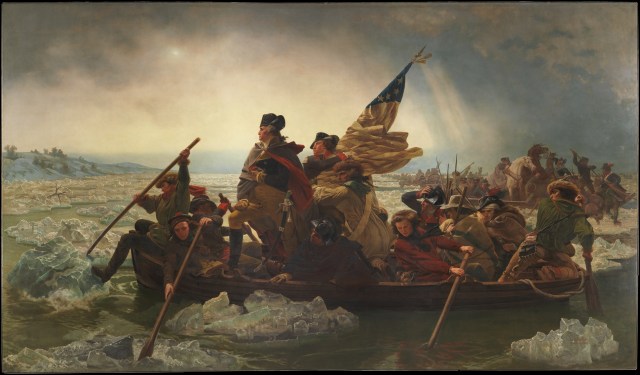
Monkman echoes Emanuel Leutze’s Washington Crossing the Delaware, an iconic portrayal of American heroism reframed and reinvented in “Resurgence” . Miss Chief takes Washington’s place, as the boat bravely pulls away from a rocky island of male militarism complete with a white-power flashing goon in the background.
Emanuel Leutze (American, 1816–1868). Washington Crossing the Delaware, 1851. Oil on canvas, 149 x 255 in. (378.5 x 647.7 cm). The Metropolitan Museum of Art, New York, Gift of John Stewart Kennedy, 1897 (97.34).
My first impression online under-estimated the impact of these works, partly because online is a poor substitute for the impact of big paintings in person, partly because I didn’t really understand what Monkman was doing & saying in these works. For an audience that has no awareness of the indigenous genocide—indeed when there is disbelief and even objections to the use of the word as we saw in the recent investigation into missing & murdered Indigenous women—one has to proceed with caution.
Monkman has his biggest audience. How would you proceed if you had the chance to preach an important message to people who don’t even know they need to hear a message, people without any awareness or readiness to listen?
And so Monkman had to proceed with caution. If his message were too radical? He might be ignored if he even had the chance to be heard.
This is at one of the most fascinating aspects to the mistikôkosiwak installation. The politics behind the scenes intrigue me even as I’m unlikely to ever know the background. Was Monkman given stipulations, guidelines? The fact that he was invited at all blows me away. I’m impressed by their wisdom & good taste, a bold choice.
The fact that he has managed such a dignified yet activist statement in a conventional context is miraculous. So yes the paintings look really cool online but see if you can see them in person. They’re that much more powerful, watching hundreds of people look up in awe and wonder.
Sometimes I have a fear of flying. I usually love the takeoff & normally sit by the window but when there’s turbulence I like to distract myself.
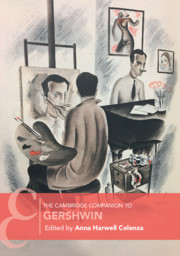
On a trip to New York what better subject could one find than George Gershwin? And happily I saw that the EJB Library had just acquired the Cambridge Companion to Gershwin (2019), edited by Anna Harwell Celenza.
It made for a romantic interlude in the sky on my flight.
If you know this series you’d be familiar with their usual template:
Historical context
The music
Influence & reception
So there I was reading about old New York, both as a way to frame the life of Gershwin and as a kind of travel book. It might seem odd to come at a city via its noise history: that is until you recognize its relevance to a composer’s sonic world, as an influence.
Lots of people –millions and millions—lived in NY before and after. It might be trite to be thinking of traffic noise as somehow important: except that Gershwin was one of the first classical composers to bring the urban soundscape into his music.
Ellen Noonan’s essay “Hearing Gershwin’s New York” unpacks the different layers of the experience.
Apartment living is a key influence.
Regardless of social class, it was the very nature of apartment building life to hear your neighbors. Windows, thin walls and floors, shared hallways, airshafts – all provided all provided avenues for the sounds of others to infiltrate domestic space.
Yet I saw a tweet this morning from Lydia Perovic @LyyPerr
“I’m recovering from flu, cmon. One day I had her upstairs, in apt next door 4 young women screaming exuberantly re whatever young people scream about for hrs (“ughhhhaaaghhhhh I’m turning 32” for ex) and fire trucks on Bloor E. I thought: is this not hell. It’s hell. Sartre knew.”
Such is urban apartment life and it’s nothing new. Noonan quotes Duke Ellington explaining the context for his composition Harlem Air Shaft:
You get the full essence of Harlem in an air shaft. You hear fights, you smell dinner, you hear people making love. You hear intimate gossip floating down. You hear the radio. An airshaft is one great big loudspeaker. (18)
As Zoe and I were walking across the Williamsburg Bridge yesterday I was reminded of the book, listening to vehicles & people.
R-42 no. 4709 leads a J train across the Williamsburg Bridge in July 2008. (Photo: John Barnes)
You can feel the structure vibrate with so much traffic, so much life. It may have changed its timbre but the intensity is much the same as a century ago.
“Outdoors, human and mechanical sources – shouting peddlers, recorded music, delivery wagons, trolleys, elevated trains, construction equipment, automobiles – combined to banish tranquility from the streets where George Gershwin grew to adulthood…Isaac Goldberg (Gershwin’s first biographer, and the only one to write his life story while he was still alive) for example, identified urban sounds as “the rhythms that sound not only from his first hits but from his most ambitious orchestral compositions,” ambient urban noise such as:
The clatter of rollers over asphalt… the din of the elevated overhead… the madness of the traffic below… the cracked tones of the hurdy- gurdy… The blare of the automatic orchestra as the merry-go-round traced its dizzy circles through Coney Island’s penny paradises… The plaintive wail of the street singer across the obbligato of a scraping fiddle…these were the earliest rhythms to which young George awoke. (19)
Loud as it may be in 2020 I suspect it was louder in Gershwin’s youth.
The essay by Susan Neimoyer on “Gershwin’s Musical Education” couldn’t be more timely as we come to the Met’s High Definition broadcast of Porgy and Bess on February 1st.
And so begin the problems in our reception of the composer.
From the time of its creation George Gershwin’s concert music was viewed with skepticism by classically trained musicians. His signature mixture of popular and art music elements –taboo among his contemporaries unless “folk” elements were significantly modified—was seen as evidence of a lack of taste, skill and originality.
Neimoyer quotes Virgil Thomson’s 1935 review of Porgy and Bess:
“I do not wish to indicate that it is in any way reprehensible of [Gershwin] not to be a serious composer. I only want to define something that we have all been wondering about for some years. It was always certain that he was a gifted composer… I think, however, that it is clear by now that Gershwin hasn’t learned his business. At least he hasn’t learned the business of being a serious composer, which one has always gathered to be the business he wanted to learn.” (29)
There’s a whole lot more for me to read, in my spare time on my trip and especially when I’m flying home later this week (whether the air is turbulent or not). There are essays about his music theatre, his music for piano & orchestra, two essays about Porgy and Bess, one concerning his music for film, plus the essays on his influence & reception, fifteen in all.
Gershwin is lurking in the back of my head when I think about the interface between popular & art music, influences & echoes. Playing the Slavonic Dances (the first set of 8, in two-handed versions) & Liszt’s Valses Oubliées, since re-listening to Scott Walker’s music late last year I’m reframing virtuosity as something more genuinely exploratory. If we get away from the competitive model of the pianist skillset it can simply be a playful exploration especially when linked to folk elements, teasing out new shapes & combinations of sounds. Gershwin comes later responding to some of the same dynamics & influences. Serious and popular meet in so many musical styles even as the academic world sometimes struggles to catch up to the admiring crowd, slowed by the complex politics of popularity.
Fortunately the listeners don’t have that problem. We are drawn to beauty without academic prejudice or jealousy.
I’m in New York to see Nukeface, at the Bodega Gallery in New York.
More accurately I’m in New York because it’s a chance to see Zoe Barcza, my daughter.
It’s exciting to get to see her and to see her art in a gallery. These vagabond shoes are longing to stray… so of course I came to NY. Nukeface = paintings by Zoe, a show that has just opened, running until March 8th.
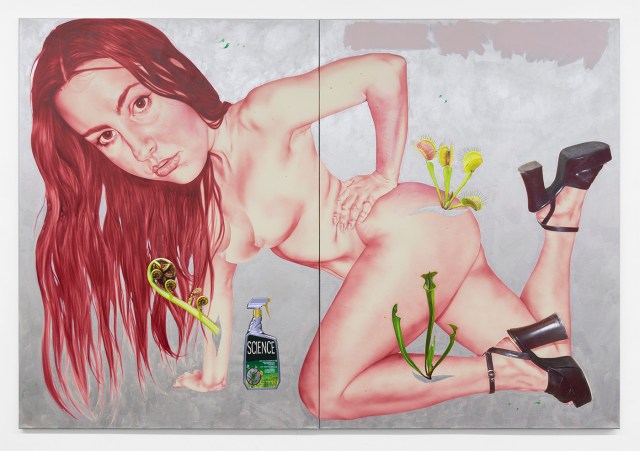
Zoe Barcza: Bring the Ruckus, 2019 Acrylic, vinyl paint and collage on linen 59.1 x 86.6 in (150 x 220 cm)
I’m very proud of what I see her doing, as I struggle to say something that sounds even a little objective. But I’ve never seen anybody do what she does. A big part of what I’m feeling might be normal parental disorientation in the presence of change & growth. I feel that I’m watching society change before my eyes, doing things I never expected to see. Sometimes I struggle with that sense of getting older, surrounded by smarter cuter younger people, hoping to keep up with them as I feel my competence slipping. I take comfort when I see something new and brilliant, especially from young artists.
We went to see a film yesterday that’s full of disturbing images & violence, a much cleaner version of the angst & horror I saw Saturday in the Met Wozzeck. Uncut Gems stars Adam Sandler, Judd Hirsch plus a bunch of actors I don’t know in an unrelenting and driven 2 hours 15 minutes, a throbbing score from Daniel Lopatin. I’m seeing connections between the art, the film, and our troubled & troubling world, that offers occasional glimpses of transcendent beauty to the schmucks down in the trenches (that might sound like Wozzeck especially in its WW I updating). I’m not sure that the truth will set you free, but lying and cheating is no way to live. Recent events are such that nowadays I can be uplifted even by getting a glimpse of a moral compass and some sense of right & wrong, whether or not the good actually get rewarded.
Empowerment and agency aren’t always possible. Let’s just put that out there. The world can be a difficult place. The paintings in Nukeface and the way they made me feel is so different from what I saw coming from Peter Mattei on Saturday, the paintings like a series of rocks thrown into the waters not just to disrupt the calm surface but to grab some dignity and power at a time when that seems to be slipping away.
As a group there’s a great deal of nudity, exposed female bodies, vulnerability, and yet it’s right there in your face on each large canvas. I’m trying to unpack what’s going on, sometimes something playful and witty on the surface of something darker.
I’ll start with the pair of complementary paintings in the rear space of the gallery, Linda And Tentacles #1 and #2. The title is mechanically accurate as though the fact of the nude and tentacles could happily co-exist, a blithe little paradox that resembles life.
But it’s a subtle conflict as we notice upon further review that we’re in a kind of dream-space. The sweet expression on the face is unexpected with such an exposed & vulnerable female form. It’s disjointed because of the angularity of the composition, a body floating or falling, perhaps flying as in a vision or nightmare. There is a kind of defiance in the assertion of joy in this image, with silhouetted flowers. The proportions play with our perceptions, the head a bit foreshortened, but no, it’s disproportionately large, making the female nude somewhat childlike by implication.
The cognitive dissonance between the joyful beauty on the one hand and the implicit exploitation of exposure & possible violation on the other suggests questions for me, the complicit male viewer, making me unpack the sexual politics of my time and my self. Is the body exploited, used by the gaze, and can the form take back its power? I feel that’s at least part of what’s going on here. If “Linda” could speak, she might laugh at my confusion, as tangled as tentacles obscuring and grabbing.
I started with those two even though they were the last of the paintings, a stiller resting place after the front part of the gallery, where things are even more fraught and dramatic.
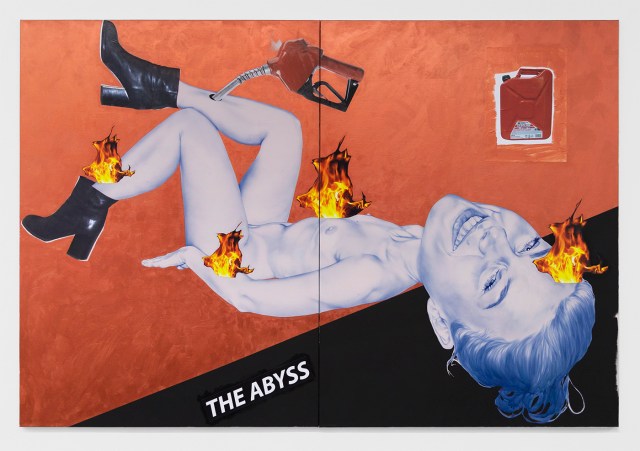
How Alcohol Makes Me Feel reminds me of something Frida Kahlo might have painted, the body having become an elaborate site for drama, as though the body is the set on which an epic opera or an installation were to be enacted. And so it is, come to think of it. Since Kahlo we see the body vital or broken, empowered or crushed. I suppose all nudes since her time are almost footnotes to Kahlo the way any philosophy has been seen as footnotes to Plato.
Zoe Barcza: How Alcohol Makes Me Feel, 2019 Acrylic, vinyl paint and collage on linen 59.1 x 86.6 in (150 x 220 cm)
But I see echoes in the way Zoe has things growing out of these bodies, infections or eruptions like hallucinatory effects.
There are similar eruptions & growths in Bring the Ruckus (shown above). I’m trying to calibrate the eruption of a Venus fly-trap: erupting out of a woman’s ass.
I can’t stop staring into those eyes, trying to appreciate what’s going on inside that head. This is not a helpless exploited female, even if the body is a problematic site and the male gaze is fraught in a world of porn & exploitation.
The headline is really what I think she says to me, arguably what any woman might be asking.
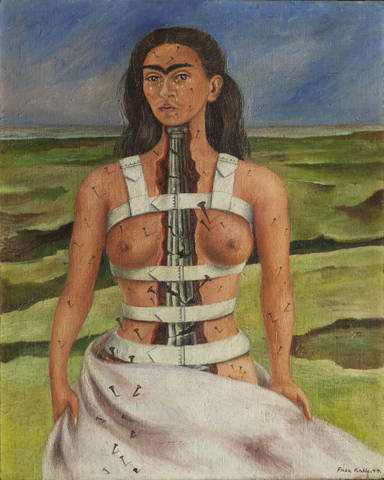
Frida Kahlo: The Broken Column
Zoe could have made these more real (as Kahlo did), and then really would have freaked me out completely. I talked to her about this. The things bursting out of the bodies are overlaid very artificially in order to disrupt the surface almost as Brechtian devices, calling attention to themselves as fakery rather than being perfect. If it were too real we’d be into a realm of such powerful magic as to possibly get too dark too scary too unbearable. And that might take us back to Wozzeck and Marie, helpless and defeated.
Frida Kahlo: Henry Ford Hospital
Indeed, that’s more like what Kahlo showed us, her body like a broken thing on an assembly line, infertile and unable to conceive. But these bodies are alive and empowered, undaunted by the questions and provocations implied in those secondary phenomena.
I’m reminded of certain groups who manage to find a positive affirming outlook. The art of the Third World, the performances of Indigenous artists reconnecting with their culture and language, and especially the creations of women. There is nothing so beautiful as that feeling we experience watching artists finding an answer to oppression, finding a way to say “yes.” Their answer can be our answer.
Meanwhile I was thinking of the song “New York New York”, that I heard so recently. At the New Years celebration we hear that line “if you can make it here, you’ll make it anywhere”, a place where the best art & music & theatre still can be found. These vagabond shoes are longing to stray…
They say it’s a co-production, this new Wozzeck that was broadcast in High Definition this past weekend from the Metropolitan Opera:
“A co-production of the Metropolitan Opera;
Salzburg Festival; the Canadian Opera Company, Toronto; and Opera Australia.”
The co-pro of Parsifal is coming next season, a production we’ve seen in HD. When will Toronto audiences see our own Wozzeck? This one won’t be nearly so expensive when the COC mounts it so perhaps we won’t have to wait too long. While we could go with expensive imports (for example we’ve seen two of the Met’s cast Elsa van den Heever & Christian Van Horn in Toronto before), yet there are Canadians who can sing these roles.
Indeed after seeing the high-def broadcast I think they’d do a better job.
That’s another way of saying that while this production is visually impressive, and a triumph for Yannick Nézet-Séguin & his Met orchestra, I have some misgivings about the choices made by the performers on stage: which would suggest that a Canadian cast can do this at least as well if not better.
Peter Mattei in Wozzeck at the Met. (Photo: Paola Kudacki/Met Opera)
Yes I’m starting the lobbying early. Why not?
There are at least two big caveats I need to throw out there before I begin:
The High Def viewpoint isn’t the same as in the house. The view from up close is so unforgiving as to be like an acid test. (as I shall explain in a moment)
I don’t know whether what we saw comes from the performers or the director, although ultimately it’s a moot point either way. But as with #1 keep this in mind as a possible footnote to what I’m about to say about the interpretations.
I’ll aim for the executive summary up front, and then pursue the nerdy stuff later.
Wozzeck is not Amfortas. Obvious? Perhaps, but someone should tell Peter Mattei. The personage of Wozzeck would seem to pose the question: can such a passive figure even be understood as a hero? He has very limited agency, following orders, cowering, or speaking as though he’s mad almost from the beginning. He is a kind of lab rat in the experiments of the Doctor that might contribute to his mental problems, he’s cuckolded by his partner Marie, and mocked publicly for it. The close-up camera does Mattei no favours, capturing all his angst, so much pain right in your face. Perhaps in the huge Metropolitan Opera House it works just fine? If Wozzeck knew he were mad and wanted to become sane, to be redeemed & to change? all well and good. But that wouldn’t be Wozzeck anymore. I don’t know whether this is Mattei’s doing or the outcome of director William Kentridge’s interpretation. I understand Wozzeck as much more passive than what we see from Mattei, someone whose personal mantra could be captured in his first line in the first scene, when he says “Jawohl Herr Hauptmann” more than once. He passively obeys the Doctor & the Captain. With Mattei so powerful from an explosive beginning he has nowhere to build. The voice is lovely, the emotions genuine. But perhaps his director should help give the character some shape?
I’d love to see this role played by Russell Braun or some other capable Canadian. I found that Mattei over-acted, his every gesture and facial contortion caught by the high def cameras. This is an expressionist opera, where the emotions are all larger than life, exaggerated in the sounds we hear from the orchestra and sometimes in the singing, and so perhaps that seems like an invitation to act up a storm & forget about subtlety or small gestures.
Van den Heever though does much better in close-up, sometimes giving us a blank face in response to the explosions from her partner. And in every case she was the one I was looking at, the one who was believable, because she didn’t seem to be acting. Is this a sign of a better alignment between her interpretation, Kentridge’s reading & the text? But I’ve never seen a Wozzeck where I didn’t like the Marie. The role is unbreakable, so brilliantly written by composer Alban Berg that we can’t help but be moved. Although maybe van den Heever deserves at least some of the credit for being believable both as the Mary Magdelene side of the character and as the mother as well. On a day when Toronto was enduring huge rains & fears of flood, there was a minor deluge on my face in her solo scenes in the first act & again in that poignant scene that usually opens Act III.
Usually that is. For this production however instead of three acts of five scenes each, we get an uninterrupted flow for fifteen scenes, for a running time around 100 minutes. That would seem to be a brilliant idea.
The child that we first meet in the scene where Marie sings the lullaby is played by a puppet, a choice reminding me of the child in the Minghella Madama Butterfly. While this might be one of the most troubling aspects of the production, I found it totally worked for me (waterworks as confirmation): except for the last scene. I hate to be a spoiler but you will likely see pictures and hear people talk about this. Again I suspect that this works better in the theatre than in high-def close-up.
Kentridge updates the production to the First World War, a little over 100 years ago. I was just discussing something comparable last week regarding Robert Carsen’s Rosenkavalier production that has been revived this year, also updated; Carsen’s updating places the action just before The Great War begins. I’m not sure what the updating accomplishes, as this is already one of the most powerful operas ever written, but it doesn’t harm the work. Kentridge puts a screen onstage ostentatiously projecting images that sometimes complement the action, sometimes distracting. During the elegiac summation interlude before the final scene I felt that the images failed to match the eloquence of the music; they need to be reconsidered.
It includes some of the most explicit lines about poverty of any opera in the rep . Because it’s an expressionist opera it’s over the top, not just a depiction of poverty but characters talking about being poor. Kentridge’s stage picture is often a messy collage in multiple media, people sharing the stage with puppets and masked figures on the border between human and puppet. Of course. This is not a pretty story.
I’m hopeful that the COC will announce their plans to stage this production sometime soon.
January is named for that two-headed god who is able to look ahead and back. As I ponder the wreckage of 2019 I wonder if Janus was too busy looking down at his phone and not watching where he was going, a year of surprises, crashes & misadventures. So while I never pretend I’m able to see everything, this year has been especially erratic, between our basement flood and the new rescue animal. I’m even later than last year in my review of the previous year.
While I missed a few performances I feel extraordinarily lucky. Things could have been so much worse.
As I reflect on what it all means I keep coming back to Pollyanna, that avatar of positive thinking. There’s a quote in the book that should be a mantra for critics.
“When you look for the bad,
expecting it,
you will get it”.
And so I prefer not to seek the bad. Denial ain’t just a river in Egypt. It’s a pain management strategy, a way to handle reality especially when you live in interesting times. Speaking of rivers, we coped with the flood, thanks to a combination of a good pump (I rushed off to rent it, keeping the water from getting more than a few inches deep), luck and insurance coverage.
And while we spent lots of money on canine ailments she’s still here, often under the piano.
Pollyanna doesn’t avoid reality. She reframes it, which means selectively looking and sifting and, dare I say it, even curating. So I don’t deny so much as pull back and look at frameworks & contexts. Whether we’re speaking of morals or aesthetics the framework is key. Yes it’s a bit of a tap-dance but the tune is a happy one.
And so I frame the year around key issues that have greater prominence at a time like this one. I saw a gallery who described their mission beautifully in language that could stand for everything I’m demanding going forward.
“The presentation of complicated and interesting ideas,
subversive actions, and socio-political consciousness.”
That doesn’t sound like anything Pollyanna would say, but maybe she’s just too polite to say that out loud. She has her dreams, her ideal world, but in the meantime must be content with the world she is in. Ambition is a good thing, right?
We have a right to demand more.
Inclusiveness: gender, race, age, and awareness of such things as the quest for reconciliation with Indigenous populations, varieties of ableness, LGBTQ, and historical interfaces that have been fraught in the past
Stewardship: of the environment, of an art itself in thoughtful programming,
Canadian talent: their desire to make enough $ to live in our increasingly gentrified city
Who am I to speak of such things? I’m figuring it out as I go. I’m learning.
In the meantime I rely on a few go-to people. They may not always knock the ball out of the park but knowing that their hearts are in the right place means I will always find time for what they’re doing. And more often than not, they are brilliant.
Joel Ivany: Against the Grain continue to entertain & enlighten. Figaro’s Wedding in December and Vivier’s Kopernikus in April were two of the highlights of the year, and I’m not even including the revivals of la boheme that toured the country: likely as good as they were when I saw them before (I missed the more recent ones). Whether he’s transladapting a well-known work such as Figaro or boheme or showing us something new like the Vivier, he first makes sure it works as a good piece of theatre. I’m eager to see what Ivany will make of Hansel & Gretel with the Canadian Opera Company next month, an opera whose exploration of poverty seems especially timely right now.
Crystal Pite whose Revisor in collaboration with Jonathan Young was the single most exciting & thought-provoking show I saw all year.
Adam Paolozza: Bad New Days gave us two intriguing shows in 2019, namely Paolozzapedia and more recently Melancholiac: The Music of Scott Walker.
Sondra Radvanovsky: there is no more reliable artist in this country right now than this one. Whatever she touches turns to gold. Part of that may be the awareness of Alexander Neef of the COC, wanting to always employ her Midas touch intelligently. The production of Rusalka assembled around her was like a fabulous ring to showcase the diamond. We are so lucky that she has chosen to live here.
Tamara Wilson has been consecutively in a pair of shows that are the opposite of what we saw from Sondra, productions I found frustrating as she shone in spite of their darkness. Que bella voce!
Jonathan Crow continues to sparkle at the Toronto Symphony while venturing across town for the Toronto Summer Music Festival, not just as curator but as a performer seeming at times to carry the whole show on his back. And he’s just getting started.
David Fallis who is so busy, between bringing the Toronto Mendelssohn Choir to a higher level, whose gentle touch gives Opera Atelier so much integrity, while finding time for Choir 21, the Toronto Consort and guest appearances, makes everything he touches sound better.
Andrew Davis is holding the fort conducting the Toronto Symphony while we wait for Gustavo Gimeno to take over in the fall of 2020. The first few glimpses of Gimeno give every indication that he’s worth the wait.
Johannes Debus continues to be reliable no matter what he conducts, often the best thing (meaning his leadership of the COC Orchestra) in that production. And Parsifal is coming soon!
I want to be especially sensitive to the women stepping forward in leadership roles. It’s a great time for the women in opera & music. And yes, it’s about bloody time. Please note, some of these people are mentioned even though I didn’t actually see what they did last time around because I’ve seen them in past years. There’s Aria Umezawa, back after time spent abroad, as part of Amplified Opera teamed up with Teiya Kasahara. There’s Alaina Viau both of Loose Tea Music Theatre and also Toronto City Opera. The excitement of Musique 3 Femmes bringing so much new creation to life–here and elsewhere– bodes well for the future.
Tafelmusik are led by Elisa Citterio who include creative programming by Alison MacKay. Ah yes Tafelmusik are wonderfully inclusive, even letting a dead composer conduct (thinking of Herr Handel of course). Now that’s inclusive..!
I will list a few of my favorite moments of 2019, recognizing that my two favorite moments were at home:
• When the flood-waters stopped
• When the dog settled in beside the piano for the first time (later settling underneath, where we have created a den for her)
Maybe I should provoke more dialogue. The most exciting thing I did all year was shoot my mouth off about Canadians on the stage of the COC in a bit of a rant. I received a number of replies and also some wonderful private messages. Let’s just say “don’t believe everything you hear” and I won’t go any further than that.
But in the spirit of that rant, let me in the quietest and most abstract terms lay out a few key principles along the lines of what that aforementioned gallery said. Remember? They spoke of
“the presentation of complicated and interesting ideas, subversive actions, and socio-political consciousness.”
If you prefer simple ideas you’re probably not reading my blog, a place full of contradictions, run-on sentences and wistful observations. But if you’re here, let me remind you when this matters most:
When you decide what to see..(?)
When you decide whom to support(?)
When you vote (?)
Then you might well ask yourself: what do I want? What matters to me?
Do I care whether my artists of choice make a land acknowledgement, and if it seems sincere? Some do, some don’t. Does it matter to you?
Do I demand inclusiveness, or will the status quo of white men be enough?
Do I care that the city’s gentrification has made it so expensive to live here that artists are being squeezed out?
Does it matter whether I’m watching Canadian artists performing Canadian work?
You vote with your money. When you decide to go see a show you can pick the one packed with stars from abroad, or you can see something that might help feed someone born in this country.
And so: here is how I recall a few of the notable moments of 2019. I always prefer ambitious art. While I raved about all sorts of things, I only list the ones here that were really good. I offer this subjective list in order of the intensity of my response.
Doug Letheren in Revisor (Photo: Michael Slobodian)
Revisor – Jonathan Young & Crystal Pite, the single most exciting night of theatre all year
Prince Hamlet ran a close second. It would be #1 except this is a revival from an earlier year.
Dawn Jani Birley a signing Horatio (photo: Bronwen Sharp)
Rusalka from the COC is the best opera they’ve done in years.
Sondra Radvanovsky (centre) as Rusalka (photo: Chris Hutcheson)
Isaiah Bell—Book of my Shames. Okay it’s more cabaret than opera, but these were the biggest laughs of the year, an impressive solo performance
887: while Robert Lepage may be out of fashion –indeed opera lovers worldwide trash his Ring –this was breath-taking, and the single most impressive solo performance of the year.
In conclusion I must express my gratitude for diversion, artists working long hours in their lives to distract us from life, to help us forget the craziness swirling around us. Whatever else I do, I must thank everyone who contributed in any way to all the performances, all the creativity poured forth for the lucky listeners, all the teachers & mentors, and all those giving their money to build and support that work. We are fortunate.





 JOEL: Right away we met with the cast, and looked through the whole text. For example, we take a different approach in Act II. A lot of what we’re after, was inspired by reading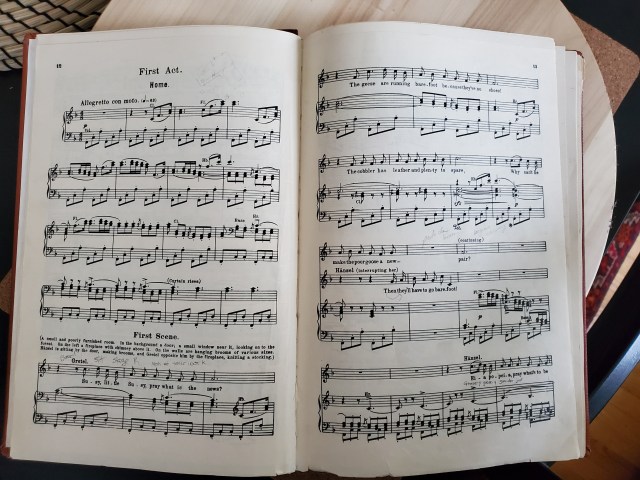
 JOEL: At one point he was looking at the set. He kind of sketched the set on a piece of paper. And he called it his “battle plan”. We had also just watched Home Alone. There’s one scene where Kevin sets up all the rooms and what he would do. Well that’s kind of like what it is. The kids leave Act 1 on a mission. Mom told us to get food. How are we going to do that? Where can we get food nearby? So we’re looking to involve elements of their adventure.
 On a trip to New York what better subject could one find than George Gershwin? And happily I saw that the EJB Library had just acquired the Cambridge Companion to Gershwin (2019), edited by Anna Harwell Celenza.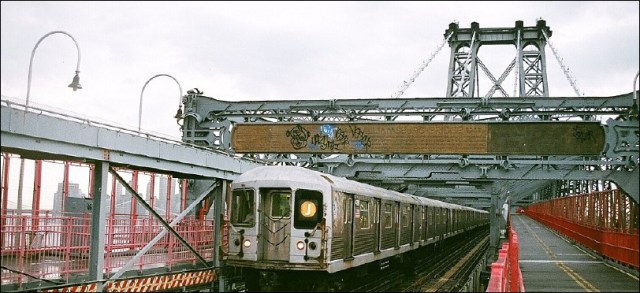



 barczablog