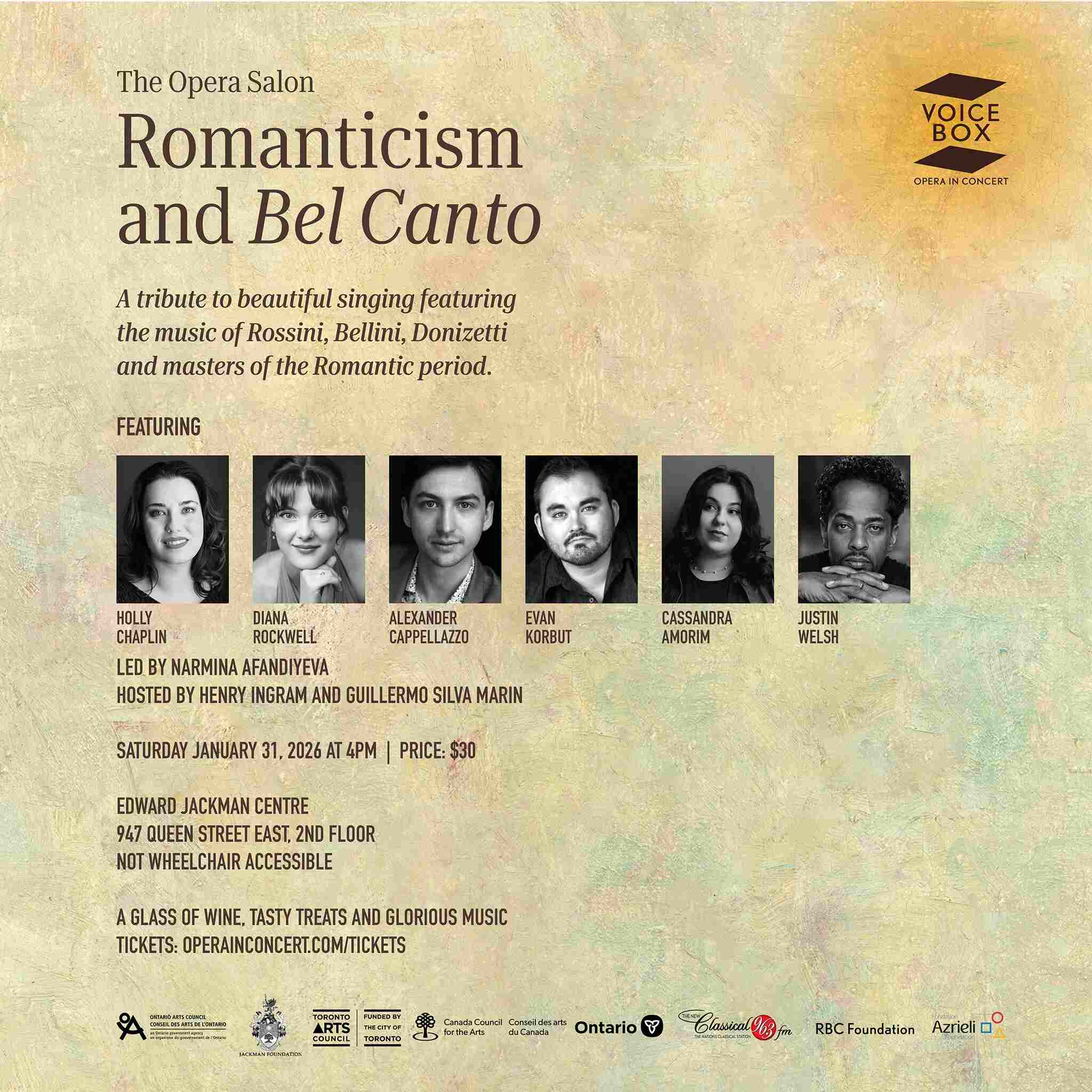
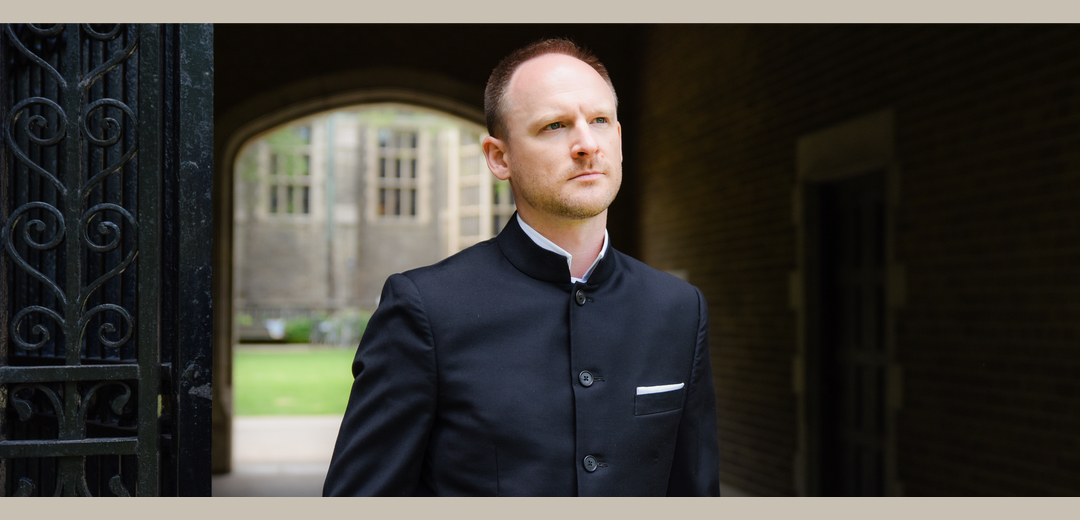
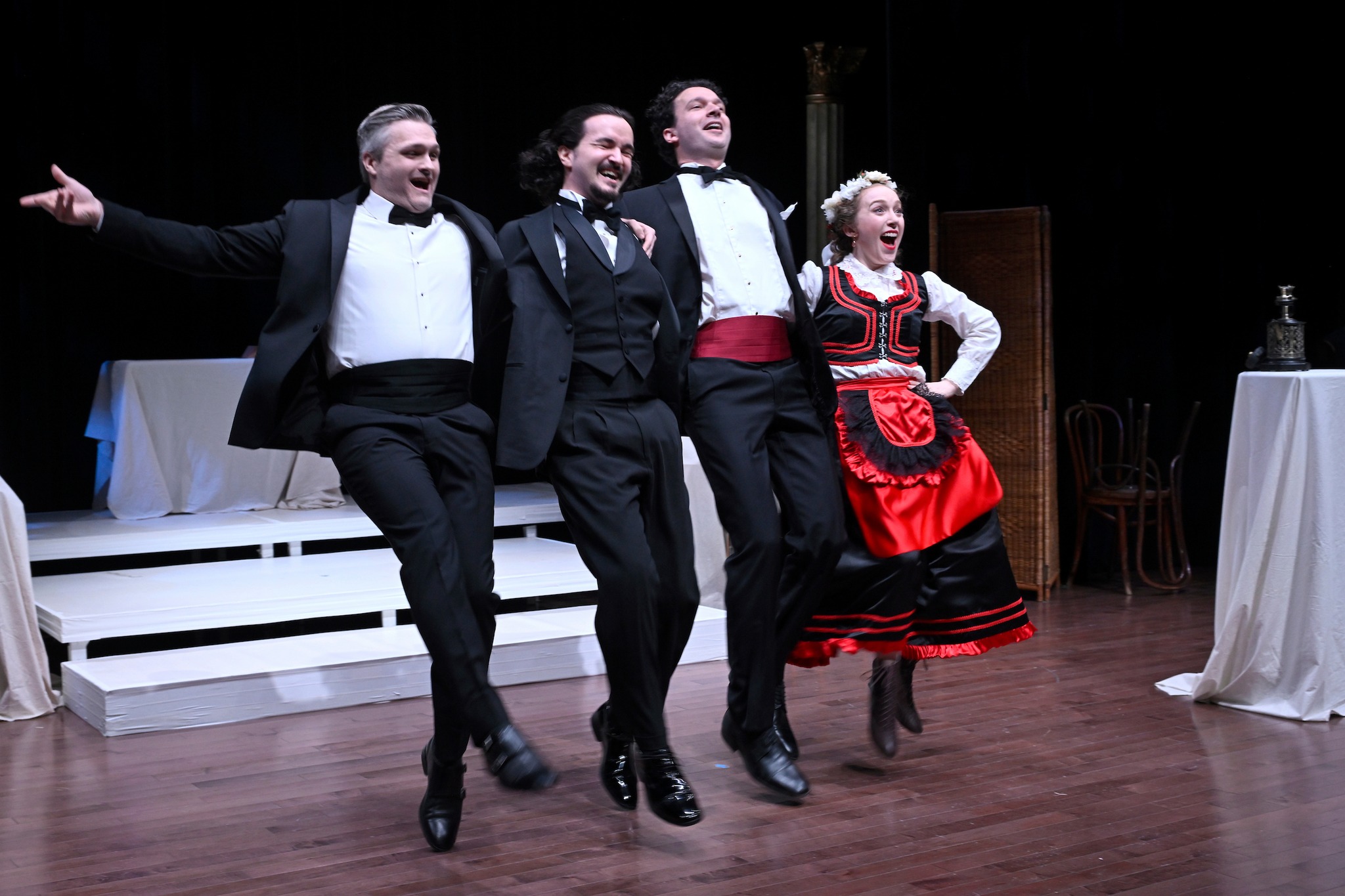
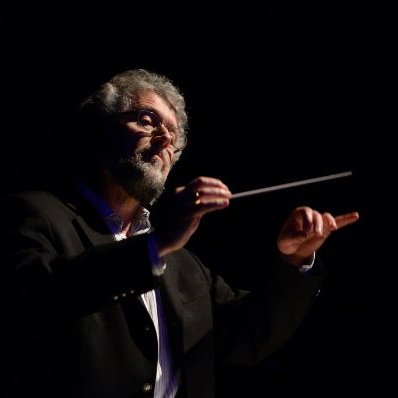
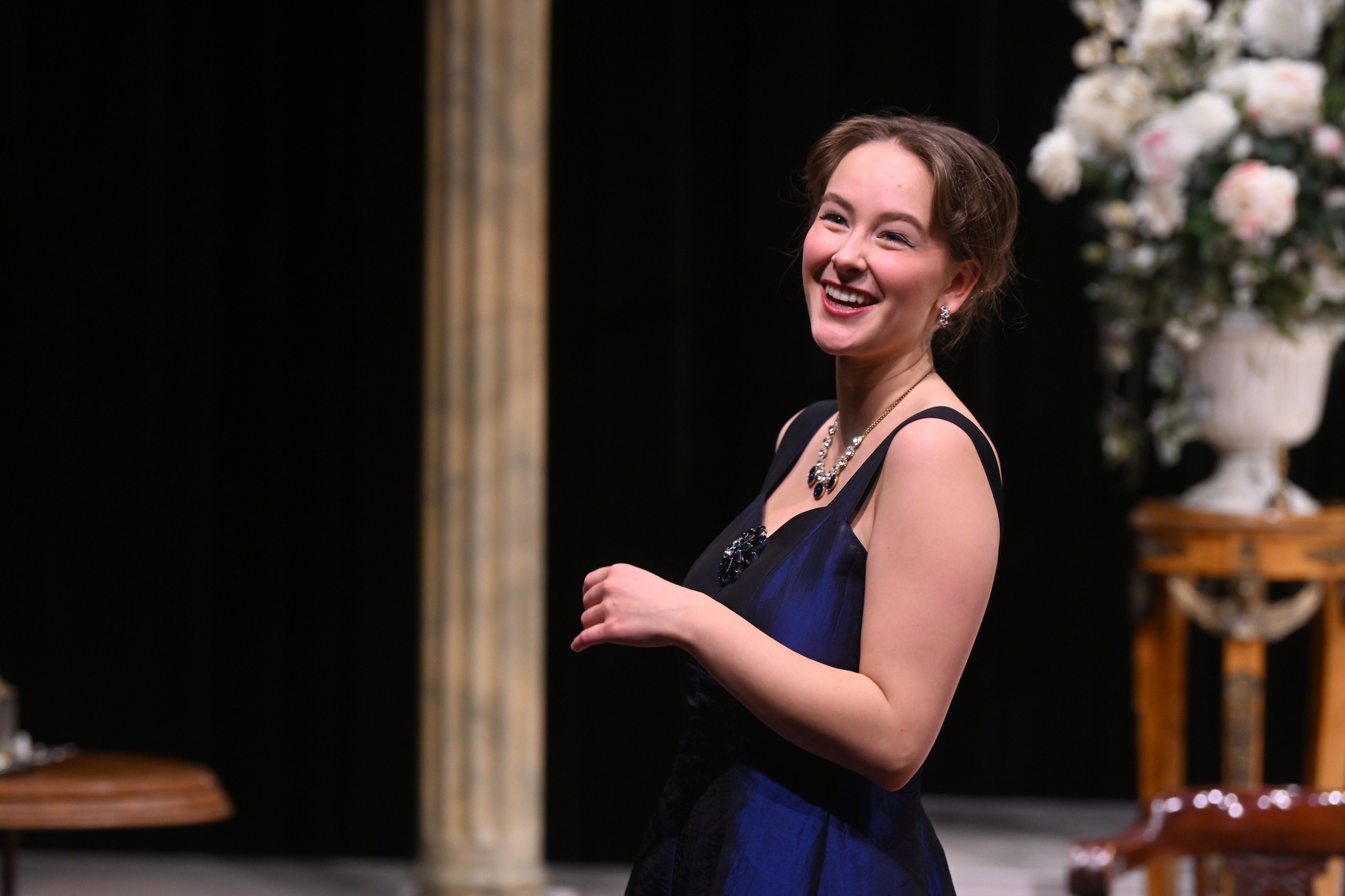
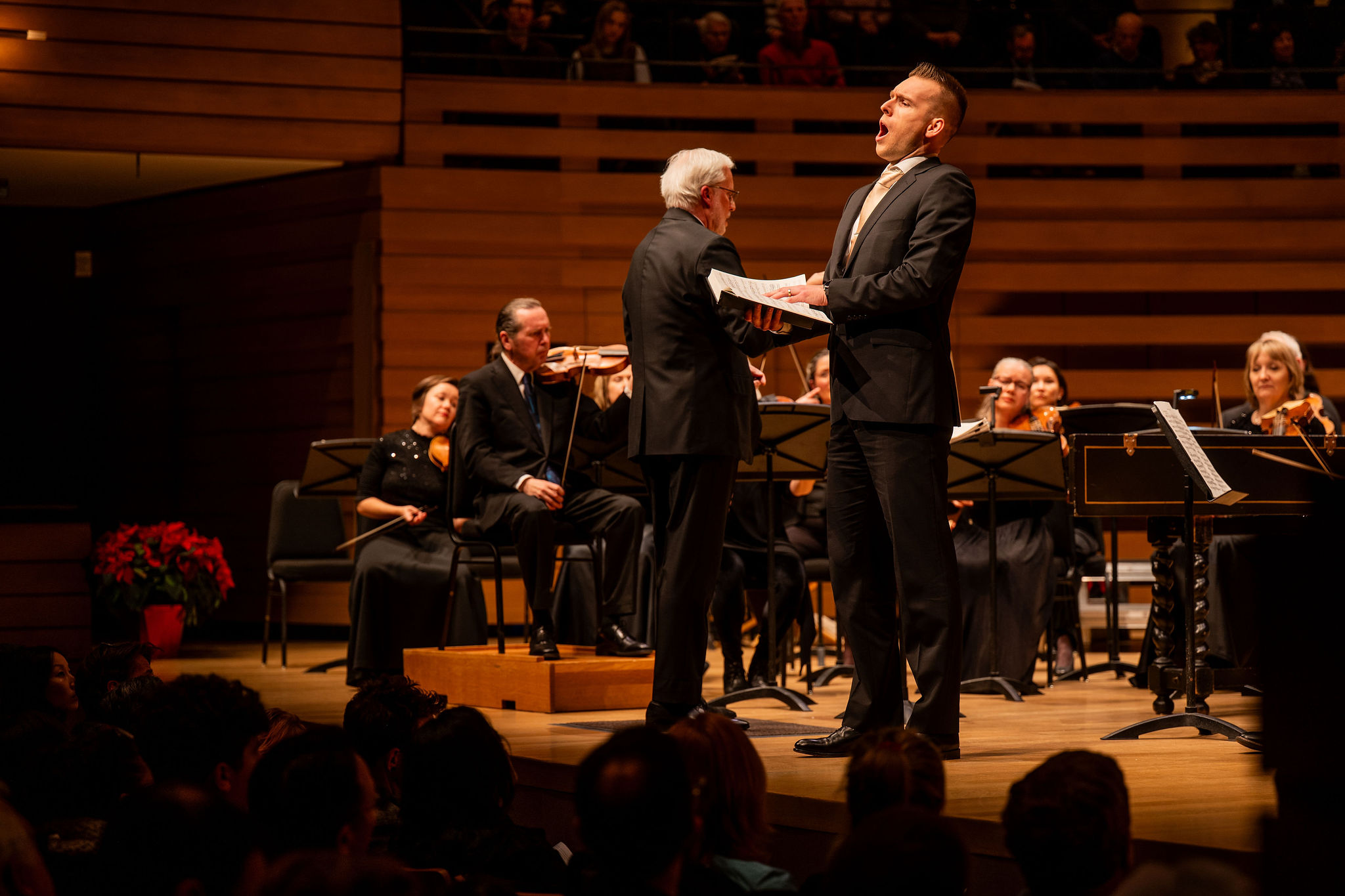
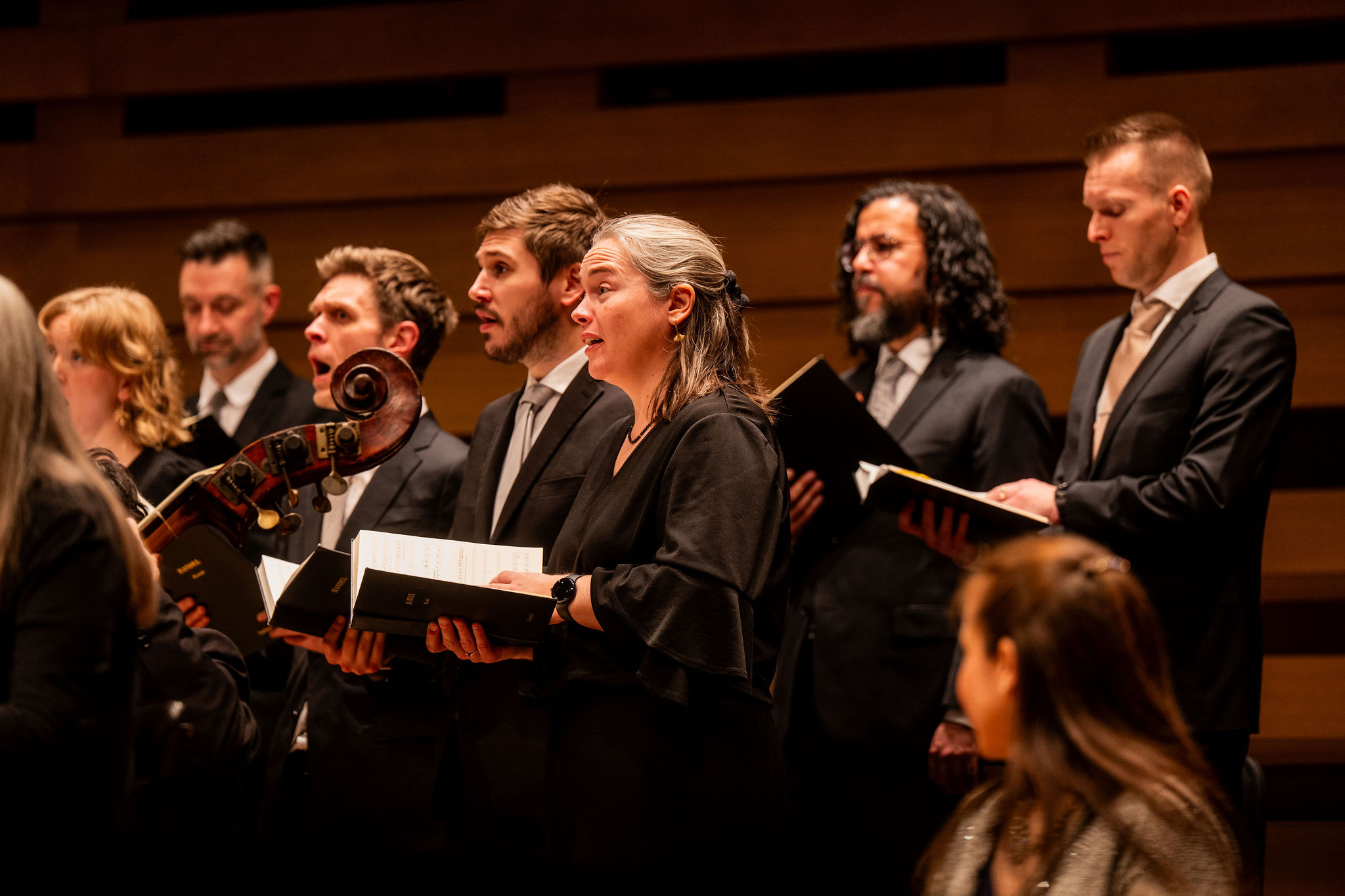
Today I attended a Voicebox: Opera in Concert Opera Salon, highlighting Romanticism & Bel Canto.
I want to see any concert or presentation that offers us a new way to offer opera and to find an audience. We’ve seen arias in bars & restaurants, this was something a little different. And I thought it works really well.
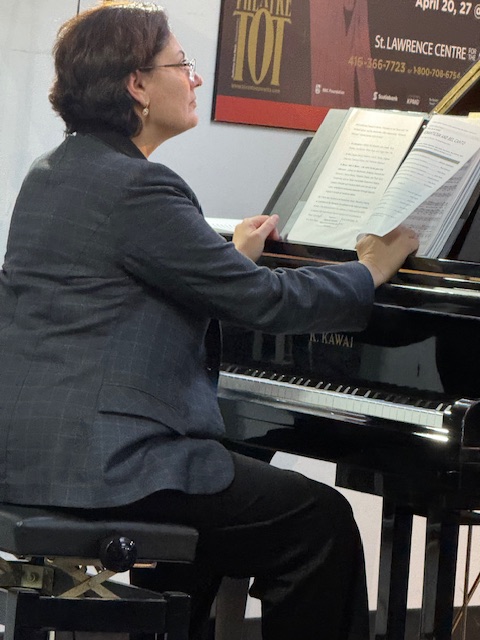
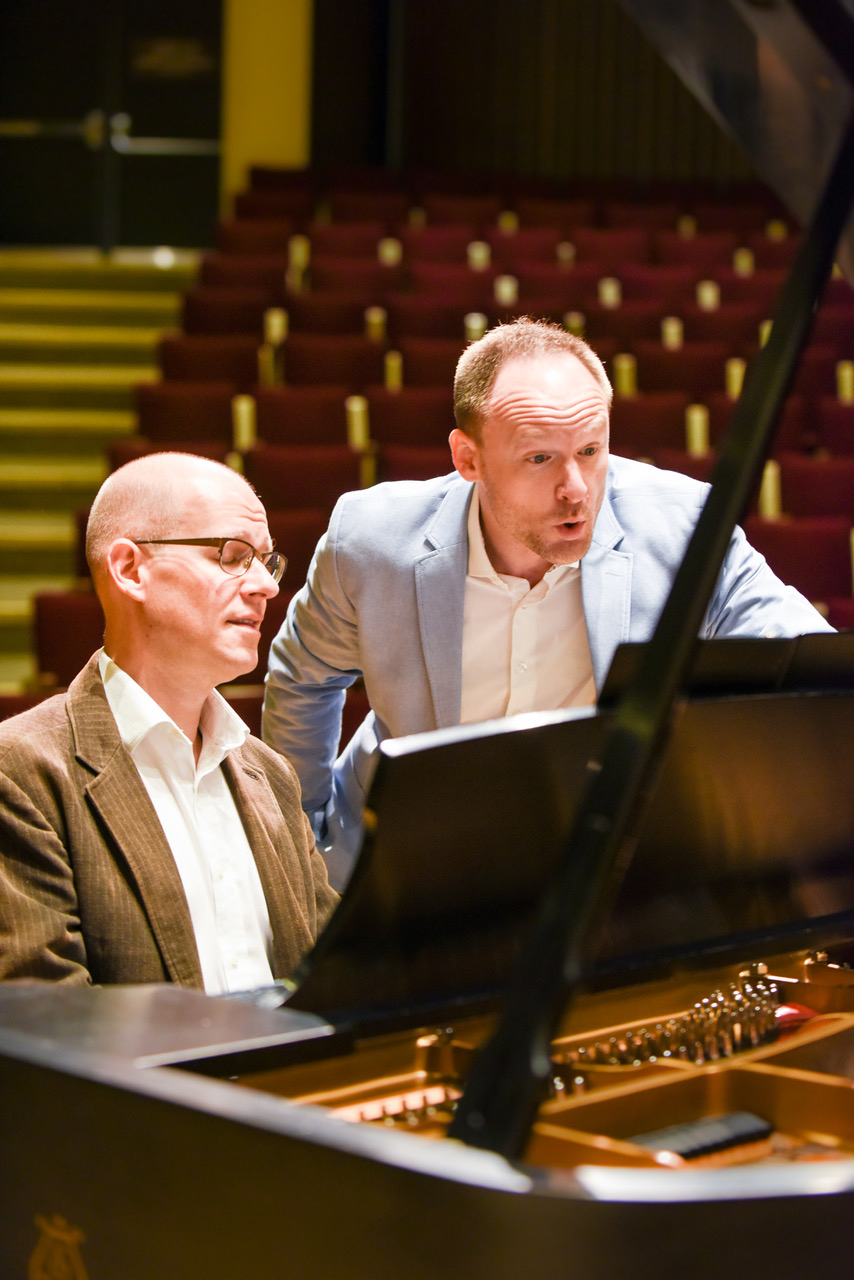
We heard solos from six artists, accompanied by Narmina Afandiyeva at the piano, organized around a unifying theme.
Narmina Afandiyeva at the piano
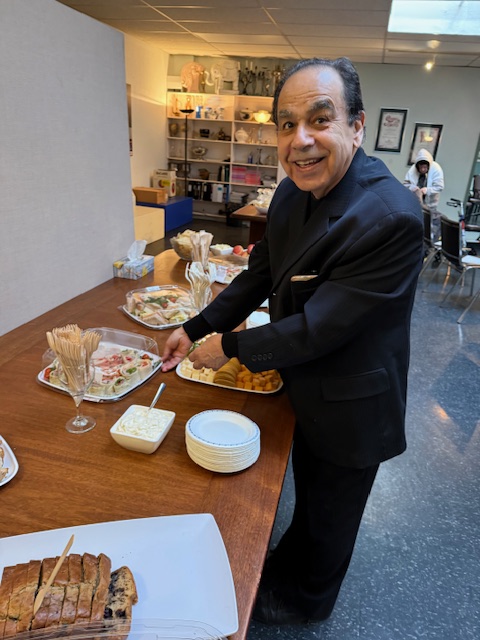
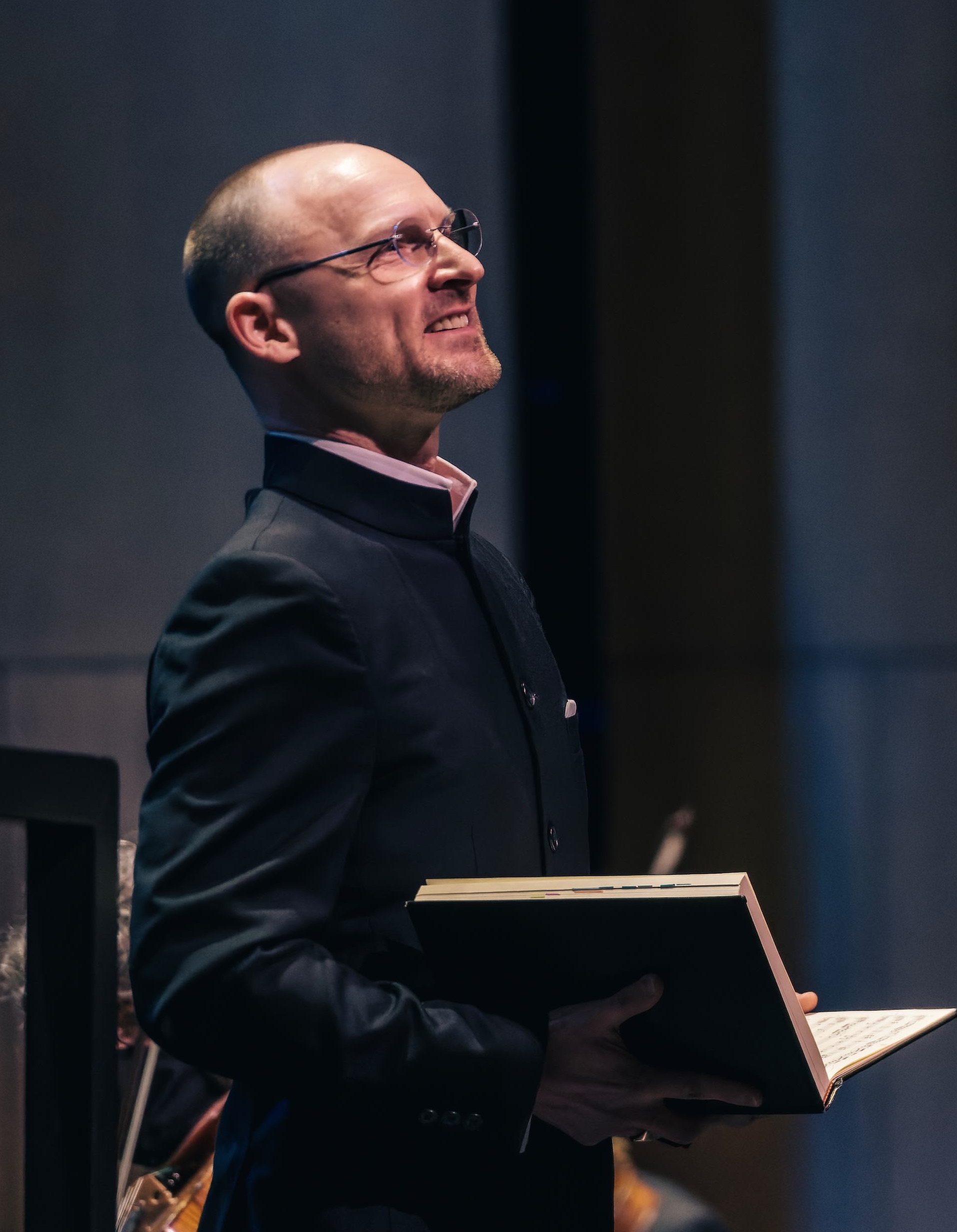
Although Henry Ingram is mentioned on that poster I shared above, he was in Puerto Rico, dodging our snow & chill (smart guy!), which meant that Guillermo Silva-Marin was our host all by himself, even arranging the delicious treats they offered to us as you see in the picture below. He was also our Master of Ceremonies, introducing the artists, telling anecdotes about artists of Opera in Concert and speaking about the history of bel canto & romanticism.
Guillermo Silva-Marin
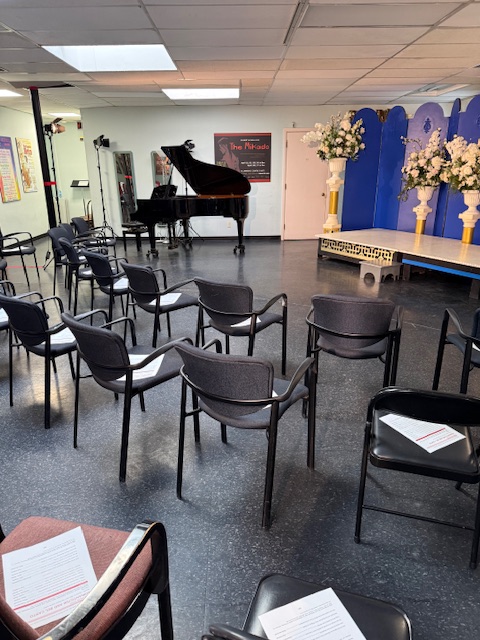
This was my first time seeing the space, an intimate venue on Queen St East near Carlaw Ave. On this occasion I think there was seating for perhaps fifty people (although I didn’t count).
The performance space for the Opera Salon at the Edward Jackman Centre
I think it has been used as a rehearsal space, but it was more than adequate for our purposes.
Here’s a list of the artists and what they sang:
Alexander Cappellazzo: “When other lips” from The Bohemian Girl and “Una furtiva lagrima” from L’elisir d’amore
Diana Rockwell: “Adieu notre petite table from Manon and “Ah non credea mirarti” from La Sonnambula
Holly Chaplin: “Regnava nel silenzio” from Lucia di Lammermoor and “Caro nome” from Rigoletto
Justin Welsh: “Cruda funesta smania from Lucia di Lammermoor and “Ah per sempre io ti perdei” from I Puritani
Cassandra Amorim: “Eccomi… O quante volte” from “I Capuleti e i Montecchi” and “Casta Diva” from Norma
Evan Korbut: “Pierrot’s Tanzlied” from Die tote Stadt and Bertrand’s aria from Robert le Diable
And to end, both before intermission and again at the end of the concert we heard “Libiamo, ne’ lieti calici” from La Traviata, sung by the entire company.
I think it’s a really good concept. I find the chance to hear an operatic voice up close a powerful experience that I highly recommend to anyone who hasn’t tried it. This isn’t to be confused with hearing opera in a big place like the Four Seasons Centre, where you’re sharing sound with roughly 2000 people, admittedly a superb acoustic considering that we get sets & orchestra. But when Holly or Diana or Cassandra hit their high notes or tossed off their coloratura, it was a fabulous intimate sound. Evan softly crooned the high note in the Korngold as though we were in a cabaret, a lovely effect. Justin gave us big notes, Alexander swooped up high to end his aria. I hope the experience helps persuade more people to investigate operas.
And we had great things to eat and the chance to drink wine (which i didn’t do, given that I live in Scarborough and had to drive home). The fact that the venue is east is something I really love, given that so many of our Toronto performance venues are west of Yonge St.
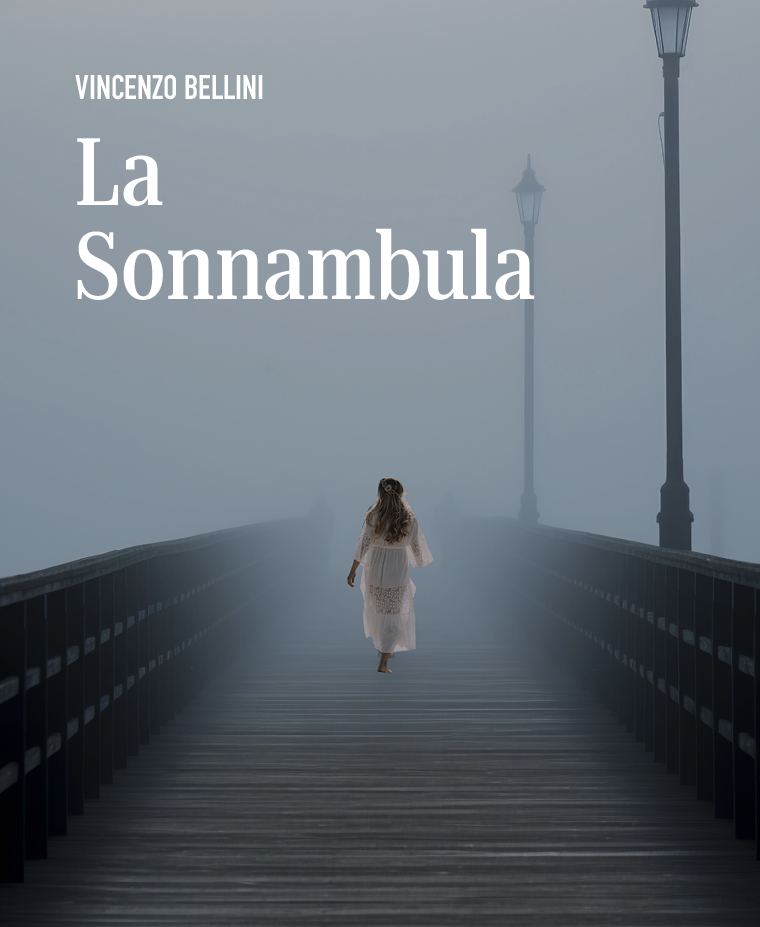
Voicebox – Opera in Concert return two weeks from today with Bellini’s La Sonnambula at Trinity-St Paul’s Centre, February 14th at 3 pm.
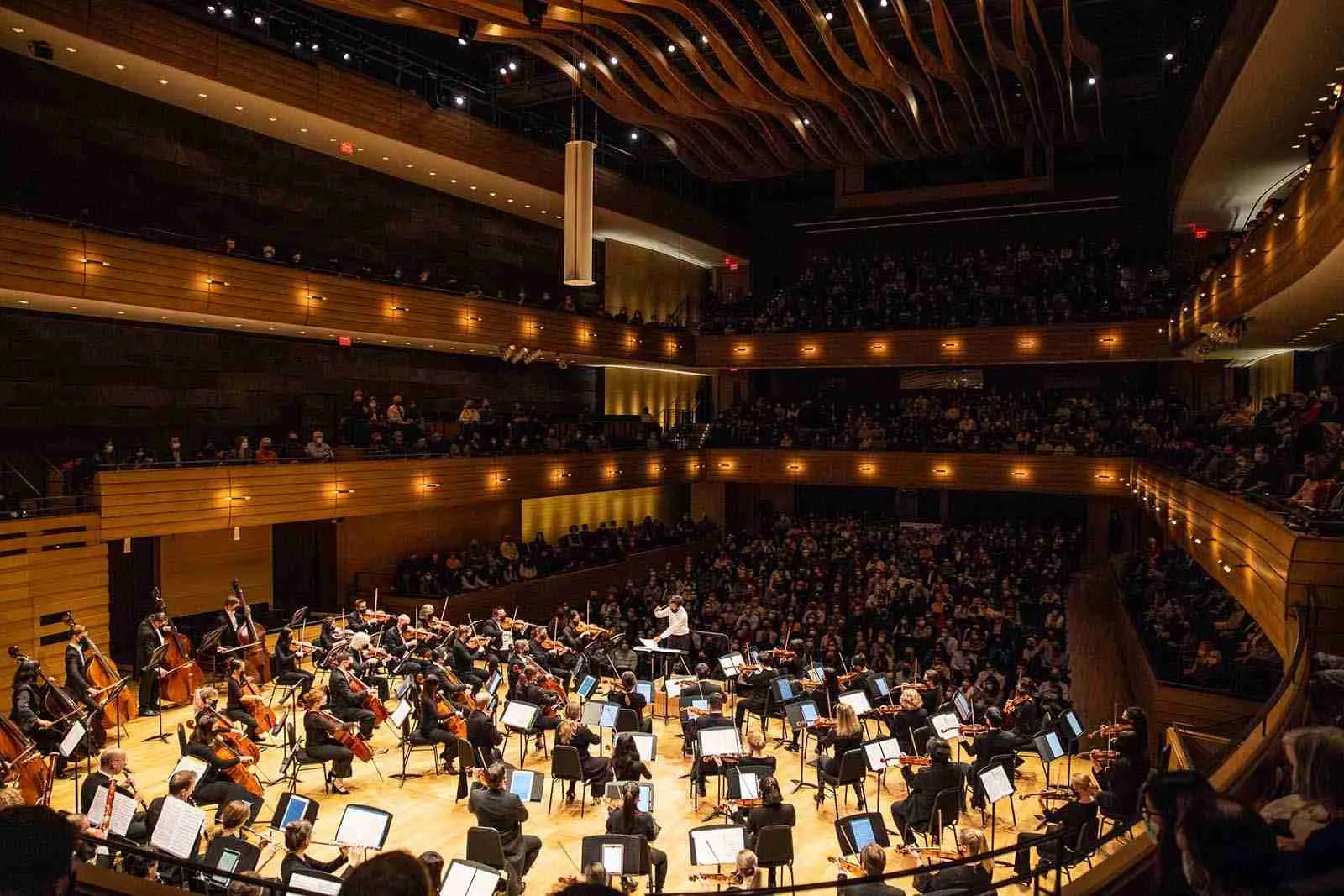
I saw & heard an astonishing concert last night at Jeanne Lamon Hall from Tafelmusik playing a program of well-known music by Johann Sebastian Bach. I heard four of the six Brandenburg concertos and a version of his majestic E-flat Fugue for organ, arranged for chamber orchestra.
The fame of the Brandenburg Concertos by Johann Sebastian Bach reaches far beyond Earth, when we recall that Bach was chosen to represent humankind on the Voyager space mission, now having reached interstellar space beyond the Solar System.
But this did not sound like the music performed in the 1970s when Carl Sagan & his committee gave JS the nod to be on famous golden record made for the hypothetical space aliens, who somehow would have to figure out how to play the record back. Tafelmusik aim to make something closer to how Bach might have expected his music to sound, both as far as the period instruments they’re playing and the way they are played and tuned.
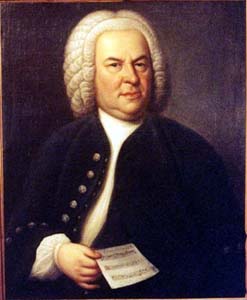
JS Bach
For Thursday January 29th we had far more down to Earth concerns than inter-planetary travel, after the snow that hit the city last weekend, yet the place was full, and buzzing with excitement.
As Rachel Podger, Tafelmusik’s Principal Guest Director explained, the Brandenburg Concertos combine multiple & rare combinations of instruments with thrilling results.
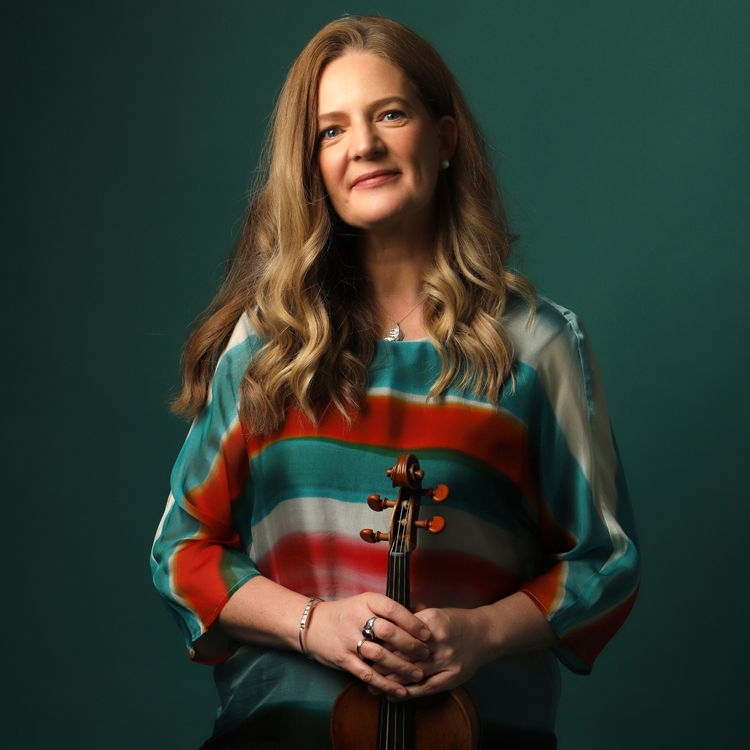
Rachel Podger
The 1st Concerto included Rachel’s virtuoso performance on a 17th century piccolo violin, tuned a minor third higher and smaller than the usual size. It has a sweeter sound, even as I mused over the challenge of fingering on a smaller instrument (my fingers are humongous), and playing the piece faster than I have ever heard it played: in pursuit of the authentic style. I’m reminded of the violin my grand-daughter played on, with her tiny fingers: except this was adult music making!
Among the players for this concerto we heard a pair of horns played by Todd Williams & Micajah Sturgess, their hunting calls in arresting triplets that suggested adventure & fun, not least because the rest of the orchestra kept glancing their way, smiling. I suppose in its time the hunt meant fun and plentiful game on the dinner-table, so I suspect JS Bach meant to make this sound like party-time, but baroque.
The outcome is so much more fun than this language might suggest, the back and forth between voices transparent not just in sound but in the eye contact between sections in Trinity St Paul’s.
The next item on the program was the reason I came, namely the transcription of the great organ Prelude & Fugue by Dominic Teresi, one of the Tafelmusik Artistic Co-Directors.
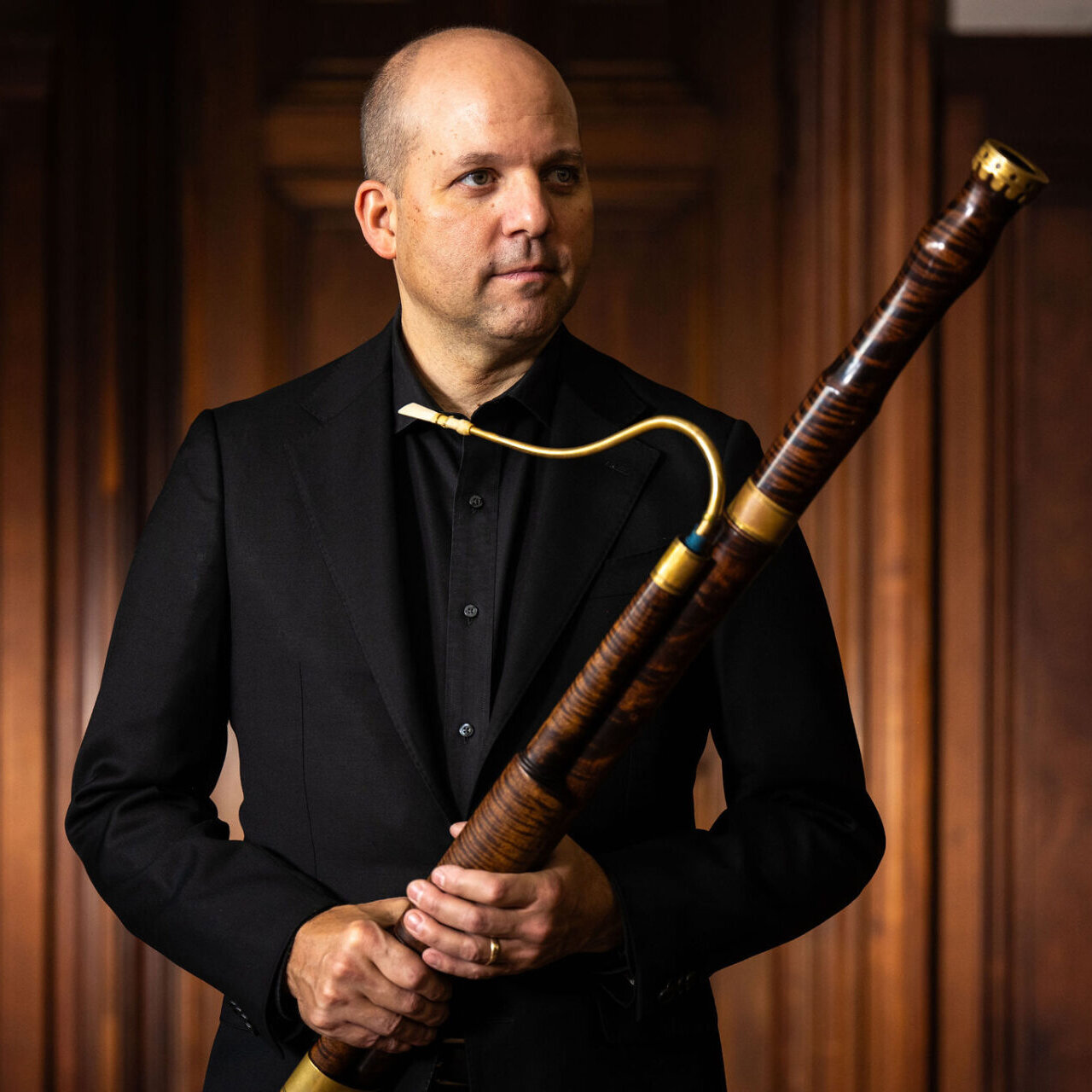
Bassoonist Dominic Teresi
I have been listening to this piece since childhood, when I stumbled upon a recording played by Helmut Walcha, from the 1970s or earlier.
More recently I discovered Busoni’s piano transcription in an anthology. So in a way it’s personal to hear Dominic’s version. There have been earlier attempts at this, for instance one by Schoenberg that is as obsolete and dated in its assumptions about Bach as the Voyager Bach that went to outer space, full of drama but turning Bach into a Wagnerian.
I wonder if Bach would even recognize himself. In fairness, we all must work with what we have and know, and for Schoenberg in his time, that was the large orchestra, using every modern instrument. If we did it now we might use synthesizers and computer technology.
But let me get back to the church space where we heard Dominic’s creation played by a small group of instrumentalists. As Rachel explained, Bach sometimes would employ a kind of musical symbolism for the Holy Trinity, apt for a performance at Trinity St Paul’s Centre with the visual reminders before us of a church organ and Christianity.
We heard Dominic’s creation programmed among the Tafelmusik Brandenburg’s, sounding every bit as authentic. I think a great deal about transcriptions, understanding them as aspirational, embodying ambition. I remember once discussing them with Professor Carl Morey, when he asked me why would anyone want to transcribe something? I think in some ways it’s a fundamental impulse. We may tap our toes listening to music (as I wanted to throughout this rhythmic concert). I remember as a child conducting the record player when I heard Beethoven. We imitate and dance along with music, and may wish to sing or play songs we have heard, to make them our own. As we grow up we learn inhibitions and lose our wilder impulses.
When Ravel made Mussorgskii’s piano piece Pictures at an Exhibition into an orchestral suite he was sharing something of the original in a new shape. There is something similar at work when Stokowski or Schoenberg take a keyboard work and turn it into an orchestral work: except that they must use the idiom and the stylistic language of their own time. I am enraptured having experienced Dominic’s version of an organ piece, recast in a manner that I feel certain would be recognizable and even applauded by Bach himself.
That was just the music we heard before intermission, namely Brandenburg #1 and the new version of Bach’s Prelude & Fugue arranged for chamber orchestra. I was already thrilled, with a great deal more brilliance to come.
After intermission we heard three more concertos in order, namely #2, #3 and #4, each with its own different assortment of musicians.
For #2, the first after intermission we had a smaller ensemble arranged across the stage, bringing us Tafelmusik’s take on the concerto that was sent out into space. I was especially stunned by the detailed horn playing from Todd Williams, given a level precision I associate with valves, rather than his older instrument, alongside brilliant play from Kathryn Montoya on recorder, Daniel Ramirez Escudero, oboe as well as Julia Wedman, Tafelmusik violinist stepping into the foreground.
For #3 it was strings strung across the stage, three trios plus the harpsichord-bass in support, with Johanna Novom, Genevieve Gilardeau & Rachel in the violin trio stage right (our left), Brandon Chiu, Patrick Jordan & Christopher Verrette, viola centre stage, and Keiran Campbell, Michael Unterman & Margaret Gay, cellos stage left. The opening allegro was as visual as was auditory, watching voices and fragments played and then answered in another trio-group. The slow movement consisted of an Adagio ad libitum like a cadenza serving as a brief intermezzo, before they launched into the stunning Allegro, some of the fastest playing of the night, everyone working their fingers off: but in a joyous celebratory movement infused with the spirit of the dance.
Finally we came to the cutest music of the night. Can I say that? I find the opening of #4 adorable like kittens and chipmunks frolicking, the pair of recorders played by Kathryn Montoya and the hard-working Dominic Teresi, perhaps wanting to show us that he didn’t mind venturing up into the treble clef for a change (after his huge role in the Prelude and Fugue, not just as arranger but his bassoon singing with a low voice). The two recorders seem to live a third apart, calm and peaceful, going back and forth with Rachel Podger’s quicksilver violin soothing or provoking between them. In the presto finale it’s a terrific release, a lovely conclusion to a superb evening of Bach.
Bach Brandenburgs will be repeated January 30 & 31 at 8:00 pm and February 1st at 3:00, in Jeanne Lamon Hall in the Trinity – St Paul’s Centre.
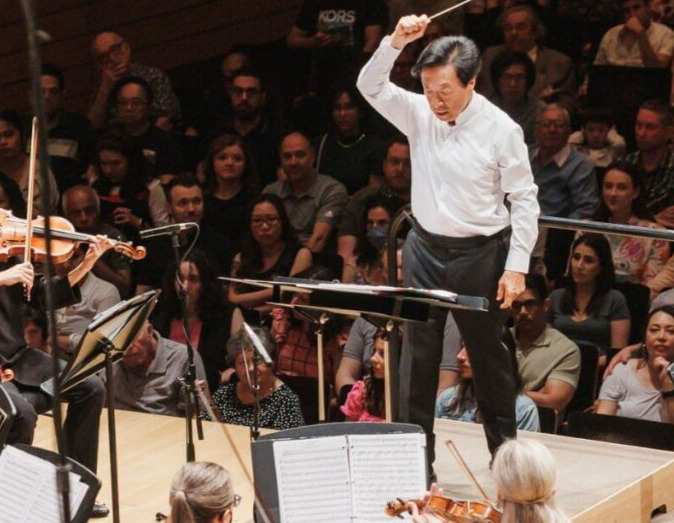
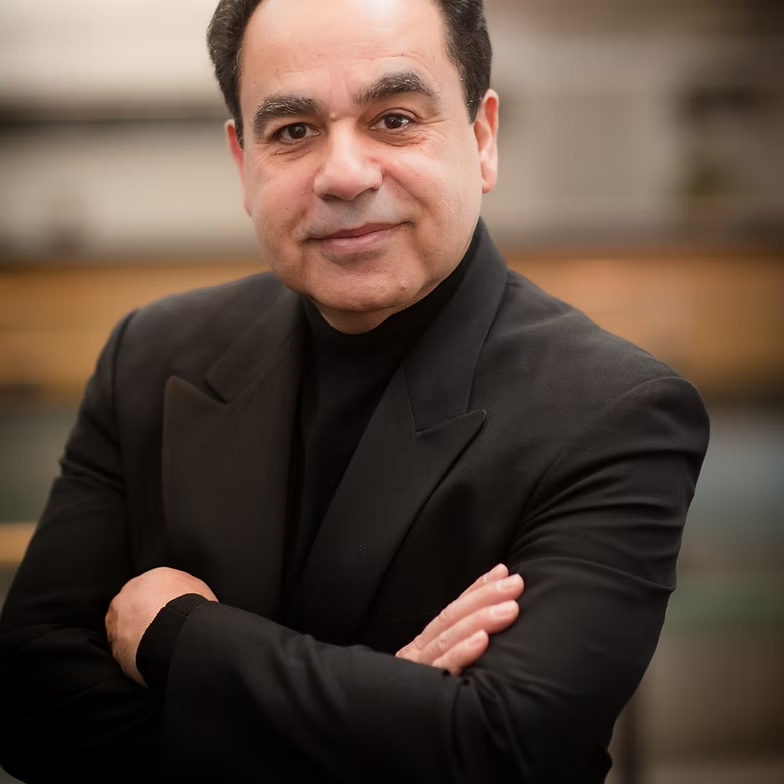
I can’t stop thinking about Mandle Cheung, the successful tech entrepreneur who paid the Toronto Symphony for the privilege of conducting Mahler’s 2nd Symphony last summer. I wrote a review of the concert for the Globe & Mail, and couldn’t stop thinking about him and his music-making.
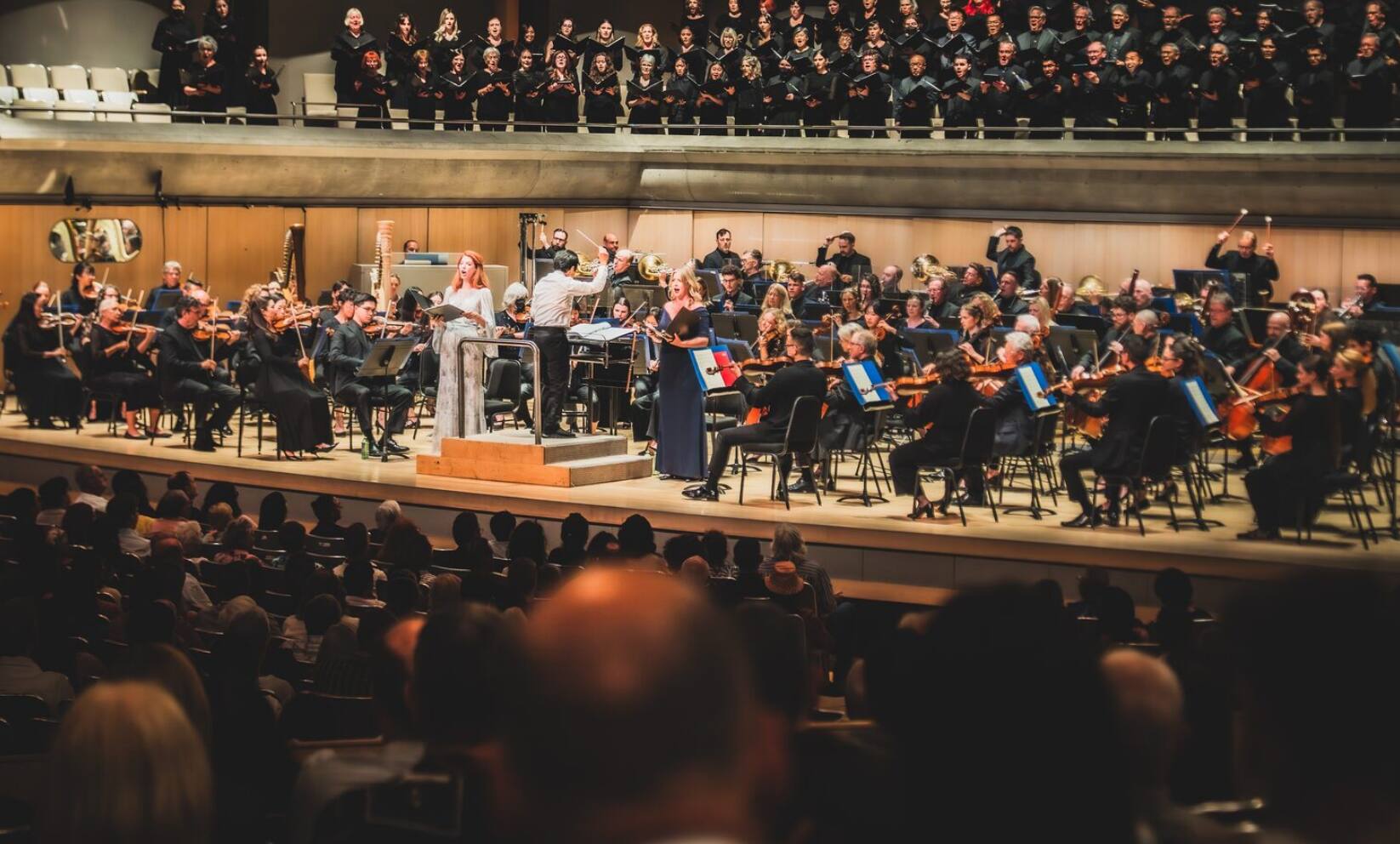
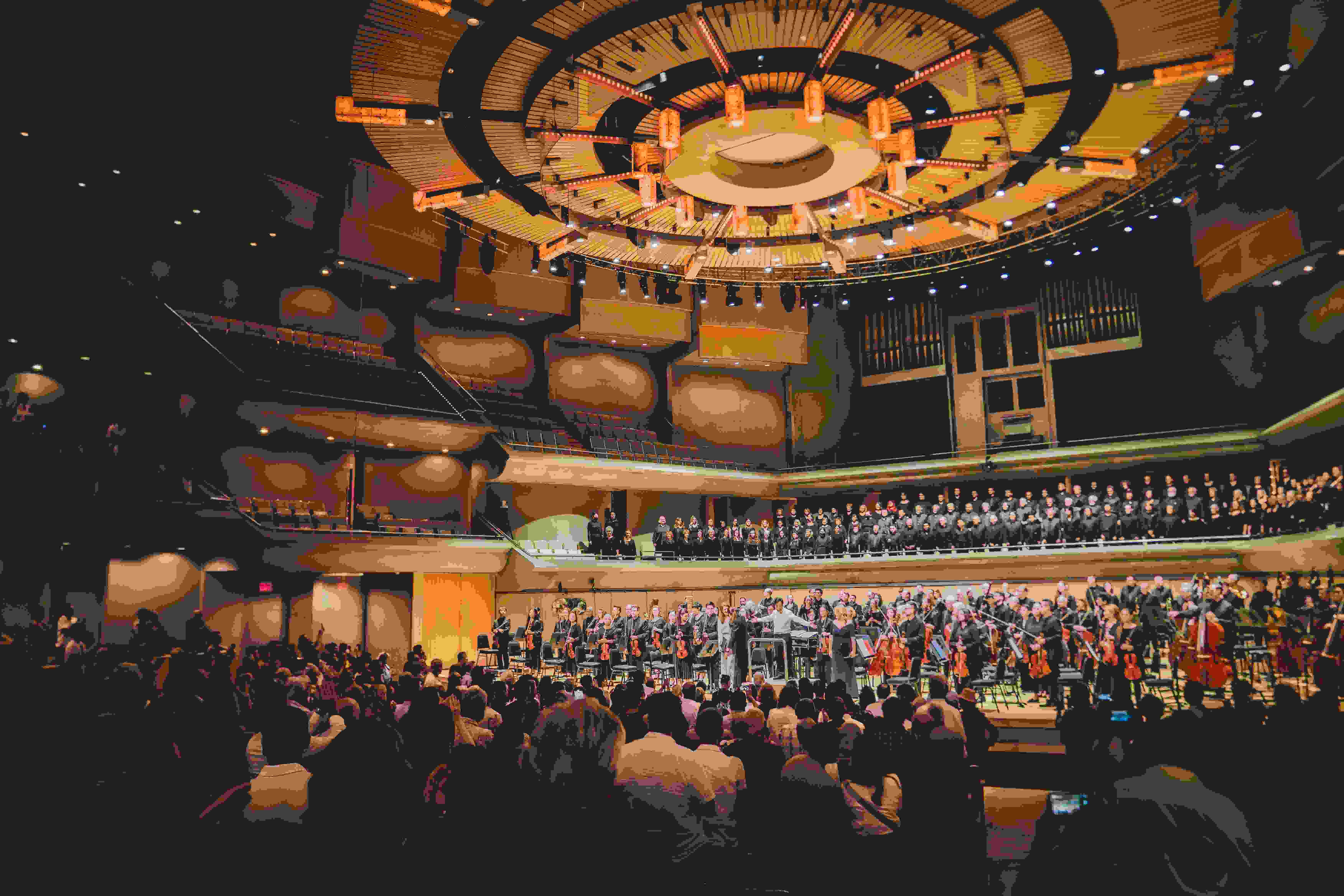
Mandle Cheung conducting the Toronto Symphony, Amadeus Choir and soloists Mireille Lebel & Kirsten LeBlanc (photo: Allan Cabral)
In my review I described my emotional response, although I didn’t tell the full story. In the article I said this while quoting the text from Urlicht, the song that’s the 4th movement of Mahler’s 2nd: “I was moved by parallels between the composer and the conductor during the concert, especially in the fourth movement when Mahler used one of the songs he had written based on Des Knaben Wunderhorn (The Youth’s Magic Horn): Da kam ein Engelein und wollt’ mich abweisen. (An angel came and sought to turn me back) Ach nein, ich ließ mich nicht abweisen! (Ah no! I refused to be turned away) Both Cheung and Mahler may have asked: Will they listen to me, or reject me? While the third movement is a comical burlesque about being ignored, this solemn song is a brave affirmation, in the face of the officious angel blocking the way.“
I had a previous experience with Urlicht, that song from Mahler’s 2nd that I quoted above. It was in church, where I was playing the piano accompaniment to a mezzo-soprano singing these words. She was partially disabled, and because of her physical challenges could not walk well enough to come out in front of the congregation to sing, but had to find a spot in the choir loft, further from me at the piano. When she sang about the angel barring the way I was shocked that we were in a sense blocking her path inside the church. This song is far more universal than I’d ever realized, speaking to anyone who has faced discrimination & dismissal. I saw a connection between what happened to our mezzo-soloist, Mahler and Mandle, particularly while listening to the same song being sung in that TSO concert, which is why I became so teary-eyed. Mahler is proclaiming redemption & resurrection while fighting against a racist & antisemitic establishment barring his path.
When I talked to Mandle a few days ago, he reminded me: 1) that his orchestra has had more than 16 concerts, 2) that for the June TSO concert he managed to fill Roy Thomson Hall 3) that the ovation after the Mahler was almost four minutes long.
The caption in the Globe & Mail for Allan Cabral’s photo said “The Toronto Symphony Orchestra performs Gustav Mahler’s Symphony No. 2 in C Minor, led by amateur conductor Mandle Cheung”.
Amateur? I wonder what the word even means. How many concerts will be enough? when — if ever– will Mandle get to call himself a “professional conductor”? I wonder is Mandle holding up a mirror to classical music?
At least there’s the original sense of “amateur” as the one who loves what they’re doing, and that’s certain with Mandle.
But there are so many questions one could ask. What does any conductor actually do? We see the performance, not the rehearsal, so there’s already a mystery. And the conductor stands before an orchestra waving their arms, sometimes holding a baton: and music erupts from the orchestra standing before them. When we get a ticket to go to a concert we’ve made a series of assumptions, that may or may not lead to pleasure & music in the performances we attend. If we blindly trust that the conductor must be good, we may have a better experience than if we show up with a series of stipulations & requirements.
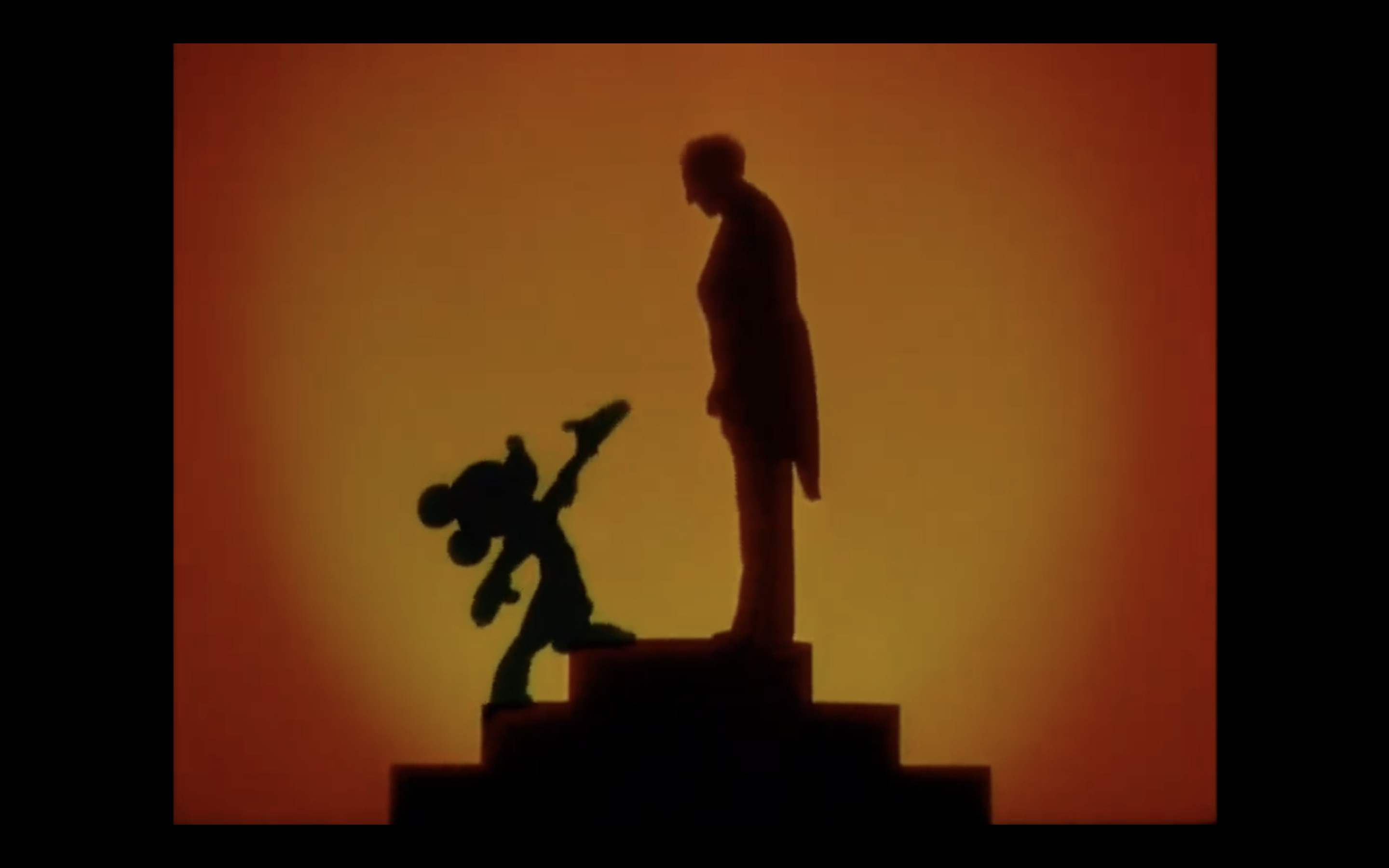
In effect a conductor performs magic. They wave their arms and for some reason a bunch of other people make music. That magic may have reached its peak with Disney’s Fantasia in 1940, aided by the great Leopold Stokowski.
Mickey Mouse thanking Leopold.
And then there’s Long-Haired Hare, released in 1949. Stokowski is the great “Leopold”. It’s not that they mock the conductor but the way he is idolized. I share this excerpt of the later cartoon to suggest some of the blind faith that goes into the music-making and listening. I believe this little sample of Bugs Bunny shows the way people may idolize a maestro.
You see the disconnect, the gap between the way this cartoon conductor is perceived and logic. Whether it is Bugs Bunny or Leopold Stokowski or any conductor waving their baton or their arms (or in Bugs Bunny’s case, waving his paws), they wave: and the music miraculously is heard. Notice that the cartoon goes for the extreme impossibility that is implicit to the newcomer, who may think that the conductor is somehow making the orchestra play this or that, their gestures steering the music to higher or lower notes, their powerful gestures controlling duration and intensity, when of course that’s something that must be established in rehearsals (if at all).
Let’s come back to Mandle Cheung, the tech entrepreneur who conducts an orchestra because it’s fun. In the weeks after that Mahler concert, I listened & then blogged about some of Mandle’s YouTube recordings with his Mandle Philharmonic, the ensemble he has assembled. You can see and hear them play on YouTube if you can’t make it to a live concert.
That word “maestro” that is used to identify a conductor is part of the dynamic. But Mandle told me he does not want to be called a maestro. Yes we can say he’s a conductor, an employer of musicians & soloists & a choir, hiring a concert hall to put on concerts.
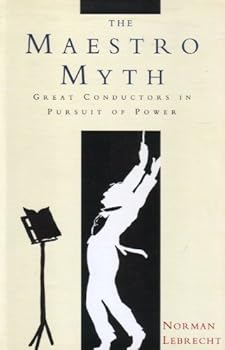
Indeed I pulled out a book I received long ago as a birthday present, indeed it was more than a decade ago (thank you Paul Babiak, great gift!), namely “The Maestro Myth” by Norman Lebrecht, a book that studies many conductors over many decades.
In the introduction he quotes Carl Flesch, who says “There is no profession which an imposter could enter more easily.” I have to wonder if this might be subtext for some of the negative responses to Mandle, who makes no false claims, who doesn’t pretend to be a Maestro. I think Flesch is touching upon a kind of tension underlying the conductor’s magic trick, the suspicion that we don’t really know how the magic is accomplished.
Lebrecht himself writes “The conductor exists because mankind demands a visible leader or, at the very least, an identifiable figurehead. His musical raison d’être is altogether secondary to that function. To the listener in the stalls, the conductor represents a dual form of escapism: the longing to lose oneself in music combined with an urge to subliamte in the actions of that all-powerful figure on the podium. The conductor is an obvious hero whose gestures are unconsciously imitated with a finger on the arm of the concert-hall seat or, back home, waving one’s arms before the bathroom mirror to the accompaniment of recorded sound. “ (Lebrecht 2-3)
Let’s talk about impulses. Children sing & dance, and at a certain point they become more socialized, they stop obeying their impulses. Perhaps that’s one of the ways we know that childhood is ending. When I was a child I used to sometimes conduct the records being played on the hi-fi. I grew up and stopped, but the fantasy didn’t die, given life by various gigs as a music director for musicals, church choirs and even a few operas while I was studying in graduate school. Mostly I sat at a keyboard but sometimes I had to conduct singers & musicians. Whenever I go to a concert and watch the performance I identify with the musicians. Do we all identify? I don’t know. But I can’t be the only one who sometimes wishes they were up in front of the orchestra conducting, enjoying the music while having vicarious feelings watching the performers.
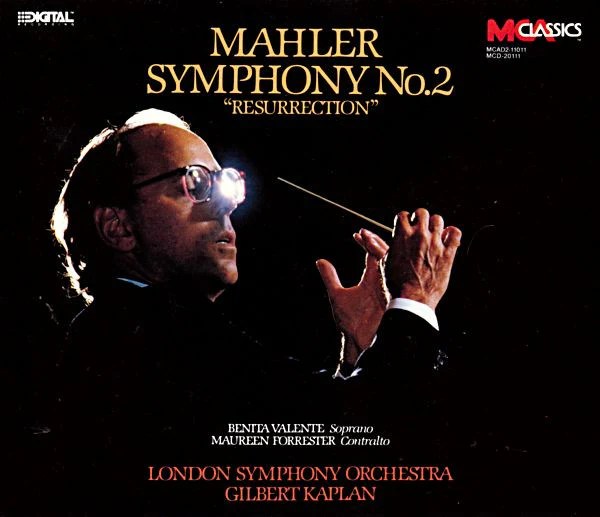
In his book Lebrecht writes about many famous conductors. He goes a long way towards unpacking Bugs Bunny’s magic trick, the trick every conductor accomplishes, when they wave the stick or their hands, and a bunch of music is heard played by other people. I wonder if maybe Lebrecht’s book needs a chapter about people like Gilbert Kaplan and Mandle Cheung. Kaplan was another wealthy conductor who hired an ensemble to play Mahler’s 2nd Symphony. I obtained the CD long ago, fascinated by the unprecedented phenomenon. Setting aside the question of the music, it was a bit of a happening, that this wealthy guy made a recording of the one piece he really knew & loved.
I would argue that the story of conductors is incomplete without the inclusion of the interlopers, the conductors who paid their way into the club, and in so doing cast doubts upon the authority of the ones who had already laid claim to leadership roles. Indeed you may question: how good are Kaplan or Mandle, are the interlopers legitimate creators of music, with the right to conduct? They certainly pay for the privilege.
Meanwhile, it’s the orchestras (as always) who play the piece, whether it’s Mahler or Mozart.
I assume Lebrecht will never bother with Kaplan or Mandle, even if I continue to be fascinated by them. So perhaps think of this interview as a kind of unauthorized appendix to a book I didn’t write, my unofficial questions like an unsanctioned addition.
Maybe the musicological questions concerning credentials are irrelevant as I point you to a quote I saw at mandlephil.com the orchestra’s webpage, that might be the key.
“Your time is limited, so don’t waste it living someone else’s life. Don’t be trapped by dogma – which is living with the results of other people’s thinking.“ Steve Jobs
As of course it was inevitable that I would eventually ask Mandle Cheung to answer some of my questions about his musical adventures. And he did answer…
*******
Barczablog:Are you more like your father or mother?
Mandle: I have to say I don’t know because I am the youngest of 17 children of my father, youngest of six of my mother. The only thing I ever done with my father I can recall is going with him, seeing a movie. And we argued about which movie to see.
BB: So this is in Hong Kong?English or Chinese?
Mandle: Hong Kong. Chinese. But I speak English in high school.
BB: How many languages do you speak?
Mandle: Oh I am terrible with languages. I speak some Chinese and some English. That’s it.
My mother is a very very sweet lady. We never had one conversation. The only recollection of her I have is she loved playing mah jong. Everybody knows what mah jong is. Little square oblong pieces…
BB: What is the best or worst thing about what you do?
Mandle: The best is building my company, from a room in a basement downtown 37 years ago, to know a hundred people, an amazing team of people, operating on their own, so I am very happy about that.
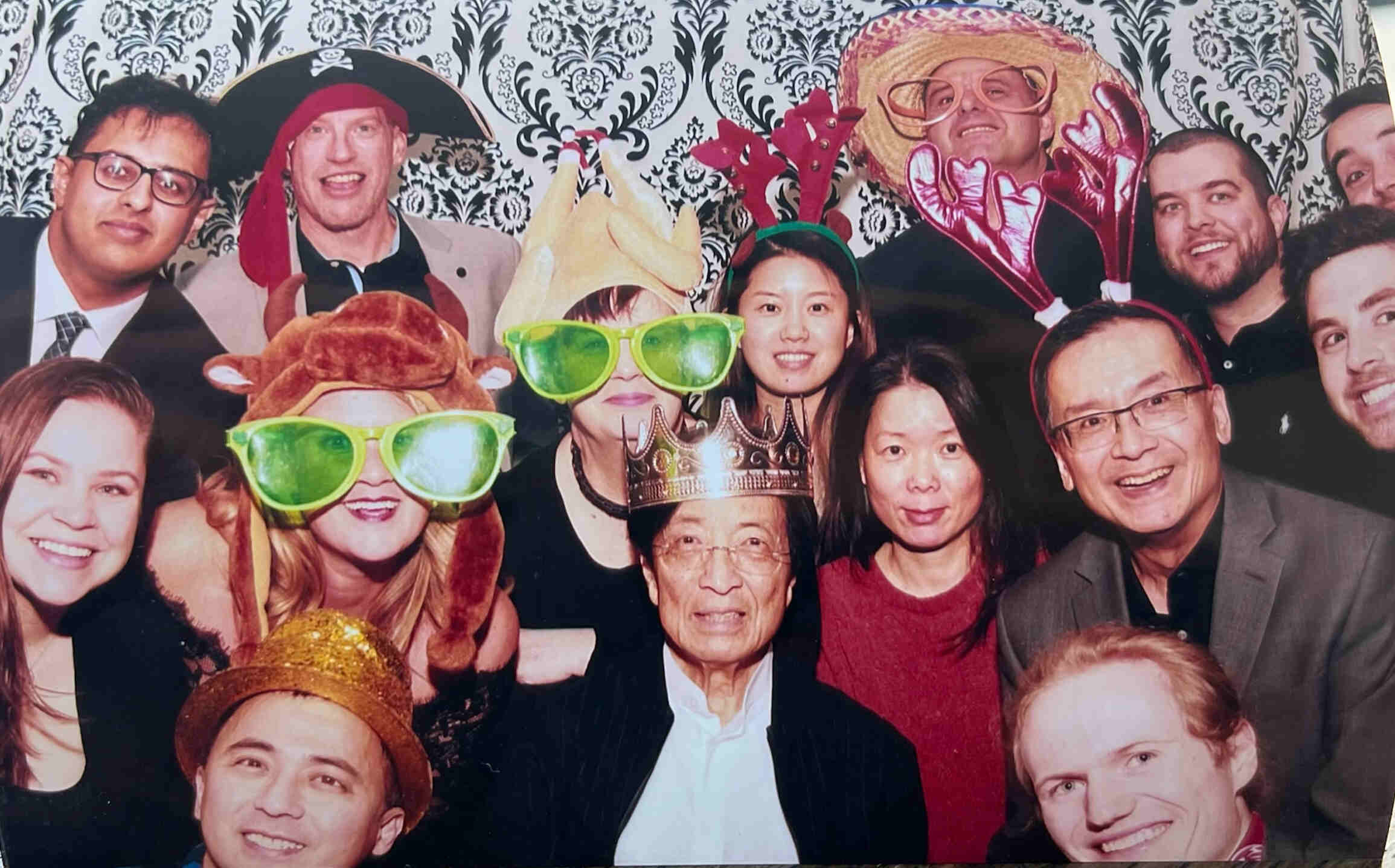
Mandle Cheung surrounded by colleagues at the company Christmas Party
BB: Is there a downside?
Mandle: Actually the one thing about our first major client, 30 years ago, three decades ago, head of the Ontario Government IT Group. The IT Group had something like 7 or 8 Chief Information Officers and one Chief Technology Officer, and he’s the chief of all the chiefs, so he’s the top man. So I knew him when he was still an analyst, in Toronto Dominion Green Line, trading over the phone. That’s when it first became our customer.
So now we hire him on contract to do a few things here and there. And someone asked him about me, and he said “Mandle’s biggest strength is people.” The team I built. He said I know how to hire people, which as I look back, is actually true.
When I hire somebody, the two questions to get answered right away, are “what they are good at doing” and “what they enjoy doing”. And if I find someone that the two answers are the same, then I got a winner! If somebody is doing what they like and they’re good at it, you don’t need to look over their shoulders.
BB: Good point.
Mandle: So the company of 100, we have no managers. And I never liked the word “manager” anyways because it doesn’t make any sense. Somebody who is really good at what they’re doing
“oh we have to promote you to be a manager”.
“Have you been a manager before?”
“No”.
So how do you know what to do as a manager? Of course I know I’m so good at it.”
BB: You’ve just explained the Peter Principle in reverse, that speaks of promoting people to their level of incompetence. Imagine: you have someone who’s good at making dinner who gets promoted, so they are then in charge of the personnel in the restaurant, and it’s a different skill! When they were cooking they were good…
Mandle: Exactly, so I take that one step further. So if you’re good at something I want you to keep doing it. I don’t want to take it away. And I will have people around you to learn from you, by learning how you do things. So I don’t call them “managers”, I call them “function owners”. You own the function because you’re good at it.
BB: What do you like to listen to or watch?
Mandle: I only listen because of Mandle Philharmonic. The only thing I listen to is Mahler 2 and Mahler 8. I just started Mahler 8 actually.
BB:That’s your favourite music?
Mandle: The ultimate in classical music. There’s nothing beyond that.
BB:But what if you did something simpler. Something like Eine Kleine Nachtmusik. You don’t like that?
Mandle: I haven’t listened to music in a long time. Mahler is sort of the end song, after Mahler there’s nothing else.
BB: It gets noisier doesn’t it? I mean if we look at music history. So there’s nothing that appeals to you? For example I play a lot of Richard Strauss. He’s in this same period when the music starts to get very noisy, dissonant.
Mandle: I love Strauss.
BB: He’s a contemporary of Mahler, they were friends.
Mandle: If I have the energy I will conduct some Strauss.
BB: I mean maybe one of those tone poems. I have piano versions of some of them, and it’s so exciting to be able to do a reduced version…!
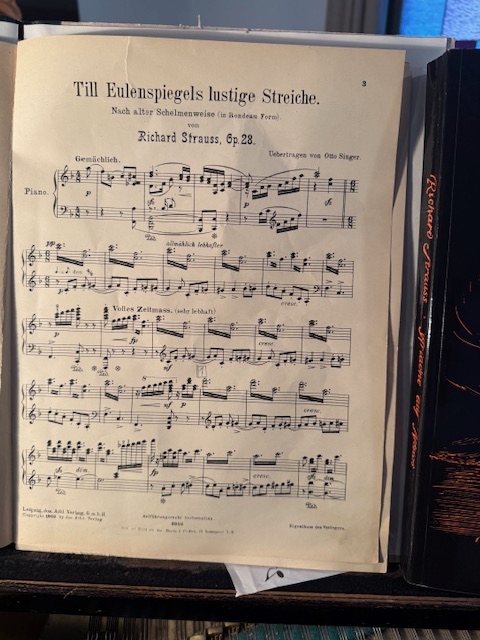
(I went over to a piano, and played the opening phrases of Till Eulenspiegel…in a piano reduction)
(I stopplaying) You know that piece…?
Mandle: Of course.
BB: (I am going back and forth between my interview / conversation with Mandle, and some analytical thoughts like this one that I am adding after the fact. Because they’re in a real sense “parenthetical” I put them into brackets just like this)
I think my desire to play these huge pieces on the piano is similar to your desire to conduct the orchestra. I played it for you because I thought you could relate to it. I have started using a word to describe my ambitions namely “aspirational”. I think playing these pieces as I dream of the orchestral sound is aspirational, trying to make a sound at the piano while I imagine the orchestra. When I am sitting at the piano it’s a fantasy, not always about playing perfectly, and more like imagining the orchestral piece.
(It’s the reason I play pieces like Pictures at an Exhibition, or that I love to play transcriptions of orchestral works, and also love opera at the piano. That was my first big fantasy, because I would accompany singers while trying to impersonate their orchestral accompaniment. It’s fun! Of course I have fewer options, because I am not a wealthy man. But the desire to play a reduction is I think similar to that impulse to conduct or to sing along. It’s normal I think, that people hear music and want to share it, join in, or perhaps to dance. When we sit like zombies silently? that’s un-natural. Applause between movements of symphonies, too, while it’s bad form to do that, it’s a child’s impulse and that can’t be bad. We want to make music. The impulse of the child to sing or dance or wave their arms like a conductor may be something we think of as “childish” or “immature”, but it’s a real natural thing that maturity stifles, whether through inhibitions we acquire or simply because we lose the ability to be like a child. )
When I was a kid, Mandle, I used to conduct along with the Beethoven on the record player. To want to conduct or to dance or sing along: surely that’s a normal impulse, even if our normal experience is often to be told by peers or teachers that we’re not good enough, stifling the natural impulses, teaching us inhibitions, making us forget our childish delight.
At the piano (thinking of a reduction of the big orchestral piecelike TIll Eulenspiegel) it can’t really be played.
Mandle: You need an orchestra.
BB: Playing a big piece at the piano is a bit like pornography, a fantasy.
(laughter in the room)
…because you’re fantasizing about doing something with someone else (at the piano dreaming of the orchestra making the big sound). In my head I hear the orchestra, and of course that’s a fantasy. It’s just a soloist at the piano. It’s like when I was a kid conducting along with the orchestra on a record. It’s a fantasy. Did you ever conduct along with a record as a child?
Mandle: Not really.
BB: I did as a kid.
Mandle: I think I may have bought a baton.
BB: I know at one point you may say “who’s the interview with, is it you or is it me?” …because I like to put myself into the questions, to make it relatable. It’s a conversation, but also because I am trying to analyse and understand. I think when we think of the conductor as a kind of everyman, who acts out our fantasies for us..? No matter how well they conduct, the audience watches the conductor and projects, identifies to some extent.
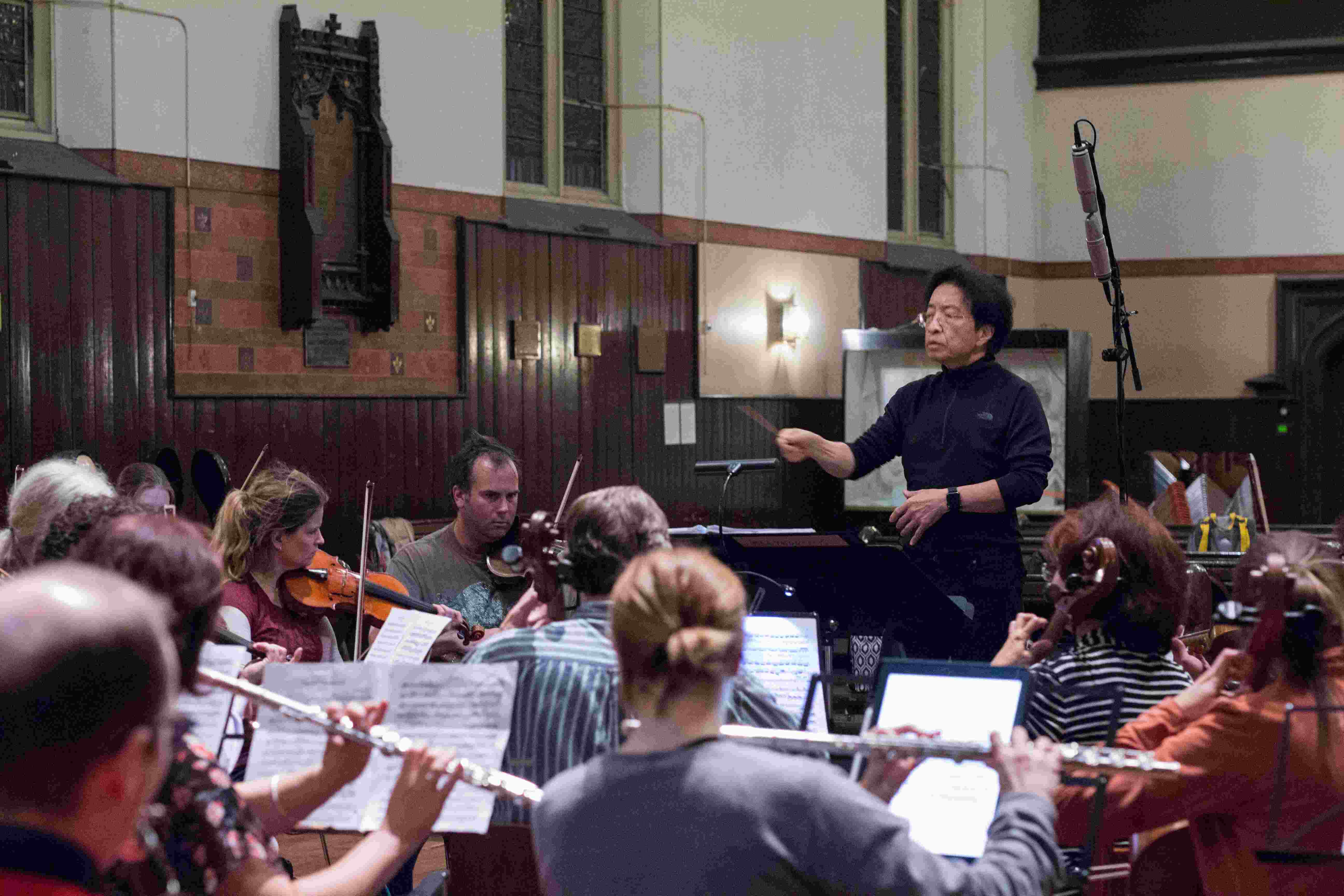
Mandle Cheung rehearsing the Mandle Philharmonic
BB: So, we were talking aboutwhat you like to listen to.
Mandle: The very first classical music I listened to was on a little FM radio with an antenna and earphones that I listened to in the backyard when I was thirteen years old. I still remember the moment, it was Saint-Saens 3rd Violin Concerto. Bang! that’s it. After that all I listened to is classical.
BB: Would you ever conduct Saint-Saens? For instance that 3rd Symphony with the organ, would be a great project for your orchestra. Or the 2nd piano concerto (one of my favourite pieces).
Mandle: If I have the time & energy, because I have so many things I want to conduct. There are at least 30 pieces I would love to conduct.
BB:Could we make a list? because maybe that tells us the future of Mandle Phil, no?
Mandle: No, the future of Mandle Phil is Mahler 2 and Mahler 8, that’s it. I am conducting the Royal Philharmonic, in London August 21st, Friday.
BB: Wow… so what are you going to conduct?
Mandle: Mahler 2 of course. (giggles)… because there’s is nothing after the Mahler 2 & the Mahler 8.
BB: Did I ask you what is the best or worst thing about what you do?
Mandle: There’s the company and then there’s the orchestra. I came up with the idea in 2015. I started talking to a couple of people in 2016. In 2017 we put a few musicians together. In 2018 we had our first concert at Glenn Gould Studio, a pay what you can. Since then I think we did our 18th or 19th concert this last December, the Beethoven 9th and Carmina excerpts and some Christmas carols.
BB: So do you have a program for the coming year?
Mandle: I was going to do a couple, of Stravinsky, but I cannot afford to divert my attention. Mahler 8 is just too big. I don’t even know if I can do it. It’s huge.
BB: It’s a challenge to be sure.
Mandle: And I really have to be ready for Royal Philharmonic. And we also spoke to the New York Philharmonic. (laughter) You wanna guess the price they quoted us?
BB: That’s a good question. Erika googled the TSO price. Is it higher than the TSO?
Mandle: (laughter)
BB: Is that a yes? (more laughter) Is it a multiple of the TSO? More than twice..? Were they maybe trying to scare you away?
Mandle: No.
BB: They were serious?
Mandle: Very serious. He’s responsible for raising money for the orchestra. You know all about the kefuffle with the TSO? You don’t get surprised at my age but that one just totally caught me off guard.
BB:I’m still asking the first questions, what’s the best & worst thing about what you do…
Mandle: I don’t have any negatives.
BB: There have been other people who say this, you’re not the only one. If you’re enjoying your life and you don’t see any negatives that’s fine, a valid answer.
I asked you what you like to watch. What’s your favourite?
Mandle: TV shows. I haven’t got a good one for awhile. My all time favourites were “Evil” and ” Nip-tuck.”
BB: Nip tuck, I remember that was a great show!
Mandle: Oh there are a couple of shows we watch. The Voice, the singing competition. America’s Got Talent. The judges they have on The Voice are good. They actually know what they’re doing. The judges on the other one…. so bad!
BB: But it’s still entertaining. Bad judges…. like bad critics. Remember that guy who used to be on American Idol? Simon Cowell…
Mandle: Oh i don’t like him at all. The one who kept his accent.
BB: (laughter) He was mean. …So can I ask you what your favourite song or melody is?
Mandle: Mahler 2.
BB: What ability or skill do you wish you had, that you don’t have?
Mandle: ability to recall ! Mine is average at best
BB: When you’re just relaxing and not working, what is your favourite thing to do?
Mandle: when I try to relax, thoughts will keep popping into my head. If it’s before 8:00/9:00 pm, music will always be playing, I’ll go thru my projects, there are so many, and I enjoy all of them. I may play some iPhone games. I may work of music for up coming concert. After 8/9, I may switch on Roger’s or Apple TV. Or organize phone calls and text exchanges, work with ChatGPT.
BB: Do you have a favorite conductor?
Mandle: Karajan who is dead. Today I watch Berlin Phil videos. I didn’t search for other orchestra apps.
BB: What instruments do you play (if any)?
Mandle: when I was in high school, I played in the harmonica band. And Arthur Benjamin harmonica concerto with CBC symphony orchestra 1971-12-09
BB: What was the first piece of music that you conducted and when?
Mandle: 1969/70 University of Manitoba, school of music, Beethoven piano concerto #3, performance by graduate student soloist.
BB: What does a conductor really do? (a rhetorical question?)
Mandle: I’m not aware of any great orchestra concerts or recordings that were performed without a conductor ? None. Zilch.
Great conductors are a rare breed. Besides their amazing knowledge of the music, they bring energy.
The 3 min 55 second standing ovation is for the energy that the audience felt !! As NaomiBuck described (in the Toronto Life article), they sprang to their feet. Note that Naomi is someone who doesn’t know what a conductor does, as you can read in her article. She thinks it’s the musicians that carried the music. You absolutely must have the best musicians to play the best music. You need to add an exceptional conductor to produce extraordinary performances. There is no exceptions to that.
BB: What don’t people understand about being a conductor?
Mandle: I learned the answer to this question first hand during the less than 20 Mandle Philharmonic performances.
You need to be a musician that plays in an orchestra. Musicians follow the conductors baton. All musicians.
I actually don’t have a clue what Mandle Philharmonic musicians think of me. They kept returning. We have a group of core players that’s been with us since 2017/8/9. They play for Canadian Opera and National Ballet. We can’t rehearse or perform when those two are in town playing. I tell them what repertoire I want and they reach out. It’s the same small pool of musicians.
BB: How is building & leading an orchestra as a conductor different from, or similar to building & leading an IT corporation?
Mandle: (setting me straight): I don’t have an IT corporation. I have a technology company that has an IT department like all small and large corporations do.
By leading I assume you mean conducting? It’s totally different. No similarities I would say.
Conducting an orchestra is real time. If you screwup, there is no place to hide. Everything is instant. I said that in the Toronto Life article. For 20 min 45 min 90 min, you are totally absorbed. It is surreal. Compare to racing cars perhaps? But that’s minutes. I can’t think of anything else. You are not performing by yourself. The orchestra of 50/100 is your instrument.
You try to think about next bar next note next phrase next sound next instrument or combination of instruments. The phrasing the tempo the dynamics the sound … staccato legato … one instrument is forte while another is pianissimo.
BB: Please talk a bit about the politics of being a conductor.
Mandle: I have been told many times, I’m not like conductors that all the musicians are familiar with. I don’t feel vulnerable because I am vulnerable. I talk about my screw-ups openly with my musicians. Often they will point out when I screw-up. That’s not the behaviour of a conductor.
Mandle Cheung conducting the Mandle Philharmonic
BB: Conductors usually are long – lived because the physical part of the job is exercise using your arms. As a physical feat, how hard is it to conduct an 80 minute symphony such as Mahler 2? How tired were you after finishing that TSO concert?
Mandle: it is a work out :):) no question about it !!! I was happy 🙂 Soooo happy when the cheering started.
BB: Is any of this scary for you? if so what’s the scariest part?
Mandle: most definitely 🙂 when I lost my place in the score and conduct totally from memory :):)
BB: what music will Mandle Philharmonic do in 2026? I think you mentioned Mahler 2 & Mahler 8: but anything else, short pieces?
Mandle: Mahler 8 is monumental. I printed the score few days ago. Will start studying soon.
Talking to Budweiser about a major outdoor concert in June. Just started.
Royal philharmonic in London, Friday August 21. Mahler 2. I’m already nervous 🙂
Thought about a Stravinsky concert but I’m glad I dropped the idea.
June and October we may have two RTH dates to do Mahler 2. Still discussing with my team.
BB: symphony orchestras sometimes program lighter music, as in Boston Pops, music that isn’t as dissonant or edgy as Mahler. Would you ever put something on a program from that category?
Mandle: Georges Bizet, Carmen Suite No. 1 and No. 2
Alexander Borodin, Polovetsian Dances
Antonin Dvorak, Slavonic Dances Op 46 /8
Modest Mussorgsky, Night on Bald Mountain
Camille Saint Saens, Bacchanale from Samson and Delilah
Bedrich Smetana, Ma Vlast: Moldau
John Williams, Star Wars Suite Main Theme
BB: some pieces are done without a conductor, for instance Bach, Vivaldi or Mozart concerti are sometimes led by the soloist (playing violin or piano). Would you consider undertaking any pieces from earlier periods?
Mandle: no
BB: You’re from Hong Kong, do you have any interest in music from China or Asian countries?
Mandle:did one piece !!:):) Li, Spring Festival Overture
BB: There’s a new genre of music emerging over the last decade, as it’s gaining fans & admirers, namely film music, the music in popular films. Do you have any interest in film music?
Mandle: Star Wars is as close as i got :):) I do want to produce West Side Story.
BB: After Mahler 2 & 8 there are other pieces you admire. What are they and would you consider conducting any of them?Mahler 3 or 5 or 9?
Mandle: I considered 5 but again want to focus.
BB: Do you like any operas or oratorios, that you would consider conducting?
Mandle: not really
BB: Do you have any vocal or choral music you would consider conducting with Mandle Phil..?
Mandle: We have done Beethoven 9, Carmina Burana excerpts, and Borodin Polovetsian Dances
BB: Do you have any ideas about reforming / modernizing classical music culture to better align with modern audiences?
Mandle: Adding narratives is something i try to do before each piece.
BB: Yes I noticed in the Beethoven’s 9th concert at Koerner Hall.
BB: What if anything can classical music learn from the way popular musicians play & market their music?
Mandle: the sheer size and length make classical challenging.
BB: Do you have any teachers you would like to acknowledge, who have helped you?
Mandle:Arthur Polsen was concert master of Winnipeg symphony when i studied at University of Manitoba back in late 60 early 70’s. He picked me to conduct Beethoven third piano concerto, with a piano performance student as soloist, in graduation concert. Then the Arthur Benjamin harmonica concerto with the CBC orchestra, same players as Winnipeg Symphony.
*******
Mandle enjoys conducting, and he’s picked music that he loves. It’s not rocket science, he’s doing what he loves.
June 25 2025 – Mandle Cheung & Toronto Symphony (Photo: Allan Cabral)
The passion & pleasure Mandle experiences conducting is what we sense watching him, the surrender to a simple impulse of enjoyment & pleasure.
Although the Mandle Phil website does not yet have dates for the Mahler, if you want to attend, follow the link, as this is where you will see the dates and be able to get tickets.
The Canadian Opera Company are reviving the Christopher Alden Rigoletto, last seen in 2018 and first seen here in 2011. I have always been conflicted about it, a production that in some ways shows the real story that composer Giuseppe Verdi & librettist Francesco Maria Piave couldn’t give us.
Rigoletto is jester to the Duke of Mantua, a total beast of a seducer, who screws every woman in sight and then has the nerve to sing “la donna è mobile”, suggesting that women are fickle. He’s a man whore, and (in case you can’t tell) someone I dislike with a passion. Rigoletto may be a father but he shows no sympathy for Monterone, another father whose daughter becomes one of the Duke’s conquests, leading Monterone to curse the Duke and his Jester.
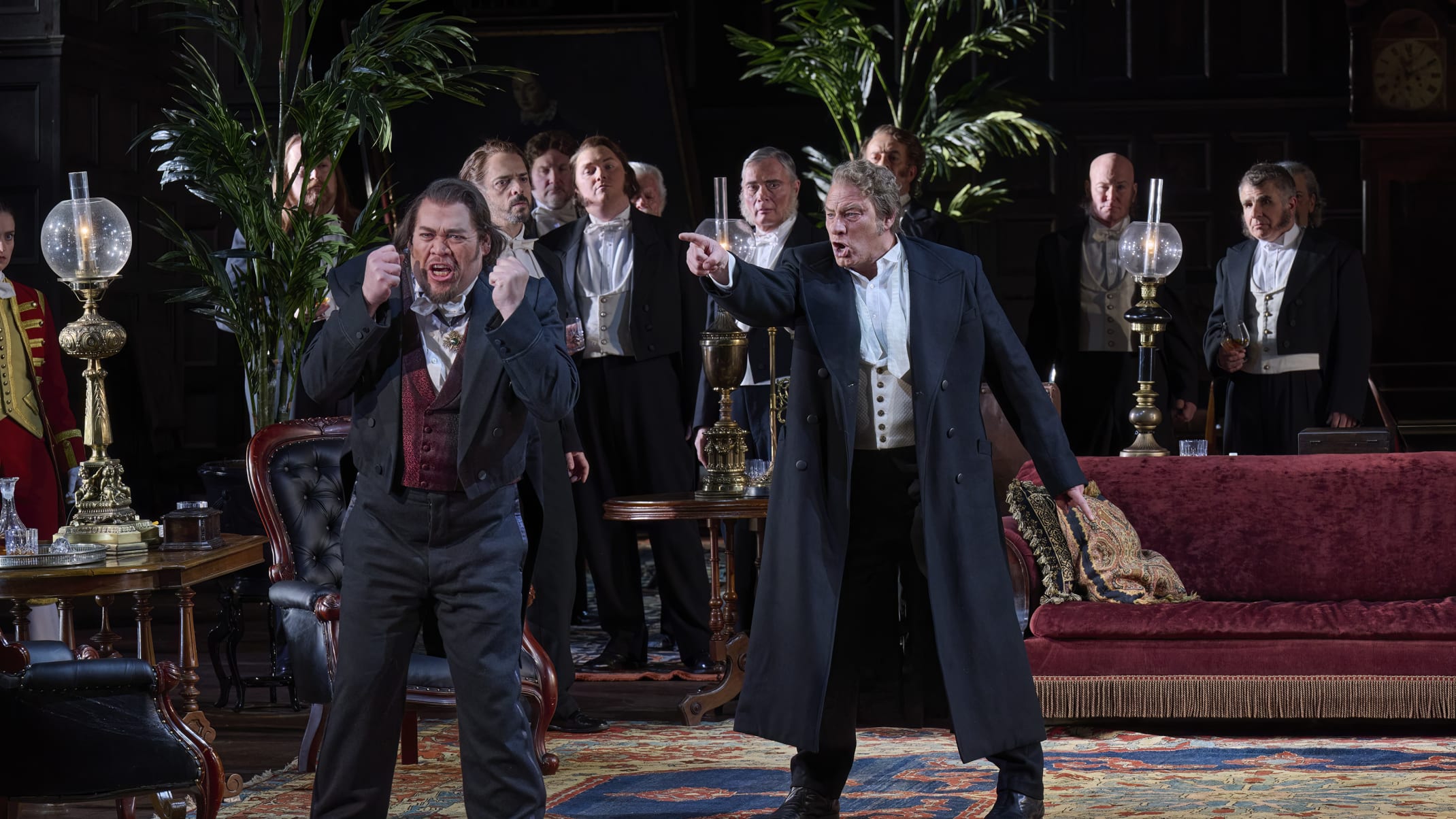
Rigoletto (Quinn Kelsey) being cursed by Monterone (Gregory Dahl, photo: Michael Cooper)
When the Duke goes on to seduce Rigoletto’s daughter Gilda, the jester pays a hit-man to kill his boss, but Gilda is so in love with the beast she substitutes herself as the victim of the hit.
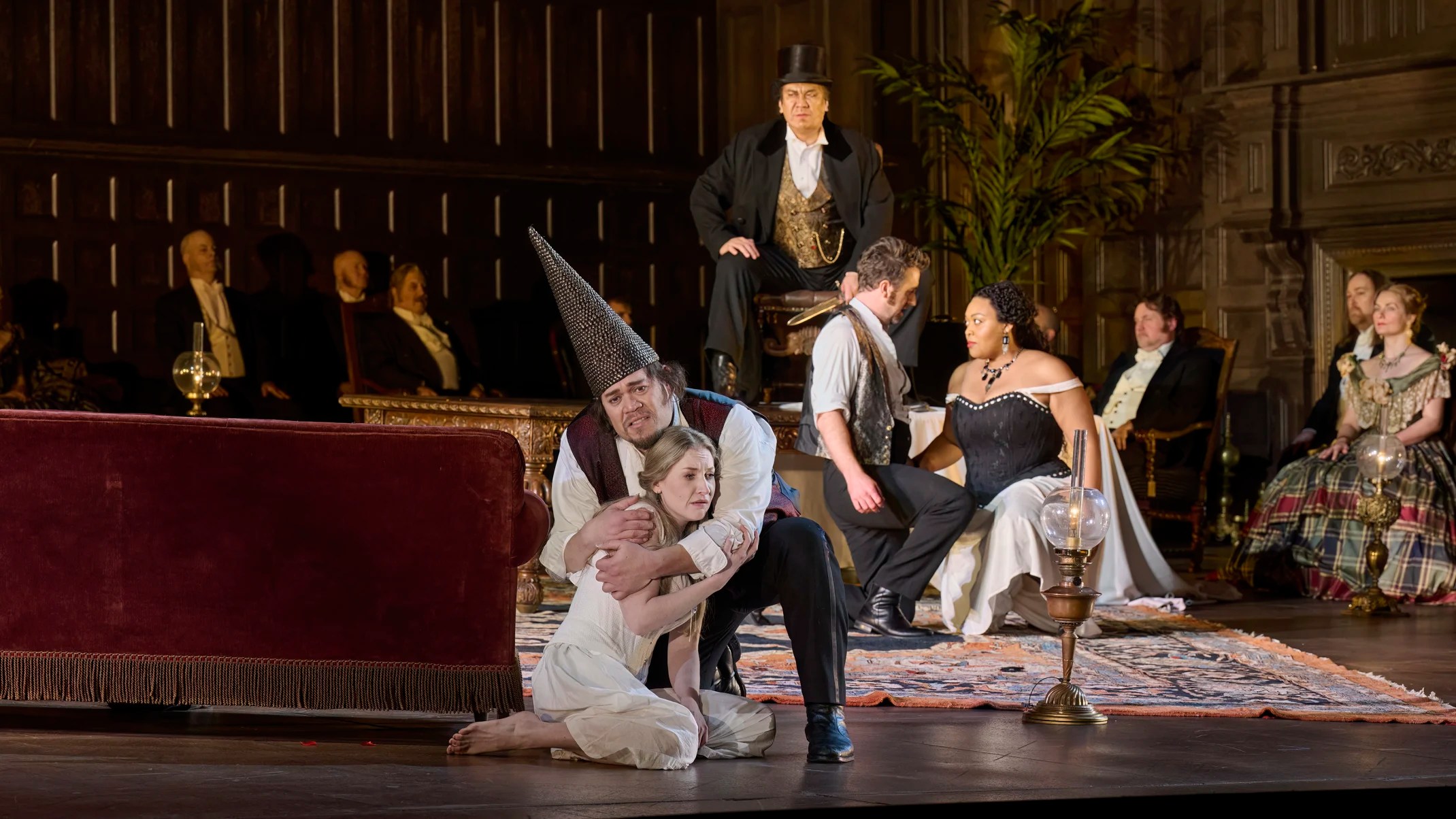
Foreground: Rigoletto (Quinn Kelsey) embraces his daughter Gilda (Sarah Dufresne), as behind them the Duke (Ben Bliss) kneels before Maddalena (Zoie Reams), observed by Sparafucile (Peixin Chen, photo: Michael Cooper)
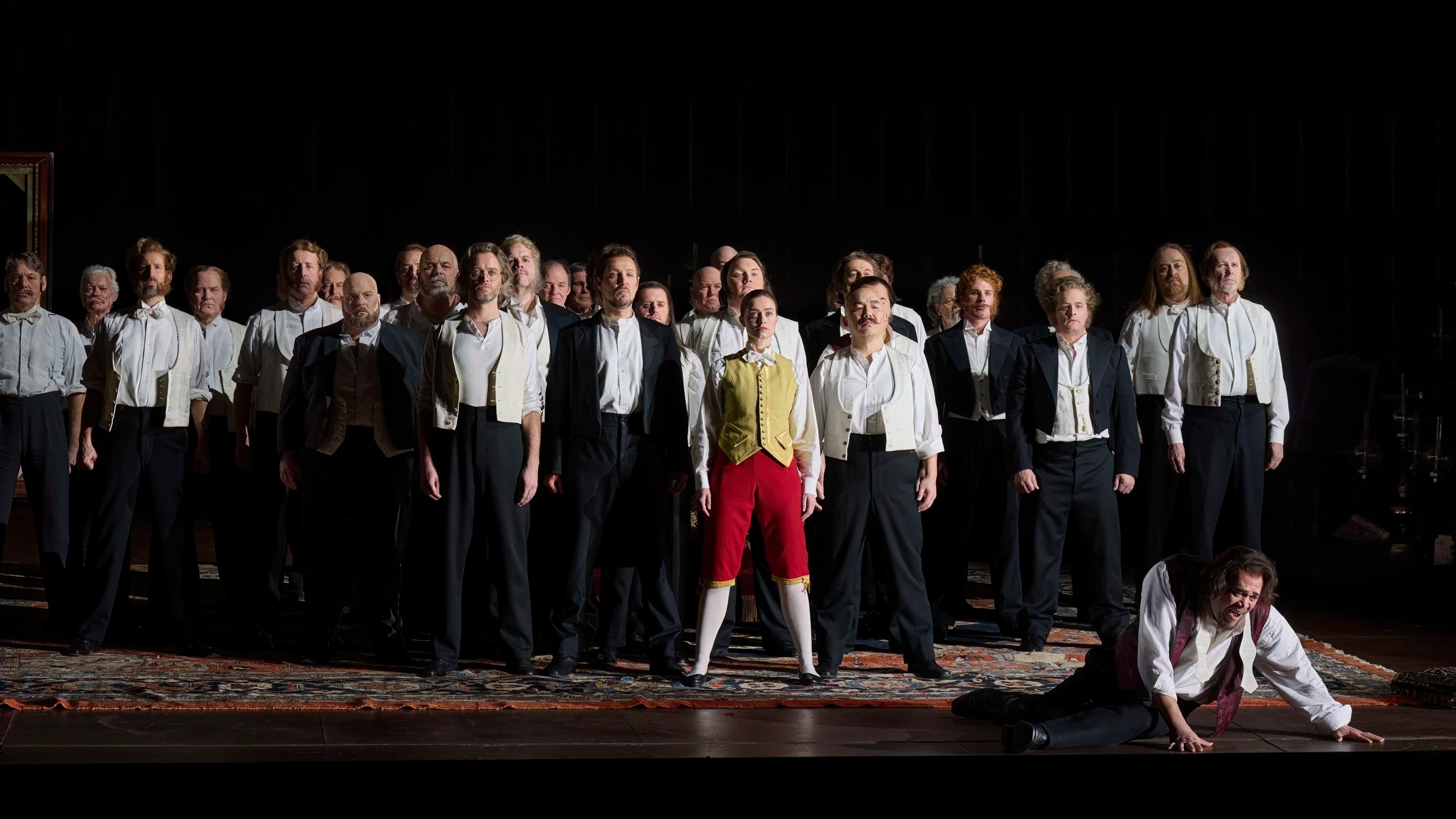
In places Verdi & Piave held back a bit, likely due to concerns about censorship, the morality of the audience in the 1850s, so that the courtiers surrounding this whorish Duke sing in a chorus that’s jocular but relatively clean in how they express themselves, and what we actually see.
Alden’s Rigoletto is as blunt as a Housewives of Tulsa episode: as it was in 2011 & 2018. The music isn’t changed, but the visuals are crystal clear, so much so that there’s no mistaking this nasty story for a happy romance.
What is so different this time, leading me to call it a Rigoletto for our time? Our time. In 2026 I’m finally ready for this production. Maybe it took awhile for me to learn how to see it correctly or maybe the thing that trained me was watching current events.
Tonight Gilda was played by Sarah Dufresne, who for once gave us a Gilda who looks as young as the character is written to be. When the Duke (Ben Bliss) pushes his Gilda onto the couch in her underwear, looking like a 15 year-old, it could be right out of the headlines. The Duke is like Epstein or one of his pedophile cronies. Perhaps Giovanna (sung by Simona Genga) is like Ghislaine, as the role is far beyond the usual house-keeper of the original, an enabler and another lover of the Duke (at least in her own mind).
Sparafucile (the hired killer, sung by Peixin Chen) argues with his sister Maddalena (sung by Zoie Reams, so impressive a couple of years ago in Medea), who has also fallen in love with the Duke. When she suggests that Sparafucile can kill the Jester instead, and take his money, Sparafucile replies that he is no bandit, a grotesque moment that made me laugh out loud.
I’ve seen a lot of productions of this opera. It feels so jarringly real, a community of sycophants & enablers trying to please the powerful pervs, just as we see in the news. When I first saw this production it seemed like a revelation even though there were moments that rubbed me the wrong way, but I think the world has worn down my resistance, as the news is now nastier than this story, that actually felt like escapism tonight.
Let me add, that the singing and the musicianship is superb led by conductor Johannes Debus.
Quinn Kelsey’s voice in the title role seems to be in a groove, the sound lighter and more truly bel canto than previous times I have heard him, as though he were rejuvenated. The high notes are all there, the voice opens cleanly and precisely on pitch, the soft passages float while the big moments hit hard. I’m glad I will hear him again. He is very believable as the Jester who is cursed, and is sounding especially good this year.
Sarah Dufresne sang well as Gilda. There were a couple of places where I thought she was being rushed by the pace coming from the podium, where a more sympathetic slower tempo could have helped. Gilda has some of the prettiest music that Verdi ever wrote, but is also pressed into a melodrama in the last part of the opera. I don’t think the role is written to give a singer the chance to really seem like a teenager, given the sophisticated situations & moral complexity in which she’s caught, but Sarah looked very much the part, doing as much with the role as possible, especially the frenetic action Alden asks of her.
All three of the main principals sang on pitch, although I think the most impressive for me was Ben Bliss as the Duke, in a role that’s not just difficult to sing but can be unbelievable to watch. Or maybe it’s just that the production, showing us in a kind of creepy men’s club, with courtiers seemingly helping the Duke in his horny pursuits, helps the opera to click perfectly for me.
Conductor Johannes Debus took us swiftly through Verdi’s tuneful world, keeping everyone tightly together, the men of COC Chorus having some great moments especially in the first act. Rigoletto continues at the Four Seasons Centre, with five more performances between now and February 14.
Rigoletto (Quinn Kelsey) gets no sympathy from the Duke’s courtiers (photo: Michael Cooper)
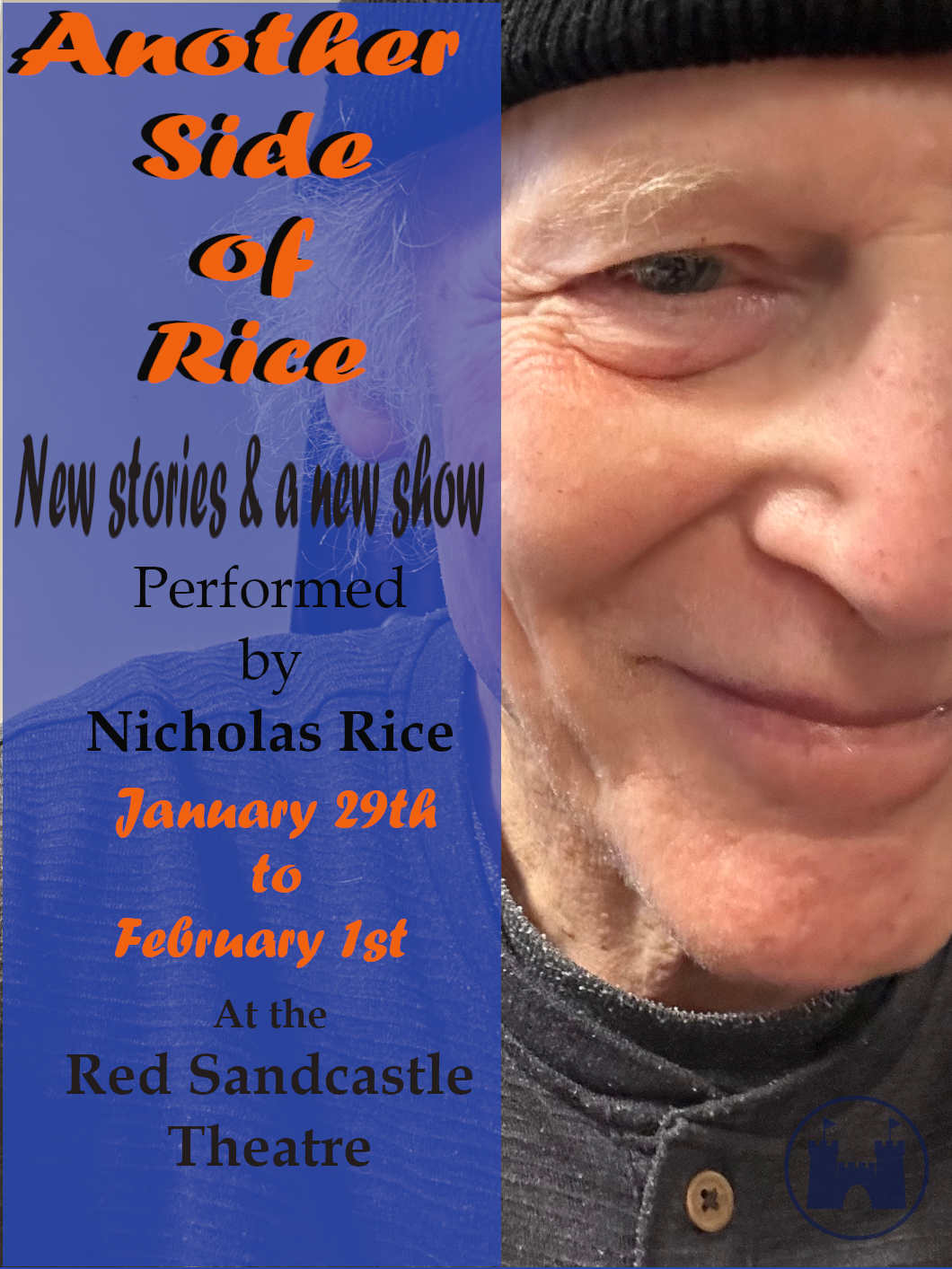
I wanted to interview Nicholas Rice, intrigued by the show he’s doing at Red Sandcastle Theatre, Another Side Of Rice. He’s a story-teller and an actor.
I had to ask him questions. I also plundered his Facebook profile, concluding with some of his poetry, that perhaps represents a different side of Nicholas Rice.
Nicholas Rice
*******
Barczablog: Are you more like your father or mother?
Nicholas Rice: Now there’s a neat question.
From my mum I think I get a sense of wackiness, a love of wordplay. She was a lexicon into herself – the English language was her silly putty. I’m grateful to her for that.
From my dad – there’s a sense of gentle-manliness, of gentlemanliness. I address this in my show, in fact. I lost my dad when I was still very little. I’ve spent my whole life trying, with varying degrees of success, to be like him.
Nicholas Rice
BB: What is the best or worst thing about what you do?
Nicholas Rice: That thing I do – there’s just something so sweet about standing before an audience (or before a group of students) and playing to them – embracing them with my eyes and my voice. I do mean ‘sweet’ – this is a sweet spot for me. Storytelling allows me to share the warmth of my heart. And man oh man, we’re in an abysmally dark age. Does our world ever need hefty doses of warmth and light right now.
BB: Who do you like to listen to or watch?
Nicholas Rice: I’m an old Boomer. I can’t get enough of the Beatles or the Stones. I love Billy Joel. Stephen Sondheim – there are some magnificent interviews with him on YouTube. And I love watching old Dick Cavett YouTubes, two in particular: Don Rickles and Beverly Sills in the same episode – and in another episode, Oscar Peterson.
Don’t faint, but I actually hold a second-degree Black Belt in goju-style karate. For many years I was a real keener, training several days a week. I no longer train, but I still value my association with the dojo, and I maintain that the karate dojo is the best acting class I ever attended. Truth is, I have little aptitude for the sport – yet it doesn’t matter. Just show up, keep showing up, chuck your fear away and cherish the practice-time: you’ll improve!
Nicholas Rice
BB: What ability or skill do you wish you had, that you don’t have?
Nicholas Rice: I wish I were a quicker study. It takes me a long time to learn a chunk of text. I need constant repetition. Yet I try not to be afraid of the process – see my ‘karate’ answer above.
Nicholas Rice
BB: If someone wanted to be a story-teller, how would you suggest they start.
Nicholas Rice: Find some storytelling events and put your name in. Or go to a few of these events first, see what they’re like, and then put your name in. You may be scared, but that’s fine, everyone is. Hell, I’m scared right now. How to start? Just start!
Nicholas Rice: John Travolta was the best colleague imaginable – funny, supportive, warm.
And so was Kirstie Alley, may she rest in peace. Our first day on set, I asked her if she’d had much time to see Vancouver. She said no, they just had to concentrate on the shoot. Then she asked about me – I was out west with my wife and daughter, settling up my mum’s estate. “How old is your little girl?” Kirstie asked. Eighteen months, I said. That was on Day One. Several weeks went by, I had tons of down time, and then finally it was my last shoot-day. I did my final shot, it was a picture-wrap for me, and I gave Kirstie a kiss on the cheek and thanked her and wished her well. She said, “You take care of that little girl of yours now, y’hear?” She’d remembered. I was deeply touched by that.
BB: Do you have a favourite story-teller?
Nicholas Rice: There’s a terrific Fringe artist, T.J. Dawe. He’s Vancouver-based, I think. His work is constantly enthralling. If you find he’s playing at a Fringe near you, run to see him – you’ll be a Dawe-fan for life.
BB: Wowzers… He’s done a lot. Here’s an example.
BB: Red Sandcastle Theatre is a very small venue, as intimate as a classroom.
Nicholas Rice: I did my original solo-show, A Side of Rice, at the Sandcastle last March. I love the intimacy of the place.
The good thing about A Side of Rice and Another Side of Rice is that these shows are just me telling stories to people I regard as friends. The show is clean and simple. There are no sound cues or lighting cues, no pyrotechnics. There’s no amplification. So many shows these days are mic’d to death, mic’d into unintelligibility . It’s ironic – the more amplification there is, the less an audience is able to understand.
BB:I hear you!
*******
Another Side of Rice is coming January 29, 2026 – February 1, 2026, the first three at 8:00, the last one a matinee at 2:00. Click here for tickets.
*******
I found these on Nicholas Rice’s Facebook profile.
Sonnet: I’d last put on a pretty pair of Pumas and worn ‘em till that cataclysmic day; and now, despite all pessimistic rumours, they fit upon my feet again okay.
Perhaps you will recall the end of summer when all my normal calm intelli-gence deserted me and, temporarily dumber, I vaulted off a godforsaken fence.
Unprecedented pain was instantaneous as was a long ferocious flood of swearing to mark my comminuted right calcaneus which swelled till it was well past all repairing.
And yet the time has hobbled on, and now the Pumas seem to fit again somehow.
A view of the Pumas (NB “Puma” is a brand of shoe)
Sonnet: At Princess Marg
I’ve never seen the waiting-room so crowded — can cancer have run rampant overnight? A sense of grave uncertainty has shrouded us men who claim survival as our right.
The system, as we know too well, is flawed; far better to be sick in Scandinavia — and yet our land still owes a loving nod, a bow to Tommy Douglas as a saviour.
For now my current state of mind is calm; I try to stay considerate and kind — my teacup runneth over, says the Psalm; my pee-cup doth as well, but never mind.
And thus your correspondent sits and waits, in gratitude he’s not now in the States.
Nicholas Rice
Sonnet: for Joe Rice and Asher Rose
A twenty-dollar ticket at the Roy? I’d willingly have paid five times as much. My bubbe might have murmured “Bozhe moy, this Manny Ax has such a subtle touch!”
To sit amid a concentrated crowd as part of a divine collective ear — I tell ya, hive, it makes a fella proud to savour phrases effortless and clear.
It’s true Toronto’s not the town it was; the traffic-jams alone are cause for fleeing, and yet I hesitate to leave because at times there’s this exquisiteness of being.
So try to snag a seat at the last minute; for twenty bucks it’s heaven and you’re in it.
Nicholas Rice
BB:I saw this picture on his Facebook profile, posted at the end of October, commenting on Movember, as you can see in the caption he posted.
Movember again. I’ve had prostate cancer. I was diagnosed in 2008. Had surgery and radiation in 2009. Been on a regimen of hormones since 2015.Sounds scary, perhaps – yet my life has never been better. Creeping into my mid-70s, I continue to act, teach, and write. There’s even a new solo-show in the works. Please don’t be afraid. If you have questions or concerns, I invite you to call, write, or visit: no subject is off-limits, and my ears, heart, and arms are open. Let’s affirm Life – let’s celebrate it – not just in Movember, but right through the year. With my love.
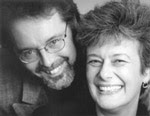
Tenor Lawrence Wiliford joined with pianist Steven Philcox and together founded the Canadian Art Song Project (CASP) in 2011.
(Left) Lawrence Wiliford and Steven Philcox
Someday I hope to interview pianist Steven Philcox, who has partnered Lawrence on his CASP journey.
A few years ago Lawrence shared his MA thesis with me, leading me to wonder if I really understood the field I claim to know. Lawrence has great ideas, and I’m still trying to decide how they fit and how I feel about them. Much of my academic life was on the boundary between theory and practice, the opportunity practitioners have to understand their art from the inside. It’s thrilling for me to get a chance to learn from someone who appears to be on the cutting edge, making interesting new projects.
It was in that spirit that I asked Lawrence to expand upon his ideas, because I think they’re original & important, so I was pleased that he agreed to be interviewed.
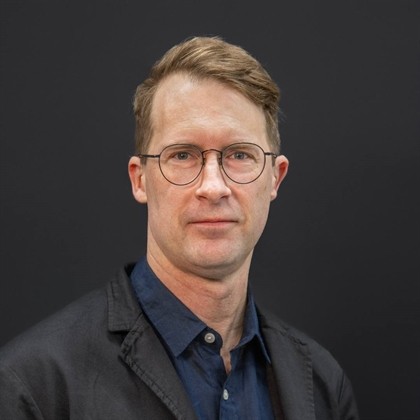
Lawrence Wiliford
*****
Barczablog:Are you more like your father or mother?
Lawrence Wiliford: How am I like my mother? My complexion is most like my mother’s: fair-skinned, blond hair. She was also incredibly creative. She took on all manner of craft projects, from sewing to stamping, furniture restoration, basket making, and painting. She crafted for as long as she lived. She also loved gardening, and when I was young I remember spending a lot of time digging in the soil and planting annuals. My mother always found ways to dream and imagine what might be possible, and she rarely let obstacles stop her.
How am I like my father? My father has a great voice and loves music. He also has an intensity with which he shares his ideas and convictions, and I’m guilty of this as well. We also share our name, Lawrence J. Wiliford (though our middle names are different).
I’m not sure who I’m most like. Perhaps I dream like my mother and work like my father. One of my friends in undergrad called me “Will-to-Power,” which I think I earned after he witnessed the tenacity and determination with which I got things done, often accomplishing things that didn’t seem possible. Maybe that combination is the overlap of both my parents’ superpowers, and it explains how I’ve been able to achieve much of what I’ve achieved.
BB: What is the best or worst thing about what you do?
Lawrence Wiliford: Best thing: What I’ve done for most of my life (since I was eight?) is perform and sing for an audience. I’ve sung on stages that were tiny (church potlucks) and large (major concert halls and opera houses), and that is a privilege. Not everyone feels called to share their gifts in this way, and even if they do, not many have the opportunity. Every time I’ve taken the stage as a professional singer, I’ve been aware of the privilege of being on stage and sharing my voice.
Sharing music with another person or people in an audience is incredible. Sharing music with another person on stage as a colleague, in front of an audience who wants to hear from you, is otherworldly. I’m not singing in front of audiences as much these days. The seasons of life and career do change. So right now, most days the best thing about what I do in my capacity as an artistic director, producer, and arts advocate is lifting up artists who deserve notice, and demonstrating that hard things can get done.
Worst thing: As a performer and arts worker, the worst thing is how difficult it is to build a career with longevity—one that can shift as you grow as an artist and as new life stages emerge. As someone trying to maintain a home in Canada with my family, the path has gotten harder and harder.
During and after COVID, everything changed. I have a lot I could say about this, but I think it’s its own conversation. I’ll just end by saying that being an artist of any kind in Canada is harder than it should be, given how much we invest in young and emerging talent. We lose much of that talent far too soon, either because artists leave Canada or because they stay but have to change careers. It’s a pretty poor investment strategy, if you ask me.
BB:Agreed! it reminds me of something you said on Facebook that I shared almost a decade ago, including your photo. You made what amounted to a nationalist challenge. As I said you’ve been been putting your money where your mouth is, as co-artistic director of the Canadian Art Song Project.
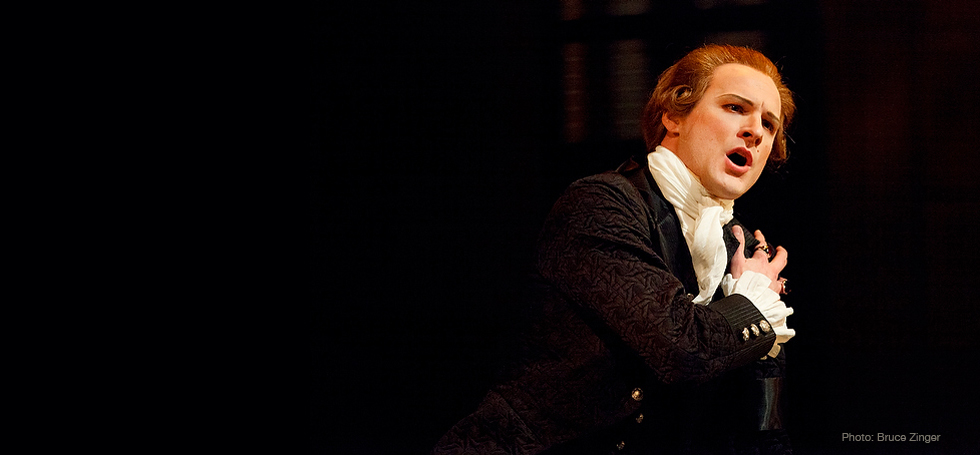
Tenor Lawrence Wiliford (photo: Bruce Zinger)
BB:Who do you like to listen to or watch?
Lawrence Wiliford: I like to listen to and watch almost any artist who is deeply invested in sharing their gifts. I don’t really have a single “favourite” anymore. I can be deeply moved by any number of artists in many different practices.
BB:What ability or skill do you wish you had, that you don’t have?
Lawrence Wiliford: I wish I played the piano. I took lessons many times in my life, and I had to reach a certain levelof proficiency to complete my music degree, but I started late and it never clicked. It’s one of my great sadnesses. I also don’t speak another language… another sadness.
BB:When you’re just relaxing and not working, what is your favourite thing to do?
Lawrence Wiliford: I like to be with friends and spend time with creative, fun, compassionate people.
BB:Who do you think of first when I ask you to name the best singer?
Lawrence Wiliford: “Best” doesn’t mean much to me anymore. I’ve been inspired by so many incredible singers across genres, both historical and currently active. I’m drawn to clarity of tone and ease of approach, nuance of phrasing, and intelligent diction—but most of all, honesty in performance.
BB:What was your first experience of singing?
Lawrence Wiliford: My first real memories of singing are with my family: my two brothers and I singing ’60s folk songs, protest songs, and church camp songs with my parents—my dad playing guitar—everyone in the living room.
BB:What’s your favourite song?
Lawrence Wiliford: I’m not sure I have one. I like everything from Jim Croce to Sting to U2 to Queen and Rush. I even liked Phish for a while in high school—don’t judge.
But I think I really fell in love with music when I started listening to Mozart—especially the Jupiter Symphony. I also love Mahler’s 3rd and 4th symphonies, and John Williams’ score for The Empire Strikes Back.
I also have a hard time relaxing when I listen to classical music with words. I don’t really relax listening to most music with words—I analyze it. Ugh.
BB:As you look back on a career singing opera and concerts, what memories stand out? Who was most influential in shaping the artist you’ve become?
Lawrence Wiliford: When I came to Toronto in 2003 to study at U of T, I had no idea I would end up singing at the level that I have. The first time I thought I might have some success was performing with Helmuth Rilling on the stage of Walter Hall for one of his Bach cantata lecture concerts. I sang an aria that was fiendishly difficult. He stared at me the entire time he conducted, and when it was over he turned to the audience with a huge grin and said, “He’s pretty good, isn’t he?” The audience response was unlike anything I had experienced as a tenor soloist up to that time.
Helmuth Rilling
Rilling, in large part, launched my career as a concert singer. I learned so much from him just being on stage and watching and listening to his direction. He was inspirational to work with, and I’m deeply thankful for his early support and belief in me.
MA Thesis / MRP and CASP
BB:A few years ago I read your MA thesis… would you be willing to comment on how that is playing out so far?
Lawrence Wiliford: When I wrote the paper in 2022, Canada was still deeply affected by prolonged theatre closures and audiences were understandably reluctant to return to large indoor gathering spaces due to concerns around COVID. I was completing my MA in Media Production at TMU online while navigating the uncertainties of pandemic life at home, trying—like many parents—to ensure that my daughter could make it through constant disruptions of partial school closures and testing, simply to complete Grade 2. At the same time, a number of filmed projects undertaken by performing arts organizations—often using stage-production funds or emergency arts grants to employ artists during full closures—were beginning to be released via streaming, with very mixed results.
The thesis was very much an attempt to capture that moment. It reflects on how the unprecedented conditions of the pandemic led many performing arts companies to explore filmed work at a scale that had not been seen in Canada since the height of Bravo!, Rhombus Media, and CBC/Radio-Canada arts programming in the late 1990s and early 2000s. As I note in the paper, during that earlier period broadcasters played a central role as commissioners, producers, and distributors. By contrast, during the pandemic, “the production and distribution responsibilities of new performing arts content in Canada were now left to individual artists and performing arts organizations.”
As a result, many companies found themselves effectively trying to operate as creative media, film, and television production entities, often without the training, infrastructure, or distribution expertise to do so. Imaginations were running high and the impulse to experiment was genuine, but stage production is not film production. Performing arts organizations know how to sell ickets and invite audiences into concert halls and theatres, but they did not—and largely still do not—have the tools to reach audiences through digital distribution. To be fair, even media companies with deep experience in television and film are struggling to adapt to constantly changing realities of digital distribution.
For roughly two to three years, while emergency funding and recovery money were available, many organizations tried to make this work. Orchestras across the country invested in high-quality streamed concert broadcasts. Opera houses and concert halls invested significant sums in purchasing and upgrading in-house recording, streaming, and filming equipment to capture performances at a professional technical standard. Yet very few have sustained that activity. One of the only organizations I know that continues to invest regularly in filming, recording, and distributing high-quality work for an online audience is the Vancouver-based tenor/bass choir Chor Leoni, where Artistic Director Erick Lichte has made filmed releases on YouTube a central strategy for audience cultivation and growth.
I’m not in the rooms where all of these decisions are being made, but from what I have heard—and what seems observable—most organizations have stepped back from filmed and distributed work as a core strategy. Many of the conversations I had near the end of my research could be summed up like this: we tried, but this isn’t our wheelhouse; our audiences didn’t respond strongly to the digital product; we need to refocus on live performance; and making filmed work look good and finding a market for it is hard and expensive.
What feels unresolved, rather than failed, is the structural question the paper raised at the outset: how filmed performing arts work can be sustainably supported in a system where policy, funding, labour frameworks, and distribution mechanisms were not designed for hybrid artistic practices. As I argue in the thesis, without changes to those underlying conditions, experimentation was always likely to remain episodic—energized by crisis but difficult to sustain once the urgency and temporary resources receded. I do think there is still an audience for filmed, media-specific performing arts productions. We simply shouldn’t expect performing arts organizations and individual artists to shoulder that responsibility alone. Instead, we need artistic and media-production expertise that can collaborate with the performing arts sector and bring ambitious filmed work to the screen through well-resourced production and distribution mechanisms.
BB:Can we draw a line connecting your thesis to what CASP is doing now?
Lawrence Wiliford: In short, yes. We can draw a very clear line.
I mention at the start of the thesis that my own interests in classical music were largely introduced through film and television. John Williams’ scores for the original Star Wars trilogy were hugely formative in my awareness of orchestral sound.
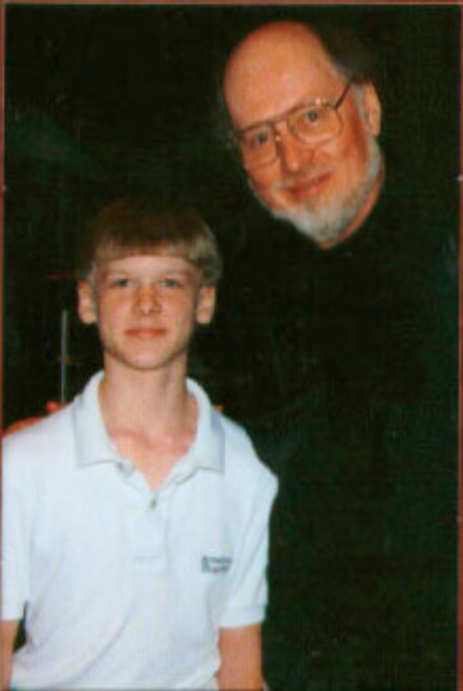
A young Lawrence Wiliford with composer & conductor John Williams in 1990
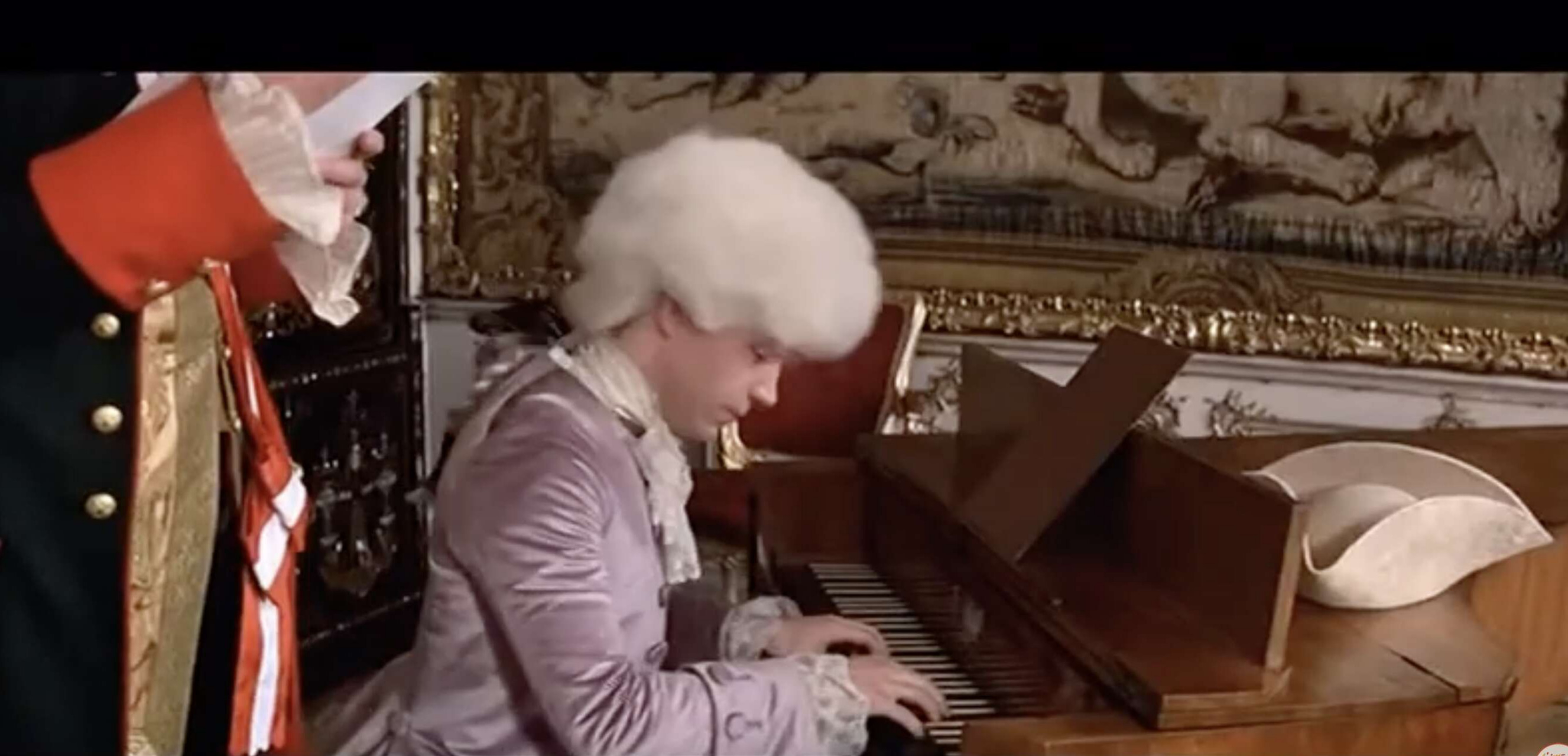
Seeing Amadeus—Miloš Forman’s film based on Peter Shaffer’s play—was genuinely life-changing. It introduced me not only to Mozart and opera, but to the idea that music could be surrounded by drama, politics, psychology, and history in a way that felt immediate and visceral.
Tom Hulce as Mozart in Forman’s Amadeus
I also remember animated shorts from my childhood—playful, educational, and imaginative—that introduced basic musical ideas long before I ever walked into a concert hall.
When my daughter was born (ten years ago!), I assumed it would be easy to find age- appropriate, engaging ways to introduce her to the performing arts and to concert music. In reality, the options were surprisingly limited. There are a few touchstones—the Eric Carle animated short I See a Song, the Fantasia films, the Classical Kids recordings—but they are exceptions. Considering the sheer volume of content available to young audiences today, non-commercial jazz, classical, and art music are remarkably absent from the visual and narrative spaces where people actually encounter culture.
That realization connects very directly to both my thesis and CASP’s current work. The thesis argues that the performing arts sector, particularly in classical music, lacks effective mechanisms for reaching people who are not already part of the Western concert music tradition. That problem hasn’t gone away. If anything, it has become more pronounced. The audience for concert music that is not attached to an existing IP ecosystem—Bridgerton, Dune, Harry Potter, Final Fantasy, Zelda—continues to shrink. I don’t believe that is because the music itself lacks relevance or resonance. I think it is because our practices remain largely disconnected from the cultural spaces where most people now encounter storytelling.
One of my priorities with CASP flows directly from that thinking. Alongside live performance and recording, we are deliberately developing media-specific projects: animated shorts based on individual art songs (which are naturally well suited to animation in scale and duration), and longer-form film projects based on song cycles. These projects are not conceived as documentation of stage work, or simply as marketing tools for concerts, but as standalone artistic works designed for the screen. They bring composers, performers, filmmakers, animators, and designers into genuine collaboration around Canadian stories and voices.
In that sense, CASP’s work is a practical continuation of the questions raised in the thesis. Where the thesis was diagnostic, CASP’s projects are experimental responses. What remains unresolved—and this is where the line from then to now is clearest—is the structural issue. Funding models, labour frameworks, and cultural policy still struggle to fully recognize hybrid performing arts and screen-based work as artistic creation in its own right.
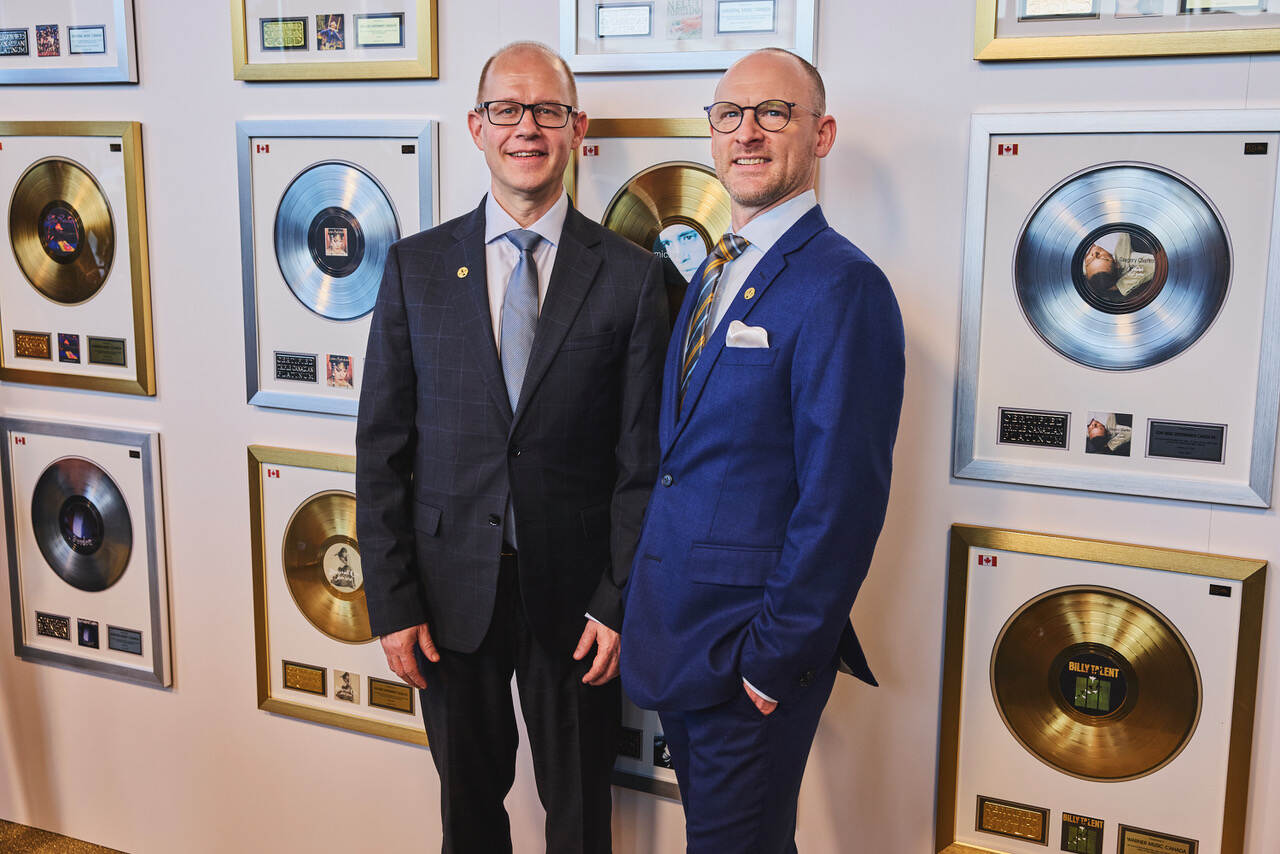
Steven & Lawrence Steven at the JUNOs last year
Filmed projects are often positioned primarily as engagement or outreach activities, rather than as works of artistic creation with intrinsic cultural value. I’m convinced there is an audience for media-specific performing arts work. The challenge lies in developing sustainable creation and production models that combine public investment with partnerships across the screen sector, including producers, broadcasters, and digital platforms. Public funding can support research, development, and artistic risk, but long-term sustainability will require cross-sector collaboration and access to domestic and international distribution ecosystems.
BB:Should Canada emulate what the Met and European opera houses do in capturing performances for broadcast?
Lawrence Wiliford: I don’t believe that any Canadian company can—or should—try to replicate what the Metropolitan Opera does. The Met operates at a scale, with funding structures, branding, labour agreements, and long-standing broadcast infrastructure that simply don’t exist in Canada. Similarly, while some European opera houses distribute work through platforms like Medici or MarqueeTV, they are working within different public-funding models and artist contracts that explicitly account for filming and long-term distribution. Those conditions are not easily transferable to the Canadian context.
Where I do think there is a viable and exciting path forward for Canada is working intentionally with experienced production companies on discrete, purpose-built projects. Rather than attempting ongoing capture or large-scale broadcast replication, Canadian organizations can focus on one-off or limited projects that are conceived specifically for the screen, with a clear artistic vision and an understanding of film as its own medium. That approach allows for higher quality, greater coherence, and more realistic production and distribution partnerships, without placing unsustainable expectations on performing arts organizations.
Career / Repertoire / Media Questions
BB:Reconciling earlier music (Classical/Baroque) with new music for CASP—disconnect, or growth?
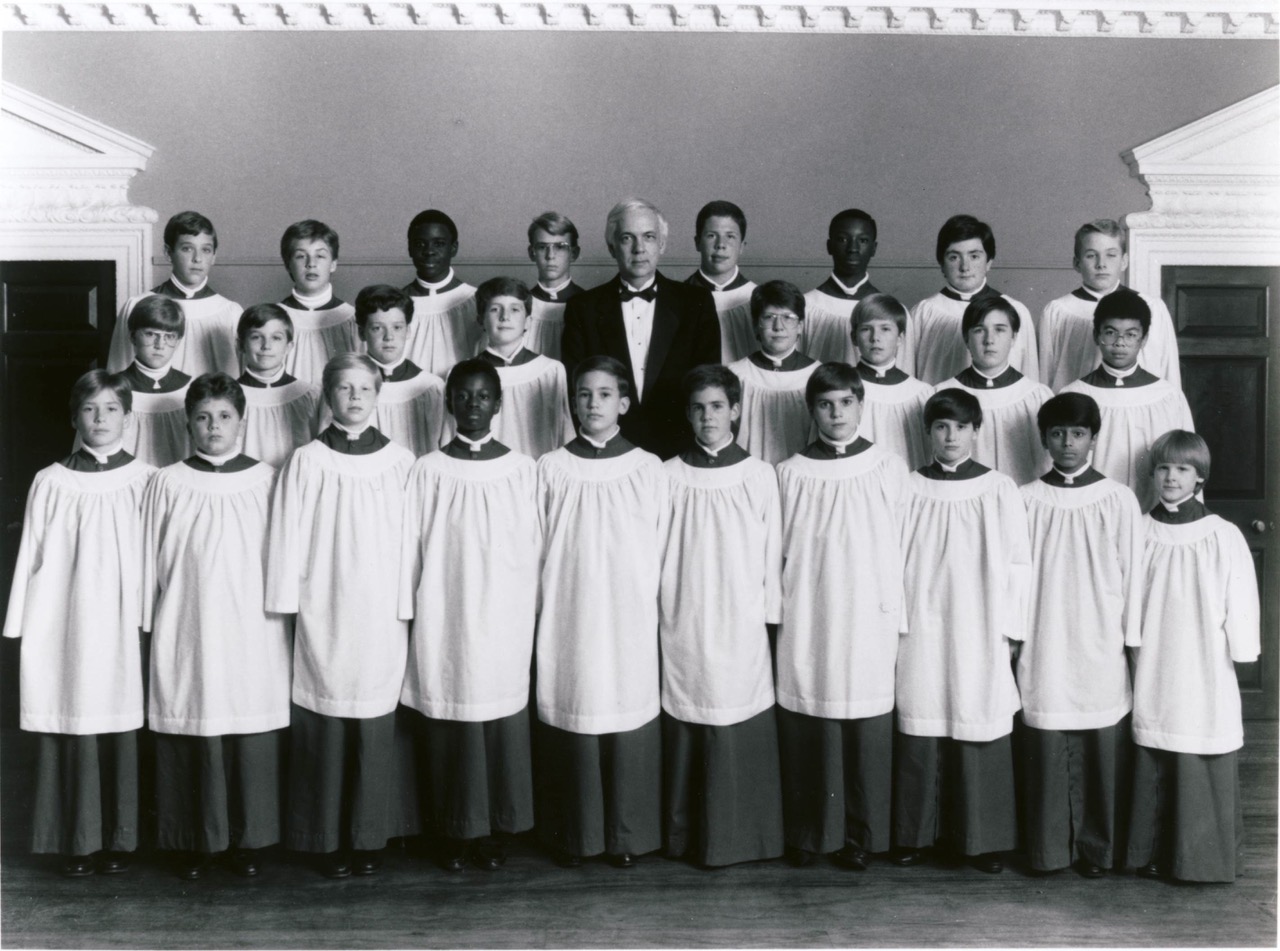
Lawrence Wiliford: I don’t experience it as a disconnect at all. My musical foundation was never exclusively focused on earlier music. My earliest formative training came through my years singing with The American Boychoir in Princeton. That repertoire spanned centuries. We sang early music, Romantic choral works, and contemporary commissions. I still vividly remember premiering a commissioned work by Milton Babbitt. From a very young age, I understood that new music was not an outlier, but part of the same continuum as historical repertoire.
American Boychoir 1987, Lawrence is on the end of the front row, right side
That sense of continuity carried into my undergraduate studies at St. Olaf College, where I focused on choral conducting and solo vocal repertoire. Minnesota has a particularly strong contemporary music culture, shaped by the American Composers Forum and by composers such as Dominic Argento, Stephen Paulus, and Libby Larsen. New music wasn’t something exotic or separate; it was simply part of being an engaged musician in that environment.
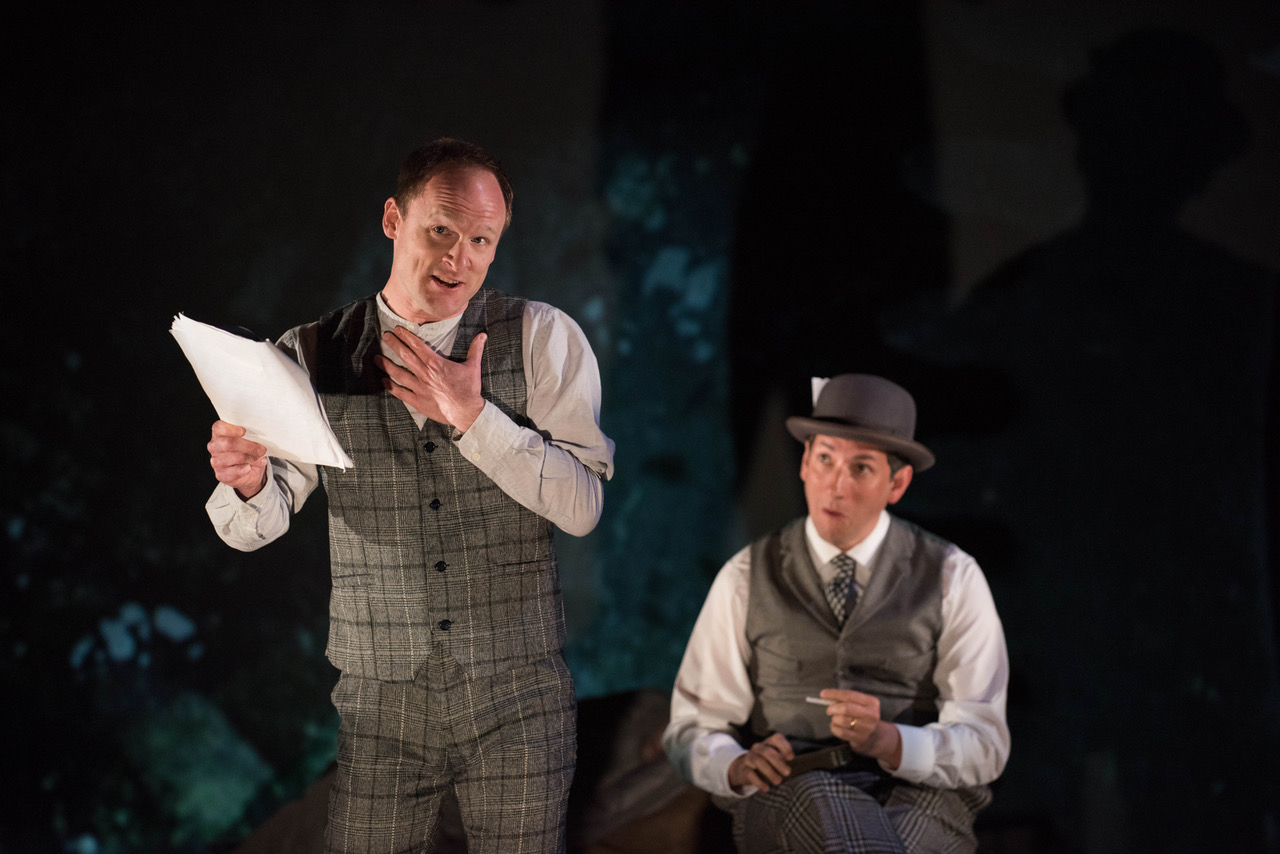
Francis Flute in A Midsummer Night’s Dream 2017 at The Aldeburgh Festival at the Sape Maltings (photo: Hugo Glendinning)
In many ways, my professional focus on Baroque and Classical repertoire came later, largely because I was asked to perform it and was drawn to it—probably through my choral background. But even there, what attracted me was not the historical distance, but the immediacy of communication and storytelling. Attention to text, rhetoric, phrasing, and meaning is central in Baroque music, just as it is in contemporary vocal writing.
The work I do now with CASP feels like a natural extension of that trajectory. For singers trained in the classical tradition, much of our professional life is devoted to reinterpreting works that have already been performed countless times. That can be deeply rewarding, but artists also need opportunities to create. There is something uniquely powerful about singing words and music that have never been performed before, and about being part of the process that brings new work into the world. I feel a real urgency in ensuring that classical music is not only rooted in the historic canon, but also expanded to reflect lived experiences that are often missing, so that our collective work remains meaningfully connected to contemporary life.
Looking back, the balance between earlier music and new music feels right. At both ends of the repertoire spectrum, the core skill is the same: communication. Whether the music is Baroque or newly written, the responsibility of the singer is to make text, intention, and meaning come alive. In that sense, my work as a performer and my work with CASP are not separate paths, but different expressions of a similar artistic impulse.
BB:Do we of the press/media oversimplify by categorizing an artist by fach or style?
Lawrence Wiliford: Yes, although I think that oversimplification is often a reflection of how the repertoire used to be taught and performed. There may have been a time when these distinctions mattered more, but I don’t find them particularly useful for me—or for many singers working in North America now. Even if someone wanted to build a career singing only Baroque or Classical repertoire, it would be very difficult to do so. In North America, that repertoire is performed not only by historically informed ensembles such as Tafelmusik or Arion, but also by regional orchestras and large symphony orchestras, almost always in sizeable concert halls. That means singers need to produce sound that can carry in those spaces, rather than working within the narrower parameters often associated with specialist ensembles.
So, while the press may want to categorize an artist by fach or style, the lived reality of the work is far more fluid and practical. Singers adapt to the contexts in which the music is presented, the ensembles they collaborate with, and the spaces in which they perform. As a coach once said to me—and still reminds me when I question a particular repertoire choice—you sing what you’re paid to sing, as long as it doesn’t hurt you. That said, there is repertoire that feels more comfortable and repertoire that stretches me, and I prefer not to stretch too far from my happy place.
BB:What don’t we understand about live performance vs filming live performance?
Lawrence Wiliford: I think what we often misunderstand is that filming live performance doesn’t just capture it—it changes it. Live work is built around shared presence and scale, while filmed (and studio recorded) work is shaped by framing, editing, and point of view. Once a camera and editing are involved, you’re no longer dealing with the same art form.
BB:Good point! That’s an understatement.
Lawrence Wiliford: A good example is Hamilton. The filmed version works because it was very clear about what it was trying to be: a carefully produced record of a landmark stage production. It wasn’t trying to become a movie, and audiences understood that going in. That clarity of intent is part of why it succeeded. In that sense, it’s similar to why people used to buy DVDs of opera productions. You might want to hear the singers, of course, but you were also watching to experience a particular production as a snapshot in time, or to understand a stage director’s approach to a well-known work. Neither those DVDs nor the streamed Broadway cast of Hamilton were ever intended to replace the live experience; they were intended to amplify reach.
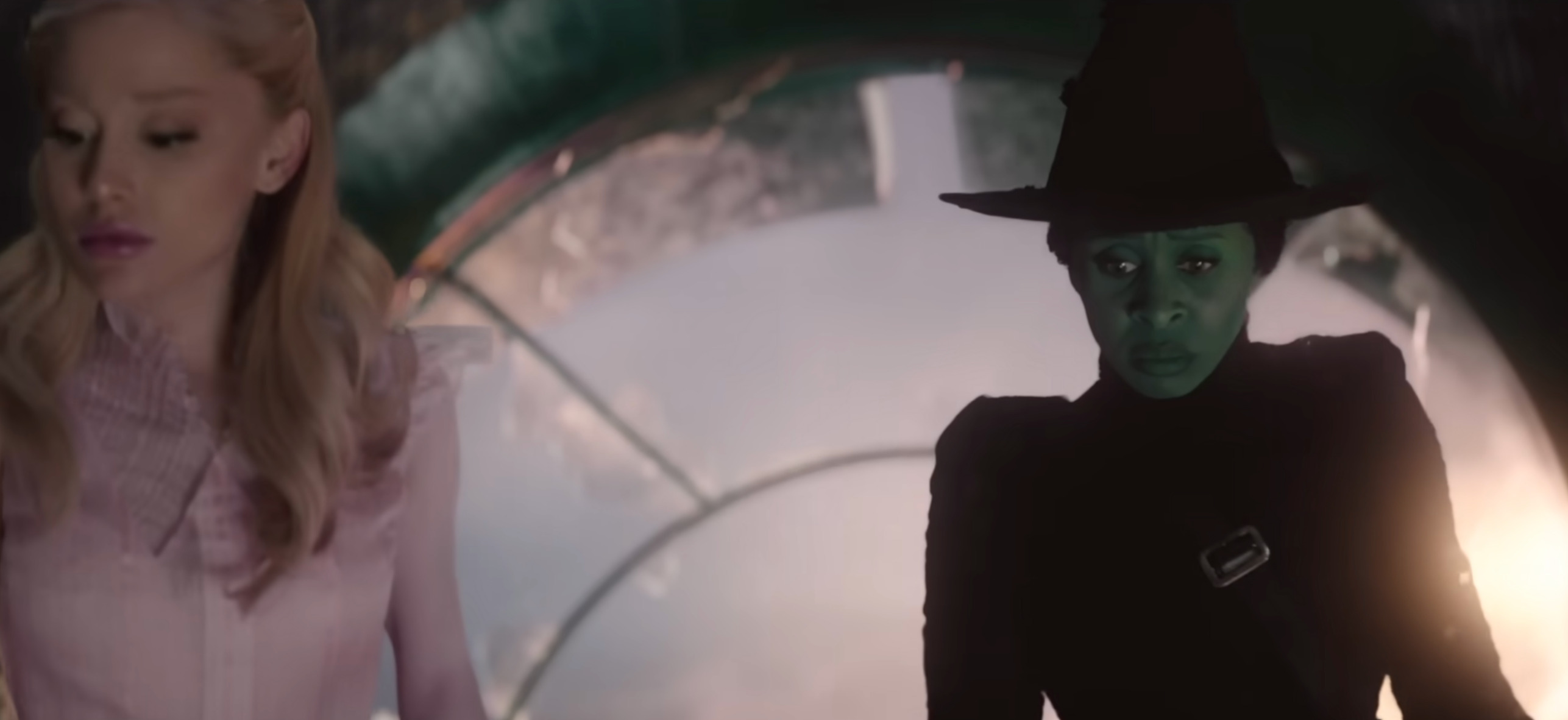
The Wicked films show the other side of the coin. The filmed adaptation makes huge adjustments to scale, spectacle, pacing, and visual storytelling to take advantage of what film does well. It doesn’t try to preserve the stage experience; it re-imagines it for the screen.
Where we still struggle, especially in the performing arts, is assuming that documentation and adaptation are the same thing. They’re not.
BB:Wow, in fact you’re showing me that there’s a whole spectrum, arguably as many different forms as there are different media. Hm, lots to contemplate. Thanks.
Lawrence Wiliford: Until we’re clearer about whether we’re preserving a live event or creating a work specifically for the screen, filmed performance will keep feeling unsatisfying—even when it’s beautifully shot. To be clear, I think capturing stage productions on film is valuable. It documents work, preserves performances, and allows audiences to encounter productions they might otherwise never see. But that isn’t really what I’m personally most interested in.
What excites me is adapting work for specific media, or creating projects conceived for the screen (and other media) from the outset. Media-first work allows one to think differently about scale, intimacy, pacing, and storytelling, and to explore intersections between film, animation, recording, and the performing and vocal arts in ways that live capture simply can’t. That’s where I feel there is real creative potential right now, and a meaningful opportunity to broaden our reach.
CASP / Culture / Support Questions
BB:How do you feel about the way Canadian singers are supported & received in Canada, especially in Ontario?
Lawrence Wiliford: There are many strong opportunities for young and emerging singers in Canada, particularly in Ontario. Our training institutions, young artist programs, and early-career platforms are genuinely excellent. Where I think the system struggles most is supporting singers at the mid-career and later stages. This isn’t entirely new, but it is more challenging now than it was even when I was coming up.
The sustainable pathways for maintaining a long career in classical vocal music in Canada are quite narrow. We cultivate remarkable talent, but unless an artist moves quickly into an international career, relocates to Europe, has access to independent financial support, or transitions into institutional teaching, it becomes very difficult to remain an active artist beyond the mid-30s. That isn’t a reflection of artistic quality; it’s a structural reality. And this doesn’t even begin to account for broader life pressures such as housing, starting a family, or the cost of childcare.
Canada relies heavily on provincial and federal grants to support individual artistic development, and for classical singers in particular that model is under increasing strain. Grant programs are extremely competitive, and understandably so. At the same time, classical solo vocal music now engages a smaller and more specialized audience, and access to live performance has become more limited and, in many cases, more privileged than it once was. That context makes it harder for singers to demonstrate impact in the ways funding systems often require. I will say that federal funding has, in recent years, been more robust than provincial funding, and I was relieved that the most recent federal budget did not include cuts to arts and culture, as many in the sector had feared. In Ontario, however, the level of investment remains a serious concern.
There is also a question of alignment. Peer juries are asked to assess an enormous range of artistic practices, and classical vocal projects can be difficult to articulate within frameworks that prioritize discrete project outcomes, innovation metrics, or short-term public reach. That doesn’t mean those frameworks are wrong, but they don’t always map well onto the current realities of the classical music industry in North America. The result is a gap at exactly the point where artists should be consolidating their practice: developing and expanding into mature repertoire, undertaking first recordings, deepening collaborations, and taking artistic risks that aren’t immediately marketable. If the only viable pathway is a few years in young artist programs followed by a patchwork of short contracts, travel, auditions, and largely self-funded development, we risk losing an entire generation of Canadian singers.
I don’t think the answer is simply more funding, stricter quotas, or pitting artistic traditions against one another. The real challenge is designing support systems that recognize long-term artistic growth, provide meaningful mid-career stability, and value vocal artistry as a sustained practice—without relying entirely on opera companies and orchestras that are facing serious funding challenges themselves. If we don’t address that, we will continue to train exceptional singers who ultimately have no viable way to remain artists in Canada.
BB:Tell us about the most recent CASP animated short.
Lawrence Wiliford: The Piece Atop His Pate is an animated short inspired by Jocelyn Morlock’s song “Bobby Hull” (premiered by Tyler Duncan and Erika Switzer), from her cycle Perruqueries, with text by Bill Richardson. It’s a sharp, funny, and surprisingly operatic take on one of hockey’s more peculiar moments: the 1978 WHA game in which Bobby Hull’s toupee was knocked loose on the ice. Morlock and Richardson take playful liberties with the story, turning it into a satirical art song that blends Canadian sports mythology, media culture, and musical wit.
We released the short in the fall, and it’s now available to watch online:
The song is performed by baritone Keith Lam, with Steven Philcox at the piano.
Baritone Keith Lam
It was professionally recorded and mixed by Dennis Patterson at Imagine Sound Studios in Toronto, and produced by me. That recording became the foundation for the film and was conceived specifically for a visual medium, rather than simply as a stand-alone audio document. The animation was created in collaboration with students from OCAD University’s Department of Experimental Animation, under the supervision of Philippe Blanchard and myself.
Philippe Blanchard, OCADU
A large team of students worked together in a studio-style process, with clearly defined roles including story-boarding, research, character design, animation direction, and visual development. I presented a project brief outlining specific parameters and references we wanted to explore, and the students began by researching the era and cultural context of the song. Visually, they drew inspiration from late-1970s CBC hockey broadcasts, analog television graphics, and Hanna-Barbera animation—particularly the Peter Puck cartoons that once helped explain hockey rules to young viewers.
Peter Puck
Listeners may also catch a playful nod to Dolores Claman’s Hockey Theme, which immediately situates the piece in a shared Canadian memory.
One of the challenges—and pleasures—of the project was working with a real historical figure.
Bobby Hull
Bobby Hull is a complicated and, at times, controversial character, so we were very conscious of tone, aiming for satire that was good-humoured rather than cruel. The students leaned into empathy as much as irony, finding a balance that allows the audience to laugh while still recognizing the vulnerability of the moment.
Lawrence & Steven with the OCAD students who made The Piece Atop His Pate
The introduction of a mascot-style narrator character, Stan, became a way to guide the story visually and give it a slightly absurd, self-aware lens, while also nodding to the visual language of Peter Puck without directly replicating it.
For CASP, this project is as much about process as outcome. We start by creating high-quality audio recordings of Canadian art song and then place those recordings in the hands of visual artists who are encountering this repertoire for the first time. The students are asked to respond creatively to both the music and the text. What’s been consistently striking is how personally invested they become in the projects, and how often they describe this as their first experience of art song as something living, flexible, and relevant.
The Piece Atop His Pate builds on our earlier animated short The Wild Goose and points directly to where CASP is heading.
Alongside live performance and recording, we’re committed to developing media-specific projects that allow Canadian vocal music to intersect with film, animation, and contemporary visual culture. These projects aren’t about replacing the concert hall; they’re about expanding how and where Canadian musical stories can be encountered. Our next animated short, My Agnes from Niagara, based on a song by R. Nathaniel Dett, will take this approach into very different historical and emotional territory, but the underlying objective remains the same: to bring Canadian art song to life in unexpected, thoughtful, and distinctly Canadian ways.
BB:In 2025 Canadian culture seems precarious… thank you and CASP for doing your part…
Lawrence Wiliford: Thank you—I really appreciate that. I’m very conscious of how important it is to create opportunities in Canada for artists to build sustainable careers and to share Canadian stories, both here and abroad. That’s very much at the heart of what CASP is trying to do.
BB:Could you offer any advice to Canadian singers?
Lawrence Wiliford: My advice for Canadian singers is to absolutely invest the time and energy into building a solid technique. Listen to a lot of singers early—not to copy what they do, but to understand what really good singing and artistry is. Try to find opportunities to collaborate with more established artists and learn from their experience.
Then—go be an artist. Find ways to contribute to what it means to be a singer now. In the current context, very few people will be able to build careers the way singers did in the past. Most will need to juggle performing with something else, so blaze a trail that makes that possible for you, if indeed that is what you want to do. Above all, be original. Create, and bring what makes you unique into your performing.
BB:Do you have any influences/teachers you want to acknowledge?
Michael & Linda Hutcheon
Lawrence Wiliford: My circle of support over the last 15 years or so includes my voice teacher, Lorna MacDonald (also godmother to my daughter), Liz Upchurch, who really believed in what I had to offer during my training as a COC Ensemble Member, Don Tarnowski, who has been my primary vocal coach for most of my solo career, Michael Albano, who guided me as a stage director during my graduate work at U of T and served as a secondary reader of my thesis during my MA in Media Production at TMU, and my MRP supervisor at TMU, James Nadler. I also need to thank Linda and Michael Hutcheon for their incredible support, both personally and the work of CASP.
Steven Philcox has been an incredible friend, musical collaborator, and artistic partner, both within and outside of CASP.
Steven Philcox & Lawrence Wiliford
Finally, my spouse Katie Larson and our daughter, Lyra. The honest truth is that I couldn’t have continued to be an artist in Canada without Katie’s support, and my daughter rejuvenates how I perceive the world almost daily.
There are many others from my life and training prior to my arrival in Canada that are very important (indeed vital) to my development as an artist, but I think in this context, the more I name, the more I might unintentionally leave out. I am indebted to so many mentors and friends. They know who they are.
Toronto Operetta Theatre began the new year of 2026 looking over their shoulders with a romance that had its premiere over a century ago in Vienna: Imre Kálmán’s Czardas Princess. We went on the weekend sitting among a boisterously enthusiastic crowd as the run closed with matinees Saturday & Sunday January 3rd & 4th at the Jane Mallett Theatre.
Before the show I had a friendly chat with TOT’s Artistic Director Guillermo (Bill) Silva-Marin. Bill reminds me a bit of the god for whom the month of January is named, namely Janus the two-headed wonder who manages to look both forwards & backwards.
Yes I know that Bill’s picture only has a single head even if he does a great job of emulating Janus, looking in multiple directions at once.
Guillermo Silva-Marin aka “Bill”
That’s Bill’s job with TOT, trying to satisfy audiences for the only company in Canada that specializes in operetta. While he chose last fall to look forward to the questions relevant to 2025 by updating Mikado to something contemporary & Canadian, this time Czardas Princess looked back to an era of arranged marriages and class consciousness. That’s the challenge of operetta, reviving works that may seem to belong in a museum while aiming to entertain audiences.
Offering a show full of singing and dancing is usually the best solution!
(from left) Scott Rumble (Edwin), Joseph Ernst (Feri), Sebastien Belcourt (Count Boni), and Maeve Palmer (Sylvia Varescu), photo: Gary Beechey, BDS Studios
Conductor Derek Bate led the TOT orchestra, a small ensemble whose sound fills the space without overwhelming the soloists, keeping everyone together even when they were airborne, as in the picture above.
Conductor Derek Bate
Scott Rumble’s powerful tenor confirmed that while he’s ideal to sing Wagner (as he has done out west), he’s a versatile artist, his piercing high notes heard even when the entire cast was singing at the same time. Scott’s enunciation as Edwin was crystal clear, opposite Maeve Palmer in the title role aka Sylvia. Whether in her diva guise or pretend role as nobility, Maeve didn’t just sing beautifully but also showed a touching vulnerability in her portrayal.
Patricia Wrigglesworth (Countess Stasi) , photo: Gary Beechey, BDS Studios
The other pairing may have been written to be a lighter, more comical couple in contrast to the lead pair. Count Bonifazius (aka Boni) and Countess Anastasia (aka Stasi), the latter supposedly betrothed to Edwin were my favourites. Sebastien Belcourt played Boni largely as a fun music-theatre figure, while Patricia Wrigglesworth as Stasi, underplayed her role, gently deadpan much of the time. As a result they were the most believable couple onstage. I can’t decide whether they stole the show or maybe that’s just how the text is written: but it worked beautifully.
TOT’s next shows feature Johann Strauss Jr. On March 7th it’s TOT Cabaret: Strauss – the Waltz King, perhaps helping prepare us for Strauss’s A Night in Venice coming April 17, 18 & 19. For tickets & information click here.
Zoe and I walked through the many wonderful pieces displayed in Joyce Wieland’s show Heart On, running at the AGO until Sunday January 4th.
The conversations I have been having with Zoe about criticism can feel different depending on where we are. Over dinner in the restaurant the tone is calmer than in the gallery in the thick of it. Location matters in more than real estate.
At the end of the year it’s normal to use sweeping generalizations. They are our broom to tidy the mess.
I apologize for my use of labels even as I search for the best ones to describe what I’ve seen. There was a painting among the first few I saw that I thought to call “primitivist”, meaning the style / movement that deliberately emulates something from a non-western culture and all that can suggest. The word is so big and heavy with allusions and implications I want to retreat back to grunts and gut-level responses without resorting to words, especially when the artist herself did not necessarily embrace them.
I read that she’s a feminist, a Canadian nationalist. I don’t know how to process that in 2025 terms, only that I recall when it was brand-new in the 1960s, when our flag had just been designed and introduced in 1965. There are layers to each of these, stages of development in each word as it’s understood to be a movement with some only partially in support, some pushing back, some articulating “feminism” or “nationalism” in ways that are no longer done the same way.
When I encountered the picture that moved me the most I had to photograph it.
My photo of Shaping Matter oil on canvas, 142×180 cm by Joyce Wieland
I saw a few responses when I posted my photo on Facebook, including one from my friend Edward Brain. Edward said “Interesting painting, but not my style personally.” I was moved to reply, recalling that I first met Edward at the Toronto Wagner Society.
I said “It’s funny this strikes me as a very Wagnerian painting (as I aim for an epithet that might inspire you). This painting shows an artist self-reflexively. She’s painting even though her image is naive, simple/ simplistic , suggesting humility, alongside / within a landscape that’s like a volcano of creation. What exactly are we seeing? Fire pouring out of the sky to make a landscape: as the painter is “shaping matter”? I say that because (spoiler alert) the person standing painting also is the person who made this happen/ erupt. Yet she seems so calm. It took my breath away. I think Edward if you stood before the painting you might hear thunder or something comparable (perhaps from one of the Ring cycle operas).
If we recall that the painting is titled “Shaping Matter”: we are watching a painter in a painting. Of course the painting was painted by a painter, so it’s not a huge leap to say that the painter we see is in some respects an image of Joyce Wieland, the painter in the act of painting: shaping matter. The image is self-reflexive, even as I wonder: but what am I seeing?
Maybe that sounds crazy, but let me explain my Wagnerian allusion for this painting. I was mindful of the moment in Das Rheingold when Donner strikes the ground with his hammer, conjuring a lightning storm out of the sky. The rainbow that follows the storm will be the pathway the gods use to enter Valhalla. The relevant moments in this video come about 2 minutes in, and following.
Of course Wieland is a million miles away from the pompous Wagnerian opera. Even so, when we speak of “Shaping matter”, I can’t ignore that fire seems to pour out of her sky, and the ground takes shape in a variety of shades. Is the painting an image of her imagination, the stage upon which she gives the world shape? Yes I see it as partly a bit of theatre. Is the fire made by the painter but coming from heaven, from the gods? You tell me. The figure who holds a brush and palette in the painting is looking back at us.
What are we seeing? I am not sure but it’s electrifying.
As I told Edward in reply “I keep staring at the image. I will try to get back to the show for another look before it closes.“
And let me mention in passing that the image I downloaded from the Canadian Art Database is different from my photo, and both differ from what I experienced standing in front of the painting. I’m reminded of why live performance and live experiences of art matter. You don’t get it the same way in a book or on video.
Shaping Matter: from the Canadian Art Database
There is a tendency in some of Wieland’s paintings that I want to call “naive” after a bit of googling for the best descriptor of a style that suggests childlike imagery and a childlike artistic sensibility.
Notice that the face of the artist shown in this sophisticated painting is in some respects an image of naivete even though she’s in the middle of this complex image. No wonder considering the way she was sometimes attacked (something I recall sadly).
As I look at her image in the painting, I’m wondering what she felt making this, what ironies might have been in play.
Sometimes my need to explain myself leads to huge introductions that may confuse or perplex, pre-ambulations that happen both on foot and in the words of the blog.
As 2025 closes I escaped into recreation at the Red Sandcastle Theatre, where I took daughter & BF for a bit of escapism through Buster Canfield & his industrious fleas.
Eric Woolfe is the magician – puppeteer portraying Buster Canfield.
Buster alias Eric among his admiring throng of fans
Before the show Zoe and I (plus the BF) talked about criticism, art and the meaning of life. Does that sound insane in this context? Or maybe to be expected.
Lately deep truths and Buster’s fleas share similarities, which is to say, they’re almost impossible to see, hard to find, perhaps not even there at all.
Speaking of escape: as I was talking their ears off about judgmental critics, Buster (Eric) worked his magic.
In the year since my mom’s passing, from time to time I think back to grad school & the study of theatre history in books such as Nagler’s Source Book, as I question the meaning & purpose of my blog, wondering if anything can be helpful.
I won’t make an awkward segue from the flea circus to something more serious, as this is normal for me, a stranger in a strange land. While I may write criticism my understanding of the word is different. I don’t judge, I don’t dismiss, and if someone’s performance is not good in my estimation, I will not write about it. I want to be positive, to be Pollyanna in saying only good things and avoiding negativity.
Funny today as I was listening to Vince Gilligan quoted on Q, broadcast by CBC today, I heard a call for more stories about good guys, while he seemed to lament the glamour of the bad guys.
I have to laugh but first let me quote Vince G.
“As a writer, speaking to a room full of writers, I have a proposal … I say we write more good guys. For decades, we’ve made the villains too sexy…. They say, ‘Man, those dudes are badass. I want to be that cool!’ When that happens, fictional bad guys stop being the cautionary tales that they were intended to be. God help us, they become aspirational.” (Vince’s full interview)
This is somehow new? Come on Vince, what about the readers mistaking Satan for the hero of Paradise Lost, written in the 17th century? No I’m not changing the subject, I’m saying that the same dynamic that gives us a preference for villains over heroes, also messes up our appreciation of the arts AND even worse, makes nasty reviews clickbait while positive supportive reviews languish in relative obscurity.
No this isn’t me lamenting the number of hits I don’t get.
When I wrote about the recent presentation by Canadian Stage of Robert Lepage’s Ex Machina show The Far Side of the Moon, I was intrigued that they promoted it mostly as a nostalgic look at the space program with little mention of the autobiographical elements in the play.
And then I remember: that’s not Canadian Stage’s choice but the playwright’s. Maybe Lepage is reticent & shy even as he rips his belly open, showing us his entrails and flaws for us to examine. Of course he wouldn’t call it autobiographical but it’s obvious in its self-referential moments.
Isn’t it?
And I kept seeing a surprisingly rough tone in what other critics said about him, people taking shots at him in their assessment of the play. Lepage at one point speaks of narcissism, and if that weren’t sufficiently vulnerable, gets accused of being a narcissist. I saw a great deal (yes I later surveyed the reviews by others, long after I had written my own) about the technical prowess, with little apparent sympathy for what is felt in this show.
I say this after weeks pondering Lepage and his play, through the lens of the 2003 film version. When I heard that he’d filmed the play I got all excited and called up Bay St Video. I had hoped to buy it but dammit all, alas, it’s out of print. So I rented it for the week.
Watching Lepage’s film alongside 3 other non-commercial titles (Birdman, Klimt and War Requiem) had me thinking about the challenge of popularity, when some might mistake the box office returns for a true measurement of quality. Do I really have to say it? A film or an opera is not necessarily better just because lots of people went to see it. Box office is regularly used as an instrument to assess the success of commercial cinematic projects. And of course, there we go again, with a dynamic like the one with Satan in Paradise Lost. I am reminded of my frustration with Barbenheimer, when I loved Barbie and thought Oppenheimer was over-rated: but because of the usual response to their subjects, the comedy made money while the serious epic was treated as somehow better. I wonder if that verdict will persist.
Klimt & War Requiem, like Far Side of the Moon, were never going to generate a big audience, unlike the critically acclaimed Birdman.
I suppose I should not be surprised, especially when I read some of the reviews from other Toronto critics, mostly buying into the idea we saw in the promotional material: that Lepage is giving us a nostalgic glimpse of the space program. I suppose it’s clear to me he was employing those materials to talk about himself when we saw Lepage himself in the film playing the parts. Of course.
I was surprised to see so many who seemed indifferent, or maybe it was the decision that this time Lepage was not going to be given such an easy ride, perhaps resented because so many admire him. I know I admire him. I have to wonder if my experience is different because of what I have been through as a caregiver, and now mourning the passing of my mother, and subsequently observing her possessions and photos in the months after her passing. I want to again quote a line from Ex Machina speaking to this work that says “there is a sometimesthin line between the trivial and the sublime.”
As in 887 (another Lepage play I’ve seen a couple of times), a poem by another author is recited. 887 is subtitled “Or how does memory work,” and although Lepage dwells on memories of his life, he is also sharing the process of memorizing the poem “Speak White” by Michèle Lalonde. For Far Side of the Moon the poem in question is now about a mother and her aging, the focus of the play surely upon her death and its impacts upon her two sons. By splitting himself in two (as Philippe & André) Lepage is creating additional distance. But that doesn’t mean the work lacks feeling.
And so it now occurs to me that 887 is in some respects an elaboration of what Lepage did in Far Side of the Moon, where he uses a poem as a departure point for some of the observations made by Philippe, one of the characters. At first I was going to say 887 is deeper but no. 887 is merely easier to grasp because any Canadian can identify with it, whereas Far Side of the Moon might be more primal in its subject matter.
Olivier Normand as the mother in the Ex Machina production of The Far Side of the Moon, presented by Canadian Stage in Toronto (Photo: Li Wang)
We watched Olivier Normand playing all the roles in 2025, roles originated by Lepage himself, including the mother and the doctor. In the film other actors play the mother and the doctor, but Lepage plays the adult versions of both Philippe and André. Watching the film I am more certain than ever that the imagery of the cold war space race are less nostalgia than the backdrop for an autobiographical meditation.
Philippe in the laundromat near the beginning of the film.
The images I captured from the video below show a stunning transition that I wanted to show that you see in the film.
Then we meet André, Philippe’s younger brother, who is a weatherman on tv in Quebec, forecasting for the upcoming Christmas holiday.
Philippe at the gym, where he meets Carl (André’s BF)
The questions of reconciliation between USSR & USA are presented alongside the antipathy of two brothers, both of whom have a relationship with the sky, that in some ways encompasses the two sides of Lepage the artist. He’s both mainstream like André the tv weather man and a risk taker like Philippe the researcher.
Philippe has seen an invitation from television for video submissions to SETI, the international Search for Extraterrestrial Intelligence project. You may recall seeing some of this in the film Contact, where an array of radio telescopes were trained on the sky listening for some kind of evidence of intelligence. What’s different in this case (in the film) was the invitation to create a message that would be sent out. That’s what Philippe was doing.
When André hears of Philippe’s project he jokes: you say nobody listens to you but now the whole cosmos will hear you.
Philippe would give the aliens a primer on humans living on Earth, a wonderfully oblique way to show us who he is. At one point Philippe offers a kind of roadmap for the hypothetical alien visitor searching for Earth, describing our solar system & the blue planet that’s the third from the Sun.
The examples of Philippe’s video are in black & white to let us know we’re watching what Philippe has filmed. Would an old camera be B & W? Perhaps.
He is in the USSR for the conference where he misses his time to present. While there, he talks about poetry as the place where complex truths are captured.
He reads the Émile Nelligan poem Before Two Portraits of My Mother. Just as in 887 Lepage turned to an external poet to articulate a truth he wanted to echo or explore. On that occasion it was Speak white, a poem about the francophone experience in Canada. This time it’s a poem about portraits of mother. Need I repeat the obvious? Neither the play nor this film is merely about the space program. Here’s the poem.
BEFORE TWO PORTRAITS OF MY MOTHER
I love the beautiful young girl of this portrait, my mother, painted years ago when her forehead was white, and there was no shadow in the dazzling Venetian glass
of her gaze. But this other likeness shows the deep trenches across her forehead’s white marble. The rose poem of her youth that her marriage sang is far behind. Here is
my sadness: I compare these portraits, one of a joy-radiant brow, the other care- heavy: sunrise – and the thick coming on
of night. And yet how strange my ways appear, for when I look at these faded lips my heart smiles, but at the smiling girl my tears start.
Emile Nelligan (1879-1941)
I can’t help being a bit overwhelmed in encountering this, speaking as someone who has a house full of portraits of my mom, and who watched her smile bravely as she went from being the bold 80 year old to the bold 90 year old, the bold 95 year old (still driving her Honda civic), to the bold hundred year old using canes and then a walker, and then a wheelchair. I am also overwhelmed because I am frankly astonished that I did not read about this even once in responses to the play, but only in a comment from my dear friend Mary Walters, directing me to the text of the poem. (thank you Mary) The omission by critics seems rather huge, like a review of a Ring cycle opera that doesn’t mention that there are people singing. But come to think of it, that’s really apt, given that from what I see, they simply were un-moved, didn’t find Lepage’s imagery nearly as compelling as I have.
There’s a powerful scene when André looks at the the empty wheelchair in the home, one of the remaining pieces of evidence for his mother’s life. No words are needed. I shuddered at the image because it was literally so close to home for us. 2025 was the year of looking at the remnants, the furniture, the books, the clothes, and yes, even wheelchairs. Writing now as we come up on the anniversary of her passing I feel rather devastated. As I’ve been told, maybe it’s going too far to say that I’m moved to tears by something. I watched the film at least four times, plus a few extra views to capture the images you see in this blog. I hope Ex Machina / Lepage will forgive me. Indeed I forgive them that the film is out of print, which I find really upsetting.
Our understanding of objects changes with experience. I knew “wheelchair” differently, until I saw my mother in one, saw her struggling various times to get into or out of one, perhaps at the door to a hospital or doctor’s office. Looking at the wheelchair in this film complete with that cryptic Lepage expression is absurd in a Gustav Mahler sort of way, replete with comic overtones to tease you at a moment of enormous gravitas. Maybe my segue from the flea circus isn’t crazy at all.
I find the title brilliant, as I ponder the Far Side of the Moon as a meditative place. Pink Floyd had an album with a similar title that was among their best. I wonder if Lepage had to choose his title, mindful of copyright concerns.
Perhaps my reading of the film and play sounds odd. The thing is, here I am again, speaking about testimony rather than judgment. Yes the Canadian Stage production was a success, but I did not see any recognition of the play as autobiographical. I am not here to judge or assess Lepage, as good or bad, but to help with the digestion of his work, nor to judge the critics who saw it differently than how I saw it. A critique needs to be a digestive aid, like the rocks in a bird’s stomach to assist in breaking down / unpacking the work for others in the audience. The rocks are not to be hurled at anyone, neither the artists nor the critics who seem to love their villainous roles.
I wish those people who spoke dismissively of Lepage’s work on his play at Bluma Appel would watch this film, perhaps opening their hearts if not their minds. Maybe it’s because I’ve been tenderized like a veal cutlet pounded over and over by years of caregiving, challenged to empathize with the person in the wheelchair. I am sorting through the responses, intrigued but frustrated at dismissals from people who can’t seem to engage with what’s right in front of them. I suspect some of this is Lepage’s choice, perhaps reticent about laying himself bare and ready to allow the play to be misrepresented as a play about the space race, when it’s really all about him, the Quebecois artist confronting his two aspects, the commercially viable celebrity (like André the weatherman) and the risk-taking artist (Philippe who explores cultural impacts with his research). I wonder how fully he is reconciled to such emotions.
How can I look at this picture without getting upset?
I hesitated before posting my comments about Lepage’s film, suspecting that my perspective may be distorted by the recent passing of my own mom. Or perhaps it’s the other way around, that I’m not a jaded reviewer inured to human pain, desensitized by having seen too many films.
I hope I never lose my sensitivity to the magic of artists, whether they’re working with fleas or wheelchairs. I am forever grateful, Eric & Robert. Thank you.
While there’s something comforting in being able to return to a classic text year after year, I always hope to find ways to make it a fresh experience.
Tafelmusik’s first 2025 Messiah on Thursday December 18th at Koerner Hall had drama to spare, from the first solo by tenor Benjamin Done.
Tenor Benjamin Done
Of course that’s because Benjamin was replacing an indisposed Nicholas Scott, the tenor who may or may not be back for any of the remaining Messiahs this weekend (either Friday & Saturday at Koerner Hall or the Singalong at Massey Hall Sunday).
Tenor Benjamin Done during one of his solos with Tafelmusik, Ivars Taurins conducting (photo: Dahlia Katz)
After singing the splendid solos that follow the Sinfonia, namely “Comfort Ye” and “Ev’ry Valley”, Benjamin went back to his station in the chorus for the remainder of Part The First. In Part The Second the tenor usually has an enormous role, although some of those solos were taken by Soprano Stefanie True. I don’t know whether that is unusual or not, only that our printed programs still showed the assignment for the missing tenor.
Members of Tafelmusik Chamber Choir (photo: Dahlia Katz), including Benjamin Done among the tenors (right) and Kate Helsen (centre) at the end of the row of Altos.
We may think of a solo as the hardest task a singer faces, but it’s not necessarily true, given the many choruses, particularly when the section is as small as in the Tafelmusik Chamber Choir, where Benjamin shares the tenor line with another four singers (Paul Jeffrey, Will Johnson, Robert Kinar & Cory Knight: you can see the bios of the Chamber Choir). The amount of singing Benjamin did when you include solos and choruses was “a big sing”. The glowing appreciation Conductor Ivars Taurins showed at the end of each part (when we responded with our applause) for Benjamin’s work might indicate the underlying drama faced in preparation for the performances.
Speaking of drama, what choices did they face in the hours leading up to the performance? What adrenaline did they (meaning not just Benjamin but also Nicholas, Ivars, Stefanieand other members of the Tafelmusik team) burn in the hours leading up to the event, pondering whether to make cuts or alter assignments. One can only speculate, wondering how well they slept. But this is live performance, and that means that sometimes, especially in peak flu season, singers are indisposed, unwell, sick, and therefore must cancel: and yet the show still must go on.
Before any of this unfolded, before we heard about the changes, we saw and heard Olivia Chow speaking before the event, the Mayor of Toronto adding a bit more drama.
Mayor Olivia Chow speaking before the concert began (photo: Dahlia Katz)
I wonder what butterflies were flying in the stomachs of participants, as the show went on as if it was just another year of Messiah, to be presented as usual.
I wanted to experience Handel’s Messiah as something new and different. In addition to the drama I alluded to in the changed solo assignments, I had the good fortune to hear Messiah in an entirely new way due to my seating in the gallery section behind the stage.
I was staring at faces that were very close, that I know vaguely from social media or from past concerts. I wondered why Kate Helsen’s face looked so familiar, sitting at the end of the row of Altos. But of course she was the musicologist – vocalist who gave the speculative YouTube lecture for the Double Dixit concert last month. I was so close in the Gallery seating that not only could I see faces more clearly than ever before, I could vaguely make out the music. Here’s a picture I took of Patrick Jordan’s music stand as we awaited the resumption of the Messiah after the intermission (and yes I did use the zoom lens).
“Behold the Lamb of God” is hand-written in pencil.
I have often wondered what it’s like to see the fluid choreography & expressive movements of Ivars Taurins’ music direction from the vantage point of a chorister or orchestra player, rather than from the usual place behind him, sitting in the hall.
This photo is from the second gallery, a level higher than the level where I sat.
What a revelation!
If you want to hear a familiar piece as though for the first time, this is how to do it. The orchestra’s attacks, their climaxes, are all magnified, because from this vantage point you almost seem to be in the orchestra. The sound surrounds you. And with a conductor as demonstrative as Ivars, it’s especially exciting. I think I’ve said this before, that Ivars conducts orchestra and chorus alike as voices in a choir, that he brings out effects and moments with a vivid movement vocabulary suitable for dance, an eloquent body language.
Yes there are trade-offs. You’re no longer seeing the soloists from in front, so there’s a loss of the facial expression and much of the body language of a solo singer during one of their airs. If you are familiar with the work that likely won’t matter as the drama is very much there, via your identification with the performance. The eloquent silences in Krisztina Szabó singing “He was despised” hang in the air between the sung phrases and the soft responses from the orchestra. We see the audience responses. We see Ivars not merely as a leader of the ensemble but in such moments as a kind of ideal audience member, urging and guiding the performers, and he is clearly moved.
Mezzo – Soprano soloist Krisztina Szabó (photo: Dahlia Katz)
Is it always like this? I don’t know. But this was a magical performance to me both in my new location and especially watching the singers coping with the changed assignments.
As it has been a few years since I heard a Tafelmusik Messiah, I can’t be sure whether the glorious sounds I experienced are due to the location in the Gallery, where the orchestra is so close, or perhaps due to a renewed intensity in the interpretation from Ivars. The biting string attacks in Part the Second have never seemed so vivid, even if the effect was partly due to being closer to the players, partly also due to the chance to see Ivars’ directions from in front.
And as a sometime chorister it’s amazing to be so close to that chorus, a very cleanly articulated sound enunciated as never before. No they have never sung “For unto wuss a child is born” (a pitfall I was warned about in the 1990s by Art Wenk, when he conducted a Messiah at our church in North Toronto), every phrase from the chorus was clear, much clearer than what we heard from the soloists.
Whether singing softly as in “And he shall purify”, sung quicker than I’ve ever heard it anywhere else, or powerfully as in the Hallelujah or Worthy Is the Lamb, the voices of the Tafelmusik Chamber Choir surrounding us in the gallery achieve a remarkable sound that fills the space. Glorious.
The soloists perform important functions in the drama of Messiah. The radiant transparent sound from Soprano Stefanie True is essential to bring good news in the appearance of the angels to the shepherds on Christmas Eve, and again declaring I know that my Redeemer liveth, even before we speak of the additional solos on behalf of the indisposed tenor.
Krisztina Szabó offers operatic gravitas to every moment, commitment and focus. Bass Jonathan Woody announces that the trumpet shall sound with his own powerful clarion voice, in duet with the stunning trumpet sound from Kathryn James Adduci.
Bass soloist Jonathan Woody (photo: Dahlia Katz)
While I usually aim to do a night-of the concert write-up, I knew that the concerts are assured of selling out, not needing my promotion.
If I may insert one tiny quibble with the way Tafelmusik approach their media and self-promotion, I believe they are too reticent about Ivars, who has the charisma of a star in this community of self-effacing Torontonian artists. I wish others could see what I saw, given that we see a democratic approach showing every player in the orchestra, every singer in the Chamber Choir. For example watch this video I pulled up. It’s brilliantly played but Ivars is almost invisible, only seen from afar at the beginning.
If you compare that to how every other orchestra in the world works (where the conductor gets the focus of the camera) you may agree with me. Yes Ivars’ charisma enacting the role of Herr Handel in the Singalong Messiah is played up. But he is so much more than a comedian. His brilliant conducting in everything else does not get the attention it deserves.