Churchill – Darkest Hour

2017 may be remembered as a year that two movies gave us detailed portraits of Winston Churchill.

Darkest Hour is the one you’re probably aware of, starring Gary Oldman in an Oscar-nominated performance.  But I stumbled on another one with Brian Cox, titled Churchill.  Each has a very tight timeline concerning one small part of the biography of the great man.  While what I’m about to say is historical fact, please don’t read this if you’re afraid of encountering a spoiler.  For starters, Germany lost the war, but at the time it was far from certain.

Darkest Hour takes us from the time in 1939 when Neville Chamberlain is replaced as the leader of the Conservatives (making Churchill Prime Minister without the necessity of an election, but also without the blessing of a popular mandate), showing the doubts of all around him.

Churchill happens much later in the war, on the eve of the 1944 invasion of Europe and again concerning the conflicts between Churchill and all those around him.

Darkest Hour is a very inspiring tale showing a man full of doubt finding his authentic voice. Churchill, in contrast, shows a man who is again full of doubt, his own finest hours now behind him.  Where Darkest Hour is triumphant and uplifting, Churchill is a much darker exploration of the human soul.

I saw Darkest Hour on a big screen, so it’s perhaps not a fair comparison, but Churchill did not seem so impressive.  How could it? The budget for Darkest Hour is reported as $30 million while that for Churchill is but $10 million, and alas the latter film has only taken in roughly half of that total so far.  Chances are Darkest Hour will help swell that total (that is, people watching Churchill either by accident or design) by creating additional interest in the subject.  So far Darkest Hour has earned over $54 million, and that’s sure to swell in the aftermath of the Academy Awards, where the film has six nominations.

The portrayals are quite different, as indeed is the writing and cinematography.  And perhaps I can’t make any unbiased comparison between the actors, not when one of them is my favourite actor working today.

I know Cox for a role & portrayal I really disliked, namely Agamemnon in Troy.   As I scan his listing on IMDB, I see lots of films I saw, but can’t recall his performances: because they didn’t really make an impression. Nor did this one as Churchill.

And then there’s Oldman, who I treasure for

  • His portrayal of Beethoven in Immortal Beloved, a film I watch over and over
  • His portrayal of Lee Harvey Oswald in JFK¸ another film I watch over and over
  • His portrayal of Dracula
  • His portrayals of Commissioner Gordon in two of the Batman movies
  • His nasty creation as Zorg in The Fifth Element

Each of those five (a deaf composer, a killer, a vampire with a heavy Hungarian accent, a boring cop with heart, and a psychopathic criminal) are completely unique and unlike the others. Indeed, what makes Churchill a worthy addition to this list is how fluid his portrayal, one that rarely calls attention to the artist. This isn’t a virtuoso turn, one of those films where you know every moment that you’re watching the great Olivier as Hamlet (splendid but ostentatious), or F Murray Abraham as Salieri (did the Oscar go to the wrong actor?).  I was distracted a few times by this nagging need to see, hmm, is that really Oldman? And usually I would get lost in the story-telling and not bother with the game of spot-the-star.

Meanwhile, there’s also the question of his consort.   I think Miranda Richardson as Clementine Churchill is far more believable to my eye and ear than the still stunningly beautiful Kristin Scott Thomas.  Thomas was very very nice to her Winston Churchill, while Richardson was very difficult, and actually stole the picture out from under Cox. Her drama –trying to figure out how to talk to a larger than life personality—was in itself larger than life.  But she wasn’t a diva.  I found I was watching her rather than him whenever they were on the screen together.

Both films feature a stenographer who endures a trial by blustery fire, eventually finding her place at the great one’s side, and including a story about a loved one in the war.  Oldman’s is Lily James, while Cox’s is Ella Purnell.  I suppose each of them is somewhat electrifying in contrast, a stunning young woman onscreen beside a bunch of tired old farts. I’d like to think there’s some truth behind their stories but who knows?

Both films feature a handsome fellow as the king, -James Purefoy in the 1944 story alongside Cox, Ben Mendelsohn as the 1939 king—although only Mendelsohn bothers to give him the stutter (and it’s wonderfully well done) that we know from The King’s Speech.

Alongside Oldman & Cox there are some good portrayals. Samuel West deserves to be better known (you may remember him from Howard’s End or Notting Hill), often sharing the frame with Oldman as his supporter Anthony Eden, while the two chief antagonists (Ronald Pickup as Neville Chamberlain and Stephen Dillane as the Viscount Halifax) glare and scheme quietly, Pickup helping things by portraying Chamberlain’s growing illness quite beautifully.  As he drifts towards death he stops resisting Churchill.

In the end I think Darkest Hour will be remembered as Oldman’s star vehicle rather than for its historical accuracy.  And while Churchill has lots of good moments, I think it’s already well on the way to being forgotten, which is unfortunate. If Churchill can emerge from the shadow of the comparison, it might actually get noticed.

Posted in Cinema, video & DVDs, Politics, Reviews | Leave a comment

Vanderdecken among the zombies: Wajdi Mouawad’s Abduction

I had a second look & listen to Wajdi Mouawad’s Abduction from the Seraglio,  my second time coming in the closing performance of the run with the Canadian Opera Company at the Four Seasons Centre.

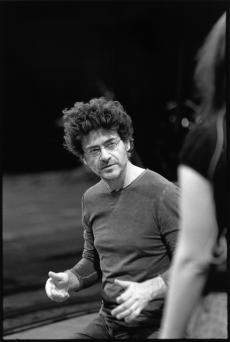
Wajdi Mouawad_ photo jean-louis_fernandez

Wajdi Mouawad (photo: Jean-Louis Fernandez)

I wanted to reflect on what did & didn’t work for me, while aiming to be mindful of multiple objectives & points of view.

While this production added a prologue, additional dialogue & restored music that’s often cut, making for a long evening, it was still the most absorbing Entfuhrung/Abduction I’ve ever sat through, never letting down  in intensity, never boring me.  I’ve yawned in every other production, a work that sometimes seems overlong in the way the musical numbers go on and on (or in the immortal critique we hear in Amadeus: “too many notes”).  Do I sound like a Philistine? I don’t care.  If we’re going to talk about hits & misses, first off in a production adding to an already long work, I’d be surprised if no one suggested that they consider judicious cuts to go with their creative additions.

And yet the result feels very Wagnerian in its intensity.  I don’t know Mouawad’s work, don’t know about his possible acquaintance with the works or dramaturgy of Richard Wagner, only that I think it might be terribly interesting to see what he as an artist with Muslim roots might make of Parsifal for example.

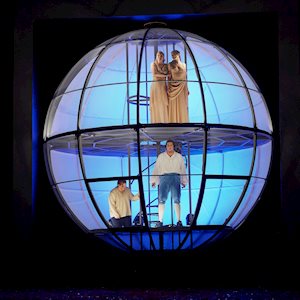
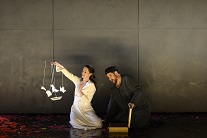
(top, l-r) Jane Archibald and Claire de Sévigné (bottom, l-r) Owen McCausland Peter Mauro_PHOTO_MICHAEL_COOPER

Top l-r Jane Archibald & Claire de Sévigné, bottom l-r Owen McCausland & Peter Mauro (photo: Michael Cooper)

The headline above (“Vanderdecken” being the character in the Heine original adapted by Wagner as The Flying Dutchman ) is an indication of how I read Pasha Selim last night in Mouawad’s version of Abduction.  No it’s not a light comedy, but something very serious and perhaps therefore requiring such length.  In the final tableau Selim gets inside the enclosure of the set—where the captives were held—with his Janissaries and is moved upstage. It’s almost like a ship sailing off.  I couldn’t help thinking that this reminds me of the Flying Dutchman, who would come ashore at regular intervals seeking love and redemption.  As the enclosure is shaped like a globe I took it to represent the world in some sense.  If we think not simply in terms of the romantic plot (and the question of which man Konstanze chooses) but rather the larger inter-cultural encounter at the core of the story, Selim is in a sense still looking for the redemption that Mouawad himself might seek of a real enlightened meeting between cultures, unhindered by cliche or over-simplification.

I should probably not project the director’s notes so far as to conflate Mouawad & Selim, although I can’t help it.  After reading his notes (that spoke of “caricature or casual racism.”)  and seeing the show early in the run, I was reminded of Peter Hinton’s attempt to update & redeem aspects of Louis Riel through the framing device of an onstage group of silent witnesses, counter-balancing or weakening some of the poison in the text.  Some critics found it heavy-handed.  I won’t go on about this, only to suggest that what struck me as a wonderfully fertile pathway turned many other people off.

Perhaps I read too much into Pasha Selim being Mouawad, if we notice the casting of Raphael Weinstock, an actor born in Haifa.  At the very least this is an intriguing & inclusive choice.

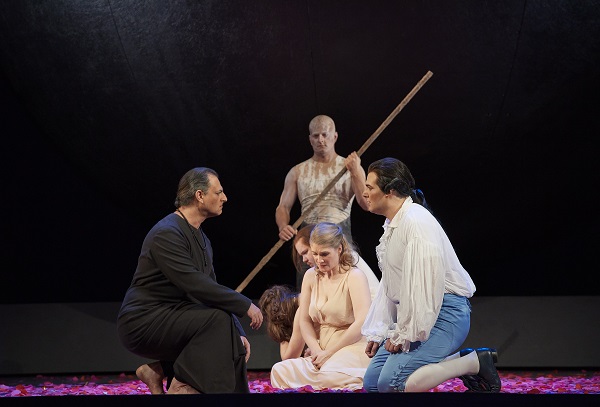
17-18-04-MC-D-1255

Raphael Weinstock as Selim, Jane Archibald, Peter Mauro and upstage an un-named Janissary on guard (photo: Michael Cooper)

I asked about the appearance of the Janissaries yesterday on twitter.  I tweeted:

“For today’s show I sat beside someone who was really disturbed / upset by the way the chorus looked, and said so aloud. Now that it’s over, do you mind me asking, what if anything did it mean?”

No I wasn’t disavowing by blaming my seatmate, (who found them scary). I just wondered what they were meant to signify.

I was told

“We represented how alien the east was in the minds of the western world. I wondered how shocking it was from the house. Not our favourite look! Tough to wear for over 4 hours.”

Thank you  Alexandra Pomeroy @ladychyld for the reply.

RESIZEd goran_Juric_as_Osmin_PHOTO_Gary_Beechey

Goran Juric as Osmin (Photo: Gary Beechey)

I think that these zombie-like creations were mysterious and fearsome while dodging clichés, which is what one usually encounters (thinking for instance of movies such as the aptly named True Lies).  I don’t blame Mouawad for talking out of two sides of his mouth, when staging an opera full of two-dimensional caricatures, thinking especially of Osmin, whose aria “O wie will ich triumphieren”, is a celebratory rant about the joys of torture.  By directing it to a child (who might represent his own daughter inside Blonde that he’ll never see) he deconstructs much of the rage & violence.  Again, this cryptic moment was intriguing and for me, very rich even if I might be decoding it all wrong.  Similarly, while the Janissaries could represent the most fearsome side of Ottoman culture, Mouawad opted for something gentler & more ambiguous.

Three other things really worked for me

  • The first big aria from Konstanze, sung not to Selim but framed by Belmonte in the meta-theatre set up at the beginning
  • As I mentioned in my review, the aria “Marten aller Arten” that closes the first half, which was even more powerful for me, knowing it was coming.
  • The celebratory aria from Blonde “welche Wonne welche Lust” just after the interval, includes dancing from the other women onstage resembling dervishes, making her celebration seem inter-cultural, and beautiful in so many ways.
RESIZED Claire_de_Sévigné_as_Blonde_and_Goran_Juric_ PHOTO_Gary_Beechey

Claire de Sévigné and Goran Juric (photo: Gary Beechey)

Some things were a bit obscure, only reading retrospectively. That Osmin is playing with a mobile through the first scene, and then sings his aria “O wie will ich triumphieren” to a little child who seems to sweetly kiss him goodnight at the end as though he is her papa singing a bedtime story, reads a bit differently when we discover that Blonde is pregnant.  At the very least Mouawad seeks to make Osmin a three-dimensional character rather than a nasty buffoon.

And I wish there had been more of the meta-theatre set up in the opening.  I have an idea that they might want that costs no money whatsoever for the ending, namely to bring down the reflective curtain that was used to set up the flashback scene a bit earlier.  We see this curtain come down just at the moment when the music ends, sealing off the flashback and the Ottoman world; why not bring it down 30 seconds or even a minute earlier? Let us hear that celebratory chorus snuffed by the curtain, sounding far off as though in the heads of the quartet onstage, remembering.

Oh well, like so many, I’m a vicarious backseat driver wishing to grab the steering wheel…

And for those who want more Mouawad?

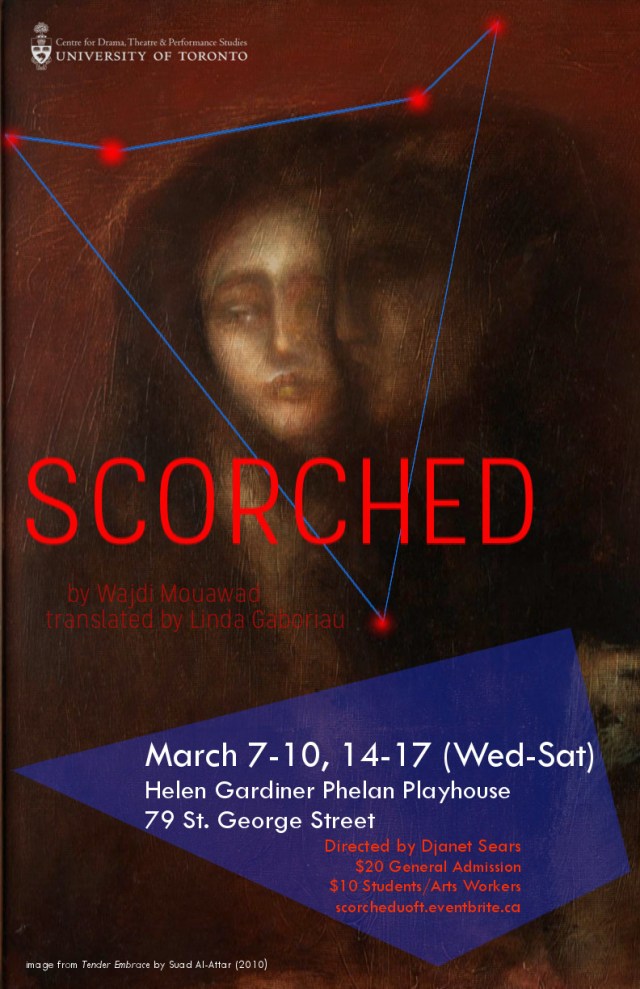
His play Scorched is to be presented at the University of Toronto in March at the Helen Gardiner Phelan Playhouse, March 7-10 and 14-17, two weeks of Wednesday to Saturday.Scorched-9.7

Posted in Dance, theatre & musicals, Opera, Personal ruminations & essays, Reviews, University life | 5 Comments

Questions for Geoffrey Sirett – The Overcoat: A Musical Tailoring

Sometimes interviews are a pretext to get closer to someone you’ve admired for awhile, watching their development as an artist.

Oh sure, I’m interviewing Geoffrey Sirett because he’s about to star in the Canadian Stage – Tapestry Opera—Vancouver Opera co-production of The Overcoat: A Musical Tailoring.  But I’ve been a keen observer, watching Sirett:

Not only does he do many things, he does them well.  His tiny role in the Canadian Opera Company’s Arabella made a huge impression on me, and I’m hoping the boss noticed, because he’s done excellent work every time I’ve seen him. I hope we see more of him with the COC and elsewhere.

But in the immediate future? The Overcoat: A Musical Tailoring  in March and the occasion for some questions right now.
SIRETT-PHOTONEW1 copy_preview

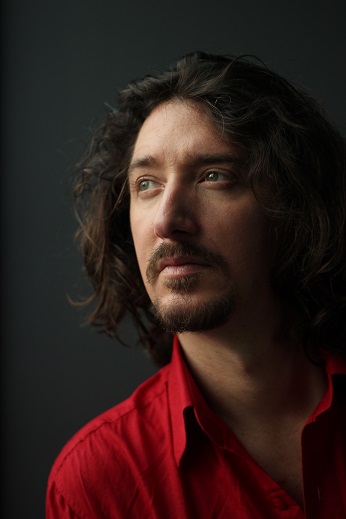
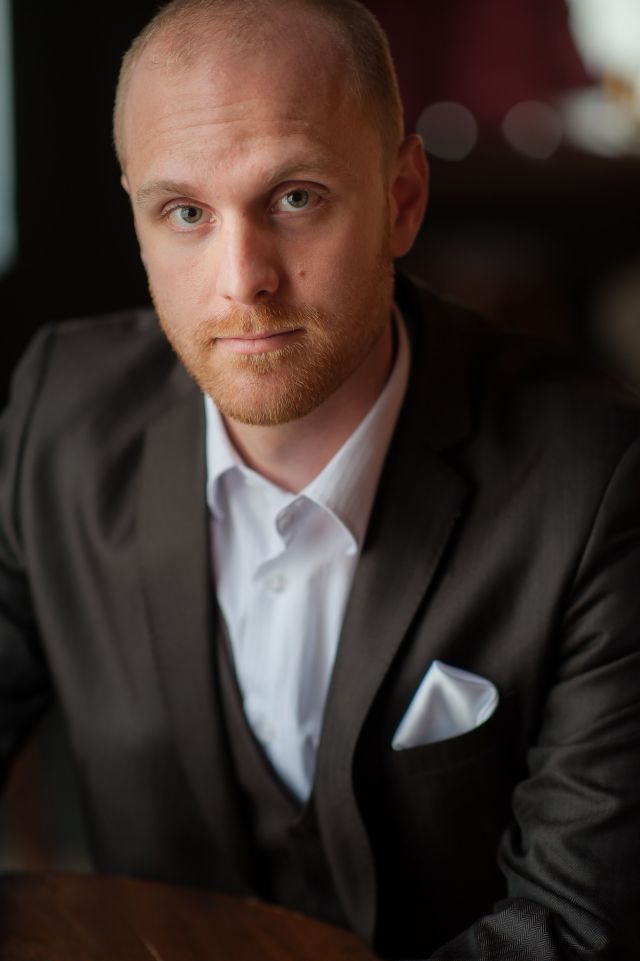
Baritone & conductor Geoffrey Sirett

1) Are you more like your father or your mother?

For those who know me, this answer will be no surprise: I am most like my father. For one thing, I am a few grey hairs short of being a 1.3x scale replica in physical attributes. My father is also a musician: he has a doctorate in choral conducting and pedagogy, making music, and singing in particular, a significant influence in my childhood. My musical training began at age six, singing under the direction of my father.  My mother also sang, and continues to sing, in my father’s choirs, so advocacy for the arts, passion for musical expression, and support of my career pursuits is certainly owed to both of them.

2) What is the best or worst thing about what you do?

I often feel that the best and worst things in this career are one and the same. That is, the experiences that offer reward and fulfillment as an artist often are the same experiences that produce challenges and grief. Day to day, contract to contract, the balance shifts; sometimes favourably, sometimes not. I’m not sure if that is a necessity as an artist, but it’s certainly part of the cultural narrative and expectations for artists: make a lot of sacrifices. The more sacrifice, the more reward.

The rewards, no doubt, are numerous: creative expression, being a member of an artistic community, developing intense relationships, opportunities to travel, getting paid (hopefully in money) to do something you love, etc.

Sacrifices, though, rarely see the spotlight, and I think they need to play a larger role in the discourse of the arts and theatre: constant criticism (self and other), financial instability, significant time away from family and friends, etc.

Special, meaningful experiences sway the balance favourably. These are different for each artist, but I tend to find the greatest reward in the process of creation, and I am grateful that many opportunities for creation and development have made their way into my career. The Overcoat: A Musical Tailoring is no exception. It is an opportunity to be instrumental in the creation something new and vivid, which will no doubt contribute to the rich tapestry (pun intended) of new works that push the possibilities of this art-form forward.

3) Who do you like to listen to or watch?

I don’t listen to a lot of music. Audiobooks occupy the majority of my listening these days. Almost all non-fiction: lots of psychology, sociology, behavioural economics.
[also, Bryn Terfel:. because I have two ears and a heart]

Fellow nerds should check out:
Thinking, Fast & Slow – Kahneman
Nudge – Sunstein and Thaler
The Black Swan – Taleb

4) What ability or skill do you wish you had, that you don’t have?

I used to wish my falsetto was better, so I could be a counter tenor. It will never happen, so I’m content to live vicariously through Dan Taylor.

5) When you’re just relaxing and not working, what is your favourite thing to do?

Spend time with my wife, family, and friends, in whatever form that takes: Netflix, going out for drinks, playing squash (only if I’m winning), hiking/biking through nature.

*******

More questions about Geoffrey’s projects, especially The Overcoat: A Musical Tailoring 

1- Please tell me a bit about the adaptation of Gogol’s story The Overcoat

  • The Overcoat: A Musical Tailoring is a landmark partnership and co-production between Tapestry Opera, Canadian Stage and Vancouver Opera.
  • It is the operatic re-imagining of the classic theatre production The Overcoat reuniting the original creative team twenty years after its debut.
  • Award-winning composer James Rolfe (whose works include Inês, Elijah’s Kite and Beatrice Chancy) joins forces with Morris Panych, the acclaimed co-creator of The Overcoat, in order to bring bold operatic voice to a beloved tale. This is Morris’s first libretto.
  • Music for The Overcoat: A Musical Tailoring will be played by a live orchestra, as opposed to the pre-recorded Shostakovich musical score in the theatre production.
  • The world premiere of The Overcoat: A Musical Tailoring will take place on March 29 at the Bluma Appel Theatre in Toronto running through to April 14. The production then heads west for Vancouver’s second annual Vancouver Opera Festival on April 28 and 29 as well as May 4 and 9-12.
JamesRolfe_Headshot_PhotoCredit_JulietPalmer_preview

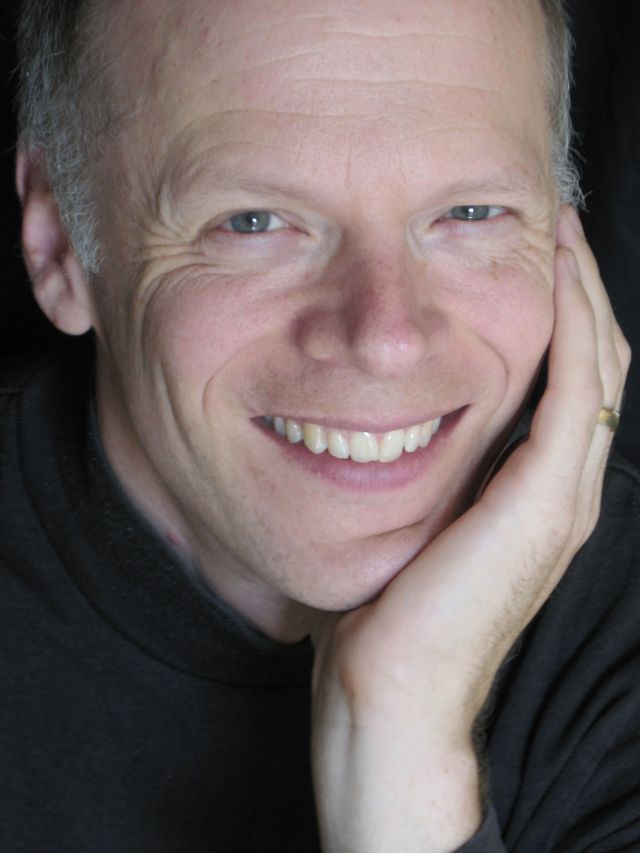
Composer James Rolfe (Photo: Juliet Palmer)

*************************************************************************************

Additional fun facts for your reference:

  • The Overcoat: A Musical Tailoring was conceived in Tapestry Opera’s 2014 LibLab, a program that pairs up leading librettists and composers.
  • The two venues are the original Toronto and Vancouver homes for the critically-acclaimed theatre production of The Overcoat, created by Morris Panych and Wendy Gorling. The theatre production in 1998 was praised as an “elegant expression of accomplished theatricality” by Variety Magazine.
    [The cast & creative team are listed below ]

Some thoughts from my own voice:
The Overcoat: A Musical Tailoring is beautifully rendered because it has managed to create something new and exciting while being faithful to, and drawing inspiration from, the original production. For those who don’t know, the original stage play The Overcoat was a non-verbal, movement-based theatre piece set to the music of Dmitri Shostakovich. Its success was ubiquitous, I think, due to the clarity of the story-telling and narrative as crafted by Morris Panych and Wendy Gorling. Because the vision and narrative of the original was so finely tuned, I believe the ‘Musical Tailoring’ enters this story with such a solid foundation that all text, singing, and new music serves to enhance the drama in a unique way. Fans of the original production will love this, as will new audiences.

2) What style of music—both in terms of harmony and vocalism—should we expect to hear in the new opera? 

I know that Morris prefers to call this piece a “musical” rather than an “opera”. I don’t think the words need to be mutually exclusive, however I think the concern is that “new opera” or “contemporary opera” conjures images of atonality and a potentially inaccessible musical style. This is far from the case. James Rolfe has created a hauntingly beautiful, lyrical score, with memorable melodies in a tonal environment. That said, do not mistake this to imply simplicity. James is a masterful composer, every bit of music required to aid the story/drama but nothing superfluous. I think those who are opera-lovers will love this piece, as will those who love musicals. At the end of the day, it is its own piece, and it is splendid no matter what you call it.

3-Does riding a bicycle through the summer –as you have done with The Bicycle Opera Project—help your singing?

I do think that being on tour with the Bicycle Opera Project has provided advantages to my singing, at least regarding breath control and stamina.  More than anything, though, tour cycling is meditative for me, provides an opportunity to clear my mind, and creates special bonding with my cast/cycling mates. These features of cycling likely contribute more to a healthy singing lifestyle than the physical benefits.My wife, Larissa Koniuk, is the driving force behind BOP. She determines its future and I support her as best I can. I expect it will always play a role in our lives and future, though, in some form or other.
angel_homme2

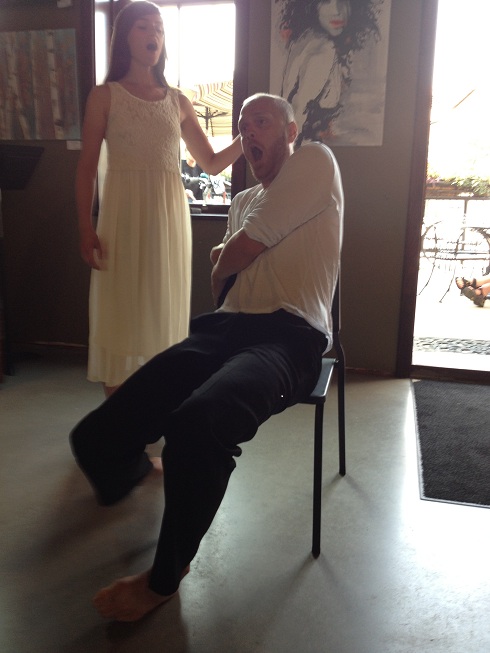
Sirett & soprano Larissa Koniuk, L’Homme et l’Ange qui a venu du Ciel, from summer 2014.

4-please reflect for a moment on the challenges a singer faces doing a new work, as opposed to a standard work  

No singer likes to admit that they listen to recordings when preparing roles. But the reality is, we usually do. Not to learn notes and pitches, but often to draw inspiration, learn about musical style and precedents that have been set by artists over many decades or centuries.  Historical precedent can be oddly suffocating as an artist, since there are a lot of expectations about how a role “should” be done, and it can be difficult to find and explore oneself artistically within these confines.With new works you have the luxury of starting from scratch. It is both a daunting task and a great opportunity to create a unique role, find a vocal character that is idiosyncratic, and be free from expectations.

5) I think you have a gift for comedy, so much so that they’re promoting this show using your by now recognizable face. Have you heard this before?

I’ve not heard this much, if ever. In standard repertoire, the lyric baritone is either heroic or villainous, and I haven’t often had the opportunity to play comedic characters.  On tour with bicycle opera, though, I’ve been able to play around more with comedic characters, and I enjoy it a lot. There is, I think, more artistic freedom in comedy. It can be choreographed, to a certain degree, but it needs to come from within and have the feeling of spontaneity, otherwise the jokes don’t land. Comedic works also lend themselves to improvisation, as you connect with the audience, play off of their energy, and refine timing and delivery in the moment.

6-The singing actor is a curious mix of skills. I was impressed by your appearances in Arabella (you made much of a tiny role that isn’t usually noticeable) and earlier in Against the Grain’s Messiah (the funniest moment in this piece was your inspired work in “All we like sheep”), leading me to ask about the actor side of your personal equation, and your background as an actor.

My acting experience is typical of most trained opera singers. At various points in our education, we are involved in acting courses, masterclasses and/or workshops, but for the most part we mostly learn it “on the job” and formal training is relatively minimal. I don’t think I offer much unique as an actor, but I try to commit to new ideas and push myself a little further each time. It’s a balance between pushing yourself towards the character, but also recognizing your limitations and pulling the character towards yourself and your own strengths.

7) in Bicycle Opera’s 2017 production of  Sweat you were the music director.  Will we see you pursue this aspect of your career further?

My venture as MD for Sweat was my opera conducting debut. Prior to that, I had training and some experience conducting choirs. This past year I have been working, periodically, as assistant conductor for the Cantabile Choirs of Kingston, a community choral organization founded by my father in 1996. This is a great platform for me to continue my training as a conductor, and also revitalize my love for choral music. This is a role that I will continue next year, so I do expect it to be a part of my future.

8-What direction do you see yourself going after this?

The most recent undertaking in my life has been the pursuit of a Masters degree in clinical psychology. This is a departure for me, as a life-long musician, but has long been a passion of mine and I enjoy it tremendously. How this will develop into my future life, I do not yet know, but in the mean time I am saturated with curiosity and enjoying learning everything that I can. I am approaching the end of my second year of course work, which will be followed by an 8-month clinical placement, likely some time next year.

9) Is there a teacher or an influence you’d care to name that you especially admire?

One of my first teachers, Alvin Reimer, continues to be an inspiration to me. He built the foundation of my vocal training, but was also a tremendous artist and exceptional human; I owe a lot to him, and am so grateful for the impression he made on me and my whole life. That is not to say there haven’t been many incredibly influential teachers and mentors over the years, but my heart tends to turn to Alvin first.

*******

The world premiere of The Overcoat: A Musical Tailoring will take place on March 29 at the Bluma Appel Theatre in Toronto running through to April 14. The production then heads west for Vancouver’s second annual Vancouver Opera Festival on April 28 and 29 as well as May 4 and 9-12

Cast:

  • Akakiy Akakiyevich: Geoffrey Sirett (baritone)
  • Manager: Asitha Tennekoon (Dora Award-winning tenor)
  • Head of Department: Peter McGillivray (baritone)
  • Landlady: Andrea Ludwig (mezzo-soprano)
  • Secretary: Meher Pavri (soprano)
  • Mokiya: Keith Klassen (tenor)
  • Sossiya: Aaron Durand (baritone)
  • Khodozat: Giles Tomkins (bass)
  • Mad Chorus: Erica Iris (mezzo-soprano), Caitlin Wood (soprano), Magali Simard-Galdés (soprano)

Creative Team ( * = part of original creative team)

  • Composer: James Rolfe
  • Playwright and director: Morris Panych*
  • Movement: Wendy Gorling*
  • Set Design: Ken MacDonald*
  • Lighting Design: Alan Brodie*
  • Costumes: Nancy Bryant*
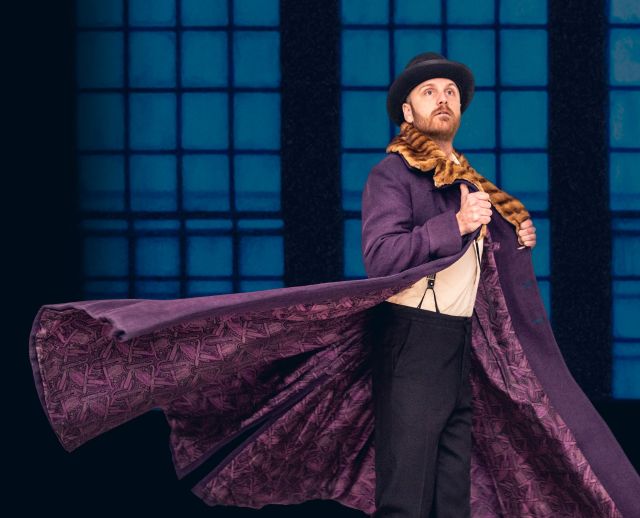
Geoffrey Sirett as Akakiy in The Overcoat A Musical Tailoring_Photo Credit Dahlia Katz_preview

Geoffrey Sirett as Akakiy in The Overcoat A Musical Tailoring (Photo: Dahlia Katz)

Posted in Interviews, Music and musicology, Opera | 1 Comment

Admiring Alexander’s Feast

It was a happy celebration of the birthday of George Frideric Handel at Koerner Hall tonight, feasting on the bounty that is Alexander’s Feast, one of the Dryden odes for St Cecilia’s Day, celebrating the power of music.  Thank goodness for Handel’s setting, which is indeed like a big party.

Admiration is a big part of the Augustan Aesthetic, the artists showing off their abilities to emulate models of beauty and virtue, to instruct & delight us. We the audience can stare and listen in wonderment, although if this had been an 18th century space there would have been lots more going on, besides.  Koerner Hall in Toronto is much more polite, so much so that –when a fellow snored a few feet away from me – no one woke him (indeed when the fellow in front of me heard of it from his wife, he replied “good for him”).  From solos to concerti to choruses untroubled by snores, there was indeed much to admire, in a very cheerful Friday night audience.

Of the vocal soloists, I think two seemed more attuned to the baroque display while the third, splendid as he was, conformed more closely to modern ideas.

RESIZED Alexander-Dobson-Credit-Melissa-Tremblay

Baritone Alexander Dobson (photo: Melissa Tremblay)

Alexander Dobson seemed particularly attuned to Dryden’s text & Handel’s setting.  When we heard of Timotheus crying “revenge” it was delivered in a most ostentatious manner, the furies rise causing his eyes to bug out of his head, enacting a hissing when he sung of snakes. And when the ghosts of the unburied warriors haunt the battlefield, and Handel’s music shudders for us, anticipating the horrors of romantic tone-painting, Dobson modeled horror, unexpectedly bringing a sympathetic quiver running down my spine.  While it’s bass writing, Dobson interpolated higher baritone notes in his da capo repeats, while modeling the defiant cries of the poetry.

Amanda Forsythe too inspired silent awe at times, from the beauty of her appropriately direct baroque sound, unsullied by excess vibrato but pure of tone and precise of intonation.  I have to think Handel picked up the challenge from Dryden’s text to inspire something voyeuristic in the audience, writing music that teases us as she sings “And sigh’d and look’d and sigh’d again”.  Ah yes indeed we did sigh and look, the place was silent, listening to every playful nuance of her delivery, sighing and looking and listening with admiration.

Amanda-Forsythe-Credit-Arielle-Doneson

Soprano Amanda Forsythe (photo: Arielle Doneson)

Tenor Thomas Hobbs sounds lovely but didn’t invoke any of the theatricality I mention for the other two, giving us something much cooler, refined & accurate, an excellent performance all the same.

There are also two concerti in this big glorious work .  In the first half hour we hear a harp concerto that is quite well-known.  I remember the melody of the first movement vividly from the agonies of my youth. Have you ever turned on the radio to hear the end of something, and wondered “but what was that”? At the age of 12 or so, I had that experience with this stunning piece, that I sought for years until luckily catching up to it.  The performance tonight was wonderfully nuanced, slower than the versions I know –such as the Judy Loman performance that used to be played so often on CBC (the theme music on one of their programs? Can’t recall which): because Julia Seager-Scott was elaborating repeats with all kinds of decorations, wonderful repeated phrases that pulled us to the edge of our seat because the second utterance was so soft and delicate. This was a revelation, conductor Ivars Taurins wonderfully supportive in this as well as the D minor organ concerto that comes near the end, played by Neil Cockburn (thank you Larry!), substituting on short notice for an indisposed Charlotte Nediger.  The two movement concerto began with a stunning slow D Minor theme, not terribly complicated just a noble theme, followed by the complex & fast moving contrapuntal finale you might expect.

And yes there was a ton of choral work as well.  As I’ve observed before it’s fascinating watching Taurins conduct, because he seems to treat the orchestra & chorus in much the same way, his gestural language helping us to observe the different sections & voices in each: which strikes me as a wise approach especially for someone like Handel.  The work deserves to be better known, full of gorgeous music.

They repeat this intriguing work on the 24th and 25th at Koerner Hall.

Posted in Music and musicology, Reviews | 2 Comments

I hate shoot-outs

Yes I hate shoot-outs, those contrived rituals to determine the outcome of a game.  While they are full of drama, I detest them, because they are an alternative way of resolving the outcome of a game that in someone’s opinion is taking too long, the cheap alternative to letting the game play to its natural conclusion.

Two teams are locked in a close contest, and you wonder who will win: so you suddenly stage a contest between goalie and solo players skating in on the goalie? But that’s not hockey.

Imagine a boxing match that’s so close that they decide it by asking them to play a hand of poker. Or a close game of soccer decided by flipping a coin.

Perhaps you’d say “but that’s now a part of the game”. But only recently.

The FIFA World Cup (soccer) is coming.  Please please please don’t let anything be decided by a shootout..!

And in the NHL? Yes they do the shootout thing in the regular season, but they allow the full spectacle of overtime to play itself out in the playoffs, making the post-season feel that much more special.

Oh my I love overtime in the playoffs.

Incidentally, the NHL have now been surpassed for the longest hockey game in history.

And in baseball when you have extra innings they don’t force an outcome but let the game play out: even in the regular season! That’s one reason I adore baseball, a sport with a great reverence for traditions.  In the later innings you may witness the madness of an outfielder pitching because there are no other players available. And that’s part of the game, and actually tremendously exciting, watching the struggle.

Of course when a Canadian team loses to an American team in a shoot-out for a gold medal, naturally there’s this assumption that I’m whining for partisan reasons. But when a Canadian team wins a shootout I STILL hate it.  I want to see the game won through hockey, not a shootout.

….I feel your pain, ladies.

There are alternatives that stay within the boundaries of the game, but help bring a result that is determined by the game of hockey, not this alternative game of “the shootout”.

The best one I’ve heard involves the removal of players.

Imagine…you play a period of overtime.  And if after 80 minutes (the game plus an overtime period) they are still tied, what if you remove a player from each side, and they play 4 on 4 (plus the goalie) for that next period? More space on the ice likely makes a goal easier to come by, and makes it harder to obstruct the offensive players.

Hm still no result after 100 minutes?

Take off another player, play 3 on 3 (plus the goalie). I think that’s where I’d leave it, and see.   But what if, at the end of the next period, you went to 2 on 2 plus goalie. And after another period, one on one plus goalie.  Is that crazy? If you remove the next player it’s a lot like a shootout: except it’s hockey, not a staged shootout.  Oh I just wish they would let them play to a conclusion.  Maybe stop removing people, once you get to 3 on 3. But wow imagine the space, the room for a good player to move the puck.

OH and it would work for FIFA too, instead of a shoot-out. Take a player off every 30 minutes.

The other factor in this –and I’m really talking about YOU, my dearly beloved NHL—is the officiating.  At playoff time the rules seem to change. Where hooking and interference is clearcut in February and March, once we get into the playoffs, things seem to revert to the Don Cherry school of “oh no, don’t let the referee decide it” hockey.  The problem with this is that, if you now have a kind of unwritten permission to clutch and grab and tackle people in front of the net. When it’s politically incorrect to call penalties, especially late in the game or overtime: then the referee is STILL deciding it, by allowing aggressive play without any sanctions.  Whoever is better at passive aggressive play –that is, breaking rules nonchalantly and without embarrassing the referee by being too obvious about it –has a big advantage.

So in other words, referees must call the game by the same rules for the entire game. This is one of the things I LOVE about the NFL, who seem to have no fear of calling penalties at any moment of the game. And this is what fairness really looks like, when holding is holding whether in the first minute of play or overtime.

And now the hockey season gets more serious with every game as the playoffs get closer.

How about those Leafs…!

Posted in Sports | Leave a comment

Know Thyself, a lesson from Jane Archibald

Today I sat in a very good seat to hear Jane Archibald sing and she sang very well.  I am a very lucky guy.

She doesn’t need my review to validate her (ha, but then does any artist?). This is a singing actor who’s hit her stride in mid-season, at the top of her game, another Canadian treasure like Virtue & Moir, (to drop the names being spoken with pride over and over today).  I don’t know if the template requires it to be a Canadian as their artist in residence, but Archibald is a great ambassador whether she’s singing in Europe or Toronto.

I think it’s accurate to say we’re past the midpoint of Archibald’s year as the first “artist in residence” for the Canadian Opera Company.   Last autumn she was Zdenka in ArabellaThe Nightingale & Other Short Fables is still to come in the spring season.  She’s nearing the end of the run as Konstanze in Abduction from the Seraglio, with a pair of final performances this week.

I love this take-no-prisoners photo from an earlier incarnation of this co-production. Her Toronto version of the aria she sings at this moment is every bit as intense. While you’d never know it from this photo, she was all smiles today, as indeed we were as well, even if she didn’t sing any Mozart.  For that you have to come see the opera later this week.

operaenlevementauserail35_copyrightstofleth

Jane Archibald as Konstanze, in the Opéra de Lyon/COC co-production of Abduction from the Seraglio, 2016 copyright ©Stofleth

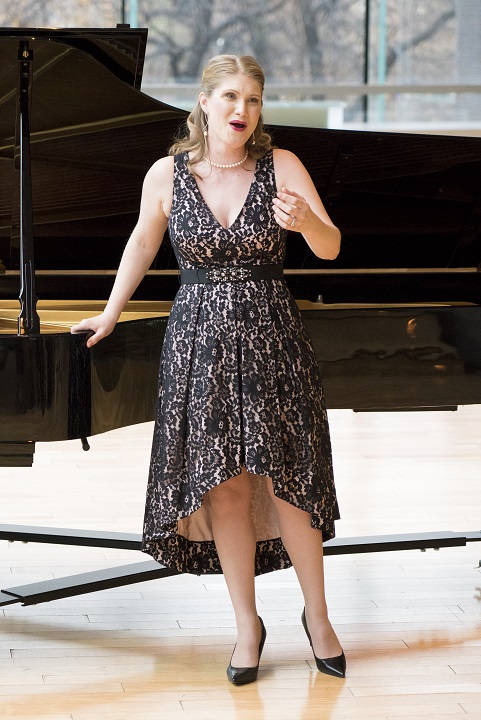
If I am correct in my understanding that the artist in residence will mentor the young artists of the Ensemble Studio, today’s noon-hour concert was like a clinic, a masterful display of self-knowledge for singers of any age, in partnership with pianist Liz Upchurch and Dominic Desautels, clarinet.

Archibald told us that the program is one she’d be singing again in Halifax:

  • “Sweeter than roses” and “If music be the food of love” by Henry Purcell
  • “Pierrot”, “Regret”, and “Apparition” by Claude Debussy
  • “Der Hirt auf dem Felsen” by Franz Schubert
  • “Ich wollt’ ein Sträusslein binden”, “Säusle, liebe Myrthe!” and “Amor”, by Richard Strauss

It’s a rich hour of singing demanding a great deal of the pianist, and in the Schubert, of the clarinet as well.

We’ve heard Archibald in Toronto in some of these guises.  The German repertoire seems especially congenial, whether we look far back to her COC Zerbinetta in 2011 or to this autumn in Arabella.  The Strauss songs are full of coloratura fireworks that Archibald pops with stunning ease.  When she’s singing this rep it’s as though she’s totally at home, and having a great time. And how wonderful that we get to share in that pleasure.

There’s an old saying that comes to mind, perversely. “Do what you love and the money will follow”. The saying is really about finding a career, but I think it could apply to singing and repertoire.  How often have you seen a concert where the artist seems to be fighting the repertoire, singing an aria or playing a sonata that was perhaps chosen for them or maybe a case of wishful thinking?  There is a real tao of music that comes into play when one really pays attention, both to the comfort / discomfort of your body & your instrument as well as the visible comfort / discomfort of your audience.  Archibald sang music well-suited to her voice, some very difficult material that seemed easy.

While the Schubert is a more conservative exercise than the Strauss songs, we are still in the realm of beautiful sound that emerges organically from the singer. It’s a song with great leaps —not just big intervals such as ascending ninths or descending tenths—but also huge arcing arpeggios, and a delightful call-and-response dialogue with the clarinet.  This relatively early attempt at the romantic sublime leads to a charming affirmation of spring-time, that Archibald joyfully seized in the blush of the warmest day so far in 2018.  But it would be great February programming even if we had to endure snow instead, as the song is all about the dream.

There’s nothing easy in this program, though.  The Debussy songs are especially challenging for the piano, played with wonderful subtlety by Upchurch.  While Archibald barnstorms up and down, dazzling, Upchurch kept it light as quicksilver.  And to begin, the Purcell songs showed us that Archibald was ready, soft but intensely committed from the first note.   As an encore we were given a gently intimate “Du bist die Ruh”.

It was a pleasure observing the body language, as Archibald sang for the most part in two positions.  In her softest moments she’d lean her weight onto her right hand that held fast to the piano, while angling over about 30 degrees from upright, as though the music was singing her rather than the other way around: ecstatic and gentle music-making. And then purposefully she’d stand straight and tall gesturing before her as she  sang coloratura.  Again there’s no sign she ever sings off pitch, her intentions clear in her mind.  She knows where she wants the voice to go: and it goes.

Archibald has two performances left as Konstanze this week, and then in April – May, we get The Nightingale & Other Short Fables.

JANE

Soprano Jane Archibald (photo: Kevin Lloyd).

Posted in Music and musicology, Opera, Reviews | Leave a comment

The Wizard of Oz live with the TSO

For the past few years the Toronto Symphony have given us opportunities to see well-known movies with live orchestral accompaniment:

I don’t pretend to understand how all the necessary technical challenges are surmounted to make these possible.  The dialogue appears to be on a different track from the music, with the result that we still get Anthony Perkins or Kim Novak or Jimmy Stewart speaking their lines, whether we have the old Bernard Herrmann soundtrack that was recorded and imprinted onto those films, or a live performance by the Toronto Symphony in the 21st century.  Vertigo and Psycho have scores that are 100% extra-diegetic: meaning that the music is created outside the world of the story.  While there’s a moment in Vertigo when Scottie is cracking up after the apparent death of his beloved when he’s listening to Mozart to calm his soul, and so some music is from the same world as the dialogue, namely, within the film’s diegesis, but it’s on a phonograph record, and so doesn’t shatter our reality. We can watch those stories unfold whether the music is the same sound we’ve always heard or a live performance.

Wiz 2

In Back to the Future it gets a bit harder because we’re watching Michael J Fox sing & play “Johnny B Goode” live at the “Enchantment Under the Sea” dance.  But this would only pose a technical challenge if the scene contained Fox’s guitar & vocals as well as live orchestra. But because there’s no other music at that moment we’re content to listen to music from the same place as the dialogue, in much the same way as that vinyl recording of Mozart in Vertigo.   In the performance of Howard Shore’s The Fellowship of the Ring there was a much higher level of complexity, as we heard a soloist singing a song, and a chorus as well, adding to what the orchestra did.  Even so, these too were extra-diegetic, and not in any way penetrating the world of the film.

That colossal preamble is meant to explain the different challenges posed by the film I saw tonight, namely The Wizard of Oz.  First and foremost, is the fact that it’s a classic film musical, which means that the songs had to be left more or less un-touched, because you can’t replace Judy Garland or Ray Bolger or Bert Lahr.  As a result we were in the presence of something reminding me a bit of Natalie Cole’s Unforgettable, an album of songs where she sang duets with her deceased father Nat King Cole.

Emil de Cou conducted the Toronto Symphony in the virtual ensemble across two different centuries, including their concertmaster Jonathan Crow, playing along with Garland and Bolger and Lahr et al.  What I saw tonight was surely one of the most difficult and thankless jobs I can imagine, speaking as an accompanist.  There are times when singers are hard to follow.  But usually when one is attempting to stay with a singer or an ensemble, they are making adjustments, trying to stay with you and adjusting as much as possible.  In this case, we were watching the TSO led by de Cou, seeking to synchronize with a performance that was fixed long ago and could not in any way respond or adjust.  When it was a vocal solo it was amazing stuff.  For these solos, such as “Over the Rainbow” or “If I were the King of the Forest”, I believe the track was at least put through an equalizer if not actually edited so that we heard mostly voice coming from the film, while the orchestra gave us the accompaniment, and de Cou did his best to synchronize the big orchestra.

Emil de Cou - head shot

Conductor Emil de Cou

This became an almost impossible task with the big choral numbers, thinking especially of the songs with the Munchkins such as “Follow the Yellow Brick Road” that pose a huge challenge for the synchronization. And so of course in places the accompaniment and the vocals were out of synch. But I’m hugely sympathetic because I can see what a difficult task this is.   I don’t think anyone minded, indeed it calls attention to something that’s easy to forget: that the orchestral music is being created live.  The virtual aspect was overshadowed by the live-ness of the creation, rather than undermined.

When you know every line of the film –and I know I’m not the only one in this category—options open up.  For the last half-hour of the film, it seemed as though the orchestra was often on the edge of completely drowning out the dialogue. But who cares, if we know every word?  We experienced something like being deeply immersed in the film.  We had the  film projected on a big screen, which is a novelty for those of us who grew up watching it at home on TV. But the big thing was simply hearing all the details in the score.  I never realized how often a theme or melody from earlier in the film comes back as a leit-motiv.  That’s all much clearer when the score is played so powerfully.

Another challenge was the occasional wordless chorus (a trope you can find in Debussy’s 3rd Nocturne for orchestra or in Neptune in Holst’s The Planets suite although it appeared as early as in Rigoletto, which is currently on stage in Toronto; and we still hear such choruses in the film-scores of Danny Elfman). They solved the problem by the choice to use a synth player on his laptop.   Did anyone notice? It wasn’t a problem for me that’s for sure.

It was a very full night for the orchestra. While the playing is rarely virtuosic in nature –although there are a slew of borrowings from the classical repertoire, for instance the chunk of Night on Bald Mountain in the big confrontation scene with the Witch—it seems to be a full night’s work.  Crow sounded wonderful in his solos.

The TSO perform it again Sunday afternoon.  See/hear it if you can.

Posted in Cinema, video & DVDs, Music and musicology, Reviews | Leave a comment

Aeris Chordas

“Aeris Chordas” is the name for the concert I saw tonight, chamber music from four artists:

  • Christina Raphaëlle Haldane, soprano
  • Carl Philippe Gionet, piano
  • Michelle Jacot, clarinet
  • Marc Labranche, cello
ChristinaHeadshot8

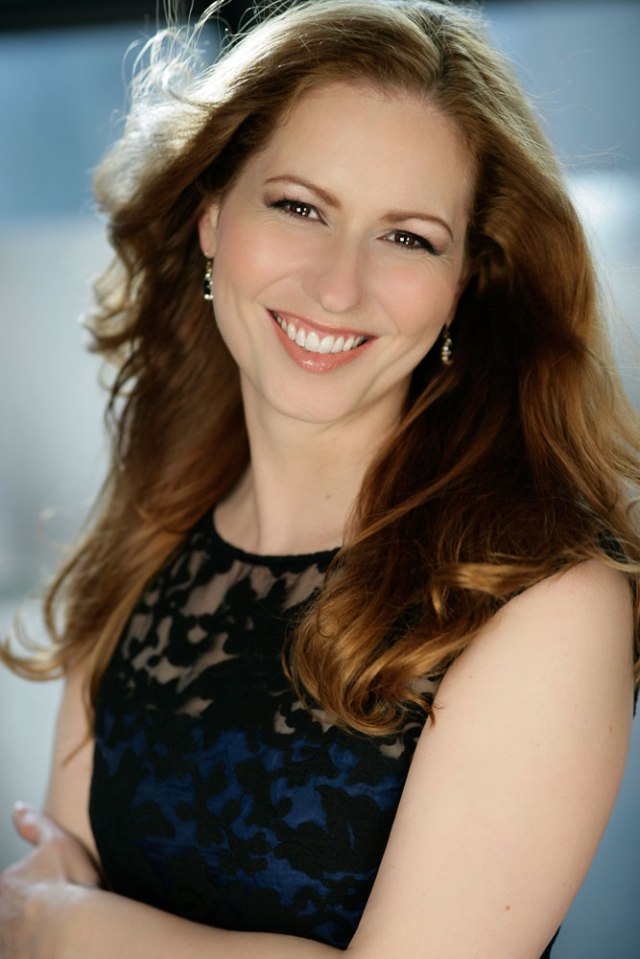
Soprano Christina Raphaelle Haldane

The four composers I saw on the program:

  • Johannes Brahms
  • Gionet: (the same person playing the piano)
  • André Previn
  • Franz Schubert

Aha, Schubert + a clarinet? First things first. Scanning the program, I looked for “Der Hirt auf dem Felsen” (aka “the Shepherd on the rock”) and voila! there it was to close the program. It’s a challenging work, not programmed often enough, a lovely composition.  And so there we were at Jeanne Lamon Hall at Trinity St Paul’s Centre, hearing these “Chords of the Air,” (my feeble attempt to translate the title, not knowing what language we’re working from).

In a program of unfamiliar music composed in the last quarter century (Previn in 1994 and Gionet’s work from the past year), book-ended by the more familiar composers (Brahms & Schubert), I would never have predicted the high points of the concert.  Let me begin by saying that Carl Philippe Gionet was especially impressive, a bit of a musical chameleon.  It’s funny that with the concluding piece, Schubert’s “The Shepherd on the Rock” that Gionet was totally self-effacing while allowed clarinetist Jacot and soprano Haldane to soar.  Yet over the evening he really was their collaborative rock, the one who held it all together.   The Brahms is easy to under-estimate, a work that demands ensemble fluidity as though the players are one mind and one body rather than a trio.  It was in his three songs that I was especially impressed.

To hear the introduction from Haldane & Gionet, one would understand these as his adaptations, although I am hesitant because of course some artists have used this sort of framework to disguise original  compositions –for instance Pierre Louÿs’ “Chansons de Bilitis” that were originally presented as historic specimens, and only later seen to be the poet’s own writing.  According to their explanation, the “Trois folklores acadiens” are the beginning of a larger compilation, reminiscent perhaps of the anthropological record of folk music that Bartók assembled, rather than original compositions.  Do I care whether these are adaptations or 100% original? Nope. Either way Gionet has made something very special.   The three songs were introduced to us in Haldane’s wonderful incarnation of each, along with Gionet’s remarkable pianism, supposedly older a cappella songs adapted by Gionet.

  • If I understood “Wing tra la” there’s flirtation here, Haldane giving us some remarkable sounds from her rich lower register (from a singer who is a lot more than just a soprano) while impersonating more than one character
  • “Tout passe” in stark contrast is a smaller part of a longer hymn sung by the Acadians as they awaited deportation, a kind of stoic song of acceptance of their sad fate, while the piano swirls and comments, without really anchoring us solidly in a single tonality. We are floating in space for much of the song.
  • “L’escaouette” is a wildly playful conclusion to this cycle, the pianist playfully hitting clusters, sounding at least bitonal in his support of an energetic song.  Gionet has a gift at the piano, making something happen in his writing that never gets in the way of the voice, sometimes ambiguous in its tonality, and always interesting to hear. His is a flamboyant compositional voice that deserves to be heard.  I look forward to the future additions to this cycle.

After the interval we encountered three strong solo voices together, namely cellist Labranche, soprano Haldane, and Gionet at the piano, in “Four songs after poems by Toni Morrison”, by André Previn.  The cycle ends in an understated song called “The Lacemaker”, after some remarkable flamboyance from the piano, particularly in the jazzy “Stones”.  Gionet & Haldane seem to be very happy on jazzy turf, her voice having several possible approaches to such repertoire.

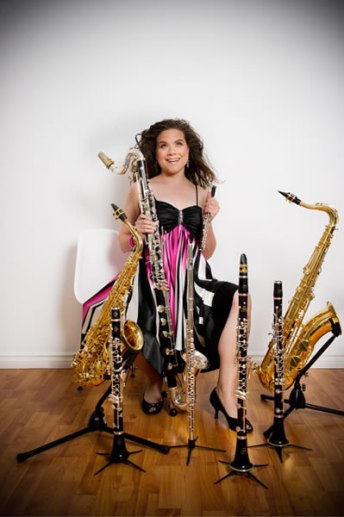
MICHELLE

I found this picture on Michele Jacot’s website. She’s a clarinetist and conductor, but maybe just maybe she plays a few other instruments…?!

My admiration for the final song really centres on Haldane, Jacot playing accurately, Gionet playing softly while Haldane astonished me, as though in a duet between the two soloists.

Coming at the end of a busy evening and lots of notes, I couldn’t help noticing how intelligently she began this Olympian song of huge leaps that suggest the high mountains, ascending 9ths and descending 10ths, all with pristine intonation.  She began very carefully, gradually opening up as the song went on.

Will we hear more from this group, perhaps an album of this rep?

I hope so.

Posted in Music and musicology, Reviews | Leave a comment

Questions for Maxim Lando: Lang Lang’s protégé

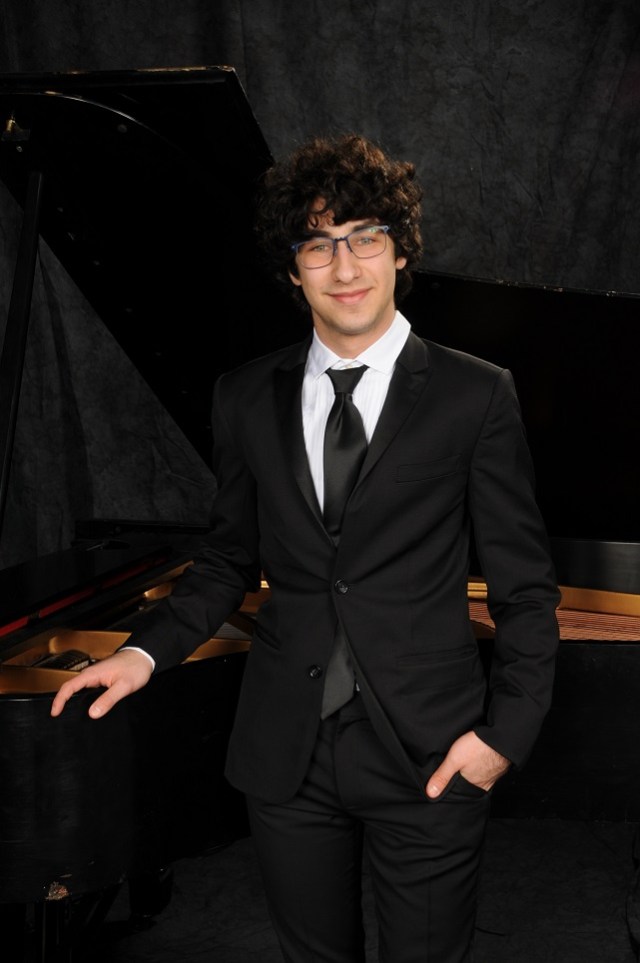
Maxim Lando is a 15 year old American pianist. In 2017 at the age of fourteen, Maxim performed Rachmaninoff 3rd Concerto with the Mariinsky Theater Orchestra in Saint Petersburg,  receiving rave commentary on the popular Russian TV Kultura program Tzar’s Box. Maxim also had the great honor to perform at Carnegie Hall’s Opening Night Gala Concert together with Lang Lang, Chick Corea, and the Philadelphia Orchestra led by Yannick Nézet-Séguin in an unprecedented three-pianist rendition of Gershwin’s Rhapsody in Blue.

There’s lots more I could tell you, but you can find a more detailed biography on his website or check him out for yourself on youtube.

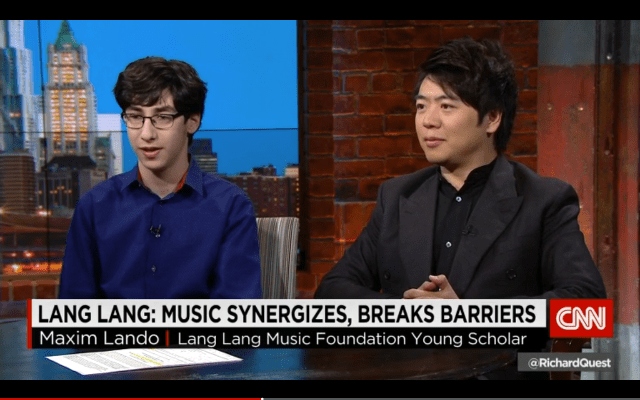
Maxim is in Toronto performing March 1st on a revised Toronto Symphony Orchestra program led by Peter Oundjian, revised because the featured performer, pianist Lang Lang, has developed tendinitis.

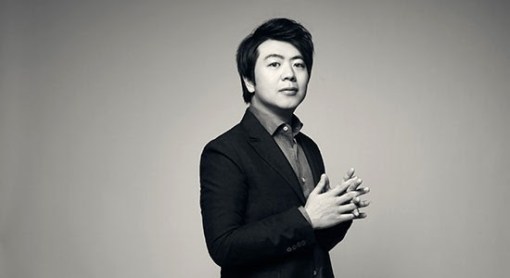
Lang Lang also happens to be Maxim’s mentor.

Screen-Shot-2015-12-31-at-3.28.10-AM

Of course I had to ask Maxim some questions.

Are you more like your father or your mother?

I feel like I am a combination of many traits from both of my parents. I definitely share their stubborn persistence, especially about ideas and passions. My entire family (including grandparents, uncles, aunts, and cousins) is full of determined, strong-willed people, and I would have to say that I have inherited that quality. My parents have a particularly relaxed view of life, almost always looking at the humorous side of things. My home is full of quick loud outbursts (because we are all stubborn and passionate) and then a lot of irreverent laughter. I think I am the same way – most of the time my personality could best be described as either very intense or very goofy.

What is the best thing or worst thing about being a pianist?

Music has to be one greatest pleasures in life, so spending the majority of my time immersed in music is fantastic. Being a pianist specifically, there are definitely best and worst aspects. We have an amazing repertoire, endless really. There is so much incredible music already written and constantly being written for the piano, that you could spend several lifetimes and still not even play a fraction of it. On top of all the music specifically written for piano, there is an entire genre of transcriptions for the piano. Almost any orchestral work, opera aria, great melody, or popular song, could be conceived on the piano. Composers like Liszt and Rachmaninoff did this in virtuoso ways, and composers and pianists today continue to have fun changing up the tradition.

As far as a more difficult thing about being a pianist, it can be lonely. Pianists don’t perform and practice with other musicians as much as orchestral players and singers. For me, I would love to have a career that involves both – performing all over the world as a solo pianist, but also having ample opportunities to collaborate with other artists.

Who do you like to listen to or watch?

I love listening to the musical Jekyll and Hyde. I often find myself singing at the top of my lungs in the shower and running around the house screaming the lyrics to Jekyll and Hyde. I also always enjoy watching and studying the famous ping pong player Jan Ove Waldner. The Lord of the Rings has always been my absolute favorite book and movie series, and I think that the musical score is brilliant. Lately I’ve been listening to this score as a nightly routine right before I go to bed. Among classical recordings, I can never ever get enough of Vladimir Horowitz!

What ability or skill do you wish you had, that you don’t have?

Invisibility (but only when I choose). I could hear what people are really saying, and it could be advantageous is so many fun ways.

When you’re just relaxing and not working what is your favorite thing to do?

I really enjoy playing ping pong and also spending time cooking with my friends, (especially making fresh homemade pasta from scratch). I love taking long walks that are often around 27 miles long. I always look at nature on these walks, which inspires me to come up with new ideas in music. I think that music is all about telling a story and bringing the audience on a journey. Somehow my walks help me to feel and understand that journey. They can always cheer me up when I’m in a bad mood or I don’t feel like practicing on a particular day.

Maxim_Lando_Island_Photography

Maxim Lando (Island Photography)

Please talk about some of the joys & challenges in Gershwin’s Rhapsody in Blue

Gershwin’s Rhapsody in Blue is simply a blast to play! There are endless possibilities of different types of sound, rhythmic variations, and voicing. Gershwin’s music always has this wonderful combination of both jazz and classical elements, but still distinctly has its own voice. For me, the fun in playing the Rhapsody in Blue is the absolute joy and love of life that I hear in the music. I also feel that the jazz influences give freedom to add something or improvise here and there.

What is it like sharing the stage with a major star such as Lang Lang?

LangLang_Photo_Robert_Ashcroft_Sony_Classical

Lang Lang (Photo: Robert Ashcroft – Sony Classical)

To be honest sharing the stage with Lang Lang is very easy, because he makes it easy. Lang Lang’s enthusiasm for everything is infectious, and when we are playing together there is so much joy of just making music in the moment. From the first time we ever played a duet (I had just turned 12), I have always felt his overwhelming support and encouragement. For me, Lang Lang is one of the most brilliant and committed musicians out there and I think he has done more for the classical music world than almost anyone. Of course there is always the sense of awe in Lang Lang’s crazy star power (I don’t think there is any other classical musician who can affect young musicians, a roomful of school kids, or popular culture the way Lang Lang can), but when we play together I feel like fundamentally and musically somehow we are in sync.

How do you approach the Gershwin differently, to take the pressure off Lang Lang?

For the Gershwin, essentially I am playing the notes of the left hand using two hands, and Lang Lang is playing the right hand. This gets a bit complicated however, since the Rhapsody in Blue contains numerous hand cross overs (where the left hand crosses over the right hand or vice versa). There will be places in the piece where I end up taking over both hands, Lang Lang takes over the left hand with his right hand, where we are constantly crossing over each other’s hands, and sometime we just add extra notes that aren’t even written. It’s really quite fun! I also feel like it’s something really special on a fundamentally human level. Playing any chamber music together is a very intimate experience, but to play a solo piano concerto with three hands (rather than two) is even more connected!

What is the experience of mentorship like?

I would have to say that the Lang Lang International Music Foundation has ultimately been responsible for the majority of unbelievable opportunities that I have had over the past four years. Through the foundation’s support, I have had the chance to travel all over the world! Almost every time, these first introductions have led to new opportunities or concert invitations. I have also had the chance to spend time with an amazing network of other young musicians through the foundation.

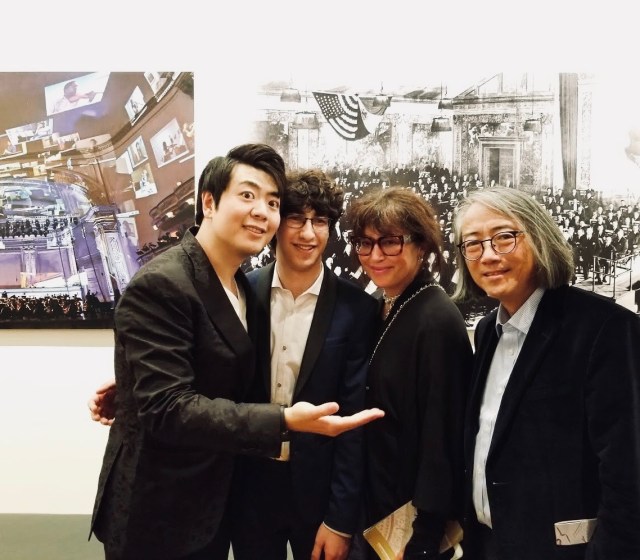
Maxim with his teachers Lang Lang, Tema Blackstone, and Hung-Kuan Chen

Maxim with his teachers Lang Lang, Tema Blackstone, and Hung-Kuan Chen

As a personal mentor, Lang Lang is simply the best! Probably the best moments are informal ones, when I play something in a dressing room and Lang Lang offers some invaluable words of wisdom. A very special form of mentorship also happens on stage during rehearsals, where I’m part of the action or just observing as Lang Lang interacts with some of today’s most important orchestras and conductors. This form of mentorship is extremely rare and it’s such an amazing opportunity to learn first-hand from someone who has performed with orchestra thousands of times. Finally, Lang Lang is a mentor in terms of his fantastic view of life and incredible strength of character.

Talk for a moment about what you’re doing to make music accessible to your generation.

I think most classical music is just as moody as the typical teenager. There are calm moments, crazy moments, insanely intense moments, depressing moments, and unbelievably beautiful moments. It’s not hard to understand or appreciate this art form, it’s simply that a lot of young people are never really exposed to this music (or when they were, it was unfortunately a negative experience) so they think they hate it. There is also sometimes a bit of a snob appeal to classical music that turns people off. I think this is such a shame! You don’t have to know anything about classical music to enjoy it. Music in general is probably one of the most powerful ways we can bridge gaps and become closer together as caring human beings. It is language that has no boundaries.

Is there a teacher or an influence you’d care to name that you especially admire?

I am always inspired by my teacher at Juilliard, Hung-Kuan Chen. He passionately shares a lifetime of profound wisdom, insight and advice on so many levels. He supports and encourages me to find my own path in this world.

*****

Maxim Lando and Lang Lang team up with Peter Oundjian and the Toronto Symphony , including members of Toronto Symphony Youth Orchestra in a March 1st concert featuring Dukas’ The Sorcerer’s Apprentice, Ravel’s Daphnis et Chloé Suite No. 2 and Gershwin’s Rhapsody in Blue.

Posted in Interviews, Music and musicology | 1 Comment

Abduction via Mouawad

It’s another new Canadian Opera Company production where my first impulse is to credit the brass running the COC. But in a week when the big news for North American opera was the second artistic directorship undertaken by Alexander Neef, this time in Santa Fe, it’s a wonderful omen that his role is again front and centre, a series of wise choices.

RESIZED_neef_Debus

COC Music Director Johannes Debus and COC General Director Alexander Neef. (Photo: bohuang.ca)

While the photo of Jane Archibald is far more striking –no offense Mr Neef or Maestro Debus—I’ll still lead with the two men, as I think that’s the real story.  The new COC Abduction from the Seraglio –a co-production with Opéra de Lyon—reminds me a lot of their production of Louis Riel last season because of a similar political framework, an enlightened director leading a kind of redemptive production, aiming to save the opera from itself.

Wajdi Mouawad_ photo jean-louis_fernandez

Wajdi Mouawad (photo: Jean-Louis Fernandez)

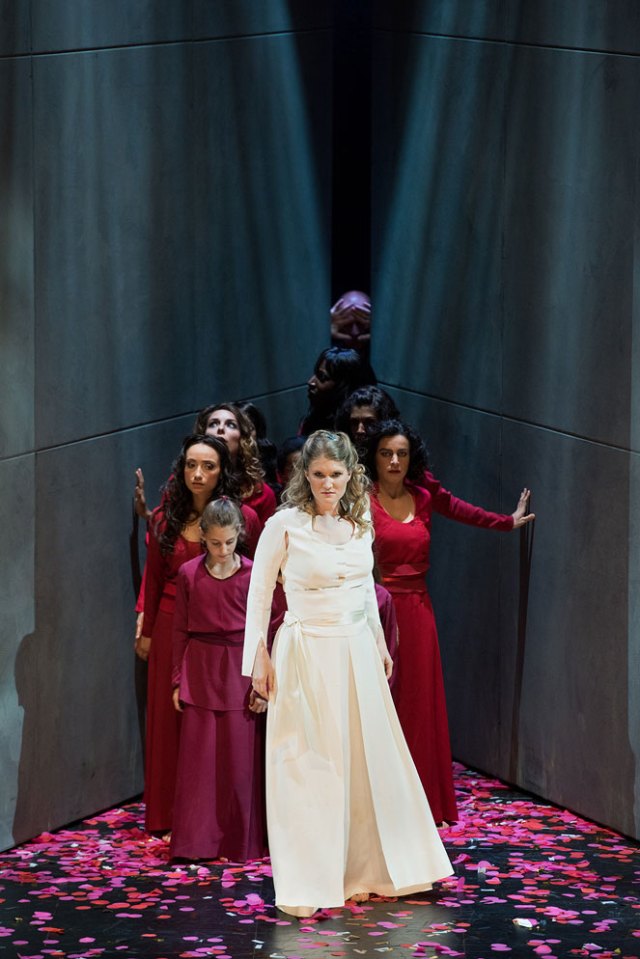
This time we’re in the presence of a Lebanese Canadian, namely Wajdi Mouawad, who interrogates the Mozart Singspiel as a site of what the director might call “caricature or casual racism.” By a curious coincidence, Mouawad’s method sets up a similar sort of layering to what Hinton gave us in the spring for Riel. When Jane Archibald sings her big number to close the first half of the show it’s again in the presence of silent witnesses, lending an extraordinary weight to the moment. “Marten aller Arten” is sung from a kind of cleft that has huge resonance for me in a week when I was watching François Girard’s Parsifal and its lurid suggestions of female sexuality (ha, while we’re speaking of co-productions with Opéra de Lyon). As the set begins to move and close in on the women –Archibald plus a dozen extras, half children half adult—if you know this opera, you may gasp. Mouawad seems to make this moment speak for all women. No wonder people are speaking of Archibald as though she were Gandhi or MLK, because of course the moment becomes one of activism, highly political, and I might add, totally irresistible. It doesn’t hurt that Archibald, the COC’s artist in residence sings note-perfect. I can’t recall ever hearing her sing off pitch, and tonight there was a great deal more going on than just the music.

operaenlevementauserail35_copyrightstofleth

Jane Archibald as Konstanze, in the Opéra de Lyon/COC co-production of Abduction from the Seraglio, 2016 copyright ©Stofleth

Mouawad gives us a highly original new slant to the story with a fascinating little prologue. What if we were to see the characters who escaped from the Seraglio, back in Europe? The opera becomes a kind of discussion resembling a trial –again reminding me of Hinton’s Riel—in its reframing of a flawed work with the benefit of 21st century hindsight. The dialogue is new, and the staging is peppered with moments where the illusion is pierced by flashback moments, as when Belmonte is touching Konstanze in a scene she has with Selim. Those occasional moments of ambiguity made the whole thing electric, seeming to dance on the edge of being yanked from one reality into another. We open after the intermission with a prayer and a dervish-like dance both of which add to the richness of the production.

The set design of Emmanuel Clolus is a co-conspirator in the inter-penetration of the original, at times pushing it away, at other times overwhelming us, as in the moment I described that concludes the first half. There’s a mysterious geometric shape peeking out upstage, that is finally revealed near the end –spoiler alert—when we discover that this is where the women have been held captive and where the four Europeans are held pending their torture, a spherical shape that alludes to the Earth in its totality. Am I reading too much into it? one does that when one is feeling drugged, my mind expanded in sympathy with all the love and enlightenment (in more senses of the word than just the one) on display.

There may be casualties. The comic tone one usually encounters is harder to find, possibly because the opera simply isn’t as funny in this version. No it’s not a light comedy, too much gravitas for that. Pedrillo, played by Owen McCausland is the designated funny man, sometimes in cahoots with Goran Juric’s Osmin.

While I’m saying nice things about Neef, who hopefully will read my apparently sycophantic words, I hope he reads my next sentence. There are several brilliant Canadians in this show, and some talented imports: but I feel that if a Canadian can do the role, every effort should be made to cast the domestic talent. I think we’ve improved from the days –especially under Mansouri—when we had to endure mediocre Americans coming north when there were lots of Canadians perfectly capable of offering a mediocre (or even dare I say it, good?) performance. All things being equal, the Canadian must get the job. If you’re bringing in brilliant foreigners such as our Rigoletto, fine and dandy. But I am sure there are Canadians who could have sung Belmonte or Osmin, lovely as these two artists were. As Neef’s star rises with his new foreign appointment, as the sesquicentennial sinks into the distance behind us, I hope they will keep the Canadian in Canadian Opera Company, as we must continue to see lots of Canadians onstage. Jane Archibald, Claire de Sévigné, Owen McCausland and Wajdi Mouawad are brilliant Canadians of whom I am very proud, thrilled by their excellence.

Abduction from the Seraglio continues until the closing performance February 24th.

Posted in Opera, Reviews | 2 Comments