Tremendous Triptyque

We’re in the twilight of Matthew Jocelyn’s time at Canadian Stage, a near- decade of unprecedented multi-disciplinarity.  We’ve had dance, we’ve had opera, and yes, theatre that combines disciplines.  We’ve had several offerings from Crystal Pite, from Robert Lepage, and now another brilliant mix tonight. As Jocelyn approaches the end of his tenure he’s going out with a bang.

MJ-hi-res

Canadian Stage Artistic & General Director Matthew Jocelyn

Triptyque is a three part performance—really three different works – created in the interface between dance and circus.

I can’t recommend it highly enough. See it if at all possible.   

The 7 Fingers (7 doigts de la main) circus troupe from Québec collaborated with three different choreographers, giving us three different works that sit in that ambiguous place that’s neither dance nor circus.

One of the things I love best is to be mystified, to be lost in something that I can’t figure out.  Whether I’m listening to a Beethoven symphony or a science fiction filmscore, the conventions usually serve to comfortably tell us where we’re going. The coded moments in works of recognizable genres let us relax a bit, pointing us towards predictable outcomes. But what if you don’t know where you are? Then you’re really in a magical place.

Here’s the published description of the three works on the program:

1. Anne et Samuel – Marie Chouinard (The Garden of Earthly Delights) Following in the footsteps of Chouinard’s signature work bODY_rEMIX/gOLDBERG_vARIATIONS, this duet between a dancer and hand balancer examines the relationship between gravity and moving bodies with awe-inspiring effect.

2. Variations 9.81 – Victor Quijada (Quebec) A quintet of virtuoso hand balancers search for absolute control of gravity, testing the relationship between stillness and movement.

3. Nocturnes – Marcos Morau (Spain) Subtly mixing circus and dance, the mesmerizing Nocturnes lures us into the space between wake and dreams where eight artists try to break free of their physical constraint.

Quijada’s quintet is perhaps the most gentle of the three, a piece that had me thinking of the word “virtuoso” throughout. We watched different groupings, always poised when on their hands but –irony- sometimes unsure on their feet. What we might think of as upside down is the place of calm repose for much of this piece.  In the dance continuum between drama / story telling on the one hand, and dance as pure dance on the other, Quijada has us very firmly at the latter end of the spectrum.  It’s beautiful movement for the sake of beautiful movement. Charming as this one was, for me it made the least impact, while the other two were overwhelmingly powerful.

Chouinard’s opener takes us into a realm I’d call disability drag, as we watch two phenomenally gifted artists moving in ways that seem to be or are actually compromised.  At the opening Samuel enters using crutches, while Anne is suspended on and in ropes, resembling a kind of bondage.  She is released by him almost inadvertently, as she comes down to the ground, only to join him on her own crutches.  Speaking as someone confronting my own growing decrepitude, there’s a universal struggle underlying this piece, as they fight gravity, at times climbing onto one another –again making me think of BDSM power struggles—and briefly achieving freedom from their crutches, before sinking back down. This is a piece of great tenderness, wonderfully beautiful at times.

Morau’s Nocturnes take us to the most natural place to explore the night, namely bed.  While this epic work includes the entire troupe, we begin with one person alone in their bed, that site of maximum vulnerability.  In time we are looking up at wonderfully original assemblies of rope above the bed, ridden by multiple aerialists.  Can you relate to my devout wish: that circus discover something meaningful and even representational, beyond just beautiful balletic moves in the air?  In this piece we’re truly experiencing drama, something profound and symbolic.

Morau achieves this, anchoring his aerial explorations around the bed.  All the movements seem profoundly psychological in this context.  We even get moments of delicious surrealism, which I won’t spoil for you.   And eventually the bed itself flies.

If you are a dance or circus practitioner, or at least a fan, please find a way to see one of the remaining performances of Triptyque (running until Nov 19, with two performances Saturday) at the Bluma Appel Theatre.

You will be inspired as never before.


Posted in Dance, theatre & musicals | 2 Comments

Putnam County: nerds rule

The 25th Annual Putnam County Spelling Bee (PCSB) is not just a musical but also an irresistible evocation of youth, concealed erections and performance anxiety.  A spelling contest is the microcosm, and in this world the nerds rule: not unlike music theatre itself come to think of it.

SPELLINGBEE_scottgorman-6

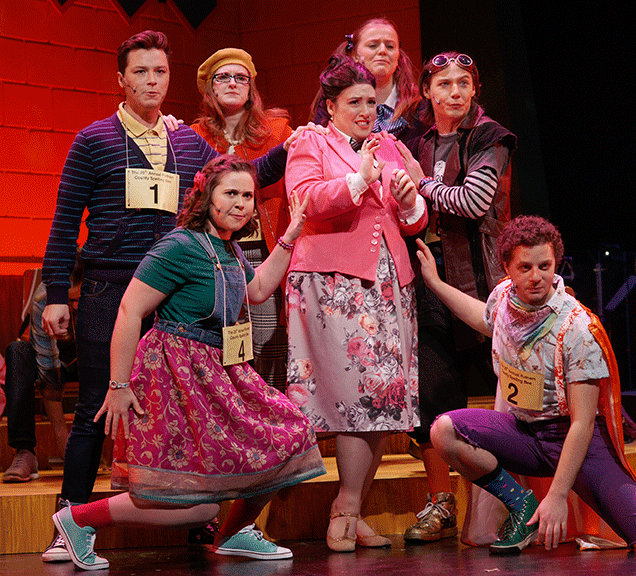
The students surround the teacher at the Spelling Bee (photo: Scott Gorman): clockwise from left, Vanessa Campbell, John Wamsley, Erin Humphry, Amy Swift, Braelyn Guppy, Hugh Ritchie and Kevin Forster

Hart House Theatre opened their production Friday night, with tonight’s second performance concluding the first weekend of three.  In some respects PCSB is every bit as grueling as its subject, 100 minutes of fast patter, flashy dance-moves and tight cues for laughs without intermission, to put Rossini to shame.  My companion commented that it’s like a modern opera in some respects, a very fine-tuned machine to tell a charming little story, amuse you with its humour and please you with its tunefulness.

Considering that the run has just begun they’re already very tight on the HH stage.  While tonight’s show surely included lots of friends & family –packing the theatre –the laughs were huge and I don’t just mean my own.  There’s lots of glory to share between Director Cory Doran, Music Director Giustin MacLean and Choreographer Sabrina Hooper.  This is a high energy show, whether in those moments when one person is trying to spell a word, or when the company starts dancing to a song laying someone’s emotions bare.  As far as I could tell there were no dead moments, no false starts, nothing that didn’t run smoothly except for some facial hair that may have been deliberately contrived to set up a series of gags.  And if that was a real problem (I have my doubts), they effortlessly turned it into an asset.

Speaking of nerds, the cast offers a full range of quirky people, possibly reminding you of someone you know.

  • Logainne, the politically outspoken girl with gay parents
  • Chip, the eager boy with the bulge in his pants
  • Leaf, the boy with the inferiority complex
  • William, the boy whose spelling is infallible, but whose name is always mispronounced
  • Marcy, the girl so perfect that she dreams of failure
  • Olive, the girl whose parents don’t show up but who loves her dictionary
  • Rona, the teacher who is a former winner
  • The Vice-Principal who needs a restraining order
  • Mitch, the ex-con performing community service

The show gives everyone at least one great moment.

SPELLINGBEE_scottgorman-26

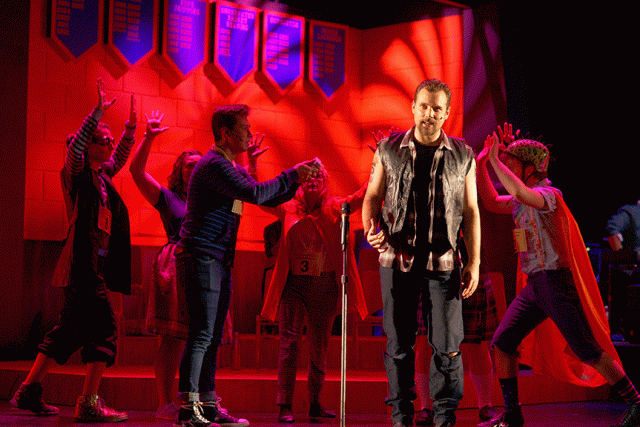
Carson Betz with the Putnam County company (photo: Scott Gorman)

Carson Betz as Mitch, our ex-con, has a stunning voice used to great advantage.  John Wamsley as Chip gets lots of laughs, especially in a brief cameo that stops the show near the end (if I tell you more I’d spoil the joke).  Braelyn Guppy is equal to the challenges as Marcy, managing to be impressive yet still very likable.   Vanessa Campbell’s Olive and Kevin Forster’s Leaf both win us over with their tender vulnerability.  And then there’s Hugh Ritchie’s quirky rebel William, and Erin Humphrey’s intense Logainne.  Amy Swift & Art Carlson as the two teachers function as our hosts, to keep the contest and the show running smoothly, almost like stage management.

PCSB runs until November 25th at Hart House Theatre.


Posted in Dance, theatre & musicals, Reviews | Leave a comment

Jennifer Nichols talks about Haus Musik Crossing / Traversée

I invited Jennifer Nichols to talk about Haus Musik.

If I understand the concept Haus Musik aims to do what every classical music company seeks: re-packaging and re-inventing their content in new ways in the quest for that elusive younger demographic, in search of new audiences.

I asked Jennifer to talk about Crossing / Traversée, their newest performance coming up this Thursday November 16th that she directs at The Great Hall.

Hausmusik is a wonderful recurring annual event developed by William Norris of Tafelmusik with the intention of presenting Baroque music in a non-tradition context and supported by other disciplinary elements.

Understandably, the audience for period music is quite niche, and this is such a shame, as it is exquisite and more people should be exposed to it, particularly a younger demographic. This is a not uncommon problem in the arts. For example, classical ballet, opera and classical music struggle to build and maintain audiences. It is even more difficult for something as niche as Baroque music. How do we change this and ensure its longevity and audience support through future generations?

IMG_3173

There are many arts organizations endeavouring to do this, and with Haus Musik, an audience is served period music in a manner that is perhaps more enticing.  Directors are offered a platform on which to experiment with their own unique way of presenting the music, and the result is different every time.

William approached me with this great opportunity, and the first steps for me were to begin with a concept and develop the supporting elements from there.

My concept was formed from a question I’ve asked myself for decades, which is ‘why does Baroque music resonate so deeply with me when I had no early exposure to it?’ Long before I started dancing with Opera Atelier (and hence was exposed to it extensively), I felt a deep connection with it, far deeper than the type of enjoyment I get from other styles of music.

The more I thought about it the more the idea intrigued me. Why do certain works of art, places, or people make us feel as if we know them intimately, perhaps from another time?

Version 2

When something resonates with us far beyond what is rational to us, is it indicative of something we are unaware of? The concept of time perhaps being ‘non-linear’ started to form, and from there a loose narrative took shape.

The result is a love story that reaches beyond the boundaries of time; in fact, time is fluid in their circumstance. Their story unfolds neither in one time or another, but in multiple.

It’s perhaps an esoteric concept, but I think it lends itself well to the music we are presenting and the intention behind it, which is that it is timeless and relevant regardless of context or date.

Version 2

The other parameter I was given to work with was the repertoire, which is entirely French Baroque, and so I ‘went to town’, so to speak, with everything French. I wanted the show to be immersive and engage all of the senses, and so the audience will be immersed in a world of film, visual art, dance, music, poetry, all bathed in a cloud of lavender. There will be LOTS of lavender. Everywhere. 😉

I’ve been incredibly blessed to have built a team of artists and collaborators who are truly excited about the concept and have come along on this ride in a fully committed way from day one. In addition to the Tafelmusik artists who are open minded and totally on board with what we are developing.

I have a brilliant DJ and electronic music artist named Andycapp, who has put together a gorgeous set of music to complement the Baroque. This musical transition from past to contemporary and vice versa is lovely, because they highlight and lend a nod to each other without being too distracting.

Visual artist and filmmaker Patrick Hagarty has lent a few of his works of art to support the narrative and these canvases will be featured. He and I have also developed and shot a film that is a stunning complement to the narrative and will be teased throughout the show. Without giving too much away, I think it helps transport the audience in and out of time periods in a very effective way.

IMG_3030

Dancer Jack Rennie has been a friend and colleague for a decade and it has been thrilling to work with him one on one to develop the character and choreography. I highly respect him as a dancer and actor, and his approach to the work. We have spent a great deal of time not only in movement creation but in discussion about motivation and intent and really fleshing out ‘who he is and what his purpose is in the show’. I appreciate how keen he is to develop concept and not simply present aesthetically pleasing elements.

There is also a poetic element woven throughout, in the form of a letter, which gave me an opportunity to flex my writing muscle. 😉

Hopefully it all comes together; there are so many moving parts!

A very important part of the whole process for me was to ensure that whatever unfolded was ultimately a ‘supportive’ context for the music, which is above all else, the focus of the show. Yes, there is a narrative, and yes, there are other artistic disciplines involved, but these should be platforms on which to push the music to the forefront and help the audience experience it in a new way. Which will hopefully make Baroque music more accessible.

At the end of the day, we want the audience to walk away feeling that they really want to experience more of it. Sometimes it’s all in the packaging.

*****

Haus Musik present Crossing / Traversée Thursday, 16 November 8:00 PM at The Great Hall 1087 Queen Street West.


Posted in Dance, theatre & musicals, Interviews | Leave a comment

Sofia Coppola Retrospective at TIFF

Sofia Coppola: A Name of Her Own —

Retrospective revisits the works of the
American auteur following her recent
Cannes Best Director win

December 8 — December 17
TIFF Bell Lightbox


img
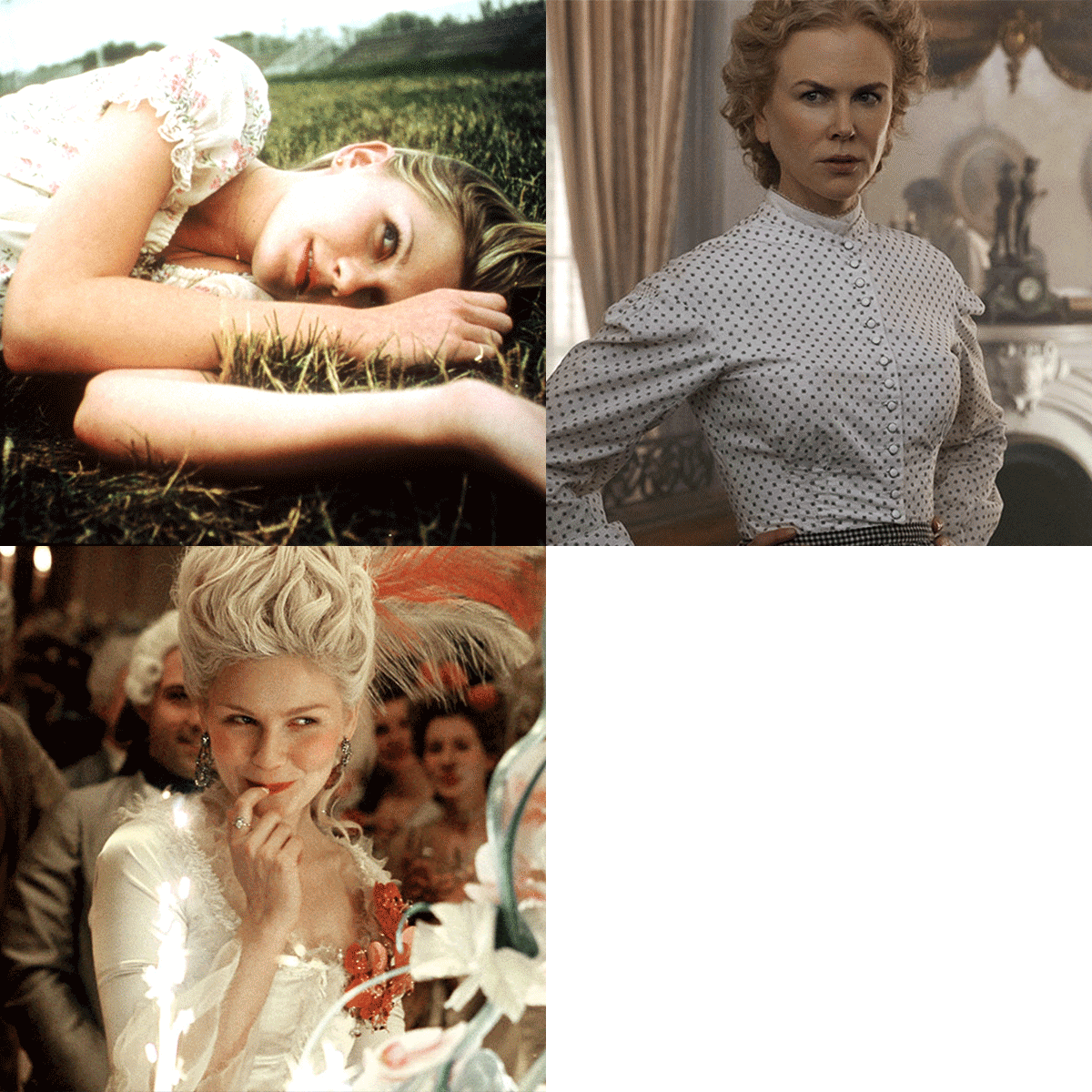
The Virgin Suicides (1999)
The Beguiled (2017)
Marie Antoinette (2006)

The writer-director of ‘Lost in Translation’ and ‘Marie Antoinette’ has made the malaise of the privileged her special turf. Ennui is her milieu. And Coppola has a talent for revealing its existential and cultural dimensions.
— Lisa Kennedy, Denver Post

[Coppola] transports you to a place you’ve never been, makes you feel a sensation that’s familiar, yet leaves you different than you were two hours earlier.
— Christy Lemire, The Associated Press

With her recent Cannes Best Director win for The Beguiled — making her only the second woman ever to receive this accolade in the Festival’s 71-year history — Sofia Coppola has further cemented her reputation as an American master. Known for the dreamlike quality of her films, and narratives that focus on the ambitions and desires of her young female characters, Coppola has a fresh voice that offers a distinct female vision in a largely male-dominated industry. This latest prize a list of prestigious accolades that includes a Best Original Screenplay Academy Award for her second feature Lost in Translation, and the Golden Lion at the Venice Film Festival for Somewhere.

An alumna of the California Institute of the Arts, where she studied photography and fashion design, Coppola is also known for the prominence that costume and other design elements have in her films, not to mention that fact that her multiple collaborations with fashion houses — most notably Marc Jacobs —  have earned her a name in that field as well.

Running December  8 to 17Sofia Coppola: A Name of Her Own offers an opportunity to revisit the works of the American auteur, showcasing all six of her feature films. The programme also offers a rare opportunity to see two of Coppola’s earlier works in 35mmThe Virgin Suicides(1999) on December 8; and Marie Antoinette (2006) on December 10 and 15.

Click here for complete schedule or visit tiff.net.
Posted in Cinema, video & DVDs, Press Releases and Announcements | Leave a comment

Questions for Madeleine Jullian: directing GASH

Madeleine Jullian has worked as an actor, writer, and director in Berlin, London, and Toronto.  She produced and directed Nick Dipchand’s solo show The Nature of a Bullet as part of the Toronto Fringe in 2013 and produced a double bill of Sheldon Rosen’s one-act plays, New Order and The Grand Hysteric, at Ryerson University’s Abrams Theatre in 2015.

Madeleine’s written works include Prize Horse, performed at the 2012 New Voices Festival, as well as bagged, created with the 2013 InspiraTO Playwriting Academy.  She also won Pat the Dog’s 24-Hour Playwriting Contest with her play Bunk*R in 2014.  Other directing credits include Caitie Graham’s earlier work Paradise Comics (2014), Positive I.D by Peter Dickinson (2012), and Laurie Campbell’s Just to See You Smile (2012).

Madeleine directs Caitie Graham’s GASH that opens Nov 22nd at Alumnae Theatre.  Let’s find out more: about Madeleine and GASH.

1) Are you more like your father or your mother?

madeleine+jullien

Madeleine Jullian

Both, I think. My mother studied literature and taught for many years, and my dad ran a microelectronics company for decades.  So, at first glance, it may look like I get my artistic sense from my mum and my analytical side from my dad.  But my mum is intensely logical and likes to extract facts – she could be silent for much of a conversation, only to come out all of a sudden with one perfectly-crafted sentence that summarizes what we’ve been discussing, changes the perspective on the situation, and also happens to be extremely funny.  And my dad – well, he’s a visceral storyteller.  You should watch him play the board game Articulate: he becomes utterly possessed with the word he wants you to guess.I could go on, but I feel I’ve inherited all of these things in strange ways.

2) What is the best or worst thing about what you do?

The lack of structure.  I was an athlete for a long time, so my days, years even, were intensely planned out.  I could tell you what I would be doing at a 5pm on a Thursday three years ahead of time. Since graduating I often feel like I’m treading water, instead of swimming to my destination.  But that’s a personal problem.

3) Who do you like to listen to or watch?

I’m definitely a people-watcher.  I like to see what I can know by looking at a person.  Do they have their employee ID on them?  Who do they work for?  Why did they choose that shirt this morning?  Are they in pain?  How did they come to take on that particular posture to get through their day?  We give off so many clues about ourselves without knowing it.  Where is that particular individual going?  What does their way of moving say about them?  Where do they hold tension in their body?  Oh, and I love period dramas, the Bourne films, Luther, and Broadchurch.  I once waited three hours in the rain to get a photo with Ruth Wilson, because she was both in Luther AND in my favourite version of Jane Eyre.  Rough ride man.

4) What ability or skill do you wish you had, that you don’t have?

I wish I could time-travel, but somehow I don’t think that’s what you mean.

[actually that’s an awesome answer…!]

Or see into the future, but I guess that would be useless if I could travel in time?  Then again, if I could see into the future, then I wouldn’t have to worry about being seen by my future self and therefore ruining the universe.

But then, I wouldn’t be able to live in the past, which I think is ultimately what I’m after… I think I would do really well as a medieval farmer.  Actually, I did this thing on a website once that said in a previous life I was a medieval farmer.  Wish I could remember that.  I bet I was like the second person who said it would be a good idea to use fertilizer.  Not the first person, nah, but the first person’s friend who was like, that is a good idea, you should pursue that, and what’s more, I’ll do it too.  And then we both get invited to talk about our experience to the king who’s like, you two are smart, and then I can go, I’m not, your majesty, but my friend is.  She’s incredibly smart, and funny, too.  And then me and my great friend would go off and have some mead or whatever booze they drank back then and celebrate a little before heading back to our land to rock our new farming practices for the next ten years or so before we die of overwork.

5) When you’re just relaxing and not working, what is your favourite thing to do?

Hot tea in bed, wine and chips, lattes and walking.  I also like to buy scratchcards and call out the numbers like I’m in a bingo hall.

More questions about GASH.

1- Please describe how you came to be part of the team preparing GASH

219665_3106cd82a4e443ee874ddfab8fd2e253-mv2

Playwright Caitie Graham

I directed Caitie’s play Paradise Comics when it was part of the New Voices Festival back in 2014.  It was a great experience for both of us, and I’ve been a massive fan of her work ever since.  She sent me previous drafts of what was then called POSE BALL, so I feel I’ve been with the play for some time.  I remember reading early drafts while sitting in a coffee shop in South London.  She had already had an excerpt of the play produced as part of the New Ideas Festival at Alumnae, as well as a staged reading of the play at Tarragon, so when Caitie asked me whether I would consider directing it for Alumnae’s Fireworks Festival, I was honoured that she would think of me.

We then worked on Sama Kokabi to be our Stage Manager.  Sama is a stunning artist and incredible SM – she’s also one of the best people I know.   She’s worked with us many times, and always brings a caring and resourceful energy to the room.

Once Sama agreed to come on board, the team was set.

samakokabi

Sama Kokabi

2- The social media storm surrounding Harvey Weinstein & the #metoo conversation makes this play feel very timely, in its concerns with consent & sexual violence.  How has that impacted your feelings about the project?

Once in a philosophy elective a young woman began her in-class-participation-mark-getting comment by saying, “I’m not a feminist or anything but…” There is definitely a lot coming to light recently, but this is not a recent fight.  My mother went to a bar with some friends who joked she should get on the table and dance for them.  My grandma was pawed down at neighborhood dances.  As the metoo hashtag shows, surprise surprise, there’s something wrong with how things are run, and we’re getting sick of it.  I hate “timely” pieces.  Caitie did not write a “timely” play.  She wrote what was true to her, what she wanted to explore, and it’s that truth that speaks to me, the story of these three young people.  I don’t jump on bandwagons, and I don’t feel like talking about sexual violence being flavour of the month.

3- How would you describe yourself & your previous work(s)? 

I’ve worked as a director, actor, writer, producer… and done a shedload of retail and customer service.  When I was in school I wrote a play called Prize Horse, about a sinister bet between a brother and sister.  I’ve also written a ten-minute play about a young man confronting a piece of rope after his father has died by suicide. I’m fascinated by darkness and the thoughts we don’t want anyone to know we have. When I read something in the news about a horrifying crime, I try to think, in what kind of place would I have to be to even consider committing that crime?  Psychologically, financially, emotionally, logically.  And I think that’s what my work is about.  Just trying to see where people are coming from.  So in terms of directing, that’s what feeds my hunger for new work.  I love mining text, digging through layers, thinking about characters and the shape and structure of scenes and plays, and what’s motivating all these people.  And when I get in the rehearsal hall, it’s about giving actors the most delicious things to work with.  You can just see when a note or a thought fires an actor up.  That’s when you shut up and let them try it, and see how you can best shape that drive to give the actor the most to play with.

4- GASH tells an existential CSI kind of story, piecing together events between a woman and those around her.  Please unwrap some of the politics for us.   

Ah, if we’re going to start name-dropping shows, then I’m a Law and Order: Special Victims Unit kind of a woman. Olivia Benson, you know what I’m saying?  But GASH doesn’t even deal with the justice side of things, we don’t even enter that reality.  It’s not even brought up as an option, because it’s basically understood that if Cata decided to go to the cops, she would be out of the police station with an “unfounded” stamp on her forehead quicker than Harvey Weinstein ejaculated into that potted plant (allegedly of course).  How sad that seeking justice is not even on this young person’s mind.  So instead we see their trying to figuring it out themselves.  When you know you will never get justice, when you’re not even sure what justice actually means, how do you move forward?  Cata so desperately wants to be in charge of her own life, but Jules, and even her friend Isa, take that agency away from her in different ways.

5- Caitie Graham’s work often concerns youth and their particular concerns. Please talk a bit about what that means to you, in terms of process & how you direct the script.

meara+khanna

Meara Khanna

This is a really tough time for young people.  I didn’t have facebook until university; this next generation doesn’t know a world without youtube.  They’re smart, crafty, resourceful, and critical, but it’s hard to grow up and figure out who you are when your phone can tell you via snapchat, facebook, twitter, Instagram, etc. how the rest of your acquaintance is living a better, more glamorous, more fulfilling life than you. Now, dramatically, of course, this is supremely fascinating, and to watch young people play young people is really cool as a director.  In theatre school you get used to seeing twenty-somethings play all roles, regardless of age, which is part of the training.

Seeing young actors play young people, it brings a whole new energy to the room. Both Meara Khanna, who plays Cata, and Blake Murray, who’s playing Jules, are relatively close in age to the characters (17 and 23).  It gives them an immediate grasp on the material that an older actor may struggle with.  And Caitie, of course, knows the play intimately, so it’s particularly fun to see her come at the text as a performer.  I get to see what weird and wonderful things they bring to the work and then we go from there!

*******
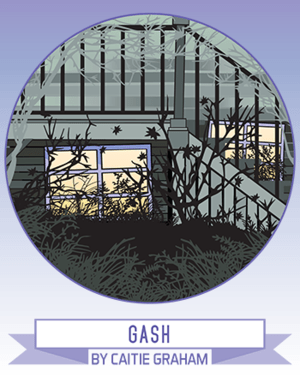
FW-GashbgCaitie Graham’s GASH runs Nov 22 – 26 at Alumnae Theatre, directed by Madeleine Jullian.  (Information & tickets)

SPECIAL EVENTS

Thursday November 23
Free Panel Discussion: Navigating Consent
Moderated by Anne Wessels, director of education at Tarragon Theatre. Our panelist is Andrew Townsend, coordinator of teen programming at Planned Parenthood Toronto.

Saturday November 25
Writer/Director Talkback with Caitie Graham and Madeleine Jullian


Posted in Dance, theatre & musicals, Interviews | 1 Comment

Martin Geck: Beethoven’s Symphonies

Sometimes the release of books and records seems serendipitous.  If I look closer at the process I might start to feel cynical. I will cling to the positive magic implicit in serendipity, naive though it may seem. geck

For instance, here I was, beginning to work my way through the new Tafelmusik complete Beethoven Symphonies just released this fall, and what should I see on the new books shelf at the Edward Johnson Building Library?  Beethoven’s Symphonies, a new book from Martin Geck, translated by Stewart Spenser.  The German edition came out in 2015 so it really is quite new.   A book like this, however musicological and rigorous it may be, feels like a bigger better version of liner notes for a record, especially when you’re listening to the recordings every day.

Maybe it’s not such an unlikely coincidence, considering how much keeps being written about Beethoven.  At the very same time that I noticed Geck’s symphony book, I also spotted Barry Cooper’s The Creation of Beethoven’s 35 piano sonatas, another book that can legitimately carry “2017” on its call number.   There’s always lots of Beethoven study in the world.  I’ve been through the symphony set, one end to the other twice, listening to each of them twice along the way, so I’m fairly swimming in Ludwig van B.  Mostly it’s a constructive – additive sort of thing, where having the music saturating my ear complements the reading.

For the most part Geck seems to have a rare understanding of the composer, in a book full of insights.There have been moments when I pushed back a bit.  When Beethoven was being extolled to the skies at the expense of Franz Schubert I had to push the pause button for a moment.  Must we play those 19th century musicological pissing contests, declaring that my composer pees further than yours ergo he’s better? It’s tricky because Geck has a very ironic style at times, and I’m decoding a translation that might have emasculated or embellished what he actually meant.

Can’t we all just get along?

In a chapter segment titled “Delusions of Virility: A Constant in Beethoven’s Symphonies?” –a segment proposing an intriguing frame for Beethoven’s symphonies– we see the following from Geck:

Are delusions of virility a characteristic of Beethoven’s symphonies as such? Strictly speaking, there is no “As such” because each work merges with its own reception to such an extent that it is almost impossible to separate the two. Even so, comparisons are still possible –not only between Beethoven and his contemporaries but also between Beethoven’s individual works.  Against the background there is no denying that Beethoven’s symphonic music admits of far more gestures of power than Schubert’s, for example, and that Schubert was able to achieve the mellow calm of his great C-major symphony only after he had failed to achieve the heroic Beethovenian ideal in his unfinished symphony in B minor, a failure that he himself saw in an entirely positive light.

It’s really hard to argue when you’re inside someone’s head, wondering just what he means. We’re less in a scholarly discussion and more in a kind of poetic labyrinth of allusive phrases.  I wish I knew what was really meant by “gestures of power”, as I can’t really calibrate such moments as the powerful fanfare that opens the first movement of Schubert’s 9th, or the call to battle that opens its finale. Surely those are gestures of power…? Perhaps it’s problematic because some of this virility is not at all delusionary, leading us away from the big metaphor Geck is creating.

I made this quote and took issue with it not so much to take Geck down, as to suggest another way to read this book.  When I recall my joyful experience with the Tafelmusik CDs, it places this book into a slightly different category, less musicology than entertaining guidebook.  If Geck isn’t required to explain what he means, then it’s wonderfully enjoyable as a way to open up the conversational space, rather than to close & conclude the discussion.  I’m far happier with that tendency, as though the symphonies are prayers or meditations and Geck’s commentary the marginal gloss, illuminating our reading/ prayer. It really does work, as one doesn’t have to fight when the commentary is presented in a somewhat non commital and ambivalent tone; even the Schubert quibble I mention above ceases to be problematic if we see this as Geck’s celebration of the achievements of the era (and of both composers) rather than anything precise or definitive.

One has to let go of one’s rigor, to “lighten up”.

So when Geck asks about the sequence of keys for Beethoven’s symphonies, it’s more of a provocation than the introduction to something rational; and no wonder that the question is posed in a chapter segment titled ”On Idle Speculations.” First time through, especially after the recent conversations I’ve had with Jenna Simeonov about keys (see her recent piece here, and something I suggested she read, from a few years before), I was almost angry that the writer seemed to be copping out, ducking the question altogether:

C major, D major, E-flat major: these are the tonics of the first three symphonies. But why is the next symphony in B-flat major rather than the expected F major? And why is there no G major, but instead two symphonies in F major and one each in C minor and D minor in addition to C major and D major?

Argh…!  Wrong question surely. It’s already profoundly remarkable that the first three symphonies have this sequence. Does it mean anything? Must it mean anything at all?  How about asking those questions, framed against the certain knowledge that no composer had ever set symphonies in this kind of sequence.

AHHH..! but then again, if we back off lighten up, and allow Geck to have his fun? if we stop treating this as musicology and instead let it be a bit of a romp –albeit with a Beeethoven soundtrack—I think we’re in much better shape, and far less likely to have our noses out of joint.

One of the things I really love about this book is how new it all sounds, how fresh and modern Beethoven seems in Geck’s eyes and by implication, in those new recordings that I’m playing.  Geck has us immersed in the cultural preoccupations of the time as to make the symphonies sound fresh and even radical.     So go get this book as your companion to listening to the symphonies, whether it might be the new Tafelmusik recordings or something older.  No matter what recording you put on, Geck makes the music sound fresher and newer.

That’s a good thing.

Martin Geck’s Beethoven’s Symphonies, subtitled “Nine Approaches to Art and Ideas” is from University of Chicago Press, translated by Stewart Spencer.

Posted in Books & Literature, Music and musicology, Reviews | Leave a comment

Vegan in Toronto

Where would you take a visitor to Toronto if you knew (s)he were vegan or vegetarian?

I was in a rut for awhile, with two standard answers to that question, one in Kensington Market, one on Bloor St.  But now –led by the visitor’s inspired choices—I know a whole bunch more.

This is a quick summary of our travels. Our focus has been from the east end (where we both reside) to the middle of town (where I work). I understand that the west end is full of great places but we don’t go there so often.

Why does one do this? Some people have political objections to meat and to the assumption that animals only exist on this planet to serve humans. Does the thought trouble you at all? I certainly find it problematic, especially when I think of what a mess we’ve made of this planet. And sometimes it’s simply a matter of health.  I am finding myself feeling better when I eat vegan, and totally open to hearing the arguments against a conventional diet.

I won’t try to persuade you.  Instead?  Here are the five places that were most noteworthy over the past two weeks, that you might want to check out for yourself.

1) Grasshopper on College St near Spadina

Grasshopper is a cute little place near the university (where I work).  The menu is a series of humorous options, as they parody a typical menu with such things as “mac n Cheese” or “chili” or “pulled pork” or a “burger” all accomplished without recourse to meat.  I suppose this is how many vegetarian places operate, framing their selection in terms of the conventional foods they don’t offer.  But Grasshopper seem especially witty.

The question you might want to pose is: on a menu, is it more important to make an accurate imitation of something normally containing meat / dairy, or should the chef aim for something tasty or even healthy?  I’ll let you answer the rhetorical question yourself.  But Grasshopper gives you a fun parody of a typical restaurant experience if you need that. Or you can have one of their bowls or salads and simply enjoy something quite marvellous.   They’re not expensive.  MENU

2) Udupi Palace  on Gerrard near Coxwell

I’ve been driving past this place for years without noticing it, indeed, driving through this fascinating neighbourhood without ever really noticing much.

We went in, descending to a lower level, the space delightfully disorienting. Is this still Toronto? i felt as though I was far away in another world.

It’s inexpensive, and the flavours and spices totally transporting us to another world.  I had the South Indian Thali –which is a lovely sampler of several flavours including some wonderfully spicy ones—while my companion has something much smaller, from among the dosas.

I’m going back, as the menu is enormous..!

3) Planta on Bay at Cumberland

This one has to be pricier because of its location. But wow it’s busy busy, having attracted attention with its beautiful execution and the prettiest space of any that we visited. (some are downright plain)

We had a tough time getting in –crowded!—but the service was quite spectacular considering.  One can have pizza or burgers.

But wow, some of the simplest things can blow you away. Their roasted Brussel Sprouts? Thrilling, making me want to try to make this myself.

They offer an Artisanal Nut Cheese Plate, that is stunningly creative, a series of different textures & flavours to remind you of cheese without any actual dairy.

I also had something called “Kale Caesar”, which I assume is meant to be a comical take on the usual cry of “Hail, Caesar”, but instead of wearing the green laurel leaves on your head, you put them –as kale this time—onto a plate.

Everything was wonderful, but it’s not cheap.  MENU 

4) Live on Dupont near Spadina

This was the one we ate after going to the haunted house at Casa Loma.  It was Halloween Night, but there were no tricks, only treats.

We started with the 7 layer dip, a stunning variety of textures and flavours to get you mightily appetized & excited about what’s to come.

Hm maybe “Kale Caesar” isn’t meant to be shouted, as it appears on this menu too. Okay, so I have an over-active imagination.

I had something called Über Protein, and watched my companion eat Bibimbap. We both ate lots, and felt amazing afterwards.  MENU

5) Green Earth on Broadview near Gerrard

Finally perhaps the simplest is sometimes the best. This menu –like all the menus we saw—can’t be properly explored in a single visit.

We both had soup. I ate a spinach – asparagus soup that was a delightful green colour, that I inhaled, while my companion had a Tom Yum soup that I helped her finish.

MENU

cheesecake

Green tea flavoured cheesecake

I had a cheesecake, flavoured like green tea with something resembling whipped cream on top.  Should i put “cheesecake” into quotes? But it’s remarkably like real cheesecake, especially in the way it entices one to devour it.

The coffee? We had to each have two, as it was so amazingly good, the best coffee I’ve had in a restaurant in years, delivered with organic soy milk.

But we’ve barely started our explorations.  And there are so many more places in Toronto.

Posted in Food, Health and Nutrition | 6 Comments

Musik für das Ende

I’m late coming to the party, seeing something near the end of its run.

After seeing Musik für das Ende tonight at the beautiful Guloien Theatre, one of the spaces at Streetcar Crowsnest, Crow’s Theatre’s new facility, I had a series of intense conversations. Please understand, while I’m a social butterfly, I wasn’t seeking them out, I was just minding my own business, furiously making notes on my phone, as I tried to capture a few thoughts after the show.

But people seemed to want to talk. Clearly they had been moved.

I wondered if they wanted to make sure I wasn’t going to rain on their parade, by insulting or disparaging their precious work that they loved so much. Please understand, I’m reporting this because that’s meaningful, that people had such a powerful response to this piece that you could see and feel it afterwards. Part of this is due to the intimate space seating 220 in the round and all that it implies and conditions. We sat facing one another in a performance that at times was like a ritual, making all of us into witnesses or even participants in a rite.

I am aiming to unpack the experience as much as possible from first principles, in order to honour both the text and the performances, each of which contribute to the experience. I’m mindful of a phrase from Joseph Kerman’s Opera as Drama that is stuck in my head tonight as a phrase that rings false, that “the composer is the dramatist”.
That may be so in the time of Verdi or Wagner, but not in earlier times when so much of the creation lay in the choices made by virtuosi, the singers realizing the possibilities of a score. And so, if we go back in time to centuries when the performance was less determined and more improvised, we need to balance the composer’s credit with that of the singers.

And so too in more recent times with compositions leaving so much open to the performers. For Vivier’s work, he co-created with those who realize work such as Musik für das Ende.

Tonight and this past week, we’ve been seeing the outcome of a collaboration between Soundstreams & Crow’s Theatre, “conceived by Chris Abraham and Zack Russell” in the words of the program, employing two compositions of Claude Vivier (Glaubst du an die Unsterblichkeit der Seele (1983) and Musik für das Ende(1971) ) preceded by Il faisait nuit, a text written by Zack Russell. The program would suggest that Russell’s words are part 1, and that each of the two Vivier compositions are parts 2 & 3, but it’s not quite as distinct as that.

01

Alex Ivanovici as Claude Vivier (photo by Claire Harvie)

Alex Ivanovici portrays Claude Vivier. Is this the eternal aspect of the composer: who was murdered in Paris before his 35th birthday? Perhaps. We begin in the dark, where we all begin. It’s mythic and universal in the extreme, even if Ivanovici plays a very grave & adult Vivier to my eye, without the famous laugh; but then again I recall so many people telling me how much they detested Mozart’s laugh in Amadeus, so perhaps this was a canny choice, opting for gravitas and universality. When I mentioned that to a friend afterwards, I was admonished that they didn’t expect verisimilitude. Nor did I. But this is a tonal choice. It’s a small quibble, and perhaps I am simply wrong, that the piece wouldn’t work if one opted to bring out a more vulnerable youthful side to Vivier.

I am grateful I had the chance to chat with cast-member Bud Roach. He confirmed what I thought I was experiencing, as I stumbled upon a word that the cast was apparently using namely “mantra”. The big final piece on the program, which is done with Vivier incarnated onstage for the latter part of the performance—meaning Ivanovici, and also a younger aspect of the character onstage at the end (perhaps to balance out the seriousness? To inject a bit of vulnerability?) –is a curious ritual. The procedures as far as I could tell alternated between groups of performers repeating or roughly imitating certain key phrases, syllables that I didn’t understand (and that I don’t need to understand), and individual segments using music brought from life. I heard a bit of “you are my sunshine” and “ombra mai fu” and “vittoria vittoria mio core”, among others and assorted words and phrases in several languages; I particularly observed some Hungarian (from Margaret Bárdos) because it always grabs my ear (as a Magyar) but there were others as well, that I didn’t understand. I don’t think the particulars of what’s said or sung matters, so much as that we observe this back and forth between solitary expression and the tendency to coalesce into groups and repeated chants.

While I don’t pretend to understand the procedures Vivier specified –and I did hear a bit about it on social media—the important thing is what they achieved in this back and forth vacillation, between the solos and clusters / constellations of singers, that were a reminder that we are not entirely alone, but never fully lost in the group. It was a kind of enactment of culture & society, of the dynamics of a person relating to a larger group, pulled at times to conform, at other times free to fly away in their own thoughts / songs / words.

02

Music für das Ende (photo by Claire Harvie)

My first impression –as I watched the excitement in the space and tried to get my ego out of the way of the complex procedures I was watching –was to be reminded of my first experience of Philip Glass, of seeing something that seemed to defy my understanding. The trick then (with a concert of music from Einstein on the Beach in the 1970s, and later, Satyagraha in 1981), was to stop expecting the music to do what other musics usually did. Instead of stipulating –as some critics did– that music must do x or y, that there must be development, the real trick is to be in the here and now (haha I accidentally typed “hear and now” which might be even more accurate), of the phenomenon itself.  Stipulations are for your real estate agent (i need 4 bathrooms!) not concerts or operas.  Once I let Glass have his way with my ear and viscera, and indeed, once I surrendered to Vivier and this production, it made a whole lot more sense.  Don’t worry about what those syllables mean (they’re in Sanskrit, Bud tells me).

I don’t speak Sanskrit. Do you?

I found myself wondering how Vivier imagined the work. For this occasion with the collaboration between Crow’s Theatre & Soundstreams, the procedure was enacted right in front of us, in the round where we couldn’t miss what was going on. Vivier might have expected the work to be done by singers in tuxedos on a concert hall stage, not in a maelstrom of bodies on a half-lit stage, surrounded by observers. His score was as much an occasion for voyeurism and visuals as it was for the more typical aural listening experience, and that’s before we add in the meta-drama (or meta-music??) of the composer wandering through his own composition.

From time to time, a voice emerged from the group. We began the Glaubst du… section with Owen McCausland and then Adanya Dunn, who would make her presence felt much more in the later larger work, along with Bárdos, Vania Chan, as well as a few singers whose sound I recognized, particularly Keith Lam, Justin Welsh, and the unmistakable tenor of Bud Roach.

There’s a lot more to it than I’ve captured here, including sound design for the first part, featuring Adam Scime’s synth, as well as Ryan Scott, percussion & John Hess, synthesizer & conductor. The piece had been workshopped last year.

A pair of performances remain on Saturday November 4th. I would suggest you get there if at all possible: so you’ll know what your friends are excited about.

Posted in Music and musicology, Opera, Reviews | 4 Comments

Centre Stage 2017

They keep fine-tuning the format for the Canadian Opera Company’s Centre Stage Gala, the competition & celebration of the Ensemble Studio, now in its fifth year as a gala, seventh as a singing competition.

I would say this was the most entertaining yet, featuring the comic stylings of Ben Heppner at the microphone, regaling us with witty anecdotes, followed by Alexander Neef teasing us unmercifully with the results, a genuine fun time.

While past years have featured more entrants in the competition, this year everyone seemed to have a legitimate shot at winning. While I was fairly sure who had won –in one of those happy years when the audience favorite is also the winner of the actual competition—I think anyone else in the competition could have been a legitimate 2nd or 3rd place finisher, at least based on the performances that we heard tonight.

But of course the competition isn’t just about tonight. These singers prepare their solo arias with the staff of the Ensemble Studio, who are at least partly the ones who determine the winner. In preparation they get to see what kind of person they’re dealing with, from work habits to simple kindness. I don’t pretend to know the criteria for the selection, only that it’s not just about how well they hit their high notes tonight.

2017 is a very strong cohort.

Simona Genga was the audience favorite, a popular winner with an intense reading of the aria “Adieu forêts” from Tchaikovsky’s Jeanne d’Arc. I don’t know the piece, only that Genga gave us great intonation, pathos a plenty and a remarkable range. The response after that aria might have been the biggest I’ve ever heard at one of these Centre Stage competitions.

Joel Allison finished second with a rendition of “Scintille, diamant” from Offenbach’s Tales of Hoffmann, and Anna-Sophie Neher was third, giving us “Je veux vivre” from Gounod’s Roméo et Juliette.

It was a spectacular evening not just for the high level of the competitors, but also for Jane Archibald’s epic performance of arias from Don Giovanni and La Traviata.  Archibald sang while the judges tallied their scores, but she was far more than just a place-holder. Impressive as the youngsters were, it was thrilling to hear so much beautiful singing pouring out of Archibald, the COC’s Artist-in-Residence.

We began with the overture to Abduction from the Seraglio. Johannes Debus who is just back from conducting at the Met in NYC led a strong showing from the COC Orchestra, ensuring that every aria sounded even more beautiful. On this occasion there were no weak performances, as everyone seems to be ready for prime time.

09-10-S-01-MC-D-095

COC Music Director Johannes Debus with the COC Orchestra. (Photo: Michael Cooper)

I will be intrigued to see just who might be joining the Ensemble Studio after this strong showing.

Posted in Opera | Leave a comment

Legends of Horror

If you like your theatre interactive, I have the show for you. But whoops tonight was the closing night.

Even so I am betting that Legends of Horror will come back to Casa Loma next year.  I sure hope so.  This was the most fun I’ve had in a long time.

building

Imagine your standard haunted house, like the sort they used to have at the CNE. Remember? Some of it was cheesy and even silly, and occasionally they might scare you or startle you.  So that’s what we remember from childhood.

NOW: picture a grown up version, not really appropriate for small children, because some of the images are truly grotesque and scary.  You take Casa Loma –an actual castle in downtown Toronto—and employ its grounds and its tunnels to create a genuine ambience of terror.  Sometimes it’s because you’re in an enclosed space, with spooky music. Sometimes it’s because an actual actor surprises you in the dark.

Because it was Halloween we dressed up.  I was in a blue wig, my daughter in a pink one (as you see in the picture above).  The place was totally jammed full of people, which also made it less likely we would be scared, especially when one sees so many others get startled, jump or scream at the top of their lungs, and many others were also in costumes.

Legends of Horror is a totally amazing experience anytime, let alone on Halloween Night.

It was a bit of a challenge to figure out how to dress, on this the coldest night of the entire run (remembering that it’s been unseasonably warm since the show started in late September).  The wig turned out to be a great way to stay warm, allowing me to get rid of my sweater (that I needed earlier in the day, walking on the Board Walk).  I also enjoyed the possibility that by being a bit chilly, I might have shivers that would be a natural segue into shaking in terror.

But really, the crowd defuses much of that.  If we had come earlier in the run, on a quiet night, we might have been genuinely jarred by what we saw and heard, including some wonderful performances by live actors.  I was especially impressed by the big Frankenstein’s Monster figure near the end, towering over us, as I shouted “it’s alive”.

They told us before we went in that

  • We were not to touch any objects
  • We were not to touch any of the actors
  • They were not to touch us

And that made me feel quite safe.

A few times, the performers loomed out of the dark, while I smiled and stood my ground.  I am one of those weirdos who –when someone says “can I get a volunteer” during a show—screams “me me me!” It led to some wonderful moments including one almost nose to nose, but it was magical.  And I have to say that’s hard work, keeping a straight face, staying in character especially when a doofus in a blue wig (moi that is) smiles back and says “howdy howdy” or “hey there handsome.”

What fun!

ZOE_dentist_pic

The caption I used on social media: “Hm just remembered I’m seeing the dentist next week.” But jokes and costumes are a way to avoid being scared

And they told us that halfway through the tour that we’d find a bar and washrooms.  It’s delightful, stopping to look at the pictures we’ve taken while we have a drink and gather ourselves for more.  It was interesting sharing this with social media, getting comments from friends & family far & near, particularly on a night when some were experiencing genuine terror in NYC.   How fortunate that ours was entirely innocent.

I hope they revive it next year.  I will be back, bringing other friends along.

Posted in Dance, theatre & musicals, Popular music & culture, Reviews | 1 Comment