Three performances remain of The Return (il ritorno) at the Bluma Appel Theatre, the last of Canadian Stage’s “Spotlight Australia”, a kind of festival that they’ve offered the past few weeks. The Return, from Circaappears to be the creation of Yaron Lifschitz, who wrote an extensive program note, a kind of manifesto in defense of circus as so much more than what it’s usually permitted to be. In my case he’s preaching to a convert. This could be a version of Monteverdi’s opera Il ritorno d’Ulisse in patria, although we get bits of Monteverdi interspersed with lots of other music. This is not the conventional approach to telling a story. The singing is lovely but it’s in Italian without titles. If you’re open to it, you’ll connect mostly to the physical element, the bodies in many different positions.
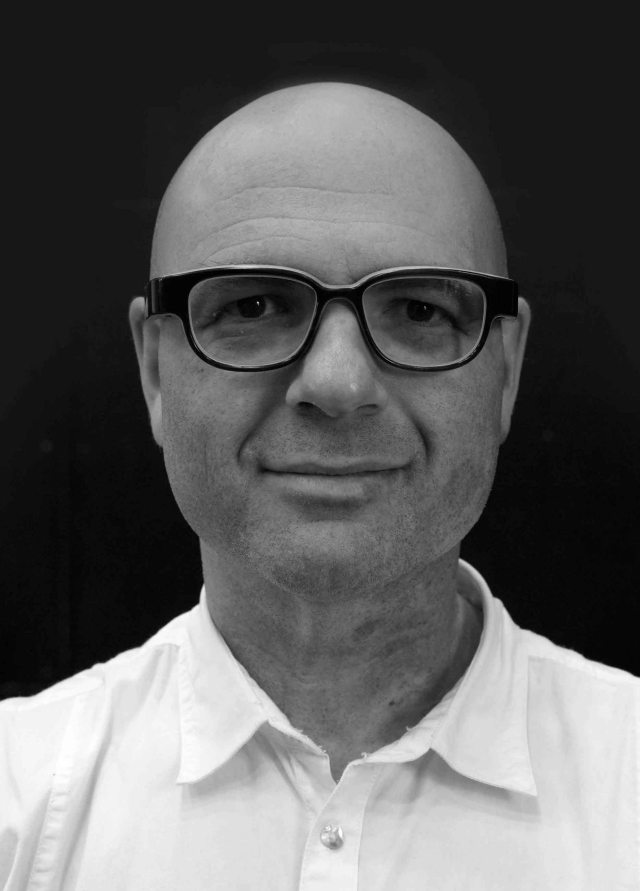
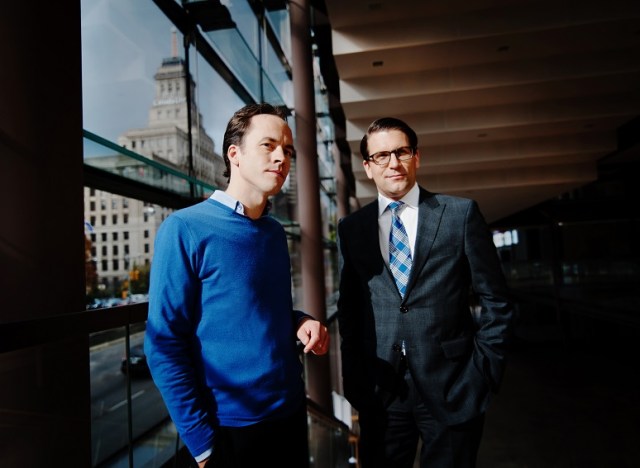
Yaron Lifschitz, creator of The Return with Circa
There are many people I’m wishing could go see this, as it’s a kind of textbook study in semiosis & signification. The stage picture before you separates the discreet channels physically, so that it’s almost like bun raku, where you have the puppet on one side and the story-teller on the other: except this time it’s a split between music-makers and physical performers. One channel is aural / musical and mostly static, while the other channel is that of the dance or the circus, of pure energy, effort, and the ongoing struggle with the law of gravity. It’s fascinating and likely to inspire anyone making theatre, dance, circus, opera, or any combination of the above. If you are any of those, do whatever is necessary to get a ticket. See it!
There are times when the movements are astonishingly impressive, beautiful to watch, heart-stopping, original, creative: but only loosely connected to what we’re hearing. The music is reduced to something that adds a bit of a cachet and glamour to the lovely movement. The idea of The Return —the predicament of the characters– may be signified in a general sense. If you’re open to it, if these images speak to you, then the connections will be made in your mind.
I have been desperate to see something like this: that is, what the Return purports to be. Yes I’ve been waiting for this. No seriously, for years and years I have been dreaming of this moment, after getting the first glimmer back in the 90s. “Circus” is a whole vocabulary, a discourse (or perhaps more accurately, a series of discourses, if we distinguish between aerials and acrobatics and animals and the other pathways that don’t immediately come to mind, that could be subsume under that broad circus tent) that could do so much more than the roles to which it’s often relegated.
Last November I saw a show that had similar ambitions, namely Balancing on the Edge, a meeting between new music and circus. It’s truly like comparing apples to oranges in trying to speak of these shows. I’ve wanted to see circus step more boldly into the arena of theatre & story-telling. It can be done, and it’s the same challenge that has been faced before.
We’re talking about making an abstract form signify more exactly and precisely, a challenge faced several times:
Music leans upon text, and has employed a written program to create a “tone poem”, whereby something entirely musical aims to tell a story
Dance too can tell a story, especially if movement is codified as in the style at the Bolshoi, where we are able to read movement without recourse to text
And circus has been used as parts of other shows, thinking particularly of Robert Lepage’s theatricals, especially the operas such as The Tempest¸ Damnation de Faust, or the Ring Cycle, where aerials and acrobatics enlarge the expressive possibilities of a theatre form. But there are others, such as the Fura del Baus troupe.
On the occasion of Balancing on the Edge last fall, I asked whether disciplinarity is a kind of safety net that both assists us in our decoding but also prevents us from breaking through to something genuinely new. What I really loved in The Return was the ambiguity. Sometimes I felt i was watching figure skating, a formal duet of sorts between two people, even as they defied expectations. Sometimes I couldn’t tell whether this might be a kind of dance or a kind of circus / floor exercise. The longer it went on, the more I felt that they themselves had their own rigid procedures, as one or two of them would come on or go off, doing an exciting series of movements that could just as easily be a duet or a pas de deux, in their preoccupation with a kind of display, showing off as blatantly as anything you find in opera or ballet. That’s good, even if it was a different set of procedures in play. Perhaps this is early in the development cycle, and they’ll evolve further.
The Return is wonderful to watch, full of moments suggesting new possibilities. I felt I was watching an athletic kind of dance, really, as there have been dance companies in Toronto employing at least part of this movement vocabulary. This is a very enjoyable show. I can’t help thinking that the arrival of a troupe from afar should be inspiring, opening new imaginative vistas. Claude Debussy’s creative life was spurred by the international Paris exposition in 1889 when he first heard the gamelan. This visit by our friends from afar could be every bit as inspiring.
Tonight was the first of two farewell concerts for the Toronto Symphony before a two week tour taking them to Tel Aviv & Jerusalem, and then Prague for a residency that Conductor Peter Oundjian spoke of, to honour Karel Ancerl, who was the TSO’s Music Director from 1969-1973 (the year of his death). I can’t be objective about such things, having been very young at the time but I do recall a couple of amazing concerts and a live recording I had of the TSO playing Beethoven. The naïve expectation among my friends (when people speculated about the name of the new concert hall) was that it would be Karel Ancerl Hall, but this was before it became standard practice to name halls for donors rather than leaders.
Schumann’s piano concerto played by Jan Lisiecki (a work he recorded recently ), who was the TSO’s soloist in their January 2016 tour of Florida;
and
Bartók’s Concerto for Orchestra.
Oundjian also mentioned Dvorak’s 7th Symphony as a work to be played on the tour.
Tonight’s program included the following:
Oscar Morawetz’s Carnival Overture, a great choice for the visit considering that Morawetz was born in what is now the Czech Republic, was a Canadian for most of his life, and just had his 100th birthday in January.
Pierre Boulez’s Le soleil des eaux, a challenging work with soloist Carla Huhtanen plus chorus. Tonight we heard Soundstreams Choir 21 although they are not accompanying the tour.
Nicolai Rimsky-Korsakov’s Scheherazade, a work that’s becoming their calling card, recalling that the TSO played on the 2016 Florida tour and that they’ve recorded it
Pleased as we can be with the TSO’s ongoing commitment to new Canadian compositions in this Sesquie-season, it’s worth noting that each program has at least one Canadian piece on offer even if they’re not much more than what R Murray Schafer called “un pièce du garage” (and I quote from My Life on Earth and Elsewhere)
A commission from the Toronto Symphony Orchestra followed that from the MSO a year or so later. The contract read: ‘It is agreed that the work shall have a minimum duration of approximately seven(7) minutes and no longer than ten (10) minutes.’ That is, the work was to be what Canadian composers call a ‘piece de garage’, intended for performance while the patrons were parking their cars.
Neither piece exceeds ten minutes, but yes at least it’s something, and forgive me if I seem to be asking too much.
Morawetz’s overture is a lively affair, coming from the very beginning of his career, before his emigration, and therefore of special interest for the concerts in the Czech Republic.
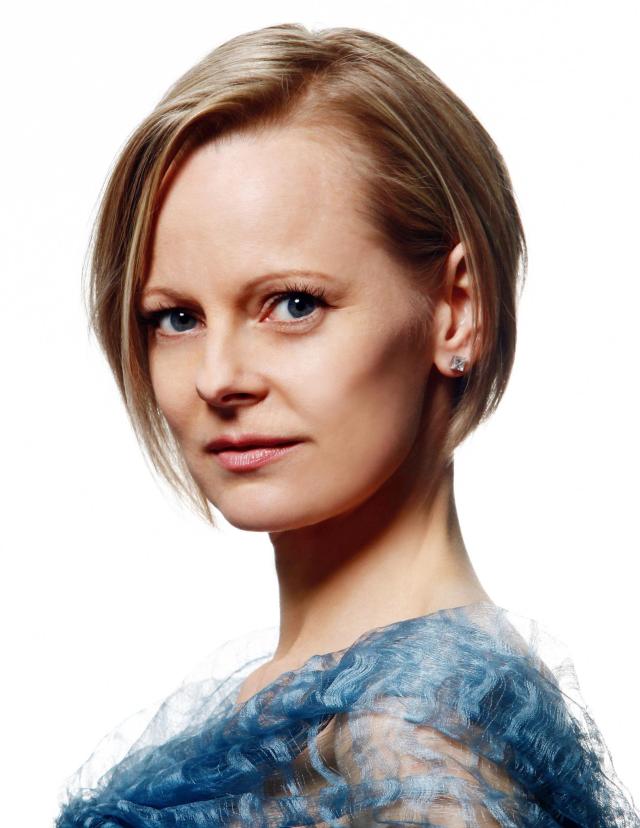
Soprano Carla Huhtanen (photo: Tobin Grimshaw)
The Boulez that followed was a fascinating study in 12 tone composition, delicate and lyrical without any unpleasant dissonance that I can recall. Carla Huhtanen is a wonderful ambassador not only for Canadian music but especially for the modernist composers such as Boulez. Her voice has a kind of acuity whether she’s singing baroque & classical music for Opera Atelier, or pushing the envelope with music from recent times, a wonderfully precise intonation and clarity of tone.
Vanessa Fralick, Associate Principal Trombone of the Toronto Symphony
And speaking of Opera Atelier, Soundstreams Choir 21 were prepared by David Fallis, who just last week led Opera Atelier’s Médée, and who will again go back to early music for Toronto Consort’s staging of Cavalli’s comedy Helen of Troy next weekend. While the Boulez is not a long work, it’s a very unique sounding work. I don’t find it matches the surrealism of the text, being instead much more random, a smattering of colours and tones rather than being able to reference images or moods that one might call surreal. But wow it’s intriguing all the same.
To conclude the TSO gave us a piece I heard three times in Florida on the 2016 tour, a series of marvellous performances. The live experience of the TSO playing Scheherazade isn’t at all what you get on their CD (which has a more conventional interpretation), as Oundjian fully exploits the potential theatricality of the piece in a live performance. When, for example in the 2nd movement, we get the portentous exchange of solos from trombone and trumpet, instead of doing it as written, Oundjian plays up the contrast, getting Vanessa Fralick to play it super slow and loud, while getting the trumpet’s answer to be a comically tiny cartoony echo, like something from vaudeville. It’s brilliantly wacky, and not the only example. Concertmaster Jonathan Crow is given several opportunities to draw out the schmaltzy drama in his solos, as if to call attention to the story-telling. I think it’s fair to say that the audience gave them a wild send–off with some of the biggest applause i’ve heard all year, leading Oundjian to joke about wanting to take us along on the tour.
I wish…!
After tomorrow afternoon’s concert, the TSO leave on their tour Sunday for two weeks, returning towards the end of the month.
We’re on the road until the end of the season! Due to issues with our performance space we’ve had to reschedule our remaining shows – see below for full listings. Please join us for our first Emergents outside of the church, visit us in the intimate confines of the Burdock Music Hall for an early showthis Friday.
The first set focuses on The Toronto Harp Society, whose mandate is to cultivate and foster an appreciation of the harp, as well as to encourage new works for harp by Canadian composers. The society is also adamant about supporting arts education, which has resulted in tonight’s featured performers being the winners of their annual competition.
Robert Taylor – J’ai tant rêvé de toi Aria for voice and harp by , performed by Myriam Blardone, winner of the Judy Loman Award from the Toronto Harp Society Scholarship Auditions.
Glenn Buhr – Tanzmusik: IV. Cantilène Elégiaque
Paul Hindemith – Sonata for Harp performed by Clara Wang, winner of the ARCT category of the Toronto Harp Society Scholarship Auditions.
Patrick Arteaga – A Portrait of Tschamiu performed by Angela Schwarzkopf
Henriette Renié – Pièce Symphonique en trois épisodes performed by Angela Schwarzkopf
The second half of the night features Stereoscope Duo, Toronto’s newest saxophone duo – Olivia Shortt (last seen during X Avant as a member of Dialectica) and Jacob Armstrong. This creative and quirky duo aren’t afraid to use electronics, collaborate with dancers and other artists or make new sounds. It’s all in a day’s work.
Robert Lemay (CANADA 1961- ) – Fragments Noirs (2016) for soprano and alto saxophones
Ben Wylie (USA/CANADA 1992) – Dichotic (2015) for two alto saxophones
Anthony T. Marasco (USA 1986- ) – Werewolf (2017) *World Premiere
Finola Merivale (IRELAND 1987- ) – Home (2015) for alto and baritone saxophones and voice
with Dancer Kathleen Leggasick and soprano Lindsay McIntyre
The Emergents Series is generously funded by Roger D. Moore.
The Music Gallery presents Pharmakon + Mamalia + Kristina Guison +DJ Garbage Body ***NEW VENUE***
The Baby G, 1608 Dundas St. W. Saturday, May 27, 2017 Doors:7:30pm | Concert:8pm Tickets: $15 Regular | $10 Members/Students | $13 Advance at musicgallery.org
The Music Gallery presents DKV + Icepick + Invisible Out Thursday June 15, 2017 Doors:8pm | Concert:8:30pm
Burdock Music Hall, 1184 Bloor St. W. Tickets: $15 Regular | $10 Members/Students | $13 Advance at musicgallery.org
“Press releases and announcements” are presented verbatim without comment.
Ukrainian Canadian soprano Natalya Gennadi was recently announced as a replacement in the title role of Tapestry Opera’s Oksana G, when the original singer had to cancel. Oksana G tells the story of a young Ukrainian woman lured into the world of sex trafficking by a recruiter who unexpectedly falls in love with her.
Natalya has performed the role of Suor Angelica with Cathedral Bluffs Symphony Orchestra and Opera Oshawa, and recently made her debut with the Brott Opera as the Countess in Mozart’s Le Nozze di Figaro. She has also sung Yaroslavna in VoiceBox’s Prince Igor, Zemfira in Aleko with Opera Five, Tatiana in Eugene Onegin with Slavic project Tchai, Donna Anna in Don Giovanni with Opera Nuova and Opera by Request, Fiordiligi in Cosi fan tutte with TSOW, and covered the part of Santuzza in Cavalleria Rusticana with Maryland Lyric Opera, USA. Natalya successfully collaborates with Vesnivka choir, Toronto and is a guest soloist for the annual European Union Christmas Concert in Notre Dame Basilica, Ottawa. Recent recipient of the IRCPA’s Karina Gauvin Scholarship, she was awarded the Career Blueprint grant from the National Opera America Center and Sondra Radvanovsky.
I had the pleasure of asking Natalya some questions in anticipation of the world premiere of Oksana G May 24th
Natalya Gennadi (photo: Heather Kilner)
Are you more like your father or your mother?
Although I love and respect my mother a lot I am undoubtedly my father’s daughter. Restless and passionate about everything he took on, he had a mind of a mad inventor: he built furniture, houses, could draw cute puppies and was a successful engineer at a big plant during the Soviet era. I think I inherited his fearlessness when it comes to decision-making and I am the handyman of the family. However, my mother and I are more similar when it comes to music as my father can’t string two notes together in a tune while my mother plays piano and still sings duets with me at the dinner table. She’s the one who read us Pushkin and Tolstoy as bedtime stories and played opera recordings casually.
What is the best or worst thing about what you do?
I do many things because I have to provide for my family. I call these things “survival jobs” and they have run the gamut from co-writing for Forbes Ukraine, being an usher for a Cirque du Soleil production to playing a speaking part of Rob Ford’s friend on The Daily Show with Jon Stewart. These experiences helped me learn discipline and time-management and allowed me to meet so many hard-working and friendly people.
However, I do struggle with finding a healthy balance. Do I go to a competition, or enroll my son in French lessons? Should I pick up a longer shift, or should I rest and be a real diva on a dime? With experience these little decisions become easier to make, but they are still a major challenge, I am sure, for many singers. But whenever I get the chance to sing and perform, it makes the “survival jobs” worth it.
Who do you like to listen to or watch?
Maria Callas all the way! Her interpretations are always on point. I also like watching videos of Sophia Loren, Catherine Deneuve, or Patricia Petibon before a performance or audition to get me in the right mood. Most recently, I was preparing a modern aria about an abuse victim for Tapestry Opera’s Oksana G., so I watched several heavy documentaries on the topic before opening my music.
What ability or skill do you wish you had, that you don’t have?
I’ve always wished I could play piano better. I started out as a biologist and later became a linguist so I never thought that I’d benefit from learning how to play piano well. I do play well enough to get through my notes when preparing the music, but I wish I could just spontaneously break into a jazzy arpeggio.
I’ve also always wanted to learn ballet and take some serious dance lessons. However, I am quite athletic and have had some basic, yet very valuable dance training at the University of Toronto. Let’s just say that no feet were stepped on when I had to dance in productions, but pointy shoes are probably not happening any time soon
When you’re just relaxing and not working, what is your favourite thing to do?
My partner, Ivan Jovanovic, is a pianist and we like to travel on the rare occasion we both have time off. Even a little day trip can be very special, whether it’s a trip to Montreal or to the ROM.
On weekends, we usually explore Toronto with my son, who’s almost 12 and is the best companion for gastronomic and historical adventures. Normally you can get a brief lecture on European history over a burger and a milkshake, or, God forbid, a full classification of Pokémon. Never a dull moment.
More questions about preparing Oksana G in a production for Tapestry Opera…
You’ve been brought in to play the lead in Oksana G. Talk about what that means, learning the part so close to the opening.
It’s a very ambitious role for me and the music can be challenging. Usually I prefer the role to settle in before I start rehearsals, but the Tapestry team has been so helpful and supportive – our motto is “divide and conquer” and we work with pianist Gregory Oh daily. I luckily have a significant advantage with Ukrainian being my second language and the comfortable tessitura of the piece so now I’ve been focusing on dissecting the scenes into excerpts that are easy to memorize.
What kind of music is this?
I would define Oksana G. as a Greek drama, but Tom Diamond, who’s the Director, describes it as an opera vérité and I completely agree. The topic of human trafficking is heavy, but the libretto is very realistic and does it justice. And I find that the music is truly respectful of the story it’s conveying. It consists of a series of dialogues that is more movie-esque than conventionally operatic – each character has their own specific way of talking and it’s incredibly clever. For example, the main anti-hero, Konstantin, who lured Oksana and many others into the world of human trafficking, has a very unsettling, immediately recognizable leitmotif – an eerie variation on Georgian folk singing.
What sort of role is this?
Oksana is such a unique and beautiful heroine. She has the purity and strength and all of the imaginable misfortune of Puccini’s heroines. However, she’s much more alive and detailed and is truly a breathing human being. With this comes the great challenge and responsibility of making her real on stage. Not to spoil the plot in any way but, I think there is a lot of Cio Cio San’s youth and strength in Oksana, accompanied by Tosca’s power. The role was written for a coloratura or a high lyric soprano, however my full lyric brings a wider palette of very Slavic colours to it.
What language or languages do you have to sing in this opera?
Oksana speaks Ukrainian, Russian and English, which is a really fortunate coincidence for me.
How would you describe yourself & your voice?
My voice has been going through some positive changes in the past few years. I’m coming from singing as heavy as Santuzza to finally settling into much more lyric, fluid repertoire. Oksana is comparable to Donna Anna and Violetta, and that’s where I find myself comfortable these days.
Oksana G. tells a story about human trafficking in Eastern Europe. Please unwrap some of the politics of this opera for us.
Natalya Gennadi (photo: Heather Kilner)
I grew up in Ukraine in the post-Soviet 90s and I find Oksana G. to be extremely accurate. Times were tough, people were naïve and desperate to make a living. Children, especially girls, are so vulnerable when such economic disasters unravel. I remember seeing one of my classmates suddenly coming to school dressed in a fur coat and sporting a new purse…
There were stories that my mother would share quietly over the phone: a friend of a friend went to Cyprus to work as a maid and left her old mother and a little daughter in Ukraine. They haven’t heard from her since. Those were regular women – mothers, sisters, daughters, wives, friends. They were just looking for a regular, paid job because there were no opportunities in Ukraine at the time. Oksana is an average girl – loved by her family, applying to university and looking for a summer job that can pay for tuition. Her recruiter knew exactly how to lure her and convince her parents, giving them a “legitimate” solution to their financial problem.
This issue is not in the past, unfortunately. Human trafficking is something we are dealing with right here in Canada too with hundreds of women being lured into its dark underbelly. It’s truly unsettling.
Are there any shows you’ve done or seen that now seem to have laid the groundwork for what you’re doing in Oksana G?
Suddenly I am looking at operas through the prism of Oksana G. , which has led me to question conventional operatic stories. For instance, Suor Angelica never mentions the man whom she had her son with. If she were in love, why wouldn’t she pray for both of them, or even curse the man’s name?
Is there a teacher or influence you’d care to name that you especially admire?
It’s a small village really. I’ve been working with soprano Frédérique Vézina for the past three years and am very grateful to have her as my teacher. During my university studies I was lucky to be in the studio with Ingemar Korjus and then Lorna MacDonald, whom I still consult with.
There are also people like Wendy Nielsen who inspire and guide me even though I don’t study with them regularly. Her Donna Elvira at Opera Lyra was my first memorable Canadian operatic experience, and as an emerging artist I’ve learnt a lot from her both on a professional and personal level.
I like an opera with ambition. Tonight I saw a production with style & wit whose chief ambition was to make us laugh: and it succeeded admirably because it was unafraid of sometimes being totally silly.
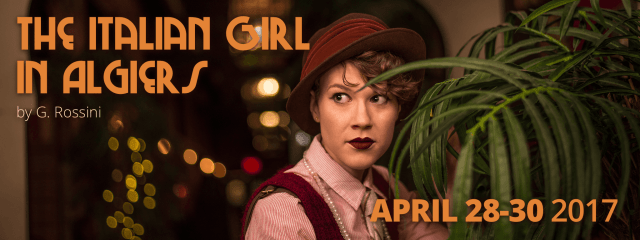
MYOpera launched their 2017 offering, the first of three performances of Rossini’s The Italian Girl in Algiers at the Aki Studio in Daniels Spectrum.
One might expect that a company whose stock in trade is giving opportunities to young performers can’t measure up to big money productions featuring mature talent. But sometimes that tendency can work in reverse. In theatre I immediately think of Romeo and Juliet, and the credibility the story gains from a young cast. In opera it’s even more pronounced when one factors in the complex skills required to portray a Mimi, a Butterfly, a Lucia or a Juliette, meaning that the singers employed are normally older than the role they’re portraying.
I think there was at least a little of the shock of recognition in the audience with me tonight watching a lovely young group of performers, drawing us into their story-telling and music-making. It felt authentic and right.
In an early chapter of Karol Berger’s Beyond Reason, a lengthy study of Richard Wagner that I’ve been reading lately, we encounter Rossini, whose madcap operas are explained and embraced in terms of “organized lunacy”. I felt the greatest possible surrender to that impulse in this production, a fearless embrace of the wacky and the whimsical. Berger cites Alessandro Baricco, who spoke of Rossini’s creation of a theatre of marionettes, mechanical music and singing. Director Anna Theodosakis took this to the next level. No it’s not the first time I’ve seen a Rossini production reduce the performers to something mechanical—we saw this for instance in the 2015 Barber from the COC—but this seemed to take it further, as it was executed with complete abandon and commitment. At times the movements & actions of the singers seemed totally koo-koo: which certainly helped create many laughs tonight.
There is a possible international subtext to the story that happily was side-stepped, in favour of the sexual politics underpinning this redemptive tale of an independent female, a kind of inverted version of Abduction from the Seraglio, as it’s the woman rather than the man who undertakes the heroic rescue. By framing the story early in this century with at least a hint of silent film via the projected titles, we were encouraged to sidestep the problematic issues one might observe in the original text, while turning instead to the era of the suffragette.
MYOpera music director Natasha Fransblow
MYOpera offer a complete package, both the dramatic values and musical ones too. Natasha Fransblow led a thoroughly organized performance, leading several quick ensembles where the singers listened to one another with fabulous attentiveness: a useful component both in the creation of cohesion and intelligibility. Sometimes the performers were singing quickly while executing complex physical moves as well.
I have a hunch that the production was built around Camille Rogers, whose intriguing looks and remarkable mezzo-soprano voice likely led the production team in their selection of repertoire. Without her confident strutting presence, the story falls apart. But whenever she came onstage, the Rossini comedy machine clicked into a higher gear.
Bass Peter Warren
Her rival in the operatic power struggle that triggers many of the laughs was Peter Warren’s Mustafà, a bass who was a triple threat, making us laugh with his physical plasticity, his endless array of facial expressions, or with fearsome poses and characterization. And he can sing too. Jan van der Hooft as Lindoro, Isabella’s long-lost love, gave us some of the most impressive singing of the night even though he too was conscripted into the comedy corps. There were no weak spots in the cast, especially in the beautifully balanced ensembles.
I need to mention one of my chief sources of pleasure, in the stage configuration. By accident we chose to sit on seats immediately beside the stage, a privilege I’d recommend to anyone who might be seeing one of the remaining two shows this weekend. By sitting where we did, we were watching the show obliquely, often watching singers facing an audience who thereby deconstructed any pretense of an illusion. The silliness was right in our faces, within inches. I am a sucker for theatricality, and in this show Theodosakis required her cast to work harder, coping with those of us poised right beside their performances. At times singers had no choice but to include us in the action, which can be magical, but also nerve-wracking for the singer.
If you can get there, go see The Italian Girl in Algiers because you might see a future star or two, because it’s musically excellent and yes, because it’s full of laughs.
The Italian Girl in Algiers featuring Camille Rogers (pictured above)
Ben Heppner and other opera stars join the Canadian Children’s Opera Company for thrilling 50th Anniversary Season
TORONTO – The Canadian Children’s Opera Company presents the thrilling lineup of its 2016/2017 50th Anniversary Season. Founded by Ruby Mercer and Lloyd Bradshaw in 1968 to provide the children’s chorus for the Canadian Opera Company, the CCOC has gone on to become an internationally-recognized organization in the field of children’s opera.
50th Anniversary Celebration Concert
On October 26, 2017, the CCOC will kick of its momentous 50th anniversary celebrations with a celebratory concert at Canada’s foremost opera house, the Four Seasons Centre for the Performing Arts. The company has shared the stage with countless opera stars over the years and we are happy to invite some of the best Canada has to offer to share the occasion. Internationally renowned tenor and radio personality Ben Heppner will host, with performances by Richard Margison, Krisztina Szabó, Simone Osborne and Andrew Haji. CCOC Music Director Teri Dunn will conduct the choruses of the CCOC while former music and artistic directors John Tuttle and Ann Cooper Gay will lead a chorus of the company’s many alumni. The event, one of the largest in the CCOC’s history, is generously supported by our partners at BMO Financial Group, Donnelley Financial Solutions, and the Canadian Opera Company.
The Monkiest King
The main opera production for the season is the world premiere of The Monkiest King, a new CCOC commission by award-winning composer Alice Ping Yee Ho and librettist Marjorie Chan. The duo won the 2013 Dora Award for Outstanding New Opera for their Toronto Masque Theatre commission of The Lessons of Da Ji.
The story is adapted from the Song Dynasty mythological figure of Sun Wukong – the Monkey King. The character, which grew to include Taoist, Buddhist and Hindu influences, spread outside of China throughout East and Southeast Asia. He has appeared in many forms and adaptations, prominently including the Classic 16th-century novel Journey to the West by Wu Cheng’en, and remains prevalent in the modern day with appearances in Hong Kong action movies and video games. A proud trickster character reminiscent of Raven or Loki, Sun Wukong rebels against heaven, but ultimately learns humility.
While we in Canada are most familiar with the European tradition of opera, storytelling through the combination of art forms transcends cultural boundaries. The CCOC, with this commission, has proclaimed their dedication to exploring the cultural diversity of Toronto and Canada while celebrating the stories of our whole community. The premiere production will feature a number of Chinese-Canadian artists in addition to the composer and librettist, including orchestral musicians and choreographer Emily Cheung, Artistic Director of the Little Pear Garden Dance Company.
I am absolutely thrilled to write a new opera “The Monkiest King” for the incredible Canadian Children’s Opera Company. This is also my second collaboration with award-winning librettist Marjorie Chan in our exploration of new story from an old Chinese tale. The legendary Chinese character “The Monkey King” is probably the most famous modern day Chinese “Marvel” hero – it is a dream project for me to bring this mischievous good-natured character to life in a contemporary children’s opera setting. The “Monkiest King” will certainly inspire and educate children performers the magic of music/drama in a different cultural premise, the production is a promise of both fun and challenges to all!
-Alice Ho, composer
The Monkiest King
by Marjorie Chan and Alice Ping Yee Ho
May 25-27, 2018
Lyric Theatre
Toronto Centre for the Arts
Featuring members of the CCOC.
With a mixed chamber orchestra of Chinese and Western instruments.
A Cup of Kindness – Choral Concert
In late November, the CCOC presents its annual winter choral concert, presenting all six divisions of the company performing operatic and choral music.
Myths & Monsters – Junior Divisions
In the spring, The Junior Divisions (children aged 3-10) will be presenting Myths and Monsters, a collection of music and theatre examining the fantastic and frightening in the world of myth and legend. This will include a production of Dean Burry’s opera for young performers, Theseus and the Minotaur.
Chip and His Dog – Youth Chorus
Since 1968, the CCOC has commissioned no less than 12 major operatic works and the Youth Chorus of the CCOC (for older choristers and changed male voices) will present one of the first, Chip and His Dog, by the prominent international composer Gian Carlo Menotti. In the late seventies, the company’s founder, Ruby Mercer, commissioned her friend to compose the work. It was premiered at the Guelph Spring Festival in 1979 and has gone on to countless international productions in numerous languages. The CCOC is excited to be bringing this opera home again.
The Canadian Children’s Opera Company’s 2016/2017 Season continues
Commedia
Saturday, April 29
7pm
Tanenbaum Opera Centre
Spring in Song
Sunday, May 28
5pm
Grace Church on-the-Hill
Brundibár
International Tour of the critically-acclaimed CCOC production
July 2-12, 2017
Prague, Krakow, and Budapest.
About the Canadian Children’s Opera Company
Currently in its 49th season, the CCOC consists of six choruses for ages 3 to 19 and is the only permanent children’s opera company in Canada. Led by Artistic Director Dean Burry, Managing Director Ken Hall, and Music Director Teri Dunn, the company engages young people in the vibrant world of opera by offering intensive musical and dramatic training and numerous professional performing experiences. In addition to their own concerts and opera productions, members regularly perform with the Canadian Opera Company and other major professional organizations, record, and tour nationally and internationally.
“Press releases and announcements” are presented verbatim without comment.
The words on the poster caught my eye. “FIGHT LIKE A GIRL”, all in capitals.
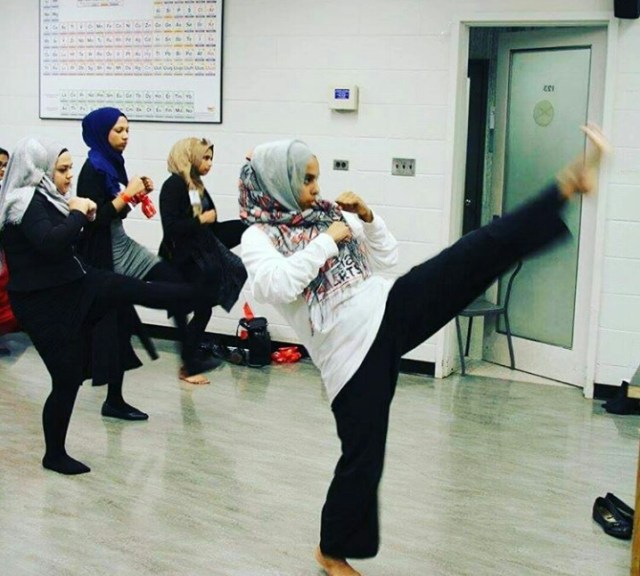
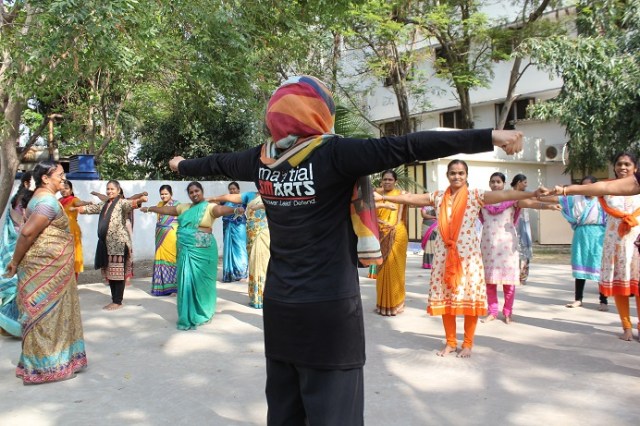
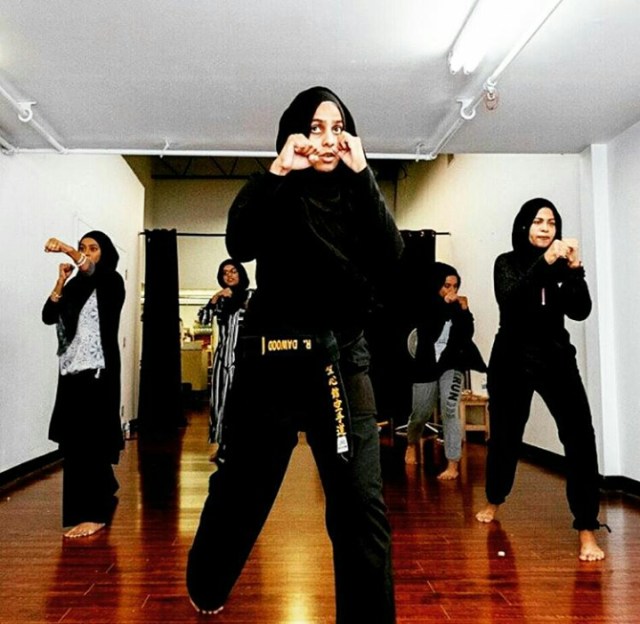
When I inquired further I discovered Martial Smarts and then its founder Dr Ryhana Dawood: a strong advocate for women’s health and female empowerment through self-defense. As a resident physician and double black belt, she has worked with hundreds of women across the GTA and overseas leading self-defense workshops for many underprivileged groups, schools and universities.
Ryhana founded Martial Smarts, a non-profit organization based out of Toronto that aims to teach proactive and reactive self-defense and situational awareness based on the principles of Karate and Taekwondo.
I wanted to share this remarkable story of empowerment by asking Ryhana a few questions.
Are you more like your father or your mother?
I am like both. My parents are both strong-willed people, both in their own unique way. I think I get my work ethic from my father. He is the most hard-working person I know. When he is assigned a task he dedicates all his time and energy to complete that, going above and beyond expectations. Watching him do this throughout my life has definitely helped me realize that our accomplishments and successes are a direct result of the amount of hard work we put in. That is what separates us from the pack. Keep working even if it’s only you, even if the going is slow and your goals seem unreachable.
I am also like my mother. She raised us to be independent, self-sufficient and people of integrity. She also emphasized that whatever a boy could do, a girl could do, and whatever a girl could do, a boy could do too. As such, my brothers, my sister and I were all taught the same things, put in the same lessons and expected to live an active lifestyle while also learning how to take care of things at home. My mother is free-spirited, curious, dependable and unique. I believe growing up with such a wonderful person has helped me become similar to her.
Lastly, both my parents are deeply spiritual people. They brought us up to be God-conscious, socially responsible, respectful, generous and loving people. These are the principles that Islam also teaches and qualities that I have attempted to and continue to further develop. Out of all the things that they have taught me, the most beautiful gift they have given me is most definitely the gift of Islam.
What is the best thing about what you do?
The best thing about what I do is bringing women from all different ethnicities, religions and socioeconomic backgrounds together – empowering women to, in turn, empower others. I’ve always been told that if you want to see real change in the world, teach a woman a skill because she will use that skill to help all those around her. I’ve tried to use this principle with Martial Smarts. It’s really beautiful to see the effect of my workshops. Almost immediately you see women begin to feel more comfortable, confident and strong. They realize their own potential, build their self-esteem, quite often regain some of the confidence they have lost and learn how to lead a more active lifestyle. Our workshops focus on improving overall health, as well as learning basic self defense. Women come in believing they are learning how to protect their bodies but they leave with something even better – the confidence to take on the world.
I love that Martial Smarts allows me to combine my knowledge of medicine and martial arts with my love for community work, activism, mentoring, uniting others and travelling. It is the perfect vehicle to achieving my dreams and I can’t wait to see where we end up.
Who do you like to listen to or watch?
Toronto Raptors, Toronto Blue Jays, represented family time growing up. Played basketball competitively so have always been drawn to it. Enjoy supporting the home team and have been following them since I was about 8 or 9 years old. I don’t have a lot of time to watch movies or musicals and I’m not a radio person, but if I had to choose my favourite movie it would definitely be Disney’s Mulan – for obvious reasons I really identify with her. We have a lot of family discussions which are lively and varied in topics. I enjoy these. I like to read various blogs and books (memoirs, historical novels, learn about different cultures).
What ability or skill do you wish you had that you don’t have?
I wish that I was more organized and that I would stop procrastinating. These are two areas that need significant improvement and I feel would make my life less hectic. Who knows though maybe I work better under pressure.
When you’re just relaxing and not working what is your favourite thing to do?
When I’m just relaxing there are a bunch of things I like to do. Catching a basketball game, playing basketball/soccer/volleyball, working out, going for a bike ride or hike (if it’s warm out), catching up with my friends and their beautiful babies/families, hanging out with my siblings, reading a good book. I don’t think I can pick just one.
More questions about Martial Smarts.
Please talk about the team you have
Most of my team consists of my students. My goal when teaching my weekly classes with UMMA Martial Arts is to train my students to be leaders and better than me. I give them opportunities in class to lead the warm-up exercises and after a while you really get to see them come out of their shell. Through this process, I have 3 students ranging from 15-23 who help me run my workshops. These ladies aren’t always my strongest students in terms of a technique but they are motivated, excited to share what they know, disciplined, responsible and committed. These are the qualities I am trying to foster. All of them started off timid and nervous but really grown into excellent students, fighters and teachers. The students really do respond to them and I’m happy to have them on my team. Out of the 3 students the 23 year old is a beginner but was motivated to join my regular classes predominantly to help with Martial Smarts. She attends the majority of the workshops with me, even joining me in Chennai, India in Jan 2017 where we taught self defense and workshops on healthy relationships to over 1000 women and children. She has been a great addition to the team!
I’ve had other black belts reach out recently asking to volunteer with us so this is exciting stuff. I also have male black belt friends who help me out when there are requests for workshops for boys/men.
Have you ever been in a fight? Talk about what that was like, and how this influenced you.
I started training in karate when I was around 9 years old and have been training in taekwondo for the last 10 years. It started as a mandatory lesson for my brothers and I, my mom joined us too. It then turned into a fun weekly activity where I got to learn new moves, compete and develop important character traits. As I’ve grown, I realize I was probably drawn towards the martial arts because of its close similarity to the principles of Islam. Both encourage me to be responsible, disciplined, respectful of myself, my surroundings and the people around me. I believe it was my love for Islam that fueled my love for the Martial arts.
I’ve never been in a physical fight outside of the ring. The beauty of the martial arts is that it teaches us how to control our anger and try to defuse situations rather than engaging in a physical altercation. We know what we are capable of doing and so we are ultimately responsible for restraining ourselves, being disciplined and controlling our power.
I did have various experiences that influenced me though. Once on the street I had a young man yell racial slurs at me telling me to go back to my country. He stepped towards me with his hand raised and only backed off because his girlfriend pulled him back. During a basketball game I had a guy on the sideline call me a terrorist. While at work I had someone yell terrorist as I walked by. While training at a martial arts gym I was sexually harassed. I’ve had students who have come to me with physical injuries inflicted by family members for simple things such as breaking a glass. I feel all these experiences and many more have directed me to the path I am currently on.
After completing my MSc in Global Health I realized the importance of improving accessibility to services and I definitely feel this made me think more critically about my own training and ways I could bring this beautiful art to those who need it the most but unfortunately can’t afford it, predominantly lower income/immigrant families. I used to train at a low cost after school program for most of my early years of training because we couldn’t afford to attend the main gym. Only once I had a job could I afford to pay for training. At one time I was paying over $1000 to train for a year. A lot of money for a 16 year old. After going through this, I realized I can play a small part in making this training more affordable and accessible to those who need it the most. Most of our workshops are done for free, no cost to the student. For those that can afford to pay we charge a nominal fee so that we are able to provide free workshops for those who can’t afford it. So far this model has worked well.
As a man and before that as a boy I heard phrases such as “you fight like a girl” or “you throw a ball like a girl” directed to other people. It can be incredibly coercive, the language of bullies to pressure and harass people. Even though I wasn’t the victim directly, I was harmed indirectly by being part of a coercive macho culture. I have to wonder: did you ever hear this phrase used in anger directed at anyone?
Yes, growing up all the time on the playground. Mainly with the intention of bullying the other kid. Hearing the phrase always motivated me to try harder to show them that girls actually play/throw well. I’m too competitive for it not to, and I always remember my mom telling me whatever a boy can do a girl can as well. Hearing boys say this to other boys pushed me to excel and eventually for them to try to subtype me as not the average girl. Some even called me “bro”. Just goes to show you how deep this stereotype runs.
What does that phrase FIGHT LIKE A GIRL mean to you?
The name “Fight like a girl” was actually chosen by one of the lead organizers of the event from Hart House. I hadn’t previously thought about my workshops as teaching women to “fight like a girl” but when I agreed to the name I looked at it more as defying the stereotypes entrenched within that phrase that bothered and motivated me all those years ago on the playground. By fighting like a girl, you’re actually fighting for so much more than your own physical safety. You’re fighting against the expectations placed upon us, the doubts people have when they think about us, we’re fighting for a stronger community of women, we’re fighting to empower a whole new generation of young women to dream big and overcome those obstacles that they experience solely because of their gender. We’re also fighting against cultural stereotypes and defying the odds. No one expects their martial arts instructor to look like someone like me – a woman in hijab.
This poster was for a workshop at Hart House, at the University of Toronto, which is how i first discovered Martial Smarts
But I think that’s one of the greatest parts of our workshops – showing other women it really doesn’t matter what expectations are placed upon us based on our appearance. There are so many stereotypes about Muslim women that are running rampant given the current political climate. I try as hard as I can to disprove those stereotypes and encourage my students to do the same. Islam empowered us more than 1400 years ago, many of the greatest Muslims and scholars have been women. They are successful in business endeavours and strong, powerful leaders in their communities. I aim to help women from all communities realize this potential and breakaway from limitations that others have set upon us. We will continue to fight against that. We will continue to fight to empower others.
Ultimately, every single girl/woman who has taken my workshop is part of my team. Each plays a vital role in spreading the message of self-empowerment and a safer world for women. Women who come to our workshops experience sisterhood – we break down artificial boundaries that have been set for us and aim to bring women together regardless of race, religion, educational background, socioeconomic status or ability. The women learn from each other in a safe environment, regain their confidence, boost their self esteem, learn about the extent of their power. They leave our workshops having learned that their voice is their strongest weapon. It is the most powerful tool and can and should be used in any situation where they feel uncomfortable. They also leave with a mandatory task – that of teaching everything they’ve learned to at least two other women that they know. Their mother, sister, grandmother, friend. This is how we spread our message, this is how we improve sustainability in the communities we work in.
Can we discuss FIGHT LIKE A MAN for a minute: and what’s wrong with the phrase?
I think this phrase is mainly used to instigate fights, make a boy angry or feel inadequate. It is never used with good intentions. It is used to ignite a flame in little boys/teens that in the end is counterproductive and quite often destructive. By using this phrase, and hearing this phrase from a young age, little boys are taught the wrong way of dealing with conflict. They aren’t taught the appropriate way of reacting to a negative situation, how to use their words or why fighting is a bad idea. A more appropriate phrase would be “fighting doesn’t solve anything, it’s better not to fight at all”. It is always better to solve a disagreement using your words and to make it clear that you don’t want to fight. If however you are attacked, I believe it is appropriate to fight back with the goal of getting away, not winning a fight.
Is there anything you’re dreaming of doing with Martial Smarts in the future?
We’ve already done a short documentary that was produced in early 2016. It has been showing around the world. Played first at the Global Impact Film Festival in Washington DC. Has since played in various cities in the US, in Toronto, the UK, Ukraine and China. It’s called “The Good Fight” by Chrisann Hessing, a local Toronto filmmaker. It was quite an empowering experience all around given that Chrisann is quite young and this was her first project directed, produced, filmed and edited all on her own. I’m really glad I was able to help her achieve this goal.
We’ve also run workshops I’m Bangalore, Chennai, Sri Lanka, Dar es Salaam and Maryland. There have been numerous requests from other cities and hopefully we will make our way around and train/involve people locally to continue this work.
My goal for Martial Smarts is global. I have connected with a couple of women doing similar work around the world and I think that is the most exciting part. Ultimately, if we can change the life of even just one woman, all the effort we have put in has been worth it.
Please talk about your martial arts training and the connection to Martial Smarts
My training has predominantly been in karate and taekwondo (black belt in both). I have done some training in BJJ, must Thai and boxing. I believe these martial arts all teach effective methods of defending yourself and I teach a bit of everything in my workshops. There are women who train in all of these arts and are very successful in their art. I don’t believe that martial arts are inherently sexist at all but rather the philosophy is for anyone willing to push themselves to listen to the body and learn how to use their bodies effectively. This is irrespective of gender or ability. You learn how to use what you have and this embodies the beauty of the martial arts. I am definitely more of a traditional girl and I try to bring my love for this art to other women.
Is there a teacher or influence you’d like to acknowledge?
There are a few teachers who I have admired for their perseverance, kindness, dedication and commitment.
Sensei Jared- my first martial arts teacher, taught me karate for several years. Encouraged me and pushed me to get better. Made accommodations for my family with no questions asked that allowed us to keep training. Was studying medicine too and showed me that it is possible to combine both. Ultimately showed me the importance of kindness and how to be a good teacher.
Sensei Debbie Markle – my first female karate instructor at Northern Karate Schools. A great inspiration for me as she continues to train hard. Showed me that it is possible to achieve a high rank in the martial arts as a woman.
Master Abdullah Sabree – my first taekwondo instructor. Started the first Muslim Martial Arts Club in Toronto to help youth in the Jane and Finch area stay out of trouble. Opened up his club to people from all religions and ethnicities. Offers his classes at a nominal rate in various mosques around the GTA with the goal of supporting the community. Taught me the importance of showing up every class no matter what the weather is like or whether you have no students show up. Once people see your dedication and skill they will show up in droves. He was right.
*******
Martial Smarts Workshops occur regularly. There are some in May that are already full and therefore not open to the public. The best way to find out is through social media via their facebook and instagram pages which are regularly updated.
When an opera company remounts a work they’ve done before, one wants to see improvement. Lately every time Opera Atelier revives a piece it comes back better than before.
Tonight was the opening of Charpentier’s Médée, promoted as “Medea and Jason”. It’s been spruced up because it’s to be our collective calling card in Versailles in a few weeks, when Opera Atelier represent Canada as part of the Sesquicentennial Celebration. While the look is still true to the 17th century –using masses of fabric and Gerard Gauci’s signature set-designs—they’ve spent some money to up the ante. When Médée unleashes the forces of hell we see some scary tableaux. I hope artistic director Marshall Pynkoski remembers this for the next time he mounts Der Freischütz, as this is what the Wolfs Glen Scene could have been like, where less is more. Mystery & obscurity beat clarity when you’re trying to scare people. It’s ironic that more money gave us something much subtler: and better.
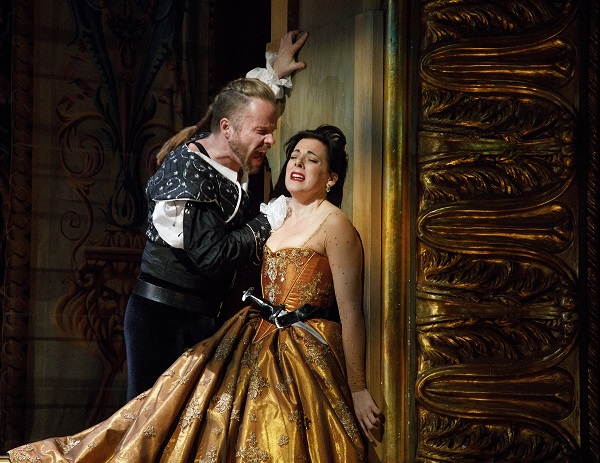
It started with the haircut. Colin Ainsworth, the sweet faced tenor of the eternally youthful demeanor channeled something seriously badass tonight, beginning with the hair and the beard. We were seeing more physical contact than ever before, as people were grabbing each other, smacking the walls and the floor, looking very much like an anger management workshop: and not a successful one. I have to think that Pynkoski has been re-thinking his company’s signature movement vocabulary, as we saw the usual poses and balletics, but with the passion turned up a notch or two.
Colin Ainsworth (Jason) and Peggy Kriha Dye (Medea), photo by Bruce Zinger.
For decades this was a company strait-jacketed by their own mandate to make historically informed performance. I see Pynkoski–finally– trusting his instincts to make good drama. Yes by all means read the history books, but don’t be afraid to take ownership of your own creativity. Over the past few years I’ve seen more and more bold moves from this company. I feel that between the last version of this opera that I saw –which was entertaining but very conservative—and what I saw tonight, there’s been a lot of growing up, both by Pynkoski and his company.
Tonight’s version of Charpentier’s opera has a more extreme arc. Surely everyone in the theatre knows exactly where it’s going, exactly what’s coming. The discrepant awareness thing –where we all can see the train-wreck take shape, where we watch characters say really stupid things that make you want them to get a come-uppance—makes this deliciously enjoyable even if it’s possibly a sick kind of pleasure. In the 17th century I am sure the audience members would have been watching and pointing and giggling, discussing this amongst themselves, not silent the way we are in 2017, but I couldn’t resist the impulse to whisper to my companion. Often the set-up is deliberately ironic, so much so that we’re laughing out loud in the first act. But it gets nastier and darker, not unlike one of those horror movies, where you giggle in places but then it clicks into something altogether more serious.
I’m not sure what it says about me that I am in love with the nasty witch who was so horrible to everyone. Peggy Kriha Dye as Medée has messed up her life for love of Jason. She is just aching to be loved, right? Dye sings with such a sweet achingly plaintive tone for most of the way, how could you not want to love her back? Yes yes she is homicidal, regularly pulling out a knife and doing nasty things when she doesn’t get her way. No, Disney is never going to make an animated film to tell her story. I am astounded at what a good job Dye did, making me care about her. The past few years she keeps offering three-dimensional portrayals of roles that call for larger than life artists. Her approach is unorthodox, balancing baroque ostentation with a kind of vulnerable authenticity. I especially like her recent make-over (not sure when that was), the haircut adding to her edge. But her chemistry with Ainsworth is quite wonderful to watch, as she goes from a sweet wounded girl-child to (spoiler alert…) a demonic sorceress laying waste to the city.
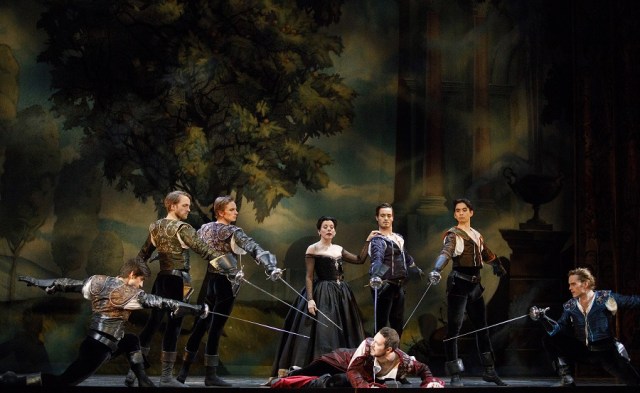
Peggy Kriha Dye (centre) and Stephen Hegedus (front), with Artists of Atelier Ballet. Photo by Bruce Zinger.
While some things are different, some remain unchanged. David Fallis is as always a tower of strength, Tafelmusik orchestra & chorus sounding magnificent in this score. I’ve said before that Lully and Charpentier are really Pynkoski’s promised land, the composers who wrote works requiring ballet throughout. The divertissements are brilliant releases of tension in this magnificent score. Charpentier moves the action along as ably as Verdi or Wagner, occasionally allowing the orchestra, or the chorus, or the ballet, to briskly blow us away with a sudden fast explosion. There are no weak spots in the cast, and some standouts. Alongside the two stars, Mireille Asselin was brilliant in taking us from the height of Créuse’s passion to the deepest agonies of her suffering and death. Stephen Hegedus as her father Créon showed us some of that extra physicality I spoke of, a towering presence both vocally and physically.
Medée continues at the Elgin Theatre until April 29th.
After walking through the Georgia O’Keeffe exhibit at the AGO today, I can’t help thinking about the way people are stereotyped, misunderstood, misread.
Louis Riel was very much on my mind after two intense nights, one in the company of Peter Hinton in conversation, the following night in the presence of his Canadian Opera Company production. I am a bit obsessed with ways of hearing and paraphrasing right now. Yes that’s partly the way interpretation must happen, in the reading and signification of the artists picking up an opera for production. But it’s also key to the reception process, to the way we sit and may or may not really hear or see what they’re doing, possibly receptive, possibly deaf to what it really means or what they meant to say. I was struck for example by how differently Jani Lauzon’s opening song about Riel felt, a song about Riel sitting in his stolen chair with his stolen knives. In the original it felt very cold to me, right on the edge between painting a picture of his oppression and still calling him out as a villainous criminal. When Lauzon sings? It’s loving and kind and compassionate, a totally new way to start the opera and a huge breath of fresh air, not just because she’s a woman or an Aboriginal Artist, but because she encourages us to re-hear. A fresh start is a wonderful objective, and a good thing for any artist, any curator, and any visitor to a gallery.
That’s all preamble to my thoughts encountering Georgia O’Keeffe today at the AGO. When you go into a gallery you see it all the time, the breathless respect some people have, or the lack others have, the assumptions flying around and smacking you in the face like the saliva coming out of a lisping lecturer. Respect can be a good thing, but not if they leave you stuck in a set of hypotheses, turning the fluid life of the artist into something more rigid, even monolithic. We’ve all heard them, the way people will speak of an artist or a composer or an actor, not really looking in the here and now of what they see before them because they’re so busy forcing their perceptions into a template, trying to reconcile what they see with what they’ve been told.
I do not believe O’Keeffe has been well-served by the conversation surrounding her work. I am thinking especially of the tendency by some to eroticize her images, perhaps a projection begun by the viewers of her youthful naked photos, who had been titillated and perhaps even scandalized. For the generation accustomed to women as models and subjects of paintings rather than as the creators and interpreters, it’s likely nothing more profound than sexism, and please excuse me if that’s simplistic. But I am so in awe of this woman and her work, sad that sexist reception of her nude pictures or of her person in a gallery could poison the way her work was understood. But I’ve become much more cynical in the past year, for example as I watch the current POTUS spend more tax $ in 100 days on family vacations, than the previous President spent in years of family travel. And because the previous one was black, there’s no objectivity about it, and a double standard. Just as there appear to be multiple separate conversations, where the GOP are in their silo, the Democrats in theirs, and never the twain shall meet, perhaps too with the reception of some artists. This AGO show is a chance to see O’Keeffe afresh, unhindered by the poison you may have absorbed previously. I am embarrassed at how much it messed me up, just as I am disgusted at how badly I mis-read Riel before the refreshing revisionist interpretation I saw last night.
No I’m not saying that the AGO show is radical or political. Hm, maybe it is. But I breezed in, exhausted from lack of sleep the past few days, and hungry for the art. So I can’t pretend to be able to paraphrase the show’s purview, other than to say that it’s every bit as profound as the long life lived by that artist, a complete meal, an opportunity to meet the artist from first principles without interference.
And so I begin by recommending this show, a colossal collection of wonderful works, complemented throughout by photographs taken by O’Keeffe’s husband Alfred Stieglitz. There are a few observations I’d make that might be useful or not. But in the end you’ll decide for yourself, only please do go see the show, which is on until July 30th.
My mind is still full of a performance of Brahms’ Third Symphony that I encountered from the Toronto Symphony last week, brought back to me as I came home from the AGO by the serendipity of the radio playing that soulful third movement. I couldn’t help thinking that maybe Brahms and O’Keeffe have a few things in common.
While Brahms is a much beloved composer, he is understood as being a bit out of synch with the most original and provocative composers of his time, a throwback in some ways to stylistic objectives from a half-century before. So long as composition is a kind of pissing contest, where new is good and something beautiful is suspect, Brahms won’t be respected, at least not as much as I think he should be respected. But if you step outside that paradigm to look at the composition on its own terms, on the skill with which the materials are handled, one stops worrying so much about being new. That old-style fetish for newness never worked for me.
O’Keeffe was miraculously long-lived, straddling different eras. That can mean that by the time you’re old, you seem like a relic, at least compared to the artists like Jackson Pollock or Vincent Van Gogh who died young and never had to confront their legacy or to see the next brash new thing to come along.
I am reminded too of Lawren Harris, with whom she was a near-contemporary. Both artists gave us abstracted urban images as well as stylized landscapes. His best were mountains, while hers are desert shapes, including mountains. Both Harris and O’Keeffe give you a landscape un-spoiled by any sign of a human imprint. Their mountains are metaphysical, or at least they invite the metaphysical reading some would make, because they’re so intensely abstract.
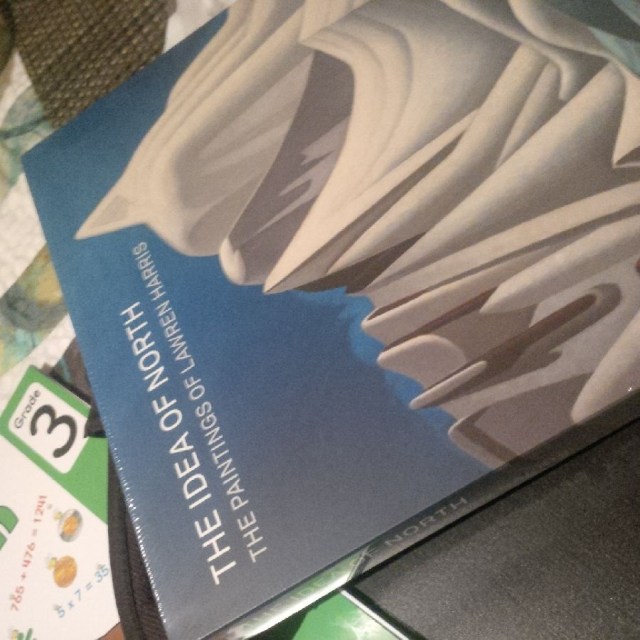
I pulled out “The Idea of North” just now. Speaking of “north” her mountains and landscapes can give you an idea of south.
They seem to be cousins in the way they let shape and colour work for them irrespective of too much differentiated reality. Instead we’re in a place reminding me at times of stain-glass, recalling the epithet “cloisonism” that was used to describe Gaugin & Denis (although the analogy probably doesn’t fully apply). Gaugin & Denis are sometimes cartoon-y, with outlines and colours filled in after, not unlike a cartoon from an old-fashioned newspaper: which makes for a sort of abstraction, a kind of symbolism if you will.
Another word that I use for Harris comes to mind for O’Keeffe, namely “reified”. Her intense abstraction of things brings us to another place as though in contemplation of the object. I couldn’t help noticing that one of the paintings of flowers took notice of how photography –possibly her close exposure to Steiglitz’s work, possibly her own –showed her new ways of showing objects in close-up. When you look at some of her flowers or skeletal structures, and see the ways she moves them within the frame, moving focus and perspective, I find it astonishing when you consider that this is all before digital imaging: although perhaps she did play around with enlargers, which are analog devices giving you some of the same effects. But she managed to give us views of things that are literally impossible in life, but are hyper-real in her work, after being conceived somewhere, presumably in her head.
There is something profoundly sane about her work. She gives us de facto images, not sentimental, not dynamic, but brilliantly static and in the moment. Of course when we’re staring at a picture of a pile of bones, we shouldn’t expect them to move. But her images are still and calm and feeling so centred, as to imply something spiritual at work. Her bone compositions have been read as religious even though, as far as I know, she denies such interpretation of her work. It might be the flip-side of the eroticising, when someone reads something religious, but in each case her classically organized compositions (see why I think of Brahms?) invite or at least leave room for projection by the viewer.
I will stop at this point, other than to say, again, that this show invites you to re-acquaint yourself with an artist you may think you know, to make a fresh start, to get back to first principles. Please give the AGO a visit.
When I look back at my childhood, the way the word “Indian” was used and abused, I can barely recognize where we were and where we’ve come. The past two years have been especially transformative, with the Truth & Reconciliation Commission’s report, with so many promises made by those in power and so many intriguing works of art, thinking of Kent Monkman’s paintings, the Royal Winnipeg Ballet’s Going Home Star, and ambitious programming of concerts here in Toronto.
While I often doubt leaders –for instance I’m trying to sort through the personas of Justin Trudeau— a walking endorsement for the virtues of drama education if ever there was one—my hat is off to Alexander Neef, the General Director of the Canadian Opera Company. Pressured by artists, critics & donors to make the COC relevant especially in this our Sesquicentennial year, he put not just the COC’s money but his reputation on the line the past couple of years. Tonight was a genuine occasion, the premiere of Peter Hinton’s daring re-imagining of Somers & Moore’s 1967 opera Louis Riel, complete with additional performances for much of the hour before the show in the Richard Bradshaw Amphitheatre, in the lobby of the Four Seasons Centre. I think if the show had even been mediocre or bad, Neef kept his end of the bargain, giving us our Canadian opera.
COC Music Director Johannes Debus and COC General Director Alexander Neef. (Photo: bohuang.ca)
But it’s a marvelous creation. I am reminded of Richard Bradshaw’s stated aim, not to make the best opera, but to create the best theatre in Toronto, and that’s indeed what we were seeing. I couldn’t help feeling –in a theatre shared between those who would bravo and those who would whoop, between those coming from the opera side, those in the theatre side, plus those drawn by the Indigenous artists and their culture—that we were experiencing a genuine conversation, a meeting of worlds, of people with different assumptions, goals and objectives.
Above the stage it was enacted for us, in surtitles in three languages (although there were more than three, when you add Michif and Cree and the Latin words of liturgy to the French & English), the singers sometimes shifting from one language to another. The boundaries between cultures were fluid, as they were between disciplines –as we watched Indigenous dance, watched a silent chorus bearing witness to the action, alongside the usual participants of the opera.
I understand that Peter Hinton was brought to this project because of his history working with Indigenous artists, for instance a King Lear that starred Billy Merasty, who appeared in a small role tonight, but whose presence was huge every time he came onstage. What was unsaid or unsung was as important as what was heard and enacted. Hinton explained his objective with the chorus, which included a silent group, as though bearing witness. I had thought it would merely be to frame the action but it was so much more than that, as the legitimacy of what we saw and heard was altered, the centre of gravity for the show shifted.
Some parts of the show work better than others, but it may be that nerves were a factor on opening night. I found the opening song of the original score, a somewhat bluesy song now sung by the luminous Jani Lauzon, redeemed a passage that disturbed me when I first heard it. We hear of Riel sitting in his stolen chair using his stolen silver, and this time I felt a connection and compassion that was always missing for me in the older version.
I have some quibbles, that again might be a case of opening night nerves. I wondered that conductor Johannes Debus—who led a fast, taut reading of this difficult modernist score—sometimes let his brass overpower a cast leaning heavily on lower voices. Yes they played with passion & commitment, those trombones and horns snarling like the wronged id of a whole nation, filling the space with their dark, nasty sounds; but unfortunately they share the same register as the three biggest roles:
Russell Braun as Louis Riel
James Westman as John A Macdonald
Alain Coulombe as Bishop Taché
I’m concerned that these gentlemen will be exhausted before the end of the run if they keep facing such big sounds. Braun’s Sprechstimme (if that’s what it’s supposed to be) danced on the edge of speech, sometimes howling and raging rather than singing. He made the visionary scenes very sympathetic, perhaps because he underplayed them, compared to what I recall from Bernard Turgeon, the originator of the role who gave us more of an image of a visionary on the edge of madness. I worry that he won’t survive the run, but of course I think he poured extra into opening night. Westman’s cartoonish reading, so deftly comical exploited the text and Moore’s many opportunities for comedy in this role, especially a scene where he’s clearly drunk. His voice sailed over the orchestra, which seems much more sympathetic, precisely because it’s rarely as angry or strident with Macdonald, as it is with poor passionate Louis Riel. Coulombe at times is like the conscience of the opera, perhaps a bit like Arkel (Pelléas et Mélisande) or Sarastro (Magic Flute) with his deep & soulful philosophy, to counter the cynical opportunism of Macdonald or the urgent activism of Riel.
There was a great deal of good work all around. Simone Osborne was especially effective in the most discussed scene of the opera – the one that provoked a mini-conference earlier this week on the protocols for using aboriginal songs in original Canadian compositions—earning the one spontaneous eruption of applause of the night. Otherwise the audience was quiet until the end of each act, erupting at the end in support especially for Hinton and his team.
I can’t mention everyone, but did love the work of Andrew Haji, he of that lovely voice, stepping into someone else’s role because of an indisposition (sorry they made an announcement, so I’m not sure which roles were his and which ones were last-minute). Michael Colvin was quite a piece of work in the most troubling role, namely Thomas Scott, the shit-disturber with the foul racist mouth who promises not to make trouble, and then when after repeatedly breaking his promise is executed. Colvin sounds wonderful, but was physically inside the role. You couldn’t take your eyes off of him, especially in his brutal death scene.
(centre) Justin Many Fingers (Mii-Sum-Ma-Nis-Kim) as The Buffalo Dancer in a scene from the Canadian Opera Company’s new production of Louis Riel, 2017 (photo: Michael Cooper)
Justin Many Fingers gave us a glorious buffalo dance, which I heard him explaining on the radio –oh the serendipity of hearing him speak on CBC’s “Q” as I drove home tonight! –as a kind of balancing of another neglected part of the story, namely the slaughter of the buffalo. There are so many more –in a huge cast—but I’ll be back to see it again and will write some more about Riel.
It’s a complex stage picture at times, and perhaps I wished for something cleaner and simpler, but then again Hinton’s concepts are not simple. We are watching multiple groups interacting, and when you watch and listen it coheres. The opera that includes so many dated and troubling moments –now that I recall it—has been re-framed by Hinton and his team. While it’s far from perfect, I wonder if it can be part of that conversation in search of truth and reconciliation. It’s not a closed finished masterpiece, but ragged and rough in places, just like reality. Its ending is wonderfully open and ambiguous, much like that conversation.
I suspect that the COC planners expected Tosca to be the cash-cow with Riel as the exotic project for purists & history buffs. But don’t be surprised if it’s Riel that sells out every show. I saw a crowded theatre full of excited patrons, young and old from diverse backgrounds. I’d suggest you get tickets right away.













 barczablog