
Bruce asked me whether the Scottish play is worth seeing. I had seen it from the front row, able to see every detail of the complex presentation in the Avon Theatre, less Shakespeare’s immortal play than Robert Lepage’s Macbeth.
YMMV or “your mileage may vary” comes to mind. Some will love it, some won’t. My goal is to describe how Lepage’s production works, to help people like Bruce decide whether they might like it, even as Bruce’s question gives me a perfect template to examine questions of theatre criticism and the discourse surrounding creations. I continue to obsess about memory since my mom’s passing. I see my role as a witness, to remember & testify to what I’ve seen, rather than as a judge to say “this is good /bad.”
I came to Stratford for Bruce’s birthday party. Although he lives in Stratford he hadn’t yet seen the show, perhaps hesitant because of what he heard, given Lepage’s refusal to do the usual things.
Instead of kilts we get jeans and leather jackets.
Instead of old castles we get cheesy modern motels.
Instead of a medieval tale of murder we get men riding their motorbikes right onstage.
So in other words, no it’s not what you expect when someone says “I saw the Stratford Festival Macbeth Friday night.”
But Shakespeare is still there. We see the most perfect ghostly apparitions I’ve ever seen for the Scottish Play, and I say that having sat in the front row. From further back they will be even better.
The witches are as usual the most interesting characters of all. Lady Macbeth is the usual troubled inspiration for the evil deeds of her husband.
I keep looking at my program because the cover photo is so compelling. It’s all there in the photo.
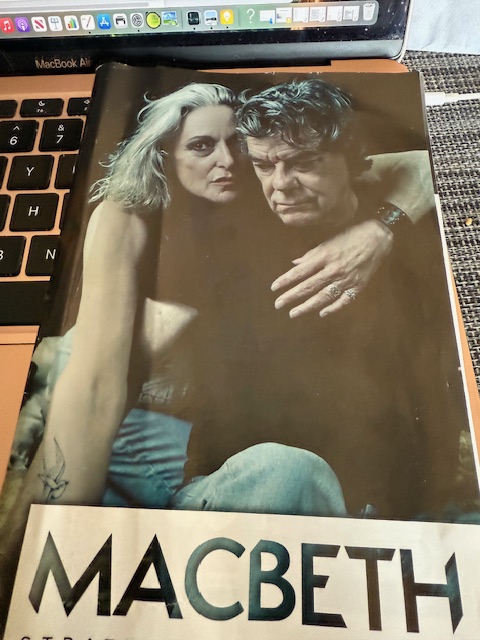
No there are no crowns or kilts to be seen, but Lucy Peacock and Tom McCamus are powerful in the usual ways. Sexy arms enfold Shakespeare’s great over-thinker, her sensuality in the service of murder, mayhem and poetic reflection.
Lepage is the ideal specimen to look at how the modern artist adapts and reframes classics. It’s right there in the photo, where they burned the key word in reverse.
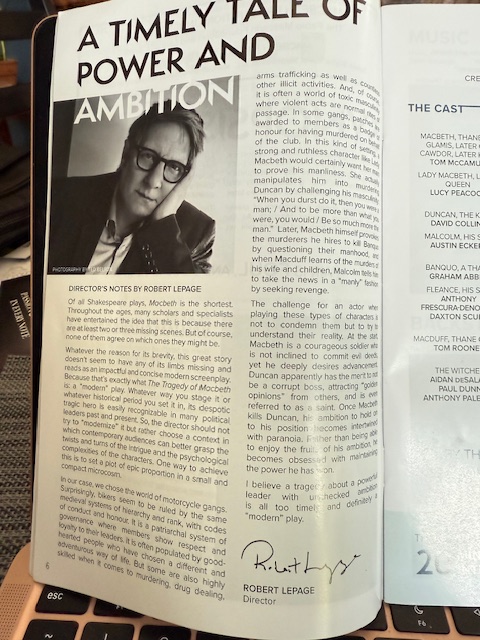
“Ambition” it says, and yes that’s Macbeth in a nutshell.
And it’s also Lepage who rewrites the text as something original and sometimes unrecognizable, so maybe it’s less McCamus’s or Shakespeare’s and more Lepage’s Macbeth.
The design focus of Robert Lepage reminds me of Ridley Scott, a director known for his thorough art direction. I could also mention Wes Anderson or Tim Burton or Terry Gilliam, directors whose work features phenomenal detail & inventive visuals. A Lepage show is best understood as architecture, an investment of time and money to build a space for the live theatre experience. We see that in every Lepage show I’ve seen. Whatever character dynamics we see, they are always played upon elaborate stage designs & machinery, usually via Ex Machina, Lepage’s design company. (read and see more about Lepage’s Macbeth including future dates beyond Stratford on the Ex Machina website)

This was true for Eonnagata (2010), one of the very first things I reviewed on this blog. The stage was relatively empty even as everything and everyone else (sound, light, movement, text) were all brilliantly interconnected.
This was true for 887 (2015), a kind of reflection on the life & sensibility of a Francophone written and actually performed by Lepage himself.
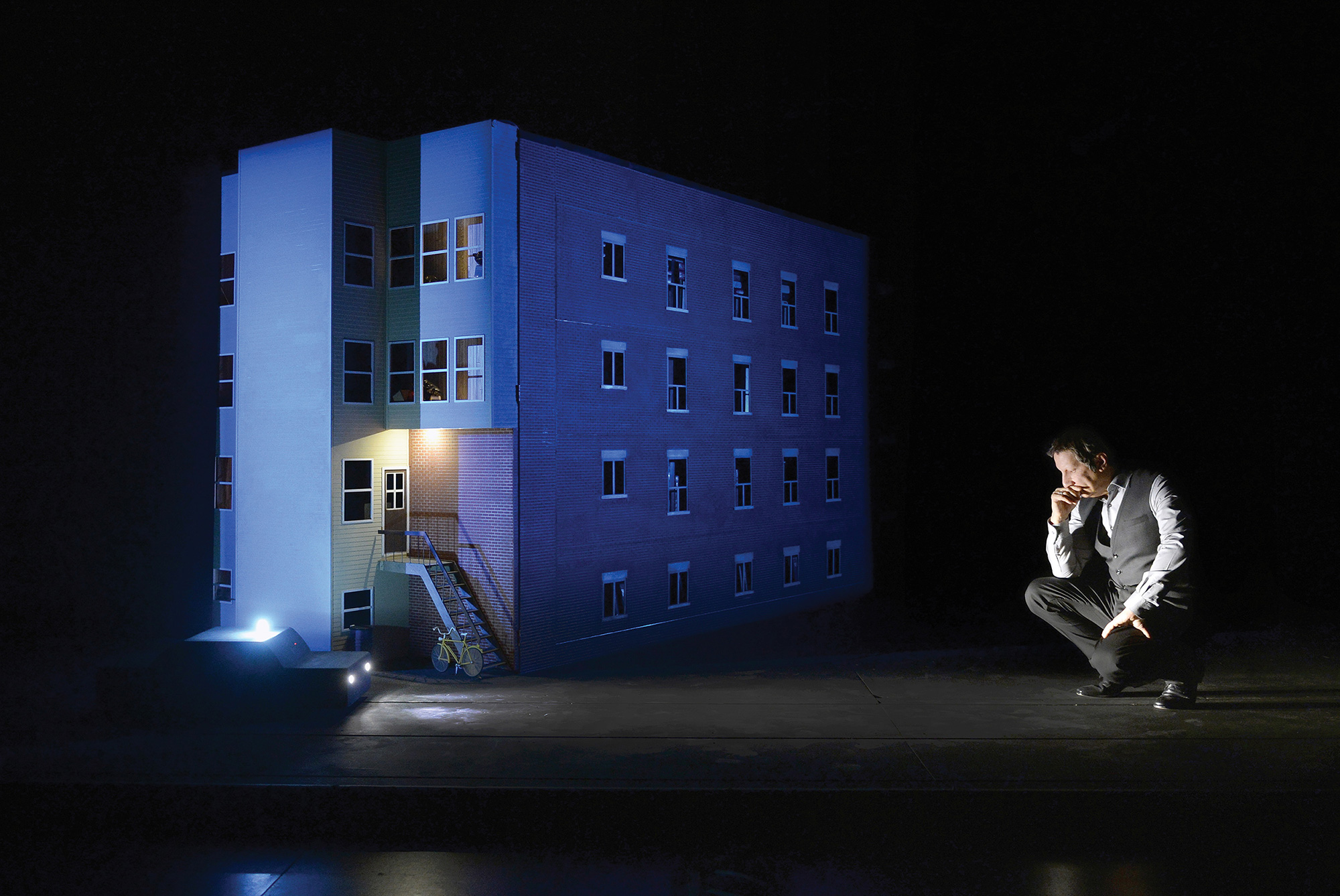
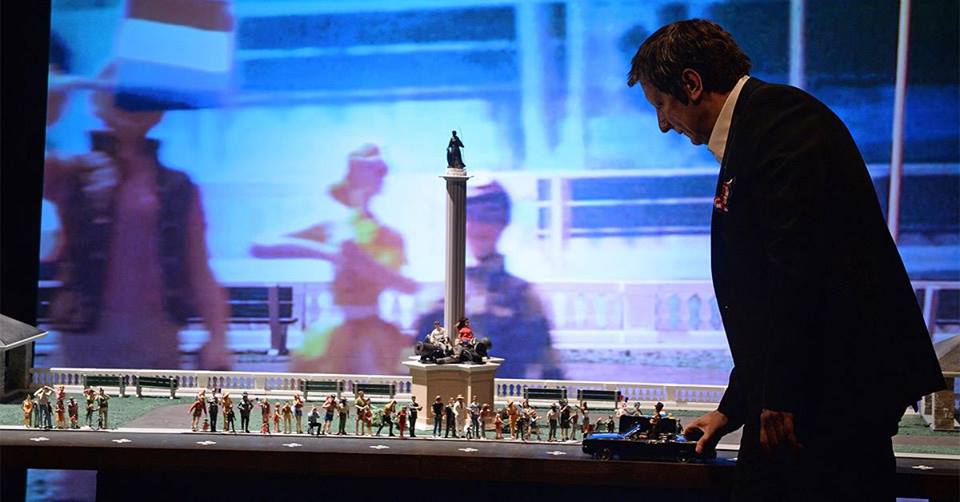
And there’s Needles & Opium (2013), as the stage machine is a simple & blatant metaphor that seems to torture the actor onstage, a box rotating with the performer forced to cope with the impacts of that microcosm (the set, his world).
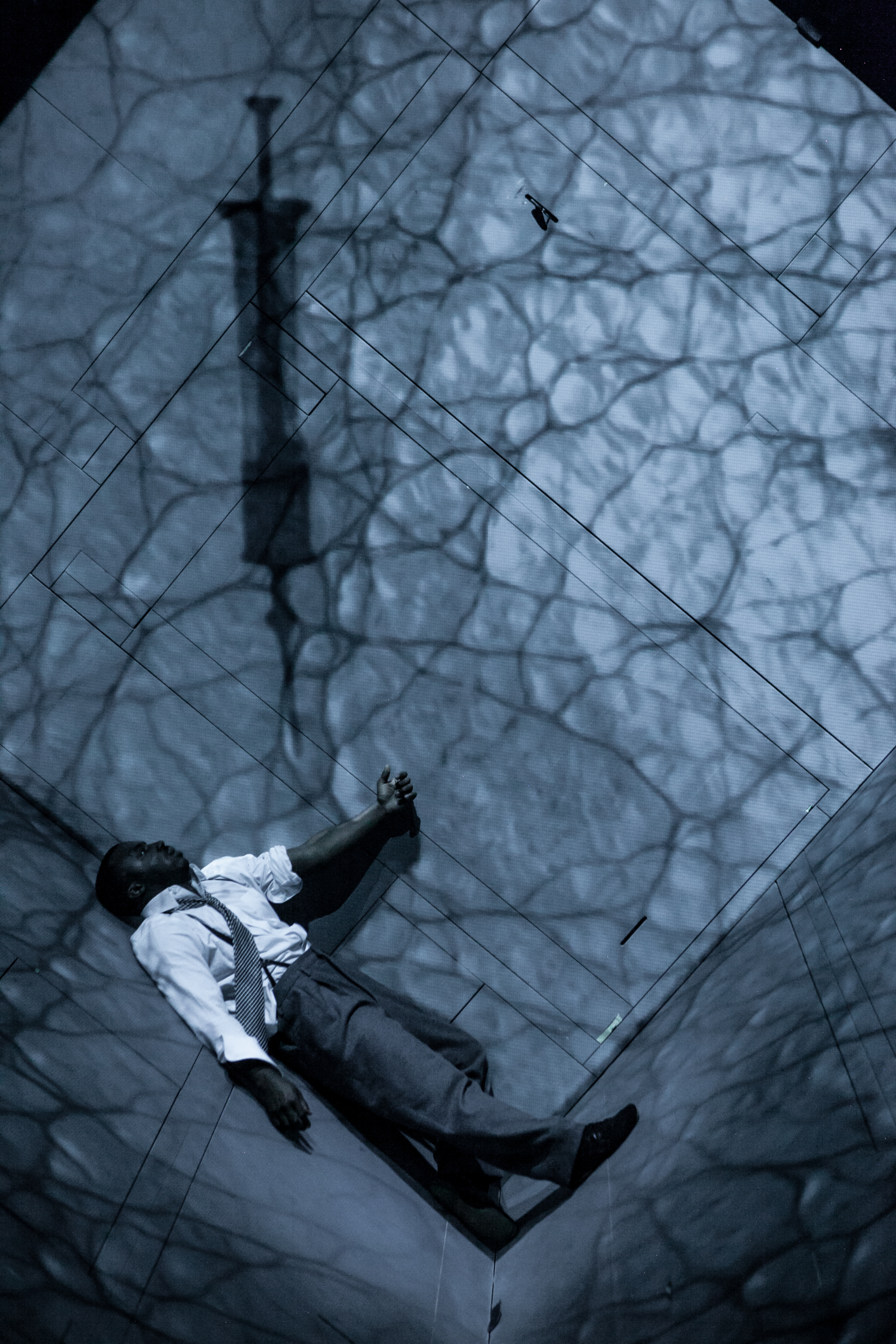
This was also true for Lepage’s operatic creations, such as Damnation of Faust (2008). Here’s a brief interview with Lepage about his Met production, still totally relevant to what we see in Macbeth.
There was also Tempest (2012), the four Ring Cycle operas (2010-12), The Nightingale and other short fables (2009), and the first ones I saw, the double bill of Bluebeard’s Castle & Erwartung (1993), the latter two so effective that the Canadian Opera Company will revive them again in 2026.
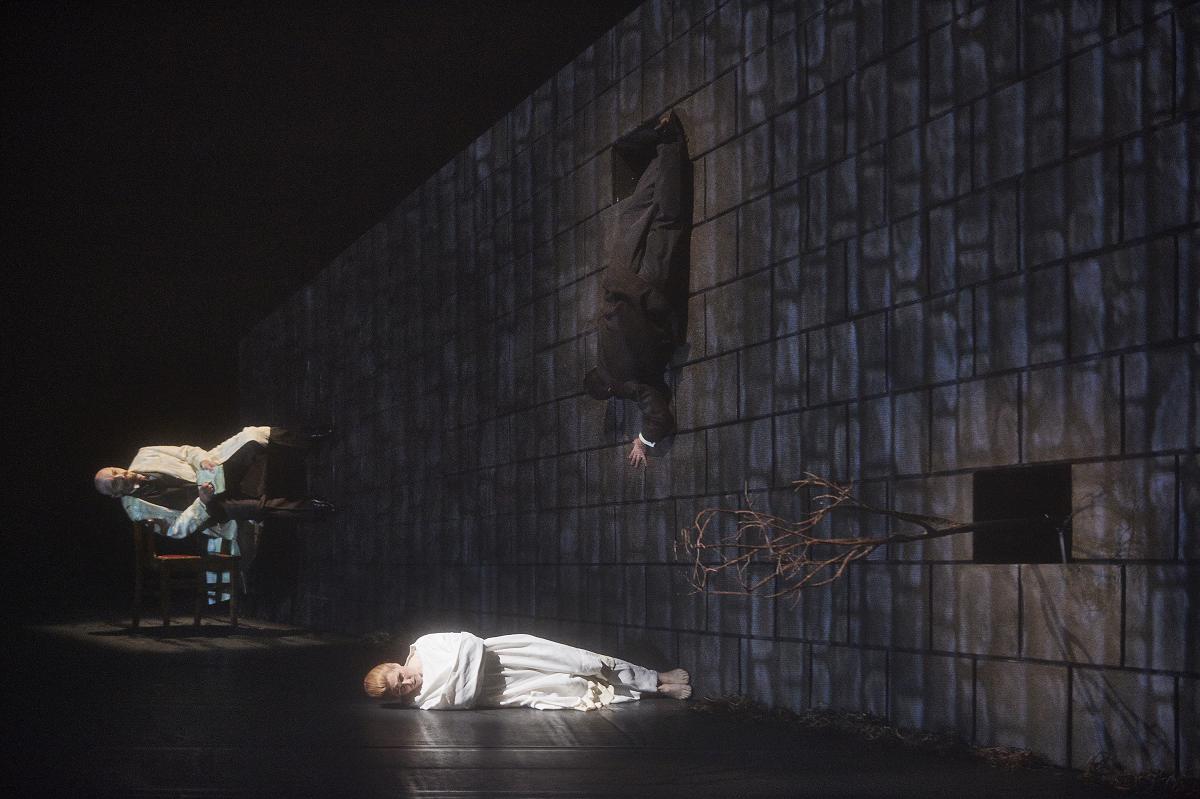
I invoke all of these elaborate designs, mindful of impatient & dismissive voices, whether in NY for his Ring or more recently for Macbeth. I mentioned YMMV as a polite way to suggest that one needs to suspend judgment in the encounter with originality. Does one require kilts and castles for a Macbeth to work? That’s a question I would offer to anyone who shows up with stipulations, their nose out of joint before the play has even begun.
And as I sat there in the front row, watching parts of the complex stage set be reconfigured, I remembered my experience with Lepage’s Ring, that in fact it was better to sit further away. Up close there is less of an actual illusion, because we could see the actors or singers working with the complexities of the set, and even saw stagehands working to move the set. It’s impressive, it’s fascinating: but it undercuts a dramatic illusion. It reminds me of a Brechtian dramaturgy –where the apparatus & set call attention to themselves as a way to distance us (Brecht speaks of a Verfremdungseffekt or “alienation effect”), pushing us into a reflective space and away from the story.
Why was Brecht trying to do this? I think he was reacting to Wagner’s dramaturgy, against the ideals of the Gesamtkunstwerk (or “total art work”), and the overpowering illusion of music theatre. We live in that world now. Whether it’s the visuals, music & sounds of a superhero movie or just your smartphone telling you when you’ve received a message, our art, our appliances, cars & virtual realms are often Wagnerian, swallowing us up with messages working together in multiple channels. Brecht wanted critical thinking, so he tried to wake us up from the dream.
Long before Lepage did a Wagnerian opera, he was already employing elements of the Wagnerian toolkit, even as he was sometimes himself working to distance us, pushing us away, encouraging us to wake up & reflect rather than swallow his illusion. Lepage has spoken of cinematic elements, aware of the sophisticated modern audience, and playing with us, using both Brechtian & Wagnerian tools.
Working with composer & sound designer John Gzowski, Lepage (meaning Gzowski of course) faced a challenge in bringing bikers and bikes believably into a Macbeth. One real motorcycle motor is a huge loud sound when it revs, let alone the sound of a whole fleet, and that’s magnified further if they’re the huge type of vehicle driven by bikers. That’s not what Gzowski & Lepage give us, however, because we’d never hear the dialogue even were they to shout or scream back and forth. I can’t imagine the agonies of level setting, editing, revising the sound & music lower & lower, likely with earlier versions ending up on the cutting room floor. The result is remarkable to hear, the voices clear, the music subtly threatening rather than overpowering. I am sure it must have taken a lot of work to achieve something that seems so effortless.
To state the obvious: this is a work of art not reality. The bikes moving onstage were probably electric with sound on the soundtrack to simulate the reality of a motorbike. We are presented with a cinematic image that collapses somewhat if you sit in the first few rows, partly because we see a biker ballet, harmonious movement and gentle throbbing rather than the real raw roar that such machines would generate in reality. And the actors must have had a steep learning curve to execute their movements so cleanly. On so many levels this is a tour de force, to make it look easy rather than something a bunch of Shakespeareans did between soliloquys and swordfights. The moving sets are another part of that tour de force, but nobody usually notices the stagehands, who are especially heroic in this show.
I’m reminded of some of the other daunting challenges Lepage has given to his performers. Damnation of Faust featured all sorts of acrobatic performers climbing and hanging from the set, as did The Tempest.
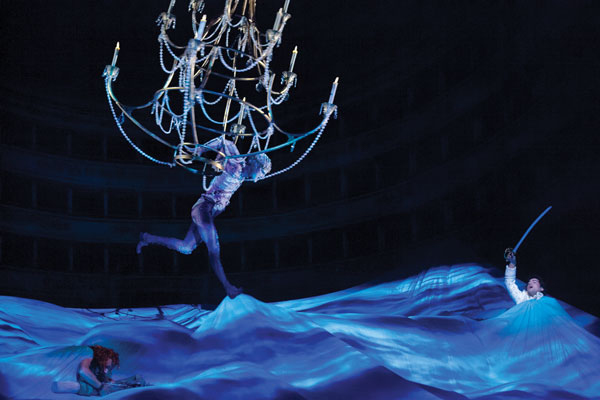
The machinery becomes such a big focus that the actor or singer may feel threatened, at least given the usual dynamic where an audience watches the stars. In a Lepage show his design is arguably one of the stars of that show.
It felt like a revelation, watching the enraptured audience at the Avon Theatre watching Macbeth last week, speaking as someone who has been a big fan of Lepage’s work. At the interval in the washroom and afterwards, people buzzed as though they were on drugs. But it helps to be open to the experience, to arrive with an open mind rather than to show up with stipulations.
I continue to be fascinated by Lepage & Ex Machina. The originality I see in his opera productions sometimes forces me to look at familiar works in new ways. The pieces that were new to me always moved me. I experienced Macbeth in many of the same ways I came to the Ring operas or Damnation of Faust, sometimes staring open-mouthed, but never indifferent and sometimes powerfully moved. I never expected tears as I watched Lady Macbeth (Lucy Peacock) coming apart at the seams or the ravings of Macbeth (Tom McCamus) as he is haunted. The show hit me in unexpected ways. I’m glad to see that the show has been extended, and perhaps will be revived in a future season, because I’d like to see it again.
So for the record: I think Bruce should go see Macbeth. If we can handle iambic pentameter coming out of the mouths of men wearing togas I don’t see how it’s troubling when it’s a guy in jeans on a motorbike. I don’t want to give away too much except to say that for Lepage’s staging, the supernatural – ghostly elements are the most powerful I’ve ever seen. If you’re interested in going to the show, Macbeth has been extended until November 22nd.

 barczablog
I went to see this only because I read the post on your blog. This was a brilliant experience. The only complaint I had was that we didn’t get to clap enough for the performers before the curtain went down. The setting felt so natural. I saw this after seeing Romeo et Juliette, where the updated setting often felt puzzling and forced. The moral quandaries of Macbeth removed from the world of just rulers to the more banal setting of a motel took on entirely new dimensions. I loved that it ends with Macduff dismembering Macbeth’s body, muddling any easy feelings about good and evil. Thank you for the recommendation!
I like the way you put that: “The moral quandaries of Macbeth removed from the world of just rulers to the more banal setting of a motel took on entirely new dimensions.” Wow yes very much so. Thanks for the feedback, glad you enjoyed the show!