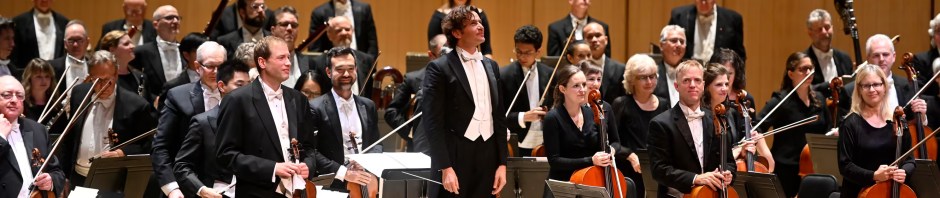
In a week when every item in the Toronto Symphony’s concert program has a connection to film, it was amazing to see such a remarkable variety, the many different ways music and movies can be connected. And the results were spectacular in this cinematically inspired program.
Before I babble on about the concert I want to remember previous programs where the TSO and Gustavo Gimeno stunned us with combinations of music to great effect, perhaps because I’m looking back at the end of another season. I went back to a quote from 2022 when Gimeno said the following in a TSO program:
“The creation of contrast is at the heart of what I believe about concert programming—the coming together of past and future, masterworks side by side with new commissions, old friends and new faces on the concert stage: all manner of refreshing or startling juxtapositions.”
There have been several fascinating moments from the TSO over the years:
in 2022 when Ligeti Atmosphères (as heard in 2001: a Space Odyssey) was followed by
Wagner’s Lohengrin Prelude (that’s when I quoted the passage above)
or
in 2023 when loud music by Berlioz met an elegant Mozart piano concerto
or
in 2024 i was stunned by the combination of Lontano by Ligeti, the soft Parsifal Prelude by Wagner and then “Yericho” a powerful trombone concerto by Samy Moussa
They did it again this week in spectacular fashion.
I have been trying to find the right way to write about this week’s concert. Usually I aim to publish a review the night of the concert or shortly after, but this time I was so stimulated I couldn’t find the right words, possibly because the subject is near & dear to my heart.
I used to teach film music courses at the University of Toronto School of Continuing Studies, another at the Royal Conservatory, essentially music appreciation courses, adult ed. Even so there were years early on when we had practitioners enrolling, bewildered because (as they told me) nobody was teaching the subject, at least not yet. And until recently it was normal practice to think of film music as a lighter sort of music. Meaning no disrespect, film music was not given with the same seriousness. Ten years ago, for example, I interviewed Steven Reineke, TSO’s Principal Pops Conductor, about a concert featuring music by John Williams. Please note, I am not one of those people who considers film music or pops concerts somehow lesser. I may sound a bit like Rodney Dangerfield.
…when I say that film music doesn’t always get the respect it deserves. Thirty years ago it was a relatively new concept in the academic realm, as more analyses were being written.
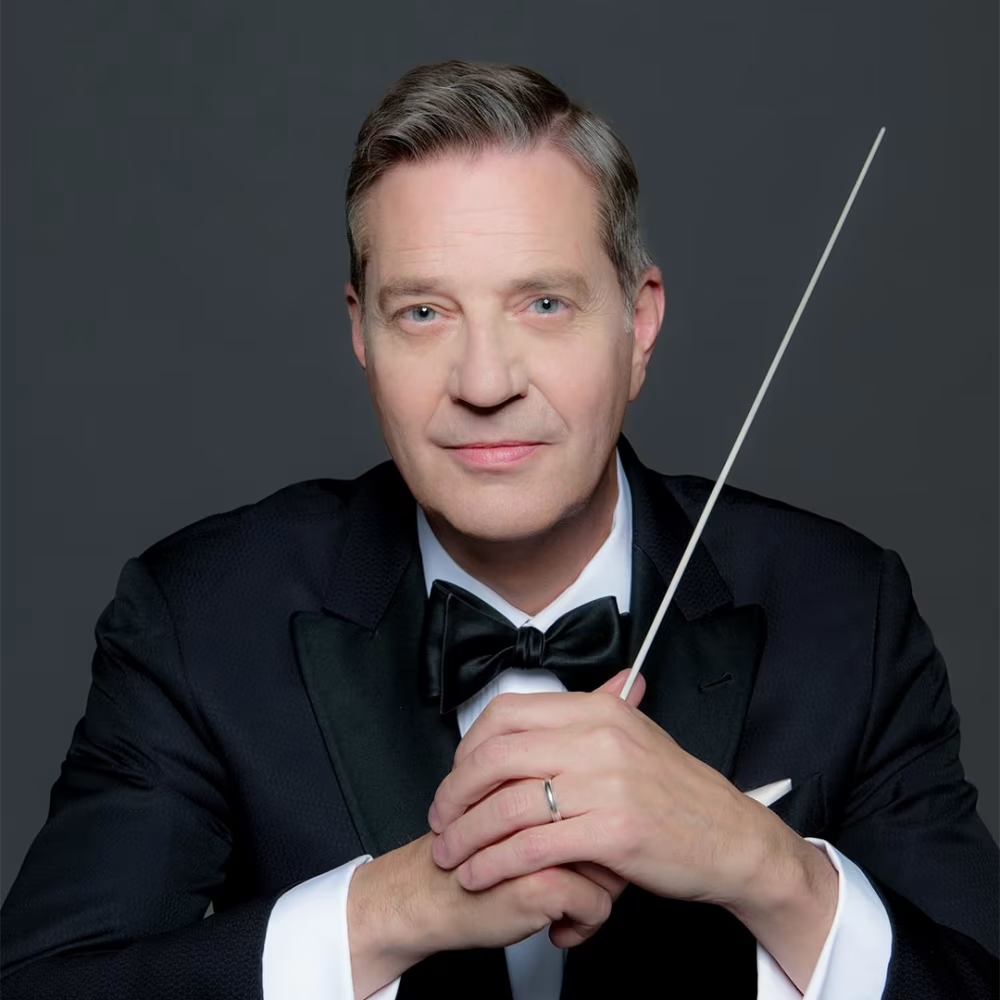
So it felt like a breakthrough to see the Toronto Symphony treating music composed for film seriously, put into their “Masterworks” series. Every work in the program had cinematic connections, especially the first two items. I am resisting the impulse to use exclamation points, but I find what I am saying very exciting. When you look at what the TSO & Gimeno did this week? They took that “contrast” principle to the next level. Here’s the program.
Bernard Herrmann/ ed. John Mauceri: Psycho: A Narrative for String Orchestra
Erich Wolfgang Korngold: Violin Concerto in D Major, Op 35
-intermission-
Bekah Simms: Nostalgie
Felix Mendelssohn: Symphony No. 4 in A Major Op. 90 “Italian”
My mind boggled over the contrasts implied by the complementary opposites in that first part of the concert, although hearing the concert played live took it to the next level. Korngold was part of the first generation of film music composers along with Max Steiner, with a dramaturgy where the music employed leit-motivs as in a Wagnerian music drama, the orchestral score like a Greek chorus. The “Hollywood sound” was a kind of normal performance practice accomplished in studios, perhaps aiming to make a 20 piece orchestra sound like 60 players, deliberately lush & dramatic, and making good use of the money spent on the music in these films.
And there were also composers who resisted this tendency. Chief among them, Bernard Herrmann, who used orchestration and instrumental colour to great effect, while avoiding the Hollywood sound, aiming instead for instantaneous effects from the first minute of his first appearance in Citizen Kane, or in such colourful scores as Beneath the Twelve Mile Reef or The Day the Earth Stood Still. One didn’t wait for the emergence of a leit-motiv, not when an instrument’s colour could viscerally communicate right away.
This is one of my favourites. The conclusion of the film on a discord is as powerful as any operatic climax.
The title for the concert was “Maria Dueñas Plays Korngold”, highlighting a melodic violin concerto that quotes from several Korngold film-scores.
But what came before Maria appeared to play this sensuous emotional music was the most perfect preparation imaginable, the most remarkable sort of contrast I have ever encountered in a concert program. Before the colourful music we had the musical equivalent of black & white: like the film for which it was composed.
We sang Oh Canada accompanied only by strings, because the opening piece was Psycho: A Narrative for String Orchestra, using the music Bernard Herrmann composed for Alfred Hitchcock’s 1960 film.
The 16 minute work to open our concert was in segments, with titles given in the program as follows:
Prelude
The Madhouse
The Murder
The Water
The Swamp
The Stairs, The Knife and The Cellar
Finale
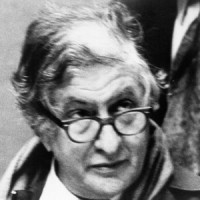
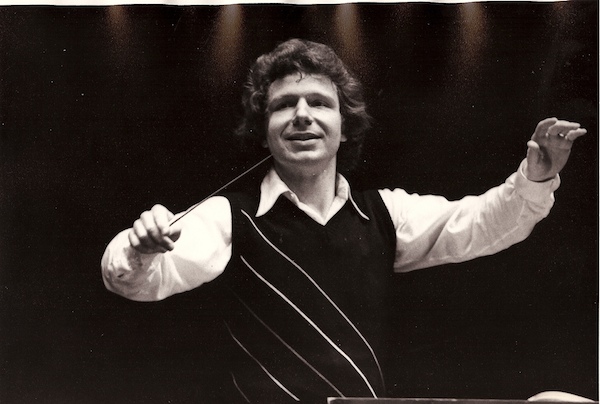
The program says “edited by John Mauceri”. Looking at his website I was humbled by how much he has done in a long career, a winner of Grammy and Emmy awards. I have to think Mauceri is someone Steve Reineke knows of, perhaps even as a friend and colleague. I’m including a 1974 photo because it lines up with Herrmann who died in 1975, although Mauceri is still alive after a long & distinguished career.
I found two other performances of this piece on YouTube, both far less exciting than the one we heard from the Toronto Symphony, conducted by Gustavo Gimeno. While the others played it perhaps as a specimen to remind us of a film, Gimeno came to Herrmann the way he came at other modern works such as the Bartók Miraculous Mandarin CD, which is to say the players of the orchestra were challenged to make the best possible music they could, underlining the drama in the music and not just the beauty.
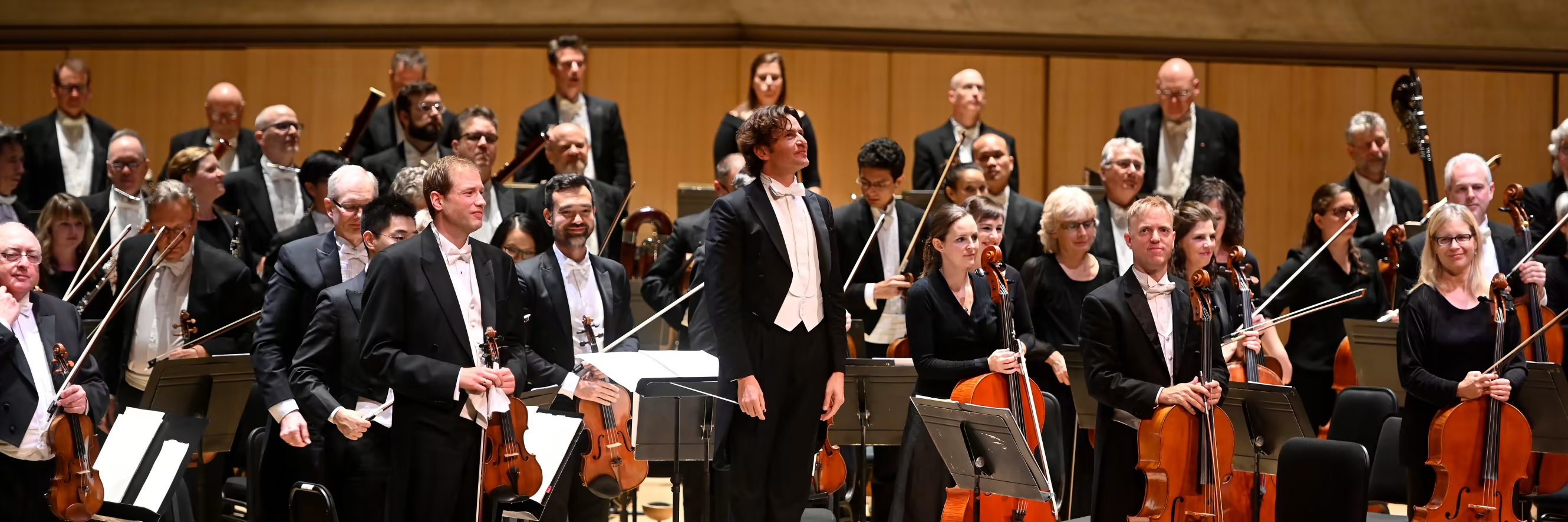
I found myself wondering how this music sounds to anyone who has not seen the film. When we came to the famous stabbing music (one for the shower, another later) there were nervous giggles through the audience. I remember how audiences respond to the Jaws music played by the TSO in their film music concerts showcasing John Williams (Steve Reineke of course). The raw edgy sound isn’t meant to be pretty or tuneful, but simply to provoke a response when played with visual images & dialogue.
I recall the pure joy of turning this music into an experimental specimen in the classroom for students. Playing the music alone (from a CD I have) but without the images is very different than watching Hitchcock, and the film becomes different again when we turn off the sound. How would our assessment of Hitchcock change if you take away Herrmann’s contribution from Vertigo, North by Northwest, Psycho, Marnie, or the Man Who Knew too Much? Hitchcock reminds me a bit of Lorenzo da Ponte, the librettist whose highest achievements were collaborations with Mozart. Yes this will sound like heresy but I think Herrmann isn’t given enough credit, Hitchcock gets too much credit. In the previous century when we spoke of La boheme or traviata, we barely remember the librettists, while identifying these works by their composer. In the BFI’s Sight & Sound magazine survey, that previously had given the best film of all time honour to Citizen Kane (directed by Orson Welles, score by Bernard Herrmann), it was replaced with Vertigo (directed by Hitchcock, score by ahem Bernard Herrmann). And while Hitchcock didn’t ever get anything nearly as wonderful without Herrmann, the directorial partners in Herrmann’s life were amazing, from the beginning (Citizen Kane with Orson Welles) to the end (Taxi Driver with Martin Scorsese) with great stuff in between such as Fahrenheit 451 with François Truffaut.
Okay excuse the digression. Herrmann has other music that I hope the TSO will undertake some day. To repeat what I said earlier I love the choice to play Herrmann alongside Korngold as high art, especially the way Gimeno brought out the stark brutality of the strings in this score. I dream of encountering other Herrmann scores in future TSO concerts.
The combination was a special gift to violinist Maria Dueñas, preparing the audience for what she brought to the Korngold violin concerto. Imagine you’re the violinist, what could be more ideal than this. It was as though the Herrmann piece was a chilly blast of snow, and then the violin arrived like a warm breeze to remove the chill from the air. Excuse me as I overuse the word “contrast”. We went from the black and white astringency of the Psycho suite to the warm use of a full orchestra, woodwinds and brass. We went from jagged music to melodic phrases, from anxiety & tension embodied in a score portraying murder, to something tender and romantic. And of course this made Maria sound that much more beautiful in the concerto. We were not only able to linger over phrases, expressiveness simply for the momentary pleasures of sound, but the shift from melodrama to lyricism made the violin sound as though it were alive in Maria’s hands.
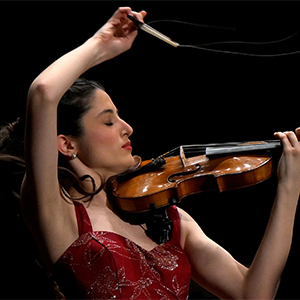
After her amazing performance we were in for an additional treat. I think we were all a bit perplexed when Maria walked upstage from the usual place where a soloist plays. She took her position beside the harp, playing a long cadenza that was introduction to what was to come, her encore.
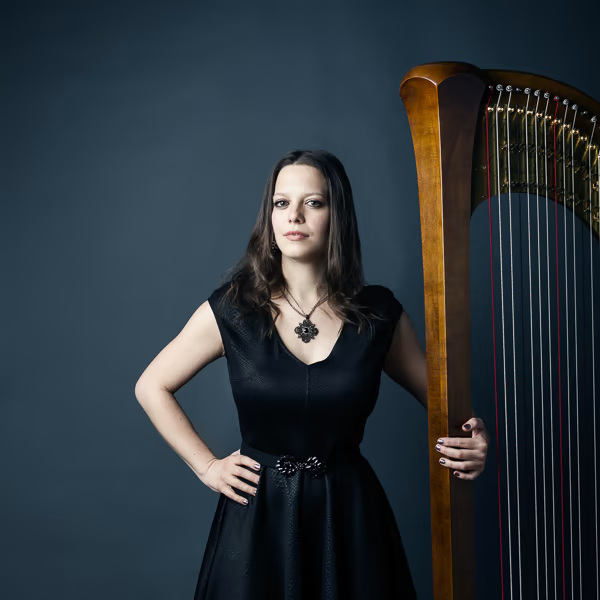
And of course after the intro the TSO’s harpist Heidi Bearcroft jumped in with a pulsing rhythmic accompaniment to the melody we would soon recognize, namely “Grenada”, exuberantly played by Maria and Heidi. Heidi confirmed for me that this was Maria’s arrangement. I expressed the hope that Gustavo would appreciate a moment of hispanic solidarity between him and the soloist.
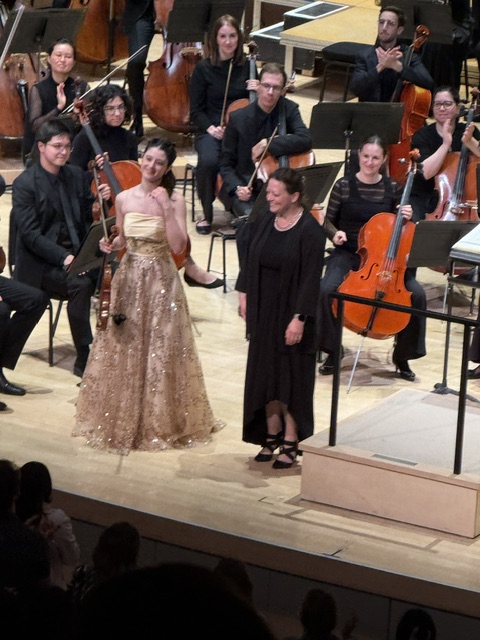
The second part of the concert was different, yet still with links to the cinema.
Nostalgie was a world premiere, a composition roughly ten minutes in length from Bekah Simms. I’m moved to observe that a good program note is itself a work of art, writing that creates the horizon of expectation. We are meeting a new work, and it’s part of the job of the composer or painter or playwright to give us some idea, perhaps teasing us, perhaps mystifying us, but whether it’s explicit or poetic, they are drawing us in.
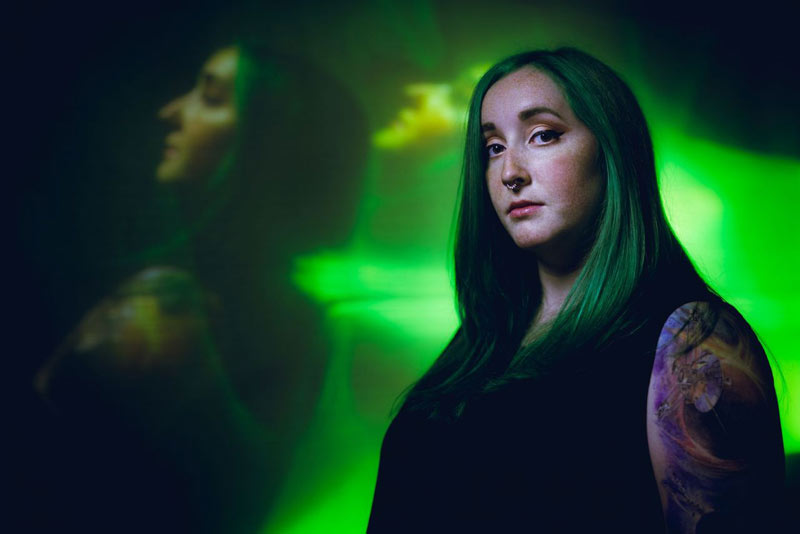
Here’s what Bekah said, that links this work to the cinematic tendency of the concert:
Nostalgie is broadly a reflection on time and its strangeness, in particular the hazy nostalgia for the period after my son was born just over a year ago. Parenting a newborn is undeniably challenging, yet many parents will long for this period once it is over, despite its practically psychedelic manipulation of time and the brand-new flavour of future it unlocks. You are in love with a tiny, inert and unknowable extension of yourself while not sleeping. The chasm between life in the present and life in that singular period is impassable: as are all things in the past. It is strange and it is sappy and it is so quickly over.
Nostalgie uses the Golden Era of Hollywood movie music as a lens to channel this unusual form of nostalgia, à la Herrmann via Korngold. The result is a slightly broken version of warm gooey schmaltz.
The amazing thing about this description is how it frames the music for us. We heard some music that I found reminiscent of older orchestra music, especially the muted brass, sometimes sliding between pitches, possibly microtonal, ambiguous and suggestive. I wanted to look at the score to see if I could find possible tunes or references (if there were any), but of course you don’t have that opportunity on a first listen. Again, it was a piece matching the cinematic focus, well-received. I wish I could hear it again.
The fourth item in the concert program that I claimed had a cinematic connection is accidental yet represents the most common link between classical music and film. Often a director grabs a pre-existing composition to underscore a scene, or a cartoon or a TV commercial. This music may have had an entirely different purpose when it appeared but that doesn’t matter, once someone re-purposes music. The obvious examples of this are such films as Stanley Kubrick’s film 2001: A Space Odyssey (the opening Richard Strauss fanfare turning up regularly in TV ads), although I could just as easily point to Bugs Bunny forever re-framing Rossini’s Barber of Seville overture for anyone who saw Bugs shaving Elmer Fudd. By seeing the film a composition gets connected with images after the fact.
In this concert, I have no idea whether Gustavo or anyone at the TSO was thinking of the film that comes to mind for me when I hear the first movement of Mendelssohn’s Symphony No. 4, known as the Italian. While it’s perhaps under the radar I am very fond of the film Breaking Away (1979), a story of a teen cyclist aspiring to acquire Italian culture. We see him sing ‘M’appari’ at his girlfriend’s window, and he is seen on the screen accompanied by several different compositions with Italian associations, including Rossini’s Barber of Seville overture, but most notably the Mendelssohn.
Yes that’s the least cinematic link of anything in the concert, but I couldn’t omit mention. And yes that is Dennis Christopher we saw again in Chariots of Fire (1981), another film with a stunning film-score.
And again the TSO and Gimeno were very much in synch. The tempo for the first and last movements were brisk, but the orchestra was mostly restrained, gradually building to a climax towards the end of each of those outer movements. I’m thrilled at how well the TSO follow. The second movement is not my favourite, yet it sets up the third (speaking of contrast), both the lovely main section and the sweet trio from the horns.
The TSO are back next week with Beethoven’s 9th.

