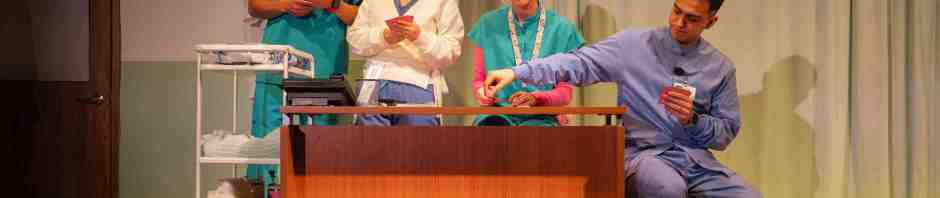
For the Glenn Gould School’s annual chamber opera, they chose to present two short works, A Hand of Bridge (Samuel Barber) and Trouble in Tahiti (Leonard Bernstein) at Mazzoleni Concert Hall.
Director Mario Pacheco employed a clever concept that allowed the two different works to exist in the same surreal world of a clinical waiting room. We entered a theatre where the singers were already in character, welcoming the musicians as though they too were in a waiting room. Before the arrival of conductor Jennifer Tung the onstage ensemble did a gentle vamp-until-ready, something between new age pattern music (apt for our upcoming appointment with a marriage counsellor / psychiatrist) and jazz, repeating the same chords but with decoration.
The table was set for the A Hand of Bridge.
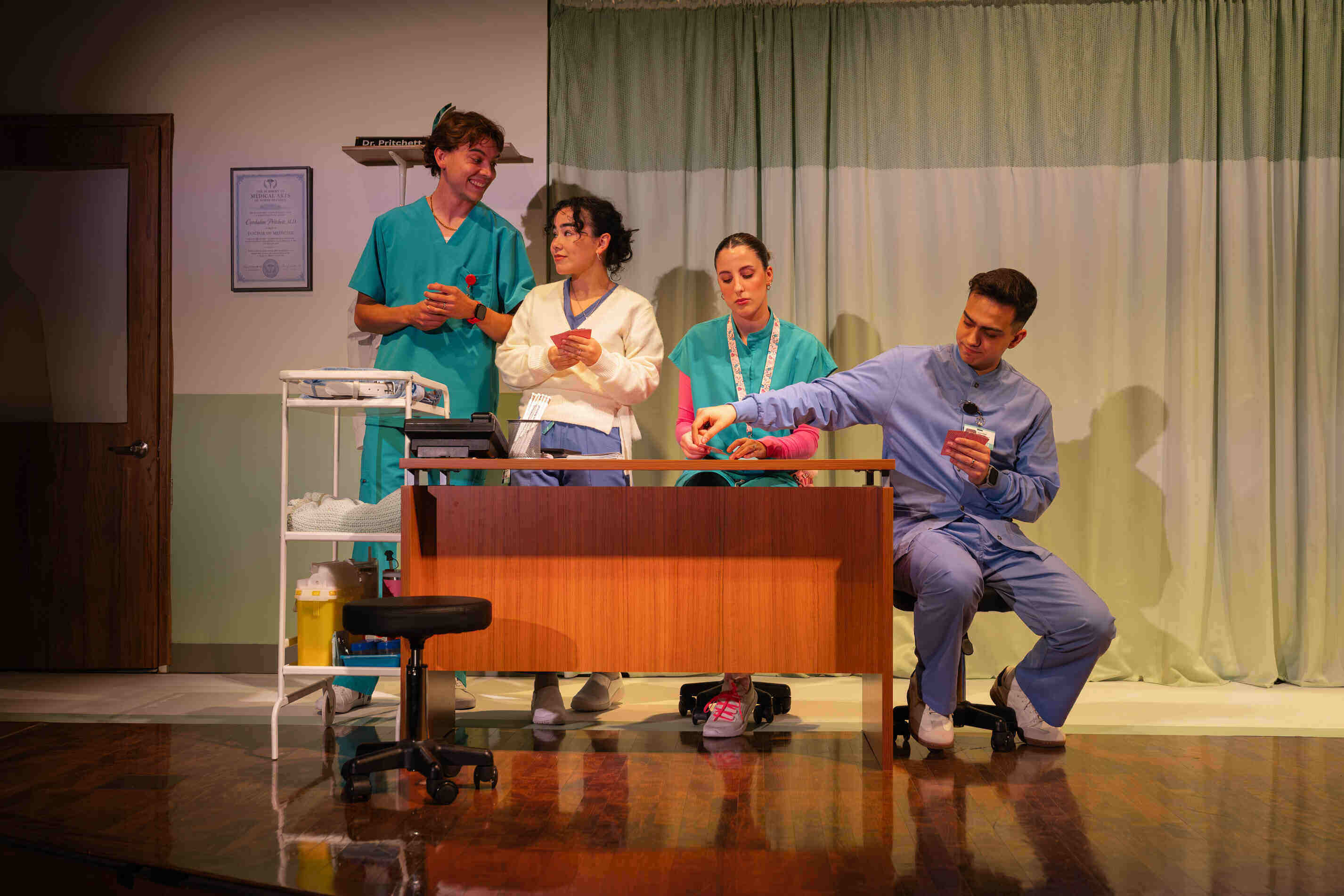
While I applaud the clever concept for connecting the two works, there are trade-offs, as often happens with Director’s Theatre. While it may have seemed theatrical & exciting back in the 1950s when Barber first created the work, to show a foursome of bridge-players expressing private thoughts a million miles removed from their actual bridge-game, that element goes out the window when the game isn’t realistic. Speaking as someone who used to play bridge, it’s a complex game you don’t undertake lightly, that can be highly competitive & dramatic. I played euchre and hearts at coffee break, in my workplace decades ago, but bridge is a quantum leap beyond that.
We saw two of the four showing cards to one another, perhaps necessitated by the use of a narrow table putting all four on the same side rather than at four corners of the card-table that one usually uses for bridge. But hey it’s opera not actual bridge playing. And I think they (director & singers) saw this as a fun piece, without any requirement to make it realistic, especially given that this was like a curtain raiser, with a direct segue into the world of the second longer opera, Trouble in Tahiti.
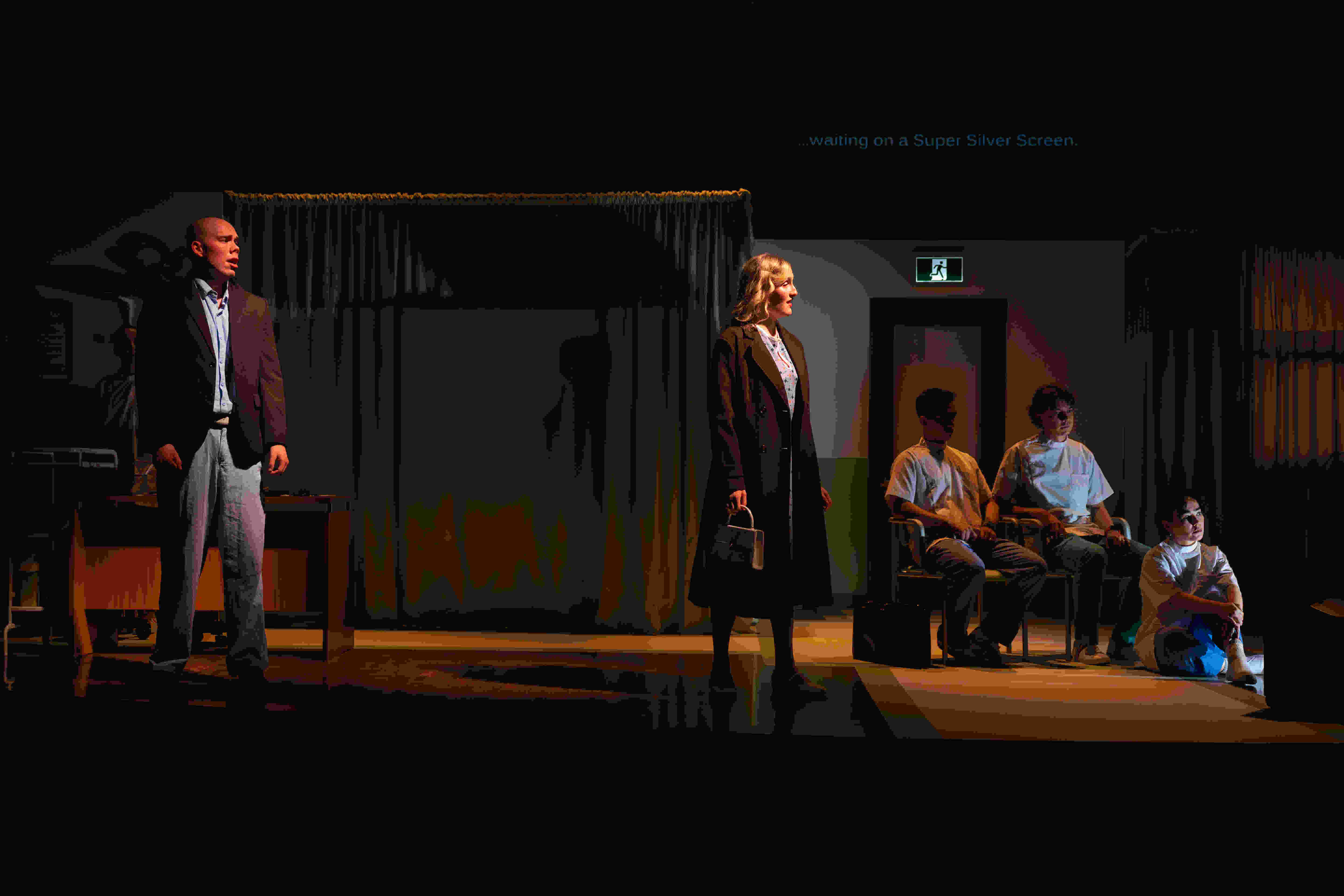
I like the way the two operas felt together, the clinical trio (three of the four card players) like a jazzy Greek chorus rhapsodic in their ironic celebration of the joys of suburbia, alongside the troubled couple Sam (Owen Phillipson) and Dinah (Jada Alexiou). The television, employed throughout as a place to sit downstage, gets turned on at the end, as a nice creative touch, pulling everyone together as seen in the photo above. While we were still in the clinical space, the tv invoked the iconic ambience of a suburban home.
I was impressed at how clearly the English texts were enunciated by singers sometimes coping with syncopation & even scat. I say that having watched a version on YouTube that was barely intelligible, the singers letting their operatic voices overwhelm the text. It’s a reminder that student productions are sometimes better than professional ones, as far as the discipline of performers obeying their coach & following their conductor. I’m grateful that Jennifer’s leadership gave us a reading of Bernstein that was energetic & fun while still letting the singers be heard clearly. The student ensemble looked so young but sounded flawlessly professional. My age may be showing in saying this, but I still find it exciting when an orchestra or chamber ensemble are visible onstage, remembering a time when that was considered revolutionary.
As a pedagogical exercise training singing actors, as a showcase for young talent, it worked really well. The normal experience of any singer in the world of opera or music theatre will be to accept direction that may or may not make sense: and they have to make it work somehow. I’m reminded yet again that universities & conservatories play a key role as repositories of culture when they program pieces we might otherwise never hear, relatively free of the pressures faced by commercial theatres to make money by choosing popular works. Their chief objective is teaching.
In March the GGS will present a fully staged production of Mozart’s Le Nozze di Figaro in Koerner Hall.

