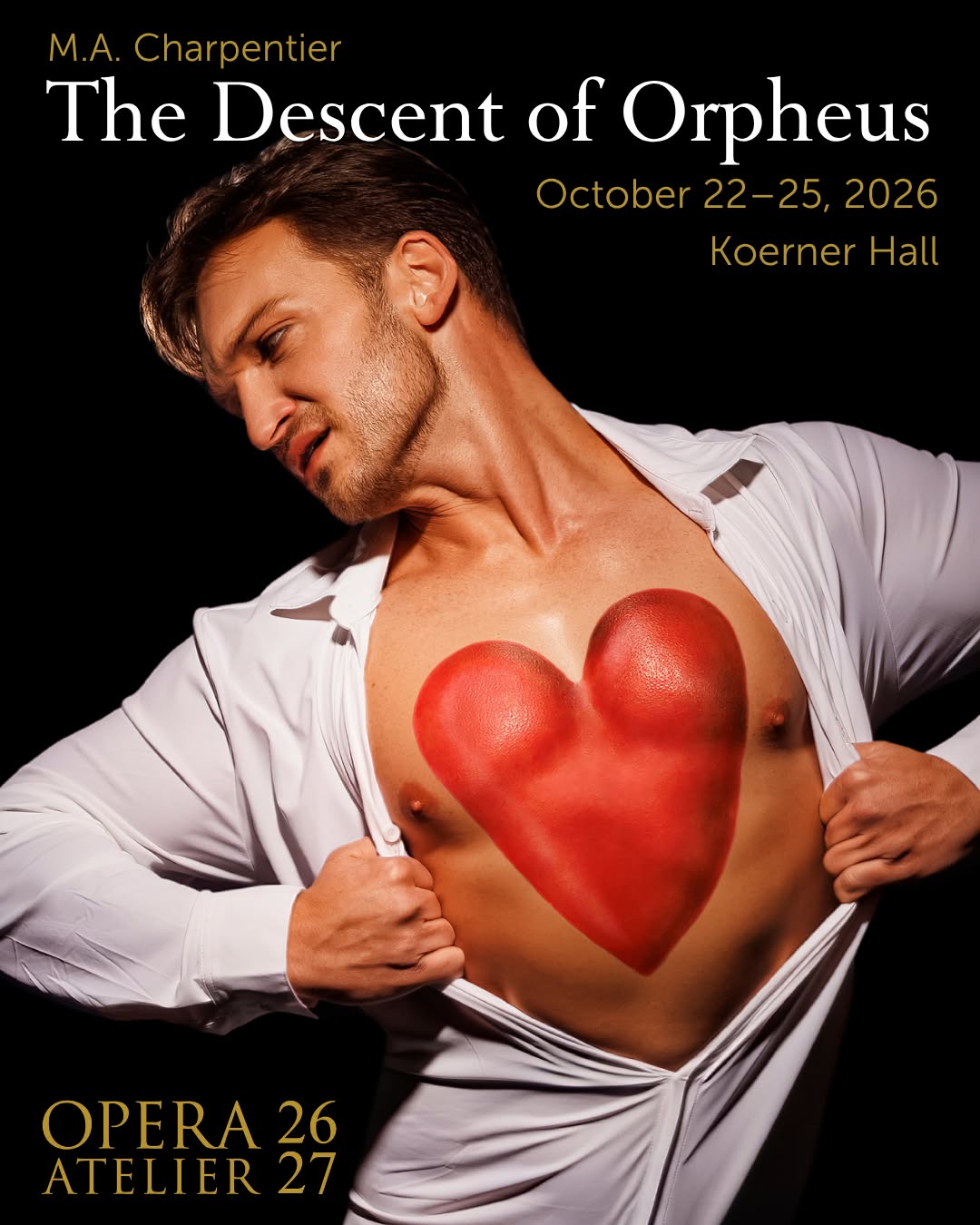
Watching Opera Atelier open their fall season at Koerner Hall Thursday October 22nd was a snapshot of their history in one impressive show.
Their new production of Marc-Antoine Charpentier’s The Descent of Orpheus (1686), continues the company’s exploration of theatre freely mixing singing and dance.
In his introductory remarks, Co-Artistic Director Marshall Pynkoski remarked on their “season of heroes” and the parallels between the two featured heroes in their season, namely Orpheus (in the Charpentier that’s on for the next few days) and Jesus Christ (in Handel’s Resurrection, coming in the spring of 2027).
I was wrong to mistake Marshall’s intro for a mere promotional sales-talk. Before long we would see an opera featuring a rather Christ-like version of Orpheus’s story. When placed alongside the July version we saw from Les Arts Florissants at Toronto Summer Music, we see that the Opera Atelier Orpheus chose to emphasize a truly redemptive reading.
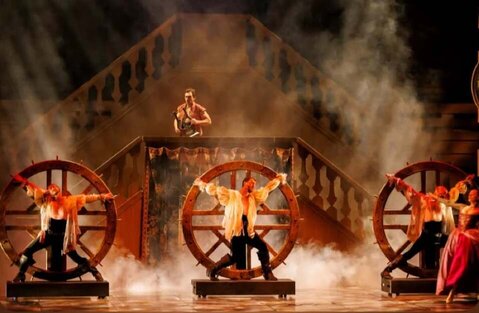
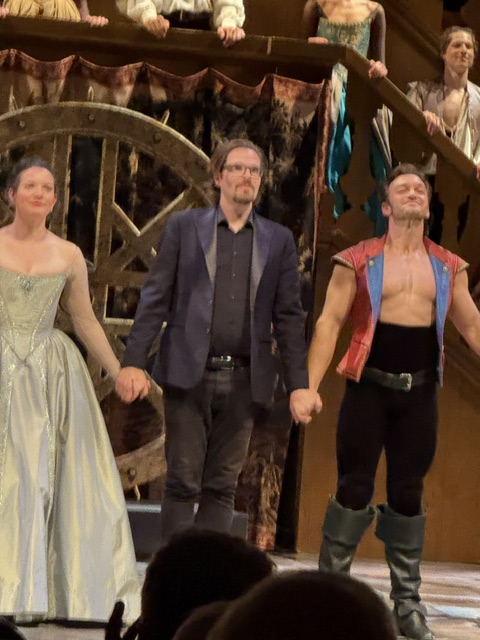
After intermission, to begin the second act we see three torture wheels with Ixion (Alexander Cappellazzo), Tantalus (Christopher Dunham) and Tityos (Olivier Bergeron) attached, as Orpheus (Daniel McGrew) arrives in the underworld. They are not just comforted by Orpheus’s singing, but then rescued, released from torment in an action that reminds me of Jesus’s harrowing of hell. I wouldn’t be surprised if that’s how Charpentier saw it. Opera Atelier’s emphasis contrasts William Christie’s more pagan reading in July with Les Arts Florissants.
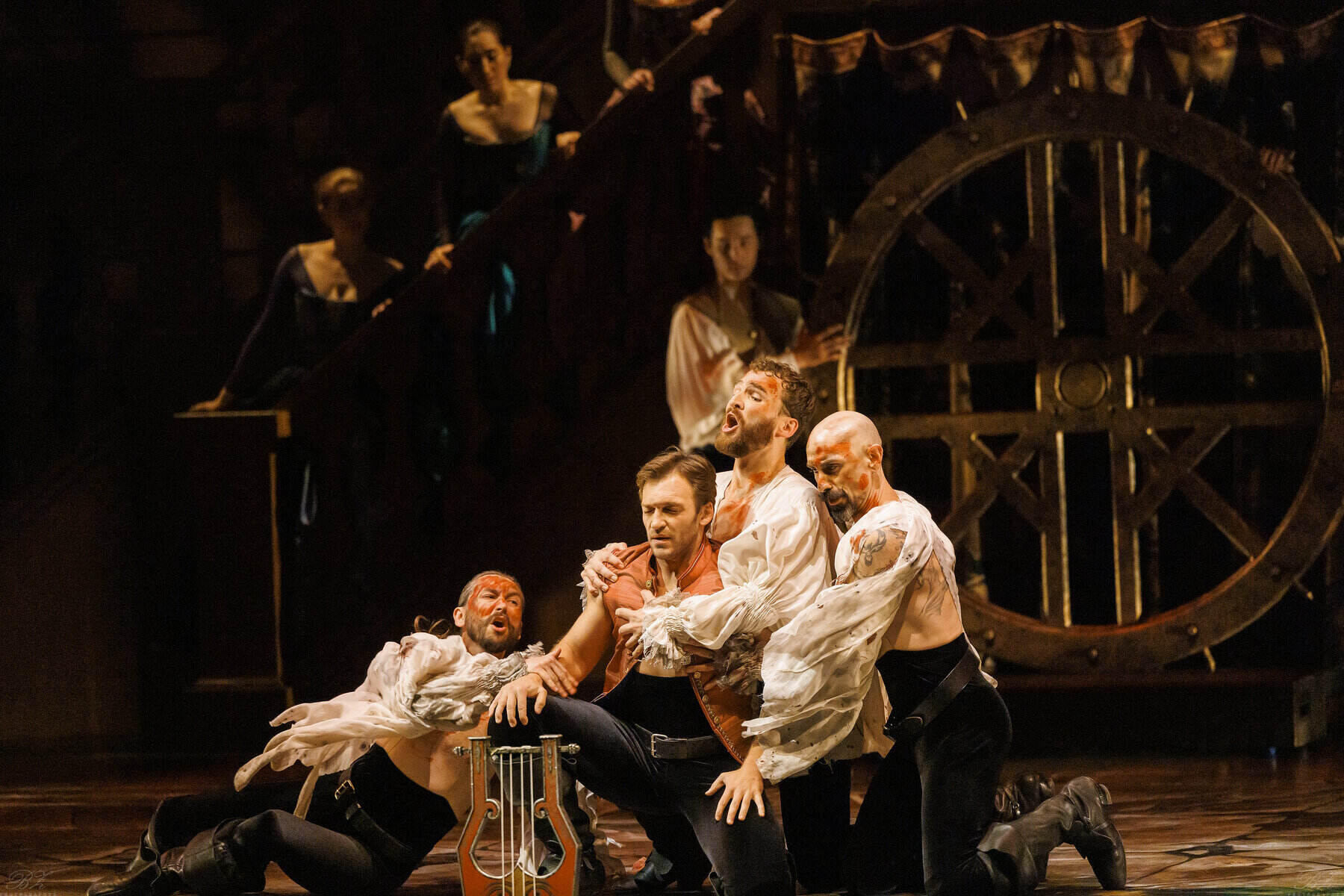
The story in Charpentier’s treatment differs substantially from what we see in the better known Gluck – Calzabigi Orfeo ed Euridice. Where Gluck shows us a musician inspired by suffering & grief to write songs, the operatic experience emphasizing his music-making, the chief drama in the underworld after the three tormented ones are released from their wheel is between Orpheus and the gods of the underworld, namely Pluto(David Witczak) & Persephone(Mireille Lebel).
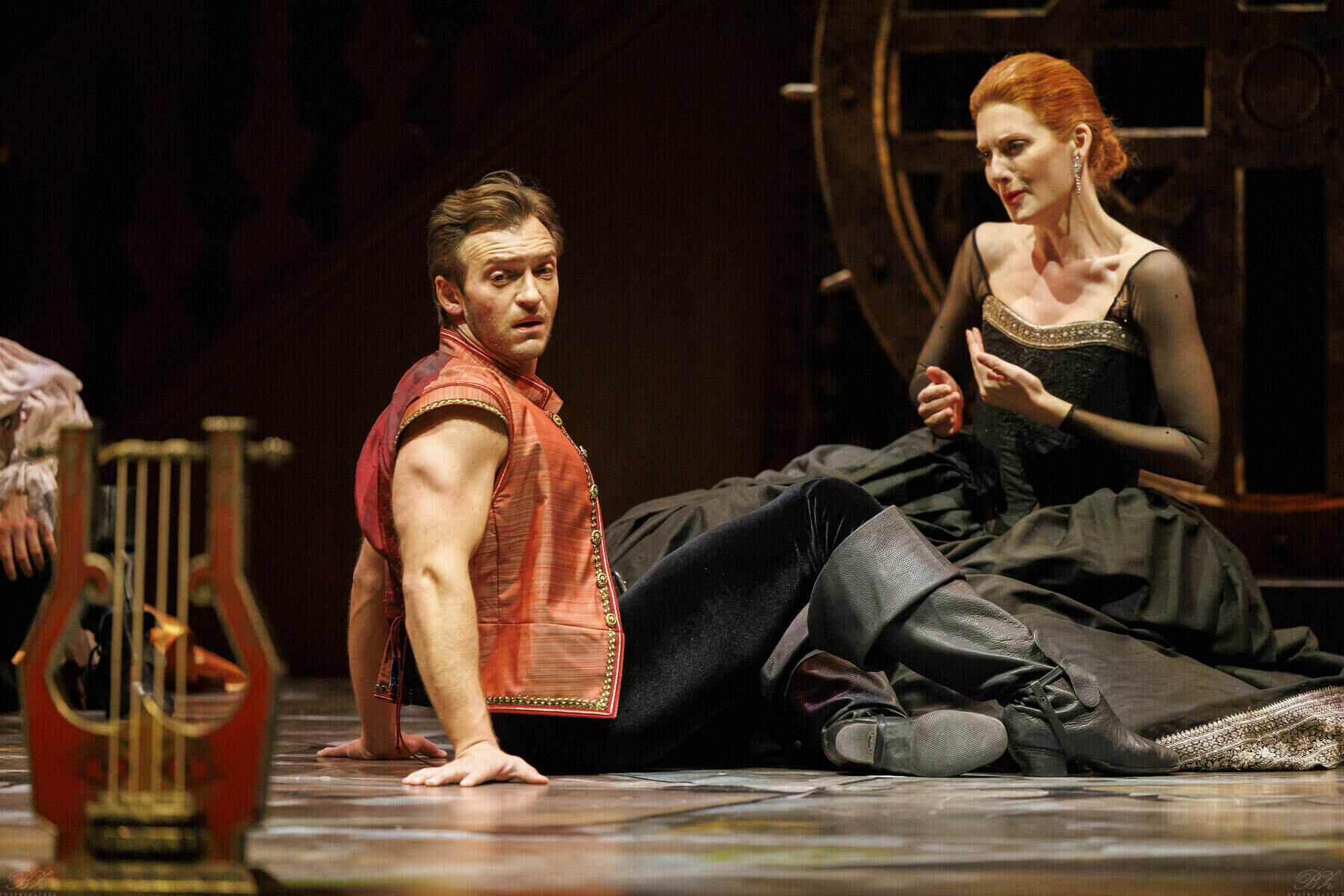
Persephone is so moved by Orpheus, won over observing the grief of the singer, that she then demands clemency from husband Pluto, who ostentatiously submits to her, and frees Eurydice. I felt that Marshall gave this more dignity than the somewhat comical reading we saw & heard in July from Les Arts Florissants. Perhaps Pluto was written with comedic overtones, but Marshall kept the focus on the romantic story, on Persephone’s passionate response to Orpheus’ plight, and then the drama of the revival and return of Eurydice (Mireille Asselin) from death. I love the way they chose to stage this.
So much of our opening night experience at Koerner Hall was governed by a beautiful set design by Gerard Gauci, putting the eight-member chamber ensemble into a pit created in the stage, bounded in front by a small catwalk or passerelle (excuse me as I try to find the right term for this part of the stage design). The players were invisible in this space, the acoustic clarity remarkable. I wanted to include this somewhat silly sequence of three photos with a musician descending into the pit because you can’t see the pit & catwalk in the publicity photos.
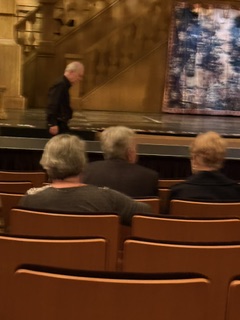
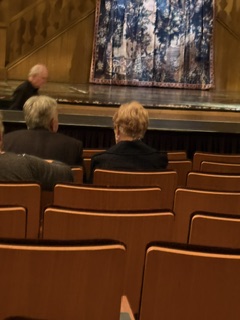
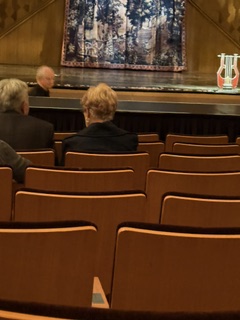
The production did not make much use of that passage at the front of the stage, but I am guessing that Marshall will find ways to exploit the intimacy it might afford in some future show. It would be a great place to put a comic figure delivering a prologue or making asides directly at the audience.
Alongside Marshall’s input on the direction and from co-Artistic director Jeannette Lajeunesse Zingg for the elaborate choreography throughout the program, I want to mention Christopher Bagan’s conducting. He also created a prologue in his arrangement of a Ralph Vaughan Williams song “Orpheus with his lyre” for the baroque-sounding ensemble that he led in the opera, sung by Measha Brueggergosman-Lee. As with the reduced version of Pelléas et Mélisande that Christopher premiered earlier this year that included baroque selections alongside Debussy, Opera Atelier again combined compositions from different centuries into a single musical score for their presentation. I’m glad to see that Marshall, Jeannette, Christopher & the company seem to be embracing their creativity without letting questions of historicity terrorize them.
The Descent of Orpheus continues at Koerner Hall with performances Friday & Saturday night at 7:30 pm and Sunday afternoon at 2:30 pm.