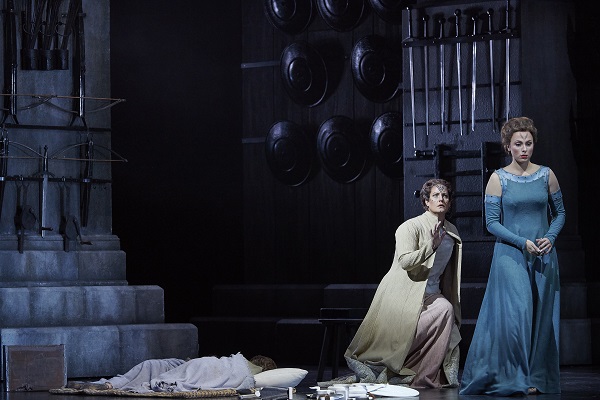
Naomi’s Road leads to Toronto

Tonight I saw Naomi’s Road, an opera with libretto by Ann Hodges & music composed by Ramona Luengen, based on a novel by Joy Kogawa, to open Tapestry Opera’s 2016-17 season.
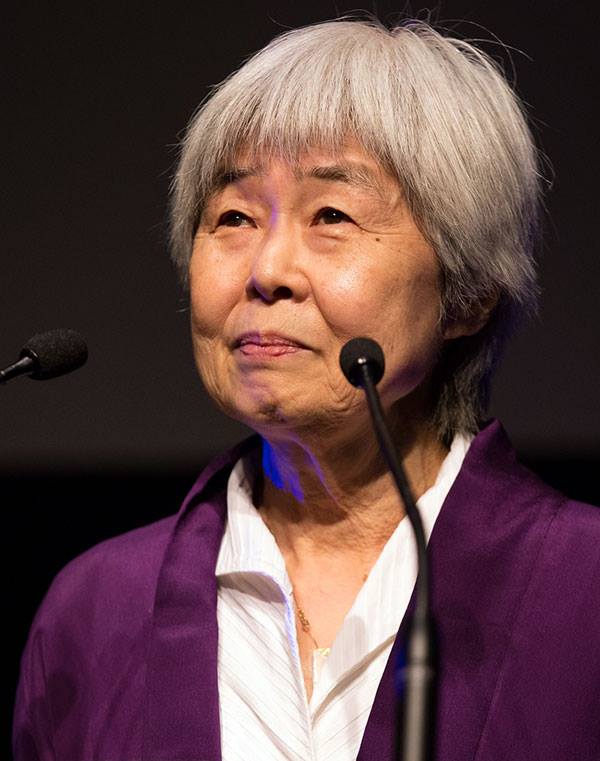
joy-kogawa

Joy Kogawa whose novel Naomi Road was adapted as an opera, currently being presented by Tapestry Opera in its first Ontario production

Tapestry Artistic Director explained before the show’s presentation at David’s Anglican Church (a location that is supposedly full of historical significance for the Japanese Canadian community)  that while this little opera has been to at least 400 communities in places such as British Columbia & Alberta, it only now comes to Ontario, and for the first time is directed by a Japanese Canadian: Mori that is.

naomi_dahlia-katz

Naomi’s road with (l-r) Hiather Darnel-Kadonaga, Erica Iris Sam Chung and Sung Taek Chung (photo: Dahlia Katz)

I’m simultaneously having a whole flood of emotional responses to this unpretentious little work of roughly an hour in length.  It’s less than a week since I saw Ayre presented by Against the Grain at the Ismaili Centre, yet here I am again looking at a political work and its context, the day before i see another quasi political event, namely “A Bridge to the Future: commemorating the Hungarian Revolution“.  While the American election may be over, many of us are still reverberating with its implications.  Naomi’s Road seems especially timely in that context, a tiny glimpse in microcosm of Canada’s treatment of Japanese Canadians in the Second World War, interned & stripped of their possessions as a consequence of the government’s invocation of the War Measures Act (a law that gives the government extraordinary powers to more or less do anything it wants no matter how disgusting).   Naomi is part of a family who endure this humiliating loss of rights & property.

I understand that this adaptation was intended for a school audience.  The simplicity of the idiom –wholly intelligible, largely tonal, sometimes sentimental, then abruptly turning into something of breath-taking bluntness—is like a lesson in how to write an opera.  Perhaps the question I’d ask anyone writing an opera is , if you make it any more complex than this are you sure you’ll improve it? We’re in the tonal realm of a Menotti, recalling the accessible idiom of Amahl & the Night Visitors, thinking of another hour-long opera that’s a staple in churches all over North America, and –like Naomi’s Road come to think of it—a huge success because it’s easy and cheap to produce.

Tonal music is a problem child, given that composers are expected to make their music sound new and/or difficult.  But there are a few refuges for career composers who prefer tonal music.  One is the world of music theatre, where melody is a requirement if you expect to be a success.  Film is another place where you have opportunities for feel-good music, at least if the story allows (whereas horror and suspense films are another story).  And then there’s church music, a place where composers are sometimes welcomed if their style is retro as far as their use of the voice & tonality.   Ramona Luengen has a lovely compositional voice, especially when she employs multiple voices. There are several stunning moments where two or more singers sing together, sometimes unaccompanied.

Hodges’ libretto & Luengen’s score lulls you in places, seemingly telling a kids’ story, the stage occupied by happy children telling a sentimental tale: that is until the plot takes a surprise turn or two.  The soft and gentle harmonies that lure us in, getting us to drop our defenses, leave us vulnerable for the nastier moments in the opera.   And yet it’s wonderfully educational, as we really get inside the experience.  I recall hearing a professor argue that politics and art are ultimately incompatible, that as soon as something becomes didactic or preaches, it must cease to be art. And so with this opera, which never takes that movie-of-the-week tone, opting always to stay inside the narrow zone inhabited by its characters.  Naomi, Stephen, their family and friends, are all simply trying to survive in their own little world.  That’s the brilliance of this work.

I like the way the music gets you to open your heart to the characters and their story.  It’s not rocket science, it’s opera.  Mozart, Puccini and Menotti all did this at times, and so does Luengen.  This is no virtuoso vehicle, but a very direct little piece that’s full of life, a great piece of theatre. Hiather Darnel-Kadonaga as Naomi and Sam Chung as Stephen were very sympathetic, while Sung Taek Chung and Erica Iris were wonderful in a whole series of other roles, especially when the four sang as an unaccompanied quartet. Stephanie Chua at the piano played and music-directed a flawless show.

I would strongly recommend that you come see this opera, running until November 20th at St David’s Anglican Church on Donlands Avenue just north of Danforth Ave, across from the Donlands Subway.
Posted in Music and musicology, Opera, Reviews | 1 Comment

Berlin Philharmonic, Rattle, Boulez & Mahler

Tonight was the first of two concerts by the Berlin Philharmonic Orchestra presented at Roy Thomson Hall. I think this is the closest I’ve seen to “full” in the space, as every seat appeared to be occupied, and no wonder.

  • This is the orchestra reputed as one of if not the greatest in the world.
  • This is the program –Mahler’s 7th Symphony + a short work by Boulez, not tomorrow’s oxymoronic program of modernists + Brahms—that surely is the crowd-pleaser.

And we were pleased.

It might be fun to compare notes with some in the audience, if I were a bit pushier and were to walk up to strangers and ask them probing questions. But I swear the nerd quotient was high tonight, even if there were a few people who applauded between movements, which can be forgiven especially when the movements are so moving.
But there are two things I’d bring up with the nerds (mes semblables mes freres, sans doute).

We’d talk about 1-the orchestra and 2-this symphony as touchstones.

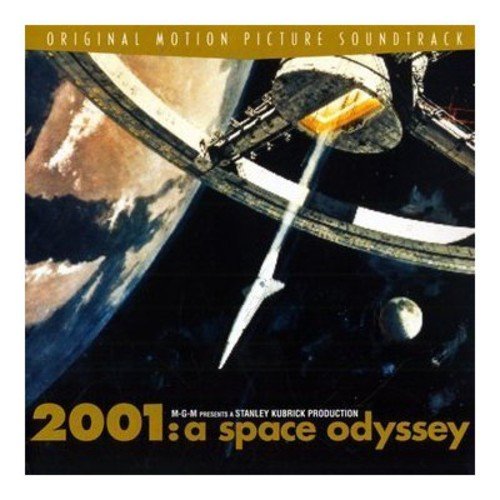
2001Long ago when we were too young to be subscribers to the Toronto Symphony, there were other outlets. In 1968 I first fell under the sway of the Berlin Philharmonic with the help of Stanley Kubrick’s curated soundtrack for 2001: A Space Odyssey. The BPO played both the main title –that seminal opening of Richard Strauss’s Also Sprach Zarathustra imitated so often since—and some of the most haunting music in the first hour, in the re-purposing of Johann Strauss’s An der schönen blauen Donau, aka The Blue Danube Waltz, as an orbital dance between a shuttle and a space station. MGM’s soundtrack album was a best-seller. There was also the von Karajan Ring cycle that came out a little later, played by the Berlin Philharmonic. The BPO was the orchestra you used when you went to a stereo shop looking for music to test just how hi your fi truly was.
And then the nerds might also weigh in on Mahler’s 7th Symphony. I remember one conversation after a TSO Mahler 7th decades ago when a prominent Toronto expert who i won’t embarrass by naming in this space (then much younger of course) opined that maybe Mahler’s 7th doesn’t really work; given that he must have been in the hall tonight, I wonder if he’d now recant that bold statement of his youth. This is a big unwieldy composition that can be taken slow or fast or maybe a bit of both. In my youth I was partial to Klemperer, who is the slowest of the slow, and also enjoyed conductors such as Bruno Walter and James Levine. When I encountered conductors who make Mahler move more quickly –thinking especially of Leonard Bernstein, who has been my favourite– I was converted from Klempererism not just because he shares my initials.

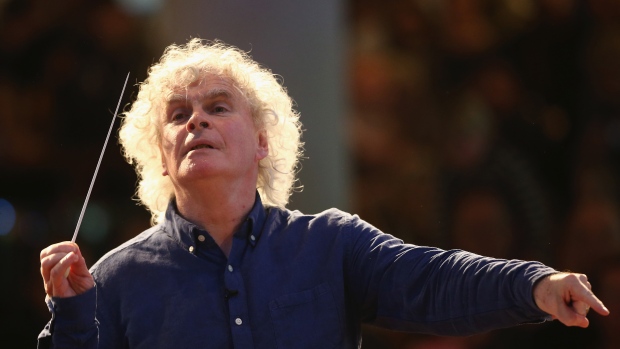
Which brings us to tonight’s program, the Berlin Philharmonic conducted by Sir Simon Rattle, as he comes to the end of his mandate to lead this unique orchestra. Mandate? Yes because this orchestra elects its leader, so the odd word fits.

The program consisted of two works:

  • Eclat by Pierre Boulez
  • Mahler’s 7th Symphony

The first piece was about eight minutes long while the second usually runs about 80 minutes. This was a magical pairing in several ways. Eclat served as a wonderful curtain-raiser, an overture that is much more –and less—than an actual overture.
We had the benefit of contrast:

  • Where the Mahler is long, the Boulez is short
  • Where the Mahler employs a huge orchestra and every section of the orchestra, the Boulez is more of a chamber work
  • Where the Mahler is like a blanket of sound, from loud to soft but full of varied textures and colours, the Boulez is more of a sampler, a series of hors d’oeuvres to offer only a brief glimpse of the sound of that instrument, taking us through the sounds of fifteen instruments
  • Where the Mahler is often passionately emotional, whether soothing, mysterious or triumphant, the Boulez is much more reticent and mysterious, and teases the ear to want more (which we certainly got when the Mahler began shortly thereafter)
majella

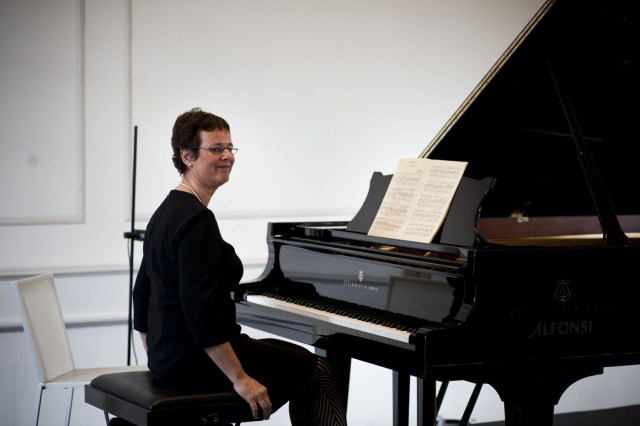
Majella Stockhausen

The Boulez features a wonderful solo piano part, played tonight by Majella Stockhausen, the daughter of the famous composer. Some of the passages she played are ferociously complex, and sound quite difficult to execute. As far as I could tell she did a brilliant job. The essence of Eclat is that it is a fragmentary work (among several meanings “Eclat” can mean ‘splinter’ or ‘fragment’), with jagged bits of sound that sometimes sustain or fade, depending on the way the instrument is made (this is one of the composition’s subtexts).

And shortly after, we were into the first movement of the Mahler. Listening to this big ensemble play a composition calling for a big sound from every section is a fabulous demonstration of the excellence of both the orchestra and the hall. Rattle took an approach that showed us just how well this orchestra can follow. The lush melodic parts were sometimes achingly slow, while the marching motifs were taken faster than I’ve ever heard them, even faster than either of the Bernstein recordings I’ve heard: yet the ensemble followed him like a shadow, even when he made an abrupt or even a quirky tempo change. One of the most impressive moments in that first movement came at one of the big climaxes of the marching motif, where Rattle simply stood and watched the orchestra execute the phrases perfectly without any help from the conductor’s baton.
All night we were not just treated to Mahler, but a showcase of every instrumental colour. The second movement was all about inner voices, solos from everyone, from the timpanist through wind players onstage and off. The pastoral delights of this movement hypnotized an audience already enraptured by the powerful conclusion of that first movement. In this movement we experienced more of a dynamic range, in some understated and delicate playing alongside some big moments.

For the third, I was intrigued by what I think I saw Rattle doing, a conductor who challenges the orchestra with adventurous repertoire, resisting the challenge to force the piece to cohere, and instead letting it be messy and noisy, in a bit of an echo of the opening work. The fragmentary and noisy element was front & centre, and only towards the end of the movement did he suddenly turn up the schmaltz. But in the process he made Mahler seem very modern indeed and a fitting showcase for this orchestra.

simon-rattle

Sir Simon Rattle (Dan Kitwood/Getty Images)

For the fourth movement we were beguiled by a series of solos, as Mahler wears his heart on his sleeve. The concert-master is given wonderful opportunities, as well as smaller moments for the cello and the French horn. And then came the pure gratification of the final movement rondo, an array of contrasts & different tempi & moods. While Rattle showed us that his orchestra can follow him at any tempo, I wonder, were there perhaps too many abrupt changes of tempo, too much of Rattle showing off and not enough attention to pulling this big oversized piece together? That’s what suddenly reminded me of that commentary from decades ago, the fellow doubting the symphony can work. But I’ve heard the symphony cohere before, so long as the conductor tries to keep the tempo a bit more consistent. So I was certainly impressed by what the orchestra could do and Rattle’s command, even if that last movement was not to my taste. Even so the audience went nuts at the end, and I bravo’d at least a dozen times.

Wednesday night November 16, Rattle and the Berlin Philharmonic will be back at Roy Thomson Hall in a program of Schönberg, Berg, Webern and Brahms.

Posted in Music and musicology, Reviews | Leave a comment

Perlman’s Cinema Serenade: vol 1 & 2

You think you know someone, what they’re all about, and what they really like. That can be true of your friends, or of famous artists, where they surprise you with a hidden dimension, an unexpected interest.

I thought I knew Itzhak Perlman the violinist. But I clearly only know part of who he is.

If you’d asked me about violinists I’d name a few that I admire, the ones from the past like Stern or Oistrakh, the ones currently playing such as Anne-Sophie Mutter, Nigel Kennedy, Midori, Zukerman. I’d eventually admit that the tone I always found the most attractive came from Itzhak Perlman.

And when I heard about an upcoming concert, I discovered a great deal about Perlman that I’d never suspected. November 22nd Perlman’s coming to play with the Toronto Symphony at Roy Thomson Hall, a concert titled “Itzhak Perlman’s Cinema Serenade”. When I googled to find out more, wondering if he was changing his direction in his mature years, I was astonished to discover that the man has long had a whole other side I had never suspected.

vol1

Or to put it another way, I bought the two CDs. Volume 1 is simply titled “Cinema Serenade”, while the second one is “Cinema Serenade 2: The Golden Age.”

John Willliams, the film-music composer & long-time conductor of the Boston Pops conducts both CDs (the first with the Pittsburgh Symphony, the second with the Boston Pops).

Now don’t get me wrong, this isn’t easy music, not by a long shot. But the thing is, Perlman has long been leading a kind of double life. In addition to his classical work — in concert halls playing concerti or in recording studios making astonishing recordings of those same serious works—Perlman has been involved in the creation of film music.  I never knew that it’s Perlman who plays in the soundtrack of Schindler’s List.

This is not to be confused with any sort of cross-over, like the bizarre Broadway musicals you sometimes get when an opera singer tries to let their hair down and sing popular music instead. Nope. Perlman is actually doing what he does in the concerti. In any of the concerti by Mendelssohn or Bruch or Tchaikovsky, yes yes there’s passage work and all sorts of fussy parts that seem designed to make you jump through a series of hoops: but that’s not all. In each of those concerti, the composer has the good sense to write a beautiful melody and hand it to the soloist. And what makes Perlman’s performances so special is not that he can execute fast arpeggios and difficult passages – which he can, make no mistake –but rather that when a simple melody is written, that Perlman knows precisely what to do with it.

One of the most enjoyable things I get to do in this space is to quote beautiful passages to illustrate my points. Exhibit A is from Cinema Paradiso.

Here’s another example from Schindler’s List.

Please note that the excerpt on the CD (unlike this clip) is conducted by the composer, John Williams.

The second CD has even more examples that I love very much, that I think any film buff would enjoy.  We begin with that most haunting of melodies, David Raksin’s “Laura”. My favourite cut on the CD is a suite from Robin Hood, meaning the award-winner from Korngold rather than Michael Kamen’s more recent –but also quite excellent—score. One of the things I love to do when teaching film-music is to take us through the film, noting the way that the themes change as the story goes on as elegantly as if we were in a Wagner opera, not a swashbuckler of a film, so this one is especially moving for me. Wonderful as the melody is, Perlman takes it up an additional notch in his stunning reading.

November 22nd I’m looking forward to hearing some of these tunes in person with the TSO. But the CDs are a completely hypnotic alternative.


Posted in Cinema, video & DVDs, Music and musicology, Reviews | Leave a comment

The truth about James Bond

I saw the premiere performance of James Bond: A Convenient Lie (Opera in Pasticcio), a collaboration between Malfi Productions and Manosinistra Lyric Workshops.  I don’t know either group, only that I shared a press release on this blog a little while ago, and tonight went to check out the show.

chaplin

Soprano Holly Chaplin, aka “Ample Bliss”

It’s a bit of a parody.  They take familiar tunes but insert new words, and so a big part of the charm comes in hearing the old tune done a new way.  I’ve never seen the Queen of the Night not only hit her high notes but do martial arts at the same time.  But this was not the Queen of the Night, it was the aptly named Ample Bliss, wonderfully portrayed by Holly Chaplin.  The angry tune (“Der Hölle Rache”) is a natural for gun-play, so we had that too.

Kyle McDonald is responsible for the libretto, which really means he conceived of the adaptation. Of course he plays James Bond (doesn’t everyone want to do that?).  His enemy “The Naturalist” is played by baritone Stuart Graham.

As both are low voiced males, McDonald had to plunder scenes from opera featuring low voices. And so we hear the scene from Don Carlos where Philip faces the Grand Inquisitor, except this time it’s James Bond facing an arch-villain.  Or we get the scene where Don Giovanni is dragged to hell, except this time it’s James Bond plus his new soprano conquest Bliss (she’s no longer trying to kill him but instead fights alongside as an ally), as they both struggle with a big guy named “Tiny”.

kyle

McDonald. Kyle McDonald, aka James Bond and librettist of A Convenient Lie

YMMV, or in other words, some jokes are funnier than others.  I love that McDonald tried this, a worthwhile effort.  I wish there had been surtitles as I am pretty sure I missed some funny lines, that I couldn’t quite make out.  Even so McDonald came up with a few good ones, for instance rhyming (if I remember it right) “I’m James Bond, I’m an agent don’t be nervous” with “I’m an agent on her Majesty’s Secret Service” sung to the tune of “Non più andrai” from Nozze di Figaro.  Later we hear McDonald take on the single best known sexy swagger song, namely the Toreador Song.  “Toreador” becomes “Double Oh Seven…”

There are several splendid moments, both from the standpoint of musical highlights or comedy.  I loved the railroad tracks chase, complete with mimed trains portrayed by the chorus zipping back and forth—and a car-chase, again with the help of lots of creative movement.

Accomplices in this caper include Constantine Meglis as Tiny, who sang a menacing “La vendetta”, reframed as a threatening song, Rocco Rupolo, who sang a take-off of “la donne e mobile” (can’t recall the new lyrics, sorry…although as I recall McDonald gave him an awkward word on which to ascend to the high B, and Rupolo got there anyway), Diego Catala, singing a wonderful “largo al factotum”, as Q talking about all the great gadgets he’d make for James Bond, and Alexandra Harris aptly under-estimated and never properly exploited as Moneypenny: precisely as happens in every Bond film. Sasha Bult-Ito and Gregory Almay were the compact orchestra in support of the production & its comedy.

I hope McDonald tries this again.

Posted in Opera | 1 Comment

A Bridge to the Future: commemorating the Hungarian Revolution

In Commemoration of
The 60th Anniversary of the Hungarian Revolution &
The 135th Anniversary of the Birth of Béla Bartók

With the Performances of
Piano Works by Bartók, as well as
Works by Kodály, Liszt, Dohnányi, Lehár, and Kálmán

Mary Kenedi, Piano
Krisztina Szabo, Mezzo-Soprano
Sharon Lee, Violin
Laurence Schaufele, Viola
Sybil Shanahan, Cello
William Shookhoff, Piano

Thursday, November 17, 2016, 7:30pm
Trinity-St. Paul’s United Church
427 Bloor St W, Toronto

Tuesday, November 29, 2016, 7:30pm
Canadian Museum of History
100 Rue Laurier, Ottawa-Gatineau

Canadian – Hungarian A s s o c i a t i o n f o r M u s i c P e r f o r m a n c e
Adult $35 / Senior $25 / Student $25 At the door, Adults $40 / Senior $30 / Student $30 To order tickets, call 416-272-4904 Or visit: www.champ1956.com

Magyarország Nagykövetsége Ottawa in Ottawa
Magyarország Főkonzulátusa Toronto Concert

Sponsors The 1956 Hungarian Revolution &
Freedom Fight 60th Anniversary Memorial Board

Posted in Press Releases and Announcements | 1 Comment

Ayre: An Evening of Osvaldo Golijov

When the organizational wizards of Against the Grain Theatre decided to present Ayre: An Evening of Osvaldo Golijov beginning November 10th I doubt that anyone recognized the significance of the date.  Had the American electorate made their expected repudiation of Donald Trump’s xenophobic platform on Monday, this might have been a fitting celebration of multi-culturalism, especially in context with the location of the concert, in Toronto’s Ismaili Centre. We witnessed a truly collaborative effort, presented in partnership with the Aga Khan Council for Canada, and the Glenn Gould School of the Royal Conservatory of Music.  The Canadian Opera Company should also be mentioned (who hosted this afternoon’s preview), as AtG are the inaugural COC company in residence, a relationship that so far looks to be a win-win relationship.

With the unexpected turn of events the program took on an additional gravity, a moment to recognize how fortunate we are in this city.

While Ayre was the biggest work on tonight’s program (a song cycle I also heard this afternoon), Golijov was also represented by three other pieces in the first half of the evening, and presented in a different way.  Ayre was performed from a raised stage to a seated audience, whereas the other works were given a more challenging presentation.

I don’t know if everyone read the space as I did, but for me this was a hugely significant choice, that we were in this beautiful space devoted to Islamic culture & art.  I’m reminded of the times I’ve seen music with a religious subtext presented in a church, whereby the resonances & implications are amplified.

We began with a string quartet playing Golijov in a somewhat disorganized space, people milling around, some blocking the view, some checking their smart-phones.  When I said “challenging” above, I meant to the audience’s civility.  We were given no instructions but allowed to find the music within the space, as though the music and musicians were another exhibit to view as much as hear.  With the beginning piece “Yiddishbbuk” as with the two songs that followed –each in a slightly different space in the Centre with a different configuration of listeners /watchers—we were allowed to find our way to the heart of each piece.  The quartet is almost a meta-religious piece, a provisional exploration of what might be or might have been (as the program note explains):

“A broken song played on a shattered cimbalom” Thus, writes Kafka, begins Yiddishbbuk, a collection of apocryphal psalms Golijov attempts to reconstruct that disappeared music, creating a three-movement work in the mode of the Babylonic Lamentations.”

Golijov proposes a music that the exiles might have sung or strummed, a first stumbling stagger in the general direction of the affirmations to come.  Lua Desccolorida a secular song sung by Adanya Dunn, and Tenebrae, an inspired meditation sung by Elen McAteer, lay the groundwork for our experience of  Ayre after the intermission.

SÃO PAULO/SP - 28/09/2010 - 16h30 - CADERNO 2 - GOLIJOV - Compositor argentino, Osvaldo Golijov na sala São Paulo.

Osvaldo Golijov (photo: Robson Fernandjes)

Golijov gave a lovely talk before Ayre that helped me understand one of the more puzzling parts of his composition.  The second of the songs baffled me, a lovely lyrical song, until you see the shocking text:

(complete texts for the cycle can be found here)

And a mother roasted
and ate her cherished son: 

“Look at my eyes, mother.
I learned the law with them 

Look at my forehead, mother,
I wore the philacteries there 

Look at my mouth, mother:
I learned the law with it.” 

Golijov framed this within the Lamentations, when a mother might be starving, but it could just as easily be set in Syria, or perhaps on a boat full of starving refugees.  With this context, suddenly the song made perfect sense, a breath-taking creation.

miriamkhalil

Soprano Miriam Khalil

Seeing it done again confirms how special this moment is for Against the Grain Theatre, and for Miriam Khalil who sang the songs of Ayre.  The stars seem to have aligned with this project.  Imagine if Claude Debussy had premiered Pelléas et Mélisande with a non-native French-speaker, and then the joy of hearing the opera sung for the first time by a Francophone.  But Golijov conceived this work for American Dawn Upshaw, and must have been surprised to hear what Miriam Khalil—a Syrian-Canadian—could do with the text.  Her authenticity is palpable, whether in the romantic songs or the call to uprising of the third song: to which I might have started clapping in rhythm had this not been such a classical crowd.  I am hopeful that tomorrow or Saturday, Miriam’s fist-pumping will get the crowd to join her in this stirring piece.

I hope someone is considering capturing this on video or at least making an audio recording, as the chemistry of this group is truly special.

Ayre: An Evening of Osvaldo Golijov continues Friday & Saturday, Nov 11& 12 at the Ismaili Centre on Wynford Drive. Further info here.

Posted in Opera, Personal ruminations & essays, Reviews | 1 Comment

Ayre: counter-discursive affirmations

I needed that.

Ayre, the piece I saw/heard just now in its noon-hour incarnation at the Canadian Opera Company’s free concert series, will be presented tonight in a fuller version by Against the Grain Theatre , but I doubt they’ll surpass what I just saw, a welcome affirmation of so many of my beliefs.

Ayre is an ambitious song cycle by the Argentinian composer Osvaldo Golijov, who was present before the concert to say a few brief words.  He spoke of his hopes with Ayre, a work that he described as a kind of pilgrimage, beginning in Spain and going to Jerusalem, an itinerary more of the mind & spirit than a literal journey, composed in several idioms.  He saw the work as an attempt to grapple with the problems & conflicts of the Middle –East.  I’m reminded –both in the words of the composer & his creation—of David Warrack’s Abraham, another work that would explore the roots of the conflicts that seem to be never-ending, while incorporating tuneful tonal music into a modern composition.

I would misrepresent them both if I dared paraphrase them with the phrase “why can’t we just get along”. But music with text has a way of taking us to a place of harmony & idealism, as though we were at the conclusion of Beethoven’s 9th or Mahler’s 8th, a place that wraps some people up in warm fuzzies.  Yet in the spirit of the week –when some are despondent, while others are ecstatic—it needs to be noted that one person’s rapture leads to instinctive distrust in others.  We don’t all get along, and it’s often because we can’t even agree whether to turn the radio to the classical, the rock or the country music channel.

miriamkhalil

Soprano Miriam Khalil

I suspect Golijov knows the problem I’m addressing, the need for genuine dialogue, the concern that I believe is fundamental to his work and to our problems right now in the world.  I don’t think it’s accidental that he’s captured the mood of the week, in a work that manages to be affirmative, ironic, and also to at least hint at counter-discursive rebuttal at the very same time.  Or in other words, I think Golijov manages to simultaneously salve the wounds of those who want tuneful hymns to peace, as well as those demanding angry rock n roll uprising.  It’s there in the choice of texts, in Golijov’s sonorities, and in Miriam Khalil’s astonishingly versatile performance.  This cycle of eleven songs (including some instrumental-only portions) calls for the singer to sing in varied styles.  But in Joel Ivany’s interpretation  (he’s directing tonight’s show and surely we saw that in this afternoon’s reading) he  and/or Golijov challenged her to inhabit the different sounds as though each were a different character, portrayals of great variety.

My mind is very much on how this work at this precise moment seems to be a near-perfect summation of everything that’s going on right now, allowing one to sit on both sides and admire the dialogue.  For such a short work its admirable for its depth.  No there’s no real Islamic presence in the work (which I’d perhaps foolishly hoped to encounter) so the balance I speak of is more between contending sides of arguments, and not the two sides we know to be in contention in the Middle East.  But let’s not ask the impossible.

What Ayre achieves is pretty amazing.  A small ensemble including electronics surround Khalil physically and aurally, her voice sometimes very gentle, sometimes angrily guttural, sometimes more typically operatic, and always tuneful.

I’m looking forward to seeing./ hearing it tonight at the Ismaili Centre at 49 Wynford Drive.  For further information click.

Posted in Music and musicology, Opera | 1 Comment

Balancing on the Edge

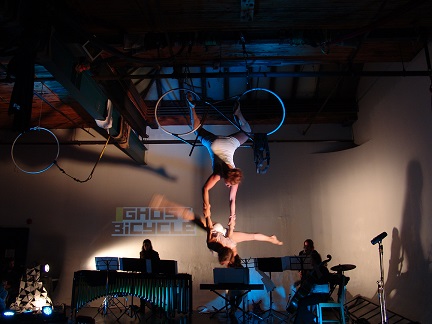
New circus and new music collide in boundary pushing, radical circus performances featuring special guest, DJ P-Love from New York. Co-produced in association with Harbourfront Centre Theatre by Thin Edge New Music Collective and A Girl in the Sky productions. Six collaborative new works interpret what it means to be “balancing on the edge.”

Processed with Snapseed.

Including Ghost Bicycle, a aerial and dance piece created by Rebecca Devi Leonard and Natasha Danchenko about the tragic death of dear friend who was killed while cycling and Ascension, an aerial ladder choreography developed by mothers and artists Angola Murdoch and Holly Treddenick who balance the demands of motherhood and the instability of life as a working artist.

The synthesis of new music and new circus was inspired by an encounter where the producers of each discipline: new music and new circus saw the creative work of the other for the first time and fell in love with the risk and passion being collectively expressed.   It sparked recognition that these boundary pushing forms were the perfect vessel to hold the transformative stories that are part of the human experience and provoke questions we don’t always have the answers to. Like the big life questions of what happens when we die? How do we cope? Are we alone? How can we connect in a world of technology?  Where do we belong?

reized-ghost-bicycle-planchesm

Featuring: One aerial bicycle. Two world premieres created collaboratively by ground-breaking composers working with virtuosic circus creators. Six physical poems on motherhood, tectonic plates, bicycle accidents, communication, helping hands and deconstructing social formulas underpinned and conversing with boundary pushing contemporary compositions played live by TENMC musicians. Thirty Seven Toronto artists perform energetic journeys of sound exploration on turntable, grand piano, string quartet, saxophone/bass clarinet, voice, live electronics and a battery of percussion instruments while breathtaking high-flying circus artists dance on floating rocks, ladders & bicycles in columns of light against arresting images. Don’t miss this awe-inspiring cast of international performers supported by OAC, CCA, TAC & Array Space. Compositions: David Lang, Nicole Lizee, Xenakis, and John Cage. Premieres: Scott Rubin and Nick Storring.

ONLY 3 PUBLIC PERFORMANCES!! 

Buy Tickets  

PERFORMANCES:

November 18         12:30 PM – School Performance
November 18           8:00 PM – World Premiere
November 19           2:00 PM – Matinee
November 19           8:00 PM – Closing Night

Balancing on the Edge

~~~~~~~

“Press releases and announcements” are presented verbatim without comment.


Posted in Press Releases and Announcements | Leave a comment

Freedom First – Hungary 1956 Film Festival

FREEDOM FIRST – HUNGARY 1956 FILM FESTIVAL

November 17 – 20, 2016

Hungary cinematically celebrates 60 years of freedom and honors its Canadian connection at the Freedom First – Hungary 1956 Film Festival at TIFF Bell Lightbox

Featuring a number of special appearances including internationally acclaimed pianist János Balázs, and Award-Winning Producer Robert Lantos, who will be presented with Hungary’s state honor.

For a full listing of films to be screened from November 17 through 20, click here.

Tickets are FREE

Tickets can be requested in advance by calling TIFF Box office 416-599-8433, or at the door 350 King St. W. 

As part of a cross-Canada program of cultural events marking Hungary’s 1956 revolution, the Hungarian Consulate presents the Freedom First – Hungary 1956 Film Festival featuring films about that historic Revolution. The uprising of October 1956 not only asserted Hungary’s national identity, but represented the first real resistance to the Soviet empire – the 1956 Revolution was the beginning of the end of communism.

The Freedom First – Hungary 1956 Film Festival – from Nov. 17-20 at TIFF Bell Lightbox – is a presentation of films about or themed around the revolution. The selected movies and documentaries show different aspects of how the Freedom Fight directly affected the lives of everyday people, how fear can be part of daily routine, how the desire for freedom can create heroes.

“On behalf of the Consulate General of Hungary in Toronto, we are pleased to be able to give thanks to Canada for accepting the Hungarian refugees after the brutal defeat of the 1956 revolution,” says Stefánia Szabó, Consul General of Hungary. “With our many events over the last few months to honor this anniversary, it is really a rare and special opportunity for us to show these very important, insightful, and emotional films. I hope that many of you will come and take in a film or two, or three, and be inspired by heroes – Freedom First!”

Canada took in 37,565 refugees from the Hungarian uprising, cementing a long-standing relationship between the two countries. Award-winning producer Robert Lantos was one of the refugees who left Hungary as an 8-year old boy, settling first in Uruguay then emigrating to Canada in 1963. He will be on hand at Freedom First – Hungary 1956 for a Q&A following the November 18 screening of his acclaimed film Sunshine (starring Ralph Fiennes and Rachel Weiss) about three generations of a Hungarian Jewish family whose experiences mirror the turmoil around them. Other credits for Mr. Lantos include Oscar and Golden Globe Nominated films, Barney’s VersionEastern PromisesBeing Julia, and The Sweet Hereafter.

On behalf of János Áder, the President of Hungary, Toronto’s Consul General Stefánia Szabó and the Hungarian Ambassador to Canada, H.E. Bálint Ódor will present Mr. Lantos with the Officers Cross of the Hungarian Order of Merit. This award is one of Hungary’s highest state honors.

Canada continues to be represented at Freedom First with a presentation of the CBC-produced The Fifty-Sixers, with Anna Porter in attendance for a Q+A following the screening on Saturday November 19. And Young Rebels, produced by Susan Papp, who will also be there for a Q+A following the screening, along with some of the Canadian-Hungarians, who appear in the documentary.

Another highlight during the festival is the screening of The Face of the Revolution – In Search of a Budapest Girl which will be followed by a live performance of János Balázs, one of Hungary’s most acclaimed pianists, who will also take part in a Q&A.

Tickets are FREE and can be requested in advance by calling TIFF Box office 416-599-8433 or available at the door, 350 King St. W.

Sponsored by the 1956 Hungarian Revolution and Freedom Fight 60th Anniversary Memorial Board.

About Freedom Fight and the Hungarian Revolution 1956 On the commemoration of the 60th anniversary of the Hungarian Revolution of October 23, 1956, the Freedom Fight was a defining event in both Hungarian and Canadian history. Canada and the Canadian people welcomed Hungarian refugees in an act of compassion, humanity and generosity. Canada welcomed 37, 565 Hungarians after the Uprising. These events built a strong link between Canada and Hungary, molding the image of Canadian society so much, that in 2010 it was designated a Canadian national historic event and part of Canadian heritage. The Revolution and Freedom Fight lasted for no more than two weeks; in October 1956 the Hungarian nation proved that it was capable of taking control of its own destiny. It wrecked the regime established by the great powers after World War II and unveiled the cruel reality of the Soviet terror that had taken over. Once and for all, the world woke up from the illusions of communism. The desperation and anger that had been bottled up for so many years finally broke through the surface during the revolution. The spontaneous uprising grew to become a revolution, and since the prerequisite of freedom is to regain national independence, this became their target. The whole world turned its attention to Budapest during that time, and this life-and-death struggle in the two week span made it clear that the then existing great powers gave no chance for the freedom fight of the Hungarians to succeed. Even so, the death defying courage of The Boys of Pest inflicted an incurable wound upon communism and shook the Soviet empire.

About Hungarian Consulate The Toronto Consulate General of Hungary serves as a key component for both the Canadian-Hungarian Diaspora and for Hungary’s foreign affairs liaisons. The Consulate began its work in Toronto in August 2013, and continues to service their consular clients, as well as deepening bilateral relations between Hungary and Canada.  The maintenance and promotion of national interests of Hungarians in Toronto is both a responsibility and an opportunity to achieve great things. Their goal is to create collaboration with Hungarian organizations in order to advance commerce, cultural and consular matters, politics, tourism and everyday relations.  The organization continues be at your service and welcome all observations and comments regarding their work.

Posted in Press Releases and Announcements | Leave a comment

Farewell Norma

I had another look at the Canadian Opera Company’s Norma tonight, the closing performance of their fall season. It was both a chance to get a closer look as well as to see a slightly different cast.

Elza van den Heever took over from Sondra Radvanovsky for the last performances of the run, otherwise (as far as I know) it was the same cast as the one I saw weeks ago. But the chemistry is substantially different.

Lord_2007

Stephen Lord (Photo: Christian Steiner)

Tonight the musical highlight was the explosive chorus “Guerra, guerra! Le galliche selve” starring not just the singers but the COC Orchestra led by Stephen Lord. It seemed apt for a week in which we watched the 7th game of the World Series between two teams hungry for a championship, when the understanding would be to hold nothing back on the last day. I sit in the second row for the pleasure of watching the conductor, watching the orchestra players, and yes, being overwhelmed by the big sound of that orchestra. At that moment, when the chorus and orchestra let loose, we were eaten alive by the ferocious sound.

There were other wonderful moments. I am in awe of Isabel Leonard, who was not the same character opposite Sondra as opposite Elza. According to gossipy old google Sondra is 47, while Isabel is 34. Google doesn’t seem to know Elza’s age, which might be younger than 34. Towering six-foot tall Elza, who gave a wonderful portrayal in the COC’s Il trovatore a few years ago, is certainly a different Norma than Sondra, a powerful amazon presence whenever she appears, sometimes ferocious, sometimes deliciously vulnerable.

16-17-01-MC-D-2455

Elza van den Heever (left) as Norma and Isabel Leonard as Adalgisa (photo: Michael Cooper)

The duet “mira Norma” was another highlight, Elza and Isabel blending beautifully. I think Sondra is a better actor than Elza, but Elza is a very studious and careful singer, more precise in her pitch than Sondra. In the cadenzas in that duet, the two women were bang on pitch, rock solid.  I am reminded of something i probably have mentioned way too often, but some singers are really good at saving their energies, while others seem to sing the pants off of every note.  One of the things that blows me away about Sondra is how she seems to croon her ppp notes, saving herself in the process for those moments when she opens up and blows us away.  Elza, in contrast, puts it all out there for us, singing every note.  I don’t say that as a criticism, just an observation in a role where her sacrificial death at the end can seem to parallel what the singer does with (and to) their voice.

Russell Thomas too, the man who blew us away just a couple of days ago as the guest star of Centre Stage Gala, is another who knows how to save himself, in those moments when he was singing what seemed to be a loud crooning falsetto up top, expertly saving himself for those moments when he really needed to be able to erupt with a big voice.  The technique is astonishing, the high notes completely reliable, and always cutting through the orchestra’s big sound.  Russell was the one who put me in mind of the World Series, marshaling his energies and frequently defying expectations, by holding nothing back tonight.  As there’s no tomorrow for this production, he left it all out there tonight.  I think there was at least one extra high note I didn’t hear the first time, and the effort was stunning all night.  Where I was unable to tear my eyes off of Sondra on her night, tonight i was more intent on Russell than anyone else.

16-17-01-MC-D-2627

Russell Thomas as Pollione and Elza van den Heever as Norma (photo: Michael Cooper)

I couldn’t stop wondering about those kids, though. Whereas my first time through I kept thinking about Trump and Clinton, (the resonances with the election in this opera about lying, infidelity and political pressures), tonight I was more bemused by the emotional blackmail throughout. I wonder what equivalents to psychotherapy one could get as a young druid. Those kids are going to need some serious couch time.

Freud was Druish, wasn’t he?

Posted in Opera, Reviews | Leave a comment