Finding Dory and the symbolists

These days I am feeling a bit overwhelmed by emotions. I’ve had a death in the family (not a tragedy, when someone lives to a ripe old age, but still, it has stirred up a lot of feelings for me & everyone else in my family), and was already struggling with my responses to the American election.

How handy to have films that promise escape. I’ve been a fan of animation for a long time, possibly as an offshoot of my love of opera. I link animation to the media that are essentially symbolic or dare I even say symbolist:

  • Opera (thinking especially of Wagner & Debussy)
  • Ballet and dance
  • Puppet theatre
  • Music theatre
  • Music

Documentary films, realism or naturalism onstage and in film, reality TV, or the news usually engage an entirely different part of the brain than those less explicit sorts of signification.

Finding Dory was today’s little film,  preceded by Piper an even smaller film that was in its way perhaps even more ambitious. For the first half minute I thought I was watching a real film and not animation. Finding Dory spares us that ambiguity, by letting the denizens of this world talk and squawk with cute personalities voiced by genuine stars, mostly a kind of who’s who of the comedy world (Bill Hader, Kate McKinnon, Ellen Degeneres, Albert Brooks and Eugene Levy are almost like comic royalty).

All those wacky voices put us at our ease, as if to say “be not afraid”, while we cope with a very challenging story.  It can’t be real.

But wow.

tseliot

Poet TS Eliot

I watched this the night after an overpowering production of The Rape of Lucretia here in Toronto. I don’t think I’m offering any spoilers at this point (as I repeat what I heard over and over) by saying that the story concerns a character – the fish Dory played by Ellen Degeneres—with serious short-term memory issues. When I recall the way such things have turned up in mainstream film, which is to say, clumsily if at all, I then look at this as a strategy for story-telling. Nevermind your resistance to animation – if you’re one of the people who still thinks puppet theatre is for kids, that animation is “cartoons”. We’re in the same territory as Parsifal or The Waste Land even if many people who adore Wagner & Eliot  might be expected to look down their noses at such popular populist media.

But if you’re one of those people hahaha you’re not even reading this, right? As usual for the realm of social media, I am preaching to the choir. If you didn’t know Frank Zappa you likely wouldn’t have read what I wrote. I sometimes want to be an evangelist, spreading the gospel of what I love. I love Zappa, I love opera, I love puppet theatre, and yes I love animation. I think they’re fundamentally similar.

At a time when I have –temporarily—sworn off political posts on Facebook and am striving to be positive & sunny, Finding Dory was a no-brainer, the natural choice. I expected to cry, and was actually surprised that it elicited fewer tears than Inside Out.( a film that blew me away).  There were still a couple of warm fuzzy moments, but also lots of tough moments.

I can’t help thinking that this is a movie with real nerve. I compare it to a Gilbert and Sullivan operetta I saw that made me cry years ago, Iolanthe. When you take topsy-turvy to its absolute extreme, when your happy ending is so impossible as to be an absolute oxymoron, is it truly a happy ending? Such dark thoughts may never furrow your brow, but hey I have deep furrows in my forehead this week. Dory’s plight is impossible. The story is brave & uplifting in her response to the impossible situation she faces. I hope I’m not being too dark saying this. Perhaps you’ll feel much more positive seeing it than I.  Hm, I am again reminded of how sadly Lucretia comes onstage to join her housemaids, unable to share in their joy because she’s weighed down with her impossible grief and self-judgment.  I repeat the question I asked myself when watching Iolanthe at Stratford so long ago, starring Maureen Forrester… Is an impossibly happy story really a happy story? If the solution to the contradictions of the plot is impossible, what are we really left with?
This improbable tale (Dory) takes us to some very dark places: and illuminates them. I will want to see it again perhaps in a few weeks to see if my current perspective is unreliable, and if I see it differently next time.

I did not expect this film to remind me of Maureen Forrester, nor of Avo Kittask (along for the ride).


Posted in Books & Literature, Cinema, video & DVDs, Opera, Personal ruminations & essays, Reviews | Leave a comment

Lucretia: a messed up kind of story for a messed up time

Sometimes one escapes from the real world in the theatre, diverted from life. And sometimes theatre is such a perfect mirror that it reminds us of the craziness we’re seeing everywhere else.

That latter choice –finding the craziness of the world in the theatre—is what I experienced tonight at the Winter Garden Theatre watching Benjamin Britten’s Rape of Lucretia.
I think I understand this opera better from seeing what Against the Grain (in collaboration with Banff Festival & the Canadian Opera Company, presenting it this time under the auspices of Toronto Summer Music Festival, whew how’s that for a preamble) came up with. Or to put it another way, how should one feel after the events of this opera, wherein we see a pushy nobleman of Ancient Rome seizing what’s not his, jealous of a near-perfect relationship, leading the wronged wife to kill herself.

AFTER_he_strokes

Jasper Leever and Emma Char (Photo by Jorge Chaves)

While I have never felt closure or completeness at the end of this opera before, always attributing that messed up feeling to the composer’s shortcomings, I now see that hey: we should be messed up. This is a very messed up world we’re seeing –not unlike our own—and at the end we can’t feel closure, not even the closure one has when we see Rodolfo sobbing over Mimi or Jose confessing he’s killed his Carmen. This isn’t a neat tidy bundle.

Owen McCausland as the male chorus bore a large part of the burden of that mess. Every other production I’ve seen tries to make sense of that ending, with its platitudes and professions of faith, pointing us to a brighter day tomorrow. McCausland seems to be breaking down, shattered by what he’s seen and felt, and sounding less like the brave pillar than a confused and lost soul, and in so doing, making those lines sound real for once. In the process I think we see a transformation into what the chorus (male and female) can and should be, namely the conscience of the work.

I now really get that scene with the flowers, where Lucretia’s maids are ooh-ing and ahh-ing over the beauty of the morning, the most over-the-top rendition of this I’ve ever seen, and it came beautifully into focus watching Lucretia stagger onto the stage.

Let me ask you, have you ever had one of those days when it’s stunningly beautiful outside, but you feel depressed or lost or sad, and can see that none of that positive stuff can reach you, as though you’re somehow freezing in the hot sun? That’s what we saw tonight, as Emma Char blankly enters, in the face of the ridiculously joyful antics of her maids, played by Beste Kalender and Ellen McAteer. Here and elsewhere we’re less in the presence of operatic virtuosity for its own sake, and instead deep inside the drama. The moments a bit later, between Kalender and Char, are astonishingly touching. For certain kinds of drama music-theatre or opera have far greater power, as we saw in that scene.

Jasper Leever as Collatinus, the husband of Lucretia, had been a gently macho presence, to counter-balance Iain MacNeil’s tyrannical Tarquinius. While I was less convinced in the first act scene between the men, I was drawn in gradually. The scenes that one might expect to be the most difficult –thinking really of the last scenes of the opera, when we see the rape, Lucretia’s death and the aftermath—were the best. [morning after addition: I realize now –and after facebook chatting last night with AtG’s Joel Ivany– that I have been remiss in failing to properly celebrate both Leever and Peter Rolfe Dauz as Junius.  In the aftermath Junius is the one who will avenge Tarquinius’ crime, but not out of passion but political opportunism, cleverly packaged in the clothing of self-righteousness.  And Leever as Collatinus is totally destroyed, the other victim with Char as Lucretia. The stage picture at the end is messy, and no one is more messed up than Collatinus, rightfully, contemplating Lucretia’s body.  I knew this intuitively last night when i chose to lead with that stunning photo of Leever’s great wounded face, alongside Char’s body.  The arc of that ensemble, the two men from their first scene to the last, is one of the great joys of the production.]

I think I read somewhere that this is a semi-staged production, but I’m not so sure that’s accurate. Yes we had a visible ensemble sharing the stage with the singers and little or no set, but we’re in a meta-theatrical world, watching characters sing while male and/or female chorus walk in between them and comment or react. They’re singing with this ensemble, so how real could it ever really be? I would say that the attempts to enact “realism” (whatever that is understood to be) sometimes founder on their own contradictions, as various elements call attention to the illusion.

The star of the show for me was Topher Mokrzewski, the music director, who sometimes planted his baton between his lips while playing subtle accompaniment while standing at the piano, then stepping back to lead the ensemble, who sounded amazing. Britten was the beneficiary of this fabulous, gentle account of a score that was always shimmering with transparency, dramatically taut. Words were never obscured even though at times I wondered if we would have been better off with surtitles; but the important lines came through clearly.  I think Topher is ready to conduct at the Canadian Opera Company or  at the Toronto Symphony.  Young dynamic talent?  Nezet-Seguin is taken (busy busy now in Philadelphia and at the Met), but there’s also Topher.  We need him in Toronto, when he’s not conducting or playing out west.

aftermath_with_strings

This image of Emma Char alongside the orchestra is a small sample of the meta-theatricality of this production. (Photo by Jorge Chaves)

As one who’s been watching too much CNN, caught up in too many political comments on social media, I found the same crazy world here, the politics that reflect unresolved passions and unhappiness writ large.

I have to ask parenthetically, is the director Paul Curran who directed this show a few days ago in Banff? Or Anna Theodosakis, who has the credit in the program? On the website of MetroYouth Opera –where Theodosakis directed this opera a couple of months ago in a very different interpretation—they say this:

This summer Theodosakis will be the assistant director for Paul Curran’s production of The Rape of Lucretia at The Banff Centre

And Emma Char in her recent interview identified him as “Paul Curran, our director at the Banff Centre”.

So the same cast presents the opera a few days later, and it’s no longer Paul Curran’s? I’m confused.

But my confusion isn’t the sense of “messed up” I was speaking of.  I am really speaking of the complexities of the production, its willingness to stir us in several directions: no matter who directed it.

Posted in Music and musicology, Opera, Reviews | 3 Comments

Eat That Question: Frank Zappa in His Own Words

I can’t help thinking that composers are sometimes badly appraised in their own century.  I watched a documentary tonight that inspired me yet pained me, because it’s a nagging reminder of the undeserved obscurity enjoyed by Frank Zappa, and of his untimely death.

whatsnew_left01When I first encountered Zappa I loved his music right away, blown away by the best rock music I had ever heard (and it’s still the most interesting almost half a century later).  But he is much more.  I’m reminded somewhat of Leonard Bernstein, a composer who enjoyed success in both the serious and popular worlds, and like Zappa a composer strongly influenced by Igor Stravinsky.  But Bernstein never had to overcome the negative assumptions of those dismissing a long-haired guitarist, which might explain the comparatively higher reputation he enjoys compared to Zappa.  If you can see past the stereotype, you might consider something that I believe: that Zappa is a great composer.

Watching Thorsten Schütte’s 2016 documentary Eat That Question: Frank Zappa in His Own Words at TIFF gives a fair glimpse of the musician over the course of his life.   Yet there are not very many performances of his music, because we are mostly listening to him speak.  We encounter the political wit of Zappa – the funniest satirist after Tom Lehrer—yet he’s much more.  We hear him speak of his process, of his influences, of his beliefs and philosophy.

I am reminded of the way foreigners sometimes have greater objectivity, in their ability to recognize talent, whether it’s the way the French put Hitchcock on a pedestal, or saw genius in Jerry Lewis.  In Europe Zappa is appreciated much more thoroughly.  Zappa is seen being adored by the French (yes they did it again), and the Swedes and the Czechs.  We see Zappa meeting Vaclav Havel.

In the classical realm there are moments suggesting recognition, such as a glimpse of him with Pierre Boulez, a rehearsal with Kent Nagano.  In fact when I watch this following clip – from the Tonight Show with Steve Allen—I am reminded of many new music concerts, except what’s missing is the tone of ridicule. Zappa was always a man with a sense of humour.

We see several incarnations of the composer / performer, sometimes singing, sometimes strumming, sometimes pontificating.  For such a brilliant man he’s rarely given the kind of respect he deserves, as there’s often a note of disbelief, as though longer hair somehow sucks out your brains.  He is a very humble man, happy in his own skin and never terribly concerned with his reputation.  Crazy as our world sometimes is (and this has been a weird couple of weeks), the film is a reminder that we may be making progress, compared to what we see in this film (although the Europeans  clearly get him).

Alas we see the arc of his life-story, a tragically brief arc at that.  He died just before his fifty-third birthday.

Eat That Question: Frank Zappa in His Own Words continues at TIFF Tuesday, Wednesday & Thursday of this week, with four showings on each of Wednesday & Thursday.

Posted in Music and musicology, Reviews | Leave a comment

Questions for Emma Char

Born in Kitchener – Waterloo, Ontario and raised in the Philadelphia area, Emma Char (who holds dual U.S. and Canadian Citizenship and currently resides in Toronto) recently crossed the border back to Canada to make debuts with Opéra de Montréal, I Musici de Montréal, Les Violons du Roy and Ensemble Caprice. The current adventure is in a co-production of the Banff Centre, Canadian Opera Company, Against the Grain Theatre and Toronto Summer Music, taking on the title role of Benjamin Britten’s The Rape of Lucretia, which opened July 14th in Banff. July 22nd it’s Toronto’s turn to see this production at the Elgin-Winter Garden Theatre.

I had to find out more about this intriguing young artist and her portrayal of Lucretia.

Emma Char in A Little Night Music, Eastman Opera Theatre, (photo: Gelfand-Piper Photography)

Emma Char in A Little Night Music, Eastman Opera Theatre, (photo: Gelfand-Piper Photography)

ONE: Are you more like your father or your mother?

I think I am a blend of both my father and mother in terms of how I look and my inherited character traits. My father is Chinese- American and my Mom is Canadian of British Heritage. I would say I’m calm, analytical and logical like my father, but also possess a non-linear way of thinking and a latent fiery side, which I believe are traits inherited from my mother. My father is a computer-scientist with a passion for musical theatre and my mom is a painter and homemaker; their influence pervades my life in many ways most of which I am probably not completely conscious.

TWO: What is the best thing about what you do?

I’d say the best thing about what I do is the possibility for continuous growth. In this field of work I’m learning about myself all the time through taking risks in rehearsal and making discoveries about what is possible to create with my voice in the practice room. I am usually a quiet person in normal life, so performing through singing is a way I feel I can express myself and connect to people in a much larger way than I would ever be able to do otherwise.

THREE: Who do you like to listen to or watch?


In general, I love watching and listening to people with rock- solid technique that allows them tremendous expressive capabilities through sound but who also use their bodies in an expressive physical way to further convey emotion and drama. Joyce Di donato and Isabel Leonard are two of my favourite mezzos to watch.

I love watching TV shows; Arrested Development, Parks and Recreation, The Office and also getting lost in amazing dramas; House of Cards, The Good Wife, Broadchurch, The Killing etc. Netflix is a major source of joy and comfort, but at times a tremendous addicting temptation.

FOUR: What ability or skill do you wish you had, that you don’t have?

I wish I were an incredible dancer. I love dancing but I’m afraid that will never be a highlight of my skill set.

FIVE: When you’re just relaxing and not working what is your favourite thing to do?

Sharing a meal with family and friends is my favourite thing to do. I also love going outside for any reason; biking around Toronto is amazing, as I find it both stimulating and relaxing.

Emma Char in Amahl and the Night Visitors (Photo: Yves Renaud)

Emma Char in Amahl and the Night Visitors (Photo: Yves Renaud)

*******

More questions for Emma Char as she undertakes the title role in The Rape of Lucretia at Toronto Summer Music Festival July 22nd.

ONE: Lucretia lives through hell in this opera, and has to express that through her voice yet while still sounding heavenly. Please talk about the special challenges of such a role vocally.

Preparing the music very, very well, so what is on the page is more or less automatic and second nature technically in terms of vocal production hopefully allows me to not worry about my voice while performing. Diving into the experience of Lucretia, her intentions, her depth of feeling, has been a huge exercise in getting comfortable being uncomfortable with vulnerability. At times during the rehearsal process, emotion took over and I could barely speak or phonate at all, let alone sing. Getting comfortable feeling such heightened emotions and learning where my edge is; the point where I am completely engaged dramatically with my entire body but where I can still keep my throat calm and breath flexible in order to be able to sing well is a continuous process, the ease of which changes from day to day.

TWO:Rape of Lucretia is a small-scale work both musically and dramatically, to be performed in a relatively small theatre on July 22nd, as the heroine’s heart is laid bare with an almost indecent intimacy for the audience. Please talk about what that feels like, particularly in an intimate venue.

For the rehearsals of our production in Banff, we rehearsed in a relatively small space, where the production team would be watching a few feet away from the front of the stage. These rehearsals definitely felt intimate and at first a bit uncomfortable but I got used to the space and missed it when we moved into the theatre. The best thing about a small space is that I feel I have no choice but to get lost in the character and completely commit to the moment to moment, as there is no shield of distance between stage and audience.

THREE: One of the special challenges in some roles is the desire as a feeling person to react, to feel. A performer who is reacting emotionally –perhaps crying or laughing—has lost some if not all of their control, and is no longer performing, having become another of the spectators. How do you stay clear in a role like this one, where your feelings may overwhelm your thought process?

What is most difficult is learning exactly how far I can let emotions inform me before they take over when I’m onstage. It is usually a lot further than I think. What is also interesting to me is that the audience doesn’t feel what I feel. Sometimes I can be feeling a lot of really negative things about a performance and everyone thinks it was incredibly moving. Other times I feel great about what I have just done and those observing have less intense reactions to the experience. The best advice I have gotten about acting had to do with keeping my intentions on stage active. Sometimes, sinking into too far into “feeling it” does little to move the audience because all that people experience is that you’re standing there flailing your arms around.

FOUR: I can’t help wondering if Rape of Lucretia is a coded work of art, where the composer’s ideas are hidden yet lurking under the surface. But unlike so many of Britten’s operas –thinking of Peter or Grimes or Billy Budd or Death in Venice—there’s no troubled male protagonist at the centre of the story, as though tempting us to seek the correspondence between his life and the story of that opera. Where, if anywhere, would you find him in this story (for instance in the exchanges between the male and female chorus, or in the anguish of Lucretia)? Or am I being too reductive?

Paul Curran, our director at the Banff Centre, brought up the idea that this piece was written at the end of the World War II as a political statement to Churchill and a commentary about war and the harm it does not only to soldiers but to bystanders. At the end of the opera the Female and Male Chorus bring up questions about what the point is of all of this that has happened. What has humanity learned from the horrors of the past, do we ever learn? Why does history continue to repeat itself?

Director Paul Curran

Director Paul Curran (click photo for more info)

FIVE: Opera has always relied upon women to be the voices for suffering from its inception and Britten’s powerful opera isn’t much different, leaning most heavily upon the women, while leaving the men comparatively inarticulate. Please weigh this opera, whether you see it more as a modern piece of theatre, or as a classic opera requiring its diva to suffer and die. Is it modern or timeless in its handling of an ancient crime?

I think this piece is not necessarily just representative of women’s suffering but with the collective suffering of humanity. The characters at the end of the opera dealing with the aftermath of Lucretia’s death are the ones who are perhaps left with the greatest pain.

I believe this piece couldn’t be more modern and its subject matter couldn’t be more relevant. What I hope to do with this role is to make Lucretia a real person with desires and not a one-dimensional character. The subject matter presented in this opera is unpleasant, but so necessary to bring to light. What can we learn from this story, and why do tragedies like these continue to occur across the world in real life?

SIX Is there a teacher or an influence you’d care to name that you especially admire?atg

The Against the Grain Theatre team has been a great source of influence and inspiration to me personally and professionally. The work they have done the past few years has gotten me enthused about the possibilities of opera yet to come and my involvement with this project has been nothing short of life – transforming. My highest admiration and gratitude goes to those brave souls who took risks starting this company.

*******

Produced at the Banff Centre in collaboration with Against the Grain Theatre, Canadian Opera Company, and the Toronto Summer Music Festival, Benjamin Britten’s The Rape of Lucretia comes to the Elgin/Winter Garden Theatre, 189 Yonge Street, Toronto at 7:30 Friday July 22nd. For further information click image below.

2016-Web-Banners-TheRape

Posted in Interviews, Opera | 1 Comment

London Calling: Toronto Summer Music Begins

Tonight’s concert kicked off Douglas McNabney’s final season as artistic director of the Toronto Summer Music Festival. “London Calling: Music in Great Britain” is the theme of the festival. Mother Nature even got into the act, offering us a proper English downpour as we emerged afterwards.

Douglas McNabney photo (Bo Huang)

Douglas McNabney (photo: Bo Huang)

Over the next three weeks we can encounter not just composers of Britain but composers from abroad who came there, such as Handel, Haydn or Mendelssohn, as well as composers known to have had momentous concerts in England, such as a historic 19th century concert of Beethoven string quartets that McNabney described, a concert that’s to be re-enacted. In addition to the concerts, one can hear lectures, workshops and more over the next three weeks.

Tonight was titled “English Music for Strings”, exploring “the Finest and Most Influential Pieces in English Repertoire,” a wonderfully conceived program:

  • Holst’s “St Paul’s Suite”
  • Britten’s “Serenade for Tenor, Horn and Strings”
  • Tippett’s “Concerto for Double String Orchestra”
  • Elgar’s “Introduction and Allegro”

We were presented with some of the glories of English composition over the past century, a series of pieces displaying the kind of resemblances one sees in a family album.

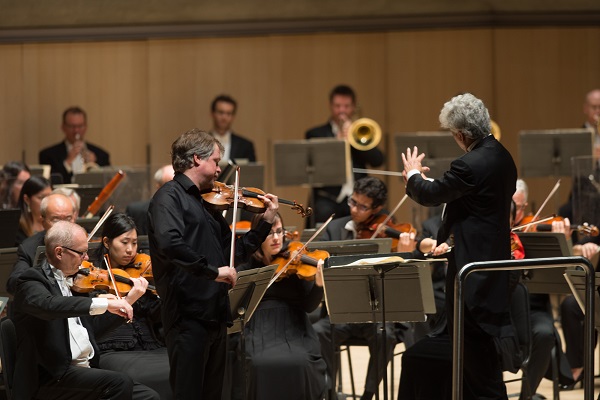
Conductor Joseph Swensen drew a sweet sound from the TSM Festival Strings, displaying an ear for melody & sensitivity to the many solo moments in the evening, while pulling them together into a cohesive ensemble.

neil-deland

Neil Deland

Neil Deland, the Toronto Symphony’s principal horn player and tenor Nicholas Phan gave a splendid account of the Britten Serenade. Accustomed as I am to light voices singing this piece such as Peter Pears or Robert Tear, I didn’t think I could be surprised by a voice going in an even gentler direction: but I was wrong. Phan made sounds that were always supported and strong even though at times he took the piece further in the direction of the upper register and even sounds that resemble falsetto. And yet he also gave us explosive power in other places, making for a sensitive and poignant account of the poetry in this work. I believe Phan showed new possibilities in the piece with his imaginative approach.

Deland played with admirable restraint, impossibly soft in the haunting Elegy, playfully agile in the Hymn that’s as quick as a scherzo, yet always showing off a marvellously well-shaped and controlled sound.  As the first and last sound we hear in this piece (the prologue and the offstage epilogue), Deland’s magical playing was for me the highlight of the evening.

After intermission Swensen and the orchestra seemed determined to show us that they could be just as virtuosic without soloists in the Tippett. The Adagio was especially beautiful, although all three movements showed genuine inspiration.

For more information about the Toronto Summer Music Festival, which continues until August 7th go to their website (click here).

Posted in Music and musicology, Reviews | Leave a comment

A new Jussi Björling recording, 57 years later

The headline isn’t a mistake nor a figure of speech.

Swedish tenor Jussi Björling is one of my favourite singers.  As a child, it was his recordings of the great arias and duets that I usually encountered first, often spoiling me for any other singer.  In addition to his unparalleled operatic output he created a wonderful body of song performances, often songs from Scandanavia that I’ve never heard sung by anyone else.

The immortal voice came from a mortal.  I came to discover his pluses and minuses –as with any artist—as I grew up.  While the tone was stunningly beautiful, I heard critiques suggesting that he was better on record than in person given his limitations as an actor.  Sometimes his pronunciation showed an accent (for example the Italian word “ciel” often sounded like “shell” rather than “chell”), even though this was a singer who performed in many languages  (the CD includes the usual German, French and Italian, but also Swedish and Norwegian).  Note that he sang in a transitional period, when many regional houses still sang everything in the local language (for example, he had learned Tamino in Swedish and never learned it in German because it wasn’t a role he sang internationally), whereas by the time of his retirement most operas were being done in the original language.  He had a habit of sometimes singing higher notes a fraction of a tone sharp, an effect that I found exciting even if it’s not strictly accurate, and bothers some listeners.

And he died in 1960.

How then can I properly appreciate the magical gift of a newly discovered performance, released for the first time in 2016?  October 15th 1959 was the date of Björling’s recital in Falkoner Centret Concert Hall, Copenhagen, one of the first events in a brand-new facility.  The precious tape of this concert was recently discovered, restored, and now has been released fifty-seven years later for the first time in cooperation with Jussi Björling societies in Sweden, UK and America.  While the recording includes a twenty-four page booklet, the song texts aren’t included but can be found instead on the website of the Swedish Jussi Björling Society with translations (although a couple are missing, possibly because there were late changes in the CD).    The recording concludes with a bonus Voice of Firestone broadcast from 1952, an additional seventeen minutes or so, pushing the total to over sixty-seven minutes in total (the Copenhagen recital comprising almost fifty minutes).

Part of the booklet is the engineer’s explanation as to why these never came to light before: that both the broadcast recording (from 16” lacquer coated discs, exhibiting crackle and disc noise) and the Copenhagen recital recording (on reel-to-reel tape, including dropouts, low-end bumping (bias) noises plus audience coughs) were unserviceable without digital enhancements (NB the re-furbished Voice of Firestone broadcast has previously been made available on an Immortal Performances release of a 1941 Il Trovatore from the Met, and I think I’ve heard it before with its original rough sound).

JB_konvolut

Here’s the list of tracks on the CD:

The Copenhagen Oct 15th recital, Jussi Björling with Bertil Bokstedt piano:

1: Mozart: Die Zauberflöte: Dies bildnis ist bezaubernd schön, (sung in Swedish Ja, detta är en ängels bild)

2: Brahms: Die Mainacht

3: Liszt: Es muss ein Wunderbares sein

  1. Wolf: Verborgenheit

5: Schubert: Die Forelle

6: Schubert: Die schöne Müllerin: Die böse Farbe

7: Bizet: Carmen: La fleur que tu m’avais jetée (Flower Song)

8: Björling announces a Peterson-Berger song instead of the originally programmed Alfvén song.

9: Petersen-Berger: Jungfrun under lind

10: Alfvén: Skogen sover

11: Sibelius: Demanten på marssnön

12: Sibelius: Säv, säv, susa  

13: Grieg: En svane

14: Grieg: Ein Traum (sung in Norwegian as En drøm)

15: Giordano: Andrea Chenier: Come un bel dì di maggio

16: Tosti: Ideale

17: Richard Strauss: Zueignung

The Voice of Firestone from March 10, 1952 with the Voice of Firestone Orchestra & Chorus, Howard Barlow, Conductor

18: Opening announcements & Firestone: If I Could Tell You

19: Announcements

20: Speaks: Sylvia (with Chorus)

21: Announcements

22: Puccini: Turandot: Nessun dorma

23: Announcements

24: Tosti: L’alba separa dalla luce l’ombra

25: Announcements

26: Herbert: The Princess Pat: Neapolitan Love Song (with Chorus)

27: Announcements

28: Firestone: In My Garden and concluding announcements

I think this is an important CD for a number of reasons, that will reveal itself to me in the years to come as I listen incessantly.  Our habits have changed possibly due to shifts in fashion or scholarship, taking us in different directions, so it’s marvelous to hear a singer going back and forth between opera arias and lieder, sometimes bringing the same interpretive approach to bear on both.  His Flower Song is more like lieder than opera, in its remarkable changes of pace and tone, a phenomenally psychological reading unlike anything you’d hear in an opera house.   And although he was only a few weeks removed from the hospital –having had heart problems during the recording of Madama Butterfly earlier the same year—we aren’t easily able to discern any evidence, no signs of compromise.

Several of these are the most perfect realization of a particular piece that I have ever heard (although in the case of the Scandinavian songs, the only other versions are by Björling).

  • “Säv, säv susa” and “Skogen sover” sound more delicate and vulnerable than ever, the soft head-voice fluid yet supported, astonishing to reconcile with some of the powerfully macho sounds in the same fifteen minutes of singing
  • While this “Zueignung” seems to be a bit of a tug of war with pianist Bokstedt (possibly because the singer didn’t have the same wind & stamina we encounter in other recordings, especially that wonderful concert recording from 1960, where the last note goes on so powerfully) I was struck by the lucid intelligence of this trouper, coping boldly with his limitations.
  • This is the first time I’ve ever heard “Die Forelle” sung by someone known to be an avid fisherman, a playful interpretation unlike any I’ve heard.

This recording isn’t just for Jussi fans, but anyone who enjoys good singing and beautiful music.  You can find the CD by going to the Swedish Björling society website ,  then clicking on “Shop” in the menu at the left of the page.  As far as I know you won’t find this in record stores, making this a one-of-a-kind gift for your opera-loving friends / family members. They’ll love you for it.

jussi_logo_940_en

Posted in Music and musicology, Opera, Reviews | Leave a comment

Aida by Request

I am doing something I’m not supposed to do.  I went to a concert more or less having made up my mind what I was going to say before the first note sounded.  It’s not because I’m prejudiced and lacking objectivity.

shookhoff-william

William Shookhoff

Instead of talking about the performance I really wanted to talk about context, about the circumstances underlying tonight’s Aida, presented by Opera by Request.  As you may recall, I’ve reviewed them before, a rather unorthodox opera company run by Artistic Director William Shookhoff.

“By request” means just what you think.  Instead of a company whose programming and casting are driven by market forces, Shookhoff reverses the usual expectation.  Singers come to him wanting to undertake particular roles, although sometimes Shookhoff does pursue a singer.  But this company sometimes performs a valuable function, wonderfully illustrated by tonight’s concert.  Yes it was a concert, so not only were there no elephants, there was no chorus, nor orchestra nor set, nor any costumes either.  It was given for a relatively small audience of devoted listeners, likely drawn by the prospect of hearing the singers in new repertoire.

Here’s the thing.  The template one sees in opera companies –whether we speak of the Merola program in San Francisco, the Ensemble Studio here in Toronto with the Canadian Opera Company, or a host of other frameworks for young talent—is one with strengths and weaknesses.  This is a great way to give young singers a kind of paid apprenticeship, leading to a career.  It seems to be a great way to spot future Zerlinas or Figaros or Taminos, but when it comes to the bigger voices you need for a Verdi opera such as Aida..?

We’re told there’s a worldwide shortage of singers who can handle the roles in operas like Aida.  But maybe it’s the template that’s at fault, the philosophy of companies that select the wrong sort of talent, aiming to fill small parts.  To sing Aida or Radames or Amonasro or Amneris, you need to somehow hang around in the business until the voice comes around, until it’s ready to take on this heavier repertoire.  Some do people manage to hang around.  We’ve seen Christine Goerke, who had sung lighter roles for years, come to Toronto to undertake her first Brunnhildes.  Thank goodness she was able to wait for the changes in her voice.   We heard Sondra Radvanovsky sing a fabulous Aida a few years ago, opposite a weak Rhadames and a barking Amonasro.  Adrianne Pieczonka took on Amelia in Ballo in Maschera,  again a case of patiently waiting for the right time to take on a killer role.

What do you do if you’ve got a bigger voice, but don’t fit the ensemble template?  I don’t know!  It’s a scary question.  Some singers manage to stay in the business, while others continue singing intermittently, as their voices develop.  If you’re not singing regularly the development doesn’t happen the same way.  And so this is where Shookhoff and Opera by Request can play a useful role, at least for the singer, if not for the community at large.

I watched a production of Aida presented by a group of singers who are not singing with a big company such as the COC, perhaps not singing as often as they would wish.

  • Soprano Carrie Gray

    Soprano Carrie Gray

    Carrie Gray sang Aida, and was not at all daunted by this difficult role. Both of the big arias were musical highlights of the evening.  If she were singing more often she’d be better, but wow this was impressive, her legato smooth, her control solid.  I wish I could hear this voice more often.

  • Paul Williamson sang Rhadames, a voice that has grown in heft and colour since I last heard him. While he still has a very Italianate line, a splendid sound up top, he’s making a big big sound that matches Gray’s powerful voice.  This is a voice that would have improved the COC production had he been cast instead.
  • Michael Robert-Broder was for me the highlight of the show, speaking as someone who thinks Amonasro is the most interesting character in the opera. This is one of the prettiest readings of the role I’ve ever heard, a part that is sometimes barked (and again, this mellifluous singing would represent an improvement for the COC), which means that he gave us subtlety and even something verging on bel canto musicianship to which I am unaccustomed in this opera.
  • Ramona Carmelly was every inch the diva princess as Amneris, in a thoughtful performance that held nothing back, especially in her big scene in Act IV. This is a voice that could develop in several directions, as she has the top and low notes, and sang a huge role in a bluesy style a few months ago in the premiere of David Warrack’s Abraham.
  • Andrea Naccarato as the High Priestess made a huge impression in this small role.  I’ve heard Andrea sing “Un bel di”, so this was luxury casting, having such a powerful voice invoking the ancient god.

I have to wonder.  Would Jon Vickers or Maria Callas have managed to make it, to have a career had they come along in the opera world of the 21st century?  One would hope so.   But in the meantime, as the younger versions of Vickers and Callas sing as often as they can, seeking to make an impression, hoping for a career breakthrough, at the very least one can enjoy the voices in performances like this one.

For more information about Opera by Request click here.

Posted in Opera | Leave a comment

Lydia Perović’s All That Sang

Perhaps art is really a proposition. I’m not sure there’s much difference between the approaches we make to one another in our discourse or our intercourse, particularly when so many of the words we use for one, apply to the other.

I recall an amazing conversation I had long ago with a director who had begun to speak retrospectively as if taking a long valedictory victory lap, enjoying the sunshine before the expected onslaught of a major illness. He explained that he got into the theatre because there was someone he wanted to fuck, and yes that’s exactly how he said it, and he was sure that lots of people were in the arts for the same reason. At the time I giggled a little bit, to conceal my surprise but as the years have gone by I’ve started to notice that his statement has more than a little truth to it.

all_that_sangThat conversation came back with a vengeance while reading All That Sang, Lydia Perović’s recent novella. There’s a chicken-and-egg quality in some relationships, as we may wonder: did that couple become intimate first and collaborate later, or were they working together and only later ended up in the sack? The happy oblivion of desire means that people don’t necessarily do what logic or planning would dictate.

That I am speaking this way of All That Sang should tell you that I am fully engaged in its world and its loves, having bought into its narrative, fascinated by the way the book unfolds.

I am reminded of a conversation I had back in university, one that I recall regretting for how it showed my naivete. I’d read a short story about a cellist, and told the writer “I didn’t know you played the cello”.

“But i don’t” he told me matter of factly, while I picked my jaw up off the floor, and realized, oh yes, that’s why it’s called “fiction”, that’s what’s known as “writing”. I think the first mistake I’d made was in under-estimating that writer, someone I’d mistaken for a rock-n-roller without depth. Or maybe the problem was that at this point in my life, I casually underestimated lots of people (rockers and cellists alike), and needed to look deeper, and seek to understand.

I am taken back to this story because in reading All That Sang I recalled the expert descriptions of how to play the cello, and wondered whether I should assume it was all from a kind of expertise.   Of all the different sorts of prose in All That Sang¸ I don’t doubt Perović’s authority and expertise in the explorations of lesbian eroticism, both because she has more or less told me –excuse the euphemism here—that she plays the cello, and also because Incidental Music (another of her books) also demonstrated a comparable virtuosity.

As with Incidental Music, All That Sang takes us into a world that seems to be within Perović’s comfort zone. This time we’re not in the realm of opera but instead the symphony, but every move in the milieu into which we’re taken is made with confidence. This is a work of great self-assurance.

Every note is played with conviction, every word significant. But it’s a lightly Apollonian exercise, less Mahler than Satie, and one that leaves you in your right mind rather than stirred or intoxicated. All That Sang calls for admiration, leaving us with a strong sense of skill and the clarity of Perović’s purpose.

I keep coming back to that notion that there is an intersection in our second Chakra, that creativity and procreativity are related if not actually the same thing. All That Sang takes us to the ambiguous and conflicted heart of passion and amorous vulnerability, not flinching from the unpleasantness we sometimes encounter.  I’m reading it a second time, discovering additional depths and nuances.

banner-2014

For further information & to purchase, click here to go to Véhicule Press’s website.

Posted in Books & Literature | 1 Comment

Gourmet Schnitzel House: look eastward, Toronto

I don’t want to provoke an argument, particularly not one of those regional disputes where someone tries to suggest one place is better than another. Toronto is a city full of neighbourhoods, ethnicities, communities, and nothing stands still because it’s a dynamic city. Not only is the skyline encumbered with construction cranes, testimony to the ongoing growth transforming the place, but every street has the capacity to confuse with new places. It’s impossible to keep up with them.

web_logTonight I’m writing about Gourmet Schnitzel House, the restaurant that’s earned a place in my heart and gulp maybe a place on my waistline as well. Tonight I overate, and while I started out thinking I’d pursue a path of moderation, I let my appetite get the better of me, sigh, again.

Maybe it’s because ancestral voices call to me, singing songs of my ancient home, Magyarország, aka Hungary. I don’t literally mean music, so much as the scents and sights on your plate that go with this breath-takingly simple menu. Everything they offer is executed brilliantly.

I can say that because I’ve tried them all.

Tonight I had their Cordon Bleu Schnitzel, other nights I’m having Goulash Soup, or Cabbage Rolls, or Chicken Paprikas. The schnitzel that’s made here is unlike any I’ve encountered in a Toronto Hungarian restaurant (and I’ve tried a great many). I’ve long been conflicted about Hungarian cuisine (someday we can discuss the mixed joys of Töpörtyű, something I never liked as a child). Most of the schnitzels I encountered around Toronto in Hungarian restaurants were a troubling experience, a celebration of the same fatty excess.

Imagine my joy to discover a new approach in the Gourmet Schnitzel House. These schnitzels are less fatty than any I’ve ever encountered because their process suspends them vertically, while they drip, losing most of their fat. They’re then served dry and crispy.

Ideal!

I was stunned at how beautifully the smoked ham and emmental mixed in my Schnitzel tonight, much subtler than other such Schnitzels I’ve encountered. I recall a dinner long ago at the Austrian House on Beverley (where I think the same one was called the “Franz Josef Schnitzel”), or Tarogato, or so many others, where I struggled to finish those greasy behemoths.

Madness! I didn’t slow down for a moment.  I had dessert too. I passed up the ice cream that could have decorated my warm Apple Strudel, and insanely finished off my wife’s Palacsinta too. The coffee accompanying dessert is the best coffee I’ve had in weeks, muscular without any bitterness.

Such are the blessings of this little corner of Toronto, the Cliffside – Bluffs part of Scarborough. Gourmet Schnitzel House can be found on Kingston Rd a couple of blocks west of Midland, licensed. Here’s their website where you can view the menu, hours and contact information.

Posted in Food, Health and Nutrition | Leave a comment

Divergent objectives from TSO

For awhile now the Toronto Symphony has been offering a series of concerts organized around ten-year periods of history, in other words, their Decades Project. Some have been more illuminating than others, but for me tonight’s pairing was especially powerful, seeming to illustrate a kind of musical fork in the road.

As Peter Oundjian described it, you could see one part of the concert pointing to the past, and the other to the future. One work portrayed the tenderest emotions. The other? human sacrifice. One enacted a secret program rather than anything explicit, while the other was as subtle as being hit by a stick. One gave us a concerto, a celebration of foregrounded virtuosity, while the other subsumed all skill into the total effect. Or in other words, we began with Elgar’s Violin Concerto played by James Ehnes, and concluded with Stravinsky’s Le Sacre du Printemps, both works conducted by Oundjian.

James Ehnes, Peter Oundjian 3 (Emma Badame photo)

James Ehnes violin, Peter Oundjian, leading the Toronto Symphony (photo: Emma Badame)

The contrast between the two works made this the best Decades program yet in my opinion.

When I turned on my laptop after getting home, I googled “effect of heat on acoustics”, seeing a few links confirming my suspicions: that both heat and humidity can make things totally wonky especially in the realm of classical music.

I did so because

  • this was the warmest TSO concert I’ve ever attended, a day with ambient temperatures around 30, and a humidex even higher.
  • There were some very strange effects in the hall

In the first movement of the concerto at times the TSO was drowning out the soloist even though he had lots of sound, plenty of oomph to his playing, particularly on his higher strings. I couldn’t help wondering whether Oundjian –standing a few feet away from Ehnes—could possibly have heard what we heard, sitting in the mezzanine. At times it was more a concerto for violin vs orchestra. I smiled when we got to the third movement passages where the orchestra gets out of the way, quiets down for some exquisite cadenzas, masterfully played. I’ve always heard Oundjian lead with great sensitivity, himself a violinist who surely cares about the result. I have to think he’s undone by Roy Thomson Hall, a space that tonight had the oddest effects. At times the strings –who are assembled downstage, closest to us—seemed to be a big pool of woofy sound enveloping everyone else, making all other details (eg woodwind solos) emerge as though coming through a fog.

Ditto with Le Sacre, and sacre bleu I might have said (an epithet I recall from childhood in comical send-ups, showing a French person cursing: and please excuse me that I have no idea what it actually means when you say this!). The same effect at times concealed finer details that should have been able to emerge. Oundjian seemed to lead a very committed performance, although at times the strings were all that was coming through, as even the massive brass was seeming remote, distant, as their fat sounds were clearly coming from way upstage, rather than emerging properly. The bass & kettle drums seemed to be the only ones who could cut through but that’s likely because they’re playing in an entirely different register, so low that they’re not clogged up by anyone else’s sonic residues.

Even so the audience ate it up, making me wonder if they were hearing something substantially different. Ehnes played superbly, the orchestra especially sympathetic in the last two movements.

Posted in Music and musicology, Reviews | Leave a comment