A Celebration of Jeanne Lamon

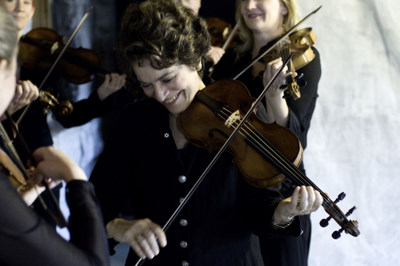
At the end they handed her a bouquet, and she immediately separated it into discreet flowers, walking among her colleagues handing one to each.  It was a moment that was so typical.

Jeanne Lamon with her colleagues

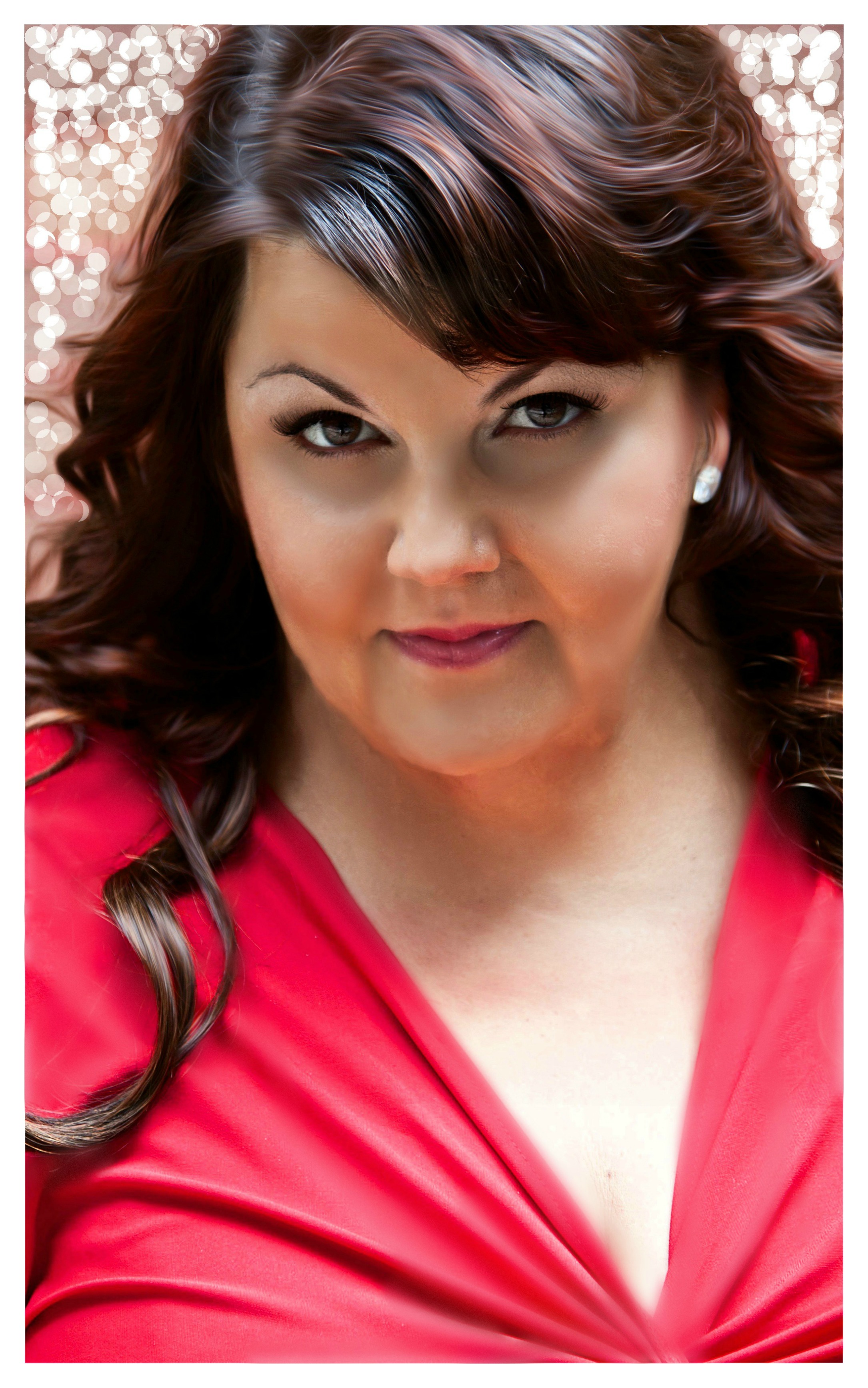
Tafelmusik Music Director Jeanne Lamon (Photographer: Sian Richards)

Jeanne Lamon has been in the process of stepping down from an over 30 year tenure as music director and principal violinist with Tafelmusik Baroque Orchestra.  As she told us tonight, in the first of a series of celebratory concerts in her honour, she’s not precisely going away.   There are future projects on her horizon, such as an academy of period performance, and a couple of years of transition for Tafelmusik, when she’ll serve as an artistic advisor.

One can’t measure the contribution of such an individual, but suppose we look at what she leaves behind.  Tafelmusik have not had a deficit in many years (I forget the figure quoted tonight, but it’s a number any arts organization could envy). They’re doing many things right, and I look first at the leadership model.  It’s not based on testosterone or male ego, because of course Lamon shares the podium, a distinctly different leadership model than what‘s traditional for symphony orchestras.

This is a culture of humility.  I saw a sample walking in, when I bumped into Alison MacKay, who has contributed more than just her abilities as Double Bass player, but also as a gifted programmer.  She walks up to me and compliments me, but that is the Tafelmusik style, one of generosity, humility, and dare I say it: love.  Lamon joked somewhere recently that her role as leader is one where she can avoid the limelight, because she’s shy.  And so she shares and in the process, the orchestra gains.

In addition to MacKay’s contribution from within, there are others.  There’s Ivars Taurins, who used to play in the orchestra, and who leads the Tafelmusik Baroque choir, the man who portrays Handel for us in the annual singalong Messiah.  There’s David Fallis, of Toronto Consort and the Musical Director of Opera Atelier, challenging the orchestra with everything from Lully to Weber, from Monteverdi to Mozart.  And then there’s Bruno Weil, who has led the orchestra through their Beethoven cycle.

Tonight’s concert will be repeated.  Normally i’d wonder if the magic can be replicated from something that felt so much like a “happening” (a concept that probably dates me) but the source of this chemistry is the relationship between the orchestra and their devoted audience, who will come out each night.  The first part of the concert gave us a little music heavily laced with thank yous, moments that Lamon took to express her thanks to the various parts of the organization.  Just as she’d given a rose to each player, she seemed to thank everyone in the organization.

The program came in three big chunks:
1) “Audience choice” (meaning a few pieces chosen by responses on a website somewhere, perhaps via social media? )
2) “Inspired by Purcell”, three sets of variations on themes by the English composer
3) “Jeanne’s choice”: music chosen by Lamon herself

In a concert with so much emotion, I would still like to call attention to a few spectacular highlights.  The item #2 hints at something unique in my experience.  To honour Lamon, sets of variations were composed that received their premiere tonight.    I know of one precedent in musical history, when a group of composers (including Schubert & Beethoven) were approached to compose a variation on a theme by Anton Diabelli, Beethoven deciding to write a full set of 33 in response.  I wouldn’t be surprised if this has been done other times as well, but I don‘t know for sure.

This time? nineteen different individuals from the extended Tafelmusik community participated, including the partner conductors (Fallis, Weil and Taurins), as well as many of the orchestra’s players: including Lamon herself in a final variation.  It seemed very much like a kind of communion, whereby they not only played together but created the piece as well, christened in performance tonight.

The variations were mostly well within the baroque sensibility of the three Purcell tunes.  Some were overtly comical, quoting recognizable melodies both as part of the playful exercise and as part of the celebration.  Some were more serious.  At times most of the ensemble stood watching a few players, while at other times everyone was engaged.  I sincerely hope the compositions are recorded, not just to commemorate this moment in honour of Jeanne Lamon, but because I believe the music is worthwhile.

The third section was a highly personal set of performances that Lamon chose and arranged, a disparate series of pieces played without interruption or applause.   The sinfonia that begins Monteverdi’s Orfeo –and as I had believed at one time, seemed to begin the form of opera once and for all– began the second half, a procession that grew in its repetition.  We heard an arrangement of the duet “pur ti miro” set for oboes instead of human  voices.  While these may have been Lamon’s favourites, it looked and sounded as though she’d chosen pieces loved by the ensemble.   We heard Vivaldi, Handel, Rameau, JS Bach, including a breakneck reading of the closing Allegro from Brandenburg Concerto no 3.

As Lamon told us in her introductory words, it’s not something you can capture in video, but something you get from live performance.  The electricity between the players and the audience, and in the delightful glances between the players must be seen to be understood.  I’d go again and again if I could.

A Celebration of Jeanne Lamon continues: May 9-11 & 14 at Trinity st Paul’s Centre, Jeanne Lamon Hall and May 13 at George Weston Recital Hall. 

Posted in Music and musicology, Reviews | 1 Comment

COC casting change announcement

“Press releases and announcements” are presented verbatim without comment

CASTING CHANGE FOR CANADIAN OPERA COMPANY’S ROBERTO DEVEREUX

 Toronto – The Canadian Opera Company regrets to announce that Italian tenor Giuseppe Filianoti will not be returning to the company’s production of Roberto Devereux, currently in performance at the Four Seasons Centre for the Performing Arts. As previously announced, Filianoti withdrew from the title role for the first three of seven scheduled performances, and circumstances continue to prevent his return to the stage. American tenor Leonardo Capalbo stepped into the role on April 25, 29 and May 3, 2014 and was met with overwhelming popular and critical acclaim for his portrayal of Roberto Devereux.


For the production’s next performance on May 10, 2014, Mexican tenor Edgar Ernesto Ramírez appears as Roberto Devereux. An emerging voice on the international opera stage garnering rave reviews for his distinctive Italianate sound, youthful exuberance, and expressive musicality, Ramírez appeared with the opera company last season as Ruiz in Il Trovatore and has been understudying the role of Roberto Devereux for the COC this spring. He has performed to great acclaim for audiences in France, Germany, Switzerland, Canada, and the United States, and makes Toronto his home.

For the final three performances of Roberto Devereux on May 15, 18 and 21, 2014, the COC welcomes Spanish opera star José Bros in his company debut. One of the leading tenors of the romantic bel canto repertoire, Bros has appeared in starring roles with major opera houses around the world including Teatro alla Scala; Royal Opera House, Covent Garden; Wiener Staatsoper; Teatro Real; Gran Teatro del Liceu; and the houses of Hamburg, Munich, Rome, Tokyo, Los Angeles, San Francisco, Washington, Berlin, and Naples, among others.

The COC’s Roberto Devereux, starring superstar soprano Sondra Radvanovsky as Queen Elizabeth I, opened on April 25 to rave reviews that proclaimed it “a night to remember” (Charlebois Post), “puts the ‘grand’ back into ‘grand opera’” (Toronto Star), is “a moving production that examines, with heart-rending power, the price of power and love, and the danger of combining the two” (Bachtrack), and that “the audience gets caught up in the beauty of the music, the taut of power of the often thrilling solo performances, and the electric voltage of vocal athleticism and emotional depth meshing in perfect combination” (Globe and Mail).

A limited number of tickets are available for the remaining performances of Roberto Devereux. Tickets are $12 – $332 (includes applicable taxes) and may be purchased online at coc.ca, by calling 416-363-8231 or in person at the Four Seasons Centre Box Office (145 Queen St. W.).

Posted in Press Releases and Announcements | Leave a comment

The Tempest Replica: Icing and Cake

click image for more information

Tonight Toronto got another look at Kidd Pivot, Crystal Pite’s company from out west.  While this may be new to us, it’s not really new.  Just as Dark Matters –brought to Toronto by Canadian Stage back in 2012— was already 3 years old, similarly The Tempest Replica originated in 2011 (roughly three years ago), a co-production with several companies in Europe & North America.

The title is a splendid way (the use of “replica” in particular) of addressing one of the work’s fundamental issues: that it is a very original and self-conscious adaptation of Shakespeare‘s last play, The Tempest.  Forgive me if I blather on a bit about the mechanics of adaptation, an obsession of mine.

Pite and her team followed much the same pattern as seen in Dark Matters.  On that occasion I observed that the first half of the show was in some respects the most dynamic & theatrical, whereas the last half was pure dance.  Tonight I’ve seen another show more or less following that pattern, leading me to wonder if my sense of what‘s best in the show diverges from hers.

The first half-hour was a miracle of compressed exposition, using almost no words whatsoever, a bold series of choices, considering the poetry of the source play.  But if Pite’s objective is to set up dances exploring the relationships among the characters it’s an understandable choice.  I didn’t find that much was added beyond the first twenty minutes of the work, which, as I suggested, runs through the story with quiet eloquence.  Those dances are stunning explorations of dynamics, and yes, they’re also wonderful dance for the sake of dance.

I’m going to invoke Richard Wagner as I so often do, a touchstone of dramaturgy, and someone who could distinguish between icing and cake.  Speaking of opera in his seminal Opera and Drama, Wagner observed that composers had mixed up means and ends; whereas opera had been invented as a dramatic form utilizing music, it turned into a medium employing drama to make music.   I wonder if I can adapt that axiom to the dance realm?

What struck me about The Tempest Replica was that some people (me!) might like different parts of the show than other folks (the choreographer especially).  The brilliant opening section — to my mind the best part– served to set up the dance explorations that follow, that likely were the parts choreographer thought were best.  Was that flamboyant exposition nothing more than an intro to the dance part that comes later? or was the dance really there to decorate the core of the story, told at the beginning?  Or to put it in the language of my headline, I wonder how you decide which part is icing and which part is cake?  Don’t get me wrong, I love the dance; but in some respects it reminded me of  the celebratory –and redundant– dances in the second act of Nutcracker.  The drama had already been more or less settled, particularly in a tale such as The Tempest, where the protagonist is an invincible magician, in effect the one who creates the production. If, however, you recognize dance as an end in itself, if you love watching beautiful movement, then everything before is merely a preamble to how Pite explores the relationships.

I saw a movement vocabulary reminiscent of Dark Matters, where the protocols of power & control begin with puppets and then are further explored among dancers.  On that occasion the dance seemed like a necessary expansion of something introductory.  With Tempest, too, we see a great deal of analytical dance, where human interactions are probed as power relationships.  Prospero dominates, but so too, Ariel.  And at times we see one or another figure like a thing, a puppet controlled by an animator figure.

By the end I was mightily impressed by the intelligence of the adaptation, seeing cleverness everywhere.  Yet it left me somewhat cold at the end, a tour de force to be sure, but one whose sense of warmth eluded me. I felt as though i’d been outsmarted. 

The Tempest Replica continues at Canadian Stage until May 11th at the Bluma Appel Theatre.

Posted in Dance, theatre & musicals, Reviews | Tagged , , , | 3 Comments

Ernesto Ramirez to sing Roberto Devereux

The Canadian Opera Company scheduled seven performances of Roberto Devereux.  The COCassigned the first three performances to Leonardo Capalbo in the title role, and he did a marvelous job from what i saw & heard.

Giuseppe Filianoti was scheduled to sing the next four, beginning Saturday May 10th.  I say “was” because something has changed.

It’s come to my attention that Ernesto Ramirez (the cover) will sing the May 10th performance.

I’ll be there.

Posted in Opera, Press Releases and Announcements | Tagged , | 4 Comments

Synesthesia III

Synesthesia III was a collaboration initiated by FAWN Opera, who reached out to The Seventh Art.  We saw a series of films with –mostly– live original music.  FAWN found the composers & organized the –mostly–live performance, while The Seventh Art procured film-makers.

FAWN Artistic Director Amanda Smith

The word “synesthesia” can mean many things, but for me is a reminder of the avant-garde of the 1890s in Paris, seeking the symbolist dream of a synthesis of the arts across the senses.  I suspect that FAWN’s artistic director Amanda Smith & the rest of the FAWN team are every bit as ambitious in our own century.

For me this was like a genuine laboratory, a study of the art of film music from first principles.  Just to really make us appreciate what music brings to the equation, we were first given a film without music, Dalsza Modlitwa by Sofia Bohdanowicz.  We heard sneezes and chairs moving and our own presence breaking the illusion.  Music covers up all those noisy people who distract me from my one-on-one relationship with the film, preventing me from falling deeply under its spell.  In fairness Bohdanowicz’s film was genuinely magical, a ghostly trace in honour of a lost grandmother.

Then we began a series of films each of which presented a different set of requirements for a composer.  FAWN artistic director Amanda Smith said as she brought us back after intermission that the collaborations had aimed to bring together good film-makers with good young composers: an aim that I believe was achieved.

Sometimes the music and the film seemed to be fighting.  Two of the early examples displayed very strong musical personalities that seemed to impose new meanings upon the film, in a manner we’ve seen in Regietheater or “director’s theatre”, a common phenomenon in opera.  This is not to suggest there’s anything wrong with that, but rather that we’re accustomed to music in a very compliant & subservient role, a post-production add-on that slavishly upholds whatever the director wants (at least in the commercial realm), rather than adding an additional interpretative layer.   And it turned out I was wrong about one of those films, given what we heard in the brief interviews conducted of film maker Stephen Broomer & composer Trevor Hewer, by Christopher Heron of The Seventh Art.  Where I’d seen Broomer’s film as abstract, Hewer saw something melancholy & even sentimental, and put that into his score; but it turned out this is precisely what Broomer was aiming for,  so they were clearly on the same page.

More often, the music worked in the conventional ways of film-music, which is to say, that it drew upon the images, creating a layer that was supportive & seemed to be a logical outgrowth of what we were seeing.

Conductor & composer Patrick Murray

I was most impressed by a score that wasn’t actually played live.  Patrick Murray, who conducted the FAWN ensemble of five players + a singer, created and recorded an electronic (digital or electro-acoustic? I don’t know) composition to go with BOOTLEG, a film from Liam Crockard.  BOOTLEG is simultaneously the most conservative film in terms of its dramaturgy (I suppose I mean the relationship between film images & music) , yet most daring both in terms of the nature of what we saw and what we heard.  Here’s a quote from the program explaining the premise:

“In an homage to the dodgy concert videos of yesteryear, Crockard distorts his video to a point of pure abstraction, more akin to the textural film experiments of someone like Stan Brakhage.  Interestingly, this effect is achieved through the excessive use and abuse of iMovie’s built in “stablize and zoom” function, designed specifically to transform the most amateur iPhone video into something legible. “

And then Patrick Murray says this:

“When creating the music for Bootleg, I wanted to honour the same artistic process of degradation that Liam Crockard began his film with.  Audto samples from the original “bootleg” videos are severely distorted and overlaid with new sounds created using spectal synthesis of still frames drawn from the processed film.  Disorienting and overwhelming, the music nevertheless enhances the range of emotional intensity inherent in non-representational, abstract film.”

If Wagner himself had been scoring this film he couldn’t have honored it more perfectly in his score.  At times it was loud & raucous, yet this was music, not noise, and matched the abstracted visuals remarkably well.

Sometimes, as in Christine Lucy Latimer’s The Magik Iffektor we were in the presence of profound ironies, bringing me giggles even though they were very poignant.  The Iffektor –if i understand the title, speaking of profound ironies–is in fact a device for processing found VHS footage, enhancing some colours, with the result that we were seeing something both old and new, something grotesquely altered even while being familiar.  It’s a reminder that in some cases the line between adaptation and parody is narrow indeed.  Patrick Arteaga’s score stayed out of Latimer’s way, letting me have the aforementioned giggles.  As Arteaga remarked, it was an open work, which is to say, not overly determined but ambiguous, an effect that the composer preserved & even enhanced.

In Blake Williams’ The Storm the understatement of the film nicely matched an under-stated score by Amanda Lowry.  Williams explained that he’d had the opportunity to shoot in Galveston just after Hurricane Rita, but in landscapes temporarily deserted due to evacuations.  I was strongly reminded of Reggio’s Koyaanisqatsi.

Looking upon the exercise, I couldn’t help comparing this in with Tapestry’s recent “Tapestry Briefs”, a series of brief operas bringing librettist & composer together.  Is it my imagination, or was this more fun & even festive experience precisely because it wasn’t opera?  In this atmosphere everyone was safe to experiment, accepted & appreciated for their adventurousness, something I don’t always experience in the operatic realm.  I think the problem is not so much the medium as the opera audience. And yes, I think opera is much harder.  Why?  Perhaps because these were mostly abstract and oblique connections between the film & the music, where anything goes really.  The live singing actor changes everything.

I hope FAWN will try something like this again.  Of course when I said this very thing to Amanda Smith ( “please do it again!”) she said they had done it before.  This was Synesthesia III after all (and i missed I & II).  I am glad to know that there will be a IV..!

Posted in Cinema, video & DVDs, Opera, Reviews | Tagged , , , | Leave a comment

Media circus 1: Star lover

While newspapers seem to be going under left & right, Toronto continues to be a multi-paper town.   Loyalties to a particular paper are funny things, or at least they look that way now.  However you slice it –changing media landscape, evolving information technologies– we’re seeing the slow death of anything requiring hard copy in favour of the virtual, and of course I’m having the tiniest most infinitesimal impact on this on my blog.

When I was a wee lad I remember how a paper could be a matter for loyalties. Gordon P and his family loved the Telegram, a paper I recall even then as being somewhat stuffy & conservative.  I lived in a household getting the Globe & Mail and the Toronto Star, which felt a bit like being loyal to another sports team.  We had lots of kids and so one paper wasn’t enough.  The Globe came in the morning, the Star in the afternoon.

Their basic character, if one can generalize something from a large group of writers, is largely the same, decades later.  The Star was more of the liberal paper, and that really meant upper case L Liberal as well: in their support for Pearson & Trudeau.  The Globe, like the Telegram, was conservative but better written than the Telegram (as i recall) . The Globe had a good arts section at least, so there was always something to read.

I recall as I grew up that some writers were so negative in their criticism as to be positively scary.   I met Herbert Whitaker in my 20s, a charming man, who seemed more tempered in his writing even if the body of his work was really before my time.  Both he and Nathan Cohen (who had a scary rep),  were before my time.  Later, came Gina Mallett, whose direct critiques scared me, possibly because they felt so arbitrary. But these writers were very powerful in determining the fate of shows.

As I grew up I do recall reading two people religiously.  John Kraglund and William Littler were the two critics for music & opera in my formative years.  While the names might suggest who was the tougher one –after all, surely someone who is a B Littler must know from an early age what his calling must be, no?– Kraglund was the one who I recall as being arbitrary and difficult.  I remember him disliking voices with too much vibrato, indeed I think he wrote as though he hated vibrato altogether.  Can a critic be influential?  I have to wonder, given that Toronto seems so geared towards historically informed performance using gentle vibrato-less voices.  Did Kraglund get his wish?    Speaking of getting his wish, Kraglund’s most infamous moment, if something reported in discreet conversation can make you famous or infamous– was in describing Jon Vickers as a “fat and balding tenor”.  The way I’ve heard the legend go, Kraglund was told by the tenor that this was why Vickers wouldn’t come to Toronto anymore.  In –I think– 1972 or so he partnered with Birgit Nilsson in what was billed as the concert of the century, Act I of Walkure plus…. I can’t remember what else. So Kraglund could proudly say that for a long time (Vickers’ prime), Toronto wasn’t besmirched by his presence.   Littler was gentler on the whole, although that‘s not saying much, particularly considering what was understood to be the norm for critics of the time.

Littler’s successor is an even gentler man, a gentle giant in fact.  John Terauds who was until recently the voice behind Musicaltoronto.org succeeded Littler at the Star, at least on the classical music / opera beat (NB Littler also reviewed ballet & dance).  He stands out in a landscape where other critics, thinking especially of Arthur Kaptainis, have engaged in some very pointed commentary.  I can’t forget the time he said that someone at the COC should be embarrassed or perhaps resign over something or other.  No wait I guess I have forgotten because the only part of the story I can remember is the ad hominem, not the particulars.  As far as I know neither the Star nor Globe has a full-time classical music critic any longer, Kaptainis being the last man standing (or if it’s a concert hall, probably sitting…).

I have history with two people at the Star.

1) John Cruickshank, the editor of this wonderful paper, was the director of a production of Gay’s The Beggar’s Opera back in  (blush) 1975, when we were a bit (?) younger.  I adapted it for woodwind quintet + harpsichord, but John made it happen with a fabulous team back at Trinity College Dramatic Society, aka TCDS.  It’s still one of my fondest memories, particularly because it was like my loss of (music theatre) virginity.

2) Robert Prichard, former President of the University of Toronto,  was a key figure at the Star (chairman of the board?) .  I remember the time he came into the mailroom where I worked, met each of us… and then years later, when I ran into him waiting for an elevator, he greeted me by name.  I’d heard this before, that he has the ability to remember almost everyone he’s met.  Amazing, especially because he seems to sincerely care and to connect.

So you see I was already a partisan fan of the Star long ago.  But now, looking back at the Ford era (which haha may not be over: especially if he’s re-elected in the fall), I am feeling very grateful for their bravery. Sure, they made money. But they endured extraordinary criticism.  I wonder if people remember how the Fords singled this paper out, refusing to talk to the Star at a time before anyone knew that the mayor was drinking or smoking up.

I have a subscription to the Toronto Star both online and in hard copy form.  Main reason?  Because they’ve spoken truth to power, in daring to hold Rob Ford to account since the very beginning of his time as mayor.  It’s an important principle that the press needs to ensure due process, that the high and mighty answer questions.  Politicians don’t always like that.  Ask Steven Harper or for that matter, any politician caught with their hands in the cookie jar.

Hopefully their current revenue model will keep them in business.

Posted in Popular music & culture | 1 Comment

10 Questions for Amanda Smith

Amanda Smith is Artistic Director & Resident Stage Director of FAWN Opera, a new company I’ve recently seen for the first time.  In the middle of April they presented l’Homme et le Ciel a new opera in progress (review).  Her primary focus is in new-creation projects. To that end, she founded the Toronto-based collective, FAWN Opera & New Music, which allows her to work with a variety of talented emerging artists and be a part of the development of innovative new work.

Smith, is a recent graduate from the University of Toronto’s Opera Division (as the Student Stage Director), after formal musical training at Wilfrid Laurier University (voice with Kimberly Barber followed by opportunities to work as a stage technician in the WLU performance facilities). In her last year at WLU Smith created a customized stage directing stream in the WLU opera program. In that time, she had the opportunity to work as the Resident Assistant Director and Stage Manager for all Opera Laurier productions in the 2010-11 season, as well as innovate and direct the creation of a new, improv-based opera, with text from Ovid’s Metamorphoses. Since then Smith directed Woyzeck  (Buchner rather than Berg) and Assistant Stage Managed Queen of Puddings’ Svadba. Smith will be Assistant Director to Tim Albery on a new production in England of Britten’s Peter Grimes.
But this week FAWN present Synesthesia III, a series of short films with live original scores from Canadian composers.  I use this occasion as the departure point for ten questions to Smith: five about herself and five more about her role as Artistic Director of Fawn Opera.

1)    Are you more like your father or your mother?

Artistic Director & Resident Stage Director of FAWN Opera Amanda Smith

I am very much a balance of both my parents. I spent a lot of time with both of my parents, doing separate, but equally valuable, activities. From my dad, I developed the appreciation for community and leadership. My dad is a Rotarian, so I was frequently involved in community events, which were always made to be viewed as fun ways to contribute to society. With my mom, I developed my creativity. My mom and I would read, paint, draw and go to galleries together, which was often accompanied by discussions of what it all meant and how those meanings were achieved aesthetically. This is not to say we academically dissected everything we saw and did, as they were casual conversations between a mother and daughter, but my mom definitely made a point to teach me how to have an opinion and understand why.

I grew up in Milton, which was quite small at the time, but my parents always made sure I saw the various cultural events that came to town. On Friday nights when my friends were going to the movies, my parents would take me to see the TSO and other chamber concerts in churches around the town. Classical and world music was consistently played at my house, which I never thought of as novel until I grew up and realized most of my other friends weren’t raised listening to classical music recreationally. I didn’t realize it while I was growing up (I don’t think they did either), but I see now that both of my parents have been preparing me for a career in the arts at a very young age.

2)    What is the best thing or worst thing about being artistic director of a company such as FAWN Opera?

The very best part about being the Artistic Director of FAWN is that I essentially get to see the shows I’ve always wanted to see. No point in waiting for someone else to put it on when you can just do it yourself!

I also love that through FAWN I get to show so many young people, who have had very little to no exposure to new classical music, that it is in fact an innovative and evolutionary art form. By collaborating with individuals from other disciplines, we are able to attract a diverse audience, filled with people who have strong interests in art – many of them hear classical music as contemporary art for the first time. Some say that classical music audiences are disappearing, but I say we just have to expand and reach out to the people who are already predisposed to having an appreciation for what we do.

And now comes the worst – the money. Of course, when your primary target audience is 35 to 20 years old, it’s difficult to find the balance between affordability for the audience and the collective. The reality is that ticket sales only cover a fraction of production costs, for both our operas and our interdisciplinary concerts, so money is always a topic of discussion. Fortunately, we have a new member on our team, Ryan Coulter, who is our new Development Coordinator and will be working with FAWN to help us keep our shows affordable to young people, while keeping performance quality high.

3) Who do you like to listen to or watch?

I primarily listen to alternative electronic music. I love how it has the potential to really push my understanding of sound and musical structure, and I equate much of it to new classical music. For example, Rrose & Bob Ostertag’s collaborative album, Motormouth Variations, is an incredible example of how closely linked experimental dance music can be to New Music. A few other artists that I love are Burial, Ricardo Villalobos, Hands, Kode 9, Rone, Pinch and Mala, just to name a few.

I truly do see a direct connection between electronic and new classical music, so last December FAWN put on a free classical improv concert. The show was comprised of a one hour set by 4 classical instrumentalists, one soprano and an electronic music artist, David Psutka, who is internationally known for his work as the dj and producer, Egyptrixx. The performance was the perfect marriage of techno and classical, and people loved it!

4)    What ability or skill do you wish you had, that you don’t have?

One thing that I am trying to do is focus on the abilities I do have and utilize those. No one can do everything well and I see no point in coveting the skills I don’t have. Not having certain abilities just gives me reason to work with other talented people who do. One of my favourite things about opera is that there are so many people with different specialties that I would love to know more about, and I get to work alongside them.

5)    When you’re just relaxing and not working what’s your favourite thing to do?

When it’s warm enough, my favourite thing to do is to lay around in Bellwoods Park on my big blanket, eat snacks and listen to music. Add a good book in there and I’ll be in the sun for hours.

*******

Five more about Synesthesia III and the presentation of short films with live new music by Canadian composers

1) Please talk about the challenges in producing programs such as Synesthesia III.

The main challenge about producing Synesthesia III – Film & Music is that we’ve never done it before, and the same is to be said every time we do a Synesthesia concert. Since these concerts are collaborations with artistic disciplines outside of our own, we always have to figure out how to put together a new kind of show. For example, Synesthesia III is a collaboration with an online film magazine, called The Seventh Art, who selected seven Canadian filmmakers to participate in the project. It’s essential to work with people who are specialists in the industry you’re trying to collaborate with and it makes the process an enjoyable learning experience.

2) What do you love about FAWN Opera?

I love the potential of FAWN and that it provides me, and everyone who’s involved, with new and rare experiences. We’re all going to look back and know we were a part of something special.

3) Do you have a favourite moment in Synesthesia III?

Not yet! We haven’t done it yet, so I won’t have an answer to this until Sunday, the day after our show. I know I’m going to hear and see everything differently once it’s in performance, as is usually the case, so I’ll hold off from answering this for now. This is one of the most riveting parts of being a producer – you never know how it’s all going to come together.

4) How do you feel about the importance of FAWN Opera?

FAWN is an experiment in how to reach the younger generation of art appreciators. I believe this is done by aligning ourselves with other interesting and notable art forms,  therefore exposing classical music to people who are involved in disciplines that are still niche but more popularized. With the growth of FAWN, we will be exposing more and more young people to classical music in hopes of contributing to the discipline’s future audience. An industry can only survive if there are those to support it, so we are working toward building awareness and interest.

5) Is there a teacher or an influence you’d care to name that you especially admire?

I have been fortunate enough to have had a number of influential teachers. I did my undergraduate musical training at Wilfrid Laurier University, which has a very rich New Music community and a number of very supportive teachers that encouraged me to explore my interests within music. As a result, I discovered my interests lied in producing musical experiences, as opposed to being the one to perform the music itself.  This is exactly what I get to do as a stage director of operas and as a curator, both things I get to do with FAWN Opera & New Music.

This Saturday, May 3rd, FAWN will be presenting our newest collaborative project, Synesthesia III – Film & Music, hosted by Chris Heron of the Toronto-based online film magazine, The Seventh Art. This will be a night when two artistic communities get to introduce themselves to each other, and we’re very excited to see what happens.

click for tickets or information about Synesthesia III

Posted in Interviews, Music and musicology, Opera | Tagged , , | 2 Comments

Back for More Moore, Bacon (and Brandt)

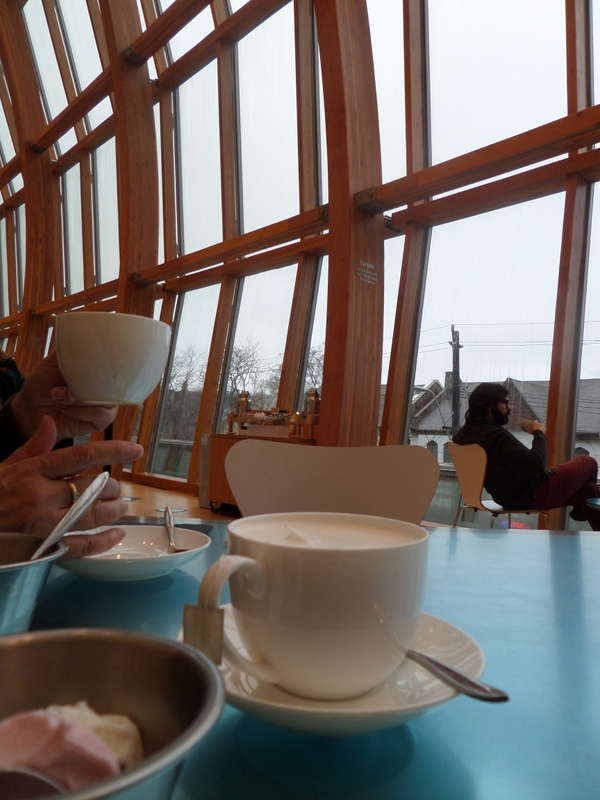
SAMSUNG CAMERA PICTURESToday I revisited the AGO show “Francis Bacon Henry Moore Terror and Beauty” (or FBHM for short) that I wrote about at the beginning of April.  I’m on holiday today even if it’s a rainy spring day.  I saw the show again, then sat through two short documentary films (one for each of the British artists), then walked through the massive Henry Moores at the extreme east end of the floor, overlooking McCaul.  As expected you don’t see them the same way, once you’ve experienced Moore in context with Bacon (and Brandt).

The upstairs Dundas corridor and its coffee bar beckoned, an opportunity to simply let it all sink in.

As the parenthetical addition in the title makes clear, this is really a show with three artists, even if the third isn’t understood as a peer of the first two, but more like an opening act for the two big attractions.

Professor Dan Adler

Even so, Bill Brandt plays a huge role in this show.  The chemistry between these three is one of several aspects of FBHM for which curator Dan Adler must be congratulated and thanked.

As readers of this blog know I regularly attend opera and new music concerts.  As a concerned audience member, as an academic I am constantly wondering: how does one build an audience? When an interpretation is transgressive or risky, how does one prepare an audience, especially if they’re likely to be hostile?  I have heard genuine anger from people concerning recent Handel productions at the Canadian Opera Company (both Hercules and Semele) that I loved without reservation.  What is an artistic director to do?

And then I stumbled –again– into FBHM, as enraptured today at the end of April as I was at the beginning of the month.  I wonder if we can see what Dan Adler did as a kind of prototype.

Instead of just presenting Moore & Bacon with the usual accompanying text & history, we get an additional inspired stroke.  Bill Brandt’s pictures remind me of nothing so much as pop-up video, a visual gloss upon a very complex series of artworks that require not just the usual scholarly explanations, but something to prepare our eyes.

The analogy may seem unhelpful, considering that one can’t very well imagine pop-up video during an opera or concert.  But then again: what if the COC or the TSO offered some kind of running textual commentary on mobile phones, so that some people could opt-in for a curated performance experience?  Or perhaps some kind of powerpoint slides that would come up on our personal devices at the key moments when we might benefit from having something decoded or unpacked a bit?  I know I know, those who see mobile phones as Satan’s playtoys would see me as wearing the mark of the beast.  But I am just brain-storming, looking for a way to help get inside complex works.  Offering the pre-show talks simply isn’t enough, especially for those of us who simply don’t have the extra time.

Some of the things Adler gives us are devastatingly simple, possibly obvious.  We see Brandt’s photographs of people sleeping in the tubes during the London Blitz.  He puts a few alongside studies Moore made of reclining figures, forever changing –for me at least–the way I’ll see those reclining figures.  Obvious content is usually important, but sometimes is suppressed in cultural marketing because people sometimes want to appear subtle, refined, sophisticated.  In fact I suspect Adler might have meant to have more such images in the last powerful room showing us images pertaining to war, except that maybe those are so well-known that he felt we didn’t need any help.  All I am saying is that simple learning tools are sometimes the best ones.  Bravo Dan Adler!

Let me add that on this, my second time through, I saw a few things I missed the first time.

In the room of crucifixions –an odd idea from a pair of atheist artists don’t you think?–the approach of each artist to the subject is decidedly different.  Moore shows people on the way to death or dead, bodies suffering, dying, dead, turning from flesh to thing, from damaged life to dishonored object.  His images, living or dead, seem impersonal and universal.  Bacon has a remarkable crucifixion for an atheist,  a figure that could be a painting of the energy field of a god (or dare I say it, God?).  This isn‘t someone dying, it‘s someone powerful, seemingly ready to leap out of the painting.  It might be the most spiritual crucifixion I’ve ever seen. How funny that i only noticed this after living through Easter.

If it were up to me I’d change something, though (a minor thing really).  Last time I walked directly towards one of the popes, which drew me inexorably to the right, into the room with similar paintings.  Only much later did I see the small picture of Velasquez’s portrait of Pope Innocent X, an image that obsessed Bacon and is a key piece of subtext for Bacon’s Pope paintings.  Today I serendipitously wandered left to avoid a bit of a crowd in front of a Pope, and so this time I saw Velasquez’s Pope first: the way Bacon experienced it.  As a result it gave me a kind of preparation and framed my visual sensibility in much the same way that Brandt’s photos had framed the reclining figures I spoke of earlier.  An explanation after the fact is all very well, but not as powerful as the chance to experience a gut-level emotional responses, as I had today.  The way it’s laid out, the only way you’d be lucky enough to have it in the sequence I had today is if you get a bunch of people blocking your view of the famous painting: which come to think of it can happen at a show with famous paintings.  Today –if I don’t’ miss my guess– Adler was actually in the gallery, taking a tour around while explaining his choices.  Wonderful as most of them are, I think this one –where I believe I heard him say he wanted us to walk into the room seeing this–is a mistake.  As there’s no way they would ever put a humongous reproduction (haha or the original) of the Velasquez in front of us as we enter the room, yet that’s really what we need, to experience Bacon with some insight into what Bacon himself felt.  I luckily stumbled upon it by accident.

I’ve understood those Popes for years as very rich & complex paintings so I am not saying I didn’t get them before and now I understand them.  Yet I saw things differently today.  Yes I’ve understood these images as complex & ambiguous even as they’ve scared me and creeped me out.  On the one hand we see powerful people, but at the same time they’re in a virtual prison or electric chair.  On the one hand they seem to be strong, but are they perhaps trapped by their role and the world they inhabit?  The chair or throne of a regal personage is a symbol of their office, and so sitting enacts ruling.  In person I think these big paintings look much more vulnerable & human than what we get in reproductions. Bottom line, is that art books and posters are often a terrible substitute for the real colours of the original painting.

I enjoyed the way Adler set up the parallels between the two artists.  Some were startling, such as the room of crucifixions (a subject I wouldn‘t have expected from either artist).  I’d been fascinated by the obvious contrasts:

  • Moore is abstract while Bacon seems very specific
  • Moore is depersonalized while Bacon’s humanity is very individualized
  • Moore rarely shows a male while Bacon mostly shows males
  • Moore seems to come from the inside, showing us bones and morphological structure, while Bacon seems to flay off the surface skin, showing us messy and smeared views
  • Moore seems to strive for symbolic & archetypal while Bacon seems to aim for instantaneous effects of heads and eyes moving, something unexpected, shocking, and dramatic

But we do get the occasional convergence.  There’s the room with bodies, where Bacon’s “Two Studies from the human body” and “Untitled” (kneeling figure) are missing the usual gore, and instead are the same sort of curvaceous and impersonal shapes Moore usually makes as in his “Three quarter Figures: Lines” or “Woman”.

And one of the last parts of the show gives us something military, with several armed figures from Moore, suggesting classical warfare.  I suppose the parallel between Moore’s Atom Piece and the avatar of power in Bacon’s “Untitled” (marching figures) shouldn’t surprise me.  I called attention to one of the most wonderful sight-lines of the show, where you can see the clear parallel Adler is drawing with a photo i took.

Moore & Bacon in juxtaposition (photo: Leslie Barcza)

Moore & Bacon in juxtaposition (photo: Leslie Barcza)

Note that Bacon’s painting is a huge departure from his usual practice, because he depersonalized his warriors.  The title could be “Hail Victory” or perhaps “Sieg Heil” as the tooth-shape somehow appeals to the faceless hordes loyally marching past.  Notice too that there is a transparent box as in his Pope portraits.  Are these soldiers marching into a symbolic trap (comparable to the prisons of his popes)?

In the documentary film about Bacon (easily missed because these two films are outside the show space…make sure you see them both!) the painter notes something that could be a kind of explanation of his work.  The game of art, he says, will become more difficult, because ever more violent images will be required to return us to life.  So in other words,  I guess the screams and contortions can be read as his attempts to return us to life, to make his paintings live.  He described an intuitive process to his painting, and said that at a certain point chance takes over: “when I don’t know what I’m doing”.  Bacon said he’d studied the works of the great masters, particularly Rembrandt & Velasquez.  And he pronounced his painting of the Popes –influenced by Velasquez– as a series of failures, claiming that he was “tampering”.

We’re one month into a show that will be here until July.  Don’t miss it.

Posted in Art, Architecture & Design, Music and musicology, Opera, Reviews | Leave a comment

Perfecting Persée

This morning I wondered, hm will I have anything to say?  This is Opera Atelier’s third Persée this millennium.  And now I have so much to say that I’ll probably have to split it into at least two separate posts.  The fact it’s not actually the same production is part of it, but also –having been goaded by a friend who quoted Joseph Kerman‘s dissing of Lully in Opera as Drama–I feel it’s a matter of honour.  Lully’s honour.  Opera Atelier’s honour.

Whenever I see this opera –and I saw each of the previous productions at least twice each– I come out of the theatre as if a bit inebriated, high on Lully as it were.  I will address that eventually, as it gives me a chance to write about a favourite topic, namely operatic dramaturgy aka how to construct an opera. OR skip to the end if you simply want a review of the production.

I feel very intimately connected to this opera & its incarnations with Opera Atelier.

That first time we were both under the spell of the same wizard.  In 2000, before I started my thesis, I took a directed reading course with Benoit Bolduc, then a relatively new professor at the University of Toronto.  I say “we” because at that time he was also the academic advisor to Opera Atelier, back when they took the historically informed thing so seriously as to allow themselves to be terrorized by it.

Marshall Pynkoski –someone I’ve called a genius on this blog– is the artistic director of Opera Atelier.  At one time they were so cautious about what they were doing that it had to be justified and defended, that historicity being something they took very seriously.  Curiously we both seem to be emerging from that magic spell:

  • me because it’s dawning on me that whether or not I finish my thesis there’s no job waiting
  • Marshall, because he’s no longer terrorized by history books and maybe just maybe believing in himself and his genius enough that he can relax a bit and have fun

But let me get back to Benoit.  He’s truly an amazing professor, now in USA, but at that time in a lovely office at Victoria College.  The directed reading was meant to place my study of Pelléas et Mélisande in a very important context, namely the relationship between music & words in French opera (aka dramaturgy, remember?).  French opera is seriously different from German or Italian or English opera in this regard.  What Kerman disrespected was precisely the thing the French –alone among operatic nations– got right, when everyone else seemed to get it wrong.  As Wagner tells us in Opera and Drama, the form had gone off track, lost its way from its original intentions. Music was to be a means to an end: creating a dramatic form, but instead, drama was being used as a means to opera’s actual (misguided) end, namely to create a musical form.  You go to see Donizetti, as I did Friday, and you see wonderful singing & ensembles, drama being a means to the main end, namely beautiful music.  If we were watching Mozart or Purcell it would be more or less the same.

The frustrating thing with Lully to an operatic aficionado is that it refuses to do what you expect an opera to do, to surrender to that misguided addiction to melody & musical forms.  Indeed, this is also the case with Debussy’s Pelléas.  We’re talking about operas that privilege the text, that don’t get too caught up in giving singers brilliant arias, that the story actually gets told through music.   Bolduc traced a line from the 17th to the 20th century, including Gluck & Bizet.

Where Opera Atelier’s fascination with ballet can seem a bit odd in a Mozart or Weber opera (indeed at one time I used to joke that Opera Atelier is a ballet company pretending to be an opera company) it’s a whole different story with Lully or Charpentier.  With Lully Pynkoski and Opera Atelier were coming home in a real sense, integrating dance effortlessly into the operatic fabric because that’s how it was written in the first place.  It dawns on me that no other opera company can really do what they do, because other companies usually start with a creative team comprised of music & dramaturgy & vocals, dance being somewhere just slightly below sets and just above the person who makes the coffee.

Hello..! Lully was a dance-master, in the court of a King of France who danced!  This is an entirely different kind of opera surely.  Dance isn’t something extraneous.  It’s as fundamental as breath for this kind of opera.  What’s more, it makes perfect sense given Opera Atelier’s complement of talents.

Today, almost 15 years after Benoit Bolduc introduced me to the idea of divertissements, I think I finally got what Lully is doing.  The word is a misnomer, really.  You hear “divertissements” and you think diversion or distraction, as though we’re taken away from the action.  But the action of Persée is built in a very different way from other operas.  Instead of exit arias following recitative, the passions of the sung text find their fullest release in these divertissements.  In Act I it’s more theoretical, but in Act II, it’s a kind of explosion of athleticism, as Persée accepts gifts from the gods, before going off to battle the gorgons.  The closest operatic analogue I can think of is the battle between Siegfried and the dragon in Act II of Siegfried, or perhaps Siegfried’s Rhine-journey in Gotterdammerung.   But this is dance.  And we get similar things in later acts.  The main thing being that these divertissements are central to the dramaturgy, a colossal release of passion and energy through something physical onstage.  These orchestral passages with dance are a curious precursor to the orchestral transformations we see in Wagner, Debussy and even Berg’s Wozzeck.  Unless one has a company that can integrate the dance into the action the way Opera Atelier does, you won’t really understand Lully or Charpentier.  You would be forgiven for thinking Kerman was right.  How could he or anyone know differently, with the usual understanding of opera?  But just because I’ve never seen a narwhal doesn’t mean I don’t believe they exist.

Newness is always a terrible challenge.  We tend to work from what we’ve seen before, even if that limits what we can properly understand .  It’s so funny, because I’ve been seeing operas old & new, struggling gamely to avoid pigeonholes and stereotypes that are inapt, inadequate ways of seeing & hearing.  If you go into a gallery or theatre, only understanding what you see by the template of something else, you may completely miss the point.  Our challenge is to resist the temptation to demand  of something –for example opera– that it do what it has always done.  We walk into an Opera Atelier production, and instead of seeing what it’s actually doing, we measure it by how other operas are done.  Now of course this is by and large what critics do.  They have seen things before and so –on the theory that their sensibility is educated, their experience enlightened & enlightening–we listen to what they say even if their wisdom prevents us from breaking through to anything new.  Are we –the critics at least –going to help facilitate change by imaginatively helping? or are we going to be conservative forces protecting our old culture from anything new or original?

I feel lucky that anyone reads what I say.

Pardon me if I interrupt this essay concerning the dramaturgy of Lully, to speak for a moment about the new production of Persée at the Winter Garden theatre.

Gerard Gauci

Set designer Gerard Gauci

You can probably already tell that I liked it.  Gerard Gauci’s sets are much more elaborate this time, possibly the same way that the Opera Atelier revival of Armide (that was taken to Versailles & Glimmerglass) was bigger & better.  The choreography by Jeannette Lajeunesse Zingg is the most central body of dance & movement in any of the operas from Opera Atelier, given that at least one climax of each act is actually enacted movement. For example near the end we watch Persée battling rebels in a choreographed fight sequence.  This isn’t a diversion, it’s a central piece of action, even if it is also a hugely entertaining set-piece.  And it’s interspersed with singing, so it’s not like the ballets in Aida or Faust, where the opera seems to stop while another medium takes over for awhile.

Jeannette Lajeunesse Zingg

Jeannette Lajeunesse Zingg

I’m very fond of the sound of Lully’s orchestras, a very gentle sound in the hands of Tafelmusik baroque orchestra & chorus, especially under David Fallis’s subtle guidance.  My ears are still pulsing with the stunning sounds, bold rhythms and yes, a soft sensuous texture that never covers the singers.  The principals were hugely enjoyable, particularly two recent graduates of the COC’s ensemble studio, namely Chris Enns as Persée and Mireille Asselin as his beloved Andromède.  Lawrence Wiliford was very impressive as Mercure, a role that seems to lie very high.  The gorgons scene –especially Olivier Laquerre as Méduse–was funnier than last time.  Opera Atelier stalwarts such as Curtis Sullivan, Peggy Kriha Dye and Carla Huhtanen as Cassiope were their usual dynamic selves.

Opera Atelier’s Persée continues at the Winter Garden theatre until May 3rd.

Posted in Music and musicology, Opera, Reviews | Tagged , , , , , , , , , , , , , , | Leave a comment

10 questions for Margarete von Vaight

Serendipity is a funny thing.

A few days ago Canadian heldentenor Ben Heppner announced his retirement from singing after one of the most extraordinary careers.  At the exact same time, I’ve been talking to Canadian soprano Margarete von Vaight, who just left town to participate in the Lauritz Melchior singing competition this week in Europe, a competition celebrating the kind of singing (at least among the young up and coming talent) Heppner excelled at, namely Wagner.

Canadian soprano Margarete von Vaight was a recent recipient of the Jim Madros Artist Award at the Musician in Residence Program at the Banff International Centre for Performing Arts.  She’s emerging as one of Canada’s exciting young dramatic sopranos, under the recent tutelage of Wendy Nielsen, and formerly with Jane Eaglen with whom she participated in the inaugural season of the Baldwin-Wallace Wagner Intensive Program, performing the role of the Third Norn (Götterdämmerung) and Brunhilde (Siegfried).

In addition to Ms. von Vaight’s musical education, she is currently a student a of Harvard University Liberal Arts Extension in Business Program in Cambridge, Massachusetts.

As they begin the competition in Jutland (Denmark), I emailed some questions to Margarete, asking about herself and the competition.  Luckily she answered.

1) Are you more like your father or your mother?

I possess a little of both. My father was an extrovert filled with joy and charisma. As a child I remember thinking he was a dichotomy. Albeit he was very masculine and gregarious, he belonged to a men’s choir. There was something very special about attending one of his performances. His face reflected the internal connection he felt with singing: elated. My mother is very clever and sophisticated. She is warm and understanding; always thinking outside the box with her business mind. She is a lover of the arts and is very creative. They were both influential in my exploring creativity in any form. Both were adamant that I learn from experiences whether good or bad. Life in the world of performance can be filled with highs and lows. They were influential on how I dealt with the both extremes. My parents would say ”one must take risks and keep a fun card in hand at all times”.

Soprano Margarete von Vaight

Soprano Margarete von Vaight

2) What is the best thing or worst thing about being a singer in a singing competition?

The preparation wins hands down. I was a Musician-in-Residence at The Banff Centre when I was notified about the LMISC. I panicked. It was my first international competition of this magnitude. An entire program needed to be performance ready in a short amount of time, three months to be precise. During my time there I worked with two exceptionally talented musicians, Cecilia Berkovich and Mark Simpson who experienced the repertoire from the perspective of the orchestra pit. It was an insightful opportunity to understand the composition from a panoptic view, not just the vocal line. Moreover, I felt I had already won. To have been selected to represent Canada was quite the achievement. Because I am in the early stages of my career, I felt the pressure was off. I could only become better aware of myself. What better place to learn than being on the stage itself? The process is the most enjoyable part for me- the end result of winning does not motivate me. I’ve invested a significant amount of time, effort and money; however, it is the music and the joy of learning and sharing that keeps me going.

I have enjoyed the impeccable attention to detail and precision the LMISC has provided. A fabulous support staff, top notch accompanists and wonderful facilities available to us. The people of Aalborg have been most welcoming and incredibly friendly. Like most singers, I enjoy visiting other countries and interacting with the local people. In addition, one of the highlights is singing alongside and learning from singers who are more advanced than me.  Learning a bit of the language ahead of time is also an interesting experience when put to public use. The response is usually in English followed by a giggle. After my first round of competition I saw a few of the audience members in the foyer, albeit we could not find a common language.  We managed to communicate via German, Danish and English. There were hugs! Music has no boundaries.

Unfortunately, the worst part of an international competition is the internal pressure one feels. No matter how positive one tries to make a competition sound, it can feel like a blood sport at times. Luckily I have not felt that at all while here. Consequently, it is the buildup of my own insecurities which I slowly diffuse over time. I’ve learned to laugh at myself. Matriculation comes through error. I cannot progress without errors. For anyone who says they do not experience insecurity: they are not being honest. It’s natural. It eventually wears off over time; personally I think a tad bit of insecurity is a good thing. It keeps the bar high ensuring I put my best work forward.

3) Who do you like to listen to or watch?

Joan Sutherland, Kiri Te Kanawa, Luciano Pavarotti, and Jussi Bjorling were my idols growing up. Their approach to singing seemed effortless. These days I listen a great deal to Irene Theorin, soprano. She has been a delight to watch. I’ve been in love with the Copenhagen Ring Cycle- I’ve been watching it time and time again. Stig Fogh Andersen blows my mind- his vocal and physical endurance beats many of the thirty-something year olds hands down. For the most part, one will rarely see me listening to Opera outside of the rehearsal hall. My musical tastes vary. My IPod includes Daft Punk, The Crystal Method, Agricantus,  Sarah Mc Laughlin, Emmy Lou Harris, Cote de Pirate and The Wilderness of Manitoba. I am also a lover of Danish and Swedish crime dramas- the soundtracks are also on my IPod.

4) What ability or skill do you wish you had, that you don’t have?

Unfortunately, I don’t “wish” I had a skill. I believe we all have skills, many of which are underdeveloped; however, some are more prominent than others. I am very action oriented. If I am required or interested in attaining a skill, I will learn it to the best of my ability and incorporate it into my skill toolbox. With that being said, I have many skills which best remain in the box. These days I am enamored with sewing. I designed all of my gowns for the competition and seem to have been successful in the execution of the skills I learned (patterns, cutting, sewing). Unfortunately, when my gowns were fitted I realized my sewing skills were terrible resulting in the hiring of a seamstress to correct my multiple errors. The body fit well; consequently, if I only had the arms of a ten year old and the height of a tree it would have worked out well.

5) When you’re just relaxing and not working what is your favorite thing to do?

I love driving. I drive every evening. I have been nicknamed “Night Rider”. When I lived in Toronto I could find myself up at Lake Simcoe after exploring the side roads. If I could drive to Europe I would. I am also an avid gardener. Attending to the garden is a trait inherited from my mother. I adore flowers. I also love living near the water. I eagerly await the return of summer so I may head out for my daily bike ride and stroll our deserted beach with my cruiser bike “Roxie”. Albeit not the norm, I am an enthusiastic furniture restorer. Unfortunately, it is a pleasure which best be controlled for I haven’t enough room to accommodate the space needed to house these projects.

*******

Five more about the singing competition.

1) Imagine for a moment what Wagner might say.  He wrote singing competitions into TWO operas…but those heroes–Tannhauser & Walther in Meistersinger–seem to mock rather than celebrate competitions.  Would he approve?

Absolutely!

Wagner pushed the boundaries on all levels. For the singer the real test is endurance, not just vocally, but psychologically. Both Tannhauser and Walther are tested figuratively and literally. At a glance, if one compares both characters side by side, Walther wins the precious hand of Eva, while Tannhauser loses his Elisabeth. Interestingly enough the same goes for singing competitions. Nothing is ever as it seems when it comes to Wagner. He was far too clever. His theme of redemption through love which applies to many of his operas runs parallel to singing competitions: redemption through performance; may the best singer win.

2) talk about the challenge of singing Brunnhilde in a singing competition, and how you’re approaching this special moment

In my experience singing the Wagnerian repertoire is a process rather than a challenge; moreover, it is not limited to the role of Brunnhilde. In my discussion with Poul Elming, Tenor (Lauritz Melchior International Singing Competition Director and re-owned for his role as Parsifal, Bayreuth, ‘94-‘01) the consortium of singers able to perform the work is rare and limited for several reasons. The voice type is rare. A prerequisite of course would be a moderately well developed sound, size and range of voice; consequently, the long period of development can be twice as long as for the non-Wagnerian singer. This also involves years of financial expense. As a student at the Royal Conservatory of Music in my teenage years I did not hear voices similar to mine. The range, size and vocal timbre was different than most of my peers. However, I was encouraged by my voice teacher at the time (Eraine Scwing-Braun) to sing with my natural voice. It was liberating. I was constantly being told to sing lighter or darker by other teachers. In my late teens I was asked to use Siegliende’s aria “Du Bist der Lenz” from “Die Walkure” as an exercise. It was evident that my voice responded to the long lines albeit I did not have the top notes. The higher register eventually developed over several years while the Wagnerian repertoire lurked in the background. It is important to note that the culture surrounding Wagner is different to the operatic culture of Puccini or Verdi. Wagner re-wrote the rules when it came to opera. Not only does he demand vocal stamina, and thorough examination of musical texture, but most importantly, he serves up a constellation of innovative orchestral structure in his compositions posing rhythmic and musical “clash” for the novice. For the singer, it requires one to collect this knowledge over time as it is multi-layered. This also requires a singer to go further by emotionally understanding his character’s motives through leitmotifs. I believe this requires quite a few years of “real life” experience to sincerely feel and portray for instance, the love Isolde has for Tristan. Singing the words and knowing the notes on a page is not substantial enough in my opinion. Often times the score does not provide the preamble to Wagner’s intentions. It is for these reasons that I have concluded that the process begins long before one reaches the stage of singing Brunnhilde or Isolde. Like Wagner’s compositions, maturation evolves over time, through experience.

3)   what do you love about singing Wagner? 

The Wagnerian repertoire is MAJESTIC! One of the most wonderful experiences I’ve had attending the LMISC is the thrill of hearing my colleagues. I feel alive and excited when I hear or sing the Wagnerian repertoire. The energy is like no other. It awakens a playfulness and joy that I do not experience elsewhere. While studying, I love the exploration of finding the answer to the question “Why did Wagner do that? What was his motivation?” Whether it is researching the works of Schoppenahuer, poetry, myth, or his letters, the quest for the answer is half of the fun.

4)  put this in context for us, at a time when the opera world seems so fragile, when so many companies are going under, and even the Metropolitan Opera seeming at risk.  Is opera an endangered art form, and how does that make you feel about what you do.

I believe it would be fair to say that Opera is undergoing an explorative renovation. Like most businesses there are high and low periods, sometimes, prolonged low periods. Businesses in general, not just Opera, are continuously trying to retain their clientele. Is the art form at risk? Absolutely. I am thankful to the administrative teams who work endlessly at trying to find innovative ways to retain and attract new patrons.  The silent communication between musicians and audience is electrifying. The sound of the human voice is extraordinary. To enter into “endangered” territory would be a disservice to society. At the end of the day I will forever advocate for live performance. The long hours of preparation, years of practice and joy of singing will continue- even if I have to set up my soap box in the town square.

5) is there a teacher or influence you’d care to recognize who has brought you to where you are today? 

Goodness, there are a few to list. My “dream team” Wendy Nielsen, soprano and Rachel Andrist, Pianist were an integral part of my development. Not only is their musical tutelage impressive, but their personalities and joy for creativity reflects a healthy approach to an art form which imposes the unrealistic quest for perfection.  Jane Eaglen, Wagnerian soprano extraordinaire, was also an integral part of my development. She remains in my opinion, the consummate musician. I learned a tremendous amount from her in the years we worked together. I must admit I hadn’t been the best of students in my younger years; however, I would not have been able to get to this point without observing Jane’s work ethic. Eric Weimer, (Lyric Opera of Chicago) permeated musical intellect like no other. A cornucopia of people, both family and extended family that put up with many years of supporting me. Lastly, the audience; without them I would not have as much joy in creating and continuing in this special art form.

*******

And so, the competition.  Friday night it began.

Margarete has sung in the first round, and although some singers were eliminated she’s through to the next round!

I’ll let you know what I hear, or check out their website (click the logo).

Posted in Interviews, Opera | Tagged | 7 Comments