Patrick DeCoste: Dreaming of Bear and Crow

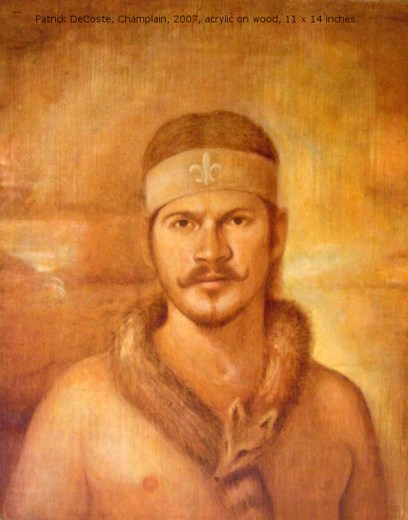
Patrick DeCoste: “Champlain (self portrait)”, 2009, acrylic on wood, 12 x 14 inches

There is a particularly Canadian sensibility that I crave, an attitude that feels all too scarce these days.  I crave a real sense of history, the kind of thing I grew up watching on the CBC & the NFB.  At one time we were very different from the Americans to our south, for our ability to be truthful about our past, without pounding on our chests in perpetual self-glorification. No, that’s wouldn’t be Canadian (at least at one time).  But to look ourselves square in the eye, perhaps with an ironic jest, even as we glorify our true achievements? That’s Canadian.

I felt that again today when I walked into Patrick DeCoste’s show on Richmond Street, a series of pieces that feel very much like part of a voyage of self-discovery.  He tells us so in the title of the show, which is called Dreaming of Bear and Crow: A Search for Métis Identity.  I should add that DeCoste is part French, part aboriginal (sorry I don’t  know which tribe), or “Métis”, like Louis Riel.

If I may digress for a moment, my favourite moment in Harry Somers opera Louis Riel is the  first scene, where we watch a bilingual encounter between some men who speak English (from the east) coming upon a barricade created by Riel’s men (in the west).  The encounter between cultures is magical, because neither really understands the other.

DeCoste’s show also concerns such an encounter, except it’s a first encounter between races from opposite sides of the sea.  Here’s DaCoste telling the story in a spell-binding little video.

My favourite line –if something horrific can be favourite– is when the shaman says

we have heard of these bearded men before.  Kill them or flee”

Every piece in the show is in some way connected with that remarkable shamanic dream.   My only regret is that there isn’t more art because everything I saw was fabulous, profound, and beautiful.  The quality of the pieces, both the craftsmanship –because we were dealing with art that is carefully made from exquisite materials like genuine animal skins –and the complexity of what’s being investigated –left me wanting more.

I have to believe we’ll see a great deal more from Patrick DeCoste.

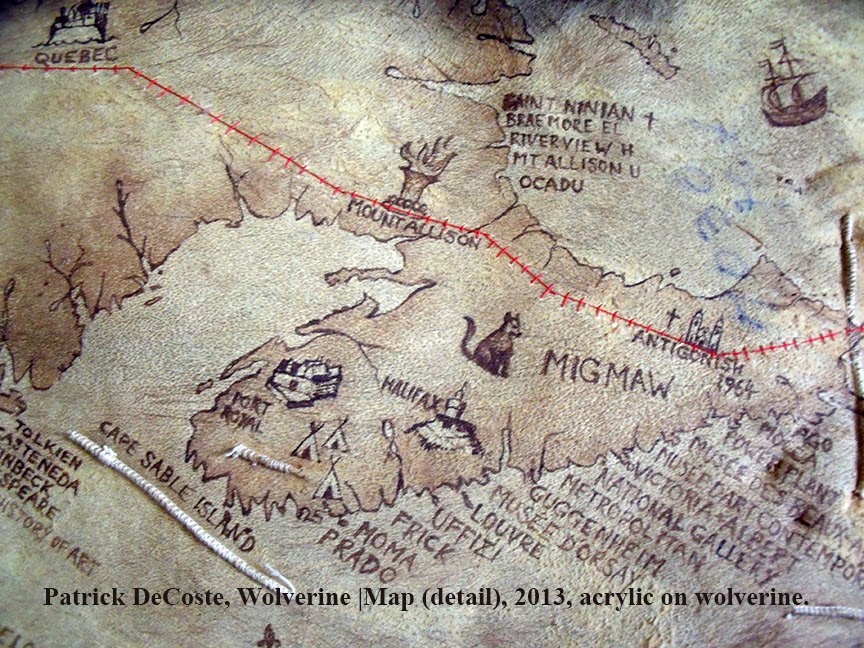
The story is at the interface between the aboriginals and the Europeans, a primal moment from five hundred years ago.  Sometimes DeCoste is gently faithful.  At other times he’s more of a trickster himself, playing with this whole inter-cultural encounter, as he leads us ourselves through that magical doorway.  We’re looking at objects resembling artefacts from long ago, such as a map on a wolverine skin.

Patrick DeCoste “Wolverine Map” (2013) mixed media on wolverine skin, 3ft x 4ft.

But you look closer.  What are those locations on that antique map? It’s Nova Scotia but the locations:

  • Prado
  • MOMA
  • Louvre
  • Guggenheim (etc)

Patrick DeCoste “Wolverine Map” (2013) detail, mixed media on wolverine skin, 3 x 4 feet.

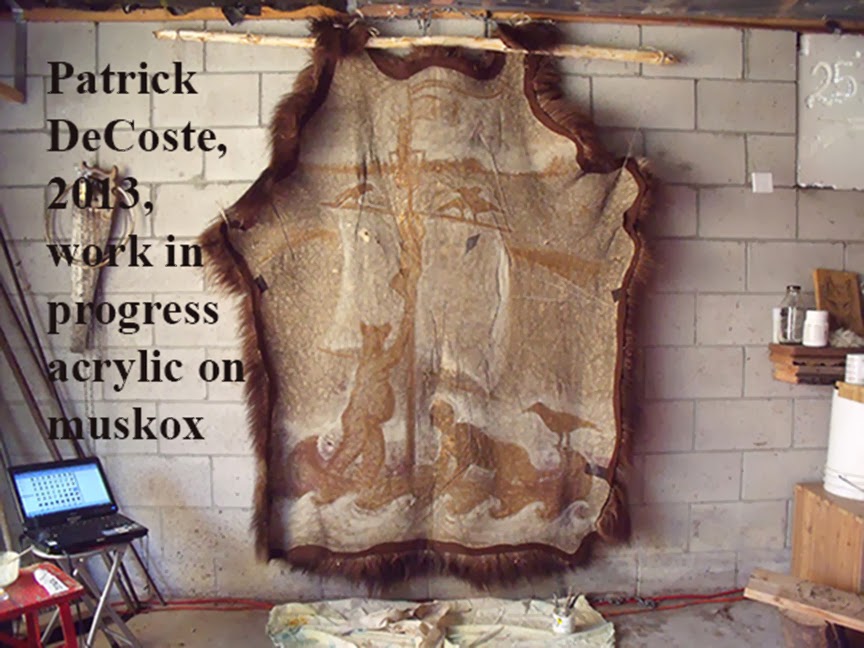
His images can be ambiguous.  In the dream there were bears: but they turned out to be bearded men.  Notice how the men and the bears can be similar, both with bellies and unsure whether to walk on four or two legs.  A French priest strung up (martyred?) on the boat dangles above bear and man, with crows to keep him company.  We’re looking at a picture that isn’t so very different at first glance from many traditional aboriginal images, a more commercial & mainstream kind of art.  The surfaces, the high quality materials & workmanship make these prized objects to buy.

Patrick DeCoste: “The Dream on Muskox” (2013) work in progress, acrylic on muskox skin, 66 x 72 inches. Yes, it’s six feet tall.

Oh yes, I did ask the obvious question about that map on the wolverine. It’s already sold.

Dreaming of Bear and Crow: A Search for Métis Identity is on at the OCADU Graduate Gallery, 205 Richmond Street West, a the corner of Duncan until Tuesday March 11th.

Patrickatocadu.blogspot.ca

Posted in Animals, domestic & wild, Art, Architecture & Design, Reviews, Spirituality & Religion | Tagged , , , , | 2 Comments

Adams & Thomalla at RBA

Today’s free concert at the Richard Bradshaw Amphitheatre was an opportunity to hear composers John Adams and Hans Thomalla.  We heard them speak and then we heard their music.

The RBA is not to be confused with an ideal concert space.  It’s really a lobby space.  We either sit on an inclined plane –a staircase— or stand on the surrounding lobby space leaning against the railing to look downwards at performers.

Visually it may be the most beautiful place in the whole city.  Okay, quote me. Yes,  I think that when you add the music and the intimate views of  say a Thomas Allen or a Topher Mokrzewski or any of the other artists singing at the COC’s noon-hour concert series?  It’s almost forgotten that we’re floating in the sky while staring through glass at the commerce of the city, underscored by marvellous soundtracks like the ones we had today.  We watched a protest passing the American Consulate in front of us on University Ave, moving turbulently past us, but still only a ripple on the surface of our hour-long concert.

And the sound?  As your real estate agent will tell you, it depends on location.  And it also depends on what you’re hearing.  Last week’s gentle strumming of La Dafne was sucked up by the somewhat dry acoustic.  It’s a great space to hear singers, whereas I’m not sure it always serves instrumentalists well.  We hear detail with almost clinical precision, which is terrific when you’re hearing the finest voices or the best players in the country. Ah but one could wish for a bit more warmth, though, especially listening to an instrumental concert such as today’s.

A pair of pianists played a pair of pianos that weren’t quite identical (one lidless, one with its lid open).  Each of Claudia Chan and Ryan MacEvoy McCullough has a personal connection to one of the composers, as we heard in the introductions.

Pianist Claudia Chan (photo: Karen E. Reeves)

Adams spoke first, explaining his connection to the young McCullough –whom he’s known for five years—and decoding the title to the first item on the program, namely “Hallelujah Junction”.  Adams told us that it an actual place, and that he recalled thinking that it caught his attention as a possible title before there was a composition of that name.  The word “hallelujah” seems to have been a definite inspiration to the composer, a rhythm that figures in the piece.  Adams liked the phrase so much he used it again for a recent book he wrote as well.

I was mindful of the RBA acoustic during the performance of HJ. The piece is so full of detail, especially when the players are just slightly out of phase with one another, that it challenges the ear in more reverberant spaces: although perhaps Adams approves of that sort of effect.

Pianist Ryan MacEvoy McCullough (photo: Michael Lutch)

Next up was Hans Thomalla’s Noema, a work that is like yin to HJ’s yang.  Where the Adams piece is tonal, at times wonderfully tuneful and full of soul, Thomalla’s work feels like an experiment, a challenge as much to the listener as to the player, asking for a prepared piano, a few plucked notes, glissandi and even a few clusters played by forearm.  Thomalla told us he had been thinking of romantic composers’ etudes, citing Czerny & Liszt. There were a few moments when one could hear something allusive without really being imitative, like shards of a picture painted on glass that had been smashed, flashback memories rather than full-out quotes.  I felt Noema resembled more of an installation than a composition, a series of effects and moments,  some of which were rather intriguing and clever. Considering what the title means –for example one definition says “the object of thought”—I can scarcely be surprised that this music seems highly reified, so abstracted as to be an idea of a composition as much as it’s an actual composition.

CC & RMM gave a wonderfully clear account of Adams’ piece, full of youthful energy.  In the second work I was fascinated by the dynamics between them, making unique and diverse events out of the different parts of Thomalla’s piece.

For more about the pianists check out their websites:

Posted in Music and musicology, Reviews | Tagged , , , | 1 Comment

Unfinished dreams from Borodin to Putin

Today’s High Definition broadcast from the Metropolitan Opera (Dmitri Tcherniakov’s version of Borodin’s Prince Igor) threw me.  I’m sure I couldn’t be the only person amazed at how perfectly the show seemed to match what’s unfolding, while the world holds its collective breath awaiting Vladimir Putin’s next move or a response from the West.  The dark side of dreaming of world peace is the fear of annihilation in the madness of war.
Prince Igor? No nukes yet.  But he leaves Putivl to defend Russia against the Polovtsian invaders from the east.  He fails, falling captive to the surprisingly friendly Khan Konchak, leader of the enemy, while his son Vladimir falls in love with a princess.  In his absence, Igor’s brother in law seeks power. Before he can cause too much trouble, the invaders do a better job of it, destroying Putivl.  At the end, Igor returns to a city in ruins, blaming himself for what happened, and encouraging his people to rebuild.

I’ve wondered how to decode this story since I first encountered the work in an old film from the Kirov opera.  Yes, there have been different ways to assemble the fragments –of Borodin’s unfinished opera—pointing to different meanings. When that Kirov version has Igor ride into the sunset having apparently made peace with the friendly Polovtsians, it seemed emblematic of that ultimate melting pot multi-cultural state: the Soviet Union.  How should we decode the story now?  For example as a friend pointed out on Facebook the upstart brother-in-law Prince Galitzky’s name means he’s Galician: a foreigner.  But wait, in this story –where Igor’s son Vladimir falls in love with the daughter of his Polovtsian enemy—who isn’t a foreigner?  There aren’t countries in the modern sense after all.  If Galitzky is a foreigner, than so is Igor’s faithful wife (Galitzky’s sister).  Is inter-marriage code for alliance and even conquest?  In the 21st century it all reads differently of course.

Dreams figure prominently, both the waking sort that we think of as aspirations but also the kind that serve as story-telling devices, when we see something as though a character were unconscious.  In an interview during the interval Tcherniakov compared his utopian scenes in the first act to the island in Alcina, another place to explore archetypal possibilities.  For this purpose 12,000 fake poppies were crafted as part of a surreal design through which the half-dead Igor walks, encountering his son, Konchak, and hordes of dancers.  Just to ensure that we got it, Tcherniakov frames it with a black and white film, first showing the horrors of battle, and then Igor’s unconscious face, to which we periodically returned throughout and again at the very end.

Act II is a different mirror, reminding me of the morass of feuds at our City Hall and the attempts to curry favour with different factions.  Where Act I begins with a paean to the glory of Igor & his objectives, in Act II we see a kind of parody complete with half-hearted songs of celebration, where the prince’s brother-in-law takes advantage of loopholes and opportunities, a triumph of de facto wisdom fuelled by alcohol.  And then Act III is a remarkable mixture of darkness & sardonic humour, stripping away illusions and lies.  Igor returns to a people who continue to idolize him in spite of his failures, an admiration that inspires feelings of guilt and unworthiness.

At the beginning an epigraph is projected: “To unleash a war is the surest way to escape oneself.”  I wonder if Tcherniakov would say this to Putin..?

The Met performance was as stellar as one could wish, with Gianandrea Noseda leading the orchestra in a soulful reading.  The camera work was as intimate as ever.   Ildar Abdrazakov was a suitably heroic Igor, wonderfully conflicted throughout.  Mikhail Petrenko played up the dark comedy as the corrupt Prince Galitzky.  Oksana Dyka was a very moving Yaroslavna (Igor’s wife), while tenor Sergey Semishkur was spectacular as their son Vladimir.

I don’t know how it comes across in the opera house, but this presentation felt like a movie, with its frequent use of filmed sequences, often in black and white.  Tcherniakov’s interpretation is like a defense of Borodin’s score, arguing for its greatness.

The schedule says that encore showings will be offered April 12 & 14, but the best way to be certain is to contact the theatres.

Posted in Cinema, video & DVDs, Opera, Reviews | Tagged , | 4 Comments

Unexpected WWI Cabaret

When I say “World War I” what pops into your head?

  • Mustard gas?
  • Trench warfare: a stalemate in muddy battlefields?
  • In Flanders Fields: a desperately sad poem about honour?
  • A war of attrition?
  • The end of illusions about heroism and nobility?

Can you say distant, dark and depressing?  Maybe that’s why this crucial and transformative event is not being commemorated: because we don’t dare think about something so dark, so  upsetting.  The war began one hundred years ago this summer, so long ago.  All before and after pictures pale compared to this one, the world before and after WW I.  Indeed, that’s what the AGO show The Great Upheaval resembles , a show imported from the Guggenheim Museum, and on view until this Sunday March 2nd.  It’s an artistic snapshot of the world transformed by the Great War.  Where each year up to 1914 merits a  big room full of art, 1914-18 is one room, partly because the art world was hijacked by war, partly because the artists were all busily dying on the battlefields.

You can go to a  gallery to see relics from a century ago, or, as i did tonight, see something brand new about the very same subjects.  And so I came to WWI. (Re)Visions of the Aftermath at Theatre Glendon, a show that’s on until March 1st.

Director Aleksandar Lukac, ambushed by my blackberry as he tries to watch his students

Director Aleksandar Lukac, ambushed by my Blackberry as he tries to watch his students

I’d seen the title, had interviewed director, Aleksandar Lukac.  I was initially hesitant.  Forgive me, World War I has always signified these impossibly dark things, the ultimate bogeyman.   But I was intrigued by the photos I’d seen and reproduced with the interview.  Why not something light and even entertaining from such a relentlessly dark topic?  I was intrigued by Lukac’s Serbian perspective on the assassination that triggered the declaration of war, because it had never occurred to me that this moment could be perceived so differently than what I’d read in history books.

But to be honest, I’m caught up lately in the question of making theatre among students.  Yes pedagogy can be understood as one objective, even if teaching occurs on several fronts, the sorts of learning spiralling in many directions.  But at the same time the energy and creativity of students presents one with extraordinary opportunities.

I love student theatre, and heartily recommend it always, making no apology for what can be seen onstage.

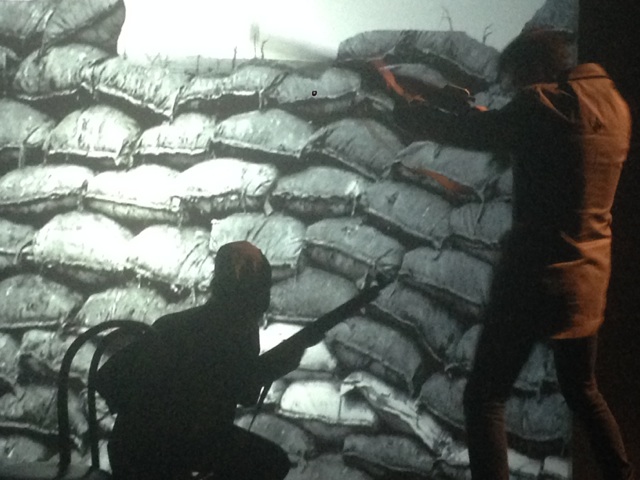
WWI. (Re)V is not so much a play as a series of short works, a miniature theatre festival constructed around a theme.  It’s as though Lukac asked his students to answer his question –“what  does WW I mean to you?”—in a piece of theatre.  Over a period of roughly 90 minutes we see a wonderful profusion of performances: puppets, songs, cabaret, a silent film enacted on the stage.  Sometimes we’re jolted by something modern, other times we’re able to simply laugh at the comedy or enjoy the songs.  This crazy quilt coheres loosely around its theme, delightful precisely because it never tries to be commercial, polite, coherent.  It’s bawdy, emotional, and often completely unpredictable.  The photos I’ve seen fail to capture the wild sexy edge you get when they’re singing & dancing right in front of you.  Who would think a tank could be sexy? You haven’t seen this tank obviously.  In this (the sober pictures) they’re being respectful, perhaps because war is a kind of sacred cow.  Yet as often as they’re careful and respectful, they’re also flagrantly deconstructing our assumptions about roles & how we should behave.  I think that i learned a great deal about war tonight.

It’s never dull, although they run the emotional gamut.  Can the horror of an assassination be told in a light-hearted fashion?  Don’t let me spoil it for you, except to affirm: yes it can.  At times they’re in your face, dancing and singing right in front of you.

And just when your ears and eyes are full, we also get the subdued language of a silent film, actors miming rather than speaking: a form perfectly suited to the passivity of a generation swept away by something largely beyond their control, an event where they weren’t consulted, weren’t allowed to speak.  The original music is from the inventive voice of Nicolas Dot, and there’s a great deal of music.  There are many talented contributions, so i hope i’m forgiven for having mentioned so few names, when the ensemble work was so uniformly strong.

As a writer and performer I found this totally inspiring, wanting to jump in with my own contribution, envying them this forum.  I went back and forth between distance (laughter) and empathy (tears), my emotions getting a full workout.

One additional experimental element –and likely a reflection of Lukac’s interest—comes from social media, where channels enabled a virtual viewer to comment.  There was a fascinating moment when the online commentary jabbed at one of the people onstage, who seemed to do a bit of a diva freaking out –comically and excessively – in response to their mistreatment by the tweetosphere.  Even as we explored history this part was brand new & edgy.

Whether you attend at the theatre or online there’s lots to see, and a surprising amount of fun to be had.

WWI. (Re)V? A blast.       IMG_0657Theatre Glendon present “WWI. (Re)Visions of the Aftermath” February 26- March 1st.  For tickets call  416-487-6822.

Posted in Dance, theatre & musicals, Reviews | Tagged , | Leave a comment

Gentle Dafne

The Dafne I refer to is not that of Jacopo Peri from 1598, and considered the first opera (for those who might want to make that kind of statement), but Marco da Gagliano’s 1608 setting, also using Ottavio Rinuccini’s libretto.

click picture for more information about Capella Intima

Dafne was brought to us through a happy co-production of Capella Intima (who specialize in baroque vocal music) and the Toronto Continuo Collective (who describe themselves as a 17th-Century “pluck band”).  I heard this lovely opera for the first time at the Richard Bradshaw Amphitheatre, or in other words, as part of the Canadian Opera Company’s free noon-hour series.

The nine instrumentalists mostly plucked (lute, harpsichord, archlute, theorbo, guitar) rather than sustained (a bowed bass viol and a little organ music near the end), which meant that the music tended to fade sweetly into the air, phrases dying sweetly, the way a stage picture lit by candles fades at the edges, and must always be an indistinct chiaroscuro.  None of the six vocalists sang stridently, the voices sounding wonderfully apt for a royal court rather than a big public theatre.  Everything was wonderfully intimate.

Toronto Continuo Collective (for more info click the picture)

Bud Roach is director of Capella Intima, while Lucas Harris & Borys Medicky are co-directors of Toronto Continuo Collective.  But there was sense of collaborative team-work, partly because there was no conductor imposing upon the performance.  While someone (I would guess it’s Harris or Medicky: I don’t know who) led the band especially at a few crucial moments, the singers and players stayed together by listening really well.  This was a demonstration of pure musicianship.  There was a genuine freedom to the performance, starting with the freshness of the material, an opera unknown to most in attendance, me included.

It’s a valid way of telling a story, and a wonderful reminder of the original objectives for opera, that we read about in textbooks explaining “monody” and the Florentine Camerata.  The words were clear, the voices without stress or strain, the exchanges between characters dignified.  At times I was reminded of Lully and Rossi, who begin the declamatory style of the French opera at the end of the 17th century: except without all the dance.

Tenor Roach was Apollo, first heard from offstage, in a mysterious game played with the rest of the cast.  Luke Arnason, countertenor and Sheila Dietrich were Amore (or Cupid as he’s sometimes called) and his mother Venus.  Their byplay was never dull and sometimes highly amusing as the saucy boy never let us forget who’s really boss.  Emily Klassen was a wonderful Dafne, especially in the long period after her transformation, while Apollo mourns her change.  Tenor John MacArthur (Tirsi) and baritone James Baldwin (Shepherd) complete an ensemble that had no weaknesses, that blended marvellously with the orchestra, and whose dramatic portrayals inhabited a middle ground something like “semi-staged”.  I think one must be careful of such epithets unless one know both the objectives of the group and the proper way for such pieces to be staged.  Perhaps this amount of drama is all that would have been given in 1608…?  The last thing I want to do is misread or misjudge a performance by imposing modern expectations onto something quite splendid and beautiful.

I only wish I could see & hear it again.

click for more information about the COC noon-hour series (photo: Chris Hutcheson)

Posted in Music and musicology, Opera, Reviews | Tagged , , , , , , , , | 5 Comments

Tcherniakov’s Wozzeck

Dmitri Tcherniakov is a brilliant young artist—just approaching his 44th birthday—who designs his own sets & costumes as well as directing his singers.  The DVD I just watched of Alban Berg’s opera Wozzeck was a co-pro. between the Bolshoi Theatre & Bel Air Media, who captured the 2010 production.  Tcherniakov seems to be everywhere right now.  His Don Giovanni comes to Toronto next season, while his Prince Igor will be broadcast by the Metropolitan Opera in a high definition broadcast this Saturday March 1st .

Director, set & costume designer Dmitri Tcherniakov

Tcherniakov’s Wozzeck does many of the same things we see in his Don Giovanni or in the videos I saw of Il trovatore and Ruslan und Ludmilla.

  • What we get is a kind of gloss or commentary on the work presented, as though the director were probing deeply into the work in search of its fundamental meaning
  • The production is worth seeing multiple times because of the density of meanings
  • Performers never look better than when singing for Tcherniakov, who motivates them as no one else

This Wozzeck is a fusion of stage & video.  Powerful as it is on TV at home, I also wish I could see it in a theatre, where its effect would be different again.

Before the work begins we see 12 roughly square urban living spaces –apartments?—on the stage, not unlike Hollywood Squares…. We’ve also seen a grid in Lepage’s Damnation de Faust and Robert Wilson’s Einstein on the Beach stage picture.

Cover of the Wozzeck DVD (click for more info, to view the trailer or to order)

Each room is populated, some with televisions.  But it’s a silent tableau. The orchestra tunes, then we narrow in on fewer and fewer until only one such space is visible, the others concealed (likely by curtains).

The last square shows us the fellow we saw in the credits who plays Wozzeck, at a table with a boy & his mom. Then they close this final square.

Conductor Teodor Currentzis –who seems to be much younger than Tcherniakov, even if he’s much taller –arrives.  And we begin.

Each scene is prefaced by a synopsis in titles, and during the scenes, translations are projected.

As with Tcherniakov’s Trovatore or Don Giovanni the characters seem to take on roles, as though the opera were an occasion for role-play.  And so while we begin with urban adults and children, they put on clothing and take on roles, taking us to different realities.   Sometimes the blatant and tragic events of the opera acquire ironic distance as a result. Other times the role-playing is more poignant than ever.

In the first scene, for example, Wozzeck begins as a very passive man, ostentatiously putting on a ball and chain while submitting to the Captain’s harangue.  But near the end of the scene, in a sequence that’s something like an aria, beginning “wir arme leut”, the passive man suddenly acquires such rage, masked behind that placid front that the Captain is totally surprised, as was I come to think of it.  I know this work inside out, yet Tcherniakov kept surprising me with new ways to present something familiar.

By taking the scene with Andres –set in a field, in the score—indoors, into a tavern, we’re now in a public place where simultaneously we can normalize the behaviours, and then –when Wozzeck begins to rave—immediately calibrate them as madness.  By displacing a scene from its usual place, Tcherniakov makes it brand new, and often frames it in a new way, even as the music continues to work in the usual way.  In this production especially, I think we get to have our cake and eat it too.  We don’t get the usual sentimentality in the moments where Marie seeks solace –in her lullaby—or possible absolution—when singing passages from the Bible, but instead something wholly unpredictable.

I don’t want to give it all away, except to say that once you get past the slight differences –such as having a boy who’s a bit older than what you might expect—one discovers that yes it can work.

Georg Nigl is a brilliant Wozzeck, with a gentler voice than I’ve ever heard in the role.  Mardi Byers is the most remarkable Marie I’ve ever seen, a full-figured sex symbol, vulnerable and abused.  For the rest, I’d say they are much like every other Captain or Doctor or Drum-major I’ve ever seen, all marvellous in various ways, but not so very different from what we usually get in those roles.

Conductor Currentzis makes the opera sound brand new to me, sometimes taking tempi I’ve never heard before.

Greek Conductor Teodor Currentzis (click photo for more info)

The scene with the doctor in the first act begins faster than I have ever heard.  There are a  few other places where he goes very fast such as the tavern scene after Marie’s murder.  But he can also find great delicacy & soul in this wonderful Bolshoi orchestra such as in that elegiac interlude before the last scene.

And Tcherniakov’s also coming to your movie theatre Saturday.

Posted in Cinema, video & DVDs, Opera, Reviews | Tagged , , , , , , | 2 Comments

Questions about WWI. (Re)Visions of the Aftermath

WWI. (Re)Visions of the Aftermath, presented this week at Theatre Glendon beginning Wednesday February 26, is an exercise in history & story-telling, both onstage and inter-actively through social media. What was World War I? What impact did it have, perhaps still has now?

The production looks at the documented stories of Gavrilo Princip –the assassin of Archduke Ferdinand—as well as stories of men and women affected by the war, combining contemporary renditions and modern (artistic) impressions of WWI. As their facebook page asks: “Whose voice is more important? What are the impacts of the war on us today? Who cares? (Re)Visions of the Aftermath navigates its way through these controversial questions and attempts to find the WWI story.”

They invite your participation:

Help us define war through this interactive performance:

  • Before the performance visit our facebook page (https://www.facebook.com/revisionsoftheww1aftermath) and tweet @revisionsofww1 words, quotations or photos that represent war and you might just see them in the show.
  • Make sure to bring your smart phones and tablets to the performance as we collaboratively define and explore the First World War.
  • Don’t live in Canada/Ontario? Watch our live stream on our Facebook page and participate online – visit Theatre Glendon’s youtube page for the live stream: http://www.youtube.com/user/TheatreGlendon

In anticipation I ask Director Aleksandar Lukac questions about the project.
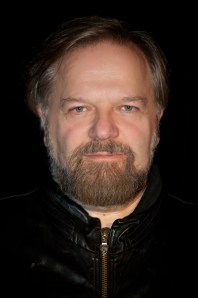
Aleksandar Lukac

Director Aleksandar Lukac

1- Is WWI. (Re)Visions of the Aftermath a play or something else?

I would call  this  a theatrical event  / it is a result of a six month research-writing workshop the students in my Glendon College, Approaches to Theatre Class conducted since September. They were placed in groups and were basically instructed to search their own memories of WWI. This could have included very personal histories like stories from their grandparents to just historical research to just very blunt imagining of the stories of soldiers and women from the period. We also included some authentic contemporary cabaret numbers and comedic writing. These really offset the expected gloominess of the play.

On top of this we have an online component / the play is live/streamed on YouTube and we are expecting the audience / in the house as well as around the world to tweet their own WWI stories to us / this happens in a segment of the play which is formatted to look like an audition for future theatre-film projects about WWI. It is interesting that this dynamic is far more present in some European countries / there are whole festivals showcasing new works about WWI. Canada seems to be less obsessed with the subject.

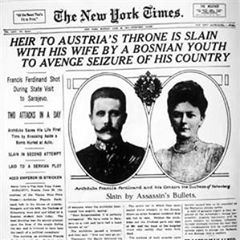
newspaperI personally was born in Sarajevo and am flabbergasted with the developments there / I grew up considering Gavrilo Princip to be a hero of the Bosnian liberation from the Austro Hungarian hegemony / let’s not forget that Hitler was given as a birthday gift the original plaque commemorating Princip’s deed that was ripped from the locale by Nazi soldiers.  Today the history is being revised (hence the title of our play) and the West seems to put more and more blame on Serbia for the assassination and subsequent war. Others keep to the more traditional interpretations of the causes and effects of WWI. It is pretty chaotic – the winners usually write the history – we live in the world where those original alliances have been broken down and history is being interpreted by new winners – if you are young you probably don’t care, however if you have packed a few years you get a shock. This shock is what prompted me to do the show. Take an x-ray of where our collective memory stands on the subject.

2-You’ve used social media before in theatre.  How did you use it before, and how is this different?

Two years ago we did Marat Sade Occupied (still available online http://www.youtube.com/watch?v=l7rUIbLF-fM )  and it was dubbed world’s first fully interactive play through social media. It was a wonderful experiment albeit somewhat chaotic – actors and audience members were tweeting live at each other and the play – using the Occupy setting as a context. All of the commentary was immediately available for everyone to see on our huge screens so everyone was in tune to other messages and posts. It was a stormy interaction teaching us possibly even more about the audience attention and interests then about our subject. I loved the energy of it and the unpredictability of the exchanges – we had no filters and people could tweet anything they wanted.

This time around we are trying to experiment with a more directed uploading of information – we expect and solicit from the audience to contribute their own proposals for WWI stories – ones that would be worth a movie or a theatrical treatment. We shall comment back  in a segment where several groups are auditioning their own stories – it is a more streamlined and hopefully more defined segment – but since it is live we are still facing the possibility of people posting all kinds of things – this is essential part of social media and it would be counter productive to eliminate the elements of chance in this process.silent_movie2

3-You’re a  practitioner of political theatre, with a history of edgy work in Eastern Europe, Canada and internationally.  Is this more of a theatrical experience or more a political experience… and why?

I would say it is both because the two cannot be separated. Theatre is political in nature because it is public – when you add the social media component it becomes even more so. You know, I grew up artistically in a politically very monolithic society in which it was easy to commit to a  “side” – opposition to the ruling class was always expected from the artists. Today in this version of democracy commitment to an idea or a side is much harder because we know both more and less about any issue in the world. Adding multiple voices through social media just exposes that problem – that we are confused and aware that there are also people whose job is to create this confusion as well as profit from it. I believe our show reflects this – and this is why it is very political.
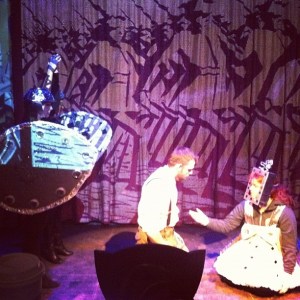
Futurist Cabaret

Futurist Cabaret

4-World War I is very remote from our own time.  Does that make this easier or harder?

Well many people would say that we would not have had WWII without it – that most problems in the 20th century were caused by the political movements after WWI. Would Soviet Revolution, Hitler, formation of a number of states in Middle East to name just a few, happen without WWI? But since this is also a project mostly written by my students, it was also an opportunity to hear what this generation’s take on WWI is. This is neither harder nor easier – it just is. It just might be harder for my generation to hear how the values placed on historical events are changed today.

5-Do you think we understand what war is in this country?

No, I don’t think so – although paradoxically there are so many people here who have escaped their own wars. But hearing their stories, when and if we do, are completely different experiences compared to living even one day under bombs or any other type of warfare. However the worst example of the misunderstanding of what war might be the situation with the Canadian war veterans who are experiencing a government negligence that is inexcusable.

6-If I am in another country can I participate?  And if so, what will I experience on my tablet, laptop or smartphone?  

Everyone can watch on http://www.youtube.com/user/TheatreGlendon  and tweet at @revisionsofww1

We will be receiving the tweets – hopefully this time either related to the scenes we have already performed or tweets that will be suggestions or concepts  for possible scenes/movies/performances related to WWI. We will be showing these messages in only one segment of the show – but our actors will be commenting on the received messages throughout the show itself.

7-The internet is chaotic, especially when people get excited about something.  How will you avoid a free for all?

Again, we will lay out the expectations but of course you can’t control the input so there is always a chance to create chaos. That is the fun of it, is it not?

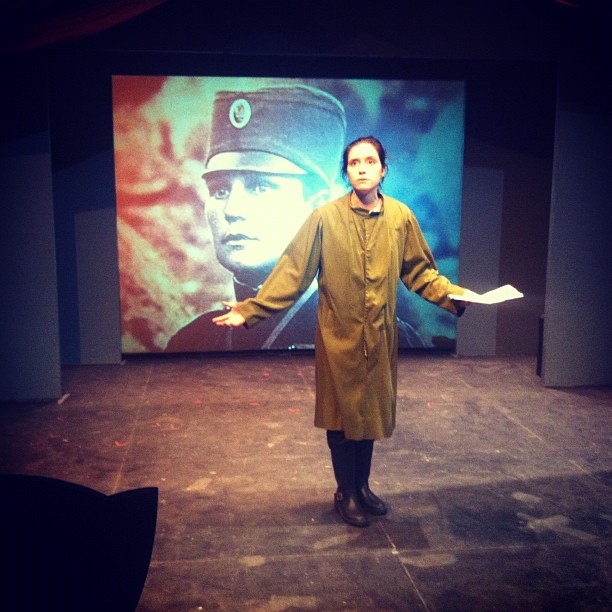
Milunka Savic scene at WWI(re)Visions of the Aftermath — with Alexia Polito

Milunka Savic scene at WWI(re)Visions of the Aftermath — with Alexia Polito

Theatre Glendon present “WWI. (Re)Visions of the Aftermath” February 26- March 1st.  For tickets call  416-487-6822.

Posted in Dance, theatre & musicals, Interviews | 2 Comments

ATMA Orlando

Click to go to ATMA’s site for more information or to purchase

I’ve been listening to a recording that deserves recognition.  It’s an ATMA Classics recording of Handel’s Orlando.  Is anyone anywhere recording operas anymore?  Perhaps the question sounds a bit silly, but the health of the classical music industry has been a regular topic of concern in some circles, and that includes recordings.  This recording captures Orlando as performed at the 2012 Vancouver Early Music Festival.

As a Torontonian my baroque musical life is largely influenced by Tafelmusik, with a few competitors in the picture such as Kevin Mallon’s Aradia Ensemble.  But Early Music Vancouver? Or Pacific Baroque Orchestra?  They’re new to me, so all the more reason to eagerly seek out the new ATMA Orlando. When one only hears one ensemble & their approach one can forget about the myriad of interpretive choices available.

I’m pleased to see that Orlando is up for a Juno, and no wonder.  Ideally there would be a whole category of opera recordings, as opposed to “Classical Album of the Year: Vocal or Choral Performance”.  Are there operas being recorded in this country? Not that I am aware of.  When I googled I found a few modern operas (as you can see for yourself), but nothing like this ATMA recording.

I should add that as far as awards are concerned I am conflicted.  I think great art should be celebrated, but I also cringe at competition.  I don’t like adjudicators & the measurement of performances as though against some imaginary yardstick.  This is one way that virtuosity can be understood as a kind of circus of thrills where the performer risks everything.  How demeaning.  I think it’s a relic from another age.

Parenthetically I want to observe that among the nominations the Junos are recognizing Stewart Goodyear’s Beethoven set.  Forgive me if I now contradict myself. Yes I just said that I don’t like competitions between performers.  But every now and then a performance is so extraordinary that it must be recognized.  Goodyear’s recordings are the best recordings of this or any year.  Juno is to be congratulated for jumping on the bandwagon.  I suppose it’s possible he won’t win, but then again, these competitions are always apples & oranges. How can one assess performances of different works? It boggles my mind, even though I feel this is an exceptional circumstance: that Goodyear is beyond any Beethoven I’ve ever heard, every single sonata in the set.  With all due respect to James Ehnes, Jan Lisiecki, Janina Fialkowska, and Louis Lortie –the other nominees in his category—Goodyear’s achievement is paradigm shifting, the most important pianism from this country since Glenn Gould re-invented JS Bach.

While Orlando doesn’t make me quite as rhapsodic as Mr Goodyear, it’s also something special, another important recording project that must be recognized & hopefully will win Juno recognition.  I would wish that the three disc set heralds a new era.  I hope they make back their investment and decide to record another opera.

Last night I saw Saul at Koerner Hall, a performance of a very different Handel work in a very different context.  Orlando is languid & lyrical, fiery and passionate, but never dissonant or strident.  I find myself thinking, not for the first time, about Handel’s operas and his version of the operatic, a parade of individual moments, instances of great beauty in diverse colours that likely made sense in a theatre where the lights were on and the audience not fully attentive.

I am still under the spell of Allyson McHardy’s Opera in Concert Phaedre in Hippolyte et Aricie earlier this month.  I used to think of her voice in context with Janet Baker –the greatest voice of that type that I’ve ever heard—even though I now manage to recognize McHardy as her own distinct flavour, a profound & complex tone so voluptuous and nuanced that she interrupts my thinking whenever I encounter her voice.

English counter-tenor Owen Willetts portrays Orlando, an ornate & colourful reading in a different direction from, for example, the approach used by Daniel Taylor last night.  This is ornamented elaboration that corresponds to what I understand about baroque singing, a stunning example of virtuosity & a gloriously full tone.   

Karina Gauvin is another distinctive voice that I’ve come to know and love, a sweet timbre of  transparency embodying great intelligence and insight, lines sung in a way to penetrate directly to the essence of the music.  

Alexander Weimann leads the Pacific Baroque Orchestra in a non-nonsense reading of great clarity, an ensemble we could stand to hear more often.

It remains to be seen–next month– whether Juno shares my enthusiasm for this recording of Orlando.

Posted in Music and musicology, Opera, Reviews | Tagged , , , , | 1 Comment

Saul

The biblical story of Saul is one of the most psychologically complex stories in the Old Testament.  Young David is a humble shepherd brought to soothe the troubled spirit of King Saul with his harp-playing.  Later David surprises everyone by defeating the Philistine champion Goliath in single combat.  As David’s popularity grows, Saul becomes jealous.  Saul’s son Jonathan becomes a close friend and loyal supporter of David in spite of his father’s murderous demands.  There are also two daughters. The Princess Merab rejects the humble David, but her sister Michal loves and eventually will marry him.

It’s perfect for opera or oratorio.

George Frideric Handel and Charles Jennens (the librettist) begin their telling of the story of Saul with the triumphant celebration of the great victory over Goliath.  Much of the last act is dark, including Saul’s encounter with a witch who calls forth a ghost prophesying defeat, and a sombre death march after he and his sons die in battle.

Tafelmusik orchestra & baroque choir are presenting Saul this weekend at Koerner Hall with a splendid group of soloists and led by Ivars Taurins.  We sat with partial house-lights on to enable us to follow the libretto in our programs, an authentic way to present such a work.

While concert performances of operas can leave you feeling that essential elements are missing from the presentation, there’s nothing missing when you do an oratorio in concert.  In fact there’s just enough drama, while we’re immersed in amazing music.

Daniel Taylor (see what i mean about the resemblance?)… click for the CD

As David I was struck by counter-tenor Daniel Taylor’s resemblance to Russell Crowe, in a performance of genuine star-power.  Taylor sings without the ostentation one sometimes encounters in baroque music, displaying exquisite precision and a tendency to understatement.  As the Head of Historical Performance at the University of Toronto I can’t help wondering if his simple & unaffected singing is a matter of personal style or possibly the latest word in scholarship.  Either way, it’s tasteful and compelling.

As the loyal Jonathan, Rufus Müller sang with great warmth & fluidity.  His most powerful moment came in his dark reading of the tenor air near the end of the work, the words seeming to catch in his throat on the line “Lest we, whom once so much they fear’d /be by their women now depis’d.”

As the title character Peter Harvey gave us a colourful account of the conflicted and tormented king.  Joanne Lunn & Sherezade Panthaki were a wonderfully contrasting pair of sisters.  Panthaki gave us ardour & love, while Lunn was the haughty princess, a regal portrayal every bit as colourful & quirky as her troubled father.

Taurins is one of the most entertaining conductors to watch, marvellously fluid in his body language, but always in the service of his ensemble & the music.  Saul is an extraordinarily good score, one I need to listen to again.  The brass in the first section sound unlike anything I’ve ever heard in Handel.  Often the arias dispense with da capo or recitative, so the action moves along much faster than what you might expect from Handel.  Sure, it’s not Webern, but I’ve never encountered Handel that sounded so modern.  The serenade music on the harp is mesmerizing even if you aren’t suffering from depression like King Saul.  Tafelmusik Baroque Choir were an essential part of the story-telling, responding eloquently to Taurins every nuance.

Saul continues Sat Feb 22 at 8pm and Sun Feb 23 at 3:30pm in the delighful Koerner Hall.

Tafelmusik Chamber Choir, directed by Ivars Taurins (left foreground). Photo by Cylla von Tiedemann

Posted in Music and musicology, Reviews | Tagged , , , , , , , | 3 Comments

COC Ballo voices

Back on February 2nd (aka Groundhog Day: when the cowardly little varmints ran back into their little holes) I had a choice.  I could have gone to see the opening of the Canadian Opera Company’s Ballo in maschera, which purported to be a fascinating production and one of the better casts this season.  I passed it up with great difficulty: because Opera in Concert offered their single performance of Rameau’s Hippolyte et Aricie.  I knew I’d catch a later performance on my subscription: tonight in fact.

There’s one more performance left Saturday at 4:30.  I will keep this simple.

Right now I think Adrianne Pieczonka is the most impressive Canadian singer in the world.  Now of course i am horribly promiscuous (and was torn between Pieczonka & Jane Archibald when they shared the stage in Ariadne a few years ago), so perhaps i can’t be trusted.  Even so, in a cast where the set offered no acoustical support to the singers–because they played in a big vacant space without  reflective surfaces—competing with an orchestra unleashed –because Stephen Lord turned the COC orchestra loose, as he said he would—it was like the second coming of Birgit Nilsson. I am trying to strike a balance between rapturous excitement and  something resembling a rational response. But my brain melted listening to this voice tonight, and it was a good thing.

Adrianne Pieczonka as Amelia in the Canadian Opera Company production of A Masked Ball (Un ballo in maschera), 2014. Photo: Michael Cooper

The aria to begin Act II –Ecco l’orrido campo—is the first of several successive challenges for the soprano.  At this point Pieczonka sang with restraint, her high notes laser accurate.  I sit quite close to the stage, so, while unaccompanied voice can be big, when the orchestra is pounding, voices get covered by the musicians who are right in front of me.  But not Pieczonka.

A couple of days ago, Charlie Handelman –recalling Leonie Rysanek—mused “let’s talk about the last great Sieglinde”.  Perhaps I was being difficult when I responded “did you see Pieczonka”?  Because of course she is the last greatest voice to sing the role.  She’ll sing the Empress in Frau ohne Schatten in a few months.  Her Ariadne is the most beautiful, most wonderful combination of power, vulnerability, sweetness and musicianship I’ve ever heard.  One of these days –I hope—she’ll undertake Isolde & Brunnhilde.

But I think I have to stop being narrow-minded, thinking of her and Wagnerian roles, when there are other dramatic roles to be conquered.  I was only okay with her Tosca, perhaps because I was less than thrilled with the chemistry she had with her tenor, and yes, I suppose I took it for granted that she could sing this role easily.  Sorry, I guess I was a bit unreasonable,wanting to hear her sing Wagner & Strauss.  But maybe Aida and Turandot are possible for this voice.  And I never heard a really big glorious voice sing Amelia.  The magic of a really good voice trumps every other consideration.

Tonight?  I was very happy with the whole cast.  Pieczonka pushed Dimitri Pittas to a higher level than what I’d seen from him as Rodolfo a few months ago.  Roland Wood found his stride in the latter acts, an affable Renato who turns quite believably when betrayed.  Simone Osborne made more of the odd role of Oscar than I’ve ever seen, in this wacky production. Elena Manistina as Ulrica seized the stage at every opportunity with her powerful presence and beautiful tone.

The run is almost over.  Please let no one complain that it’s not like the usual Ballo. As  I argued awhile ago, there’s no such thing.  Enjoy it for what it’s doing.  The relationships are vivid and powerful, the key moments as good as you can hope for even without the vocalism, the COC orchestra under Lord sounding magnificent.

If you can get there Saturday see it.

Posted in Opera, Reviews | Tagged , , , , , , , | Leave a comment