10 Questions for Laura Pudwell

Laura Pudwell’s reputation as a superb vocalist has been well-established as a result of her performances worldwide, in a vast repertoire ranging from early music to contemporary works.

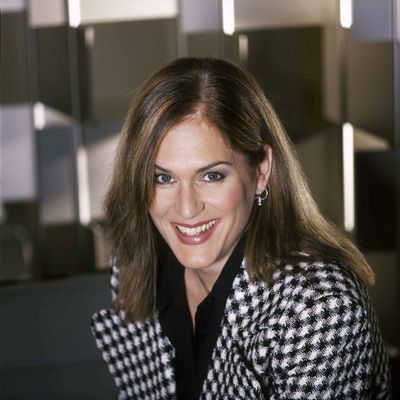
Mezzo-soprano Laura Pudwell

I’ve been watching her engaging performances for many years, fascinated by her effortless sense of comedy.  Yet Pudwell brings a genuine pathos when needed, as we saw in the Tafelmusik Hercules a couple of years ago, or as a soloist in the Mozart Requiem just over a year ago.  The vocal colours are rich, her expression & diction wonderfully flexible.  Those comic gifts will be foregrounded in Toronto Consort’s upcoming presentation of Cavalli’s 17th century masterpiece Giasone in early April.  On the occasion of assuming the title role I ask Pudwell ten questions: five about herself and five more about her work on Giasone.

1) Are you more like your father or your mother?

Mezzo-soprano Laura Pudwell

Mezzo-soprano Laura Pudwell

Interesting question!  I’ve always thought I look very like my father, but in recent years I see more and more of my mother in me.  I would still say I have more the look of my Dad than my Mum.  But in terms of personality, it’s my Mum all the way!  Of course this made for very interesting teenaged years… my brother used to refer to us as the clones, and I’m not sure he was being altogether positive.

Like my mother, I’m a very quick processor, in fact I do everything quickly, which is both good and bad.  I  learn quickly, make decisions quickly, make friends quickly, anger quickly.  You get the picture.  I’ve always wished I had my Dad’s calmness, rootedness, gentleness.  But my brother got all of that.

2) What is the best thing or worst thing about being a singer of historically informed performance repertoire?

The very best thing about singing the repertoire that I perform is the people I get to work with!  No question about that.  The creativity and talent is boundless, and collaborations are always fun and challenging. I get to work with some of the worlds most talented instrumentalists and singers, and am privileged to be part of every project I do.  I used to fret about being pigeonholed as an early music singer, but you know, I’m very happy where I am now.  I don’t think I would change a thing.

3) Who do you like to listen to or watch?

Curiously, I don’t listen to much vocal music.  I’m a cello fan, as is my son, so I listen to a lot of Rostropovich, Mischa Maisky, Jacqueline Du Pre. (Will  anyone ever play the Elgar Cello Concerto more beautifully?)   My son introduced me to a recording called The Goat Rodeo Sessions, with Yoyo Ma, Stuart Duncan, Edgar Meyer and Chris Thile.  Fantastic stuff.  And I confess that the popular bands of my youth still hold me in their power;  Supertramp, Led Zeppelin, Genesis,  The Beatles, The Rolling Stones.  But I also have a secret fixation on great tenors, and listen to them just for sheer heart-stopping beauty.  Caruso, Bjorling, Wunderlich, Pavarotti.

4) What ability or skill do you wish you had, that you don’t have?

Oh good grief!  Where do I start?  The list of what I can do is SO short.  I’ve always wanted to ski.  Well, I’ve always wanted to be not AFRAID to ski, which I guess is different.  And there’s the cello again.  Every time I watch a beautiful player, I think how great it would be if I could just sit down and pick up that lovely instrument and play it.  So sad.  And as the mother of two teenagers, I would LOVE to be clairvoyant so I could actually have some clue as to what they might be thinking…

5)    When you’re just relaxing and not working what is your favourite thing to do?

I’m a big reader.  Every Saturday after I finish the Globe and Mail cryptic crossword, I pour over the Book Section and make notes of everything that sounds interesting; biography, fiction, non-fiction, murder mysteries.  Sadly, my list is now so long I’ll never get through it, but I keep adding books to it anyway.  I also knit socks.  I have a largish family with very cold feet.

~~~~~~~

Five more about Giasone,  Toronto Consort’s upcoming production at Trinity-St. Paul’s Centre, Jeanne Lamon Hall April 4-6.

1) Please talk about the challenges in creating Giasone.

Well, the biggest challenge was certainly not mine!  Just creating the score, which our brilliant Artistic Director, David Fallis, undertook, was a very time-consuming, painstaking process.  That’s way outside my skill set.  Laura Pudwell PHOTO

I have done very few pants roles in my life;  I’m neither physically nor vocally suited for them, as they tend to be for higher mezzos.  Having said that, it’s always interesting to try to find a masculine energy, while clearly inhabiting a feminine body.  I had some very good success singing Nerone in Poppea, simply by channeling the energy of my children at around three or four years of age;  self-centered, impatient, unreasonable a lot of the time.  It seemed to work very well!  Giasone is clearly not the same sort of character as Nerone, so I will have to use a different strategy.  In the Cavalli portrayal of Giasone, he comes across as a rather devil-may-care womanizer, not so much heroic as opportunistic.  I haven’t quite figured out how to find that in myself yet, but I will.

2-What do you love about Toronto Consort?

Toronto Consort Artistic Director David Fallis

Oh boy, where do I start?  I have been a member of this group for 28 years now.  My first concert was in the Fall of 1986.  So obviously there is something compelling about this group of people and the music that we perform.  I remember auditioning for David Fallis and Terry McKenna, taking in some Abbess Hildegard von Bingen (I had discovered the Sequentia recording A Feather on the Breath of God and was compulsively listening to it)  I had no idea about performance practice, I’d never had a voice lesson, I just went in and sang how I always sing and was immediately asked to come and do a concert with the group, a kind of trial concert to see how I would fit.  Apparently I fit pretty well …  Almost everything I have learned about period performance of Medieval and Renaissance music has been through working with and listening to the members of this group.  We have covered such a range of time periods, composers, languages;  there have been some crazy collaborations (one of my favourites was about light where we performed a Christos Hatzis piece and the Perotin it is based on, and shared the concert with two throat-singers.)

But one of my favourite things about working with these truly wonderful musicians is the laughter.  We laugh a lot, about all manner of things.  There is such mutual respect and admiration among us that rehearsing is a real pleasure.  And I get to listen to them perform for free!

Toronto Consort

3) Do you have a favourite moment in Giasone?

I’m still making friends with the score, but I suspect there will have be two parts where I will have to bite my cheek not to laugh out loud.  The first is when Isifile (played by Katherine Hill) finds Giasone with Medea, asleep.  She wakes him up in a very startling manner, and proceeds to demand her due.  Having borne him his first set of twins, she has the right to be as unreasonable as she is.  Knowing Katherine, she will make Giasone squirm, and she will make ME laugh.  This could be bad.

The second moment that already makes me laugh, is a moment with Besso, Giasone’s right hand man, played by John Peppper.  He has been given quite cryptic instructions by Giasone, which will result in a murder.  He does PRECISELY as he is told, ends up killing the wrong person, and then explains himself in a most hilarious manner.  John will sing this so perfectly.  I’m already laughing, and I haven’t even heard him yet.

4) How do you feel about historically informed performances such as Giasone for a modern audience?

I would venture to say that most people will not ever have heard this opera.  They will likely be familiar with the story of Jason and the Golden Fleece, but might not know about the myriad distractions Jason faced in his search.  I mean really, twins with Isifile, another set of twins with Medea …

I think it’s important for anyone who enjoys opera to see how the threads of early opera are woven into the fabric of Grand opera.  From these early operas of Monteverdi and Cavalli and others, we see how continuo recitative can lead into the accompagnato recitative of Mozart, for example, and how the arias of later opera grew out of the short ariosi of these early operas.

I love how much freedom there is for individual interpretation in these earlier operas.  While there is of course a very clear structure, there is much more room for true collaboration between the singer and the continuo instruments.  Great continuo players, like the ones we will hear in this performance, will change the colour and feel of their playing according to each individual singer.  The performance can change substantially each night.

5) Is there a teacher or an influence you’d care to name that you especially admire?

Even before I started my almost thirty year career in singing, I had people who encouraged me to discover and hone my potential, and offered tangible support as well.  In 1985 I was working full-time for the Inter-Church Coalition for Refugees, and was asked to sing my first Messiah, in Toronto.  My boss, Kathleen Ptolemy, and her husband happened to choose that Messiah as their holiday concert, not knowing that I would be participating.  This remarkable woman offered to house me for a year with the understanding that I would pursue a career in performance.  My dear friend Edith Shore paid for my first year of singing lessons.  My teacher, Patricia Rideout, by sheer force of her warm, generous, no-nonsense spirit, got me to stand up straight and take responsibility for my own talent.  Despite her tragic, early death some years ago, she remains a cornerstone of my performance.

I have had the great good fortune to learn from some remarkable colleagues over the years.  The great Canadian soprano Henrietta Schellenberg taught me so much about how to work with a conductor and an orchestra.  Daniel Lichti has been an advocate and mentor for my entire career.  There are countless others whose performances have helped me to shape my own.

Perhaps my staunchest supporter and advocate has been David Fallis.  He was the first person to hire me after I made the leap into full-time singing, and he has been a constant presence in my musical life ever since.  His gentle, wise and generous counsel has helped me through many a rough patch over the years.  And he’s the smartest person I know!

~~~~~~~

Laura Pudwell plays Giasone in Cavalli’s opera in Toronto Consort’s upcoming presentation at Trinity-St. Paul’s Centre, Jeanne Lamon Hall April 4-6.

Posted in Interviews, Music and musicology, Opera | Tagged , , , , , , | 3 Comments

Voices to discover

The media give us interfaces with the arts.  Yes, we can go see plays, concerts & operas in person.  But what are the credentials of those voices on TV, radio, in newspapers and elsewhere?  We’ve all heard that  line “those who can’t do, teach”.  And do those who can’t teach criticize?

Don’t answer that….

Of course sometimes the question is answered decisively, as we encounter famous people in those roles.  Tenor Ben Heppner is the new host of CBC’s “Saturday Afternoon at the Opera”, after having turned up regularly in operas broadcast in that timeslot.  The name of drama critic Richard Ouzounian regularly turns up in programs, his work on both sides of the footlights.  No one questions Randy Bachman’s credentials as an expert host for his CBC program “Vinyl Tap“.

This preamble is subtext for three CDs I’ve listened to recently, conducted by another media figure.  If you listen to Kerry Stratton on CFMZ there’s no mistaking the authority in the voice, anecdotes from a life as a conductor, from a thorough knowledge of music & composers.  For what it’s worth, Stratton has one of the most beautiful speaking voices I’ve ever heard.

The three CDs I’ve been listening to establish his credentials.  I wonder sometimes how one gets to be a successful Canadian conductor.  I know of few in this rather tiny fraternity (and yes there are probably women, but I don’t know of any who hold steady jobs, aka “successful”).  I’ve dropped names such as Peter Oundjian, David Fallis, Derek Bate & David Warrack, along with many others who weren’t actually born in Canada.

While I have not yet heard Maestro Stratton conduct in person, the recordings are enough of a demo for me.

Two of the CDs represent music that I didn’t know.

click image for more information

First let’s talk about a CD titled “Music for String Orchestra” with compositions by Jean Françaix, a composer I’d never heard of.  Having listened incessantly to this recording by the Sir Georg Solti Chamber Orchestra, conducted by Stratton, I wonder how I missed hearing of Françaix, an authentic and unique composer from the 20th Century.  I wasn’t surprised to discover mention of Ravel & Poulenc in the Wikipedia article I just read, given what I’d heard.  This is a sure antidote to February & March, which is to say, positive & energetic, and nothing to encourage a surrender to the darkness of winter.

The CD includes the four movement Symphonie d’Archets, the Ode to Botticelli’s Birth of Venus, and music for the pantomime DieKamelien. Stratton has done a huge service in bringing two world premiere recordings before the public.  The luscious sound of this string ensemble serves Françaix very well indeed.

Why has this composer somehow managed to be under the radar, unknown, largely unrecorded?  The CD’s liner notes suggest indirectly why he’s not known: because he was so busy writing.  Where some composers busy themselves with their legacy, others are so consumed with creation that they neglect this other crucial task.  Not to sound critical, but I read somewhere that Sibelius spent the last decades of his life composing very little, and it’s the same with Rossini, who became a very wealthy man from a very prolific youth.  The music –electric & at times very witty—suggests something very sane about his preoccupations: that he lived in the present.

click image for more information

The second of the three CDs is someone a bit more familiar to me, namely Alan Hovhaness.  I’d heard a little bit of his music long ago and was, I confess, unimpressed by his late romantic sound.  Have I changed? Probably.  Or maybe I heard the wrong compositions before.

This time it’s the Slovak Radio Orchestra that’s led by Stratton, in a recording titled “Celestial Fantasy”, aptly named for one of the pieces on the disc, considering that most of the disc has a spiritual or religious focus.  But the music seems to reflect an eastern religion, reflecting Hovhaness’s Armenian heritage.  This God is glimpsed dimly from afar, a being of mystery and gentle inspiration.

click image for more information

The third disc is much closer to the mainstream, containing three marvellous pieces from Anton Dvorák performed by the Prague Radio Symphony Orchestra.  It begins with the Czech Suite, followed by “Songs My Mother Taught Me” in an arrangement for violin & orchestra. Yes these sound authentic, readings that stay in my head.  I was pleased to be serenaded internally during a dentist appointment today, by recollections of these haunting melodies.  The third item is one of my favourite pieces by Dvorak—or any composer come to think of it—namely the wonderfully inventive Serenade for Winds.

All three can be found on this website.

Stratton leads a performance of Brundibar by Hans Krasa next weekend on March 29th at BMTM Secondary School.  Click here for further information.

Posted in Music and musicology, Reviews | Tagged , , , , , | 1 Comment

Creature to Creature

Talisker Players’ program themed around the animal kingdom titled “Creature to Creature” was better than expected.

I should explain, because I love Talisker.  Why lower expectations?  Classical programs using music about animals usually condescend. Such compositions –however excellent—are relegated to playing comic relief, are infantilized, elicit mugging in the usually repressed world of classical concerts.  Or they are shuffled into a category sometimes known as “light music”.

That’s not what Talisker did, and thank goodness.  Only the closing set—by Flanders and Swann –caved in to the usual kind of broad comedy, and of course these songs earned the biggest applause of the afternoon.

And the featured creatures at the heart of Talisker’s matinee were “archy and mehitabel”, Alexander Rapoport’s adaptation of some of Don Marquis’ best known pieces for two singers, flute clarinet & string trio.  It’s a great choice of text even if it’s been done before.  But as we’ve seen with films of Shakespeare or Austen, a good text inevitably generates multiple adaptations.

I can’t deny I was resistant.  There’s an ambiguity on the page that disappears in performance, so any adaptation of a favourite book or poem must collide with preconceptions.  For example, I wouldn’t have given a cat who says “toujours gai” an American accent: or at least that’s not how I read it when I first encountered it years ago.  But Norine Burgess persuaded me, making a compelling case for Rapoport’s intriguing combination of styles in “the song of mehitabel”, using a voice that was sometimes decidedly feline, usually American, yet with the injured dignity of reincarnated royalty.  Geoffrey Sirett was every bit her match, although I think I wasn’t resisting his performance quite so much, as he sounded very much the way I would have expected archy to sound.

Composer Alexander Rapoport

I hope Rapoport’s composition gets further hearings, either in this kind of concert setting or perhaps with a fuller staging.  Coming the day after a matinee performance of Puppetmongers’ March Break show, I couldn’t help thinking that “archy & mehitabel” could work wonderfully with puppets (and please don’t accuse me of condescension or infantilizing in that formulation, because I don’t see puppets as something only for children. They should be part of a director’s toolkit, and something I’ve used in opera stagings on more than one occasion), or perhaps as a soundtrack for animation.

Rapoport’s songs give me hope, considering how original music sometimes vanishes without a trace after a single hearing.  The one place I had a tiny concern –and it’s minor—is that the last song had a somewhat pretentious & academic sound that struck me as a mismatch with the text, even if it was still catchy.  But overall his use of instrumental colour showed off the Talisker ensemble to great effect, while the texts were wonderfully lucid and among the most intelligible phrases sung all afternoon.  I’ll be hoping to hear these songs again someday, whether live or in a recording.  They deserve to be heard.

There were no weak spots in the concert, displaying Talisker’s usual combination of sung texts and readings by actor Ross Manson, juxtaposing different styles & periods:

  • “La Bestiaire, ou Cortège d’Orphée” by Francis Poulenc, setting poems by Apollinaire
  • “Creature to Creature” by Miriam Gideon, setting poems by Nancy Cardozo
  • “archy and mehitabel” by Alexander Rapoport, text by Don Marquis with supplementary text by the composer
    –intermission–
  • “Duetto buffo di due Gatti” by Rossini
  • “Rainforest” by Lee Hoiby, setting poems by Elizabeth Bishop
  • “Songs from The Bestiary” by Donald Swann (arranged by Laura Jones), text by Michael Flanders
Norine Burgess

Mezzo-soprano Norine Burgess (photo credit: Johannes Ifkovits)

The most intense music-making of the afternoon followed the intermission, first in a splendidly convicted and deadpan reading of the well-known Rossini duet, followed by three Hoiby songs that are new to me.  I can’t help wondering about the vicissitudes of programming, the choices by artists to sing a particular composer while ignoring another.  Hoiby (as well as his mentor Menotti) and their tonal approach appeals to me very much, even if it was a Tempest by English composer Adès rather than American Hoiby that premiered at the Met last season.  I suppose it’s a matter of who will champion you –singers championing composers, and perhaps vice versa—as a new generation of directors favour their own composers.  Burgess sounds wonderful singing Hoiby.  The three inter-connected songs of “Rainforest” meander about in tonal language that shows Hoiby’s usual sensitivity to the text.  Where composers of previous generations get caught up in introductory rhetoric, these songs are very direct, wonderfully expressive in their pulsing rhythms and bold use of instrumental timbres.

Talisker Players, Burgess, Sirett and Manson will be back at the Trinity St. Paul’s Centre for the Arts at 427 Bloor St West Tuesday March 18th.

Posted in Animals, domestic & wild, Music and musicology, Opera, Reviews | Tagged , , , , , , , , , , , , , , , | 1 Comment

The Miller and his Wife

There were two distinct parts to Puppetmongers’ shows today.   First came the magic, then the magicians –Ann and David Powell—explained their tricks.

The program is among their oldest works.  The Miller was first presented in 1974 and its sequel The Miller’s Wife in 1976.  Together –as The Miller and His Wife—the Powells revived this acclaimed classic over March Break both for matinees and evenings, with the last performances today Theatre Passe Muraille’s intimate Back Space.

Afterwards the Powells revealed some of their secrets in a question and answer session.    By the time you read this, Puppetmongers’ March Break run will be over, so that I can freely speak of elements that might otherwise spoil surprises.  In the plays we watch a bomb explode, a cat disappear into a cup of milk, a cake decorated.  The Powells happily deconstructed the effects.  David showed us the flimsy support for his flats.  Ann explained how there were two cakes because they do two shows a day, giving a whole new meaning to the phrase “sponge cake”.  We were shown the simple contents of the special effect that explodes at a climactic moment.

This show kicks off their Fortieth Anniversary Celebration.  To this pair of eyes the hardest part of this show might be ergonomic, considering that David & Ann spend a good hour bent forward slightly, in a position that looked painful, and that they admitted does get tiring by the end of each show.  As we come to the end of March Break I’m glad to know their backs are going to get some relief.

The talk-back felt like evangelism, as the perplexing revelations seemed to inspire more and more curiosity. With every discovery –of the banal and ordinary underpinnings of this magical world—the more the audience seemed to throng forward in the tiny theatre.

The children pushed forward as if trying to get onto the stage. I can’t help thinking that some of them will get there, someday creating their own magic.

Posted in Dance, theatre & musicals, Reviews | Tagged , , , , | Leave a comment

Pain and meds

The 1980s were a decade of pain.  It was a momentous decade for me including:

  • a marriage
  • the birth of a child
  • a divorce
  • another marriage

While lots happened –joyfully and painfully– on the outside, my biggest drama was going on under the surface, playing out in my body.  I suppose it had started long before, but really hit its stride in 1979, when I lost my stride, literally.  I developed a chronic limp for awhile, intense pain whose cause was a mystery to the several doctors I visited.

Yeah, you can imagine the conversations.  While I was offered all sorts of wonderful opportunities to be injected with cortisone directly into both heels –a spectacular sensation not to be missed, especially when the cure is to an unknown disease, one who wasn’t terribly impressed with the medicine—the symptoms were problematic.  Doctors can be fabulous conversationalists, particularly friendly when stumped.

1979 was the year of my break-down, when I couldn’t walk and didn’t know why.  I lost a job and suffered further ignominy via bureaucracy (a memory I’d suppressed until just now…), trying to explain and justify it to the worker’s compensation people.

But one must decide where to line up, as it were.  Certain key questions identify you.  “Did you develop this on the job?” I sure noticed it there, unable to take a step without agony.  And so if it’s worker related, that’s one thing.  But a chronic (genetic?) ailment isn’t really something you picked up on the job.  I stopped asking when I realized that I was as confused as the doctors.

I stumbled (literally?) upon a solution quite by accident.  I went through a period of drunken life, depressed, upset and puzzled.  I avoided the rock bottom of those who are not blessed & protected as I was and am. I moved in with family, rescued for a time, while I stopped all the bad things I’d been doing:

  • no alcohol (although I would later resume moderate drinking)
  • no smoking (this would lapse, but I’d eventually stop for good by the end of the decade)
  • no food excesses (sugar, salt, major carbs): as I accidentally stumbled upon a cleansing diet

My symptoms stopped.  Wow, I had no idea why.  But I was able to resume life, doing all the momentous things I mentioned above.  My doctor for most of this decade gave me the usual lecture, looking at my posture and concluding that I slouch, said with the usual pejorative associations.  Good posture and physical fitness seemed to associate with happy healthy people, while those of us whose shoulders & necks sloped forward? Perhaps not so diligent, not so happy nor so healthy.

When the more intense symptoms reared their collective head (if you’ll excuse the contradiction…. Rearing my head is getting harder all the time) at the end of the decade, I was more fortunate in my experience with the medical system, even though i still had that doctor who seemed intent on blaming me, perhaps because she didn’t like admitting that she didn’t know the cause of my symptoms.

Ha, it’s a brave person who can say “i don’ t know.”  I recall being moved by the way Northrop Frye said it in response to a question in a class at university.  This was a real mensch, someone who knew so much and so could say “i don’t know” without surrendering his competence.

Then I got an amazing gift.  My wife surprised me with a book about backs by a British doctor –and I am so sorry I can’t recall the author, arguably the single best book I ever read in my life.  I read about some new possibilities.  The book included a fascinating self-diagnosis flow-chart, whereby you plug in your symptoms to get a possible diagnosis.

Suddenly I saw a possibility, an explanation.  I had to live through the cognitive dissonance with my current doctor, who responded by shouting “who’s the doctor here”?  Imagine my nerve, challenging her wisdom, her hegemony, her diagnosis of bad posture?  She insisted I continue to see the specialist at a downtown hospital, follow the pathway in a book by a Canadian (ha, imposed Can-con!), and the program of exercise.

I remember standing in that hospital with the radiologist as we looked at the X-ray together, the wedge shaped vertebrae in my upper back.  I said to him “isn’t that exactly what ankylosing spondylitis (or “AS” as I know sometimes call it) looks like?” …because of course that’s what I’d read about in the British book, the possible diagnosis that gave me new hope.  Maybe I wasn’t just a lazy malingerer, faking symptoms and expending healthcare dollars needlessly.  He mumbled something in reply, more or less taking the party line with the doctor who needed to remind me who was the doctor.

While she was on vacation, my wife –bless her—got a referral from that doctor’s secretary to see a new specialist suggested by a friend of a friend.  There’s no way this would have flown when the Fuhrer was in town.  But even Nazis sometimes take vacations.

His name is Charles Bull.  I recall being able for awhile to say “he’s Wayne Gretzky’s doctor, Hulk Hogan’s doctor, and Leslie Barcza’s doctor”.   And he gave me back my dignity, something that had more or less been stolen by the implications of a decade of shame.  It’s funny, but when I asked him about the possibility of AS– but oh so humbly and cautiously for fear of being told to stand down, admonished “who’s the doctor here!” — he just smiled and said yes I looked very much like someone who could have the disease.

Of course he’d have to confirm it with the blood-test, for something called “HLA-B27”.  The test was so uncommon they had to ship my sample off to Guelph, but Dr Bull wasn’t in much doubt, having seen my X-ray.  And yes the blood test came back positive.  Apparently Hungarians are especially likely to get this disease, having the highest incidence (19% I think I recall him saying) of positive tests for HLA-B27. I would later hear that the slouchy posture of AS is decoded differently in Hungary, that such a body shape is seen as “distinguished”.  That made me stand a little taller.

Two prescriptions immediately changed my life.

1) The first was for medications.  I entered the world of NSAIDs, meaning stronger versions of the same drug class that includes Aspirin and Tylenol.  I had been waking up with pain in my tailbone area, sometimes with pain in my heels, as well as other assorted flares of hurt.

2) The second?  I recall Dr Bull telling me that we needed to build a layer of muscle to protect me.  And so I was sent to a gym where I was taught rehab exercises.

And Dr Bull sent me to the first of the rheumatologists I’d go to, who would monitor the progression of this disease.  It’s not a killer, just a chronic condition that –when I looked at the pictures of slouching deformed sufferers—scared the crap out of me.  When you see such prospects, you take your medication & you exercise, motivated by what lies unavoidably ahead.

That was 1989.

The decade closed with a new hope, a sense of beginning again.  My pain faded into a dull cloud, a new buzz –from the meds—that replaced years of soreness.  It felt like a miracle, a new beginning.  Life began anew after a curious delay.  After wandering through the 80s, confused and sore, I could stop feeling blamed and ashamed (as some doctors had left me feeling), because maybe it wasn’t my fault after all.

I’m looking back as I come up to another birthday, a full quarter of a century since the diagnosis (quite a bit longer when i include that period of frustrated inaction).  I wrote a bit about AS awhile ago, the discovery that has allowed me to lower my doses of NSAIDs to almost nothing: by looking at the roots of AS in dietary choices.  My experience shows me that I don’t need the big pharmaceutical guns, not when they carry so many risks.

One has to decide one’s pathology ultimately, between choices that aren’t always clear.  Reduce pain (NSAIDs) but maybe fry some internal organs?  Or stop the disease cold, but develop something really nasty due to the overpowering drug you’re taking (i said no to the doctor who wanted me to take Enbrel after hearing the risks she quoted)?

Or stop eating certain foods and –wow—reduce meds to almost nothing.

Just so long as I keep exercising & eat right.  For me that’s the magic bullet.  It’s counter-intuitive, but my body has taught me that sitting still or resting as a response to pain is a colossal mistake.  I’ve had to develop a more mature relationship with pain, which is to say, understanding the messages from my body that tell me how far I can go, how much stretch or exertion I can handle, and sometimes, what i can’t eat (when i get too cocky and resume eating starches).  Because of course it’s always been activity, not medication, that has been my chief guarantor of physical and mental health.  While I hardly take any pills anymore, the real prescription was that second item.  My real meds are the stair-master, the weight machine, stretching, walking,….  Sometimes I get too busy and forget for awhile.  Thankfully, my body never lets me forget.

So long as I remember to listen to what pain is telling me? so far so good.

Posted in Food, Health and Nutrition, Personal ruminations & essays | Tagged , | Leave a comment

Sondheim not quite by Sondheim

Marry Me A Little is 75 minutes or so of songs written by Stephen Sondheim.  These are songs that were cut from other shows and then assembled into a play by a bunch of other people.  It’s new at the Tarragon Theatre.  In some respects it resembles a musical like Mamma Mia, like a quilt the way it’s stitched from a series of independent & unrelated found materials.

But there are at least two crucial differences.
1.    These songs are unknown, so they don’t undermine the story being told in the quilting exercise (whereas we all remember those ABBA tunes)
2.    I love ABBA, but these are songs by Stephen Sondheim (!), which means they are designed for music theatre, and are fabulous material for good performers.

Can you tell that I loved it?  I am bowled over first of all by the achievement of stitching this quilt together into something that to my eyes and ears is coherent.  But maybe I should address how that was done, hopefully without giving too much away.

Marry Me A Little reminded me of The Method, whose idea of good acting would have performers give the impression that –instead of reciting lines—they speak the lines as they come into their heads, as though we were seeing spontaneous thoughts and impressions.  Musical theatre is often very daunting because of its artificiality, a contrived art that can seem totally fake and unbelievable.  Marry Me a Little completely sidesteps  that concern.

OR let’s phrase this in reverse, attempting to capture the process of the show’s creators, CraigLucas & Norman René.  How, they might have asked, do we make these songs seem to arise from genuine feelings in an authentic situation that’s not contrived or fake?  Their solution was and is very simple.  Marry Me A Little is self-reflexive.  There are two characters, namely “He” and “She”.  For this incarnation at least (NB I read there was at least one different way of doing this show, so maybe I should be attributing this idea to director Adam Brazier, not Lucas & René), He is a composer, finding his way through the materials not just as a performer but apparently as their creator.  He sings his way as though discovering the answer to his creative problems, first in solitude, then conjuring “She” up in his mind.

This discrepancy at once makes him more authentic within the text (as he seems to grapple both with his romantic self and his creative self, the one never far from the other) and in a real sense, shallower (in his solipsistic focus).  She is so much more vulnerable, the one who sings the title song that expresses romantic agnosticism (marrying a little being a cautious alternative to full-on marriage), and yet the bold & vulnerable one in their romantic dialogue who bravely puts her ass on the line.  As such her part is in my opinion much harder because she is so exposed, seeming at times like his very thoughts, flitting in and out, as elusive and changeable as an inkblot in a Rorschach test.  Elodie Gillett makes a very likeable ghost, and a three-dimensional phantom.

Don’t get me wrong.  “He” is a killer part, required to play keyboards, sing as though discovering an idea inside his head and then bringing it to life.  That electric sense of discovery, of something being born right in front of our eyes, is what I was referring to when I spoke of method acting.  Tonight I know I wasn’t the only one electrified, as I often noticed that special silence you get when the whole audience is leaning forward, rapt.

Adrian Marchuck, Elodie Gillett  (photo: Cylla von Tiedemann). Click photo for more info about the show.

Adrian Marchuck, Elodie Gillett (photo: Cylla von Tiedemann). Click photo for more info about the show.

This –particularly in the hands of Adrian Marchuk—is why I spoke of The Method.  Did the creators of this musical have the clever idea to suck us in by watching a composer trying to write a musical, thereby persuading us to excuse the appropriation of all these chunks of Sondheim that were found as if on the cutting room floor: excised from other musicals?  All I know is, it works. He works. Marchuk works.

And yet I know nothing about He or She.  These two are a virtual template, a blank space filled only with Sondheim and performance.  Why do we need to know anything?  Their plight is universal.  We glimpse Paul Sportelli’s hands on a piano upstage of the action –as though in the next apartment—playing sometimes, while for some of these songs it’s Marchuk who plays, sometimes inspired, sometimes pounding the keys in frustration.  It’s all so understated that the component parts are almost invisible: the music direction, Sportelli following the singers like their shadow, Linda Garneau’s choreography that seems merely like clever people being natural, not contrived movement, and Adam Brazier’s direction, ensuring that it all flows & coheres. There’s almost nothing there: except the whole world.

Marry Me A Little runs until April 6th, the best musical i’ve seen in a long time.

Posted in Dance, theatre & musicals, Reviews | Tagged , , , , | 2 Comments

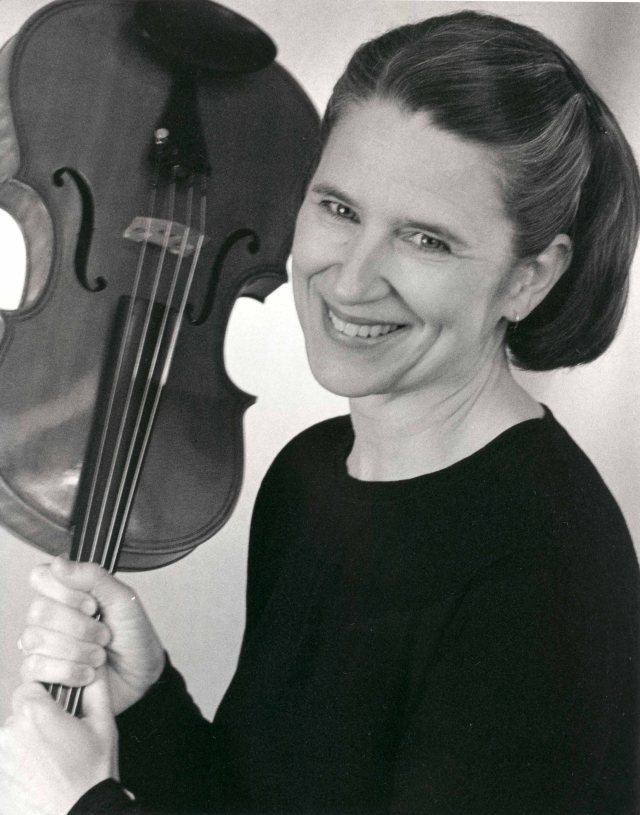
10 Questions for Mary McGeer

Mary McGeer is Artistic Director of Talisker Players Chamber Music, General Manager and principal violist of the Talisker Players Choral Music Orchestra, also principal violist of the Huronia Symphony, and performs with a wide variety of other ensembles in and around Toronto, from baroque to contemporary. McGeer was a member of the Phoenix String Quartet for 10 years. She is a teacher and chamber music coach, in Toronto and at the Soundfest String Quartet Institute in Falmouth, Massachusetts.

Click image for more info about “Creature to Creature”

If you’re a Talisker regular it won’t surprise you to discover that in additional to her musical background, McGeer also holds an MA in history and political science from Carlton University, has worked as a journalist and editor, and continues to write reviews and programme notes occasionally.   Originally from the Saguenay region of Quebec where she began her musical training on piano, she completed the Diplome Complementaire from the Universite de Laval.

On the occasion of Creature to Creature –Talisker Players’ next program upcoming March 16 & 18—I ask McGeer ten questions: five about herself and five more about her role as Artistic Director.

1-Are you more like your father or your mother?

I’m built like my mother, but I think perhaps my facial features are more like my father’s. Personality? – that’s an open question!  A little of each is the quick answer.

Both my parents grew up in Vancouver, but they moved east after they were married, and I grew up in the gorgeous Saguenay Valley, north of Quebec City.

Violist Mary McGeer, Artistic Director of Talisker Players

Violist Mary McGeer, Artistic Director of Talisker Players

2- What is the best thing & worst thing about being artist director of Talisker Players?

There are several best things.  Working with a great ensemble of musicians who have become close friends over the years would be first on the list.  Working with singers (our guest artists, many of whom have also become friends) is also fabulous.  The human voice is a glorious thing, in and of itself – and then there is the fact that they sing words, which adds a whole other layer of depth and meaning to the music we play with them.

I love researching this repertoire too – discovering new pieces and composers (and frequently new poets as well) – and building programmes.  And working with composers, talking to them about texts they’d like to set, getting a glimpse of how they think about words, music and instrumental colour.

The worst things?  Constructing rehearsal schedules.  And above all, the endless struggle for funding!

3- Who do you like to listen to or watch?

I spend quite a lot of time watching Turner Classic Movies.  Especially screwball comedies, but anything will do if it was made before about 1960.  The dialogue alone is so different from today’s movies – not to mention the clothes …

Much of my listening is music I’m working on, or thinking about programming.  But when I’m kicking back I most often turn to big-band jazz and the great popular singers of the 1930s and 40s.

4- What ability or skill do you wish you had, that you don’t have?

I wish I were better at current technology … sort of (I have a love-hate relationship with my electronic devices).  And I wish I could sing.

5- When you’re just relaxing and not working what is your favourite thing to do?

Reading. Anything – the newspaper, magazines, novels, history, memoirs.  Also, getting outdoors, even if it’s just a walk around the block.  And spending time with friends and family.

 *******

Five more about Talisker Players’ upcoming concert “Creature to Creature” March 16 & 18.

1) Please talk about the challenges in curating & performing a complex and literate series of programs for Talisker Players.

Our programming starts with the music.  Over the years, we’ve built a huge catalogue of vocal chamber music repertoire, cross-referenced in subject categories based on the texts.  From there, we build thematic programmes – but each has to be balanced for vocal and instrumental requirements, and also varieties of musical styles, etc.  Often we’ll think we have a terrific programme, and then realize that it needs four different voice types, or way too many different instruments – or perhaps worse, that all the music is the same instrumentation.

Sometimes we start with a particular piece, and then build a programme around it.  Everyone in the ensemble has a bucket list of pieces they really want to do.  The Britten Serenade for Tenor, Horn and Strings was on the list for several of us … also Les Illuminations (that was mine especially), and the Mahler Songs of a Wayfarer, in Schoenberg’s arrangement for voice and 10 instruments, Murray Schafer’s Minnelieder.  But of course, for every piece like that, there are several that we programme because they look kind of interesting, or just because they fit a particular theme – and then we discover that they are brilliant, and that is in some ways even more rewarding.

Once a programme is in place, there are all the issues of booking singers and players, juggling dates, and eventually, the rehearsal schedule.  Our programmes typically include at least a dozen singers and players, in six to eight pieces, each one with a different combination of performers.  Each piece gets its own rehearsal schedule, and it all comes together only at the dress rehearsal.

And then of course there are the readings.  In an odd way, choosing them is one of the most satisfying aspects of the process, because they tie the whole thing together.

2) What do you love about Talisker Players?

First and foremost, working with my colleagues.  Building programmes is interesting and fun, but the real payoff is putting the music together in rehearsal.  Once we’re there, I’m not so much the artistic director as just one of the ensemble, and it’s hugely rewarding to work that way – sharing ideas, shaping the music together.

We all love working with singers, too.  The relationship of music to text is endlessly fascinating, and the way they approach technique is often very illuminating.  Also, they tend to have a much more concrete sense of how to connect with an audience.

Norine Burgess

Mezzo-soprano Norine Burgess (photo credit: Johannes Ifkovits)

The singers on this programme are especially wonderful.  This is our third programme with Norine Burgess, who is one of Canada’s great vocal artists, and a joy to work with.  Geoffrey Sirett is a new discovery for us – and a very exciting one!

3) Do you have a favourite moment in the upcoming program?

I have known the songs of Flanders and Swann since my childhood, so the four animal songs on this programme are especially close to my heart.  Laura Jones, as always, has done fabulous arrangements for us.

Don Marquis, creator of Archy & Mehitabel

I’m also very attached to Alexander Rapoport’s new piece about Archy and Mehitabel.  Archy, the philosophical cockroach, and Mehitabel, the disreputable alley cat who was his sometime pal, were the creations of newspaper columnist Don Marquis, and very popular in the 1920s.  Rapoport’s piece brilliantly expresses the courage, the pathos and the sleaze of these characters.

And then there is Poulenc’s little gem, Le Bestiaire.  It’s a setting of short, enigmatic poems by Guillaume Apollinaire, for voice with flute, clarinet, bassoon and string quartet.  Eight performers, six movements – all in less than five minutes!

I’ll stop before I name every piece on the programme!

4) Talk about the upcoming program (Creature to Creature a 21st-century Bestiary) as a human in a world we share with animals. 

There’s a wonderful quote from Lewis Thomas, in his essay The Medusa and the Snail:  “We tend to think of ourselves as the only wholly unique creations in nature, but it is not so.  Uniqueness is so commonplace a property of living things that there is really nothing unique about it at all.”

5) Is there anyone out there who you particularly admire, and who has influenced you?

Composer Alexander Rapoport

Many wonderful teachers and mentors have influenced my personal approach to work and performance.  As artistic director, I am constantly inspired by the work of other organizations, large and small.  So much great work is being done these days in the arts.

*********

Talisker Players’ next program, “Creature to Creature”, will be presented at 8:00 p.m. March 16 & 18th at Trinity St. Paul’s Centre.

Posted in Animals, domestic & wild, Interviews, Music and musicology | Tagged , , , , , , | Leave a comment

Patrick DeCoste: Dreaming of Bear and Crow

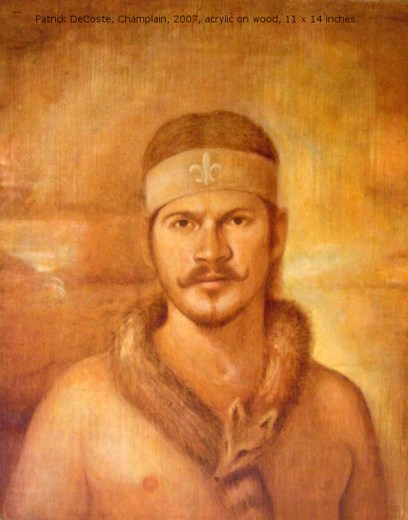
Patrick DeCoste: “Champlain (self portrait)”, 2009, acrylic on wood, 12 x 14 inches

There is a particularly Canadian sensibility that I crave, an attitude that feels all too scarce these days.  I crave a real sense of history, the kind of thing I grew up watching on the CBC & the NFB.  At one time we were very different from the Americans to our south, for our ability to be truthful about our past, without pounding on our chests in perpetual self-glorification. No, that’s wouldn’t be Canadian (at least at one time).  But to look ourselves square in the eye, perhaps with an ironic jest, even as we glorify our true achievements? That’s Canadian.

I felt that again today when I walked into Patrick DeCoste’s show on Richmond Street, a series of pieces that feel very much like part of a voyage of self-discovery.  He tells us so in the title of the show, which is called Dreaming of Bear and Crow: A Search for Métis Identity.  I should add that DeCoste is part French, part aboriginal (sorry I don’t  know which tribe), or “Métis”, like Louis Riel.

If I may digress for a moment, my favourite moment in Harry Somers opera Louis Riel is the  first scene, where we watch a bilingual encounter between some men who speak English (from the east) coming upon a barricade created by Riel’s men (in the west).  The encounter between cultures is magical, because neither really understands the other.

DeCoste’s show also concerns such an encounter, except it’s a first encounter between races from opposite sides of the sea.  Here’s DaCoste telling the story in a spell-binding little video.

My favourite line –if something horrific can be favourite– is when the shaman says

we have heard of these bearded men before.  Kill them or flee”

Every piece in the show is in some way connected with that remarkable shamanic dream.   My only regret is that there isn’t more art because everything I saw was fabulous, profound, and beautiful.  The quality of the pieces, both the craftsmanship –because we were dealing with art that is carefully made from exquisite materials like genuine animal skins –and the complexity of what’s being investigated –left me wanting more.

I have to believe we’ll see a great deal more from Patrick DeCoste.

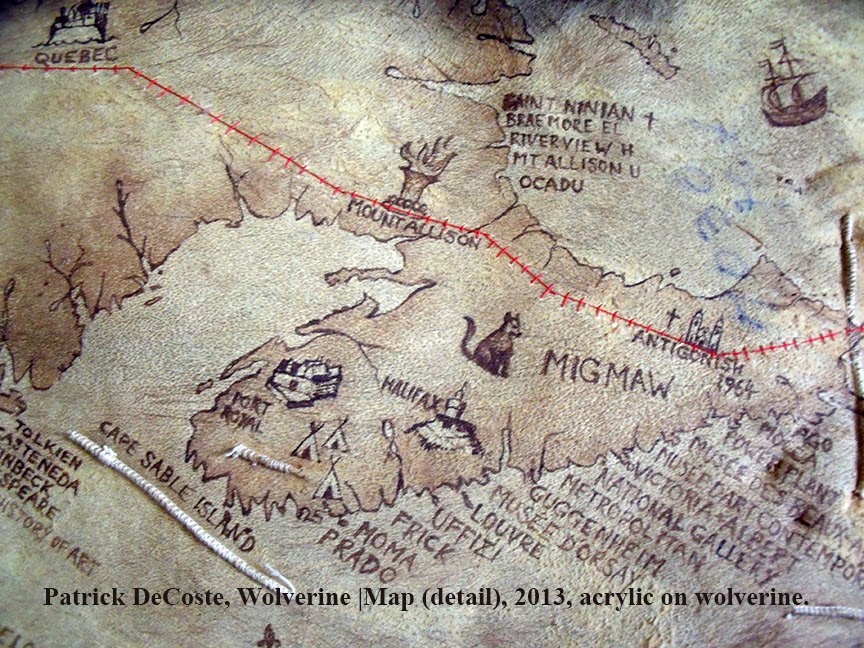
The story is at the interface between the aboriginals and the Europeans, a primal moment from five hundred years ago.  Sometimes DeCoste is gently faithful.  At other times he’s more of a trickster himself, playing with this whole inter-cultural encounter, as he leads us ourselves through that magical doorway.  We’re looking at objects resembling artefacts from long ago, such as a map on a wolverine skin.

Patrick DeCoste “Wolverine Map” (2013) mixed media on wolverine skin, 3ft x 4ft.

But you look closer.  What are those locations on that antique map? It’s Nova Scotia but the locations:

  • Prado
  • MOMA
  • Louvre
  • Guggenheim (etc)

Patrick DeCoste “Wolverine Map” (2013) detail, mixed media on wolverine skin, 3 x 4 feet.

His images can be ambiguous.  In the dream there were bears: but they turned out to be bearded men.  Notice how the men and the bears can be similar, both with bellies and unsure whether to walk on four or two legs.  A French priest strung up (martyred?) on the boat dangles above bear and man, with crows to keep him company.  We’re looking at a picture that isn’t so very different at first glance from many traditional aboriginal images, a more commercial & mainstream kind of art.  The surfaces, the high quality materials & workmanship make these prized objects to buy.

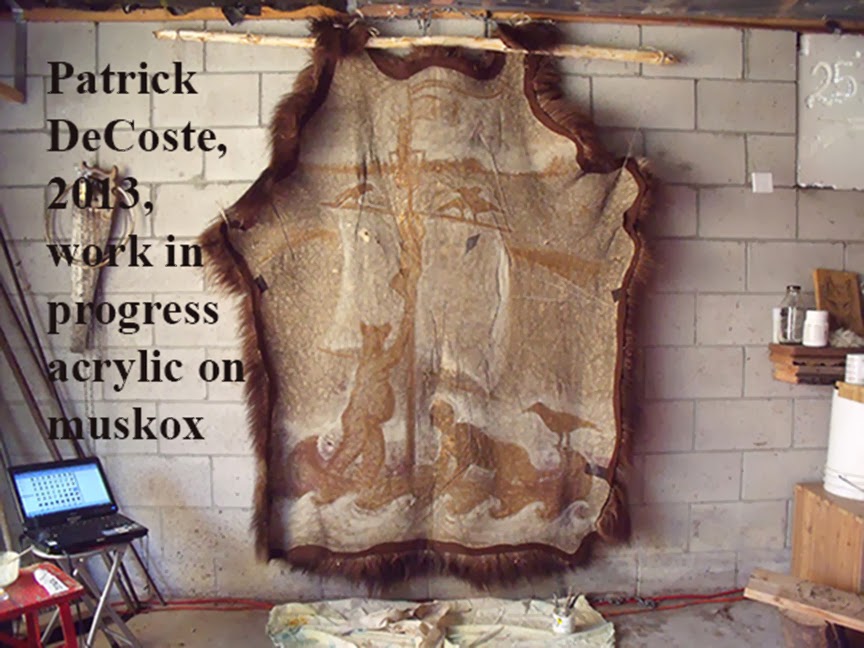
Patrick DeCoste: “The Dream on Muskox” (2013) work in progress, acrylic on muskox skin, 66 x 72 inches. Yes, it’s six feet tall.

Oh yes, I did ask the obvious question about that map on the wolverine. It’s already sold.

Dreaming of Bear and Crow: A Search for Métis Identity is on at the OCADU Graduate Gallery, 205 Richmond Street West, a the corner of Duncan until Tuesday March 11th.

Patrickatocadu.blogspot.ca

Posted in Animals, domestic & wild, Art, Architecture & Design, Reviews, Spirituality & Religion | Tagged , , , , | 2 Comments

Adams & Thomalla at RBA

Today’s free concert at the Richard Bradshaw Amphitheatre was an opportunity to hear composers John Adams and Hans Thomalla.  We heard them speak and then we heard their music.

The RBA is not to be confused with an ideal concert space.  It’s really a lobby space.  We either sit on an inclined plane –a staircase— or stand on the surrounding lobby space leaning against the railing to look downwards at performers.

Visually it may be the most beautiful place in the whole city.  Okay, quote me. Yes,  I think that when you add the music and the intimate views of  say a Thomas Allen or a Topher Mokrzewski or any of the other artists singing at the COC’s noon-hour concert series?  It’s almost forgotten that we’re floating in the sky while staring through glass at the commerce of the city, underscored by marvellous soundtracks like the ones we had today.  We watched a protest passing the American Consulate in front of us on University Ave, moving turbulently past us, but still only a ripple on the surface of our hour-long concert.

And the sound?  As your real estate agent will tell you, it depends on location.  And it also depends on what you’re hearing.  Last week’s gentle strumming of La Dafne was sucked up by the somewhat dry acoustic.  It’s a great space to hear singers, whereas I’m not sure it always serves instrumentalists well.  We hear detail with almost clinical precision, which is terrific when you’re hearing the finest voices or the best players in the country. Ah but one could wish for a bit more warmth, though, especially listening to an instrumental concert such as today’s.

A pair of pianists played a pair of pianos that weren’t quite identical (one lidless, one with its lid open).  Each of Claudia Chan and Ryan MacEvoy McCullough has a personal connection to one of the composers, as we heard in the introductions.

Pianist Claudia Chan (photo: Karen E. Reeves)

Adams spoke first, explaining his connection to the young McCullough –whom he’s known for five years—and decoding the title to the first item on the program, namely “Hallelujah Junction”.  Adams told us that it an actual place, and that he recalled thinking that it caught his attention as a possible title before there was a composition of that name.  The word “hallelujah” seems to have been a definite inspiration to the composer, a rhythm that figures in the piece.  Adams liked the phrase so much he used it again for a recent book he wrote as well.

I was mindful of the RBA acoustic during the performance of HJ. The piece is so full of detail, especially when the players are just slightly out of phase with one another, that it challenges the ear in more reverberant spaces: although perhaps Adams approves of that sort of effect.

Pianist Ryan MacEvoy McCullough (photo: Michael Lutch)

Next up was Hans Thomalla’s Noema, a work that is like yin to HJ’s yang.  Where the Adams piece is tonal, at times wonderfully tuneful and full of soul, Thomalla’s work feels like an experiment, a challenge as much to the listener as to the player, asking for a prepared piano, a few plucked notes, glissandi and even a few clusters played by forearm.  Thomalla told us he had been thinking of romantic composers’ etudes, citing Czerny & Liszt. There were a few moments when one could hear something allusive without really being imitative, like shards of a picture painted on glass that had been smashed, flashback memories rather than full-out quotes.  I felt Noema resembled more of an installation than a composition, a series of effects and moments,  some of which were rather intriguing and clever. Considering what the title means –for example one definition says “the object of thought”—I can scarcely be surprised that this music seems highly reified, so abstracted as to be an idea of a composition as much as it’s an actual composition.

CC & RMM gave a wonderfully clear account of Adams’ piece, full of youthful energy.  In the second work I was fascinated by the dynamics between them, making unique and diverse events out of the different parts of Thomalla’s piece.

For more about the pianists check out their websites:

Posted in Music and musicology, Reviews | Tagged , , , | 1 Comment

Unfinished dreams from Borodin to Putin

Today’s High Definition broadcast from the Metropolitan Opera (Dmitri Tcherniakov’s version of Borodin’s Prince Igor) threw me.  I’m sure I couldn’t be the only person amazed at how perfectly the show seemed to match what’s unfolding, while the world holds its collective breath awaiting Vladimir Putin’s next move or a response from the West.  The dark side of dreaming of world peace is the fear of annihilation in the madness of war.
Prince Igor? No nukes yet.  But he leaves Putivl to defend Russia against the Polovtsian invaders from the east.  He fails, falling captive to the surprisingly friendly Khan Konchak, leader of the enemy, while his son Vladimir falls in love with a princess.  In his absence, Igor’s brother in law seeks power. Before he can cause too much trouble, the invaders do a better job of it, destroying Putivl.  At the end, Igor returns to a city in ruins, blaming himself for what happened, and encouraging his people to rebuild.

I’ve wondered how to decode this story since I first encountered the work in an old film from the Kirov opera.  Yes, there have been different ways to assemble the fragments –of Borodin’s unfinished opera—pointing to different meanings. When that Kirov version has Igor ride into the sunset having apparently made peace with the friendly Polovtsians, it seemed emblematic of that ultimate melting pot multi-cultural state: the Soviet Union.  How should we decode the story now?  For example as a friend pointed out on Facebook the upstart brother-in-law Prince Galitzky’s name means he’s Galician: a foreigner.  But wait, in this story –where Igor’s son Vladimir falls in love with the daughter of his Polovtsian enemy—who isn’t a foreigner?  There aren’t countries in the modern sense after all.  If Galitzky is a foreigner, than so is Igor’s faithful wife (Galitzky’s sister).  Is inter-marriage code for alliance and even conquest?  In the 21st century it all reads differently of course.

Dreams figure prominently, both the waking sort that we think of as aspirations but also the kind that serve as story-telling devices, when we see something as though a character were unconscious.  In an interview during the interval Tcherniakov compared his utopian scenes in the first act to the island in Alcina, another place to explore archetypal possibilities.  For this purpose 12,000 fake poppies were crafted as part of a surreal design through which the half-dead Igor walks, encountering his son, Konchak, and hordes of dancers.  Just to ensure that we got it, Tcherniakov frames it with a black and white film, first showing the horrors of battle, and then Igor’s unconscious face, to which we periodically returned throughout and again at the very end.

Act II is a different mirror, reminding me of the morass of feuds at our City Hall and the attempts to curry favour with different factions.  Where Act I begins with a paean to the glory of Igor & his objectives, in Act II we see a kind of parody complete with half-hearted songs of celebration, where the prince’s brother-in-law takes advantage of loopholes and opportunities, a triumph of de facto wisdom fuelled by alcohol.  And then Act III is a remarkable mixture of darkness & sardonic humour, stripping away illusions and lies.  Igor returns to a people who continue to idolize him in spite of his failures, an admiration that inspires feelings of guilt and unworthiness.

At the beginning an epigraph is projected: “To unleash a war is the surest way to escape oneself.”  I wonder if Tcherniakov would say this to Putin..?

The Met performance was as stellar as one could wish, with Gianandrea Noseda leading the orchestra in a soulful reading.  The camera work was as intimate as ever.   Ildar Abdrazakov was a suitably heroic Igor, wonderfully conflicted throughout.  Mikhail Petrenko played up the dark comedy as the corrupt Prince Galitzky.  Oksana Dyka was a very moving Yaroslavna (Igor’s wife), while tenor Sergey Semishkur was spectacular as their son Vladimir.

I don’t know how it comes across in the opera house, but this presentation felt like a movie, with its frequent use of filmed sequences, often in black and white.  Tcherniakov’s interpretation is like a defense of Borodin’s score, arguing for its greatness.

The schedule says that encore showings will be offered April 12 & 14, but the best way to be certain is to contact the theatres.

Posted in Cinema, video & DVDs, Opera, Reviews | Tagged , | 4 Comments