Worth Waiting for Julie

There is much to admire in Louis Dufort’s opera Julie Sits Waiting.  It’s conservative to suggest an opera “belongs” in any sense to the composer, particularly a work that’s clearly a collaborative work across several disciplines.  Call me old-fashioned.

Louis Dufort

Composer Louis Dufort (Photo: Diane Charland)

But I am persuaded by the authoritative voice of Dufort, whose score won me over almost from the first moment.

I’ll try to explain myself without giving too much away, as the work deserves your attention, and calls me back for at least a second hearing.

JSW is a little over an hour long, featuring two characters, namely Julie and Mick, portrayed respectively by Fides Krucker and Richard Armstrong, as middle-aged lovers.  When we’re not listening to the pair either together or in a solo by one or the other, we’re listening to some sort of musical interlude between these segments (perhaps they’re scenes?).  I suppose these passages are reminiscent of what Debussy or Berg did in their operas, giving us a non-verbal/non-vocal contrast to what had just gone before, and amplified by Jeremy Mimnagh’s projections.  Those reflective interludes alone –Dufort’s music withMimnagh’s visuals –are wonderful oases from the volcanic passions stirred between the singers.

The work seems genuinely operatic.  I say that because a number of opera companies have been offering works that aren’t actually opera, whether it’s Queen of Puddings’ Svadba (which was more of a song cycle), Against the Grain’s The 7 Deadly Sins (and Holier Fare), the recent A Synonym for Love, or the Canadian Opera Company’s mixed program of The Nightingale and Other Tales (combining opera with songs & instrumental music).  Clearly the city has such an appetite for opera, that producers look everywhere.

And so, while Dufort’s score is at times very unconventional –mixing sounds that are recognizably musical with others that are closer to what we’d call noise—there’s no denying that JSW is opera.  And perhaps more importantly, it’s a work that needs to be operatic.  Sometimes one encounters texts that don’t really need to be sung, or music that doesn’t connect to its story.  But JSW is a synthesis of its media, requiring the words, the music, the singing & the theatrical presentation to work its magic.

It’s true that I found myself fighting Tom Walmsley’s libretto at times early on, yanked out of the story by poetic turns of phrase that killed the illusion, by reminding me of a poet trying to be a poet.  And yet it made sense when I discovered that Mick is an Anglican priest, and therefore likely to make ostentatious and occasionally pompous turns of phrase.  Perhaps on second or third hearing I’d be less likely to fight with the text; but it felt as though  everyone else in the team –particularly Krucker, Armstrong, Mimnagh & Dufort—selflessly worked to create a seamless whole, without calling undue attention to themselves. Maybe this is a reflection of the fact that Walmsley’s text was the departure point for everyone else… (and therefore not his fault)?

Richard Armstrong

Richard Armstrong

Considering how short the work is, they grab us quite quickly, and for that Walmsley deserves credit, an economical exposition.  It’s a truism that opera can’t move as fast because words that are sung simply take longer than those that are spoken.  I would have wished that Walmsley and Dufort had slowed down, in fact, repeating more phrases (and not trying to make the singing quite so naturalistic).  There were many moments that I wanted to last much longer.  The work felt quite short to me, but oh so economical, getting down to business without any hesitation.  The opera is sixty-seven minutes long, which is likely a brilliant choice when reconciling expenses & the desire to be a commercial success: but I would be very happy if the same opera were simply expanded by another 20-30 minutes.  I didn’t want it to be over.

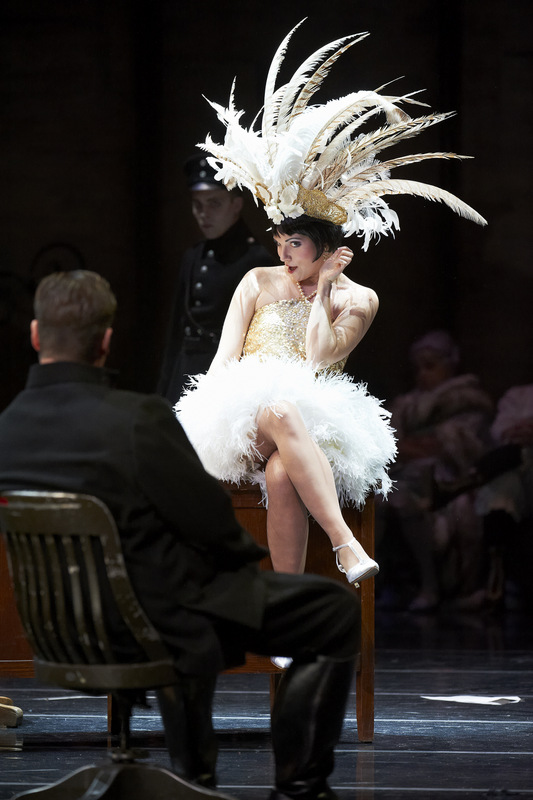
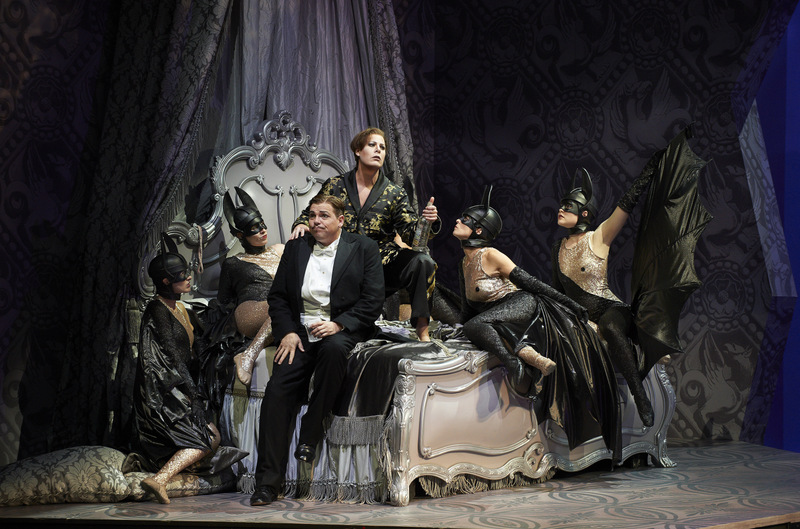
Directed by Heidi Strauss and Alex Fallis, there are many moments of great beauty, striking compositions of the two bodies on the stage.  Speaking as a middle-aged man, I was delighted with the frank eroticism of the work, the genuine physicality Krucker & Armstrong display.  Yet what will stay with you longest is sound.  I am still hearing the echoes of their voices, used in so many ways.  The title –so suggestive of passionate contemplation—is in no way misleading, even if the work is far from static.

Julie Sits Waiting continues at Theatre Passe Muraille Backspace until Sept 23rd.

Posted in Reviews | 4 Comments

September Buzz

In the circles I share in person or online I am thinking about the question of buzz, to which I alluded recently.

Julie sitsI’m excited to be going to a brand-new opera tomorrow night, namely Julie Sits Waiting.  It’s hard for there to be a buzz before anyone has heard a new work, so we shall see how “she” (Julie) is received at her opening.  Newness excites me, so I am sure this will be fun.

In the meantime, TIFF has drowned out any other sort of buzz.  When paparazzi from all corners of the globe suddenly learn how to spell “t-o-r-o-n-t-o-“ and even start clogging our streets, chasing the beautiful people, live performance, particularly of classical music & opera, can be forgiven if it doesn’t just fall by the wayside, but cowers, daunted in comparison.

And so, my question is not so much “what’s next” as “what is the next thing you’re interested to see and hear”?  I will offer my answer: an opinion about what I think should be getting the attention.

fledermausketeer

One of the Fledermausketeers, in Constance Hoffman over-the-top designs. Note, the best pictures can be seen via the COC’s Facebook group (click on the image).

So far in my small corner of the world, the new Canadian Opera Company Die Fledermaus is more than holding its own, and that’s probably according to plan.  I would bet that the COC are making the effort to show us flamboyant photos of the Fledermausketeers, confident in their other fall offering.  When the other opera is Il trovatore starring Ramón Vargas, Elza van den Heever, Elena Manistina and Russell Braun, there’s likely no reason to worry that nobody is yet discussing it.  After all, both of these operas open at the end of this month (Trovatore on Sept 29th, Fledermaus onOctober 4th)

There’s another entry, though, that deserves buzz.  Nobody that I am aware of has yet said anything about it, but I get buzzed just thinking about Opera Atelier’s Der Freischütz.  Set to open October 27th (when the COC operas would be coming to their last few performances in their runs) the first historically informed Der Freischutz in Canada is definitely news.

I have to wonder if that whole historically informed performance (HIP) smokescreen has been counter-productive for Opera Atelier.  Not long ago, as we sat around the table for the last COC podcast, discussing our personal highlights of the past season, nobody mentioned Opera Atelier.  I wish I had remembered to at least give their Don Giovanni a mention.  The HIP discourse, a conversation that has served to shelter Artistic Director Marshall Pynkoski from certain kinds of criticism is like a sword that cuts both ways.  I believe that as a result of their constant emphasis of HIP, Pynkoski has been under-estimated as a creative force in this city, and therefore not getting the credit he richly deserves.  His Don Giovanni was a very witty take on a work that I thought I knew inside out, a breath of fresh air.

David Fallis

Opera Atelier’s resident Music Director, David Fallis

When they come to the romantic music of Freischütz I expect Pynkoski to be as original as he’s already been with the baroque and classical periods.  Much will depend on David Fallis, back from Glimmerglass with a fresh score–and a different century– to conquer.

So what about it… what are you looking forward to?

Posted in Essays | Tagged , , , , , , , , , | 2 Comments

Backbone and the moral high-ground

As a Canadian I am sitting back, wondering whether Barack Obama will be re-elected or not, and what impact if any, we’ll see from these events north of the border in Canada. It makes great television, a dramatic pageant ritualistically enacted every four years.

Last week at the Democratic Party’s national convention, there were several moments that have been touted as the highlight.

  • San Antonio Mayor Julián Castro’s charismatic presentation
  • Michelle Obama’s appearance
  • Bill Clinton’s stirring speech
  • …and of course there was Obama’s own acceptance speech.

These and several others are still present in my mind, yet one phrase keeps coming back to me.  It came from Massachusetts Governor Deval Patrick.  The phrase, as soon as I heard it, jumped out precisely because it’s not like the usual polite language from the Democrats.  Oh no, this sounds more like the kind of language used by the GOP to attack the Democrats.

You can hear the whole speech if you missed it.

Roughly five minutes into it, Patrick said the following:

If we want to win elections in November and keep our country moving forward, if we want to earn the privilege to lead, my message is this.  It’s time for Democrats to grow a backbone and stand up for what we believe.

That’s the phrase that I can’t stop thinking about, can’t stop using in my conversation.  Democrats need to grow a backbone.

Why?

While I don’t really question their resolve, this is the party of civil discourse, the ones who, if confronted with a rude and irrelevant question, have typically answered politely even when it was insulting or stupid.  In the process the Conservatives easily seized the initiative in almost every instance.

As I remember it, the big change was with Ronald Reagan.  Before that time?  Democrats stood on the moral high ground, proud of their alliance with labour and unashamed of their legacy of big government via FDR’s New Deal.  These were proud achievements…!

But Reagan changed all that.  Big government came to be a sin. The mythology of big government and spending was created at this time and seized the public imagination.  Being “liberal” went from being a synonym for being caring or trust-worthy, to being the ready insult, hurled by conservatives to defame liberals.

We saw a generation of liberals falter, suddenly apologetic about the things they thought they believed, suddenly hearing silence or even jeers where a few years before, they’d heard cheers.  And so they dithered and became indecisive, seeking someone who might lead them because they lacked conviction and certainty.  They strayed from the true path, while the Conservatives found their way.

Where Reagan or either of the Bush presidencies were firm against criticism even when they were caught red-handed, on the Democratic side?  With the single exception of Bill Clinton, liberalism had lost its mojo.

In actual fact the only Democrats who broke through since 1980—Clinton and Obama—were more conservative than Canadian conservatives such as Harper or Mulroney, two Prime Ministers who never dared challenge the sanctity of our social safety net or our national medical plan.  It’s sad that the only way Democrats could win was by becoming ersatz conservatives.

And what good is that, really?

No, things seem a little different this time.  The language at the convention last week was no longer apologizing for the achievements of government and the rationale for taxes and cutting the deficit.  At last I heard Democrats willing to stand up for what they believe in.

This is the payoff for the downturn in 2008: that capitalism has a lot of explaining to do, that the GOP rhetoric has less and less conviction.  For once, the Democrats don’t have to be just another version of conservatism.  They can actually move a bit to the left for the first time since George McGovern.

The idea that the Democrats can stop apologizing and actually be brazen and arrogant about their beliefs is still a new idea.

What does a Democrat with backbone sound like?

  • Calling trickle down a fantasy, rather than politely discussing it.
  • Ridiculing the lies of their opposition

And here’s my current favourite from Chris Kluwe of the Minnesota Vikings.

Kluwe

Left to right: Chris Kluwe of Minnesota Vikings, Baltimore Ravens linebacker Brendon Ayanbadejo and Maryland state delegate Emmett C. Burns Jr

If this is what Deval Patrick calls “the election of a lifetime”, one needs to be ready.   Whatever side you’re on, a backbone is going to be handy.

Canadian conservatives have long had role-models in the USA.  I have to wonder whether liberals (and the NDP) might also pick up some tips from south of the border.

Posted in Essays | Tagged , , , , , , , , , , , , , , , , | 1 Comment

Once is not enough

We know that technology is changing rapidly.  Can you imagine that human perception would somehow remain unchanged, or is it more likely that with all the new platforms, applications, and media, that our brains might work in new ways?

Such questions are on my mind because…

1)      I was watching the American conventions on television (last week was the GOP, this week it’s the Democrats’ turn).  It’s been at least a half-century that we’ve been speculating about the impact of media on the electoral process.  The results of US Presidential election in 1960 were among the closest in history, likely influenced by the televised debates.  Since that time we’ve seen increasingly sophisticated forms of persuasion, from the use of attack ads to the recent mobilization of social media.

2)      September is the traditional back-to-school month, a time to reflect on education and the educated.  The nature of intelligence seems to be changing, with new skill-sets emerging from our recreation.

3)      September means TIFF (Toronto International Film Festival), as film-goers’ thoughts turn to cinema.  The new technologies have changed the ways films can be made, but also changing the nature of the filmgoer.

When the sensibility of the circus was confined to a different place & culture to the mentality of academic scholarship –to name two usually distinct discourses segregated by genuine boundaries—there was no problem.  You might occasionally see circus acts on Ed Sullivan or on a street corner, but never at a conference or in a journal; and nobody expects to hear a conference paper at the circus.

Modern media have changed that, probably forever.  While I can find PBS or some other educational channel on my television, offering a patient and thorough analysis of news, a click of the remote takes me to music, sports, or a host of other sorts of instant gratification, requiring far less time to unfold. The juxtaposition of wildly divergent media is far more extreme on other platforms such as your iphone or PC.

Or maybe the changes we seem to see in humans are a matter of taste.  Whether we’re talking about a political speech, a lesson in a classroom, or the cinema, communicators have been told repeatedly that humans have a shorter attention span than in former times.  It may not even be true, but just a low estimation of human behaviour that encourages our audiences to sink to the lowest level, a cowardly refusal to challenge the listener.

No wonder that all discourses seem to be different.

When I go see an opera nowadays, it’s a rare director who allows the overture to play with the curtain down, and no visuals added: trusting the musical text to do its job.  No, the usual practice is to add something, as if the audience might pull out their iphones and start tweeting their bored displeasure.  While I am open to adventurous direction –and embrace the wildest examples of Regietheater—I still feel estranged from these classical media.  I am intrigued to see concerts with additional visuals added (for instance, the butoh-influenced movements of Melati Suryodarmo during the Beethoven Marathon), and accept changing fashions.  But in another time, I recall being hypnotized by performers in black, a bottomless well of inspiration to be found simply in the body language of a performer in concert even before the music starts.

And some works simply don’t unfold in a single hearing.  Gustav Mahler is my touchstone for the way our ears and eyes may be educated.  Mahler only came into his own in the half-century after his death through the medium of recording.  Curiously, technology (regularly dissed for changing us into an ADHD world with no ability to concentrate) was part and parcel of a change in how we understand music.  Richard Wagner’s Ring operas (once among the most popular operas in the world, if you go back a century) are again being produced more and more in the last decade, likely because of such influences as

  • The saturation of the market with many recorded audio versions
  • DVDs capturing different directorial interpretations
  • Social media to generate buzz for particular directors, productions & opera houses
zizek

Philosopher & Freudian Slavoj Žižek

For much of the past century it’s been a truism that opera is dead.  Slavoj Žižek– a Freudian critic writing in Opera’s Second Death—alleged that opera had been killed by Freud. How?  Opera had been our therapy, our place to go to cry in the dark, and now, said Žižek, western culture uses a shrink instead.

I don’t buy it.  If opera was killed –and I don’t think it was—there’s a smoking gun.  The last opera to enter the ranks of the most popular was Puccini’s Turandot in 1926.  Coincidentally, talkies date from 1927.  Since that time?  One can look to Prokofiev’s operas, but must also remember his scores to Alexander Nyevsky or Lieutenant Kijé.  Bernard Herrmann set Wuthering Heights, but does one need to even bother to ask who’s heard it, compared to those who might have heard the scores to Vertigo, Citizen Kane, Psycho, or Taxi Driver?

Oh sure, I can hear you say.  Opera isn’t the same as film.  Perhaps not.  But what is the real difference?

  • That in film, the composer is cut down to size (as one of several post-production collaborators held to firm deadline), whereas in opera –to paraphrase Kerman—“the composer is the dramatist” (and therefore the deal-breaker).
  • That in film, the composer makes a ton of money, whereas in opera, a composer might make money but needs another job, perhaps at a university or working in film & TV.
  • That in film (at least the commercial sort of film), the audience usually expect the work to be intelligible in a single viewing, whereas opera is more demanding.

Remembering the Mahler-Wagner dynamic I spoke of above –where some works require multiple hearings to really be understood and find their true audience of devotees and maniacal fans—new opera is in a difficult place.  But it’s been in this difficult place for a long time, perhaps its entire history.  In 1800 –when there was no alternative, and when a composer such as Rossini could pump out an opera in 3 weeks—this was a viable model for a commercial money-maker; note too that Rossini’s operas were eminently intelligible.  By 1900 this was still possible, even though composers were becoming increasingly remote from their public, whether in the complexities of their sonic world or their stories.  And so I believe opera was later in competition with film, just as it had previously had to compete with other public entertainments throughout its history.

Nowadays?  “Opera” normally means something rarefied, complex, difficult.  Opera could also include something written for immediate consumption, but considering the expense & the challenges of production (for one tiny example, getting a cast of singers to learn all the parts), it rarely works that way.

Singer Fides Krucker

Fides Krucker, who appears in Julie Sits Waiting, beginning Sept 14th

Those devoted to the medium include composers & performers willing to invest the time even if there is no promise of a future production.  My recent 10 Questions for Fides Krucker brought me into contact with someone committed to the medium of opera and theatre. From a commercial standpoint, it’s almost incomprehensible to picture opening a factory with an assembly line to pump out a single widget, and then close the factory. Clearly artists like Krucker aren’t motivated by money, but are as devoted to voice and theatre as if this were their religion.

I fervently believe we’re talking about changing taste not actual changes in cognition.  Media and technology are supposedly the problem (for the alleged change in our collective attention span) but also sometimes offer solutions (ie in helping Mahler & Wagner find their audience).  Can there also be a solution for the composer of the new opera?

I think for example of the way Justin Bieber or Valentina Lisitsa invented themselves on youtube.  Could someone do the same thing with an opera?

In any case I think it’s premature to suggest that opera is dead, too soon to dismiss technology as bad for culture.  For every Bieber there’s a Lisitsa.

We’ll see.

Posted in Essays | Tagged , , , , , , , , | Leave a comment

Crossover Kaffe

“Crossover” is a word used to describe artists venturing into a new discipline.  It’s not always a complimentary epithet, considering that

  • What some will celebrate as a new arrival others may perceive as an invasion
  • Expectations aren’t necessarily very high, given that the artist’s expertise is understood to lie in the area they have deserted rather than the one to which they’ve migrated
  • They may have some of the qualities of an exile, looking back from their new location to their former home
Kaffe Fassett

The exuberant colours of Kaffe Fassett

I’ve been looking at Kaffe Fassett’s new autobiography Dreaming in Color, and that’s what provoked me to contemplate the subject of crossover.

In Fassett’s case there are a number of ways in which the epithet might apply.  Fassett is a visual artist who found himself in his ventures into such diverse media as the design of yarn & fabric, patchwork quilting and needle-point, making an impact far greater than anything he achieved painting.   His disciplinary moves parallel his physical displacement from his roots in America to a new home in England (since the 1960s).

I found myself thinking about crossover looking at the images in Deaming in Color, a book unlike any autobiography I’ve ever seen.  For one thing, it’s a picture book, which would only seem like an odd way to write an autobiography to a biographer.  In effect the book flouts the usual procedures understood for such an undertaking.   A picture book to tell a life story?  That’s odd only to someone whose discipline is words, whereas a visual artist would think it odd to work any other way.

Dreaming in Color

Red Red Bobbin is hosting Kaffe Fassett and Brandon Mably to conduct a Lecture October 2nd (click image for details)

The book is a perfect example of crossover.  Only the most consevative critic could find it deficient (for having departed from usual procedures) but its breakthrough is precisely in disregarding procedure, while instead allowing the new disciplinary influence to illuminate and inspire.  Who cares if it’s an uncommon approach to biography, if good visual art & design practices inform the book?  I had a hard time putting it down.

Of course Fassett is now a mature artist looking back on decades of creativity.  Dreaming in Color is a comprehensive survey of his development, now available.  The title is perfect considering this man’s obsessive love of color.

Posted in Reviews | Tagged , , , | Leave a comment

10 Questions for Fides Krucker

Fides Krucker in white

Fides Krucker (Photo by Jeremy Minmagh)

Fides Krucker is an inter-disciplinary vocalist, a performer, creator and teacher specializing in contemporary vocal repertoire: prolific, versatile & regularly involved in new creations here and abroad.

Krucker is known for her performances of Canadian composer R. Murray Schafer’s works and has also premiered new operas by several dozen composers both at home and throughout Europe.  Krucker is particularly interested in bringing extended vocal techniques into the development of new work.  Her interdisciplinary work has included work with dance theatre company Jumpstart!, hologram artist Mary Alton and writer/director Thom Sokoloski for the music drama Artaud’s Cane (for which she received a Dora nomination in composition).  Krucker started Good Hair Day Productions, and is a founding member of and producer for the interdisciplinary female collective, URGE.

As a teacher Krucker is in high demand for private and group voice classes in Toronto by singers, actors, dancers and non-performers.  Krucker’s writing on voice/body work has been commissioned and published by the Canadian literary journal Descant and her teaching has been profiled in magazines such as Chatelaine.

Krucker Berio

Fides Krucker (Photo by J.Evan Kreider)

You can read a more detailed account here

Krucker’s next project, Julie Sits Waiting, from Good Hair Day Productions, with libretto by Tom Walmsley and music composed by Louis Dufort, opens Sept 14th 2012 in Theatre Passe Muraille BackSpace.

I ask Krucker 10 questions: five about her and five more about Julie Sits Waiting.

1) Which of your parents do you resemble (what’s your nationality / ethnic background)? 

I think I resemble my father…he is Swiss…both my looks and certain aspects of my behaviour. As I age I feel my hips tighten a little further – like his – and the bags under my eyes become more pronounced. My dad was always fiery and the ‘Krucker temper’ a bit legendary. The good part of that…his drive…was something I absorbed when I ran his business, a large wholesale bakery, in the early 80s. I feel it is the engine of the urge that has had me take on creating, commissioning and producing new work since 1991. During the time I was working for him I remember being surprised by a very astute comment he made about Faure’s Requiem. He was far more creative and sensitive than his career path might have indicated. I look less like my mum (she is a red head whose ancestors came from Scotland in the late 1700s) but feel more and more respect for her way of being – patience, a certain non-explosive grace under fire, an ability to reframe things once reality has made its point. She is my ‘Yoda’ these days. There is a history of art and music in her family as well as his, and a deep loyalty to ideas and people. I feel I am rediscovering my inheritance from her now that I have had my 3 decades of rebellion and individuation! Still, I am slightly spooked when my voice sounds like hers in a random moment.

2) what is the BEST thing / worst thing about being a singer creating original work?

Fides Krucker singingI love being involved, through improvisation, with a composer’s process of creation. It varies with each project – sometimes I may feel more like I have co-created or even composed my vocal lines and other times I feel that the raw material I have provided gives the composer a different shape for the sound of the female voice. Following the textures that I find interesting and pleasurable and the melodic curves that speak to me feels really satisfying on a visceral and emotional level. So it is freeing! But then it comes back on the page – and whether it is really similar to the original improvs or wildly transformed through the composer’s aesthetic – the hard work of ‘learning the freedom’ has to happen at this point. Sometimes finding a way to integrate apparent freedom with technical repeatability and musical precision makes me wish I had offered an easier sound idea in the first place!

3) who do you listen to or watch?

I get youtube crushes. So Anne Wilson of Heart singing ‘Crazy on you’ at the 2000 Women Rock Concert – so connected and so beautiful.  Diana Damrau in the Queen of the Night – steely precision – spine and sparkle! James Brown and Pavarotti doing a duet of ‘This is a man’s world’ – each of them animal in his own way. Janis Joplin and Tom Jones trading off in “Raise your hand” ….the hip action is fantastic as well as the joy in one another’s prowess. I love to contrast two performances of ‘Stairway to Heaven’ – Robert Plant with Mary J.Blige – the feminine and the masculine illuminated in new ways. This makes me laugh as I used to think my younger brother was an idiot for liking Led Zeppelin as a teenager. I loved Bach!

As for opera, I have really enjoyed the joy in Adrianne Pieczonka’s voice and the balance of light and dark in Russell Braun’s performances. We are lucky to be able to hear them live here in Toronto. I was brought to tears watching a dvd of Dawn Upshaw in Peter Sellar’s production of Love from afar just a few months ago.

I was very soothed at one point in my life by Eva Cassidy’s voice and inspired by her abandon and clarity.

Matti Salminen – a Finnish bass – encouraging a type of carnal reaction deep within me to his sound. Jackie du Pres on cello – arriving at a rehearsal and asking “what will we be doing today?” – her repertoire so much a part of her that she could manifest extraordinary ease as well as passion. Eve Egoyan playing Alvin Curran or Ann Southam and guiding me to new ways of hearing.

I am curious about hybrids that could form – morphing Disney’s Snow White with Etta James. Can we map our own evolution through borrowing from others? Can we make our own models when we can’t find existing ones to learn from?

4) what ability or skill do you wish you had, that you don’t have?

I wish I was better at relaxing or letting go of things which bug me. I wish my tenacity was a little more tensile. I wish I could sail really well. I wish I could be in the full throttle of an emotion and slow down my sense of time enough to have my mind and maybe even some other balancing feeling come into play. I wish Compassion and Play were my middle names.

5) When you’re just relaxing (and not working) what is your favorite thing to do?

Oh God – I did not see this question before answering the last. I love to cook and eat. I LOVE DUCK. I love to walk someplace beautiful and thrilling like the Pembrokeshire coast. I really love to laugh with people in a way that invites lots of chaos and sparkiness. I love my old friends – just hanging out – knowing that the layers of experience – good and bad – are holding every moment. I love looking across the Prairies or a large body of water.

Five more concerning  Julie Sits Waiting

1) How does your role in creating Julie Sits Waiting challenge you?

She needs to think that this opera is a good idea…that falling in love with a strange and difficult man is the right choice and that passion is of supreme value – despite the fact that she is married to someone else. She has to be unable to choose the right path but not be pathetic in her inability to choose. There is an extreme vulnerability to her because she is taking such a risk in order to change…to evolve. It happens within a fairly conservative idea of what a woman is – from the outside – and I have to love her where she is at in her life’s journey and see how it is like mine and not like mine. I can’t question her logic but find it and live in it.

2) What do you love about Julie Sits Waiting?

I think it is really good art. I think that this opera doesn’t pull its punches – neither with story nor with form. It gives Richard and me a chance to do what we do well – work with a wide range of connected sound. I really like the maturity of the creators. Tom is a shocking and expert writer and Louis is a unique, incredibly current composer who has really ‘gotten’ Tom and infuses the piece with beauty and grit. The production team has a wealth of experience…beyond fad and favour…and I love what they illuminate with all of their choices.

3) Do you have a favourite moment in Julie Sits Waiting?

I love being in the passion, the anger, the frailty and the need of this character. I love it whenever singing the music, listening to the tape, fulfilling the staging and  looking into (or away from) Richard’s eyes all add up to a moment I could not have designed but am thoroughly engaged in. I love the authenticity of the story emerging between Richard and I.

That is maybe more process than moment but it leads to moment by moment inhabitation of this incredible story and a reality I would not otherwise know.

There are many lines that feel great in the mouth.

4) How do you relate to Julie as a modern woman? 

We are very different. I have a job out in the world (several really – teacher, singer, producer) and I identify strongly with my ability to do things and to have a kind of freedom through that. She is married and she has a daughter but we don’t learn about what she ‘does’ apart from that. In the opera she is caught in a moment of extreme and merciless transformation. I can relate to that. And the dilemma she is trying to unravel around love is one I can also relate to. “What is love at first sight?” “What is sustainable love? Passion?” She gets to make big mistakes trying to figure this out and then the opera is over. The big risks I have taken (or not) around relationship are with me today. And they have affected my family. I think the way the daughter is brought into the opera, and the woman’s role as a mother, make this a very modern cautionary tale. Or at least that is how it resonates for me. The story is not saying how to behave in any way but it is saying that decision or indecision both have consequences. I had already been separated six years when I commissioned the opera and in the years since then have watched many of my friends with children come close to separating or in fact divorce. It is not pleasant. But looking for sustainable passion is a really decent human desire….

5) Is there anyone out there who you particularly admire, and who has influenced you?

Sally Potter. Her film “Yes” blew my mind. The whole thing is in iambic pentameter. It is audacious and she found a way for the characters to inhabit it. I think I cried about 5 times in the first 25 minutes from the sheer beauty of the pull between this formal language and the emotional discoveries of the characters. It seemed to allow very large and sophisticated thought around love and difference to flow between the characters. And it invited amazing composition for each of the shots.

I love it when someone lets form break apart – pushes what is known until it has to reassemble as something new – Beethoven and Schoenberg are two composers I really feel passionate about.

The women of URGE – a collective I was part of for fourteen years. It is hard to collaborate and we struggled – but phrases each woman said in rehearsal and moments of unbridled creativity pop to mind more and more in the decade since we last created and rehearsed.

My students – they keep shining a light on themselves, through their voices, with such diligence – and they also look at their peers with unflinching affection and honesty. Richard Armstrong…he has such grace. My partner Nik – he is so kind and has a very particular wisdom and sense of humour, which I find helpful and really amusing.

My daughters have likely influenced me more than any other person or experience. They arrived so fresh on the planet and they keep sticking with life in such a glorious way.

~~~~~~~~~

Julie Sits Waiting — September 14-23
Librettist: Tom Walmsley
Composer: Louis Dufort
Starring: Fides Krucker and Richard Armstrong
Directed by: Heidi Strauss and Alex Fallis
Set and Costume design by: Teresa Przybylski
Video Design by: Jeremy Mimnagh
Lighting Design by: Rebecca Picherack
Sound Diffusion by: Darren Copeland
Co-Produced by: Aislinn Rose

Posted in Interviews | Tagged , , , , , , , , , , | 3 Comments

Buzz

At the first COC podcast, we discussed the implications of a post from John Terauds, when he speculated about Toronto audiences.

In passing it was observed by one of us (perhaps Wayne Gooding, perhaps John Gilks, perhaps Gianmarco Segato; all I know is that it wasn’t me) that the venue in question was part of the problem.  Koerner Hall was half full, which was the reason the matter was raised as a concern by Terauds.  A half-full Koerner Hall?  Still likely 500 people present, but it doesn’t look very good, does it?

AtGToday, recording our next discussion, we were looking at the successes of Against the Grain Theatre and other smaller companies in the Toronto area.

Optics can make a huge difference, it seems.

On the one hand, you have the phenomenon reported by Terauds, where 500 seats seem paltry.  Even worse is the example someone gave of a chamber concert in Roy Thompson Hall, where the ambience of the venue already seems too big, particularly if there are unsold tickets.

If you put on an opera in a smaller venue (that is, 100 seats or even fewer) and sell every ticket, making your audience frantic for those few tickets, the result is “buzz”.

The lesson would seem to be, that one should aim for the right size of venue.  Too small? You make less money, even if you create excitement. Too big? Even if you’ve sold plenty of tickets, you don’t want to seem to be rattling around inside a large space, because there will be less excitement.

Posted in Essays | 2 Comments

10 Questions for Tamara Wilson

Tamara Wilson

Soprano Tamara Wilson

Tamara Wilson is a soprano who’s going places, a major talent with the voice to be a star.

An alumna of the Houston Grand Opera Studio, Wilson’s awards include the George London Award from the George London Foundation, as well as both a career grant in 2011 and study grant in 2008 from the Richard Tucker Music Foundation.  Wilson had the honor of being Washington National Opera’s 2011 Singer of the Year.

We’ve been fortunate to hear Wilson at the Canadian Opera Company in Toronto, first as Amelia Grimaldi in Simon Boccanegra in 2009, and as Elettra in Idomeneo in 2010.  I reviewed Elettra this way in 2010:

Tamara Wilson, on the other hand, injected a campy levity into every moment she was on stage as Elettra.  Wilson easily stole the show, whether chewing the scenery in over-the-top displays of jealousy suitable for an old-fashioned diva, or channelling the 18th century version of the Material Girl in her fantasies of a happy future complete with matching luggage.  But perhaps that’s inevitable when everyone else is serious, and poor rejected Elettra is so much fun, especially in her raging coloratura. 

In the meantime, Wilson has been busy (and I won’t even mention concert appearances).

Last season?

  • Miss Jessel in Britten’s The Turn of the Screw at Los Angeles Opera
  • Her German debut at Oper Frankfurt in concert performances of Wagner’s early opera ‘Die Feen’ as Ada, to be commercially released by Oehms Classics.

The 2011 – 2012 season?

  • Aida at Teatro Municipal de Santiago in Chile
  • Elisabeth de Valois in the five-act French version of  Don Carlos at Houston Grand Opera 
  • debut at Théâtre du Capitole in Toulouse as Leonora in a new production of Il trovatore

And needless to say, I’ve been eagerly awaiting her return to Toronto in the new COC production of Die Fledermaus, which is now happily upon us. Fledermaus opens October 4th at the Four Seasons Centre.

I ask Wilson 10 questions: five about her, and fivemore about her portrayal as Rosalinde in Die Fledermaus.  

1) Which of your parents do you resemble (what’s your nationality / ethnic background)?

Tamara Wilson

Soprano Tamara Wilson

I am a pretty even mix of the two. I definitely have my father’s face and hair color. I have my mother’s ears and eyes. My eyes change from green to blue to grey.

We’ve been working on our family history so I can tell you that I am mostly French, Irish, Scottish (Wilson from my Dad), English, and German (Miller or Müller from my Mom). You know, the countries with all the super pale people. My nickname at home is Casper. Fun fact, I have played Miss Jessel in Turn of the Screw in two different productions. Both times they had to give me makeup darker than my actual skin, to play a GHOST. Sad.

In doing our family history we found that we are related to Martha Washington, George Washington’s wife. We are also related to Napoleon through marriage. There are some pretty powerful women in my bloodline. We’ve traced our family lines all the way back to Charlemagne.

2) What is the best thing / worst thing about being an opera singer?

The best thing I would have to say is the travel but it’s a double-edged sword. It can be both awesome and tiresome. Singers basically get paid vacations in cities all over the world. We get the chance to see all walks of life from many varied cultures, which fascinates me. The problem with that is we are away from home most of the time. I think from August of this year till next June I’m away for around 224 days. I have started feeling more at home living out of suitcases. If I’m anywhere longer than three months I start to get antsy. It can be lonely at times but on the bright side our opera community is so small that we work with the same people a lot of the time. They then become a sort of quasi-family. Let me tell you, Skype is the best technological advancement for stabilizing the sanity of the travelling opera singer.

Worst thing is that if we get sick we don’t get paid. It’s not like a day job where you get a paycheck every week or month. Opera singers aren’t afforded the luxury of sick days. If you’re sick on a performance night you forfeit that paycheck. If you only have five performances that’s 20% of your fee gone. Only in very rare cases will a singer receive their fee. This is why some singers are constantly wearing scarves, drinking tea and acting crazy. We have to work wisely and be smart enough with our budget that we can afford those times when one just can’t sing.

3) Who do you like to listen to or watch?

I will give you two categories for this. Classical and What I actually listen to everyday.

My first ever classical cd was Cecilia Bartoli’s Chants d’amour. That sort of hooked me on classical vocal music. I love how unique and expressive her voice is. My other favorite singers are Montserrat Caballé, Anita Cerquetti, Anna Tomowa-Sintow, Anna Di Stasio, Serena Farnocchia, Alexandrina Pendatchanska, and the lovely Joyce DiDonato. All of these ladies have a technique that is amazing and musicality beyond compare.

My ipod is awash in various artists and genres. I love bluegrass, indie, 80’s pop, jazz, acid rock, heavy metal, R&B, rap, orchestral. My all time favorite band is the Foo Fighters and anything that Dave Grohl is involved in like, Them Crooked Vultures. This band has Josh Homme from Queens of the Stone Age, Dave Grohl and John Paul Jones from Led Zeppelin. This is essentially a recipe for awesomeness. Their live show from Roskilde 2010 is simply amazing. I highly recommend it.  Here’s the youtube link.

Other favorites include Grizzly Bear, Muse, Band of Skulls, The Staves, St. Vincent, and Local Natives. There’s so much good popular music out there right now you just have to sift through the stuff they play on the radio.

There is one thing you’ll never see on my ipod and that’s reggae. I can’t stand it. I think it’s because it all sounds the same to me.

4) What ability or skill do you wish you had, that you don’t have?

I wish I had the ability to download languages into my head. The day they invent that computer chip I will be the first one in line. I have a basic understanding of French, German and Italian but it would be nice to be fluent in all languages.

Oh and not being a klutz. I FALL DOWN. A. LOT.

5) When you’re just relaxing and not working what is your favourite thing to do?

I like to paint in my spare time. I have always loved drawing and painting. It’s another artistic outlet that I don’t have to be judged on. I can just do it for fun.

I do like home improvement as well. I like building things and working with my hands. I helped my folks remodel their basement. Put up wall studs and dry wall, put stone up in the wine cellar. It’s nice to feel like you’re doing something productive.

I love to read as well. I finally broke down and got a kindle (mostly because it was a gift). I love the feel and smell of books but it’s hard to pack light with them. I just finished reading, How the Universe Got It’s Spots: Diary of a Finite Time in a Finite Space, by Janna Levin. I love anything having to deal with science. If I weren’t a singer I would totally go back to school to be a science teacher.

Five more about appearing in the COC production of Die Fledermaus:

1) How does singing the role of Rosalinde challenge you?

This will be my fourth role in German. I have over a dozen in Italian. So doing this operetta with all of the dialogue is a bit of a challenge. However I love the fact that you get to act more in these types of scenes. I really miss doing plays. I used to think memorizing lines in English was hard but learning them in German is a whole other level.

On the vocal side of things I think she’s a really great fit. She has everything, a little coloratura, high notes galore and long legato phrases.

2) What do you love about Rosalinde: both the role & your part in the intrigues of the production?

I LOVE the fact that I get to be funny for a change. Most of the Verdi roles I sing don’t have even a glimpse of levity to them. It’s nice to not be suffering for once.

Christopher Alden

Director of the COC Die Fledermaus, Christopher Alden

I really enjoy the acting aspect of Opera. This production is very thoughtfully constructed. Our director, Christopher Alden, did not want to do a rehashing of what everyone else has done with this piece. It is a bit of a different type of comedy. Ambur Braid, one of our Adeles and I think it’s more like a Wes Anderson film. A dryer comedy than the usual screwball versions associated with this piece. I always like to try things that are different from the norm. It makes things far more interesting.

3) Do you have a favourite moment in Die Fledermaus?

Musically speaking, I love the slow Duidu waltz in the party scene. I think it’s some of the most gorgeous music. This score in general is built on great tune after great tune. It’s easily one of those shows you go home from humming.

We’ve just started our staging this week and the Rosalinde/Alfred scene in Act I might be my favorite so far. Alfred comes in wearing a Caruso-esque Shakespearean costume and promptly does a strip tease. Not gonna lie, it’s pretty amazing.

4) How do you relate to Rosalinde as a modern woman?

In most of the productions I’ve seen Rosalinde is not a very likable character right away. She’s mean to her maid. She’s either taking pills or drinking to fill the void her husband creates in their relationship. Then she has a gentleman caller who she doesn’t really do anything with but probably wants to. At the end of the opera it’s a little hard to swallow that her husband treated her unfairly. Both of them flirt with others. They are both guilty.

This production is trying to show that Rosalinde and Eisenstein do love each other, but the passion has run out. Now they’re just trying to get it back. A situation like this is universal. Every marriage/relationship has this period where things aren’t as easy and fun as they used to be. It gets to the point where you actually have to work on the relationship to make it successful. Rosalinde feels neglected while Eisenstein feels smothered and wants to be on the prowl again. I think that today there are many women that deal with this all the time.

Back in Rosalinde’s time it was sort of expected that a man would be able to have a little on the side. A woman’s place would be in the home, period. Nowadays women can be man’s sexual equals. Everyone is free to cheat equally. Women have sexual desires so why should men have all the fun?

Maybe I would regulate a teensy bit more self control than Rosalinde does. Plus I don’t think disguising myself at a party to trick my husband would be such a great relationship builder.

5) Is there a teacher or an influential recording you’d care to name whose work you especially admire?

Barbara Honn

Barbara Honn

I have known my voice teacher, Barbara Honn, since I was 17 years old. I am now 30 and I still go to see her (when I’m actually in the country). She was the one who taught me not only how to sing but how to teach, be a better human being, and learn how deal with our business. She has been a true mentor. Plus she makes sure you don’t get away with anything. I sang Don Carlos in Houston last year. After the performance she said, “I have a few exercises that will help you not sing that in your neck. It was ok but it could be better.” That, my friends is the mark of a true teacher.

~~~~~~~~

Constance Hoffman's design

One of Constance Hoffman’s costume designs for the COC production of Die Fledermaus

The Canadian Opera Company production of Die Fledermaus, starring Tamara Wilson runs October 4th – November 3rd at the Four Seasons Centre.  Find out more here.

Posted in Interviews | Tagged , , , , , , , , | 2 Comments

Contrasting Butterflies

Classrooms can be amazing places for discovery, especially for the teacher.  Sometimes we can’t anticipate what develops right in front of us.

Not long ago I showed two contrasting DVD versions of Puccini’s Madama Butterfly to my opera class.

MitterandHaving talked about the differences between theatrical realism and verismo –not at all the same things—we began with Frédéric Mitterrand’s 1995 film version.  Starring soprano Ying Huang and tenor Richard Troxell, this is a very handsome version that seems to stop at nothing to create its illusion of reality.  Although Ying Huang is not Japanese, she looks enough like Cio-cio-san to help us believe in this tale of east meets west.

At the other extreme is Jean-Pierre Ponnelle’s 1975 production originally made for TV. Starring Mirella Freni & Placido Domingo, this is a very theatrical approach.

I thought I’d be demonstrating the ways that different interpretations offer us variety, encouraging us to revel in the divergence we encounter between different directors, and the pleasures we could take.

Instead we were confronted with some of the limits of verisimilitude.  Richard Troxell’s Pinkerton is shown up close in Mitterand’s film.   With each subsequent viewing I feel more and more troubled with the character of Pinkerton, surely one of the least heroic leading roles ever to emerge from Puccini’s pen.  While he sings well, Troxell is trapped by Mitterand’s framing of the role.  For those who seek realism, Mitterand seems to spare no expense, but I am not sure that the result makes the opera more meaningful.

Ponnelle ButterflyPonnelle’s approach has many strengths, but in passing it’s worth noting that one of its chief objectives seems to be a kind of rehabilitation of Pinkerton.  I’ve never been fond of the character, but nothing could make it so clear as our head-to-head comparison in the classroom, as though Ponnelle wanted us to like our American naval officer.  Where the opera pushes him aside after the first act, making Pinkerton almost a bit player –absent in Act II and remorseful but inexorable in Act III—Ponnelle reframes everything around Pinkerton.  The opera begins with a surreal flashback of Pinkerton’s frenzied pursuit of Butterfly that concludes the work, as she kills herself.

My favourite moment in Ponnelle’s interpretation is the inventive introduction to the last scene.  We see images as if from Butterfly’s dreams, figures moving in the manner of stylized Kabuki figures.  Her dream includes her physical (re-)union with Pinkerton, surreal figures associated with the USA (including Uncle Sam & someone resembling Wild Bill Hickok), and a Butterfly who dreams of assimilation, counter-intuitively dressed in western clothing for a change. While this is not by any means a recent film, Ponnelle’s profound images are deep & troubling, calling me back again and again for repeated viewing.

Watching Ponnelle’s work I feel convinced that, contrary to what some people would say, opera scores are far from exhausted, if only directors would seek to explore them more fully.

Posted in Reviews | Tagged , , , , , , , | Leave a comment

COC Podcast

The conversation about the arts is as much about the audience as it is about the art.  If you’re marketing the question can be one of identification (who’s coming to see/hear) as much as how to find, connect with and retain that audience.

While it’s been said before, this is a time of transition, a new world being born from the old.  We have new works co-existing with the old, and new ways of presenting & packaging those creations.

New platforms are coming into play for all of the arts, and opera isn’t being left behind, whether we’re speaking of opera in your movie theatre or your telephone.  While the music you hear from your tiny device may not offer the faithful audio reproduction that a high-end system can in your home, that’s not relevant when you’re jogging, cycling or driving.

Nikitin tattoo

Nikitin and his controversial tatt

And the communications can be very political.  The Metropolitan Opera saw a scandal erupt online earlier this year when their General Director Peter Gelb seemed to be censoring Opera News, the Metropolitan Opera Guild’s own publication.  I believe Gelb’s approach was short-sighted, in failing to see the value in the vibrant –if sometimes dissenting–discourse around his own company & their productions.  In similar fashion, The Bayreuth Festival –an opera house that has seen more than its share of controversy –was again in the spotlight for many of the wrong reasons, with the departure of Yevgeny Nikitin from their production of Der Fliegende Holländer over tattoos that may or may not have included a swastika.  Like the tattoo itself, the story was a jumbled mess, and a case study in how not to handle a situation.

Wayne Gooding

Wayne Gooding, Editor of Opera Canada

Speaking of conversations, new media and controversy, I was happy to participate in The Big COC Podcast Episode 1 with Wayne Gooding of Opera Canada, John Gilks of operaramblings and hosted by the COC’s Gianmarco Segato.  Episode one includes  round table discussions about the controversy at Bayreuth, thoughts on marketing classical music in Toronto and the question of operetta in an opera house, especially considering the upcoming production of Die Fledermaus by the COC.

Posted in Essays | Tagged , , , , , , | Leave a comment