According to the proponents of Positive Psychology –a relatively new movement in mental health—gratitude is useful if not essential to mental health.
Martin Seligman, author of Authentic Happiness, is one of the key figures in this movement that seeks to place the focus on psychology on understanding the nature of happiness and wellness instead of the usual focus in dysfunction. This feels especially apt after watching Dr Falke floating above the stage in the COC Die Fledermaus, a community of unhappy people unable to find or even define “happiness,” seeking solace in pleasure.
One might ask, to quote Peggy Lee: “is that all there is”?
While i want to be respectful of Peggy Lee (wherever she might be) and the people who wrote this song, the sentiment “Is that all there is” is about as far away from my sensibility as you can get. The subtext for this song is a kind of fundamental boredom. I love the circus, and would never say “is that all there is to the circus”. Even when it’s not life and death, artists put themselves on the line, and it’s a beautiful thing: so long as you take a moment to notice.
So while I like a good drink as much as the next boy/girl (although I prefer beer and single malts to champagne), lots of people are listening to Seligman, an aging population seeking the meaning of life in something more enduring than food, drink & real estate investments. Or in other words, if that’s all there is –the material pleasures of life– then of course, eat drink and be merry: because you’re already dead, not really living.
I’d like to think that we don’t just say “thank you” because it’s good for us. I have no doubt that gratitude is healthy, just as I have no doubt that a sense of entitlement (being bored and expecting to be entertained)or perpetual rage (a nasty variation on entitlement) can’t be healthy. Saying thank you, being grateful and feeling it from the bottom of one’s heart is a way of being alive, of knowing you are connected to something. Do it at first because Dr Seligman tells you, as a pathway to rediscover your humanity. But ultimately do it because you mean it.
So please, don’t think I am doing this –what follows in this space—because it might lower my blood pressure or win me brownie points with The Man Upstairs. I am actually inclined to gratitude because I think it’s fundamental, the one sacrament from which all others proceed. I never feel more alive than when i am connected to the sacred fire of artists creating, the colours and sounds of life.
I am alive, and that’s a miracle. I take in the beauty around me, also miraculous. Whether it’s sitting in a concert hall or in the presence of one of my kids, gratitude is the pathway to the miraculous.
With that in mind I am going to say thank you for a few blessings (among many) from this past year, in no particular order.
Stewart Goodyear… I don’t know where he’s been all my life, and no we don’t have a romantic relationship even if it may seem that way. But for me he burst on the scene with his plan to play all the Beethoven sonatas in a day. I spent a good chunk of the late spring and summer playing Beethoven sonatas, measuring the feat by trying it myself (haha NOT nearly as well). As a result I changed the way I look at these pieces, as well as the music of many other people. I am not sure about the way we currently program concerts, except that the newness of his Marathon was one of the most exciting things I’ve ever encountered on the concert stage. His set of Beethoven sonatas –that I first encountered with a pair of youtube performances of the Hammerklavier sonata—are very original, and as far as I can tell, the best versions out there. I wish more people would discover these, and I am eager to hear what else Goodyear might play in the years to come. He’s so young,…!
Thank you Stewart.
Against the Grain Theatre.. I like the excitement they brought to their projects. Their La boheme in the Tranzac (a pub) gave me a word that I have been over-using. I apologize for this –it’s a bad habit—that once I latch onto a new concept I beat it to death, looking for it everywhere. Buzz has been my word for 2012. Who managed to create buzz? AtG didn’t just do it, they created the template, with interesting ideas in new places, with breathless audiences jammed into tight spaces. Other people are now imitating them, but even so, they’re the prototype, and I am sure people continue to watch their every move. Thanks for making theatre exciting.
Robert Lepage… Some people want to reduce him to his Vegas achievements, to see his Ring through that very narrow lens. I am eager to see his production of Thomas Adès’ operatic setting of Shakespeare’s The Tempest, coming up in a High Definition broadcast in November. I love that he challenges us with new ideas. Thank you Robert for refusing to do it the way everyone wants you to do it.
One of the flamboyant designs from Robert Lepage’s production of Ades’s opera The Tempest.
I am thinking again of Glenn Gould, whose 80th birthday was celebrated recently, 30 years after his untimely passing. He’s still my prototype for the iconoclast, the daring artist. Hunched over his piano he looks all wrong playing. He fled the concert stage for whatever reason, to the privacy of the studio. He makes it okay to be a nerdy artist. Thank you Glenn wherever you are.
David Warrack is a national treasure. I can’t possibly sum him up, but will only speak to the tiny window I have on his life, a man who has written 100 musicals or more, who conducts classical music, plays jazz, leads my church choir/plays the organ with no more effort than a walk in the park on Sunday morning –speaking of doing nice things to keep you sane—and is a brilliant teacher and mentor. Being around him is a chance to learn something, if not through a well-delivered anecdote, then through the example of his gentle musicianship. Thank you David.
And thank you anyone kind enough to read my rantings in this space. If you’re here reading: THANK YOU.
The bat came back: from the dead that is. Forgive me for invoking one of my very favorite animated cartoons (and Richard Condie). I said BAT not CAT.
After many mediocre bats –productions of Die Fledermaus from the Canadian Opera Company over the years—my expectations were low. While I expected an improvement this time I still was thinking of a frothy bit of fun.
The COC gave us much more than that.
Prominent among the resurrections is the laughing song. While there are many versions, the one that has stayed with me longest in some respects summed up my low opinion of the operetta, namely Florence Foster Jenkins’ laughable laughing song. She amuses me, ha ha ha.
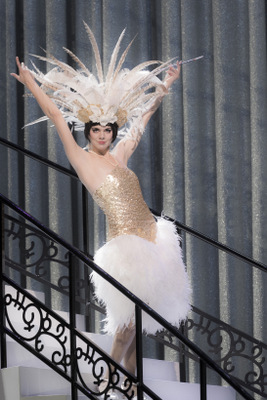
Ambur Braid has brought Adele back from the dead, banishing Florence once and for all because of the way the song is staged. It’s full of defiance and could almost be sub-titled Adele Occupies the Stairway (Wall Street being a bit too far away for her).
Richard Bradshaw (photo by Michael Cooper)
I am reminded of Richard Bradshaw’s stated objective, which was to offer the best theatre in Toronto. I’ve always found the goal impressive for its audacity. For much of the past decade he did just that in a very competitive theatre town (until his untimely death…). Fledermaus is in that tradition: tight, challenging, and easily the best thing I’ve seen on a stage in 2012, in a year that also included Einstein on the Beach.
I find myself unable to get certain moments out of my head.
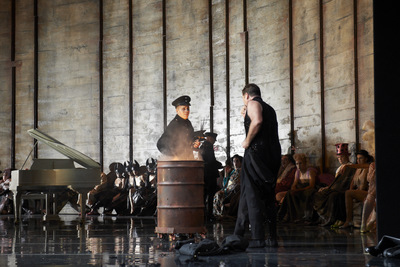
The fluidity of the sets ties in to the psychological theme underpinning Christopher Alden’s interpretation. Dr Falke is like Freud, his swinging pocket-watch a talisman of hypnosis and wish-fulfillment. When the walls and floor (designed by Allen Moyer) are ripped asunder as if by an earthquake, Rosalinde’s bedroom –where we begin the adventures—is problematized. Where are we? Inside Rosalinde’s head, I would suppose.
The locations in the story itself are wonderful departure points for Alden’s symbolism, considering that we go from bedroom –site of futility & frustration—to a wild party, and from there to a jail, and maybe more futility one might fear, especially because once in the jail we see Rosalinde’s bed again. Or did they make a break-through? If we don’t get a happily-ever-after I’m pleased precisely because it’s not a glibly superficial ending to this problematic tale. But Rosalinde and Eisenstein appear to have more clarity, more insight into themselves and one another. Falke/Freud couldn’t ask for any more than that, nor could a couple going for counselling.
I’m noticing this partly because I’ve been playing with a young child, noticing how we erect walls in our lives that children don’t perceive unless taught to do so. The limitations are in our own heads, as are the solutions to our self-imposed problems .
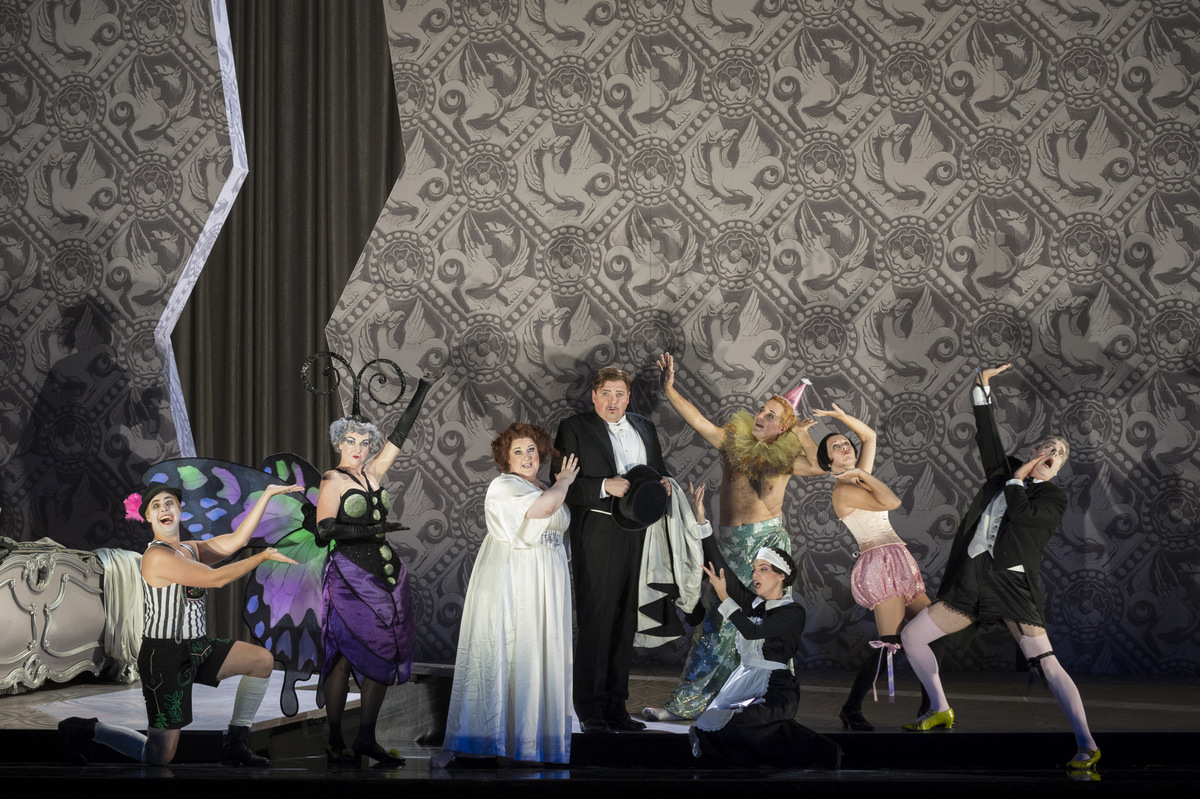
And identity is just as fluid in this world, among so many travesties. In addition to Orlofsky –the only one who’s actually scripted that way—Alden (aided by costume designer Constance Hoffman) populates the stage with a world of ambiguities. There’s Frank, played by James Westman, gradually showing us another side of himself at the party, in a lovely dress. So too with several nameless figures in the chorus. We’re in a place where you can be anything you dream of. It’s a place where –as Frank seems to demonstrate—one may not even know who one is until one lets loose: to find oneself. This is not in any way a portrayal that would ridicule travesty, but rather a place of great dignity, that seems to honour and respect difference & exploration. Dr Falke’s laboratory –that I alluded to in my earlier review—is a highly sympathetic place, and one that is empowering even if one of the individuals finding himself –Frosch—is himself a colossal threat to everyone else.
While I suspect some may not have liked the ending, I think it made great sense precisely because there is no neat answer. Frosch is the dark underside of human nature, and unlike the bat, is the real nightmare lurking in the dark. I was happy to laugh it all off at the end because there is no simple answer. Jan Pohl as Frosch includes a twitchy series of uncontrollable body parts in his movement vocabulary, echoing what we saw in Dr Strangelove (creepy! but funny).
I’m looking forward to seeing the other Adele in this production, namely Mireille Asselin, and having another listen to everyone else.
It’s counter-intuitive for Torontonians. We’ve become a bit shell-shocked with all the new condos. More condos must be bad.
Someone knocking down a theatre? surely a bad person.
The Mirvish Gehry project for King St in Toronto
If anyone in Toronto has the right to knock down a theatre to build a money-maker instead it’s David Mirvish. Mirvish is the son of Honest Ed Mirvish, the proprietor of Honest Ed’s, and the owner-rescuer of the Royal Alexandra and the Old Vic in London.
No, I don’t mean that after one generation of philanthropy we can now allow David to stomp on what his father has done and reap some profits. Nope. I think those who made knee-jerk reactions against David Mirvish and his announced plan to demolish the Princess of Wales Theatre should look again.
There are several reasons I’m inclined to trust David Mirvish.
First of all, I am no fan of the Princess of Wales Theatre. Like so many other big theatres in Toronto it’s a glorified Walmart, housing imported products from abroad. Okay, maybe the PoW is not a dollar store, but its wares are essentially outsourced culture. Where a Walmart is full of cheap goo-gahs made in China or India, a theatre like the PoW fill its seats employing foreign creative talent, occasionally putting a few of our actors to work. But I don’t like a theatre presenting American musicals produced abroad to compete with Canadian theatres, because I fear there are simply too few dollars from consumers to easily absorb this kind of import.
That Mirvish proposes to put up an art gallery on the site is a wonderful bonus, as it says in the project press release:
The new 60,000‐square‐foot Mirvish Collection will be a destination for viewing contemporary abstract art from the exemplary collection of Audrey and David Mirvish. The collection was built over 50 years, beginning when David Mirvish ran a globally recognized art gallery in Toronto from 1963‐1978. The Mirvish Collection comprises works by leading artists including Jack Bush, Anthony Caro, Helen Frankenthaler, Morris Louis, Robert Motherwell, Kenneth Noland, Jules Olitski, Larry Poons, David Smith and Frank Stella. The nonprofit Mirvish Collection, which will be free and open to the public, will present curated artist‐focused exhibitions that leverage the depth of the Mirvish holdings and will be available to other institutions. It will also host traveling exhibitions.
Wow…
Podium, Courtesy of Gehry International, Inc. (click to read feature on the development in an OCADU publication)
There’s so much to it, including The Gallery, those gorgeous buildings (that Gehry called “sculptures”), and “a new multi‐floor facility for the OCAD University Public Learning Centre for Visual Art, Curatorial Studies and Art History, including exhibition galleries, studios, seminar rooms, and a public lecture hall.”
I believe both Mirvish and Gehry are looking at their legacy, the way they’ll be remembered. This could be a bit like the Rockefeller Centre in Toronto, a natural nexus for the local culture.
I am a bit concerned about the infrastructure questions; do we have the wherewithal to take care of those additional thousands of people plunked down in the middle of the city? Are there schools for the children, adequate services for the new condo-dwellers who will arrive? I suppose there will have to be, won’t there (and people who know a whole lot more about such things will certainly think about it). These people will suddenly represent some of the missing bodies in the seats that kept the PoW from being profitable, so Mirvish will share his profits with his (former) competitors, although I suppose many will go straight to the Royal Alex.
I have a very good feeling about this, a project unlike anything I can recall in the GTA. We have had some lovely institutional construction recently (the AGO, the ROM, the RCM, several charming buildings at the U of T). But a big gorgeous building from an entrepreneur, expressing faith in the city without benefit of a fund-raising drive or government help? That’s unheard of.
No matter how well they may sing, Johann Strauss Jr’s operetta Die Fledermaus requires its singers to act. Although the music may be irresistible, I haven’t fully surrendered to any of the Fledermice I’ve seen. No wonder it was usually done in English in the past (if memory serves: as it was a long time ago), as the skills were probably beyond the casts assembled here.
It’s therefore a great pleasure to be able to proclaim the excellence of the Canadian Opera Company production that opened tonight at the Four Seasons Centre. It’s deep and it’s funny, it feels a bit decadent, and has undertones of madness & violence: just like our century. Director Christopher Alden rips off the surface of this comedy of class disparity, exposing the disturbing psychological underpinnings of that wild & wacky period between the rise of Freud on the one hand, and the onset of fascist madness on the other. While these images have been seen before, Alden, working with set designer Allen Moyer and Costume Designer Constance Hoffman, give us just enough gravitas to make these deeply satisfying laughs. This is the best production from the COC in awhile, and possibly the best thing I’ve ever seen on the Four Seasons Centre stage.
Moyer dangles the key image above the stage, namely a pocket watch. The watch signifies time of course, where the chronological framework of the story sets up a dreamlike assumption of new identities. We’ve seen this sort of thing in stories such as Cinderella, where the dream represents a kind of wish-fulfilment, ended again by the arbitrary passage of time.
The watch signifies at least two other things. Eisenstein carries a pocket watch, which plays an important part in the intrigue. But for me the most powerful –and additional –meaning Moyer and Alden find in the watch is the association to psychiatry.
Are there bats in heaven? there ought to be. Michael Schade as Gabriel von Eisenstein and Laura Tucker as Prince Orlofsky (Photo: Michael Cooper)
Alden says in his program note (although it’s beautifully clear in the staging) that “Dr Falke seems a lot like Dr Freud as he invites Rosalinde, Eisenstein, Adele and Frank to the dreamy libidinous party”. Falke wields his watch at key moments even though his control is as unnecessary as the superficial plot mechanisms Wagner uses of a love potion (Tristan und Isolde) or a curse (the Ring cycle). We are watching a story about dreams & wish-fulfillment, where the good doctor helps each of these people explore their hopes & expectations. No wonder, then, that Alden employs more bats than the Toronto Blue Jays, exploiting the overtones of something nightmarish and scary to probe deeply into this pleasure-seeking milieu.
But don’t get the wrong idea. I would say it’s Constance Hoffman’s costumes as much as Moyer’s sets that set up this story, pulling it all into a wonderful parable about repression and truth. Aided by the most impressive performance from the COC chorus since War & Peace, we visit a laboratory of dreams, where all our modern ills are grown for study or perhaps amusement. I hope I haven’t given too much away, because the show is full of surprises, a few of which I stumbled upon via social media.
There are several wonderful portrayals with two upon which the entire evening rests.
Ambur Braid as Adele as “Olga”, directed by Christopher Alden, set designed by Allen Moyer, costume designed by Constance Hoffman (Photo: Chris Hutcheson)
In the first scene Tamara Wilson & Ambur Braid are instantly real, their German dialogue compelling as we’re instantly plunged into their dramas. Although the stage will fill with personnel and imagery, we never really lose our interest in them. While there will be diversions throughout, it’s their show through and through.
I wasn’t at all surprised by the excellence Tamara Wilson brought to Rosalinde, a young woman with a wonderful voice that can be powerful or delicate, and with a genuine flair for comedy. But Wilson was matched by her maid Adele as portrayed by Ambur Braid. I’d been expecting to enjoy this portrayal, but was not prepared for how fully she inhabited the maid- who- becomes –Olga. While I’d seen the photos in the publicity, I was unprepared for the power (and comedy) of her transformation from the ugly duckling of Act I into the seductive Olga in Act II Her rendition of the laughing song had a delightfully angry edge to it.
Jan Pohl as Frosch and James Westman as Frank (photo Michael Cooper)
But the excellence doesn’t end there. Michael Schade brought his usual fluid German and effortless singing to Eisenstein. James Westman was a suitably embarrassed Frank, Peter Barrett, a constant presence (especially when he was hanging above the stage) as Dr Falke, and Jan Pohl, able to steal the show whenever he wanted to as Frosch the jailer; he was a troubling spectre of what was to come, giving the part a decidedly brown-shirted aura.
Laura Tucker’s Prince Orlofsky was among the most successful among several examples of performed travesty, on a stage full of ambiguities. Sets blended one room with the next, costumes were flipped off or pulled on at will, aiding Alden in creating the sense of subjectivity & dreams.
Conductor Johannes Debus & the COC Orchestra are their usual excellent selves, ably supporting a reading that never let the serious moments onstage hijack this joyful score. We never forget for a moment that this work is all about fun & enjoyment.
I am expecting Die Fledermaus to be a huge hit, and look forward to seeing it again with Mireille Asselin who assumes the role of Adele for half the remaining performances.
Arthur Wenk is so multi-faceted he’s what would once have been called a Renaissance Man. I wrote about Wenk earlier this year in connection with the sesquicentennial of the birth of Claude Debussy: because among so many other achievements, Wenk is an authority on Debussy. But that’s merely one feather in a cap full of achievements.
Art holds a doctorate in musicology from Cornell University, masters degrees in psychology, information science and music theory, and an honours degree in mathematics and music from Amherst College. As a musicologist, Dr. Wenk taught in universities in the United States and Canada, notably the University of Pittsburgh and Université Laval, where he published two books in French. As a mathematics teacher, Art taught calculus and Advanced Placement Statistics at St. Andrew’s College in Aurora, Ontario.
Currently Art pursues careers as Oakville psychotherapist with Wilson Counselling Associates, Toronto church musician (at Jubilee United Church), and mystery writer.
In an autumn when, in addition to all those activities and the occasional lecture, Wenk will be busy playing a lot of organ recitals, I ask him ten questions: five about himself and five about being an organ virtuoso.
1) Which of your parents do you resemble (what s your nationality / ethnic background)?
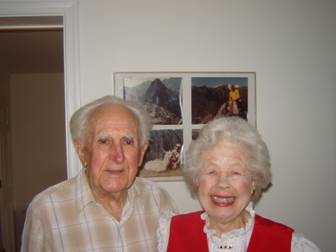
Arthur Wenk’s parents
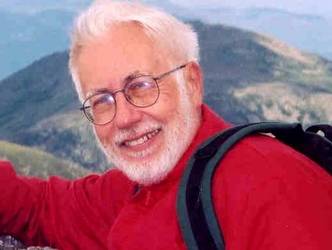
I’ll let you judge resemblances. My father’s family was German, my mother English. Dad compiled an extensive genealogy that included a witch burned in Salem, Massachusetts in the 17th century. The photos in the background show my Dad atop Machu Picchu and my mother with a llama in Peru. My photo was taken on Mount Washington in New Hampshire’s White Mountains.
Arthur Wenk
2) what is the BEST thing / worst thing about being an organist?
The worst thing about being an organist, throughout my career, has been competing with conversation during the Sunday morning prelude. I thought I’d have to suffer this annoyance indefinitely until, with the advent of a new organ at Jubilee, it occurred to us to do away with the prelude and replace it with a series of evening organ recitals. This has resulted in a joyous liberation!
3) who do you listen to or watch?
I regularly read The New Yorker magazine, watch “Big Bang Theory,” and listen to the novels of Carl Hiaasen on my iPod, along with podcasts of CBC “Ideas” and “Vinyl Café.” I see as many movies as I can, and have enjoyed lecturing on film at Jubilee for the past two seasons.
4) what ability or skill do you wish you had, that you don’t have?
I might have been unwilling to answer that question in the past, but now I’m thoroughly at ease with my limitations while continuing to admire the strengths and accomplishments of others who do things I couldn’t begin to do.
5) When you’re just relaxing (and not working) what is your favorite thing to do?
I read and read. When I came to Canada I thought I should become acquainted with the two dozen novels that any Canadian has read. It took some doing to put that list together, but it began a major project. I mean, how can you read just one book by Robertson Davies or Margaret Atwood? Harold Bloom’s The Western Canon set me off on another large-scale project. Between project books I read murder mysteries and work the New York Times crossword puzzles.
Five more about being an organ virtuoso
1) How does programming and playing the organ challenge you?
Edwin H Lemare
Since becoming inspired by the career of Edwin H. Lemare I have explored a new repertoire, including challenging organ works by Widor and Vierne and transcriptions of orchestral works, pieces I never would have learned as a church organist.
2) what do you love about playing the organ as a church musician and in concert?
My church organ playing now consists of a three-minute prelude, a two-minute offertory, and a three-minute postlude. Within that narrow compass I enjoy presenting a wide repertoire of what might be called sacred organ music. Our new Phoenix organ has led me into a new career as concert organist, and between Sunday evening recitals and Thursday noon recitals, I shall be playing fourteen different programs this season. I spent twenty years concertizing as a pianist, but playing organ recitals represents new territory.
3) Do you have a favourite piece for organ that you play or that you like to hear?
The new organ at Jubilee has led me to relearn pieces I haven’t touched for nearly fifty years: the Liszt “Ad nos” Fantasy and the Dupré Prelude and Fugue in G Minor. I have also enjoyed many hours trying to master the Final of the Vierne Symphony No.1. At Christmas I love returning to the Bach Canonic Variations on “Vom Himmel hoch” and his five-part fugue on the Magnificat.
Art also described his greatest triumph as an organist
When I was a graduate student at Cornell, Karel Husa, our composer and conductor, directed the Buffalo Symphony and the Cornell University Glee Club in a performance of the Janacek Glagolithic Mass, a work that includes two challenging organ solos. At the rehearsal, when it became evident that the local organist engaged for the performance simply wasn’t up to the job, Mr. Husa called me over and said, “Art, can you play this?” “Sure,” I said, with the arrogance of youth. The building contained a room with a practice organ, so I spent an hour learning the movements in question and that evening came out of the choir to perform them. For years I held the experience as a treasured memory. Now that I am older than the hapless local organist, unable to deal with the complex rhythms of a twentieth-century idiom, I realize that I could as easily be he, and no longer feel so smug.
4) How do you relate to the organ as a modern man?
I don’t. As I play virtually all of Bach’s organ music I relate to him as one might to a beloved uncle. Endeavouring to “channel” Edwin Lemare, I put myself back in the early years of the 20th century. And performing the virtuoso music of the French Romantics puts me in touch with a tradition before the invention of electronics and recordings. I like to imagine living in an era in which hearing music meant that someone was actually performing it at that moment.
5) Is there anyone out there who you particularly admire, and who has influenced your playing and your thinking about the organ?
Organist Charles Tournemire
My teacher at Cornell, Donald R. M. Patterson, acquainted me with French Baroque music, which I have only recently begun to explore at length thanks to the Phoenix instrument. Hugh Giles, who taught me Franck, explained that since he had studied with Tournemire who had studied with Franck, I was getting it “straight from the horse’s mouth, by way of the colt.” Vernon Gotwals put me in touch with Baroque performance practice. I greatly admire the performances of Gordon Turk, whose CDs have helped to guide me into new areas of repertoire.
Wenk also recounts his earliest memory of an organ.
The instrument at our church had three indicator lights: white, meaning that the blower was on; green, for the crescendo pedal; and red, for sforzando, or full organ. On Easter, at the last stanza of “Christ the Lord Is Risen Today,” all three lights would be on, a moment of surpassing musical excitement. Even today I feel an exhilaration at the sheer sonic power of full organ.
~~~~~
Arthur Wenk’s autumn is a busy one:
Concert dates:
“JOSEPH” Concerts (Jubilee Organ Sunday Evening Program Hour) (Sundays at 7:30 p.m.), free admission at Jubilee United Church:
Today I escaped from the urban rat race in the company of hundreds of fans of designer Kaffe Fassett. We’d gone where the GPS won’t go, somewhere in the vicinity of Brantford Ontario.
Fassett is the Mick Jagger of the quilting world. I suppose that’s a bit of an oxymoron, considering how quiet that community is. In other words, if anyone had thrown their underwear at the stage it would only happen because the owner wanted to show off a clever design.
But our quilt and knit rockstar is an extraordinarily humble man, genuinely interested in reaching out to his audience. It wasn’t just a book signing, not when the book is Fassett’s autobiography, My Life in Colour. I had no idea he’d be such a flamboyant speaker, holding us spellbound with tales of his fascinating life & times, his creativity, and several funny stories.
And for what it’s worth, the title of this piece is his mnemonic to explain how to pronounce his name.
Although I’d wondered at one point before I heard the fluidity of his delivery whether there were any ghost writers in the picture (and apparently there was one for one of Fassett’s earlier books), once i saw Fassett take the stage, as charismatic as a talk-show host, there were no doubts in my mind. The artist is also a wonderful writer.
Fassett is already known for his work in several disciplines: painting, knitting, fabric design, quilting, patchwork…. And while I would suggest he add writer to the list of occupations, he’s been doing this for quite some time in several books. The only thing different this time out is that we’re reading about Fassett’s life rather than his quilt patterns or his designs.
As the author himself puts it, My Life in Colour is a “narcissistic trip down memory lane”. He said that with a straight face, as the entire place roared with laughter.
In the book and in his talk we hear how Fassett became Fassett.
early life as a visual artist, working in an academic context, and then his gradual retreat from that context
decision to go to England
discovery of the wonderful colours found in the wool in a Scottish yarn store
learning how to knit from a woman he accosted on a train
He spoke eloquently to some of his key philosophical preoccupations, procedural preferences representing his beliefs as surely as they are etched in his work.
Fassett feels very strongly that colour is instinctive, and was revolted by the systematic approach to colour in school. As he put it, “when they brought out the colour wheel I said ‘get thee behind me’”. Fassett is strongly anti-formulaic, against the use of systems, and preferring instinct to a scientific approach to colour.
This meant that his approach to painting began as very understated, with so little colour early on that Fassett became frustrated. Or as he put it “beige clothes, beige skin, beige hair…” And he pulled a face, accompanied by a roar of laughter.
By going into yarns and knitting, where he could happily employ bold colours, it was as though a restraint had been removed from the artist & his work. Fassett would then take his bold designs to Vogue where they were quickly acclaimed as the most original approach to knitting that had been seen in a generation.
As Fassett acknowledges, his work was “wrong” in terms of following correct procedure. In this sense he’s a genuine crossover artist, bringing a fresh philosophy to a moribund discipline screaming for something new.
Or as he put it, “’It would look like cat vomit in the wind all higgledy piggledy.” Fassett showed us the gorgeous front, then the slightly messy back. Only a total purist would object, as –naturally—Vogue were thrilled and chose to highlight his work.
My Life in Colour tells us a great deal about Kaffe Fassett the man & his process, illuminated with illustrations and glosses worthy of a poem by William Blake. The book is as consistently beautiful as his work.
My Life in Colour is available in stores such as “Red Red Bobbin”.
Alex Pauk is an artistic activist, a composer, a conductor, driving force behind many commissions for other Canadian composers, and the Founding Music Director & Conductor of the Esprit Orchestra, an ensemble embarking upon their 30th Anniversary Season with a very special program on October 14th.
What better introduction than the statement by the jury of the Canada Council, upon Pauk’s selection for the 2007 Molson Prize…(?)
“A passionate and visionary conductor, artistic director, composer and educator, Alex Pauk has demonstrated remarkable skills in the arts of initiative, risk-taking and the building and promotion of a leading Canadian arts organization, Esprit Orchestra, which is recognized around the world. A fervent believer in the richness and vitality of Canadian new music, he is a cutting-edge leader in the cultivation and presentation of contemporary music, in Canada and abroad. His true brilliance has emerged in the way that he has introduced new audiences – including young people and more traditional audiences for orchestral music – to the joys of exploring uncharted terrain, both musically and in the new and unusual venues where he has set his performances. Alex Pauk is a true champion of new music who continues to introduce Canadian and international composers to the world.”
I ask Pauk 10 questions: five about himself and five about leading Esprit into this special season.
1) Which of your parents do you resemble (what’s your nationality / ethnic background)?
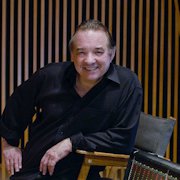
Alex Pauk
I don’t think I resemble one of my parents more than the other but rather, have qualities passed on to me from both of them equally that affect how I do things in both personal and professional situations. My mother’s steadfast approach and stamina in getting things done raising a family of five kids under all kinds of circumstances, was an example to me in how to persevere in building the various new music groups I’ve been involved with – especially The Esprit Orchestra. Through his sense of humor and his practicality, my father showed me a lot about relating to people and realizing dreams through realistic organizational approaches. Three of my grandparents were Ukrainian and one grandfather (on my mother’s side) was Polish. Both of my parents were born in Canada and I was born in Toronto.
2) what is the BEST thing / worst thing about being a conductor interpreting modern compositions?
The best thing about being a conductor of modern compositions is that you become completely engrossed in the music and what you are doing to successfully bring performances to their optimal levels of quality. This is quite different from relying on the comfortable, sure knowledge of performing well-known classical repertoire even though this is also rewarding.
It’s also a wonderful experience working with composers to bring their new pieces to the public for the first time. There is truly an electricity, tension and excitement in trying to get things right at a premiere performance. It’s also always rewarding to get reactions from the composers and audiences when history is being made through a premiere. There’s a wonderful feeling in knowing that some kind of ongoing development of music is taking place through your hands and thoughts.
Perhaps one of the worst things about being a music director for new music is worrying about the technical, administrative and scheduling details involved – will the players’ parts for a brand new piece arrive on time? – is all the right percussion equipment available in town? – can we get the musicians we need for enough rehearsal time when they are busy with other projects? Conductors of all kinds of music have administrative responsibilities but the situation is more intense with new music.
3) who do you listen to or watch?
My range of listening is really eclectic – everything from the playing of the jazz great Bill Evans to Lady Gaga, Ravel, Bach, Mozart, Berio, Ligeti and all the new composers surfacing around the world. I like to know about all the things that are exciting and influencing people. The same is true regarding my taste in movies.
I especially like Glenn Gould’s interpretation of Bach and was happy to attend the recent Glenn Gould conference at the University of Toronto where Gould’s impact on all kinds of arts and entertainment was explored.
4) what ability or skill do you wish you had, that you don’t have?
I wish I had more ability to memorize the music I conduct. But usually, the music I perform is quite complex rhythmically and in terms of orchestrations and doesn’t lend itself easily to being memorized. It would be generally hard for anyone without a photographic memory to memorize most new music. The fact that one doesn’t get to perform new works more than once or twice also limits one’s opportunities for memorizing through repeat performances.
5) When you’re just relaxing (and not working) what is your favourite thing to do?
When relaxing, I like going to movies of all kinds. At home, I’ve recently taken a strong interest in cooking as kind of useful hobby. This was inspired by the delight of sampling so many kinds of tapas on a recent holiday that my wife Alexina and I had in Spain. The problem is that I have to battle with Alexina to get control of the kitchen. She is a gourmet cook and questions me about what the heck I’m doing there. She and my kids usually do end up eating and liking what I make.
Esprit Orchestra: Alex Pauk, Music Director & Alexina Louie, Composer (Photography: bohuang.ca Hair and Makeup: Ivy Lam Hair and Makeup)
Five more concerning Pauk’s roles with Esprit Orchestra and their upcoming 30th anniversary season
1) How does your role as Music Director & Conductor of Esprit Orchestra challenge you?
My role as Music Director and Conductor of Esprit Orchestra provides the challenge of continually coming up with ever more interesting programmes but keeping them affordable from a budgeting point of view. In recent years, I’ve been able to increase the number of musicians I’ve had on stage and this has enabled me to explore a wider range of repertoire.
But a large orchestra is very difficult to maintain financially. With Esprit, there is a real balancing act going on in this regard. As for the conducting aspect, I’ve never programmed a concert that did not require full, intense attention to performing and interpreting the music. This is an exhilarating kind of challenge – often on the knife’s edge.
2) What do you love about Esprit Orchestra & your programme for the upcoming season?
I love the coming Esprit season because it is both a reflection on the solid work we’ve done in building relations with composers and audiences over a considerable period of time, as well as the fulfillment of my dream of gathering a large number of musicians together who know how to play new music well and want to do it. The composers commissioned for the season are those for whom Esprit has been important and who have likewise been important to Esprit. While there is a strong link to composers we’ve worked with in the past, we are also presenting the music of Zosha Di Castri, a Canadian rising star that will soon have attention around the world.
Composer R. Murrray Schafer (Ottawa Citizen photo by Patrick Doyle)
In terms of the musicians, I love the fact that at the start of each season I feel no trepidation about starting to rehearse again. I only feel support from them and know that there will be good vibes and a productive, rewarding artistic environment. This season I’ve been able to build much of the programming around the theme “The Tuning of the World” after the title of a book by R. Murray Schafer. While some of the pieces relate more directly to our acoustic or natural environment than others, I feel the title is apt in that all composers are “tuning the world”.
3) Do you have a favourite composition in the upcoming season of concerts?
I can’t say that I have a favorite composition in the lineup this season because I’ve programmed with the idea that I like each piece a lot. And each piece is there for a good reason in the flow of repertoire. Of course I don’t know what all the pieces are like because most of the commissioned works are still being written. That being said, I’ll give an idea of how my planning works using the first concert as an example. The Tuning of the World brings Murray Schafer’s thoughts about and concern for our sonic environment to the fore. In the new composition of his that we’ll premiere on October 14th, Wolf Returns, he brings the sound world of the wilderness to Koerner Hall (employing chanters from his Wolf Project in the piece) and contrasts the listening space of urban life with that of the lakes and forests where distant listening is possible. The programme continues with Xenakis’ For the Whales, not only suggesting the images of massive whale bodies and oceans in sound, but offering a plea to save them from harm by mankind. The imagined sounds of the Cosmos in Alexina Louie’s piece O Magnum Mysterium: In Memoriam Glenn Gould, blend with fragments of Bach and Mahler that she embedded in the work when she learned of Glenn Gould’s death 30 years ago. McPhee’s Tabuh-Tabuhan is a vivid portrayal of the life, culture and environment of Bali, drawing on pulsations and colors derived from the Balinese gamelan orchestra (made up of gongs and metal bar percussion instruments). John Rea’s musical depiction of the Icarus legend directly links us, psychologically and physically, to conditions in nature that we can or cannot use and control to varying degrees.
4) How do you relate to Esprit Orchestra as a modern man?
Esprit’s relevance to modern man has to do with keeping us abreast of recent trends in music and the relationships of that music to how we think about our present condition. By way of comparison, we don’t expect doctors to use medical equipment from the 1800s in their practices today, so why should we expect musicians to only perform music from the past? I enter into my work with Esprit with a sense of adventure and discovery and I want my artistic colleagues, as well as audiences, to share in that experience. While there is sometimes a degree of entertainment value in what we do, the idea of moving music forward in a pure sense is important. We aim to provide a sensual experience as well as an intellectual one – one that relates to life in a meaningful way today.
5) Is there anyone out there who you particularly admire, and who has influenced you?
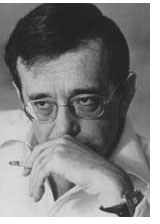
French composer Marius Constant (click picture for obituary)
I had a mentor, the conductor/composer Marius Constant, who passed away several years ago. His work both in Paris (where he lived) and around the world, inspired me and proved to me how important it was for me to maintain my interlocking interests of composing and conducting. These two areas inform one another. As a composer, I’m much better able to deal with composers and new music than I would be as a performer only. As a conductor I’m able to determine better what things are practical to write and what won’t work. My musical life is rather all encompassing – it is really more a lifestyle than a vocation. I learned how to operate in this realm by being around Constant a lot. His influence is still with me as I deal with an ever-expanding range of composers, musicians, technologies, and audience environments.
~~~~~
Esprit Orchestra begin their 30th Anniversary Season with a concert October 14th, “The Tuning of the World,” a spectacular program incorporating the launch of R Murray Schafer’s book My Life On Earth and Elsewhere. The concert includes works by Schafer, McPhee, Louie, Rea and Xenakis.
The Tuning of the World
Sunday, October 14, 2012
8:00 p.m. Concert / 7:00 p.m.
Book Launch and Pre-concert Talk
Koerner Hall / Royal Conservatory of Music
TELUS Centre for Performance and Learning
273 Bloor Street West, Toronto
For tickets (Regular: $55/Seniors: $50/Under 30: $20),
Please call (416) 408 0208 or visit performance.rcmusic.ca
Subscriptions Available. For more details: www.espritorchestra.com
When you think about it, the notion of a “radical cycle” is a bit of an oxymoron. Cycles are usually understood to be stable and repeating, which is hard to imagine if something is radical.
Radical Cycle is also the title of a CD from Dani & Sageev Oore, a pair of musical brothers. Dani plays the saxophone, Sageev plays the piano. The CD resembles a song cycle even though there are no vocals.
Listening to the CD the first time, I was more aware of the radical than the cyclical.
Saxophonist Dani Oore
Does repetition make the radical normative in some sense? Could one take something edgy, and by repeating it, get accustomed to it? Where the cycle is actually a cycle of musical compositions, and it’s on a CD that you can listen to repeatedly, there’s a possibility to test this proposition, investigating what happens when you repeat the radical.
Hm, that’s almost exactly what I asked myself listening to the CD.
First time? Not knowing where it was going there was a great deal of edginess, alright, because of the contrast between the tracks, unmitigated by any familiarity.
When I listened to the CD a second time, I started to perceive it as a cycle. I couldn’t tell if it had been conceived this way, or assembled from pre-existing elements. But with each listening I got accustomed to it, and its edginess became something I could live with, the contours of a shape i could fathom and even learn to like.
The compositions range across several styles, which is at least part of the “radical”. Classical songs are channelled in several shapes, sometimes with a jazzy flavour, sometimes klezmer. Dani’ s sax sometimes shows a breathy sound resembling a human voice, sometimes the tragic-comical klezmer sound of the clarinet, sometimes a more conventionally jazzy sound.
My favourite track is a curious fusion of two romantic compositions, namely Schumann’s “Träumerei” (from Kinderszenen) and Schubert’s song “Gretchen am Spinnrade.” The paraphrase of the two pieces combine elegantly, a natural kind of segue as if the day-dreams of the Schumann lead us to the troubled thoughts of Gretchen in the Schubert lied. I can’t really get across how deep it is, only that I didn’t expect it to work so well. While the piece was likely an outgrowth of their jazz work, it’s a curious fusion of styles, in its way the epitome of anything you’d find on this CD.
Speaking of cycles, it’s now a pleasure to keep the CD in circulation in the car playing it repeatedly.
Tuesday October 2nd, the Brothers Oore bring their unique fusion of styles to the Richard Bradshaw Amphitheatre, a free noon-hour concert.
How about Verdi or Wagner? That was one big question tonight. While some people chose to attend the opening of the COC’s Il trovatore, I opted for Wagner, namely Die Walküre. Oh dear, …I’m better with the food questions….
The concert performance in the intimate confines of College St United Church was an opportunity for some wonderful singing.
There was Michael Robert-Broder singing a very different sort of Hunding. In my experience the part is usually a brute, loud and scary. How atypical then to have a Hunding who was capable of being loud but also soft, precisely in tune, and full of subtlety. And since when does Sieglinde have an attractive husband? This was a fascinating & unexpected transgression.
Hunding was busy trying to scare his unexpected guest, namely the Siegmund of Lenard Whiting. In the concert this was a tuxedoed Siegmund, sung with wonderfully clear diction and remarkable accuracy. While Whiting might be a little light to sing Siegmund in a big venue with orchestra, he was just fine on this occasion, showing excellent stamina.
Wotan was the truly godlike presence of Andrew Tees, not only bringing power to the angry parts, gentle and musical pianissimos to the introspective parts in the second act, but also unexpected resourcefulness when confronted with a pianist re-writing chunks of Wagner. Wotans are not usually expected to improvise their role, but my hat’s off to Tees, who sang with bold conviction.
One of the most exciting moments of the night came during the Ride of the Valkyries, when Margo Levae, Naomi Eberhard, Christine Turingia, Karen Bojti, Erin Armstrong, Dolores Tjart, Monica Zerbe and Olga Tylman provided, first the happy diversion that opens the act, followed by their rescue of Sieglinde and the powerful confrontation with Wotan that follows.
Alla Ossipova as Fricka was progressively more powerful with every line sung, a goddess to match Tees’ god.
Acts Two and Three were sung without intermission, which must have been taxing for all of the performers. I was impressed that they were able to carry on so ably.
I suppose my biggest question was how to reconcile my Pollyanna principles (that if you can’t say anything nice, don’t say anything at all), with the desire to honour so many people who worked hard and did great work. This bizarre review is one solution to that question.
I hope that if this offends anyone, they’ll not be harsh in their criticism.
It’s almost 2013, the bi-centennial for both Giuseppe Verdi & Richard Wagner (that is, a pair of composers born in 1813).
Last night I watched the dress rehearsal of Il trovatore at the Canadian Opera Company’s Four Seasons Centre. Tonight I watched Stephen Fry’s very personal BBC documentary about his lifelong love affair with Richard Wagner. Saturday Sept 29th will be the opening night for Trovatore, but I’ll be seeing Opera By Request’s concert performance of Die Walküre instead (and catching Trovatore again, later on in the run).
I wonder if the next year will be one long series of forks in the road, as we’re asked to choose between these two giants…?
Stephen Fry
But tonight was about Fry & his trip through Wagner. Fry is a Jew, coming to terms with the beloved music from a loathed composer. It’s a mostly chronological study taking us through Wagner’s adult life including his Swiss exile, his trip to St Petersburg (an excuse to hear some of Gergiev’s Wagner), and eventual salvation via Ludwig II of Bavaria (taking us backstage at Bayreuth).
In the last portions of the roughly hour-long documentary, we’re confronted with the great cloud over Wagner, namely his relationship to Hitler, the Nazis and their ideologies. Fry muses that the person most hurt by Wagner’s anti-semitism is Wagner himself. The way Fry agonizes over it, it’s as if he wants to talk to Wagner, hoping to rescue him from his future condemnation in the hearts and minds of the world.
Fry is a genuine Wagner nerd, delighted to step across the threshold at the Festspielhaus in Bayreuth. The film has an odd balance, between his love of Wagner and his allegiance to his own people, particularly when speaking to a Holocaust survivor, a cellist who played in the Auschwitz orchestra.
Fry feels that our modern understanding of the composer has been distorted, by being forced to look at Wagner through the tiny lens that Hitler used, judging him by those same criteria, and in the process missing all sorts of other aspects.
Yet, as Fry says near the conclusion, “Hitler wasn’t the first nor the last dictator to exploit art. They always do so, from the Medicis to Stalin & Chairman Mao.”
Here’s the documentary (enjoy it while the link is still working)








 barczablog